Contact Us

Want to send us a quick message? Use the form on the right to contact us and we'll be in touch within 2 business days!

Please contact Audrey at info@amritayogawellness.com for general inquiries, software issues, in-studio and out-of-studio events and workshops, marketing, and community outreach and donations.

Please contact Heather at heather@amritayogawellness.com for private events, private yoga/pilates requests, and trainings.

1204 Frankford Avenue
North Philadelphia, PA, 19125
United States

(267) 928 3176

Amrita Yoga & Wellness offers a variety of Yoga traditions, Pilates Mat, Pilates Group Reformer, Tai Chi, and Massage services in a beautiful space. Our studio is located in Philadelphia, Pennsylvania.

Blog

Filtering by Category: Yoga

Aerial Yoga Poses Step by Step: Beginner's Guide

Heather Rice
TL;DR:

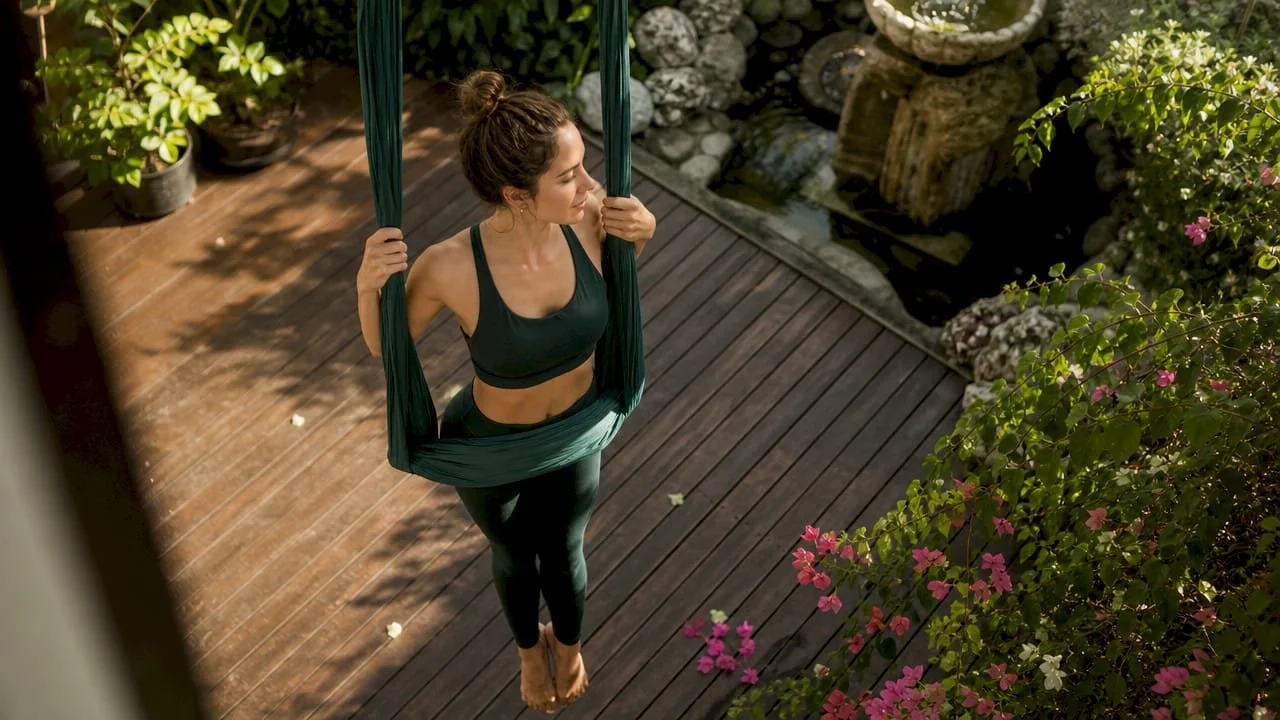
Aerial yoga uses a suspended hammock to support traditional poses and inversions for all fitness levels. Proper equipment setup, clothing, and gradual skill building are essential for safe practice and progress. Beginners should focus on foundational poses and patience before attempting advanced inversions to avoid injury and build confidence.

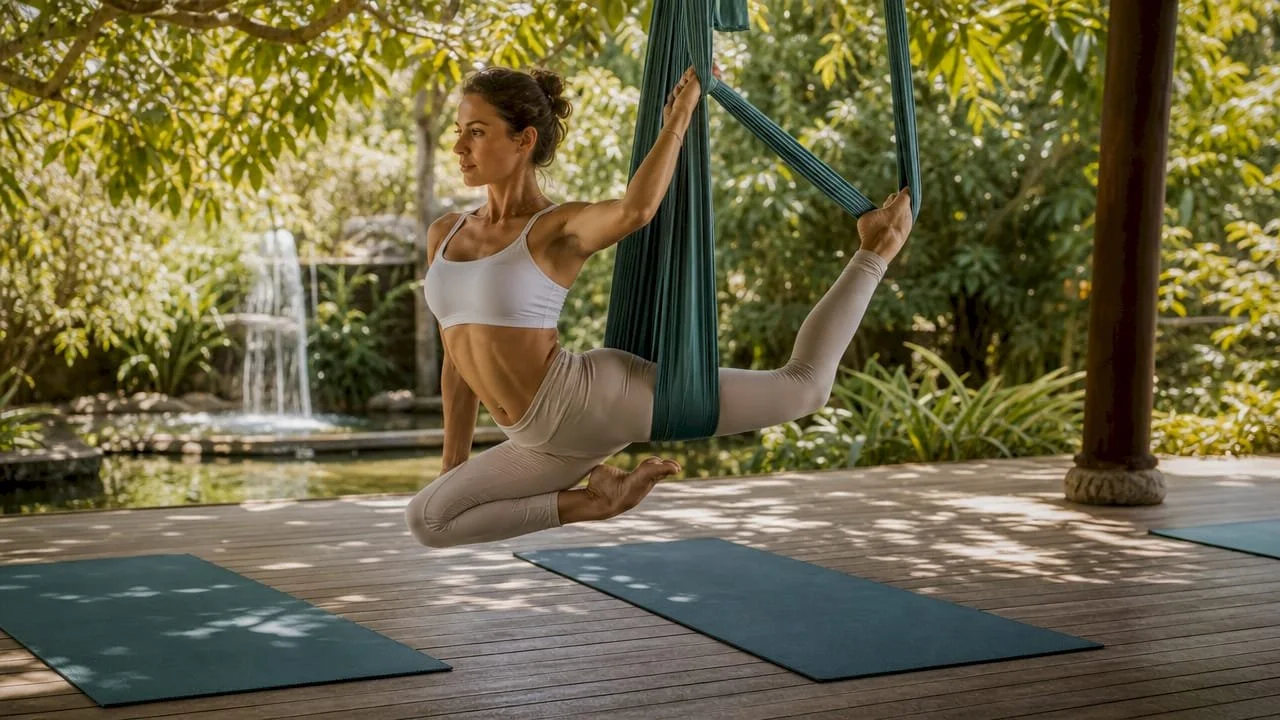
Aerial yoga is defined as a practice that uses a suspended silk hammock to support the body through traditional yoga poses, inversions, and strengthening movements. Learning aerial yoga poses step by step gives you a clear path from your first hammock sit to confident inversions, without guessing or risking injury. The hammock acts as both a prop and a support system, making poses accessible to adults at any fitness level. A typical aerial yoga class runs 60–75 minutes and moves through breathwork, standing sequences, and a cocooned savasana at the end. That structure exists for a reason: it builds your body and your confidence at the same pace.

What do you need before starting aerial yoga poses step by step?

Getting the equipment right is the single most important step before you attempt any pose. Skipping this part is where most beginners run into trouble, and it has nothing to do with flexibility.

Hammock setup and clearance

Your hammock suspension point must be rated for at least twice your body weight. That load factor accounts for dynamic movement, not just static hanging. You also need a minimum of 3–5 feet of clearance around the hammock on all sides. That space prevents collisions during wide poses and gives you room to exit safely if a position feels wrong.

What to wear and what to bring

Clothing choices affect both your safety and the life of the hammock fabric. Wear fitted clothing with no zippers, buttons, or jewelry. Loose fabric tangles in the silk during complex wraps, and metal hardware tears the weave over time. Fitted leggings and a snug long-sleeve top are the standard choice for most practitioners.

Item Requirement Why it matters
Suspension point Rated 2× body weight minimum Prevents structural failure during dynamic movement
Clearance space 3–5 feet on all sides Avoids collisions and allows safe pose exits
Clothing Fitted, no zippers or jewelry Protects hammock fabric and reduces tangling risk
Mat Placed below hammock Cushions landings and marks your safe zone
Bare feet or grip socks No hard-soled shoes Maintains contact and control on the fabric

Place a yoga mat directly below the hammock. It cushions any unexpected contact with the floor and gives you a visual reference for your center point.

Pro Tip: Remove rings, bracelets, and hair accessories before every session. Even small metal pieces can snag the silk and create a tear that weakens the fabric over time.

Step-by-step guide to beginner aerial yoga poses

These foundational poses build the grip strength, body awareness, and trust in the hammock that every intermediate move depends on. Work through them in order.
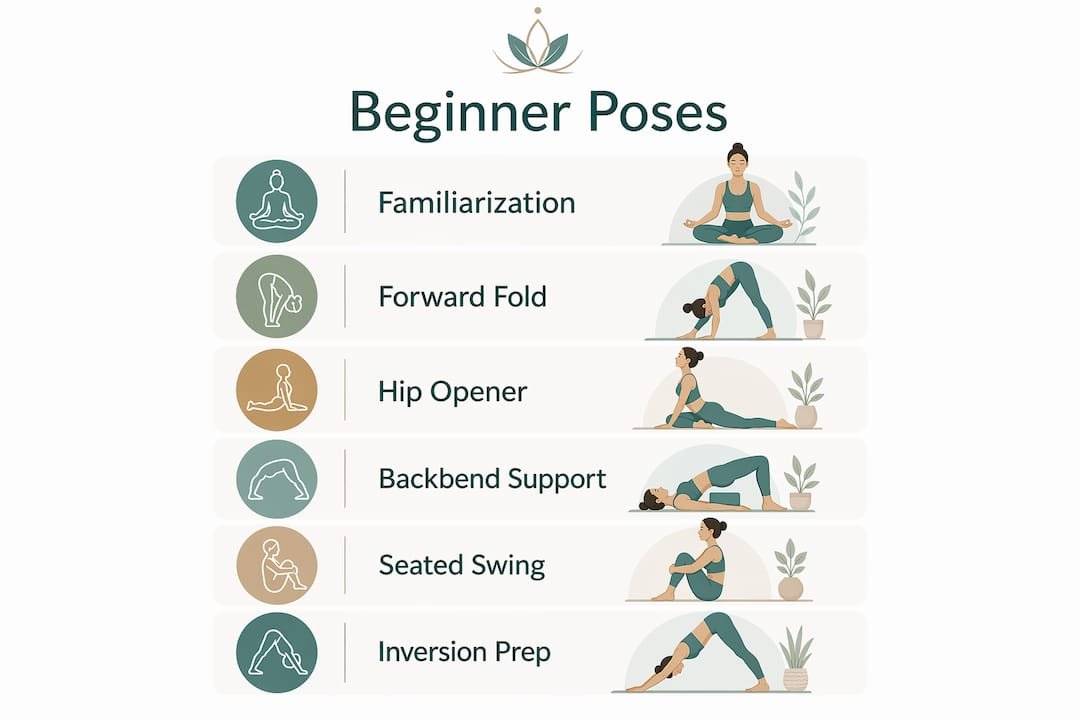
1. Hammock familiarization

Stand inside the hammock loop with the fabric resting across your hips at hip height. Place both hands on the fabric and shift your weight gently side to side. This is not a pose. It is a calibration step that tells your nervous system what the hammock feels like under load. Spend two to three minutes here before attempting anything else.
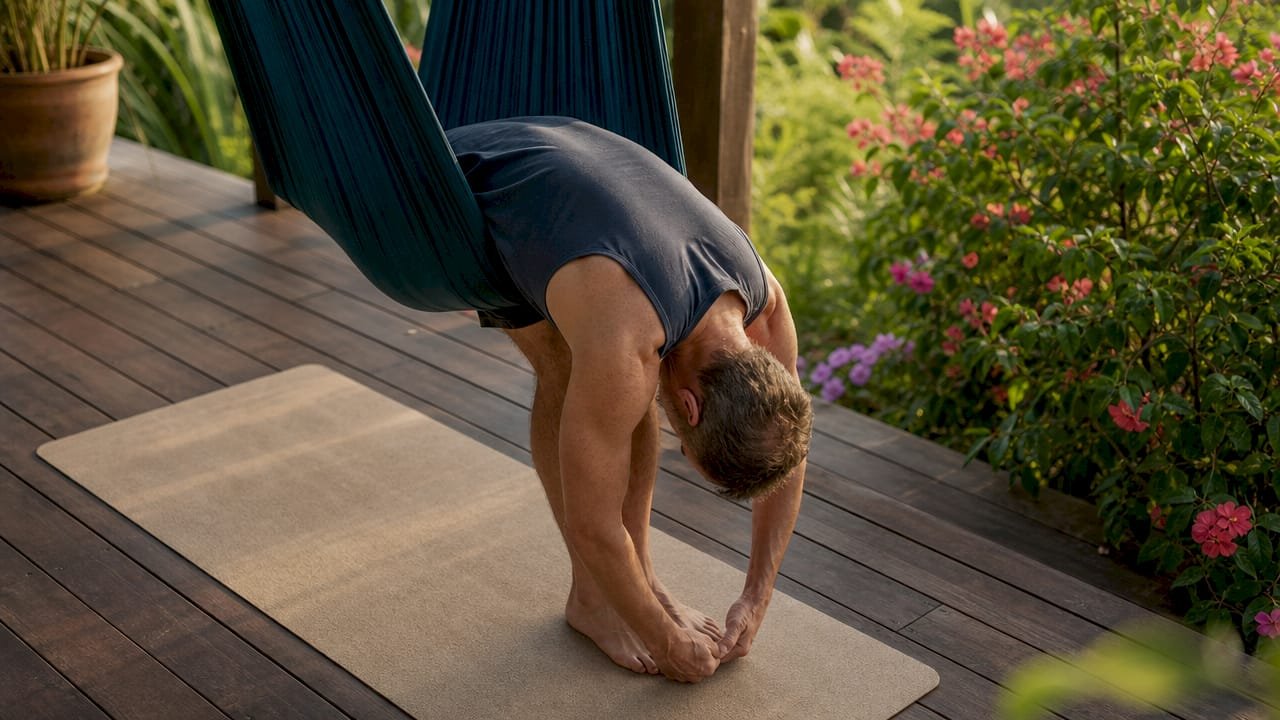
2. Supported forward fold

Stand with the hammock behind you at hip height. Lean your hips back into the fabric and hinge forward at the waist, letting your arms hang toward the floor. The hammock carries your hip weight while your spine decompresses. Hold for five slow breaths. This pose is one of the best aerial yoga strengthening moves for releasing lower back tension while teaching you to trust the fabric.

3. Hip opener pose

Sit in the hammock with the fabric supporting your sit bones. Open both knees out to the sides and press the soles of your feet together in a butterfly position. Let the hammock carry your full weight. Hold for five to eight breaths. This pose builds hip mobility that you will need for every seated and inverted position that follows.

4. Supported backbend

Stand facing away from the hammock with the fabric at mid-back height. Lean back slowly and let the silk support your spine as you open your chest toward the ceiling. Keep your feet flat on the floor and your knees slightly bent. This is a gentle introduction to spinal extension without any weight-bearing on the neck or shoulders.

5. Seated swing

Sit fully in the hammock with the fabric under your thighs and your hands gripping the sides. Push off gently and allow a slow, controlled swing. This step is purely about building comfort with motion. Many adults feel mild disorientation here. That response is normal and fades with repetition.

Pro Tip: Integrate breath with every pose from the start. Inhale as you enter a position, exhale as you settle into it. This habit makes the transition to inversions far smoother because your nervous system stays calm.

6. Gentle inversion preparation

From the seated position, grip the hammock firmly and slowly tilt your head back until it drops below your heart level. Do not go fully upside down yet. Hold for three breaths and return upright. This micro-inversion trains your inner ear and circulatory system to adjust gradually.

How do you progress to intermediate aerial yoga poses?

Intermediate aerial flying yoga poses require grip endurance, core control, and a clear understanding of how to exit each position safely. Build these qualities before attempting any full inversion.

Aerial downward-facing dog

  1. Stand facing the hammock with the fabric at hip height.

  2. Place both hands on the floor in front of you, shoulder-width apart.

  3. Step both feet back and rest the tops of your feet on the hammock fabric.

  4. Press your hips up and back to form an inverted V shape.

  5. Hold for five breaths, keeping your core engaged and your heels pressing toward the floor.

This pose builds shoulder stability and teaches you how the hammock behaves under foot pressure, which is a key skill for more complex aerial silks yoga positions.

Aerial low lunge

  1. Start in aerial downward-facing dog.

  2. Step your right foot forward between your hands.

  3. Let your left leg extend back with the hammock supporting your left shin.

  4. Lift your torso upright and raise both arms overhead.

  5. Hold for four breaths, then switch sides.

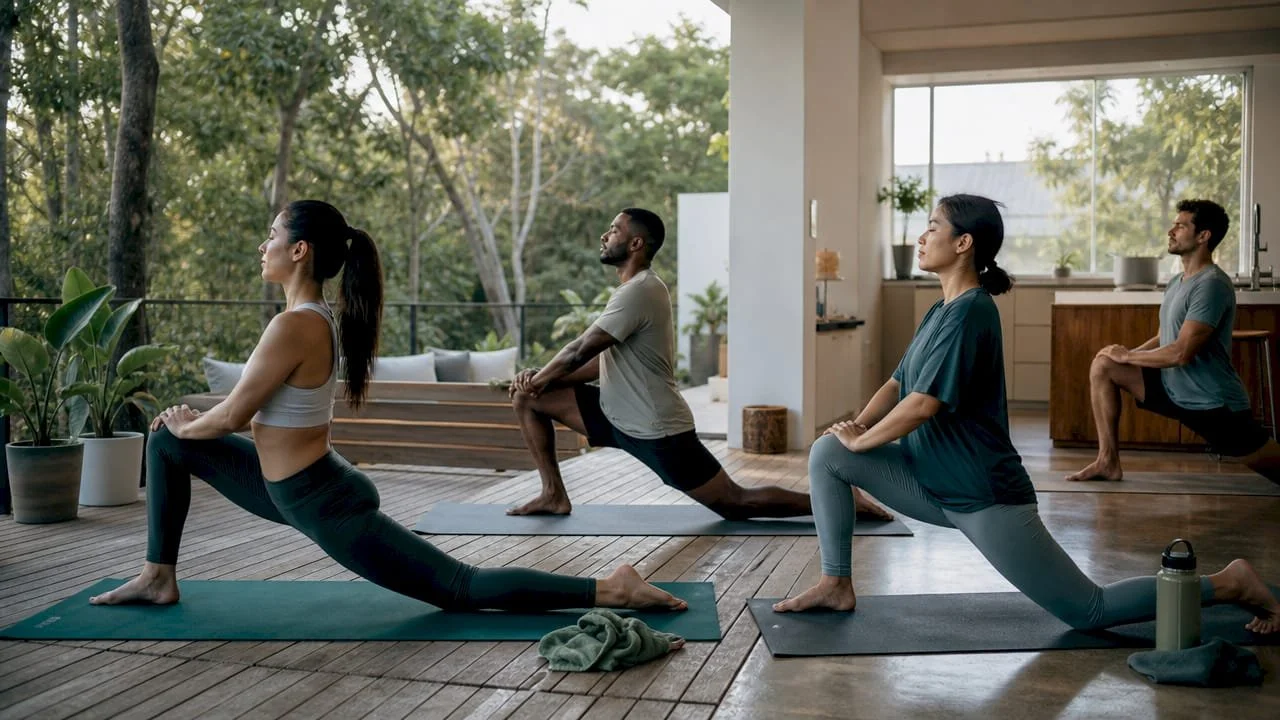
The hammock elevation in this lunge creates a deeper hip flexor stretch than a floor-based version. That depth is the point, but it also means you should move into it slowly.

Aerial chair pose

  1. Stand with your back to the hammock, fabric at mid-thigh height.

  2. Sit back into the hammock as if lowering into a chair.

  3. Keep your feet flat on the floor and your knees at a 90-degree angle.

  4. Extend both arms forward for balance.

  5. Hold for five breaths, then stand back up with control.

Lotus inversion preparation

The lotus inversion requires progressive mastery of grip, core strength, hip mobility, and trust in the fabric before you attempt the full position. Do not skip the preparation steps.

  • Complete at least four weeks of consistent beginner poses before attempting this.

  • Practice the gentle inversion preparation until three-breath holds feel effortless.

  • Build grip endurance with mini-movements: small controlled shifts in the hammock while hanging.

  • Work with an instructor for your first full inversion attempt.

Pro Tip: Grip strength and body control are the two most underestimated requirements in aerial fitness. Start with mini-movements and assisted holds to build endurance before attempting unsupported inversions.

Dizziness during early inversions is common. Keeping your head above your heart initially helps your inner ear adjust to spatial reorientation. Increase inversion depth only after that sensation disappears completely.

What mistakes do beginners make in aerial yoga poses?

Most errors in aerial yoga come from rushing, not from lack of ability. Identifying them early saves you weeks of frustration.

  • Incorrect grip: Wrapping fingers too loosely around the fabric reduces control. Grip the hammock with your full hand, not just your fingertips.

  • Shoulder creep: Letting shoulders rise toward your ears during holds compresses the neck and reduces stability. Keep shoulders actively drawn down and back.

  • Overstretching: The hammock amplifies range of motion. A stretch that feels mild can be deeper than it appears. Move slowly and stop at the first sign of sharp discomfort.

  • Wrong clothing: Loose fabric or jewelry snags the silk and can cause sudden shifts in position. Fitted clothing is a safety requirement, not a style preference.

  • Ignoring dizziness: Pushing through inversion nausea does not build tolerance faster. It builds aversion. Exit the pose, sit upright, and wait for the sensation to pass before continuing.

  • Skipping savasana: The cocooned savasana at session end stabilizes the nervous system after inversions. Skipping it leaves your body in an activated state, which increases soreness and reduces recovery.

Aerial yoga rewards patience. Every practitioner who rushes past the foundations ends up returning to them. The ones who stay with the basics longest progress the fastest.

Exiting a challenging pose safely means reversing your entry steps in order. Never drop out of a position. Reverse it deliberately, one step at a time.

Key takeaways

Mastering aerial yoga poses step by step requires correct equipment setup, progressive skill building, and consistent attention to breath and body signals at every stage.

Point Details
Equipment comes first Suspension points must be rated for at least twice your body weight before any practice begins.
Clothing affects safety Fitted garments with no zippers or jewelry protect both you and the hammock fabric.
Build in sequence Complete beginner poses for at least four weeks before attempting intermediate inversions.
Manage inversion nausea Keep your head above your heart in early sessions to let your inner ear adjust gradually.
Never skip savasana Five to ten minutes of cocooned relaxation after inversions stabilizes the nervous system and aids recovery.

Why I think most people approach aerial yoga backwards

Most adults who come to aerial yoga want to be upside down within the first session. That impulse is understandable. The inversions look like the whole point. But the hammock is a playful partner, not a shortcut. The people who treat it that way, who spend their first few sessions just getting comfortable with the fabric's weight and movement, end up with far better inversions than those who force it.

Strength gains in aerial yoga are cumulative. Rushing to advanced poses without mastering the foundations risks injury and frustration. I have seen this pattern repeat consistently. The practitioner who spends three sessions on supported forward folds and hip openers builds the grip endurance and spatial awareness that makes a lotus inversion feel natural. The one who skips ahead spends those same three sessions recovering from a strained shoulder.

The mind-body connection that aerial yoga builds is also different from floor-based yoga. When you are partially suspended, your body cannot rely on ground feedback. Your proprioception, your sense of where your body is in space, has to sharpen quickly. That sharpening is one of the most underrated benefits of the practice. It carries over into every other physical activity you do.

My honest recommendation: treat the beginner sequence in this guide as a six-week program, not a checklist to complete in one session. Revisit the seated swing and gentle inversion prep every single session, even after you have moved on to intermediate work. Those two poses keep your nervous system calibrated and your confidence grounded.

— Juiced

Aerial yoga classes and wellness at Amritayogawellness

Amritayogawellness, the Philadelphia-based studio behind this guide, offers structured classes for adults at every level of aerial yoga fitness, from first-timers to practitioners ready to work on inversions with expert guidance.
Every class at Amritayogawellness includes safety instruction, proper hammock setup guidance, and instructor-led progressions so you never have to guess your next step. For adults looking to complement their physical practice with deeper wellness work, the studio also offers tarot readings as part of its broader approach to personal growth and self-care. Whether you are stepping into a hammock for the first time or refining your intermediate poses, Amritayogawellness gives you the structure and community to make it stick.

FAQ

What is aerial yoga?

Aerial yoga is a practice that uses a suspended silk hammock to support the body through yoga poses, inversions, and strengthening movements. It combines traditional yoga alignment with the added challenge and support of working off the ground.

How long does a typical aerial yoga session last?

A standard aerial yoga class runs 60–75 minutes, including breathwork, active poses, and a 5–10 minute cocooned savasana at the end.

Is aerial yoga safe for complete beginners?

Aerial yoga is safe for beginners when the hammock is properly installed and poses are learned in sequence. Starting with easy aerial yoga poses and building gradually is the key to avoiding injury.

Why do I feel dizzy during aerial yoga inversions?

Dizziness during inversions is a normal inner ear response to spatial reorientation. Keeping your head above your heart in early sessions and increasing inversion depth gradually resolves the sensation for most practitioners.

What should I wear to an aerial yoga class?

Wear fitted clothing with no zippers, buttons, or jewelry. Loose fabric and metal hardware snag the silk hammock and can cause sudden shifts in position during poses.
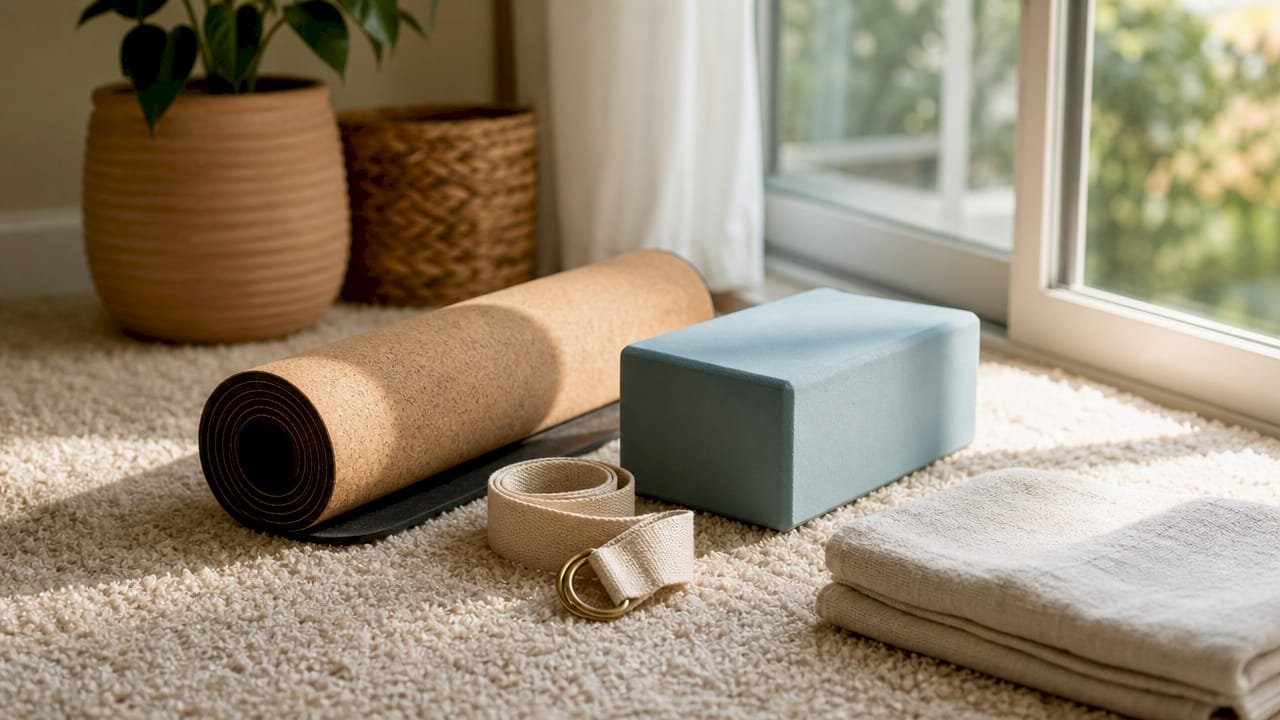
Recommended

Yoga Set for Beginners: Build Your Practice Right

Heather Rice

TL;DR:

A beginner yoga set includes a mat, a yoga block, and a strap to support comfort and stability. Choosing eco-friendly materials like natural rubber or TPE provides better grip and safety, while a 4-5mm thick mat balances joint support and ground feel. Proper care and gradual prop addition help build confidence, with a quality mat being the most important investment.

A yoga set for beginners is a curated collection of gear designed to give new practitioners the comfort, stability, and physical support they need to build a consistent practice. The right beginner yoga kit removes the guesswork from your first sessions and lets you focus on learning poses, not managing discomfort. Brands like Manduka, Gaiam, and JadeYoga have built entire product lines around this need. Choosing well from the start protects your joints, builds confidence, and sets the tone for a practice that actually sticks.

What are the essential components of a yoga set for beginners?

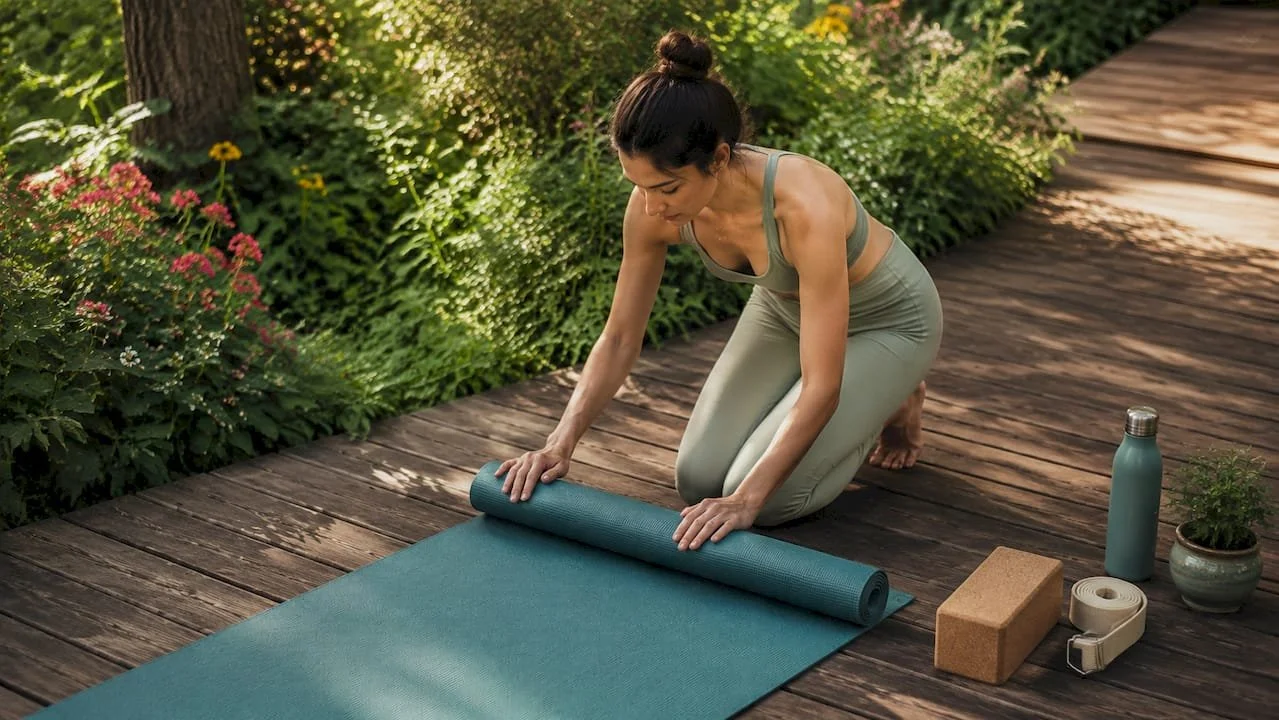
A complete yoga starter set contains three core items: a mat, at least one block, and a strap. Standard beginner kits include a yoga mat in the 4–6mm thickness range, a foam or cork yoga block, and a 6-foot yoga strap. Each item solves a specific problem that new practitioners face in their first weeks.

The yoga mat is your foundation. It provides grip, cushioning, and a defined personal space during class. Without adequate grip, you spend mental energy preventing slips instead of focusing on alignment.

Yoga blocks close the gap between your body and the floor. If you cannot reach the ground in a standing forward fold, a block brings the floor to you. This keeps your spine long and your joints safe. Foam blocks are lighter and more affordable; cork blocks are firmer and more durable.

The yoga strap extends your reach. Yoga straps double as flexibility tools and carrying slings, making them one of the most versatile props in any beginner yoga kit. A standard 6-foot strap lets you hold a hamstring stretch without rounding your back.

Optional additions worth considering:

  • A microfiber yoga towel for hot yoga or sweaty sessions

  • A foam roller for post-practice muscle recovery

  • A resistance band for hip and shoulder mobility work

  • A yoga mat bag or sling for easy transport

Pro Tip: Start with a mat, one block, and a strap. Add extras only after you have practiced consistently for four to six weeks and know what your body actually needs.

How to choose the best yoga mat for beginners

The mat is the single most important item in your beginner yoga kit. Every other prop is secondary. Getting the mat right means understanding four variables: material, thickness, surface texture, and construction type.

Material: natural rubber, TPE, and PVC compared

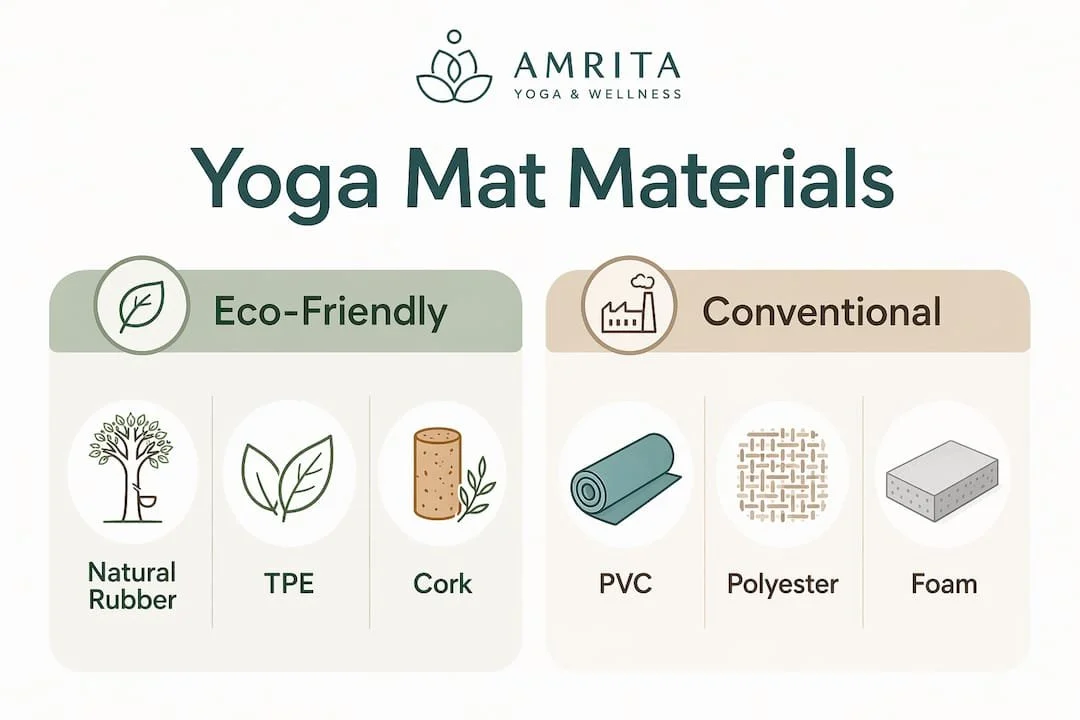
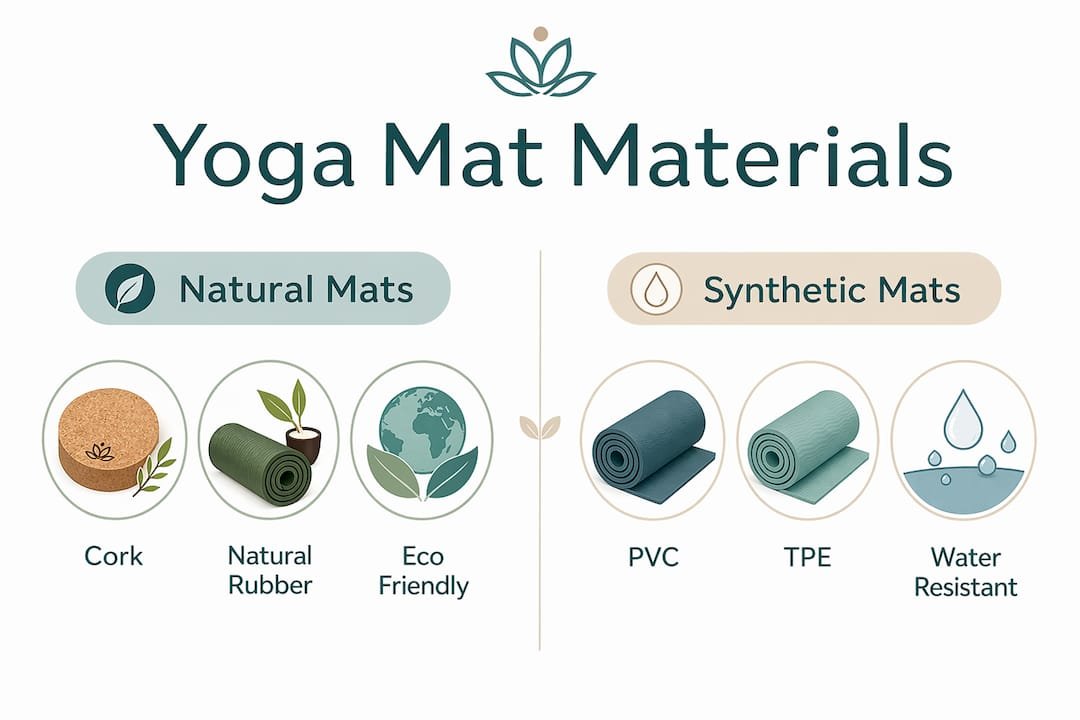
Material Grip Eco-Friendly Durability Best For
Natural rubber Excellent Yes High Studio and home practice
TPE Good Yes Medium Budget-conscious beginners
PVC Moderate No High Budget entry-level mats
Cork surface Excellent Yes Medium Hot yoga and sweaty practice

Eco-conscious materials like TPE and natural rubber are preferred over PVC because they offer better grip and eliminate harmful chemicals. Natural rubber mats from brands like Manduka and JadeYoga deliver reliable traction on both sides and hold up through years of daily use.

Thickness: finding the right balance

A 4–5mm mat thicknessis the sweet spot for most beginners, balancing joint cushioning with pose stability. Thicker mats at 6mm or above add comfort for sensitive knees but reduce your connection to the floor, which can make balance poses harder. KURMA recommends 4–5mm for new practitioners who want both support and ground feel.

Construction and hygiene

Closed-cell mat construction prevents sweat and bacteria from soaking into the material. Closed-cell mats are easier to clean, requiring only a wipe-down with a yoga mat spray or damp cloth after each session. Open-cell mats absorb moisture, which creates odor and bacteria buildup over time.

Alignment guides and reversible designs

Alignment stripes on beginner mats provide visual cues that help new practitioners position their hands and feet correctly. The Manduka Begin Mat uses this feature to build muscle memory from day one. Reversible mats offer two surface textures in one product, which adds value for beginners still figuring out their preferred grip level.

Pro Tip: If you practice at a studio like Amrita Yoga & Wellness in Philadelphia, check whether the studio provides mats before buying. You may want to test a few surfaces before committing to a purchase.

How to use and maintain your beginner yoga set

Proper care extends the life of your gear and keeps your practice hygienic. Most beginners skip this step and end up with a slippery, smelly mat within a few months.

  1. Clean your mat after every session. Spray it lightly with a yoga mat cleaner or a diluted mix of water and mild soap. Wipe with a soft cloth. Never soak the mat or submerge it in water.

  2. Store natural rubber mats away from sunlight. Natural rubber mats require storage away from sun and moisture to maintain their grip and structure. Roll them loosely and keep them in a cool, dry space.

  3. Use blocks under your hands, not just your knees. New practitioners often place blocks only under their knees in seated poses. Blocks are equally useful in standing poses like Triangle or Half Moon to keep the spine aligned.

  4. Use your strap before you feel you need it. Forcing a stretch without a strap strains the lower back and hamstrings. The strap lets you hold a position longer with correct form, which builds flexibility faster.

  5. Replace your mat when grip fails. A mat that slides during Downward Dog is a safety hazard. Most quality mats last two to three years with regular use and proper care.

"The props are not a sign that you are less advanced. They are the tools that let you practice correctly from the very first session." — Yoga instruction principle widely shared across Iyengar and Hatha traditions.

A common beginner mistake is rolling the mat up wet after a sweaty class. This traps moisture inside and degrades the material quickly. Always let the mat air dry flat before rolling it for storage.

How do popular beginner yoga kits compare in price and contents?

The market for yoga essentials for newbies ranges from simple three-piece sets under $30 to premium eco-friendly bundles that cost significantly more. Understanding what you get at each price point prevents overspending and under-equipping.

Basic beginner kits often cost $60–$70 for the mat alone, while comprehensive premium sets can reach $165 or more depending on materials and included accessories. That price gap reflects real differences in material quality, durability, and what is included.

Brands like Gaiam, JadeYoga, and Manduka offer kits focused on quality mats paired with essential props. Here is how the tiers break down:

  • Budget kits ($20–$45): Typically a PVC mat, one foam block, and a basic strap. Good for testing whether yoga sticks before investing more.

  • Mid-range kits ($50–$100): TPE or entry-level rubber mat, two blocks, a strap, and sometimes a carrying bag. Gaiam's Studio Select kit falls in this range.

  • Premium kits ($100–$165+): Natural rubber or cork mat, two cork blocks, a cotton strap, and extras like a towel or foam roller. Manduka Begin packages and eco-focused bundles like the Shakti Warrior Begin Within Bundle sit here.

The accessories that add real value are blocks and a strap. Extras like resistance bands and foam rollers are useful but not necessary in your first kit. A towel matters if you practice hot yoga. Everything else is optional until your practice demands it.

Pro Tip: Choosing the right mat matters more than buying a complete kit. A quality mat with a single block and strap outperforms a full budget kit every time.

Key takeaways

A quality mat paired with a block and strap gives beginners everything they need to practice safely, build confidence, and develop consistent alignment from day one.

Point Details
Core kit components Every beginner needs a mat, one block, and a 6-foot strap before anything else.
Mat thickness sweet spot A 4–5mm mat balances joint cushioning and pose stability for most new practitioners.
Material matters Natural rubber and TPE outperform PVC in grip, safety, and environmental impact.
Maintenance is non-negotiable Wipe your mat after every session and store natural rubber away from sunlight and moisture.
Prioritize mat quality A high-quality mat with basic props beats a full budget kit for long-term practice.

What I have learned after watching hundreds of beginners start their practice

Most new practitioners buy too much gear too soon. They show up with a seven-piece kit, two blocks, a bolster, and a strap they have never used, and then quit after six weeks because the practice felt complicated before it felt good.

The truth is that mat quality drives confidence more than any other factor in the first three months. A slip-resistant mat with alignment guides lets you focus on your breath and your body. A cheap mat that slides pulls your attention to the floor every thirty seconds.

I also think the eco-conscious material conversation is undersold. Beginners often dismiss natural rubber or TPE mats as a premium splurge. They are not. A non-toxic mat means you are pressing your face, hands, and bare skin against a surface that is not off-gassing chemicals during a heated class. That matters more than the price difference.

The one piece of advice I give every new practitioner: buy the best mat you can afford, add one block and a strap, and explore aerial yoga and stress relief or other complementary practices only after you have a solid foundation. Upgrade your props gradually as your practice deepens and your body tells you what it needs. The gear should serve the practice, not the other way around.

— Juiced

Yoga gear and wellness resources at Amrita Yoga & Wellness

Amritayogawellness offers beginner-friendly classes across yoga, pilates, barre, and tai chi at its Philadelphia studio, making it a strong home base for new practitioners building their first routine.

Whether you are selecting your first yoga mat for beginners or looking for guidance on which props suit your practice style, Amritayogawellness connects you with instructors who work with new students every day. The studio also offers wellness services that go beyond the mat. If you are curious about the mental and spiritual side of your practice, the tarot readings at Amrita Yoga & Wellness offer a unique way to deepen your self-awareness alongside your physical work.

FAQ

What does a yoga set for beginners include?

A standard beginner yoga set includes a mat in the 4–6mm thickness range, at least one foam or cork block, and a 6-foot yoga strap. Some kits add a towel, carrying bag, or resistance band depending on the price point.

What is the best mat thickness for a beginner?

A 4–5mm mat is the best choice for most beginners. It provides enough cushioning for joints while keeping you close enough to the floor for balance and stability in standing poses.

Are natural rubber mats worth the extra cost?

Natural rubber mats offer superior grip, non-toxic materials, and longer durability compared to PVC options. For beginners who plan to practice regularly, the investment pays off within the first year of use.

How often should I clean my yoga mat?

Clean your mat after every session with a light spray and a soft cloth. Never soak it or submerge it in water, and always let it air dry flat before rolling it up for storage.

Do I need a full kit or just a mat to start?

A quality mat, one block, and a strap cover everything a new practitioner needs. Full kits are convenient but not necessary. Prioritize mat quality first and add props as your practice develops.

Recommended

Infrared Heat Yoga: Benefits for Body and Mind

Heather Rice

TL;DR:

Infrared heat yoga heats the body directly using far-infrared panels at lower temperatures than traditional hot yoga. It improves muscle flexibility, circulation, and cardiovascular health while offering easier breathing and greater accessibility. Practicing two to three times a week supports flexibility, recovery, and nervous system regulation.

Infrared heat yoga is defined as a yoga practice performed in a studio heated by far-infrared panels rather than conventional forced-air systems. The benefits of infrared heat yoga go well beyond simple warmth: practitioners gain deeper muscle flexibility, improved circulation, and a more breathable environment than traditional hot yoga provides. Studios like ALIVE Studios and SaunaCloud have documented how far-infrared energy penetrates tissue directly, warming muscles from the inside out at room temperatures between 85–95°F. That combination of deep tissue warming and cooler air makes infrared yoga one of the most accessible heated practices available today.

What are the benefits of infrared heat yoga on the body?

Far-infrared wavelengths penetrate 1.5–3 inches into skin and muscle tissue. That depth of penetration is what separates infrared yoga from every other heated practice. The heat reaches the muscle before the air around you feels oppressive.

Collagen fibers become more pliableabove 104°F, which directly increases tissue extensibility during stretches. This means your hamstrings, hip flexors, and connective tissue respond to poses more readily than they would in a room-temperature class. The result is a safer, more effective stretch with less risk of overpulling cold tissue.

Vasodilation follows the tissue warming. Blood vessels widen, circulation increases, and oxygen delivery to working muscles improves. Infrared heat produces cardiovascular benefits comparable to moderate aerobic exercise by elevating heart rate and blood flow. A single infrared yoga session can deliver a meaningful cardiovascular load without the intensity of a run or spin class.

Your body also responds with thermoregulatory sweating. Sweating in infrared heated yoga mainly functions to cool the body. The detoxification claims you may have read about lack strong scientific support, so the real wins here are circulatory and musculoskeletal.

Key physical effects of infrared heat yoga include:

  • Deeper muscle warming at lower ambient temperatures than traditional hot yoga

  • Increased tissue extensibility from collagen pliability above 104°F

  • Vasodilation that improves blood flow and oxygen delivery

  • Cardiovascular conditioning comparable to moderate aerobic exercise

  • Preliminary evidence of reduced muscle soreness and joint health support with regular far-infrared exposure

Pro Tip: Some studios allow infrared heating to run at higher intensity at the start of class to pre-warm tissues. Arriving five minutes early and lying in savasana before class begins lets you absorb that initial heat dose and enter your first pose with warmer, more responsive muscles.

How does infrared yoga compare to traditional hot yoga?

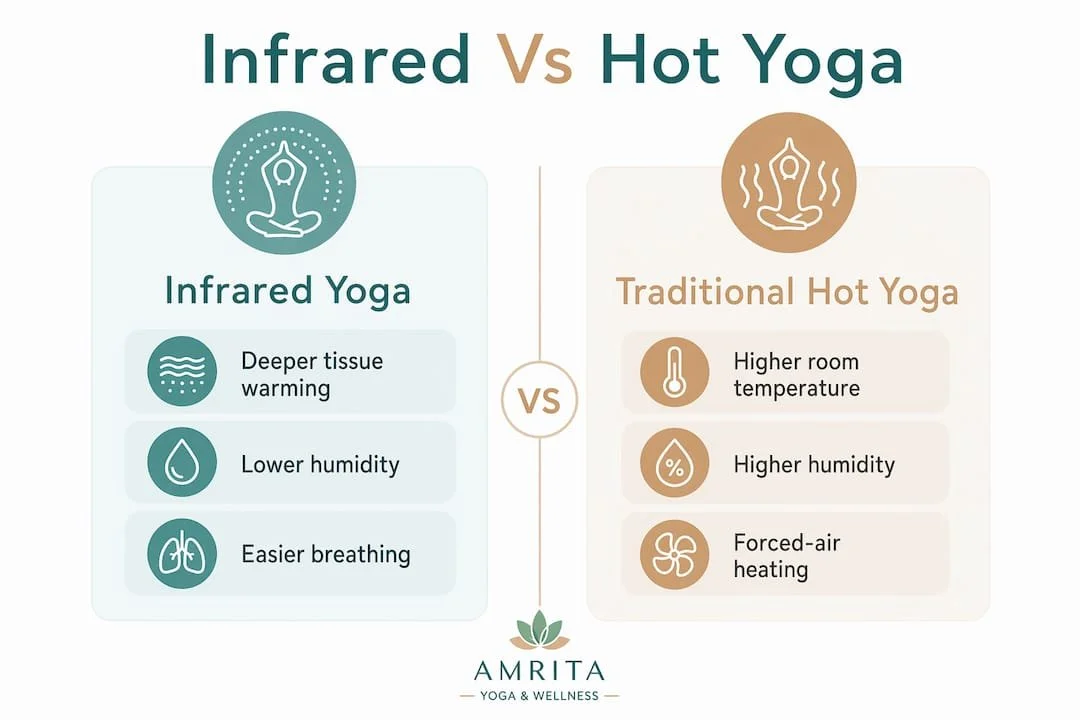
The core difference between infrared yoga and traditional hot yoga is the heat delivery method, not the yoga itself. Traditional hot yoga heats the ambient air to 95–105°F using forced-air systems or radiant heaters. Infrared yoga warms the body directly at a room temperature of 85–95°F. The postures are often identical. The experience is not.

Infrared heated yoga offers easier breathing due to lower humidity and cooler surrounding air. In a traditional Bikram or hot vinyasa class, the dense, humid air can make breathing feel labored from the first sun salutation. Infrared studios feel warmer in your muscles than in your lungs. That distinction matters for practitioners with respiratory sensitivity or those who have avoided hot yoga because the air felt suffocating.

Feature Infrared yoga Traditional hot yoga
Room temperature 85–95°F 95–105°F
Heat delivery Direct tissue penetration Heated ambient air
Humidity level Lower Higher
Breathing comfort Easier More labored
Tissue warming depth 1.5–3 inches Surface level
Cardiovascular load Moderate to high Moderate to high
Accessibility Higher for beginners Moderate

Both practices produce cardiovascular and flexibility benefits. The perceived intensity differs significantly. Practitioners who find traditional hot yoga overwhelming often report that infrared classes feel challenging but manageable. The heat delivery method accounts for most of that difference in experience.

Practical differences practitioners notice most:

  • Infrared studios feel warm without the wall of humid heat at the door

  • Sweat onset is gradual rather than immediate

  • Longer pose holds feel more sustainable due to easier breathing

  • Practitioners with mild heat sensitivity often tolerate infrared better

What mental health benefits does infrared heat yoga offer?

Infrared heat yoga shifts the nervous system away from fight-or-flight and toward rest-and-restore. The combination of gentle heat, deliberate breathwork, and physical movement creates conditions where the parasympathetic nervous system can take over. That shift is the mechanism behind the relaxation practitioners feel after class, not just during it.

Practitioners report improved relaxation, reduced anxiety, and clearer mental focus after infrared heated sessions. The breathability of infrared studios plays a direct role here. When breathing is easy, mindfulness practice deepens. You can focus on the pose and your breath rather than managing the sensation of hot, heavy air.

The cardiovascular effects of infrared heat also support mental well-being. Elevated heart rate and improved circulation during class produce effects similar to moderate aerobic exercise, which research consistently links to reduced anxiety and improved mood. You get a mental health benefit from the heat itself, layered on top of the psychological benefits of yoga practice.

For infrared yoga for stress relief, the combination is particularly effective:

  • Heat-induced relaxation of muscle tension reduces physical stress signals

  • Easier breathing supports longer, slower exhales that activate the vagus nerve

  • Cardiovascular effects mirror the mood benefits of aerobic exercise

  • The warm environment encourages practitioners to slow down and stay present

Pro Tip: End your infrared yoga session with at least five minutes in savasana with the heat still active. The combination of stillness and warmth deepens the parasympathetic response and extends the post-class calm significantly longer than a rushed exit.

One misconception worth addressing directly: sweating in infrared yoga does not detoxify the body in any clinically meaningful way. The liver and kidneys handle detoxification. The real mental health benefits come from nervous system regulation, cardiovascular effects, and the meditative quality of the practice itself.

Who should practice infrared heat yoga, and how to do it safely?

Infrared heat yoga suits adults seeking improved flexibility, active recovery, or a gentler entry into heated yoga. The lower ambient temperature and easier breathing make it more accessible than traditional hot yoga for beginners, older adults, and people returning from injury.

Safety considerations for infrared heat yoga mirror those of other heat therapies. Anyone with cardiovascular conditions, heat sensitivity, or pregnancy should consult a healthcare provider before attending. The heat load is real even if the room feels cooler than a traditional hot yoga studio.

Follow these steps to practice safely and get the most from each session:

  1. Hydrate before class. Drink at least 16 ounces of water in the two hours before your session. Infrared heat produces significant sweat output, and starting dehydrated accelerates fatigue.

  2. Acclimate gradually. Attend two or three classes before pushing intensity. Your body needs time to adapt to the thermoregulatory demands of infrared heat.

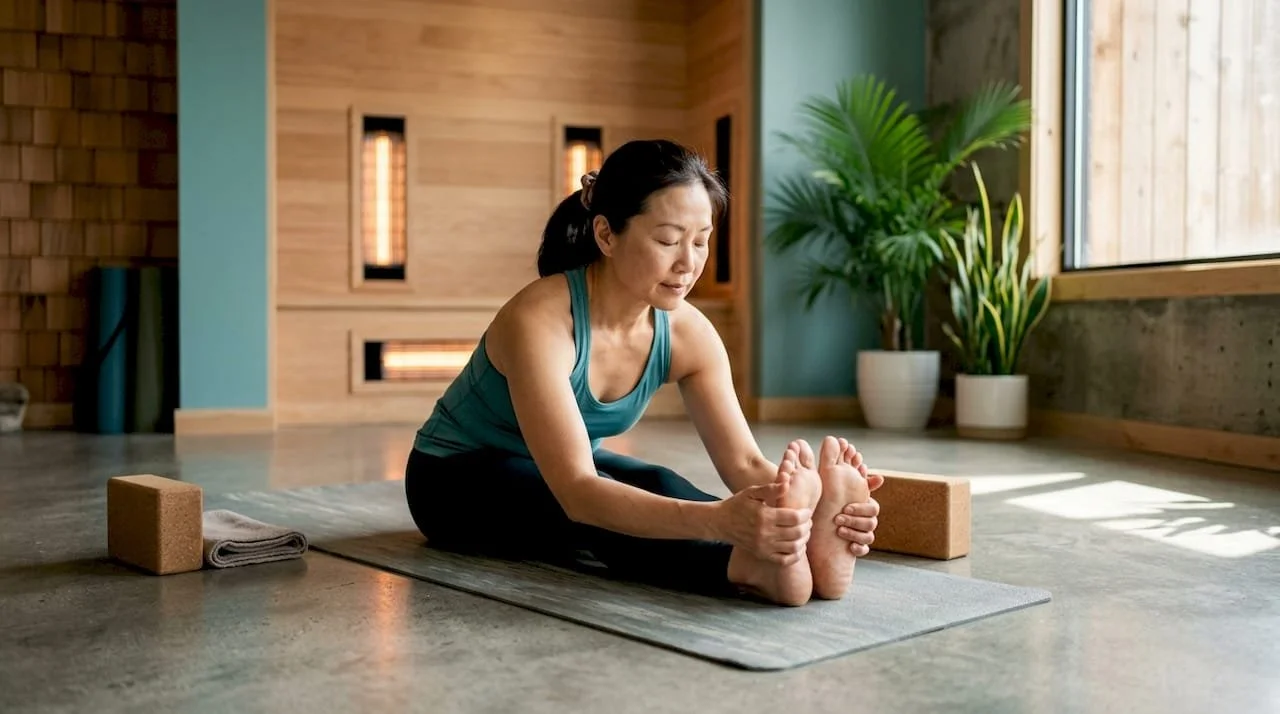
  3. Choose your mat placement intentionally. Heat exposure varies by distance from infrared panels. Placing your mat farther from panels reduces heat dose if you are new or sensitive. Moving closer increases it as you build tolerance.

  4. Bring a full water bottle and a towel. Sipping water throughout class prevents dehydration. A towel keeps your mat from becoming slippery as sweat builds.

  5. Listen to your body during class. Dizziness, nausea, or a sudden drop in energy are signals to rest in child's pose or step out briefly. These responses are not signs of weakness. They are your thermoregulatory system asking for a break.

  6. Rehydrate after class. Replace fluids and electrolytes within 30 minutes of finishing. Coconut water or an electrolyte drink works better than plain water after heavy sweat sessions.

Infrared yoga is not a replacement for medical treatment. For practitioners managing chronic pain, joint conditions, or stress-related illness, it works best as a complement to professional care, not a substitute.

Key Takeaways

Infrared heat yoga delivers deeper muscle warming, easier breathing, and meaningful cardiovascular benefits by using far-infrared energy to heat tissue directly rather than heating the surrounding air.

Point Details
Direct tissue warming Far-infrared penetrates 1.5–3 inches into muscle, improving flexibility and reducing injury risk.
Easier breathing Lower humidity and cooler air make infrared studios more accessible than traditional hot yoga rooms.
Cardiovascular benefit Infrared heat elevates heart rate and blood flow to a level comparable to moderate aerobic exercise.
Mental health support Nervous system regulation and cardiovascular effects reduce anxiety and improve post-class mental clarity.
Safe practice habits Hydration, gradual acclimation, and smart mat placement are the three non-negotiable safety steps.

What I've learned from practicing in the heat

Most people approach infrared yoga expecting it to feel like a milder version of hot yoga. It does not feel milder. It feels different. The heat sits inside your muscles rather than pressing against your face. Your first few classes, that distinction is disorienting in the best way. You feel warm and capable at the same time, which is not the usual hot yoga experience.

What I have observed over time is that the quality of heat matters more than the quantity. A well-designed infrared studio at 88°F produces a more productive practice than a poorly ventilated hot room at 100°F. The infrared yoga studio experience is genuinely different from anything forced-air heat produces, and that difference shows up in how your body feels the next morning.

The mistake most practitioners make is treating every infrared class as a maximum-effort session. The heat does real physiological work. Pairing two or three infrared classes per week with non-heated sessions gives your nervous system and connective tissue time to consolidate the gains. Recovery is where the benefits actually take hold.

Detox claims aside, the case for infrared yoga is strong and defensible: better circulation, more flexible tissue, a calmer nervous system, and a practice environment that does not punish you for breathing. That is a meaningful combination for anyone building a long-term wellness routine. Check out yoga essentials that support your heated practice, from grip towels to moisture-wicking mats.

— Juiced

Infrared yoga classes at Amrita Yoga & Wellness in Philadelphia

Amritayogawellness offers infrared yoga classes as part of a full wellness program at its Philadelphia studio, alongside pilates, barre, tai chi, and massage therapy. The studio's infrared classes are designed for practitioners at every level, from first-timers curious about heated yoga to experienced students seeking deeper recovery and stress relief.

Amritayogawellness also offers tarot readings as part of its broader wellness programming, giving practitioners a way to support mental and spiritual well-being alongside their physical practice. Whether you are new to infrared yoga or ready to build it into a regular routine, Amritayogawellness provides the classes, community, and guidance to make that happen. Visit amritayogawellness.com to browse the class schedule and sign up.

FAQ

What is infrared heat yoga?

Infrared heat yoga is a yoga practice performed in a studio heated by far-infrared panels that warm the body directly rather than heating the surrounding air. Room temperatures typically range from 85–95°F, lower than traditional hot yoga studios.

Is infrared yoga good for you?

Infrared yoga supports flexibility, circulation, cardiovascular health, and stress reduction. Safety considerations are similar to other heat therapies, so practitioners with cardiovascular conditions or heat sensitivity should consult a healthcare provider first.

How does infrared yoga differ from hot yoga?

Traditional hot yoga heats the ambient air to 95–105°F using forced-air systems, while infrared yoga warms body tissue directly at cooler room temperatures. Infrared studios have lower humidity, making breathing easier and the experience more accessible for many practitioners.

Does infrared yoga detox the body?

Sweating in infrared yoga primarily cools the body and does not detoxify it in any clinically supported way. The liver and kidneys handle detoxification. The credible benefits of infrared yoga are improved circulation, flexibility, and nervous system regulation.

How often should you practice infrared heat yoga?

Two to three infrared yoga sessions per week is a practical starting point for most adults. Pairing infrared classes with non-heated sessions gives connective tissue and the nervous system adequate recovery time between heat exposures.

Recommended

Best Type of Yoga for Beginners: A Practical Guide

Heather Rice

TL;DR:

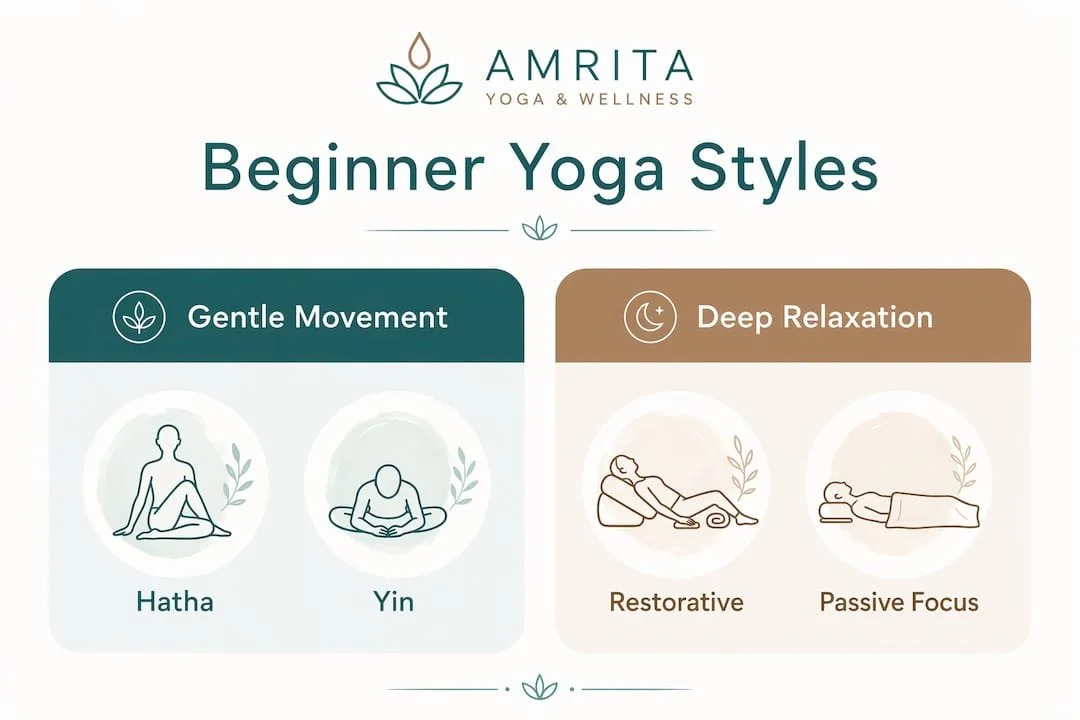
Gentle yoga styles like hatha, restorative, and yin are best for beginners because they focus on slow movement, breath awareness, and proper alignment. They help build strength, flexibility, and mental calm without pressure, making them accessible and safe. Choosing the right style depends on your goals, flexibility, and how your body feels each day.

Hatha, restorative, and yin yoga are the best types of yoga for beginners because they move slowly, emphasize breath awareness, and give you time to learn each pose without pressure. These gentle beginner yoga styles build strength, flexibility, and mental calm at the same time. The best yoga style for beginners is ultimately the one that fits your current fitness level, your goals, and how your body feels on any given day. This guide breaks down each style, compares them directly, and helps you decide where to start.

What is the best type of yoga for beginners?

The best type of yoga for beginners is a gentle style that holds poses long enough for you to feel them, breathe through them, and understand your body's response. Beginners prefer gentler styles that hold poses longer, which eases them into more active yoga without feeling lost or rushed. Fast-paced styles like power yoga or Ashtanga demand that you already know the poses. Starting there is like learning to drive on a highway.

The three styles most recommended for new practitioners are hatha, restorative, and yin yoga. Each one prioritizes breath coordination, body awareness, and gradual progress over athletic performance. Vinyasa yoga is sometimes listed as beginner-friendly, but its continuous flow format can feel overwhelming without a foundation in basic poses first.

What makes a yoga style beginner-friendly?

A yoga style is beginner-friendly when it slows down enough for you to actually learn what you are doing. Four specific characteristics define these styles:

  • Slow pace with longer holds. Holding a pose for several breaths lets you feel which muscles are working and where your alignment needs adjustment. This builds body awareness faster than moving through poses quickly.

  • Breath coordination. Every beginner-friendly style ties movement or stillness to the breath. This keeps your nervous system calm and teaches you to use breathing as a tool, not just a background function.

  • Prop use. Blocks, bolsters, straps, and blankets allow your body to reach positions it cannot yet access on its own. Restorative yoga in particular relies on props so you can relax fully into a pose without strain.

  • Alignment focus. Slower styles give instructors time to correct your form. Good alignment prevents injury and makes each pose more effective.

These features work together to build confidence. You leave class knowing what you did and why, rather than just surviving the hour.

Pro Tip: Before your first class, tell the instructor you are new. A good teacher will watch your alignment and offer modifications. This one step prevents most beginner injuries.

Hatha, restorative, and yin yoga: which one fits you?

These three styles share a slow pace but feel very different in practice. Understanding each one helps you pick the right starting point.

Hatha yoga

Hatha yogais the most widely recommended starting point for absolute beginners. Hatha focuses on movement with poses held long enough to learn muscle engagement without rushing. A typical hatha class moves through standing poses, seated stretches, and simple balances, pausing at each one to explain alignment and breath. You build real strength and flexibility because you spend enough time in each position to feel it working. Hatha is also where most yoga teachers learn to teach, so classes tend to be well-structured and clear.

Restorative yoga

Restorative yoga is the most physically passive of the three styles. Restorative yoga activates the parasympathetic nervous system, which is linked to lower blood pressure and heart rate. That means it is not just relaxing in a general sense. It produces measurable physical changes. A class typically involves five to seven poses, each held for five to twenty minutes, fully supported by props. Restorative yoga is the right choice if you are dealing with stress, recovering from illness, or simply need to slow down before you can build up.

Yin yoga

Yin yoga sits between hatha and restorative in terms of effort. Yin yoga holds poses for three to ten minutes, targeting connective tissue rather than muscle. Connective tissue, which includes fascia, ligaments, and joint capsules, responds to slow, sustained pressure rather than dynamic movement. This makes yin yoga particularly good for joint mobility and flexibility that other styles cannot reach. The long holds are meditative, which also trains mental focus and patience.

Side-by-side comparison

Style Pace Physical intensity Primary benefit Best for
Hatha Slow Low to moderate Strength, alignment, flexibility Most beginners
Restorative Very slow Very low Deep relaxation, stress relief High stress, recovery
Yin Slow Low Joint mobility, connective tissue Flexibility, mindfulness

Pro Tip: Try hatha first for two to three weeks. Once you know the basic poses by name and feel, yin and restorative will make much more sense because you will already understand the shapes your body is making.

How to choose the right yoga style for your needs

No single beginner yoga style fits everyone, so the selection process matters. Work through these four steps before signing up for a class.

  1. Assess your physical starting point. If you have tight hips, lower back pain, or limited flexibility, start with restorative or yin yoga. If you are reasonably mobile and want to build strength alongside flexibility, hatha is the better fit. If you have a specific injury, check with your doctor before starting any style.

  2. Clarify your primary goal. Stress relief and sleep improvement point toward restorative yoga. Building a physical practice with visible strength and flexibility gains points toward hatha. Improving joint range of motion and deepening body awareness points toward yin.

  3. Try at least two different styles. Experts advise beginners to explore different classes because pace and energy vary even within the same style depending on the teacher. A hatha class with one instructor can feel very different from hatha with another. Sampling two or three classes before committing gives you real data.

  4. Talk to the instructor before class. Tell them your experience level, any physical limitations, and what you hope to get from the practice. A qualified teacher will adjust their cues and offer modifications throughout the session. This conversation takes two minutes and changes the entire experience.

Once you find a style that feels right, starting yoga for stress relief and overall wellness becomes a natural, sustainable habit rather than a chore.

How to start yoga safely and build a lasting practice

Starting well matters more than starting fast. These principles keep beginners safe and help the practice stick.

  • Begin with breath, not poses. Beginners should start with breath-focused warm-ups and simple movements before attempting full poses. Even five minutes of conscious breathing before a session changes how your body responds to the practice.

  • Never force flexibility. Avoid forcing flexibility early and instead progress by holding poses with deep breath awareness. Pushing past your current range does not speed progress. It creates injury and sets you back weeks.

  • Practice briefly but consistently. A little yoga daily, even 10 minutes, beats infrequent long sessions for building confidence and physical adaptation. Ten minutes every day produces better results than a ninety-minute class once a week.

  • Include rest and stillness. Savasana, the final resting pose, is not optional. It is when your nervous system processes the session. Skipping it is like closing a document without saving.

  • Watch for signs a class fits you. You should leave feeling calmer and slightly more open in your body, not exhausted or sore. Mild muscle fatigue is normal. Sharp pain, dizziness, or feeling worse than when you arrived means the class is not the right match yet.

Pro Tip: If you practice at home, follow a structured sequence rather than random poses. A simple format of breath work, warm-up, three to five main poses, and a final rest gives your body a complete session in under twenty minutes.

A recommended progression for new practitioners is to start with foundational hatha poses and breath work, then move to flowing dynamic classes like vinyasa yoga once the basic holds feel comfortable. This gives you controlled movement instead of scrambling to keep up.

Key Takeaways

Hatha, restorative, and yin yoga are the most effective beginner yoga styles because they prioritize slow movement, breath awareness, and alignment over athletic performance.

Point Details
Best starting style Hatha yoga suits most beginners with its slow pace, foundational poses, and alignment focus.
Restorative for stress Restorative yoga activates the parasympathetic nervous system, lowering blood pressure and heart rate.
Yin for joint mobility Yin yoga holds poses for 3–10 minutes to target connective tissue and improve joint range of motion.
Try before committing Pace and energy vary by instructor, so sampling two or three classes gives you real information.
Consistency beats duration Ten minutes of daily practice builds confidence and physical adaptation faster than weekly long sessions.

What I have learned from watching beginners find their practice

Most beginners make the same mistake. They pick a style based on what looks impressive rather than what their body actually needs right now. They sign up for a fast-paced class because it seems more serious, then feel defeated when they cannot keep up. That experience convinces them yoga is not for them. It is not. It is just the wrong style at the wrong time.

The practitioners I have seen build the most consistent, rewarding practices almost always started with something gentle. They spent weeks in hatha or yin before they ever tried a flow class. By the time they got to faster styles, they already knew their body. They knew which hip was tighter, how their lower back responded to forward folds, and how to breathe when a pose got hard. That foundation made everything else easier.

Patience is not a personality trait in yoga. It is a skill you practice. The same way you hold a pose a little longer each week, you learn to stay with discomfort without reacting. That skill transfers directly to daily life, which is why so many people describe yoga as changing how they handle stress off the mat.

Find a teacher you trust. That matters more than the style. A great hatha teacher will serve you better than a mediocre yin teacher, even if yin is technically the better fit for your body. The relationship and the environment shape the practice as much as the poses do.

— Juiced

Beginner yoga classes at Amritayogawellness

Amritayogawellness, the Philadelphia-based yoga and wellness studio, offers beginner yoga classes across multiple styles, including hatha and restorative formats taught by experienced instructors who understand how to work with new practitioners. Every class is designed to meet you where you are, with modifications available so you never feel out of place.

Beyond yoga, Amritayogawellness also offers wellness services that complement a new practice. If you want to deepen your self-awareness alongside your physical work, the studio's tarot reading sessions offer a reflective, grounded way to explore your intentions and personal growth. Amritayogawellness brings together physical practice and broader wellness support under one roof in Philadelphia.

FAQ

What is the best yoga style for absolute beginners?

Hatha yoga is the most recommended starting point for absolute beginners because its slow pace and longer pose holds give you time to learn alignment and breath coordination without feeling rushed.

Is yin yoga good for beginners with no flexibility?

Yes. Yin yoga uses passive, supported holds lasting 3–10 minutes that gently work connective tissue, making it well-suited for beginners with limited flexibility who want gradual, sustainable improvement.

How often should a beginner practice yoga?

Short daily sessions produce better results than infrequent long ones. Even ten minutes of consistent daily practice builds confidence and physical adaptation more effectively than a single weekly class.

Can beginners do yoga at home?

Beginners can practice at home by starting with breath-focused warm-ups and simple poses, moving slowly without forcing flexibility. A structured sequence with a clear rest period at the end keeps home sessions safe and effective.

What is the difference between hatha and restorative yoga?

Hatha yoga builds strength and flexibility through active poses held for several breaths, while restorative yoga uses full prop support and very long holds to activate the parasympathetic nervous system and produce deep physical relaxation.

Recommended

20 Types of Yoga: Your Complete Style Guide for 2026

Heather Rice

TL;DR:

Yoga comprises more than 20 styles, each tailored to different physical, mental, and philosophical goals. Choosing a style that matches your objectives and personal preferences ensures better consistency and long-term benefits.

Yoga is not one practice. It is a family of more than 20 distinct types, each built around different physical demands, mental goals, and philosophical roots. Some styles move fast and build heat. Others hold still and release tension stored deep in connective tissue. Whether you are stepping onto a mat for the first time or looking to expand beyond your usual Vinyasa class, knowing the full range of yoga styles helps you practice smarter and progress faster. This guide covers the full spectrum, from the eight styles you will find in most Western studios to specialized practices most people have never tried.

1. What are the 8 core modern yoga styles?

Eight major stylesform the backbone of Western studio yoga: Hatha, Vinyasa, Ashtanga, Yin, Kundalini, Hot/Bikram, Restorative, and Power Yoga. Including therapeutic and hybrid approaches pushes the total well past 20 distinct modern styles. Each one targets a different combination of strength, flexibility, breath, and mindfulness.

Style Intensity Best For Class Length
Hatha Low to moderate Beginners, alignment 60–75 min
Vinyasa Moderate to high Cardio, flow 60–75 min
Ashtanga High Structure, strength 75–90 min
Yin Low Deep flexibility, recovery 60–75 min
Kundalini Moderate Breath, energy work 60–90 min
Hot/Bikram High Detox, endurance 60–90 min
Restorative Very low Stress relief, healing 60–75 min
Power Yoga High Strength, athleticism 60 min

Hatha is the most accessible entry point. Classes move slowly, hold poses longer, and focus on alignment. Vinyasa Yoga links breath to movement in a continuous flow, making it the most popular style in American studios today. Ashtanga follows a fixed sequence of poses practiced in the same order every session. That structure appeals to practitioners who want measurable progress.

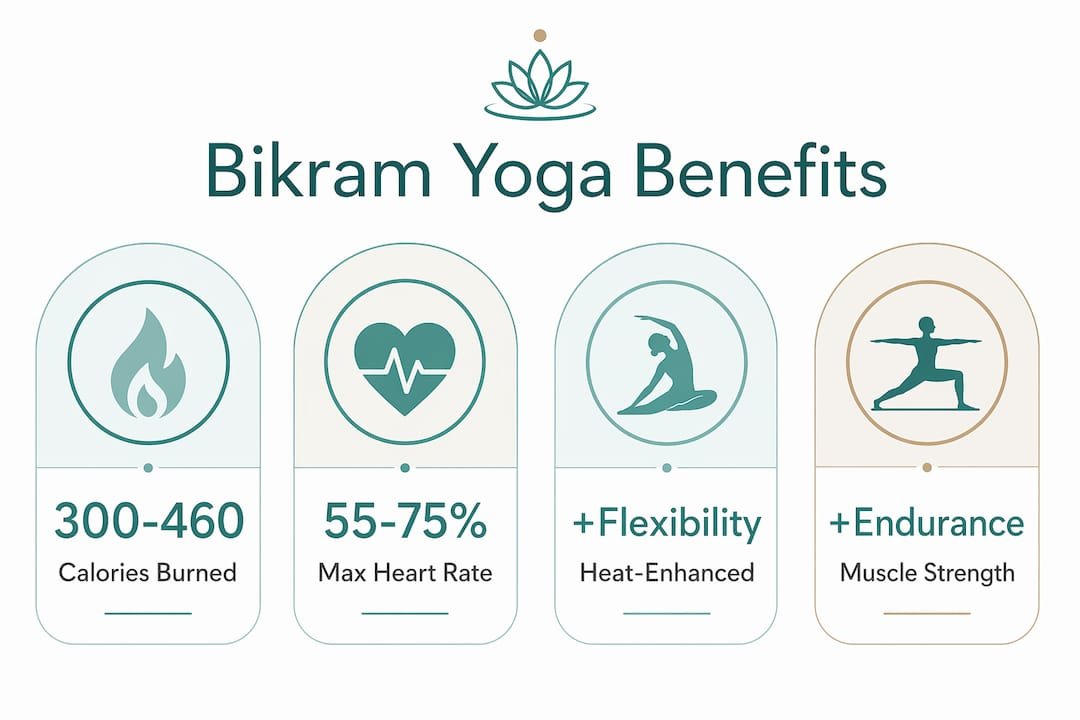
Yin Yoga targets fascia and connective tissue by holding poses for 3–5 minutes. Kundalini combines breathwork, chanting, and movement to work on energy and nervous system regulation. Hot Yoga (often called Bikram when it follows the original 26-pose sequence) is practiced in a room heated to around 105°F. Restorative Yoga uses props like bolsters and blankets to support the body in complete stillness. Power Yoga is a gym-friendly, strength-focused adaptation of Ashtanga.

Pro Tip: Read the class description, not just the style name. A "Flow" class at one studio may be beginner-friendly; at another, it may be an advanced cardio session.

2. How do traditional philosophical yoga paths shape modern practice?

Six core philosophical pathsunderpin every physical yoga style practiced today: Hatha, Raja, Karma, Bhakti, Jnana, and Tantra. These are not workout categories. They are complete systems for living, each with a different primary focus.

  • Hatha Yoga uses the body as the primary tool for spiritual development. Most physical studio classes trace their roots here.

  • Raja Yoga centers on meditation and mental discipline. It follows the eight-limbed path described by Patanjali in the Yoga Sutras.

  • Karma Yoga is the path of selfless action and service. It shows up in volunteer-based teaching and donation-model studios.

  • Bhakti Yoga is devotional practice, expressed through chanting, prayer, and ritual. Kundalini classes often carry strong Bhakti elements.

  • Jnana Yoga is the path of knowledge and self-inquiry. It is more philosophical study than physical movement.

  • Tantra Yoga works with energy, ritual, and the body as a sacred instrument. Modern interpretations vary widely from the classical tradition.

Understanding these paths explains why two classes with similar poses can feel completely different. A teacher trained in Bhakti traditions will open class with chanting. A Raja-focused teacher will prioritize seated meditation. The physical sequence is just one layer of what yoga is.

3. What are 12 additional specialized yoga styles worth knowing?

Beyond the eight studio staples, specialized styles serve specific populations and goals. These are not fringe practices. Many are growing fast in therapeutic and clinical settings.

  • Iyengar Yoga uses props extensively to achieve precise alignment. It is ideal for people recovering from injury or managing chronic pain.

  • Anusara Yoga blends alignment principles with heart-centered philosophy. Classes tend to be warm and community-focused.

  • Jivamukti Yoga integrates physical practice with music, scripture, and activism. It is popular in urban studios and appeals to practitioners who want yoga to connect to daily life.

  • Sivananda Yoga follows a fixed sequence of 12 poses and emphasizes breathwork, relaxation, and vegetarian diet as part of a complete lifestyle.

  • Chair Yoga adapts standard poses for seated practice. It serves older adults, office workers, and people with limited mobility.

  • Prenatal Yoga modifies poses for pregnant practitioners, focusing on pelvic floor strength, breath, and stress reduction.

  • Aerial Yoga uses a fabric hammock suspended from the ceiling to support inversions and deep stretches. It reduces joint compression during poses.
  • Acro Yoga combines yoga with acrobatics and partner work. It builds trust, communication, and core strength simultaneously.

  • Therapeutic Yoga is prescribed for specific health conditions, from anxiety to back pain. Sessions are often one-on-one and guided by a trained yoga therapy specialist.

  • Trauma-Informed Yoga adapts language, touch, and sequencing to support survivors of trauma. It is increasingly used in mental health settings.

  • Yoga Nidra is a guided meditation practice done lying down. It induces a state between waking and sleep, used for deep rest and stress recovery.

  • Laughter Yoga combines intentional laughter exercises with breath techniques. Research links it to reduced cortisol and improved mood.

Each of these styles fills a gap the eight core types do not cover. If you are pregnant, recovering from surgery, or working through anxiety, a specialized style will serve you better than a general studio class.

4. How to choose the right yoga style for your goals

No single best yoga style exists.The right choice depends on your primary goal, your current fitness level, and what you will actually enjoy enough to keep doing. Enjoyment is not a soft factor. It is the main driver of consistency, and consistency is what produces results.

Start by identifying your primary goal:

  1. Flexibility and mobility: Yin Yoga and Hatha Yoga are the strongest choices. Both hold poses long enough to work connective tissue, not just muscle.

  2. Strength and endurance: Power Yoga, Ashtanga, and Hot Yoga build functional strength through bodyweight resistance and sustained effort.

  3. Stress relief and recovery: Restorative Yoga and Yoga Nidra activate the parasympathetic nervous system. They are the most effective styles for nervous system reset.

  4. Mindfulness and focus: Kundalini and Raja-based practices prioritize breath and meditation over physical output.

  5. Community and spirituality: Jivamukti and Bhakti-influenced classes offer a social and devotional dimension that purely physical classes do not.

Beginners should prioritize pace and intensity over style names. A slow Hatha class is a better starting point than a fast Vinyasa, regardless of what the studio markets as beginner-friendly. Talk to the teacher before class. Ask about modifications and the expected pace.

Pro Tip: Try at least three different styles before committing to one. What feels wrong in week one often clicks by week three once your body adapts to the format.

5. Common misconceptions about yoga practice and flexibility

The biggest myth in yoga is that flexibility is a prerequisite. Flexibility is the outcome, not the entry requirement. Stiff people benefit more from yoga than flexible people, because they have more room to gain.

Flexibility improvement requiresnervous system engagement and sustained pose holds of 90 seconds or more. Muscle stretching alone does not remodel fascia. Breath control and controlled tension release are what allow connective tissue to adapt over time. A 30-second stretch at the end of a gym session does not accomplish this.

"Consistency beats intensity every time. Four short sessions a week will outperform one long session on the weekend, every single week." — Yoga for Flexibility research consensus

Beginners see measurable mobility gainsafter 2–4 weeks of consistent practice. Deeper pose gains become apparent at 6–8 weeks. That timeline requires regular attendance, not occasional drop-ins. Four sessions per week, each 15–30 minutes, produces more sustainable progress than one 90-minute class per week.

Other common misconceptions worth addressing:

  • Yoga is not only for young or already-fit people. Chair Yoga and Restorative Yoga are specifically designed for people with limited mobility or chronic conditions.

  • Yoga is not exclusively spiritual. Many practitioners use it purely as a physical training tool with no philosophical component.

  • Studio class names like "Flow," "Sculpt," or "Fusion" are often marketing terms for hybrid practices. They do not represent distinct yoga styles. Always read the full class description.

  • Rest weeks matter. A cycle of three weeks of practice followed by one lighter week supports nervous system adaptation and reduces injury risk.

Poses like Forward Fold, Low Lunge, Pigeon, Downward Dog, Butterfly, and spinal twists target the key flexibility areas of hamstrings, hips, calves, spine, and shoulders. These show up across multiple styles, which means you build flexibility regardless of which style you choose, as long as you practice consistently.

Key takeaways

The most effective yoga practice is the one you enjoy enough to repeat four times a week, starting with a style matched to your current fitness level and primary goal.

Point Details
More than 20 styles exist Eight core studio styles plus specialized and hybrid practices total well over 20 distinct types.
Match style to your goal Yin and Hatha build flexibility; Power and Ashtanga build strength; Restorative resets the nervous system.
Consistency beats intensity Four short sessions weekly produce more progress than one long, infrequent session.
Read descriptions, not labels Class names like "Flow" or "Sculpt" are marketing terms and may not reflect the actual content.
Flexibility takes 2–8 weeks Beginners see early gains at 2–4 weeks; deeper changes appear at 6–8 weeks of regular practice.

Amritayogawellness also offers tarot readings as a complementary wellness tool for practitioners who want to pair physical practice with personal reflection and insight. For a full overview of yoga styles for beginners and how to get started, visit the Amritayogawellness blog and class schedule at amritayogawellness.com.

FAQ

What are the most beginner-friendly yoga styles?

Hatha and Restorative Yoga are the most accessible styles for beginners. Both move at a pace that allows new practitioners to learn alignment and breath without feeling overwhelmed.

How long does it take to see flexibility gains from yoga?

Beginners typically see early mobility improvements after 2–4 weeks of consistent practice. Deeper flexibility gains become visible at 6–8 weeks.

Is there one best yoga style for everyone?

No single best style exists. The right choice depends on your goal, fitness level, and what you enjoy enough to practice consistently several times per week.

What is the difference between Hatha and Vinyasa yoga?

Hatha holds poses statically and focuses on alignment, while Vinyasa links poses together in a continuous, breath-driven flow. Hatha is slower; Vinyasa is more cardiovascular.

Are class names like "Flow" or "Sculpt" official yoga styles?

No. Names like "Flow" and "Sculpt" are marketing terms for hybrid or varied practices. Always read the full class description to understand the actual content and intensity level.

Recommended

Hot Yoga Renton: Your Complete Beginner's Guide

Heather Rice

TL;DR:

Hot yoga in Renton is available in two formats: traditional heated classes and infrared sessions. Infrared yoga offers a dry environment with shorter sessions, making it more beginner-friendly and accessible.

Hot yoga is defined as any yoga practice performed in a heated room, typically between 95°F and 105°F, designed to deepen stretching and accelerate calorie burn. In Renton, WA, adults now have access to two distinct formats: traditional heated studio classes at Hot Yoga Renton downtown and infrared sessions at HOTWORX Benson Hill. Both options serve beginners and experienced practitioners, but they deliver very different experiences. This guide breaks down your local choices, explains what sets each format apart, and gives you the practical knowledge to walk into your first class with confidence.

What hot yoga studios are available in Renton, WA?

Renton residents can practice hot yoga at two main locations, each with a distinct approach to heat and class structure. Hot Yoga Renton is located at 222 Williams Ave S, Suite 200, Renton, WA 98057, offering traditional heated studio sessions with live instructors and scheduled class times. HOTWORX Benson Hill sits at 10713 SE Carr Road, Suite 16, Renton, WA 98055, and focuses on infrared technology with a very different scheduling model.

The biggest practical difference between these two Renton yoga studios is access. HOTWORX operates 24/7 with virtually instructed workouts available any time of day or night. That flexibility makes it a strong fit for shift workers, parents, or anyone whose schedule does not align with fixed class times. Hot Yoga Renton runs scheduled sessions, which suits people who prefer the energy and accountability of a live group class.

Class length also differs significantly between the two formats. HOTWORX infrared sessions run 30 minutes, roughly half the duration of traditional 60–90 minute hot yoga classes. That shorter window makes infrared sessions easier to fit into a lunch break or a busy evening without sacrificing a real workout.

Pricing and membership options

Pricing in the Renton and greater Seattle area varies by studio and membership tier. Regional infrared studios have launched with introductory rates around $49 bi-weekly for unlimited classes, rising to $69 bi-weekly after the founding period ends. That pricing model reflects a broader trend in the Pacific Northwest toward subscription-based fitness access. Drop-in options are also available at most studios for those who want to try before committing.

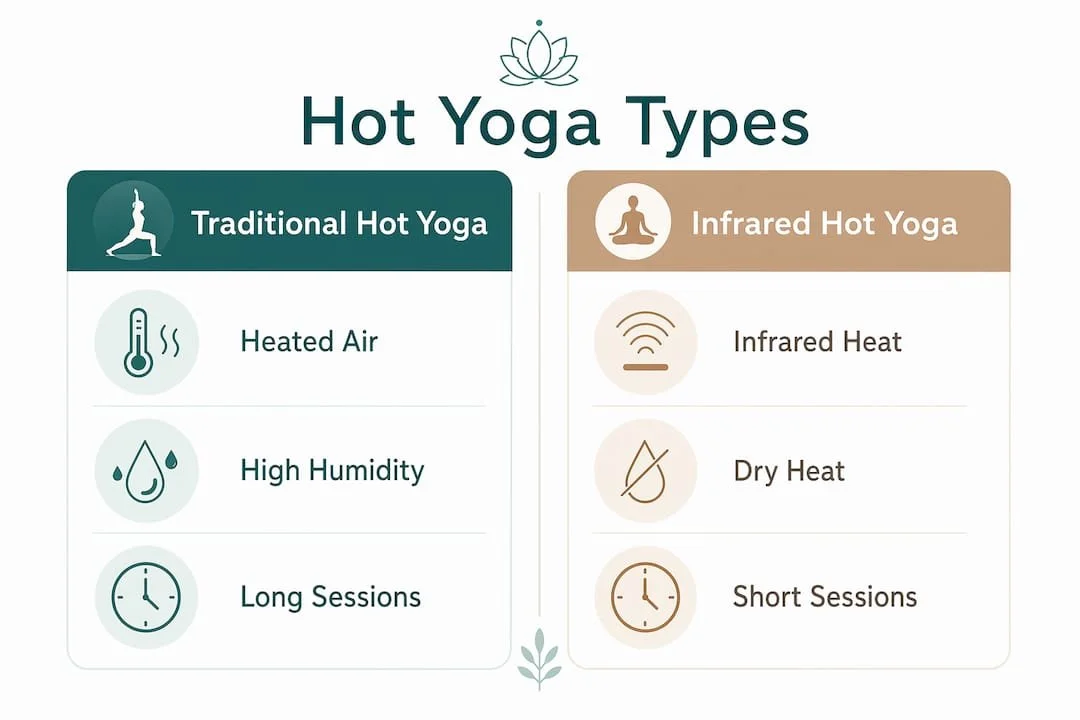
Feature Hot Yoga Renton (Traditional) HOTWORX Benson Hill (Infrared)
Heat source Heated air Infrared panels
Class length 60–90 minutes 30 minutes
Scheduling Fixed class times 24/7 virtual access
Humidity level High Low
Best for Community, live instruction Flexibility, recovery

How do traditional hot yoga and infrared hot yoga differ?

Traditional hot yoga heats the entire room using forced air systems, which raises both temperature and humidity. That combination creates the signature "sweat room" feel most people associate with Bikram or Baptiste-style classes. The heat loosens muscles quickly, but the high humidity can make breathing feel labored, especially in the first few sessions.

Infrared heat works differently. Infrared panels heat the body directly without significantly raising the ambient air humidity. The result is a warm, dry environment where breathing stays more comfortable throughout the session. This distinction matters most for beginners or anyone with respiratory sensitivities.

Here is a quick breakdown of what each format delivers:

  • Traditional hot yoga: Higher humidity, longer sessions, live instructor energy, strong community atmosphere, deeper sweat detox effect

  • Infrared hot yoga: Dry heat, shorter sessions, 24/7 access, easier breathing, gentler introduction for newcomers

  • Recovery focus: Infrared heat penetrates deeper into muscle tissue, which many practitioners find accelerates post-workout recovery compared to surface-level heated air

The trend toward infrared reflects real consumer demand. People want the muscle recovery and flexibility benefits of hot yoga without the overwhelming humidity that can cut a session short. If you have tried traditional hot yoga and found the air too thick to breathe comfortably, infrared is worth testing.

Pro Tip: If you are new to heated yoga, start with an infrared session at HOTWORX before moving to a traditional studio. The lower humidity gives your body time to adapt to exercising in heat without the added respiratory challenge.

What are the physical and mental health benefits of hot yoga?

Practicing hot yoga regularly delivers documented improvements across flexibility, strength, detoxification, stress relief, and cardiovascular health. Each benefit compounds over time, which is why consistent practitioners often report feeling stronger and calmer within just a few weeks. Here are the four core benefits worth understanding before you start:

  1. Increased flexibility and strength. Heat allows muscles to stretch further with less risk of strain. Over time, poses that felt impossible become accessible, and the isometric holds build functional strength throughout the core, legs, and shoulders.

  2. Detoxification through sweating. A single hot yoga session produces significant sweat output. Sweating flushes metabolic waste through the skin, and the heat encourages circulation that supports lymphatic drainage. This is one reason practitioners often report clearer skin and reduced bloating after consistent practice.

  3. Stress relief and mental clarity. The focused breathing required in a heated room forces the nervous system to slow down. Controlled breathwork activates the parasympathetic nervous system, which is the body's rest-and-digest mode. Many Renton practitioners cite this mental reset as the primary reason they return week after week.

  4. Improved cardiovascular health. Exercising in heat elevates heart rate similarly to moderate aerobic activity. A 30-minute infrared session or a 60-minute traditional class both challenge the cardiovascular system in ways that support heart health over time.

The mental benefits deserve equal weight alongside the physical ones. Yoga for flexibility in Renton is a common search goal, but the stress relief and mental clarity outcomes are what keep most people practicing long after they hit their flexibility goals.

What should beginners know before their first Renton hot yoga class?

Preparation is the single biggest factor in whether a first hot yoga class feels manageable or miserable. Most people who quit after one session do so because they arrived unprepared, not because the practice is wrong for them. Beginners benefit most from studios that offer pose modifications, and both Renton options provide instructor support for newcomers.

Follow these preparation steps before your first class:

  • Hydrate aggressively the day before. Drink at least 64 ounces of water in the 24 hours leading up to class. Arriving dehydrated in a heated room is the fastest route to dizziness or nausea.

  • Eat light. A small meal two to three hours before class is ideal. A full stomach in 100°F heat is deeply uncomfortable.

  • Know what to wear for hot yoga. Lightweight, moisture-wicking fabrics are the standard. For women, a fitted tank or sports bra with shorts or leggings works well. For men, compression shorts or lightweight athletic shorts are the go-to. Avoid cotton, which absorbs sweat and becomes heavy.

  • Bring a large water bottle and a towel. A non-slip yoga towel placed over your mat prevents sliding as sweat builds up. Most studios sell or rent these if you do not own one yet.

  • Tell the instructor you are new. A good instructor will watch for you and offer modifications. Inclusive classes with pose adjustments are standard at quality studios, so do not hesitate to ask for help.

For a deeper look at preparation, Amritayogawellness has a detailed resource on preparing for hot yoga that covers hydration, attire, and mindset in one place.

Pro Tip: Sit or lie down on your mat if you feel lightheaded during class. Leaving the room is always an option. Pushing through dizziness is never worth it, and experienced instructors expect beginners to need breaks.

How to choose the best hot yoga class in Renton for your goals

Choosing between Renton's hot yoga options comes down to three factors: your schedule, your heat tolerance, and what you want from the practice. There is no universally better option. The right class is the one you will actually attend consistently.

Consider these decision points:

  • Schedule flexibility: If your work hours vary or you travel frequently, HOTWORX's 24/7 virtual access removes the barrier of fixed class times entirely. Traditional studios require you to plan around their schedule.

  • Session length: A 30-minute infrared session fits easily into a lunch break. A 90-minute traditional class requires more time commitment and recovery time afterward.

  • Heat sensitivity: If you have asthma, sinus issues, or simply find high humidity uncomfortable, infrared is the more accessible starting point. The lower ambient humidity makes the transition to heated practice far less overwhelming for most beginners.

  • Community vs. solo practice: Traditional studios offer the energy of a live group class and the social accountability that keeps many people consistent. Infrared studios are quieter and more self-directed.

  • Budget: Compare drop-in rates against monthly memberships at each location. If you plan to practice three or more times per week, a membership almost always costs less per session than drop-in pricing.

For those also exploring hot yoga in Bellevue, Washington, options like Oxygen Yoga & Fitness are expanding the infrared market across the greater Seattle area, giving you additional comparison points if you work or live near the Eastside.

Key takeaways

Hot yoga in Renton delivers real physical and mental benefits through two distinct formats, and choosing the right studio depends on your schedule, heat tolerance, and practice goals.

Point Details
Two local formats Hot Yoga Renton offers traditional heated classes; HOTWORX Benson Hill offers infrared sessions.
Infrared vs. traditional heat Infrared produces less humidity, making breathing easier and sessions more beginner-friendly.
Session length matters HOTWORX runs 30-minute sessions; traditional classes run 60–90 minutes.
Preparation is non-negotiable Hydrate the day before, wear moisture-wicking fabrics, and inform your instructor you are new.
Benefits compound over time Regular practice builds flexibility, strength, cardiovascular health, and stress resilience.

Why I think most people overthink their first hot yoga class

The most common thing I hear from people who have never tried hot yoga is that they are waiting until they are "more flexible" or "more fit." That logic is backwards. Hot yoga is the tool that builds flexibility and fitness. You do not need to arrive ready for it. You just need to arrive.

What I have seen consistently is that the first class is the hardest, and it is hard for reasons that have nothing to do with yoga. The heat is unfamiliar. The room smells like effort. You do not know where to put your mat or how the flow works. All of that disappears by the second class. By the third, you start to feel the actual benefits.

The infrared option at HOTWORX is genuinely useful for people who are intimidated by traditional hot yoga. The dry heat environment is less aggressive, and the 30-minute format removes the mental barrier of committing to a 90-minute session. I would recommend it as a starting point for anyone who has bounced off traditional studios before.

One thing I would push back on is the idea that hot yoga is only for the already-athletic. The inclusivity built into modern classes means instructors are trained to meet you where you are. Every pose has a modification. Every instructor has seen a beginner. You are not a burden in that room. You are exactly who the class is designed for.

Show up, drink water, and give it three sessions before you decide. That is the only advice that actually matters.

— Juiced

Explore yoga and wellness with Amritayogawellness

Ready to take your wellness practice further? Amritayogawellness offers a full range of yoga styles, workshops, and holistic services designed for every level of practitioner. Whether you are stepping onto the mat for the first time or deepening an existing practice, the resources at Amritayogawellness connect you with expert guidance and community support.

Beyond yoga classes, Amritayogawellness offers tarot readings as a complementary wellness service for those exploring mindfulness and self-reflection alongside their physical practice. For anyone starting out, the hot yoga for beginners blog is a strong first resource. Visit amritayogawellness.com to browse classes, book a session, or connect with the community.

FAQ

What is hot yoga, and how is it different from regular yoga?

Hot yoga is practiced in a room heated to 95°F–105°F, which increases flexibility and sweat output compared to room-temperature yoga. The heat also raises heart rate, adding a cardiovascular component to the session.

Is hot yoga in Renton safe for beginners?

Yes. Both Hot Yoga Renton and HOTWORX Benson Hill offer modifications for beginners, and instructors are trained to support new practitioners. Hydrating well before class and informing your instructor you are new are the two most important safety steps.

How often should I practice hot yoga to see results?

Most practitioners notice improved flexibility and reduced stress within two to three weeks of attending two to three sessions per week. Consistency matters more than session length.

What should I bring to my first hot yoga class in Renton?

Bring a large water bottle, a non-slip yoga towel, and wear lightweight moisture-wicking clothing. Avoid cotton fabrics, which absorb sweat and become uncomfortable in a heated room.

Is infrared hot yoga better than traditional hot yoga for beginners?

Infrared hot yoga produces less ambient humidity, which makes breathing easier and the overall experience less overwhelming. For most beginners, starting with an infrared session at HOTWORX is a lower-barrier entry point than a traditional heated studio class.

Recommended

Yoga Instructor Class: Your 2026 Certification Guide

Heather Rice

TL;DR:

Yoga instructor classes certify individuals to teach safely and professionally, with the RYT 200 being the industry standard minimum credential. Courses cover techniques, anatomy, philosophy, teaching methods, and supervised practicum, requiring at least 200 hours of training, followed by advanced certifications. Choosing between in-person, online, or hybrid formats depends on your schedule, learning style, and access, with credentialing also requiring documentation, CPR certification, and liability insurance.

A yoga instructor class is a structured training program that certifies individuals to teach yoga safely and professionally. The industry standard credential is the RYT 200, defined by Yoga Alliance, and studios across the United States treat it as the minimum qualification for hiring. If you are exploring how to become a yoga instructor, understanding the credential levels, curriculum requirements, and delivery formats available in 2026 will save you time and money before you commit to a program.

What types of yoga instructor classes and credentials exist?

Certification levels in yoga teacher training follow a clear progression. The 200-hour foundational program is the entry point for professional teaching. From there, instructors can pursue a 300-hour advanced training, and the combination of both earns the RYT 500 designation recognized by Yoga Alliance.

Many aspiring teachers underestimate the 200-hour requirement and assume a 100-hour certificate is enough to get hired. Studios and insurance providers do not agree. The 200-hour credential is the professional floor, not a shortcut option.

The table below compares the three main certification levels:

Credential Hours Required Best For Career Impact
RYT 200 200 hours New instructors entering the field Qualifies for most studio hiring and insurance
RYT 300 300 additional hours Instructors deepening expertise Unlocks advanced yoga techniques and specialty teaching
RYT 500 500 combined hours Experienced teachers seeking top-tier status Highest Yoga Alliance recognition; opens training roles

A 300-hour advanced training requires prior completion of the 200-hour foundational program before enrollment. That sequencing matters because the advanced curriculum assumes you already understand class sequencing, anatomy basics, and verbal cueing from your foundational work.

Key facts about credential levels:

  • RYT 200 is the recognized minimum for certified yoga classes at most U.S. studios

  • RYT 300 focuses on advanced yoga techniques, specialty populations, and deeper philosophy

  • RYT 500 combines both levels and qualifies instructors to lead yoga teacher training programs themselves

  • Yoga Alliance is the most widely recognized credentialing body in the United States, though programs like the International Association of Yoga Therapists (IAYT) serve specialized tracks

Pro Tip: Before enrolling, verify that your chosen program is registered with Yoga Alliance as an RYS (Registered Yoga School). Without that registration, your hours may not count toward official RYT credentials.

What does a yoga instructor class curriculum actually cover?

The curriculum inside a 200-hour program is more demanding than most beginners expect. Yoga Alliance sets minimum content requirements across five core domains, and quality programs go well beyond those minimums.

Here are the five core areas covered in a standard yoga teacher training curriculum:

  1. Techniques and practice: Asanas (physical postures), pranayama (breathwork), and meditation form the physical and experiential core of training. Students practice these techniques daily, not just study them theoretically.

  2. Anatomy and physiology: You learn how the skeletal and muscular systems respond to yoga postures. This knowledge directly informs how you cue students safely and modify poses for different bodies.

  3. Yoga philosophy, lifestyle, and ethics: Training covers foundational texts like the Yoga Sutras of Patanjali and the ethical principles that govern a teacher-student relationship. This is not optional background reading. It shapes how you show up in the room.

  4. Teaching methodology: Class sequencing, verbal cueing, hands-on adjustments, and managing group yoga sessions are all taught here. You learn how to build a class arc from warm-up to savasana.

  5. Practicum and supervised teaching: Typical 200-hour programs allocate roughly 10 hours to practicum and teaching methodology. Students observe experienced teachers, then lead sessions themselves under supervision.

The practicum component separates programs that produce confident teachers from those that produce knowledgeable students who freeze when they face a live class. Students typically lead at least two full classes during training to develop voice modulation and real-time problem-solving skills. Two classes is a minimum. The best programs build in more.

Pro Tip: Ask any program director how many live teaching hours students accumulate before graduation. If the answer is fewer than four full-length classes, look for a program with more supervised practice built in.

Personal yoga coaching and mentorship from experienced teachers during practicum is what turns curriculum knowledge into actual teaching ability. No amount of reading about verbal cueing replaces the feedback you get when a real teacher watches you lead a class and tells you exactly what to fix.

In-person, online, or hybrid: which format fits you?

Delivery format is one of the most consequential decisions you will make when choosing a training program. Each model has real trade-offs, and the right choice depends on your schedule, learning style, and access to local programs.

In-person intensive programs compress 200 hours into a short window. A Rishikesh-based program example completes 200 hours in 21 days with bi-monthly batches. That pace builds immersion and community fast, but it requires you to step away from work and family obligations entirely.

Online and hybrid programs spread training across a longer timeline. Online or hybrid 200-hour programs typically span 3–6 months with 2–4 synchronous live sessions per week. That structure fits working adults who cannot take three weeks off but still want a rigorous credential.

The critical compliance detail for online programs: Yoga Alliance requires a minimum of 15% synchronous live instruction for a program to count toward RYT credentials. Pre-recorded video modules do not count as contact hours. This distinction trips up many students who assume watching recorded content fulfills their live hour requirements.

Here is a direct comparison of format trade-offs:

  • In-person intensive: Maximum immersion, hands-on adjustments, fast community building. Requires full schedule availability and often travel costs.

  • Online synchronous: Flexible scheduling, lower cost, access to programs nationwide. Requires strong self-discipline and a reliable internet connection.

  • Hybrid: Combines online self-study with periodic in-person intensives. Balances flexibility with real-world practice time.

Maximizing live interaction during online trainingbuilds teaching confidence and mentorship connections far better than passively watching recorded content. Show up to every live session, ask questions, and volunteer to teach during practice rounds even when it feels uncomfortable.

What are the credentialing steps after completing your training?

Finishing your training hours is not the final step. Becoming a certified yoga instructor requires submitting documentation and meeting additional requirements before you can teach professionally.

The credentialing process typically involves:

  • Submitting training verification to Yoga Alliance through their online portal, including your school's RYS registration number and your completed hours log

  • Passing any program assessments required by your school, such as written exams, teaching evaluations, or philosophy papers

  • Obtaining CPR/AED certification, which costs between $50 and $100 and is strongly recommended or required by most studio insurance policies

  • Securing liability insurance before teaching any paid classes, whether in a studio, gym, or private setting

The legal picture in the U.S. is straightforward but often misunderstood. Most U.S. states do not legally license yoga instructors, but studios and insurers require the RYT 200 credential for hiring and coverage. That means insurance and venue policies regulate yoga teaching prerequisites more effectively than any law does. If you want to teach, you need the credential. The market enforces it even when the government does not.

In-person studio teaching also carries ongoing responsibility. Instructors managing hands-on adjustments must handle consent continuously and stay within their qualification scope to limit liability. This is especially relevant for teachers moving into group yoga sessions with mixed-ability students.

Pro Tip: Register with Yoga Alliance within 60 days of completing your training. Your school's registration may have an expiration window, and delays can complicate your application.

Key takeaways

Becoming a certified yoga instructor requires completing a recognized training program, meeting credentialing requirements, and choosing a delivery format that matches your learning style and schedule.

Point Details
RYT 200 is the professional standard Studios and insurers require the 200-hour credential as the minimum qualification for hiring.
Curriculum covers five core domains Training includes techniques, anatomy, philosophy, teaching methodology, and supervised practicum.
Format choice affects compliance Online programs must meet Yoga Alliance’s 15% live instruction minimum to count toward credentials.
Credentialing goes beyond graduation Submitting hours, obtaining CPR/AED certification, and securing liability insurance are all required steps.
Advanced credentials open new doors The RYT 300 and RYT 500 designations qualify instructors for advanced teaching roles and training programs.

What i have learned about choosing the right training program

Most people spend more time researching a laptop purchase than they spend vetting a yoga teacher training program. That is a mistake that costs real money and months of your life.

The first thing I look at is whether the school is a Registered Yoga School with Yoga Alliance. That single check eliminates a large percentage of programs that will leave you with hours that do not count. After that, I look at the lead trainer's biography, not the school's marketing copy. How long have they been teaching? Do they have a specialty that matches your interests, whether that is beginner yoga classes, hot yoga, or advanced yoga techniques?

The format question is personal, and I have seen both sides. Immersive in-person programs build community and confidence faster. But I have also watched working parents complete rigorous online programs and become excellent teachers because they had the discipline to show up to every live session and practice teach on their own time. The format matters less than your commitment to it.

One thing most guides will not tell you: plan to exceed the minimum hours before you start marketing yourself as a teacher. The RYT 200 qualifies you legally. Teaching 50 or 100 additional hours in community classes, donation-based sessions, or corporate wellness settings is what makes you actually good. The credential opens the door. The practice hours build the teacher.

If you are in the Philadelphia area, exploring the yoga teacher training options at Amritayogawellness is worth your time before committing to a program.

— Juiced

Start your path at amrita yoga & wellness

Amritayogawellness, based in Philadelphia, supports students at every stage of their yoga education, from first-time practitioners in beginner yoga classes to those pursuing formal certification pathways. Whether you are researching your first yoga instructor class or looking to deepen your practice before committing to a full training program, the studio's offerings give you a real foundation to build on.

Amritayogawellness also offers tarot readings and complementary wellness services that many students find valuable alongside their yoga studies. Holistic well-being extends beyond the mat, and the studio's community reflects that. Explore the full range of classes, workshops, and training support at Amritayogawellness and take the next concrete step toward your certification goal. You can also check out affordable training options that can reduce the cost of your path to certification by up to 30%.

FAQ

What is the minimum credential to teach yoga professionally?

The RYT 200 is the recognized minimum credential for professional yoga teaching in the United States. Most studios and insurance providers require it for hiring and coverage, even though no state legally mandates a license.

How long does a 200-hour yoga teacher training take?

Program length varies by format. Intensive in-person programs can complete 200 hours in about 21 days, while online and hybrid programs typically span 3–6 months with multiple live sessions per week.

Do online yoga teacher training programs count toward yoga alliance credentials?

Yes, but only if the program meets Yoga Alliance's requirement that at least 15% of instruction hours are delivered through synchronous live sessions. Pre-recorded modules do not count as contact hours.

Is CPR certification required to become a yoga instructor?

CPR/AED certification is not legally required in most U.S. states, but most studio insurance policies require it. Certification typically costs between $50 and $100 and is strongly recommended before teaching any live classes.

What is the difference between RYT 300 and RYT 500?

The RYT 300 is an advanced training credential that requires prior completion of a 200-hour program. The RYT 500 combines both the 200-hour and 300-hour credentials into a single designation, qualifying instructors for the highest-level teaching and training roles.

Recommended

Hot Power Fusion Yoga: Benefits, Tips, and What to Expect

Heather Rice

TL;DR:

Hot Power Fusion Yoga combines strength-building power yoga with the deep stretching and detoxifying heat of hot yoga, creating a physically demanding yet mentally grounding practice suitable for all levels. Classes typically last 60–75 minutes in rooms heated to 95–105°F, enhancing flexibility, cardiovascular fitness, and mental clarity while challenging practitioners physically and mentally. Preparation, including proper hydration, appropriate clothing, and modifications, is essential to maximize benefits and ensure a safe, effective experience.

Hot Power Fusion Yoga is defined as a practice that merges the strength-building sequences of power yoga with the deep stretching and detoxifying heat of hot yoga. The result is a physically demanding, mentally grounding class that works for beginners and seasoned practitioners alike. You build real muscle strength, gain flexibility faster than in a standard room, and leave with that particular clarity that only comes from sweating through something hard. If you've been curious about what this practice actually involves, this guide covers everything you need to know.

What is hot power fusion yoga, really?

Hot Power Fusion Yoga is a fusion of power yoga and hot yoga that combines dynamic movement with a heated environment to produce both physical and mental results. Power yoga contributes the strength sequences and flowing vinyasa transitions. Hot yoga contributes the room temperature, the sweat, and the meditative stillness found in posture holds. Together, they create something neither discipline delivers alone.

Classes run 60–75 minutes in rooms heated to 95–105°F. That temperature range is deliberate. It warms your muscles faster, increases your range of motion, and pushes your cardiovascular system in ways a room-temperature class simply cannot. The heat also creates a sensory environment that forces you to stay present. You cannot mentally check out when the room is that warm.

This practice sits in the broader category of fusion yoga styles, which blend two or more yoga traditions to serve practitioners who want more than one thing from a single session. Hot Power Fusion is one of the most physically demanding entries in that category.

How is a hot power fusion class structured?

A typical Hot Power Fusion class follows a clear arc from warm-up to peak intensity to cool-down. Understanding that structure helps you pace yourself, especially in your first few sessions.

  1. Warm-up (10–15 minutes): The class opens with breath-focused movement and gentle flows. Sun Salutations or modified vinyasa sequences activate the spine and raise your core temperature alongside the room's heat.

  2. Standing sequence (20–25 minutes): This is where power yoga's influence shows up most clearly. Warrior series, balance poses, and standing strength holds build leg and core strength. Instructors often cue longer holds here to develop muscular endurance.

  3. Floor sequence (15–20 minutes): Spine-focused backbends, hip openers, and core work dominate this section. The heat makes deep hip openers like Pigeon Pose feel more accessible than they would in a cooler room.

  4. Cool-down and Savasana (10–15 minutes): The class closes with restorative postures and a final rest. This is not optional. Your nervous system needs the transition after that level of exertion.

Music plays a real role in pacing. Most Hot Power Fusion instructors use a curated playlist that mirrors the class arc, starting slow and building to a peak during the standing sequence before dropping back for the floor work. The rhythm guides your breath and keeps you moving when the heat makes you want to stop.

Pro Tip: Arrive 10 minutes early for your first class. Sitting in the heated room before class starts lets your body acclimate gradually instead of hitting the full intensity the moment you begin moving.

What are the physical and mental benefits?

The benefits of this practice are well-documented and span both the body and the mind. Here is what the research and experienced practitioners consistently report.

  • Improved bone density and balance: Practicing heated yoga 2–6 times per week over several weeks improves bone mineral density, flexibility, and balance. That finding comes from an analysis of 43 studies covering 942 participants. Bone density improvements are particularly significant for women, who make up the majority of the study pool.

  • Cardiovascular fitness: The heated room elevates your heart rate faster and keeps it elevated longer than a standard yoga class. Over time, this builds real aerobic capacity.

  • Increased flexibility: Heat increases muscle laxity, which allows for a greater range of motion during stretching. You will notice deeper forward folds and more open hip postures within a few sessions.

  • Detoxification through sweat: Heavy sweating in a heated environment supports the body's natural detox processes. This is one of the most cited reasons practitioners return to hot yoga formats consistently.

  • Stress relief and mental clarity: The heat creates a cathartic sensory effect that deepens the mind-body connection beyond what physical stretching alone produces. E-RYT 500 instructor Laura Lusson describes this as one of the most underappreciated aspects of heated yoga practice.

"The heat in hot yoga provides a cathartic, sensory experience crucial for deepening mind-body awareness beyond mere physical outcomes." — Laura Lusson, E-RYT 500

The mental benefits deserve equal weight here. Many practitioners report that the concentration required to hold poses in a hot room translates directly into improved focus and stress management outside the studio. You learn to stay calm under physical pressure. That skill carries over.

For beginners, modifications are standard and built into every class. Accepting a modification is not a sign of weakness. It is the approach that keeps you practicing long-term. You can explore the hot yoga wellness advantages in more depth if you want a fuller picture of what the heated environment adds to your practice.

Hot power fusion vs. other hot yoga styles

Understanding how this practice differs from Bikram yoga and standard power yoga helps you choose the right class for your goals.

Feature Hot Power Fusion Yoga Bikram Hot Yoga Standard Power Yoga
Room temperature 95–105°F 105°F Room temperature
Sequence structure Dynamic, varied flows Fixed 26-posture sequence Dynamic, varied flows
Meditative elements Integrated throughout Minimal Minimal
Modifications offered Yes, actively encouraged Limited Yes
Intensity level High, with recovery built in High, repetitive High, no heat assist
Accessibility for beginners Strong Moderate Moderate

Bikram yoga uses a fixed sequence of 26 postures performed in the same order every class. That predictability has real value for some practitioners. Hot Power Fusion trades that predictability for variety and a more balanced challenge-to-recovery ratio. You are not doing the same class every time.

Standard power yoga, as popularized by teachers like Bryan Kest and Beryl Bender Birch in the 1990s, delivers strength and flow without the heat. The absence of a heated room means you miss the cardiovascular push and the deeper flexibility gains that heat provides. Fusion classes balance internal peace with physical exertion in a way that traditional yoga's more singular spiritual focus does not always achieve.

Pro Tip: If you have practiced Bikram yoga before, expect Hot Power Fusion to feel less predictable but more physically varied. The dynamic flows will challenge muscle groups that fixed sequences tend to underwork.

What should you know before your first class?

Preparation makes a significant difference in how your first Hot Power Fusion session feels. These are the practical things that matter most.

  • Hydrate aggressively before class. Drink water consistently in the hours leading up to your session. Arriving dehydrated in a 100°F room is the fastest route to dizziness or nausea.

  • Bring two towels. Practitioners are advised to bring one towel for the mat and one for themselves. The sweat volume in a Hot Power Fusion class surprises most first-timers.

  • Respect heat-induced laxity. Heat increases muscle flexibility but also creates a risk of overstretching. Treat the heat as a facilitating tool, not a signal to push past your natural limits. Skilled instructors will remind you of this throughout class.

  • Use modifications without hesitation. Mastering complex inversions is unnecessary. Modifications are tools for longevity in practice, not shortcuts for people who cannot keep up.

  • Expect a cardiovascular challenge. Your heart rate will climb. If you feel lightheaded, come down to Child's Pose. Every instructor expects this from new students and will not single you out.

You can get a clearer sense of what the studio environment feels like before you walk in, which helps reduce the anxiety that comes with trying something new.

Pro Tip: Wear moisture-wicking fabric that fits close to the body. Loose clothing traps heat and gets heavy with sweat, which makes movement harder and more uncomfortable than it needs to be.

Key takeaways

Hot Power Fusion Yoga delivers strength, flexibility, and mental clarity by combining dynamic power yoga flows with the detoxifying heat of a 95–105°F room.

Point Details
Core definition Hot Power Fusion blends power yoga strength sequences with hot yoga's heated environment and meditative elements.
Class structure Sessions run 60–75 minutes and move from warm-up flows through standing strength work to floor sequences and Savasana.
Physical benefits Regular practice improves bone density, cardiovascular fitness, flexibility, and balance across all fitness levels.
Safety in the heat Heat increases muscle laxity, so treat it as a facilitating tool and use modifications to avoid overstretching.
Preparation matters Arrive hydrated, bring two towels, and wear moisture-wicking clothing to get the most from every session.

Why the heat changes everything

Most people approach Hot Power Fusion Yoga expecting a harder workout. What they do not expect is how much the heat changes their relationship to the practice itself.

I have practiced and taught in heated rooms for years, and the thing I keep coming back to is this: the heat removes the option of being somewhere else mentally. In a room-temperature class, your mind can wander. In a 100°F room, your body demands your full attention. That forced presence is not a side effect of the heat. It is the point.

The common misconception I hear from beginners is that they need to be fit before they try Hot Power Fusion. That thinking has it backwards. The modifications built into every class mean you can start exactly where you are. I have watched complete beginners find their footing in three sessions because the heat itself does a lot of the preparatory work that months of room-temperature practice might otherwise require.

What makes this practice stick for so many people is the combination of physical results and mental reward in a single session. You leave stronger, more flexible, and genuinely calmer. That combination is hard to find anywhere else. If you are on the fence, go once with no expectations. The room will do the rest.

— Juiced

Try hot power fusion yoga at amrita yoga & wellness

Amritayogawellness offers Hot Power Fusion classes in Philadelphia for practitioners at every level, from first-timers to advanced yogis looking for a consistent challenge. The studio's instructors actively cue modifications throughout every class, so you never feel left behind. The environment is welcoming, the instruction is specific, and the results show up fast.

Beyond yoga, Amritayogawellness supports your full wellness picture. If you want to complement your physical practice with something that addresses the mental and spiritual side of well-being, explore the studio's wellness offerings for a more complete approach to self-care. Book your first Hot Power Fusion class at Amrita Yoga & Wellness and experience what the heat actually does for your practice.

FAQ

What is hot power fusion yoga in simple terms?

Hot Power Fusion Yoga is a class that combines the strength-building flows of power yoga with the heated room and deep stretching of hot yoga. Classes run 60–75 minutes in rooms heated to 95–105°F.

Is hot power fusion yoga good for beginners?

Yes. Modifications are built into every class and actively encouraged by instructors. Beginners can participate fully without needing prior yoga experience or advanced fitness.

How does hot power fusion differ from bikram yoga?

Bikram yoga uses a fixed sequence of 26 postures every class. Hot Power Fusion uses varied, dynamic flows that change session to session and integrates meditative elements throughout.

How often should you practice hot power fusion yoga?

Research supports practicing heated yoga 2–6 times per week to see measurable improvements in bone density, flexibility, and balance. Starting with two sessions per week is a practical approach for beginners.

What should i bring to a hot power fusion class?

Bring two towels, one for your mat and one for yourself, along with a full water bottle and moisture-wicking clothing. Hydrating well in the hours before class is equally important.

Recommended

What Is Therapeutic Yoga? Benefits and How It Works

Heather Rice

TL;DR:

Therapeutic yoga is an individualized practice that combines assessment, goal setting, and lifestyle guidance within a therapeutic relationship to promote healing. It differs from regular yoga classes by focusing on specific health needs under the guidance of a certified therapist with clinical expertise. Evidence shows that yoga therapy can reduce stress, anxiety, and depression, especially when tailored to conditions like chronic pain and mental health disorders.

Therapeutic yoga is the individualized application of yoga practices within a therapeutic relationship, combining assessment, goal setting, and lifestyle management to support healing. The International Association of Yoga Therapists (IAYT) defines this practice as yoga therapy: a professional discipline distinct from general yoga classes. Where a standard class follows a fixed sequence for a room full of people, therapeutic yoga is built around one person's specific health needs. Amritayogawellness sees this distinction every day at its Philadelphia studio, where practitioners arrive with chronic pain, anxiety, or stress and leave with a personalized path forward.

What is therapeutic yoga and how does it differ from regular yoga?

Therapeutic yoga, formally called yoga therapy, is a clinical practice in which a certified yoga therapist works one-on-one with a client to address specific physical or mental health conditions. The therapist draws on training in anatomy, physiology, medications, and symptom recognition. That depth of knowledge separates yoga therapy from a drop-in vinyasa class.

A general yoga class teaches movement and breath to a group. Yoga therapy structures sessions around individual needs and clinical goals, not standard sequences. The therapist conducts a full intake assessment, identifies health priorities, and designs a practice that fits the client's current capacity. Progress is tracked and the program evolves as the client improves.

The therapeutic relationship itself is a defining feature. Personalized care and ongoing communication between therapist and client drive outcomes. This is not a wellness trend. IAYT has credentialed yoga therapists since 1989, and the field now intersects with hospitals, rehabilitation centers, and integrative medicine clinics.

Pro Tip: Before your first session, write down your top three health concerns and any medications you take. A yoga therapist uses that information to design a safer, more targeted practice from day one.

Core techniques used in yoga therapy sessions

Therapeutic yoga sessions draw from several yoga tools depending on the client's condition and goals:

  • Breathwork (pranayama): Regulates the nervous system and reduces physiological stress responses.

  • Guided movement (asana): Modified postures adapted to the client's mobility, pain level, and strength.

  • Meditation and mindfulness: Builds mental focus and reduces rumination linked to anxiety and depression.

  • Relaxation techniques: Progressive muscle relaxation and yoga nidra lower cortisol and support recovery.

  • Lifestyle guidance: Sleep habits, nutrition awareness, and daily movement recommendations.

Therapeutic yoga sequencingemphasizes warming joints gradually, building stability before intensity, and staying within a safe therapeutic window. That pacing principle protects clients with injuries or chronic conditions from setbacks.

What are the therapeutic yoga benefits for mind and body?

The evidence for yoga therapy's benefits is growing and specific. A 2026 meta-analysis of 30 controlled studies covering 2,288 participants found that yoga interventions significantly reduce stress, anxiety, and depression symptoms with a moderate effect size. That finding is especially strong for older adults, a population that often cannot tolerate high-intensity exercise.

A separate 2026 community study of 253 women found that a single 60-minute Hatha yoga session measurably improved mood, decreased anxiety, and increased energy levels. One session produced noticeable results. That suggests yoga therapy does not require months of practice before a client feels a difference.

Yoga's combination of movement, breath, and mindfulnessinfluences brain chemistry and stress pathways in ways that benefit mental health. Research quality varies across studies, but the direction of evidence is consistent. Yoga therapy complements healthcare by improving musculoskeletal conditions, mental health disorders, and quality of life without the side effects of many pharmaceutical interventions.

Conditions that respond well to yoga therapy

Yoga therapy shows documented benefit across a range of conditions:

  • Chronic low back pain and neck tension

  • Anxiety disorders and generalized stress

  • Mild to moderate depression

  • Post-surgical rehabilitation and mobility recovery

  • Hypertension and cardiovascular risk reduction

  • Insomnia and sleep disruption

  • Fatigue related to cancer treatment

Yoga therapy is best viewed as complementary care, not a standalone cure. It works best alongside medical treatment, physical therapy, or mental health counseling. Clients who approach it that way get the most out of it.

Therapeutic yoga vs. restorative yoga: what is the difference?

These two practices overlap in tone but differ sharply in structure and purpose. Understanding the distinction helps you choose the right practice for your needs.

Restorative yoga uses propssuch as bolsters, blankets, and blocks to fully support the body, allowing deep relaxation by shifting the nervous system into a rest state. Poses are held for 5–20 minutes with zero muscular effort required. The goal is nervous system recovery, not skill development or symptom treatment.

Therapeutic yoga, by contrast, is goal-directed and clinically informed. A yoga therapist assesses your condition, sets measurable health targets, and adjusts your practice over time. Restorative yoga is a supportive relaxation practice that removes effort entirely. Therapeutic yoga is an active treatment process, even when the techniques used look gentle.

The table below shows the key differences clearly.

Feature Therapeutic Yoga Restorative Yoga Standard Yoga Class
Session format One-on-one, individualized Group or solo, prop-supported Group, fixed sequence
Primary goal Treat specific health conditions Deep nervous system relaxation Fitness, flexibility, stress relief
Therapist role Certified yoga therapist, clinical assessment Certified instructor, minimal guidance Instructor leads group
Intensity level Adapted to condition, gradual progression Very low, fully passive Low to high depending on style
Typical use case Chronic pain, mental health, rehabilitation Burnout, stress recovery, sleep issues General wellness, fitness

If you are recovering from surgery, managing anxiety, or dealing with chronic pain, therapeutic yoga is the more targeted choice. If you are burned out and need deep rest, restorative yoga delivers that efficiently.

How to start therapeutic yoga: finding the right therapist

Starting therapeutic yoga requires more than finding a yoga studio. You need a qualified practitioner with specific credentials. The IAYT certifies yoga therapists through its C-IAYT credential, which requires a minimum of 1,000 hours of training beyond standard yoga teacher certification. That credential is the clearest signal of clinical competency.

Here is how to approach finding and starting therapeutic yoga:

  1. Search the IAYT directory. The IAYT website lists C-IAYT certified therapists by location and specialty. Filter by your health concern.

  2. Ask about their clinical experience. A therapist who has worked with your specific condition, whether chronic pain, anxiety, or post-surgical recovery, will design a more targeted program.

  3. Expect a full intake assessment. Your first session should include a health history review, movement assessment, and goal-setting conversation. If it does not, that is a red flag.

  4. Confirm the setting. Therapeutic yoga is offered in hospitals, integrative medicine clinics, private practices, and specialized studios like Amritayogawellness in Philadelphia.

  5. Integrate it with your existing care. Share your yoga therapy plan with your doctor, physical therapist, or mental health provider. Coordination improves outcomes.

Pro Tip: Tell your yoga therapist about every medication you take, not just the ones you think are relevant. Certain medications affect balance, heart rate, and flexibility, and a skilled therapist will adjust your session accordingly.

Yoga therapy for mental healthis one of the fastest-growing applications of the practice. Therapists working in this space often collaborate directly with psychologists and psychiatrists to support clients managing depression, PTSD, and anxiety disorders. That collaboration model is the future of integrative care.

Key takeaways

Therapeutic yoga is the most personalized form of yoga practice available, and its clinical structure is what separates it from every other style on the market.

Point Details
Clinical definition matters Yoga therapy is defined by IAYT as individualized practice within a therapeutic relationship, not general group instruction.
Evidence supports mental health benefits A 2026 meta-analysis of 2,288 participants confirmed yoga reduces stress, anxiety, and depression with moderate effect size.
One session can shift your mood A single 60-minute Hatha yoga session improved mood and reduced anxiety in a study of 253 adult women.
Restorative yoga is not the same Restorative yoga focuses on passive nervous system recovery; therapeutic yoga targets specific health conditions through clinical assessment.
Credentials signal competency Look for the C-IAYT credential when choosing a yoga therapist to confirm clinical training beyond standard teacher certification.

Why therapeutic yoga deserves more credit than it gets

Most people who walk into a yoga class are looking for stress relief or a good stretch. That is a fine reason to practice. But therapeutic yoga operates at a completely different level, and the wellness world has been slow to recognize that distinction.

What I find most striking about yoga therapy is how much it resembles physical therapy in structure but draws on a far wider toolkit. A physical therapist addresses the body. A yoga therapist addresses the body, the breath, the nervous system, and the mental patterns that often drive physical symptoms in the first place. That scope is rare in any single discipline.

The research is not perfect. Effect sizes vary, study populations differ, and yoga therapy is not a replacement for surgery or medication. But the consistent finding across dozens of studies is that yoga-based interventions move the needle on stress, pain, and mood. That is not a small thing for people who have exhausted conventional options.

My honest view is that therapeutic yoga is underused precisely because it requires more from both the practitioner and the client. It demands a real assessment, honest communication, and patience with gradual progress. Generic classes are easier to sell. But for anyone dealing with chronic pain, persistent anxiety, or recovery from illness, the personalized healing approach of yoga therapy is worth every bit of that extra effort.

— Juiced

Explore therapeutic yoga and wellness at Amritayogawellness

Amritayogawellness offers a full range of wellness services at its Philadelphia studio, including yoga therapy sessions designed around your specific health goals. Whether you are managing chronic pain, working through stress, or rebuilding after injury, the studio's practitioners bring clinical depth to every session.

Beyond yoga therapy, Amritayogawellness integrates complementary wellness practices to support your whole-person health. The studio's tarot readings offer a reflective, intuitive complement to the physical and mental work of yoga therapy. Many clients find that pairing body-based practices with introspective tools deepens their self-awareness and accelerates their progress. Explore the full range of yoga therapy offerings and find the support that fits where you are right now.

FAQ

What is therapeutic yoga in simple terms?

Therapeutic yoga is a personalized form of yoga delivered by a certified therapist to address specific physical or mental health conditions. It differs from group yoga classes by using individual assessment and clinical goal setting.

How does therapeutic yoga work for pain relief?

A certified yoga therapist assesses your pain patterns and designs a movement, breath, and relaxation program adapted to your condition. The gradual pacing and symptom-specific sequencing reduce pain without risking further injury.

Is therapeutic yoga the same as restorative yoga?

No. Restorative yoga uses props to support passive relaxation and nervous system recovery. Therapeutic yoga is a clinically structured practice targeting specific health outcomes through individualized assessment and progression.

Who should consider yoga therapy?

Anyone managing chronic pain, anxiety, depression, post-surgical recovery, or stress-related conditions can benefit from yoga therapy. It works best as a complement to existing medical or mental health treatment.

How do i find a qualified yoga therapist?

Search the IAYT directory for practitioners holding the C-IAYT credential, which requires over 1,000 hours of clinical training. Specialized studios, hospitals, and integrative medicine clinics are common settings for certified yoga therapists.

Recommended

The Yoga Shop: Philadelphia's Guide to Gear and Classes

Heather Rice

TL;DR:

A yoga shop in Philadelphia offers a combination of quality gear, structured classes, and community resources to support both physical and mental health. Amritayogawellness provides diverse classes, workshops, and holistic services in one accessible location, emphasizing beginner-friendly options and proper gear selection. Choosing the right mat and maintaining it properly enhances safety and longevity, especially tailored to practice style and environmental factors.

The yoga shop is defined as a full-service wellness destination that combines quality gear, structured classes, and community resources to support physical and mental health. For Philadelphia adults, finding the right combination of instruction and equipment makes the difference between a short-lived experiment and a lasting practice. Amritayogawellness brings both together under one roof, offering everything from hot yoga and barre to premium yoga mat selection and spiritual tools. Whether you are a complete beginner or a seasoned practitioner, the right shop gives you the gear and guidance to go deeper.

What does the yoga shop offer philadelphia practitioners?

A yoga shop in Philadelphia is more than a place to buy a mat. The best local options function as wellness hubs, connecting you to classes, workshops, and a community that keeps your practice consistent.

Amritayogawellness offers a wide range of class formats designed for different goals and experience levels:

  • Vinyasa yoga: A flow-based style that links breath to movement, building strength and flexibility simultaneously.

  • Hot yoga: Practiced in a heated room to increase flexibility and cardiovascular output. Cork mats grip better when moist, making them the preferred choice for this format.

  • Pilates and barre: Low-impact formats that target core stability and muscular endurance, ideal for injury recovery or cross-training.

  • Tai chi: A slow, meditative movement practice that builds balance and reduces stress over time.

  • Massage therapy: A hands-on recovery service that complements active yoga practice by releasing muscular tension.

  • Workshops and specialty events: Amritayogawellness hosts tarot readings, mindfulness workshops, and community events that extend wellness beyond the mat.

Every class format at Amritayogawellness is structured for accessibility. Beginners receive detailed class descriptions before signing up, so there are no surprises. Advanced practitioners can filter by intensity level and find sessions that challenge their existing skills. That layered approach to programming is what separates a genuine yoga and wellness studio from a basic yoga accessories shop.

Pro Tip: If you are new to yoga in Philadelphia, start with a beginner Vinyasa class before moving to hot yoga. The heat in hot yoga amplifies physical demand, and building baseline flexibility first reduces injury risk significantly.

How do you choose the best yoga mat and accessories?

Choosing the right yoga mat is the single most consequential gear decision you will make. The wrong mat creates slipping, joint pain, and frustration. The right one supports your body and your practice style for years.

Thickness: cushion vs. stability

A 6mm thick mat offers the best joint protection for most practitioners. That extra cushioning matters most in poses that load the knees, wrists, and spine. Thinner mats in the 3–4mm range suit advanced practitioners who prioritize balance and want to feel the floor beneath them. Beginners almost always benefit from the 6mm option.

Material: what your practice actually needs

Material determines grip, durability, and environmental impact. Mat material should align with your practice style: absorbent natural rubber or cork for sweaty sessions, and closed-cell PVC for studio environments where hygiene and durability matter most.

Natural rubber and cork mats absorb moisture, which improves grip as you sweat. PVC mats resist moisture absorption, which makes them easier to wipe clean but potentially slippery in high-heat classes.

Accessories worth buying

Blocks, straps, and a quality mat cleaner round out a complete yoga accessories shop purchase. Foam blocks support alignment in poses where flexibility is still developing. Straps extend your reach in seated forward folds and shoulder openers. A dedicated mat spray keeps your surface clean between sessions without degrading the material.

Price ranges for quality mats run from under $25 for entry-level options to over $165 for premium mats built with sustainable materials and advanced grip technology. That price gap reflects real differences in longevity and performance, not just branding.

Pro Tip: Look for mats with alignment markers, like the Liforme AlignForMe® system. Alignment guides reduce injury risk by helping beginners position their hands and feet correctly from day one.

How do popular yoga mat materials compare?

Understanding the trade-offs between mat materials helps you buy once and buy right. The table below covers the four most common options across the factors that matter most.

Material Grip When Wet Cushioning Eco Impact Cleaning Ease Best For
Cork Excellent Moderate Low Impact Easy (antimicrobial) Hot yoga, eco-conscious practitioners
Natural Rubber Very Good Good Moderate Moderate All-around practice, sweaty sessions
PVC (closed-cell) Moderate Excellent Higher Impact Very Easy Studio use, durability-focused buyers
Hybrid (PU/rubber) Excellent Good Moderate Moderate Performance-focused, advanced practice

Cork mats stand out for hot yoga specifically. They dry antimicrobial and grip better when moist, eliminating the need for a separate towel during heated sessions. That is a practical advantage that saves money and reduces gear clutter.

Closed-cell PVC mats prevent sweat and bacteria from penetrating the surface. That construction makes them the most hygienic option for shared studio environments. The trade-off is environmental: PVC is not biodegradable, and its production carries a higher carbon footprint than natural alternatives.

Natural rubber and PVC mats differ significantly in how they handle moisture. Open-cell rubber absorbs sweat for superior grip but requires more frequent cleaning. Closed-cell PVC stays drier on the surface but can feel slick before you warm up. Knowing which side of that trade-off matters more to you makes the decision straightforward.

For Philadelphia yogis practicing at Amritayogawellness, cork or natural rubber mats are the strongest choice for hot yoga classes. PVC mats work well for pilates and barre, where sweat volume is lower and floor stability is the priority.

What are the best practices for caring for your yoga mat?

A quality mat lasts years with proper care. Most practitioners shorten their mat's lifespan through avoidable mistakes.

The correct cleaning method is simple: wipe with a damp cloth using cold water or a mild detergent, then air-dry flat. That process removes sweat and bacteria without degrading the mat's surface or structure. Regular wiping after every session extends mat lifespan significantly compared to occasional deep cleans.

What to avoid:

  • Washing machines and dryers: The agitation and heat break down mat materials, especially natural rubber and cork. Even one machine wash can permanently warp a quality mat.

  • Prolonged sun exposure: UV light degrades most mat materials over time, causing cracking and loss of grip. Store your mat away from windows.

  • Shoes and pet claws: Shoes and pet claws permanently damage the non-slip surface, reducing grip and shortening the mat's functional life. Keep your mat a shoe-free and pet-free zone.

  • Folding instead of rolling: Folding creates permanent creases that compromise surface flatness and stability during practice.

Storage matters as much as cleaning. Roll your mat loosely with the top surface facing outward, and store it upright or hanging to prevent compression. A mat bag or strap keeps it clean during transport and protects the surface from contact with rough floors.

Pro Tip: For a quick between-session refresh, mix equal parts water and white vinegar in a spray bottle. Lightly mist the surface, wipe clean, and air-dry. This maintains mat hygiene without the chemical residue that some commercial sprays leave behind.

Key takeaways

Choosing the right yoga shop means finding one that pairs quality gear with real instruction, because gear without guidance only gets you so far.

Point Details
Mat thickness matters A 6mm mat protects joints for most practitioners; 3–4mm suits advanced balance work.
Match material to practice Use cork or natural rubber for hot yoga; closed-cell PVC for studio hygiene and durability.
Care extends lifespan Wipe with mild detergent, air-dry flat, and keep shoes and pets off the surface.
Accessories complete the kit Blocks, straps, and mat spray support alignment and hygiene from the first session.
Classes multiply gear value Quality gear paired with structured instruction at a studio like Amritayogawellness produces faster, safer progress.

What i have learned from years of watching practitioners gear up

Most people walk into a yoga supplies store and buy the cheapest mat on the shelf. I understand the logic. You are not sure you will stick with it, so why spend $120 on a mat? The problem is that a thin, slippery mat makes your first ten classes harder than they need to be. You spend half the session readjusting your hands because your mat is sliding. That friction, literal and psychological, is one of the main reasons beginners quit.

The practitioners I have watched progress fastest are the ones who treated their first gear purchase as a real decision. They read about choosing mats for their practice style, bought something in the $60–$100 range, and showed up to class with equipment that did not fight them. That confidence compounds quickly.

Philadelphia has a specific yoga culture worth noting. The city's practitioners tend to be practical and community-oriented. They want a local yoga accessories shop that also offers real instruction, not just retail. Amritayogawellness fills that role well. The combination of hot yoga, pilates, barre, and holistic workshops under one roof means you can build a complete wellness practice without bouncing between five different studios.

My honest advice for anyone starting out: buy a mat suited to Philadelphia yogis, sign up for a beginner class, and commit to six weeks before evaluating whether it is working. Six weeks is enough time for the physical benefits to become undeniable.

— Juiced

Start your practice at amrita yoga & wellness today

Amritayogawellness is Philadelphia's most complete yoga and wellness studio, offering hot yoga, pilates, barre, tai chi, massage therapy, and specialty workshops in one accessible location. Whether you are looking to buy yoga mats online, stock up on yoga props, or find a class that fits your schedule, Amritayogawellness has the resources to support your goals.

Beyond physical classes, Amritayogawellness offers tarot readings as part of its holistic wellness programming. These sessions complement your yoga practice by supporting mental clarity and self-reflection. New students can browse the full class schedule, sign up for workshops, and explore yoga accessories directly through the site. Your practice starts with one decision. Make it a good one.

FAQ

What is the yoga shop in philadelphia?

The yoga shop refers to a local wellness destination that offers yoga classes, workshops, and quality gear under one roof. Amritayogawellness in Philadelphia serves this role with formats including hot yoga, pilates, barre, and tai chi.

What yoga mat thickness should beginners buy?

Beginners should choose a 6mm thick mat for joint protection during floor-based poses. Thinner mats in the 3–4mm range are better suited for advanced practitioners who prioritize balance and floor feel.

Is cork or PVC better for hot yoga?

Cork is the stronger choice for hot yoga because it grips better as moisture increases and dries naturally antimicrobial. PVC mats can become slippery during heated sessions and require a separate towel for grip.

How often should you clean a yoga mat?

Wipe your mat with a damp cloth and mild detergent after every session, then air-dry flat. Consistent light cleaning prevents bacteria buildup and extends the mat's lifespan far longer than occasional deep cleans.

Where can philadelphia adults find yoga classes and gear?

Amritayogawellness at amritayogawellness.com offers class scheduling, workshop sign-ups, and yoga accessories for Philadelphia adults at all experience levels.

Recommended

Aerial Yoga Weight Loss: Does It Actually Work?

Heather Rice

TL;DR:

Aerial yoga promotes weight loss through muscle engagement, calorie burn, and stress reduction, supporting a sustained caloric deficit. Practicing three to five times weekly at moderate intensity yields better results than sporadic high-intensity sessions, especially with equipment that supports heavier individuals. While limited specific research exists, broader yoga evidence indicates improvements in self-regulation, fat reduction, and flexibility, making aerial yoga a sustainable complement to a comprehensive weight management plan.

Aerial yoga weight loss is achieved through a combination of bodyweight resistance, dynamic movement, and stress reduction that collectively support a sustained caloric deficit. A single aerial yoga session burns approximately 320 calories in 50 minutes, with estimates ranging from 200 to 400 calories depending on body weight and intensity. Beyond the calorie math, aerial yoga builds core strength, improves flexibility, and reduces cortisol levels, all of which contribute indirectly to fat loss. For anyone searching for aerial yoga classes near me or exploring low-impact weight loss workouts, this practice offers a genuinely different entry point into consistent physical activity.

How does aerial yoga promote weight loss compared to other exercises?

Aerial yoga for weight loss works through three overlapping mechanisms: caloric expenditure, muscle engagement, and behavioral adherence. The hammock forces your stabilizer muscles to fire constantly, even during poses that look passive from the outside. That sustained muscle activation adds up across a session in ways that traditional mat yoga does not replicate.

Calorie burn in context

The 200 to 400 calorie range per session places aerial yoga above gentle yoga and comparable to brisk walking at roughly 3.5 mph. A 150-pound person walking briskly for 50 minutes burns around 230 calories. The same person in an aerial yoga class burns closer to 280 to 320 calories, with heavier participants burning more. This difference matters when you are building a weekly activity plan.

Activity (50 minutes) Estimated calories burned Impact level
Aerial yoga 280–320 Low
Brisk walking 220–250 Low
Traditional yoga (vinyasa) 200–280 Low
Cycling (moderate) 350–450 Low to moderate
Running (6 mph) 500–600 High

Aerial yoga sits in a practical middle ground. It burns more than seated or restorative yoga while placing far less stress on joints than running or high-intensity interval training.

Why frequency beats intensity

Total weekly movement volumematters more for weight loss than how hard you push in any single class. Practicing three to four times per week at moderate intensity produces better fat loss outcomes than one intense session followed by days of soreness and rest. The hammock actually helps here. Supported movement allows you to complete more repetitions with better form, which increases total weekly calorie output without the injury risk that derails many exercise programs.

Pro Tip: Track your weekly session count before worrying about class intensity. Three consistent moderate sessions beat one brutal class followed by a week off every time.

Calorie estimates should guide your planning, but consistent caloric deficit over time is what produces measurable weight loss. Aerial yoga contributes to that deficit. It does not replace it.

What are the benefits of aerial yoga for beginners and heavier individuals?

Aerial yoga for beginners carries one significant structural advantage over most gym-based workouts: the equipment is designed to support you, not challenge your baseline fitness before you have built any. That changes the psychological and physical experience of starting an exercise program entirely.

Equipment safety and inclusivity

Aerial yoga hammocks support 300 to 1,000 poundswhen properly rigged, making the practice genuinely accessible for individuals with higher body weight. This is not a marketing claim. It reflects the load-bearing engineering of professional aerial rigging hardware. The practical implication is that body weight alone does not disqualify anyone from starting.

Key benefits specific to beginners and heavier participants include:

  • Reduced joint stress. The hammock decompresses the spine and offloads pressure from knees and hips, allowing longer practice sessions without the joint fatigue common in floor-based workouts.

  • Supported inversions. Full inversions like aerial downward dog or supported shoulder stand become accessible to beginners because the hammock controls the descent and provides a recovery point.

  • Higher rep tolerance. Hammock support enables more repetitions per session, which directly increases calorie burn and muscle engagement without requiring advanced fitness.

  • Psychological confidence. Completing poses that feel impossible on a mat builds genuine exercise confidence, which research consistently links to long-term program adherence.

  • Condition-specific modifications. Instructors trained in aerial yoga can modify poses for participants with back pain, shoulder issues, or limited mobility, making the practice safer than many assume.

Pro Tip: Tell your instructor about any joint or back issues before your first class. A qualified aerial yoga teacher will modify your session so you build strength safely rather than compensating with poor form.

Starting with beginner-focused decompression poses rather than advanced inversions reduces overwhelm and builds the body awareness needed for more demanding sequences later. Adherence is the variable that determines weight loss outcomes over months, and comfort in early classes directly predicts whether someone returns.

What does the science say about aerial yoga and fat loss?

The honest answer is that aerial yoga-specific research is still limited. No randomized controlled trial has conclusively proved that aerial yoga alone causes clinically meaningful weight loss. The JMIR PATH Trial is currently testing virtual Iyengar yoga combined with a weight-loss treatment program over 12 months, with assessments extending to 18 months. Results from that trial will add important data to this field.

What broader yoga research shows

The existing evidence on yoga and weight management points to behavioral mechanisms rather than direct fat targeting. Yoga improves self-regulation and reduces behavioral lapses, which are the two factors most predictive of long-term weight loss success. In practical terms, people who practice yoga consistently are better at sticking to nutrition plans and returning to exercise after setbacks.

Study focus Finding Implication for aerial yoga
Restorative yoga vs. stretching (48 weeks) Yoga group lost 1.7 kg with significant subcutaneous fat reduction Even low-intensity yoga produces measurable fat loss over time
Yoga and behavioral adherence Yoga improves self-regulation and reduces program dropout Aerial yoga’s enjoyment factor enhances long-term consistency
Flexibility and stress reduction Hamstring flexibility improved 18% after 12 weeks of aerial yoga Reduced physical discomfort supports higher weekly activity volume

Restorative yoga produced greater subcutaneous fat reduction than stretching alone in overweight women over 48 weeks, with the yoga group losing approximately 1.7 kg by the end of the study. That is modest but sustained, and it came from a practice far less physically demanding than aerial yoga. The implication is clear: the wellness benefits of aerial yoga extend well beyond what a single calorie-burn number captures.

One claim worth addressing directly: the idea that inversions “detoxify” the body lacks strong scientific support. The plausible benefits of inversion poses are spinal decompression and psychological relief, both of which are genuinely valuable for weight management without requiring unsubstantiated detox claims.

Which aerial yoga poses and routines best support weight loss?

Effective aerial yoga routines for weight loss prioritize multi-muscle engagement over single-joint isolation. The poses that deliver the most calorie burn and toning benefit are those that require you to stabilize your entire body against the hammock's movement.

High-value poses for calorie burn and toning

The following poses consistently appear in weight loss-focused aerial yoga programs because they engage the core, glutes, and upper body simultaneously:

  • Suspended plank. Feet in the hammock, hands on the floor. This variation increases core activation compared to a standard plank because the hammock introduces instability.

  • Aerial warrior sequences. Standing poses with one leg supported in the hammock challenge balance and engage the hip stabilizers more deeply than floor versions.

  • Inverted core work. Hanging in a partial inversion while performing controlled crunches targets the deep abdominal muscles that mat crunches rarely reach.

  • Aerial backbends. Supported by the hammock at the hips, backbends open the chest and hip flexors while requiring sustained spinal erector engagement.

Building a weekly routine

A practical weight loss-focused aerial yoga schedule looks like this:

  1. Sessions 1 and 2 (beginner focus). Decompression poses, basic hammock orientation, and supported standing sequences. Duration: 45 to 60 minutes.

  2. Session 3 (strength focus). Suspended plank variations, aerial warrior sequences, and core work. Duration: 60 minutes.

  3. Sessions 4 and 5 (progressive intensity). Add inversions and flowing sequences that connect poses without rest. Duration: 60 to 75 minutes.

Practicing three to five times per week produces the weekly movement volume needed to support a consistent caloric deficit. Progress through skill mastery rather than forcing harder poses before you are ready. The real impact on wellness accumulates through months of consistent practice, not through any single challenging session.

Key takeaways

Aerial yoga supports weight loss most effectively when practiced consistently, combined with sound nutrition, and approached with progressive skill development rather than intensity-chasing.

Point Details
Calorie burn per session Aerial yoga burns 200 to 400 calories per session, comparable to brisk walking and above traditional mat yoga.
Frequency over intensity Practicing three to five times per week produces better fat loss outcomes than sporadic high-intensity sessions.
Inclusive equipment Hammocks rated for 300 to 1,000 pounds make aerial yoga accessible for heavier individuals with proper rigging and supervision.
Behavioral adherence Yoga’s primary weight loss mechanism is improving self-regulation and reducing program dropout, not direct fat targeting.
Evidence gaps No RCT has yet proved aerial yoga alone causes significant weight loss; broader yoga research supports its role in a complete program.

Why aerial yoga changed how I think about weight loss exercise

Most weight loss advice treats exercise as a calorie-burning transaction. Burn more than you eat, and the math works out. That framing is technically correct and practically useless for most people, because it ignores the reason people quit: exercise they hate does not get repeated.

Aerial yoga breaks that pattern in a way I have not seen replicated by treadmills or group fitness classes. The hammock removes the floor, and with it, the psychological weight of "I am not fit enough for this." People who have avoided exercise for years will attempt an aerial inversion on their first class because the hammock makes it feel safe. That first success matters more than the 320 calories burned.

The mistake I see most often is treating aerial yoga as a standalone solution. Combine it with nutrition awareness and at least one other weekly activity, whether that is walking, swimming, or cycling, and the results compound. Aerial yoga handles the adherence problem. You still need to handle the calorie equation.

One practical caution: verify your instructor's qualifications before committing to a studio. Rigging quality and condition-specific pose modifications are not optional safety considerations. They are the difference between a practice that builds your body and one that injures it. Check that your studio uses certified rigging hardware and that instructors have completed formal aerial yoga teacher training.

The aerial yoga for wellness community in Philadelphia has shown me that the people who succeed long-term are not the ones who push hardest in class. They are the ones who show up consistently, enjoy the process, and treat the hammock as a tool rather than a performance stage.

— Juiced

Start your aerial yoga journey with Amritayogawellness

Amritayogawellness offers structured aerial yoga classes in Philadelphia designed for every level, from complete beginners to practitioners ready to advance their inversion practice. The studio's instructors prioritize safety, proper rigging, and pose modifications that make aerial yoga accessible regardless of your current fitness level or body weight.

Whether you are stepping onto a hammock for the first time or looking to build a consistent weight loss-focused practice, Amritayogawellness provides the guided environment that turns a single class into a sustainable routine. The studio also offers holistic wellness services that complement your physical practice and support the mental clarity that long-term weight management requires. Visit Amritayogawellness to explore class schedules and book your first session.

FAQ

How many calories does aerial yoga burn per session?

Aerial yoga burns approximately 200 to 400 calories per 50-minute session, with ACE reporting around 320 calories as a common estimate. Actual burn varies based on body weight, session intensity, and individual fitness level.

Can aerial yoga help lose weight without dieting?

Aerial yoga contributes to a caloric deficit but works best alongside a balanced nutrition plan. Exercise alone rarely produces significant weight loss without dietary awareness supporting the overall calorie equation.

Is aerial yoga safe for beginners with no fitness background?

Yes. Aerial yoga hammocks are engineered to support 300 to 1,000 pounds with proper rigging, and beginner classes focus on decompression and supported poses that require no prior fitness level. Instructor supervision and appropriate modifications make it one of the more accessible entry points into structured exercise.

How often should I practice aerial yoga for weight loss?

Practicing three to five times per week produces the weekly movement volume needed to support consistent fat loss. Total weekly session frequency matters more than the intensity of any individual class.

Does aerial yoga tone muscles as well as burn calories?

Aerial yoga engages core, glute, and upper body stabilizer muscles throughout every session because the hammock introduces constant instability. Suspended plank variations and aerial warrior sequences in particular produce measurable muscle toning alongside calorie expenditure.

Recommended

Yoga at Every Location: Your 2026 Wellness Guide

Heather Rice

TL;DR:

Practicing yoga in various locations enhances physical and mental well-being, fitting diverse lifestyles and preferences.Consistency, proper setup, and structured routines are key to maximizing benefits regardless of the setting.

Yoga at a studio, on a beach, in your living room, or at your desk is one of the most location-flexible wellness practices available to adults today. Yoga with Adriene has built a YouTube following of over 12 million subscribers by proving that quality practice requires no commute. Santa Barbara Beach Yoga offers private and group sessions directly on the sand, demonstrating that outdoor settings are fully viable for structured instruction. Whether you are exploring Vinyasa yoga flows or restorative stretching, the setting you choose shapes the experience as much as the poses themselves.

What are the best locations for yoga practice?

Yoga at a dedicated studio gives you access to certified instructors, climate-controlled space, and a community of fellow practitioners. Group classes run 45 to 90 minutes and cover styles from hot yoga to yin. Private instruction is also widely available. Private yoga packages typically run in increments of 5, 10, or 20 sessions, customizable by location, which means you can book a trainer to meet you at a park, your home, or a corporate office. That flexibility removes the "I have to drive there" barrier that stops many beginners.

Practicing yoga at home has become the default entry point for millions of adults. Digital platforms like Yoga with Adriene and YogaRenew deliver on-demand classes at zero cost or low monthly fees. The tradeoff is accountability. Without a scheduled class and a room full of people, it is easy to skip. Setting a fixed time slot, even 20 minutes before work, solves most of that problem.

Outdoor settings, particularly yoga at the beach or in a park, add sensory richness that no studio can replicate. The sound of waves, natural light, and open air create a meditative environment that deepens relaxation. Community-organized outdoor classes are also common in cities like New York and Tybee Island, Georgia, where free public sessions run on a donation or sponsorship model.

Workplace yoga is the least discussed but arguably the most needed format. Short 15 to 30 minute sessions during lunch breaks or between meetings address the postural damage and stress accumulation that desk work causes. Many corporate wellness programs now include guided yoga breaks, and solo desk stretches require nothing more than a clear patch of floor.

Location Session length Cost range Key benefit Main challenge
Studio 45 to 90 min $15 to $35/class Expert instruction, community Schedule and commute
Home 10 to 60 min Free to $20/month Convenience, flexibility Self-motivation
Beach or park 45 to 60 min Free to $25 Fresh air, community Weather, terrain
Workplace 15 to 30 min Free (employer) Stress relief, posture Space, privacy

How can you get the most out of yoga at home?

The single most important factor in a successful home practice is consistency, not duration. Short, regular sessions of 10 to 30 minutes outperform occasional 90-minute classes in producing lasting flexibility and stress-reduction benefits. That finding reframes the common beginner mistake of waiting until you have a full hour free before rolling out the mat.

A practical home setup requires less than you think. A non-slip yoga mat, roughly six feet of clear floor space, and a reliable internet connection cover the basics. You do not need a dedicated yoga room. A cleared living room corner works just as well, provided you return to the same spot consistently. That physical cue trains your brain to shift into practice mode.

Choosing the right platform matters more than most beginners realize. YogaRenew offers at-home guidance with progress tracking, though users should avoid weight-loss-focused metrics that shift attention away from breath and body awareness. Yoga with Adriene is the gold standard for free, beginner-friendly content. Both platforms cover foundational yoga poses that translate directly to studio classes when you are ready to make that step.

Here is a simple four-step framework for building a home practice that sticks:

  1. Schedule it like a meeting. Pick three to four fixed time slots per week and block them in your calendar. Morning slots before the day's demands accumulate tend to have the highest completion rates.

  2. Start with 15 minutes. A consistent 10 to 30 minute practice three to four times per week produces noticeable benefits within four to six weeks. Fifteen minutes is achievable even on your busiest days.

  3. Follow a structured program. Random pose selection leads to imbalanced practice. Use a platform like YogaRenew or Yoga with Adriene's beginner series to follow a logical progression.

  4. Track how you feel, not how you look. Note energy levels, sleep quality, and stress after each session. These markers keep motivation grounded in real results rather than appearance.

Pro Tip: Avoid apps that center progress metrics around calorie burn or weight loss. These frameworks undermine the mind-body connection that makes yoga effective. Choose platforms that track session frequency, breath quality, and flexibility milestones instead.

What should you know about yoga at the beach or outdoors?

Outdoor yoga, especially yoga at the beach, delivers benefits that go beyond the physical. Natural environments lower cortisol levels more effectively than indoor settings, and the added proprioceptive challenge of uneven sand strengthens stabilizer muscles that flat studio floors never engage. Community classes at locations like Brooklyn Bridge Park and Tybee Island's Free Yoga Fridays make this format accessible to people who cannot afford studio memberships.

Preparation for outdoor practice differs significantly from indoor sessions. Outdoor yoga on beaches or parks demands checking for stable ground, applying sunscreen, and preparing for environmental changes. Arriving 10 minutes early to assess the surface, set up your mat on the flattest patch available, and hydrate before class starts are non-negotiable habits.

Community-organized outdoor classes often require advance registration and a digital fitness waiver. Seasonal fitness waivers for public yoga classes are completed online prior to sessions, which reduces administrative burden on the day and keeps participation smooth. Check the event page for your local class at least 48 hours before attending.

The cost model for outdoor yoga is worth understanding. Beach yoga events are commonly community-sponsored, keeping them free or donation-based and accessible to participants across income levels. Local businesses, parks departments, and wellness brands fund these programs in exchange for community visibility. That sponsorship structure is what makes free weekly classes financially sustainable year after year.

Pro Tip: Wind and uneven terrain require pose modifications. In Tree Pose on sand, widen your stance and lower your gaze to a fixed point on the ground rather than the horizon. This small adjustment prevents the wobbling that discourages beginners from returning to outdoor practice.

How does yoga at work support your health?

Workplace yoga addresses two of the most common physical complaints among desk workers: chronic lower back tension and elevated stress hormones from sustained mental load. A 20-minute midday session targeting hip flexors, thoracic spine rotation, and shoulder mobility directly counteracts the postural patterns that eight hours of sitting creates. The occupational health benefits of regular movement breaks are well-documented, and yoga is one of the most time-efficient formats available.

The formats workplace yoga takes vary by company culture and available space. Common options include:

  • Group lunch sessions led by a visiting instructor, typically 20 to 30 minutes, held in a conference room or outdoor courtyard.

  • Guided digital breaks using apps or short YouTube flows that employees follow independently at their desks.

  • Self-led desk routines focused on neck rolls, seated spinal twists, and wrist stretches that require no mat and no floor space.

If your employer does not yet offer a wellness program, the most effective way to introduce one is to propose a four-week pilot. Frame it around productivity and absenteeism data rather than wellness ideology. HR departments respond to cost arguments. A single instructor session per week for a month is a low-risk test that most managers will approve.

Beginners should prioritize breath awareness over attempting advanced poses, which is especially relevant in a workplace setting where self-consciousness can lead to overreaching. A seated Cat-Cow stretch and a 90-second box breathing exercise are more valuable than attempting a Warrior sequence in business casual clothing. Start with what is practical and build from there.

Key takeaways

Yoga at any location produces real physical and mental benefits when practiced consistently, and the setting you choose should match your schedule, goals, and current fitness level.

Point Details
Consistency beats duration Three to four sessions of 10 to 30 minutes per week outperform occasional long classes.
Home practice needs structure Use platforms like YogaRenew or Yoga with Adriene to follow a logical progression.
Outdoor yoga requires preparation Check terrain, apply sunscreen, hydrate, and complete digital waivers before attending.
Workplace yoga is underutilized Even a 20-minute desk routine addresses back tension and stress more effectively than no movement.
Free options exist everywhere Sponsored community classes at parks and beaches make yoga accessible at no cost.

Why where you practice matters more than you think

Most yoga advice focuses on what to practice. Very little addresses where, and that gap costs people real progress. I have watched students with technically sound form plateau for months because their home environment was too distracting, and I have seen complete beginners make rapid gains simply because they committed to a Tuesday morning park class with a consistent group. The social contract of showing up for other people is a more powerful motivator than any app notification.

My honest recommendation: do not pick one location and stick to it rigidly. Rotate. Use a studio for accountability and instruction, your living room for beginner yoga skills on days when commuting feels impossible, and an outdoor class once a week for the sensory reset that no indoor space can replicate. That combination covers the full spectrum of what yoga offers physically, mentally, and socially.

The one thing I would push back on is the idea that you need to find your "perfect" practice before committing. Your body changes week to week. A restorative session on a Thursday night is not a failure to do power yoga. It is accurate listening. The practitioners I have seen sustain a practice for years are not the ones who found the ideal format. They are the ones who stopped judging their practice against an imaginary standard and just showed up.

— Juiced

Deepen your wellness practice with Amritayogawellness

Yoga builds physical strength and mental clarity, but a truly holistic wellness practice reaches further. Amritayogawellness, Philadelphia's community-centered studio, offers more than mat-based classes. The studio's tarot reading sessions provide a structured space for reflection and self-awareness that complements the introspective work you do in yoga. Many students find that pairing a weekly yoga class with a monthly tarot session creates a rhythm of physical release and mental clarity that neither practice achieves alone.

If you are new to the studio, explore the free yoga class options available through Amritayogawellness to experience the community before committing to a membership. The studio's offerings span hot yoga, pilates, barre, tai chi, and massage therapy, making it a single destination for adults who take their well-being seriously.

FAQ

What is the best time of day to practice yoga?

Morning practice, often called yoga at dawn, builds consistency because fewer schedule conflicts arise before the day starts. Evening sessions support relaxation and sleep quality, making both windows effective depending on your goal.

How often should beginners practice yoga at home?

Three to four sessions per week of 10 to 30 minutes produces noticeable strength and flexibility gains within four to six weeks. Starting with three sessions and adding a fourth once the habit is established prevents burnout.

Do outdoor yoga classes require any special equipment?

A non-slip mat with extra grip is the primary addition for outdoor practice. Outdoor yoga preparation also includes sunscreen, water, and checking the surface for stability before placing your mat.

Are free community yoga classes legitimate?

Yes. Community-sponsored classes at locations like Brooklyn Bridge Park run 60-minute sessions led by certified instructors, funded by local sponsors. Most require advance registration and a digital waiver completed before the session.

Can yoga at work replace a full studio practice?

Workplace yoga addresses specific issues like posture and acute stress but does not replace the full-body conditioning of a studio class. Treat desk-based routines as a supplement to, not a substitute for, a structured weekly practice.

If you are new to the studio, explore the free yoga class options available through Amritayogawellness to experience the community before committing to a membership. The studio's offerings span hot yoga, pilates, barre, tai chi, and massage therapy, making it a single destination for adults who take their well-being seriously.

FAQ

What is the best time of day to practice yoga?

Morning practice, often called yoga at dawn, builds consistency because fewer schedule conflicts arise before the day starts. Evening sessions support relaxation and sleep quality, making both windows effective depending on your goal.

How often should beginners practice yoga at home?

Three to four sessions per week of 10 to 30 minutes produces noticeable strength and flexibility gains within four to six weeks. Starting with three sessions and adding a fourth once the habit is established prevents burnout.

Do outdoor yoga classes require any special equipment?

A non-slip mat with extra grip is the primary addition for outdoor practice. Outdoor yoga preparation also includes sunscreen, water, and checking the surface for stability before placing your mat.

Are free community yoga classes legitimate?

Yes. Community-sponsored classes at locations like Brooklyn Bridge Park run 60-minute sessions led by certified instructors, funded by local sponsors. Most require advance registration and a digital waiver completed before the session.

Can yoga at work replace a full studio practice?

Workplace yoga addresses specific issues like posture and acute stress but does not replace the full-body conditioning of a studio class. Treat desk-based routines as a supplement to, not a substitute for, a structured weekly practice.

Recommended

Bikram Yoga Advantages: Science-Backed Benefits Explained

Heather Rice

TL;DR:

Bikram yoga offers significant physical and mental health benefits through heat-enhanced flexibility, mechanical loading, and stress regulation. Its fixed sequence promotes measurable progress, long-term adherence, and emotional resilience, making it effective for diverse practitioners. Proper preparation, consistent practice, and understanding its role complement broader fitness goals contribute to optimal results.

Bikram yoga is defined as a structured 26-posture sequence, known as the 26-and-2 protocol, practiced in a room heated to 105°F with 40% humidity. These conditions are not incidental. They are the mechanism behind the practice's most measurable health outcomes, including improved flexibility, cardiovascular conditioning, metabolic changes, and stress reduction. Research published in the Journal of Biological Research confirms a 6.17% body fat reduction over six months of consistent practice, exceeding the 5% clinical threshold for metabolic benefit. For adults seeking a yoga practice with documented physical and mental returns, the bikram yoga advantages are grounded in physiology, not marketing.

What are the main bikram yoga advantages for physical fitness?

Bikram yoga improves physical fitness through three distinct mechanisms: heat-enhanced muscle extensibility, mechanical loading from static postures, and progressive neuromuscular adaptation. Each one produces measurable results that distinguish this practice from ambient-temperature yoga styles.

How heat changes your flexibility ceiling

Muscle tissue becomes more pliable at elevated temperatures. In a 105°F room, connective tissue stretches further with less resistance, allowing practitioners to access ranges of motion that would take significantly longer to develop in a standard studio. This is not a shortcut. It is a physiological advantage that accelerates the early stages of flexibility training. The risk, however, is real. Warm tissue can mask the sensation of overstretching, particularly in ligaments, which do not have the same elastic recovery as muscle fibers.

Pro Tip: Focus on muscular engagement rather than passive sinking into postures. If a joint feels unstable rather than stretched, back off immediately. Alignment protects you more than depth does.

Bone density and muscular endurance

The weighted standing postures in Bikram yoga provide mechanical loading that stimulates bone remodeling, making this practice particularly valuable for peri and postmenopausal women managing bone density loss. Postures like Standing Bow and Warrior series require sustained isometric contraction, building muscular endurance in the legs, core, and posterior chain. Studies also document improvements in balance and postural control after consistent practice, outcomes that directly reduce fall risk in older adults. The fixed 26-and-2 sequence enhances neuromuscular memory, meaning the body learns the demands of each posture and adapts with increasing precision over weeks of repetition.

What cardiovascular and metabolic benefits does Bikram yoga offer?

Bikram yoga produces a moderate cardiovascular stimulus that most practitioners underestimate. Heart rates during sessions typically reach 55 to 75 percent of age-predicted maximum, comparable to brisk walking or light cycling. That range is meaningful for cardiovascular conditioning, especially for adults who find high-impact exercise difficult to sustain.

"Bikram yoga provides a hybrid exercise experience combining isometric strength with moderate cardiovascular stimulation due to heat stress." — The Yoga Fitness

Heat-induced vasodilation is the key cardiovascular mechanism. As core temperature rises, blood vessels dilate to dissipate heat, which elevates cardiac output and trains the autonomic nervous system to regulate blood pressure more efficiently. After 8 to 12 weeks of regular practice, controlled trials document clinically meaningful reductions in both systolic and diastolic blood pressure. That outcome matters for the large percentage of adults managing hypertension without pharmaceutical intervention.

On the metabolic side, caloric expenditure averages 300 to 460 calories per 90-minute session. Early marketing claims of 600 to 1,000 calories were inflated, but the actual numbers still align with moderate-intensity aerobic work. Fat oxidation increases with regular practice, and improved glucose regulation has been observed in practitioners with pre-diabetic markers.

Metric Bikram yoga result
Heart rate during session 55 to 75% of age-predicted max
Caloric burn per session 300 to 460 calories
Blood pressure improvement Clinically meaningful after 8 to 12 weeks
Body fat reduction (6 months) 6.17% average, exceeding clinical threshold

In what ways does Bikram yoga support mental health?

Bikram yoga reduces cortisol levels, improves mood, and builds emotional resilience through two parallel pathways: the physiological stress of heat exposure and the meditative structure of a predictable sequence. These are not separate benefits. They reinforce each other in every session.

The heat itself acts as a controlled stressor. Repeated exposure trains the body's stress response system to activate and recover more efficiently, a process that carries over into daily life as improved emotional regulation. Lower cortisol levels, increased endorphins, and improved executive function are all reported outcomes from regular practice. Practitioners also report better sleep quality and reduced anxiety, outcomes consistent with what we know about exercise-induced nervous system modulation.

The predictable 26-posture sequence adds a layer of psychological benefit that flow-based yoga styles cannot replicate. When you know exactly what is coming next, the mental challenge shifts from orientation to execution. You stop managing uncertainty and start managing effort. That shift builds patience, focus, and a form of mental discipline that transfers outside the studio.

  • Cortisol reduction from heat-stress adaptation

  • Endorphin release during sustained isometric effort

  • Improved sleep quality linked to autonomic nervous system regulation

  • Mental clarity from breath-controlled, sequenced movement

  • Emotional discipline built through repeated exposure to discomfort

Pro Tip: Use the predictable sequence as a mental benchmark. If Triangle Pose feels easier than it did three weeks ago, that is measurable progress. Tracking physical improvement in a fixed sequence is one of the most reliable motivation tools in any fitness practice.

How does Bikram yoga compare to other yoga styles and exercise?

Bikram yoga occupies a specific and well-defined position in the fitness spectrum. It is not a replacement for high-intensity aerobic training, and it is not equivalent to a vinyasa flow class. Understanding where it fits helps you use it effectively.

Compared to ambient-temperature yoga styles like Hatha or Yin, Bikram's heated environment adds a cardiovascular and metabolic dimension that those practices do not produce. The fixed sequence also makes progress measurable in a way that freeform classes cannot. Bikram yoga's fixed protocol is one of the most scientifically reproducible yoga practices, enabling precise measurement of physiological adaptations over time. That reproducibility is a genuine advantage for anyone who wants to track improvement rather than simply show up and move.

Compared to HIIT or running, Bikram yoga operates at a lower intensity ceiling. Houston Methodist research confirms it is not a substitute for higher-intensity aerobic workouts. However, its 94% retention rate versus HIIT's 75% tells a different story about long-term adherence. A practice you maintain for years produces better outcomes than an intense program you abandon after three months. Bikram yoga is also low-impact, making it accessible for adults with joint issues, older practitioners, and those returning from injury.

For beginners, the fixed sequence removes the cognitive load of learning new poses every class. You can focus entirely on form, breath, and body awareness from session one.

What safety considerations should practitioners know?

Practicing in 105°F heat with 40% humidity is a genuine physiological challenge. Preparation is not optional. It is the difference between a productive session and a dangerous one.

  1. Hydrate before class, not during. Drink at least 16 to 24 ounces of water in the two hours before your session. Sipping during class is fine, but arriving dehydrated puts you behind from the first posture.

  2. Manage electrolytes. Sweat loss in a Bikram session is substantial. Sodium, potassium, and magnesium all deplete faster than water alone can replace. Add an electrolyte supplement or eat a small, mineral-rich snack before class.

  3. Expect lightheadedness in your first few sessions. Plasma volume shifts and vasodilation cause dizziness in beginners. Sitting down on your mat is not failure. It is correct acclimatization behavior.

  4. Communicate with your instructor. Tell them if you have cardiovascular conditions, are pregnant, or are managing any heat-sensitivity issues. Qualified instructors adjust guidance accordingly.

  5. Respect the acclimatization timeline. Most practitioners need four to six sessions before the heat feels manageable. Do not judge the practice or your fitness level based on your first two classes.

The true benefits of Bikram yoga come from mechanical loading and stress system modulation, not from sweating out toxins. Detoxification is a metabolic and renal process. Sweat is temperature regulation. Keeping that distinction clear helps you focus on what actually produces results.

Key takeaways

Bikram yoga's advantages are most pronounced when practitioners combine consistent attendance with proper preparation and realistic expectations about intensity.

Point Details
Heat amplifies flexibility gains Elevated temperature increases muscle extensibility, accelerating early-stage flexibility development.
Moderate cardiovascular conditioning Heart rates reach 55 to 75% of max, producing real but not high-intensity aerobic stimulus.
Measurable metabolic improvement Six months of practice reduces body fat by 6.17% on average, exceeding clinical thresholds.
Mental health benefits are structural The fixed sequence builds cortisol resilience, focus, and emotional discipline through repetition.
Retention outperforms HIIT A 94% retention rate means practitioners actually stick with it, compounding benefits over time.

Why the fixed sequence is Bikram yoga's most underrated advantage

Most people focus on the heat when they talk about Bikram yoga. I think that misses the point. The heat is a tool. The fixed sequence is the architecture.

After years of observing practitioners at Amrita Yoga & Wellness and working through the 26-and-2 protocol myself, the single most consistent predictor of long-term benefit is not how well someone tolerates the heat. It is whether they use the fixed sequence as a measurement system. When every class is identical, you cannot hide from your progress or your plateaus. That accountability is uncomfortable and genuinely motivating in equal measure.

The mental health gains surprised me most. Practitioners who commit to three sessions per week for 60 days consistently report changes in how they handle stress outside the studio. Not because yoga is magic, but because spending 90 minutes repeatedly choosing to stay in a difficult environment, breathe deliberately, and execute a known sequence trains the nervous system in ways that carry over. That is not a spiritual claim. It is a behavioral one.

My honest recommendation: treat the first six sessions as pure acclimatization. Do not evaluate the practice until your body has adapted to the heat. After that, track one posture per week and watch what happens to your motivation when you see objective improvement in a practice that never changes its variables.

Combine Bikram yoga with one or two sessions of higher-intensity cardio per week if cardiovascular fitness is a primary goal. The two modalities complement each other well, and neither replaces the other.

— Juiced

Start your Bikram yoga practice at Amrita Yoga & Wellness

Amrita Yoga & Wellness in Philadelphia offers hot yoga classes designed for practitioners at every level, from first-timers navigating the heat for the first time to experienced students refining their 26-and-2 sequence. The studio's instructors understand the physiological demands covered in this article and provide hands-on guidance for safe acclimatization, alignment correction, and progress tracking. If you want to experience the cardiovascular, metabolic, and mental health benefits of heated yoga with qualified support, Amrita Yoga & Wellness is the place to start. Review the studio's hot yoga safety tips before your first class, and explore the full range of wellness services at amritayogawellness.com.

FAQ

What does Bikram yoga actually do for your body?

Bikram yoga improves flexibility, builds muscular endurance, reduces blood pressure, and supports fat loss through a combination of heat-induced vasodilation and mechanical loading from 26 static postures. Research documents a 6.17% average body fat reduction over six months of consistent practice.

Is Bikram yoga good for beginners?

Bikram yoga is accessible for beginners because the fixed 26-posture sequence removes the need to learn new poses each class, allowing full focus on form and breath. Lightheadedness in the first few sessions is normal and resolves with acclimatization over four to six classes.

How many calories does a Bikram yoga session burn?

A 90-minute Bikram session burns an average of 300 to 460 calories, which aligns with moderate-intensity aerobic exercise. Early claims of 600 to 1,000 calories per session were not supported by controlled research.

How does Bikram yoga compare to HIIT for long-term fitness?

Bikram yoga operates at a lower intensity than HIIT but shows a 94% retention rate compared to HIIT's 75%, meaning practitioners maintain the habit longer and accumulate greater long-term benefit. For cardiovascular fitness goals, combining both modalities produces the best outcomes.

How often should you practice Bikram yoga to see results?

Three sessions per week for a minimum of eight weeks produces clinically meaningful improvements in blood pressure, flexibility, and metabolic markers. Consistency matters more than frequency in the early stages of practice.

Recommended

Benefits of Yoga and Pilates for Your Fitness and Mind

Heather Rice

TL;DR:

Yoga and Pilates are complementary practices that enhance physical fitness, mental well-being, and long-term health. Pilates excels in alleviating chronic back pain and improving core strength, while yoga significantly reduces stress, anxiety, and supports cardiometabolic health. Consistent practice over eight to twelve weeks, combining two to three sessions weekly, maximizes both physical and psychological benefits.

Yoga and Pilates are complementary mind-body exercise systems that deliver distinct and overlapping benefits for physical fitness, mental well-being, and long-term health. Yoga is a practice rooted in postures, breathwork, and focused attention, while Pilates is a controlled movement system built around core strength, posture correction, and muscular endurance. Together, the benefits of yoga and Pilates cover a wide spectrum: from reducing chronic pain and improving flexibility to lowering anxiety and supporting emotional regulation. Recent 2026 meta-analyses confirm both practices produce measurable improvements in stress, back pain, and cardiometabolic health, making them two of the most evidence-supported options for adults pursuing holistic fitness.

What are the main physical benefits of yoga and Pilates?

Yoga and Pilates each target physical fitness from a different angle, and understanding that difference helps you get more from both. Yoga builds flexibility, joint mobility, and muscular strength through sustained postures and flowing sequences. Pilates develops core stability, postural alignment, and muscular endurance through precise, controlled movements that demand full-body coordination.

The pain relief evidence for Pilates is particularly strong. A meta-analysis of 35 RCTs involving 2,132 participants found that Pilates produced a mean difference of MD=−1.14 on chronic low back pain, outperforming yoga and most other exercise modalities. That result means Pilates is not just a gentle stretch routine. It is one of the most clinically validated tools for back pain management available to adults without surgery or medication.

Yoga's physical benefits extend into cardiometabolic health. A meta-analysis of 30 RCTs found that yoga reduced systolic blood pressure by 4.35 mmHg and diastolic blood pressure by 2.06 mmHg in adults with overweight or obesity, with additional improvements in LDL and HDL cholesterol. For adults managing cardiovascular risk factors, a consistent yoga practice is a meaningful intervention, not a supplement to real exercise.

Physical benefit Yoga Pilates
Flexibility Strong improvement via sustained postures Moderate, through full-range-of-motion movement
Core strength Moderate, through stabilizing poses Primary focus of every session
Posture correction Moderate Strong, especially with reformer work
Chronic back pain relief Moderate evidence Superior analgesic effect vs. most exercise types
Cardiometabolic health Significant in overweight adults Limited direct evidence
Balance and body awareness Strong Strong

Pro Tip: Aim for at least two to three sessions per week for a minimum of eight weeks before evaluating physical results. Single sessions produce temporary relief. Sustained practice produces structural change.

How do yoga and Pilates benefit mental health?

Both practices produce measurable psychological benefits, and the mechanisms behind them are well understood. Yoga's mental health effects come primarily from breath control, mindfulness cues embedded in class instruction, and the parasympathetic activation that sustained movement and stillness produce. Pilates contributes through mind-body coordination, the concentration required for precise movement, and the sense of physical competence that builds over time.

A systematic review and meta-analysis of 30 controlled studies with 2,288 participants found that yoga interventions produced effect sizes of ES=−0.54 for stress, ES=−0.52 for anxiety, and ES=−0.50 for depression. Those are moderate effect sizes, comparable to many pharmaceutical interventions for mild-to-moderate conditions. The review also found that benefits increased with participant age, meaning adults over 40 tend to see stronger results than younger participants.

Program length is a critical factor that most people underestimate. A meta-analysis of over 24,000 participants found that mindfulness-based programs, including yoga, produced a pooled effect size of Hedges' g=−0.45 for anxiety, stress, and depression combined, with stronger effects for anxiety (g=−0.56) and for programs lasting 8 to 12 weeks. Short programs or irregular attendance produce underwhelming results. The dose matters as much as the practice itself.

The mental health benefits of both practices include:

  • Stress reduction: Yoga's breathwork directly activates the parasympathetic nervous system, lowering cortisol and heart rate. Pilates achieves similar effects through focused concentration and physical exertion.

  • Anxiety relief: Structured mindfulness-based programs show the strongest anxiety reductions among all mental health outcomes studied.

  • Depression support: Both practices improve mood through movement, social connection in group classes, and the neurochemical effects of regular physical activity.

  • Sleep quality: A four-week Pilates program showed significant sleep improvements (p=0.004) in adults with chronic low back pain, a population where poor sleep is nearly universal.

  • Emotional regulation: Yoga's emphasis on present-moment awareness builds the same attentional skills that cognitive behavioral therapy targets.

Pro Tip: If mental health is your primary goal, choose a yoga class that explicitly incorporates breathwork and mindfulness cues, such as a restorative, yin, or trauma-informed format. A flow class focused on physical intensity will produce fewer psychological benefits than a slower, breath-centered practice.

What is the difference between yoga and Pilates?

The difference between Pilates and yoga is best understood as a difference in primary emphasis, not a difference in quality or difficulty. Both are mind-body movement systems that develop balance, flexibility, and body awareness. But yoga prioritizes mindfulness, stress reduction, and a spiritual or philosophical framework, while Pilates prioritizes core stability, postural alignment, and controlled muscular engagement.

Yoga sessions typically require only a mat and can range from deeply restorative to physically demanding, depending on the style. Hatha, yin, and restorative yoga are gentle and meditative. Vinyasa, Ashtanga, and hot yoga are vigorous and cardiovascular. Pilates mat classes are accessible and equipment-free, while reformer Pilates uses a spring-resistance machine that adds load and precision to every movement. Reformer sessions tend to be more individualized and are often used in physical therapy settings for rehabilitation.

A common misconception is that both practices are "too gentle" to produce real fitness results. The clinical evidence on Pilates for back pain and the cardiometabolic data on yoga directly contradict that view. Both practices produce measurable physiological changes when practiced consistently at the right intensity.

Here is a practical breakdown of where the two practices differ and overlap:

  • Breath use: Yoga uses breath as a mindfulness anchor and a guide for movement transitions. Pilates uses breath to stabilize the core and coordinate muscular engagement.

  • Spiritual dimension: Yoga carries philosophical roots in Indian traditions and often includes meditation, intention-setting, or chanting. Pilates has no spiritual component.

  • Equipment: Yoga requires a mat. Pilates can use a mat, reformer, Cadillac, or Wunda chair.

  • Instructor training: Both require specialized certification, but Pilates teacher training, especially for reformer instruction, tends to be more anatomy-focused and longer in duration.

  • Shared benefits: Both improve balance and body awareness, reduce stress, and build functional movement quality that transfers to daily life.

For a deeper comparison of how to choose between the two based on your specific fitness goals, the yoga vs Pilates guide at Amritayogawellness covers the decision framework in detail.

How to integrate yoga or Pilates into your wellness routine

Choosing between yoga and Pilates, or combining both, depends on your primary health goal. If chronic back pain or postural issues are your main concern, start with Pilates. If stress, anxiety, or emotional regulation is the priority, start with yoga. If you want both physical and mental benefits simultaneously, a combined weekly schedule produces the broadest results.

Here is a practical framework for building a sustainable practice:

  1. Define your primary goal. Back pain relief, core strength, flexibility, stress reduction, and sleep improvement each point toward different starting points and class formats.

  2. Commit to a minimum of eight weeks. Both the Pilates back pain research and the mindfulness meta-analyses confirm that shorter programs produce weaker results. Eight to twelve weeks is the threshold for meaningful change.

  3. Schedule two to three sessions per week. Once-weekly practice produces some benefit but falls below the dose needed for significant physical or psychological outcomes.

  4. Choose qualified instructors. For Pilates, look for instructors certified through the Pilates Method Alliance or a recognized studio training program. For yoga, Yoga Alliance registration (RYT-200 or higher) indicates a baseline standard of training.

  5. Track functional outcomes, not just how you feel after class. Note changes in pain levels, sleep quality, emotional reactivity, and physical performance over four-week intervals. These markers tell you whether the practice is working before you feel the full effect.

  6. Consider combining both. Two Pilates sessions and one yoga session per week covers core strength, postural work, and mindfulness in a manageable schedule. The benefits of Pilates and yoga compound when practiced together rather than treated as competing options.

Pro Tip: If you are new to both practices, start with a beginner Pilates mat class before moving to reformer work. The mat builds the body awareness and core engagement patterns that make reformer sessions far more effective and safe.

For adults managing stress alongside physical fitness goals, pairing your practice with stress reduction techniques from evidence-based frameworks can accelerate the mental health benefits of both yoga and Pilates.

Key takeaways

Both yoga and Pilates produce clinically significant physical and mental health benefits, with Pilates showing superior results for chronic back pain and yoga showing stronger effects for stress, anxiety, and cardiometabolic health.

Point Details
Pilates leads on back pain Meta-analysis of 35 RCTs confirms Pilates outperforms yoga and most exercise types for chronic low back pain relief.
Yoga targets stress and anxiety Effect sizes of ES = -0.52 for anxiety and ES = -0.54 for stress make yoga a clinically meaningful mental health tool.
Eight to twelve weeks is the minimum Programs shorter than eight weeks consistently show weaker outcomes across both physical and psychological measures.
Combining both practices maximizes results Pilates covers core strength and posture; yoga covers mindfulness and stress reduction. Together they address the full spectrum.
Functional outcomes matter most Pain levels, sleep quality, and emotional reactivity are better progress markers than how you feel immediately after a session.

Why I think most people underestimate what these practices actually do

Most adults approach yoga or Pilates expecting a gentle supplement to their "real" workout. That framing is the single biggest reason people quit before they see results. The clinical data tells a different story. A mean difference of MD=−1.14 on chronic back pain from Pilates is not a wellness trend. It is a result that competes with physical therapy protocols. Yoga's effect on blood pressure and anxiety is not anecdotal. It is replicated across thousands of participants in controlled trials.

What I have observed, both personally and through the Amritayogawellness community in Philadelphia, is that the people who get the most from these practices are the ones who stop treating them as interchangeable. Yoga and Pilates are not the same thing done in different clothes. Yoga asks you to regulate your nervous system through attention and breath. Pilates asks you to stabilize your spine through precise muscular control. Both skills are worth developing, and they reinforce each other in ways that neither practice achieves alone.

The other pattern I see consistently: people expect results in two or three weeks and walk away when they do not feel transformed. The research is clear that eight to twelve weeks is the threshold. Patience is not a personality trait here. It is a clinical requirement. If you are exploring these practices for the first time, give yourself a full program cycle before you evaluate whether it is working.

— Juiced

Explore holistic wellness at Amrita Yoga & Wellness

Amritayogawellness offers yoga, Pilates, barre, tai chi, and massage therapy at its Philadelphia studio, with classes designed for every level from complete beginners to advanced practitioners. Whether you are starting with a mat Pilates class to address back pain or exploring restorative yoga for stress relief, the studio provides qualified instruction across all the practices covered in this article.

Beyond movement classes, Amritayogawellness also offers tarot readings as part of its holistic wellness programming. Tarot sessions provide a structured space for personal reflection and self-inquiry, complementing the mindfulness work you develop through yoga and Pilates. For adults who want to integrate physical, mental, and reflective practices into a single wellness routine, Amritayogawellness brings all of those offerings together under one roof in Philadelphia.

FAQ

What are the main benefits of yoga and Pilates together?

Combining yoga and Pilates addresses both core strength and mental well-being simultaneously. Yoga reduces stress and anxiety with effect sizes comparable to mild clinical interventions, while Pilates delivers superior results for chronic back pain and postural alignment.

Is Pilates or yoga better for back pain?

Pilates produces stronger results for chronic low back pain. A meta-analysis of 35 RCTs found Pilates outperformed yoga and most other exercise types on both pain intensity and functional disability measures.

How long does it take to see results from yoga or Pilates?

Meaningful physical and mental health improvements typically require eight to twelve weeks of consistent practice at two to three sessions per week. Programs shorter than eight weeks show significantly weaker outcomes across both practices.

What is the difference between yoga and Pilates for mental health?

Yoga produces moderate effect sizes for stress (ES=−0.54), anxiety (ES=−0.52), and depression (ES=−0.50) through breathwork and mindfulness. Pilates supports mental well-being through physical competence and mind-body coordination, but with less direct evidence for psychological outcomes than yoga.

Can beginners do both yoga and Pilates at the same time?

Yes, and combining both from the start is practical. A beginner schedule of two Pilates mat sessions and one yoga session per week covers core stability, posture, and stress reduction without overloading recovery. Start with mat-based formats in both practices before progressing to reformer Pilates or advanced yoga styles.

Recommended

Bikram Yoga: Is It Good for You?

Heather Rice

TL;DR:

Bikram yoga is a standardized hot yoga practice involving 26 postures in a 105°F, 40% humidity room, promoting flexibility, strength, and mental resilience. Research shows it effectively reduces fat, improves balance, and enhances psychological toughness, but it is not a substitute for cardio workouts. Safety considerations include medical clearance for those with health issues, and gradual acclimation is essential for beginners.

Bikram yoga is a structured hot yoga practice consisting of 26 specific postures performed in a 105°F room at 40% humidity over 90 minutes, designed to improve flexibility, strength, metabolic health, and mental resilience. If you're asking whether bikram yoga is it good for you, the short answer is yes, with important conditions. Research confirms measurable benefits in fat reduction, balance, and psychological resilience. But it is not a cardio replacement, and the heat demands respect. This article gives you the evidence, the comparisons, and the practical guidance to decide if Bikram belongs in your fitness life.

What is Bikram yoga and how is it practiced?

Bikram yoga is a fixed-sequence style of hot yoga developed by Bikram Choudhury, standardized globally so every class follows the same structure regardless of location. The format never changes: 26 postures and 2 breathing exercises, performed in the same order, every single session. That predictability is a feature, not a limitation. It means you can track your progress with precision across weeks and months.

The environment is the defining variable. The room is held at 105°F with 40% humidity, which raises your core temperature, increases muscle elasticity, and amplifies perceived exertion. Your heart rate will climb into the 60 to 70% range of your age-predicted maximum, which qualifies as moderate aerobic activity. You will sweat heavily, which makes hydration before and during class non-negotiable.

The 90-minute class length surprises most beginners. Unlike a typical gym session where you control the pace, Bikram classes move on the instructor's cues. You hold poses for specific durations, rest briefly between sets, and repeat each posture twice. The physical demands include spinal compression, hip opening, shoulder mobility work, and standing balance challenges, all layered under heat stress.

  • The 26 postures include standing series (Half Moon, Eagle, Standing Bow) and floor series (Cobra, Locust, Full Locust, Bow)

  • Two pranayama breathing exercises open and close the class

  • Classes are taught verbatim from a standardized dialogue, ensuring consistency

  • Mirrors line the walls to support alignment self-correction

Pro Tip: Arrive 15 minutes early for your first class. Sitting in the heated room before the session starts lets your body begin acclimating, which significantly reduces the shock of the first 20 minutes.

What does the science say about Bikram yoga's health benefits?

Bikram yoga delivers measurable metabolic improvements that go beyond what most people expect from a yoga class. A longitudinal study found an average fat mass reduction of 6.17% over six months of regular practice. That figure exceeds the 5% clinical threshold considered meaningful for metabolic health improvement, which means Bikram yoga produces outcomes comparable to structured weight loss interventions.

Flexibility and strength gains are well-documented. Research on sedentary adults practicing Bikram over eight weeks showed improvements in spinal, hip, and shoulder flexibility, along with measurable strength and balance gains. For older adults specifically, the balance improvements translate directly to reduced fall risk, which is a clinically significant outcome for functional longevity.

Calorie burn is moderate, not dramatic. A 90-minute session burns approximately 330 to 460 calories depending on body weight. That is comparable to a brisk walk or light cycling session, not a high-intensity interval training workout. The heat makes it feel more intense than it is metabolically, which is a critical distinction.

"Perceived workout intensity is amplified by heat-induced metabolic and inflammatory responses but does not equate to chronic fitness improvements alone." — Houston Methodist Research

The mental health case for Bikram yoga is genuinely compelling. The combination of heat stress and fixed sequence creates what researchers describe as a stress-inoculation effect, building psychological resilience, patience, and determination over time. Practitioners consistently report reduced anxiety, improved focus, and greater emotional regulation after regular practice. These gains stem from adapting to controlled discomfort repeatedly, not from relaxation alone.

Health Benefit Evidence Level Notes
Fat mass reduction Strong (6.17% over 6 months) Exceeds 5% clinical threshold
Flexibility and balance Strong (8-week studies) Spinal, hip, shoulder improvements
Cardiovascular fitness Moderate (limited aerobic gains) Not a cardio substitute
Mental resilience Supported by research Stress-inoculation mechanism
Calorie burn Moderate (330–460 per session) Comparable to brisk walking

Bikram yoga also shows promise for type 2 diabetes management. The combined effect of aerobic stimulus, flexibility training, and stress reduction creates a multi-mechanism benefit that no single component produces alone. This makes it a useful complementary practice for metabolic health, not a standalone treatment.

How does Bikram yoga compare with other yoga styles and workouts?

Bikram yoga produces different outcomes than room-temperature yoga, and the differences matter when you're building a fitness plan. The heat in Bikram accelerates muscle extensibility, which allows deeper stretching earlier in a session. Room-temperature yoga requires longer warm-up time to reach comparable muscle pliability. For flexibility-focused goals, Bikram has a measurable edge in the short term.

The fixed sequence is Bikram's most underappreciated advantage. Unlike vinyasa or flow-based classes where postures vary by instructor, Bikram's predictable posture structure builds neuromuscular memory and alignment accuracy over time. You know exactly what's coming, which means you can focus on depth and precision rather than learning new movements. Progress becomes trackable in a way that variable-format classes cannot match.

Where Bikram falls short is cardiovascular conditioning. Traditional aerobic exercise like running, cycling, or swimming produces significantly greater gains in VO2 max and aerobic capacity. Bikram's heart rate elevation is real but insufficient to drive meaningful cardiorespiratory adaptation on its own. If cardiovascular fitness is a primary goal, Bikram should supplement your aerobic training, not replace it. Pairing Bikram with energy-focused practices like meditation can further support recovery and mental clarity between sessions.

Feature Bikram yoga Room-temp yoga Aerobic exercise
Flexibility gains High (heat-assisted) Moderate Low
Cardiovascular fitness Low to moderate Low High
Fat mass reduction Moderate to high Low to moderate Moderate to high
Mental resilience High (heat + sequence) Moderate Moderate
Measurable progress tracking High (fixed sequence) Low to moderate High

Who should try or avoid Bikram yoga? Safety and contraindications

Bikram yoga is not appropriate for everyone, and knowing your risk profile before stepping into a 105°F room is non-negotiable. The heat amplifies every physical condition, which means manageable issues at room temperature can become serious problems under heat stress.

  1. Cardiovascular conditions: People with heart disease, uncontrolled hypertension, or a history of heat stroke should consult a physician before attempting Bikram yoga. The sustained heart rate elevation combined with heat load places real demand on the cardiovascular system.

  2. Pregnancy: Hot yoga is contraindicated during pregnancy due to the risk of overheating, which can affect fetal development. Most studios require medical clearance for pregnant practitioners.

  3. Heat intolerance: Conditions like multiple sclerosis, certain autoimmune disorders, and medications that impair sweating increase heat sensitivity significantly.

  4. Dehydration or illness: Practicing while sick or under-hydrated accelerates the risk of heat exhaustion. Even mild dehydration entering class compounds quickly under heat stress.

  5. Recent injury: The heated environment increases muscle elasticity but warms ligaments more slowly, creating a window where you can overstretch connective tissue without feeling the warning signals.

Symptoms that require you to stop immediately include dizziness, nausea, visual disturbances, and chest tightness. Lying down on your mat is always acceptable in Bikram class. Instructors expect it, especially from beginners.

Pro Tip: Drink at least 32 ounces of water in the two hours before class and bring a full 32-ounce bottle into the room. Beginners who push through dizziness instead of resting are the most common source of heat-related incidents in hot yoga studios.

For most healthy adults, Bikram yoga is safe when approached with gradual acclimation. Your first three classes will feel overwhelming. That is normal and expected. The body adapts to heat stress within two to four weeks of consistent practice.

How to get started and make the most of Bikram yoga

Starting Bikram yoga well sets the foundation for long-term benefit. The preparation you do outside the studio matters as much as what you do inside it.

  • Hydrate aggressively the day before: Electrolyte balance, not just water volume, determines how well you handle heat. Add a pinch of sea salt or an electrolyte tablet to your pre-class hydration.

  • Wear minimal, moisture-wicking clothing: Shorts and a sports bra or fitted tank are standard. Heavy fabric traps heat and restricts movement.

  • Bring two towels: One for your mat, one for your body. A non-slip mat towel prevents sliding in sweat-soaked poses.

  • Use the fixed sequence as a progress tracker: Because every class is identical, you can note specific postures where your depth or balance improves week over week. This is one of Bikram's most practical advantages over variable-format classes.

  • Integrate Bikram into a broader fitness plan: Pair it with two to three sessions of cardiovascular exercise weekly to address the aerobic gap. The beginner hot yoga guide at Amritayogawellness covers this integration in detail.

  • Apply the mental discipline outside the studio: The patience and focus you build holding a posture under heat stress transfers directly to stress management in daily life. That transfer is intentional, not incidental.

Position yourself near the door for your first few classes. Experienced teachers recommend this not as a safety crutch but as a practical acclimation strategy that lets you exit without disrupting the class if needed.

Key takeaways

Bikram yoga produces real, research-backed improvements in fat mass, flexibility, balance, and mental resilience, but it requires honest assessment of your health status and a commitment to gradual acclimation.

Point Details
Fat mass reduction Six months of practice produces a 6.17% reduction, exceeding clinical thresholds.
Not a cardio substitute Heart rate stays at 60 to 70% max; aerobic capacity gains are minimal without supplemental cardio.
Fixed sequence advantage Predictable postures build neuromuscular memory and allow measurable progress tracking.
Heat safety is non-negotiable Cardiovascular conditions, pregnancy, and heat intolerance require medical clearance before practice.
Mental resilience is a real outcome The stress-inoculation effect of heat plus fixed sequence builds psychological durability over time.

Why Bikram yoga deserves more credit than it gets

I've watched a lot of fitness trends come and go, and Bikram yoga consistently gets dismissed by two groups: people who tried one class and hated the heat, and people who assume it's just stretching in a sauna. Both miss the point entirely.

The fixed sequence is genuinely brilliant from a training design perspective. You cannot hide in a Bikram class. Every session exposes exactly where your body is tight, weak, or imbalanced, and it does so in the same order every time. That consistency is rare in fitness. Most workouts let you unconsciously avoid your weaknesses. Bikram does not.

What I find most underreported is the mental health return. The psychological resilience built through adapting to heat and sequence discipline is transferable in ways that a gym workout simply is not. Sitting still in discomfort, breathing through it, and choosing not to react is a skill. Bikram trains it directly.

That said, I would never recommend Bikram as someone's only form of exercise. The cardiovascular limitation is real. Pair it with running, cycling, or swimming and you have a genuinely well-rounded fitness program. Use it alone and you're leaving aerobic fitness on the table.

The heat also demands honesty. If you have any cardiovascular concerns, get clearance first. The studio is not the place to discover a heart condition. Respect the environment and it will give you back far more than you put in.

— Juiced

Explore wellness at Amrita Yoga & Wellness in Philadelphia

Amritayogawellness offers hot yoga classes, workshops, and wellness services at its Philadelphia studio, designed for adults at every level of experience. Whether you're stepping into your first Bikram class or deepening an existing practice, the studio's instructors provide the structure and community support that make the difference between a one-time experiment and a lasting habit. Beyond the mat, Amritayogawellness connects physical practice with holistic wellbeing through offerings like personalized tarot readings, which complement the mental clarity and self-awareness that regular Bikram practice develops. Explore the full range of classes and services at Amrita Yoga & Wellness and find the practice that fits your goals.

FAQ

What is Bikram yoga exactly?

Bikram yoga is a fixed-format hot yoga practice consisting of 26 postures and 2 breathing exercises performed in a 105°F room at 40% humidity over 90 minutes. The sequence is standardized globally, meaning every class follows the same structure regardless of location.

How many calories does a Bikram yoga session burn?

A 90-minute Bikram session burns approximately 330 to 460 calories depending on body weight, which is comparable to brisk walking or light cycling. The heat amplifies perceived effort but does not proportionally increase calorie expenditure.

Is Bikram yoga good for beginners?

Bikram yoga is accessible to beginners who prepare properly with aggressive hydration, moisture-wicking clothing, and realistic expectations for the first few classes. The fixed sequence means there is no new choreography to learn, but heat acclimation takes two to four weeks of consistent practice.

Does Bikram yoga replace cardio exercise?

Bikram yoga does not replace cardio training. Heart rate averages 60 to 70% of age-predicted maximum during class, which provides moderate aerobic stimulus but does not produce significant gains in aerobic capacity or VO2 max.

Who should avoid Bikram yoga?

People with cardiovascular conditions, uncontrolled hypertension, pregnancy, heat intolerance, or certain autoimmune disorders should consult a physician before practicing Bikram yoga. The sustained heat load amplifies underlying health conditions in ways that room-temperature exercise does not.

Recommended

How to Start Yoga at Home: A Beginner's Guide

Heather Rice

TL;DR:

Starting yoga at home requires only a mat, minimal space, and short, consistent sessions focusing on breath and foundational poses. A structured 15 to 20-minute routine, including breathwork, warm-up, core poses, and relaxation, promotes habit formation and physical progress. Prioritizing breath connection over pose complexity enhances long-term success and safety for beginners.

Starting yoga at home means building a simple, consistent practice with the right setup, foundational poses, and breathwork to develop strength, flexibility, and mental clarity. You do not need a studio membership, expensive gear, or prior experience to begin. A yoga mat, six feet of clear floor space, and 15 minutes a day are enough to get started. Australia's Department of Health and Aged Care 2024 review confirms yoga delivers measurable physical and mental health benefits, making it one of the most evidence-backed wellness practices you can adopt at home.

How to start yoga at home: what you actually need

The barrier to beginning a home yoga practice is lower than most people expect. You need a non-slip surface, clothing that allows a full range of movement, and a space roughly 6 by 4 feet cleared of furniture and hazards. That is the entire minimum requirement.

Choosing your mat and clothing

A dedicated yoga mat gives you grip, cushioning, and a defined practice zone. If you are not ready to invest, a folded towel on carpet works for your first few sessions. Many university wellness programs recommend personal mats for hygiene and consistency. Wear fitted or stretchy clothing that does not bunch up during forward folds or inversions. Loose sweatpants and a fitted top work well.

Setting up your space

Pick a spot with natural light and ventilation if possible. A quiet, distraction-free space is one of the strongest predictors of a consistent home practice. Turn your phone to silent, close the door, and remove clutter from your field of vision. These small steps signal to your brain that practice time is different from the rest of your day.

Optional props that make a real difference

  • Yoga blocks (2): Bring the floor closer to your hands in standing poses like Triangle or Half Moon

  • A strap: Extends your reach in seated forward folds without forcing your spine to round

  • A folded blanket: Supports your hips in seated poses and cushions your knees in low lunges

  • A bolster or firm pillow: Ideal for restorative poses and Savasana

Props are not training wheels. Using blocks and straps to maintain alignment actually prevents the wrist and hamstring injuries that sideline beginners most often. Check out these beginner yoga tips from Amrita Yoga & Wellness for more on building a safe setup.

Pro Tip: Place your mat in the same spot every time. Physical consistency reinforces the mental habit of showing up.

How to structure a beginner yoga session

A well-structured session does not require a yoga beginners course or a live instructor. The sequence below follows the format recommended by experienced home practice guides and takes 15 to 20 minutes total.

The five-part session flow

  1. Breathwork (0 to 3 minutes): Sit comfortably and practice diaphragmatic breathing. Inhale slowly through your nose, letting your belly rise first, then your chest. Exhale fully. This activates your parasympathetic nervous system and shifts your attention inward before any movement begins.

  2. Warm-up (3 to 7 minutes): Move through gentle neck rolls, shoulder circles, Cat-Cow on all fours, and hip circles. These prepare your joints and connective tissue for load-bearing poses.

  3. Core poses (7 to 16 minutes): Work through 5 to 7 foundational postures. See the table below for a starter selection.

  4. Seated stretches (16 to 18 minutes): Transition to the floor for a seated forward fold or Supine Twist to release the lower back and hamstrings.

  5. Savasana (18 to 20 minutes): Lie flat on your back, arms slightly away from your body, and rest completely. This session structure is not optional. Savasana is where your nervous system integrates the session's work.

Foundational poses for beginners

Pose What it trains Key alignment note
Mountain Pose (Tadasana) Posture, body awareness Press all four corners of each foot into the mat
Child's Pose (Balasana) Hip flexors, lower back Rest forehead on mat; arms forward or alongside body
Downward Dog (Adho Mukha) Hamstrings, shoulders, spine Bend knees generously if hamstrings are tight
Warrior I (Virabhadrasana I) Legs, hip flexors, core Back foot at 45 degrees; front knee over ankle
Seated Forward Fold (Paschimottanasana) Hamstrings, spine Use a strap around feet; never force the fold
Bridge Pose (Setu Bandha) Glutes, spine, chest Press feet flat; avoid turning the head

Hatha yoga is the style best suited to this kind of session. Its slow pace and emphasis on alignment make it the right starting point before exploring Power, Vinyasa, or Hot yoga. For breathwork that deepens your practice further, the Amrita Yoga & Wellness guide on aerial yoga breathing offers transferable techniques for any beginner.

Pro Tip: Set a single intention before each session, such as "I will focus on my breath" or "I will stay patient with myself." Intention setting measurably increases mindfulness and session engagement.

How to build a routine that actually sticks

The most common reason beginners quit yoga at home is not lack of motivation. It is starting with too much, too fast. Sustainable practice means beginning with 3 sessions per week at 15 minutes each, not daily 60-minute flows. That frequency is enough to build noticeable flexibility and mental calm within four to six weeks.

Here is what makes the difference between a two-week experiment and a lasting habit:

  • Anchor your practice to an existing habit. Practice right after your morning coffee or immediately before your shower. Habit stacking removes the decision of when to practice.

  • Track your sessions in a simple journal. Write the date, the poses you did, and one sentence about how you felt. Reviewing three weeks of entries is genuinely motivating.

  • Use free resources strategically. Free yoga for beginners on YouTube channels like Yoga With Adriene gives you structured guidance without cost. Pair video sessions with solo practice days to build independence.

  • Adjust poses gradually, not all at once. Add one new pose per week rather than overhauling your entire sequence. Gradual progression prevents overwhelm and reduces injury risk.

  • Set a phone reminder for your practice time. It sounds trivial, but a consistent alarm trains your body clock the same way a gym schedule does.

The 10 to 20 minute session window is not a beginner compromise. It is the scientifically supported sweet spot for building a habit without the burnout that longer sessions create in the early weeks. Explore the Amrita Yoga & Wellness yoga routine blog for sequencing ideas as your practice grows.

Pro Tip: Missing one session is normal. Missing two in a row is the start of quitting. If you skip a day, practice for just five minutes the next day to keep the streak alive.

Common mistakes beginners make at home

Practicing yoga at home without any guidance creates specific risks that a studio setting naturally prevents. Knowing these pitfalls in advance keeps you safe and progressing.

  • Skipping the warm-up. Cold muscles tear. Even five minutes of Cat-Cow and shoulder rolls before your first standing pose reduces injury risk significantly.

  • Forcing depth in poses. Deeper is not better. A Downward Dog with bent knees and a long spine is more effective than a straight-legged version with a rounded back.

  • Practicing on a full stomach. Wait at least two hours after a full meal. Twists and inversions on a full stomach cause discomfort and reduce your ability to breathe deeply.

  • Ignoring existing injuries. If you have a history of lower back, knee, or shoulder issues, consult a physical therapist or physician before beginning. Yoga is therapeutic when practiced correctly and harmful when it is not.

  • Comparing your practice to online videos. Instructors on YouTube and social media have practiced for years. Their range of motion is not your starting point.

"Yoga is not about touching your toes. It is about what you learn on the way down." This perspective, widely attributed to Jigar Gor, captures the mindset that separates beginners who progress from those who quit. The goal is awareness, not performance.

For busy schedules, the Amrita Yoga & Wellness guide on home yoga for professionals addresses how to maintain practice quality even in short windows.

Key takeaways

Starting yoga at home requires only a mat, clear floor space, and consistent short sessions built around breathwork, foundational poses, and gradual progression.

Point Details
Minimal setup is enough A non-slip mat, comfortable clothing, and 6x4 feet of space are all you need to begin.
Session structure matters Follow the five-part flow: breathwork, warm-up, core poses, seated stretches, and Savasana.
Start with Hatha style Hatha yoga's slow pace and alignment focus make it the safest entry point for beginners.
Three days per week is optimal Short, frequent sessions build habit faster than occasional long ones.
Props prevent injury Blocks and straps support correct alignment and protect wrists and hamstrings from strain.

Why breath matters more than any pose

Most people who want to learn yoga for beginners focus entirely on the physical shapes. That is understandable. Poses are visible, measurable, and easy to compare. But after years of observing how beginners progress, the single clearest predictor of long-term success is not flexibility or strength. It is whether someone learns to connect movement to breath in the first two weeks.

Yoga is a mind-body discipline, not a fitness format. When you rush through poses while holding your breath, you are doing calisthenics with Sanskrit names. When you slow down and let each inhale and exhale guide your movement, something genuinely different happens in your nervous system. Stress responses quiet. Attention sharpens. The body feels safer moving into unfamiliar positions.

The practical implication is this: if you can only focus on one thing in your first month of home practice, make it your breath. Not the depth of your forward fold. Not how close your heels get to the floor in Downward Dog. Just breathe slowly, breathe fully, and let the poses follow. The physical results, including improved flexibility, better posture, and reduced tension, arrive faster when you stop chasing them directly.

I also want to address the question of online resources honestly. Free yoga for beginners on YouTube is genuinely excellent for structure and variety. But it works best as a complement to understanding the principles, not a replacement for them. Watch a video, then practice the same sequence without the video the next day. That gap between guided and solo practice is where real learning happens.

— Juiced

Explore yoga and wellness at Amrita Yoga & Wellness

Ready to take your home practice further with expert guidance and a supportive community?

Amrita Yoga & Wellness, Philadelphia's studio for yoga, pilates, barre, tai chi, and massage therapy, offers beginner-friendly classes and resources designed for exactly where you are right now. Whether you want structured sessions to complement your home practice or are curious about integrating holistic wellness tools, Amrita Yoga & Wellness has options built for every starting point. Explore their tarot readings and wellness services to deepen the mind-body connection your yoga practice is already building. Community, guidance, and growth are all available when you are ready.

FAQ

What do I need to start yoga at home?

You need a non-slip yoga mat or towel, comfortable clothing that allows full movement, and roughly 6 by 4 feet of clear floor space. Optional props like blocks and straps help with alignment but are not required for your first sessions.

How long should a beginner yoga session be?

Beginner sessions of 10 to 20 minutes are the recommended starting point. Short sessions reduce overwhelm and make it easier to practice consistently several times per week.

Which yoga style is best for beginners at home?

Hatha yoga is the best starting style because of its slow pace and strong emphasis on alignment and breath. Avoid Power yoga, Vinyasa flow, or Hot yoga until you have built a solid foundation over several weeks.

Can I lose weight doing yoga at home?

Yoga supports weight management through improved body awareness, stress reduction, and consistent physical activity. Styles like Vinyasa and Power yoga burn more calories per session, but any regular home practice contributes to overall wellness and healthier habits over time.

Where can I find free yoga classes for beginners?

YouTube channels like Yoga With Adriene offer structured, free yoga for beginners with sessions ranging from 10 to 45 minutes. Pair these with the session structure outlined in this guide to build both guided and independent practice skills.

Recommended

Hot Yin Yoga Benefits for Relaxation and Flexibility

Heather Rice

TL;DR:

Hot yin yoga combines gentle long-held poses in a warm environment to deepen connective tissue stretching and promote nervous system relaxation. Its physical benefits include increased joint flexibility, improved circulation, and stress reduction through parasympathetic activation, supported by controlled heat application. Practitioners should prioritize temperature safety, gradual deepening, and mindful use of heat to avoid overstretching and maximize restorative effects.

Hot yin yoga is defined as a yin yoga practice performed in a warm environment or with applied heat to deepen passive stretches and amplify relaxation. Where standard yin yoga holds poses for three to five minutes to target connective tissue, the addition of heat takes those same holds further by warming collagen fibers and calming the nervous system simultaneously. The result is a practice that delivers hot yin yoga benefits no unheated session can fully replicate: greater range of motion, measurable stress reduction, and a parasympathetic shift that lingers well after class ends. Studios like Amrita Yoga & Wellness in Philadelphia have built entire programming tracks around this combination because the demand from wellness-focused adults is real and growing.

What are the main physical benefits of hot yin yoga?

Hot yin yoga produces physical changes that go deeper than a standard stretch class because heat and time work together on the body's least pliable structures. Muscles respond quickly to warmth, but the real target in yin yoga is the fascia, ligaments, and joint capsules. These dense connective tissues require both sustained pressure and elevated temperature to release.

The core mechanism is collagen extensibility. Tactile heat anchors warm connective tissue directly, increasing its pliability during long holds so the tissue remodels rather than simply stretches and snaps back. This is why a five-minute Dragon pose in a warm room produces a different result than the same pose at room temperature. The tissue stays more receptive throughout the hold.

Key physical benefits include:

  • Increased joint flexibility. Warm connective tissue yields more readily to sustained load, expanding range of motion in the hips, spine, and shoulders over time.

  • Enhanced circulation. Heat dilates blood vessels, improving delivery of oxygen and nutrients to tissues that normally receive limited blood flow, including cartilage and ligament attachments.

  • Detoxification through sweating. The body expels metabolic waste through perspiration, which is amplified in a warm practice environment.

  • Pain relief and recovery support. Localized warming tools like microwavable grain pads and rechargeable heat packs reduce joint stiffness and support recovery without the systemic thermal load of a full hot room.

  • Improved proprioception. Weighted heat props provide a steady tactile anchor that reduces micro-movements in a pose, helping the body settle into correct alignment.

Pro Tip: Place a warm bolster under your hips in Butterfly pose rather than relying solely on room heat. The localized warmth targets the hip flexors and inner groin directly, and you will feel the difference within 90 seconds.

One caution worth stating plainly: heat reduces the feeling of stiffness, which makes stretches feel easier than they are. Temporary tissue laxity means you can overstretch without realizing it. Controlled, gradual deepening of each pose is the rule, not the exception.

How does hot yin yoga support mental relaxation and stress relief?

The mental benefits of hot yin yoga are not a side effect. They are a direct physiological outcome of combining warmth with long, still holds and conscious breathing. This combination creates one of the most reliable parasympathetic triggers available in a group fitness setting.

When you hold a yin pose for three to five minutes in a warm room, your body receives two simultaneous signals to downshift. The heat tells the nervous system that the environment is safe and comfortable. The stillness and slow breathing reinforce that signal. Together, they shift the autonomic nervous system away from sympathetic activation (fight-or-flight) and toward parasympathetic dominance (rest-and-digest). Research on heat and autonomic function confirms this: far-infrared heat applied during rest lowers tympanic temperature and increases REM sleep proportion from 18.6% to 22.2%. That shift in sleep architecture is a direct marker of improved autonomic regulation.

The mental benefits practitioners report most consistently include:

  • Reduced anxiety and mental chatter during and after class

  • A stronger ability to sit with discomfort without reacting, which transfers to daily stress management

  • Deeper mindfulness because long holds force sustained attention on breath and sensation

  • Improved sleep quality, supported by the thermal comfort effects that reduce the body's need for evaporative cooling at night

"The combination of heat and stillness in yin yoga creates a neurological environment that is genuinely difficult to replicate through other means. You are not just stretching. You are training your nervous system to tolerate and release tension." This reflects what practitioners and instructors at studios across the country observe session after session.

Sound bath integration is another layer worth exploring. A yoga sound bath sequence paired with warm yin holds compounds the parasympathetic effect, using auditory vibration to deepen the relaxation response already initiated by heat and stillness.

How does hot yin yoga compare to traditional yin yoga and hot yoga?

Understanding what hot yin yoga is requires knowing what it is not. Traditional yin yoga and hot yoga each offer real benefits, but they operate through different mechanisms and serve different goals.

Traditional yin yoga is practiced at room temperature, typically 68 to 72°F. The focus is entirely on long passive holds targeting connective tissue. There is no cardiovascular demand. The practice is meditative and slow, accessible to most bodies regardless of fitness level.

Hot yoga (most commonly Bikram or Baptiste-style power yoga) is practiced in rooms heated to 95 to 105°F with high humidity. The emphasis is on muscular endurance, cardiovascular output, and detoxification through heavy sweating. The pace is active, the demand is high, and the heat is systemic.

Hot yin yoga sits between these two. Warm yin yoga is typically practiced at 80 to 90°F (30 to 32°C), a temperature range that warms tissue without the cardiovascular stress of a full hot yoga environment. The practice remains slow and meditative, but the heat amplifies connective tissue release and nervous system downregulation in ways room-temperature yin cannot match.

Feature Traditional yin yoga Hot yoga Hot yin yoga
Room temperature 68 to 72°F 95 to 105°F 80 to 90°F
Pace Slow, passive Active, dynamic Slow, passive
Primary target Connective tissue Muscles, cardiovascular Connective tissue plus nervous system
Sweat level Minimal High Moderate
Best for Flexibility, mindfulness Fitness, detox Relaxation, flexibility, stress relief

The audience for hot yin yoga skews toward adults who want the deep tissue benefits of yin yoga with an added layer of therapeutic warmth. It is not a fitness class. It is a recovery and restoration practice with a measurable physiological edge.

What safety considerations and best practices should you follow?

The benefits of hot yin yoga depend entirely on how the heat is applied. Done carelessly, heat during passive holds creates real injury risk. Done correctly, it is one of the safest and most therapeutic practices available.

Follow these guidelines to practice safely:

  1. Stay within the recommended temperature range. Conservative safe practices set surface temperatures for heat props at 40 to 45°C (104 to 113°F). Room temperatures for warm yin yoga sit between 80 and 90°F. Above these thresholds, the risk of burns and heat-related illness rises sharply.

  2. Always use fabric barriers with heat props. Direct skin contact with heated objects causes burns even at moderate temperatures during long holds. Wrap all heat packs, grain pads, or bolsters in a cloth cover before placing them against your body.

  3. Screen for contraindications before class. Pregnancy, cardiovascular conditions, Raynaud's disease, neuropathy, and certain skin conditions all require medical clearance before practicing in a heated environment.

  4. Hydrate before, during, and after. Warm yin yoga produces moderate sweating. Drink at least 16 ounces of water before class and sip throughout. Electrolyte replacement matters for sessions longer than 60 minutes.

  5. Limit heat prop contact time. Even at safe temperatures, prolonged skin contact with a heat source during a five-minute hold can cause discomfort. Reposition props every two to three poses and check skin condition regularly.

  6. Use props to support, not force, depth. Bolsters, blocks, and blankets allow your body to settle into a pose without muscular effort. In a warm environment, the temptation to go deeper is strong. Resist it. Let the heat do the work over time.

Pro Tip: If you are new to heated yin practice, start with a warm (not hot) room at around 80°F and use a single microwavable grain pad on your lower back during Sphinx pose. This gives you the neurological benefit of localized heat without full systemic thermal load, and it is a much gentler entry point than a 90°F studio.

The difference between comfort and risk in hot yin yoga comes down to temperature control, screening, and prop setup. None of these are complicated. All of them are non-negotiable.

Key takeaways

Hot yin yoga delivers its most significant benefits through the precise combination of controlled heat, long passive holds, and conscious breathing to warm connective tissue and activate the parasympathetic nervous system simultaneously.

Point Details
Heat amplifies connective tissue release Warming collagen fibers during long holds increases pliability beyond what room-temperature yin yoga achieves.
Parasympathetic activation is measurable Research shows heat improves REM sleep proportion and lowers autonomic arousal, confirming real nervous system benefits.
Temperature control is non-negotiable Safe practice requires room temps of 80 to 90°F and heat prop surfaces of 40 to 45°C with fabric barriers.
Hot yin yoga differs from hot yoga The practice is slow and meditative, not cardiovascular, making it accessible to adults prioritizing recovery and stress relief.
Localized heat tools are a valid alternative Grain pads and rechargeable heat packs deliver targeted warmth with lower systemic stress than a full hot room.

What I've learned from years of watching people practice hot yin yoga

Most people come to hot yin yoga expecting the heat to be the hard part. It never is. The hard part is staying still long enough to let the practice work.

What I have observed consistently is that the adults who get the most out of this practice are the ones who stop treating it like a workout and start treating it like a conversation with their nervous system. The heat is a tool. The stillness is the practice. When you combine them with patience, the results show up not just on the mat but in how you sleep, how you respond to stress, and how your body feels the morning after a long workday.

I will say something that most articles skip: hot yin yoga is not for everyone in every season of life. If you are going through a period of high physical stress, illness, or hormonal fluctuation, a warm room at 80°F with a single heat prop is a smarter choice than a 90°F studio. The benefits of heated yoga scale with how well you listen to your body, not with how much heat you can tolerate.

For beginners, I always recommend starting with three poses per session: Butterfly, Supported Fish, and Child's Pose. Hold each for four minutes with a warm bolster. That is twelve minutes of genuine therapeutic input. It is enough to feel the difference without overwhelming your system.

The practitioners I have seen make the fastest progress are not the most flexible. They are the most consistent and the most honest about what their body needs on a given day.

— Juiced

Deepen your wellness practice with Amrita Yoga & Wellness

Amritayogawellness offers a full range of holistic services at its Philadelphia studio that pair naturally with a regular hot yin yoga practice. Whether you are working through stress, seeking deeper self-understanding, or building a recovery-focused wellness routine, the studio's offerings extend well beyond the mat. Amritayogawellness also provides tarot readings as a reflective tool for personal insight, a complement to the inward focus that yin yoga cultivates. For anyone ready to take their practice further, explore the full class schedule and wellness services at Amrita Yoga & Wellness and find the combination that works for your body and your life.

FAQ

What is hot yin yoga?

Hot yin yoga is yin yoga practiced in a warm environment, typically 80 to 90°F, or with applied heat props to deepen passive holds targeting connective tissue. The heat amplifies flexibility gains and supports nervous system relaxation beyond what room-temperature yin yoga achieves.

Is hot yin yoga effective for stress relief?

Yes. The combination of warmth and long passive holds activates the parasympathetic nervous system, reducing anxiety and improving sleep quality. Research shows heat interventions increase REM sleep proportion, a direct marker of improved autonomic regulation and relaxation.

How is hot yin yoga different from Bikram or hot yoga?

Hot yin yoga is practiced at 80 to 90°F, far cooler than Bikram's 105°F environment, and the practice is slow and meditative rather than active. The goal is connective tissue release and nervous system downregulation, not cardiovascular fitness or heavy detoxification.

What temperature is safe for hot yin yoga heat props?

Safe surface temperatures for heat props used in yin yoga are 40 to 45°C (104 to 113°F), always covered with a fabric barrier. Room temperatures between 80 and 90°F are the standard range for a warm yin yoga environment.

Can beginners practice hot yin yoga?

Yes, with appropriate modifications. Beginners should start at the lower end of the temperature range, use supportive props like bolsters and blankets, and limit sessions to three or four poses until the body adapts to the combined effects of heat and sustained holds.

Recommended

Bikram Yoga Health Benefits: What the Science Says

Heather Rice

TL;DR:

Bikram yoga provides significant physical and mental health benefits, including improved flexibility, cardiovascular health, and reduced stress. Its heated environment enhances muscle elasticity and stress resilience, but it does not significantly outperform room-temperature yoga in aerobic capacity. Proper hydration, gradual adaptation, and individual caution are essential for safe practice, especially for those with health risks.

Bikram yoga is defined as a standardized 26-posture sequence practiced in a room heated to 90–105°F with 40% humidity, and its health benefits span cardiovascular conditioning, flexibility gains, body composition changes, and measurable stress reduction. Unlike general yoga styles, Bikram's fixed structure and controlled heat environment create specific physiological responses that researchers have studied in controlled trials. The evidence shows real, quantifiable bikram yoga health benefits, though some are more dramatic than the marketing suggests. Understanding exactly what the heat does, and what it does not do, helps you practice smarter and set realistic expectations.

How does Bikram yoga improve physical fitness?

Bikram yoga improves physical fitness by raising muscle temperature, increasing joint range of motion, and driving cardiovascular adaptations that room-temperature yoga cannot fully replicate. The heat is not just a backdrop. It is a physiological tool.

When you practice in a room at 90–105°F, your muscles become more pliable, which allows deeper stretching with lower injury risk. Sessions last 90 minutes and follow the same 26 poses every time, which means your body adapts progressively to both the thermal load and the movement demands. That consistency is what drives measurable gains over weeks and months.

The cardiovascular response is significant. Bikram yoga elevates heart rate to 60–75% of your maximum, combining isometric strength holds with an aerobic stimulus. This means your heart and lungs are working at a moderate training intensity for the full session, not just during warm-up. Over time, chronic heat exposure causes cellular and cardiovascular adaptations that improve heart function, similar to the adaptations seen in endurance athletes.

The physical benefits of regular Bikram practice include:

  • Flexibility: Heat increases muscle elasticity, allowing greater range of motion in poses like Standing Bow and Camel.

  • Muscular endurance: Isometric holds in postures like Awkward Pose and Eagle build sustained muscle activation.

  • Balance and coordination: Single-leg postures such as Standing Head to Knee train proprioception and neuromuscular control.

  • Bone density: Research reviews show yoga strengthens bone mineral density and improves lung capacity through enhanced circulation.

  • Cardiovascular conditioning: Vasodilation and increased cardiac output during sessions translate to improved resting heart function over time.

Pro Tip: Track your range of motion in two or three key poses at the start of each month. Standardized measures like this give you objective feedback on progress that perceived effort alone cannot provide.

A meta-analysis of 30 randomized controlled trials covering 2,313 participants found that yoga practice reduces systolic blood pressure by 4.35 mmHg and diastolic pressure by 2.06 mmHg in overweight adults. For anyone managing cardiovascular risk, that is a clinically meaningful number, not just a wellness talking point.

What mental health benefits does Bikram yoga offer?

Bikram yoga produces measurable mental health improvements by combining breath control, physical exertion, and heat exposure in a way that directly affects stress hormones and mood-regulating neurochemicals. The psychological benefits of hot yoga are not incidental. They are built into the structure of the practice.

Enduring 90 minutes of heat and physical challenge trains psychological resilience. Each time you stay in the room through discomfort, you build a tolerance for stress that transfers to everyday life. Regular hot yoga reduces cortisol levels and improves stress resilience, with documented reductions in anxiety and depression symptoms across multiple studies. That hormonal shift is why practitioners consistently report feeling calmer after class, not just physically tired.

The mental health benefits of consistent Bikram practice include:

  • Reduced anxiety: Breath-focused movement lowers the sympathetic nervous system's stress response during and after sessions.

  • Improved mood: Endorphin release during moderate-intensity exercise creates a post-class mood lift that accumulates with regular practice.

  • Better sleep quality: The body temperature drop after a hot yoga session signals the nervous system to shift toward rest and recovery.

  • Emotional resilience: Completing difficult sessions under heat stress builds confidence and a stronger stress tolerance baseline.

  • Reduced depression symptoms: Studies cited by Verywell Health show consistent mood improvements with regular hot yoga participation.

Emerging research adds another layer. A systematic review found that yoga and meditation are linked to beneficial gut microbiota changes, including increased populations of beneficial bacteria and metabolites associated with reduced anxiety and improved cardiovascular health. The gut-brain connection means Bikram yoga's mental health effects may run deeper than hormone regulation alone.

How does Bikram yoga influence weight management and metabolic health?

Bikram yoga produces meaningful body composition changes with consistent, long-term practice, though the mechanism is more nuanced than simply "sweating off calories." The weight you lose immediately after class is water. The fat you lose over months is the real result.

A six-month study with 22 women aged 20 to 65 practicing Bikram yoga three times per week at 40°C found a progressive body fat decrease of up to 6.17%. That is a substantial reduction achieved without dietary intervention, driven purely by consistent practice. Skipping sessions or reducing the heat and humidity changes the effective dose and blunts these results.

Metric What the research shows
Body fat reduction Up to 6.17% decrease over 6 months with 3x/week practice
Caloric burn per session 330 to 600 calories per 90-minute class, depending on body weight
Blood pressure impact Systolic reduced by 4.35 mmHg across yoga meta-analysis populations
Cardiovascular adaptation Improved cardiac output and heart function with chronic heat exposure

Calorie expenditure during a single session ranges from 330 to 600 calories depending on body mass and session intensity. That range matters because heavier individuals burn more, and intensity varies with how deeply you engage each posture. The metabolic benefit extends beyond the session itself. Improved insulin sensitivity and glucose regulation are associated with regular yoga practice, making Bikram a useful tool for metabolic health management.

Pro Tip: Do not judge a Bikram session by how much you sweat. Sweat volume reflects heat response, not caloric output. Use session completion rate and body composition measurements over 8 to 12 weeks as your real progress markers.

How does Bikram yoga compare to other forms of yoga and exercise?

Bikram yoga delivers unique benefits compared to room-temperature yoga, but the differences are more specific than most practitioners realize. The heat amplifies certain outcomes while leaving others unchanged.

One controlled study found that Bikram yoga did not significantly increase oxygen consumption or caloric burn compared to room-temperature yoga. Feeling like you worked harder in a hot room does not mean your aerobic intensity crossed the threshold required for cardiovascular fitness improvements. This is one of the most important distinctions in the heated versus non-heated yoga debate.

Factor Bikram yoga Room-temperature yoga
Flexibility gains Greater, due to heat-increased muscle pliability Moderate, depends on pose selection
Cardiovascular stimulus Moderate aerobic load at 60–75% max heart rate Lower heart rate response overall
Caloric burn 330–600 calories per 90-minute session Comparable when intensity is matched
Mental health benefits Strong, amplified by heat-stress resilience training Strong, especially with breath-focused styles
Injury risk Slightly higher if hydration and heat tolerance are ignored Lower baseline risk

Where Bikram clearly outperforms room-temperature yoga is in flexibility development and heat-specific cardiovascular adaptations. Where it does not outperform is in raw aerobic output. For anyone whose primary goal is cardiovascular fitness, Bikram yoga complements rather than replaces dedicated cardio and strength training. The most effective approach combines Bikram's flexibility and stress-reduction benefits with higher-intensity aerobic work two to three times per week.

For women over 30 evaluating yoga against other modalities, a comparison of yoga and Pilates shows that each targets different physical outcomes, and combining both often produces better results than either alone.

Who should practice Bikram yoga and what safety precautions matter?

Bikram yoga suits most healthy adults, but specific populations should approach it with caution or avoid it entirely. The heat is the primary variable that changes the risk profile compared to standard yoga.

People who benefit most from Bikram yoga include those managing chronic stress, individuals seeking flexibility improvements, adults with mild cardiovascular risk factors, and anyone who finds room-temperature yoga insufficiently challenging. The hot yoga studio environment also suits people who respond well to structured, predictable formats since the 26-pose sequence never changes.

Populations who should consult a physician before starting include:

  • Pregnant women, particularly in the first trimester, due to core temperature elevation risks.

  • Individuals with heart conditions, uncontrolled hypertension, or a history of heat stroke.

  • People with multiple sclerosis, as heat sensitivity can temporarily worsen symptoms.

  • Anyone with a history of fainting or severe dehydration episodes.

Safe practice requires consistent hydration before, during, and after class. Electrolyte replacement matters more than plain water for sessions exceeding 60 minutes. New practitioners should plan for a two to four week acclimation period where the primary goal is staying in the room, not completing every pose. If you feel dizzy, nauseous, or experience heart palpitations, leave the room immediately. Those are not signs of a good workout. They are signs your body has exceeded its heat tolerance threshold.

Key takeaways

Bikram yoga delivers measurable physical and mental health benefits through a combination of heat-driven physiological adaptations and consistent structured practice, with body fat reductions, cardiovascular improvements, and stress reduction all supported by research.

Point Details
Body composition changes A 6-month study showed up to 6.17% body fat reduction with three sessions per week.
Cardiovascular conditioning Heart rate reaches 60–75% of maximum, driving aerobic and cardiac adaptations over time.
Mental health improvements Regular practice reduces cortisol, lowers anxiety, and improves sleep quality.
Heat amplifies flexibility Muscle pliability increases in heated rooms, enabling deeper range of motion gains.
Complement, do not replace Bikram yoga works best alongside cardio and strength training for full fitness outcomes.

Why Bikram yoga rewards patience more than intensity

Most people walk into their first Bikram class expecting to feel transformed. What they actually feel is overwhelmed, overheated, and slightly humbled. That gap between expectation and experience is where most people quit, and it is exactly where the real benefits begin.

The research is clear that Bikram yoga does not dramatically outperform room-temperature yoga on raw aerobic metrics. Feeling like you worked harder does not always mean you did. What Bikram does deliver, and what the studies consistently confirm, is a specific combination of heat adaptation, flexibility development, and stress resilience that builds progressively with consistent attendance. The six-month body fat study did not show dramatic results at week two. The changes accumulated with repetition.

The practitioners who get the most from Bikram yoga are not the ones who push hardest in every class. They are the ones who show up three times a week for months, stay in the room when it gets uncomfortable, and treat the practice as a long-term investment rather than a quick fix. New practitioners at studios like Amrita Yoga & Wellness in Philadelphia often report that the mental shift, learning to stay calm under physical stress, is the benefit they did not expect and value most.

My honest advice: give it eight weeks before you judge it. Track two or three objective measures. And stop leaving early.

— Juiced

Start your Bikram yoga practice at Amrita Yoga & Wellness

Amrita Yoga & Wellness in Philadelphia offers guided hot yoga classes designed for practitioners at every level, from first-timers navigating the heat for the first time to experienced students deepening their practice. The studio's structured programs give you the consistency that research identifies as the key driver of real results. Whether your goal is flexibility, stress reduction, or body composition change, professional instruction makes the difference between guessing and progressing. Amrita Yoga & Wellness also offers holistic wellness services that complement your physical practice and support whole-person well-being. Explore the full range of classes and find the right starting point for your goals.

FAQ

What are the main Bikram yoga health benefits?

Bikram yoga's primary benefits include improved flexibility, cardiovascular conditioning, reduced stress and anxiety, and body composition changes. A six-month study documented up to 6.17% body fat reduction with three sessions per week.

How many calories does a Bikram yoga session burn?

A 90-minute Bikram session burns between 330 and 600 calories depending on body weight and engagement level. Sweat volume does not reliably indicate caloric output, so body composition measurements over time are more accurate progress markers.

Is Bikram yoga good for mental health?

Regular hot yoga practice reduces cortisol levels, lowers anxiety and depression symptoms, and improves sleep quality. The heat-stress resilience built during sessions also transfers to everyday stress management.

How does Bikram yoga compare to regular yoga for fitness?

Bikram yoga produces greater flexibility gains and heat-specific cardiovascular adaptations, but controlled studies show it does not significantly increase oxygen consumption or caloric burn compared to room-temperature yoga at matched intensity.

Who should avoid Bikram yoga?

Pregnant women, individuals with uncontrolled heart conditions or hypertension, people with multiple sclerosis, and anyone with a history of heat stroke should consult a physician before practicing. Proper hydration and a gradual acclimation period are critical for all new practitioners.

Recommended

Chair Yoga Poses for Beginners: Build Flexibility Safely

Heather Rice

TL;DR:

Chair yoga is an accessible, low-impact practice performed entirely from a seated position or with support, suitable for adults of any age or fitness level. It emphasizes safety by using sturdy, armless, non-wheeled chairs on non-slip surfaces and incorporates breath-paced poses that improve flexibility, balance, and confidence, especially for seniors or individuals with mobility limitations.Practicing short, consistent sessions focusing on foundational poses helps build strength, mobility, and body awareness while reducing fall risk and supporting mental well-being, making chair yoga a complete and inclusive approach to wellness.

Chair yoga is defined as a modified form of traditional yoga practiced entirely from a seated position or with a chair for support, making it one of the most accessible entry points into yoga for adults of any age or fitness level. If you have limited mobility, joint pain, or simply no prior yoga experience, chair yoga poses for beginners give you a structured, low-impact way to improve flexibility, circulation, and stress levels without getting down on the floor. You need nothing more than a sturdy chair and a few feet of open space. The practice draws from foundational yoga traditions while removing the physical barriers that keep many people from starting.

What do you need to safely start chair yoga at home?

The single most important factor in chair yoga is your chair. Yoga therapist Michelle A. Thielen recommends using a sturdy, armless chair placed on a non-slip surface as the baseline safety requirement for any beginner. That means no office chairs with wheels, no recliners, and no chairs with wobbly legs. Instability in the chair translates directly into instability in your body, and that is where injuries happen.

Once you have the right chair, your seated position matters just as much as the poses themselves. The New York Times 2026 beginner guide recommends sitting centered with knees bent at approximately 90 degrees and feet hip-width apart on the floor. This alignment keeps your spine neutral and your weight evenly distributed, which is the foundation every pose builds on.

Here is what to check before your first session:

  • Chair: Armless, four-legged, non-wheeled, placed on a non-slip mat or rug

  • Seating position: Hips at or slightly above knee height, feet flat on the floor

  • Props: A yoga block or folded blanket under your feet if they do not reach the floor; a cushion under your hips if the seat is too low

  • Clothing: Comfortable, non-restrictive clothing and non-slip shoes or bare feet

  • Space: Enough room on all four sides to extend your arms fully without hitting furniture

  • Session length: Start with 10 to 20 minutes per session, three times per week, and build from there

Pro Tip: If your feet dangle above the floor, place a yoga block or a thick book under them. Unsupported feet cause your pelvis to tilt backward, which collapses your lower spine and makes every twist and fold harder and less safe.

Which chair yoga poses are best for beginners?

Yoga therapist Michelle Thielen's five foundational poses for beginners cover the major movement patterns your body needs: neutral sitting, spinal flexion and extension, forward folding, rotation, and relaxation. Work through them in this order, which sequences the practice like a ladder from simple to more complex and back to rest.

  1. Easy pose (Sukhasana in the chair). Sit toward the front half of the seat with your spine tall, hands resting on your thighs, and feet flat on the floor. Close your eyes and take five slow breath cycles. This pose establishes your baseline posture and trains your body to recognize what neutral alignment feels like before any movement begins.

  2. Seated cat-cow stretch. Place both hands on your knees. On an inhale, arch your lower back and lift your chest (cow). On an exhale, round your spine and drop your chin toward your chest (cat). Move through five full breath cycles at a pace that matches your breathing. This is the most effective warm-up for the entire spine and is particularly useful for anyone with morning stiffness.

  3. Seated forward fold. From your tall seated base, hinge forward at the hips and let your torso drape toward your thighs. Let your hands rest on your shins or the floor. Hold for five breath cycles, then slowly roll back up one vertebra at a time. This pose stretches the hamstrings, lower back, and neck without any floor contact.

  4. Seated spinal twist. Sit tall and place your right hand on your left knee and your left hand on the back of the chair seat. On an inhale, lengthen your spine. On an exhale, rotate gently to the left. Hold for three to five breaths, then repeat on the other side. Twists improve spinal mobility and support digestion. If your feet do not reach the floor, use a block under them to keep your pelvis level before rotating.

  5. Chair pigeon pose. Cross your right ankle over your left knee, keeping your right foot flexed to protect the knee joint. Sit tall and, if comfortable, gently hinge forward at the hips. Hold for five breaths, then switch sides. This pose targets the outer hip and glutes, which are chronically tight in people who sit for long periods.

  6. Seated eagle arms. Extend both arms forward at shoulder height, then cross your right arm under your left and either press the backs of your hands together or wrap your forearms so your palms meet. Lift your elbows slightly and hold for five breaths. This stretch opens the upper back and shoulders, areas that carry significant tension for most adults.

  7. Seated savasana. Finish every session by sitting back fully in the chair, closing your eyes, and resting your hands in your lap. Breathe naturally for one to two minutes. This is not optional. Savasana allows your nervous system to absorb the benefits of the practice and signals a clear end to the session.

Pro Tip: Use breath counting as your pacing tool throughout every pose. Yoga therapist Michelle Thielen calls it a "form cheat code." Counting five breath cycles tells you exactly how long to hold without watching a clock, and it keeps your attention on breathing rather than discomfort.

How to build a beginner chair yoga routine and avoid common mistakes

A beginner chair yoga routine works best at 10 to 20 minutes per session, practiced three times per week. That frequency is enough to build noticeable flexibility gains within four to six weeks without overtaxing joints or muscles that are new to movement. Short, consistent sessions outperform long, infrequent ones every time.

Structure each session in three phases: a two-minute warm-up using easy pose and cat-cow, a ten to fifteen minute movement block using the poses above, and a one to two minute seated savasana at the end. This mirrors the warm-up, work, and recovery structure used in physical therapy and is the same ladder-style sequencing that yoga therapist Michelle Thielen recommends for beginner pose progressions.

The most common mistakes beginners make are predictable and easy to fix:

  • Forcing a stretch: Pain is a stop signal, not a progress signal. Work to the edge of mild tension and stop there.

  • Holding your breath: Breath-holding spikes blood pressure and creates muscle tension. If you cannot breathe smoothly in a pose, back off the intensity.

  • Rushing transitions: Moving too fast between poses removes the alignment check that keeps each posture safe. Pause for one full breath between every pose.

  • Using the wrong chair: Chairs with wheels or unstable armrests are the leading chair yoga safety risk for beginners. This point cannot be overstated.

  • Skipping props: If your feet do not reach the floor or your hips sit below your knees, your spine cannot stay neutral. Use a block, cushion, or folded blanket without hesitation.

Pro Tip: Place a folded yoga blanket or firm cushion under your hips at the start of every session. Elevating the hips even one inch makes it significantly easier to maintain an upright spine during twists and forward folds, which is the single biggest alignment fix for most beginners.

As you build confidence over several weeks, you can incorporate supported standing poses using the chair back for balance. Standing chair work adds a leg-strengthening and balance component that seated poses alone cannot provide.

What are the benefits of chair yoga for seniors and people with health limitations?

Chair yoga is a clinically recognized adaptive yoga practice, not simply a gentler version of mat yoga. A BMC Geriatrics meta-analysis of FallProof exercise programs, which use chair-supported movement as a core component, found large effect sizes for improvements in static balance and significant reductions in fear of falling among older adults. Fear of falling is itself a major risk factor for falls, so reducing it has direct, measurable impact on safety and independence.

Structured chair yoga movements improve physical function and psychosocial outcomes, including reducing fear of falling, which is key to sustaining independence in older adults.

For people managing osteoarthritis, chair yoga therapy offers a way to improve joint range of motion and muscle strength without the loading stress of standing or floor-based exercise. The stable chair removes the fear of losing balance, which allows people with joint pain to focus on movement quality rather than stability. That shift in attention produces better outcomes and higher adherence.

The yoga for seniors community consistently reports that the psychological benefits of chair yoga, including reduced anxiety, improved mood, and greater sense of body confidence, appear within the first two to three weeks of regular practice. These outcomes matter as much as the physical ones, particularly for adults who have been sedentary for a long time and need early wins to stay motivated.

If you manage a chronic condition such as heart disease, diabetes, or severe osteoporosis, consult your healthcare provider before starting any new movement program, including chair yoga. Most providers will support the practice, but individual modifications may apply.

Key takeaways

Chair yoga poses for beginners work because they combine safe, supported movement with breath-paced progressions that build flexibility, balance, and confidence without requiring floor access or prior fitness.

Point Details
Chair selection is non-negotiable Use a sturdy, armless, non-wheeled chair on a non-slip surface before attempting any pose.
Breath counting paces every pose Hold each pose for five breath cycles to prevent over-stretching and keep attention on form.
Short sessions build lasting habits Practice 10 to 20 minutes three times per week for measurable flexibility gains within four to six weeks.
Props prevent the most common alignment errors Elevate hips or feet with a block or cushion if your seated base is not neutral.
Chair yoga has clinical support for seniors FallProof research shows large effect sizes for balance improvement and reduced fear of falling in older adults.

Why chair yoga changed how I think about starting a yoga practice

Most people assume that starting yoga means getting on the floor, holding difficult poses, and feeling inadequate next to more flexible students. Chair yoga dismantles that assumption completely. In my experience working with beginners at Amrita Yoga & Wellness, the adults who start with chair yoga build better body awareness than those who jump straight into mat classes. They learn to feel their spine, track their breath, and recognize the difference between productive tension and pain. Those skills transfer directly to every other form of movement.

The hesitation I see most often is the belief that chair yoga is "too easy" to be worth doing. That belief disappears after the first seated spinal twist held for five full breath cycles. Breath-paced holds are genuinely challenging. They require focus, patience, and the willingness to stay present in your body, which is exactly what yoga is supposed to teach.

My honest recommendation: start with the seven poses in this article, practice them three times a week for four weeks, and pay attention to how your hips, spine, and shoulders feel on day 28 compared to day one. The changes will be specific and noticeable. That is the point. Chair yoga is not a consolation prize for people who cannot do "real" yoga. It is a complete practice that meets you exactly where you are.

— Juiced

Explore chair yoga classes and wellness programs at Amrita Yoga & Wellness

Amrita Yoga & Wellness in Philadelphia offers classes and resources designed for practitioners at every level, including beginners who are just discovering the benefits of seated and adaptive yoga.

Whether you are looking to deepen your chair yoga practice or explore how holistic wellness tools support your overall well-being, Amrita Yoga & Wellness has options worth exploring. The studio also offers tarot readings as part of its broader wellness programming, a thoughtful complement to a mindful movement practice. Visit the site to browse class schedules, beginner resources, and community offerings built around inclusivity and personal growth.

FAQ

What is chair yoga for seniors?

Chair yoga for seniors is a modified yoga practice performed from a seated position or with a chair for support, designed to improve flexibility, balance, and strength safely. It removes the need to get down on the floor, making it accessible for adults with limited mobility or chronic conditions.

How long should a beginner chair yoga session be?

Beginner chair yoga sessions work best at 10 to 20 minutes, practiced three times per week. Short, consistent sessions build flexibility and habit without overtaxing joints new to movement.

Which chair is safe for chair yoga?

The safest chair for yoga practice is a sturdy, armless, four-legged chair placed on a non-slip surface. Chairs with wheels or unstable armrests significantly increase the risk of slipping or tipping during poses.
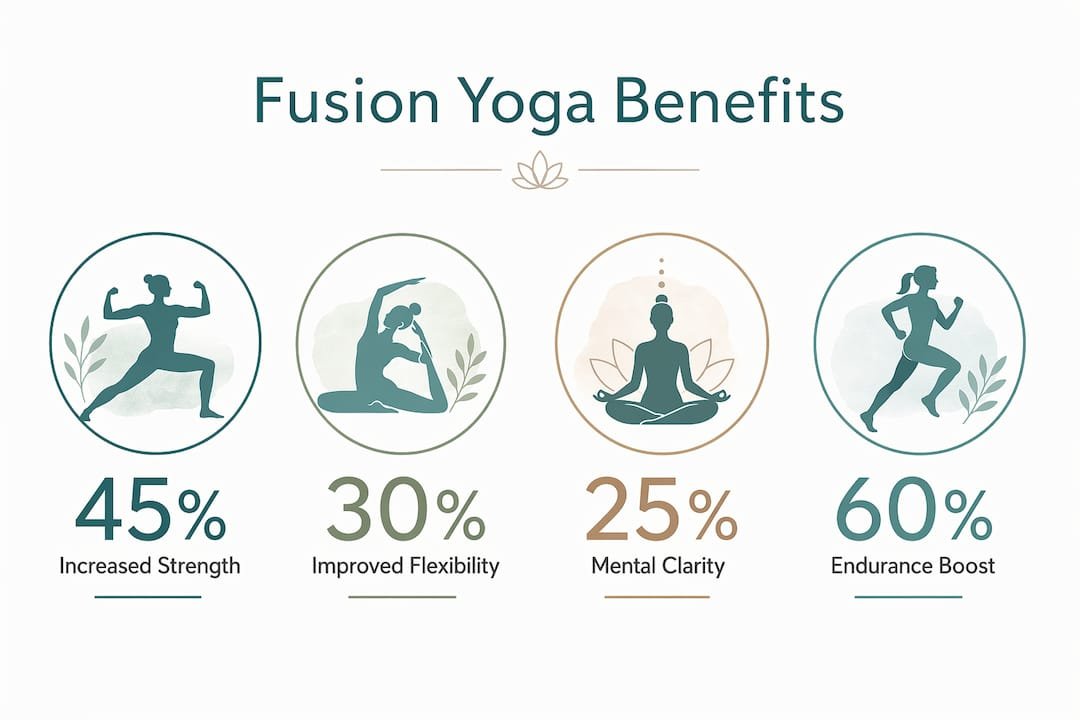
Can chair yoga help with balance and fall prevention?

Yes. Research on FallProof chair-supported exercise programs shows large effect sizes for static balance improvement and measurable reductions in fear of falling among older adults. Both outcomes directly support independence and reduce fall risk.
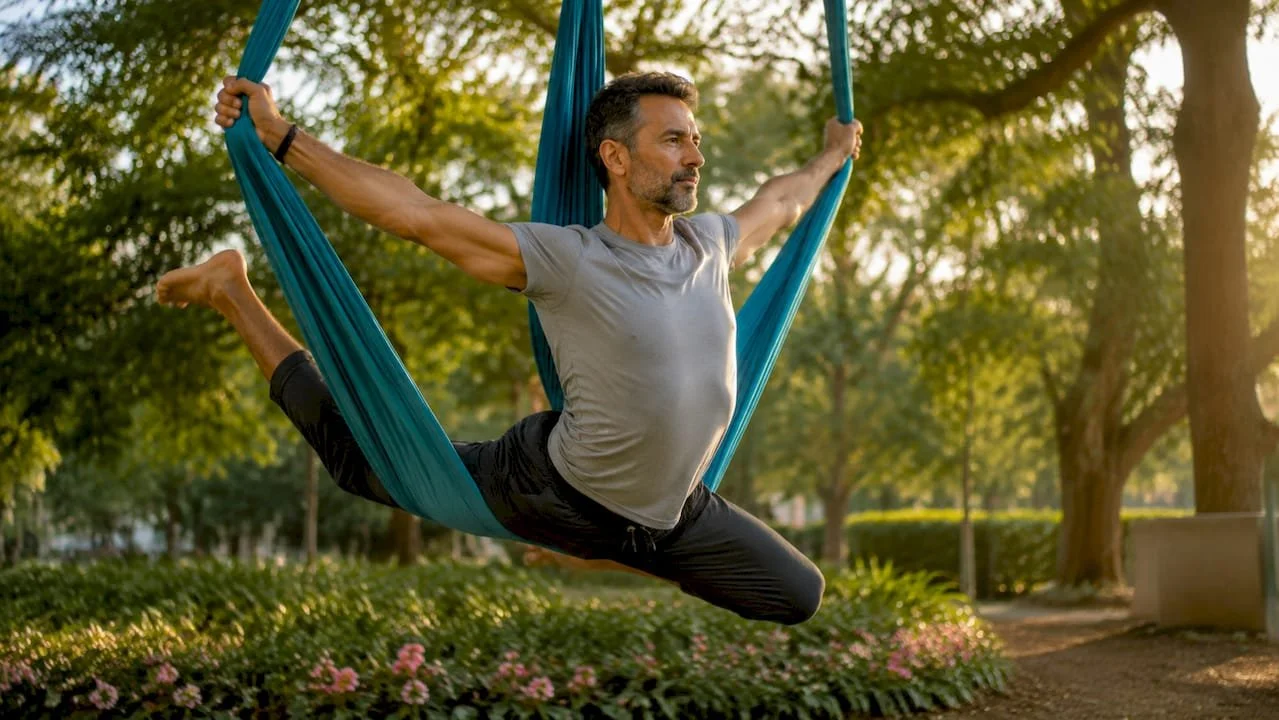
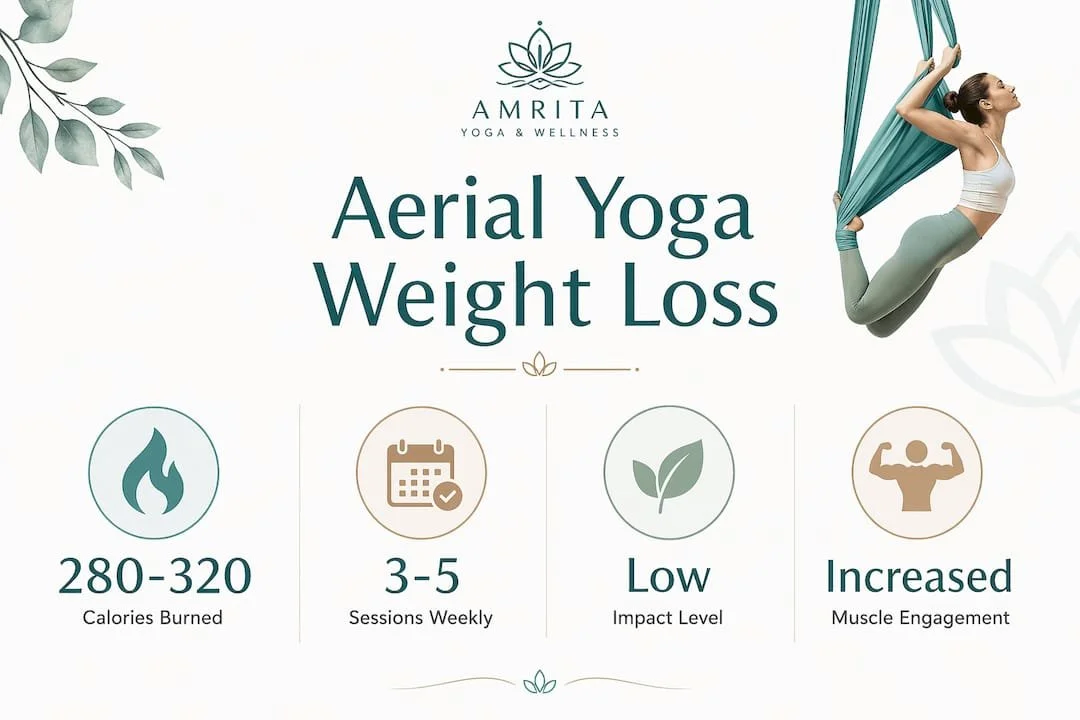
Do I need any equipment to start chair yoga?

You need only a stable chair and enough space to extend your arms in all directions. Optional props like a yoga block, folded blanket, or firm cushion help maintain proper spinal alignment if your feet do not reach the floor or your hips sit below knee height.

Recommended

Best Meditation Techniques for Beginners in 2026

Heather Rice

TL;DR:

Starting meditation can be simple when focusing on manageable techniques like breath awareness and guided sessions that suit your mood and posture. Consistent short practice, set with a timer and integrated into daily routines, builds lasting habits regardless of technique choice. Remember, wandering minds are part of the process; gentle return and self-compassion ensure long-term success.

Starting a meditation practice sounds simple until you actually sit down and try it. With dozens of styles to choose from, the best meditation techniques for beginners are ones that feel manageable, not mystical. The core idea is straightforward: you focus your attention on something, your mind wanders, and you gently bring it back. That cycle, repeated over and over, is the actual practice. This guide cuts through the noise and walks you through seven approachable techniques, how to choose between them, and how to build a habit that actually sticks.

Key Takeaways

Point Details
Start short and consistent 5 to 10 minute sessions daily build stronger habits than occasional long sits.
Mind-wandering is the practice Noticing distraction and returning focus is what meditation training actually looks like.
Match technique to your mood Flexible practice matched to energy keeps beginners engaged longer.
Use a timer from day one A set end time reduces restlessness and helps you stay seated without checking the clock.
No single method fits everyone Try multiple styles before deciding what works for your body, schedule, and temperament.

Best meditation techniques for beginners: how to choose

Before you try a single technique, it helps to know what you are actually looking for. The right meditation style depends on your personality, your schedule, and how comfortable you are sitting in silence.

Here is a practical framework to evaluate any technique before you commit:

  • Session length. Can you realistically do this for five minutes today? If a method requires 30 minutes of stillness and you have never meditated before, the bar is too high. Start with what you can show up for.

  • Posture flexibility. Some people cannot sit cross-legged on the floor without discomfort. Good news: most techniques work fine in a chair, on a couch, or even lying down.

  • Guided vs. silent. Guided meditation gives you a voice to follow, which removes the pressure of "doing it right" on your own. Silent practice is more flexible but demands more self-direction. Neither is better. One may suit you more right now.

  • Your energy level. A body scan works well when you are tired and need to slow down. Walking meditation suits days when sitting feels impossible. Match the method to the moment.

  • Emotional readiness. Loving-kindness meditation asks you to direct warmth toward yourself, which some beginners find unexpectedly challenging. If self-compassion is hard for you right now, start with breath or sound awareness instead.

Pro Tip: Don't commit to one technique for weeks before trying others. Spend three days on breath awareness, three on a body scan, three on guided audio. You'll know what resonates faster than you think.

There is no wrong choice here. Trial and error is the method.

1. Breath awareness

This is where most people start, and for good reason. You sit comfortably, close your eyes, and place your full attention on the natural rhythm of your breath. The inhale. The pause. The exhale.

When your mind wanders to your grocery list or a conversation from yesterday, you simply notice that it wandered and return to the breath. No frustration needed. According to Simply Psychology, that act of noticing and returning is the actual training. You are not failing when your mind wanders. You are succeeding every time you catch it.

Breath awareness requires nothing except a comfortable seat and a few minutes. It pairs well with breathwork fundamentals if you want to deepen your understanding of how breath affects the body.

Best for: Anyone who wants the simplest possible starting point.

2. Guided meditation

If silence feels uncomfortable or you catch yourself wondering whether you are doing it correctly, guided meditation removes that uncertainty entirely. A teacher or audio recording walks you through the session moment by moment: where to place your attention, how to breathe, what to notice.

Guided sessions reduce self-consciousness for new meditators and make it much easier to stay present for the full session. Apps, YouTube videos, and studio classes all offer this format. Many beginners find that guided audio is the easiest on-ramp into daily practice.

Best for: People who feel anxious about "doing it wrong" or who get distracted quickly in silence.

3. Body scan

The body scan shifts your attention away from the breath and moves it systematically through different parts of your body. You might start at the top of your head and slowly work down to your feet, noticing any tension, warmth, tingling, or numbness along the way.

Body scan meditation grounds attentionwith concrete physical targets, which makes it easier for beginners who find breath focus too abstract. It can be done seated or lying down, and no equipment is needed. It is especially effective before sleep or after a stressful day.

Best for: People who feel disconnected from their body or who struggle to focus on breath alone.

4. Walking meditation

Sitting still is not the only way to meditate. Walking meditation asks you to bring your full attention to the physical experience of walking: the pressure of your foot against the ground, the movement of your legs, the air on your skin.

You walk slowly and deliberately, indoors or outside, and return your attention to those sensations whenever the mind pulls away. Movement meditation helps maintain attention when seated practice feels frustrating or impossible. It is also a natural fit if you already go for daily walks and want to turn that time into intentional practice.

Best for: Active people, restless beginners, or anyone who finds sitting still genuinely difficult.

5. Loving-kindness meditation (metta)

Loving-kindness, or metta, is less about focusing attention and more about deliberately generating feelings of warmth and compassion. You silently repeat simple phrases like "May I be happy. May I be well. May I be at peace." Then you gradually extend those wishes outward to a loved one, a neutral person, and eventually everyone.

Metta meditation reduces self-criticismand builds goodwill over time. It can feel strange at first, especially the self-directed part. That strangeness is worth sitting with. Many people find it becomes the technique they return to most often.

Best for: People dealing with self-judgment, anxiety, or difficult relationships.

6. Mindfulness meditation

Mindfulness is often used as a catch-all term, but as a specific practice it means paying deliberate, non-judgmental attention to whatever is happening right now. Your breath, the sounds in the room, a physical sensation, or even your own thoughts can serve as the anchor.

You can explore mindfulness techniques for beginners across a wide range of formats, from seated practice to informal everyday awareness. What makes mindfulness particularly beginner-friendly is that the anchor is flexible. If breath focus triggers discomfort, switching to sounds or sensations as anchors can prevent frustration and keep the practice sustainable.

Best for: Anyone who wants a flexible, adaptable daily practice.

7. Visualization meditation

Visualization asks you to hold a specific image in your mind with as much sensory detail as possible. A calm beach, a forest path, a warm light spreading through your body. The image becomes your anchor, replacing breath or body sensation.

This technique works particularly well for people who find abstract focus difficult but respond easily to imagery. It is also useful for goal-setting and emotional regulation beyond the meditation session itself. The catch: visualization requires a bit more mental effort than breath awareness, so it is worth trying after you have spent a few days with simpler methods.

Best for: Visual thinkers, creative types, or people who enjoy guided imagery audio tracks.

Comparing techniques at a glance

Technique Session length Posture Needs guidance? Complexity
Breath awareness 5+ minutes Flexible No Very low
Guided meditation 10–20 minutes Flexible Yes Very low
Body scan 10–15 minutes Seated or lying Optional Low
Walking meditation 10–20 minutes Standing/walking No Low
Loving-kindness 10–15 minutes Flexible Optional Medium
Mindfulness 5–20 minutes Flexible No Low
Visualization 10–20 minutes Flexible Optional Medium

Pro Tip: If you are completely new, spend your first week alternating between breath awareness and guided meditation. These two together cover the widest range of beginner needs and give you a real sense of what style fits your brain.

Building a meditation habit that actually lasts

Knowing seven techniques is only useful if you actually practice them. Here is what makes the difference between a habit that sticks and one that quietly disappears by week two.

Set a consistent time. Morning works well for many people because the day has not yet filled up with demands. That said, right after lunch or before bed are equally valid. The key is attaching meditation to an existing part of your routine, often called habit stacking.

Use a timer every session. Defined session lengths reduce the restlessness that comes from not knowing how long you have been sitting. Set five minutes, commit fully, and stop when it goes off. That boundary makes it easier to stay present.

  • Start at five minutes and add one minute per week, not per day.

  • Treat missed sessions as neutral information, not failures.

  • Keep your setup simple: one spot, one cushion, no ceremony required.

  • If a technique feels wrong on a given day, switch. Adapting to your energy is smart practice, not inconsistency.

Consistency matters more than duration. A five-minute daily practice outperforms a 45-minute session done twice a month. You can also explore different meditation types on the Amritayogawellness blog as your practice evolves.

My honest take on getting this right

Here is what I have seen over and over with people starting out: they expect meditation to feel peaceful. When it does not, they assume they are failing.

The truth is that a busy, wandering mind during meditation is not a problem to solve. It is the actual condition you are training with. Every time you notice the mind has drifted and you bring it back, that is one rep. That is the real measure of success, not how quiet your head feels.

I have also found that the people who sustain a practice long-term are not the ones who picked the "perfect" technique. They are the ones who were gentle with themselves when they skipped a day and kept the bar low enough to show up again the next morning.

If seated practice feels impossible, try walking meditation. If silence makes you spiral, use guided audio. There is no hierarchy here. Simple, short, and consistent will always beat ambitious and sporadic.

— Juiced

Start your practice with Amrita Yoga & Wellness

If you have read this far and feel ready to move from reading to doing, Amritayogawellness is a great place to take that next step. Amrita Yoga & Wellness in Philadelphia offers guided meditation sessions, yoga classes, and workshops designed specifically to support people who are just getting started.

Beyond movement and breathwork, Amritayogawellness also offers tarot readings for those looking to pair their meditation practice with deeper self-reflection and emotional clarity. Many students find that combining mindful awareness with intuitive tools opens up an entirely new layer of understanding. Whether you want to attend a class, explore the workshop schedule, or simply browse resources, the Amritayogawellness community is built for exactly the kind of beginner you are right now.

FAQ

How long should beginners meditate each day?

Starting with 5 to 10 minutes daily is the most practical approach. Consistency matters far more than session length when you are building a new habit.

What if my mind won't stop wandering during meditation?

Mind-wandering is a normal part of the process, not a sign you are doing it wrong. The practice is in noticing the wandering and gently returning your attention to your chosen anchor.

Is guided meditation better than silent meditation for beginners?

Guided meditation reduces self-consciousness and provides structure, making it easier for many beginners to stay focused. Neither style is superior. Try both in your first two weeks to see what feels more natural.

What is the easiest meditation technique for a complete beginner?

Breath awareness is the most accessible starting point. It requires no equipment, no guidance, and no special posture. Simply follow your natural inhale and exhale, and return your attention each time the mind wanders.

Can I meditate if I can't sit still?

Yes. Walking meditation is a documented option for people who struggle with seated practice. It uses slow, deliberate movement as the anchor instead of breath or body sensation.

Recommended