The Amrita Journal
Explore thoughtful stories, practical wellness guidance and inspiring ideas to support your movement, mindfulness and everyday wellbeing at Amrita.
Learn Yoga Poses: A Beginner's Complete 2026 Guide
TL;DR:
Mastering 12 to 15 foundational yoga poses builds strength, flexibility, and calm for beginners. Consistent practice with correct alignment and steady breath prevents injuries and fosters progress. Guidance from a qualified instructor enhances safety and helps develop a lasting, effective yoga routine.
Learning yoga poses means mastering a set of foundational asanas, the Sanskrit term for body postures, that build strength, flexibility, balance, and calm through mindful movement and breath. These postures are not just exercise. They are a structured physical practice with clear alignment rules, breath cues, and progression paths that make them safe for nearly any body. Yoga experts recommend beginners start with 12–15 foundational postures representing major movement categories: standing, backbends, twists, seated, hip openers, and relaxation poses. Amritayogawellness, based in Philadelphia, teaches exactly this kind of structured, accessible approach to help practitioners at every level build a real practice.
What are the essential yoga poses beginners should learn first?
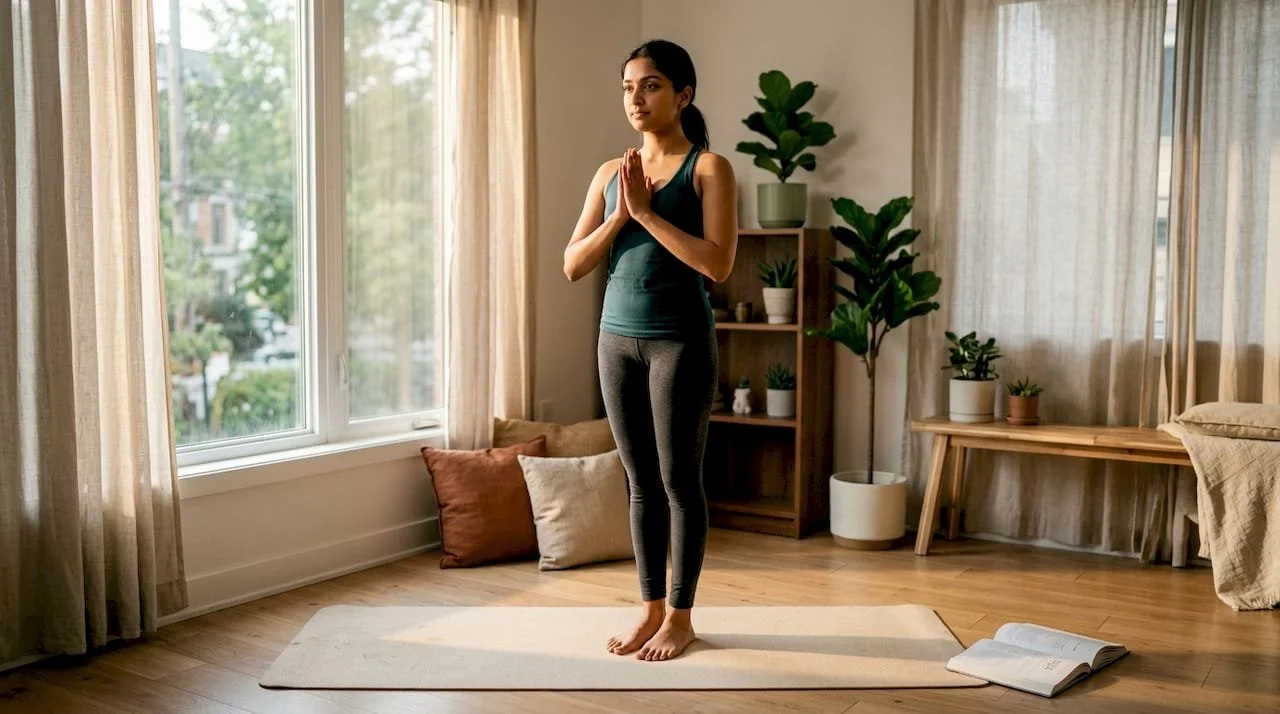
The best place to learn yoga poses is with a short list of core postures that cover every major movement pattern. Mountain Pose (Tadasana) is the foundational standing pose and the reset point for your entire practice. It aligns the spine, engages the core, and calms the breath. Every other standing pose grows from it.
Here are the core beginner postures organized by category:
Standing poses
Mountain Pose (Tadasana): stand tall, feet together, arms at sides, spine long
Warrior I (Virabhadrasana I): front knee bent, back leg straight, arms overhead
Warrior II (Virabhadrasana II): arms open wide, gaze over front hand
Triangle Pose (Trikonasana): legs straight, torso long, one hand reaching down
Backbends
Cobra Pose (Bhujangasana): lie face down, press palms into mat, lift chest gently
Bridge Pose (Setu Bandhasana): lie on back, feet flat, lift hips toward ceiling
Twists and hip openers
Seated Spinal Twist (Ardha Matsyendrasana): sit tall, rotate torso, keep spine long
Low Lunge (Anjaneyasana): front knee over ankle, back knee down, hips square
Seated and floor poses
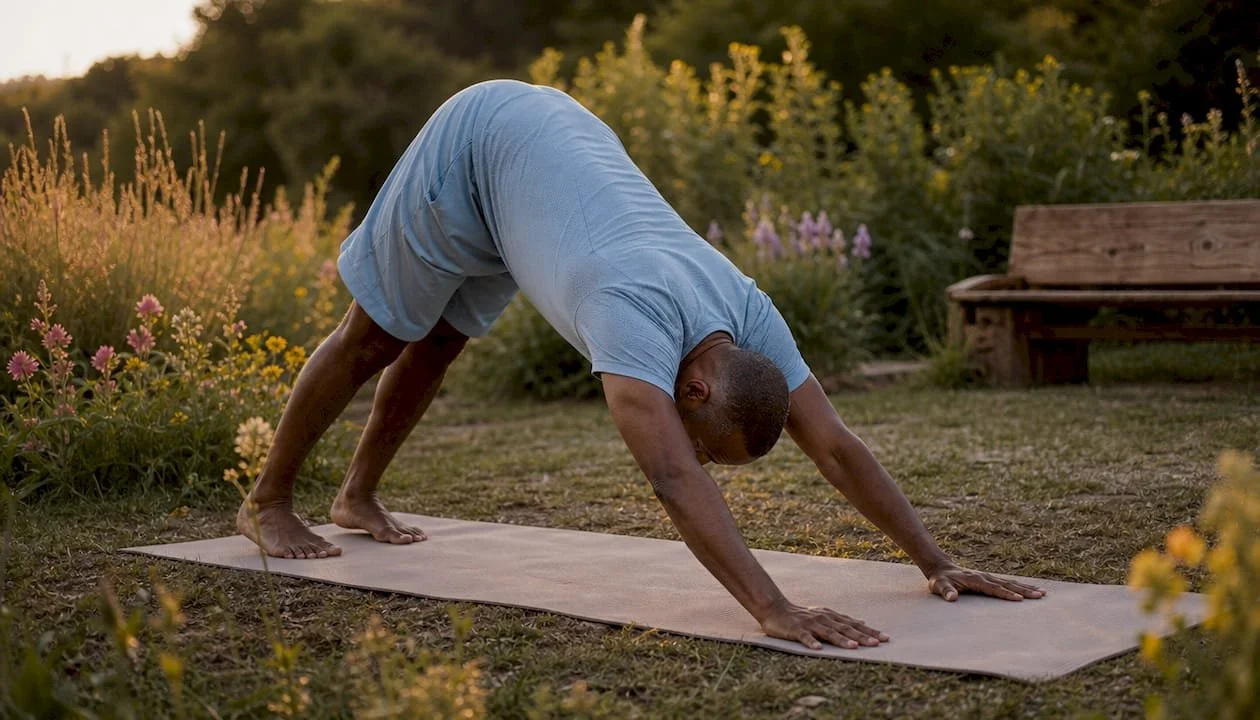
Downward Facing Dog (Adho Mukha Svanasana): inverted V shape, heels pressing toward floor
Child's Pose (Balasana): kneel, fold forward, arms extended or alongside body
Relaxation
Corpse Pose (Savasana): lie flat on your back, eyes closed, body completely still
Child's Pose and Corpse Pose are not optional extras. They are recovery tools built into every session. Child's Pose resets your nervous system mid-practice. Savasana at the end allows your body to absorb the work you just did.
Pro Tip: Every time you feel lost or overwhelmed during a session, return to Mountain Pose. It recalibrates your posture and breath in under 30 seconds.
What equipment and preparation do you need to start?
A yoga mat is the only essential piece of equipment for beginners practicing at home. No specialized props are required to get started. That said, a few optional tools make early practice more comfortable and safe.
| Item | Purpose | Required? |
|---|---|---|
| Yoga mat | Grip, cushion, and defined space | Yes |
| Yoga blocks (2) | Bring the floor closer in standing poses | Optional |
| Yoga strap | Extend reach in seated stretches | Optional |
| Blanket | Extra cushion under knees or hips | Optional |
| Comfortable clothes | Allow full range of motion | Yes |
Beyond gear, your environment matters. Choose a quiet space with enough room to extend your arms and legs fully in all directions. Turn off notifications. Keep water nearby. A consistent spot in your home trains your brain to shift into practice mode faster each time you show up.
Warm up for 3–5 minutes before your first pose. Simple neck rolls, shoulder circles, and gentle spinal movements prepare your joints and reduce the risk of strain.
How to learn yoga poses effectively and safely
Structured sequences are safer and more effective than randomly picking poses from social media. Random selection skips the logical progression that protects your joints and builds strength in the right order. A structured approach looks like this:
Start with relaxation. Begin in Mountain Pose or a simple seated position. Take 5 slow breaths to arrive in your body before moving.
Learn the entry of each pose first. Know how to get into a pose before you think about going deeper. Rushing depth before stability causes most beginner injuries.
Establish your foundation. Press your feet, sitting bones, or hands firmly into the mat before activating any other muscle group. Pressing down the foundation before engaging other muscles is the single most important alignment principle in yoga.
Build alignment from the ground up. Once your foundation is set, work upward: ankles, knees, hips, spine, shoulders, head. Never skip a layer.
Hold for 3–5 breaths. Holding poses for 3 to 5 breaths maintains stability without risking injury. Count breaths, not seconds.
Exit with control. Come out of each pose as deliberately as you entered it. Collapsing out of a pose undoes the alignment work you just built.
Rest between effort. Return to Mountain Pose or Child's Pose between challenging postures. Your nervous system needs those moments.
Maintaining calm, even breath through a hold matters more than deepening the pose. If your breath becomes ragged or stops, reduce the intensity until breathing is steady again. Breath is the real measure of whether a pose is working for you.
Iyengar yoga is particularly well suited for beginners because it focuses on detailed alignment and uses props extensively. If you want a style that teaches you exactly how each pose should feel in your body, Iyengar classes are worth exploring.
Pro Tip: Record yourself in a pose with your phone once a week. What you feel and what you look like are often very different. Video feedback replaces the mirror a studio instructor would provide.
Check out these beginner yoga tips from Amritayogawellness for more on building a structured home practice.
Common mistakes beginners make and how to avoid them
Most beginner injuries and plateaus come from a short list of repeatable errors. Knowing them in advance puts you ahead of the curve.
Ignoring the foundation. Improper weight stacking and failing to engage the foundation causes joint strain in knees, wrists, and lower back. Press down before you lift up, every time.
Holding your breath. Stopping the breath during challenging holds reduces the effectiveness of the pose and raises injury risk. If you cannot breathe steadily, back out of the pose slightly.
Chasing advanced poses too soon. Arm balances and deep backbends require months of foundational work. Attempting them from week one based on an online image is the fastest route to a shoulder or wrist injury.
Skipping rest poses. Child's Pose and Savasana are not signs of weakness. They are built-in recovery that makes the harder poses possible.
Practicing without any instruction. Following a random video without understanding alignment cues is like learning to drive from watching car commercials. Structured guidance from a qualified teacher changes the quality of your practice immediately.
The single most overlooked mistake is breath suppression. Beginners focus so hard on the shape of a pose that they forget to breathe. Breath is not a side effect of yoga. It is the practice itself.
For a deeper look at foundational postures and how to approach them safely, Amritayogawellness has a dedicated guide worth reading before your first session.
How to build a beginner yoga routine using core poses
A consistent routine beats an occasional intense session every time. Sandwiching strenuous movement between guided relaxation, starting and ending with Mountain Pose and Corpse Pose, builds a mental association between yoga and calm. That association keeps you coming back.
Here is a sample 30-minute beginner sequence:
Mountain Pose (Tadasana) — 5 breaths, set intention
Child's Pose (Balasana) — 5 breaths, open hips and spine
Downward Facing Dog — 5 breaths, full body stretch
Low Lunge (right side) — 5 breaths, hip flexor opener
Low Lunge (left side) — 5 breaths
Warrior I (right side) — 5 breaths, standing strength
Warrior I (left side) — 5 breaths
Triangle Pose (both sides) — 5 breaths each
Bridge Pose — 5 breaths, gentle backbend
Seated Spinal Twist (both sides) — 5 breaths each
Child's Pose — 5 breaths, cool down
Corpse Pose (Savasana) — 3–5 minutes, full rest
| Session phase | Poses | Duration |
|---|---|---|
| Opening and grounding | Mountain Pose, Child's Pose | 3–5 minutes |
| Active standing work | Warriors, Triangle, Lunge | 12–15 minutes |
| Floor and backbend work | Bridge, Twist, Dog | 8–10 minutes |
| Closing relaxation | Child's Pose, Savasana | 5–7 minutes |
Adapt this sequence as your strength and flexibility grow. Add one new pose per week rather than overhauling the entire routine. Consistency with a short sequence beats variety with no depth. Aim for three sessions per week to start. Your body needs recovery time between sessions, especially in the first month.
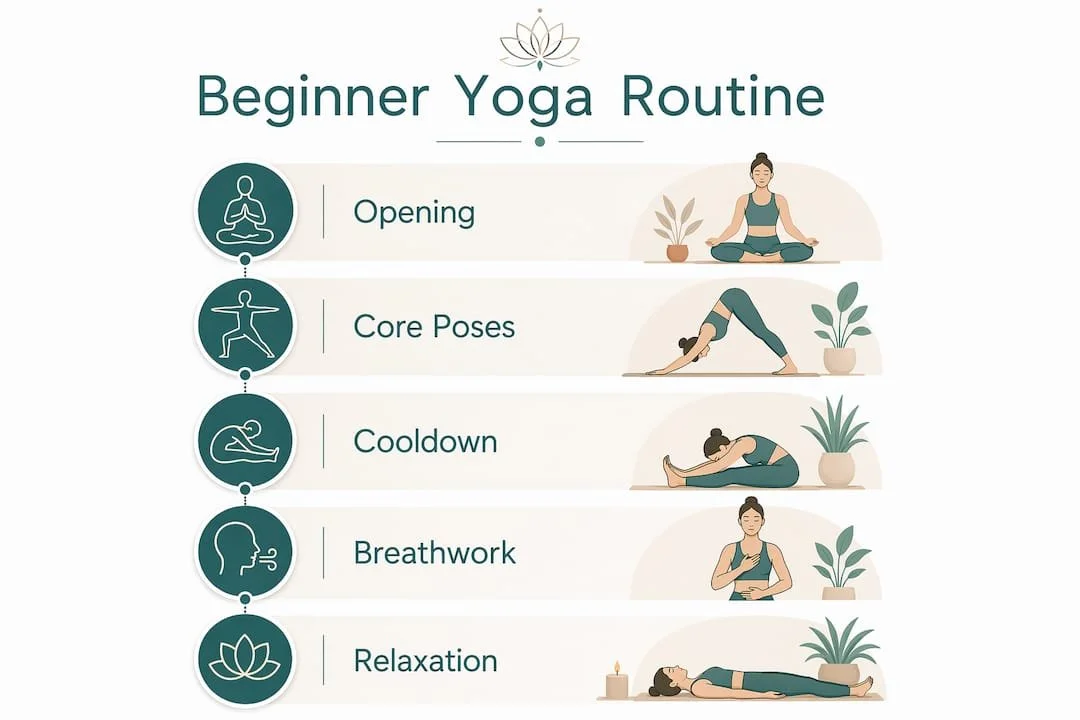
Explore these basic yoga poses from Amritayogawellness to see how Mountain Pose anchors a full beginner sequence.
Key Takeaways
The most effective way to learn yoga poses is to start with 12–15 foundational postures, build alignment from the ground up, and prioritize steady breath over pose depth at every stage.
| Point | Details |
|---|---|
| Start with core postures | Begin with 12–15 foundational poses across standing, backbend, twist, and relaxation categories. |
| Foundation first | Press feet or sitting bones into the mat before engaging any other muscle group. |
| Breath over depth | If your breath stops, reduce the pose intensity until steady breathing returns. |
| Hold for 3–5 breaths | This standard hold time builds stability without overloading joints or muscles. |
| Structure beats random selection | A planned sequence protects alignment and prevents the injuries that random pose picking causes. |
What I've learned from years of watching beginners practice
The most common thing I see in new practitioners is the rush. People want Warrior III in week two. They want the splits by month one. And every time that rush shows up, so does the injury, the frustration, and the dropout.
The practitioners who stay are the ones who fall in love with Mountain Pose. That sounds almost absurd, but it's true. When you understand what Tadasana is actually asking of your body, every other pose makes more sense. The alignment principles stack. The breath becomes natural. The harder poses arrive on their own timeline.
Breath is the part most people skip in their reading and most instructors underemphasize in beginner classes. If you take one thing from this guide, let it be this: your breath is the quality control system for your entire practice. The moment it becomes labored or stops, your pose is too deep. Back out. Breathe. Try again.
Structured instruction matters more than equipment, more than the style of mat you buy, and more than how flexible you are on day one. A free beginner yoga class with a qualified teacher gives you alignment feedback that no video can replicate. Seek that out early. It compresses months of solo trial and error into a single session.
Patience is not a soft skill in yoga. It is a technical requirement.
— Juiced
Amritayogawellness: where beginners build real practice
Amritayogawellness offers beginner-focused classes in Philadelphia designed around exactly the foundational approach this guide describes. Structured sequences, expert alignment cues, and a welcoming community make it easier to build consistency from your very first session.
The studio's beginner yoga classes cover standing poses, breath work, and relaxation in a format that keeps new practitioners safe and engaged. For those looking to complement their physical practice with mindfulness and reflection, Amritayogawellness also offers tarot readings as part of its broader wellness programming. Whether you are stepping onto a mat for the first time or returning after a long break, Amritayogawellness gives you the structure and support to make it stick.
FAQ
What yoga poses should a complete beginner learn first?
Beginners should start with Mountain Pose, Child's Pose, Downward Facing Dog, Warrior I, and Corpse Pose. These five postures cover the core movement patterns and give you a complete, safe practice from day one.
How long should beginners hold each yoga pose?
Hold each pose for 3 to 5 breaths. This standard hold time builds stability and alignment without overloading muscles or joints.
Do I need special equipment to start learning yoga at home?
A yoga mat is the only required piece of equipment. Blocks and straps are helpful but optional, and most beginner poses work fine without them.
How often should beginners practice yoga poses?
Three sessions per week is a strong starting point. Your body needs recovery time between sessions, especially in the first four to six weeks of practice.
Why is breath so important when learning yoga poses?
Holding your breath during poses reduces effectiveness and raises injury risk. Steady breath is the clearest signal that your body is working with the pose rather than fighting it.
Recommended
Chair Yoga Poses for Beginners: Build Flexibility Safely

TL;DR:
Chair yoga is an accessible, low-impact practice performed entirely from a seated position or with support, suitable for adults of any age or fitness level. It emphasizes safety by using sturdy, armless, non-wheeled chairs on non-slip surfaces and incorporates breath-paced poses that improve flexibility, balance, and confidence, especially for seniors or individuals with mobility limitations.Practicing short, consistent sessions focusing on foundational poses helps build strength, mobility, and body awareness while reducing fall risk and supporting mental well-being, making chair yoga a complete and inclusive approach to wellness.
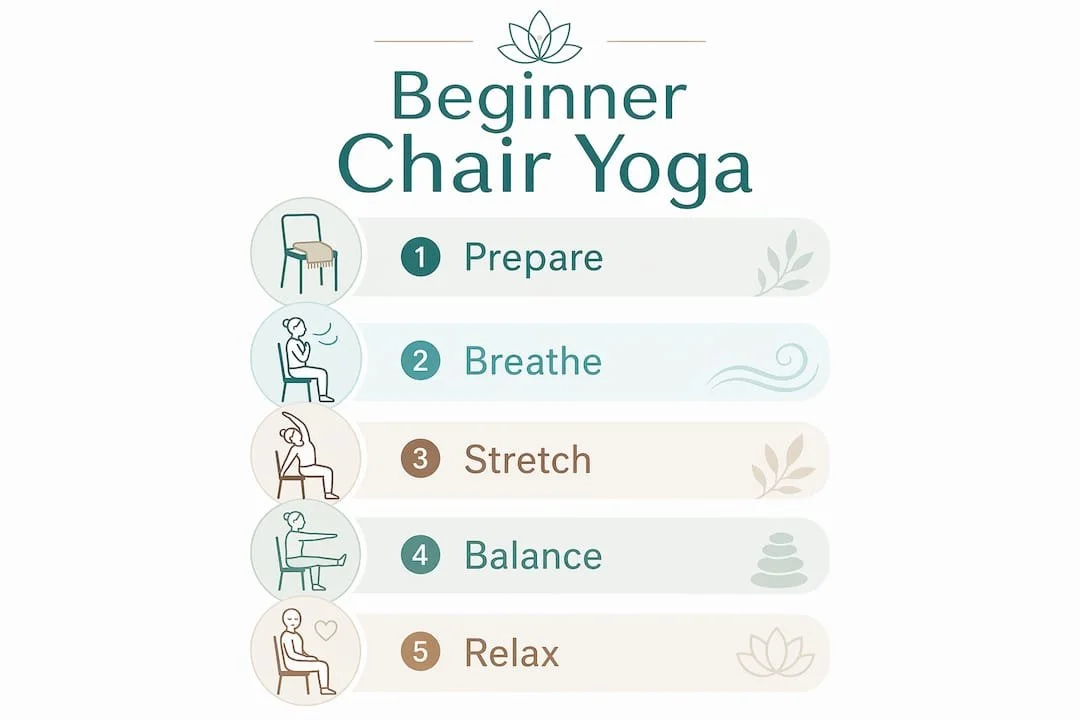
Chair yoga is defined as a modified form of traditional yoga practiced entirely from a seated position or with a chair for support, making it one of the most accessible entry points into yoga for adults of any age or fitness level. If you have limited mobility, joint pain, or simply no prior yoga experience, chair yoga poses for beginners give you a structured, low-impact way to improve flexibility, circulation, and stress levels without getting down on the floor. You need nothing more than a sturdy chair and a few feet of open space. The practice draws from foundational yoga traditions while removing the physical barriers that keep many people from starting.
What do you need to safely start chair yoga at home?
The single most important factor in chair yoga is your chair. Yoga therapist Michelle A. Thielen recommends using a sturdy, armless chair placed on a non-slip surface as the baseline safety requirement for any beginner. That means no office chairs with wheels, no recliners, and no chairs with wobbly legs. Instability in the chair translates directly into instability in your body, and that is where injuries happen.
Once you have the right chair, your seated position matters just as much as the poses themselves. The New York Times 2026 beginner guide recommends sitting centered with knees bent at approximately 90 degrees and feet hip-width apart on the floor. This alignment keeps your spine neutral and your weight evenly distributed, which is the foundation every pose builds on.
Here is what to check before your first session:
Chair: Armless, four-legged, non-wheeled, placed on a non-slip mat or rug
Seating position: Hips at or slightly above knee height, feet flat on the floor
Props: A yoga block or folded blanket under your feet if they do not reach the floor; a cushion under your hips if the seat is too low
Clothing: Comfortable, non-restrictive clothing and non-slip shoes or bare feet
Space: Enough room on all four sides to extend your arms fully without hitting furniture
Session length: Start with 10 to 20 minutes per session, three times per week, and build from there
Pro Tip: If your feet dangle above the floor, place a yoga block or a thick book under them. Unsupported feet cause your pelvis to tilt backward, which collapses your lower spine and makes every twist and fold harder and less safe.
Which chair yoga poses are best for beginners?
Yoga therapist Michelle Thielen's five foundational poses for beginners cover the major movement patterns your body needs: neutral sitting, spinal flexion and extension, forward folding, rotation, and relaxation. Work through them in this order, which sequences the practice like a ladder from simple to more complex and back to rest.
Easy pose (Sukhasana in the chair). Sit toward the front half of the seat with your spine tall, hands resting on your thighs, and feet flat on the floor. Close your eyes and take five slow breath cycles. This pose establishes your baseline posture and trains your body to recognize what neutral alignment feels like before any movement begins.
Seated cat-cow stretch. Place both hands on your knees. On an inhale, arch your lower back and lift your chest (cow). On an exhale, round your spine and drop your chin toward your chest (cat). Move through five full breath cycles at a pace that matches your breathing. This is the most effective warm-up for the entire spine and is particularly useful for anyone with morning stiffness.
Seated forward fold. From your tall seated base, hinge forward at the hips and let your torso drape toward your thighs. Let your hands rest on your shins or the floor. Hold for five breath cycles, then slowly roll back up one vertebra at a time. This pose stretches the hamstrings, lower back, and neck without any floor contact.
Seated spinal twist. Sit tall and place your right hand on your left knee and your left hand on the back of the chair seat. On an inhale, lengthen your spine. On an exhale, rotate gently to the left. Hold for three to five breaths, then repeat on the other side. Twists improve spinal mobility and support digestion. If your feet do not reach the floor, use a block under them to keep your pelvis level before rotating.
Chair pigeon pose. Cross your right ankle over your left knee, keeping your right foot flexed to protect the knee joint. Sit tall and, if comfortable, gently hinge forward at the hips. Hold for five breaths, then switch sides. This pose targets the outer hip and glutes, which are chronically tight in people who sit for long periods.
Seated eagle arms. Extend both arms forward at shoulder height, then cross your right arm under your left and either press the backs of your hands together or wrap your forearms so your palms meet. Lift your elbows slightly and hold for five breaths. This stretch opens the upper back and shoulders, areas that carry significant tension for most adults.
Seated savasana. Finish every session by sitting back fully in the chair, closing your eyes, and resting your hands in your lap. Breathe naturally for one to two minutes. This is not optional. Savasana allows your nervous system to absorb the benefits of the practice and signals a clear end to the session.
Pro Tip: Use breath counting as your pacing tool throughout every pose. Yoga therapist Michelle Thielen calls it a "form cheat code." Counting five breath cycles tells you exactly how long to hold without watching a clock, and it keeps your attention on breathing rather than discomfort.
How to build a beginner chair yoga routine and avoid common mistakes
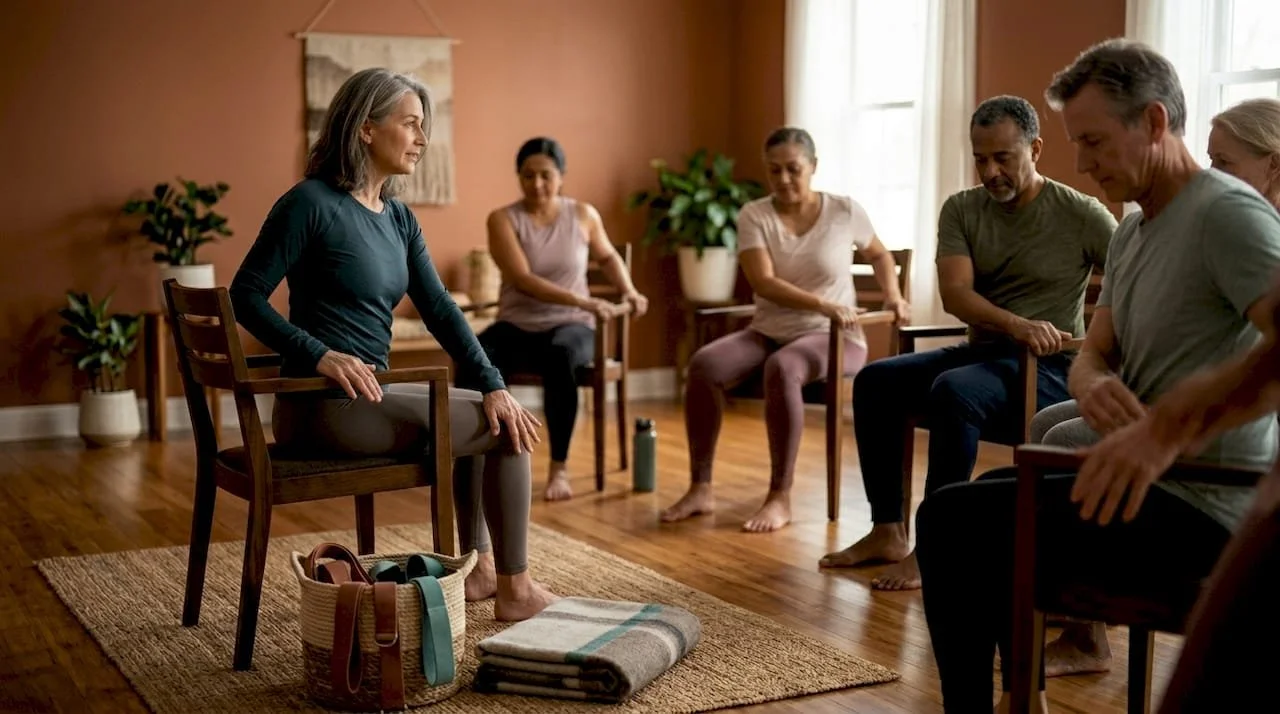
A beginner chair yoga routine works best at 10 to 20 minutes per session, practiced three times per week. That frequency is enough to build noticeable flexibility gains within four to six weeks without overtaxing joints or muscles that are new to movement. Short, consistent sessions outperform long, infrequent ones every time.
Structure each session in three phases: a two-minute warm-up using easy pose and cat-cow, a ten to fifteen minute movement block using the poses above, and a one to two minute seated savasana at the end. This mirrors the warm-up, work, and recovery structure used in physical therapy and is the same ladder-style sequencing that yoga therapist Michelle Thielen recommends for beginner pose progressions.
The most common mistakes beginners make are predictable and easy to fix:
Forcing a stretch: Pain is a stop signal, not a progress signal. Work to the edge of mild tension and stop there.
Holding your breath: Breath-holding spikes blood pressure and creates muscle tension. If you cannot breathe smoothly in a pose, back off the intensity.
Rushing transitions: Moving too fast between poses removes the alignment check that keeps each posture safe. Pause for one full breath between every pose.
Using the wrong chair: Chairs with wheels or unstable armrests are the leading chair yoga safety risk for beginners. This point cannot be overstated.
Skipping props: If your feet do not reach the floor or your hips sit below your knees, your spine cannot stay neutral. Use a block, cushion, or folded blanket without hesitation.
Pro Tip: Place a folded yoga blanket or firm cushion under your hips at the start of every session. Elevating the hips even one inch makes it significantly easier to maintain an upright spine during twists and forward folds, which is the single biggest alignment fix for most beginners.
As you build confidence over several weeks, you can incorporate supported standing poses using the chair back for balance. Standing chair work adds a leg-strengthening and balance component that seated poses alone cannot provide.
What are the benefits of chair yoga for seniors and people with health limitations?
Chair yoga is a clinically recognized adaptive yoga practice, not simply a gentler version of mat yoga. A BMC Geriatrics meta-analysis of FallProof exercise programs, which use chair-supported movement as a core component, found large effect sizes for improvements in static balance and significant reductions in fear of falling among older adults. Fear of falling is itself a major risk factor for falls, so reducing it has direct, measurable impact on safety and independence.
Structured chair yoga movements improve physical function and psychosocial outcomes, including reducing fear of falling, which is key to sustaining independence in older adults.
For people managing osteoarthritis, chair yoga therapy offers a way to improve joint range of motion and muscle strength without the loading stress of standing or floor-based exercise. The stable chair removes the fear of losing balance, which allows people with joint pain to focus on movement quality rather than stability. That shift in attention produces better outcomes and higher adherence.
The yoga for seniors community consistently reports that the psychological benefits of chair yoga, including reduced anxiety, improved mood, and greater sense of body confidence, appear within the first two to three weeks of regular practice. These outcomes matter as much as the physical ones, particularly for adults who have been sedentary for a long time and need early wins to stay motivated.
If you manage a chronic condition such as heart disease, diabetes, or severe osteoporosis, consult your healthcare provider before starting any new movement program, including chair yoga. Most providers will support the practice, but individual modifications may apply.
Key takeaways
Chair yoga poses for beginners work because they combine safe, supported movement with breath-paced progressions that build flexibility, balance, and confidence without requiring floor access or prior fitness.
| Point | Details |
|---|---|
| Chair selection is non-negotiable | Use a sturdy, armless, non-wheeled chair on a non-slip surface before attempting any pose. |
| Breath counting paces every pose | Hold each pose for five breath cycles to prevent over-stretching and keep attention on form. |
| Short sessions build lasting habits | Practice 10 to 20 minutes three times per week for measurable flexibility gains within four to six weeks. |
| Props prevent the most common alignment errors | Elevate hips or feet with a block or cushion if your seated base is not neutral. |
| Chair yoga has clinical support for seniors | FallProof research shows large effect sizes for balance improvement and reduced fear of falling in older adults. |
Why chair yoga changed how I think about starting a yoga practice
Most people assume that starting yoga means getting on the floor, holding difficult poses, and feeling inadequate next to more flexible students. Chair yoga dismantles that assumption completely. In my experience working with beginners at Amrita Yoga & Wellness, the adults who start with chair yoga build better body awareness than those who jump straight into mat classes. They learn to feel their spine, track their breath, and recognize the difference between productive tension and pain. Those skills transfer directly to every other form of movement.
The hesitation I see most often is the belief that chair yoga is "too easy" to be worth doing. That belief disappears after the first seated spinal twist held for five full breath cycles. Breath-paced holds are genuinely challenging. They require focus, patience, and the willingness to stay present in your body, which is exactly what yoga is supposed to teach.
My honest recommendation: start with the seven poses in this article, practice them three times a week for four weeks, and pay attention to how your hips, spine, and shoulders feel on day 28 compared to day one. The changes will be specific and noticeable. That is the point. Chair yoga is not a consolation prize for people who cannot do "real" yoga. It is a complete practice that meets you exactly where you are.
— Juiced
Explore chair yoga classes and wellness programs at Amrita Yoga & Wellness
Amrita Yoga & Wellness in Philadelphia offers classes and resources designed for practitioners at every level, including beginners who are just discovering the benefits of seated and adaptive yoga.
Whether you are looking to deepen your chair yoga practice or explore how holistic wellness tools support your overall well-being, Amrita Yoga & Wellness has options worth exploring. The studio also offers tarot readings as part of its broader wellness programming, a thoughtful complement to a mindful movement practice. Visit the site to browse class schedules, beginner resources, and community offerings built around inclusivity and personal growth.
FAQ
What is chair yoga for seniors?
Chair yoga for seniors is a modified yoga practice performed from a seated position or with a chair for support, designed to improve flexibility, balance, and strength safely. It removes the need to get down on the floor, making it accessible for adults with limited mobility or chronic conditions.
How long should a beginner chair yoga session be?
Beginner chair yoga sessions work best at 10 to 20 minutes, practiced three times per week. Short, consistent sessions build flexibility and habit without overtaxing joints new to movement.
Which chair is safe for chair yoga?
The safest chair for yoga practice is a sturdy, armless, four-legged chair placed on a non-slip surface. Chairs with wheels or unstable armrests significantly increase the risk of slipping or tipping during poses.
Can chair yoga help with balance and fall prevention?
Yes. Research on FallProof chair-supported exercise programs shows large effect sizes for static balance improvement and measurable reductions in fear of falling among older adults. Both outcomes directly support independence and reduce fall risk.
Do I need any equipment to start chair yoga?
You need only a stable chair and enough space to extend your arms in all directions. Optional props like a yoga block, folded blanket, or firm cushion help maintain proper spinal alignment if your feet do not reach the floor or your hips sit below knee height.
Recommended
12 Basic Yoga Poses for Beginners: Build Real Strength
TL;DR:
Starting yoga can feel overwhelming, but beginners don't need flexibility or experience to begin safely. Props, proper form, and consistency are key to building strength, flexibility, and body awareness over time. Incorporating simple poses like Mountain, Downward Dog, and Child's Pose gradually enhances overall well-being and prepares you for more advanced practice.
Starting yoga can feel like walking into a library where every book is written in a language you almost understand. Yoga practice among U.S. adults grew from 5% in 2002 to 15.8% in 2022, which means millions of people have been exactly where you are right now. Scrolling through poses, wondering if you need to be flexible already, and second-guessing whether you can do this without injuring yourself. You don't need flexibility, experience, or perfect form. You need a smart starting point. These 12 basic yoga poses for beginners give you exactly that.
Table of Contents
Key takeaways
| Point | Details |
|---|---|
| Flexibility is not required | Props like blocks and straps support alignment so beginners can practice safely from day one. |
| Pain signals to stop | Dull muscle aching is normal, but sharp or stabbing pain means you should exit the pose immediately. |
| Savasana is not optional | Skipping the final rest pose reduces anxiety relief and prevents your nervous system from resetting. |
| Props are professional tools | Using a strap or block is not a shortcut. It helps you build correct form faster. |
| Consistency beats intensity | Short, frequent sessions build more lasting strength and flexibility than occasional long practices. |
What to know before picking basic yoga poses for beginners
Not every pose belongs in a beginner's practice. The 12 poses covered here were chosen based on four factors: safety, accessibility, body coverage, and measurable benefit.
Safety first. Sharp, stabbing pain in any joint is your body telling you to stop. Dull muscle aching as you build strength is normal. If you cannot breathe comfortably in a pose, you have gone too far. That line matters more than any Instagram photo of a perfect posture.
Coverage matters. These poses span six categories:
Standing poses (Mountain, Warrior 1, Warrior 2, Standing Forward Bend)
Balancing poses (Tree)
Backbends (Cobra, Bridge)
Forward bends (Seated Forward Bend)
Seated poses (Easy Pose)
Floor and resting poses (Child's Pose, Cat-Cow, Corpse)
Flexibility is a result, not a requirement. Using props like blocks and straps is professional advice, not a sign of weakness. Props help you maintain proper alignment and prevent strain while your flexibility develops naturally over time. Reaching for a strap because your hamstrings are tight is a smart training decision.
Practice frequency. Two to three sessions per week gives your body enough time to adapt without overloading it. As you build confidence, you can increase that to four or five sessions.
Pro Tip: Focus on how a pose feels in your body rather than how it looks. A slightly bent knee with good alignment beats a straight leg with a rounded spine every time.
1. Mountain pose (Tadasana)
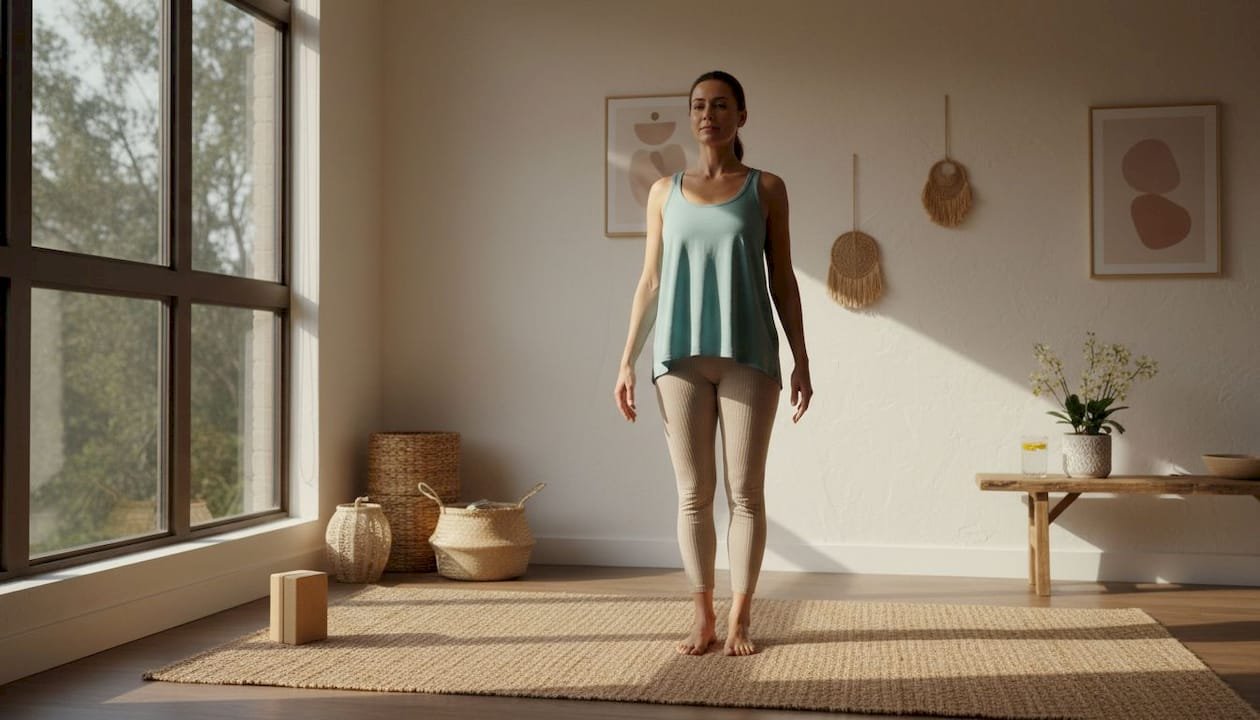
Mountain pose is the foundation for all standing poses, and it teaches you more than it appears to. Stand with your feet hip-width apart, arms at your sides, palms facing forward. Lift through the crown of your head while pressing your feet firmly into the floor. This is where you learn posture alignment, weight distribution, and grounding. Hold it for five to eight slow breaths and notice where your body wants to shift or collapse.
2. Downward facing dog (Adho Mukha Svanasana)
From hands and knees, press your hips up and back to form an inverted V shape. This pose stretches your hamstrings, calves, and spine while building shoulder and arm strength. Beginners often feel tightness in the back of the legs. Keep a generous bend in your knees to keep your spine long rather than forcing your heels to the floor. Hold for five to eight breaths.
3. Warrior 1 (Virabhadrasana I)
Step one foot forward into a lunge, with your back foot turned out at roughly 45 degrees. Bend your front knee to a 90-degree angle and raise your arms overhead. Warrior 1 builds leg strength and hip flexibility while opening the chest. If your back heel lifts, widen your stance. Repeat on both sides, holding for five breaths each.
4. Warrior 2 (Virabhadrasana II)
From Warrior 1, open your hips and arms to the side so your torso faces the long edge of your mat. Your front knee stays stacked over your ankle. Warrior 2 strengthens the thighs and improves stability. Gaze over your front fingertips and keep your shoulders relaxed. Both Warrior poses together give your legs and core a thorough workout with simple instructions anyone can follow.
5. Tree pose (Vrikshasana)
Stand on one foot and place your other foot on your inner calf or inner thigh, never on the knee joint. Bring your palms together at your chest. Tree pose trains your balance and concentration simultaneously. If balancing is difficult, keep your toes on the ground with just your heel resting on your ankle. A wall nearby is a perfectly good tool. Hold for five breaths, then switch sides.
6. Child's pose (Balasana)
Kneel, bring your big toes together, widen your knees, and fold forward with your arms extended or resting alongside your body. Child's pose is your built-in recovery station. Taking breaks during practice is part of healthy yoga. Any time a pose feels overwhelming or you need a moment, this is where you come. It gently stretches the lower back and hips while calming the nervous system.
7. Cat-Cow (Marjaryasana-Bitilasana)
Start on hands and knees. On your inhale, drop your belly, lift your chest, and look slightly up (Cow). On your exhale, round your spine toward the ceiling and tuck your chin (Cat). Move slowly and let your breath lead the movement. This pair improves spinal mobility and is one of the most effective simple yoga exercises for waking up the back in the morning. Do five to ten rounds at your own pace.
Pro Tip: In Cat-Cow, the breath drives the movement. Let the inhale naturally lift your chest and the exhale naturally round your back. You will get more spinal benefit and better body awareness this way.
8. Cobra pose (Bhujangasana)
Lie face down with your hands under your shoulders. On your inhale, press lightly through your palms and lift your chest off the floor. Keep your elbows slightly bent and your lower ribs on the mat. This is a gentle backbend that strengthens the muscles along your spine. Many beginners make the mistake of pushing too high and straining their lower back. A low Cobra, where your navel stays close to the floor, is safer and more effective at this stage.
9. Easy pose (Sukhasana)
Sit cross-legged with your hands resting on your knees. Lengthen your spine, relax your shoulders, and close your eyes. Easy pose is your go-to position for breath work, meditation, and intention setting. If your hips are tight and your knees float high off the floor, sit on a folded blanket or yoga block to level your pelvis. Even five minutes in this pose at the start or end of your session builds the mindfulness habit that makes yoga more than just exercise.
10. Bridge pose (Setu Bandha Sarvangasana)
Lie on your back, bend your knees, and place your feet flat on the floor hip-width apart. Press your feet down and lift your hips toward the ceiling. Clasp your hands underneath your back if comfortable. Bridge pose opens the chest and hip flexors while strengthening your glutes and lower back. It is a beginner-friendly backbend that gives you many of the same spinal benefits as more advanced poses.
11. Standing forward bend (Uttanasana)
From Mountain pose, hinge forward at your hips and let your upper body hang toward the floor. Bend your knees generously if your hamstrings are tight. This pose stretches the entire back of the body and has a calming effect on the nervous system. Let gravity do the work rather than pulling yourself down. Hold for five to eight breaths and roll up slowly to stand.
12. Seated forward bend (Paschimottanasana)
Sit with your legs extended in front of you. Hinge forward from your hips and reach toward your feet, using a strap around your feet if needed. This pose targets hamstring and hip flexibility, two areas where most beginners feel the most tightness. Resist the urge to round your back dramatically just to reach further. A flat back with a shorter reach builds more flexibility over time than a hunched one.
Corpse pose (Savasana) closes every session. Lie on your back, arms at your sides, eyes closed. Do nothing. Skipping Savasana reduces your anxiety relief and prevents the hormonal integration your body needs after practice. Five to ten minutes here is not wasted time. It is where the work gets absorbed.
How the 12 poses compare at a glance
Use this table to plan your sessions based on your personal goals or any physical limitations.
| Pose | Type | Target area | Primary benefit | Beginner modification |
|---|---|---|---|---|
| Mountain | Standing | Full body | Posture and grounding | Stand near a wall |
| Downward Facing Dog | Standing | Hamstrings, shoulders | Full body stretch | Bend knees generously |
| Warrior 1 | Standing | Legs, hips | Strength and stability | Shorten the stance |
| Warrior 2 | Standing | Thighs, core | Strength and focus | Reduce knee bend depth |
| Tree | Balancing | Core, ankles | Balance and concentration | Toes on floor, heel on ankle |
| Child’s Pose | Resting | Lower back, hips | Recovery and calm | Arms alongside body |
| Cat-Cow | Floor | Spine | Mobility and breath | Move at your own pace |
| Cobra | Backbend | Spine, chest | Spinal strengthening | Keep navel near floor |
| Easy Pose | Seated | Hips | Mindfulness and breath | Sit on a folded blanket |
| Bridge | Backbend | Glutes, chest | Hip and spine opening | Keep arms flat, no clasp |
| Standing Forward Bend | Forward bend | Hamstrings, back | Calming and lengthening | Bend knees freely |
| Seated Forward Bend | Forward bend | Hamstrings, hips | Flexibility | Use a strap around feet |
| Savasana | Resting | Full body | Nervous system reset | Blanket under knees |
People with conditions like high blood pressure or glaucoma should check with their healthcare provider before attempting inversions or poses that place weight on the neck. Most of these 12 poses are accessible with simple modifications, but medical guidance is always the right first step if you have existing health concerns.
Building your beginner routine at home
Knowing the poses is step one. Building a habit around them is where real change happens.
Here is what a sustainable beginner session looks like:
Begin sessions with at least two hours after your last meal
Warm up with Cat-Cow and Child's Pose for five minutes before standing poses
Spend 60 minutes total if following a class format, or 20 to 30 minutes for a home session
Use a grippy yoga mat to prevent slipping and reduce joint stress
Always close with Savasana, even if only for five minutes
Practice two to three times per week to start
Joining a guided class accelerates your progress faster than solo practice alone. A teacher can spot misalignment you cannot see in yourself, and being in a room with other beginners removes the pressure to be perfect. A yoga guide for Philadelphia can help you understand what to expect before you walk in the door.
Pro Tip: Record a 60-second voice memo after each session noting what felt good and what was uncomfortable. After two weeks, patterns emerge that help you modify smarter, not harder.
The most common beginner mistakes are skipping warm-up, holding the breath during hard poses, and skipping Savasana because it "feels like doing nothing." Breath is the practice. Savasana is the payoff.
My honest take on starting yoga as a beginner
I have worked with hundreds of beginners over the years, and the worry I hear most often is: "I'm not flexible enough for yoga." I used to say flexibility comes with practice. Now I say something more direct. Flexibility is the wrong goal for a beginner. Your real goal is body awareness, and that starts the moment you pay attention to how Mountain pose feels in your feet.
The second hurdle is props. Most beginners feel embarrassed reaching for a block while the person next to them folds cleanly in half. That comparison is a trap. Props support alignment in ways that raw flexibility cannot. The person using a strap correctly is building better habits than the person straining past their range.
Rest poses changed my practice. I used to power through Child's Pose and rush Savasana to get to the "real" work. What I learned, somewhat reluctantly, is that the nervous system resets happen in stillness. The physical strength you build during practice only integrates when you give your body time to absorb it. Treat rest as part of the workout, not a gap in it.
If you take one thing from this perspective: start simpler than you think you need to. Master Mountain pose before you chase Warrior 3. The foundation never stops mattering.
— Amritayogawellness
Start your practice with Amrita Yoga & Wellness
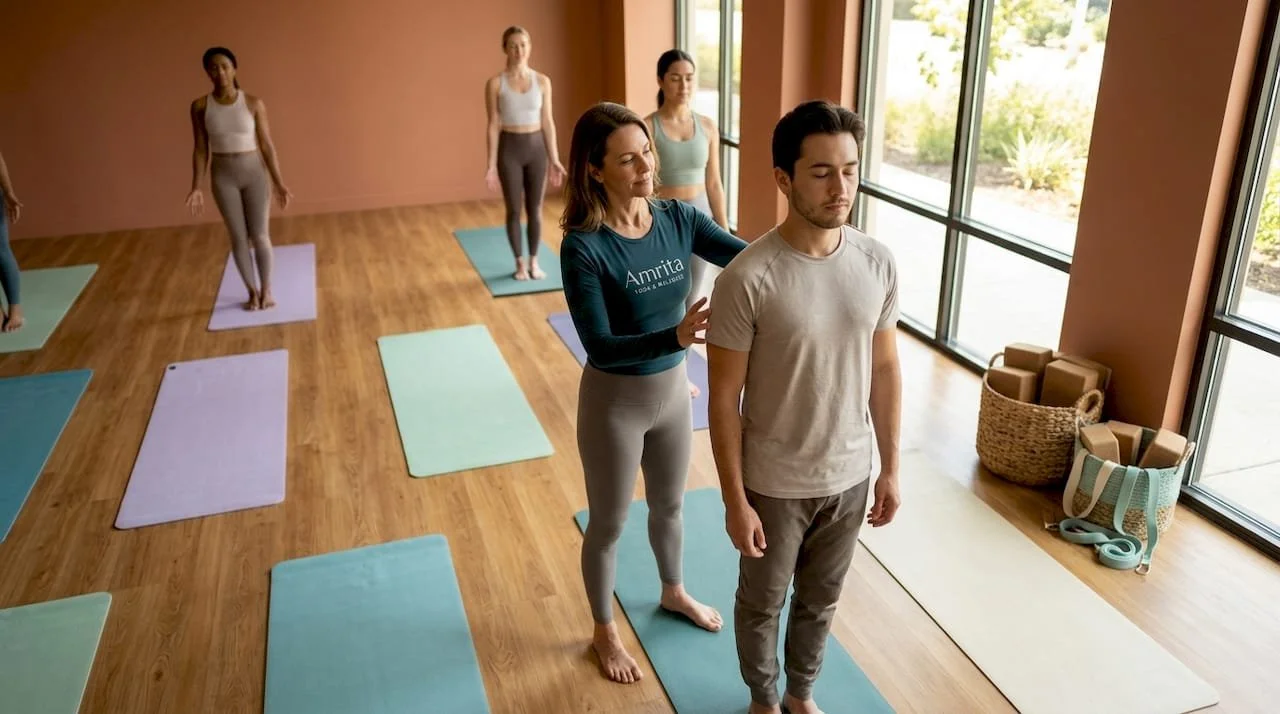
Ready to take these 12 basic yoga poses off the page and into a real session? Amrita Yoga & Wellness in Philadelphia offers beginner-friendly classes built around exactly the kind of safe, accessible practice described here. Whether you are looking for a beginner yoga routine that focuses on relaxation and whole-body wellness, or you want to explore a free beginner class before committing, the studio makes it easy to start without pressure.
Amritayogawellness also offers tarot readings as part of its broader wellness experience, pairing mindfulness with spiritual insight for students who want more than a physical practice. Yoga builds the body. These complementary offerings help you explore the whole picture. Your first step is just showing up.
FAQ
What are the 12 basic yoga poses for beginners?
The 12 foundational poses are Mountain, Downward Facing Dog, Warrior 1, Warrior 2, Tree, Child's Pose, Cat-Cow, Cobra, Easy Pose, Bridge, Standing Forward Bend, Seated Forward Bend, and Savasana. Together they cover all major muscle groups and pose categories a beginner needs.
Do I need to be flexible to start yoga?
No. Flexibility develops through consistent practice rather than being a starting requirement. Props like straps and blocks help beginners maintain correct alignment while flexibility improves naturally over time.
How long should a beginner yoga session last?
Beginner yoga classes typically run 60 minutes. At home, 20 to 30 minutes of consistent practice two to three times per week builds meaningful progress without overloading the body.
Is it safe to practice yoga at home as a beginner?
Yes, practicing yoga at home is safe when you follow basic guidelines: use a grippy mat, avoid forcing poses past your range, and never skip the warm-up or Savasana. If you have a medical condition, consult your healthcare provider before starting.
What if a pose hurts?
Sharp or stabbing pain means you should stop the pose immediately. Mild muscle aching as you build strength is normal. If you cannot breathe comfortably in a pose, back off until you can.
Recommended
Categories of yoga poses: a guide for every level
TL;DR:
Understanding yoga pose categories helps practitioners build balanced, goal-oriented practices rather than plateau.Each category serves specific functions like strength, flexibility, or recovery, and their proper sequencing prevents injury.
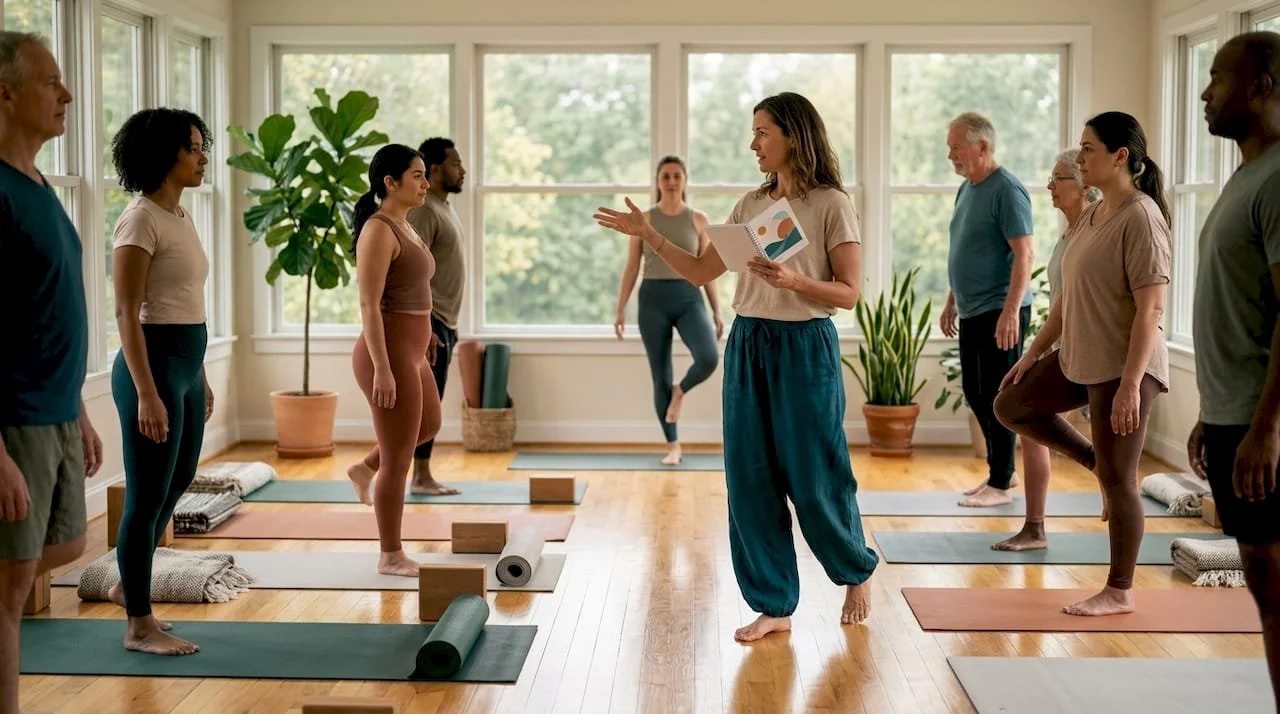
Hundreds of yoga poses exist, and jumping in without a map is one of the fastest ways to plateau. Understanding the categories of yoga poses changes that completely. Instead of memorizing poses one by one, you start seeing patterns — how a standing pose builds the strength that makes your balancing work better, or how a twist unlocks the hip mobility your forward bends need. This guide breaks down the major types of yoga poses, explains how to use those groupings to build smarter practices, and gives you practical tools whether you're stepping onto the mat for the first time or deepening a long-term practice in Philadelphia.
Table of Contents
Key Takeaways
| Point | Details |
|---|---|
| Pose categories simplify practice | Grouping poses by type helps you focus on areas needing improvement and build balanced yoga routines. |
| Balance movement types | Alternating categories like forward bends, twists, and backbends avoids imbalances and supports progress. |
| Foundational poses matter | Master basics in standing and seated categories before advancing to complex poses like arm balances or inversions. |
| Restorative poses aid recovery | Incorporating restorative and yin poses helps reduce stress and improves overall well-being. |
How to evaluate and choose yoga pose categories
The first thing to understand about yoga pose classifications is that they exist on two axes: body location and function. Body location asks where you are in space — standing, seated, lying down, inverted. Function asks what the body is actually doing — flexing forward, extending back, rotating, bearing weight on one leg.
Most confusion about yoga for mobility comes from treating every pose as its own isolated event. When you see poses as belonging to families, you start training movements rather than shapes. That shift is everything.
Here is what to look for when evaluating which categories to include in your practice:
Goal alignment: What are you trying to improve? Flexibility, strength, stress relief, balance, or postural correction? Each category serves different goals.
Movement balance: Every category has a counterpart. Backbends balance forward bends. Twists to the right balance twists to the left. Building in both sides prevents the tightness that comes from overtraining one pattern.
Skill progression: Some categories (standing poses, basic seated poses) form the groundwork for more demanding ones like inversions and arm balances. Skipping foundational categories to get to impressive shapes is the most common mistake in yoga practice.
Recovery ratio: Restorative and yin categories are not passive — they are active recovery tools that prevent overuse injuries when mixed into a weekly rotation.
Yoga Journal's pose taxonomygroups poses by type specifically so practitioners can build targeted practice by choosing pose families for specific goals rather than just picking random poses. Similarly,Yoga by Maya's frameworkuses both body location and biomechanics to help learners identify the right pose family for their needs at any given stage.
Pro Tip: Before building a weekly yoga plan, write down your top two goals and then map them to the categories most associated with those outcomes. That single step makes your practice three times more intentional.
With these evaluation criteria in mind, let's explore the main categories of yoga poses.
Major categories of yoga poses and examples
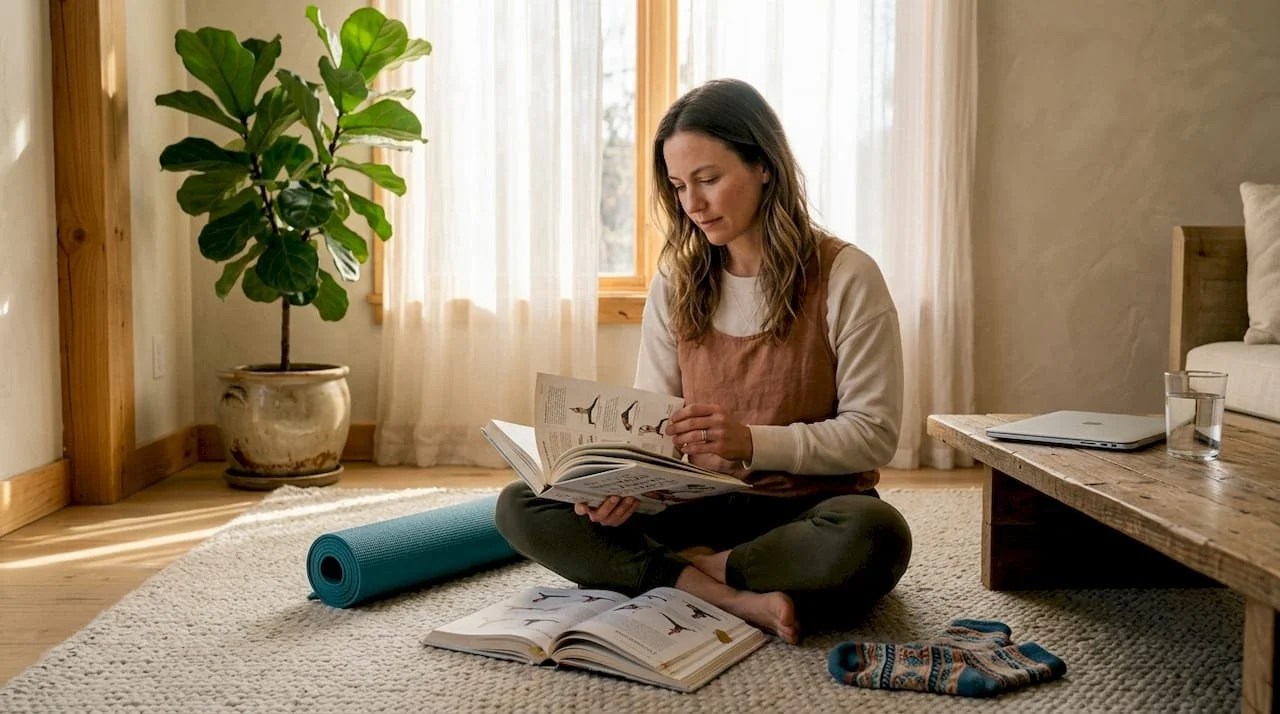
Yoga asanasfall into several distinct families, each with a clear role in a well-rounded practice.Yoga asanas are groupedinto standing, seated, forward bends, backbends, twists, balancing, inverted, and restorative poses. And 12 foundational postures across these categories provide a reliable base before you move into more complex territory.
Here is a breakdown of each major category with representative poses:
Standing poses: Mountain Pose (Tadasana), Warrior I, Warrior II, Triangle Pose. These build leg strength, improve posture, and are the backbone of most active yoga sequences. They are typically taught first because they are accessible and ground the body.
Seated poses: Staff Pose (Dandasana), Bound Angle Pose (Baddha Konasana), Hero Pose (Virasana). Seated work emphasizes hip flexibility and spinal elongation. Many of these poses are excellent entry points for beginners.
Forward bends: Seated Forward Fold (Paschimottanasana), Standing Forward Fold (Uttanasana), Wide-Legged Forward Fold. These poses lengthen the hamstrings and lower back while calming the nervous system, making them useful at the end of a session.
Backbends: Cobra (Bhujangasana), Bridge Pose (Setu Bandhasana), Wheel (Urdhva Dhanurasana). Backbends open the chest, strengthen the spine's extensor muscles, and counterbalance the forward-rounded posture most people carry from desk work.
Twists: Seated Spinal Twist (Ardha Matsyendrasana), Revolved Triangle, Supine Twist. Twists target spinal rotation and are widely credited with improving digestion and reducing lower back tension.
Balancing poses: Tree Pose (Vrksasana), Warrior III, Eagle Pose (Garudasana). These demand concentrated focus and build single-leg stability that carries over into athletic performance and daily movement.
Inversions: Legs-Up-the-Wall (Viparita Karani), Shoulder Stand, Headstand. Inversions shift circulation, calm the nervous system, and build upper body and core strength.
Restorative poses: Child's Pose (Balasana), Savasana, Supported Fish. These poses use props and gravity to release tension. They are not stretches in the athletic sense — they are recovery tools.
| Category | Primary benefit | Example pose |
|---|---|---|
| Standing | Strength and posture | Warrior II |
| Seated | Hip flexibility | Bound Angle Pose |
| Forward bends | Hamstring length, calm | Seated Forward Fold |
| Backbends | Chest opening, spine extension | Bridge Pose |
| Twists | Spinal rotation, digestion | Seated Spinal Twist |
| Balancing | Stability, concentration | Tree Pose |
| Inversions | Circulation, upper body strength | Legs-Up-the-Wall |
| Restorative | Recovery, stress relief | Supported Child’s Pose |
Now that we know the main categories, let’s compare their benefits and how they complement each other in practice.
Comparing yoga pose categories: benefits and practice tips
Understanding the types of yoga poses is one thing. Knowing how to work through them progressively and avoid the most common mistakes is what separates practitioners who improve from those who stall.
Here is a practical progression framework across categories:
Begin with standing and seated poses to build foundational strength and basic body awareness. These beginner yoga poses require no props, no prior flexibility, and teach alignment principles that apply everywhere else.
Add forward bends and gentle twists once you have two to four weeks of regular standing work. Your hamstrings and spine need a baseline of mobility before longer holds feel productive rather than painful.
Introduce backbends carefully. Before you extend the spine deeply, the front body — hip flexors, chest, abdomen — needs to be open. Backbends require front body openness before safe spine extension, and skipping this preparation is the most frequent cause of lower back pain in yoga.
Work on balancing poses concurrently with the above. They are less about raw strength than most people think. Balance is 70% attention and 30% strength, which is why a fixed gaze point (drishti) makes a bigger difference than leg strength alone.
Layer in inversions gradually. Start with passive inversions like Legs-Up-the-Wall before attempting active ones like Headstand. Your nervous system and shoulder stability both need preparation.
Close every session with restorative work. Even five minutes of Savasana or Supported Child's Pose shifts the body from effort to recovery.
"The categories of yoga poses are not a hierarchy to climb — they are a system to balance. Advanced practitioners don't abandon beginner yoga poses; they return to them with more precision."
Common mistakes by category, and how to fix them:
| Category | Common mistake | Fix |
|---|---|---|
| Standing | Locking the knees | Micro-bend both knees to protect joints |
| Forward bends | Rounding from the waist | Hinge from the hips, keep spine long |
| Backbends | Crunching the lower back | Distribute extension across the whole spine |
| Twists | Forcing rotation | Let breath create space, then rotate |
| Balancing | Holding the breath | Steady breath anchors focus better than muscle |
| Inversions | Collapsing into the neck | Engage shoulders and lift away from the floor |
Pro Tip: Before attempting essential yoga poses for beginners, spend one class just observing your body’s default patterns. Do you collapse in standing poses? Grip in twists? That self-awareness is worth more than any pose adjustment.
With this comparison, you can better decide which categories fit your current goals and practice stage.
Situational tips: which categories suit your practice goals?
One of the most practical ways to use yoga pose classifications is to match them directly to your current needs. Your goals will shift across weeks and seasons, and your pose category focus should shift with them.
For stress relief and nervous system recovery: Prioritize restorative and yin yoga categories. Restorative practices use supported poses and breath holds to calm the nervous system, and even a 20-minute session can meaningfully reduce tension after an overwhelming day. Yin yoga uses long-held reclined poses with props for deep stress relief, targeting connective tissue rather than muscle. Both categories belong in anyone's weekly routine, not just in crisis moments.
For building strength: Standing poses, balancing poses, and active backbends are your primary tools. Warrior sequences, Chair Pose, and Boat Pose build the kind of functional strength that transfers to daily movement. These are often underestimated as strength work because they don't look like gym exercises, but sustained holds in Warrior II challenge the same muscles as a leg press.
For improving flexibility and mobility: Forward bends, twists, and hip opener poses (categorized loosely under seated and supine poses) are most relevant here. Progress is slow and non-linear, but consistent work in these categories will open the hips, lengthen the hamstrings, and restore spinal rotation within a few months of regular practice.
For older adults and those returning from injury: Yoga poses for senior mobility offer a clear entry point. Starting with chair-supported standing poses and gentle seated forward bends lets the body adapt safely before introducing categories with more demand.
Pro Tip: Match your most challenging pose categories to the days when you have slept well and feel energetic. Save restorative categories for high-stress or low-energy days. Your practice becomes sustainable when it meets you where you are, not where you think you should be.
Understanding your goals makes it easier to build a sustainable yoga routine using pose categories.
Why balancing pose categories creates a stronger practice
Here is what most articles on how to categorize yoga poses won't tell you: the real skill in yoga isn't mastering any single category. It's knowing how to rotate between categories so no movement pattern goes untrained, and none gets overtrained.
Think about how most people naturally practice. They gravitate toward what feels good. Flexible practitioners do more forward bends. Strong practitioners load up on standing and balancing sequences. The result is a practice that reinforces what you're already capable of and leaves the gaps untouched.
Alternating functional categories like forward bends, twists, and backbends avoids over-conditioning one movement and under-training its counterbalance. This is not a small tweak. It's the difference between a body that moves well in every direction and one that performs beautifully in two planes and is fragile in the others.
The other dimension people miss is the relationship between foundation and advanced categories. Progressing into advanced categories like arm balances and inversions requires a solid foundation in standing, balance, and core poses first. Practitioners who try to shortcut this path end up with impressive-looking shapes built on unstable bases, and often with wrist, shoulder, or neck injuries to show for it.
For anyone working with yoga poses for seniors, this principle is even more critical. Building category variety from the beginning, even at a gentle pace, produces better long-term mobility outcomes than specializing in one area.
Rest is also part of this system. Restorative categories don't just feel nice — they allow the body to integrate the demands of active categories. Skipping them is like training hard at the gym and never sleeping. The adaptation happens in the recovery, not the effort.
Explore yoga categories with Amrita Yoga & Wellness in Philadelphia
Reading about pose categories is a start. Practicing them in an environment designed for your specific level, with teachers who can see what your body actually needs, is where real progress happens.
At Amrita Yoga & Wellness, our Philadelphia studio offers classes built around the full range of pose categories, from foundational work for beginners to advanced postures for experienced practitioners. Whether you're drawn to an active Vinyasa flow that moves through standing and balancing categories, a restorative session to reset after a stressful week, or specialty workshops that go deep into specific pose families, we have something designed for where you are right now. We also offer a range of wellness services, including tarot readings, to support the mental and spiritual dimensions of your practice alongside the physical.
Frequently asked questions
How many categories of yoga poses are there?
Yoga poses are typically grouped into around eight main categories: standing, seated, forward bends, backbends, twists, balancing, inversions, and restorative poses, though some systems use slightly different groupings.
Which yoga pose categories are best for beginners?
Beginners benefit most from standing, seated, and restorative categories, as foundational postures in these families build strength and flexibility without requiring the joint mobility or body awareness that more advanced categories demand.
How can using pose categories enhance my yoga practice?
Organizing your practice by category helps you build balanced routines that target different muscle groups and movement patterns, and alternating categories prevents overtraining one movement while leaving its counterpart underdeveloped.
What are restorative yoga poses and what benefits do they offer?
Restorative yoga poses are supported postures held for longer periods with props, and restorative sequences use these holds alongside focused breathwork to calm the nervous system, reduce stress, and support recovery between more active sessions.
Recommended
Easy Aerial Yoga Poses for Beginners: Step-by-Step Guide
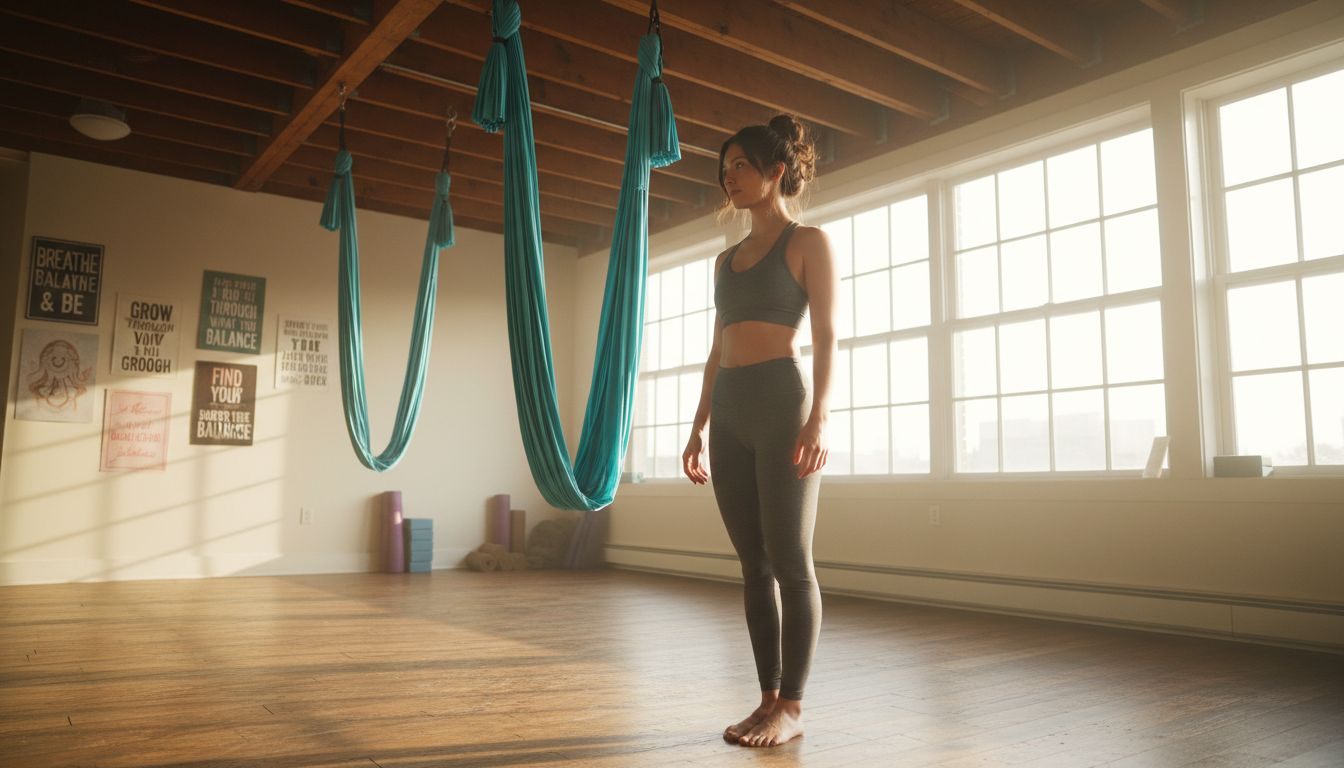
Trying something new for your well-being can be exciting but also a little daunting, especially when it comes to aerial yoga. Many adults in Philadelphia are searching for accessible ways to move, build strength, and manage daily stress, yet worry about safety and where to begin. By focusing on safe setup and easy poses, you can start your aerial yoga journey with confidence, knowing each step is designed to support both your body and peace of mind.
Table of Contents
Quick Summary
| Key Point | Explanation |
|---|---|
| 1. Ensure a Safe Setup for Aerial Yoga | Choose a location with ample clearance and robust support for the hammock to prevent injuries. |
| 2. Select Quality Hammock Carefully | Prioritize durable fabric and reliable brands to ensure safety and comfort during practice. |
| 3. Warm Up Properly Before Practicing | Engage in light movements to increase blood flow and prepare muscles for aerial yoga. |
| 4. Focus on Proper Form in Poses | Maintain alignment and relaxation in each pose to enhance strength and decrease injury risk. |
| 5. Practice Mindful Breathing Techniques | Deep breathing while holding poses promotes relaxation and stabilizes the nervous system. |
Step 1: Set Up Your Aerial Yoga Space Safely
Before you hang your first silk hammock, you need to choose the right location and prepare it properly. A safe aerial yoga setup combines the right room, proper equipment, and smart spacing to prevent injuries and build confidence as a beginner.
Start by selecting a space with adequate ceiling height and clearance. You'll want a room that's large enough to accommodate your hammock without walls or furniture creating obstacles around you.
Your location options include:
Indoor rooms with sturdy ceiling joists or beams
Doorway frames rated for the weight you'll be using
Outdoor areas with thick, healthy tree branches
Studio spaces like those at Amrita Yoga & Wellness where equipment is professionally installed
When hanging your hammock indoors, check that the ceiling can support the weight. Professional-grade rigging should handle up to 300 kilograms of force, far more than you'll ever need. If you're unsure about your ceiling's capacity, consult a contractor before installation.
Here's a quick comparison of common aerial yoga space options:
| Space Type | Installation Complexity | Safety Factors | Environment Benefits |
|---|---|---|---|
| Home room | Moderate to high | Requires ceiling evaluation | Privacy, convenience |
| Professional studio | Low (for the user) | Equipment professionally installed | Guidance from experts |
| Outdoor (tree branch) | High | Tree health and strength required | Natural atmosphere, fresh air |
| Doorway frame | Low to moderate | Weight rating critical | Compact, adaptable space |
The hammock itself needs proper support. Your rig should include support chains, webbing straps, silk material, and carabiners all securely anchored to your chosen point. These components work together to distribute your weight safely and prevent equipment failure.
Height matters for beginners. Keep the hammock suspended less than one meter above the ground. This low position builds your confidence and reduces injury risk if you slip or lose your grip while learning.
Arrange your space with movement in mind. You need clearance all around your hammock, especially when you're upside down or extending limbs. Remove furniture, yoga blocks, or anything else within arm's reach that could catch your body during practice.
A well-organized space prevents accidents before they happen. Clear the area completely and test your hammock's stability by gently pulling on it before practice.
Pro tip: Practice your first few sessions during daylight hours or with bright overhead lights so you can see your body's position clearly and build spatial awareness in the hammock.
Step 2: Select and Secure the Right Hammock
Choosing the right hammock is crucial because it directly impacts your safety, comfort, and ability to practice aerial yoga effectively. Your hammock needs to support your body weight while remaining comfortable enough for extended practice sessions.
When selecting a hammock, prioritize quality fabric and construction. Look for aerial yoga hammocks or swings specifically designed for supporting body weight safely. The fabric should be strong and comfortable, typically made from silk-like material rather than real silk, which offers better durability and easier maintenance.
Consider these factors when choosing:
Different lengths available for various heights and preferences
Color options that match your personal style and studio environment
Weight capacity ratings that exceed your body weight by a significant margin
Reputation of the manufacturer and brand reliability
Once you've selected your hammock, securing it properly is non-negotiable. Professional installation requires hardware such as support chains, carabiners, and ceiling anchors all rated to hold safe maximum weights. These components work together as a system, so don't compromise on any single piece.
When setting up, ensure every anchor point is rated for the weight it will support. Your entire rig should be able to handle far more force than your body weight alone. Always purchase from reputable sources that provide documentation of weight ratings and installation instructions.
This summary highlights key criteria when picking an aerial yoga hammock:
| Criteria | Why It Matters | Impact on Practice |
|---|---|---|
| Fabric durability | Reduces risk of tearing | Increases confidence |
| Weight capacity | Supports user safety | Allows for varied poses |
| Verified instructions | Prevents improper setup | Promotes proper installation |
| Manufacturer reputation | Indicates quality control | Ensures reliable performance |
Before your first practice, test the hammock thoroughly. Pull down on it with significant force while holding onto something stable, checking for any movement or instability in the rigging. The hammock should feel completely secure and immobile.
Quality equipment prevents injuries and builds confidence. Invest in professional-grade components and follow manufacturer guidelines precisely during installation.
Pro tip: Start with a standard length hammock in a neutral color like purple or blue, which works well in most studio spaces and won't limit your options if you move your practice location later.
Step 3: Warm Up Your Body Gently
Before you enter the hammock, your body needs preparation to move safely and comfortably. A proper warm-up increases blood flow, raises body temperature, and prepares your muscles for the unique demands of aerial yoga.
Start with 5 to 10 minutes of light movement. This timeframe gives your cardiovascular system a chance to activate without exhausting you before practice begins. Begin with simple activities like slow walking around your practice space or gentle marching in place.
Focus on these warm-up activities:
Slow walking or marching to increase heart rate gradually
Arm circles in both directions to mobilize shoulders
Gentle neck rolls to warm the cervical spine
Torso twists to engage your core and spine
Leg swings forward and backward to loosen hips
Ankle circles to activate lower legs and feet
As you move, concentrate on engaging your major muscle groups throughout your body. This ensures oxygen delivery reaches everywhere you'll be using during aerial yoga. Pay special attention to your shoulders, core, and hips since these areas bear significant load in the hammock.
Keep your movements controlled and deliberate. Avoid bouncing or sudden jerking motions, which can strain cold muscles. Instead, move through each motion smoothly, gradually increasing your range of motion as your body temperature rises.
You should feel slightly warmer and notice your breathing has quickened naturally. Your muscles should feel more supple and responsive than they did at the start. This is your signal that you're ready to approach the hammock.
A thorough warm-up reduces injury risk and helps you focus mentally on your practice. Never skip this step, even if you're short on time.
Pro tip: Play music during your warm-up to maintain a steady pace and create a ritual that signals to your body and mind that practice is beginning.
Step 4: Practice Basic Easy Aerial Yoga Poses
Now that your body is warm and your hammock is secure, you're ready to experience your first aerial yoga poses. These foundational poses use the hammock as active support, allowing you to safely explore movements that would be challenging or impossible on the ground.
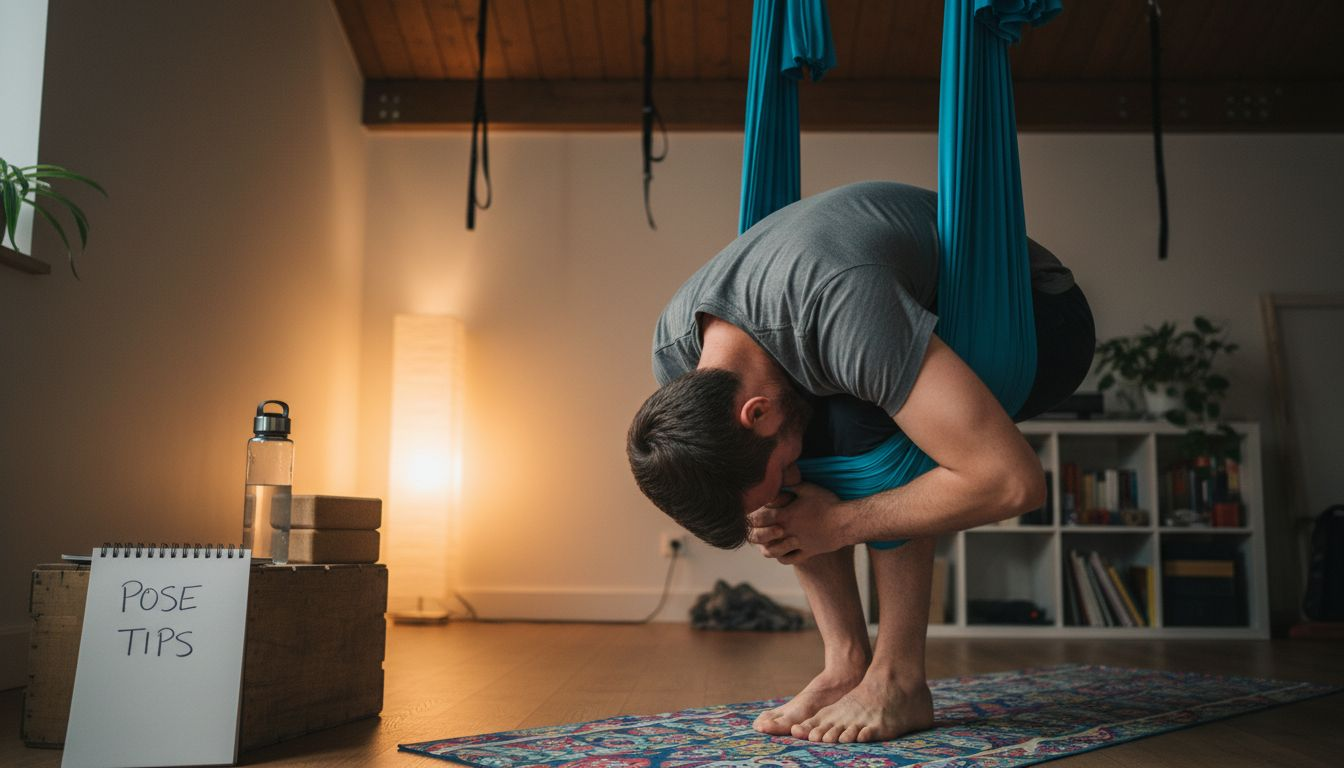
Start by sitting in the hammock with both feet on the floor. Get a feel for how the fabric supports your weight and how it responds to your movements. This builds confidence before you lift your feet completely off the ground.
Begin with these beginner-friendly poses:
Cross position where you sit with legs crossed and hold the hammock sides for stability
Star inversion with tailbone support to safely experience gentle upside-down movement
Supported forward bend using the hammock to deepen stretching through your spine
One-legged king pigeon which uses the hammock for balance while stretching your hip flexors
The hammock acts as support around your hips to enable poses that would be difficult on the ground. This support allows you to focus on breathing and alignment without worrying about balance. Move slowly into each pose, pausing to notice how your body feels in the unfamiliar position.
For your first session, choose two poses maximum. Practice each one for just 20 to 30 seconds, focusing on steady breathing and proper alignment. Exit gently by returning to a seated position before moving to the next pose.
Listen to your body constantly. Some sensations will feel like healthy stretching, while others might signal you're pushing too far. Back off immediately if you feel sharp pain, dizziness, or loss of control.
The hammock teaches you to trust support and breathe through challenging positions. This foundation builds confidence for more advanced poses later.
Pro tip: Record a short video of yourself practicing so you can review your form and notice improvements in your alignment and comfort over time.
Step 5: Check Your Form and Relax in Each Pose
Once you're in a pose, the real work begins. Proper alignment and conscious relaxation transform aerial yoga from just hanging around into a practice that builds strength and reduces stress.
Start by scanning your body from head to toe. Notice where you feel tension and where you feel supported. Your shoulders should be relaxed away from your ears, and your neck should be neutral, not craned forward or backward.
Check these key alignment points:
Shoulders away from ears and engaged properly
Spine in neutral position without excessive arching or rounding
Hips level and balanced on both sides
Core gently engaged but not rigidly braced
Neck aligned with your spine, not twisted or extended
Hands gripping firmly but without white-knuckled tension
Once your alignment feels solid, focus on your breathing. Deep breathing and maintaining awareness during poses enhances relaxation and allows energy to flow through your body. Inhale slowly through your nose for a count of four, then exhale for four counts. This steady rhythm calms your nervous system and helps you relax into the pose.
The goal is balance between effort and ease. You should feel stable yet comfortable, not straining or rigidly holding. If a pose requires constant muscular tension, you're likely gripping too hard. Soften where you can while maintaining alignment.
Observe sensations without judgment. Mild stretching sensations are normal and beneficial. Sharp pain, numbness, or tingling signals that something is wrong. Back off immediately and return to a resting position.
Relaxation in poses is not laziness. It's the practice of finding steadiness and calm, which builds confidence and prevents injury.
Pro tip: Set a timer for 30 to 45 seconds per pose during your first month so you can focus entirely on form and breathing instead of worrying about how long you've been holding the position.
Discover Confidence and Safety in Your Aerial Yoga Journey
Starting aerial yoga can feel challenging when it comes to setting up a safe space, choosing the right hammock, and mastering basic poses. The key to overcoming these hurdles is having expert guidance and access to proper equipment that supports your body and builds your confidence step by step. If you want to move beyond theory and experience how aerial yoga transforms your strength and calm, you do not have to do it alone.
Join the community at Amrita Yoga & Wellness where you can learn aerial yoga safely with professional instructors in a fully equipped studio environment. Whether you are a beginner eager to try easy aerial poses or looking for personalized support in setup and form, our expert-led classes and workshops provide exactly what you need. Take the next step today by exploring our class schedules and discover how aerial yoga can bring balance, strength, and relaxation into your life.
Frequently Asked Questions
What are some easy aerial yoga poses for beginners?
Start with beginner-friendly poses like the Cross Position, Star Inversion, Supported Forward Bend, and One-Legged King Pigeon. Try practicing these poses for 20 to 30 seconds each during your first session to build confidence and familiarity.
How do I set up a safe aerial yoga space at home?
Choose a room with adequate ceiling height and sturdy support beams, and ensure there’s enough space around your hammock to prevent injuries. Clear any furniture or obstacles before installation and test the hammock’s stability before your practice.
What should I focus on during my warm-up for aerial yoga?
Engage in light movement for 5 to 10 minutes, such as slow walking, arm circles, and leg swings to prepare your muscles. Focus on controlled movements to increase blood flow and reduce the risk of injury during your session.
How do I ensure proper form in aerial yoga poses?
Check your alignment by ensuring your shoulders are relaxed, spine is neutral, and core is gently engaged. Regularly scan your body for tension and adjust your position as needed to maintain a balance between effort and ease in each pose.
How long should I hold each aerial yoga pose as a beginner?
In your first month, aim to hold each pose for 30 to 45 seconds to focus on your form and breathing. Gradually increase the time as you become more comfortable and confident in each position.
What should I do if I feel discomfort during a pose?
If you experience sharp pain, dizziness, or numbness, back off immediately and return to a resting position. Listen to your body and adjust your movements to ensure a safe and enjoyable practice.
Recommended
Aerial Yoga Strengthening Moves for Total Body Power — Amrita Yoga & Wellness
How to Advance in Aerial Yoga for Greater Mastery — Amrita Yoga & Wellness
Building Aerial Yoga Strength for Lasting Flexibility — Amrita Yoga & Wellness
Master Aerial Yoga Poses for Beginners Step by Step — Amrita Yoga & Wellness
Master Aerial Yoga Poses for Beginners Step by Step
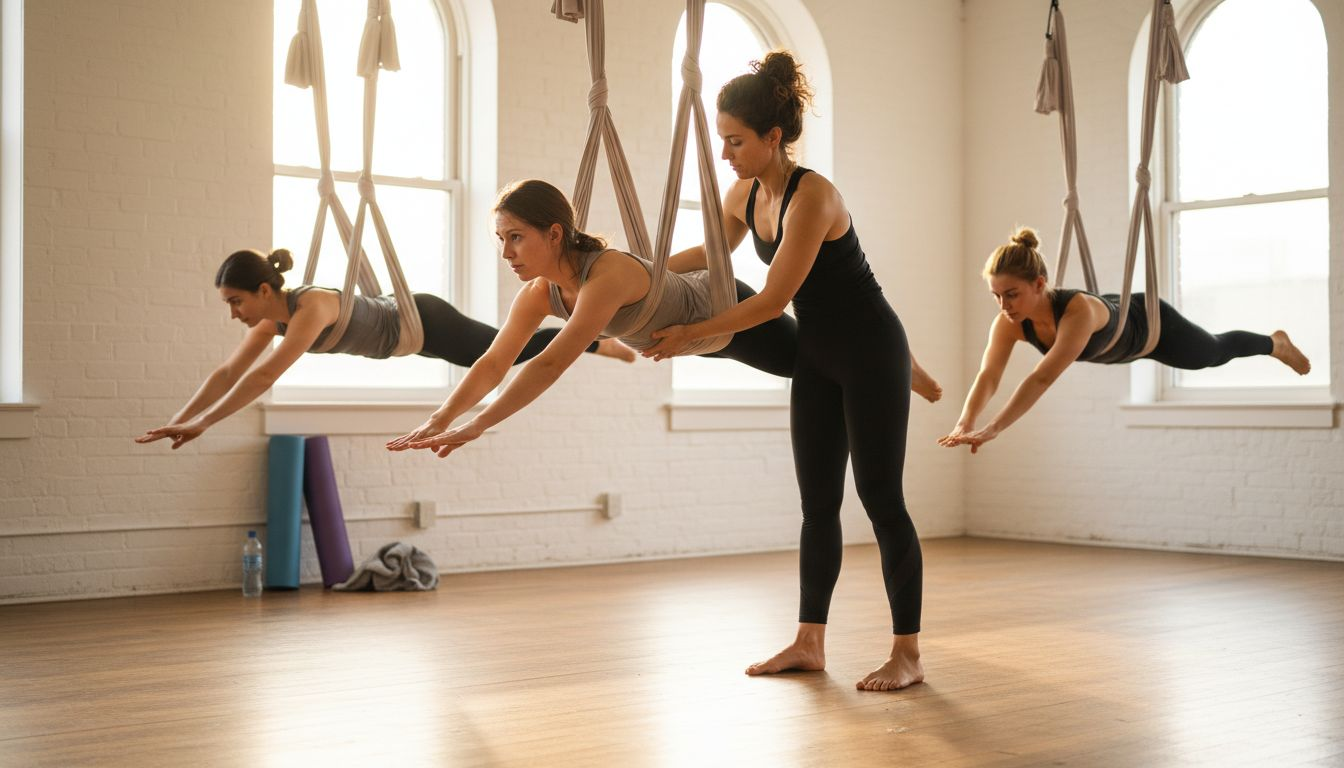
Feeling stiff or searching for an enjoyable way to strengthen your body without high-impact workouts? Aerial yoga combines traditional yoga postures with the support of a specialized hammock, making difficult moves like backbends and inversions easier and safer for beginners. For adults in Philadelphia, this unique fitness option offers gentle support while building flexibility and muscle. This guide lays out practical steps for setting up your space, selecting equipment, and mastering foundational poses, ensuring a confident start and steady progress.
Table of Contents
Quick Summary
| Key Point | Explanation |
|---|---|
| 1. Assess Your Space and Equipment | Ensure your practice area is spacious, secure, and has the proper overhead support to safely install your aerial hammock. |
| 2. Set Up the Hammock Properly | Use a sturdy mounting point and ensure all components are rated for sufficient weight to create a safe suspension system for your practice. |
| 3. Warm Up Before Practice | Engage in dynamic stretches and light cardio to prepare your muscles and joints, enhancing performance and reducing injury risk. |
| 4. Focus on Body Alignment | Maintain proper positioning throughout poses to prevent injuries; check shoulder, spine, core, and weight distribution frequently. |
| 5. Cool Down and Track Progress | Gradually decrease activity post-practice with gentle stretches and hydration, while documenting improvements to aid in your aerial yoga journey. |
Step 1: Prepare Your Space and Equipment
Setting up a safe and effective aerial yoga practice begins with creating the right environment and gathering essential equipment. Before you start your aerial yoga journey, you'll need to carefully prepare your space and choose the right gear to support your practice.
First, assess your available space and ensure you have a sturdy overhead mounting point capable of supporting your body weight. Most aerial yoga hammocks can support up to 300 kilograms of weight, but proper installation is crucial. You'll want an area with at least 8-10 feet of ceiling height and a clear radius of about 6 feet around your hammock to allow full movement without obstruction.
Equipment selection is critical for a safe aerial yoga experience. Here are the essential items you'll need:
Aerial silk hammock with sturdy support chains and carabiners
Secure ceiling mount or free-standing aerial rig
Thick exercise mat for floor work
Comfortable, form-fitting clothing without zippers or buttons
Optional: grip gloves for additional hand support
When selecting your hammock, look for professional-grade materials that can withstand repeated use and provide reliable support. The hammock should be hung less than one meter above the ground, which helps beginners feel secure while learning new poses.
Pro tip: Always test your equipment's weight capacity and mounting points before your first practice, and consider having an experienced professional help you set up your initial aerial yoga space.
Step 2: Set Up Your Yoga Hammock Safely
Setting up your aerial yoga hammock requires precision, care, and attention to safety details. Your goal is creating a secure suspension system that will support your body weight and allow fluid, confident movement during practice.
Selecting the right mounting point is crucial for a safe aerial yoga experience. Proper equipment setup involves identifying a structural support beam capable of handling significant weight. Ideal mounting points include:
Reinforced ceiling joists
Purpose-built aerial rigging frames
Professional-grade mounting brackets
Steel support beams
Before installation, you'll need specialized hardware to ensure a stable setup:
Check ceiling mount's weight rating
Select carabiners rated for your body weight
Use webbing straps designed for aerial equipment
Verify all connection points are secure
Important mounting guidelines include positioning your hammock approximately waist height, which allows safe entry and exit while providing enough clearance for basic poses. Most practitioners recommend leaving a 6-foot radius around your hammock to prevent accidental collisions with furniture or walls.
Safety always comes first in aerial yoga. Never compromise on equipment quality or installation integrity.
Pro tip: Consider having a professional rigger or experienced aerial yoga instructor verify your hammock installation before your first practice to ensure maximum safety and confidence.
Here's a summary comparing key safety and setup considerations for aerial yoga at home vs. in a studio:
| Factor | Home Practice | Studio Practice |
|---|---|---|
| Equipment Setup | Self-installed, requires personal verification | Professionally installed, regularly inspected |
| Space Requirements | Must create and clear your own area | Designed specifically for aerial yoga |
| Supervision | May require self-assessment or occasional instructor visits | Direct instructor guidance during every session |
| Safety Assurance | Relies on personal diligence and research | Guided by certified professionals |
| Maintenance | User responsibility, periodic checks needed | Studio staff manages upkeep and checks |
Step 3: Warm Up Your Body Effectively
Before diving into aerial yoga poses, preparing your body through a strategic warm-up is essential for preventing injuries and maximizing performance. Your warm-up will gradually increase muscle readiness and joint flexibility, setting the foundation for a safe and enjoyable aerial practice.
Dynamic stretching techniquesare crucial for preparing your body for aerial yoga movements. Start with light cardiovascular activities that gradually increase your heart rate and muscle temperature:
Gentle walking in place
Arm circles and shoulder rolls
Slow torso twists
Ankle and wrist rotations
Light marching movements
Progressive warm-up stages help your body adapt to the upcoming physical demands. Follow these key warm-up components:
Begin with 5-10 minutes of low-intensity movement
Perform dynamic stretches targeting major muscle groups
Focus on mobility exercises for shoulders, hips, and spine
Incorporate gentle joint mobilization techniques
Key muscle groups to focus on include your core, shoulders, and lower back, which are critical for aerial yoga stability and movement. Pay special attention to shoulder mobility and core engagement, as these will be fundamental in supporting your body during suspended poses.
Gradual, mindful warm-up is your first defense against potential aerial yoga injuries.
Pro tip: Listen to your body during warm-up and modify movements if you feel any unusual tension or discomfort, allowing yourself to ease into the practice gently.
Step 4: Learn Foundational Aerial Yoga Poses
Mastering foundational aerial yoga poses will help you build confidence and develop essential skills for your aerial practice. By understanding and practicing these basic techniques, you'll create a solid foundation for more advanced movements.
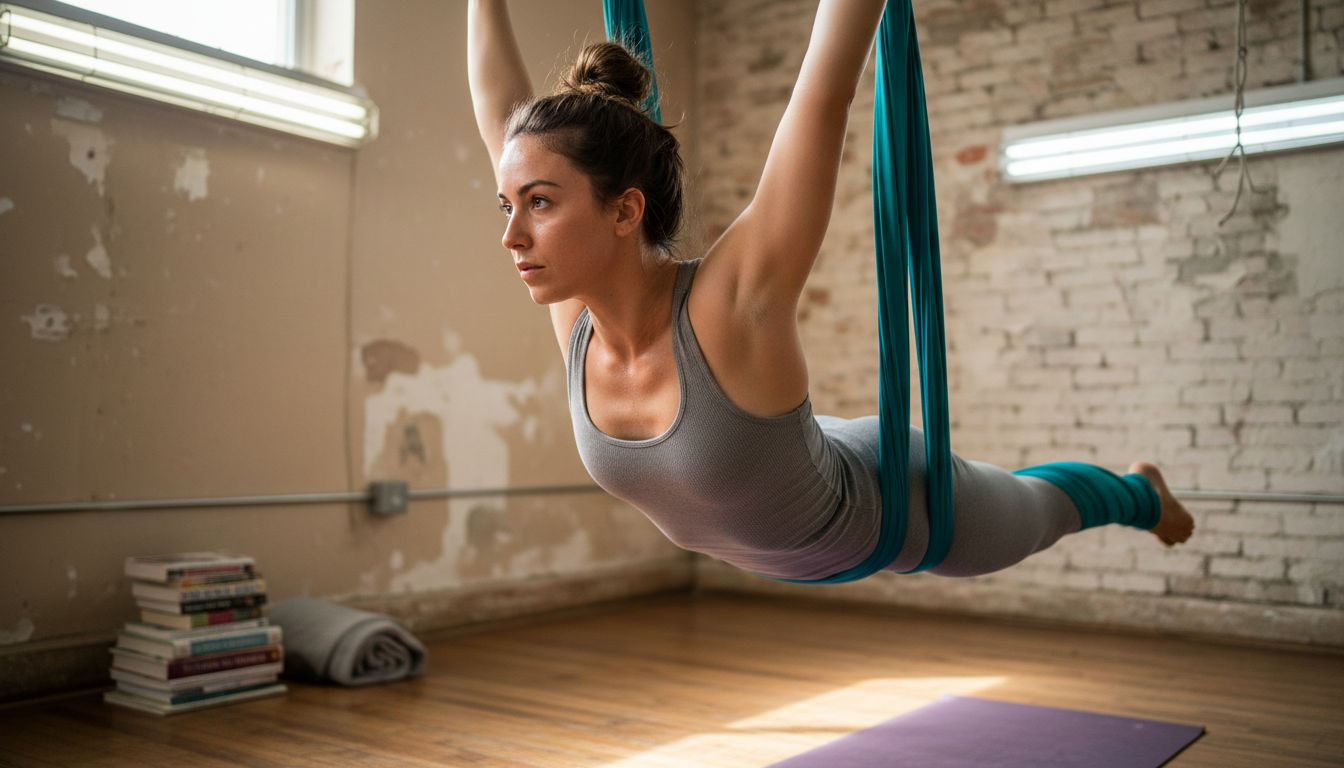
Beginner aerial yoga poses offer unique opportunities to explore movement with hammock support. These foundational poses help you understand how to use the hammock effectively while building strength and flexibility.
Here is a reference for common foundational aerial yoga poses and their benefits:
| Pose Name | Primary Focus | Typical Benefit |
|---|---|---|
| Cross Position | Core activation | Builds basic strength |
| Star Inversion | Spine and hips | Improves flexibility |
| One-Legged King Pigeon | Hips and quads | Enhances hip mobility |
| Seated Hammock Swing | Balance and posture | Develops coordination |
Cross Position: Basic suspended pose for beginners
Star Inversion: Gentle upside-down orientation
One-Legged King Pigeon: Modified hammock variation
Seated Hammock Swing: Basic seated suspension technique
Start with these progression steps for learning foundational aerial yoga poses:
Always begin with instructor guidance
Practice each pose slowly and mindfully
Focus on maintaining core engagement
Use the hammock for gentle support
Breathe steadily during each pose
Body alignment is crucial when practicing aerial yoga poses. Keep your movements controlled and pay attention to how the hammock supports your body weight. Core strength and balance will help you transition smoothly between different positions.
Your hammock is a tool for support, not just suspension. Learn to trust its stability and your own body's capabilities.
Pro tip: Start with extremely simple poses and progress gradually, allowing your body to adapt to the unique sensations of suspended movement.
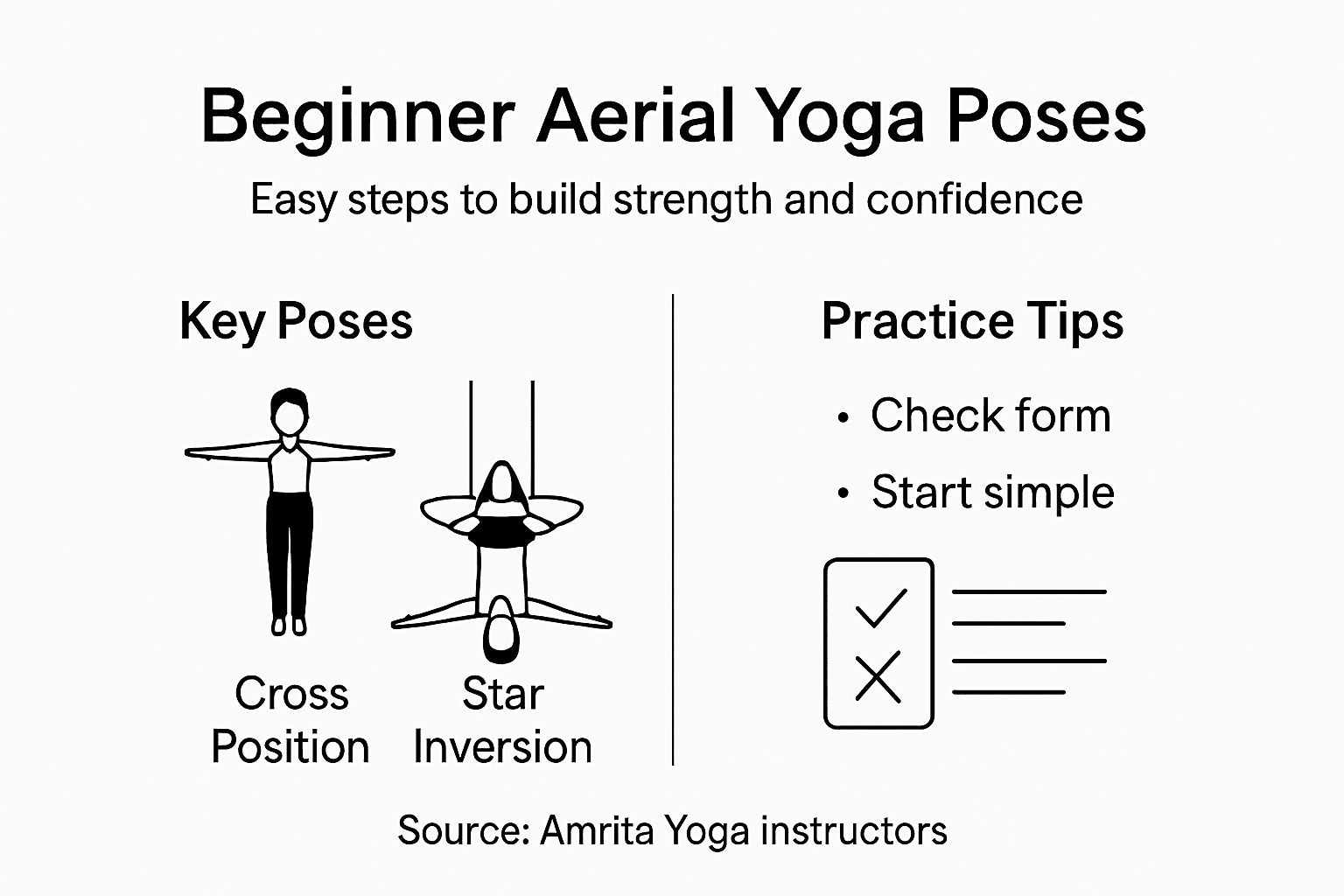
Step 5: Check Your Form and Adjust Alignment
Perfecting your body alignment in aerial yoga is crucial for preventing injuries and maximizing the effectiveness of each pose. Understanding how to assess and adjust your positioning will help you develop a safer, more confident practice.
While aerial yoga provides unique support through the hammock, maintaining proper body mechanics remains essential. Key areas to focus on during form checks include:
Shoulder positioning: Keep shoulders relaxed and away from ears
Spine alignment: Maintain neutral spine position
Core engagement: Activate core muscles consistently
Weight distribution: Balance evenly across hammock support
Breathing pattern: Breathe deeply and steadily
Use these steps to systematically check and adjust your alignment:
Pause between pose transitions
Do a mental body scan
Make micro-adjustments as needed
Reset position if feeling unstable
Ask instructor for visual feedback
Body awareness plays a critical role in aerial yoga practice. Subtle movements and corrections can dramatically improve your overall performance and reduce strain on your muscles and joints.
Alignment is not about perfection, but about creating a balanced, sustainable practice that supports your body's natural movement.
Pro tip: Practice in front of a mirror or ask a fellow student to observe your form, providing an external perspective on your alignment and positioning.
Step 6: Cool Down and Monitor Progress
After an intense aerial yoga session, cooling down properly helps your body recover and prevents potential muscle soreness. Gradual exercise reduction is essential for maintaining your body's overall wellness and flexibility.
Your cool-down routine should focus on gradually lowering your heart rate and stretching the muscle groups you've engaged during your aerial yoga practice:
Gentle hammock stretches
Static floor stretches
Deep breathing exercises
Slow joint mobility movements
Hydration and relaxation
Implement these cool-down progression steps:
Exit hammock slowly and mindfully
Perform 10-15 minutes of gentle stretching
Focus on muscles used during aerial poses
Track your flexibility improvements
Drink water to support muscle recovery
Progress tracking is crucial for continuous improvement. Personal performance metrics will help you understand your aerial yoga journey, including flexibility gains, strength development, and mental focus.
Consistent practice and mindful reflection are the keys to steady advancement in aerial yoga.
Pro tip: Keep a workout journal to document your progress, noting specific pose improvements, flexibility changes, and how your body feels after each session.
Unlock Your Full Potential with Expert Guidance at Amrita Yoga & Wellness
Struggling to master foundational aerial yoga poses safely and effectively can feel overwhelming without proper support and instruction. This article highlights crucial steps such as setting up secure equipment, warming up mindfully, and fine-tuning your form to build strength and confidence. If you want to transform these challenges into opportunities for growth and well-being, Amrita Yoga & Wellness in Philadelphia offers the perfect environment to deepen your aerial yoga practice.
Join our welcoming community through expert-led classes and workshops that emphasize safe technique, body alignment, and tailored progression. Whether you are a beginner eager to learn the basics or seeking to integrate aerial yoga into your holistic wellness routine, we are here to guide you every step of the way. Take action now to elevate your body and mind by exploring all our offerings at Amrita Yoga & Wellness and start your journey toward aerial yoga mastery today.
Frequently Asked Questions
How do I prepare my space for practicing aerial yoga at home?
To prepare your space for aerial yoga, ensure you have a sturdy overhead mounting point and at least 8-10 feet of ceiling height. Clear a 6-foot radius around your hammock for safe movement, and choose a thick exercise mat to provide comfort during floor work.
What equipment do I need to start aerial yoga?
The essential equipment for aerial yoga includes a reliable aerial silk hammock, a secure ceiling mount or free-standing aerial rig, comfortable clothing, and optionally grip gloves for added support. Gather these items before starting your practice to ensure safety and effectiveness.
What are some foundational aerial yoga poses for beginners?
Foundational aerial yoga poses for beginners include the Cross Position, Star Inversion, One-Legged King Pigeon, and Seated Hammock Swing. Focus on mastering these poses to build strength and confidence in aerial techniques.
How can I check my form and alignment during aerial yoga?
To check your form in aerial yoga, perform a mental body scan during transitions and make micro-adjustments as needed. Pay attention to your shoulder positioning, spine alignment, core engagement, and weight distribution to maintain stability and prevent injuries.
What should my cool-down routine include after an aerial yoga session?
Your cool-down routine should consist of gentle hammock stretches, static floor stretches, and deep breathing exercises to lower your heart rate and relax your muscles. Aim for about 10-15 minutes of gentle stretching to promote recovery after each aerial yoga session.
How can I track my progress in aerial yoga?
Track your progress in aerial yoga by keeping a workout journal where you document improvements in flexibility, strength, and muscle recovery. Reflect on specific pose enhancements and how your body feels after each session to monitor advancements over time.
Recommended
7 Simple Yoga Poses for Seniors to Boost Mobility
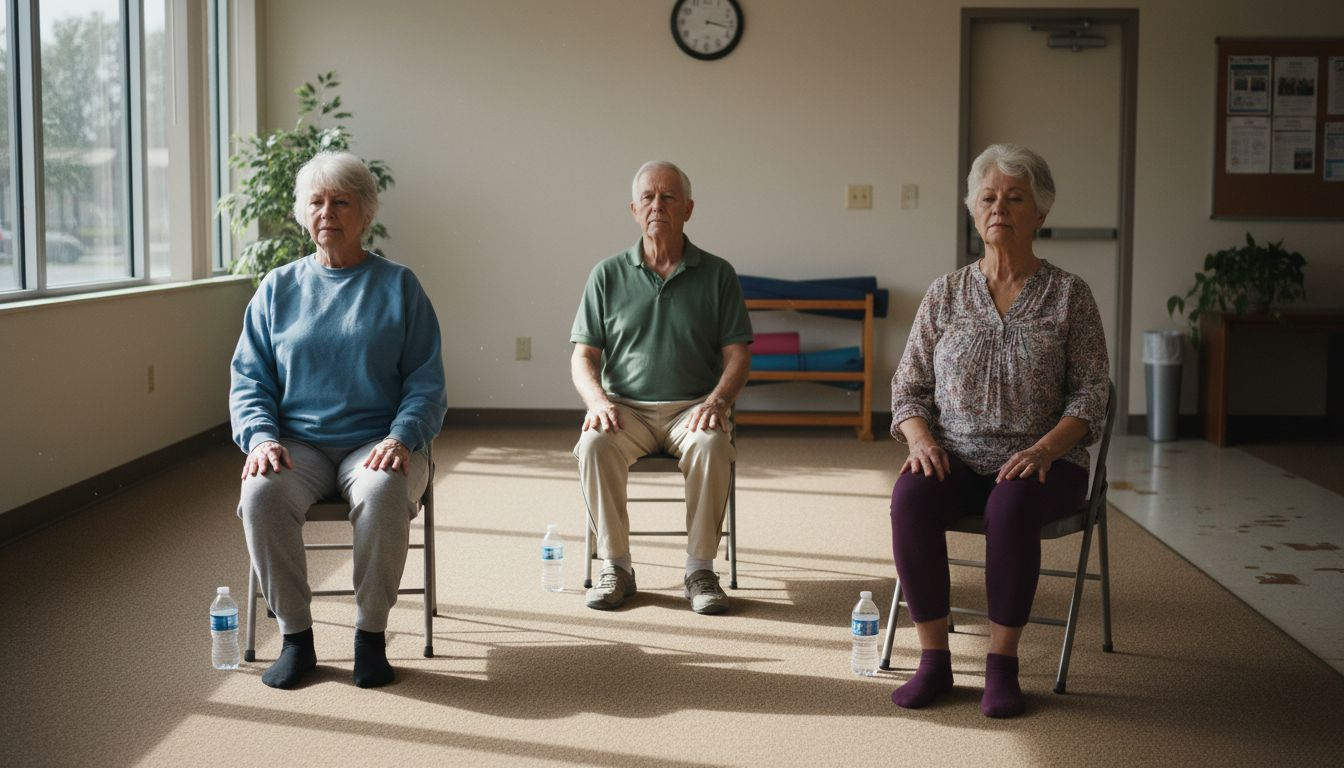
More than 60 percent of American seniors experience reduced mobility as they age. For older adults in Philadelphia, finding gentle exercises that support healthy movement can make a real difference in everyday life. Low-impact yoga offers an inviting way to improve flexibility, posture, and confidence without the strain of more intense routines. You will discover practical techniques to boost your strength and body awareness, even if you are new to yoga or American wellness practices.
Table of Contents
Quick Summary
| Takeaway | Explanation |
|---|---|
| Practice Gentle Yoga Techniques | Incorporating gentle yoga can enhance posture, body awareness, and spinal alignment for seniors. |
| Perform Neck and Shoulder Rolls | Regular neck and shoulder rolls can effectively reduce tension and improve flexibility in seniors. |
| Utilize Supported Poses for Balance | Using props in yoga poses helps strengthen balance and core stability, reducing fall risk. |
| Engage in Deep Breathing Exercises | Daily deep breathing practices can significantly reduce stress and enhance emotional well-being. |
| Include Relaxation Poses in Routine | Restorative poses like the Reclined Butterfly promote relaxation and improve flexibility in hips and lower back. |
1. Gentle Seated Mountain Pose for Posture Support
The Seated Mountain Pose serves as a foundational yoga position specifically designed to help seniors improve posture, body awareness, and spinal alignment. This simple yet powerful pose provides an accessible way to build strength and stability while seated, making it perfect for individuals with limited mobility.
While performing the Seated Mountain Pose, you engage multiple muscle groups that support your spine and core, creating a strong foundation for overall body alignment. By practicing gentle yoga techniques, seniors can counteract the natural postural changes that occur with aging, such as rounded shoulders and forward head positioning.
To practice this pose, sit comfortably in a chair with your feet flat on the floor, hip-width apart. Keep your spine elongated, shoulders relaxed, and chin parallel to the ground. Imagine a string pulling the crown of your head toward the ceiling, creating a sense of length and openness through your entire spine. Breathe deeply and maintain this position for 30 seconds to 1 minute, focusing on maintaining proper alignment.
Key Benefits:
Improves spinal posture
Increases body awareness
Strengthens core muscles
Enhances breathing capacity
Reduces risk of falls by improving balance
Pro tip: Practice this pose near a mirror initially to visually check and adjust your alignment, helping you develop muscle memory for proper posture.
2. Easy Neck and Shoulder Rolls to Relieve Tension
Neck and shoulder tension is a common challenge for seniors, often resulting from years of poor posture, stress, and reduced mobility. Gentle yoga practices offer an effective way to address these muscular discomforts through simple, controlled movements that promote flexibility and relaxation.
These neck and shoulder rolls work by gently stretching muscle groups that tend to become tight and restricted with age. The slow, deliberate movements help increase blood circulation, reduce stiffness, and release built-up muscular tension without putting excessive strain on your joints.
To perform neck and shoulder rolls, sit comfortably in a chair with your spine straight and feet planted firmly on the floor. Begin by taking a deep breath and slowly drop your right ear toward your right shoulder, creating a gentle stretch along the left side of your neck. Hold briefly, then slowly roll your chin down to your chest, and continue the circular motion by bringing your left ear toward your left shoulder.
Important Technique Points:
Move slowly and smoothly
Stop if you feel any sharp pain
Keep movements small and controlled
Breathe deeply throughout the exercise
Repeat 3-5 times in each direction
Potential Benefits:
Reduces neck and shoulder tension
Improves range of motion
Helps prevent stiffness
Promotes better posture
Decreases risk of muscle strain
Pro tip: Practice these rolls while listening to calm music or during your morning routine to make them a consistent part of your wellness practice.
3. Seated Cat-Cow Stretch for Spine Flexibility
The Seated Cat-Cow Stretch is a transformative yoga movement that helps seniors maintain spinal flexibility and counteract the natural stiffening of back muscles that occurs with aging. By mimicking the fluid motions of a traditional Cat-Cow pose while seated, you can safely improve your spine's range of motion and reduce discomfort.
This gentle stretch engages the entire spine, targeting the vertebrae, surrounding muscles, and connective tissues. Essential yoga poses for beginners often include variations of this movement because of its remarkable ability to increase flexibility and reduce tension.
To perform the Seated Cat-Cow Stretch, sit upright in a chair with your feet flat on the floor. Place your hands on your knees or thighs. As you inhale, arch your back and lift your chest, creating a gentle backward curve. As you exhale, round your spine forward, tucking your chin toward your chest and pulling your belly button inward.
Key Movement Technique:
Move slowly and with control
Synchronize movement with breath
Keep movements small and comfortable
Focus on spinal articulation
Listen to your body
Benefits:
Increases spinal flexibility
Reduces back stiffness
Improves posture
Enhances body awareness
Promotes better breathing
Pro tip: Practice this stretch near a mirror initially to ensure proper alignment and gradually increase your range of motion as you become more comfortable.
4. Standing Chair-Assisted Forward Fold for Leg Stretch
The Standing Chair-Assisted Forward Fold offers seniors a safe and supportive method to stretch hamstrings, improve lower body flexibility, and enhance overall mobility. By using a chair for balance and support, this modified yoga pose allows individuals to experience a deep stretch without risking strain or loss of stability.
Aerial yoga flexibility techniquesemphasize the importance of using props for safe stretching, and this chair-assisted forward fold perfectly embodies that principle. The pose helps counteract the muscle tightness that naturally develops with age and sedentary lifestyles.
To perform the stretch, stand behind a sturdy chair with your feet hip-width apart. Place your hands on the chair back for support. Slowly hinge forward from your hips, keeping your back straight and your knees soft. Allow your upper body to fold forward, feeling a gentle stretch along the back of your legs.
Key Stretch Components:
Maintain a straight spine
Keep knees slightly bent
Move slowly and mindfully
Breathe deeply throughout the stretch
Stop if you feel any sharp pain
Potential Benefits:
Increases hamstring flexibility
Improves lower back mobility
Reduces muscle tension
Enhances overall leg circulation
Supports better posture
Pro tip: Use a mirror to check your alignment and ensure you are folding from your hips rather than rounding your back.
5. Supported Tree Pose for Better Balance
The Supported Tree Pose is a gentle yet powerful yoga technique designed to help seniors improve balance, strengthen core muscles, and build confidence in their physical stability. By utilizing a chair or wall for support, this modified pose allows individuals to safely practice one of yoga's most iconic balance challenges.
Essential yoga poses for beginners often incorporate balance work as a fundamental skill, and the Supported Tree Pose perfectly addresses this need for seniors seeking to maintain and enhance their physical coordination.
To perform the pose, stand next to a sturdy chair or wall with your feet hip-width apart. Gently shift your weight onto one leg, and slowly lift the opposite foot slightly off the ground. If needed, rest your hand on the chair or wall for additional support. Focus on maintaining a straight spine and keeping your gaze fixed on a steady point in front of you.
Key Balance Techniques:
Use support when necessary
Move slowly and mindfully
Keep your core engaged
Breathe steadily
Start with brief hold times
Potential Benefits:
Improves overall balance
Strengthens leg muscles
Enhances body awareness
Builds confidence
Reduces fall risk
Pro tip: Practice near a mirror initially to check your alignment and gradually reduce your reliance on support as your balance improves.
6. Reclined Butterfly Pose for Hip Relaxation
The Reclined Butterfly Pose offers seniors a gentle and supportive method to release tension in the hips, lower back, and inner thighs while promoting deep relaxation and improved flexibility. This restorative pose provides a low impact way to open tight muscles that often become restricted with age and reduced movement.
Yin yoga techniques for deep releaseemphasize the importance of gentle stretching and sustained postures that allow muscles to slowly soften and lengthen. The Reclined Butterfly Pose perfectly embodies this principle, making it an ideal practice for seniors seeking mindful movement.
To perform the pose, lie on your back on a comfortable mat or carpet. Bend your knees and bring the soles of your feet together, allowing your knees to fall open to the sides. Place your arms comfortably at your sides with palms facing up. If needed, support your knees with pillows or rolled towels to reduce strain.
Key Relaxation Components:
Move slowly and mindfully
Use props for additional support
Focus on deep breathing
Allow gravity to help open hips
Stop if you feel any sharp pain
Potential Benefits:
Releases hip tension
Improves lower back flexibility
Promotes deep relaxation
Reduces muscle stiffness
Enhances overall mobility
Pro tip: Practice this pose before bedtime to help calm your nervous system and prepare your body for restful sleep.
7. Guided Relaxation and Deep Breathing for Calm
Guided relaxation and deep breathing represent powerful tools for seniors seeking to reduce stress, improve mental clarity, and enhance overall well-being. These mindful practices offer a holistic approach to managing both physical tension and emotional challenges that often accompany aging.
Essential yoga and meditation techniqueshighlight the profound connection between breath, mental state, and physical health. By learning to control and deepen your breathing, you can activate your body's natural relaxation response and reduce symptoms of anxiety and stress.
To practice guided relaxation, find a comfortable seated or reclined position. Close your eyes and focus on your natural breathing rhythm. Gradually begin to lengthen your inhales and exhales, imagining tension leaving your body with each breath. Picture a calm, peaceful scene like a quiet beach or serene forest to help anchor your attention.
Key Relaxation Components:
Focus on slow, deep breaths
Use visual imagery
Release muscle tension
Practice without judgment
Stay present in the moment
Potential Benefits:
Reduces stress and anxiety
Lowers blood pressure
Improves sleep quality
Enhances mental clarity
Supports emotional balance
Pro tip: Practice this technique for just 5 minutes daily to experience significant improvements in your overall sense of calm and well being.
Below is a comprehensive table summarizing various gentle yoga poses and their benefits discussed in the article.
| Pose / Practice | Steps / Description | Benefits |
|---|---|---|
| Gentle Seated Mountain Pose | Sit upright with feet flat, spine elongated, and shoulders relaxed, holding this posture for up to 1 minute. | Improves posture, enhances body alignment, strengthens the core, and boosts breathing capacity. |
| Easy Neck and Shoulder Rolls | Perform slow and smooth circular movements with the neck, pausing if any sharp pain occurs. | Reduces tension, increases flexibility, and prevents stiffness. |
| Seated Cat-Cow Stretch | Alternate between arching your back and rounding it forward while syncing with your breath. | Increases spinal flexibility, alleviates stiffness, and improves posture. |
| Standing Chair-Assisted Forward Fold | With hands on a chair for support, gently hinge forward from your hips to stretch the hamstrings. | Enhances leg flexibility, reduces muscle tension, and supports good posture. |
| Supported Tree Pose | Using a chair or wall, balance on one leg with a straight spine, gradually developing stability. | Improves balance, strengthens muscles, and builds physical confidence. |
| Reclined Butterfly Pose | Lie on your back with feet together, knees open, and arms relaxed at your sides. | Releases hip tension, promotes relaxation, and enhances flexibility. |
| Guided Relaxation and Deep Breathing | Practice extended breathing while focusing on positive imagery, staying present and relaxed. | Reduces stress, improves mental clarity, and supports emotional balance. |
Enhance Your Mobility with Expert Guidance at Amrita Yoga & Wellness
The challenges of maintaining flexibility, balance, and posture become more common as we age. This article highlights gentle yoga poses like the Supported Tree Pose and Seated Cat-Cow Stretch that address these concerns by improving spinal alignment, muscle strength, and balance—key goals for seniors seeking safer, more confident movement. If you are motivated to deepen your practice and enjoy tailored support in a welcoming community, Amrita Yoga & Wellness in Philadelphia offers accessible classes and workshops designed specifically to boost mobility and overall well-being.
Discover how our yoga classes can help you overcome stiffness and tension while enhancing your physical and mental health. Take the next step toward improved balance and relaxation by exploring our wellness studio offerings and joining others who value inclusive, mindful movement. Visit Amrita Yoga & Wellness today and start your journey towards greater mobility with expert support and community connection.
Frequently Asked Questions
What are some benefits of yoga for seniors?
Yoga can significantly improve flexibility, balance, and posture in seniors. Regular practice can also help reduce stress and enhance overall well-being. Aim to incorporate yoga sessions into your routine at least 2-3 times a week for noticeable improvements within a few weeks.
How can I safely start practicing these yoga poses?
To start practicing these yoga poses safely, choose a stable chair or wall for support as needed. Begin with gentle movements and listen to your body, making adjustments to avoid discomfort. Gradually increase your range of motion over time to build confidence and mobility.
How long should I hold each yoga pose?
For most yoga poses, holding each position for 30 seconds to 1 minute is recommended. Focus on your breathing and maintaining proper form during this time. This duration allows your muscles to engage and adapt, which can improve your flexibility and strength over time.
Can yoga help with joint pain or stiffness in seniors?
Yes, gentle yoga poses can alleviate joint pain and stiffness by increasing circulation and promoting muscle relaxation. Incorporate specific poses targeting affected areas regularly, and expect to experience reduced discomfort within a few sessions.
How often should seniors practice yoga for optimal results?
Practicing yoga 2-3 times a week is ideal for seniors looking to increase mobility and overall well-being. Consistency is key, so establish a routine and gradually add sessions as you become more comfortable with the poses. Regular practice will lead to improvements in strength and flexibility over time.