Bikram Yoga Advantages: Science-Backed Benefits Explained
TL;DR:
Bikram yoga offers significant physical and mental health benefits through heat-enhanced flexibility, mechanical loading, and stress regulation. Its fixed sequence promotes measurable progress, long-term adherence, and emotional resilience, making it effective for diverse practitioners. Proper preparation, consistent practice, and understanding its role complement broader fitness goals contribute to optimal results.
Bikram yoga is defined as a structured 26-posture sequence, known as the 26-and-2 protocol, practiced in a room heated to 105°F with 40% humidity. These conditions are not incidental. They are the mechanism behind the practice's most measurable health outcomes, including improved flexibility, cardiovascular conditioning, metabolic changes, and stress reduction. Research published in the Journal of Biological Research confirms a 6.17% body fat reduction over six months of consistent practice, exceeding the 5% clinical threshold for metabolic benefit. For adults seeking a yoga practice with documented physical and mental returns, the bikram yoga advantages are grounded in physiology, not marketing.
What are the main bikram yoga advantages for physical fitness?
Bikram yoga improves physical fitness through three distinct mechanisms: heat-enhanced muscle extensibility, mechanical loading from static postures, and progressive neuromuscular adaptation. Each one produces measurable results that distinguish this practice from ambient-temperature yoga styles.

How heat changes your flexibility ceiling
Muscle tissue becomes more pliable at elevated temperatures. In a 105°F room, connective tissue stretches further with less resistance, allowing practitioners to access ranges of motion that would take significantly longer to develop in a standard studio. This is not a shortcut. It is a physiological advantage that accelerates the early stages of flexibility training. The risk, however, is real. Warm tissue can mask the sensation of overstretching, particularly in ligaments, which do not have the same elastic recovery as muscle fibers.
Pro Tip: Focus on muscular engagement rather than passive sinking into postures. If a joint feels unstable rather than stretched, back off immediately. Alignment protects you more than depth does.
Bone density and muscular endurance
The weighted standing postures in Bikram yoga provide mechanical loading that stimulates bone remodeling, making this practice particularly valuable for peri and postmenopausal women managing bone density loss. Postures like Standing Bow and Warrior series require sustained isometric contraction, building muscular endurance in the legs, core, and posterior chain. Studies also document improvements in balance and postural control after consistent practice, outcomes that directly reduce fall risk in older adults. The fixed 26-and-2 sequence enhances neuromuscular memory, meaning the body learns the demands of each posture and adapts with increasing precision over weeks of repetition.
What cardiovascular and metabolic benefits does Bikram yoga offer?
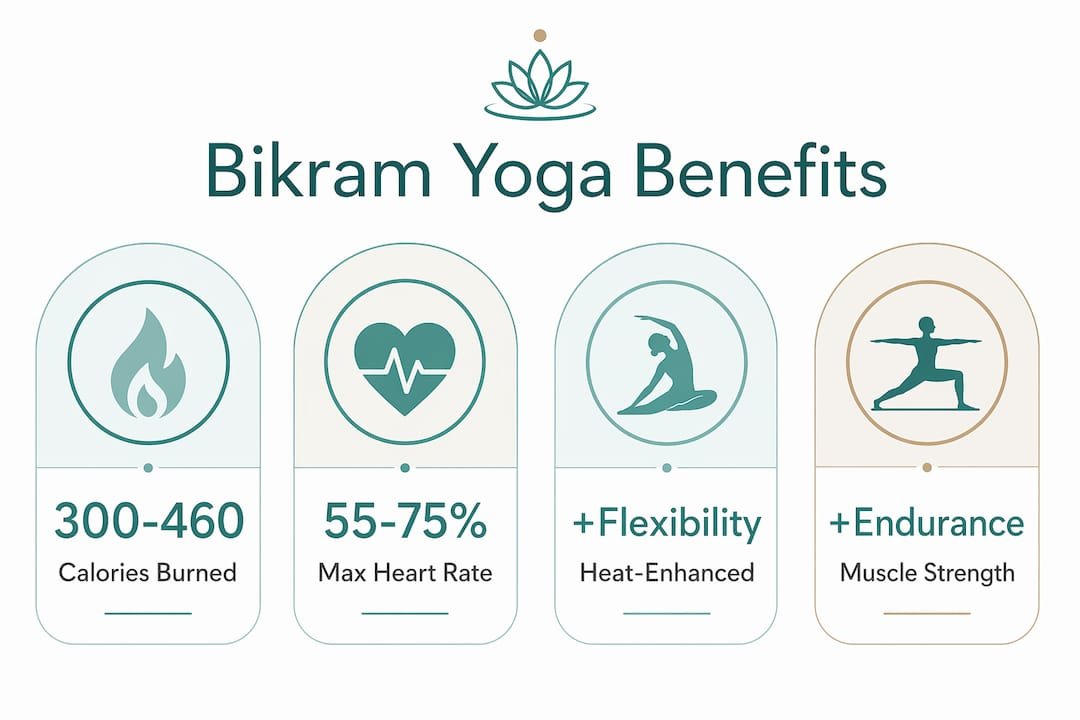
Bikram yoga produces a moderate cardiovascular stimulus that most practitioners underestimate. Heart rates during sessions typically reach 55 to 75 percent of age-predicted maximum, comparable to brisk walking or light cycling. That range is meaningful for cardiovascular conditioning, especially for adults who find high-impact exercise difficult to sustain.
"Bikram yoga provides a hybrid exercise experience combining isometric strength with moderate cardiovascular stimulation due to heat stress." — The Yoga Fitness
Heat-induced vasodilation is the key cardiovascular mechanism. As core temperature rises, blood vessels dilate to dissipate heat, which elevates cardiac output and trains the autonomic nervous system to regulate blood pressure more efficiently. After 8 to 12 weeks of regular practice, controlled trials document clinically meaningful reductions in both systolic and diastolic blood pressure. That outcome matters for the large percentage of adults managing hypertension without pharmaceutical intervention.
On the metabolic side, caloric expenditure averages 300 to 460 calories per 90-minute session. Early marketing claims of 600 to 1,000 calories were inflated, but the actual numbers still align with moderate-intensity aerobic work. Fat oxidation increases with regular practice, and improved glucose regulation has been observed in practitioners with pre-diabetic markers.
| Metric | Bikram yoga result |
|---|---|
| Heart rate during session | 55 to 75% of age-predicted max |
| Caloric burn per session | 300 to 460 calories |
| Blood pressure improvement | Clinically meaningful after 8 to 12 weeks |
| Body fat reduction (6 months) | 6.17% average, exceeding clinical threshold |
In what ways does Bikram yoga support mental health?
Bikram yoga reduces cortisol levels, improves mood, and builds emotional resilience through two parallel pathways: the physiological stress of heat exposure and the meditative structure of a predictable sequence. These are not separate benefits. They reinforce each other in every session.
The heat itself acts as a controlled stressor. Repeated exposure trains the body's stress response system to activate and recover more efficiently, a process that carries over into daily life as improved emotional regulation. Lower cortisol levels, increased endorphins, and improved executive function are all reported outcomes from regular practice. Practitioners also report better sleep quality and reduced anxiety, outcomes consistent with what we know about exercise-induced nervous system modulation.
The predictable 26-posture sequence adds a layer of psychological benefit that flow-based yoga styles cannot replicate. When you know exactly what is coming next, the mental challenge shifts from orientation to execution. You stop managing uncertainty and start managing effort. That shift builds patience, focus, and a form of mental discipline that transfers outside the studio.
Cortisol reduction from heat-stress adaptation
Endorphin release during sustained isometric effort
Improved sleep quality linked to autonomic nervous system regulation
Mental clarity from breath-controlled, sequenced movement
Emotional discipline built through repeated exposure to discomfort
Pro Tip: Use the predictable sequence as a mental benchmark. If Triangle Pose feels easier than it did three weeks ago, that is measurable progress. Tracking physical improvement in a fixed sequence is one of the most reliable motivation tools in any fitness practice.
How does Bikram yoga compare to other yoga styles and exercise?
Bikram yoga occupies a specific and well-defined position in the fitness spectrum. It is not a replacement for high-intensity aerobic training, and it is not equivalent to a vinyasa flow class. Understanding where it fits helps you use it effectively.
Compared to ambient-temperature yoga styles like Hatha or Yin, Bikram's heated environment adds a cardiovascular and metabolic dimension that those practices do not produce. The fixed sequence also makes progress measurable in a way that freeform classes cannot. Bikram yoga's fixed protocol is one of the most scientifically reproducible yoga practices, enabling precise measurement of physiological adaptations over time. That reproducibility is a genuine advantage for anyone who wants to track improvement rather than simply show up and move.
Compared to HIIT or running, Bikram yoga operates at a lower intensity ceiling. Houston Methodist research confirms it is not a substitute for higher-intensity aerobic workouts. However, its 94% retention rate versus HIIT's 75% tells a different story about long-term adherence. A practice you maintain for years produces better outcomes than an intense program you abandon after three months. Bikram yoga is also low-impact, making it accessible for adults with joint issues, older practitioners, and those returning from injury.
For beginners, the fixed sequence removes the cognitive load of learning new poses every class. You can focus entirely on form, breath, and body awareness from session one.
What safety considerations should practitioners know?
Practicing in 105°F heat with 40% humidity is a genuine physiological challenge. Preparation is not optional. It is the difference between a productive session and a dangerous one.
Hydrate before class, not during. Drink at least 16 to 24 ounces of water in the two hours before your session. Sipping during class is fine, but arriving dehydrated puts you behind from the first posture.
Manage electrolytes. Sweat loss in a Bikram session is substantial. Sodium, potassium, and magnesium all deplete faster than water alone can replace. Add an electrolyte supplement or eat a small, mineral-rich snack before class.
Expect lightheadedness in your first few sessions. Plasma volume shifts and vasodilation cause dizziness in beginners. Sitting down on your mat is not failure. It is correct acclimatization behavior.
Communicate with your instructor. Tell them if you have cardiovascular conditions, are pregnant, or are managing any heat-sensitivity issues. Qualified instructors adjust guidance accordingly.
Respect the acclimatization timeline. Most practitioners need four to six sessions before the heat feels manageable. Do not judge the practice or your fitness level based on your first two classes.
The true benefits of Bikram yoga come from mechanical loading and stress system modulation, not from sweating out toxins. Detoxification is a metabolic and renal process. Sweat is temperature regulation. Keeping that distinction clear helps you focus on what actually produces results.
Key takeaways
Bikram yoga's advantages are most pronounced when practitioners combine consistent attendance with proper preparation and realistic expectations about intensity.
| Point | Details |
|---|---|
| Heat amplifies flexibility gains | Elevated temperature increases muscle extensibility, accelerating early-stage flexibility development. |
| Moderate cardiovascular conditioning | Heart rates reach 55 to 75% of max, producing real but not high-intensity aerobic stimulus. |
| Measurable metabolic improvement | Six months of practice reduces body fat by 6.17% on average, exceeding clinical thresholds. |
| Mental health benefits are structural | The fixed sequence builds cortisol resilience, focus, and emotional discipline through repetition. |
| Retention outperforms HIIT | A 94% retention rate means practitioners actually stick with it, compounding benefits over time. |
Why the fixed sequence is Bikram yoga's most underrated advantage
Most people focus on the heat when they talk about Bikram yoga. I think that misses the point. The heat is a tool. The fixed sequence is the architecture.
After years of observing practitioners at Amrita Yoga & Wellness and working through the 26-and-2 protocol myself, the single most consistent predictor of long-term benefit is not how well someone tolerates the heat. It is whether they use the fixed sequence as a measurement system. When every class is identical, you cannot hide from your progress or your plateaus. That accountability is uncomfortable and genuinely motivating in equal measure.
The mental health gains surprised me most. Practitioners who commit to three sessions per week for 60 days consistently report changes in how they handle stress outside the studio. Not because yoga is magic, but because spending 90 minutes repeatedly choosing to stay in a difficult environment, breathe deliberately, and execute a known sequence trains the nervous system in ways that carry over. That is not a spiritual claim. It is a behavioral one.
My honest recommendation: treat the first six sessions as pure acclimatization. Do not evaluate the practice until your body has adapted to the heat. After that, track one posture per week and watch what happens to your motivation when you see objective improvement in a practice that never changes its variables.
Combine Bikram yoga with one or two sessions of higher-intensity cardio per week if cardiovascular fitness is a primary goal. The two modalities complement each other well, and neither replaces the other.
— Juiced
Start your Bikram yoga practice at Amrita Yoga & Wellness
Amrita Yoga & Wellness in Philadelphia offers hot yoga classes designed for practitioners at every level, from first-timers navigating the heat for the first time to experienced students refining their 26-and-2 sequence. The studio's instructors understand the physiological demands covered in this article and provide hands-on guidance for safe acclimatization, alignment correction, and progress tracking. If you want to experience the cardiovascular, metabolic, and mental health benefits of heated yoga with qualified support, Amrita Yoga & Wellness is the place to start. Review the studio's hot yoga safety tips before your first class, and explore the full range of wellness services at amritayogawellness.com.
FAQ
What does Bikram yoga actually do for your body?
Bikram yoga improves flexibility, builds muscular endurance, reduces blood pressure, and supports fat loss through a combination of heat-induced vasodilation and mechanical loading from 26 static postures. Research documents a 6.17% average body fat reduction over six months of consistent practice.
Is Bikram yoga good for beginners?
Bikram yoga is accessible for beginners because the fixed 26-posture sequence removes the need to learn new poses each class, allowing full focus on form and breath. Lightheadedness in the first few sessions is normal and resolves with acclimatization over four to six classes.
How many calories does a Bikram yoga session burn?
A 90-minute Bikram session burns an average of 300 to 460 calories, which aligns with moderate-intensity aerobic exercise. Early claims of 600 to 1,000 calories per session were not supported by controlled research.
How does Bikram yoga compare to HIIT for long-term fitness?
Bikram yoga operates at a lower intensity than HIIT but shows a 94% retention rate compared to HIIT's 75%, meaning practitioners maintain the habit longer and accumulate greater long-term benefit. For cardiovascular fitness goals, combining both modalities produces the best outcomes.
How often should you practice Bikram yoga to see results?
Three sessions per week for a minimum of eight weeks produces clinically meaningful improvements in blood pressure, flexibility, and metabolic markers. Consistency matters more than frequency in the early stages of practice.