The Amrita Journal
Explore thoughtful stories, practical wellness guidance and inspiring ideas to support your movement, mindfulness and everyday wellbeing at Amrita.
Aerial Yoga Poses Step by Step: Beginner's Guide
TL;DR:
Aerial yoga uses a suspended hammock to support traditional poses and inversions for all fitness levels. Proper equipment setup, clothing, and gradual skill building are essential for safe practice and progress. Beginners should focus on foundational poses and patience before attempting advanced inversions to avoid injury and build confidence.
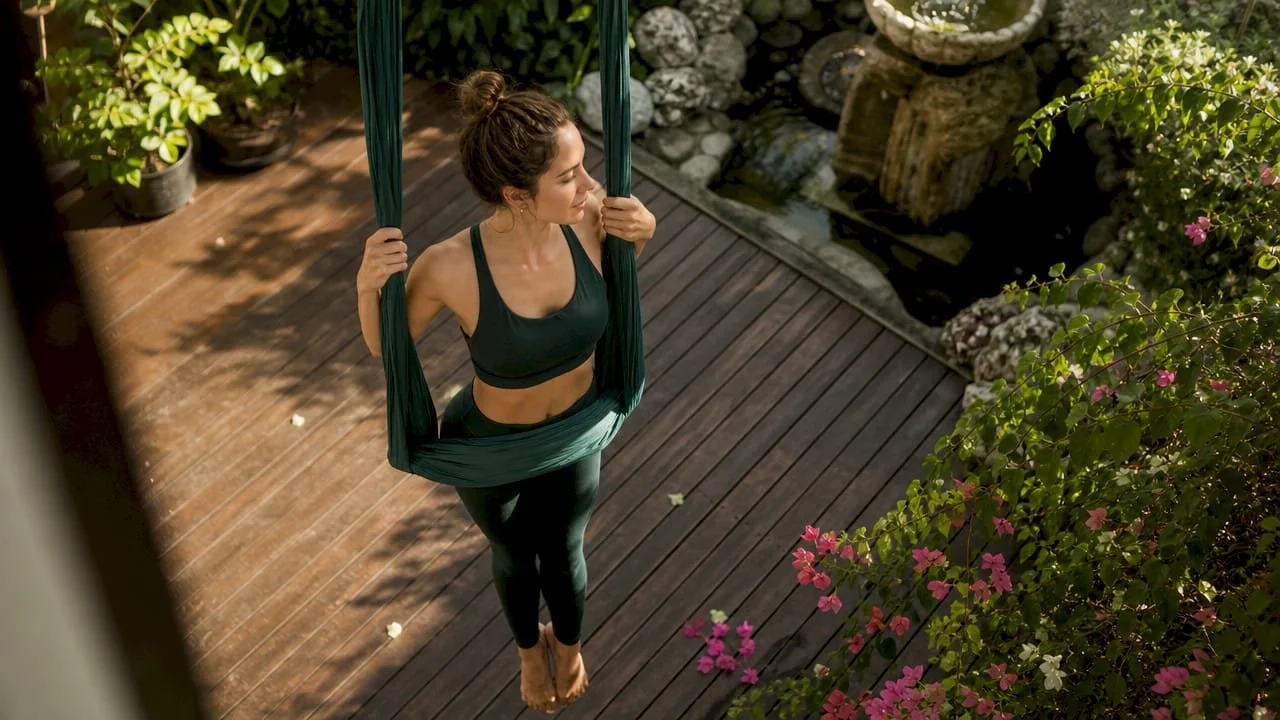
Aerial yoga is defined as a practice that uses a suspended silk hammock to support the body through traditional yoga poses, inversions, and strengthening movements. Learning aerial yoga poses step by step gives you a clear path from your first hammock sit to confident inversions, without guessing or risking injury. The hammock acts as both a prop and a support system, making poses accessible to adults at any fitness level. A typical aerial yoga class runs 60–75 minutes and moves through breathwork, standing sequences, and a cocooned savasana at the end. That structure exists for a reason: it builds your body and your confidence at the same pace.
What do you need before starting aerial yoga poses step by step?
Getting the equipment right is the single most important step before you attempt any pose. Skipping this part is where most beginners run into trouble, and it has nothing to do with flexibility.
Hammock setup and clearance
Your hammock suspension point must be rated for at least twice your body weight. That load factor accounts for dynamic movement, not just static hanging. You also need a minimum of 3–5 feet of clearance around the hammock on all sides. That space prevents collisions during wide poses and gives you room to exit safely if a position feels wrong.
What to wear and what to bring
Clothing choices affect both your safety and the life of the hammock fabric. Wear fitted clothing with no zippers, buttons, or jewelry. Loose fabric tangles in the silk during complex wraps, and metal hardware tears the weave over time. Fitted leggings and a snug long-sleeve top are the standard choice for most practitioners.
| Item | Requirement | Why it matters |
|---|---|---|
| Suspension point | Rated 2× body weight minimum | Prevents structural failure during dynamic movement |
| Clearance space | 3–5 feet on all sides | Avoids collisions and allows safe pose exits |
| Clothing | Fitted, no zippers or jewelry | Protects hammock fabric and reduces tangling risk |
| Mat | Placed below hammock | Cushions landings and marks your safe zone |
| Bare feet or grip socks | No hard-soled shoes | Maintains contact and control on the fabric |
Place a yoga mat directly below the hammock. It cushions any unexpected contact with the floor and gives you a visual reference for your center point.
Pro Tip: Remove rings, bracelets, and hair accessories before every session. Even small metal pieces can snag the silk and create a tear that weakens the fabric over time.
Step-by-step guide to beginner aerial yoga poses
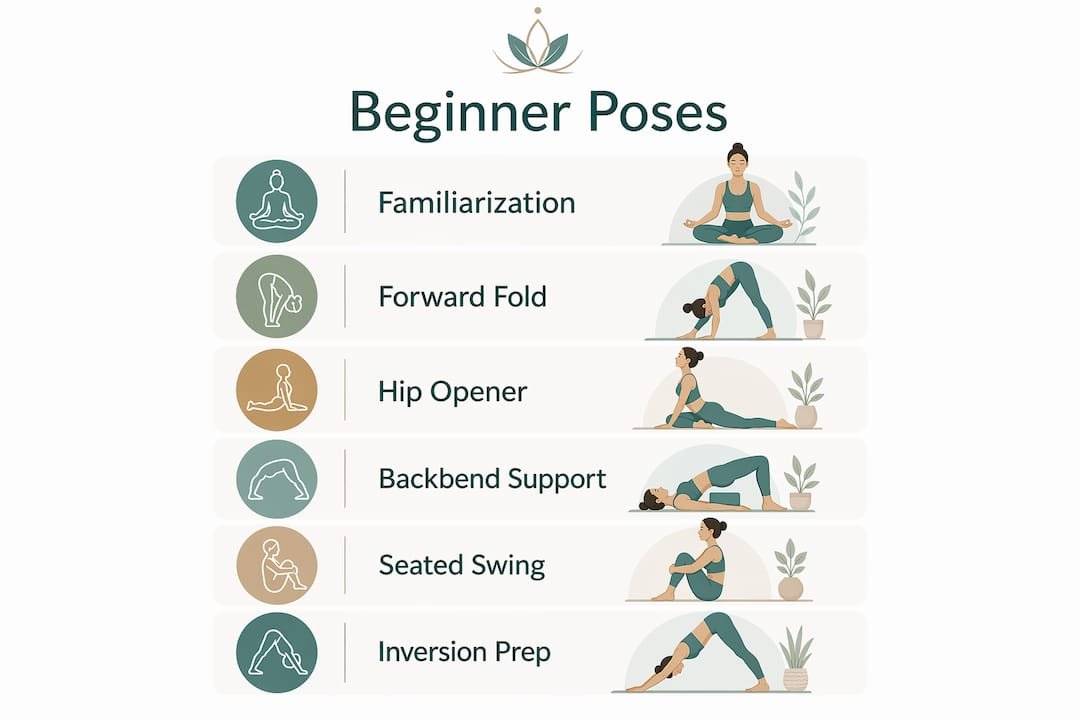
These foundational poses build the grip strength, body awareness, and trust in the hammock that every intermediate move depends on. Work through them in order.
1. Hammock familiarization
Stand inside the hammock loop with the fabric resting across your hips at hip height. Place both hands on the fabric and shift your weight gently side to side. This is not a pose. It is a calibration step that tells your nervous system what the hammock feels like under load. Spend two to three minutes here before attempting anything else.
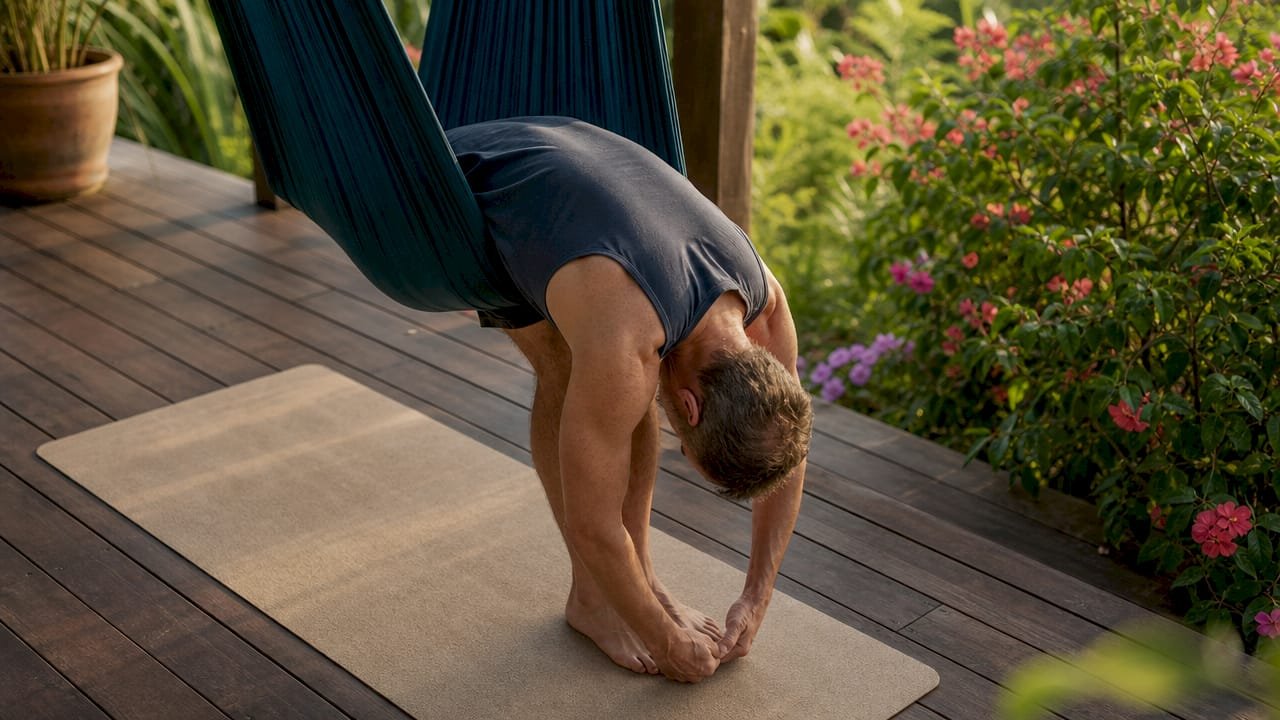
2. Supported forward fold
Stand with the hammock behind you at hip height. Lean your hips back into the fabric and hinge forward at the waist, letting your arms hang toward the floor. The hammock carries your hip weight while your spine decompresses. Hold for five slow breaths. This pose is one of the best aerial yoga strengthening moves for releasing lower back tension while teaching you to trust the fabric.
3. Hip opener pose
Sit in the hammock with the fabric supporting your sit bones. Open both knees out to the sides and press the soles of your feet together in a butterfly position. Let the hammock carry your full weight. Hold for five to eight breaths. This pose builds hip mobility that you will need for every seated and inverted position that follows.
4. Supported backbend
Stand facing away from the hammock with the fabric at mid-back height. Lean back slowly and let the silk support your spine as you open your chest toward the ceiling. Keep your feet flat on the floor and your knees slightly bent. This is a gentle introduction to spinal extension without any weight-bearing on the neck or shoulders.
5. Seated swing
Sit fully in the hammock with the fabric under your thighs and your hands gripping the sides. Push off gently and allow a slow, controlled swing. This step is purely about building comfort with motion. Many adults feel mild disorientation here. That response is normal and fades with repetition.
Pro Tip: Integrate breath with every pose from the start. Inhale as you enter a position, exhale as you settle into it. This habit makes the transition to inversions far smoother because your nervous system stays calm.
6. Gentle inversion preparation
From the seated position, grip the hammock firmly and slowly tilt your head back until it drops below your heart level. Do not go fully upside down yet. Hold for three breaths and return upright. This micro-inversion trains your inner ear and circulatory system to adjust gradually.
How do you progress to intermediate aerial yoga poses?
Intermediate aerial flying yoga poses require grip endurance, core control, and a clear understanding of how to exit each position safely. Build these qualities before attempting any full inversion.
Aerial downward-facing dog
Stand facing the hammock with the fabric at hip height.
Place both hands on the floor in front of you, shoulder-width apart.
Step both feet back and rest the tops of your feet on the hammock fabric.
Press your hips up and back to form an inverted V shape.
Hold for five breaths, keeping your core engaged and your heels pressing toward the floor.
This pose builds shoulder stability and teaches you how the hammock behaves under foot pressure, which is a key skill for more complex aerial silks yoga positions.
Aerial low lunge
Start in aerial downward-facing dog.
Step your right foot forward between your hands.
Let your left leg extend back with the hammock supporting your left shin.
Lift your torso upright and raise both arms overhead.
Hold for four breaths, then switch sides.
The hammock elevation in this lunge creates a deeper hip flexor stretch than a floor-based version. That depth is the point, but it also means you should move into it slowly.
Aerial chair pose
Stand with your back to the hammock, fabric at mid-thigh height.
Sit back into the hammock as if lowering into a chair.
Keep your feet flat on the floor and your knees at a 90-degree angle.
Extend both arms forward for balance.
Hold for five breaths, then stand back up with control.
Lotus inversion preparation
The lotus inversion requires progressive mastery of grip, core strength, hip mobility, and trust in the fabric before you attempt the full position. Do not skip the preparation steps.
Complete at least four weeks of consistent beginner poses before attempting this.
Practice the gentle inversion preparation until three-breath holds feel effortless.
Build grip endurance with mini-movements: small controlled shifts in the hammock while hanging.
Work with an instructor for your first full inversion attempt.
Pro Tip: Grip strength and body control are the two most underestimated requirements in aerial fitness. Start with mini-movements and assisted holds to build endurance before attempting unsupported inversions.
Dizziness during early inversions is common. Keeping your head above your heart initially helps your inner ear adjust to spatial reorientation. Increase inversion depth only after that sensation disappears completely.
What mistakes do beginners make in aerial yoga poses?
Most errors in aerial yoga come from rushing, not from lack of ability. Identifying them early saves you weeks of frustration.
Incorrect grip: Wrapping fingers too loosely around the fabric reduces control. Grip the hammock with your full hand, not just your fingertips.
Shoulder creep: Letting shoulders rise toward your ears during holds compresses the neck and reduces stability. Keep shoulders actively drawn down and back.
Overstretching: The hammock amplifies range of motion. A stretch that feels mild can be deeper than it appears. Move slowly and stop at the first sign of sharp discomfort.
Wrong clothing: Loose fabric or jewelry snags the silk and can cause sudden shifts in position. Fitted clothing is a safety requirement, not a style preference.
Ignoring dizziness: Pushing through inversion nausea does not build tolerance faster. It builds aversion. Exit the pose, sit upright, and wait for the sensation to pass before continuing.
Skipping savasana: The cocooned savasana at session end stabilizes the nervous system after inversions. Skipping it leaves your body in an activated state, which increases soreness and reduces recovery.
Aerial yoga rewards patience. Every practitioner who rushes past the foundations ends up returning to them. The ones who stay with the basics longest progress the fastest.
Exiting a challenging pose safely means reversing your entry steps in order. Never drop out of a position. Reverse it deliberately, one step at a time.
Key takeaways
Mastering aerial yoga poses step by step requires correct equipment setup, progressive skill building, and consistent attention to breath and body signals at every stage.
| Point | Details |
|---|---|
| Equipment comes first | Suspension points must be rated for at least twice your body weight before any practice begins. |
| Clothing affects safety | Fitted garments with no zippers or jewelry protect both you and the hammock fabric. |
| Build in sequence | Complete beginner poses for at least four weeks before attempting intermediate inversions. |
| Manage inversion nausea | Keep your head above your heart in early sessions to let your inner ear adjust gradually. |
| Never skip savasana | Five to ten minutes of cocooned relaxation after inversions stabilizes the nervous system and aids recovery. |
Why I think most people approach aerial yoga backwards
Most adults who come to aerial yoga want to be upside down within the first session. That impulse is understandable. The inversions look like the whole point. But the hammock is a playful partner, not a shortcut. The people who treat it that way, who spend their first few sessions just getting comfortable with the fabric's weight and movement, end up with far better inversions than those who force it.
Strength gains in aerial yoga are cumulative. Rushing to advanced poses without mastering the foundations risks injury and frustration. I have seen this pattern repeat consistently. The practitioner who spends three sessions on supported forward folds and hip openers builds the grip endurance and spatial awareness that makes a lotus inversion feel natural. The one who skips ahead spends those same three sessions recovering from a strained shoulder.
The mind-body connection that aerial yoga builds is also different from floor-based yoga. When you are partially suspended, your body cannot rely on ground feedback. Your proprioception, your sense of where your body is in space, has to sharpen quickly. That sharpening is one of the most underrated benefits of the practice. It carries over into every other physical activity you do.
My honest recommendation: treat the beginner sequence in this guide as a six-week program, not a checklist to complete in one session. Revisit the seated swing and gentle inversion prep every single session, even after you have moved on to intermediate work. Those two poses keep your nervous system calibrated and your confidence grounded.
— Juiced
Aerial yoga classes and wellness at Amritayogawellness
Amritayogawellness, the Philadelphia-based studio behind this guide, offers structured classes for adults at every level of aerial yoga fitness, from first-timers to practitioners ready to work on inversions with expert guidance.
Every class at Amritayogawellness includes safety instruction, proper hammock setup guidance, and instructor-led progressions so you never have to guess your next step. For adults looking to complement their physical practice with deeper wellness work, the studio also offers tarot readings as part of its broader approach to personal growth and self-care. Whether you are stepping into a hammock for the first time or refining your intermediate poses, Amritayogawellness gives you the structure and community to make it stick.
FAQ
What is aerial yoga?
Aerial yoga is a practice that uses a suspended silk hammock to support the body through yoga poses, inversions, and strengthening movements. It combines traditional yoga alignment with the added challenge and support of working off the ground.
How long does a typical aerial yoga session last?
A standard aerial yoga class runs 60–75 minutes, including breathwork, active poses, and a 5–10 minute cocooned savasana at the end.
Is aerial yoga safe for complete beginners?
Aerial yoga is safe for beginners when the hammock is properly installed and poses are learned in sequence. Starting with easy aerial yoga poses and building gradually is the key to avoiding injury.
Why do I feel dizzy during aerial yoga inversions?
Dizziness during inversions is a normal inner ear response to spatial reorientation. Keeping your head above your heart in early sessions and increasing inversion depth gradually resolves the sensation for most practitioners.
What should I wear to an aerial yoga class?
Wear fitted clothing with no zippers, buttons, or jewelry. Loose fabric and metal hardware snag the silk hammock and can cause sudden shifts in position during poses.
Recommended
Aerial Yoga for Weight Loss: What Actually Works

TL;DR:
Aerial yoga can aid weight loss by burning around 300 calories per session and building muscle. Consistent practice combined with proper nutrition enhances fat reduction and improves strength within weeks. It is suitable for beginners and benefits from progression, but should be part of a broader healthy lifestyle to maximize results.
If you've ever dragged yourself to another treadmill session and felt zero motivation, aerial yoga for weight loss might be the change you've been looking for. Suspended in a fabric hammock, you engage your core, build real strength, and get your heart rate up. All while doing something that genuinely feels exciting. Aerial yoga sessions burn around 300 calories per 50-minute class, which makes it a legitimate workout, not a novelty act. This guide covers everything from getting started safely to tracking your real progress.
Table of Contents
Key Takeaways
| Point | Details |
|---|---|
| Calories and consistency | Aerial yoga burns roughly 300 calories per class, but weekly consistency drives real fat loss. |
| Strength plus cardio combo | The hammock adds resistance that builds muscle, which supports long-term metabolic health. |
| Realistic expectations matter | Aerial yoga works best as part of a full plan including nutrition and additional activity. |
| Safety screening first | Medical clearance and knowing your contraindications prevents injuries that derail progress. |
| Progressive challenge is key | You must increase intensity and complexity over time to keep seeing results. |
Aerial yoga for weight loss: what you need before starting
Before you show up to your first aerial yoga class hoping to lose weight, a bit of preparation goes a long way. Aerial yoga is accessible to most fitness levels, but it's not entirely without prerequisites.
Physical readiness and medical clearance
You don't need to be fit to start, but you do need to be honest about your health. People with hypertension, vertigo, recent surgeries, or musculoskeletal injuries should consult a doctor first. Safety screening for conditions like hypertension and pregnancy-related concerns is vital to keeping your practice consistent and injury-free. Getting cleared upfront isn't bureaucratic. It's what keeps you in the studio week after week instead of sidelined.
For a thorough breakdown before your first session, reviewing aerial yoga contraindications gives you a clear picture of what to watch out for.
What to wear and bring
Keep it simple. Fitted clothing that covers your armpits and the backs of your knees protects your skin from friction against the silk hammock. Avoid zippers, belts, or anything with hard edges. Go barefoot or wear grip socks.
Here's what to have ready before your first aerial workout for weight loss:
Fitted leggings and a long-sleeved fitted top
Grip socks (optional but helpful)
Water bottle
Light snack eaten 90 minutes beforehand
An open mind about being upside down
Choosing the right class
Not all aerial yoga classes are structured the same way. Some focus on flow and flexibility. Others emphasize strength and conditioning, which aligns better with aerial yoga weight loss goals. Look for classes that describe themselves as "aerial fitness" or "aerial conditioning." When searching for aerial yoga classes near me, filter for studios that have certified instructors with training in both yoga and aerial arts. The instructor's background matters more than the studio's decor.
Pro Tip: Ask the studio directly whether the class targets cardiovascular endurance or primarily flexibility. A strength-focused class will do more for your weight loss goals than a slow, restorative one.
| Class type | Weight loss benefit | Best for |
|---|---|---|
| Aerial fitness/conditioning | High | Fat loss, muscle tone |
| Aerial flow yoga | Moderate | Flexibility, stress relief |
| Aerial restorative | Low | Recovery, relaxation |
| Aerial acrobatics | High | Strength, coordination |
Best aerial yoga poses and routines for fat loss
The hammock is a tool. What you do with it determines your results. These seven movements specifically target major muscle groups, spike your heart rate, and build the lean muscle that keeps your metabolism active.
Inverted core crunches. Hang face-down with your hips in the hammock. Use your core to pull your knees toward your chest repeatedly. This targets the entire abdominal wall while your stabilizer muscles work overtime to keep you balanced.
Aerial squats. Stand with the hammock at hip height behind you. Sit back into it and lower into a squat, then press back up. This loads the glutes and quads with the added instability of the fabric, recruiting more muscle fibers than a regular bodyweight squat.
Plank pulls. Start in a plank position with your feet in the hammock. Pull your knees to your chest and extend back out. Your core, hip flexors, and shoulders all fire at once.
Hip hinge swings. Standing, hold the hammock overhead and hinge forward at the hip, letting the momentum build. This trains the posterior chain, specifically the glutes and hamstrings, and gets your heart rate climbing.
Aerial side planks. Thread one foot into the hammock, extend into a side plank, and hold. The instability from the silk turns a static hold into an active full-body stabilization challenge.
Seated backbend pulses. Sit in the hammock and lean back into a backbend. Pulse up and down to activate the spinal extensors, glutes, and core. This one opens the chest and builds real back strength.
Hammock pull-ups. Grip the fabric and perform assisted or full pull-ups. Your back, biceps, and shoulders work hard here, and training all major muscle groups consistently is the core principle behind effective strength-based fat loss.
A sample 50-minute aerial yoga weight loss routine
Warm up for 8 minutes with light swinging and hip circles in the hammock. Move into the hip hinge swings and aerial squats for 15 minutes, running each for 3 sets of 12 repetitions. Shift to core work with inverted crunches and plank pulls for another 15 minutes. Finish with aerial side planks, backbend pulses, and hammock pull-ups for 10 minutes, then cool down with 5 minutes of gentle spinal traction in an inverted hang.

Pro Tip: Track how hard each move feels on a scale of 1 to 10. For weight loss, you want most of your working sets to land between 6 and 8. If every exercise feels easy, it's time to add reps, slow the tempo, or ask your instructor for a harder variation.
Common mistakes that slow aerial yoga weight loss results
Getting into the hammock is the fun part. Staying consistent and avoiding the pitfalls below is what separates people who see real change from those who don't.
Believing aerial yoga alone is enough
This is the most common mistake. Yoga contributes to weight loss as part of a full lifestyle plan that includes nutrition and other activity. One or two weekly classes won't hit the minimum 150 minutes of moderate aerobic activity per week recommended for weight management. You need to layer aerial yoga into a larger plan, not treat it as the plan itself.
Common mistakes to watch for:
Expecting to lose weight without adjusting your diet
Skipping strength-focused flows in favor of only restorative classes
Going too hard too soon and burning out within three weeks
Neglecting sleep and recovery between sessions
Falling for wellness hype
The aerial yoga world has its share of exaggerated claims. Detox and lymphatic drainage claims from inversions have no credible physiological backing. The real benefits are spinal decompression, strength development, and a genuine mood lift from the novelty and challenge of the practice. Chase the real results, not the Instagram-friendly promises.
"The best exercise plan is the one you actually stick to. Aerial yoga earns its place in a weight loss program by being something people genuinely look forward to. That consistency is worth more than the perfect protocol you never follow."
Not progressing your workouts
Repeating the same beginner flow every week is one of the fastest ways to plateau. Intensity progression and total weekly volume are what drive continued fat loss. Add minutes, increase repetitions, reduce rest periods, or try a more advanced variation every two to three weeks.
For tips on practicing safely as you advance, the aerial yoga safety resources at Amritayogawellness walk through how to scale up without risking injury.
Expected results and how to track progress
Setting the right expectations is what keeps you going when the scale moves slowly or not at all for a week.
Most people notice improved core strength and better posture within two to three weeks. Fat loss becomes visible around weeks six to eight when combined with a calorie-conscious diet. Yoga's improvements in cardiometabolic health markers like blood pressure and lipid profiles develop over consistent months of practice, not weeks.
| Metric | When to expect change | How to measure |
|---|---|---|
| Core strength | 2 to 3 weeks | How long you hold a plank or aerial side plank |
| Posture | 3 to 4 weeks | Observation or posture photos |
| Body fat percentage | 6 to 8 weeks | Body composition scale or tape measure |
| Cardiovascular fitness | 4 to 6 weeks | Resting heart rate trends |
| Cardiometabolic markers | 3 to 6 months | Bloodwork with your physician |
The number on the scale is the least interesting metric here. Track how your clothes fit, how your resting heart rate drops, and how far your endurance has improved mid-class. These tell you far more about what's actually changing in your body.
Pairing aerial yoga with nutrition and other movement
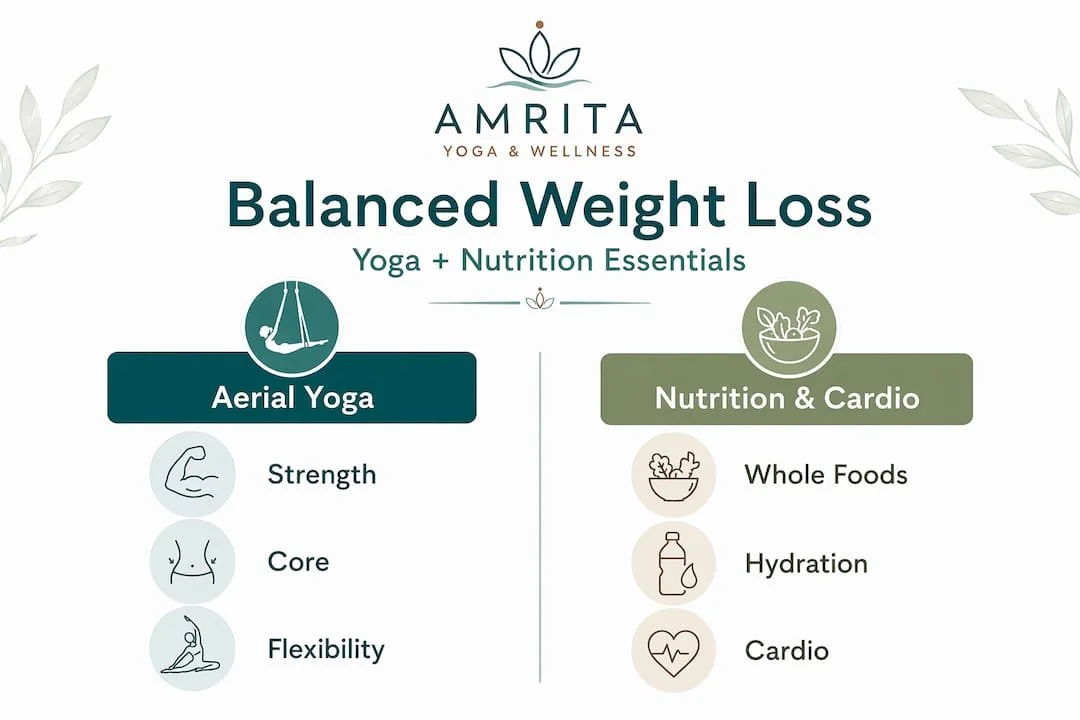
Aerial yoga works best alongside clean eating and additional cardio activity. Think of it as your strength and skill training session, then supplement with walks, cycling, or swimming on other days. For most people, aerial yoga two to three times per week plus 30 to 40 minutes of cardio on two other days puts you solidly within the recommended activity guidelines. Explore how your overall yoga wellness benefits stack up when you combine multiple modalities.
My honest take on aerial yoga and fat loss
I've watched people come to aerial yoga expecting magic and leave frustrated because they treated one weekly class like a silver bullet. Here's what I actually believe: aerial yoga is one of the most underrated strength training tools for people who hate the gym. The hammock creates instability that activates muscles your standard workout never touches, and the resistance from body weight plus gravity in unusual positions builds functional strength fast.
What I've seen work consistently is using aerial yoga as the anchor of a fitness routine, not the whole thing. The people who show up three times a week, push into harder flows every few weeks, and pair it with reasonably clean eating. They lose fat, get noticeably stronger, and, most critically, they keep coming back. That last part is everything.
I'm also straightforward about the wellness noise that follows aerial yoga around. Detox claims, lymphatic flushing, spiritual weight release. These real benefits are strength and psychological, not mythological. Reduced anxiety, real spinal decompression, and genuine calorie burn. That's more than enough to build on without fabricating extra claims.
If you're tired of workouts that feel like punishment, aerial yoga gives you something to actually practice and get better at. Progress in skill is its own motivator, and that motivation is what ultimately drives the weight loss.
— Juiced
Start your aerial yoga journey with Amrita Yoga & Wellness
If you're ready to try aerial yoga in a structured, supportive setting, Amrita Yoga & Wellness in Philadelphia has classes designed for all experience levels, from total beginners to those ready for advanced aerial conditioning. The instructors understand how to scale aerial workouts for weight loss goals specifically, not just flexibility. You'll be in a community that shows up consistently and pushes each other forward.
Beyond the mat, Amritayogawellness also offers tarot readings and other holistic wellness services for those who want to explore the mental and spiritual side of their health journey alongside the physical. You can browse class schedules, sign up online, and connect with the studio community directly at amritayogawellness.com.
FAQ
Can aerial yoga help you lose weight?
Yes. Aerial yoga helps with weight loss by burning around 300 calories per 50-minute session while building muscle through resistance-based movements. Combined with a sensible diet and additional cardio, it's a real tool for fat loss.
How many times per week should you do aerial yoga for weight loss?
Two to three sessions per week is the sweet spot for most people. Pair them with additional cardio activity to meet the recommended 150 minutes of weekly exercise for weight management.
Is aerial yoga good for beginners trying to lose weight?
Absolutely. Starting any regular resistance training produces meaningful strength and metabolic benefits even for beginners, and aerial yoga is beginner-friendly because instructors can modify every pose to match your starting fitness level.
Are there health conditions that prevent practicing aerial yoga?
Yes. Hypertension, vertigo, recent surgeries, and pregnancy may require modifications or medical clearance before you begin. Review contraindications with your doctor and inform your instructor of any conditions before your first class.
How long before you see results from aerial yoga?
Core strength improvements typically appear within two to three weeks. Visible fat loss usually takes six to eight weeks with consistent practice and a calorie-conscious diet supporting the work you do in the hammock.
Recommended
What is aerial yoga good for? A Philadelphia guide to benefits
TL;DR:
Aerial yoga offers physical benefits like enhanced flexibility, strength, and spinal decompression through supported inversions. It also promotes mental relaxation, reduces stress, and fosters a sense of community by keeping practitioners present and engaged. When practiced safely, it supports holistic wellness, improves posture, and boosts confidence, making it a valuable addition to a healthy lifestyle.
If you've ever wondered what is aerial yoga good for beyond the Instagram-worthy poses, the answer runs deeper than you'd expect. Aerial yoga suspends you in silk hammocks, which allows your spine to decompress, your muscles to stretch in entirely new planes, and your mind to go quiet in ways that seated meditation rarely achieves. This guide covers the physical, mental, and wellness benefits of aerial yoga, backed by research and explained for anyone in Philadelphia curious about why this practice keeps growing.
Table of Contents
Key Takeaways
| Point | Details |
|---|---|
| Enhances flexibility and strength | Aerial yoga effectively improves physical flexibility, core, and upper-body strength through suspended movements. |
| Promotes mental relaxation | Its unique airborne practice lowers stress and obsessive thoughts, boosting mindfulness and mood. |
| Supports spinal health | Aerial inversion and suspension decompress the spine, temporarily increasing height and relieving pressure. |
| Requires safety awareness | Proper equipment, certified instruction, and medical considerations are vital to practice aerial yoga safely. |
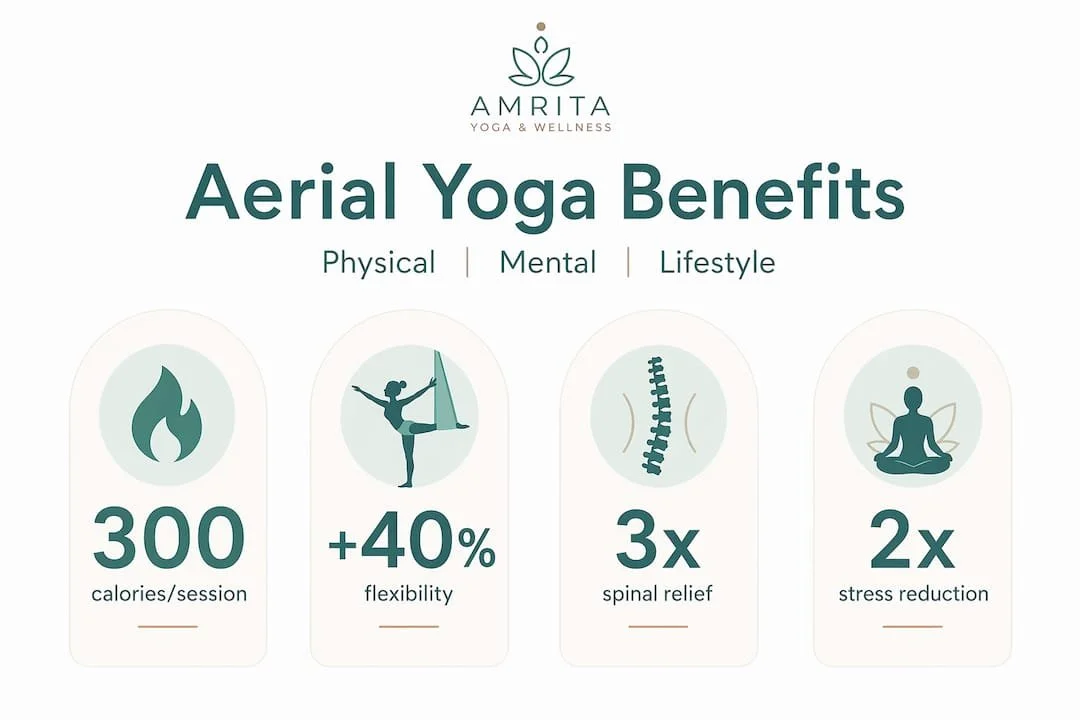
| Burns calories, supports heart health | Aerial yoga burns about 300 calories per session and reduces cardiovascular risk factors as a moderate-intensity workout. |
What is aerial yoga good for physically? Flexibility, strength, and spinal health
Aerial yoga uses suspended silk hammocks to take traditional yoga postures off the ground, and that shift changes everything about how your body responds. Gravity becomes a tool rather than an obstacle. Your joints get traction, your spine decompresses, and muscles that barely fire during a standard flow suddenly have to work to stabilize you in midair.
The flexibility gains alone set aerial yoga apart. Aerial athletes demonstrate exceptional flexibility, balance, and strength compared to traditional practitioners, according to a 2019 study. The hammock lets you ease into deeper stretches by supporting your weight, so tight hamstrings and hip flexors release in ways a mat simply can't facilitate.
Strength is the less obvious benefit. Gripping, pulling, and stabilizing the hammock builds real upper-body and core strength. Your forearms, lats, and deep abdominal muscles engage continuously to keep you balanced. This functional strength directly improves posture and protects against everyday injuries.
The spinal benefit deserves its own moment. Hanging inverted in the hammock allows spinal elongation up to 1.5 inches per session, though this is not cumulative. That temporary decompression takes pressure off the discs and nerves in your spine, which is why so many people with chronic back tension find aerial yoga immediately satisfying. For a thorough breakdown of these gains, the complete wellness guide at Amrita Yoga & Wellness covers the full picture.
Key physical benefits of aerial yoga at a glance:
Deeper stretching of hip flexors, hamstrings, and shoulders through supported suspension
Core and upper-body strength from constant stabilization demands
Spinal decompression during inversion poses that temporarily relieves disc pressure
Joint traction that eases stiffness in knees, hips, and the lower back
Better balance and proprioception (your body's sense of where it is in space)
| Benefit | Aerial yoga | Traditional yoga |
|---|---|---|
| Spinal decompression | Yes, through full inversions | Minimal |
| Upper-body strength | Significant (grip, pull) | Light to moderate |
| Flexibility range | Extended via hammock support | Limited by gravity and mat |
| Joint traction | Active | Passive at best |
| Core engagement | Constant stabilization | Pose-dependent |
Pro Tip: If you're new to inversions, follow aerial yoga self care tips to build up gradually. Rushing inversions before your core is ready is the fastest way to strain your neck.
Mental health and relaxation benefits of aerial yoga
Beyond physical gains, aerial yoga profoundly supports mental relaxation and emotional well-being. The reason is almost mechanical. When you are suspended in the air mid-movement, your brain has one job: stay present. There is no room to replay an argument from the morning or plan tomorrow's schedule.
Practicing aerial arts significantly reduces depression and stress, particularly in non-competitive settings like community yoga classes. The combination of physical challenge, controlled breathing, and the sheer novelty of being airborne creates a state your nervous system doesn't get from a treadmill or even a standard yoga class.
Research backs this up specifically. A community-based aerial sling study reported decreased stress, increased joy, and improved mindfulness in participants after regular classes. Importantly, the study noted that these weren't just momentary mood lifts. Participants reported lasting changes in how they related to stress outside the studio.
"When you're in the air moving, you can't be thinking about what made you angry earlier." — aerial yoga participant
The feeling of flying, even at low heights, triggers genuine euphoria. That isn't poetic. The vestibular system (the part of your inner ear and brain managing balance and spatial orientation) gets stimulated by suspension and inversion in ways that produce measurable shifts in mood. Think of it as a natural, movement-driven reset for your mental state.
The social dimension also matters. Group aerial yoga for relaxation classes build a sense of shared challenge and trust that solo practice can't replicate. When you're nervous about your first inversion and the instructor and the person next to you are both cheering you on, that connection has real mental health value.
Mental health benefits supported by research:
Reduced symptoms of depression and anxiety with consistent practice
Improved mindfulness through movement demands that require full attention
Mood elevation from vestibular stimulation and the joy of suspension
Community connection and social support from group class environments
Improved sleep quality from physical exertion and nervous system regulation
For more on how this practice can ease tension, explore aerial yoga stress relief approaches used at Amrita Yoga & Wellness.
How aerial yoga supports holistic wellness and lifestyle improvements
Let's now consider how aerial yoga shapes your overall wellness beyond exercise and stress relief. The anti gravity yoga benefits extend into how you carry yourself, how you eat, and how you think about your body every day, not just during class.
One of the most reported outcomes from consistent aerial practice is improved body awareness, what researchers call "body schema." Aerial sling classes were found to improve body schema and mindfulness, leading to straighter posture and reduced obsessive thinking. When you practice isolating specific muscles to control a hammock movement, you develop a granular awareness of your body that carries into daily life. You stand differently. You breathe differently.
A surprising lifestyle ripple: participants in aerial yoga studies also reported making healthier food choices following regular practice. This isn't accidental. When you feel strong and capable in your body, you naturally want to support that feeling. The confidence that comes from nailing a challenging aerial pose transfers into other decisions.
Holistic benefits of regular aerial yoga practice:
Body schema improvement: sharper awareness of posture, alignment, and muscle engagement
Mental health boost: reduced obsessive thoughts, lower anxiety, and greater emotional steadiness
Increased fitness: functional strength and flexibility gains that support all physical activities
Better diet habits: participants report gravitating toward healthier food choices
Greater confidence: mastering aerial poses builds self-efficacy that extends beyond the studio
The real impact on wellness is worth reading if you want a deeper look at how these lifestyle changes compound over time.
Pro Tip: Between aerial classes, use floor-based hip flexor and shoulder stretches inspired by aerial movements. This maintains the flexibility gains you've worked for and keeps the mind-body connection alive outside class. More ideas are available in the aerial yoga self care tips resource.
Safety considerations and who should avoid aerial yoga
Before you take flight with aerial yoga, it's crucial to understand important safety guidelines and whether this practice is right for you. The benefits are real, but so are the risks when proper precautions aren't followed.
Over 35% of aerial yoga injuriesare linked to improper equipment or lack of qualified guidance. That statistic should recalibrate how seriously you take equipment checks and instructor credentials before your first class.
Common risks include fabric burns from grip errors, falls from poor hammock technique, shoulder and wrist strains from overloading joints too early, and dizziness from prolonged inversions. None of these are inevitable. All of them are preventable with the right instruction and progressive skill-building.
Certain health conditions make aerial yoga inappropriate without medical clearance first. Avoid aerial yoga if you have glaucoma, uncontrolled hypertension, pregnancy, recent surgery, vertigo, or severe spinal issues until you've spoken with your doctor. Inversions increase blood pressure to the head, which is why conditions affecting eye pressure or blood pressure require careful evaluation.
Safety essentials before your first class:
Verify that all hardware is professionally installed and load-tested
Inspect the hammock fabric for fraying, thin spots, or worn stitching
Take a beginner class first, even if you have yoga experience
Warm up before every session to prepare joints and connective tissue
Inform your instructor about any health conditions or injuries upfront
The complete aerial yoga safety guide from Amrita Yoga & Wellness walks through every precaution in detail.
Pro Tip: Your practice area needs at least 6 feet of clearance on all sides. Furniture corners and door frames are the most common causes of accidental contact injuries.
Calories burned and cardiovascular benefits of aerial yoga
Alongside mental and physical gains, aerial yoga also delivers valuable cardiovascular and calorie-burning benefits that most people underestimate when they first see the gentle-looking hammocks.
A 50-minute aerial yoga session burns around 300 calories, classifying it as low-to-moderate intensity exercise that measurably reduces cardiovascular heart disease risk factors, according to an American Council on Exercise study. That's comparable to a brisk walk or a light cycling session, but with the added strength and flexibility work stacked on top.
This matters for Philadelphia residents looking for a single practice that covers multiple fitness needs without the joint stress of high-impact cardio.
| Activity (50 minutes) | Calories burned | Cardiovascular benefit | Flexibility benefit |
|---|---|---|---|
| Aerial yoga | ~300 | Moderate | High |
| Brisk walking | ~200 | Moderate | Low |
| Cycling (moderate) | ~330 | Moderate to high | Low |
| Standard yoga | ~175 | Low | High |
| Swimming | ~400 | High | Moderate |
How aerial yoga supports cardiovascular wellness:
Sustained low-intensity movement elevates heart rate without joint stress
Full-body engagement improves circulation throughout the session
Regular practice supports healthy blood pressure and metabolic function
Combines cardio benefits with strength and mobility gains in one session
Explore more about the intersection of movement and wellness through yoga wellness benefits to see how aerial yoga fits into a broader healthy lifestyle.
Why aerial yoga is more than a fitness trend in Philadelphia
Here's what most benefit articles miss: aerial yoga's greatest value isn't in any single category of gain. It's in the integration. You rarely find a practice that improves your spine, challenges your mind to stay present, builds genuine community, burns calories, and leaves you feeling euphoric rather than depleted. That combination is genuinely rare.
There's also a misconception worth addressing. Many people assume aerial yoga is for acrobats or unusually flexible people. The opposite is often true. The hammock supports you precisely where you're limited. It makes difficult poses accessible before your strength or flexibility has fully developed. That's not a shortcut. It's a smarter entry point.
"Inversions in a hammock create a state of physical and mental euphoria worth the trip." — Dr. Paul Jerard
The mental health advantages of aerial yoga rival what many stress reduction programs offer, and they arrive without the clinical sterility of a therapist's office or the isolation of solo meditation. You're moving, you're connected to other people, and your body is doing something it has never done before. That novelty alone is therapeutic.
Philadelphia has a genuinely strong wellness community, and aerial yoga fits it well. It's inclusive by design, it scales from complete beginner to advanced practitioner, and it rewards consistent effort with visible, felt results. If you're looking for the real impact on wellness that goes beyond a standard gym routine, aerial yoga belongs in the conversation.
The honest take: aerial yoga works best when it's not treated as a trend to try once. The compounding benefits, spinal health, mental clarity, community connection, show up most clearly after weeks of consistent practice.
Explore aerial yoga classes and wellness at Amrita Yoga & Wellness
If you're ready to experience aerial yoga firsthand, here's how Amrita Yoga & Wellness can support your journey. Whether you're a complete beginner or you've already dabbled in anti-gravity poses, the studio offers structured classes designed to meet you where you are.
Amrita Yoga & Wellness in Philadelphia offers beginner through advanced aerial yoga classes led by certified instructors who prioritize safe technique and progressive skill-building. Every class is designed to be accessible without being watered down. Beyond aerial yoga, the studio's wellness offerings extend into tarot readings, massage therapy, and other holistic services that complement your physical practice. If you want to integrate aerial yoga into a broader self-care lifestyle, this is where to start.
Frequently asked questions
What physical benefits can I expect from aerial yoga?
You can improve your flexibility, build upper-body and core strength, and experience spinal decompression that may relieve back pain. Aerial athletes demonstrate exceptional flexibility and strength advantages over traditional yoga practitioners.
Is aerial yoga safe for beginners?
Yes, when practiced in beginner classes with proper equipment and instructor guidance, aerial yoga is generally safe. That said, most aerial injuries relate to improper equipment or missing instruction, so certified teaching and careful gear inspection are non-negotiable.
Can aerial yoga reduce stress and improve mental health?
Yes. Regular aerial yoga practice reduces stress, decreases depressive symptoms, and improves mindfulness. A community aerial sling study reported decreased stress, increased joy, and improved mindfulness among consistent participants.
Who should avoid aerial yoga?
Anyone with glaucoma, uncontrolled hypertension, pregnancy, recent surgery, vertigo, or severe spinal issues should consult a doctor before starting. These conditions can be worsened by the inversion poses central to aerial yoga.
How many calories does aerial yoga burn?
A 50-minute session burns around 300 calories at low-to-moderate intensity, making it effective for cardiovascular health while simultaneously building strength and flexibility.
Recommended
Aerial Barre: Philadelphia's Fusion Workout for Strength & Grace
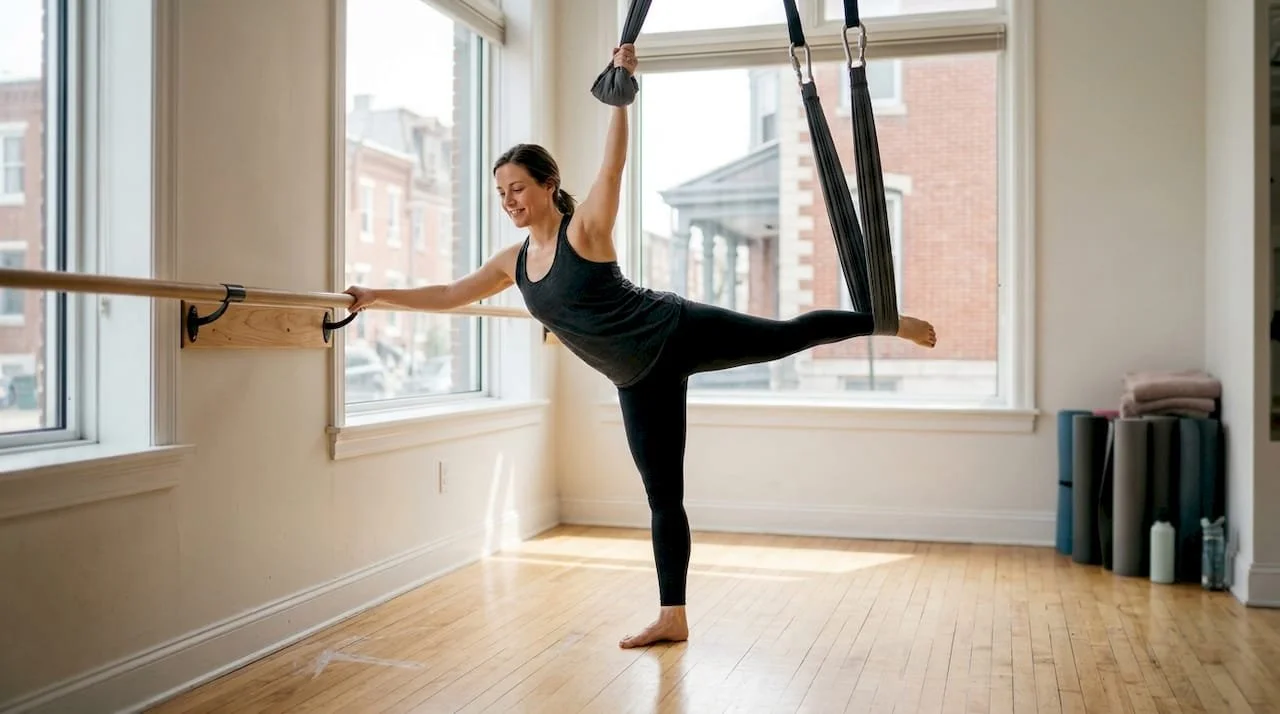
TL;DR:
Aerial barre combines ballet, aerial yoga, and Pilates using a barre and hammock for a full-body workout.It offers moderate to high strength building, improved flexibility, and mental mindfulness benefits.The practice is accessible, safe, and gaining popularity in Philadelphia as a holistic fitness and wellness option.
You've probably walked past a studio window, spotted aerial hammocks hanging next to a ballet barre, and thought: what exactly is going on in there? Aerial barre is one of Philadelphia's most talked-about emerging workouts, yet it remains genuinely misunderstood. It's not quite aerial yoga. It's not traditional barre class. It's not Pilates. It pulls from all three, and that's exactly what makes it so compelling. This guide will clear up the confusion, explain what aerial barre actually involves, and give you everything you need to decide whether it belongs in your weekly routine.
Table of Contents
Key Takeaways
| Point | Details |
|---|---|
| Fusion fitness defined | Aerial barre uniquely blends barre, yoga, and Pilates for a creative workout experience. |
| Distinct health benefits | It supports physical strength, flexibility, and mind-body wellness in one class. |
| Safety essentials | Instructor oversight and equipment checks are crucial for a safe aerial barre experience. |
| Local access | Philadelphia offers aerial barre through select studios and innovative pop-up class formats. |
What is aerial barre? How this fusion workout works
Aerial barre is a fitness discipline that pairs classic ballet barre training with suspended aerial work using a fabric hammock or silk rigging. Think of it as the lovechild of a ballet studio and an aerial arts class. You spend part of each session at a grounded barre, working through controlled movements that sculpt the legs, hips, and core. Then you transition to the hammock, using the fabric for support, resistance, and suspension as you flow through poses, stretches, and strength work.
The equipment setup is simple but purposeful. A sturdy ballet barre sits at hip height for grounded exercises. Overhead rigging holds a wide aerial hammock, typically positioned at about waist height when hanging slack. Both pieces of equipment are used together in one class session, sometimes alternating every few minutes.
The movement patterns borrow heavily from multiple disciplines:
Ballet barre: Plié sequences, tendus, leg lifts, and port de bras arm movements
Aerial yoga: Inversions, suspended stretches, and hammock-supported balance poses
Pilates: Core stabilization, controlled breathing, and postural alignment cues
Yoga: Mindful transitions, breath awareness, and flexibility-focused holds
What separates aerial barre from a typical barre fitness class is the hammock's role as both a support tool and a challenge. It assists you in poses your body might not yet reach on its own, while simultaneously demanding more core engagement to stay stable in suspension. Aerial-related studios offer aerial fitness classes with barre elements in Philadelphia, making it easier than ever to find a class that fits your schedule.
If you're curious about the broader world of aerial fitness and health, the benefits extend well beyond flexibility. And if you've heard about aerial yoga benefits but never tried anything suspended, aerial barre is one of the most approachable entry points.
Pro Tip: Before your first class, ask the studio how often their rigging hardware is inspected and whether instructors hold aerial-specific certifications. Responsible studios will have clear answers, and that transparency matters for your safety.
Aerial barre vs. other workouts: Key differences
With a foundation set, it's important to see what makes aerial barre distinct from the other fusion classes you might've seen advertised.
Here's how aerial barre stacks up against the workouts it's most often confused with:
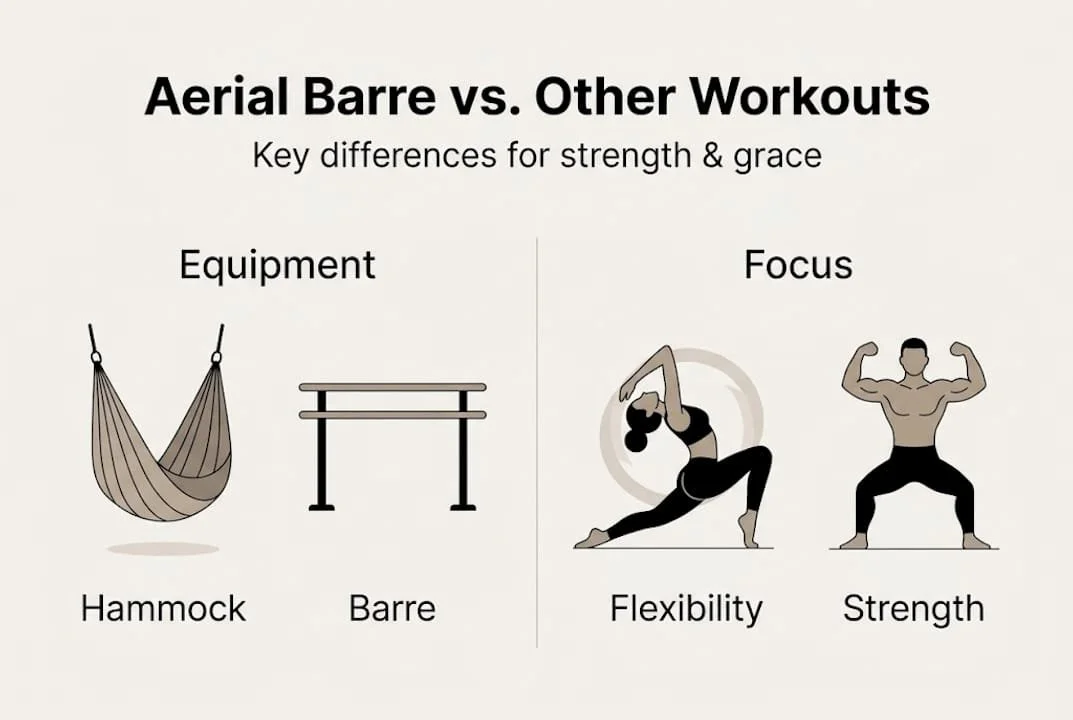
| Class type | Equipment | Movement style | Flexibility focus | Strength building |
|---|---|---|---|---|
| Aerial barre | Barre + hammock | Flowing, structured | High | Moderate to high |
| Traditional barre | Barre only | Controlled, repetitive | Moderate | High |
| Aerial yoga | Hammock only | Slow, meditative | Very high | Low to moderate |
| Pilates | Mat or reformer | Precise, clinical | Moderate | Moderate to high |
| Yoga | Mat | Variable | High | Low to moderate |
The table makes it clear: aerial barre sits in a category of its own. It offers more strength work than aerial yoga, more creative range than traditional barre, and more playfulness than Pilates. That combination is what draws people in.
Here's what makes aerial barre uniquely challenging and accessible at the same time:
The hammock as a teacher. It gives real-time feedback. If your core isn't engaged, you'll feel it immediately as the fabric shifts beneath you.
Low-impact joint support. Suspension takes pressure off knees and hips, making deeper ranges of motion achievable without strain.
Progressive challenge. Beginners use the hammock for support. As you advance, you use it for resistance and full inversions.
Creative freedom. Unlike scripted barre formats, aerial barre instructors often choreograph unique sequences that feel more like movement art than exercise.
Community feel. Classes tend to be small, which means more personalized attention and faster skill development.
The yoga and wellness integration that aerial barre offers is genuinely rare in a single class format. And if you're still on the fence, reading about the real impact of aerial yoga can help you understand what suspended movement does to the body over time. As noted in Philadelphia fitness circles, aerial barre's blending of yoga, barre, and Pilates is emerging in innovative pop-up formats across the city.
The benefits of aerial barre for mind and body
Understanding the differences is helpful, but what truly sets aerial barre apart is how it can make you feel and function, both inside and out.
The physical benefits are measurable and wide-ranging:
Core engagement: Every suspended movement demands deep stabilizer muscles that standard floor exercises rarely reach
Improved flexibility: The hammock's support allows you to safely hold lengthened positions longer
Low-impact joint support: Ideal for those managing knee or hip sensitivities who still want a genuine workout
Upper body strength: Gripping and navigating the fabric builds real arm and shoulder endurance
Spinal decompression: Brief inversions in the hammock relieve compression built up from sitting
The mental benefits are equally significant. The focus required to balance in a hammock naturally quiets mental chatter. You can't check your phone or run your to-do list when you're suspended mid-air. That enforced presence is a form of mindfulness training that happens almost by accident.
"I walked in thinking it would be a fun workout, and I walked out feeling like I'd processed something emotional. The hammock forces you to let go, literally and figuratively. I haven't felt that kind of release in any other class."
That reaction is common, and it points to something important. Aerial barre may support emotional healing and broader wellness goals in ways that standard fitness classes simply don't. It connects naturally to trauma-informed wellness frameworks, where gentle, supported movement becomes a tool for nervous system regulation.
Studios that embrace aerial yoga for healing often incorporate aerial barre elements because the hammock creates a sense of safety and containment that encourages emotional openness. This also overlaps meaningfully with practices that use movement as yoga for emotional healing, treating the body as a pathway to mental and emotional well-being.
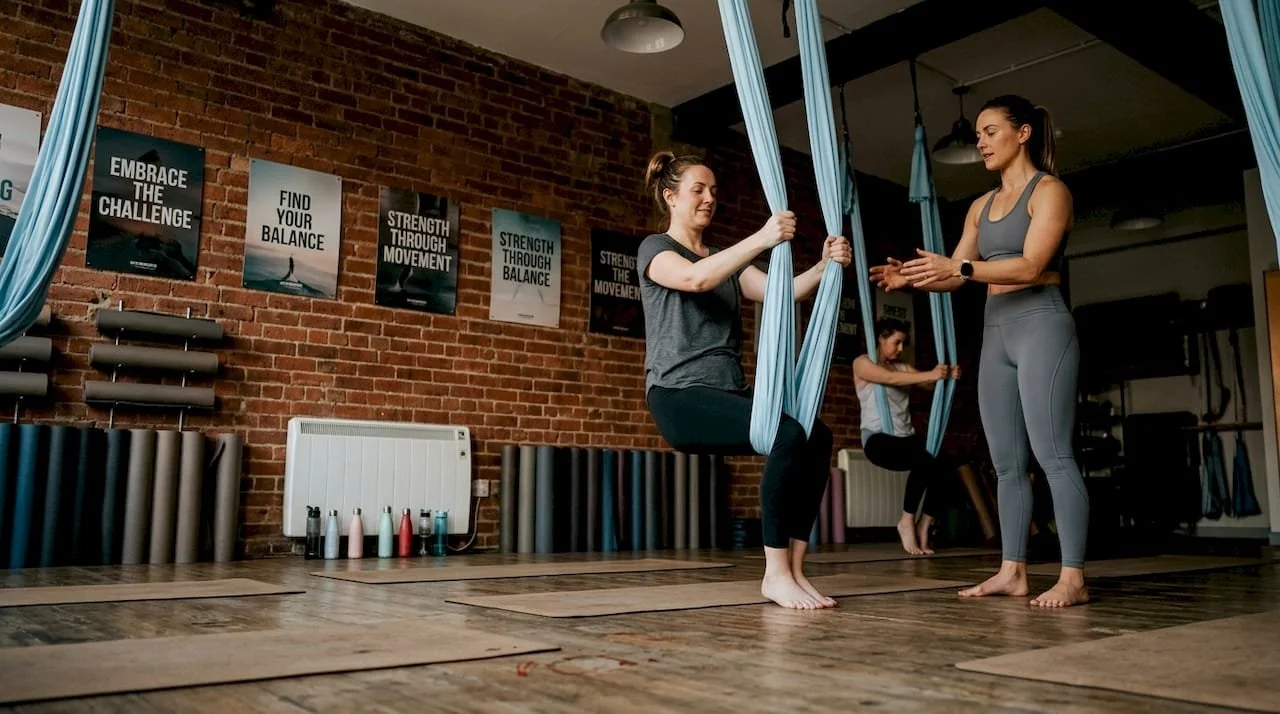
Statistic to know: Research across aerial fitness disciplines consistently shows participants report significant reductions in perceived stress after just four to six weeks of regular practice, with improvements in both mood and body confidence.
Getting started with aerial barre in Philadelphia
Ready to incorporate aerial barre into your routine? Here's how to start, step by step, right here in Philadelphia.
Finding a class requires a little research. Aerial barre isn't yet as common as standard yoga or Pilates, so look for studios that list aerial hammock or aerial silk work alongside barre offerings. Pop-up events through Philadelphia fitness communities and wellness collectives are another route, especially if you want to try before committing to a membership.
| Studio type | What to look for | Beginner-friendly? |
|---|---|---|
| Dedicated aerial studio | Full rigging setup, certified instructors | Often yes, with intro classes |
| Hybrid yoga and wellness studio | Aerial hammocks plus barre and yoga options | Yes, especially for fusion seekers |
| Pop-up fitness events | Rotating venues, varied formats | Good for sampling, less consistent |
Before you book, here's a safety checklist to run through:
Confirm the rigging is rated for aerial use and inspected regularly
Verify instructors hold both barre and aerial-specific training credentials
Check that class sizes are small enough for individualized attention
Ask whether beginners receive a hammock orientation before the full class
Look for clean, properly maintained fabric hammocks
Proper equipment inspection and instructor guidanceare crucial for safety in aerial elements, and any reputable Philadelphia studio will welcome those questions rather than dodge them.
Pro Tip: Arrive at least 10 to 15 minutes early for your first class. Introduce yourself to the instructor, mention your fitness background, and ask for a quick demo of the hammock setup. That five-minute conversation can make the entire class feel less intimidating.
For your first class, keep these basics in mind:
Wear fitted athletic wear that covers armpits and knees to prevent fabric friction
Skip the lotion on your arms and legs so you grip the hammock properly
Eat lightly at least 90 minutes beforehand, especially if inversions are planned
Leave jewelry at home, particularly rings and bracelets that can catch the fabric
If you're exploring yoga practices alongside aerial barre, many studios offer complementary class options that build the flexibility and body awareness that makes aerial barre even more rewarding over time.
Why aerial barre is more than a trend: A Philadelphia perspective
After these practical steps, it's worth considering why aerial barre's popularity is more than just a passing phase.
A lot of people dismiss aerial-based fitness as a gimmick. That's the wrong read. Philadelphia's fitness community has consistently shown an appetite for movement practices that do more than one thing at once, and aerial barre sits precisely at that intersection. It builds strength and releases tension. It requires focus and invites playfulness. That dual nature isn't a marketing angle. It's the actual experience.
We've watched plenty of "trend" workouts fade once the novelty wore off. What distinguishes aerial barre is that the hammock isn't a prop. It's a genuine training tool that reveals where your body holds tension and where it needs support. Beginners often find it more accessible than they expected, because the fabric meets you where you are.
The emergence of aerial barre in Philadelphia reflects something real: people are done choosing between a workout that challenges their body and one that restores their mind. They want both. Aerial barre delivers both. And the impact of aerial yoga research supports this: suspended movement consistently outperforms expectations in terms of long-term adherence and emotional satisfaction.
Philadelphia's wellness community is pragmatic. It doesn't adopt new practices just because they look cool. It sticks with what works.
Ready to try aerial barre or wellness fusion?
Inspired to experience aerial barre's blend of movement and wellness for yourself? Here's how you can take the next step.
At Amrita Yoga & Wellness, we bring together movement practices that go beyond the conventional gym experience. Our Philadelphia studio offers a range of fusion-forward classes designed for all experience levels, from first-timers to longtime practitioners looking to shake up their routine.
Beyond movement classes, we offer workshops that feed the whole self, including Tarot readings and other holistic wellness experiences. If you're ready to explore what a truly integrated wellness practice looks like, visit our studio page, check our current class schedule, and find the experience that fits your goals. Your first class might surprise you in the best possible way.
Frequently asked questions
Is aerial barre safe for beginners?
Yes, with proper instructor guidance and equipment inspection standards, aerial barre is accessible and safe for most healthy beginners. Reputable studios provide hammock orientations and use certified instructors who adjust each exercise to your level.
What should I wear to an aerial barre class?
Wear comfortable, fitted athletic clothing that covers the armpits and knees to prevent hammock burns and allow free movement. Avoid lotions on exposed skin, as they reduce your grip on the fabric.
Are aerial barre classes available year-round in Philadelphia?
Aerial barre is offered in select studios and pop-up formats in Philadelphia, so scheduling may vary by season. Checking studio calendars directly and signing up for newsletters is the most reliable way to stay updated.
How does aerial barre compare with barre fitness or aerial yoga?
Aerial barre blends yoga, barre, and Pilates by using both a ballet barre and an aerial hammock in one session, giving you the strength benefits of barre and the flexibility and mindfulness gains of aerial yoga in a single class format.
Recommended
How Mindfulness Deepens Aerial Yoga for Philadelphia Wellness
TL;DR:
Aerial yoga uniquely interrupts nervous system patterns, promoting emotional and mental renewal through mindfulness.Mindfulness enhances physical benefits and emotional healing by focusing awareness during suspension and movement.Philadelphia studios integrate mindfulness into aerial yoga, offering holistic practices for stress relief and self-awareness.
Aerial yoga is not just about floating above the ground or pulling off a gravity-defying pose. What most people miss is that suspension actively interrupts your nervous system's default patterns, creating a rare window for emotional and mental renewal that traditional mat yoga rarely opens. That window only stays open when you bring mindfulness into it. For Philadelphia adults exploring holistic wellness, the combination of hammock-based movement and conscious awareness is proving to be one of the most effective and underrated paths to both physical health and mental clarity.
Table of Contents
Key Takeaways
| Point | Details |
|---|---|
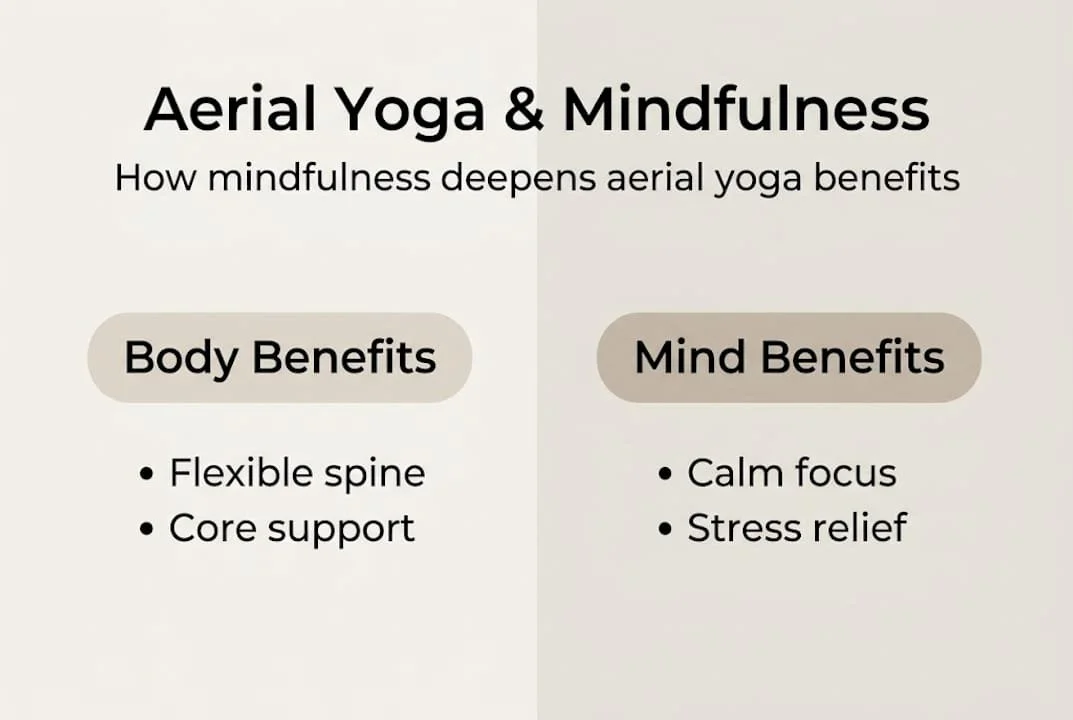
| Mindfulness and movement | By combining breath and suspended poses, aerial yoga makes mindful engagement with the body easier and deeper. |
| Emotional healing | Aerial yoga with mindfulness breaks mental patterns and supports stress relief and emotional regulation. |
| Practical applications | Simple mindfulness cues like breath focus and body scans can be integrated into every aerial yoga session. |
| Local studio advantage | Philadelphia offers unique studios specializing in mindful aerial yoga for mental and physical wellness. |
What is aerial yoga and why mindfulness matters
Aerial yoga uses a soft, hammock-like silk suspended from the ceiling to support and extend the body through yoga poses, stretches, and inversions. Unlike traditional yoga, where gravity pushes you into the floor, the hammock redistributes weight across your body, allowing you to reach positions that would otherwise strain your joints. That redistribution is what makes the practice so physically unique. But here is what most people overlook: the hammock also changes how your brain processes body movement.
Mindfulness in this context is not a meditation buzzword. It is the active, deliberate awareness of your breath, sensation, and position in space while you move. When you bring that awareness into aerial yoga, something interesting happens. Your body stops reacting automatically and starts responding consciously. That shift from reaction to response is where the real wellness gains begin.
The hammock provides support for deeper stretches, spinal decompression, and proprioception enhancement, integrating mindfulness with breath-movement synchronization. Proprioception, your body's ability to sense its own position, sharpens when you are suspended and forced to stabilize. Adding mindful breathing in aerial yoga amplifies this effect, giving your nervous system a richer map of where you are and what you are doing.
Core benefits of the aerial yoga and mindfulness combination:
Spinal decompression through supported inversions
Sharpened proprioceptive awareness during suspension
Deeper stretches with less joint compression
Slowed stress response through breath-synced movement
Improved body-image awareness via intentional sensation focus
| Aspect | Traditional yoga | Aerial yoga with mindfulness |
|---|---|---|
| Spinal support | Gravity-dependent | Hammock-assisted decompression |
| Proprioception | Moderate challenge | Heightened during suspension |
| Breathwork role | Optional emphasis | Structurally integrated |
| Mental engagement | Variable | Consistently demanded |
For anyone in Philadelphia curious about taking this further, aerial yoga classes at local studios offer beginner-friendly environments that teach you how to pair breath with each movement from your very first session. Aerial yoga is not just a workout. With mindfulness woven in, it becomes a complete wellness practice.
How mindfulness transforms aerial yoga: Mental and physical benefits
Once you understand what aerial yoga is, the real question becomes: what does mindfulness actually change about the experience? The answer is more than most people expect.

Mindfulness amplifies something called interoceptive awareness, which is your ability to notice and interpret signals from inside your body. Things like hunger, tension, emotional discomfort, or calm. An OT-led aerial yoga program showed improved interoceptive awareness and emotional regulation in youth participants, suggesting these benefits could extend to adults who practice with consistent mindfulness focus.
Suspension does something that a mat cannot. It physically removes familiar ground-level cues, which means your brain cannot rely on its usual movement shortcuts. That interruption is valuable. Mindfulness via suspension breaks mental patterns and enhances emotional healing more dynamically than traditional yoga alone. For those dealing with anxiety, burnout, or stress, that pattern interruption is not just useful. It is transformative.
"When you are suspended in a hammock and focusing on your breath, you are not just stretching your body. You are rewriting how your nervous system responds to discomfort."
Here is how mindfulness elevates specific outcomes in aerial yoga:
Stress reduction: Breath-focused awareness lowers cortisol response during and after class
Emotional regulation: Holding awareness of sensation during poses builds tolerance for discomfort
Flexibility gains: Mindful relaxation during stretches allows deeper, safer range of motion
Joint health: Conscious weight distribution through the hammock reduces compression injury risk
Sleep quality: Post-session parasympathetic activation is stronger when mindfulness is active throughout
For more on how stress relief with aerial yoga works in practice, the research and community experience align: it is not the poses themselves but the awareness you bring to them that drives the deepest results. You can also explore aerial yoga stress relief tips and the science behind benefits of aerial yoga for stress to build your practice with more intention.
Pro Tip: During any aerial pose, soften your jaw and consciously breathe into your lower belly. This one cue activates your parasympathetic nervous system faster than any single stretch can.
Mindfulness practices in aerial yoga: Techniques and studio highlights
Knowing mindfulness matters is different from knowing how to do it inside a hammock. These practical techniques make the integration real.
Before the session: Arrive two to three minutes early and sit quietly with your hands on your thighs. Take three slow, intentional breaths. This is not just a ritual. It signals to your nervous system that this time is different from the chaos of your day.
During poses: Use anchor-point awareness. Every time you shift position in the hammock, consciously notice where the silk touches your skin. That sensation becomes your mindfulness anchor, similar to how meditators use the feeling of breath at the nostrils.
Body scan in suspension: In supported inversions, mentally scan from the crown of your head down to your feet. Notice warmth, tension, or ease without judgment. This activates interoception and helps the body release held tension more effectively than passive stretching alone.
Observing mental patterns: Aerial yoga often surfaces quiet fears, whether about falling, losing control, or not being good enough. These are not problems. They are data. Mindfulness teaches you to watch those thoughts without feeding them.
After class: Lie in savasana with one hand on your heart and one on your belly. Notice how your emotional baseline has shifted. This two-minute reset anchors the session's benefits into long-term memory.
Philadelphia studios like Amrita Yoga & Wellness and Relax and Hang Aerial offer aerial yoga classes emphasizing mindfulness and stress reduction for adults. These are not generic fitness classes. They are guided mind-body experiences built for people who want more than a workout.
For those drawn to the healing dimensions of this practice, exploring healing with aerial yoga, emotional healing practices, and aerial yoga therapy approaches can open up an entirely different relationship with movement and self-awareness.
Pro Tip: Begin every session with three grounding breaths before touching the hammock. It sounds small, but this habit trains your nervous system to enter a receptive state before physical movement begins.
Getting started: Steps for integrating mindfulness into aerial yoga
Ready to build this practice intentionally? Here is a step-by-step approach that works whether you are brand new or already attending aerial yoga sessions regularly.
Set a mindful intention before class: This does not need to be spiritual. It can be as simple as, "Today I will notice how my body feels in each pose." Intention primes attention, and attention drives change.
Focus on breath in every pose: Match your inhale to expansion, your exhale to release. When you enter or exit a pose, let your breath lead. The body follows.
Pause for a body scan mid-session: Find a comfortable supported position and spend 60 to 90 seconds scanning for tension, warmth, or resistance. Do not try to change anything. Just notice.
Reflect after class: Spend three to five minutes sitting quietly after your session. Ask yourself: what felt different? What emotions came up? What did your body release?
Track your experience over time: Patterns only become visible across multiple sessions. Keeping a short journal, even two or three sentences per class, creates a record you can actually learn from.
Research context matters here. While youth-focused research suggests strong interoceptive and emotional benefits, the broader yoga literature consistently supports stress reduction and mood improvements in adult practitioners. The steps above are grounded in both the emerging aerial yoga research and decades of mindfulness-based wellness work.
For those who have experienced trauma or are using yoga as part of recovery, connecting with trauma recovery yoga strategies can add an important layer of support and context to this process.
Pro Tip: Keep a mindfulness journal and write in it immediately after class while the physical sensations are still fresh. This captures data your thinking mind will otherwise reframe or forget.
Why most people overlook mindfulness in aerial yoga—and why it matters
Here is something we have noticed: most people walk into aerial yoga for one of two reasons. They want a fun workout, or they saw it on social media and got curious. Both are valid entry points. But very few people walk in thinking about mindfulness, and that is exactly why they often plateau.
The physical benefits of aerial yoga are real, but they have a ceiling when practiced without awareness. You can get stronger and more flexible. That is great. But if you leave each session without noticing how your nervous system has shifted, you are leaving the best part behind.
Suspension creates a genuinely novel situation for your brain. Mindfulness via suspension breaks mental patterns and enhances emotional healing more dynamically than floor-based practice. Philadelphia's wellness community is in a strong position to lead this integration, because studios here are already building mindfulness into their aerial programs. The question is whether students show up willing to use it.
Exploring healing with aerial yoga is not about adding something extra to your practice. It is about waking up to what was already there.
Explore mindful aerial yoga and wellness in Philadelphia
If this article has shifted the way you think about aerial yoga, that is a sign you are ready to take the next step in your practice.
At Amrita Yoga & Wellness, we offer aerial yoga sessions designed to weave mindfulness into every movement, not as an add-on, but as the foundation. Whether you are new to aerial yoga or looking to deepen what you already do, our Philadelphia studio offers small-group classes, workshops, and community events that meet you exactly where you are. We also offer tarot readings and other wellness experiences for those exploring the fuller picture of holistic self-care. Come practice with us and feel the difference that intention makes.
Frequently asked questions
How does mindfulness enhance the physical benefits of aerial yoga?
Mindfulness synchronizes breath and movement, allowing deeper stretches and improved spinal health during aerial yoga. When your attention follows your breath, your muscles release more completely, which means each pose works harder with less effort.
Is mindfulness in aerial yoga beneficial for stress relief and emotional healing?
Research and studio practice both confirm that mindfulness-integrated aerial yoga improves interoceptive awareness and emotional regulation in participants. The suspended environment accelerates this process by removing familiar ground-level mental defaults.
What are simple mindfulness practices for aerial yoga beginners?
Beginners can start with three intentional breaths before class, a brief body scan during suspension, and two to three sentences of post-class journaling to build awareness over time.
Are there Philadelphia studios that specialize in mindful aerial yoga?
Studios like Amrita Yoga & Wellness provide aerial yoga classes in Philadelphia that emphasize mindfulness and stress reduction for adult practitioners. These classes are structured to support both beginners and those with existing yoga experience.
Recommended
Why alignment matters in aerial yoga: key benefits
TL;DR:
Proper alignment enhances safety, flexibility, and mental well-being in aerial yoga.Consistent practice with instructor feedback improves posture and structural alignment over time.Mastering foundational positions builds confidence and long-term progress beyond advanced poses.
Most people walk into their first aerial yoga class thinking the goal is to nail that perfectly inverted split they saw on social media. The hammock looks like a prop for acrobatics, not a tool for deep body awareness. But here's what actually separates practitioners who thrive from those who plateau or get hurt: alignment. Getting your joints stacked, your core engaged, and your body positioned correctly in the fabric changes everything. It boosts safety, accelerates flexibility gains, and transforms aerial yoga from a party trick into a genuine practice for physical and mental well-being.
Table of Contents
Key Takeaways
| Point | Details |
|---|---|
| Alignment is foundational | Proper alignment in aerial yoga boosts safety, posture, and flexibility for lasting well-being. |
| Results require consistency | Regular, mindful practice delivers noticeable alignment and flexibility improvements over time. |
| Feedback accelerates progress | Using instructor input and self-assessment tools builds awareness and confidence in every session. |
| Basics beat complexity | Mastering basic alignment provides the greatest long-term benefits, more than advanced poses alone. |
What does alignment mean in aerial yoga?
Alignment in aerial yoga is not just about standing straight. It means maintaining proper joint stacking, activating core stabilization, and placing your body thoughtfully within the hammock so every pose works with your anatomy rather than against it.
In traditional mat yoga, the floor gives you constant feedback. You feel when your foot rolls in or your hips shift. In aerial yoga, the hammock removes that stable reference point. You are suspended, which means small misalignments get amplified. A slightly rotated hip on the mat is a minor issue. The same rotation mid-air can strain your lower back or throw your entire posture off balance.
Here are some of the most common misalignments instructors see in aerial yoga classes:
Shoulders creeping up toward the ears during inversions
Hips tilting forward or backward instead of staying neutral
Knees collapsing inward during standing or seated hammock poses
Gripping the fabric with tension instead of using controlled engagement
Letting the lower back arch excessively when the core is not activated
Each of these seems small in isolation. Together, they add up to discomfort, reduced range of motion, and a higher risk of injury over time.
The hammock actually intensifies the need for alignment because it supports your body weight unevenly if you are not positioned correctly. Gravity pulls on whatever part of you is heaviest or most extended. Without proper alignment, the hammock becomes a source of strain rather than support.
Yoga studies show improved posture, muscle elasticity, and reduced pain in spinal conditions with consistent practice, pointing to the real structural benefits alignment-focused movement can deliver.
Think of alignment as the grammar of aerial yoga. You can string words together and sort of communicate, but without grammar, the message breaks down. Alignment is what makes every pose coherent and effective. Exploring strengthening moves for total body power alongside alignment work builds a practice that is both powerful and sustainable.
How alignment shapes safety and well-being
Proper alignment is your first line of defense against injury in aerial yoga. When your body is stacked correctly, your joints share the load evenly. When it is not, specific joints and muscles absorb more stress than they are designed to handle.
Here is a practical sequence of alignment checks to run through before and during any aerial yoga session:
Ground your breath first. Before entering the hammock, take two slow breaths to activate your parasympathetic nervous system and prepare your body for mindful movement.
Check your hip position. Neutral hips are the foundation of most aerial poses. Tuck or tilt, and everything above and below shifts out of balance.
Engage your core lightly. Not a crunch, just a gentle drawing in of the lower abdomen. This protects your lumbar spine throughout the session.
Soften your shoulders. Roll them back and down before entering any pose. Tension here transfers directly to your neck and upper back.
Confirm your hammock placement. The fabric should sit at the correct point on your body for the specific pose, whether at the hips, waist, or mid-back.
When you distribute your body weight correctly through these checks, you protect your joints and allow the hammock to do what it is designed to do: support and decompress.
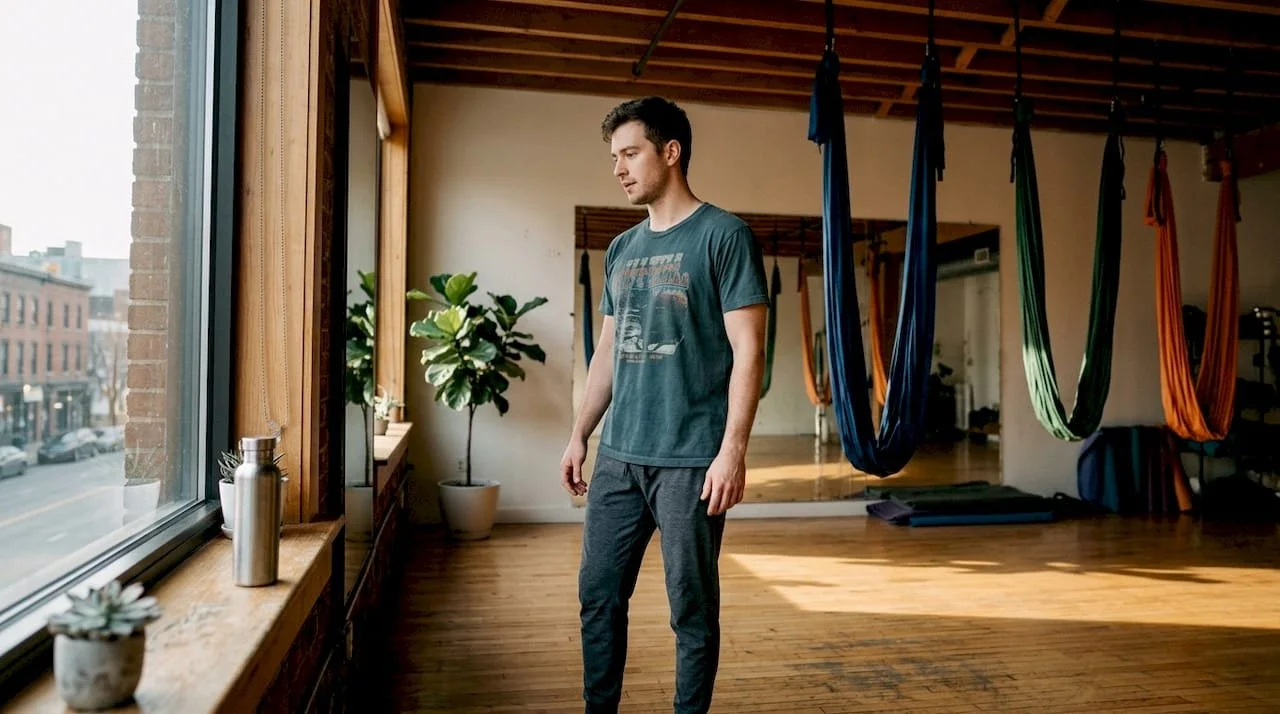
Research on yoga's effect on posture confirms that consistent practice reduces muscle stiffness and improves structural alignment over time. Specifically, 6-month yoga practice reduced trapezius and hamstring muscle stiffness while improving posture, two areas aerial yoga practitioners commonly struggle with.
Pro Tip: Before attempting any advanced aerial move, ask your instructor to physically check your alignment. A two-second correction from an experienced eye can prevent weeks of recovery from a preventable strain.
The mental well-being benefits are just as real. When your body feels safe and supported in the hammock, your nervous system relaxes. Anxiety about falling or hurting yourself drops. You breathe more deeply. That is when the meditative quality of aerial yoga kicks in, and you get both the physical and mental payoff in a single session. For a thorough breakdown of staying safe in the air, the aerial yoga safety guide is a solid resource to bookmark.
Key alignment principles: What to focus on mid-air
Knowing alignment matters is one thing. Knowing exactly what to focus on during a session is another. Here are the core principles to keep in mind every time you step into the hammock.
Core areas to focus on:
Core engagement: Your deep abdominal muscles should be gently active throughout every pose. This is not about holding your breath or tensing up. It is about creating a stable center from which your limbs can move freely.
Neutral spine: Avoid over-arching or over-rounding your back. A neutral spine keeps your vertebrae in their natural curves and reduces compression.
Relaxed shoulders: Shoulders that creep up toward your ears create neck tension and limit your range of motion. Consciously drop them before and during each pose.
Aligned hips and knees: In any standing or seated aerial position, your knees should track over your toes and your hips should be level unless the pose intentionally calls for rotation.
Self-checking alignment mid-practice takes some training, but it becomes second nature quickly. Before entering a pose, mentally scan from your feet to your head. While in the pose, notice where you feel strain versus ease. Strain often signals misalignment. Ease, combined with appropriate muscle engagement, signals you are in the right position.
Every aerial yoga pose has specific alignment cues that maintain safe joint stacking and healthy extension. Your instructor will often call these out verbally, but internalizing them means you can self-correct even when no one is watching.
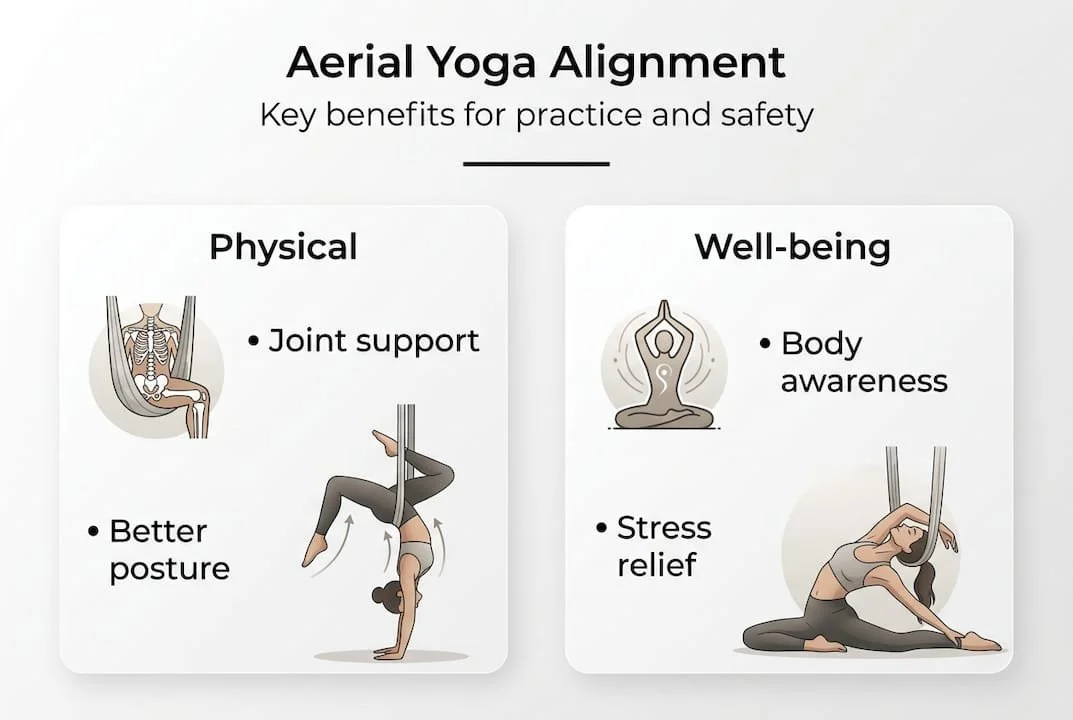
Consistent practice yields measurable posture and flexibility gains, making alignment-focused sessions one of the most efficient investments you can make in your overall well-being.
Pro Tip: Record a short video of yourself during practice once a month. Watching your own movement from the outside reveals misalignments that are nearly impossible to feel in the moment.
For building the strength that supports lasting alignment, the resources on lasting flexibility tips and training tips offer practical next steps you can apply right away.
Comparing alignment progress: Visual cues and feedback loop
Progress in alignment is not always dramatic. It shows up in subtle ways, and learning to recognize those signs keeps you motivated and on track.
Here is a comparison of what misaligned versus well-aligned practice looks and feels like:
| Area | Before alignment focus | After alignment focus |
|---|---|---|
| Body lines in poses | Uneven, crooked, or collapsed | Clean, extended, symmetrical |
| Ease of holding positions | Fatigues quickly, lots of gripping | Controlled, sustainable effort |
| Comfort during practice | Pinching, strain, or discomfort | Supported, open sensation |
| Post-class soreness | Sharp or joint-based pain | Healthy muscle fatigue only |
| Breathing quality | Shallow, held, or irregular | Deep, steady, and rhythmic |
The shift from the left column to the right does not happen overnight. It builds over weeks and months of deliberate practice.
Best ways to gather and use alignment feedback:
Ask your instructor for a quick alignment check at the start of class
Use a mirror when available to observe your body lines in real time
Partner with a classmate to give each other visual feedback on symmetry
Keep a short practice journal noting where you felt ease or strain
Review recorded videos monthly to spot patterns in your movement
Philadelphia studios like Amrita Yoga & Wellness often use spotters and verbal cues during class to help students assess their progress. This kind of guided feedback loop accelerates improvement far faster than solo practice alone.
Women with spinal disorders reported overall postural enhancement through yoga studies, which reinforces how structural feedback and consistent practice combine to create real, lasting change.
Incremental change is the signal that your practice is working. You do not need to nail a perfect inversion to prove progress. Holding a pose two seconds longer, breathing more smoothly, or feeling less tension in your neck are all meaningful wins. For a roadmap on what comes next as your alignment improves, the guide on how to advance in aerial yoga lays out a clear progression path.
A real-world view: Mastery means loving the basics
Here is something the aerial yoga world does not say loudly enough: chasing advanced poses before your alignment is solid is not ambition. It is impatience, and it costs you.
Experienced practitioners know that the practitioners who progress fastest are not the ones drilling the hardest inversions. They are the ones who obsess over their hip position in a basic hammock squat. They feel the difference between a spine that is neutral and one that is slightly extended. That body awareness is the real skill, and it transfers to every pose you will ever attempt.
Beginners often think confidence in aerial yoga comes from doing harder moves. It does not. It comes from trusting your body because you understand how it moves. That trust is built through mastering foundational moves with precision, not rushing past them.
Alignment is not a milestone you reach and move on from. It is a mindset you bring to every single session. The practitioners who treat it that way are the ones still practicing joyfully years later, without chronic injuries or burnout. Celebrate the subtle wins. They are the whole point.
Ready to deepen your aerial yoga journey?
If this article has you thinking about your own alignment habits, the next step is practicing in an environment designed to support that growth.
At Amrita Yoga & Wellness, our Philadelphia studio offers aerial yoga classes led by experienced instructors who prioritize alignment from day one. Whether you are brand new to the hammock or looking to refine your practice, our welcoming community and well-equipped space give you the feedback and support you need to progress safely. Beyond aerial yoga, you can also explore tarot readings and other wellness offerings that complement your physical practice. Come experience what alignment-focused aerial yoga feels like in person.
Frequently asked questions
Can aerial yoga help correct posture issues?
Yes, consistent aerial yoga with an alignment focus can improve posture and reduce muscle stiffness. Yoga improves posture and muscle elasticity with regular practice, and aerial yoga builds on those same principles with the added benefit of spinal decompression.
Is instructor feedback important for alignment in aerial yoga?
Instructor feedback is essential for safe alignment and steady progress. The aerial yoga safety guide highlights how instructor-led corrections help students avoid common mistakes and build good movement habits from the start.
How quickly can alignment improvements be seen?
Some gains, like improved flexibility or reduced tension, can appear within a few weeks of consistent practice. Bigger structural changes, like posture correction, build over months, as 6-month yoga studies on stiffness and posture confirm.
What's the biggest beginner mistake in aerial yoga alignment?
Skipping foundational alignment cues to attempt harder poses too soon is the most common and costly beginner mistake. It slows progress and increases injury risk significantly.
Recommended
Aerial yoga equipment checklist: safe & effective practice
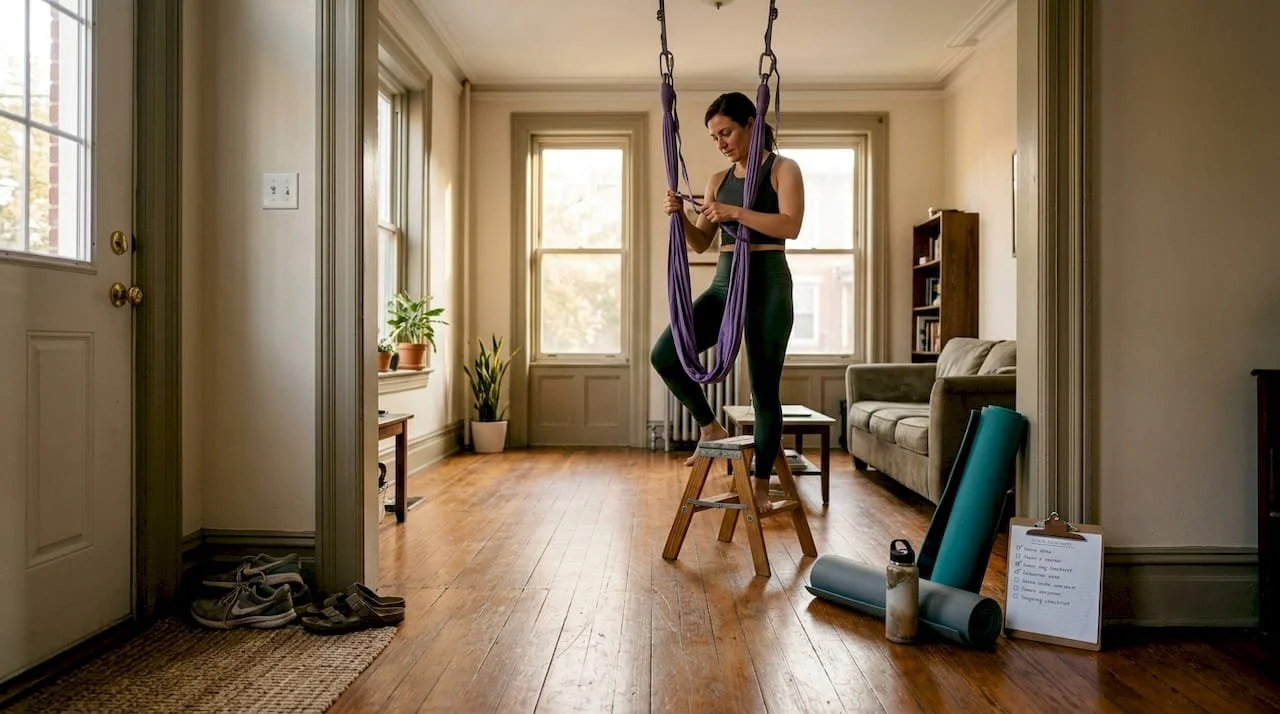
TL;DR:
Proper load-rated equipment and professional installation are essential for safe aerial yoga practice.Regular inspections, maintenance, and adherence to safety standards reduce injury risk significantly.Community resources and expert guidance in Philadelphia support safe and confident practice.
Aerial yoga is one of the most physically rewarding practices you can try, but it carries real risks when the setup is wrong. A torn hammock, an improperly anchored rigging point, or a ceiling that can't handle dynamic loads can turn a peaceful session into a serious injury. Many practitioners, both beginners and experienced movers, skip crucial steps because the gear looks fine or the setup "worked last time." This guide gives you a complete, step-by-step equipment checklist built around real safety standards, so you can practice with confidence whether you're at home in Philadelphia or walking into a studio for the first time.
Table of Contents
Key Takeaways
| Point | Details |
|---|---|
| Prioritize safety first | Professional installation, correct load ratings, and regular checks are non-negotiable for a safe aerial yoga setup. |
| Use a complete gear checklist | Every aerial yoga practitioner needs the right equipment and setup for their specific space and experience level. |
| Inspect and maintain regularly | Pre-use inspection and periodic cleaning help prevent the majority of injuries and keep equipment in top condition. |
| Consult local experts | Philadelphians can access studios like Amrita Yoga & Wellness for professional guidance, setup support, and ongoing safety. |
Understand aerial yoga safety essentials
Before you gather equipment, it's crucial to understand the standards your setup must meet. Aerial yoga isn't like floor yoga. Every piece of gear is load-bearing, and the forces involved are far greater than your body weight alone. When you swing, invert, or drop into a pose, you create what engineers call dynamic load, which can be two to three times your static weight in an instant.
"Safety standards require professional installation, regular inspections, and equipment rated 3x user weight to protect practitioners at every level."
Here's what every safe aerial yoga setup must include:
Load capacity: Your rigging system, anchor points, and hammock must all be rated for at least three times your body weight. A 150-pound person needs gear rated for at least 450 pounds minimum.
Certified equipment: Look for CE or TUV certifications on all hardware. These marks confirm the product has been independently tested.
Structural integrity: The ceiling beam or mounting surface must be inspected by a professional before installation, not just eyeballed.
Professional installation: Even if you're handy, a licensed rigger or structural engineer should sign off on your anchor points.
Local compliance: In Philadelphia, home and studio installations must follow both Pennsylvania building codes and any local Philadelphia ordinances related to structural modifications.
Studios like Amrita Yoga & Wellness in Philadelphia set the standard here. They use professionally installed equipment, conduct regular inspections, and ensure every setup meets load requirements before a single class begins. That's the benchmark to hold yourself to.
If you're new to the practice, reviewing a solid aerial yoga safety guide before purchasing anything is a smart first move. It's also worth understanding aerial yoga contraindications, which are the physical conditions that may make certain aerial movements risky for you specifically.
Pro Tip: Never assume a ceiling joist can hold your weight just because it looks solid. A structural engineer can assess load capacity in under an hour, and that one-time cost is far cheaper than an ER visit.
Build your aerial yoga gear checklist
Now that you know the safety requirements, let's list out every piece of equipment you need for a reliable setup. Whether you're building a home rig in a Philadelphia row house or outfitting a dedicated studio space, the core list stays the same.
Essential equipment breakdown:
Aerial hammock or silk: Choose a hammock rated for at least 300 to 600 pounds. Nylon and tricot fabric are the most common. Nylon is more durable; tricot is softer on skin.
Rigging hardware: This includes carabiners (rated to at least 20kN), swivel hooks, and daisy chains or extension straps. All hardware must be climbing-grade or aerial-specific.
Ceiling anchor or mount: A steel ceiling mount bolted into a structural beam is the gold standard. Portable freestanding rigs are an option when ceiling installation isn't possible.
Yoga mat: Placed directly beneath the hammock for landing safety. Non-slip, at least 5mm thick.
Crash mat or foam pad: Especially important for beginners or anyone learning inversions. Place it under and around your practice area.
Safety scissors: Keep a pair nearby to cut fabric in an emergency.
Chalk or grip aid: Optional, but helpful for maintaining control during longer holds.
| Setting | Ceiling height needed | Clearance space | Rig type |
|---|---|---|---|
| Home (ideal) | 9 to 10 feet | 5 to 6 feet radius | Ceiling mount |
| Home (minimum) | 8 feet | 5 feet radius | Ceiling or portable rig |
| Studio | 10 to 14 feet | 6+ feet radius | Professional ceiling mount |
| Outdoor/portable | Variable | 6+ feet radius | Freestanding rig |
Studios in Philadelphia use pro-installed equipment and recommend engineer consults for home rigs, which tells you something important: even the professionals don't skip this step.
For Philly practitioners with older homes or lower ceilings, a portable freestanding rig is a legitimate option. Just confirm it's rated for dynamic loads, not just static weight. Explore aerial yoga best practices to understand how different rig types perform under real movement conditions.
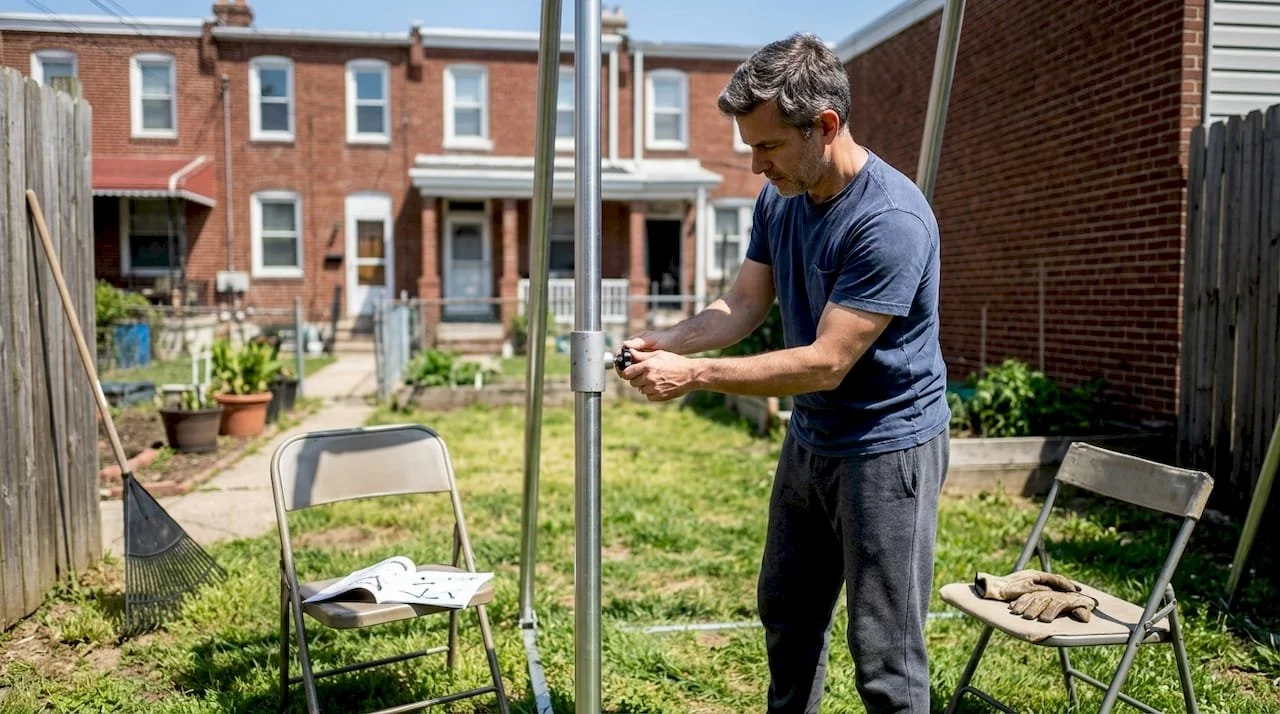
Pro Tip: Measure your ceiling height before buying anything. An 8-foot ceiling is workable, but you'll need a lower hammock mount and should avoid deep drops or swinging poses until you're in a taller space.
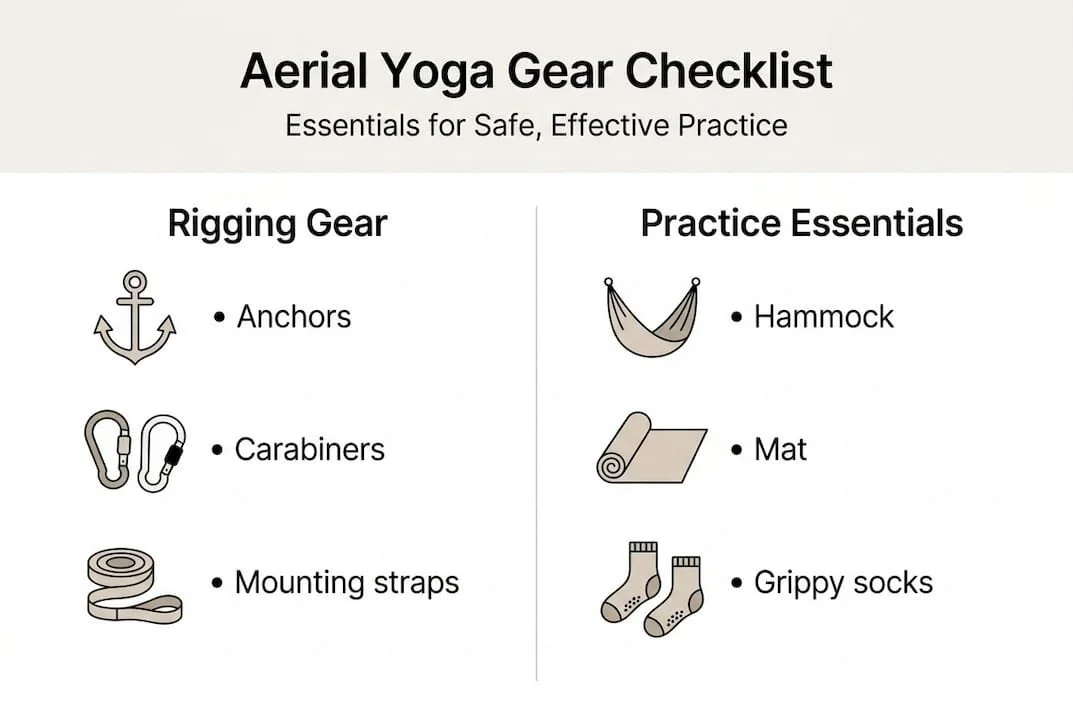
Step-by-step setup for safe practice
With everything on your checklist, it's time to put it all together for a safe start. Follow these steps every single time you set up, not just the first time.
Inspect the anchor point. Before attaching anything, visually check your ceiling mount or structural beam for cracks, rust, or looseness. Tug the mount firmly with both hands.
Attach rigging hardware. Connect your carabiner and swivel to the anchor point. Gate-check every carabiner by twisting and pulling to confirm it's locked.
Hang the hammock. Loop the hammock through the rigging at your desired height. For beginners, hip height is a safe starting point.
Test the load gradually. Sit in the hammock before standing or inverting. Apply weight slowly and listen for any creaking or movement in the anchor.
Set up your mat and crash pad. Place your yoga mat directly under the hammock. Add a crash mat for any inversion or drop work.
Clear the space. Remove furniture, sharp objects, and anything within your 5 to 6 foot clearance radius.
Run a pre-session check. Scan the fabric for tears, check all hardware connections, and confirm the hammock hangs evenly.
| Situation | Adjustment needed |
|---|---|
| Low ceiling (8 ft) | Lower mount, avoid swinging, use portable rig |
| Children practicing | Extra crash mats, lower hammock height, adult supervision |
| Practitioner with injury | Medical consult first, avoid inversions, studio guidance |
| First-time setup | Have a second person present, go slow on load testing |
Edge cases like low ceilings, setups for kids, and practice with injuries all require specific adjustments that go beyond the standard setup. Never rush these situations. Review aerial yoga setup tips for detailed guidance on each scenario.
Pro Tip: If your hammock hangs unevenly after setup, don’t just adjust by eye. Use a measuring tape to confirm both sides are at equal height from the floor. An uneven hang shifts your center of gravity and increases fall risk.
Edge cases like low ceilings, setups for kids, and practice with injuries all require specific adjustments that go beyond the standard setup. Never rush these situations. Review aerial yoga setup tips for detailed guidance on each scenario.
Pro Tip: If your hammock hangs unevenly after setup, don't just adjust by eye. Use a measuring tape to confirm both sides are at equal height from the floor. An uneven hang shifts your center of gravity and increases fall risk.
Inspect, maintain, and troubleshoot your setup
Once your setup is complete, ongoing maintenance is key to long-term safety and performance. Most aerial yoga accidents don't happen on day one. They happen weeks or months later, when gear starts to wear and inspections get skipped.
What to check before every session:
Run your hands along the full length of the hammock fabric, feeling for thin spots, small tears, or fraying at the edges.
Inspect all carabiners and swivel hooks for rust, deformation, or gate issues.
Check the ceiling mount or anchor for any movement, new cracks, or signs of stress.
Confirm the hammock hangs at the same height as your last session. A drop in height can signal a loosening anchor.
Look at the stitching on hammock loops and daisy chains. Pulled threads are an early warning sign.
"Regular inspections reduce injury risk by 35%; wash gear every 4 to 6 weeks and schedule annual professional checks to keep your setup performing safely."
For cleaning, hand wash your hammock in cold water with a mild detergent every 4 to 6 weeks, or more often if you practice frequently. Air dry only. Machine washing can weaken fabric fibers over time, and heat from a dryer accelerates breakdown.
Know when to retire gear. If you see any of these, stop using the equipment immediately: visible tears in the fabric, bent or cracked carabiners, a swivel that no longer rotates smoothly, or any anchor point that has shifted position. No amount of patching or tightening makes compromised gear safe again.
For troubleshooting common issues, an uneven mount usually means one anchor point has shifted or the hammock loops are set at different heights. Mat slippage is typically solved by switching to a higher-grip mat surface or placing a non-slip underlay beneath it.
Philadelphia practitioners can lean on local studios for annual professional inspections. Many studios, including those in the Amrita Yoga & Wellness community, connect students with trusted riggers. Check out dedicated aerial yoga safety tips and resources on aerial yoga risks to stay current on best practices.
Our perspective: why aerial yoga safety is personal
Here's something most aerial yoga content won't tell you: checklists aren't just for beginners. In fact, the practitioners who get hurt most often are the ones who've been doing this long enough to feel comfortable skipping steps.
Complacency is the real enemy. Dynamic loads far exceed static weight calculations, and most accidents occur due to skipped inspections or misguided DIY shortcuts, not inexperience. That's a critical distinction. It means experience alone doesn't protect you. Process does.
We believe the checklist mindset is actually a form of respect for the practice. Every time you run through your pre-session inspection, you're honoring the seriousness of what you're doing. It keeps you present before you even get into the hammock.
Philadelphia practitioners have a genuine advantage here. The local studio community, anchored by spaces like Amrita Yoga & Wellness, offers access to experienced instructors, trusted riggers, and a culture of shared Philadelphia safety lessons that you simply can't replicate from a YouTube tutorial. Use that community. It's one of the best resources you have.
Start your aerial yoga journey with expert guidance
Ready to take everything you've learned and bring your aerial yoga goals to life?
Amrita Yoga & Wellness in Philadelphia offers aerial yoga classes led by experienced instructors who prioritize your safety from the very first session. Whether you want to try a class before committing to a home setup, or you need a professional consultation for your own rigging installation, the team at Amrita is ready to help. You can also explore complementary wellness options like acupuncture services to support recovery and flexibility, or unwind with tarot readings as part of a broader self-care practice. Your next step toward safe, confident aerial yoga starts here.
Frequently asked questions
What is the minimum ceiling height for home aerial yoga in Philadelphia?
The minimum recommended ceiling height is 8 feet, but 8 to 10 feet with clearance of 5 to 6 feet around the hammock is ideal for safe, full-range movement.
Can I install aerial yoga equipment myself, or do I need a professional?
Professional installation is strongly recommended for all home setups, since a licensed rigger or structural engineer can confirm your ceiling can safely handle dynamic loads during practice.
How often should I check or replace my aerial yoga hammock?
Inspect the hammock before every session and wash it every 4 to 6 weeks. Replace it immediately at the first sign of fraying, tears, or thinning fabric, since routine maintenance cuts injury risk significantly.
Is aerial yoga safe for children or people with medical conditions?
Children need lower rigging, extra crash mats, and constant adult supervision, while anyone with a medical condition or injury should get a doctor's clearance and start in a supervised studio setting before practicing at home.
Recommended
How to Advance in Aerial Yoga for Greater Mastery
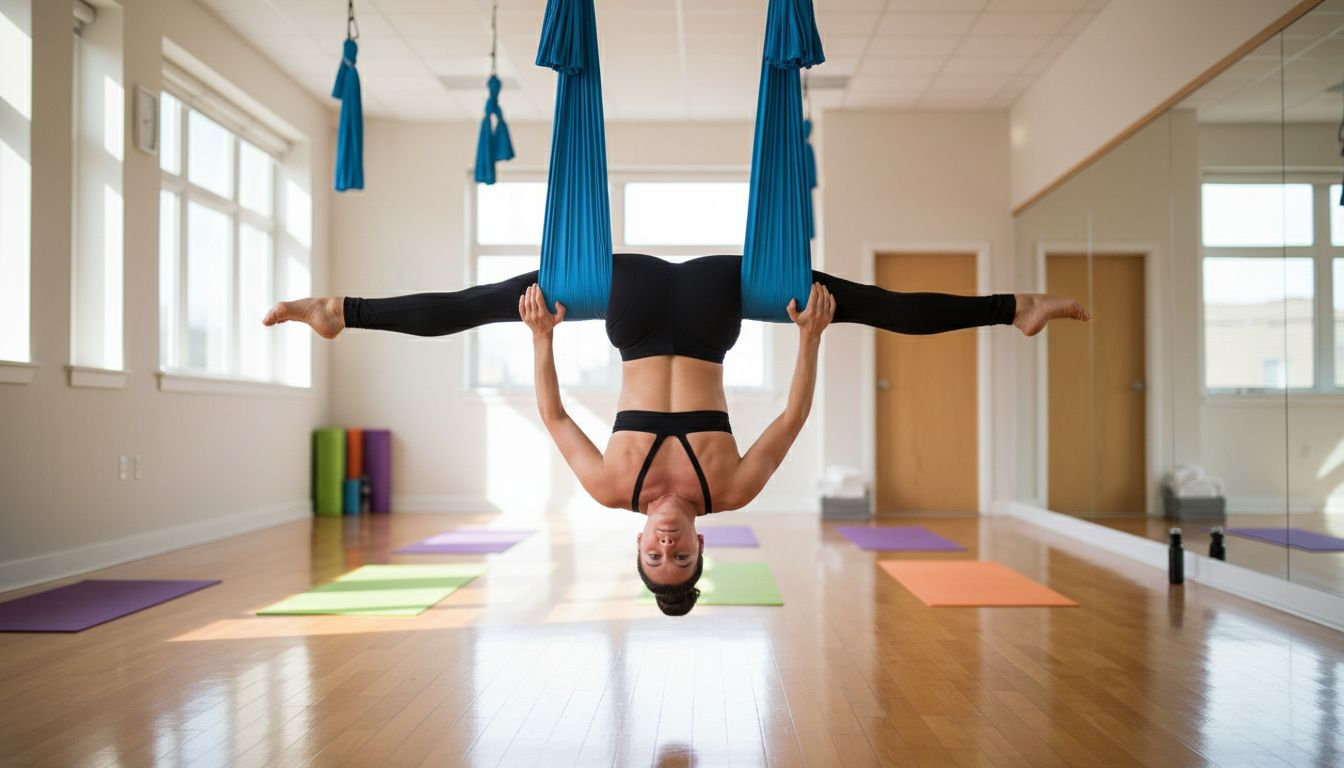
Many American adults in Philadelphia push past plateaus in aerial yoga, yet only a small percentage actually reach advanced mastery through targeted self assessment and community support. When you have experience but crave greater flexibility, strength, and connection, knowing exactly where you stand becomes the catalyst for growth. Discover how seasoned practitioners shape their aerial yoga journeys with proven methods that help track progress, deepen technique, and spark meaningful local engagement.
Table of Contents
Quick Summary
| Key Insight | Explanation |
|---|---|
| 1. Assess Your Aerial Yoga Skills | Evaluate your core strength, flexibility, and balance through self-recordings to establish a tailored progression strategy. |
| 2. Prioritize Alignment and Safety | Focus on maintaining core stability and proper body mechanics to create a safe aerial yoga practice. |
| 3. Integrate Advanced Techniques | Break down complex poses into manageable parts, mastering each movement before combining for full sequences. |
| 4. Consistent Targeted Practice | Schedule regular training sessions that focus on specified skill areas, balancing intensity with recovery time. |
| 5. Seek Instructor Feedback | Regularly consult a qualified instructor for professional evaluation and guidance to refine technique and progress. |