The Amrita Journal
Explore thoughtful stories, practical wellness guidance and inspiring ideas to support your movement, mindfulness and everyday wellbeing at Amrita.
Restorative Yin Yoga: What It Is and How to Practice It
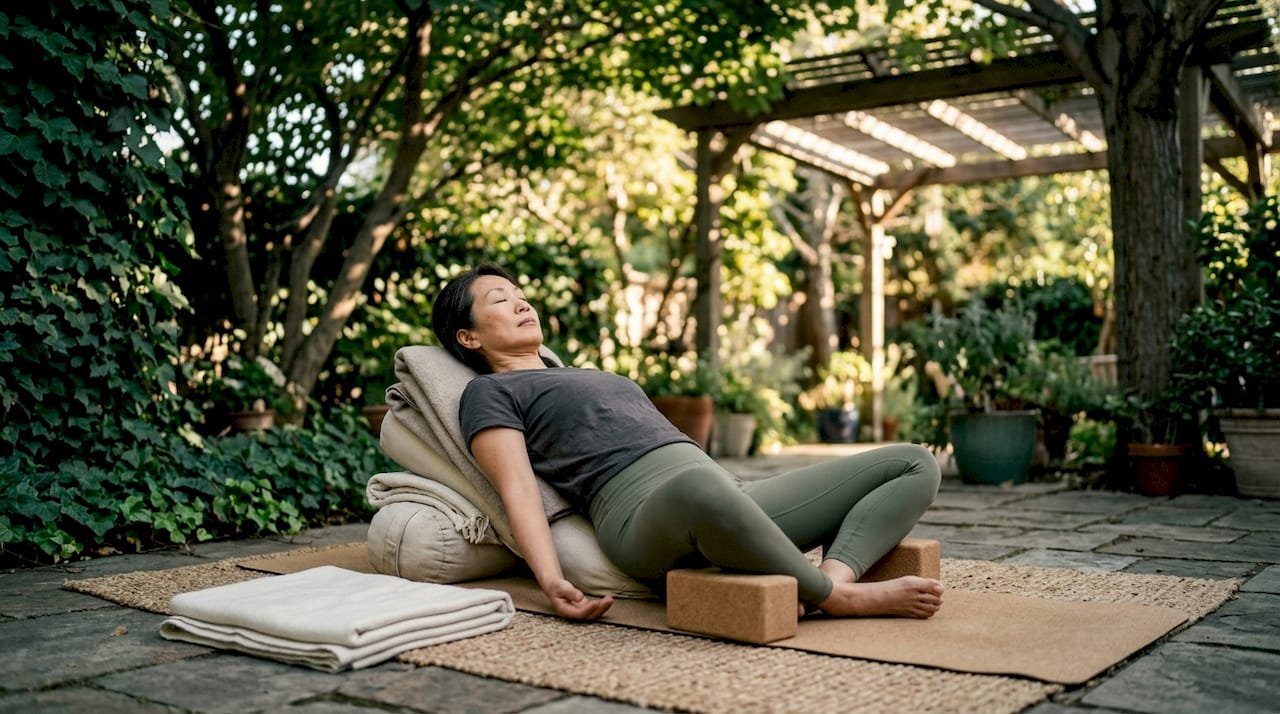
Restorative yin yoga is a hybrid practice that combines the long-held connective tissue work of yin yoga with the full prop-supported relaxation of restorative yoga. You hold floor-based poses for several minutes, fully supported by bolsters, blocks, blankets, and eye pillows, so your muscles can disengage completely while your connective tissues receive a gentle, sustained release. The result is something neither practice delivers alone: deep tissue work happening simultaneously with a profound nervous system reset.
What makes this hybrid distinct is the intention behind the props. In traditional yin yoga, props assist your position but you still feel a working edge of sensation. In restorative yoga, props eliminate all sensation entirely. Restorative yin yoga lands between those two poles, using props generously enough to remove muscular effort while still allowing mild connective tissue engagement to occur passively over time.
This practice suits anyone chasing flexibility, stress relief, or a nervous system reset, particularly people who find pure restorative yoga too passive but find traditional yin too demanding.
At a glance, restorative yin yoga:
Holds poses for 3–10 minutes in fully supported positions
Uses bolsters, blocks, blankets, and eye pillows to eliminate muscular effort
Targets deep connective tissues (fascia, ligaments, joint capsules) passively
Activates the parasympathetic nervous system for deep rest
Blends yin's tissue focus with restorative yoga's surrender and comfort
Suits flexibility goals, stress recovery, and emotional processing
What is yin yoga and why does it matter?
Yin yoga is a slow, floor-based practice that targets the body's deep connective tissues rather than its muscles. Where most movement practices work the muscular layer, yin goes deeper, reaching fascia, ligaments, and joint capsules through long, still holds. The practice was popularized in the West by Paul Grilley and Sarah Powers, drawing on both Taoist principles and anatomical understanding of how connective tissue responds to sustained, gentle load.
The defining concept in yin is the "working edge." You move into a pose until you feel a mild to moderate sensation, then stop there and stay. Not pain, not numbness, just a noticeable pull that you breathe through for several minutes. That sustained, low-level stress is what prompts connective tissue to adapt and lengthen over time, which is why yin yoga benefits include improved joint mobility and tissue health that other styles rarely touch.
Props appear in yin, but their role is positioning rather than comfort. A block under your hip might help you reach the floor, but you're still feeling the stretch. The mental side of yin is real too: staying with sensation for several minutes builds a kind of quiet resilience, training your nervous system to tolerate discomfort without reacting.
Core characteristics of yin yoga:
Poses held several minutes at a mild working edge of sensation
Targets fascia, ligaments, and joint capsules rather than muscles
Props used for alignment assistance, not to remove sensation
Builds flexibility, joint health, and connective tissue adaptation
Cultivates mental stillness and breath awareness under mild stress
Best suited for active practitioners wanting tissue-focused recovery
What restorative yoga actually does for your body
Restorative yoga operates on a completely different premise. The goal is not adaptation through stress but recovery through the complete absence of it. Every prop, every blanket fold, every bolster angle exists to remove physical load from the body until muscles have nothing left to do but let go.
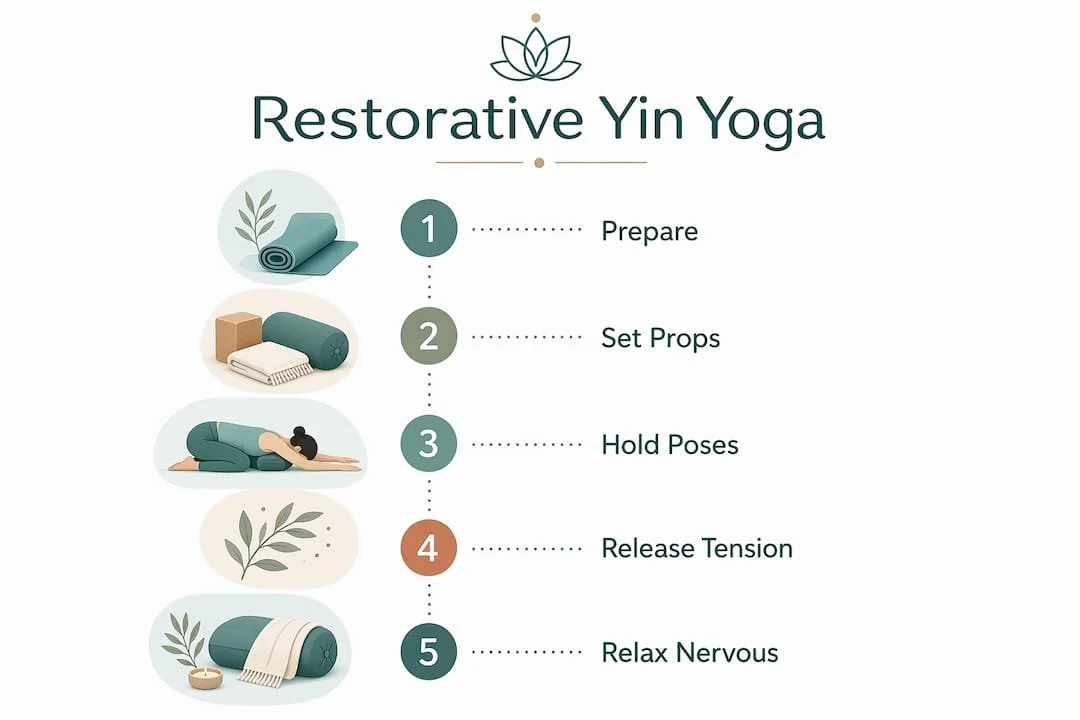
Pose durations run longer here because the nervous system needs time to shift from sympathetic (fight-or-flight) to parasympathetic (rest-and-digest) mode. A well-set-up restorative pose feels like being held rather than stretched. Restorative yoga sessions use props like two blankets, two blocks, a bolster, and often an eye pillow to create that nest of support, and even a 10-minute session can produce measurable emotional relief.
The mental approach is surrender rather than endurance. You're not staying with anything uncomfortable. You're practicing the skill of letting go, which turns out to be harder than it sounds for most people. Restorative yoga is particularly effective during burnout, illness recovery, or any period when the body's reserves are genuinely depleted.
Core characteristics of restorative yoga:
Poses held 5–20 minutes with full prop support and zero sensation
Props fill every gap so muscles disengage completely
Activates the parasympathetic nervous system for deep recovery
Benefits include stress relief, improved sleep, emotional balance, and injury recovery
No stretch sensation should be present; props are adjusted until comfort is total
Suited for burnout, stress recovery, and nervous system restoration
How yin yoga and restorative yoga actually differ
The clearest way to separate these two practices is by asking one question: are you supposed to feel something? In yin yoga, yes. In restorative yoga, no. That single distinction drives every other difference between them.
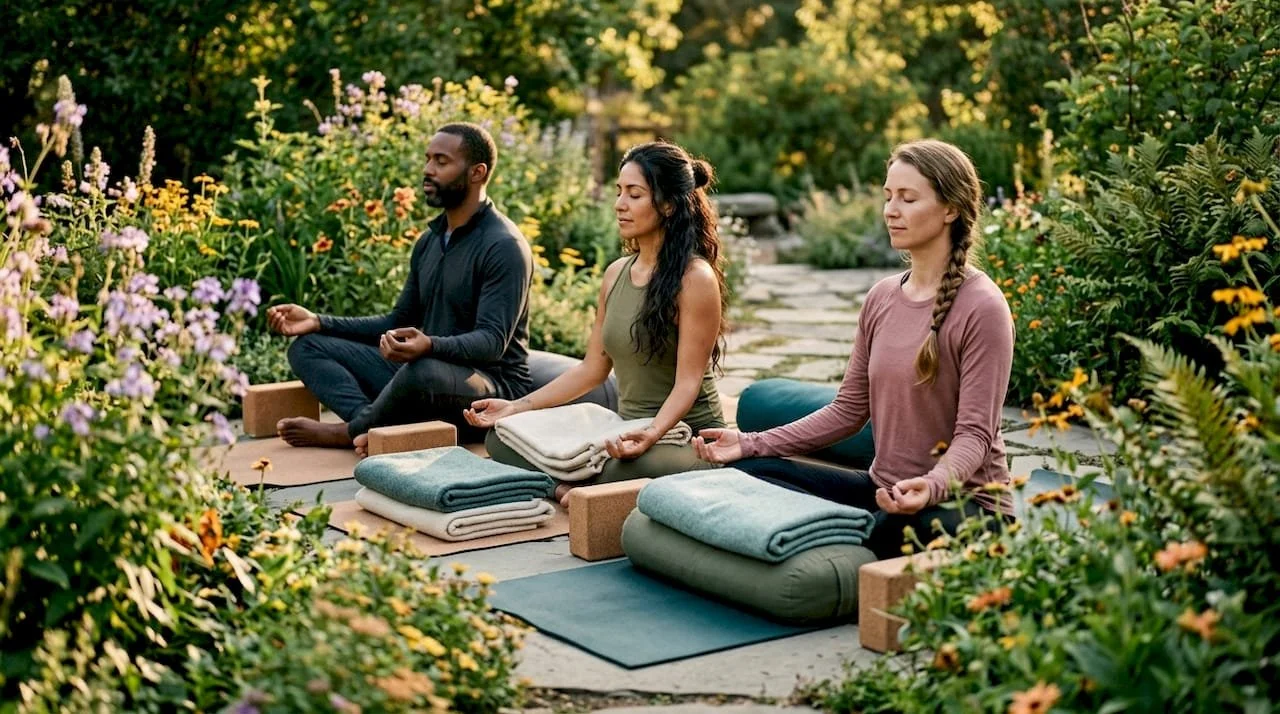
Yin yoga introduces mild sustained stress to connective tissues to stimulate adaptation, while restorative yoga uses extensive props to remove all physical load for total relaxation. The prop use reflects this: yin uses props moderately to help you reach a position, while restorative yoga's prop approach fills every negative space in the body until muscles disengage completely. A restorative setup can involve sandbags, multiple bolsters, and carefully folded blankets under every limb.
Philosophically, yin builds resilience through controlled sensation. Restorative rehearses rest by removing all challenge. Both activate the parasympathetic nervous system, but through opposite mechanisms: yin applies gentle stress for tissue adaptation, while restorative removes stress entirely for deep recovery. They're complementary, not interchangeable, and confusing them leads to either under-supporting a restorative pose or over-supporting a yin one.
| Dimension | Yin yoga | Restorative yoga |
|---|---|---|
| Philosophy | Resilience through sustained sensation | Surrender and deep rest |
| Stress vs. rest | Mild connective tissue stress for adaptation | Complete removal of physical stress |
| Alignment | Functional; props assist positioning | Comfort-first; props fill all gaps |
| Time per pose | 3–5 minutes | 5–20 minutes |
| Use of props | Moderate; sensation remains | Extensive; sensation eliminated |
| Intended benefits | Flexibility, joint health, mental resilience | Stress relief, recovery, nervous system reset |
Common misconceptions worth clearing up:
- Yin yoga is not the same as restorative yoga, even though both are slow and floor-based.
- Restorative yoga is not a beginner version of yin; it serves a different physiological purpose.
- Using more props does not make a yin pose restorative; the intention and sensation level define the practice.
- Both practices can and do activate the parasympathetic nervous system, just through different pathways.
Benefits of restorative yin yoga and how to start safely
The hybrid practice earns its place precisely because it delivers what neither parent practice does alone. Yin restorative yoga offers deep tissue work alongside complete relaxation and nervous system calming, with poses typically held up to 10 minutes in full prop support. You get the connective tissue release of yin without the mental demand of staying with sharp sensation, because the props reduce that sensation to something mild and manageable.
Mentally and emotionally, this practice creates space that active yoga rarely offers. Long, supported holds give the nervous system time to process stress rather than just suppress it. Many practitioners find that emotions surface during extended floor poses, which is a sign the body is releasing stored tension rather than a reason to stop. Breath awareness is the primary tool for navigating that experience: slow, deliberate exhales signal safety to the nervous system and deepen the relaxation response.
For beginners, the biggest obstacle is usually mental rather than physical. Stillness feels unproductive at first, especially for people accustomed to movement-based exercise. Breath focus is the primary technique instructors teach overcoming restlessness and settle into the hold. Start with shorter holds of 3–5 minutes and build gradually. Pair restorative yin yoga with more active practices on alternating days for a balanced approach to both flexibility and recovery. Exploring a holistic wellness routine that includes movement variety can make the stillness of restorative yin feel more natural over time.
Practical tips and precautions for beginners:
Start with classic poses: Supported Child's Pose, Reclined Butterfly, Legs Up the Wall, Supported Fish, and Melting Heart
Use a bolster under the spine, blocks under the knees, and blankets under the head to build full support
Aim for mild tissue sensation at most; if you feel sharp or joint pain, add props or exit the pose
Avoid restorative yin yoga during acute injury, late-stage pregnancy, or severe osteoporosis without medical guidance
Keep the room warm and dim; cold muscles and bright light work against the parasympathetic shift
Allow 5–10 minutes of stillness after your final pose before returning to activity
Pro Tip: Before settling into any pose, spend 60–90 seconds adjusting your props until you feel no muscular effort at all. Most beginners under-prop and then wonder why they can't relax. The setup is the practice.
Key Takeaways
Restorative yin yoga is the most accessible entry point for practitioners who want connective tissue release and nervous system recovery in a single session, without the mental demand of traditional yin or the complete passivity of pure restorative yoga.
| Point | Details |
|---|---|
| Hybrid practice definition | Restorative yin yoga blends yin's connective tissue focus with restorative yoga's full prop support and relaxation. |
| Pose duration | Poses are held 3–10 minutes, fully supported, to release tension without muscular effort. |
| Key distinction from yin | Yin requires a working edge of sensation; restorative yin minimizes that sensation through generous prop use. |
| Key distinction from restorative | Restorative yoga removes all sensation; restorative yin allows mild passive tissue engagement to occur. |
| Beginner priority | Adjust props until muscular effort disappears, and use breath awareness to navigate mental restlessness during holds. |
Amritayogawellness offers classes, workshops, and community events in Philadelphia designed to support exactly this kind of layered wellness practice. Whether you're drawn to the deep tissue work of yin, the nervous system reset of restorative yoga, or the restorative yoga techniques that bridge both, the studio's offerings meet you where you are. You can also explore Amritayogawellness's wellness workshops for community-centered ways to deepen your self-care practice beyond the mat.
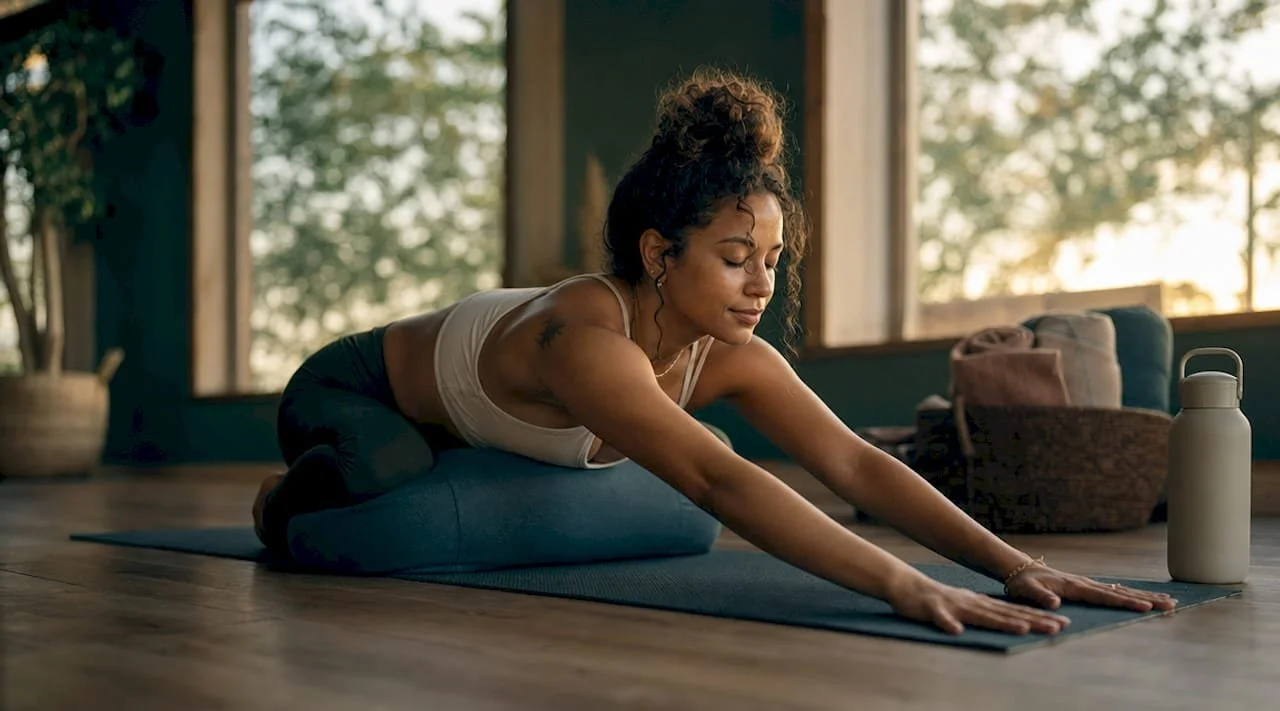
Hot Yin Yoga Benefits for Relaxation and Flexibility
TL;DR:
Hot yin yoga combines gentle long-held poses in a warm environment to deepen connective tissue stretching and promote nervous system relaxation. Its physical benefits include increased joint flexibility, improved circulation, and stress reduction through parasympathetic activation, supported by controlled heat application. Practitioners should prioritize temperature safety, gradual deepening, and mindful use of heat to avoid overstretching and maximize restorative effects.
Hot yin yoga is defined as a yin yoga practice performed in a warm environment or with applied heat to deepen passive stretches and amplify relaxation. Where standard yin yoga holds poses for three to five minutes to target connective tissue, the addition of heat takes those same holds further by warming collagen fibers and calming the nervous system simultaneously. The result is a practice that delivers hot yin yoga benefits no unheated session can fully replicate: greater range of motion, measurable stress reduction, and a parasympathetic shift that lingers well after class ends. Studios like Amrita Yoga & Wellness in Philadelphia have built entire programming tracks around this combination because the demand from wellness-focused adults is real and growing.
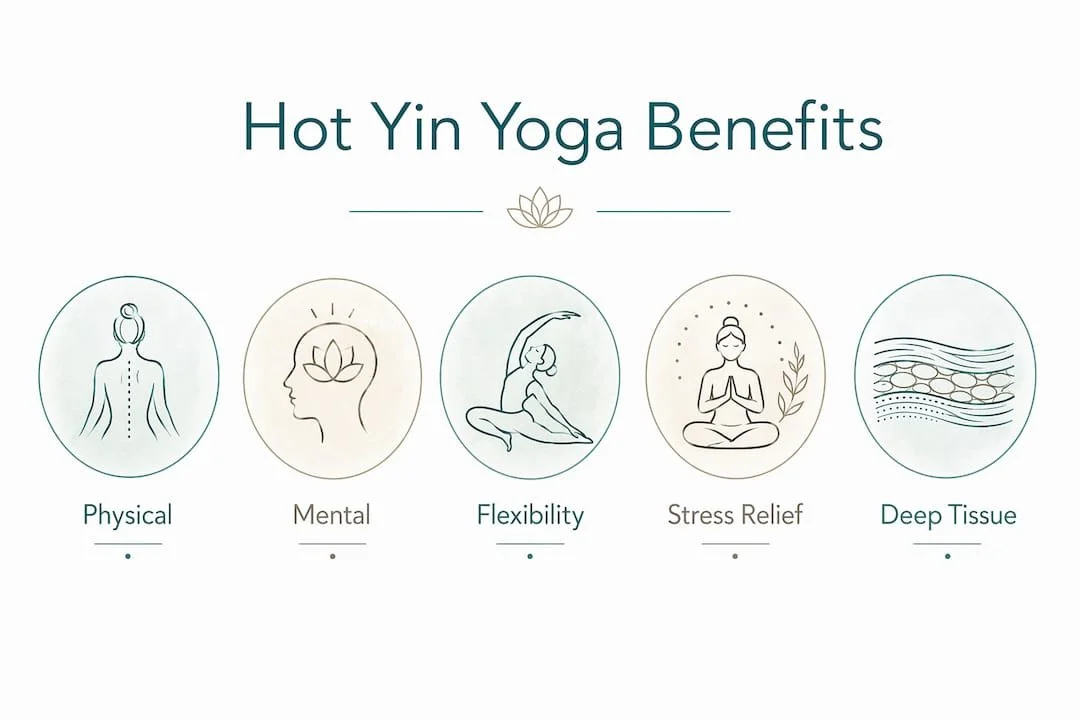
What are the main physical benefits of hot yin yoga?
Hot yin yoga produces physical changes that go deeper than a standard stretch class because heat and time work together on the body's least pliable structures. Muscles respond quickly to warmth, but the real target in yin yoga is the fascia, ligaments, and joint capsules. These dense connective tissues require both sustained pressure and elevated temperature to release.
The core mechanism is collagen extensibility. Tactile heat anchors warm connective tissue directly, increasing its pliability during long holds so the tissue remodels rather than simply stretches and snaps back. This is why a five-minute Dragon pose in a warm room produces a different result than the same pose at room temperature. The tissue stays more receptive throughout the hold.
Key physical benefits include:
Increased joint flexibility. Warm connective tissue yields more readily to sustained load, expanding range of motion in the hips, spine, and shoulders over time.
Enhanced circulation. Heat dilates blood vessels, improving delivery of oxygen and nutrients to tissues that normally receive limited blood flow, including cartilage and ligament attachments.
Detoxification through sweating. The body expels metabolic waste through perspiration, which is amplified in a warm practice environment.
Pain relief and recovery support. Localized warming tools like microwavable grain pads and rechargeable heat packs reduce joint stiffness and support recovery without the systemic thermal load of a full hot room.
Improved proprioception. Weighted heat props provide a steady tactile anchor that reduces micro-movements in a pose, helping the body settle into correct alignment.
Pro Tip: Place a warm bolster under your hips in Butterfly pose rather than relying solely on room heat. The localized warmth targets the hip flexors and inner groin directly, and you will feel the difference within 90 seconds.
One caution worth stating plainly: heat reduces the feeling of stiffness, which makes stretches feel easier than they are. Temporary tissue laxity means you can overstretch without realizing it. Controlled, gradual deepening of each pose is the rule, not the exception.
How does hot yin yoga support mental relaxation and stress relief?
The mental benefits of hot yin yoga are not a side effect. They are a direct physiological outcome of combining warmth with long, still holds and conscious breathing. This combination creates one of the most reliable parasympathetic triggers available in a group fitness setting.
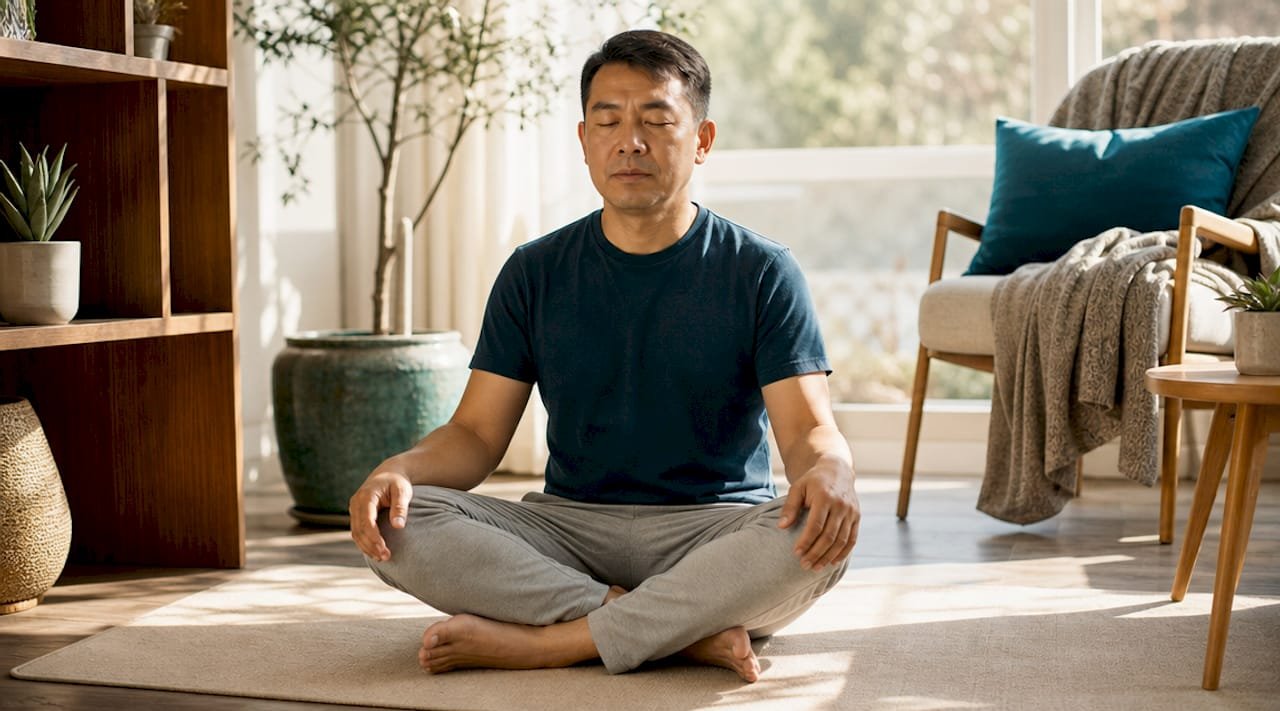
When you hold a yin pose for three to five minutes in a warm room, your body receives two simultaneous signals to downshift. The heat tells the nervous system that the environment is safe and comfortable. The stillness and slow breathing reinforce that signal. Together, they shift the autonomic nervous system away from sympathetic activation (fight-or-flight) and toward parasympathetic dominance (rest-and-digest). Research on heat and autonomic function confirms this: far-infrared heat applied during rest lowers tympanic temperature and increases REM sleep proportion from 18.6% to 22.2%. That shift in sleep architecture is a direct marker of improved autonomic regulation.
The mental benefits practitioners report most consistently include:
Reduced anxiety and mental chatter during and after class
A stronger ability to sit with discomfort without reacting, which transfers to daily stress management
Deeper mindfulness because long holds force sustained attention on breath and sensation
Improved sleep quality, supported by the thermal comfort effects that reduce the body's need for evaporative cooling at night
"The combination of heat and stillness in yin yoga creates a neurological environment that is genuinely difficult to replicate through other means. You are not just stretching. You are training your nervous system to tolerate and release tension." This reflects what practitioners and instructors at studios across the country observe session after session.
Sound bath integration is another layer worth exploring. A yoga sound bath sequence paired with warm yin holds compounds the parasympathetic effect, using auditory vibration to deepen the relaxation response already initiated by heat and stillness.
How does hot yin yoga compare to traditional yin yoga and hot yoga?
Understanding what hot yin yoga is requires knowing what it is not. Traditional yin yoga and hot yoga each offer real benefits, but they operate through different mechanisms and serve different goals.
Traditional yin yoga is practiced at room temperature, typically 68 to 72°F. The focus is entirely on long passive holds targeting connective tissue. There is no cardiovascular demand. The practice is meditative and slow, accessible to most bodies regardless of fitness level.
Hot yoga (most commonly Bikram or Baptiste-style power yoga) is practiced in rooms heated to 95 to 105°F with high humidity. The emphasis is on muscular endurance, cardiovascular output, and detoxification through heavy sweating. The pace is active, the demand is high, and the heat is systemic.
Hot yin yoga sits between these two. Warm yin yoga is typically practiced at 80 to 90°F (30 to 32°C), a temperature range that warms tissue without the cardiovascular stress of a full hot yoga environment. The practice remains slow and meditative, but the heat amplifies connective tissue release and nervous system downregulation in ways room-temperature yin cannot match.
| Feature | Traditional yin yoga | Hot yoga | Hot yin yoga |
|---|---|---|---|
| Room temperature | 68 to 72°F | 95 to 105°F | 80 to 90°F |
| Pace | Slow, passive | Active, dynamic | Slow, passive |
| Primary target | Connective tissue | Muscles, cardiovascular | Connective tissue plus nervous system |
| Sweat level | Minimal | High | Moderate |
| Best for | Flexibility, mindfulness | Fitness, detox | Relaxation, flexibility, stress relief |
The audience for hot yin yoga skews toward adults who want the deep tissue benefits of yin yoga with an added layer of therapeutic warmth. It is not a fitness class. It is a recovery and restoration practice with a measurable physiological edge.
What safety considerations and best practices should you follow?
The benefits of hot yin yoga depend entirely on how the heat is applied. Done carelessly, heat during passive holds creates real injury risk. Done correctly, it is one of the safest and most therapeutic practices available.
Follow these guidelines to practice safely:
Stay within the recommended temperature range. Conservative safe practices set surface temperatures for heat props at 40 to 45°C (104 to 113°F). Room temperatures for warm yin yoga sit between 80 and 90°F. Above these thresholds, the risk of burns and heat-related illness rises sharply.
Always use fabric barriers with heat props. Direct skin contact with heated objects causes burns even at moderate temperatures during long holds. Wrap all heat packs, grain pads, or bolsters in a cloth cover before placing them against your body.
Screen for contraindications before class. Pregnancy, cardiovascular conditions, Raynaud's disease, neuropathy, and certain skin conditions all require medical clearance before practicing in a heated environment.
Hydrate before, during, and after. Warm yin yoga produces moderate sweating. Drink at least 16 ounces of water before class and sip throughout. Electrolyte replacement matters for sessions longer than 60 minutes.
Limit heat prop contact time. Even at safe temperatures, prolonged skin contact with a heat source during a five-minute hold can cause discomfort. Reposition props every two to three poses and check skin condition regularly.
Use props to support, not force, depth. Bolsters, blocks, and blankets allow your body to settle into a pose without muscular effort. In a warm environment, the temptation to go deeper is strong. Resist it. Let the heat do the work over time.
Pro Tip: If you are new to heated yin practice, start with a warm (not hot) room at around 80°F and use a single microwavable grain pad on your lower back during Sphinx pose. This gives you the neurological benefit of localized heat without full systemic thermal load, and it is a much gentler entry point than a 90°F studio.
The difference between comfort and risk in hot yin yoga comes down to temperature control, screening, and prop setup. None of these are complicated. All of them are non-negotiable.
Key takeaways
Hot yin yoga delivers its most significant benefits through the precise combination of controlled heat, long passive holds, and conscious breathing to warm connective tissue and activate the parasympathetic nervous system simultaneously.
| Point | Details |
|---|---|
| Heat amplifies connective tissue release | Warming collagen fibers during long holds increases pliability beyond what room-temperature yin yoga achieves. |
| Parasympathetic activation is measurable | Research shows heat improves REM sleep proportion and lowers autonomic arousal, confirming real nervous system benefits. |
| Temperature control is non-negotiable | Safe practice requires room temps of 80 to 90°F and heat prop surfaces of 40 to 45°C with fabric barriers. |
| Hot yin yoga differs from hot yoga | The practice is slow and meditative, not cardiovascular, making it accessible to adults prioritizing recovery and stress relief. |
| Localized heat tools are a valid alternative | Grain pads and rechargeable heat packs deliver targeted warmth with lower systemic stress than a full hot room. |
What I've learned from years of watching people practice hot yin yoga
Most people come to hot yin yoga expecting the heat to be the hard part. It never is. The hard part is staying still long enough to let the practice work.
What I have observed consistently is that the adults who get the most out of this practice are the ones who stop treating it like a workout and start treating it like a conversation with their nervous system. The heat is a tool. The stillness is the practice. When you combine them with patience, the results show up not just on the mat but in how you sleep, how you respond to stress, and how your body feels the morning after a long workday.
I will say something that most articles skip: hot yin yoga is not for everyone in every season of life. If you are going through a period of high physical stress, illness, or hormonal fluctuation, a warm room at 80°F with a single heat prop is a smarter choice than a 90°F studio. The benefits of heated yoga scale with how well you listen to your body, not with how much heat you can tolerate.
For beginners, I always recommend starting with three poses per session: Butterfly, Supported Fish, and Child's Pose. Hold each for four minutes with a warm bolster. That is twelve minutes of genuine therapeutic input. It is enough to feel the difference without overwhelming your system.
The practitioners I have seen make the fastest progress are not the most flexible. They are the most consistent and the most honest about what their body needs on a given day.
— Juiced
Deepen your wellness practice with Amrita Yoga & Wellness
Amritayogawellness offers a full range of holistic services at its Philadelphia studio that pair naturally with a regular hot yin yoga practice. Whether you are working through stress, seeking deeper self-understanding, or building a recovery-focused wellness routine, the studio's offerings extend well beyond the mat. Amritayogawellness also provides tarot readings as a reflective tool for personal insight, a complement to the inward focus that yin yoga cultivates. For anyone ready to take their practice further, explore the full class schedule and wellness services at Amrita Yoga & Wellness and find the combination that works for your body and your life.
FAQ
What is hot yin yoga?
Hot yin yoga is yin yoga practiced in a warm environment, typically 80 to 90°F, or with applied heat props to deepen passive holds targeting connective tissue. The heat amplifies flexibility gains and supports nervous system relaxation beyond what room-temperature yin yoga achieves.
Is hot yin yoga effective for stress relief?
Yes. The combination of warmth and long passive holds activates the parasympathetic nervous system, reducing anxiety and improving sleep quality. Research shows heat interventions increase REM sleep proportion, a direct marker of improved autonomic regulation and relaxation.
How is hot yin yoga different from Bikram or hot yoga?
Hot yin yoga is practiced at 80 to 90°F, far cooler than Bikram's 105°F environment, and the practice is slow and meditative rather than active. The goal is connective tissue release and nervous system downregulation, not cardiovascular fitness or heavy detoxification.
What temperature is safe for hot yin yoga heat props?
Safe surface temperatures for heat props used in yin yoga are 40 to 45°C (104 to 113°F), always covered with a fabric barrier. Room temperatures between 80 and 90°F are the standard range for a warm yin yoga environment.
Can beginners practice hot yin yoga?
Yes, with appropriate modifications. Beginners should start at the lower end of the temperature range, use supportive props like bolsters and blankets, and limit sessions to three or four poses until the body adapts to the combined effects of heat and sustained holds.
Recommended
What Is Hot Yin Yoga: Benefits and What to Expect
TL;DR:
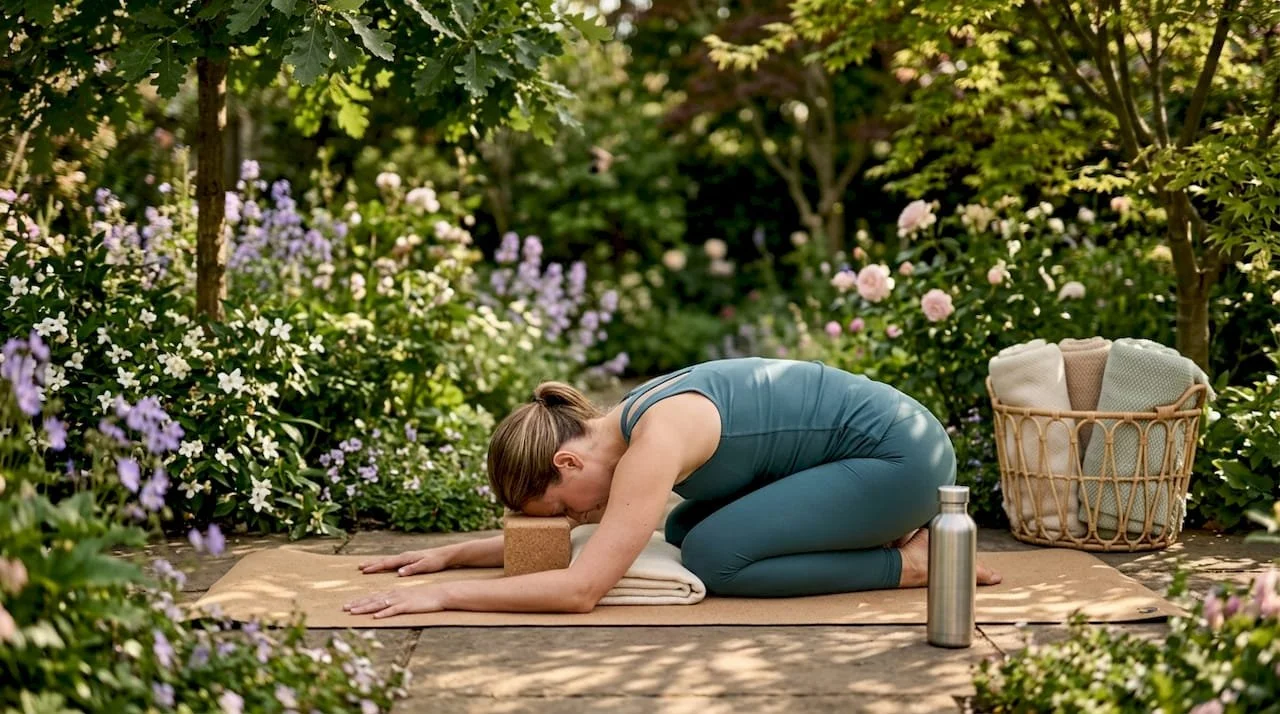
Hot yin yoga combines traditional Yin Yoga principles with a warm room of 80°F to 90°F, enhancing deeper connective tissue release and calming the nervous system. It features slow, passive holds that make it accessible for most adults, emphasizing tissue relaxation, emotional processing, and stress reduction. Preparation, proper props, and mindful practice are key to safely experiencing its physical and psychological benefits.
Most people assume Yin Yoga belongs in a cool, dimly lit room with soft music and zero sweat. That assumption misses an entire branch of the practice. Hot yin yoga layers gentle warmth over the slow, meditative principles of traditional Yin Yoga, creating a hybrid that unlocks deeper tissue release and a more profound state of calm. This guide covers everything you need to know: what it is, what separates it from other heated styles, the real hot yin yoga benefits, and how to walk into your first class feeling prepared rather than uncertain.
Table of Contents
Key takeaways
| Point | Details |
|---|---|
| Gentle heat, not intense heat | Hot yin yoga rooms sit between 80°F and 90°F, much cooler than traditional Hot Yoga studios. |
| Connective tissue focus | The warmth targets fascia, ligaments, and joints rather than muscles, enabling deeper release. |
| Nervous system reset | Long passive holds activate the parasympathetic nervous system, reducing stress and anxiety. |
| Accessible for most adults | The slow pace and lower heat make this style suitable for beginners and those avoiding cardiovascular strain. |
| Props are part of the practice | Bolsters, blankets, and warm weighted packs are tools, not crutches, in hot yin yoga. |
What is hot yin yoga, exactly?
Hot yin yoga is a practice that combines the core philosophy of traditional Yin Yoga with the deliberate addition of a warmed room. Traditional Yin Yoga, developed largely through the teachings of Paul Grilley and Sarah Powers, focuses on holding passive poses for several minutes at a time to stress the deeper connective tissues: the fascia, ligaments, tendons, and joint capsules. What the heated version adds is temperature, not intensity.
The room in a warm yin class sits between 80°F and 90°F, which is meaningfully different from the 95°F to 105°F you would find in a Bikram or traditional Hot Yoga class. That distinction matters. The goal is not to make you sweat through your mat. The goal is to use warmth the way a heating pad uses warmth: to soften tissue, encourage release, and help the body surrender into stillness more readily.
Here is a quick breakdown of where hot yin yoga fits among heated yoga styles:
Temperature: 80°F to 90°F, compared to 95°F to 105°F for standard Hot Yoga
Pace: Fully passive, slow holds of 3 to 7 minutes per pose
Sweat level: Minimal to light, not the intense cardiovascular sweat of Bikram
Focus: Deep connective tissue, breath awareness, and nervous system regulation
Class length: Typically 60 to 90 minutes, opening with grounding breath work before moving into long holds
The "hot" label sometimes creates confusion because it suggests something athletic and demanding. A better mental model is this: hot yin yoga is warm yin yoga. The heat is a tool for softening, not for pushing.
The real benefits of hot yin yoga
The benefits here go beyond "it feels nice." There are specific physiological and psychological reasons this practice works, and understanding them helps you get more out of every session.
Connective tissue release
Muscles respond well to active stretching because they contain elastic fibers designed for dynamic movement. Connective tissue, including fascia and ligaments, is denser and less elastic. It responds better to slow, sustained stress held over time. The gentle warmth promotes deeper connective tissue release without the aggressive heat that can cause muscle guarding or overstretching. You get a more genuine release, not just a temporary lengthening of muscle fibers.
Nervous system regulation
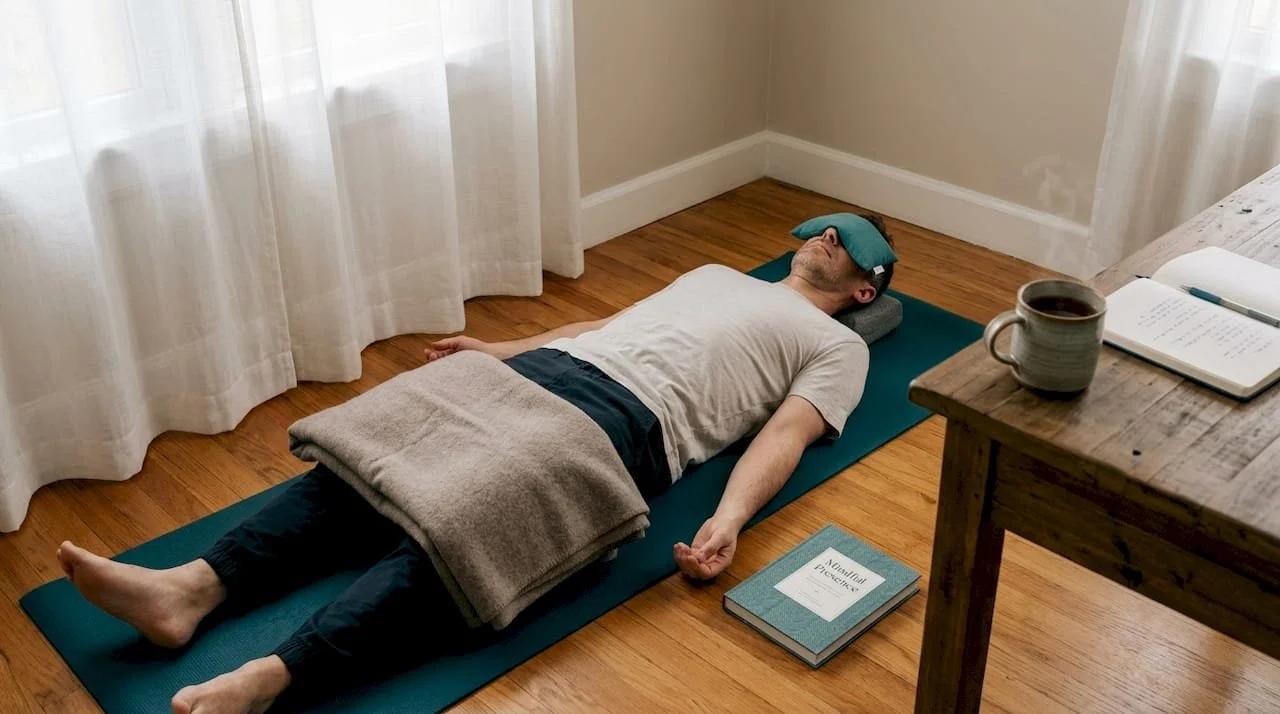
This is where hot yin yoga separates itself from almost every other physical practice. Long passive holds activate the parasympathetic nervous system, which is the branch responsible for rest, digestion, and recovery. In practical terms, your heart rate slows, your breathing deepens, and your body stops treating the world as a threat. For adults carrying chronic stress, that shift is not small.
Emotional processing
There is a reason people sometimes feel unexpectedly emotional during a long yin hold. Fascia stores tension patterns that correlate with habitual stress responses. When you release physical tension slowly and with breath awareness, emotional material sometimes surfaces. Hot yin yoga creates a supportive space for emotional balance and healing by pairing that physical release with the calming effect of warmth.
Accessibility across fitness levels
Because there is no flow, no jumping, and no cardiovascular demand, this practice works for people recovering from injury, older adults, athletes who need a genuine recovery day, and complete beginners. The lower heat avoids cardiovascular stress that makes some people feel dizzy or overwhelmed in hotter classes. You do not need to be flexible or athletic to benefit. You need to be willing to stay still.
Pro Tip: If you are new to yin yoga for relaxation, try yin yoga resources first to understand the foundational philosophy before adding heat to your practice. It will make your first hot yin class feel familiar rather than foreign.
What to expect in hot yin yoga class
Walking into a hot yin yoga class for the first time feels different from other yoga classes. Here is a realistic picture of how a session typically unfolds.
Arrival and setup. You will enter a room that feels comfortably warm rather than oppressively hot. Gather props: a bolster, two blocks, a blanket, and optionally a warm weighted pack if the studio offers them.
Opening breath work. Classes usually begin with 5 to 10 minutes of guided breathing or meditation. This is not optional filler. It signals your nervous system to downshift before the holds begin.
Long-held passive poses. Expect shapes like Dragon (a deep hip flexor stretch), Butterfly (seated forward fold with feet together), and Sleeping Swan (a floor pigeon variation). Each is held for 3 to 7 minutes with minimal muscular effort.
Props in action. Bolsters go under hips, knees, or chests to support the body so you can fully relax into the pose. Weighted warm packs placed on the lower back or hips add proprioceptive grounding and encourage the tissue to release more deeply.
Savasana. The final rest period in hot yin yoga tends to feel especially profound because your body has spent the entire class releasing accumulated tension. Give it the full time offered.
Regarding safety, the safe surface temperature for heat props sits between 104°F and 113°F. Always use a fabric barrier between a heat pack and your skin, and stop using any prop that causes discomfort. People with pregnancy (without medical clearance), sensory neuropathy, cardiovascular conditions, or recent surgery should check contraindications before practicing in a heated room.
Pro Tip: Bring a small personal water bottle and a light layer you can remove during class. The room is warm but not punishing, and having water nearby lets you focus on the practice instead of watching the clock.
Hot yin yoga vs. regular yin and other heated styles
Knowing where hot yin yoga sits on the spectrum helps you decide whether it is the right fit for you right now.
| Style | Room temperature | Pace | Primary goal | Best for |
|---|---|---|---|---|
| Traditional Yin Yoga | Unheated or room temp | Passive, slow holds | Connective tissue + mindfulness | All levels, sensitive populations |
| Hot Yin Yoga | 80°F to 90°F | Passive, slow holds | Deeper tissue release + relaxation | Most adults, beginners, recovery |
| Hot Yoga / Vinyasa | 95°F to 105°F | Dynamic, flowing | Strength, flexibility, cardiovascular fitness | Active practitioners |
| Bikram Yoga | 105°F, 40% humidity | Scripted active sequence | Detoxification, strength | Experienced practitioners |
The most important column in that table is temperature. Traditional yin yoga works without heat because the long hold duration does the connective tissue work regardless. The warm room in hot yin yoga simply lowers the initial resistance, making it easier for most people to relax fully. You are not getting a better workout by adding heat. You are removing a barrier to surrender.
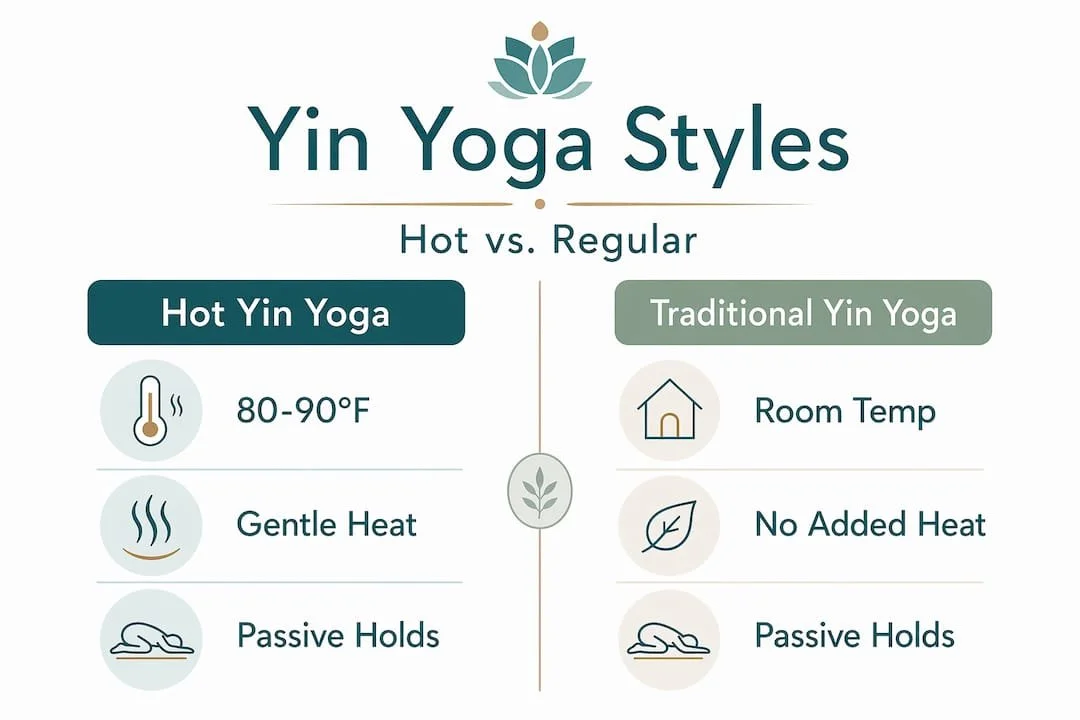
Hot yoga and Bikram, by contrast, use heat to drive cardiovascular response and increase muscle elasticity for a more active practice. The goals, pacing, and physiological demands are categorically different from what hot yin yoga offers.
Practical tips for your first hot yin yoga class
Preparation separates a rough first experience from one that makes you want to come back.
Choose the right class. Look for classes explicitly labeled "Warm Yin," "Hot Yin," or "Heated Yin" rather than general hot yoga classes. The distinction matters for what you will experience in the room.
Wear minimal, breathable clothing. Loose shorts and a light tank are ideal. Avoid thick fabrics that trap heat uncomfortably.
Hydrate before, not during. Drink 16 to 20 ounces of water in the two hours before class. Drinking large amounts during long holds interrupts the breath and stillness you are trying to cultivate.
Communicate with the instructor. Tell them it is your first class. A good teacher will offer modifications, check prop placement, and keep an eye on you during longer holds.
Plan for post-class recovery. Your connective tissue will have been gently stressed throughout the session. A light snack, additional water, and 20 minutes of rest after class helps the body integrate the work.
Pro Tip: Skip the coffee or stimulants for two hours before a warm yin class. Stimulants increase baseline nervous system activation, which makes it harder to drop into the parasympathetic state the practice is designed to cultivate.
My honest take on this practice
I have watched people come into heated yin classes expecting either a relaxing nap or a detoxifying sweat session, and leave slightly confused when it is neither. That is the most common misconception I encounter. Hot yin yoga occupies a specific territory: it is demanding in a way that has nothing to do with physical effort. Staying still for five minutes while your hip flexors resist, while your mind wants to move to the next thing, is genuinely hard. The warmth makes the physical surrender easier. It does not make the mental surrender easier.
What I have found is that the people who benefit most from this practice are not the flexible ones. They are the ones who are willing to get uncomfortable with stillness. That is a skill that transfers everywhere: in stress management, in sleep quality, in how you handle difficulty without immediately trying to fix it. Hot yin yoga teaches you to stop bracing. That is worth more than any stretch.
I have also noticed that practitioners who come from more athletic hot yoga backgrounds often underestimate warm yin classes at first. They assume less heat means less benefit. Then they hold Dragon pose for six minutes and reconsider.
— Juiced
Try it yourself at Amrita Yoga & Wellness
If this practice sounds like what your body and mind have been asking for, Amritayogawellness has you covered. Amrita Yoga & Wellness in Philadelphia offers hot yin yoga classes designed for adults at every level, from complete beginners to experienced practitioners looking for a genuine recovery practice. The studio's approach emphasizes accessibility, safety, and community, so you are never walking into an environment where you feel out of place.
Whether you are managing stress, working on flexibility, or simply curious about what a warm, meditative yoga class feels like, Amrita Yoga & Wellness offers a welcoming space to find out. Visit amritayogawellness.com to browse the class schedule, sign up for your first session, and explore everything the studio has to offer.
FAQ
What temperature is a hot yin yoga room?
Hot yin yoga rooms are typically heated to between 80°F and 90°F. This is noticeably cooler than traditional Hot Yoga studios, which range from 95°F to 105°F.
How long are hot yin yoga poses held?
Most poses in a hot yin yoga class are held for 3 to 7 minutes in a fully passive position. The class itself typically runs 60 to 90 minutes total.
Is hot yin yoga good for beginners?
Yes. The slower pace and lower heat level make hot yin yoga one of the more accessible heated yoga styles for people new to yoga or returning after a break.
What props do you need for hot yin yoga?
A bolster, yoga blocks, and a blanket cover most needs. Some studios also offer warm weighted packs placed on the body during long holds to deepen relaxation and tissue release.
Who should avoid hot yin yoga?
People who are pregnant without medical clearance, those with cardiovascular conditions, individuals with sensory neuropathy, or anyone recovering from recent surgery should consult a doctor before attending a heated yin class.
Recommended
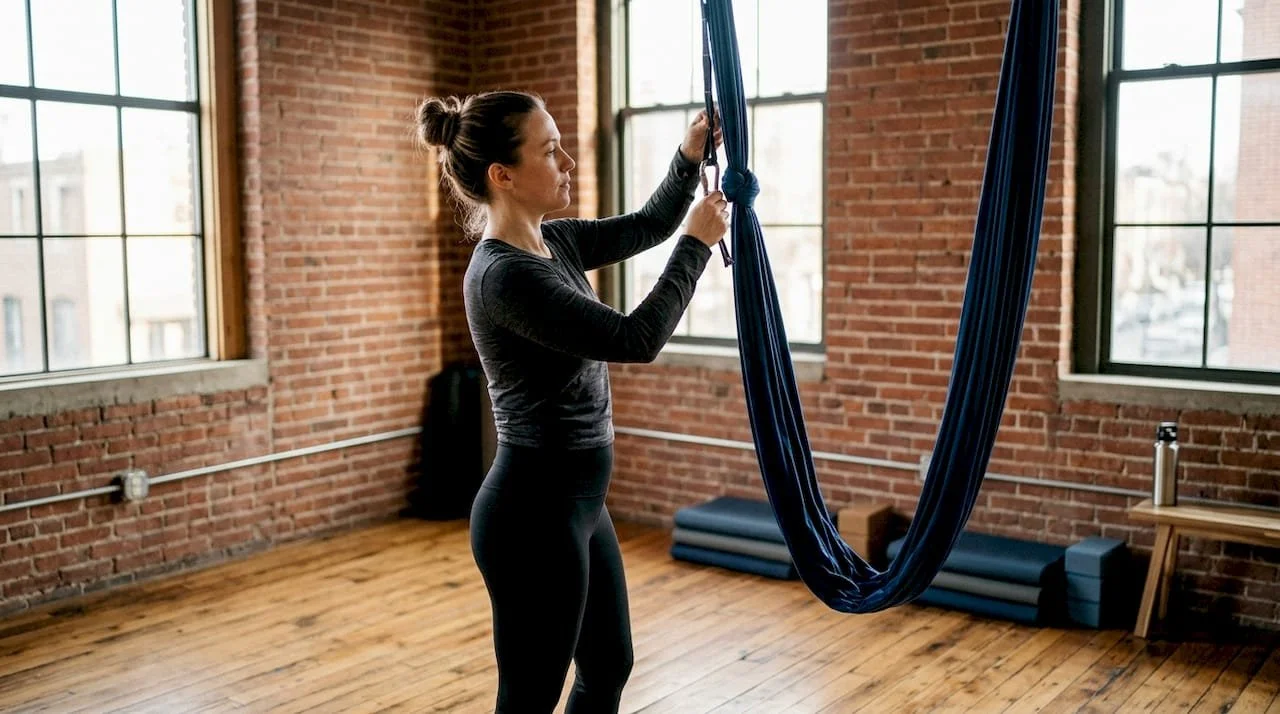
Yin aerial yoga: deep relaxation + strength in Philly
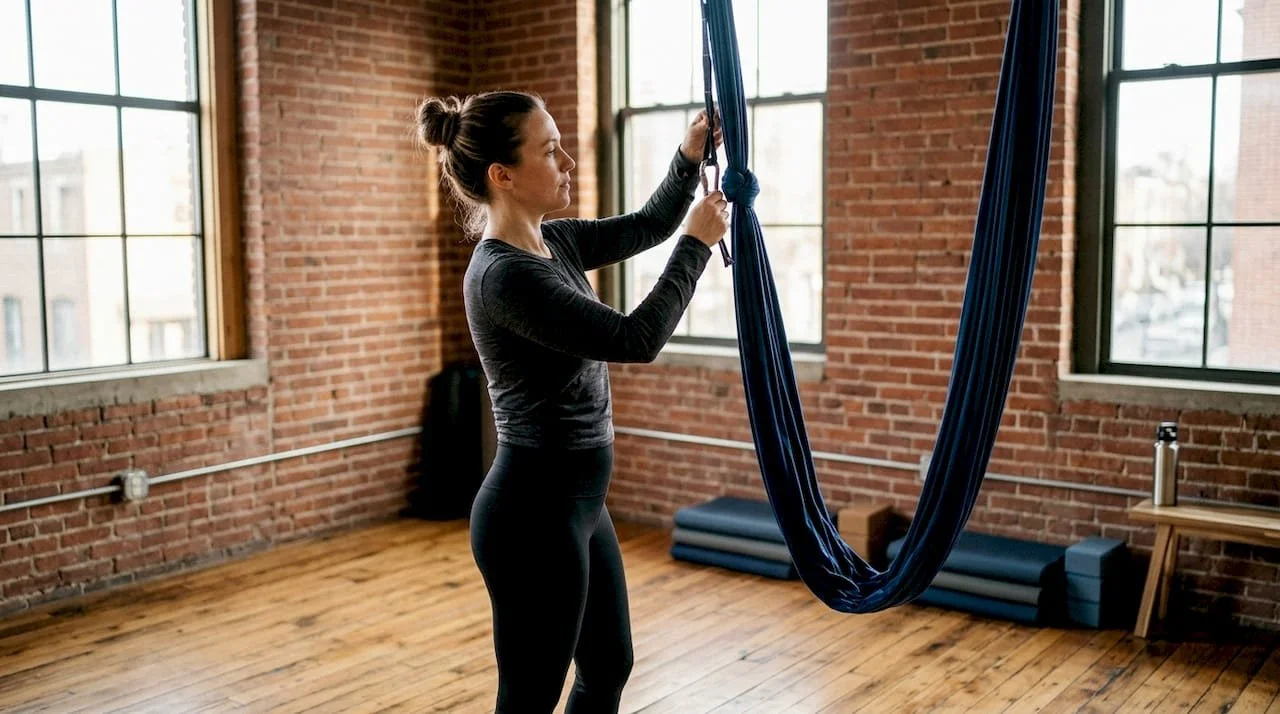
Most people picture aerial yoga as something acrobatic, a high-energy spectacle of flips and inversions. That image keeps a lot of people from ever trying it. But Yin aerial yoga is a completely different experience, one that leans into stillness, deep tissue release, and meditative calm. Research shows Yin yoga reduces anxiety significantly after a single session. When you combine that restorative power with the supportive suspension of an aerial hammock, you get something genuinely special. For Philadelphia wellness seekers looking for a practice that feeds both the body and the community, Yin aerial yoga may be exactly what you have been missing.
Table of Contents
Key Takeaways
| Point | Details |
|---|---|
| Deep relaxation | Yin aerial yoga offers meditative, anxiety-reducing sessions proven by scientific research. |
| Physical improvements | Expect greater spinal flexibility and moderate upper-body strength gains with regular practice. |
| Community connection | Group classes foster supportive relationships and contribute to Philadelphia’s holistic wellness scene. |
| Accessible for all | Certified equipment and local instructors make Yin aerial yoga approachable even for beginners. |
What is Yin aerial yoga?
Yin aerial yoga blends two distinct disciplines into one grounded, restorative experience. To understand it, you need to know what each part brings to the practice.
Yin yoga is a slow, floor-based style where poses are held for two to five minutes at a time. The goal is not muscle activation but deep connective tissue release. You are targeting fascia, ligaments, and joints rather than building strength. It is meditative by nature, and Yin yoga's passive approach has been shown to reduce anxiety while also improving flexibility over time.
Aerial yoga, in its traditional form, uses a fabric hammock suspended from the ceiling to support dynamic movement, inversions, and strength work. The hammock decompresses the spine and allows ranges of motion that are simply not possible on a mat. Studies show aerial yoga improves spinal flexibility by up to 35%, which is a remarkable outcome for any single modality.
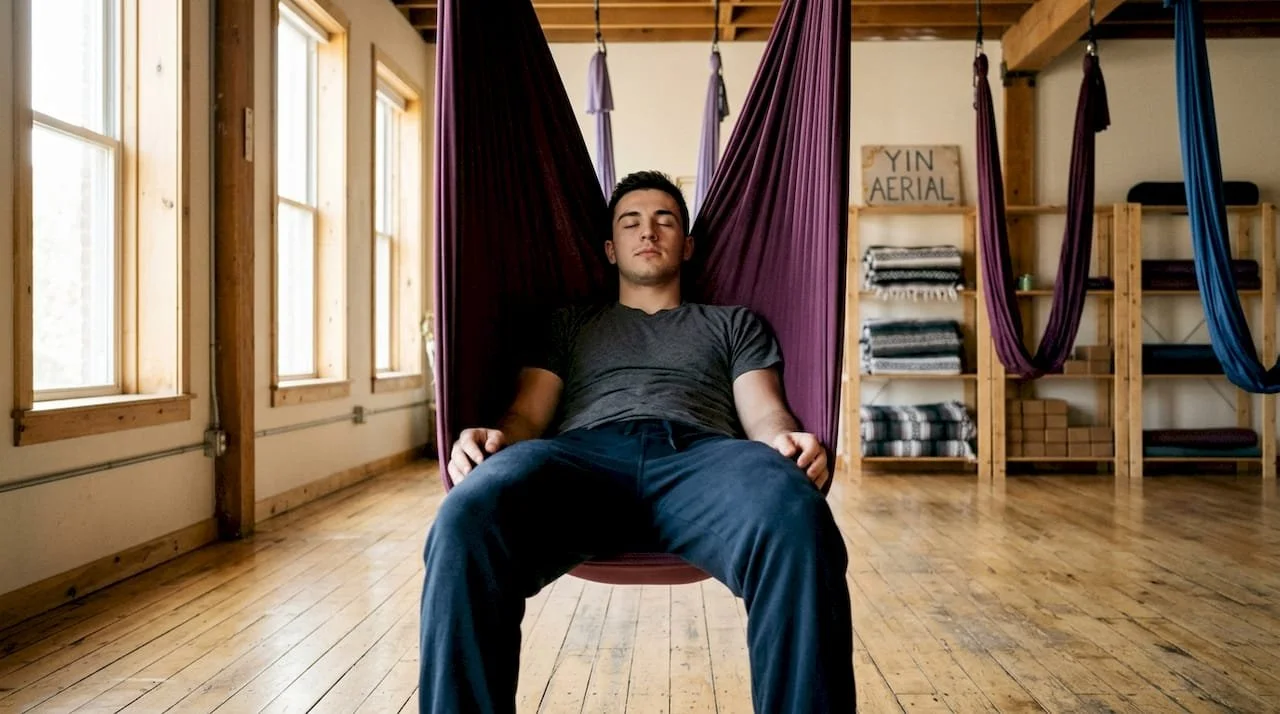
Yin aerial yoga takes the long holds and meditative focus of Yin practice and places them inside the hammock. Instead of flipping and flowing, you settle into supported shapes, letting gravity and the silk fabric do the work. The hammock becomes a cocoon rather than a trapeze.
Here is what makes this practice distinct:
Poses are held for extended periods, often three to six minutes
The hammock provides full-body support, reducing joint strain
Sessions emphasize breath, stillness, and nervous system regulation
No prior strength or flexibility is required to participate
The practice is deeply restorative, not cardio-based
"The hammock in Yin aerial yoga is not a prop for performance. It is a tool for surrender. That shift in mindset changes everything about how the practice feels."
For Philadelphia practitioners, this matters because the city's wellness scene is increasingly drawn to practices that address stress and burnout, not just physical fitness. Learning to work with breathing in aerial yoga is a core skill in Yin aerial sessions, and it carries over into everyday stress management in ways that a spin class simply cannot replicate.
Understanding what Yin aerial yoga is leads us into exploring the measurable advantages for your mental wellbeing, physical health, and local social connections.
Core benefits: mind, body, and community
The benefits of Yin aerial yoga are not just anecdotal. There is growing evidence behind both components of the practice, and the combination amplifies the results.
Mental health benefits
Anxiety is one of the most common reasons people explore yoga in the first place. Yin yoga reduces state and trait anxiety in measurable ways, with participants reporting significant relief even after a single session. State anxiety refers to how you feel right now, while trait anxiety describes your baseline stress level over time. Yin aerial yoga addresses both.
The hammock adds a sensory dimension to this. Being gently cradled and suspended activates the parasympathetic nervous system, the part of your body responsible for rest and recovery. Many practitioners describe a sensation similar to floating, which naturally quiets mental chatter.
Physical benefits
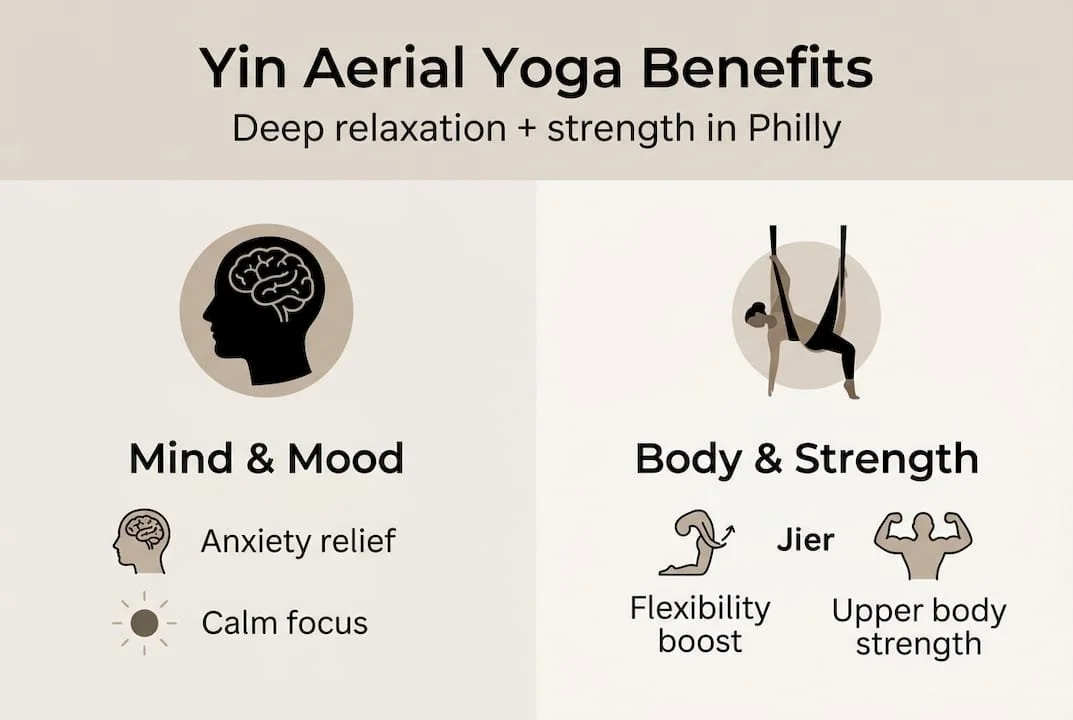
Here is a quick look at what the research and practitioner data show:
| Benefit | Outcome |
|---|---|
| Spinal flexibility | Up to 35% improvement |
| Upper-body strength | Up to 27% increase |
| State anxiety reduction | Significant post-session |
| Joint mobility | Improved through long holds |
| Posture | Enhanced spinal decompression |
Aerial yoga also improves upper-body strength by 27%, even in its more passive Yin form, because stabilizing your body in the hammock engages muscles you rarely use on the mat.
Community benefits
This is where Philadelphia's wellness culture becomes a real advantage. Group Yin aerial classes create a shared experience of vulnerability and trust. You are all doing something unfamiliar together, which builds connection faster than most gym environments.
Small class sizes mean instructors can personalize attention
Shared stillness creates a unique group atmosphere
Beginners feel welcome because no one is performing
Post-class conversations tend to be richer and more genuine
Before you sign up, it is worth reviewing aerial yoga safety tips so you walk in prepared and confident. Safety awareness is part of being a good community member in any studio setting.
To make informed choices, it helps to see how Yin aerial yoga stacks up against more energetic aerial practices.
Yin aerial yoga vs. traditional aerial yoga: what's different?
Not all aerial yoga is the same. The distinction matters when you are deciding which class fits your goals and your current fitness level.
| Feature | Traditional aerial yoga | Yin aerial yoga |
|---|---|---|
| Pace | Dynamic and flowing | Slow and held |
| Primary goal | Strength and flexibility | Deep release and calm |
| Energy demand | Moderate to high | Low |
| Ideal for | Active movers | Stress relief seekers |
| Accessibility | Intermediate friendly | Beginner friendly |
| Session feel | Energizing | Deeply restorative |
Aerial yoga is dynamic and strength-focused, while Yin aerial is passive and de-stressing. That is not a value judgment. Both serve real purposes. But if you are coming in after a stressful week, a dynamic aerial class may leave you more wired than when you arrived.
"Choosing between the two is less about fitness level and more about what your nervous system actually needs that day."
Here is a numbered breakdown of how to decide which style is right for you:
Assess your energy. If you feel depleted or anxious, choose Yin aerial. If you feel restless and need to move, traditional aerial may serve you better.
Consider your goals. Strength building and coordination favor traditional aerial. Stress relief, sleep improvement, and joint mobility favor Yin aerial.
Think about experience. Yin aerial yoga is genuinely beginner-friendly. Traditional aerial classes often assume some baseline fitness.
Listen to your body. Both practices require that you communicate with your instructor about any physical limitations.
Pro Tip: Always confirm that your studio uses certified aerial yoga equipment before your first class. Hammock quality and rigging standards vary, and this directly affects your safety and comfort.
For a deeper look at what distinguishes quality Yin aerial sessions, explore best aerial yoga practices to understand what to expect from a well-run class.
Now that you know the unique aspects of Yin aerial yoga, here is how to begin your journey safely and confidently in Philadelphia.
How to get started: Yin aerial yoga in Philadelphia
Starting something new can feel overwhelming, especially when it involves hanging from the ceiling. The good news is that Yin aerial yoga is one of the most accessible entry points into the aerial world.
Follow these steps to get started with confidence:
Research certified studios. Look for studios in Philadelphia that use professionally installed hammocks and certified instructors. The hammock adds accessibility and depth to your practice, but it absolutely requires certified equipment and proper safety protocols.
Check for beginner-specific classes. Many studios offer intro sessions designed specifically for first-timers. These classes move slower and give you time to get comfortable with the fabric.
Wear the right clothing. Fitted, full-length leggings and a long-sleeved top prevent fabric burn on bare skin. Avoid zippers or buttons that could snag the hammock.
Arrive early. Give yourself time to meet the instructor, ask questions, and get oriented to the space before class begins.
Communicate any health concerns. Certain conditions require modification or medical clearance. Review aerial yoga contraindications before your first session so you know what to discuss with your instructor.
Pro Tip: Bring a light snack to eat at least two hours before class. Practicing on a full stomach in an inverted position is uncomfortable and can disrupt your focus during those long, meditative holds.
Once you are in the studio, focus on breath and sensation rather than trying to do the pose perfectly. Yin aerial yoga rewards patience. The deeper releases often come in the final minute of a hold, not the first. For a thorough overview of what safe aerial yoga practice looks like from start to finish, take a few minutes to read up before you go.
Philadelphia has a growing network of wellness studios that take this practice seriously. Finding the right community makes all the difference in whether you stick with it.
Why Yin aerial yoga is transforming Philly's wellness scene
Here is something most fitness articles will not tell you: the real power of Yin aerial yoga is not in the poses. It is in the permission it gives you to slow down in a culture that rewards hustle.
Philadelphia is a city of doers. Traditional gyms thrive here because people want results they can measure. But burnout is also rising, and the demand for restorative, community-centered wellness is outpacing what most conventional fitness spaces can offer. Yin aerial yoga fills that gap in a way that a recovery app or a meditation subscription simply cannot.
What we see at studios like ours is that people come in for the flexibility benefits and stay for the community. The shared stillness of a Yin aerial class creates a kind of trust that is rare in group fitness. You are not competing. You are all just breathing and letting go together.
The Philly aerial yoga safety guide is a great starting point, but the deeper transformation happens when you show up consistently and let the practice work on you over time. That is what conventional fitness trends miss: the compounding value of a slow, intentional practice done in community.
Explore Yin aerial yoga with Amrita Yoga & Wellness
If you are ready to experience what Yin aerial yoga can do for your body and your stress levels, the next step is finding a studio where safety, community, and expertise come together.
Amrita Yoga & Wellness in Philadelphia offers certified aerial yoga classes designed for all levels, from complete beginners to seasoned practitioners. Our instructors prioritize your safety and comfort while guiding you into the deep, restorative holds that make this practice so effective. Whether you are drawn by the flexibility benefits, the anxiety relief, or simply the curiosity of trying something new, our community is here to support your journey. Explore our class schedule and take your first step toward a calmer, stronger, more connected version of yourself.
Frequently asked questions
Is Yin aerial yoga safe for beginners?
Yes, when practiced with certified equipment and trained instructors, Yin aerial yoga is one of the most beginner-friendly aerial practices available, requiring no prior strength or flexibility.
What physical benefits can I expect from Yin aerial yoga?
You can expect improved flexibility, joint mobility, and relaxation, with research showing spinal flexibility improves by up to 35% through consistent aerial yoga practice.
How does Yin aerial yoga reduce anxiety?
Scientific studies report significant reductions in both state and trait anxiety after Yin yoga sessions, and the hammock's sensory support deepens this calming effect by activating the parasympathetic nervous system.
Where can I find Yin aerial yoga classes in Philadelphia?
You can join community-oriented sessions at local studios such as Amrita Yoga & Wellness, which offers certified instructors, safe hammock setups, and welcoming classes for all experience levels.
Recommended
Diverse yoga practices for wellness in Philadelphia 2026 — Amrita Yoga & Wellness
Understanding Aerial Yoga vs Traditional Yoga: Explained — Amrita Yoga & Wellness
"Choosing between the two is less about fitness level and more about what your nervous system actually needs that day."
Here is a numbered breakdown of how to decide which style is right for you:
Assess your energy. If you feel depleted or anxious, choose Yin aerial. If you feel restless and need to move, traditional aerial may serve you better.
Consider your goals. Strength building and coordination favor traditional aerial. Stress relief, sleep improvement, and joint mobility favor Yin aerial.
Think about experience. Yin aerial yoga is genuinely beginner-friendly. Traditional aerial classes often assume some baseline fitness.
Listen to your body. Both practices require that you communicate with your instructor about any physical limitations.
Pro Tip: Always confirm that your studio uses certified aerial yoga equipment before your first class. Hammock quality and rigging standards vary, and this directly affects your safety and comfort.
For a deeper look at what distinguishes quality Yin aerial sessions, explore best aerial yoga practices to understand what to expect from a well-run class.
Now that you know the unique aspects of Yin aerial yoga, here is how to begin your journey safely and confidently in Philadelphia.
How to get started: Yin aerial yoga in Philadelphia
Starting something new can feel overwhelming, especially when it involves hanging from the ceiling. The good news is that Yin aerial yoga is one of the most accessible entry points into the aerial world.
Follow these steps to get started with confidence:
Research certified studios. Look for studios in Philadelphia that use professionally installed hammocks and certified instructors. The hammock adds accessibility and depth to your practice, but it absolutely requires certified equipment and proper safety protocols.
Check for beginner-specific classes. Many studios offer intro sessions designed specifically for first-timers. These classes move slower and give you time to get comfortable with the fabric.
Wear the right clothing. Fitted, full-length leggings and a long-sleeved top prevent fabric burn on bare skin. Avoid zippers or buttons that could snag the hammock.
Arrive early. Give yourself time to meet the instructor, ask questions, and get oriented to the space before class begins.
Communicate any health concerns. Certain conditions require modification or medical clearance. Review aerial yoga contraindications before your first session so you know what to discuss with your instructor.
Pro Tip: Bring a light snack to eat at least two hours before class. Practicing on a full stomach in an inverted position is uncomfortable and can disrupt your focus during those long, meditative holds.
Once you are in the studio, focus on breath and sensation rather than trying to do the pose perfectly. Yin aerial yoga rewards patience. The deeper releases often come in the final minute of a hold, not the first. For a thorough overview of what safe aerial yoga practice looks like from start to finish, take a few minutes to read up before you go.
Philadelphia has a growing network of wellness studios that take this practice seriously. Finding the right community makes all the difference in whether you stick with it.
Why Yin aerial yoga is transforming Philly's wellness scene
Here is something most fitness articles will not tell you: the real power of Yin aerial yoga is not in the poses. It is in the permission it gives you to slow down in a culture that rewards hustle.
Philadelphia is a city of doers. Traditional gyms thrive here because people want results they can measure. But burnout is also rising, and the demand for restorative, community-centered wellness is outpacing what most conventional fitness spaces can offer. Yin aerial yoga fills that gap in a way that a recovery app or a meditation subscription simply cannot.
What we see at studios like ours is that people come in for the flexibility benefits and stay for the community. The shared stillness of a Yin aerial class creates a kind of trust that is rare in group fitness. You are not competing. You are all just breathing and letting go together.
The Philly aerial yoga safety guide is a great starting point, but the deeper transformation happens when you show up consistently and let the practice work on you over time. That is what conventional fitness trends miss: the compounding value of a slow, intentional practice done in community.
Explore Yin aerial yoga with Amrita Yoga & Wellness
If you are ready to experience what Yin aerial yoga can do for your body and your stress levels, the next step is finding a studio where safety, community, and expertise come together.
Why Practice Yin Yoga: Deep Release and Balance
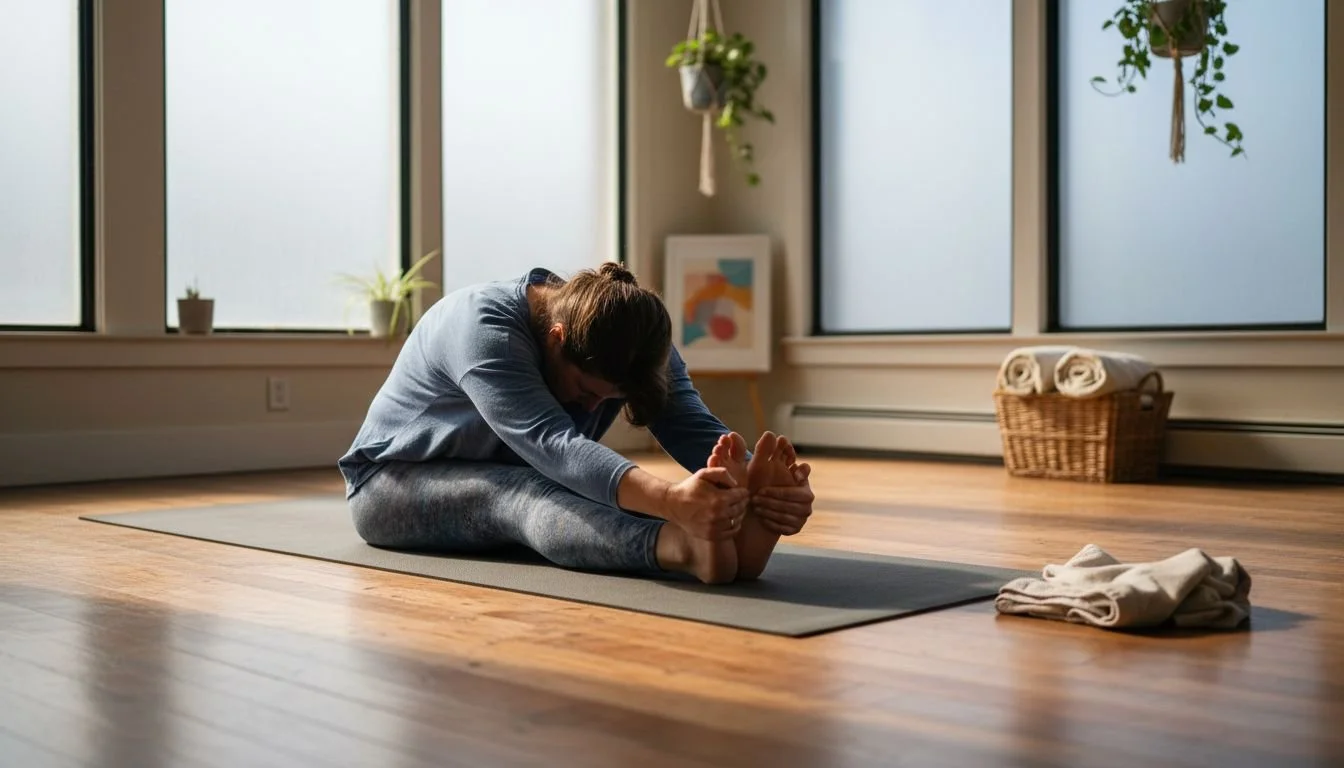
Most American yoga enthusiasts are surprised to learn that Yin Yoga challenges the body and mind in profound ways, despite its calm appearance. While active yoga styles stay popular, more people are discovering that holding stillness in Yin Yoga requires both endurance and resilience. This unique practice targets deep connective tissues, busting the myth that it is simply restful stretching. Discover how Yin Yoga delivers powerful benefits far beyond what many expect.
Table of Contents
Key Takeaways
| Point | Details |
|---|---|
| Core Concept of Yin Yoga | Yin Yoga emphasizes passive postures held for extended periods, targeting deep connective tissues and promoting holistic healing. |
| Misconceptions | Common myths suggest Yin Yoga is only for flexible individuals or lacks physical benefits; in reality, it enhances mobility and is accessible for all flexibility levels. |
| Mindfulness and Emotional Benefits | The practice fosters mindfulness, emotional regulation, and stress reduction, helping practitioners cultivate deeper self-awareness. |
| Integration into Routine | Yin Yoga complements active lifestyles by promoting recovery and relaxation; aim for one to two sessions weekly, especially on rest days. |
What Yin Yoga Involves and Common Myths
Yin Yoga represents a profoundly transformative style of yoga that differs dramatically from more active practices. Unlike dynamic yoga styles, Yin Yoga emphasizes holding gentle postures for extended periods, typically three to five minutes, targeting deep connective tissues like ligaments, joints, and fascia. Exploring the traditional principles reveals this practice’s roots in traditional Chinese medicine and its holistic approach to physical and energetic healing.
The primary misconception about Yin Yoga is that it’s an easy or passive practice. Practitioners quickly discover that maintaining stillness requires significant mental discipline and physical endurance. While poses might appear simple, the extended hold times challenge practitioners to remain present, breathe deeply, and observe internal sensations without judgment. This meditative aspect distinguishes Yin Yoga from more muscular yoga styles, making it an introspective journey of body and mind awareness.
Some common myths about Yin Yoga include beliefs that it’s only for flexible people or provides minimal physical benefits. In reality, this practice offers profound advantages for practitioners of all flexibility levels. The sustained stretches gradually increase range of motion, improve joint mobility, and release deeply stored tension. By targeting the body’s connective tissues, Yin Yoga supports healing, reduces stiffness, and promotes long-term structural resilience. Whether you’re an athlete seeking recovery, a desk worker managing chronic tension, or someone exploring mindful movement, Yin Yoga offers a powerful pathway to holistic well-being.
Core Benefits for Body and Mind
Yin Yoga offers a profound approach to wellness that transcends traditional physical exercise, delivering comprehensive benefits for both body and mind. Exploring holistic wellness practices reveals how this gentle yet powerful practice systematically addresses physical tension and mental stress through intentional, sustained movements.
Physically, Yin Yoga provides remarkable advantages for practitioners seeking improved mobility and structural resilience. The prolonged, passive stretches target deep connective tissues, ligaments, and fascia, which are often overlooked in more dynamic movement practices. By holding poses for extended periods, practitioners gradually increase joint flexibility, enhance circulation, and release deeply stored muscular tension. Athletes, desk workers, and individuals managing chronic stiffness can particularly benefit from these targeted, therapeutic movements.
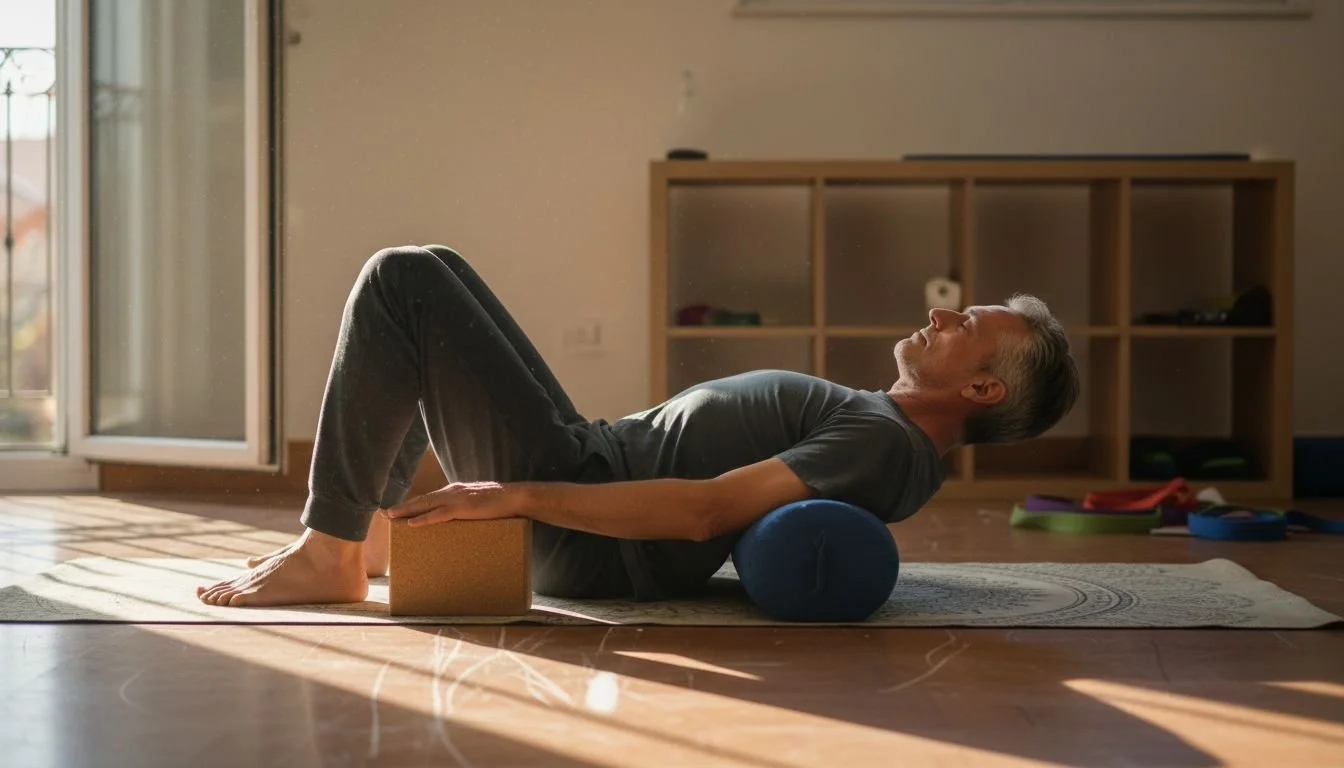
Mentally, Yin Yoga serves as a transformative practice for emotional regulation and mindfulness. The meditative nature of sustained postures encourages practitioners to cultivate present-moment awareness, observe internal sensations without judgment, and develop profound mental stillness. This introspective approach helps reduce stress, manage anxiety, and create a sense of internal calm that extends far beyond the yoga mat. Regular practitioners often report improved emotional intelligence, enhanced self-awareness, and a more balanced approach to handling life’s challenges. Whether you’re seeking physical restoration or mental rejuvenation, Yin Yoga offers a holistic pathway to comprehensive personal wellness.
How Yin Yoga Differs from Other Styles
Yin Yoga represents a distinctive approach to movement that stands in stark contrast to more traditional, dynamic yoga practices. Exploring yoga’s unique methodologies reveals that while styles like Vinyasa or Power Yoga emphasize muscular engagement and continuous flow, Yin Yoga takes a dramatically different path. The fundamental difference lies in the practice’s intentional stillness, where practitioners hold passive poses for extended periods, typically three to five minutes, creating a meditative and deeply introspective experience.
Unlike the muscular, strength-based approaches of Yang-style yoga practices, Yin Yoga targets the body’s deeper connective tissues, including ligaments, joints, and fascia. Where other yoga styles focus on building muscle strength and cardiovascular endurance, Yin Yoga prioritizes gentle, sustained stress on connective tissues to improve flexibility and joint mobility. This approach requires practitioners to surrender to the pose, releasing muscular effort and allowing gravity to create gentle, prolonged stretch, which differs significantly from the active, dynamic movements of styles like Ashtanga or Bikram Yoga.
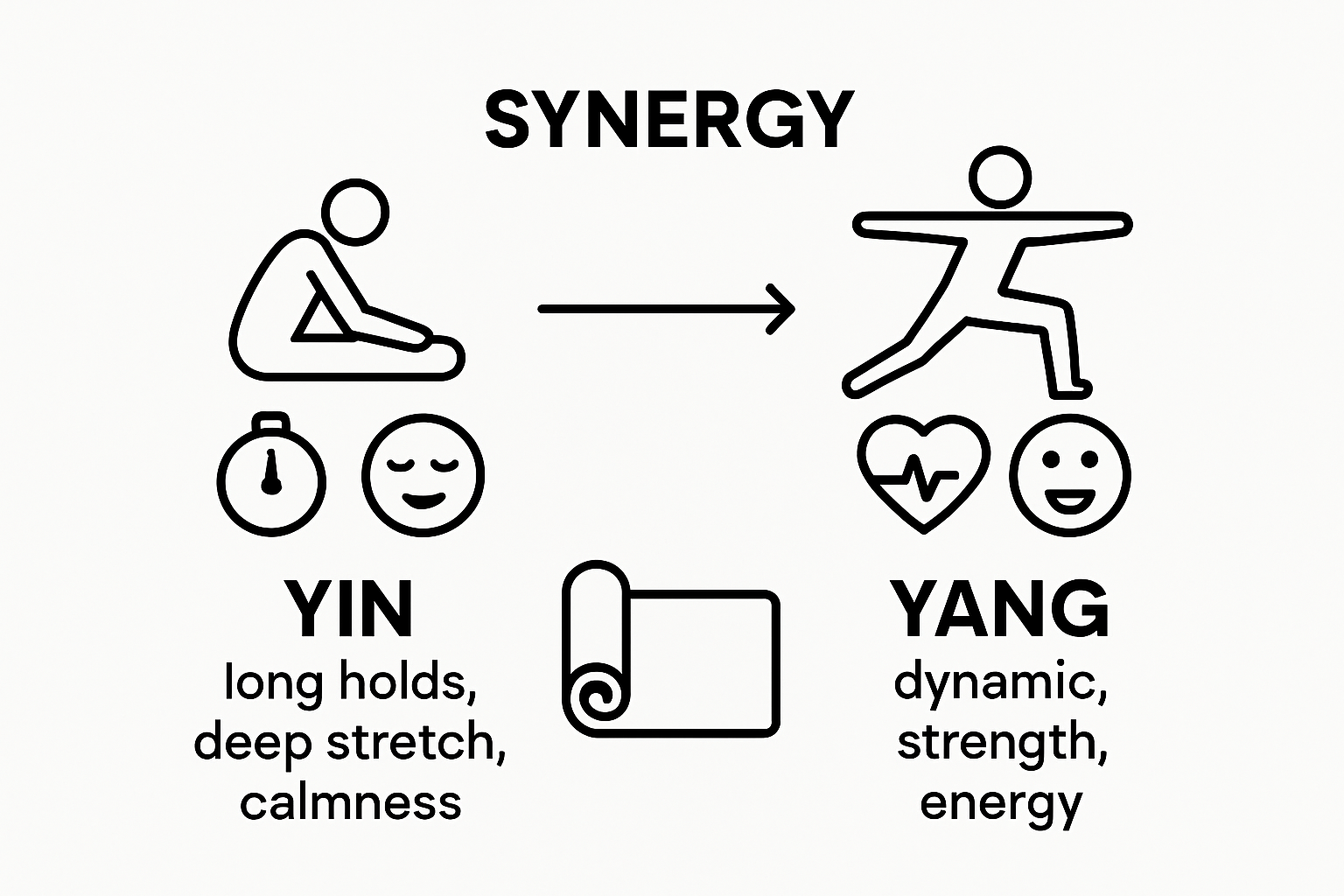
The philosophical and energetic distinctions are equally profound. While most yoga styles emphasize external movement and physical performance, Yin Yoga invites practitioners into a contemplative inner landscape. The practice draws inspiration from traditional Chinese medicine’s concept of energy meridians, focusing on releasing blockages and promoting balanced energy flow. This makes Yin Yoga less about athletic performance and more about creating space, cultivating mindfulness, and developing a deeper understanding of one’s internal landscape. For practitioners seeking a transformative approach that goes beyond physical exercise, Yin Yoga offers a unique pathway to holistic well-being, challenging conventional notions of what yoga can be.
Practical Tips for Safe Yin Practice
Practicing Yin Yoga safely requires a nuanced approach that prioritizes body awareness and mindful progression. Developing a mindful home practice begins with creating a comfortable environment that supports deep relaxation and introspective movement. This means selecting a quiet space, using supportive props like blocks, bolsters, and blankets, and wearing loose, comfortable clothing that allows unrestricted movement and helps you stay present during extended pose holds.
Body awareness becomes crucial in Yin Yoga, where the primary goal is not achieving a perfect pose but understanding your individual physical limits. Unlike more dynamic yoga styles, Yin practitioners must learn to distinguish between beneficial sensation and potential injury. This means avoiding sharp or intense pain, respecting your body’s natural edge, and using props to modify poses. Practitioners should approach each pose with curiosity, not competition, allowing gravity and time to gently stretch connective tissues while maintaining a sense of softness and surrender.
Practical safety strategies include starting with shorter hold times and gradually increasing duration, typically beginning with one to two minutes and progressively working toward three to five minutes as your body adapts. Always warm up gently before practice, stay hydrated, and listen closely to your body’s signals. For individuals with existing injuries or health conditions, consulting a qualified yoga instructor or healthcare professional before beginning a Yin Yoga practice is essential. Remember that each body is unique, and what works for one practitioner might not work identically for another. The most important aspect of a safe Yin Yoga practice is maintaining a compassionate, non-judgmental approach to your own physical and emotional experience.
Integrating Yin Yoga Into Your Routine
Effectively incorporating Yin Yoga into your existing wellness routine requires thoughtful planning and a strategic approach that respects your current lifestyle and fitness goals. Unlocking transformative wellness practices begins with understanding how this gentle yet powerful practice can complement your existing physical activities. For individuals with active lifestyles involving high-intensity workouts or strength training, Yin Yoga serves as an ideal counterbalance, providing deep muscular recovery, enhanced flexibility, and mental restoration.
Practical integration strategies involve scheduling Yin Yoga sessions strategically throughout your week. Many practitioners find success by dedicating one to two sessions weekly, typically on recovery days or after intense physical training. These sessions can range from 45 to 90 minutes and work best when performed in a quiet, comfortable space with minimal distractions. Props like bolsters, blocks, and blankets can help create a supportive environment that encourages deep relaxation and sustained pose holds.
The key to successful integration lies in approaching Yin Yoga as a complementary practice rather than a replacement for other forms of exercise. Athletes, runners, weightlifters, and professionals with sedentary jobs can all benefit from this practice’s unique approach to physical and mental wellness. Start with shorter sessions, perhaps 30 minutes, and gradually increase duration as you become more comfortable with the practice. Listen to your body, remain patient with your progress, and view Yin Yoga as a holistic tool for physical recovery, stress reduction, and mental clarity. By maintaining a consistent, mindful approach, you’ll discover how this practice can profoundly enhance your overall well-being and provide a necessary counterpoint to life’s constant motion and demands.
Find Deep Release and Balance with Yin Yoga at Amrita Yoga & Wellness
If you are seeking profound physical relief from tension or a mindful way to cultivate emotional calm the transformative practice of Yin Yoga offers exactly what you need. This style focuses on long holds in gentle postures targeting connective tissues to improve flexibility and joint mobility while inviting mental stillness and emotional balance. Many struggle to find this mindful moment in busy lives but at Amrita Yoga & Wellness you can explore Yin Yoga in a supportive, inclusive setting designed to encourage gradual progression and safe practice.
Experience the unique benefits described in “Why Practice Yin Yoga: Deep Release and Balance” by joining one of our expert-led Yin Yoga classes or workshops. Start your journey toward reduced stiffness, enhanced recovery, and profound mental clarity. Visit Amrita Yoga & Wellness to browse our full schedule and sign up today. Take that first mindful step and bring harmony to your body and mind now with our accessible yoga offerings and personalized guidance.
Frequently Asked Questions
What is Yin Yoga?
Yin Yoga is a slow, meditative style of yoga that involves holding gentle postures for an extended period, typically three to five minutes. It focuses on stretching and targeting deep connective tissues like ligaments, joints, and fascia.
How does Yin Yoga differ from other types of yoga?
Unlike dynamic styles like Vinyasa or Power Yoga that emphasize muscular engagement and flow, Yin Yoga prioritizes stillness and gentle stress on connective tissues to improve flexibility and joint mobility, offering a more introspective and meditative experience.
What are the benefits of practicing Yin Yoga?
Yin Yoga delivers several benefits, including improved joint flexibility, enhanced circulation, and the release of deeply stored tension. It also supports emotional regulation and mindfulness, helping to reduce stress and promote a sense of internal calm.
How can I incorporate Yin Yoga into my fitness routine?
To integrate Yin Yoga, schedule one to two sessions per week, ideally on recovery days. Start with sessions lasting 30 to 90 minutes, using props for support, and view it as a complementary practice to other forms of exercise for optimal balance and recovery.