Aerial Yoga Weight Loss: Does It Actually Work?

TL;DR:
Aerial yoga promotes weight loss through muscle engagement, calorie burn, and stress reduction, supporting a sustained caloric deficit. Practicing three to five times weekly at moderate intensity yields better results than sporadic high-intensity sessions, especially with equipment that supports heavier individuals. While limited specific research exists, broader yoga evidence indicates improvements in self-regulation, fat reduction, and flexibility, making aerial yoga a sustainable complement to a comprehensive weight management plan.
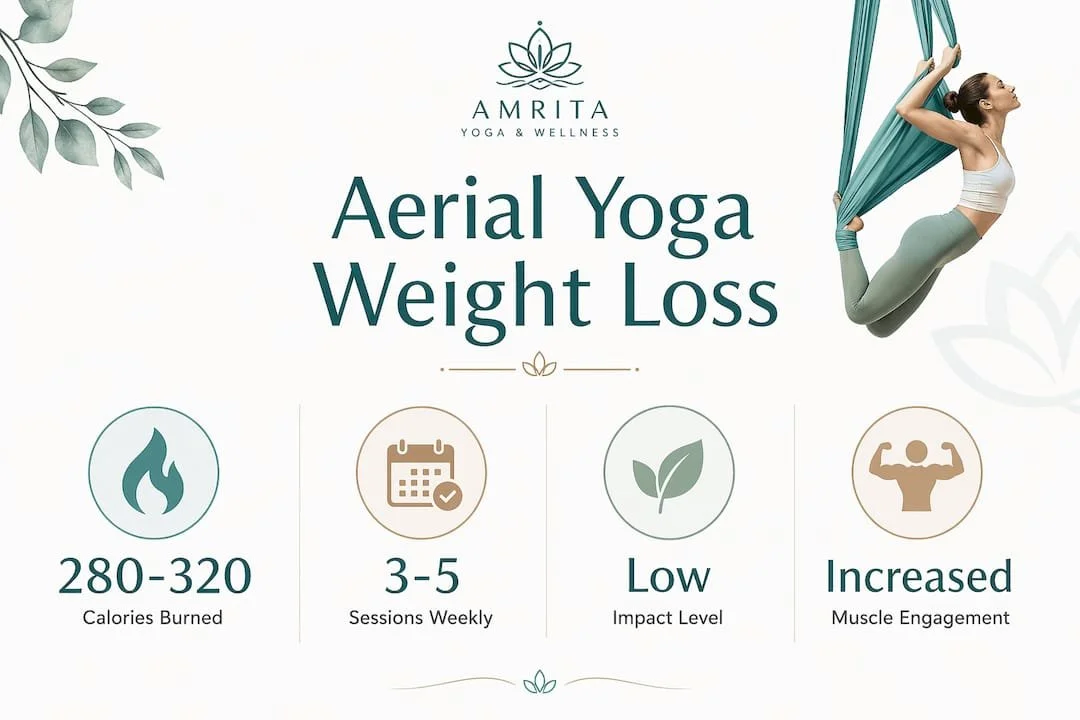
Aerial yoga weight loss is achieved through a combination of bodyweight resistance, dynamic movement, and stress reduction that collectively support a sustained caloric deficit. A single aerial yoga session burns approximately 320 calories in 50 minutes, with estimates ranging from 200 to 400 calories depending on body weight and intensity. Beyond the calorie math, aerial yoga builds core strength, improves flexibility, and reduces cortisol levels, all of which contribute indirectly to fat loss. For anyone searching for aerial yoga classes near me or exploring low-impact weight loss workouts, this practice offers a genuinely different entry point into consistent physical activity.
How does aerial yoga promote weight loss compared to other exercises?
Aerial yoga for weight loss works through three overlapping mechanisms: caloric expenditure, muscle engagement, and behavioral adherence. The hammock forces your stabilizer muscles to fire constantly, even during poses that look passive from the outside. That sustained muscle activation adds up across a session in ways that traditional mat yoga does not replicate.
Calorie burn in context
The 200 to 400 calorie range per session places aerial yoga above gentle yoga and comparable to brisk walking at roughly 3.5 mph. A 150-pound person walking briskly for 50 minutes burns around 230 calories. The same person in an aerial yoga class burns closer to 280 to 320 calories, with heavier participants burning more. This difference matters when you are building a weekly activity plan.

| Activity (50 minutes) | Estimated calories burned | Impact level |
|---|---|---|
| Aerial yoga | 280–320 | Low |
| Brisk walking | 220–250 | Low |
| Traditional yoga (vinyasa) | 200–280 | Low |
| Cycling (moderate) | 350–450 | Low to moderate |
| Running (6 mph) | 500–600 | High |
Aerial yoga sits in a practical middle ground. It burns more than seated or restorative yoga while placing far less stress on joints than running or high-intensity interval training.
Why frequency beats intensity
Total weekly movement volumematters more for weight loss than how hard you push in any single class. Practicing three to four times per week at moderate intensity produces better fat loss outcomes than one intense session followed by days of soreness and rest. The hammock actually helps here. Supported movement allows you to complete more repetitions with better form, which increases total weekly calorie output without the injury risk that derails many exercise programs.
Pro Tip: Track your weekly session count before worrying about class intensity. Three consistent moderate sessions beat one brutal class followed by a week off every time.
Calorie estimates should guide your planning, but consistent caloric deficit over time is what produces measurable weight loss. Aerial yoga contributes to that deficit. It does not replace it.
What are the benefits of aerial yoga for beginners and heavier individuals?
Aerial yoga for beginners carries one significant structural advantage over most gym-based workouts: the equipment is designed to support you, not challenge your baseline fitness before you have built any. That changes the psychological and physical experience of starting an exercise program entirely.
Equipment safety and inclusivity
Aerial yoga hammocks support 300 to 1,000 poundswhen properly rigged, making the practice genuinely accessible for individuals with higher body weight. This is not a marketing claim. It reflects the load-bearing engineering of professional aerial rigging hardware. The practical implication is that body weight alone does not disqualify anyone from starting.
Key benefits specific to beginners and heavier participants include:
Reduced joint stress. The hammock decompresses the spine and offloads pressure from knees and hips, allowing longer practice sessions without the joint fatigue common in floor-based workouts.
Supported inversions. Full inversions like aerial downward dog or supported shoulder stand become accessible to beginners because the hammock controls the descent and provides a recovery point.
Higher rep tolerance. Hammock support enables more repetitions per session, which directly increases calorie burn and muscle engagement without requiring advanced fitness.
Psychological confidence. Completing poses that feel impossible on a mat builds genuine exercise confidence, which research consistently links to long-term program adherence.
Condition-specific modifications. Instructors trained in aerial yoga can modify poses for participants with back pain, shoulder issues, or limited mobility, making the practice safer than many assume.
Pro Tip: Tell your instructor about any joint or back issues before your first class. A qualified aerial yoga teacher will modify your session so you build strength safely rather than compensating with poor form.
Starting with beginner-focused decompression poses rather than advanced inversions reduces overwhelm and builds the body awareness needed for more demanding sequences later. Adherence is the variable that determines weight loss outcomes over months, and comfort in early classes directly predicts whether someone returns.
What does the science say about aerial yoga and fat loss?
The honest answer is that aerial yoga-specific research is still limited. No randomized controlled trial has conclusively proved that aerial yoga alone causes clinically meaningful weight loss. The JMIR PATH Trial is currently testing virtual Iyengar yoga combined with a weight-loss treatment program over 12 months, with assessments extending to 18 months. Results from that trial will add important data to this field.
What broader yoga research shows
The existing evidence on yoga and weight management points to behavioral mechanisms rather than direct fat targeting. Yoga improves self-regulation and reduces behavioral lapses, which are the two factors most predictive of long-term weight loss success. In practical terms, people who practice yoga consistently are better at sticking to nutrition plans and returning to exercise after setbacks.
| Study focus | Finding | Implication for aerial yoga |
|---|---|---|
| Restorative yoga vs. stretching (48 weeks) | Yoga group lost 1.7 kg with significant subcutaneous fat reduction | Even low-intensity yoga produces measurable fat loss over time |
| Yoga and behavioral adherence | Yoga improves self-regulation and reduces program dropout | Aerial yoga’s enjoyment factor enhances long-term consistency |
| Flexibility and stress reduction | Hamstring flexibility improved 18% after 12 weeks of aerial yoga | Reduced physical discomfort supports higher weekly activity volume |
Restorative yoga produced greater subcutaneous fat reduction than stretching alone in overweight women over 48 weeks, with the yoga group losing approximately 1.7 kg by the end of the study. That is modest but sustained, and it came from a practice far less physically demanding than aerial yoga. The implication is clear: the wellness benefits of aerial yoga extend well beyond what a single calorie-burn number captures.
One claim worth addressing directly: the idea that inversions “detoxify” the body lacks strong scientific support. The plausible benefits of inversion poses are spinal decompression and psychological relief, both of which are genuinely valuable for weight management without requiring unsubstantiated detox claims.
Which aerial yoga poses and routines best support weight loss?
Effective aerial yoga routines for weight loss prioritize multi-muscle engagement over single-joint isolation. The poses that deliver the most calorie burn and toning benefit are those that require you to stabilize your entire body against the hammock's movement.
High-value poses for calorie burn and toning
The following poses consistently appear in weight loss-focused aerial yoga programs because they engage the core, glutes, and upper body simultaneously:
Suspended plank. Feet in the hammock, hands on the floor. This variation increases core activation compared to a standard plank because the hammock introduces instability.
Aerial warrior sequences. Standing poses with one leg supported in the hammock challenge balance and engage the hip stabilizers more deeply than floor versions.
Inverted core work. Hanging in a partial inversion while performing controlled crunches targets the deep abdominal muscles that mat crunches rarely reach.
Aerial backbends. Supported by the hammock at the hips, backbends open the chest and hip flexors while requiring sustained spinal erector engagement.
Building a weekly routine
A practical weight loss-focused aerial yoga schedule looks like this:
Sessions 1 and 2 (beginner focus). Decompression poses, basic hammock orientation, and supported standing sequences. Duration: 45 to 60 minutes.
Session 3 (strength focus). Suspended plank variations, aerial warrior sequences, and core work. Duration: 60 minutes.
Sessions 4 and 5 (progressive intensity). Add inversions and flowing sequences that connect poses without rest. Duration: 60 to 75 minutes.
Practicing three to five times per week produces the weekly movement volume needed to support a consistent caloric deficit. Progress through skill mastery rather than forcing harder poses before you are ready. The real impact on wellness accumulates through months of consistent practice, not through any single challenging session.
Key takeaways
Aerial yoga supports weight loss most effectively when practiced consistently, combined with sound nutrition, and approached with progressive skill development rather than intensity-chasing.
| Point | Details |
|---|---|
| Calorie burn per session | Aerial yoga burns 200 to 400 calories per session, comparable to brisk walking and above traditional mat yoga. |
| Frequency over intensity | Practicing three to five times per week produces better fat loss outcomes than sporadic high-intensity sessions. |
| Inclusive equipment | Hammocks rated for 300 to 1,000 pounds make aerial yoga accessible for heavier individuals with proper rigging and supervision. |
| Behavioral adherence | Yoga’s primary weight loss mechanism is improving self-regulation and reducing program dropout, not direct fat targeting. |
| Evidence gaps | No RCT has yet proved aerial yoga alone causes significant weight loss; broader yoga research supports its role in a complete program. |
Why aerial yoga changed how I think about weight loss exercise
Most weight loss advice treats exercise as a calorie-burning transaction. Burn more than you eat, and the math works out. That framing is technically correct and practically useless for most people, because it ignores the reason people quit: exercise they hate does not get repeated.
Aerial yoga breaks that pattern in a way I have not seen replicated by treadmills or group fitness classes. The hammock removes the floor, and with it, the psychological weight of "I am not fit enough for this." People who have avoided exercise for years will attempt an aerial inversion on their first class because the hammock makes it feel safe. That first success matters more than the 320 calories burned.
The mistake I see most often is treating aerial yoga as a standalone solution. Combine it with nutrition awareness and at least one other weekly activity, whether that is walking, swimming, or cycling, and the results compound. Aerial yoga handles the adherence problem. You still need to handle the calorie equation.
One practical caution: verify your instructor's qualifications before committing to a studio. Rigging quality and condition-specific pose modifications are not optional safety considerations. They are the difference between a practice that builds your body and one that injures it. Check that your studio uses certified rigging hardware and that instructors have completed formal aerial yoga teacher training.
The aerial yoga for wellness community in Philadelphia has shown me that the people who succeed long-term are not the ones who push hardest in class. They are the ones who show up consistently, enjoy the process, and treat the hammock as a tool rather than a performance stage.
— Juiced
Start your aerial yoga journey with Amritayogawellness
Amritayogawellness offers structured aerial yoga classes in Philadelphia designed for every level, from complete beginners to practitioners ready to advance their inversion practice. The studio's instructors prioritize safety, proper rigging, and pose modifications that make aerial yoga accessible regardless of your current fitness level or body weight.

Whether you are stepping onto a hammock for the first time or looking to build a consistent weight loss-focused practice, Amritayogawellness provides the guided environment that turns a single class into a sustainable routine. The studio also offers holistic wellness services that complement your physical practice and support the mental clarity that long-term weight management requires. Visit Amritayogawellness to explore class schedules and book your first session.
FAQ
How many calories does aerial yoga burn per session?
Aerial yoga burns approximately 200 to 400 calories per 50-minute session, with ACE reporting around 320 calories as a common estimate. Actual burn varies based on body weight, session intensity, and individual fitness level.
Can aerial yoga help lose weight without dieting?
Aerial yoga contributes to a caloric deficit but works best alongside a balanced nutrition plan. Exercise alone rarely produces significant weight loss without dietary awareness supporting the overall calorie equation.
Is aerial yoga safe for beginners with no fitness background?
Yes. Aerial yoga hammocks are engineered to support 300 to 1,000 pounds with proper rigging, and beginner classes focus on decompression and supported poses that require no prior fitness level. Instructor supervision and appropriate modifications make it one of the more accessible entry points into structured exercise.
How often should I practice aerial yoga for weight loss?
Practicing three to five times per week produces the weekly movement volume needed to support consistent fat loss. Total weekly session frequency matters more than the intensity of any individual class.
Does aerial yoga tone muscles as well as burn calories?
Aerial yoga engages core, glute, and upper body stabilizer muscles throughout every session because the hammock introduces constant instability. Suspended plank variations and aerial warrior sequences in particular produce measurable muscle toning alongside calorie expenditure.