Bikram Yoga: Is It Good for You?
TL;DR:
Bikram yoga is a standardized hot yoga practice involving 26 postures in a 105°F, 40% humidity room, promoting flexibility, strength, and mental resilience. Research shows it effectively reduces fat, improves balance, and enhances psychological toughness, but it is not a substitute for cardio workouts. Safety considerations include medical clearance for those with health issues, and gradual acclimation is essential for beginners.
Bikram yoga is a structured hot yoga practice consisting of 26 specific postures performed in a 105°F room at 40% humidity over 90 minutes, designed to improve flexibility, strength, metabolic health, and mental resilience. If you're asking whether bikram yoga is it good for you, the short answer is yes, with important conditions. Research confirms measurable benefits in fat reduction, balance, and psychological resilience. But it is not a cardio replacement, and the heat demands respect. This article gives you the evidence, the comparisons, and the practical guidance to decide if Bikram belongs in your fitness life.
What is Bikram yoga and how is it practiced?
Bikram yoga is a fixed-sequence style of hot yoga developed by Bikram Choudhury, standardized globally so every class follows the same structure regardless of location. The format never changes: 26 postures and 2 breathing exercises, performed in the same order, every single session. That predictability is a feature, not a limitation. It means you can track your progress with precision across weeks and months.
The environment is the defining variable. The room is held at 105°F with 40% humidity, which raises your core temperature, increases muscle elasticity, and amplifies perceived exertion. Your heart rate will climb into the 60 to 70% range of your age-predicted maximum, which qualifies as moderate aerobic activity. You will sweat heavily, which makes hydration before and during class non-negotiable.
The 90-minute class length surprises most beginners. Unlike a typical gym session where you control the pace, Bikram classes move on the instructor's cues. You hold poses for specific durations, rest briefly between sets, and repeat each posture twice. The physical demands include spinal compression, hip opening, shoulder mobility work, and standing balance challenges, all layered under heat stress.
The 26 postures include standing series (Half Moon, Eagle, Standing Bow) and floor series (Cobra, Locust, Full Locust, Bow)
Two pranayama breathing exercises open and close the class
Classes are taught verbatim from a standardized dialogue, ensuring consistency
Mirrors line the walls to support alignment self-correction
Pro Tip: Arrive 15 minutes early for your first class. Sitting in the heated room before the session starts lets your body begin acclimating, which significantly reduces the shock of the first 20 minutes.
What does the science say about Bikram yoga's health benefits?
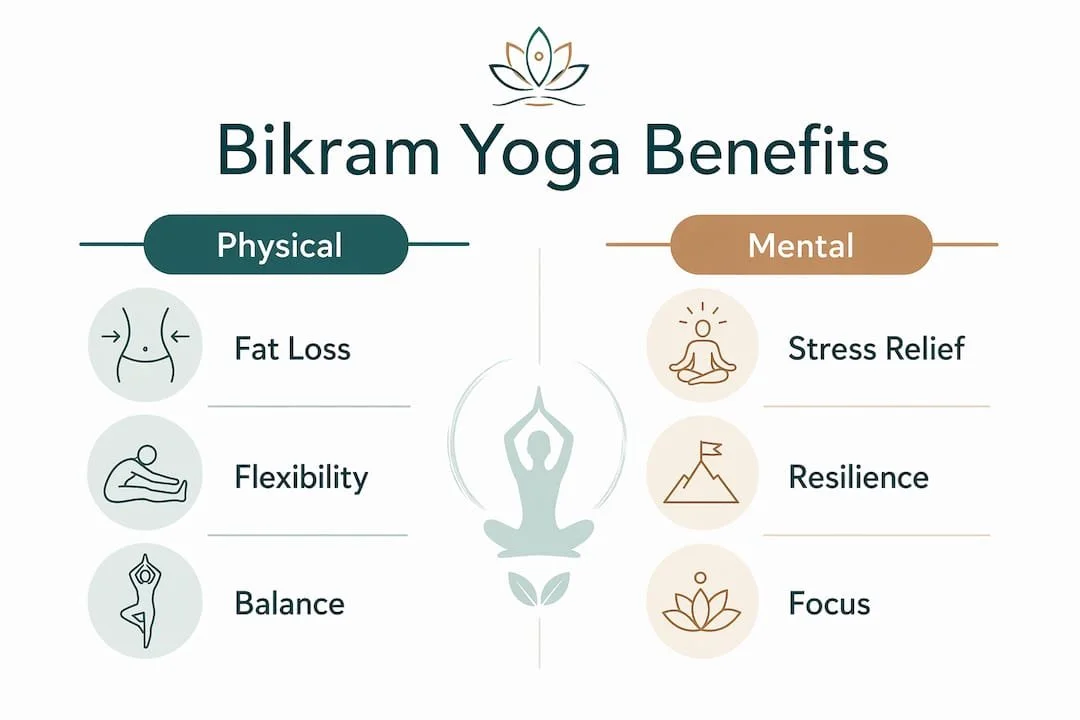
Bikram yoga delivers measurable metabolic improvements that go beyond what most people expect from a yoga class. A longitudinal study found an average fat mass reduction of 6.17% over six months of regular practice. That figure exceeds the 5% clinical threshold considered meaningful for metabolic health improvement, which means Bikram yoga produces outcomes comparable to structured weight loss interventions.

Flexibility and strength gains are well-documented. Research on sedentary adults practicing Bikram over eight weeks showed improvements in spinal, hip, and shoulder flexibility, along with measurable strength and balance gains. For older adults specifically, the balance improvements translate directly to reduced fall risk, which is a clinically significant outcome for functional longevity.
Calorie burn is moderate, not dramatic. A 90-minute session burns approximately 330 to 460 calories depending on body weight. That is comparable to a brisk walk or light cycling session, not a high-intensity interval training workout. The heat makes it feel more intense than it is metabolically, which is a critical distinction.
"Perceived workout intensity is amplified by heat-induced metabolic and inflammatory responses but does not equate to chronic fitness improvements alone." — Houston Methodist Research
The mental health case for Bikram yoga is genuinely compelling. The combination of heat stress and fixed sequence creates what researchers describe as a stress-inoculation effect, building psychological resilience, patience, and determination over time. Practitioners consistently report reduced anxiety, improved focus, and greater emotional regulation after regular practice. These gains stem from adapting to controlled discomfort repeatedly, not from relaxation alone.
| Health Benefit | Evidence Level | Notes |
|---|---|---|
| Fat mass reduction | Strong (6.17% over 6 months) | Exceeds 5% clinical threshold |
| Flexibility and balance | Strong (8-week studies) | Spinal, hip, shoulder improvements |
| Cardiovascular fitness | Moderate (limited aerobic gains) | Not a cardio substitute |
| Mental resilience | Supported by research | Stress-inoculation mechanism |
| Calorie burn | Moderate (330–460 per session) | Comparable to brisk walking |
Bikram yoga also shows promise for type 2 diabetes management. The combined effect of aerobic stimulus, flexibility training, and stress reduction creates a multi-mechanism benefit that no single component produces alone. This makes it a useful complementary practice for metabolic health, not a standalone treatment.
How does Bikram yoga compare with other yoga styles and workouts?
Bikram yoga produces different outcomes than room-temperature yoga, and the differences matter when you're building a fitness plan. The heat in Bikram accelerates muscle extensibility, which allows deeper stretching earlier in a session. Room-temperature yoga requires longer warm-up time to reach comparable muscle pliability. For flexibility-focused goals, Bikram has a measurable edge in the short term.
The fixed sequence is Bikram's most underappreciated advantage. Unlike vinyasa or flow-based classes where postures vary by instructor, Bikram's predictable posture structure builds neuromuscular memory and alignment accuracy over time. You know exactly what's coming, which means you can focus on depth and precision rather than learning new movements. Progress becomes trackable in a way that variable-format classes cannot match.
Where Bikram falls short is cardiovascular conditioning. Traditional aerobic exercise like running, cycling, or swimming produces significantly greater gains in VO2 max and aerobic capacity. Bikram's heart rate elevation is real but insufficient to drive meaningful cardiorespiratory adaptation on its own. If cardiovascular fitness is a primary goal, Bikram should supplement your aerobic training, not replace it. Pairing Bikram with energy-focused practices like meditation can further support recovery and mental clarity between sessions.
| Feature | Bikram yoga | Room-temp yoga | Aerobic exercise |
|---|---|---|---|
| Flexibility gains | High (heat-assisted) | Moderate | Low |
| Cardiovascular fitness | Low to moderate | Low | High |
| Fat mass reduction | Moderate to high | Low to moderate | Moderate to high |
| Mental resilience | High (heat + sequence) | Moderate | Moderate |
| Measurable progress tracking | High (fixed sequence) | Low to moderate | High |
Who should try or avoid Bikram yoga? Safety and contraindications
Bikram yoga is not appropriate for everyone, and knowing your risk profile before stepping into a 105°F room is non-negotiable. The heat amplifies every physical condition, which means manageable issues at room temperature can become serious problems under heat stress.
Cardiovascular conditions: People with heart disease, uncontrolled hypertension, or a history of heat stroke should consult a physician before attempting Bikram yoga. The sustained heart rate elevation combined with heat load places real demand on the cardiovascular system.
Pregnancy: Hot yoga is contraindicated during pregnancy due to the risk of overheating, which can affect fetal development. Most studios require medical clearance for pregnant practitioners.
Heat intolerance: Conditions like multiple sclerosis, certain autoimmune disorders, and medications that impair sweating increase heat sensitivity significantly.
Dehydration or illness: Practicing while sick or under-hydrated accelerates the risk of heat exhaustion. Even mild dehydration entering class compounds quickly under heat stress.
Recent injury: The heated environment increases muscle elasticity but warms ligaments more slowly, creating a window where you can overstretch connective tissue without feeling the warning signals.
Symptoms that require you to stop immediately include dizziness, nausea, visual disturbances, and chest tightness. Lying down on your mat is always acceptable in Bikram class. Instructors expect it, especially from beginners.
Pro Tip: Drink at least 32 ounces of water in the two hours before class and bring a full 32-ounce bottle into the room. Beginners who push through dizziness instead of resting are the most common source of heat-related incidents in hot yoga studios.
For most healthy adults, Bikram yoga is safe when approached with gradual acclimation. Your first three classes will feel overwhelming. That is normal and expected. The body adapts to heat stress within two to four weeks of consistent practice.
How to get started and make the most of Bikram yoga
Starting Bikram yoga well sets the foundation for long-term benefit. The preparation you do outside the studio matters as much as what you do inside it.
Hydrate aggressively the day before: Electrolyte balance, not just water volume, determines how well you handle heat. Add a pinch of sea salt or an electrolyte tablet to your pre-class hydration.
Wear minimal, moisture-wicking clothing: Shorts and a sports bra or fitted tank are standard. Heavy fabric traps heat and restricts movement.
Bring two towels: One for your mat, one for your body. A non-slip mat towel prevents sliding in sweat-soaked poses.
Use the fixed sequence as a progress tracker: Because every class is identical, you can note specific postures where your depth or balance improves week over week. This is one of Bikram's most practical advantages over variable-format classes.
Integrate Bikram into a broader fitness plan: Pair it with two to three sessions of cardiovascular exercise weekly to address the aerobic gap. The beginner hot yoga guide at Amritayogawellness covers this integration in detail.
Apply the mental discipline outside the studio: The patience and focus you build holding a posture under heat stress transfers directly to stress management in daily life. That transfer is intentional, not incidental.
Position yourself near the door for your first few classes. Experienced teachers recommend this not as a safety crutch but as a practical acclimation strategy that lets you exit without disrupting the class if needed.
Key takeaways
Bikram yoga produces real, research-backed improvements in fat mass, flexibility, balance, and mental resilience, but it requires honest assessment of your health status and a commitment to gradual acclimation.
| Point | Details |
|---|---|
| Fat mass reduction | Six months of practice produces a 6.17% reduction, exceeding clinical thresholds. |
| Not a cardio substitute | Heart rate stays at 60 to 70% max; aerobic capacity gains are minimal without supplemental cardio. |
| Fixed sequence advantage | Predictable postures build neuromuscular memory and allow measurable progress tracking. |
| Heat safety is non-negotiable | Cardiovascular conditions, pregnancy, and heat intolerance require medical clearance before practice. |
| Mental resilience is a real outcome | The stress-inoculation effect of heat plus fixed sequence builds psychological durability over time. |
Why Bikram yoga deserves more credit than it gets
I've watched a lot of fitness trends come and go, and Bikram yoga consistently gets dismissed by two groups: people who tried one class and hated the heat, and people who assume it's just stretching in a sauna. Both miss the point entirely.
The fixed sequence is genuinely brilliant from a training design perspective. You cannot hide in a Bikram class. Every session exposes exactly where your body is tight, weak, or imbalanced, and it does so in the same order every time. That consistency is rare in fitness. Most workouts let you unconsciously avoid your weaknesses. Bikram does not.
What I find most underreported is the mental health return. The psychological resilience built through adapting to heat and sequence discipline is transferable in ways that a gym workout simply is not. Sitting still in discomfort, breathing through it, and choosing not to react is a skill. Bikram trains it directly.
That said, I would never recommend Bikram as someone's only form of exercise. The cardiovascular limitation is real. Pair it with running, cycling, or swimming and you have a genuinely well-rounded fitness program. Use it alone and you're leaving aerobic fitness on the table.
The heat also demands honesty. If you have any cardiovascular concerns, get clearance first. The studio is not the place to discover a heart condition. Respect the environment and it will give you back far more than you put in.
— Juiced
Explore wellness at Amrita Yoga & Wellness in Philadelphia
Amritayogawellness offers hot yoga classes, workshops, and wellness services at its Philadelphia studio, designed for adults at every level of experience. Whether you're stepping into your first Bikram class or deepening an existing practice, the studio's instructors provide the structure and community support that make the difference between a one-time experiment and a lasting habit. Beyond the mat, Amritayogawellness connects physical practice with holistic wellbeing through offerings like personalized tarot readings, which complement the mental clarity and self-awareness that regular Bikram practice develops. Explore the full range of classes and services at Amrita Yoga & Wellness and find the practice that fits your goals.
FAQ
What is Bikram yoga exactly?
Bikram yoga is a fixed-format hot yoga practice consisting of 26 postures and 2 breathing exercises performed in a 105°F room at 40% humidity over 90 minutes. The sequence is standardized globally, meaning every class follows the same structure regardless of location.
How many calories does a Bikram yoga session burn?
A 90-minute Bikram session burns approximately 330 to 460 calories depending on body weight, which is comparable to brisk walking or light cycling. The heat amplifies perceived effort but does not proportionally increase calorie expenditure.
Is Bikram yoga good for beginners?
Bikram yoga is accessible to beginners who prepare properly with aggressive hydration, moisture-wicking clothing, and realistic expectations for the first few classes. The fixed sequence means there is no new choreography to learn, but heat acclimation takes two to four weeks of consistent practice.
Does Bikram yoga replace cardio exercise?
Bikram yoga does not replace cardio training. Heart rate averages 60 to 70% of age-predicted maximum during class, which provides moderate aerobic stimulus but does not produce significant gains in aerobic capacity or VO2 max.
Who should avoid Bikram yoga?
People with cardiovascular conditions, uncontrolled hypertension, pregnancy, heat intolerance, or certain autoimmune disorders should consult a physician before practicing Bikram yoga. The sustained heat load amplifies underlying health conditions in ways that room-temperature exercise does not.