The Amrita Journal
Explore thoughtful stories, practical wellness guidance and inspiring ideas to support your movement, mindfulness and everyday wellbeing at Amrita.

Six Pilates Principles: Origins and Cues for Your Next Move
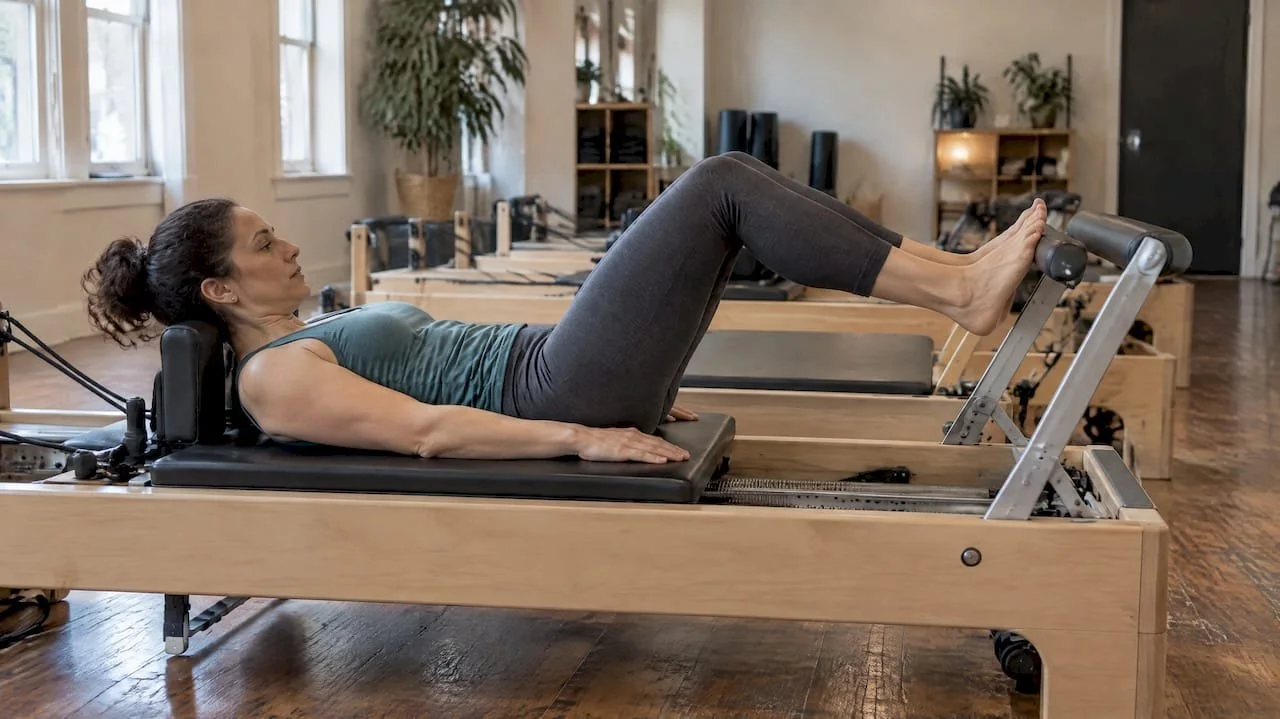
Pilates rests on six core principles: centering, concentration, control, precision, breath and flow. These act as teaching cues that guide every movement back to the "powerhouse," the deep core muscles that stabilize the spine, so that practice stays controlled, intentional and connected rather than rushed or careless.
TL;DR:
Start with one or two cues, such as centering and breath, then add control and precision as your coordination improves.
A 10 to 15 minute micro practice can reset your routine, while a full class usually lasts 45 to 60 minutes.
Stop movements that cause pain, especially in your lower back or neck; for back concerns, use a gentler pelvic tilt and shorter range.
A review of 119 papers found the six traditional principles in only about 23% of studies, while breathing appeared most consistently across fitness and clinical research.
Consistent practice typically builds measurable strength and flexibility changes over 8 to 12 weeks of practice, rather than delivering quick results.
Amritayogawellness
Bring Pilates Principles Into Practice
Explore Amrita Yoga & Wellness, a Philadelphia studio offering Pilates alongside yoga and other wellness practices.
Table of Contents
1. What do the six core principles actually mean?
Each principle answers a different question about how you move, and together they turn a simple exercise into a mind-body practice.
Centering: Every movement starts from the powerhouse, the band of muscles across your abdomen, lower back, hips and glutes. Before you lift a leg or roll up off the mat, draw your navel gently toward your spine so the movement originates from your center rather than your limbs.
Concentration: Pilates asks for full attention on each repetition rather than mindless counting. Pick one cue, such as the position of your pelvis, and hold it in your mind for the entire set instead of letting your thoughts drift.
Control: Nothing in Pilates is thrown or flung into place. Slow a movement down until you can stop it at any point, which is the clearest sign you're moving with control instead of momentum.
Precision: A few correctly aligned repetitions beat a dozen sloppy ones. Check one alignment detail, like keeping your shoulders away from your ears, on every single rep rather than only at the start.
Breath: Breath is paired with movement, often inhaling to prepare and exhaling through exertion. Try lateral or "ribcage" breathing: inhale to widen your ribs sideways, then exhale fully while drawing your abdominals in during the hardest part of a move.
Flow: Movements link together smoothly instead of stopping and starting. Once you know a sequence, practice moving from one exercise into the next without pausing to reset, letting your breath carry you across the transition.
Instructor resources, including a digital textbook on Pilates principles, present these six as the standard framework, though some teachers add related ideas like posture or balance depending on the class style.
2. Build a short routine around the six principles
A simple checklist helps you apply all six principles without overthinking them mid-class.
Set your space and breathe for three to five slow cycles before moving.
Engage your powerhouse by drawing your navel toward your spine (centering).
Choose one focus cue for the session and repeat it silently (concentration).
Perform your first movement slowly enough to pause at any point (control).
Check one alignment detail on every repetition (precision).
Match inhale and exhale to the effort phase of each exercise (breath).
Link two or three movements together without stopping (flow).
Finish with a slower cool-down breath cycle to settle your core before standing.
A short micro-practice of 10 to 15 minutes works for a quick reset, while a full class typically runs 45 to 60 minutes. Beginners should stop any movement that causes pain, especially in the lower back or neck.
Pro Tip: Breathe out as you move into the hardest part of an exercise, drawing your powerhouse in tighter, so breath and control reinforce each other during transitions instead of working against them.
3. Where do these principles come from?
Joseph Pilates called his method "Contrology" in his own writings, including his book Return to Life Through Contrology, which laid out the exercises and philosophy that later practitioners built on. The method began as training for dancers before expanding into general fitness and rehabilitation, and the Pilates Method Alliance along with academic sources, including a Springer Nature textbook chapter, later organized his ideas into the principle framework taught today.
A systematic review of 119 peer-reviewed papers found consensus that Pilates is a mind-body exercise built around core strength, control, flexibility and breathing, though the traditional six principles were mentioned in only about 23% of the papers reviewed. Breathing was the most consistently cited principle across both fitness and clinical research.
Pilates is best understood as a mind-body exercise method, with core stability, muscle control, flexibility, posture and breathing as its most consistently supported elements across the research.
This gap suggests the principles function mainly as teaching language rather than fixed clinical criteria, and their emphasis shifts depending on whether a class targets general fitness or a specific condition like low back pain.
4. How we bring these principles into the studio
We teach both mat and reformer Pilates classes and translate these six principles into cues that work for bodies at any level. For clients managing low-back concerns, we often shift the centering cue toward a gentler pelvic tilt and shorten the range of motion until control is solid, a modification we outline in our guidance on starting Pilates safely. Joining a guided class can help you feel these principles in your own body rather than just reading about them.
5. How Pilates principles compare to yoga's philosophy
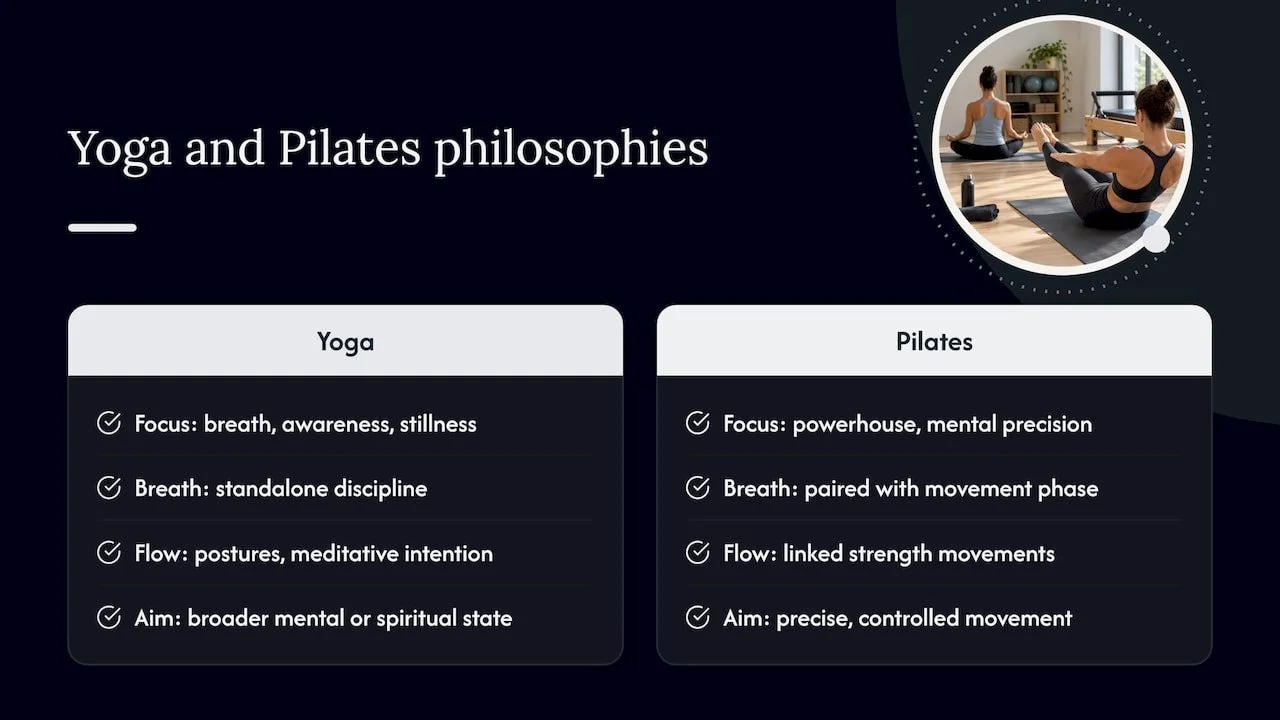
Yoga and Pilates both treat the body and mind as connected, but they organize that connection differently. Yoga philosophy traditionally centers on breath, awareness and stillness as paths toward a broader mental or spiritual state, often drawing on practices like meditation alongside physical postures. Pilates, by contrast, builds its philosophy around a specific physical anchor, the powerhouse, and treats mental focus as a tool for achieving precise, controlled movement rather than an end goal on its own.
Where yoga principles tend to describe an internal state or ethical approach to practice, Pilates principles like precision and control are closer to technical instructions you can check against your form in real time. Breath plays a role in both, but yoga breathing practices often stand alone as their own discipline, while Pilates breath is almost always paired directly with a specific movement phase. The flow principle in Pilates also differs from a yoga flow sequence: Pilates flow is about linking strength-based movements smoothly, while yoga flow often links postures with a meditative or energetic intention. Both methods reward consistency and attention, but Pilates philosophy stays closer to the mechanics of the moving body.
6. Why mental focus matters as much as the exercise itself
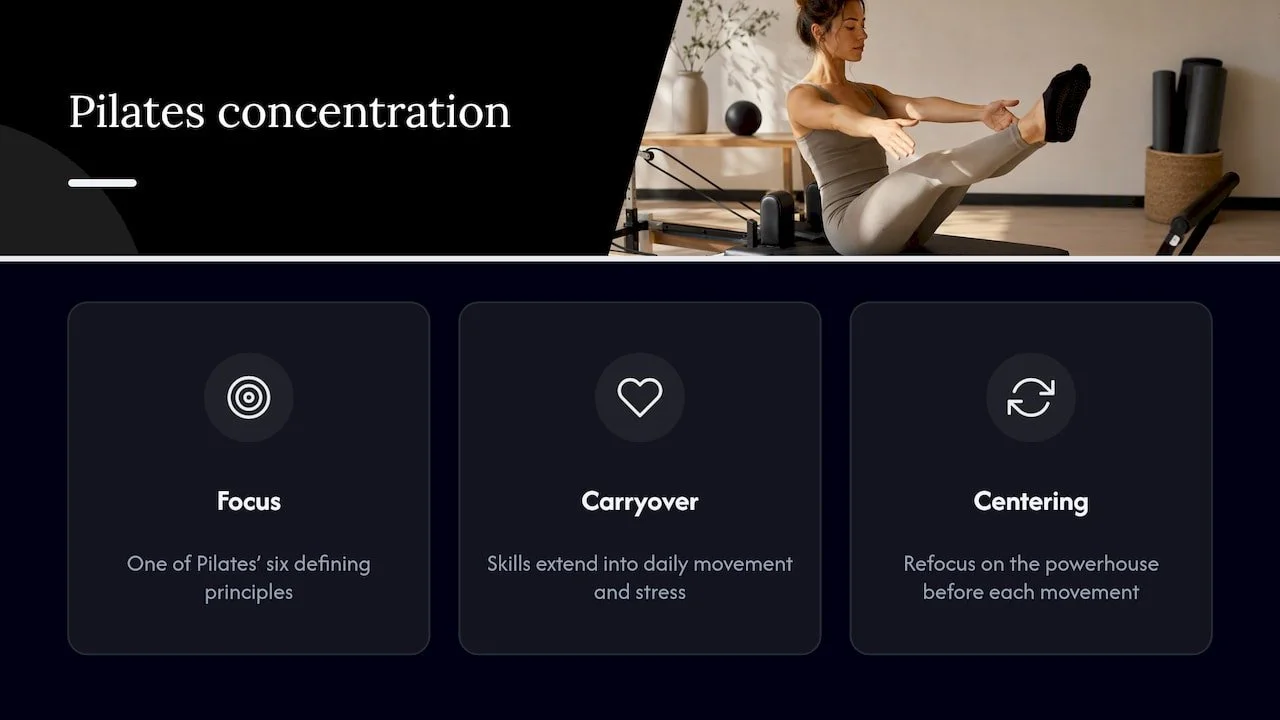
Concentration in Pilates is not a side note to the physical work, it's one of the six defining principles, which signals that Joseph Pilates considered mental engagement essential to getting results from the method. Moving through a sequence without attention tends to produce sloppy form and shallow breathing, while giving each repetition your full focus changes how your body executes the same movement.
This mental component extends beyond the single class. Sustained concentration during a session trains a habit of noticing tension, checking alignment and staying present with physical sensation, skills that carry over into how you move and hold stress throughout your day. Our explainer on the Pilates advantage touches on how this body-mind connection shows up beyond the studio. The principle of centering reinforces this mental anchoring too, since returning attention to your powerhouse before each movement works as a kind of recurring checkpoint that pulls focus back whenever it drifts.
7. What long-term, consistent practice can offer you
Practicing the six principles regularly builds more than muscle. Centering and control gradually improve posture and core stability, which tends to support everyday movement and reduce strain from poor mechanics over time. Consistent attention to breath can also support a calmer nervous system response during and after a session, since slower, controlled breathing is a known component of relaxation practices more broadly.
Beyond the physical, the repeated discipline of concentration and precision builds a kind of patience with your own progress, since Pilates rewards slow, careful refinement over quick results. Many practitioners describe this as a grounding effect that carries into daily life, a sense of being more present and less reactive. Measurable changes in strength and flexibility typically build over 8 to 12 weeks of consistent practice, and the mental steadiness that comes from practicing concentration and control tends to deepen on a similar timeline.
8. Why understanding these principles changes how you practice
Learning the six principles by name gives you a framework for noticing what's actually happening in your body during a session instead of just following along with a routine. I've found that once you can identify whether a movement is lacking control, precision or breath coordination, you start correcting your own form in real time rather than waiting for outside feedback. That shift, from passively doing Pilates to actively practicing its principles, is what separates steady, safe progress from plateauing.
— Juiced
Learn the principles in our classes and private sessions
The fastest way to feel these six principles click is to practice them with guidance, which is exactly what our group mat and reformer classes and private one-to-one sessions are built for. A private session lets an instructor adjust cues like centering or breath pacing to your body in real time, while group classes provide a consistent space to build control and flow alongside others.
Browse our class and membership schedule to find a mat or reformer session that fits your week, or book a one-to-one session if you'd rather start with individual attention before joining a group.
FAQ
What are the 8 principles of Pilates?
Most sources describe six core principles: centering, concentration, control, precision, breath and flow. Some schools or instructors add related ideas such as posture or balance, which is why you may see longer lists in different teaching materials, according to a Pilates digital textbook.
What are some Pilates poses?
Common Pilates exercises include the Hundred, the Roll-Up, the Single Leg Circle and the Plank, each designed to build strength from the powerhouse while applying principles like control and precision. Reformer classes add machine-based variations of these same movement patterns using spring resistance.
What is the main aim of Pilates?
The main aim of Pilates is to build core strength, control and flexibility through mindful, precise movement rather than fast or forceful exercise. A systematic review of the method describes it as a mind-body exercise approach centered on strength, posture and breathing.
What are the seven principles of Pilates?
There is no single, universally agreed seven-principle list. Most academic and practitioner sources use the six core principles, centering, concentration, control, precision, breath and flow, and any seventh addition, such as posture, varies by school or instructor.
How many principles should a beginner focus on?
A beginner can start by focusing on just one or two principles at a time, such as centering and breath, before layering in the rest. Building a solid feel for the powerhouse and breath coordination first tends to make control and precision easier to apply later.
Sources
Recommended

Combining Movement Modalities: What 81 Studies Mean for Your Week
Combining movement modalities reliably improves cardiorespiratory fitness, mobility, injury resilience, and mind-body well-being when you sequence the right stimulus and leave room for recovery. That claim isn't a guess: meta-analyses, clinical reviews, and public health guidelines back it up. Below, we walk through the evidence and the practical steps that turn it into a weekly routine.
TL;DR:
A time efficient session can pair compound lifts with a 10 to 15 minute interval or circuit finisher, then end with mobility work.
When strength gains are the priority, lift before sustained cardio or separate sessions by more than two hours to reduce interference.
Older adults should include balance, strength, and flexibility work at least three days each week to help maintain function and lower fall risk.
People recovering from injury or illness should coordinate exercise choices with a clinician, especially when combining endurance and resistance training.
Beginners should start with low volume and focus on consistency before increasing intensity; meditative movement can support mood and early adherence.
Amritayogawellness
Explore Movement That Fits Your Week
Amrita Yoga & Wellness offers yoga, Pilates, barre, tai chi, and other practices for people exploring varied approaches to movement.
Table of Contents
Core Benefits Explained: Fitness, Mobility, Injury Resilience, and Mind-Body Gains
What the Research Says: Headline Studies and Practical Takeaways
How to Combine Modalities: Sequencing, Frequency, and Sample Templates
Who Benefits Most and How to Adapt: Older Adults, Rehab, and Beginners
Adaptations in Neuroplasticity and Cognitive Function From Multimodal Movement
Psychological and Motivational Benefits of Varied Movement Practices
Community and Social Engagement Impact When Combining Modalities
Nutritional Considerations Complementing Multimodal Movement Practice
Practical Next Steps: Classes and Services at Amrita to Combine Movement Modalities
Core Benefits Explained: Fitness, Mobility, Injury Resilience, and Mind-Body Gains
Each movement modality contributes a distinct physiological signal, and stacking the right ones produces gains no single practice delivers alone. Aerobic exercise paired with resistance training improves cardiorespiratory fitness, body composition, and metabolic markers like blood glucose and lipid profiles more broadly than either one in isolation. Resistance training on its own still carries unique weight: it builds strength and conditions tendons and connective tissue to tolerate load, which matters directly for injury resilience.
Yoga and dedicated mobility work extend joint range of motion and sharpen movement quality, the kind of control that keeps a squat or a stride mechanically sound under fatigue. Balance-focused practices such as tai chi and dance train proprioception, the body's sense of position in space, which translates into fewer falls and better coordination as people age. Meditative movement adds a different kind of return entirely: measurable reductions in stress, anxiety, and depressive symptoms, along with better sleep quality.
Put together, a well-chosen mix covers ground that no single modality reaches:
Cardiometabolic health: aerobic plus resistance work improves heart health, body composition, and blood sugar regulation.
Strength and tissue resilience: progressive resistance training conditions muscle, tendon, and connective tissue against overuse injury.
Flexibility and movement quality: yoga and mobility drills extend range of motion and improve how a joint moves under load.
Balance and coordination: tai chi and dance-based practices sharpen proprioception and reduce fall risk.
Mental health and sleep: meditative movement lowers stress and anxiety symptoms and supports more consistent sleep.
The overlap matters as much as the individual effects. A person doing only cardio misses the tendon-loading benefits of resistance work; someone doing only yoga misses the cardiometabolic stimulus that aerobic training provides. Combining modalities closes those gaps.
What the Research Says: Headline Studies and Practical Takeaways
The case for combining modalities isn't anecdotal. A Harvard Health summary of hybrid training reviewing 81 studies found that hybrid programs mixing aerobic and resistance work in the same session improved cardiometabolic markers while also saving time: participants in hybrid formats averaged less weekly training time than they did when aerobic and resistance sessions were done separately.
That's a meaningful time savings for anyone trying to fit exercise around a full schedule, without giving up the combined cardiometabolic benefit.
On the mental health side, a network meta-analysis of meditative movement interventions found that practices like tai chi, qigong, and yoga produced substantial reductions in anxiety and depressive symptoms compared with non-exercise controls. The effect sizes were large enough to place meditative movement among the more reliable non-pharmacological options for mood support.
Public health guidance backs the multicomponent approach too. The WHO guidelines on physical activity and sedentary behaviour recommend that older adults in particular combine aerobic, muscle-strengthening, and balance activities to protect function and prevent falls.
A few key points stand out:
Hybrid same-session training can match separate-session results in less total time.
Meditative movement shows some of the strongest evidence for anxiety and depression symptom relief among movement-based interventions.
Multicomponent weekly activity is the standard public health recommendation, not an optional add-on.
One caveat worth naming: a documented interference effect exists where heavy endurance work close to a strength session can blunt maximal strength gains in already-trained lifters. It's context-dependent and manageable with smart sequencing, which we cover next.
How to Combine Modalities: Sequencing, Frequency, and Sample Templates
Good programming starts with a decision: what's the primary adaptation this session is for? Strength, cardiovascular conditioning, and mobility all compete for recovery resources, so naming the priority before you train keeps the session coherent instead of diluted.
Pick one primary objective per session. Strength, cardio, or mobility, not all three at full intensity in one sitting.
Sequence by priority. When strength is the goal, lift before any sustained cardio; fatigue from a long run or ride beforehand will compromise lifting mechanics.
Separate sessions when maximizing strength matters most. A gap of more than two hours between endurance and resistance work reduces the interference effect noted in concurrent-training research.
Track effort, not just output. Rating of perceived exertion (RPE) gives a simple, subjective check on whether you're building fatigue faster than you're recovering from it.
Schedule at least one low-intensity day weekly. Gentle yoga, walking, or restorative stretching gives connective tissue and the nervous system a chance to catch up.
Three templates cover most people's needs:
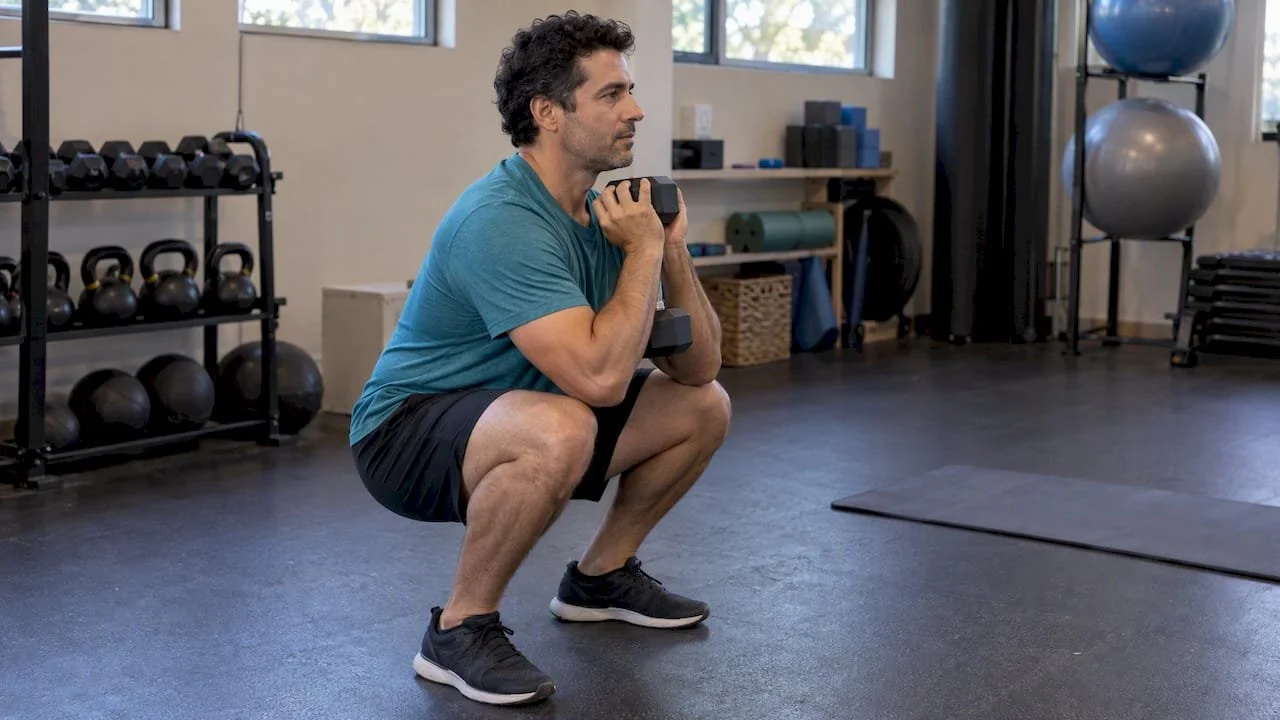
Template A, time-efficient hybrid (one session): warm-up, compound strength movements (squats, rows, presses), a 10 to 15 minute metabolic finisher (intervals or circuit work), then a mobility cool-down. This mirrors the hybrid format in the Harvard summary above and fits well into a single hour.
Template B, three-day multicomponent week: day one pairs strength with mobility work, day two pairs cardio with balance drills, day three is restorative yoga. This spreads the stimulus so no single day is overloaded.
Template C, class-friendly plan: a yoga class paired with a short run or a pilates session, plus one light strength routine during the week. This works well for people building a routine around scheduled classes rather than solo training blocks.
Pro Tip: When you're short on time, choose a hybrid session that trains two capacities at once, like resistance circuits performed with minimal rest to add an aerobic density component.
Our blog on yoga and pilates for fitness and mind walks through how those two practices complement strength-focused training if you want a deeper look at Template C in action.
Who Benefits Most and How to Adapt: Older Adults, Rehab, and Beginners
Different groups need different emphasis, though the multicomponent principle holds across all of them.
Older adults benefit most from sessions that combine balance, strength, and flexibility work at least three days a week, matching the WHO's multicomponent recommendation for maintaining function and preventing falls. Our chair yoga routine for seniors is a practical entry point for building that habit gently.
Rehab and clinical populations often see faster functional gains from multimodal programs: a systematic review on post-stroke rehabilitation found that combining resistance and endurance training improved knee-extensor strength more than single-mode approaches. Anyone recovering from injury or illness should coordinate modality choices with a clinician first.
Beginners do best starting with low volume and high consistency rather than intensity. Meditative movement in particular tends to improve adherence and mood early on, which matters more than raw training load in the first few months.
For readers managing bone health specifically, osteoporosis exercise guidelines offer useful detail on safe loading choices that pair well with balance-focused classes.
Adaptations in Neuroplasticity and Cognitive Function From Multimodal Movement
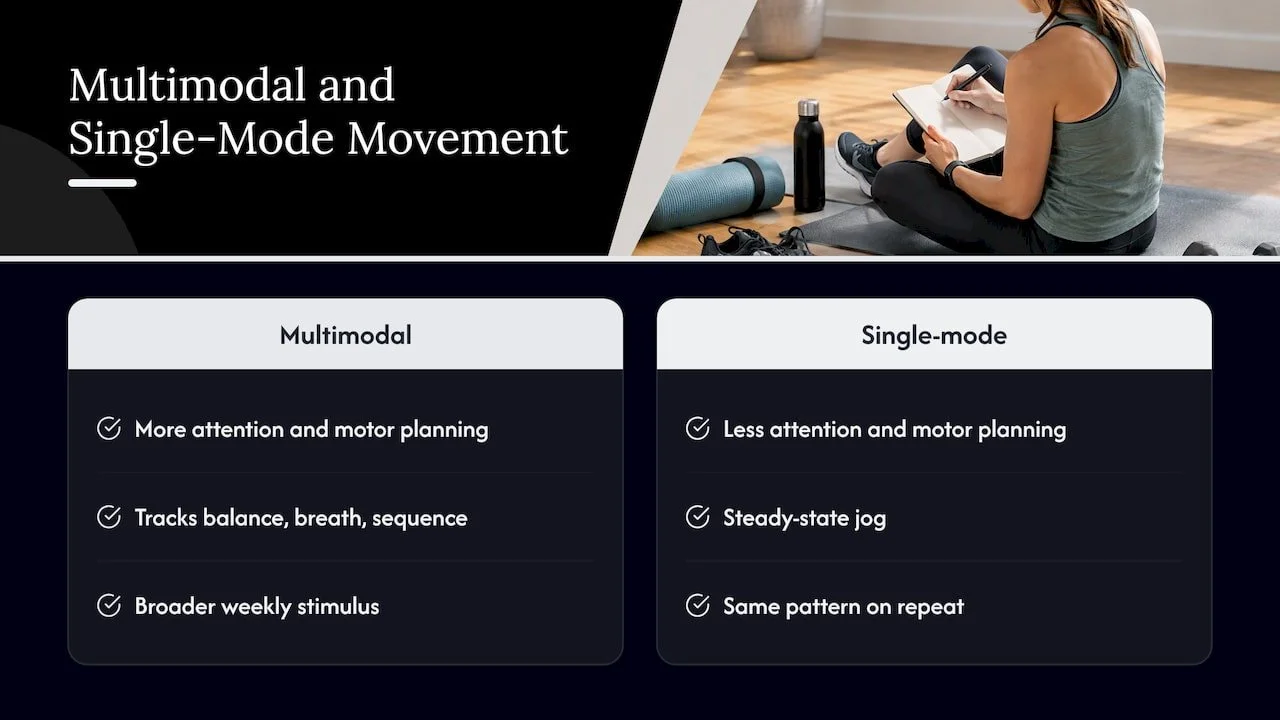
Movement that combines physical coordination with attentional demands appears to engage the brain differently than repetitive single-mode exercise. Practices that require tracking balance, breath, and sequence at the same time, like tai chi or a flowing yoga sequence, ask more of attention and motor planning than a steady-state jog.
Research on movement-integrated learning suggests that pairing physical movement with cognitive or attentional tasks can support better retention and engagement, a principle drawn from embodied cognition research on how movement and thinking interact. The same logic shows up in school-based findings: a study on movement integration in early childhood education found that programs blending movement into the school day increased physical activity and supported cognitive engagement without cutting into instructional time.
For adults, the practical version is simpler: varying the movement challenge, balance one day, coordination-heavy flow another, steady cardio on a third, gives the brain a broader range of stimulus than doing the same workout on repeat. It's not about any single "brain exercise," but about not letting one movement pattern become the only input your nervous system receives all week.
Role of Breathwork Integration Across Modalities
Breath control shows up differently across movement practices, but it's rarely optional once you look closely. In yoga, breath pacing (pranayama techniques) is built into the practice itself, syncing inhalation and exhalation with movement transitions. In tai chi and qigong, slow, deliberate breathing anchors the pace of the whole sequence. Even in resistance training, bracing the breath during a heavy lift is a basic safety technique, not a yoga-specific skill.
Adding deliberate breathwork to higher-intensity modalities gives you a built-in regulation tool: slowing the breath during a cool-down after intervals, for instance, helps shift the nervous system out of a sympathetic, fight-or-flight state faster than simply stopping and waiting. That's part of why meditative movement practices, which blend movement and breath by design, show up so strongly in anxiety and depression research.
Our mindfulness activities for stress relief cover several breath-based techniques that translate well into a strength or cardio warm-up, not just a yoga mat. The point isn't to turn every workout into a meditation session. It's to treat breath as a tool available in any modality, used deliberately rather than left on autopilot.
Psychological and Motivational Benefits of Varied Movement Practices
Doing the same workout week after week is efficient on paper and demotivating in practice. Variety solves a problem that pure physiology doesn't fully explain: people stick with routines they find engaging, and a mix of modalities gives more chances to find that engagement than a single repeated format.
There's also a confidence-building effect to trying different movement types. Someone who feels intimidated by heavy lifting might find early wins in a mobility or balance-focused class, build body awareness there, and carry that confidence into strength work later. The reverse happens too: a strength-focused exerciser who tries yoga for the first time often discovers tightness or imbalances they didn't know they had, which reframes mobility work as useful rather than optional.
Novelty itself has a motivational pull. Learning a new movement pattern, a tai chi form, a pilates sequence, a new strength lift, taps into a sense of progress that's separate from measurable fitness gains. That sense of progress is often what keeps someone training consistently long enough for the physiological benefits to compound.
Community and Social Engagement Impact When Combining Modalities
Group settings change how movement practice feels, and that shift matters more than it might seem on paper. Training alongside other people, whether in a yoga class, a pilates group session, or a tai chi circle, adds a social accountability layer that solo training doesn't offer. Showing up because a class is scheduled, and because familiar faces will be there, often sustains a habit longer than willpower alone.
Combining modalities tends to widen that social circle rather than narrow it. Someone who only ever takes spin classes meets a different group of people than someone who also shows up to a slow-flow yoga session or a barre class. Each modality tends to attract its own community, and moving between them exposes you to more of it.
Our piece on group yoga for wellness and community goes deeper into why shared practice spaces support adherence in ways that a solo home workout routine generally doesn't replicate.
Nutritional Considerations Complementing Multimodal Movement Practice
Varying your training load across the week changes what your body needs to recover well, and a flat, one-size approach to eating rarely matches that variation. A heavy resistance day calls for adequate protein to support muscle repair, while a longer cardio or cardio-heavy hybrid session increases the need for carbohydrate to replenish glycogen stores.
Hydration needs shift too, especially around hot yoga or any higher-sweat session, where fluid and electrolyte replacement matters more than on a restorative or balance-focused day. On lighter mobility or meditative movement days, the nutritional demand is lower, and the bigger priority is often just eating enough overall to support the heavier training days elsewhere in the week.
None of this requires a rigid tracking system for most people. Paying attention to how a session felt, how recovered you feel the next day, and adjusting portions and timing accordingly tends to cover the basics well enough for recreational exercisers combining several modalities.
Studio/author Perspective: How Amrita Applies These Ideas
We build our class mix around a variety of formats including strength-based formats, mobility-focused yoga, and restorative practice on the same weekly schedule. We see students get the best results when they treat that variety as a system rather than a menu, pairing a sweat-focused class with a slower one in the same week. If that approach is new to you, a single combined week in-studio is a low-pressure way to feel the difference.
— Juiced
Practical Next Steps: Classes and Services at Amrita to Combine Movement Modalities
We offer the full range the templates above call for under one roof. Our group class drop-ins cover yoga, pilates, and barre starting at $11 for a Community Class and $28 for a standard Group Class, matching Template B's multicomponent week without requiring you to piece it together across different studios.
For a program built around your specific goals, our One to One Session, from $85 per hour, lets us sequence strength, mobility, and breathwork exactly the way Template A or C calls for. Check our class schedule to find the combination that fits your week.
FAQ
What are the benefits of moving your body?
Regular movement improves cardiorespiratory fitness, strength, flexibility, and balance, while also supporting mental health through stress and anxiety reduction. Combining different movement types, rather than repeating one format, tends to cover more of these benefits at once, as reflected in the cardiometabolic gains reported with hybrid training.
What are the 7 compound exercises?
Compound exercises work multiple muscle groups and joints in a single movement; common examples include the squat, deadlift, bench press, overhead press, pull-up, row, and lunge. These movements form a practical foundation for the strength portion of a combined-modality routine like the templates described above.
What not to do immediately after exercise?
Avoid skipping your cool-down, especially after higher-intensity or hybrid sessions, since an abrupt stop skips the gradual shift out of an elevated heart rate and stress response. It's also best to avoid immediately jumping into another high-intensity session without at least a few hours of separation when strength gains are a priority.
What do movement therapists do?
Movement therapists assess how a person moves and design programs, often combining strength, mobility, and sometimes breath-based techniques, to address pain, injury recovery, or functional limitations. In clinical settings, multimodal approaches combining resistance and endurance work have shown stronger results for functional recovery than single-mode approaches in populations such as stroke rehabilitation patients.
Sources
Network meta-analysis of meditative movement interventions (PMC6111244)
Multimodal treatment for lower limb function after stroke (PMC10815740)
WHO guidelines on physical activity and sedentary behaviour (2020)
Recommended

Boutique Studio vs. Gym: Choose by Coaching, Schedule, and Cost
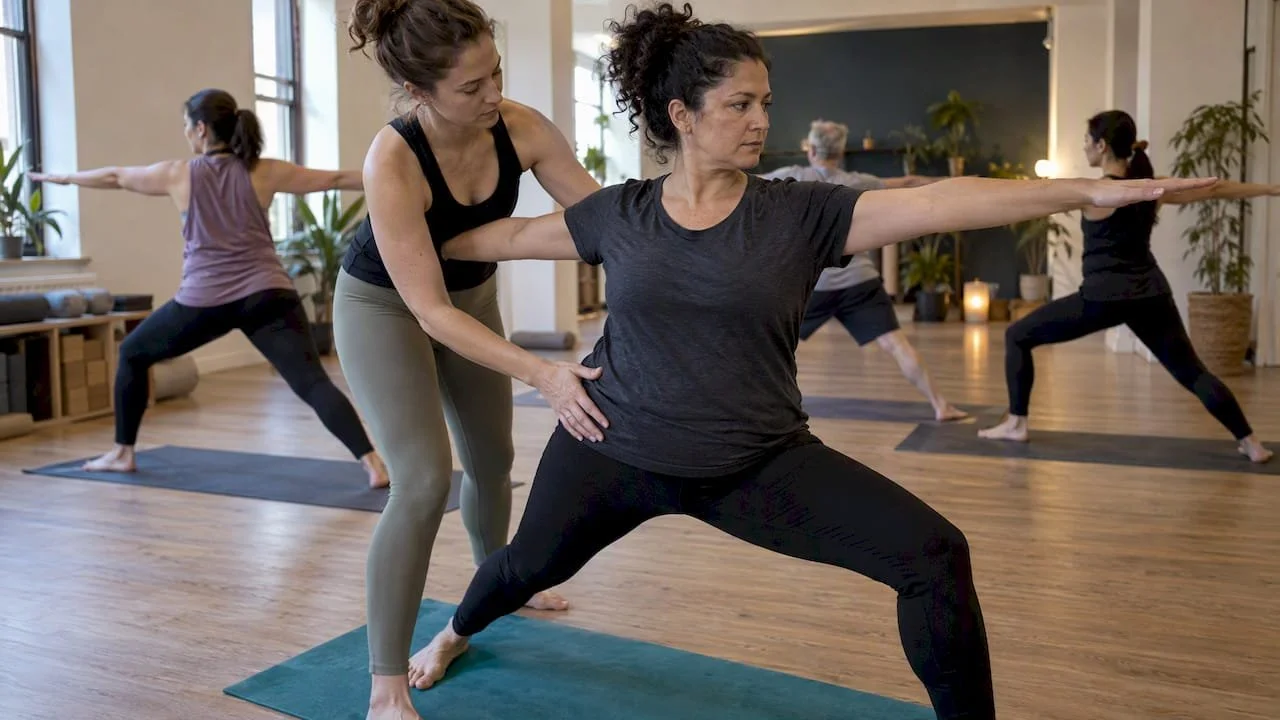
Boutique studios prioritize guided, community-driven classes and coaching, while traditional gyms prioritize variety, open access, and lower cost per month. The American College of Sports Medicine (ACSM) and the IHRSA both track these formats closely, and the right pick depends on how much instruction you want, how your schedule works, and what you're willing to spend each month.
TL;DR:
Studio classes require advance booking and may have cancellation windows, while traditional gyms offer open floor access without reservations for unpredictable schedules.
If you attend four or five classes weekly, an unlimited studio plan may cost less per session than paying individual drop in rates.
Small classes provide live form corrections, but beginners should verify instructor certifications and supervision; experienced lifters may gain less from that added attention.
A study found CrossFit members reported stronger community than traditional gym members, but social connection alone did not independently predict attendance.
Amritayogawellness
Find a Studio That Fits Your Routine
Explore Amrita Yoga & Wellness in Philadelphia, with yoga, Pilates, barre, tai chi, and wellness offerings for different practices.
Table of Contents
How do gyms and studios compare on instruction, equipment, and scheduling?
How big are classes, and how much personal attention do you get?
Which format fits which goals, and where each one falls short
Where are gyms and studios typically located, and how easy are they to reach?
What qualifications do instructors typically have in each setting?
Do studios and gyms offer services beyond the workout itself?
What is a traditional gym?
A traditional gym, sometimes called a big-box gym, gives you a large open floor with free weights, machines, and cardio equipment side by side. You move through your own routine at your own pace, with staff available but not guiding every rep.
Most big-box gyms operate on extended hours, often opening early and closing late, so you can train on your own schedule rather than booking a slot. Access is usually membership-based with month-to-month or annual plans, though many locations also allow day passes.
This model fits self-directed lifters who already know their programming, people watching their budget, and anyone who wants variety: one day of strength training, the next on a treadmill, without booking anything in advance.
What is a boutique fitness studio?
A boutique fitness studio is a smaller facility built around a specific type of movement, such as yoga, pilates, barre, spin, or HIIT. Instead of an open floor, you book a spot in a scheduled class, and that class is led start to finish by an instructor.
Class sizes stay small by design, which means the instructor can actually see your form and correct it in real time. This is the core trade: less open-ended freedom, more structured coaching. Booking typically happens through an app or website, often with a cancellation window, and many studios offer drop-in rates alongside memberships for people who want to test the waters.
This format suits people who want guided progression rather than guesswork, anyone drawn to a specific discipline like pilates reformer work or hot yoga, and those who value showing up to a room of familiar faces each week. If you've ever wondered what group classes look like in practice, a boutique studio is usually where that experience lives.
How do gyms and studios compare on instruction, equipment, and scheduling?
The two formats diverge most sharply in four areas: how much guidance you get, what equipment is available, how you access it, and what the space feels like.
Instruction: Studios build personalization into every class through small group sizes and live corrections; gyms offer open-floor access with personal training available as a separate, often paid, add-on.
Equipment: Studios specialize in gear tied to their discipline, like reformers for pilates or stationary bikes for spin, while gyms stock a broad mix of racks, machines, and cardio equipment for general use.
Scheduling: Studios run on a class calendar with booking and cancellation windows; gyms offer open-floor hours with no reservation needed.
Atmosphere: Studios tend to curate lighting, music, and decor around a specific practice, while gyms focus on functional amenities like locker rooms, showers, and equipment turnover.
The ACSM's facility guidance recommends weighing staffing, programming, and equipment condition regardless of format, since a facility's actual operations matter more than its label. A gym with poorly maintained machines and a studio with an unqualified instructor are both bad choices, no matter what category they fall into.
How do pricing and membership options differ?
Pricing structures reflect what each model is built to deliver. Big-box gyms often spread costs across a large member base, which keeps monthly rates lower, while boutique studios price around smaller class sizes and specialized equipment, which tends to raise the cost per session.
Common pricing forms: monthly membership tiers, class packs, drop-in rates, and unlimited plans.
What raises cost: low instructor-to-member ratios, specialized equipment like reformers, and boutique-style amenities.
What lowers cost: scale, since a gym serving thousands of members can spread overhead across a larger base.
IHRSA's industry data show that both boutique and big-box models can be financially viable businesses, which means the better value for you depends on how often you'll actually show up, not which model charges less on paper. If you plan to attend four or five classes a week, an unlimited plan often works out cheaper per session than drop-ins. Our own breakdown of whether an unlimited membership is worth it walks through that math in more detail.
Does community actually keep you coming back?
Community is one of the most cited reasons people choose boutique studios, and there's some evidence behind it, as discussed in how community supports your wellness journey. A peer-reviewed study comparing CrossFit members to traditional gym members found that CrossFit members reported higher social capital and a stronger sense of community. That same study found these community measures didn't independently predict attendance, meaning the social bond helps but doesn't replace personal commitment.
Scheduled classes with the same instructor and the same faces each week naturally build accountability, since skipping a booked slot feels different than skipping an open gym visit. Gyms can build similar community through small-group training or recurring workout partners, but it takes more initiative since nothing is scheduled for you. NIH's guidance on group activity notes that social support is one of the factors that helps people stay consistent over time.
How should you choose between a gym and a studio?
Match the format to your goals before you match it to your budget. Here's a short process to work through:
Define your goal. Decide whether you want guided coaching and structure, or open-ended access and variety.
Check your schedule. If you need flexibility around unpredictable hours, open-floor gym access may fit better than booked classes.
Set your budget. Compare monthly membership costs against how many sessions you'd realistically attend.
Decide how much coaching you want. If form correction matters to you, lean toward small-class formats.
Identify your preferred equipment or class style. Reformers, spin bikes, and free weights all point toward different formats.
When you tour or trial a location, ask staff directly: What's the typical class size? What are the instructor's certifications? What's the cancellation or credit policy? Is there a trial class or drop-in rate? The ACSM's facility guidance recommends asking exactly these kinds of operational questions rather than relying on branding alone.
Pro Tip: Book a single drop-in class or a trial week before committing to a membership, then judge it on three things: whether it fit your schedule, how much instructor attention you got, and whether you actually enjoyed showing up.
What a boutique studio approach looks like in practice
Our class options show how the boutique model plays out day to day. We offer group classes, livestream drop-ins, community classes, and a beginner-focused pass alongside private one-on-one sessions for people who want individual coaching.
Readers who want structured beginner guidance tend to gravitate toward a beginner-focused pass, while those seeking community and routine often choose a monthly membership tier. People who want maximum personalization typically book a private session instead of a group class, since that format lets instructors focus entirely on their form and pace.
How big are classes, and how much personal attention do you get?
Class size is the single biggest factor separating these two formats. In a boutique studio, class sizes are kept intentionally small, often capped well below what a large group fitness room at a gym would hold, so instructors can watch each person's form and adjust it mid-class. That ratio is the entire value proposition of the model: you're paying for attention, not just access.
Traditional gyms handle personalization differently. Group fitness classes at a gym can run larger and more variable in size, and outside of those classes, the floor is self-directed. If you want one-on-one correction at a big-box gym, you typically book a personal trainer separately, which adds to your monthly cost. The ACSM's guidance for evaluating any facility specifically recommends asking about staff qualifications and how equipment and programming are supervised, since a low price tag doesn't guarantee adequate oversight.
For beginners learning a new movement pattern, like a pilates reformer sequence or a yoga pose that involves balance, that ratio of eyes-on-you instruction can be the difference between building the habit safely and getting discouraged by poor form. For experienced lifters who already know their technique, a lower ratio matters far less, which is part of why self-directed gym-goers often don't feel they're missing anything.
Which format fits which goals, and where each one falls short
Neither format is universally better. Each one is built to solve a different problem, and your goals determine which trade-offs matter.
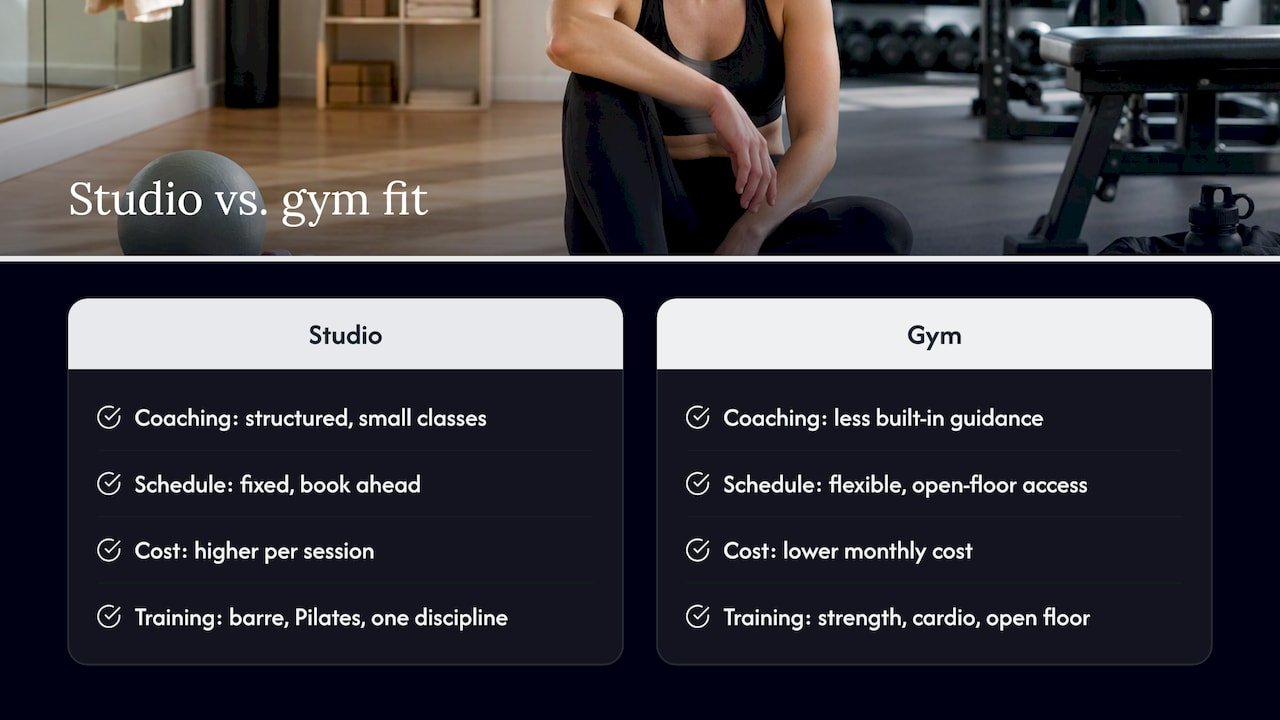
Boutique studios work best for people who want structured coaching, a specific discipline like barre or pilates, and a consistent class routine to build accountability. The trade-off is a higher cost per session and a fixed schedule that requires booking ahead, which can be a friction point if your calendar changes often.
Traditional gyms work best for people who want flexibility, a lower monthly cost, and variety across strength, cardio, and open-floor training. The trade-off is less built-in guidance, meaning you need to arrive with some knowledge of how to train or pay extra for a personal trainer to get that coaching.
If your main goal is weight training progression and you already know proper form, a gym's equipment variety and lower price point likely serve you better. If your goal is building a yoga or pilates practice from scratch, or you know you need external accountability to stay consistent, a studio's structure and small-class coaching tend to produce better adherence.
Where are gyms and studios typically located, and how easy are they to reach?
Big-box gyms tend to anchor in suburban retail centers or stand-alone buildings with large parking lots, since their footprint requires space for full equipment floors. That makes them convenient for people who drive to their workout and want a predictable, single-location routine.
Boutique studios more often cluster in urban neighborhoods and walkable commercial strips, since their smaller footprint fits more easily into a storefront or a shared building. For city dwellers without a car, a studio within walking distance can be easier to fit into a daily routine than a suburban gym that requires driving.
Accessibility also extends beyond physical location. Many studios, including ours, offer livestream class options for people who want the instruction and accountability of a class without needing to be on-site, which matters if you travel often or live outside a studio's immediate service area.
What qualifications do instructors typically have in each setting?
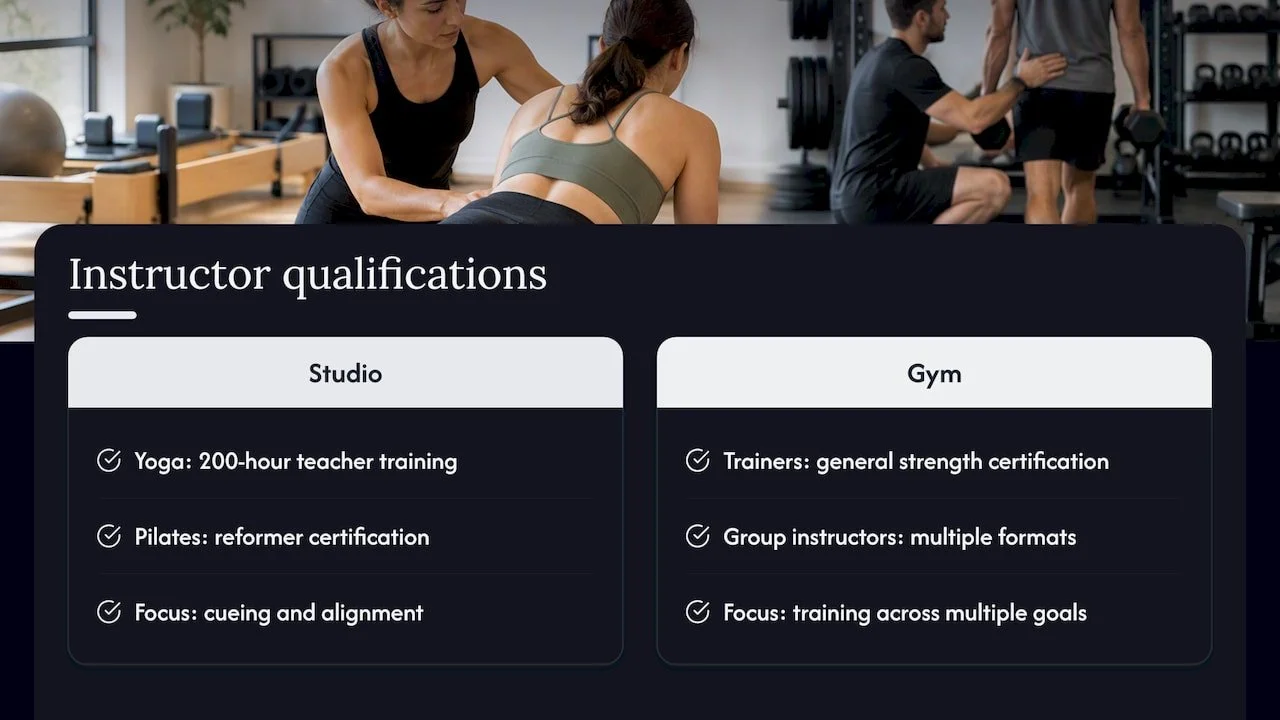
Instructor backgrounds differ because the two formats ask instructors to do different jobs. Boutique studio instructors are typically certified in a specific discipline, such as a 200-hour yoga teacher training or a pilates reformer certification, and their training focuses on cueing, alignment, and hands-on correction within that one practice.
Gym staff cover broader ground. Personal trainers usually hold a general certification covering strength training principles across multiple goals, and group fitness instructors at a gym may teach several different class formats rather than specializing in one. Neither path is inherently more rigorous, but the specialization in boutique settings tends to produce deeper expertise in a narrower skill set, which is part of why studios can offer more detailed form correction in that specific discipline.
The ACSM's facility guidance recommends asking directly about instructor certifications and how facilities vet their staff, since titles and credentials vary and aren't always visible from a class schedule alone.
Do studios and gyms offer services beyond the workout itself?
Many boutique studios extend past the workout room into broader wellness services, and that's part of what distinguishes the model beyond class format alone. Massage therapy, Ayurvedic treatments, and workshops on practices like breathwork or tarot are common additions at studios built around holistic wellness rather than pure fitness.
That extension includes massage therapy, Ayurvedic therapies, and wellness workshops alongside yoga, pilates, and barre classes. Readers focused purely on physical training may not need these add-ons, but anyone looking at fitness as part of a broader self-care routine may find this integration valuable.
Traditional gyms generally stay focused on physical training and sometimes nutrition coaching as an add-on service, without the spiritual or recovery-focused offerings that boutique wellness studios build into their model.
When I recommend a studio versus a gym
I point people toward a boutique studio when they tell me they want coaching, a specific discipline, and a group to be accountable to. I point them toward a gym when cost and flexibility matter most, or when they already know how to train and just want access to equipment. When someone genuinely can't decide, I suggest trying one week of each, a studio class and a gym visit, and noticing which one they look forward to.
— Juiced
How Amrita Yoga & Wellness fits into your decision
If the boutique model sounds like the right fit, a trial class is the easiest way to find out. Boutique studios typically attract beginners who want guided instruction, people who want a consistent class community, and anyone drawn to a specific practice rather than a generic workout.
You can start with a group class or drop-in session to test the format without committing to a membership, or book a private one-on-one session if you want individual coaching from the start. For a closer look at what each class involves, our class descriptions page breaks down intensity levels and formats so you can pick the right starting point. When you're ready to see what's on the calendar, check our class and monthly schedule and reserve your first spot.
FAQ
Why are boutique gyms so expensive?
Boutique studios charge more per session because classes stay small, which means fewer people are splitting the cost of the instructor's time and the specialized equipment. IHRSA's industry data show that big-box gyms spread overhead across a much larger member base, which keeps their monthly rates lower by comparison.
What is the difference between a studio and a gym?
A gym offers open-floor access to a broad mix of equipment that you use on your own, while a studio runs scheduled, instructor-led classes focused on one discipline, like yoga, pilates, or spin. The core difference is structure: gyms give you freedom and variety, studios give you guidance and a smaller group setting.
What is the 3-3-3 rule gym?
Definitions of this rule vary across fitness sources, and there's no single standardized version tied to a major health or fitness organization. A commonly cited version refers to structuring a workout into three segments, such as warm-up, main training, and cool-down, but you should confirm the specific approach with a qualified trainer before applying it to your own routine.
What does "big-box gym" mean?
A big-box gym refers to a large-scale fitness chain or facility with extensive equipment, open-floor access, and typically lower membership costs due to its larger member base. This term contrasts with boutique studios, which operate smaller spaces built around specialized, instructor-led classes.
Sources
Recommended

Integrative Wellness for Adults: Five Practices, From Plan to Studio
Integrative wellness combines conventional medical care with evidence-based complementary therapies to treat the whole person rather than isolated symptoms. The National Center for Complementary and Integrative Health and the World Health Organization both frame this coordination as central to modern care, and studios like ours at Amrita Yoga & Wellness put it into practice daily through yoga, tai chi, and guided coaching. Done well, it supports mental clarity, physical resilience, and a stronger sense of purpose all at once.
TL;DR:
A 2019 review of 49 studies found meditation, tai chi, qigong, and yoga improved sleep; many trials lasted 4 to 24 weeks.
An overview of 210 reviews found moderate to good evidence that yoga and tai chi help with pain, depression, and anxiety, though results vary.
Start with one foundation, add a repeatable practice, and track sleep, pain, or mood weekly during a trial lasting 4 to 12 weeks.
People with chronic conditions or prescription medications should consult their clinician first and disclose every supplement, practice, and session frequency they use.
Pregnancy, cancer treatment, cardiac disease, and recent surgery may require practice modifications; check practitioner credentials and avoid anyone who discourages medical disclosure.
Amritayogawellness
Explore Wellness Practices in Philadelphia
Amrita Yoga & Wellness offers yoga, tai chi, Pilates, barre, and other wellness services for adults at different experience levels.
Table of Contents
What Integrative, Complementary, and Whole-Person Health Mean
How a Community Studio Puts Integrative Wellness Into Practice
Start Your Integrative Wellness Plan at Amrita Yoga & Wellness
What Integrative, Complementary, and Whole-Person Health Mean
These terms get used interchangeably, but they describe different things. According to NCCIH's definitions, complementary health approaches are non-mainstream practices used alongside conventional medicine, while alternative approaches replace conventional care entirely. Integrative health goes a step further: it deliberately coordinates both systems, often with a clinician aware of everything a patient is doing.
Whole-person health shifts the question from "what disease do you have" to "what does your life actually look like." It considers sleep, stress, relationships, movement, and diet as inputs that shape physical outcomes, not background noise. A 2024 peer-reviewed modeling study found that this kind of integrated care pathway can plausibly improve long-term outcomes and reduce cumulative health care costs compared with conventional, fragmented care.
A few elements show up consistently in whole-person frameworks:
Ongoing coordination between a primary clinician and any complementary practitioners involved.
Deliberate behavior change goals, not just symptom management.
Attention to foundational lifestyle pillars before layering on specialized therapies.
Core Practices Adults Use and What They Target
Most integrative routines draw from five overlapping categories, and matching the category to the goal matters more than chasing the trendiest option.
Mind-body practices: meditation and mindfulness-based stress reduction help with anxiety, racing thoughts, and sleep onset, typically in sessions of 10 to 30 minutes several times a week.
Movement therapies: yoga, tai chi, and qigong build flexibility, balance, and stress regulation, and they adapt well to beginners or people managing chronic pain.
Manual and procedural therapies: acupuncture and massage are often considered for musculoskeletal pain or recovery support, usually alongside, not instead of, medical treatment.
Lifestyle supports: nutrition quality, consistent sleep hygiene, daily movement, and social connection form the base that other therapies build on.
Behavioral supports: health coaching, psychotherapy, and medication coordination keep the plan realistic and help prevent gaps between what a clinician recommends and what actually happens at home.
Someone dealing with low back pain might start with gentle yoga and a nutrition check-in. Someone managing anxiety might prioritize mindfulness practice and a coaching conversation about sleep. The categories overlap by design, which is part of what makes integrative wellness flexible rather than one-size-fits-all.
What the Research Actually Shows
The evidence base for mind-body and movement therapies has grown substantially, though it comes with caveats worth understanding before building a plan around it.
A 2019 meta-analysis of 49 studies covering 4,506 participants found that mind-body therapies, including meditation, tai chi, qigong, and yoga, improved sleep quality and reduced insomnia severity, with some interventions also lowering inflammatory markers like C-reactive protein. Many of the trials behind that finding ran between 4 and 24 weeks, which is why short-term trials in that same window are a reasonable way to judge whether a practice is working for you.
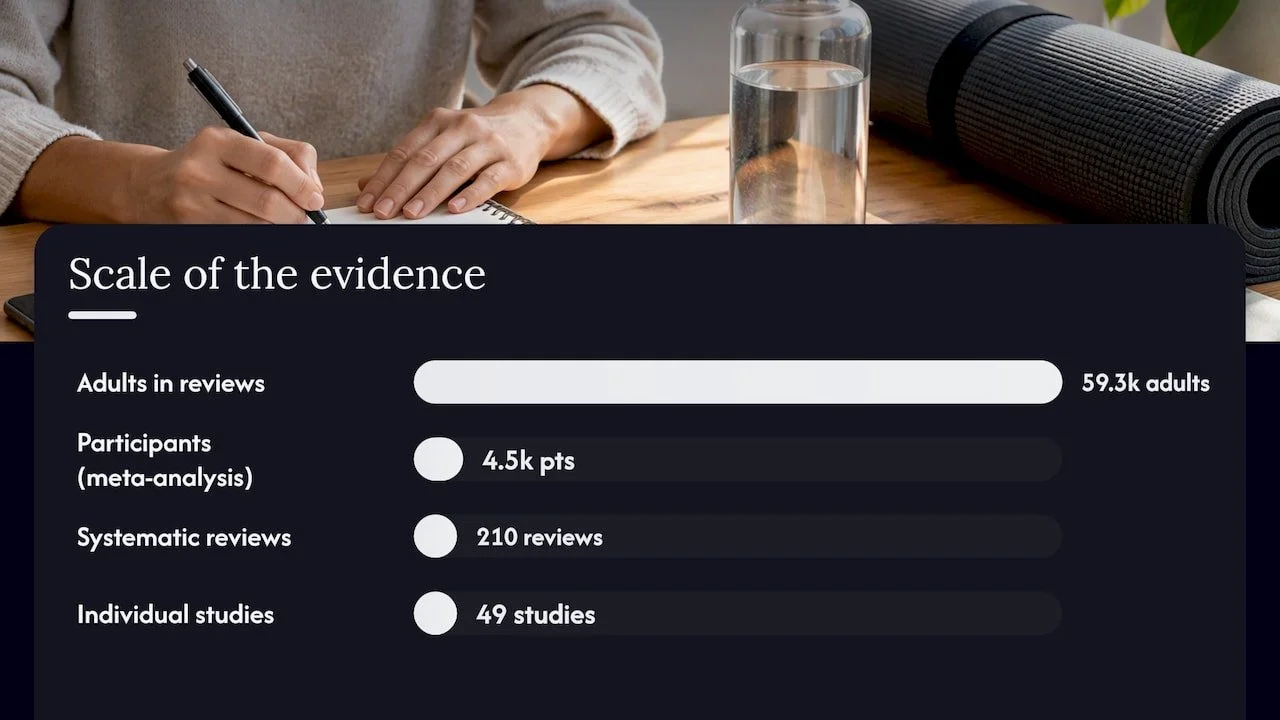
Separately, a critical overview of 210 systematic reviews spanning 59,306 adults reported moderate-to-good evidence that tai chi and yoga help manage musculoskeletal conditions like low back pain and osteoarthritis, along with mental health outcomes including depression and anxiety.
A few limitations temper these findings:
Trial quality and design vary widely across studies, making direct comparisons difficult.
Few randomized trials focus on adults managing multiple conditions at once, which is common in real life.
Effect sizes differ by population, so results don't transfer uniformly from one group to another.
The WHO's Traditional Medicine Strategy for 2025 to 2034 adds a policy dimension, supporting the integration of traditional and complementary medicine into formal health systems while prioritizing safety, regulation, and stronger evidence standards.
Building Your Own Integrative Wellness Plan
A workable plan follows a sequence rather than trying everything at once.
Document your starting point: list current goals, medications, and medical conditions, and get sign-off from your clinician if you have a chronic condition or take prescription medication.
Start with foundations: movement, nutrition, sleep, and social connection come first because they support everything layered on top. Harvard Health's five pillars of longevity frame these as the most consistently validated levers for long-term health.
Add one mind-body or movement practice: pick something you can realistically repeat, whether that's a weekly yoga class or ten minutes of daily meditation.
Set a trial window: commit to 4 to 12 weeks before judging results, tracking a specific measure like sleep quality, a pain scale, or mood.
Reassess and adjust: drop what isn't working, keep what is, and introduce the next layer only after the current one feels stable.
Low-cost entry points matter here. Community classes, short coaching check-ins, and free guided meditation apps all lower the barrier to that first trial month.
Pro Tip: Keep a simple weekly log of one number (sleep hours, pain level, or mood rating) so you have real data instead of a vague impression when the trial period ends.
When you talk to your provider, mention every supplement, practice, and session frequency you're using, not just prescription changes. That disclosure is what lets coordination actually work instead of becoming two disconnected health plans running side by side.
Safety Checks Before You Start a New Practice
"Natural" does not automatically mean risk-free, and some complementary approaches need medical oversight before you begin. Pregnancy, active cancer treatment, and cardiac disease are common situations where a practice needs modification rather than a blanket yes or no, according to NCCIH guidance on complementary approaches.
Some supplements interact with prescription medications, including blood thinners and chemotherapy drugs, which is why disclosure to your clinician matters.
Intense movement practices may need modification for joint conditions, pregnancy, or recent surgery.
Credentialed practitioners should be able to explain their training, certifications, and how they handle medical disclosures.
A practitioner who discourages you from telling your doctor about a therapy is a warning sign, not a selling point.
When vetting a complementary practitioner, ask directly about certification body, years of training, and experience working alongside medical providers for your specific condition.
How a Community Studio Puts Integrative Wellness Into Practice
At Amrita Yoga & Wellness, we build class schedules around the same whole-person logic described above. A 12-week plan might start with a beginner-friendly yoga or tai chi class for movement and stress regulation, add a mindfulness or breathwork workshop for the mental health layer, and introduce a private session as needed once goals are clearer.
Our class mix spans yoga styles, pilates, and tai chi, so movement goals and pain-related goals can be addressed separately.
Workshops on mindfulness and breathwork give a structured entry point for the mind-body layer of a plan.
Private sessions allow pacing and modification for specific conditions or injuries.
Full class descriptions make it easier to match a format to where you are starting from.
Key Takeaways to Get Started This Week
Three things matter more than the specific therapy you pick: start with one foundational habit, track something measurable, and keep your clinician in the loop if you manage a chronic condition. Complexity can come later, once the basics are holding steady.
| Step | Action | Timeframe |
|---|---|---|
| 1 | Pick one foundational habit (sleep, movement, or nutrition) | Week 1 |
| 2 | Add one guided class or mind-body practice | Weeks 2 to 4 |
| 3 | Track a single measure weekly (sleep, pain, or mood) | Weeks 1 to 12 |
A Studio Perspective on What Consistency Looks Like
The adults who see the clearest changes rarely start with an ambitious routine. They show up for one class a week, sleep a little better within a month, and notice their stress response easing before anything else shifts. The pattern repeats often enough that it's worth trusting: small, repeatable steps beat sporadic, intense ones almost every time.
— Juiced
Start Your Integrative Wellness Plan at Amrita Yoga & Wellness
Reading about movement, mindfulness, and lifestyle pillars only gets you so far. We built our studio around giving you a direct way to act on all of it, with options sized for wherever you're starting.
Try a drop-in group class to test a foundational movement practice without committing to a membership.
Book a private session if you want pacing adjusted to a specific condition or goal.
Explore our Ayurvedic therapies, including Shirodhara and Abhyanga, as a supportive layer alongside movement and mindfulness work.
Whether you start with a single class or a monthly membership, the goal is the same: build a routine you can actually keep.
This article is general information, not a substitute for advice from a qualified doctor. Consult a qualified healthcare professional about your own circumstances before acting on anything here.
FAQ
What does integrative wellness mean?
Integrative wellness means coordinating conventional medical care with evidence-based complementary therapies, such as yoga, meditation, or massage, to address physical, mental, and social aspects of health together. The NCCIH describes this coordination as treating the whole person rather than isolated symptoms.
What does it mean to take an integrative approach?
Taking an integrative approach means your conventional provider and any complementary practitioners you see are both aware of your full treatment plan and working from the same goals. It typically starts with foundational habits like sleep and movement before adding targeted therapies.
What are complementary and integrative health approaches?
Complementary approaches are non-mainstream practices used alongside conventional medicine, while integrative health actively coordinates both systems through communication between providers. Common examples include yoga, tai chi, acupuncture, and massage, often layered onto standard medical care rather than replacing it.
What are some examples of integrative health practices?
Common examples include mind-body practices like meditation and yoga, movement therapies like tai chi and qigong, manual therapies like massage and acupuncture, and lifestyle supports like nutrition and sleep hygiene. A 2019 meta-analysis found several of these mind-body practices improved sleep quality across 4,506 participants.
How do I know if a wellness practitioner is qualified?
Ask about their certification body, years of training, and whether they're willing to coordinate with your medical provider on your care plan. A qualified practitioner should encourage disclosure to your doctor rather than discourage it, especially for conditions requiring oversight like pregnancy or cardiac disease.
Sources
Recommended

Avoid Injury: 10 Common Yoga Mistakes Beginners and Intermediates Make
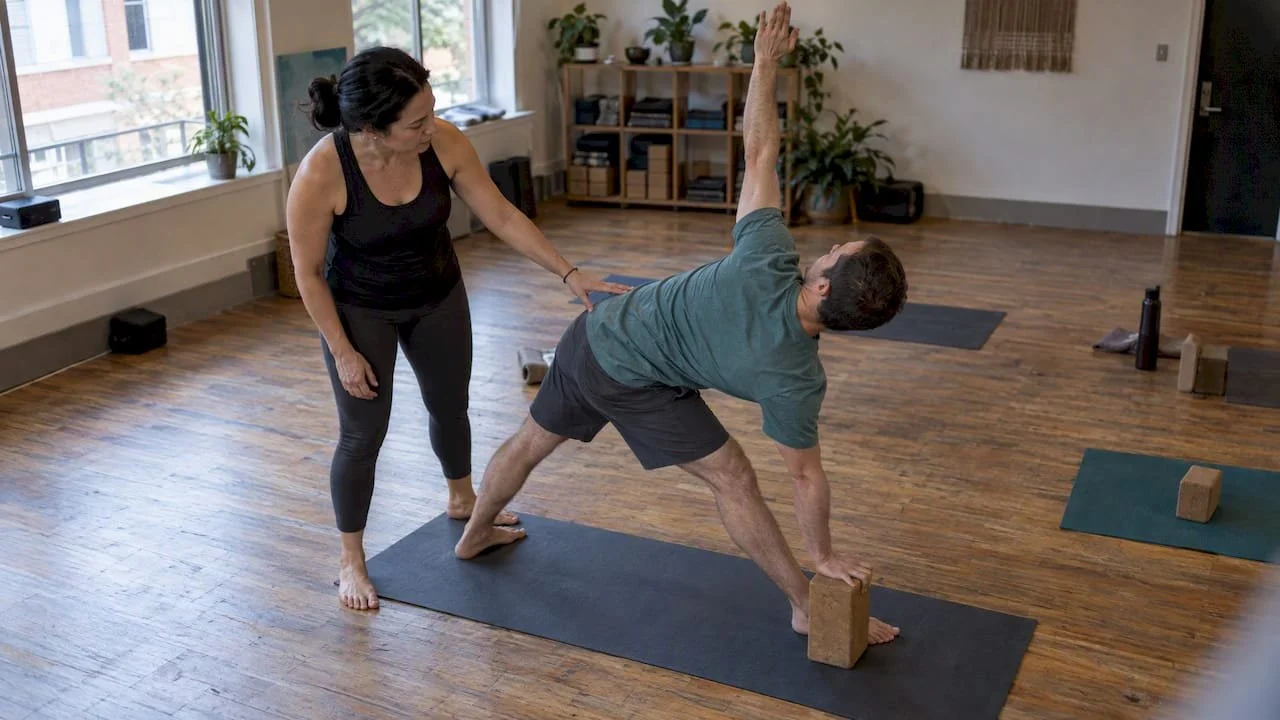
Most yoga injuries trace back to four habits: holding the breath, pushing into a pose instead of easing into it, ignoring alignment or skipping props, and rushing past warm-up and rest. The fix is one simple rule: breathe steadily, stop at sharp pain, and modify before you force a shape. At Amrita Yoga & Wellness, that rule shapes how every class is taught, from beginner mat work to advanced flow.
TL;DR:
Spend five minutes warming up, use blocks or straps to preserve alignment, and finish with at least three to five minutes of stillness.
Increase new intensity or hold times only after about two weeks, and build inversions or deep backbends through supported versions first.
People with glaucoma should get medical advice before inversions, while those with low bone density should avoid forceful backbends and deep spinal flexion.
A light snack with carbohydrates and protein 60 to 90 minutes before class can help, while steady hydration matters most for hot or vigorous sessions.
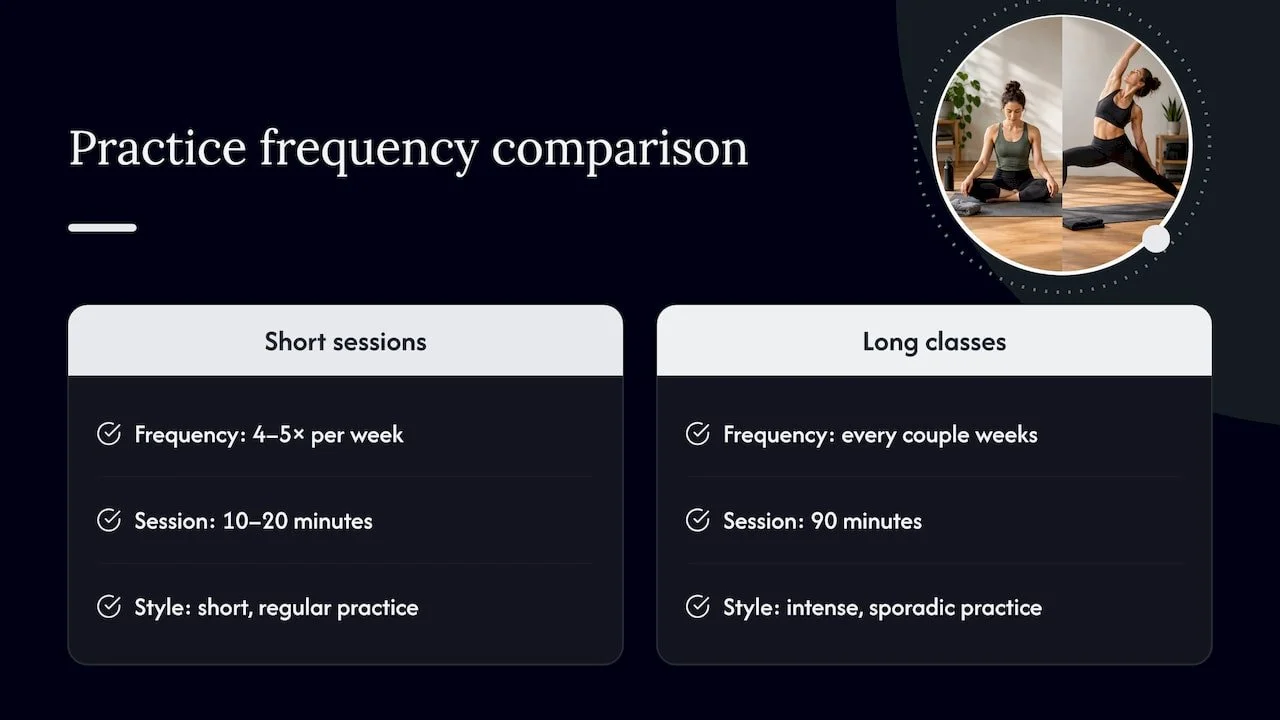
A 10 to 20 minute practice four or five times weekly supports steadier progress than a 90 minute class every few weeks.
Amritayogawellness
Build a Safer Yoga Practice
Explore yoga classes at Amrita Yoga & Wellness, with options for beginners through advanced practitioners in Philadelphia.
Table of Contents
3. How to pick a class, teacher, and props that keep you safe
5. How Amrita Yoga & Wellness builds safety into every class
6. Why hydration and nutrition timing matters more than you think
1. Spot and fix the mistakes that cause most setbacks
These are the errors we see trip up beginners and intermediate practitioners most often, along with the fixes for each.
Holding your breath during hard poses signals tension and cuts off the steady exhale that helps muscles release. Fix: inhale to lengthen, exhale to settle deeper, and never hold air during a stretch.
Chasing the final shape of a pose instead of building toward it gradually strains tissue that is not ready. Fix: work the preparatory version first and let depth come over weeks, not minutes.
Skipping warm-up sends cold muscles straight into deep stretches or backbends. Fix: spend the first five minutes on joint circles and gentle sun salutations before anything intense.
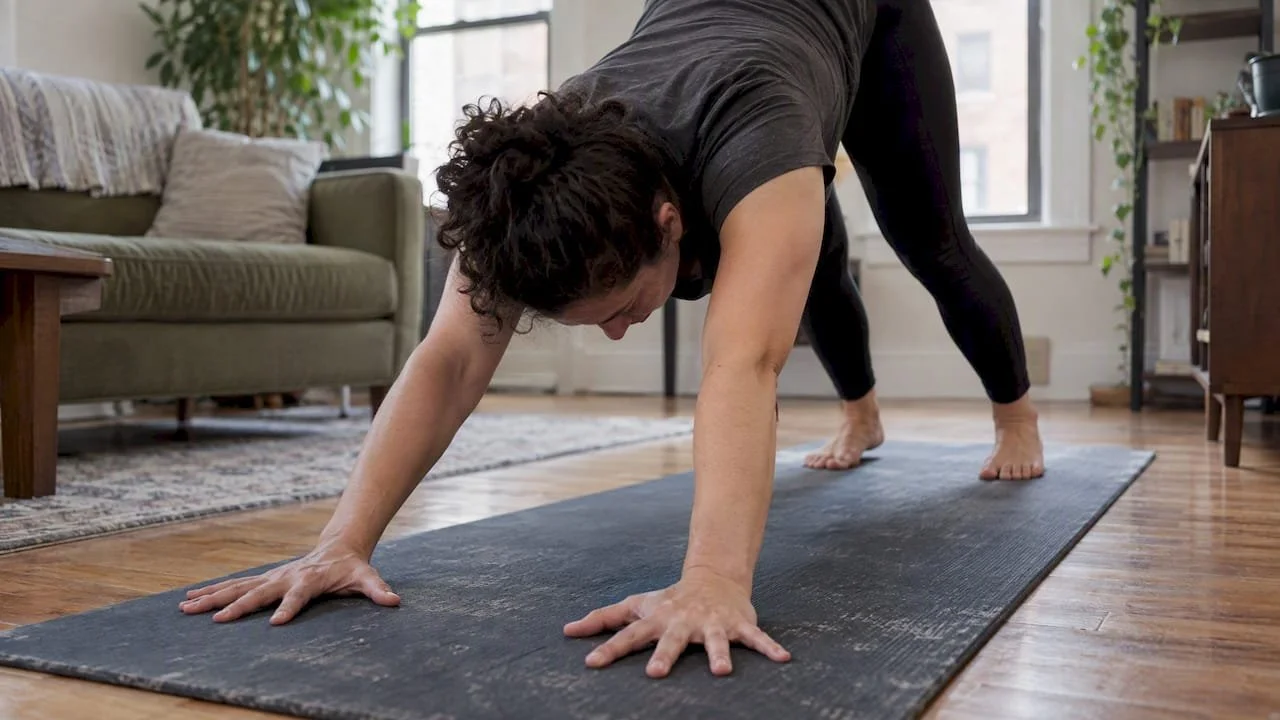
Ignoring alignment cues, like knees collapsing inward in lunges or rounding the lower back in forward folds, loads joints unevenly. Fix: check knee-over-ankle tracking and keep a slight bend in the knees during forward folds.
Refusing props because they feel like a beginner's crutch leaves many poses out of reach safely. Fix: a block under the hand in triangle pose or a strap around the foot in seated stretches changes nothing about the pose's benefit, only its accessibility.
Rushing your own progression, adding inversions or deep backbends before building core and shoulder strength, is a common path to strain. Fix: master supported variations for several weeks before attempting the full expression.
Clenching the jaw, shoulders, or hands during effort wastes energy and masks poor form. Fix: scan your body every few breaths and consciously soften anything that is not doing the work.
Comparing your shape to the person on the next mat pushes people into ranges of motion their joints are not ready for. Fix: measure progress against your own range from last month, not against someone else's flexibility.
Locking the knees or elbows in standing or plank poses stresses the joint instead of the muscle. Fix: keep a micro-bend in any weight-bearing joint.
Skipping shavasana at the end of class cuts the nervous system's transition back to a resting state. Fix: give yourself at least three to five minutes lying still, even on a short practice day.
Pro Tip: If your lower back aches in forward folds, bend your knees more than feels necessary. A softer spine beats a straight-legged stretch that pulls from the wrong place.
Pro Tip: Wrist pain in plank or downward dog often means the weight is sitting in the heel of the hand. Spread your fingers wide and press through the knuckles instead.
2. What the research says about yoga injuries and red flags
A systematic review of epidemiological studies found that most adverse events during yoga practice are mild and transient, typically sprains and strains rather than serious harm. A PLOS One review of case reports and case series examined 76 cases and found that advanced postures like headstand, shoulder stand, and lotus, along with forceful breathing techniques, were disproportionately linked to adverse events affecting the eyes, nervous system, or joints.
Productive discomfort feels like effort or a stretching sensation that eases as you breathe into it.
Sharp, shooting, or persistent pain is a signal to back off immediately and modify the pose.
Numbness, tingling, or dizziness during or after practice warrants a conversation with a clinician.
People with glaucoma should talk with a physician before practicing inversions, since head-down poses can raise intraocular pressure. Those with low bone density face similar caution around forceful backbends, where osteoporosis exercise guidelines recommend gentler, controlled movement over deep spinal flexion.
Most adverse events are mild, but a Cochrane review on yoga for chronic low-back pain found low-certainty evidence that yoga can slightly increase the risk of adverse events, mainly back pain, compared with no exercise at all.
3. How to pick a class, teacher, and props that keep you safe
A good beginner class offers modifications without singling anyone out, gives clear verbal cues about alignment, and uses hands-on or verbal corrections consistently rather than only demonstrating once and moving on.
Before booking, ask:
Does the teacher offer modifications for common limitations like tight hamstrings or wrist pain?
Are props like blocks, straps, and blankets available and actively encouraged?
How does the teacher handle injuries or physical limitations mentioned before class?
Props solve specific problems. A block under the hips in seated poses eases tight hamstrings, a strap looped around the foot extends your reach without rounding the spine, and a folded blanket under the knees protects joints during kneeling poses. Our chair yoga poses for beginners guide covers gentler adaptations for anyone working with limited mobility.
4. Build a practice routine that prevents overuse
A short, repeatable structure beats a long, inconsistent one. Try this order:
Warm up for five minutes with joint circles and easy flows to raise body temperature.
Link breath to movement through sun salutations or gentle standing poses.
Spend the bulk of class on focused strength or flexibility work, choosing one or two target areas rather than everything at once.
Cool down and finish in shavasana for three to five minutes minimum.
For progression, give any new intensity or longer hold time about two weeks before increasing it again. Jumping straight from a beginner backbend to a full wheel pose in one session is how strain happens. Between challenging transitions, use three breaths to reset: one inhale to find length, one exhale to anchor your base, one more inhale to adjust alignment before moving on. Our 10 to 20 minute beginner routines lay out this kind of pacing in full.
Pro Tip: When a transition feels rushed, pause and take one extra breath before moving. Speed is almost never the goal in a beginner or intermediate practice.
5. How Amrita Yoga & Wellness builds safety into every class
As a Philadelphia-based studio, Amrita Yoga & Wellness offers yoga, pilates, barre, tai chi, and massage therapy under one roof, with class structures built around accessibility and community rather than performance. Classes, workshops, and retreats are designed so beginners and advanced practitioners alike can find their level without guesswork. Our beginner's guide to learning yoga poses breaks down foundational postures step by step, supporting the kind of gradual, well-cued progression this article recommends.
6. Why hydration and nutrition timing matters more than you think
Practicing on an empty stomach or after a heavy meal both cause problems, just different ones. Too little fuel before a class, especially a longer or hot yoga session, can lead to lightheadedness or shaky balance during standing poses. A large meal right before practice does the opposite, pulling blood toward digestion and away from the muscles doing the work, which makes twists and forward folds uncomfortable.
A light snack with some carbohydrate and a little protein, eaten 60 to 90 minutes before class, tends to work better than practicing fully fasted or fully stuffed. Hydration matters just as much, particularly for hot yoga or vigorous flow classes where sweat loss is higher. Drinking water steadily through the day works better than chugging a large amount right before class, which can leave you feeling sloshy during inversions or twists.
After practice, rehydrating and eating something within an hour or two supports recovery, especially after a sweatier or more intense session. Skipping this step is a common beginner mistake that shows up as fatigue or a headache later in the day rather than during class itself. None of this needs to be complicated: water, a reasonable snack beforehand, and a real meal afterward cover most of what a regular practice requires.
7. Why consistency beats intensity for real progress
Many beginners treat yoga like a sport they need to master quickly, practicing hard for a week and then stopping for a month. Flexibility, strength, and breath control all build through repetition over time, not through one intense session. A short, 10 to 20 minute practice done four or five times a week moves you forward faster than one 90-minute class every couple of weeks.
Inconsistency also raises injury risk. Tissues adapt to regular, moderate loading, so a body that has not practiced in three weeks is more vulnerable to strain when it suddenly attempts a full class at the same intensity as before. Treating practice like brushing your teeth, something small and automatic, removes the all-or-nothing thinking that causes people to quit.
Setting a realistic schedule matters more than setting an ambitious one. Three short sessions a week that you actually complete build more capability than an ideal five-day plan you abandon after two weeks. Our routines for beginners are built around this kind of manageable repetition rather than marathon sessions.
8. Why staying present changes how your body responds
Running through poses on autopilot, thinking about work or scrolling through a mental to-do list, means missing the cues your body sends about tension, fatigue, or early pain. Mindfulness in yoga is not a separate spiritual add-on. It is the attention that lets you notice a twinge in your knee before it becomes an injury.
Presence also affects breath, and breath affects how a pose feels. A distracted mind tends to hold the breath without noticing, which tightens muscles and makes effortful poses feel harder than they need to. Bringing attention back to the breath, even briefly between poses, resets that pattern.
A simple way to build this habit is to pick one anchor, the sensation of feet on the mat, the sound of your breath, or the weight of your hands in a pose, and return to it whenever your mind wanders. This does not require a separate meditation practice. It just means treating the hour on the mat as a chance to actually notice what is happening in your body instead of performing poses from memory.
9. Why flexibility without strength sets you up for injury
A common misconception is that yoga is purely a flexibility practice, so progress means deeper stretches and little else. Many injuries actually come from being flexible without the muscular control to support that range of motion. A hip that can fold deeply into a split but lacks the strength to stabilize that position under load is more likely to get hurt than a less flexible hip with solid muscular support.
Poses like plank, warrior sequences, and chair pose build the strength that protects joints during deeper stretches elsewhere in a practice. A PLOS One review notes that advanced poses carry more risk partly because they ask joints to move through large ranges without always building the supporting strength first.
Balancing a practice means including strength-focused poses, not just the stretches that feel immediately satisfying. Holding a plank for a few extra breaths or working through a slow, controlled chair pose does as much for injury prevention as any amount of stretching. Our 10 basic poses every beginner should learn includes several that combine both qualities at once.
10. The one cue that fixes several mistakes at once
Instructors often notice the same pattern: students hold their breath right as a pose gets hard, which tightens everything from the jaw to the hips. One fix handles several problems at once. Before your next challenging pose, try a three-breath reset: inhale to find length, exhale to settle your base, inhale again to adjust alignment. Test it in your next class or home session and notice what loosens.
— Juiced
Where to get hands-on correction and guided practice
Reading about alignment only goes so far. A teacher watching your form in real time catches the small habits, like a dropped shoulder or a locked knee, that are hard to feel on your own. Amrita Yoga & Wellness offers both supervised group classes and private sessions for readers who want that kind of direct feedback.
Drop into a group or livestream class to practice alongside an instructor who can adjust your form as you go.
Book a private or small-group session for focused, one-on-one correction on the poses giving you trouble.
Browse our class descriptions to find the style and level that fits where you are right now.
This article is general information, not a substitute for advice from a qualified doctor. Consult a qualified healthcare professional about your own circumstances before acting on anything here.
FAQ
What should you avoid doing right after yoga?
Avoid jumping straight into a cold shower, a heavy meal, or intense activity right after class. Give your body a few minutes in shavasana first, then rehydrate and eat something within an hour or two to support recovery.
Who should avoid certain yoga poses or practices?
People with glaucoma should consult a physician before practicing inversions, since head-down poses can raise eye pressure. Those with low bone density should modify forceful backbends, and pregnant practitioners should avoid prone positions and prolonged time on the back, especially after the first trimester.
What do chiropractors generally think about yoga?
Views vary, but many clinicians support yoga as a complement to other care for back pain when practiced with attention to form. A Cochrane review found small improvements in function and pain for people with chronic low-back pain, alongside a low-certainty increased risk of minor adverse events compared with no exercise.
What are common injuries linked to yoga practice?
Most reported injuries are mild sprains and strains, often in the wrist, shoulder, lower back, knee, or hamstring. A PLOS One review of case reports and case series examined cases and found that advanced postures like headstand, shoulder stand, and lotus, along with forceful breathing techniques, were disproportionately linked to adverse events affecting the eyes, nervous system, or joints.
How do I know the difference between discomfort and an injury?
Productive discomfort feels like effort that eases as you breathe and settle into a pose. Sharp, shooting, or lingering pain, or any numbness and tingling, is a sign to stop and modify, and persistent symptoms deserve a conversation with a clinician.
Sources
Adverse Events Associated with Yoga: A Systematic Review of Published Case Reports and Case Series
Yoga for chronic non-specific low-back pain - Cochrane Review
Head-down yoga poses increase eye pressure in glaucoma patients — American Optometric Association
Recommended

Match Your Goals to Philadelphia Boutique Studios by Neighborhood
Philadelphia's boutique fitness scene spans yoga, pilates, barre, cycling, and small-group strength training, with studios clustered in Old City, Center City, Fishtown, and South Philly. The fastest way to find your fit is to book a drop-in or intro package at one or two studios this week. We built Amrita Yoga & Wellness around that same idea, and resources like ClassPass's Philadelphia market data and the YMCA's small-group training programs confirm the city's appetite for varied, community-driven workouts.
TL;DR:
Boutique fitness growth in Philadelphia relies heavily on community, social events, and personalized instruction, which boost member retention and engagement.
Choosing a studio depends more on schedule fit, instructor background, and vibe than on equipment or reputation, emphasizing trial classes for evaluation.
Pricing typically follows drop-in, class packs, or unlimited memberships, with unlimited plans best for those training multiple times weekly at a single studio.
Instructor qualifications vary, with certifications important in yoga and reformer Pilates, and small classes enabling real-time form correction.
Neighborhood location influences the studio experience, with Old City and Center City offering more community-oriented options, and Fishtown appealing to younger, trendier crowds.
Amritayogawellness
Find Your Philadelphia Wellness Fit
Explore Amrita Yoga & Wellness classes, workshops, retreats, and wellness services for varied practices and community connection.
Table of Contents
How one Philadelphia studio structures inclusive boutique offerings
Why community makes or breaks your boutique fitness experience
What's driving Philadelphia's boutique fitness boom
ClassPass reported a boutique-fitness surge in Philadelphia, with yoga and strength training ranking among the city's dominant genres. That growth tracks with a broader shift toward classes built around connection, not just calories burned.
Old City has become a proving ground for this trend. Local reporting on Old City's boutique studios found that successful spots lean into community events and collaborations that help members form real friendships, something a treadmill row rarely delivers. The same coverage notes that "boutique" increasingly signals high-touch service and belonging rather than a particular piece of equipment.
A few patterns stand out across the city:
Classes increasingly blend movement with social elements like themed nights or post-workout gatherings.
Smaller class sizes let instructors adjust cues in real time instead of shouting generic reps.
Neighborhood identity shapes studio culture almost as much as the workout itself.
Boutique studios in Philadelphia are growing because members want connection, not just a workout. That shift matters when you're choosing where to spend your money: a studio's community feel often predicts whether you'll actually show up in month three.
Boutique studio types and what each one feels like
Most Philadelphia boutique studios fall into a handful of categories, and each serves a different goal.
Yoga studios typically run 60- to 75-minute classes in groups of 10 to 25, ranging from gentle restorative sessions to heated vinyasa flows.
Pilates studios split between mat classes, which mirror a small group fitness format, and reformer sessions on specialized equipment, usually capped at 8 to 12 people.
Barre studios combine low-impact, high-rep movements in 45- to 60-minute classes aimed at muscular endurance rather than max strength.
Indoor cycling studios pair high-intensity intervals with music-driven pacing, often in rooms of 20 to 40 bikes.
Small-group strength and HIIT programs, the kind the Philadelphia YMCA documents in formats like barre, boxing, kettlebells, and TRX, emphasize certified trainers and personalized coaching because the groups stay small.
Recovery-focused studios round out the mix with slower, restorative sessions designed to complement harder training days.
Pro Tip: Book two different modalities in your first week, a flow-based class and a strength-based one, to see which pace actually holds your attention.
Finding boutique studios by Philadelphia neighborhood
Where you train often matters as much as what you train in, especially if you're commuting on foot or by transit.
Old City has become a hub for community-first studios that host events and partner with nearby businesses.
Center City offers the highest studio density and the easiest transit access, convenient for a lunchtime or after-work class.
Fishtown leans younger and trendier, with studios that often double as neighborhood gathering spots.
South Philly mixes longstanding community classes with newer boutique openings, often at friendlier price points.
University City serves students and hospital staff with flexible scheduling around academic and shift calendars.
If your commute options are limited, pick your neighborhood first and let that narrow your modality choices rather than the reverse.
What boutique fitness actually costs in Philadelphia
Pricing in Philadelphia's boutique scene generally follows three shapes: single drop-ins, class packs, and monthly unlimiteds. Drop-ins tend to run higher per class but require no commitment, which suits anyone still shopping around. Class packs reward semi-regular attendance with a lower per-visit rate, and unlimited memberships make the most sense once you're training three or more times a week at one studio.
Drop-in rates are the most flexible but the most expensive per visit.
Class packs typically reward regular attendance over the course of several weeks.
Monthly unlimiteds pay off fastest for people training multiple times weekly at a single studio.
Multi-studio marketplace passes are only cost-effective for people who train across several studios often; a single studio's in-house unlimited is usually cheaper for loyal regulars. Intro offers, community classes, and off-peak time slots remain the simplest ways to sample a studio before committing to a membership tier.
How to choose the right boutique studio for you
Picking a studio is less about finding the "best" one in Philadelphia and more about finding the one that fits your schedule, goals, and personality. Run through this checklist before you book:
Modality fit: does the class style match what you actually enjoy doing, not just what you think you should be doing?
Class size and energy: do you want personal attention or the energy of a packed room?
Instructor background: are trainers certified, and do they offer modifications for beginners?
Schedule overlap: does the studio offer times that realistically fit your week?
Price structure: does a drop-in, pack, or unlimited membership match your expected frequency?
Cancellation policy: how strict are late-cancel and no-show fees?
Overall vibe: does the space feel welcoming the moment you walk in?
Before booking, ask directly: What's your drop-in policy for first-timers? Are modifications offered for beginners? What should I bring?
A simple three-step plan works well: sample one class at two or three studios, evaluate consistency and instructor quality across three total visits, then commit to a membership or move on to the next option.
Pro Tip: Keep a short note after each trial class, noting energy level, instructor attentiveness, and whether you'd come back, so you're comparing facts instead of vague impressions a week later.
How one Philadelphia studio structures inclusive boutique offerings
At Amrita Yoga & Wellness, we structure our Philadelphia offerings around the same checklist points above. Our class lineup includes multiple yoga styles (including hot and aerial formats), pilates mat and group reformer sessions, barre, tai chi, massage therapy, and wellness workshops like tarot readings and breathwork.
We offer beginner-friendly entry points, including a dedicated Nurtured Beginnings pass for people new to the practice.
Our community class format gives newer or budget-conscious students a lower-cost way to sample group training.
We offer membership tiers structured to fit different budgets and attendance levels.
We built these formats around inclusivity and approachability for every experience level, which maps directly to the schedule, price, and beginner-support questions worth asking any studio you're considering.
Trial class and cancellation policies worth checking
Before you commit to any Philadelphia boutique studio, read the trial and cancellation terms closely, because they vary widely between businesses. Some studios offer a free or discounted first class, while others only sell discounted intro passes covering several visits.
Local guides on the city's fitness scene generally advise sampling intro offers before committing to a membership, since the right workout depends heavily on your personal goals and schedule rather than a studio's reputation alone. That advice holds regardless of modality: a trial class tells you more in 60 minutes than any class description can.
Cancellation policies typically require canceling a spot 12 to 24 hours before class to avoid a late fee, and no-shows are often billed at the full class rate. Membership cancellations usually require written notice with a set number of days' lead time, so ask about that window before you sign up for anything longer than a single month.
If recovery or complementary care factors into your routine, it's worth asking a studio whether they coordinate with outside providers like OsteoStrong Tysons VA in-person wellness sessions. Some Philadelphia-area clients pair their fitness routine with adjunct care such as chiropractic services for mobility work, which some studios can point you toward even if they don't offer it directly.
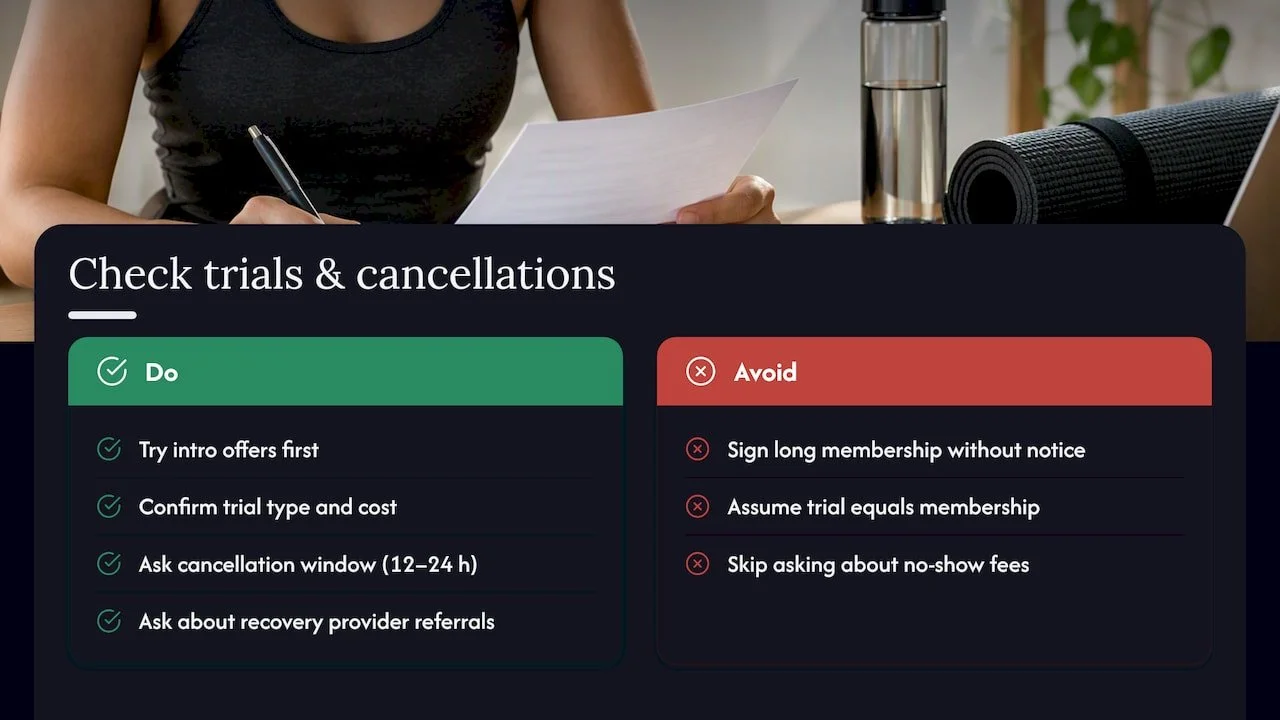
Instructors' qualifications and training styles
Instructor quality varies more than most people expect walking into a new studio, so it's worth asking directly about certifications and specialties before you book a series of classes. Yoga instructors in Philadelphia commonly hold 200-hour or 500-hour teacher training certifications, while pilates instructors, especially those teaching reformer work, typically complete equipment-specific certification programs separate from general fitness credentials.
For strength and small-group formats, the YMCA's small-group training programs emphasize certified trainers delivering personalized coaching precisely because class sizes stay small enough for real-time correction. That same logic applies across the city's boutique scene: smaller rooms let instructors actually watch your form instead of calling out cues to a crowd.
Training styles differ by instructor even within the same modality. Some lean heavily into alignment and injury prevention, others prioritize pacing and music-driven energy, and some focus on breathwork and mental components alongside the physical workout. Asking a studio about an instructor's background before your first class, rather than after a frustrating session, saves time and often money.
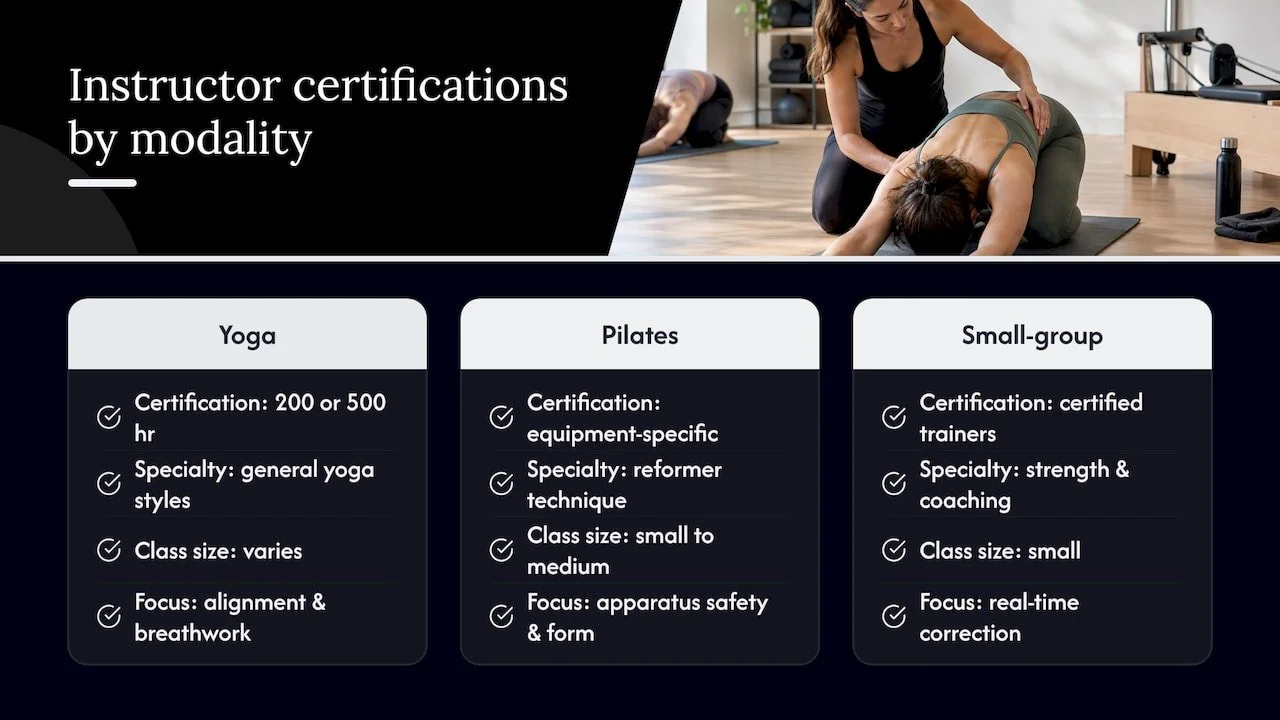
Why community makes or breaks your boutique fitness experience
The studios that keep people coming back aren't always the ones with the flashiest equipment. They're the ones where someone remembers your name by the third visit. If you're testing studios, judge the room's energy as closely as the workout itself.
— Juiced
Try a class at Amrita Yoga & Wellness
We built our Philadelphia studio around the same community-first approach this guide describes: inclusive class formats, beginner-friendly structure, and flexible membership shapes that fit different schedules and budgets.
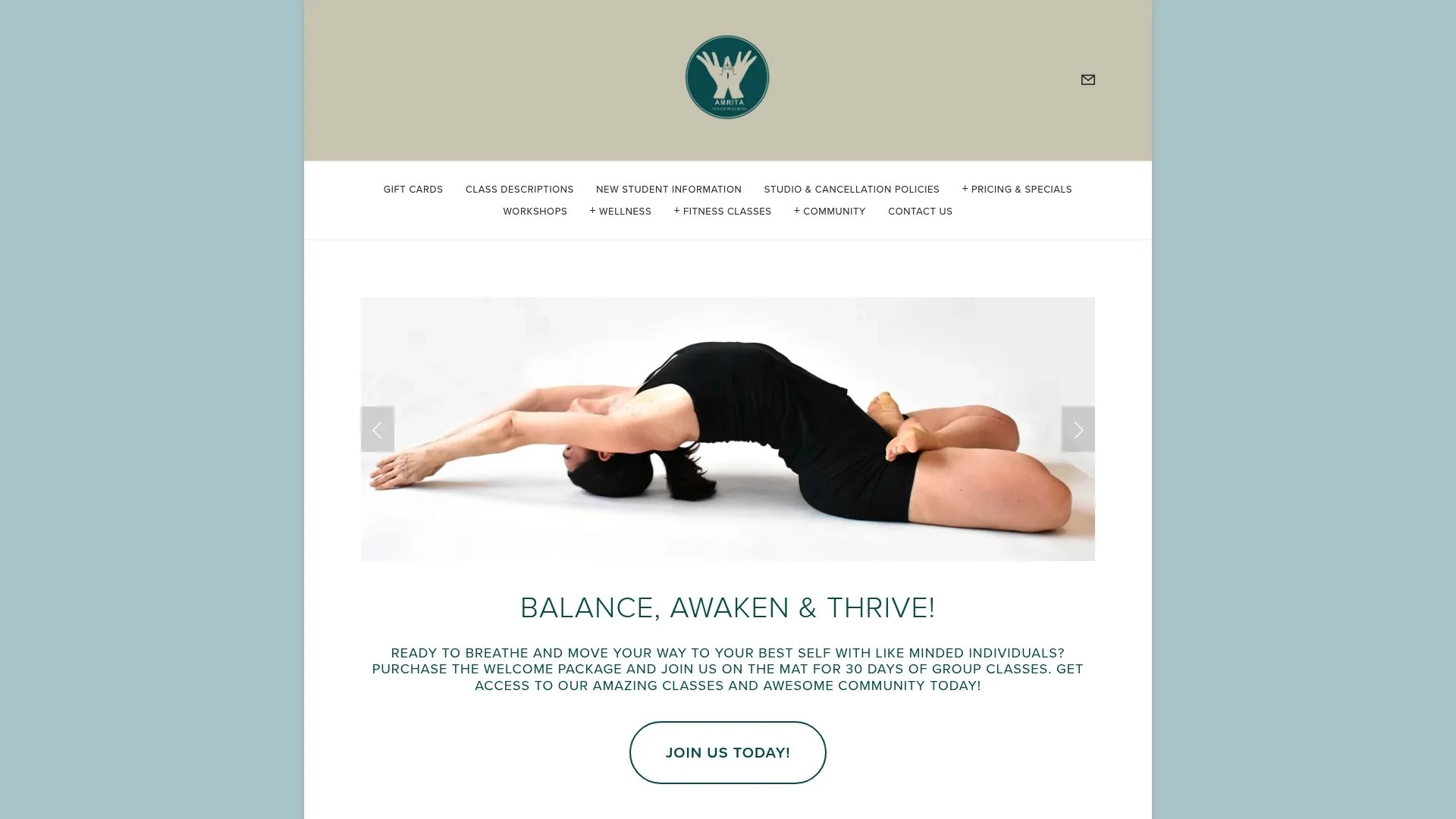
If you want to see what a session actually looks like before booking, our class descriptions break down format and intensity for every offering, from restorative yoga to group reformer pilates. When you're ready to try one in person, our drop-in and class-pack options let you sample a single class without committing to a membership. Use that first visit to judge fit the same way you would at any studio on your shortlist.
FAQ
Is there a fancy gym in Philadelphia?
Philadelphia has several premium boutique studios with upscale amenities like recovery lounges, specialty lighting, and curated playlists, particularly in neighborhoods like Old City and Center City. Local guides describe these as experience-driven spaces rather than traditional gyms, built around atmosphere as much as equipment.
How much does boutique fitness cost?
Boutique fitness pricing in Philadelphia typically follows drop-in, class-pack, or monthly unlimited structures, with unlimiteds paying off fastest for frequent single-studio attendance. At our studio, for example, a Group Class Drop In runs $28 per session, while our Earth Monthly Membership is $119 per month for unlimited group classes.
What is the 3-3-3 rule for fitness?
Definitions of this rule vary across fitness sources, and no single boutique-fitness authority defines it the same way. If you encounter it while researching Philadelphia studios, treat it as general guidance rather than a standard every studio follows.
Why is Gen Z so obsessed with the gym?
Reporting on Philadelphia's fitness scene points to younger members prioritizing social connection and experience-driven classes, not just physical results, which helps explain demand for mood-and-movement formats with music, lighting, and recovery add-ons. Local coverage of Old City's boutique studios found that community events and collaborations, not just workouts, are a major draw for younger members.
Sources
How boutique fitness is offering a different kind of experience in Philadelphia’s Old City
The Complete Guide to Philadelphia's Best Workout Classes and Fitness Trends
Recommended

Find Your Breathwork Style: 6 Purpose Groups for Beginners
Breathwork is the deliberate use of breathing patterns to influence your nervous system, mood, and physical state. The main families you will encounter are slow-paced and diaphragmatic techniques, yogic pranayama, clinical breathing retraining, and expressive or fast-paced methods. Slow-paced approaches have the strongest, most consistent evidence for easing stress and anxiety, which makes them the natural starting point for most people.
TL;DR:
Slow-paced diaphragmatic breathing is the most supported method for easing stress and anxiety with minimal risk, especially for beginners.
Multi-session, guided breathwork programs lasting at least five minutes show higher effectiveness than single, self-directed sessions.
Techniques like diaphragmatic breathing, box breathing, and 4-7-8 breathing are simple, low-risk options suitable for most people.
Fast-paced or intense methods such as holotropic or Wim Hof require supervision due to risks of dizziness, hyperventilation, or physiological distress.
People with respiratory or cardiovascular conditions should consult a healthcare professional before practicing more vigorous or breath-holding techniques.
Amritayogawellness
Explore Guided Breathwork Practice
Amrita Yoga & Wellness offers breathwork workshops alongside yoga, Pilates, barre, tai chi, and massage therapy in Philadelphia.
Table of Contents
What breathwork actually means
Breathing on purpose, rather than letting it run on autopilot, shows up across nearly every wellness tradition. Yogic pranayama has roots going back thousands of years in South Asia, Qigong uses breath to move energy through the body in Chinese practice, and shamanic traditions in various cultures use fast or circular breathing to shift consciousness. Contemporary therapeutic breathwork borrows from all of these while adding a clinical layer aimed at measurable outcomes.
Most people come to breathwork for one of four reasons: to calm a racing mind, to sharpen focus before a demanding task, to build better emotional regulation over time, or to manage a respiratory condition like asthma. The right technique depends heavily on which of those goals you are chasing, which is why a single "best" breathwork method does not really exist.
Terminology gets muddled fast, so it helps to separate three terms. "Breathwork" is the broad umbrella covering any intentional breathing practice. "Pranayama" refers specifically to the yogic system of breath control, with named techniques and traditional sequencing. "Breathing retraining" is the clinical term used by physiotherapists and respiratory specialists for structured programs that correct dysfunctional breathing patterns, often tied to asthma or chronic hyperventilation. You will see all three words used loosely in studios and online content, but knowing the distinction helps you find the right resource.
What the research actually supports
A meta-analysis of randomized controlled trials found that breathwork produces small-to-moderate reductions in self-reported stress, anxiety, and depressive symptoms, with effect sizes of g = −0.35 for stress, g = −0.32 for anxiety, and g = −0.40 for depressive symptoms.
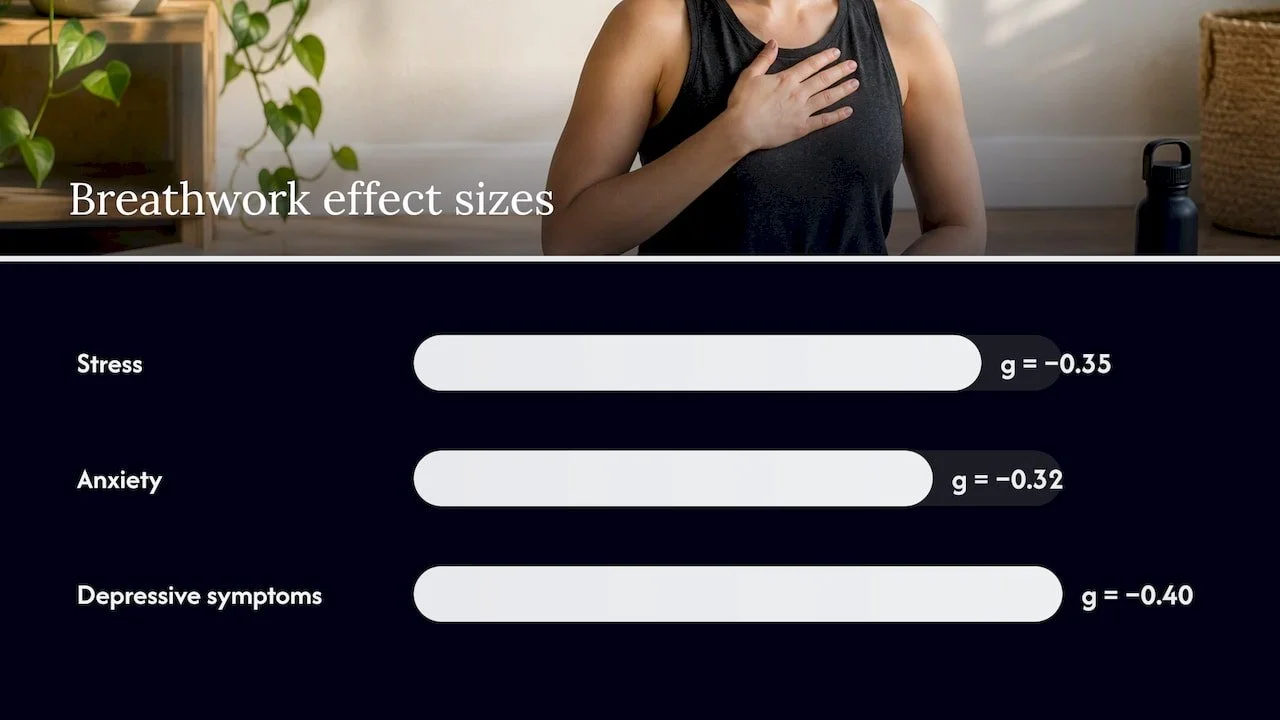
Small-to-moderate effect sizes (g = −0.32 to −0.40) for anxiety and depressive symptoms mean breathwork helps, but it is not a dramatic fix on its own. Researchers behind that review also flagged a gap between the hype around branded breathwork modalities and what the data actually shows: the rhythmic act of breathing slowly may explain much of the benefit rather than any particular trademarked method.
A separate systematic review looked at what made breathing interventions actually work. It found that programs using multi-session, human-guided training, with sessions lasting at least roughly five minutes, were more consistently effective than single, self-directed sessions. Out of 72 interventions reviewed, 54 were identified as effective, and slow, diaphragmatic breathing showed up as the most common ingredient among the successful ones.
There is a real caveat worth sitting with. Trials in this space are heterogeneous, meaning they measure different outcomes with different populations and different session lengths, and some benefit likely comes from the attention and structure of a guided program rather than the breathing technique alone. That does not erase the findings, but it does mean claims of a single miracle method deserve skepticism.
The practical takeaway: if you are new to this, start with slow-paced or diaphragmatic breathing. It has the broadest support, the lowest risk, and it sets a foundation before you try anything more intense.
Types of breathwork and how to practice each one
Breathwork techniques generally sort into six purpose-driven groups. Pick based on your goal first, your comfort level second.
Foundational slow-paced breathing builds the base for almost everything else.
Diaphragmatic breathing is belly breathing that engages the diaphragm instead of the chest, best for anyone new to breathwork or dealing with everyday stress; inhale through the nose and let your belly expand, exhale slowly, practiced for 5 to 10 minutes lying down to start, with no major safety concerns for most people.
Coherent breathing paces inhales and exhales to around five to six breaths per minute, fitting people who want a measurable calming effect tied to heart rate variability; inhale for about five seconds and exhale for about five seconds, typically for 5 to 10 minutes seated, and it carries little risk beyond mild lightheadedness if you push the pace too hard at first.
Paced slow breathing is a looser version of coherent breathing without strict timing, suited to beginners who find counting distracting; simply slow your breath rate below your resting pace and keep it smooth, for 5 minutes or more, with the same low risk profile.
Paced and patterned calming techniques add structure for people who like a clear count to follow.
Box breathing, also called square breathing, inhales, holds, exhales, and holds again for equal counts, often four seconds each. It works well for people who want a mental anchor during acute stress, such as before a presentation, and sessions of 3 to 5 minutes are typical. The breath holds can trigger lightheadedness in beginners, so starting with shorter counts is wise.
4-7-8 breathing inhales for four counts, holds for seven, and exhales for eight, making it a favorite for winding down before sleep. It suits people dealing with racing thoughts at bedtime, and most people do four to eight cycles per session. The extended hold and exhale can feel uncomfortable at first, so easing into the counts over several sessions helps.
Pursed-lip breathing has you inhale through the nose and exhale slowly through pursed lips, a technique borrowed directly from respiratory medicine for people managing breathlessness. It fits anyone with chronic obstructive pulmonary disease or exercise-induced breathlessness particularly well, and it can be used in short bursts whenever shortness of breath strikes, with essentially no downside when done gently.
Yogic pranayama carries traditional names and specific physical techniques, and our pranayama resources go deeper into how these integrate with a full practice.
Alternate nostril breathing, or Nadi Shodhana, closes one nostril at a time while breathing through the other, suited to people seeking balance and mental clarity before meditation; practiced for 5 to 10 minutes, it is gentle for most practitioners.
Ujjayi breath creates a soft ocean-like sound by slightly constricting the throat on each breath, commonly paired with movement in a vinyls yoga class; it is used throughout a practice session rather than as a standalone exercise, and it is low risk for nearly everyone.
Kapalabhati, or skull-shining breath, uses forceful, rapid exhales with passive inhales, appealing to practitioners wanting an energizing jolt; it is typically done in rounds of 20 to 30 breaths. It is not recommended during pregnancy or for anyone with high blood pressure, glaucoma, or a hernia, and first attempts go better under direct instruction.
Clinical and retraining techniques are built around measurable respiratory outcomes rather than a meditative feel.
The Buteyko method teaches reduced-volume nasal breathing to address chronic over-breathing, aimed specifically at people with asthma or hyperventilation patterns. Programs run over weeks with short daily practice sessions. Breathing retraining for asthma more broadly has been shown to improve symptoms and reduce reliever medication use over 6 to 12 months, with trials reporting reductions of roughly 1.5 to 2.5 puffs per day when programs include sufficient patient contact. These approaches genuinely benefit from a qualified respiratory physiotherapist rather than a self-taught attempt, since short one-off sessions rarely produce lasting change for a clinical population.
Intense and expressive methods sit at the far end of the intensity spectrum and carry the most caveats.
The Wim Hof Method combines cycles of forceful breathing with breath retention and cold exposure, drawing people who want an intense physiological reset or an energy boost. Sessions often run 10 to 20 minutes across several rounds. Because it involves voluntary hyperventilation, it can cause dizziness, tingling, or fainting, and it should never be practiced in water or while driving. Holotropic and transformational breathwork use sustained rapid breathing, often with music, to access altered states or process emotion, appealing to people exploring deeper personal or therapeutic work. Sessions typically last 60 to 120 minutes and are guided in groups or one-on-one. The systematic review of breathing interventions found that this style of prolonged forced hyperventilation carries real potential to provoke anxiety or physiological distress, so a supervised setting matters here more than almost anywhere else in breathwork.
Quick energizers and calmers round out the list as short, accessible tools.
Lion's breath combines a wide-mouth exhale with a stuck-out tongue and an audible roar, useful for releasing tension or facial stress in a single round or two. Humming bee breath, or Bhramari, closes the eyes and ears while humming on the exhale, creating a vibration that many people find calming within just a few rounds. Neither carries meaningful risk for most healthy adults.
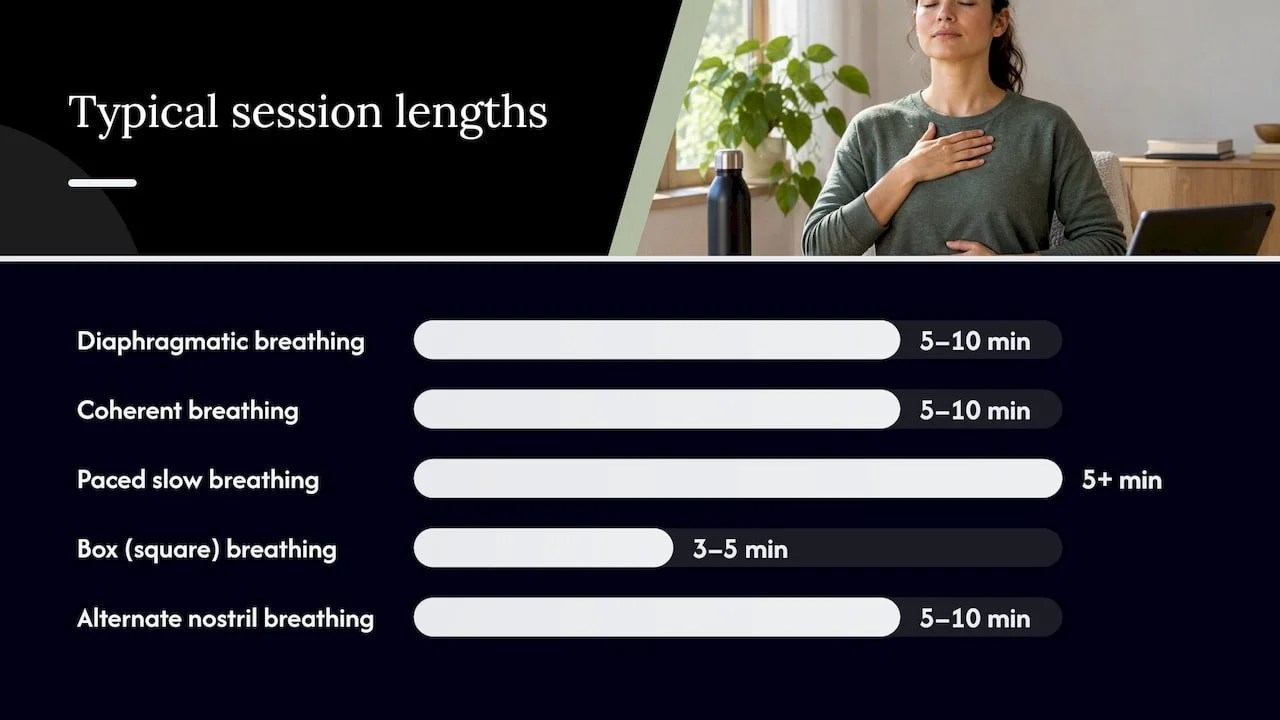
How to start a breathwork practice safely
A sustainable practice beats an intense one you abandon after a week. Here is a simple way to begin.
Week one: Practice diaphragmatic breathing for 5 minutes daily, lying down, right after waking or before bed.
Week two: Extend to 10 minutes and move to a seated position once lying down feels automatic.
Week three: Introduce one paced technique, such as box breathing or coherent breathing, for 5 minutes alongside your diaphragmatic practice.
Week four: Try a guided class or workshop session to see how a teacher's cues change the experience before adding any higher-intensity method.
Sessions of at least five minutes, repeated across multiple sessions, consistently outperform single, one-off attempts in research on breathing interventions. Consistency does more work than intensity, especially in the first month.
When choosing guided instruction, whether a class, workshop, or private session, look for a few things: a teacher who can explain the physiological reasoning behind a technique, clear verbal cues you can follow with your eyes closed, the ability to modify a practice for a health condition you disclose, and a calm, unhurried pace that never pressures you into breath holds you are not ready for.
Pro Tip: Pair your breathwork minutes with something you already do daily, like brewing coffee or brushing your teeth, so the habit attaches to an existing cue instead of relying on willpower alone.
Safety signs and when to stop
Mild lightheadedness, tingling in the fingers, or a brief wave of emotion can happen during breathwork, especially with faster techniques. If that happens, pause, sit or lie down, breathe gently through your nose, and stop the session if symptoms do not settle within a minute or two.
Persistent breathlessness, dizziness, chest tightness, or a racing heart outside of practice can signal a breathing pattern disorder, where chronic over-breathing or chest-dominant breathing has become habitual. These patterns typically respond to physiotherapist-led retraining rather than a general wellness class, and a referral is worth pursuing if symptoms linger.
Specific caution applies to people with asthma, cardiovascular disease, epilepsy, psychosis, or those who are pregnant. Fast or breath-holding techniques in particular can interact poorly with these conditions, so checking with a physician or a qualified practitioner before trying anything beyond slow diaphragmatic breathing is a reasonable baseline for safety.
How our studio supports safe breathwork learning
We built our class and workshop formats around the same principle the research points to: guided, repeated practice beats a single unsupervised attempt. We offer pranayama-focused sessions and breathwork workshops that provide direct instruction and the chance to ask questions in real time, rather than guessing from a video. We also cover how breath integrates into yoga and into Pilates on our blog, which is useful if you want to see how breathwork fits into a broader movement practice rather than standing alone. Our breathwork benefit posts walk through what different techniques tend to offer so you can match a class to your goal before you book.
Finding the breathwork style that actually fits you
The biggest mistake we see is people jumping straight to the most intense technique they heard about, usually something fast and dramatic, without building any foundation first. Start slow. Notice how your body responds to a gentle five-minute session before adding breath holds or rapid cycles. The calmest, least glamorous techniques are the ones with the sturdiest evidence behind them, and trying a few different styles over a month or two will tell you more about what fits than reading about them ever will.
— Juiced
Try guided breathwork at our studio
Reading about breathwork only gets you so far. The techniques with the strongest track record, slow and diaphragmatic breathing especially, work best when a teacher can watch your pace and adjust cues in real time, and that is exactly what our in-studio sessions are built for.
A few ways to start: guided group classes, personalized one-to-one sessions, or combined breathwork and restorative therapies are available.
None of this replaces medical care for a diagnosed respiratory or cardiovascular condition, but it does give you a structured, supervised way to build the habit. Browse our class schedule and find a session that matches where you are starting from.
FAQ
What are the 14 breathing styles?
There is no single, universally agreed list of specific breathing styles. Breathwork is better understood as a handful of purpose-based families, slow-paced, pranayama, clinical retraining, and expressive or intense techniques, within which dozens of named variations exist depending on the tradition or teacher.
What is 4-7-8 4-7-8 breathing?
4-7-8 breathing is a paced technique where you inhale for four counts, hold for seven, and exhale for eight, usually repeated for four to eight cycles. It is commonly used to wind down before sleep or to interrupt a stress response, and most people find the extended exhale produces a quick calming effect.
What are the most popular breathwork techniques?
Diaphragmatic breathing, box breathing, 4-7-8 breathing, and alternate nostril breathing are among the most widely practiced techniques because they are simple to learn and low risk. The Wim Hof Method and holotropic breathwork have also grown in popularity, though they call for more caution and ideally supervised instruction.
How many breathwork types are there?
The exact count varies by source since techniques are often renamed or combined across traditions, so there is no fixed number. It is more useful to think in terms of five or six purpose-driven groups covering calming, energizing, clinical retraining, and expressive practices, each containing several named techniques.
Do I need a teacher to start breathwork?
You can start slow diaphragmatic breathing safely on your own, but research on breathing interventions found that guided, multi-session programs produce more consistent results than single self-directed attempts. Guidance becomes especially important once you move toward faster or breath-holding techniques, where a qualified instructor can adjust pacing for your comfort and health history.
Sources
Recommended

Master 7 Intermediate Yoga Transitions With Teacher Tested Drills
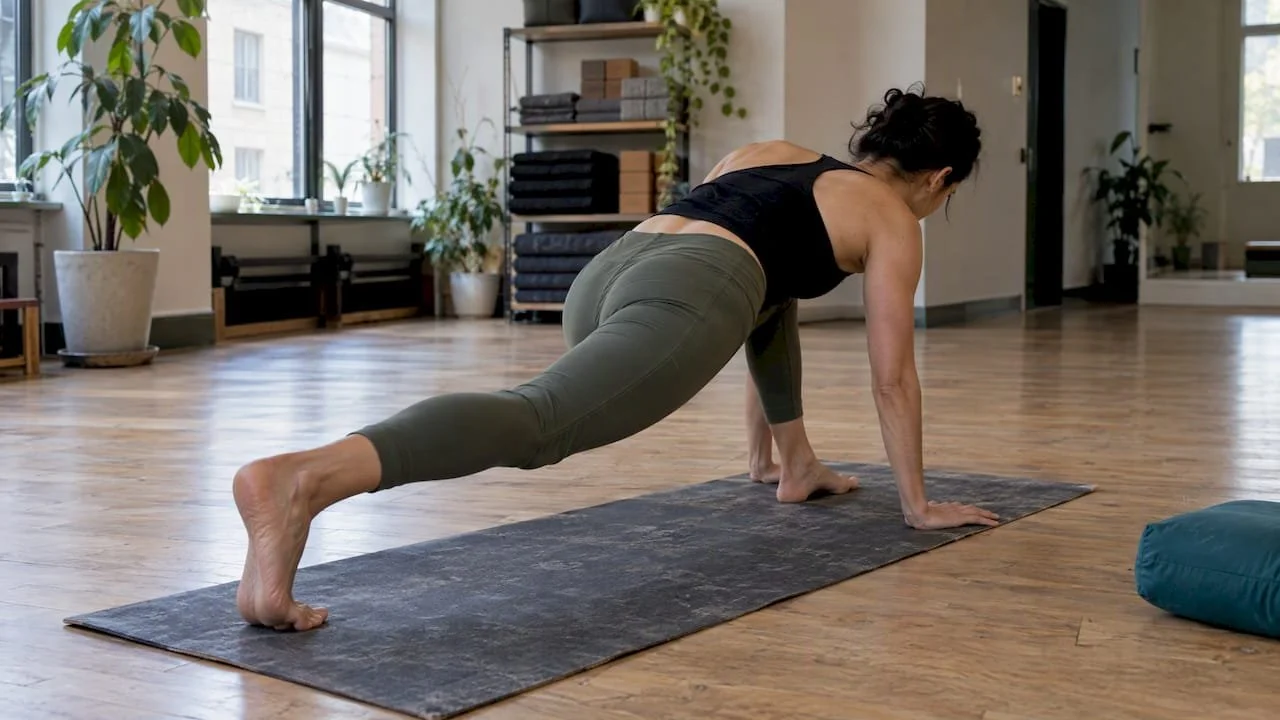
Intermediate yoga transitions are the breath-linked movements that carry you from one posture into the next, and the skill lives in the movement itself, not just the poses on either side. A few you can use today: Chair into High Lunge, Triangle into Half Moon, Downward Dog into Warrior I, and Plank into Side Plank. Each one rewards slow, breath-mapped attention over speed.
TL;DR:
Properly practicing breath-linked transitions enhances alignment and stability, requiring slow, mindful movements rather than rushing through to poses.
Repeating each transition five times with focus on form helps build muscle memory and confidence before integrating into full sequences.
Using props like blocks or walls can lower injury risk and improve stability during complex transitions, especially for beginners or those regressing.
Different sequencing patterns—one-and-done, ladder flow, and step-by-step—serve distinct goals, from precision to skill building and preparation for advanced poses.
Isolating mobility and strength drills, such as thoracic rotations and core activation, accelerates progress in transitions more effectively than only practicing full movements.
Amritayogawellness
Refine Your Yoga Transitions
Explore yoga classes, workshops, and wellness practices at an inclusive Philadelphia studio supporting mindful movement and personal growth.
Table of Contents
Examples of intermediate transitions and how to move through them
Once you can hold intermediate postures, the next skill is connecting them without losing alignment. Here are transitions worth practicing on repeat, each with a breath cue and a way to adjust the difficulty.
Chair to High Lunge: inhale to rise through Chair, exhale to step one foot back into a lunge, keeping the front knee tracking over the ankle rather than drifting inward.
Triangle to Half Moon: inhale as you shift weight into the standing leg and lift the back leg into Half Moon; a block under the bottom hand shortens the lever and steadies the hips.
Downward Dog to Warrior I: draw the knee forward using core engagement, then inhale to rise into the lunge and stack the torso upright; stepping the foot halfway forward first makes this more approachable.
Plank to Side Plank: shift weight onto one hand, inhale to stack the hips and open the chest, exhale to lengthen through the top fingertips; dropping the bottom knee removes much of the load.
Low Lunge to Extended Side Angle: inhale to open the chest and rotate, exhale to anchor the back heel and extend the top arm overhead.
Twisted Chair to Twisted High Lunge: combine rotation with a lift of the back heel, moving the spine and hips together rather than twisting from the shoulders alone.
Low Lunge step-through to Half Moon with an arm-balance lead-in: floating the back leg through to a bent-knee hover builds the hip flexion and shoulder stability needed before attempting poses like Eka Hasta Bhujasana.
Each of these treats the movement between postures as its own event rather than a gap to rush through, which matches how intelligent sequencing builds from simple actions toward more complex ones.
Pro Tip: Practice each transition five times slowly before adding it to a full flow; speed should come last, not first.
How sequencing patterns organize your transition practice
Three sequencing patterns show up again and again in intermediate classes, and each serves a different goal.
One-and-done: you move through a sequence once with full attention to alignment, useful when the goal is precision rather than repetition.
Ladder flow: you repeat a short sequence while adding one new transition each round, which builds skill gradually without overwhelming the nervous system.
Step-by-step: you break a complex transition into its component parts, practice each part on its own, then link them together once each piece feels stable.
Choosing between them depends on what you want from the practice: ladder flow suits skill-building days, one-and-done fits a cardio-focused flow, and step-by-step works best when preparing for something genuinely new like an arm-balance entry. Across all three, teachers often repeat 'landmark actions' such as pressing through the outer heel or drawing the ribs in, so the same cue transfers to unfamiliar transitions without extra instruction.
Drills that build the physical pieces of a transition
Transitions draw on specific mobility and strength qualities, and isolating them speeds up progress more than repeating the full movement over and over.
Hip mobility: a Lizard-to-Malasana flow opens the hips and hamstrings needed for leg-over-arm actions in arm balances.
Thoracic rotation: pairing a quad stretch with Thread-the-Needle or a seated twist frees the upper spine for deeper rotations in poses like Revolved Side Angle.
Core and bandha activation: hollow-body pulses, supported jump-through holds, and standing one-leg balances train the stability that transitions depend on.
Arm strength: progress from Tripod hold toward Crow prep, then add Chaturanga negatives and Plank shoulder taps to build pressing strength gradually.
Props matter here: a block under the hand, a strap around the feet, or a wall behind the hips lets you train the same pattern with less load. Aim for 5 to 8 slow repetitions per drill rather than rushing to full expression.
Pro Tip: Treat drills as their own practice, not a warm-up to skip through: five focused minutes on thoracic rotation can unlock a twist you have been forcing for months.
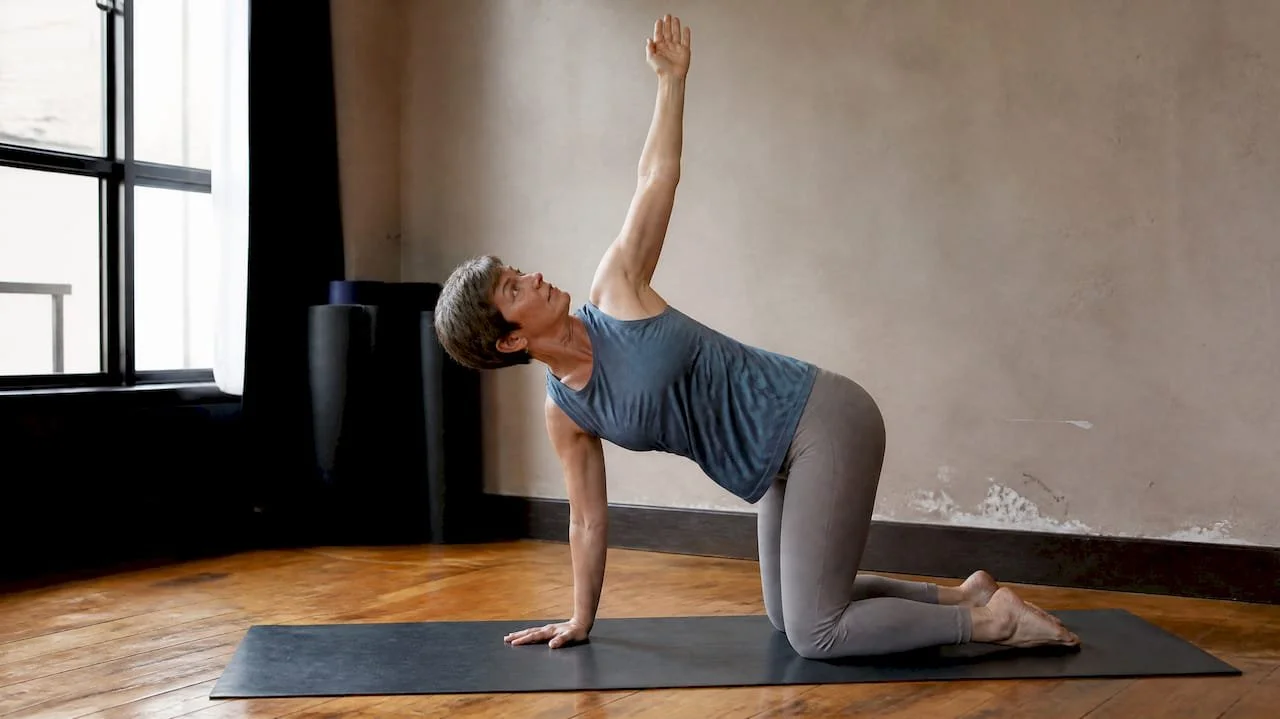
Staying safe and knowing when to regress a transition
Transitions carry more injury risk than static holds because attention tends to jump ahead to the next pose instead of staying in the movement itself. Treating the transition itself as a pose, with steady breath and a fixed gaze, lowers that risk considerably.
Shorten the lever (bend the working knee) when a straight-leg transition feels unstable.
Drop the back knee to the floor in lunges and side planks when the core cannot yet control the full pose.
Place a block under the hand in standing poses to reduce the reach and stabilize the hips.
Move slowly between floor and standing postures, since fast changes can trigger lightheadedness as blood pressure adjusts.
ACE's regression guidance frames these choices as smarter technique, not a lesser version of the pose. A well-fitted mat also matters here: better grip and traction reduce slip risk during dynamic entries like Side Plank or Half Moon.
A sample intermediate flow with breath counts
This sequence runs about 12 postures and works well as a stand-alone practice or as the center of a longer class.
Chair, 5 breaths, inhale to rise.
Chair to High Lunge, exhale to step back, 5 breaths.
High Lunge to Half Moon, inhale to lift, 3 breaths each side (regression: keep fingertips on a block).
Half Moon to Warrior II, exhale to lower, 3 breaths.
Warrior II to Extended Side Angle, inhale to extend, 5 breaths.
Extended Side Angle to Triangle, exhale to straighten the front leg, 5 breaths.
Triangle to Twisted Chair, inhale to rise and rotate, 3 breaths.
Downward Dog, 5 breaths.
Downward Dog to Plank, inhale to shift forward, 3 breaths.
Plank to Side Plank, exhale to open, 3 breaths each side (regression: bottom knee down).
Child's Pose, 5 breaths.
Seated twist to close, 5 breaths each side.
Once this flow feels steady, progress it by adding the Low Lunge step-through to Half Moon described earlier, or by shortening breath counts to build more cardio demand. For readers building toward a faster-paced class, our guide on hot vinyasa preparation covers how to adjust pacing for heat and intensity.
What years of teaching transitions have taught us
Students rarely fail a transition because they lack strength. They fail it because they rush the breath to match the shape they picture in their head rather than the one their body is actually in. Our studio teaches across styles from gentle to hot vinyasa, and the drills and sequencing patterns above come directly from how we build classes for practitioners at this stage.
— Juiced
Practice these transitions with guided feedback
Reading about a transition only gets you so far: a teacher watching your knee track or your hip height catches details you cannot feel on your own. Our Group Class Drop In gives you that live feedback inside a full sequence, while a One to One Session lets you isolate a single transition, like Half Moon or an arm-balance entry, and work it until it feels steady.
Book a drop-in class to practice transitions inside a guided flow.
Schedule a private session for focused coaching on one specific transition.
Review our class descriptions to find the format that matches your current level.
Ready to put these transitions into practice? Check our class schedule and find a time that works for you.
FAQ
What are some examples of intermediate yoga sequences?
An intermediate sequence typically moves through standing postures connected by breath-linked transitions, such as Chair into High Lunge into Half Moon, followed by a Plank to Side Plank series. The sample 12-pose flow above shows how these pieces link together with specific breath counts.
What are some interesting yoga transitions?
Transitions that combine rotation with balance tend to stand out, such as Twisted Chair moving into Twisted High Lunge, or a Low Lunge step-through that floats into Half Moon as a lead-in to arm-balance work. These ask for coordinated breath, core engagement, and hip mobility rather than one isolated skill.
What are 10 intermediate yoga poses?
Common intermediate postures include Half Moon, Warrior I, Warrior II, Extended Side Angle, Triangle, Side Plank, Revolved Side Angle, Twisted Chair, High Lunge, and Crow prep. Each one appears in the transitions and sample sequence described earlier in this guide.
What are considered intermediate yoga poses?
A pose generally counts as intermediate when it asks for balance, rotation, or sustained core engagement beyond what beginner postures require, such as Half Moon or Side Plank. Intelligent sequencing guidance recommends building the mobility and strength for these poses before adding them to a flow.
Recommended

150–300 Minutes a Week: Movement Benefits, Mood Winners, Habit Tactics
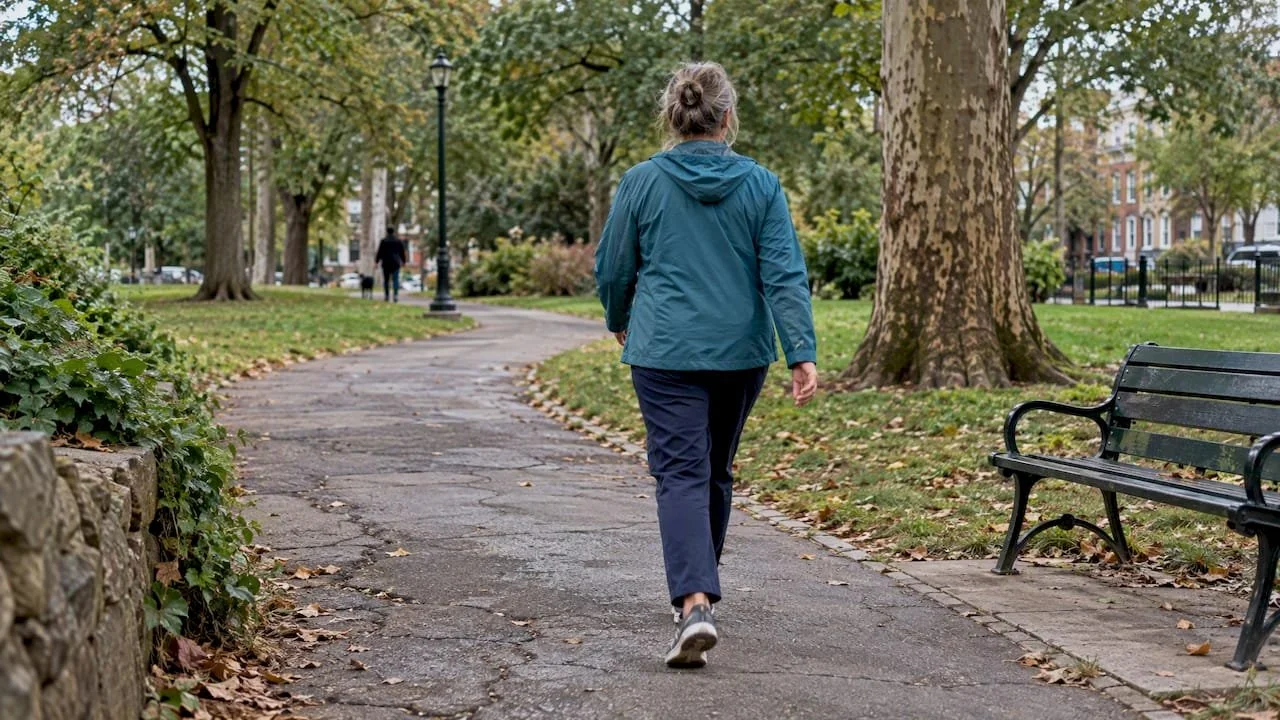
Regular movement practice reliably lifts mood, lowers risk for major chronic diseases, preserves strength and mobility with age, and supports better sleep and sharper thinking. Guidance from the World Health Organization and the CDC, along with large reviews of clinical trials, consistently point to the same conclusion: movement works, and the dose required is smaller than most people expect.
TL;DR:
Engaging in at least 150 to 300 minutes of moderate activity weekly, plus strength training twice a week, offers the most comprehensive health benefits.
Resistance exercises preserve bone density and muscle strength, especially important for aging populations, while balance training reduces fall risk.
Modest increases in daily steps significantly lower mortality risks, with the steepest decline occurring when transitioning from sedentary to lightly active.
Regular movement can help reduce depression symptoms, improve mood, and enhance sleep quality, with adherence influenced by enjoyment and consistency.
Benefits are scalable across all age groups, with adaptations available for those managing chronic conditions or disabilities.
Amritayogawellness
Build A Movement Practice That Lasts
Explore accessible yoga, Pilates, barre, tai chi, and wellness offerings at a Philadelphia studio serving beginners through advanced practitioners.
Table of Contents
Physical and functional benefits: weight, heart health, bones, strength, and mobility
Disease risk reduction and longevity: diabetes, cancer, and mortality
Mental health and cognition: exercise as treatment and prevention
Amrita Yoga & Wellness resources for building a movement habit
Physical and functional benefits: weight, heart health, bones, strength, and mobility
Movement changes how your body works on nearly every level. Combined with attention to diet, regular activity helps regulate calorie balance and supports weight management over time, though exercise alone rarely produces large weight loss without dietary changes working alongside it.
The cardiovascular effects show up fast and compound over years. Regular activity improves blood pressure and lipid profiles and is tied to measurably lower cardiovascular disease risk, a pattern confirmed across population studies and clinical guidance alike, according to a long-running review of physical activity evidence.
Bones and muscles respond directly to load. Resistance training signals bone tissue to stay dense and muscle tissue to stay strong, which matters most as people age and natural muscle mass declines. Balance work adds a second layer of protection: it trains the neuromuscular reflexes that prevent a stumble from becoming a fall, a focus echoed in clinic-based balance training guidance for older adults.
Functional ability ties these threads together. Being able to carry groceries, climb stairs, or get up from the floor without strain depends on the same strength and balance that structured movement builds.
Weight management works best when movement and dietary habits reinforce each other rather than acting alone.
Blood pressure and cholesterol respond to consistent moderate activity within weeks.
Resistance training protects bone density and counters age-related muscle loss.
Balance exercises reduce fall risk by sharpening reflexes and coordination.
Regular physical activity is linked to lower all-cause mortality and reduced risk for conditions including heart disease and type 2 diabetes, according to a major evidence review on physical activity, a pattern that holds across age groups and fitness levels.
Disease risk reduction and longevity: diabetes, cancer, and mortality
Movement's protective effect against chronic disease is one of the most consistent findings in public health research. Regular activity is associated with lower type 2 diabetes risk and improved blood sugar control, a relationship strong enough that physical activity appears in most diabetes prevention guidelines.
The cancer connection is narrower but real: several site-specific cancers show lower incidence among physically active people, and survivors who stay active often report better outcomes. Mortality data tells a similarly clear story.
Type 2 diabetes risk drops with regular moderate activity, independent of weight loss.
Several cancers show lower incidence rates among people who move regularly.
All-cause mortality falls as daily activity, including simple step counts, increases.
Regular physical activity is associated with lower all-cause mortality, with measurable benefits even from modest increases in daily steps, according to a comprehensive review of physical activity evidence. You do not need an elite training program to see this effect. Going from sedentary to lightly active produces the steepest drop in risk, with further gains leveling off at higher volumes.
Mental health and cognition: exercise as treatment and prevention
Exercise belongs in the conversation about depression treatment, not just prevention. A 2023 network meta-analysis of randomized controlled trials covering 218 studies and over 14,000 participants found moderate reductions in depression symptoms from walking or jogging, yoga, strength training, mixed aerobic exercise, and tai chi or qigong, according to this systematic review and network meta-analysis. Walking and jogging produced some of the largest effects, with a substantial effect size reported in the analysis.
Effects tended to track with intensity: harder efforts generally produced larger improvements. But intensity is not the whole story. Strength training and yoga were among the most acceptable modalities to participants, meaning people stuck with them, and a program you actually continue beats a harder one you quit after two weeks.
Walking or jogging produced some of the strongest depression-reduction effects in the analysis.
Yoga and strength training scored high on acceptability, supporting long-term adherence.
Tai chi and qigong also showed moderate benefit, offering a lower-impact option.
Beyond clinical depression, regular movement improves mood and sleep quality in the short term, often within a single session, according to CDC's summary of physical activity benefits.
Pro Tip: If motivation is the obstacle, pick the modality you enjoy most rather than the one research ranks highest. Consistency beats intensity for mental health outcomes.
Recommended dose and what counts: WHO and CDC guidance
Health authorities converge on a specific weekly target, not a vague suggestion to "move more." The World Health Organization recommends adults get 150 to 300 minutes of moderate-intensity activity per week, or 75 to 150 minutes of vigorous activity, plus muscle-strengthening work on two or more days per week.
Moderate intensity includes brisk walking, casual cycling, water aerobics, or a vinyasa yoga class, anything that raises your heart rate while still letting you hold a conversation.
Vigorous intensity includes running, fast cycling, swimming laps, or a high-intensity interval class, where talking in full sentences becomes difficult.
Muscle-strengthening activity on two or more days a week covers resistance bands, free weights, bodyweight circuits, or a reformer pilates session.
Any movement counts toward the weekly total, and CDC guidance notes that benefits begin accumulating with small increases in daily activity, even below the full target, according to CDC's physical activity basics page.
Older adults and people managing chronic conditions should add balance training and progress gradually, adjusting intensity to what feels sustainable rather than chasing the upper end of the range immediately.
How to make movement regular: practical adherence tactics
Most people do not fail at exercise because they lack information. They fail because the plan does not fit their actual week. The fix is behavioral, not informational.
Start with short sessions. Ten to twenty minutes, attached to an existing habit like morning coffee or a lunch break, builds momentum faster than an ambitious hour-long plan you skip.
Track progress simply. A notebook, a calendar with checkmarks, or a basic app keeps the habit visible and motivating.
Rotate modalities. Mixing yoga, strength work, walking, and group classes reduces both boredom and overuse injury.
Use social support. Group classes and workout buddies add accountability that solo routines often lack.
Progress gradually. Increase duration or intensity in small steps, and talk to a healthcare provider if new pain, dizziness, or unusual symptoms show up during activity.
Pro Tip: Schedule movement like an appointment, not an intention. A time slot on your calendar survives a busy week far better than a mental note to "exercise later."
Amrita Yoga & Wellness resources for building a movement habit
We built our class library and blog around the same evidence this article draws on: start small, choose a modality you enjoy, and progress safely.
Our 15-minute chair yoga routine for beginners offers a low-barrier entry point for readers with limited mobility or new to movement.
Our piece on using yoga for strength, calm, and clarity connects specific practices to the mental health benefits covered above.
Our chair yoga routine for seniors addresses balance and functional ability directly.
None of this replaces medical care. Anyone managing a chronic condition or recovering from injury should loop in a healthcare provider before changing their routine.
Impact of regular movement on immune system function
Movement and immune function are connected, though the relationship is more nuanced than "exercise boosts immunity." Regular moderate activity is linked to the broader pattern of reduced chronic disease risk and improved overall health markers that support immune resilience over time, as reflected in CDC's summary of physical activity benefits.
The practical takeaway sits closer to consistency than intensity. Regular, moderate movement, the kind most adults can sustain week after week, supports the general health markers (healthy weight, lower inflammation-related risk factors, better sleep) that in turn support a well-functioning immune system. Very long or extremely intense exertion without adequate recovery can temporarily stress the body, which is one more argument for the moderate, sustainable approach this article focuses on throughout.
For most people, this means a walk, a yoga class, or a strength session several times a week does more for long-term immune health than sporadic extreme workouts. The goal is a routine your body can repeat, not a single heroic effort.
Variations in benefits across age groups and populations
The core benefits of movement, mood, cardiovascular health, strength, and disease risk reduction, show up across every age group, but the emphasis shifts.
Children and adolescents benefit most from activity that builds coordination, bone density during peak growth years, and social skills through play or team sports. Adults in their working years see the clearest returns in cardiovascular health, weight management, and stress resilience, since this is often the period when sedentary work and chronic stress accumulate fastest.
Older adults gain the most from a combination of resistance training and balance work, since these two elements most directly address fall risk and the independence needed for daily tasks, a point emphasized in clinic guidance on balance training for seniors. Even light, consistent movement in this group correlates with preserved mobility and reduced hospitalization risk tied to falls.
People with disabilities or chronic conditions benefit from movement adapted to their specific capacity rather than a generic program. Chair-based yoga, seated strength work, and modified balance exercises let this population access the same cardiovascular, mood, and strength benefits documented across the broader population, often with meaningful improvements in daily function even at lower overall volumes of activity.
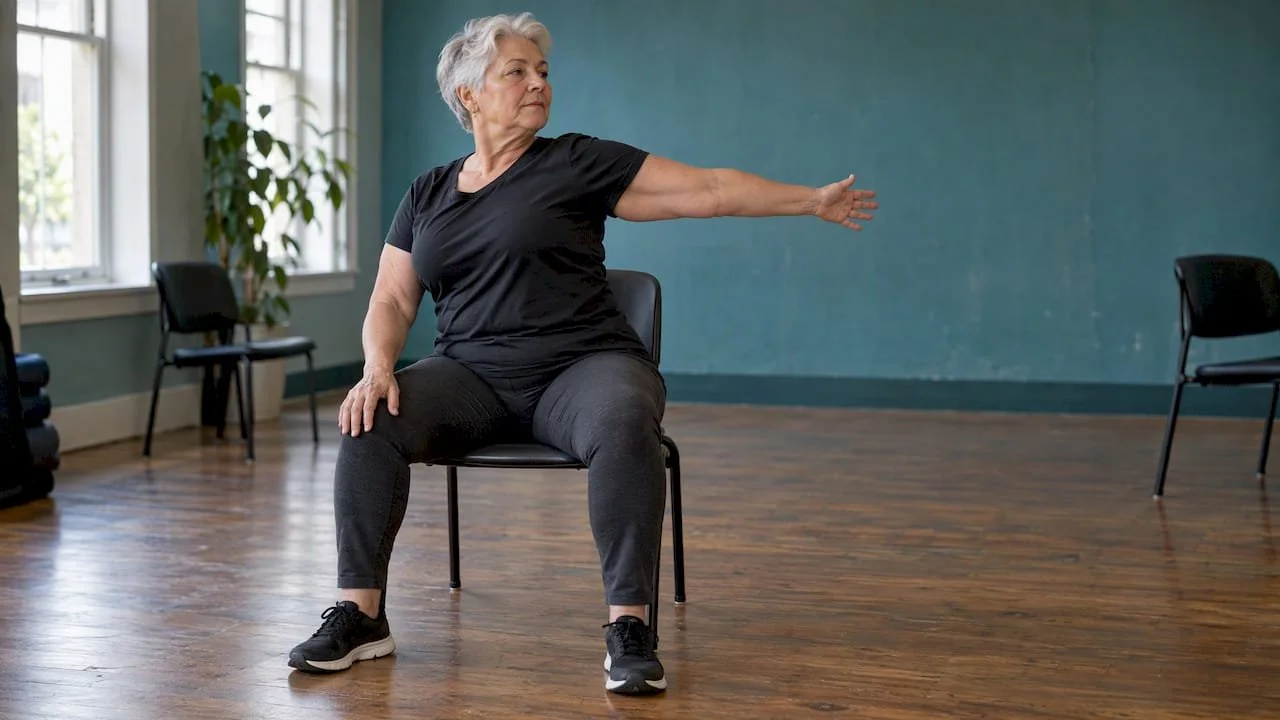
The common thread: benefits scale with what a person can sustainably do, not with how closely they match an idealized fitness standard.
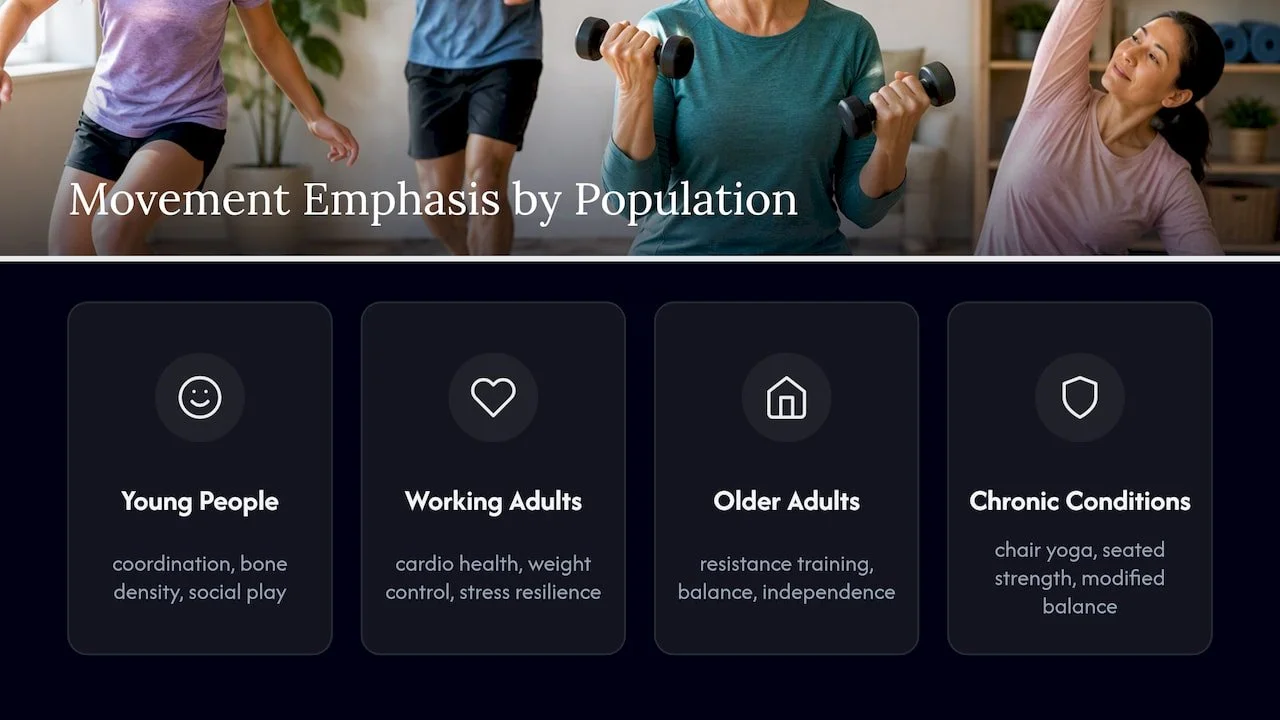
Role of movement in stress management and resilience
Movement is one of the most direct tools available for managing everyday stress, partly because the body's stress response and its physical activity systems are closely linked. A brisk walk, a yoga session, or a strength workout gives the nervous system an outlet, and the mood improvements that follow exercise show up almost immediately, often within a single session, according to CDC's summary of physical activity benefits.
Over time, a consistent movement practice appears to build resilience, not just in the moment but as a buffer against future stress. People who move regularly often report handling day-to-day pressures with more steadiness, likely connected to the same mood and sleep improvements documented in the mental health research above.
Practices that combine movement with breathwork, like yoga or tai chi, add a second layer of stress regulation by training slower, controlled breathing alongside physical effort. This combination may explain why these modalities scored well on both effectiveness and acceptability in the depression research cited earlier.
The practical implication is straightforward: when stress is high, movement is not a luxury to skip until things calm down. It is one of the more reliable ways to calm them down in the first place.
Why consistent movement matters more than perfect movement
Some students who stick around are not the ones who started with the hardest class; they are the ones who started small and kept showing up. The evidence backs this instinct. Begin with whatever movement fits your week, build from there, and let consistency do the work that intensity cannot.
— Juiced
How we can help you build a regular practice
Whatever benefit you are chasing, there is a class built around it. Strength and bone health point toward reformer pilates and strength-focused sessions, mood and flexibility point toward yoga offerings, and stress relief pairs well with Ayurvedic therapies like Abhyanga and Shirodhara.
New to movement? A Nurtured Beginnings pass eases you in at a manageable pace.
Want structure? Our class schedule shows group, livestream, and membership options.
Prefer one-on-one guidance? Our private sessions start from $85 per hour.
Browse our full class and membership schedule to find the entry point that fits your week.
This article is general information, not a substitute for advice from a qualified doctor. Consult a qualified healthcare professional about your own circumstances before acting on anything here.
FAQ
What are the benefits of regular movement and exercise?
Regular movement improves mood, sleep, and energy in the short term, while reducing long-term risk for heart disease, type 2 diabetes, and some cancers. It also preserves strength, bone density, and balance, which supports independence as you age, according to CDC's physical activity guidance.
What are 5 benefits of regular physical activity?
Five well-documented benefits include improved cardiovascular health, lower type 2 diabetes risk, stronger bones and muscles, better mood and reduced anxiety, and improved sleep quality. These effects are summarized across CDC's benefits overview and a major evidence review.
What is the 3-3-3 rule for exercise?
The 3-3-3 rule is a popular fitness shorthand rather than an official guideline from a health authority, and definitions vary depending on the source. The core guidance from the World Health Organization remains the more reliable target: 150 to 300 minutes of moderate activity weekly plus strength training twice a week.
What are 7 benefits of regular physical activity?
Regular activity supports weight management, cardiovascular health, stronger bones and muscles, lower diabetes and cancer risk, better mood, improved sleep, and sharper cognition. These outcomes are detailed across CDC's physical activity basics and research on exercise and depression.
How much exercise do I actually need each week?
Health guidance points to 150 to 300 minutes of moderate activity or 75 to 150 minutes of vigorous activity weekly, plus muscle-strengthening work on two or more days, according to the World Health Organization. Any amount above zero provides some benefit, so starting small is still worthwhile.
Sources
Recommended

5 Minute Breathwork, Cyclic Sighing, Research Backed, Studio Guided
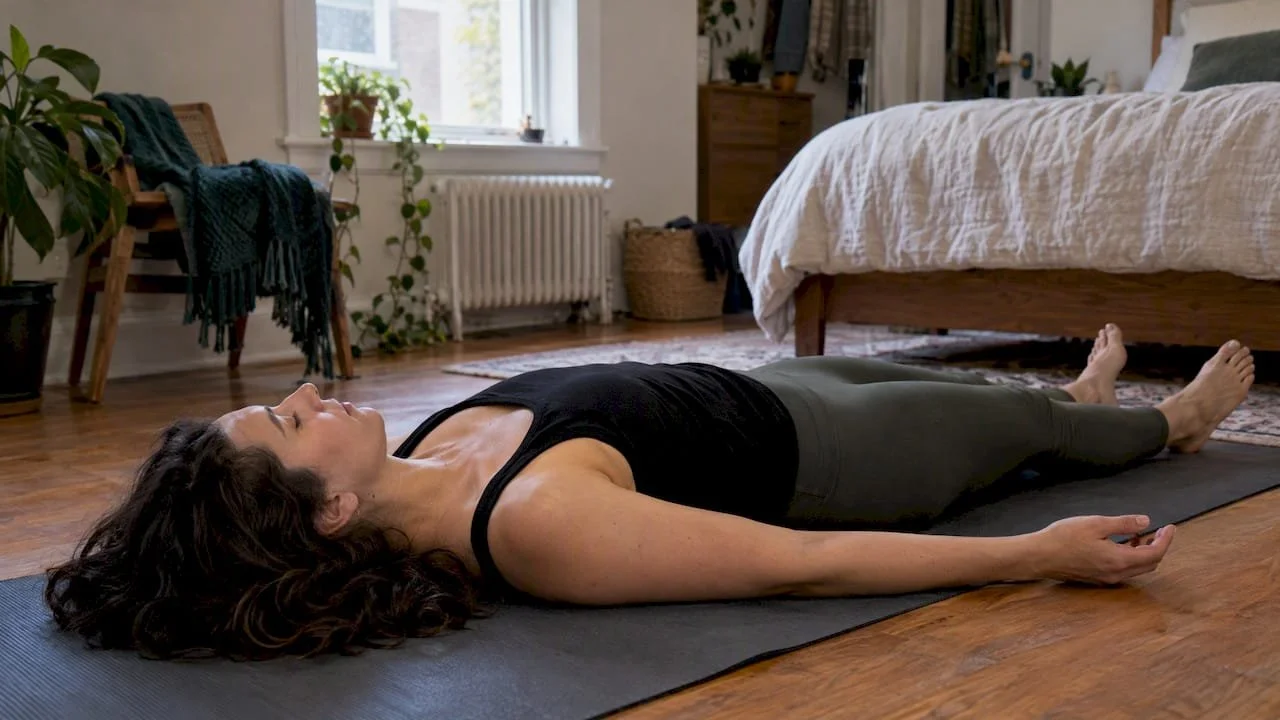
The fastest way to calm anxiety through breath is a technique called cyclic sighing: a double inhale through the nose followed by a long, slow exhale through the mouth. A Stanford-led randomized trial found that practicing it for a few minutes a day reduced anxiety and improved mood more than mindfulness meditation did. The long exhale is doing the real work here, and several other exercises use the same principle. Step-by-step instructions for each follow below.
TL;DR:
Practicing cyclic sighing for five minutes daily with an emphasis on a longer exhale significantly reduces anxiety and improves mood.
Slow, exhalation-focused techniques like diaphragmatic breathing and paced breathing are supported by research for better safety and effectiveness over fast or forceful methods.
Consistency matters more than technique complexity, with evidence indicating that regular, guided sessions produce more reliable benefits over weeks.
Techniques should be personalized and adjusted if they increase anxiety or cause discomfort, especially for people with respiratory or cardiac conditions.
Guided instruction or in-person classes can enhance technique accuracy and ensure long-term benefits, especially for beginners.
Amritayogawellness
Practice Breathwork With Guidance
Amrita Yoga & Wellness connects Philadelphia adults with yoga, breathwork workshops, and wellness practices for physical and mental well-being.
Table of Contents
Step-by-step breathwork exercises to reduce anxiety
Each of these techniques can be practiced seated, with your feet flat and your shoulders relaxed. Start with whichever feels most natural, then rotate as needed.
Cyclic sighing: Inhale through your nose, pause, then take a second shorter sip of air to fully fill your lungs, then exhale slowly through your mouth for twice as long as the inhale. Repeat for 5 minutes. The extended second inhale and the long exhale are the two parts that matter most.
Diaphragmatic (belly) breathing: Place one hand on your chest and one on your belly. Breathe so only the lower hand rises, inhaling for 4 counts and exhaling for 6, for 5 to 10 minutes.
4-7-8 breathing: Inhale for several counts, hold for a count, exhale for a longer count. If holding feels uncomfortable, shorten all three counts proportionally rather than skipping the hold.
Box breathing: Inhale for several counts, hold briefly, exhale for similar length, hold briefly. This works well as a steady anchor during ordinary stress, but the holds can feel confining during acute panic, so switch to an exhale-focused technique if that happens.
Paced breathing at roughly six breaths per minute: Inhale and exhale over several seconds each, continuously, for multiple minutes. This pace is associated with higher heart rate variability, a marker linked to a calmer nervous system.
Alternate nostril breathing: Close one nostril, inhale through the other, then switch nostrils and exhale. Reverse and repeat for several rounds. Substitute another technique if nasal congestion makes this awkward.
A 60 to 90 second reset: When you only have a minute, do 6 to 8 rounds of a single long exhale, out through pursed lips, with no formal counting required.
Pro Tip: Whichever exercise you choose, make the exhale longer than the inhale. That single adjustment matters more than the specific method.
How to practice safely and avoid common pitfalls
Breathwork is generally low-risk, but a few rules keep it that way.
Stop and seek medical care if you experience chest pain, severe breathlessness, or fainting during practice.
Avoid fast, forceful breathing patterns when you are already anxious; stick to slow, comfortable counts instead.
Begin seated with back support, and build sessions up to at least 5 minutes rather than rushing a longer routine on day one.
If you feel lightheaded or tingly, breathe a little shallower and slower rather than stopping outright, since over-breathing is the usual cause.
If a technique increases your anxiety instead of lowering it, switch to simple, unforced exhale-focused breathing or pause the practice.
People with a history of panic disorder, respiratory conditions such as asthma or COPD, or cardiac issues should check with a clinician before starting a new breathing routine, since some instructions that involve deep or forceful inhalation can worsen symptoms in panic disorder specifically.
Pro Tip: If a technique feels wrong for your body, change the method, not your commitment to practicing.
What the research says about breathwork and anxiety
The evidence for slow, exhale-weighted breathing is stronger than for fast or forceful techniques. In the Stanford trial of 111 volunteers, participants who practiced cyclic sighing for five minutes daily over one month showed greater improvement in positive mood than a mindfulness-meditation group, and the cyclic-sighing group also lowered their resting breathing rate.
A systematic review of 58 studies covering 72 breathing interventions found that 54 of those interventions were effective, and that session length of at least 5 minutes along with human-guided instruction predicted better outcomes.
A 2025 meta-analysis of six randomized trials with 517 patients found that prāṇāyāma breathing reduced symptom severity in conditions including PTSD and depression compared with passive controls, while noting more adverse events with fast breathing techniques than with slow ones. Taken together, these sources point in the same direction:
Slow, exhalation-focused breathing has a more consistent safety and benefit profile than fast-paced techniques.
Sessions under 5 minutes and techniques taught without guidance show weaker or less reliable results.
Results vary across studies, and benefits tend to be stronger when breathwork is paired with mindfulness or structured instruction rather than practiced in isolation.
A repeatable 5-minute daily practice plus a panic script
A short routine beats an occasional long one, because consistency is what builds the effect over weeks.
Warm-up (30 seconds): Sit comfortably and take two normal breaths to notice your current pace.
Core practice (4 minutes): Do cyclic sighing or diaphragmatic breathing continuously, keeping the exhale longer than the inhale throughout.
Cool-down (30 seconds): Return to normal breathing and notice any shift in your body before standing up.
For acute anxiety in the moment, use this 60 to 90 second script instead: take one double inhale through the nose, then sigh out slowly through your mouth, repeating 6 to 8 times while naming one thing you can see and one thing you can hear between cycles. That grounding cue keeps attention anchored while the long exhales do their work.
As the daily habit sticks, you can extend sessions, add simple mindfulness cues between breathing rounds, or explore mindfulness practices built for yoga and wellness settings for more structure.
Keep a simple streak reminder, such as a calendar check mark, rather than tracking detailed metrics.
Add one extra minute per week until you reach a length that feels sustainable.
How Amrita Yoga & Wellness teaches breathwork
Some yoga and wellness studios build breathwork into group classes, workshops, and private sessions, with instruction designed to be approachable for people trying these techniques for the first time. Guided instruction matters because a trained eye can catch pacing or posture issues that are easy to miss when practicing alone, which the research above ties directly to better outcomes. Readers who want more structured support than a self-guided routine can bring their questions into a class or book a private session for individualized pacing.
The real lesson in breathwork for anxiety
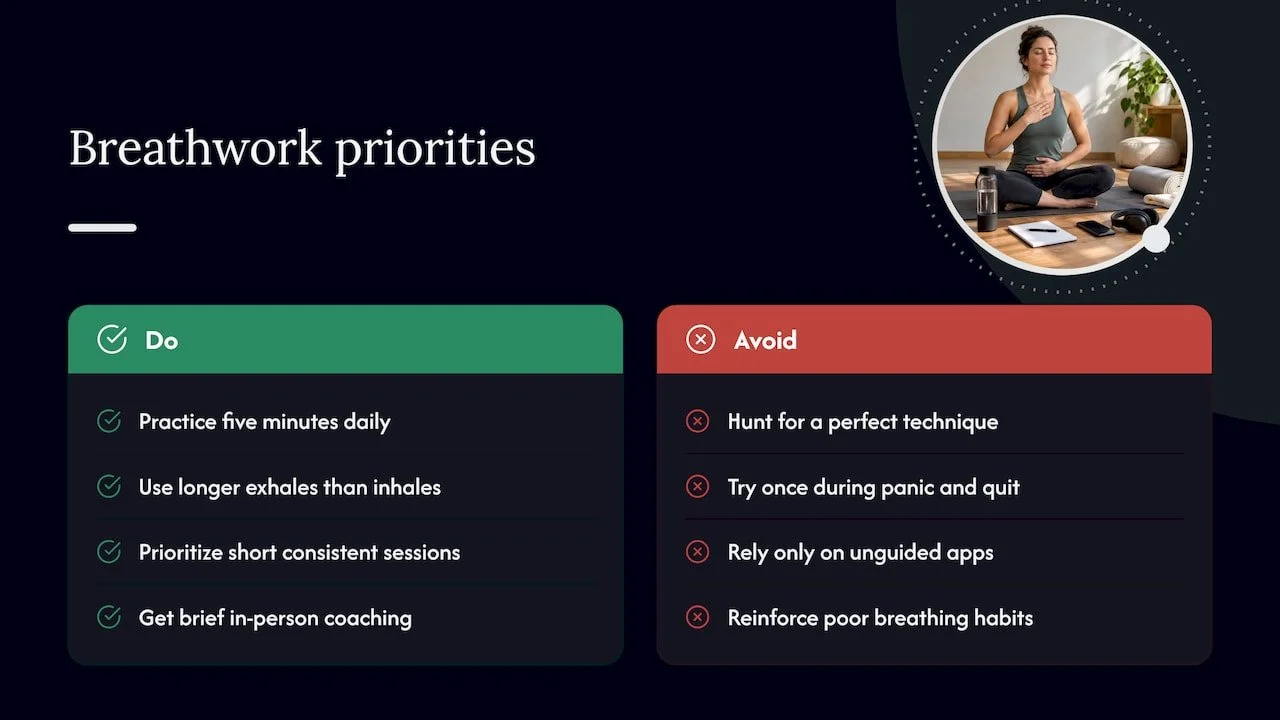
The breathwork world oversells complexity. Readers chase elaborate patterns, apps, and counting systems when the actual mechanism is almost boringly simple: a longer exhale signals safety to your nervous system, and that signal does most of the heavy lifting. Box breathing, alternate nostril breathing, and 4-7-8 all work through variations of the same principle, not through some unique formula each one claims to own.
The bigger failure point isn't technique selection, it's consistency and guidance. People try a breathing exercise once during a panic spike, decide it "didn't work," and abandon it, when the Stanford research points to daily five-minute practice building benefit over weeks. Prioritize showing up for short sessions over hunting for the perfect method, and get a few minutes of in-person coaching if you can, since guided instruction keeps you from reinforcing poor habits before they become automatic.
— Juiced
Practice breathwork with guided support at Amrita
If reading instructions isn't enough, Amrita's group and livestream classes include guided breathwork alongside yoga, so you can practice these techniques with real-time feedback instead of guessing at your pacing. First-time attendees get beginner-friendly cues and modifications, and private sessions are available for anyone who wants individualized pacing or has a health concern to work around.
Check the class schedule to find a session that fits, or book a one-to-one session for breathwork tailored to your needs.
FAQ
Which breathwork technique is best for anxiety?
Cyclic sighing, with its extended exhale, has the strongest evidence behind it for fast relief, supported by a Stanford randomized trial showing benefits from five minutes of daily practice. Diaphragmatic breathing and paced breathing at a slow, steady rate are close alternatives that work through the same exhale-focused mechanism.
What is the 3-3-3 rule for anxiety?
The 3-3-3 rule is a grounding technique, not a breathing pattern: you name three things you can see, three sounds you can hear, and move three parts of your body. It pairs well with slow breathing but is a separate grounding tool rather than a breathwork method on its own.
Does breathwork really work for anxiety?
Breathing exercises can reduce anxiety symptoms, particularly slow, exhale-weighted techniques practiced for at least five minutes, according to a systematic review of breathing interventions. Effects vary across people and studies, and benefits tend to be more consistent when paired with guided instruction or mindfulness.
What is the relationship between anxiety and breathing issues?
Anxiety often speeds and shallows breathing, and that faster breathing pattern can itself feed feelings of panic or breathlessness. Slowing the exhale interrupts that cycle, which is part of why exhale-focused techniques show more reliable results than fast breathing patterns in clinical research.
How can I combine breathwork with other anxiety management techniques?
Pairing breathwork with brief mindfulness practice tends to produce steadier results than breathing alone, based on a 2024 review of combination approaches. Adding a short grounding cue or a few minutes of passive attention after your breathing session is a simple way to combine the two.
Sources
Recommended

Pick the Right Pilates Specialization for New Instructors: Hours & Pay
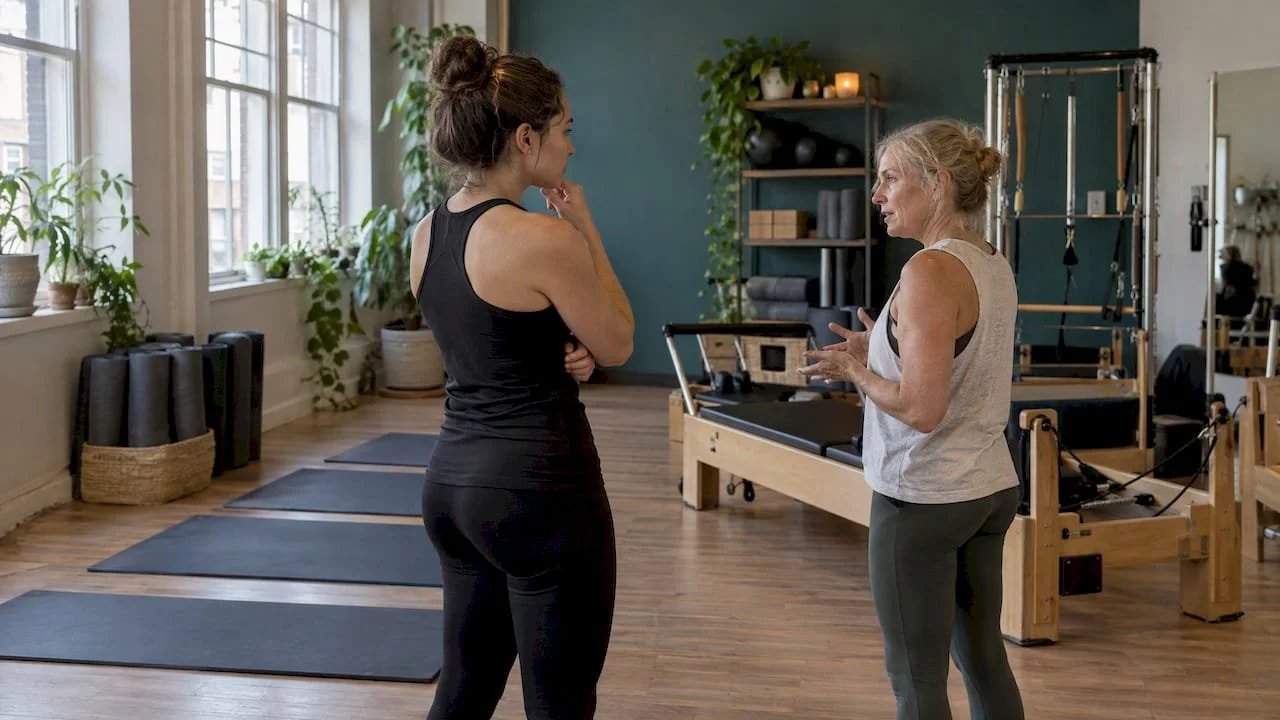
Mat, reformer, comprehensive apparatus, clinical rehab, prenatal and postnatal, active aging, athletic performance, chair and Cadillac work, barre hybrids, and group versus private teaching cover the main paths a new Pilates instructor should weigh. Each one carries its own training hours, prerequisites, and pay pattern, so the right choice depends on how much time, money, and client base you have before you even enroll.
TL;DR:
Most instructors start with mat certification, which requires fewer hours and offers faster, cost-effective entry.
Apparatus training, especially in reformer, Cadillac, and clinical areas, demands more hours and often higher fees, leading to better private rates.
Supervised teaching hours and in-person practice are crucial for meeting certification standards and building real client experience; vague or online-only programs are less reliable.
Specialties like rehab, prenatal, and athletic performance typically increase earning potential and require targeted knowledge of safety and client needs.
Building local practice hours through mentorship and workshops enhances skills more than certification alone, with private sessions paying significantly more.
Amritayogawellness
Explore Pilates Training in Philadelphia
Amrita Yoga & Wellness supports Pilates enthusiasts and future instructors through classes, workshops, and wellness offerings in a community setting.
Table of Contents
2. How many training hours do certification programs require?
5. How Amrita Yoga & Wellness supports your Pilates teaching growth
1. What are the main Pilates teaching specializations?
A mat instructor teaches group mat classes built on the core repertoire, and this route usually requires the lowest number of training hours, making it the most common entry point into the field. College and community programs often describe mat certificates as covering teaching principles and applied anatomy rather than full apparatus work, which keeps the barrier to entry lower than apparatus-based tracks.
A reformer instructor works on the spring-loaded apparatus that defines most boutique studio classes, and this specialty tends to support higher private rates than mat-only teaching because reformer sessions are harder to replace with a free app or a YouTube video. Comprehensive or full apparatus training adds the Cadillac, chair, and barrels to reformer work, qualifying a teacher to run an entire studio's equipment roster rather than one machine, which widens job options at full-service studios.
Clinical or rehab Pilates asks for a base certification plus added coursework in injury patterns and movement screening, and it often means working alongside physical therapists or taking medical referrals, so programs in this track look for a teacher who already holds a comprehensive credential. Prenatal and postnatal Pilates demands specific safety training around positioning, intra-abdominal pressure, and pelvic floor function, and a teacher without that extra layer of education should not be leading pregnant clients through standard repertoire.
Active aging and older adult specialization adapts exercises for balance, joint mobility, and fall prevention, a growing niche as community centers and retirement communities add movement programming. Athletic and sports performance Pilates integrates with strength and conditioning work, appealing to teachers who want to support competitive athletes or weekend runners rather than general wellness clients.
Chair, Cadillac, and barrel-focused niches sit inside comprehensive training but can become a teacher's signature offering once certified, since fewer instructors build deep comfort with those apparatus. Barre and hybrid modalities borrow Pilates principles and crossover certifications, letting a teacher run format classes without a full comprehensive credential. Group versus private teaching is less about apparatus and more about business model: group classes pay less per session but fill a schedule faster, while private sessions pay more per hour and demand stronger one-on-one coaching and client management skills.
Mat and group formats suit teachers who want quick entry and steady class fills.
Reformer, comprehensive, and clinical tracks suit teachers aiming for private clients and higher per-session rates.
Prenatal, active aging, and athletic niches suit teachers with a specific population they already understand or want to serve.
2. How many training hours do certification programs require?
The NPCP sets the hour benchmarks most American programs build toward.
The NPCP requires a substantial number of training hours to sit for the Comprehensive Exam, with mat-only certification demanding fewer hours compared to comprehensive training, which is why mat routes move faster and cost less than apparatus-based ones.
Beyond total hours, look at what fills them. Solid programs include anatomy coursework, supervised observation of working teachers, and hands-on practice teaching, and the NPCP handbook lists in-person components for repertoire and special-population work as part of meeting eligibility rules. A program that skips supervised teaching hours or pushes everything online is unlikely to satisfy those requirements.
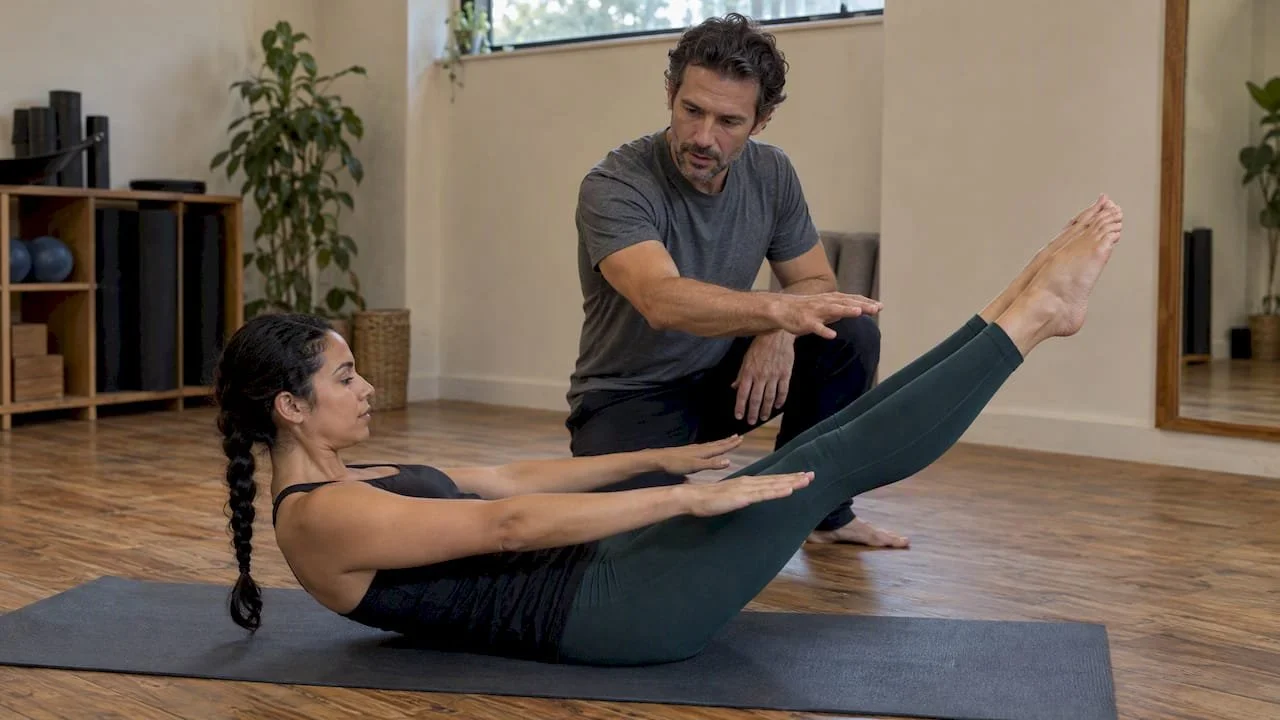
Accreditation adds another layer of confidence. The Pilates Method Alliance runs ITTAP, a voluntary review that recognizes training programs meeting professional standards, and the PMA itself notes that no single certification is universally considered the best, which makes checking for ITTAP recognition a more useful filter than chasing a brand name.
3. How do you choose the right specialization for you?
Picking a lane starts with naming the job you actually want, not the certification that sounds most impressive.
Define your goal: group instructor, private specialist, or rehab-focused teacher, since each points to a different hour commitment.
Match your budget and timeline to the program, because comprehensive and clinical tracks cost more and take longer than mat-only paths.
Check prerequisites before enrolling, since several rehab and prenatal programs require an existing mat or comprehensive credential.
Ask each program for total hours, supervised teaching hours, which apparatus are covered, and how much is in-person versus online.
Ask how the program assesses competency, whether through written exams, practical teaching evaluations, or both.
Start mat-first if you are unsure, then add apparatus or a specialty once you know what clients you enjoy teaching.
Watch for vague hour counts, no supervised practice teaching, or missing anatomy and special-population modules. Those gaps often mean a program will not satisfy NPCP eligibility or leave you underprepared for real clients.
Pro Tip: Call a program's office and ask how many supervised teaching hours graduates log before certification: a clear, specific number is a good sign; a vague answer is not.
4. What can you expect to earn in each specialty?
Pay moves with specialization. Specialist certifications in reformer, rehab, and prenatal work commonly increase earning potential compared with entry-level mat-only teaching, largely because private and apparatus sessions carry higher per-session rates than group mat classes.
Reformer, Cadillac, and chair work create differentiation that opens private-session income, and clinical or prenatal niches do the same by serving clients who need expertise a general mat class cannot offer. Building that income usually means growing a private client book, running specialty workshops, and marketing directly to the population you serve rather than waiting for a studio schedule to fill itself.
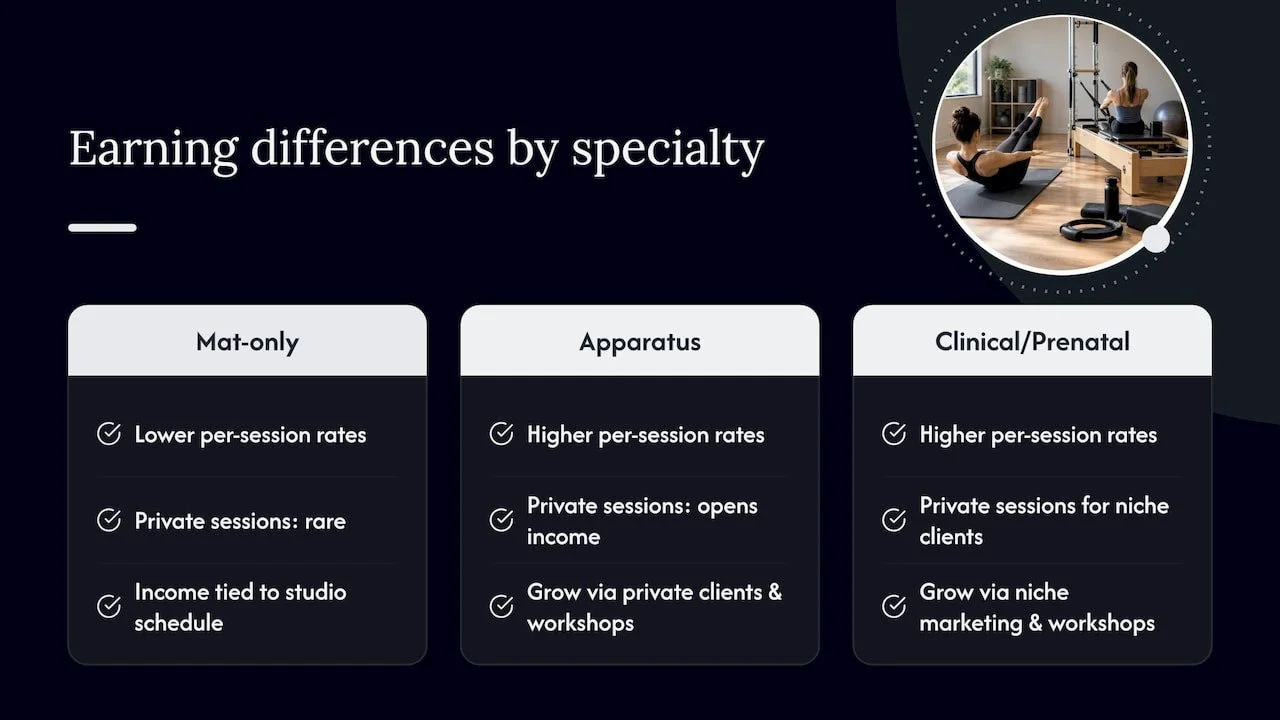
5. How Amrita Yoga & Wellness supports your Pilates teaching growth
Amrita Yoga & Wellness runs group mat and reformer classes, private sessions, and teacher-focused workshops in Philadelphia, giving developing instructors a place to log observation hours, practice teaching, and build the client relationships that specialization tracks require.
Sequencing your training without burning out
Most new teachers do better starting with mat, moving into supervised practice teaching, then adding a specialty once they know which clients energize them. Skipping straight to a narrow clinical or prenatal certification before building general teaching reps tends to leave gaps that supervised hours would have caught. Mentorship matters here more than the letters after your name: a teacher who watched you correct cueing in real time will catch things a workbook cannot. Pick the specialty that matches what you already notice yourself drawn to, and check whether your local market actually has demand for it before you commit the hours.
— Juiced
Where to get practice hours and mentorship locally
Building real teaching hours matters as much as the certificate itself. Amrita Yoga & Wellness offers group class drop-ins starting at $28, private sessions from $85 per hour, and teacher-focused workshops where you can observe, assist, and build the client relationships your specialization needs.
Reach out through Amrita Yoga & Wellness to book a session or ask about upcoming teacher workshops.
Where to verify certification rules and pay data
For program eligibility, check the NPCP handbook and PMA's ITTAP page. For pay context, see Gymdesk's salary research. For movement quality considerations relevant to clinical and athletic tracks, see Everton Chiropractic's guide.
Sources
FAQ
What are the different levels of Pilates instructors?
Instructors typically progress from mat-only certification into comprehensive or apparatus certification, then into specialty credentials like clinical, prenatal, or active aging work. The NPCP sets the comprehensive and mat hour minimums most American programs follow.
What is the most respected Pilates certification?
There is no single certification considered universally best. The Pilates Method Alliance notes that ITTAP accreditation of a training program is a more reliable quality signal than any one certificate name.
What is the 10/20/30 rule in Pilates?
This phrase is not a recognized industry standard covered by NPCP or PMA guidance, and definitions circulating online vary widely without a consistent source. Treat any claim about a fixed numeric rule in Pilates teaching with caution unless it comes from a named certifying body.
How much do Pilates teachers get paid per hour?
Pay varies by specialization and session type, with apparatus work, private sessions, and specialties like rehab or prenatal Pilates commonly commanding higher rates than entry-level group mat classes. Private one-on-one sessions, such as those priced from $85 per hour at studios like Amrita Yoga & Wellness, generally pay more per hour than group class formats.
Do I need a mat certification before training on apparatus?
Many comprehensive programs accept candidates without prior mat certification, but a mat-first path lets you build teaching confidence before tackling reformer, Cadillac, and chair work. Check each program's prerequisites directly, since requirements differ by school.
Recommended

Four Week Low Risk Routine to Safely Use Ancient Healing Practices
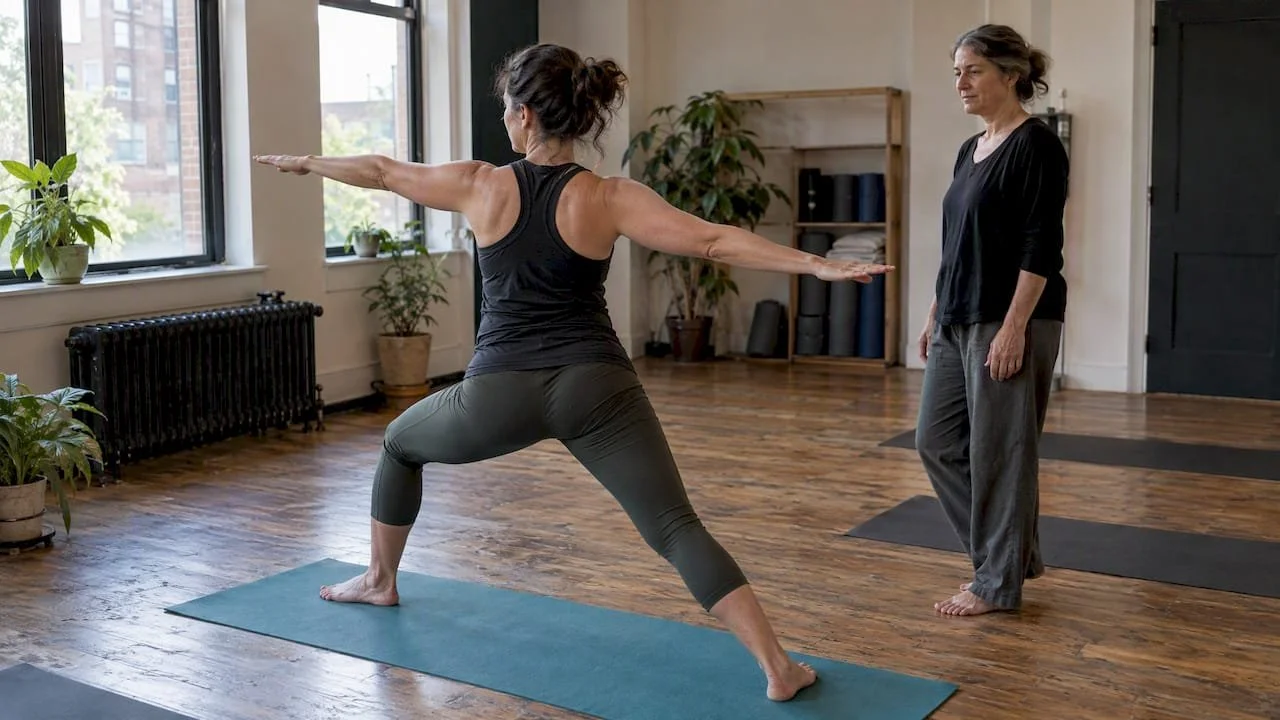
Many ancient healing practices, including yoga, meditation, tai chi, breathwork, and ritualized daily habits, can support modern wellbeing when adopted thoughtfully. The strongest evidence backs movement and mindfulness practices for stress, sleep, and pain, while herbal remedies carry real risks around quality control and drug interactions. Treat these traditions as complements to medical care, not replacements for it.
TL;DR:
Movement practices like yoga and tai chi can be learned at home or in groups with proper guidance to reduce injury risk and accommodate health conditions.
Mindfulness techniques such as meditation and breathwork are low-risk and accessible without equipment but require consistent practice to support stress, sleep, and anxiety.
Herbal remedies and Ayurvedic products pose risks due to quality control issues and potential interactions with medications, emphasizing the need for clinician oversight.
Building a daily routine that integrates movement, mindfulness, and sleep hygiene over several weeks helps gauge effectiveness without relying on single sessions or dramatic rituals.
Consult a qualified healthcare professional before adding herbal products or modifying practices, and prioritize reputable teachers and community-based experience for cultural practices.
Amritayogawellness
Find Your Wellness Practice
Explore accessible yoga, tai chi, breathwork, Pilates, and other wellness offerings through Amrita Yoga & Wellness in Philadelphia.
Explore Amrita Yoga & Wellness
Table of Contents
What Ancient Healing Practices Look Like in Practice
Ancient healing traditions fall into a few practical categories, and knowing the difference helps you pick a starting point. Movement-based practices like yoga, tai chi, and qigong combine physical postures with breath control and are generally accessible to beginners with proper instruction. Contemplative practices such as meditation and mindfulness require no equipment and can be learned from a book, app, or teacher, though guided instruction speeds progress.
Acupuncture and Ayurveda are product- and technique-based systems that involve a trained practitioner and, in Ayurveda's case, herbal formulations, so they need more vetting before you start. Ritual and ceremonial practices, often tied to specific Indigenous or cultural lineages, are less about individual wellness hacks and more about community and meaning, and they deserve particular care around authenticity.
Yoga and tai chi/qigong: entry-level movement practices you can learn in a group class with modification for injuries.
Meditation and breathwork: low-risk contemplative tools that need no special equipment.
Acupuncture: requires a licensed practitioner and is not a do-it-yourself practice.
Ayurveda: includes bodywork (generally low-risk) and herbal products (higher-risk, discussed below).
Ritual and ceremony: best learned from community-sanctioned or lineage-authorized teachers rather than borrowed casually.
What the Evidence Actually Supports
The World Health Organization reports that 170 of 194 Member States use traditional medicine practices such as herbal remedies, acupuncture, yoga, or Indigenous therapies, and its current strategy pushes for evidence-based integration, quality control, and people-centered care rather than assuming age or tradition alone proves something works.

Most WHO Member States report using some form of traditional or complementary medicine, according to the World Health Organization, which signals how mainstream these practices have become worldwide even as regulation varies widely by country.
On the research side, the picture is mixed but informative:
NCCIH notes yoga can help with stress, sleep, balance, and some pain conditions, but it should complement, not replace, medical care, and unsupervised practice raises injury risk.
NCCIH finds meditation and mindfulness can ease anxiety, depression, and insomnia in some populations, though results vary by condition and are not a cure.
A systematic review overview documented multiple herbs with potential interactions with prescription drugs, alongside uneven evidence quality and a need for clinician monitoring.
Ayurvedic herb research is similarly limited, and a hepatotoxicity review documents liver injury cases tied to certain AYUSH products, recommending vigilance and better quality control.
A Daily Framework for Blending Old and New
The most reliable way to bring ancient practices into modern life is a whole-person routine rather than a single dramatic ritual. Whole-health frameworks like the VA's model recommend weaving movement, nutrition, sleep, mindful awareness, and relationships together instead of relying on one practice to do everything. Here is a simple daily and weekly structure built on that principle.
Morning ritual (5 to 20 minutes): a short sequence of gentle movement, a few minutes of breath work, and one nourishing habit such as a mindful breakfast or a glass of water before coffee.
Midday reset: a five-minute mindful walk or seated breathing break to interrupt stress before it compounds through the afternoon.
Evening wind-down: restorative breathing or a short meditation paired with consistent sleep hygiene, like dimming lights and setting a fixed bedtime.
Weekly community touchpoint: one class, workshop, or group session to keep practice social rather than purely solitary.
Periodic check-ins: a conversation with a clinician any time you add a supplement or herbal product, or if a health condition changes.
Pro Tip: Track sleep, mood, and energy weekly instead of judging a practice after one session; small, consistent habits show their value over weeks, not days.
This sequencing matches what NCCIH's guidance on stress recommends: start with low-skill, non-ingestible practices like movement and breath before considering herbal products, and let subjective changes in sleep and mood guide whether to continue or adjust.
Staying Safe: Herbs, Movement, and Cultural Respect
Safety questions cluster around three areas: what you ingest, how you move, and whose traditions you are borrowing.
Herbs and supplements: talk to a pharmacist or clinician before combining herbal products with prescription medication, since interactions are documented and not always predictable, and watch for signs of liver trouble such as unusual fatigue or yellowing skin.
Movement practices: learn yoga, tai chi, or qigong under a qualified instructor at first, avoid pushing into extreme postures early, and ask about modifications if you are pregnant, older, or managing a health condition.
Cultural respect: for ritual and ceremonial practices tied to specific communities, seek out lineage-authorized or community-sanctioned teachers rather than adopting sacred practices casually as a wellness trend.
For a deeper look at how evidence-informed thinking shapes safe integration of traditional and modern care, Everton Chiropractic's overview is a useful primer on the concept.
How to Start: A Four-Week Low-Risk Plan
You do not need a retreat or a cabinet of supplements to begin. A gradual, four-week approach lets you test what works before committing time or money.
Week 1: add a daily 5 to 10 minute breathing and movement micro-practice, such as a short yoga flow or seated breath work.
Week 2: layer in a brief evening meditation, even five minutes, to support wind-down and sleep.
Week 3: join one in-person or online class to get feedback on form and technique.
Week 4: evaluate how you feel, then consider a private session or a vetted product choice if you want to go further.
Before joining a class or trying a supplement, ask a teacher or clinician about their training, how they modify for injuries or health conditions, and whether a product has third-party testing. Stop and seek medical advice if you notice sharp pain, dizziness, or any signs of an adverse reaction.
Amrita Yoga & Wellness as an Applied Example
Amrita Yoga & Wellness, a studio in Philadelphia, offers a working model of this kind of integration. Its group classes and workshops give beginners a supervised entry point, while private sessions allow for individual modification. Its Ayurvedic-style therapies, including Shirodhara and Abhyanga, are supervised, non-ingestible bodywork rather than herbal products, which sidesteps much of the interaction risk discussed above. The studio also publishes mindfulness content for readers who want structured practice ideas, and its community focus reflects the kind of weekly group touchpoint that whole-health frameworks recommend.
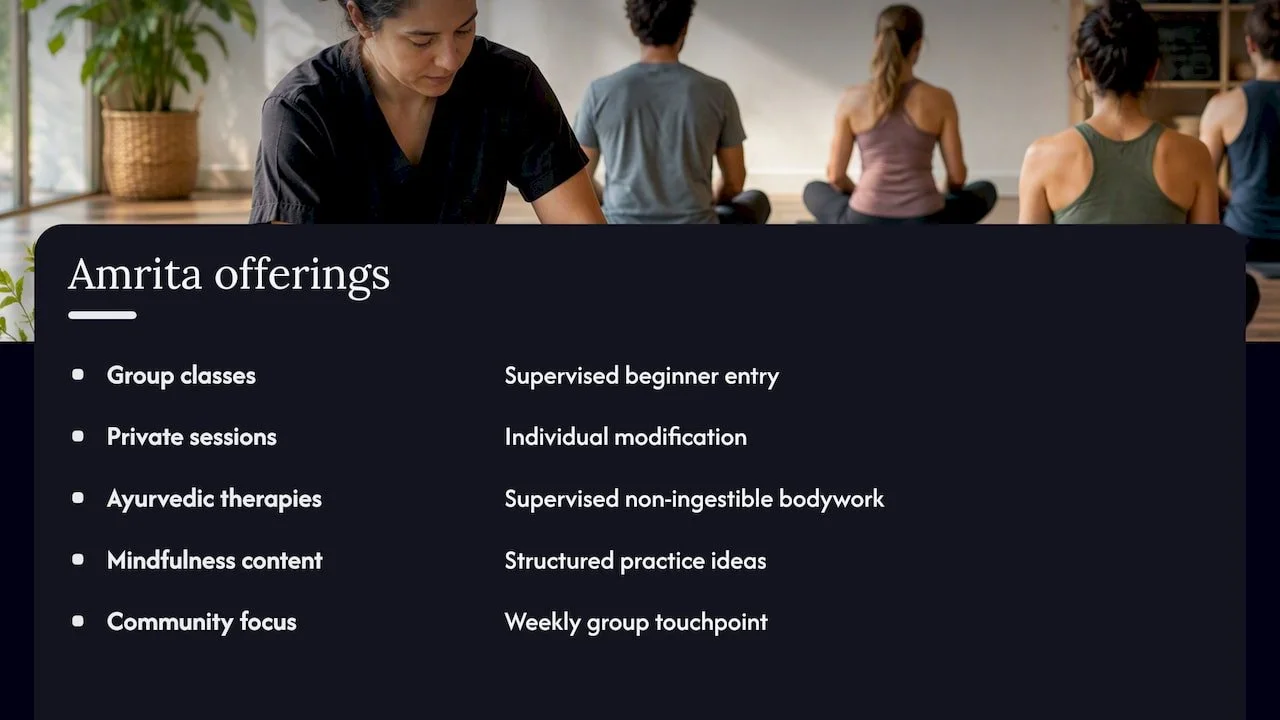
A Balanced View on Old Wisdom and New Evidence
The temptation with ancient healing is to treat it as either magic or superstition, and both framings miss the point. These traditions deserve respect for their origins and the communities that developed them, but they also deserve honest scrutiny, especially where herbal products are concerned. The practices worth keeping are the boring, consistent ones: a daily breath practice, a weekly class, a habit of noticing how you feel. Keep a clinician informed about anything you ingest, and let results, not novelty, decide what stays in your routine.
— Juiced
Getting Started With Amrita Yoga & Wellness
If you want guided support rather than trial and error, Amrita Yoga & Wellness gives Philadelphia-area beginners a structured way to try these practices safely. You can start with a low-commitment drop-in class, book a private session for one-on-one modification, or explore a supervised Ayurvedic therapy like Abhyanga before considering any herbal product.
Drop-in group or livestream classes for a first taste of guided movement and breath work.
Private one-to-one sessions for personalized pacing or modifications.
Ayurvedic therapies such as Shirodhara or Abhyanga offering supervised, non-ingestible Ayurvedic bodywork.
Browse the class schedule to find a session that fits your week and start with supervised practice before adding anything else to your routine.
This article is general information, not a substitute for advice from a qualified doctor. Consult a qualified healthcare professional about your own circumstances before acting on anything here.
Sources
FAQ
What are some examples of ancient healing practices?
Common examples include yoga, meditation, tai chi, qigong, acupuncture, and Ayurveda, along with ancestral plant remedies and ritual or ceremonial practices tied to specific cultures. Movement and contemplative practices generally carry the most consistent evidence for stress and sleep support, according to NCCIH.
What are some examples of ancient wellness practices?
Beyond yoga and meditation, ancient wellness practices include breathwork, tai chi, Ayurvedic bodywork like Abhyanga, and community rituals built around seasonal or daily rhythms. Many of these focus on consistent, low-intensity habits rather than single dramatic interventions.
What are some spiritual healing practices?
Spiritual healing practices often include meditation, prayer or ritual ceremony, breathwork, and community gatherings tied to specific cultural or religious traditions. These practices are best learned from teachers with genuine ties to the tradition rather than adopted informally, according to WHO's guidance on cultural context.
What are some examples of healing rituals?
Healing rituals can range from a daily breathing or movement sequence to community ceremonies marking seasonal changes or life transitions. Their value often comes as much from consistency and community connection as from the specific actions involved.
Is it safe to combine herbal remedies with prescription medication?
Not always. Systematic reviews document herb-drug interactions and cases of liver injury tied to certain herbal products, so a pharmacist or clinician should review any herbal addition to your medication routine.
Recommended

4 Pilates Cue Types With Copyable Scripts and Timing for Instructors
Four classroom ready cue types for Pilates instructors, with copyable scripts, timing tips, and research backed external focus guidance you can use in class.
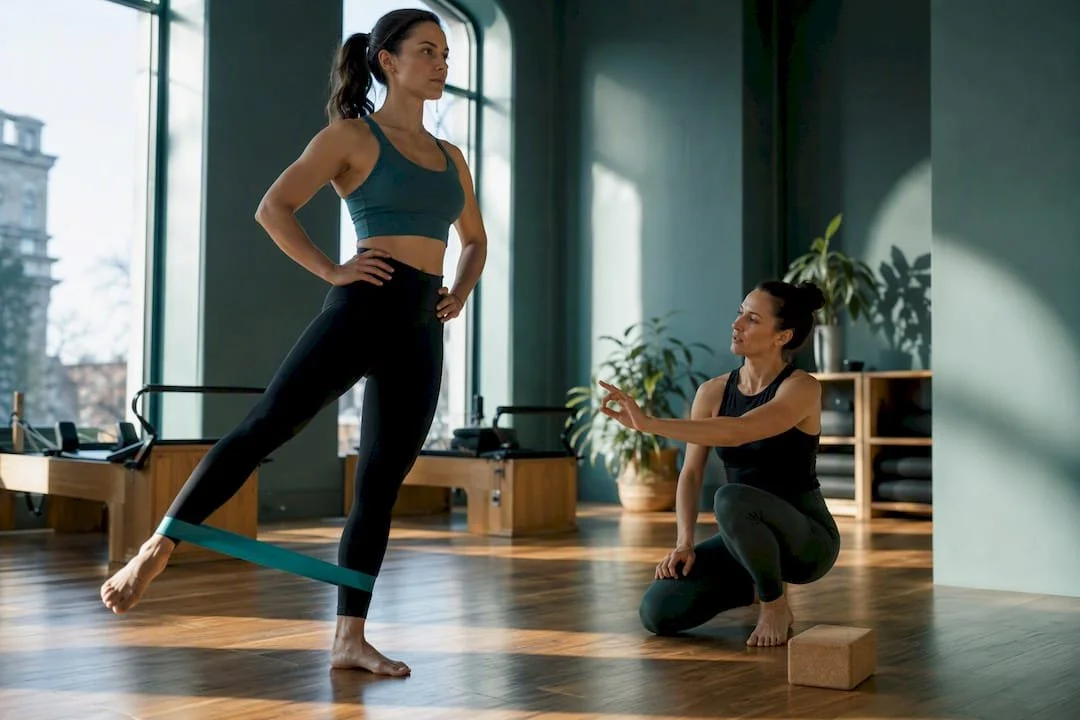
The most effective Pilates cueing techniques fall into four categories: visual, auditory, experiential, and tactile. The single rule that ties them together is this: favor external focus language that points attention to an outcome outside the body, and match your cue type to how each student learns. This list gives you scripts, timing guidance, and the research behind why it works.
TL;DR:
External focus cues are most effective when pointing attention to outcomes outside the body, and matching cue types to students’ learning preferences accelerates progress.
Different cueing styles—visual, auditory, experiential, and tactile—should be used strategically throughout class, with visual for complex exercises, auditory for pacing, experiential for awareness, and tactile for correction.
Layer cues according to a four-step framework: set up the position visually and verbally, activate deep stabilizers with experience or touch, correct minimally during movement, and streamline cues during flow.
External focus instructions consistently outperform internal cues across motor learning research, improving both immediate performance and long-term skill retention.
Always seek consent before tactile cues, keep contact brief and purposeful, and have fallback scripts ready when a cue fails to produce the desired movement change.
Table of Contents
1. Four cueing categories and when to use each
Visual cues show rather than tell, auditory cues use words or imagery, experiential cues connect movement to a felt sensation, and tactile cues use touch to guide position or muscle activation. Each works best in a different moment of class, and knowing which to reach for saves you from repeating a cue that already failed to land.
Visual: Demonstrate the movement or draw a shape in the air. Best for complex exercises and beginners who need to see the pattern before attempting it. Example: "Watch how my spine curls like a C before you try it."
Auditory: Speak a direct instruction or use imagery tied to sound or rhythm. Best for experienced students who respond to verbal pacing. Example: "Exhale for five counts as you roll up."
Experiential: Ask the student to notice a sensation or imagine an object moving through space. Best for building body awareness in intermediate students. Example: "Imagine a string pulling the crown of your head toward the ceiling."
Tactile: Use a light touch to guide alignment or activation, always with consent first. Best for students who plateau on verbal cues alone. Example: A hand at the low back signals "lengthen away from here."
According to IDEA Health & Fitness Association, most students have a dominant learning preference among these four styles, and matching your cue to that preference speeds progress and improves satisfaction. A quick way to find it: ask, test one cue type, and watch which one produces a cleaner rep.
2. Cue scripts for common Pilates objectives
These scripts cover the five goals instructors cue most often: breath, core control, alignment, balance, and mobility. Use the external focus version whenever a student overthinks the internal mechanics.
Breath: "Exhale as you press your ribs down and back into the mat" (auditory, external). For a slower class, try the experiential version: "Feel your breath fill the space behind your kidneys." Time this cue on the exhale, right before the effort phase of the movement.
Core control: Instead of "engage your core," say "draw your belly button toward your spine like you're zipping up tight jeans" (auditory with external image). A tactile alternative: two fingers pressing gently below the navel as a reminder to hollow, only after asking permission.
Alignment: "Stack your shoulders directly over your wrists" works better than "don't sag." Pair it with a visual demo showing the straight line from ear to hip to ankle before the student attempts a plank.
Balance: "Root your standing foot into the floor like it's growing into the ground" gives an external target instead of "don't wobble." Demo first for anyone new to single-leg work, then cue verbally once they're moving.
Mobility: "Reach your fingertips toward the far wall" extends range more effectively than "stretch your side body." Use this during flow, when students no longer need a full demo.
Demo before you talk when the exercise is unfamiliar or has more than two moving parts. Once students know the shape, shift to verbal and tactile cues so class keeps moving.
Pro Tip: Keep each cue to one idea. A student can absorb "exhale and reach" but loses the thread at "exhale, reach, and keep your pelvis level."
3. A four-step framework for layering cues in class
A reliable sequence for delivering cues, adapted from IDEA's mat work teaching framework, moves through four stages: lay the foundation, find the center, hold still and move, then flow. Each stage calls for a different cue density.
Lay the foundation: Set up the position with visual and auditory cues together, since students need both to see and hear the target shape.
Find the center: Add one experiential or tactile cue to activate the deep stabilizers, such as "feel your low back stay heavy on the mat."
Hold still and move: Cue one correction per repetition, not a running commentary, so students can process and adjust.
Flow: Drop to single-word or short-phrase cues ("reach," "exhale," "lengthen") since students should now know the pattern.
The decision rule is simple: if a cue doesn't produce a visible change within one or two reps, switch modality rather than repeating the same words louder.
4. Why external focus cues improve motor learning
The case for external focus phrasing isn't a teaching trend, it's a consistent finding across decades of motor learning research. A large-scale meta-analysis reviewing dozens of studies found that external focus instructions outperform internal focus instructions for motor performance, retention, and transfer, across different ages, health statuses, and skill levels. A separate set of experimental studies found the same pattern on balance and simulator tasks: external focus produced better learning outcomes than internal focus.
Converting a cue is often just a phrase swap:
"Squeeze your glutes" becomes "press the mat behind you."
"Engage your abs" becomes "draw your navel toward your spine like closing a zipper."
"Tuck your pelvis" becomes "lengthen your tailbone toward your heels."
The research consistently favors external focus cues over internal ones for both immediate performance and longer-term skill retention, according to the meta-analytic review, which means the words you choose in class aren't just style, they measurably affect how well a movement pattern sticks.
5. Tactile cuing: consent, safety, and hands-on technique
Touch is one of the most effective cueing tools available, but only when it's used with clear consent. Ask before every session, not just once: "Is it okay if I use touch to help guide your alignment today?" A student can say yes for one exercise and no for another.
Pelvis: A light hand at the sacrum cues neutral spine during bridging or footwork.
Ribs: Fingertips at the lower ribs help a student feel expansion and control during breath work.
Scapula: A gentle cue at the shoulder blade guides depression during arm work.
Hamstrings: A brief tap signals engagement during leg circles or bridge variations.
Touch requires professional judgment and, in some U.S. states, specific licensing for hands-on techniques, so confirm your local requirements and always keep contact brief, purposeful, and within clear professional boundaries.
6. Quick fixes when a cue doesn't land
When a cue fails, don't repeat it louder. Run through three fallback scripts in order: visual first, then external verbal, then tactile if the student has consented.
Visual fallback: Demonstrate the exact movement again, slower than before.
External fallback: Swap the verbal cue for an outcome-focused version, such as "push the floor away" instead of "engage your legs."
Tactile fallback: Add a brief touch cue at the target muscle, with permission.
Timing matters as much as wording. Cue the effort phase on the exhale, give one correction per repetition, and check setup before assuming the cue itself is the problem.
Pro Tip: If a student still misses the cue after three attempts, the fix is usually fewer words, not more of them.
How Amrita Yoga & Wellness applies these cueing techniques
Instructors can shift between visual, auditory, experiential, and tactile cues depending on class level and how each student responds in real time. Effective teacher training programs emphasize practiced observation and always asking consent before hands-on correction, reflecting these standards.
— Juiced
Practice these techniques in class with us
Reading a list of cues is one thing, applying them under a teacher's eye is another. Our group Pilates and livestream classes give practitioners a place to feel these cues in action, while a private session offers direct, one-on-one feedback on how you're responding to different cue types.
Book a group class to practice recognizing and responding to visual, auditory, experiential, and tactile cues in real time.
Schedule a private or small-group session for individualized cueing feedback and hands-on correction.
Ask about our teacher development track if you're building your own cueing repertoire for future classes.
Start with a one-to-one session to see which cue types work best for your body.
Sources
Instructions for motor learning: differential effects of internal versus external focus of attention
FAQ
What are some good cues for Pilates?
Good cues connect an exercise to an external outcome, such as "press the mat behind you" instead of "squeeze your glutes." The most effective options combine a visual demo with one clear verbal cue, adjusted to what each student responds to.
What are examples of cueing techniques?
Cueing techniques fall into four types: visual (demonstration), auditory (verbal instruction or imagery), experiential (felt sensation), and tactile (touch), as outlined by IDEA Health & Fitness Association. Instructors typically layer these, starting with visual and auditory, then adding tactile or experiential cues as needed.
What is the 80/20 rule in Pilates?
There is no standardized rule documented in Pilates pedagogy sources, so instructors should be cautious about treating any such rule as an established principle. If you've heard a specific ratio locally, it likely refers to a specific studio's teaching philosophy rather than a universal Pilates standard.
What are the 34 moves of Pilates?
Definitions of the classic Pilates mat repertoire vary by teacher training lineage, and no single authoritative source in this article confirms a fixed total count of moves. Instructors are better served focusing on cueing quality for the exercises in their own repertoire rather than a specific total count.
Recommended

Pilates Continuing Education: Privates First for Students & Teachers
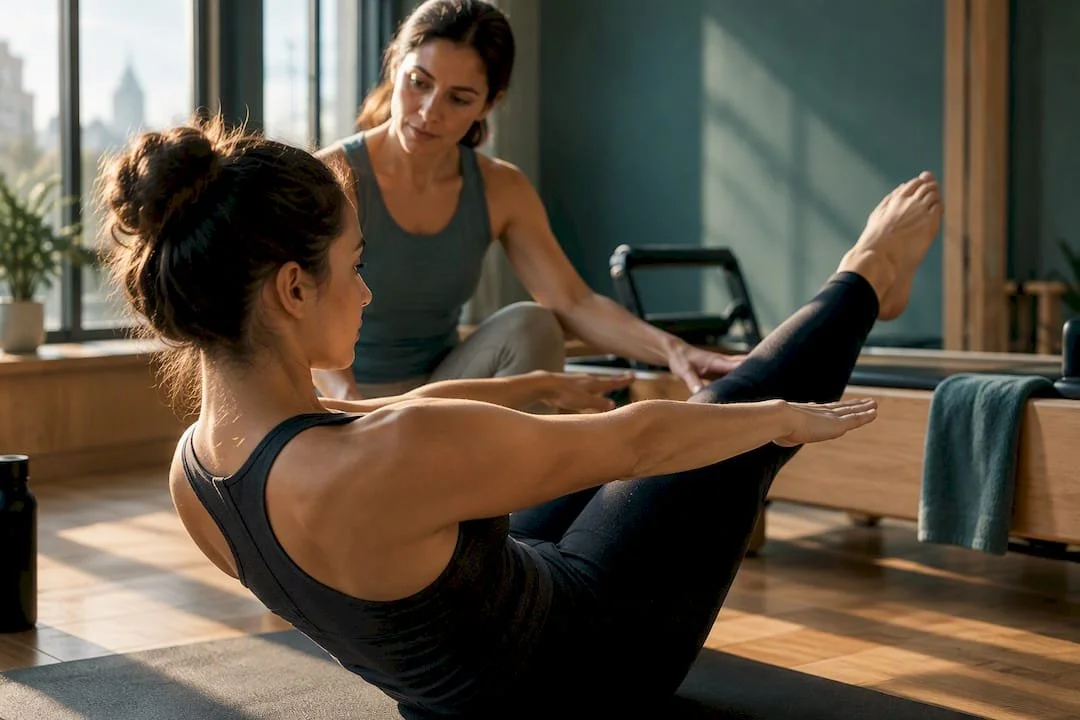
The main studio pathways for continuing your Pilates education are drop-in mat and reformer classes, focused workshops, private or small-group lessons, mentorship and apprenticeship, and full studio teacher training. Most students get the clearest answer to "what's next" by booking one diagnostic private session or a skills workshop first, which is a practical starting point offered at Amrita Yoga & Wellness.
TL;DR:
Supervised reformer classes twice weekly produce measurable strength and psychological improvements within four to six weeks, based on recent studies.
Private lessons can correct technique faster than group classes, making them essential before joining workshops or mentorship programs.
Full teacher certification programs follow ordered modules requiring specific supervised hours, avoiding advanced repertoire before mastering fundamentals.
For recreational practice, attending regular drop-in classes and occasional workshops over 6 to 12 months builds strength and body awareness effectively.
Confirm studio programs provide clear supervision ratios, written practicum hours, and specific progress assessments before enrolling in mentorship or certification pathways.
Amritayogawellness
Find Your Next Pilates Step
Explore Pilates classes, workshops, and teacher training options at Amrita Yoga & Wellness in Philadelphia.
Table of Contents
Studio Continuing Education Options Explained
Each route above serves a different goal, and matching the option to what you actually want to accomplish saves both time and money.
Drop-in mat classes are the backbone of ongoing practice. They suit anyone who wants steady conditioning, better body awareness, and the kind of repetition that builds long-term strength without a major schedule commitment. Reformer group classes add resistance and spring-based feedback, which tends to produce more measurable strength gains. An 8-week supervised Reformer program delivered three sessions a week has been shown to improve strength, endurance, and psychosomatic measures in a randomized trial of overweight and obese women, and a separate 6-week Reformer protocol reduced pain and improved psychological outcomes in people with chronic musculoskeletal pain when delivered twice-weekly in 45 to 50 minute sessions. Both studies point to the same pattern: consistent, supervised sessions multiple times a week produce measurable results within a few weeks.
Workshops and intensives target a narrow skill, such as cueing language, injury-modified practice, or a specific piece of repertoire. These typically run two to six hours or fill a weekend, making them a low-commitment way to break a plateau.
Private and small-group lessons offer one-on-one feedback that group settings cannot match. Sessions often focus on:
Correcting alignment issues that get missed in a group class
Building confidence with equipment before joining a reformer class
Preparing for a specific goal, like a return from injury or a teaching audition
Pro Tip: Use a short block of privates to fix technique before starting a workshop series, since instructors can correct habits faster one-on-one than in any group format.
Mentorship and apprenticeship come next for anyone moving toward teaching. The common structure follows a progression: assist an experienced instructor, observe full classes, then teach short segments under direct supervision before taking on a full class. Programs typically expect feedback cycles and gradually increasing responsibility rather than a sudden jump to independent teaching.
Studio teacher training ties these pieces together in sequence. Representative programs, such as Polestar Pilates' Complete Matwork Series, move through ordered modules (Principles, then Modules 1 through 3), paired with practicums and set minimums for supervised and self-directed practice hours. That module order matters: skipping ahead to advanced repertoire before mastering foundational cueing tends to slow progress rather than speed it up.
How to Choose the Right Studio Option for Your Goal
Before committing money or months to any path, run through a short checklist.
Check supervision ratios. Ask how many students share instructor attention during practicums or mentorship hours.
Ask for a sample weekly plan. A program that cannot describe a typical week is not ready to describe your progress.
Confirm practicum and mentorship hours in writing. Vague promises about "hands-on experience" are not the same as a set number of supervised hours.
Ask how progress gets assessed. Look for concrete checkpoints, not just a final certificate.
Review the cancellation and change policy. Costs and schedules shift, so know your options before paying in full.
Ask about scope for special populations. If you plan to work with prenatal, senior, or rehab clients, confirm the program actually covers those modifications.
Red flags include programs that skip observation hours entirely, instructors who cannot explain how special-population modifications are taught safely, and any teacher-track program that promises independent teaching without a supervised practicum. On cost and time scales, single workshops run a few hours, workshop series or short modules run several weeks, and full teacher-training cohorts typically span multiple months with staged tuition. The National Pilates Certification Program handbook outlines curriculum components, including anatomy, repertoire, and required observation and practice-teaching hours, as a useful reference point when comparing what a studio program actually requires.
Sample Pathways From Practice to Teaching
Three realistic timelines show how these pieces fit together depending on your goal.
Pathway A, recreational deepening (6 to 12 months): two to three weekly group classes plus an occasional workshop to sharpen specific skills, with no teaching component at all.
Pathway B, preparing to teach group classes (6 to 18 months): weekly private sessions to build technique, layered with mentorship and supervised practice teaching as confidence grows.
Pathway C, specialized or clinical focus (8 to 24 months): a mix of reformer practice, targeted workshops on populations like prenatal or rehab clients, and supervised practice teaching under a mentor experienced in that specialty.
For any of these, log hours honestly: track class attendance, private session dates, and supervised teaching minutes in a simple notebook or spreadsheet. Set milestones every four to six weeks rather than waiting for a final deadline, since short checkpoints make it easier to spot whether you are actually progressing or just staying busy.
Why Trust This Guidance
This guidance draws on studio-based teaching structures and current research on supervised Pilates delivery, plus the day-to-day class and workshop scope at Amrita Yoga & Wellness, a Philadelphia studio offering yoga, Pilates mat and reformer classes, barre, tai chi, massage therapy, and teacher trainings. The author, Juiced, covers Pilates education pathways and certification topics for the studio's blog, drawing on published research and studio program structures rather than personal instruction.
What Most Advice on This Topic Gets Wrong
Most advice treats continuing education as a straight line toward certification, as if every student who takes a workshop is angling to teach. That is not true, and the framing hurts recreational students who feel pressure to "level up" when what they actually want is a stronger, more consistent practice. The bigger mistake is skipping private sessions before jumping into a reformer class or a teacher-training cohort. A few sessions of one-on-one correction fix habits that group settings never catch, and they make every class or workshop afterward more useful. If you take one thing from this guide, prioritize honest feedback early, whether that means a private lesson or a mentor who will tell you what is not working. Certificates matter less than whether you can actually teach or move well.
— Juiced
How Amrita Yoga & Wellness Supports Your Next Step
Whatever stage you are at, Amrita Yoga & Wellness has a matching option. Ongoing practice fits into drop-in mat and reformer classes or a monthly membership. Readers working on a specific skill can book a private or small-group session to correct technique before joining a workshop or mentorship track.
New students can also check current trial pricing before committing to a full membership. Browse the class schedule and book a session to find your starting point.
Sources
FAQ
How long does it take to prepare to teach Pilates?
Timelines vary by intensity, but a realistic range generally spans several months when combining weekly private sessions, mentorship, and supervised practice teaching. Programs that follow ordered modules, like the Polestar Complete Matwork Series, typically pace this progression through set practicum and supervised-hour requirements.
Are reformer classes better than mat classes for building strength?
Reformer classes add resistance that can produce faster, more measurable strength gains, as shown in an eight-week supervised Reformer trial with overweight and obese women. Mat classes remain valuable for conditioning and body awareness and work well alongside reformer training rather than replacing it.
What should I ask before joining a studio mentorship program?
Ask for the exact number of observation and supervised teaching hours offered, how instructor feedback is delivered, and whether you will assist, observe, and then teach under direct supervision before leading a class independently. Confirm these details in writing rather than relying on a general description of "hands-on experience."
Can private sessions help before I start a teacher-training program?
Yes, private sessions correct technique and alignment issues faster than group classes because instructors can give immediate, one-on-one feedback. Many studio programs expect a baseline of movement proficiency before starting formal mentorship, and private sessions are a practical way to build that foundation.
Where can I start if I only want to deepen my personal practice?
Regular drop-in mat or reformer classes, combined with an occasional workshop on a specific skill, cover most recreational goals without any teaching component. This pathway typically takes 6 to 12 months to show steady improvement in strength and body awareness.
Recommended

5 Minutes to a Breathwork Habit: Daily Checklist and Amrita Support
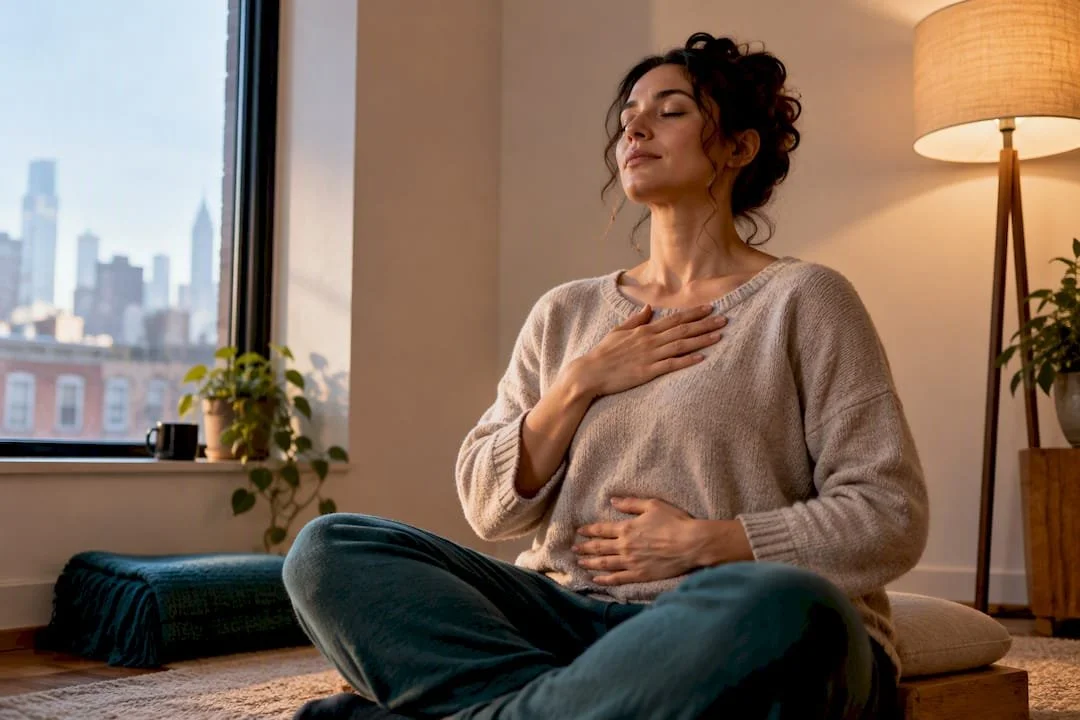
Yes, brief daily breathwork is effective, and five minutes is a real, usable minimum backed by research. A randomized study found that five minutes of daily cyclic sighing improved mood and lowered respiratory rate more than an equivalent amount of mindfulness meditation over the course of one month. Start with the checklist below today rather than waiting for a longer block of free time.
TL;DR:
Short daily breathwork sessions of five minutes, especially cyclic sighing, are supported by research to improve mood and reduce respiratory rates.
Techniques such as diaphragmatic, box, 4-7-8, cyclic sighing, and resonant breathing serve different purposes, with exhale extension providing the main calming effect.
Practice can be integrated into morning, midday, and evening routines, and consistency over 30 to 45 days builds a lasting habit more than session length.
Beginners should start with comfortable counts, shorten breath holds if needed, and prioritize safety to avoid dizziness, hyperventilation, or anxiety.
Guided instruction and real-time feedback from instructors can accelerate learning, with options for group classes or private sessions at wellness centers.
Amritayogawellness
Explore Guided Breathwork Support
Amrita Yoga & Wellness offers breathwork workshops alongside yoga, Pilates, barre, tai chi, massage therapy, and other wellness services.
Table of Contents
1. Your daily breathwork checklist, step by step
You do not need thirty minutes or a special room to get something out of breathwork. You need a few minutes and a chair.
Warm up (30 to 60 seconds). Sit tall, feet flat on the floor, shoulders soft. Take three normal breaths through the nose and notice where you feel tension.
Pick one 5-minute core practice. Cyclic sighing is the technique with the strongest direct evidence for a short daily dose: two inhales through the nose (a short one followed by a deeper top-up), then one long, slow exhale through the mouth. Repeat this pattern for five minutes.
Cool down and reflect (30 to 60 seconds). Return to normal breathing, then rate your mood on a 1 to 5 scale before you started and again now. Write one line about how your body feels.
If box breathing suits your schedule better than cyclic sighing, swap it in: inhale for four counts, hold for four, exhale for four, hold for four, and repeat for a short session of around five minutes. Either choice satisfies the daily minimum.
Once the core five minutes feels automatic, you can extend the session:
Add some extra slow, resonant breathing before bed to support wind-down.
Add a short energizing round, like three cycles of faster diaphragmatic breathing, before a morning workout or a demanding meeting.
Pair your breathwork with a one-line journal entry to track patterns over a week.
The one-line mood rating matters more than it sounds. The same study behind cyclic sighing built its protocol around a short scripted routine, a posture check, one exhale-focused technique, and a before-and-after mood score, which is exactly what makes a five-minute habit both trackable and repeatable.
2. How to do each core breathing technique correctly
Different techniques serve different goals, and knowing which one to reach for matters more than mastering all six at once.
Diaphragmatic (belly) breathing is the foundation for almost everything else. Lie down or sit comfortably, place one hand on your chest and one on your belly, and breathe in slowly through your nose so the belly hand rises while the chest hand stays still. Exhale slowly through pursed lips. The NHS's abdominal breathing guide walks through this hand placement and posture in more detail and is a good reference for beginners learning the sensation for the first time. Use this technique any time you want a baseline reset, especially before trying a more structured pattern.
Box breathing works well when you need focus without a strong sedative effect. Inhale for four counts, hold for four, exhale for four, hold for four, and repeat for four to six rounds. It suits pre-meeting nerves or a midday reset better than bedtime.
4-7-8 breathing is inhale for four counts, hold for seven, exhale for eight, repeated for four breath cycles. The Cleveland Clinic's guide to the 4-7-8 method notes that the long breath hold can feel uncomfortable for beginners, and recommends a modified 2-3.5-4 ratio (a two-count inhale, a three-and-a-half-count hold, a four-count exhale) until the longer version feels manageable. This technique fits best at bedtime, since the extended exhale tends to slow things down rather than sharpen focus.
Cyclic sighing is the double-inhale, long-exhale pattern described in the checklist above. It is worth defaulting to this one when time is short, since it carries the most direct evidence for a five-minute daily dose.
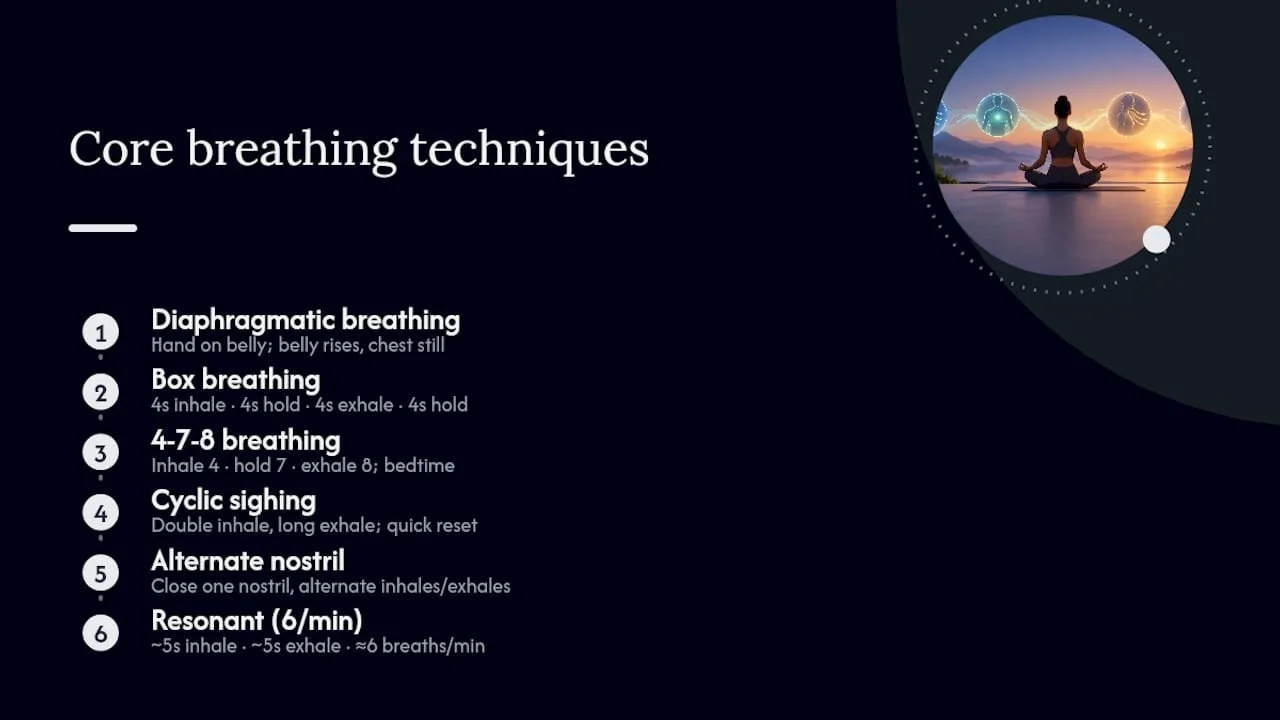
Alternate nostril breathing involves closing one nostril with a thumb, inhaling through the open side, closing that side, releasing the other nostril, and exhaling through it, then reversing the pattern. It is commonly used to settle a scattered mind before focused work, though it takes more coordination than the other techniques listed here.
Resonant or slow-paced breathing targets roughly six breaths per minute, meaning about a five-second inhale and a five-second exhale. A pilot study using resonant slow-paced breathing in long-COVID patients found measurable symptom improvements with repeated daily practice, which supports resonant breathing as a legitimate option for a regular routine rather than a novelty technique.
If breath holds trigger anxiety or dizziness, shorten every count proportionally rather than skipping the technique altogether: a 2-3.5-4 version of 4-7-8, or a two-count box breath instead of a four-count one, still delivers the pattern without the strain.
Pro Tip: Whichever technique you choose, extend the exhale beyond the inhale wherever the pattern allows it. A longer exhale is the main driver of the calming, parasympathetic response that makes breathwork feel effective.
3. When and how often you should practice each day
You do not need a perfect schedule to see a benefit. The Cleveland Clinic recommends five to 10 minutes of daily practice, using the breath as an anchor to gradually retrain the nervous system toward a calmer baseline rather than as a one-time fix.
One longer session tends to be easier to remember, while several short micro-sessions can fit into a day that has no single free block. Neither is objectively better: pick whichever you will actually repeat tomorrow.
Morning (right after waking): a short diaphragmatic or box breathing round to set a steady tone before the day's demands start.
Midday (before or after lunch): cyclic sighing for five minutes as a reset between tasks.
Evening (30 to 60 minutes before bed): 4-7-8 or resonant breathing, since the longer exhale supports wind-down.
A simple weekly structure might be a regular practice most mornings and several evenings when you have the time. Tie the practice to something you already do daily, which does more for adherence than the exact time of day.
4. Safety signs to watch for and how to adjust
Breathwork is generally low-risk for healthy adults practicing at a comfortable pace, but a few transient sensations are common enough to expect.
Lightheadedness or tingling in the hands or face can appear during longer breath holds or fast-paced rounds. Stop, sit still, and return to slow, normal nasal breathing until it passes.
Increased anxiety mid-session is a signal to shorten your counts rather than push through, since reduced counts and immediate cessation are the recommended response when adverse symptoms appear.
A modified 2-3.5-4 ratio works as a gentler substitute for standard 4-7-8 breathing when the seven-count hold feels too long.
Pregnant practitioners or people with respiratory or cardiovascular conditions should check with a healthcare provider before adopting breath holds or fast-paced patterns, since individual tolerance varies.
If a session brings on hyperventilation-like symptoms, sit down, plant your feet on the floor, and breathe slowly through the nose at a comfortable, unhurried count. This grounding sequence helps stabilize carbon dioxide levels and calm the nervous system faster than trying to finish the original pattern.
5. Turning five minutes into a lasting daily habit
Consistency matters more than length. Short daily sessions tend to build automatic habit behavior within roughly 30 to 45 days, and a brief practice done every day will outperform a longer one done sporadically.
Track it simply. A single line in a notebook, a checkbox in a habit app, or a before-and-after mood score is enough; you do not need detailed logs.
Stack it onto an existing habit. Practice right after brushing your teeth or right after your first cup of coffee, so the cue is already built into your day.
Shrink it when you slip. If you miss a few days, cut the session to two minutes and pick the simplest technique you know rather than trying to restart at full length.
Pro Tip: A missed day is not a failed habit, it is just a missed day. Restart at whatever length feels easy tomorrow, even if that means one minute.
6. Learning technique safely at Amrita Yoga & Wellness
Reading instructions is a fine start, but watching your posture and pacing get corrected in real time speeds up the learning curve. Various studios offer group classes, workshops, and private sessions where breathwork and pranayama show up alongside yoga, pilates, and other movement practices. Our breathwork in Pilates guide and aerial yoga breathing techniques article go deeper into technique pairing for readers who want more than a standalone breath practice. A private session offers a chance to have your ratios and modifications checked one-on-one, which matters most for beginners still finding their comfortable breath-hold length.
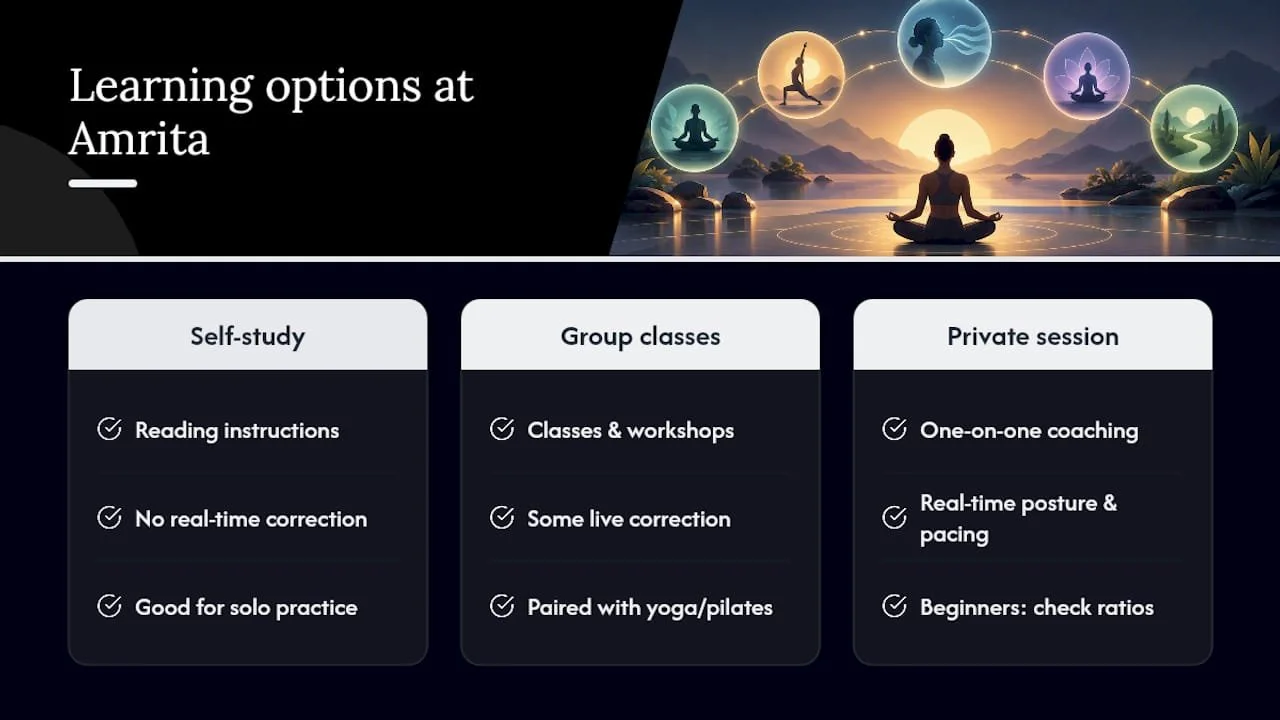
7. What an instructor wants beginners to know
Most people expect breathwork to feel effortless the first time, and it usually does not. The most common adjustment beginners need is simply shortening their counts, not abandoning the technique altogether. A ragged five minutes done daily will teach you more about your own breath than one perfect session done once a month.
Start with the checklist above, keep the counts comfortable, and let the practice get easier on its own timeline.
— Juiced
8. Practice breathwork with guided support in Philadelphia
Learning a new breathing pattern from a page is one thing. Having someone watch your shoulders, catch a rushed exhale, and adjust your count in the moment is another, and it tends to shorten the time it takes to feel confident. Amrita Yoga & Wellness builds breathwork into its class offerings and private sessions so you are never guessing whether you are doing it right.
A Community Class Drop In at $11 per session is a low-cost way to build the daily habit alongside a group.
A One to One Session starting at $85 per hour gives you focused, individual coaching on technique, pacing, and safe modifications.
The full class and membership schedule lets you find recurring sessions that fit your week, from Air Monthly Membership at $149 per month down to Earth Monthly Membership at $119 per month.
If you would rather build ritual cues at home first, Well In Spirit carries products for daily wellness routines that pair naturally with a breathwork practice. When you are ready for guided instruction, book a class or private session through the links above.
Sources
Brief structured respiration practices enhance mood and reduce physiological arousal
Abdominal breathing - Overview | Guy's and St Thomas' NHS Foundation Trust
What is the 4-7-8 breathing method? Science and benefits | Cleveland Clinic
FAQ
Is it okay to do breathwork every day?
Yes, for most healthy adults, daily breathwork is considered safe and is the pattern with the best evidence behind it. A randomized study found daily five-minute cyclic sighing improved mood and lowered respiratory rate over one month, and the Cleveland Clinic recommends five to 10 minutes daily as a starting routine.
What is the 4-7-8 rule for breathing?
The 4-7-8 method involves inhaling through the nose for four counts, holding the breath for seven counts, and exhaling slowly through the mouth for eight counts. The Cleveland Clinic notes that beginners who find the hold uncomfortable can use a shorter 2-3.5-4 ratio instead.
What is Gary Brecka's breathwork routine?
This routine is associated with a specific public figure rather than a clinically standardized protocol, and it is not covered by the sources used in this article. If you want a well-documented daily technique instead, cyclic sighing and diaphragmatic breathing both have direct research support behind them.
Does the Bible say anything about breathwork?
Breathwork as a structured wellness technique is a modern practice, and the sources used here focus on clinical and physiological evidence rather than religious texts. Readers interested in the spiritual dimensions of breath are better served by a theological resource than a wellness guide.
How long should a beginner practice breathwork each day?
Five minutes is a well-supported starting point, matching both the cyclic sighing study protocol and the Cleveland Clinic's five-to-10-minute recommendation. Consistency at this shorter length tends to build the habit faster than attempting longer sessions from the start.
Recommended

9 Mind Body Connection Exercises: How To, Modifications, 3 Routines
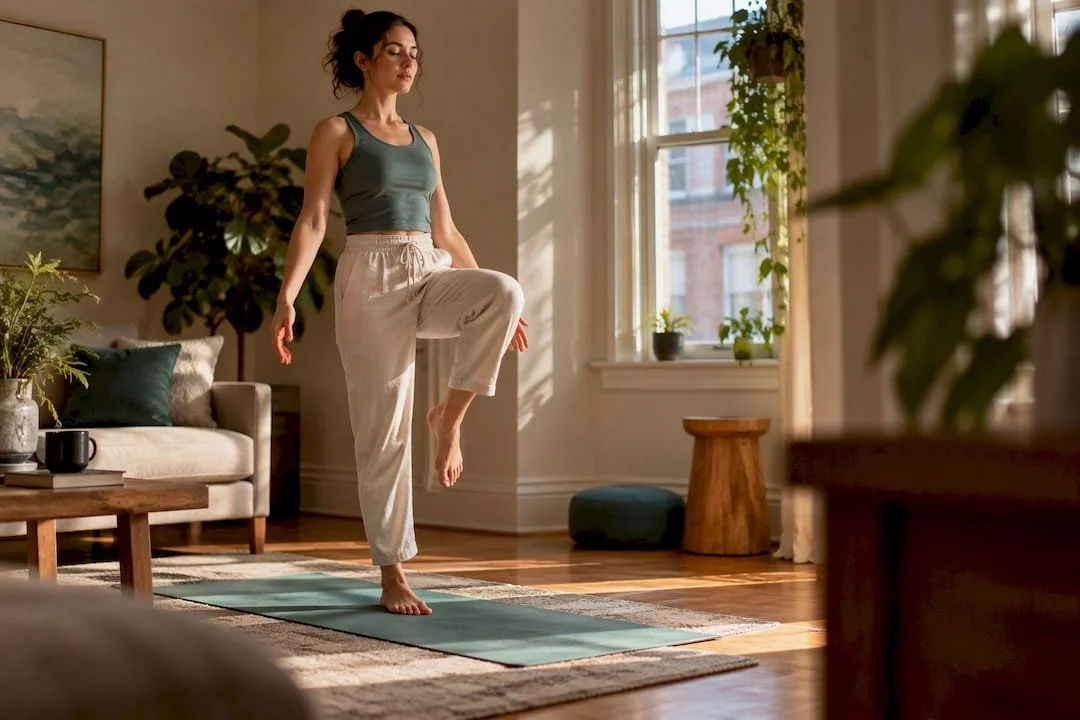
The most effective mind-body exercises are breathwork, body scan meditation, progressive muscle relaxation, guided imagery, yoga, Tai Chi or Qigong, and mindful walking, each of which builds body awareness and helps regulate stress within minutes of practice. Start with five minutes of slow breathing today, and work with a qualified teacher if you have a chronic illness, are pregnant, or have a history of trauma.
TL;DR:
Practicing simple breathwork patterns like box breathing or coherent breathing can reduce stress in just a few minutes, especially when done daily or before sleep.
Starting with two to three varied mind-body practices such as yoga, Tai Chi, or guided imagery, and maintaining consistency weekly, produces better stress regulation than infrequent intense sessions.
Modifications like chair-supported yoga and avoiding deep twists are vital for safety if you have injuries or health concerns, and supervision by qualified instructors is recommended for beginners or trauma recovery.
Short daily micro-practices, such as five minutes of breath or body scan, paired with a gradual increase in session length, help create sustainable routines for body awareness and stress management.
Incorporating regular movement, breath, and mindfulness practices into your routine can shape brain networks responsible for attention and self-awareness, extending emotional benefits beyond physical exercise.
Amritayogawellness
Find Your Mind Body Practice
Explore yoga, Tai Chi, breathwork, Pilates, and other wellness practices at Amrita Yoga & Wellness in Philadelphia.
Explore Amrita Yoga & Wellness
Table of Contents
3. Safety, modifications, and when to get professional instruction
5. Why Amrita Yoga & Wellness teaches these practices this way
1. Practical exercise list for building body awareness
Each of these practices trains a slightly different skill, so pick two or three to start rather than trying everything at once.
Breathwork. Box breathing (inhale four counts, hold four, exhale four, hold four) calms an overactive nervous system in under two minutes. The 4-7-8 pattern (inhale four, hold seven, exhale eight) works well before sleep, while coherent breathing, roughly five to six breaths per minute, is a steady baseline practice for daily stress regulation. All three suit beginners and can be done seated, standing, or lying down.
Body scan meditation. Lie down or sit comfortably, close your eyes, and move your attention slowly from your feet to your head, noticing sensation without trying to change it. A useful cue is naming one sensation on each exhale, such as "heavy legs" or "soft belly," which anchors attention and speeds up learning the skill. A full scan takes 10 to 20 minutes, though a two-minute version covering just the hands, shoulders, and jaw works when time is short.
Progressive muscle relaxation (PMR). Tense each muscle group for five seconds, then release and notice the contrast for ten seconds, working from your feet up to your face. The tense-then-release sequence teaches your body to recognize what relaxation actually feels like, which is often the missing skill for chronically tense people.
Guided imagery. Picture a specific safe place in detail: the temperature, the sounds, the light. A "resource state" image, recalling a moment you felt calm and capable, works well before a stressful event like a presentation or medical procedure. Five minutes is enough for most people to notice a shift.
Yoga. A beginner sequence of cat-cow, child's pose, seated forward fold, and legs-up-the-wall, paired with slow breathing, combines movement with attention training. A systematic review and meta-analysis of yoga interventions found that programs combining postures, breathing, and meditation reduced stress markers and improved anxiety and depression scores, with trial frequency ranging from once weekly to several sessions a week over programs that typically ran for several weeks. Keep knees soft and avoid deep twists if you have a back injury.
Tai Chi and Qigong. Both use slow, continuous movement linked to breath, and both can be practiced standing or seated for people with balance concerns. A systematic review and meta-analysis on Tai Chi found benefits for chronic pain and function with a low rate of adverse events, making it one of the gentler entry points into meditative movement.
Mindful walking. Slow your pace by about half, and cycle your attention through what you see, hear, and feel underfoot for one full minute each. This sensory anchoring turns an ordinary walk into a short attention-training session.
Pilates-based mindful movement. Sync breath to core work: exhale on the effort phase of an exercise like the hundred or a pelvic curl, inhale on the release. This breath-synced approach builds interoceptive awareness alongside strength and mobility.
Dance and movement micro-practices. A few minutes of unstructured, music-led movement, letting your body respond without choreography, gives emotional tension a physical outlet that stillness-based practices don't offer.
Meditative movement practices like Tai Chi, Qigong, and yoga appear to work partly by shaping how the brain's attention and self-awareness networks respond, which may explain why the emotional benefits often outlast the physical workout itself. For more on linking breath cues to specific postures, see this collection of mindfulness for yoga resources.
2. How to build a balanced weekly mind-body routine
A single great session helps, but consistency across the week is what actually changes your baseline stress level. Structure matters more than intensity here.
Two sessions of strength or mobility work, each opened with two minutes of breath preparation to set attention before you move.
Two low-intensity meditative movement sessions, such as yoga or Tai Chi, lasting 20 to 45 minutes.
A daily five to ten minute micro-practice, alternating breathwork and body scan, on the days without a longer session.
One full recovery day with no structured practice at all, just rest.
Dose matters in both directions. Research on the relationship between physical activity and stress biomarkers points to an inverted U-shaped pattern, where moderate practice lowers cortisol but excessive high-intensity activity can push stress markers back up. That is one reason a weekly plan mixes gentle and active sessions rather than stacking hard workouts every day.
Pro Tip: Attach your micro-practice to something you already do, like your morning coffee or the walk to your car, so it becomes automatic instead of another task on your list.
Progression should be slow — and building a sustainable routine is easier with support from professionals like those at DCFB Wellness | Corporate Wellness in Dallas & DFW, who specialize in creating workplace-friendly wellness programs. Add five minutes to a session every two weeks rather than doubling your practice time overnight, and if a habit trigger stops working, swap it rather than abandoning the practice entirely. For a broader set of short techniques to slot into these slots, this list of mindfulness techniques is a useful reference.
3. Safety, modifications, and when to get professional instruction
Most mind-body practices are low risk, but a few signals mean you should stop and reassess.
Stop a breathing exercise if you feel lightheaded, tingly, or unusually short of breath, and return to normal breathing.
Skip deep twists, backbends, or long holds in yoga if you have a spinal injury, and use a chair-supported version of standing poses instead.
Sit rather than lie down for a body scan if lying flat triggers anxiety or reflux.
Watch for increased anxiety during meditation. The NCCIH notes that a minority of practitioners have negative experiences, and beginner supervision helps reduce that risk.
Seek a qualified teacher if you are pregnant, managing a chronic illness, recovering from trauma, or new to a practice with complex movement, since learning form from video alone raises the risk of injury.
Check that any instructor holds a recognized teaching certification for the specific practice, such as a registered yoga teacher credential, before booking ongoing sessions.
4. Quick-start sample routines you can use today
These three templates scale from a spare ten minutes to a full beginner month.
10-minute daily micro-practice. Spend four minutes on coherent breathing, then four minutes on a shortened body scan covering the hands, shoulders, and jaw, and close with two minutes of stillness.
30-minute session. Warm up with five minutes of gentle movement, follow with 15 minutes of mindful yoga or Tai Chi, add five minutes of box breathing, and finish with five minutes of guided imagery or quiet rest.
4-week beginner progression. Week one: daily 10-minute micro-practice only. Week two: add one 30-minute session twice weekly. Week three: add a second weekly 30-minute session and introduce PMR before bed. Week four: hold that structure and add five minutes to one session to test your capacity.
Pro Tip: If a full session feels like too much on a hard day, the NCCIH's overview of mind-and-body practices supports shorter, more frequent sessions as a legitimate way to build the same skill, so a two-minute breath check-in still counts.
Simple cues help the habit stick: a sticky note on your water bottle, a phone reminder tied to lunch, or laying out a mat the night before. For more ready-made short practices to plug into these routines, see 7 mindfulness techniques examples for yoga and Pilates.
5. Why Amrita Yoga & Wellness teaches these practices this way
Amrita Yoga & Wellness structures its classes, from hot yoga to Tai Chi to Pilates, around the same body-awareness skills covered above, with modifications built into every level from beginner to advanced. Solo practice works well for daily micro-sessions, but classes give you real-time correction on form and breath pacing, which matters most when you are learning a new movement pattern. The studio's community classes are designed so beginners and experienced practitioners can work at their own pace in the same room.
— Juiced
6. Ways to learn these exercises with guided support
Reading a list is a start, but a body scan feels different when a teacher is cueing your attention in real time, and a yoga posture lands differently when someone can adjust your alignment.
Amrita Yoga & Wellness offers a few direct paths in. If community energy helps you stay consistent, a Group Class Drop In covers yoga, Tai Chi, and Pilates sessions built around the practices in this guide. If you have an injury or want modifications tailored to your body, a private session starts at $85 an hour. For a deeper dive into breathwork specifically, check the studio's workshop schedule on the class descriptions page.
FAQ
What are some examples of brain-body connection exercises?
Breathwork, body scan meditation, progressive muscle relaxation, guided imagery, yoga, Tai Chi, Qigong, and mindful walking are common examples, each pairing a physical action with focused attention. These practices are grouped by NCCIH as mind-and-body practices because they train awareness alongside movement or stillness.
What are the 7 essential exercises?
There is no single agreed list of exactly seven exercises, since different teachers and traditions group these practices differently. A practical starting set covers breathwork, body scan, progressive muscle relaxation, guided imagery, yoga, Tai Chi or Qigong, and mindful walking, which together cover breath, stillness, and movement.
What are the 7 trauma release exercises?
Trauma release exercise programs vary by practitioner, and no single standardized list of seven exercises is universally recognized. Gentle movement practices like yoga and Tai Chi are often used alongside professional trauma-informed guidance, and anyone working through trauma should practice with a trained instructor or clinician rather than relying on a general list.
How can I strengthen my mind-body connection?
Start with a short daily practice, such as five minutes of slow breathing or a brief body scan, and build up frequency before adding duration. Consistency across the week, mixing gentle meditative movement with a couple of active sessions, tends to matter more than any single long practice.

Try a $28 Drop In: Holistic Health in Philadelphia
If you're looking for holistic health resources in Philadelphia, start with three tracks: integrative clinics for chronic or complex conditions, complementary therapy centers for targeted support like acupuncture or massage, and community workshops or wellness studios for everyday maintenance. The fastest first step is usually the lowest-commitment one, a drop-in class, a free consult call, or a city wellness event. Amrita Yoga & Wellness is one accessible local option if classes or workshops fit what you need right now.
TL;DR:
Almost all providers should have proper licensure or certification, and transparency about their training and approaches is essential for quality care.
Integrative clinics benefit those managing chronic or complex conditions, while single-modality centers or workshops suit preventive or skill-building goals.
Community workshops are cost-effective options for hands-on learning in herbalism, sound healing, and urban farming, often at little or no expense.
For mental health, blending therapy with mind-body practices and community resources yields more sustainable results than isolated interventions.
Start small with one class or consultation, and prioritize providers or programs that emphasize ongoing support and coordination with other care sources.
Amritayogawellness
Find Your Wellness Practice
Explore yoga, Pilates, barre, tai chi, massage therapy, classes, and workshops through Amrita Yoga & Wellness in Philadelphia.
Explore Amrita Yoga & Wellness
Table of Contents
What holistic health includes and the common modalities you'll find locally
Local clinics and complementary therapy options: what they do and when to choose them
Community workshops and events: hands-on learning and low-cost access
Integrative mental health in Philadelphia: blended approaches and community supports
A compact checklist: how to evaluate and choose a provider or workshop
Resources for ongoing support and follow-up in holistic health
What holistic health includes and the common modalities you'll find locally
Holistic health is not one thing. The NCCIH draws a distinction between complementary approaches (used alongside conventional medicine), alternative approaches (used in place of it), and integrative approaches (which combine both in a coordinated plan). Whole-health frameworks described in the NCBI Bookshelf emphasize care that is people-centered, comprehensive, and equitable, with an eye toward upstream factors like housing, stress, and social connection rather than symptoms alone.
In Philadelphia, that translates into a wide mix of providers and formats. You'll commonly find:
Movement-based practices like yoga, pilates, and tai chi
Bodywork including massage, acupuncture, and Ayurvedic treatments
Naturopathy and herbalism, often taught through hands-on community classes
Nutritional counseling and sound healing sessions
Integrative psychiatry that blends medication with lifestyle and mind-body support
When you're sizing up a provider, look for basic quality signals: proper licensure for their modality, some demonstrated trauma or cultural competence, and a willingness to coordinate with other providers on your care team rather than working in isolation.
Local clinics and complementary therapy options: what they do and when to choose them
Philadelphia's holistic landscape splits roughly into two categories. Integrative medical clinics tend to be multi-disciplinary, building longer-term treatment plans that combine conventional medicine with complementary practices for chronic or layered conditions. Single-modality centers, think acupuncture studios, homeopathy practices, or hypnotherapy offices, focus on one approach and often work well for a specific, narrower concern.
What to expect when booking:
An initial intake that covers health history, current symptoms, and goals
Session lengths that typically run 45 to 90 minutes for bodywork or therapy-style appointments
Fee structures that vary by provider, with many clinics offering brief or free initial consults
Insurance coverage that is inconsistent across modalities, so it pays to ask upfront
Choose clinic-based integrative care when you're managing something chronic, complex, or layered with multiple symptoms. Choose a studio, workshop, or single-modality center when you're focused on prevention, stress management, or building a specific skill like a home yoga practice or basic herbal remedies.
Pro Tip: Before a first call or intake, jot down a short timeline of your symptoms, current medications, and self-care routines. It makes the conversation faster and gives the provider something concrete to work from.
Community workshops and events: hands-on learning and low-cost access
Some of the most accessible holistic health resources in Philadelphia aren't clinics at all, they're workshops. Community farms, botanical gardens, and local nonprofits regularly host sessions on herbalism, sound healing, and urban farming, often at little or no cost.
The PHS Community Farm runs workshops on growing, harvesting, and processing medicinal herbs, while Bartram's Garden hosts sessions like its Afro-herbalism elderberry class, where participants leave with practical takeaways like a homemade elderberry oxymel or herbal salve. These events are typically hands-on rather than lecture-style.
To find them, check:
City and neighborhood event calendars
Community farm and botanical garden event pages
Local Facebook groups dedicated to Philadelphia wellness workshops
Wellness expos and nonprofit programming listed seasonally
These workshops complement clinical care well. They build practical skills and community connection, which matters even when you also have a therapist or physician on your team.
Integrative mental health in Philadelphia: blended approaches and community supports
Integrative mental health care in Philadelphia often blends conventional therapy with mind-body and lifestyle support. A common combination pairs CBT or ACT with mindfulness practice, sleep and nutrition coaching, and, when appropriate, medication management. For trauma-related concerns, some providers add body-based modalities like somatic work alongside talk therapy.
Therapist directories show many Philadelphia practitioners already work this way, mixing CBT, ACT, psychodynamic, and relational approaches rather than sticking to a single method. Many offer brief initial consultations specifically to align treatment with your goals and circumstances.
When looking for integrative mental health support, ask at your free consult:
Which specific approaches they blend and why
How they coordinate with a psychiatrist or primary care provider if medication is involved
Whether they have experience with trauma-informed or culturally responsive care
Philadelphia also runs public programs worth layering alongside private care. The city's Department of Behavioral Health and Intellectual disAbility Services and its broader Wellness Ecosystem Initiative have expanded recovery-oriented housing and on-site behavioral health supports, making community-based options a meaningful complement to a private therapist or clinic.
A compact checklist: how to evaluate and choose a provider or workshop
Before booking anything, run through this:
Confirm licensure or certification appropriate to the modality.
Ask what treatment approach they use and why it fits your situation.
Ask about trauma-informed or culturally responsive training.
Get clear on cost, session length, and whether a sliding scale or insurance applies.
Check accessibility: telehealth options, evening hours, or location.
Pro Tip: On a first call, ask directly: "What does a typical treatment plan look like, and how will we know it's working?" A provider who can't answer clearly is a signal to keep looking.
Watch for red flags: promises of a guaranteed cure, no interest in coordinating with your other providers, or vague answers about training and credentials.
Amrita Yoga & Wellness: a local, community-centered option for classes, workshops, and some complementary services
Amrita Yoga & Wellness is a Philadelphia studio offering a range of entry points into holistic practice:
Yoga classes across various styles, suitable for a range of experience levels
Pilates mat and reformer classes, barre, and tai chi movement practices
Massage therapy and Ayurveda-based treatments
Wellness workshops covering topics like tarot readings and breathwork
Teacher trainings and private sessions
Amrita works well as a first step for movement, stress relief, and community connection. For chronic or complex medical concerns, an integrative clinic is still the better starting point, and a studio like Amrita fits alongside that care rather than replacing it.
Patient experiences with holistic health in Philadelphia
Outcomes from holistic health work in Philadelphia tend to look different from a single clinical metric. People who combine a weekly yoga or pilates class with occasional bodywork often describe better sleep, steadier stress levels, and more consistency showing up for themselves, benefits that build gradually rather than overnight. Someone managing chronic pain might pair regular massage or acupuncture with a longer-term relationship at an integrative clinic, using each piece for a different part of the picture.
Community workshops add another layer. A participant who takes an herbalism class at a community farm might walk away with a practical skill, like making an elderberry oxymel, alongside a sense of connection to other people pursuing similar goals. That combination of skill-building and community is part of what whole-health frameworks point to when they describe team well-being and comprehensive care as core elements of effective support.

None of this replaces a formal study or guarantees a specific result for any individual. What it does show is a pattern common across integrative approaches: layering small, consistent practices, movement, bodywork, community learning, and clinical care where needed tends to produce steadier results than relying on any single intervention alone. If you're new to holistic health in Philadelphia, that's a reasonable expectation to set rather than a promise of quick transformation.
Resources for ongoing support and follow-up in holistic health
Holistic health rarely works as a one-time fix. Sustained results usually come from checking in regularly, whether that's a support group, a recurring class, or an online community.
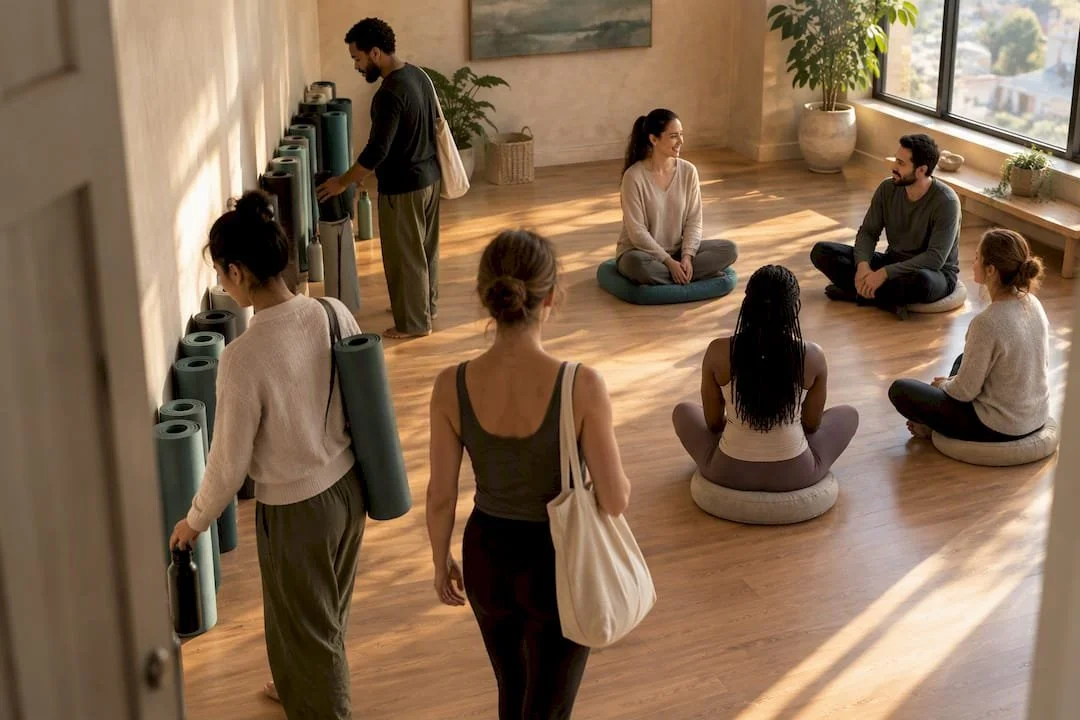
Philadelphia's public infrastructure offers some of this built in. The Wellness Ecosystem Initiative has opened recovery-oriented housing and community programs designed for ongoing, not one-off, support. These programs are especially useful if you're managing a behavioral health condition alongside other holistic care.
For less formal follow-up, look at:
Recurring community workshops at local gardens and farms, which build relationships over multiple sessions rather than a single visit
Local Facebook groups focused on Philadelphia wellness events, which often share ongoing meetups
Therapist-led group sessions, which some integrative mental health providers offer alongside individual care
Studio memberships that create a regular rhythm of classes rather than sporadic drop-ins
The common thread is consistency. A single acupuncture session or one workshop can help, but the providers and programs built for repeat visits tend to be where people see the most durable change.
Building a wellness plan without losing your way
Start small: one class, one consult, one workshop. Track what shifts. Add clinic-based care for anything chronic, and lean on Philadelphia's community programs for connection along the way.
— Juiced
How Amrita can help you get started
If a class or workshop is your next step, Amrita Yoga & Wellness makes it simple to try one without committing to a long-term plan first. Drop into a group class, book a private session, or explore Ayurvedic treatments.
Try a group or livestream drop-in class with no long-term commitment
Book a private one-on-one session for individualized attention
Explore Shirodhara, Abhyanga, or other Ayurvedic therapies for targeted bodywork
Check new student specials if you're visiting for the first time
For medically complex needs, an integrative clinic should still lead your care plan. For everyday movement, stress relief, and community, Amrita is ready when you are.
Sources
FAQ
What is included in holistic health?
Holistic health typically includes conventional medical care alongside complementary practices like acupuncture, massage, yoga, herbalism, and nutritional counseling. Whole-health frameworks describe it as people-centered and comprehensive, addressing physical, mental, and social factors together rather than treating symptoms in isolation.
Is a doctor of holistic medicine a real doctor?
It depends on the specific credential and training program, since "holistic medicine" covers a range of licensure paths rather than one standardized degree. Ask any provider directly about their license, training, and scope of practice before booking, especially for anything beyond wellness maintenance.
Does holistic medicine really work?
Results vary by modality and individual, and the research on integrative medicine frames it as combining clinical experience with multiple traditions rather than promising a fixed outcome. Many people find value layering complementary practices, movement, bodywork, community support, alongside conventional care rather than as a replacement for it.
What are some examples of holistic medicine?
Common examples include yoga, acupuncture, massage therapy, Ayurvedic treatments, herbalism, and integrative psychiatry that combines therapy, lifestyle support, and medication when needed. In Philadelphia, you'll also find these paired with community programs like herbalism workshops at local gardens and farms.
How do I find affordable holistic health options in Philadelphia?
Community workshops at gardens, farms, and nonprofits are often free or low-cost entry points, alongside public programs through the city's Wellness Ecosystem Initiative. For studio classes, drop-in options like those at Amrita Yoga & Wellness let you try a single session, starting at $28 for a group class, before committing to a membership.
Recommended

6 Studio Ready Hybrid Fitness Class Examples You Can Teach Today
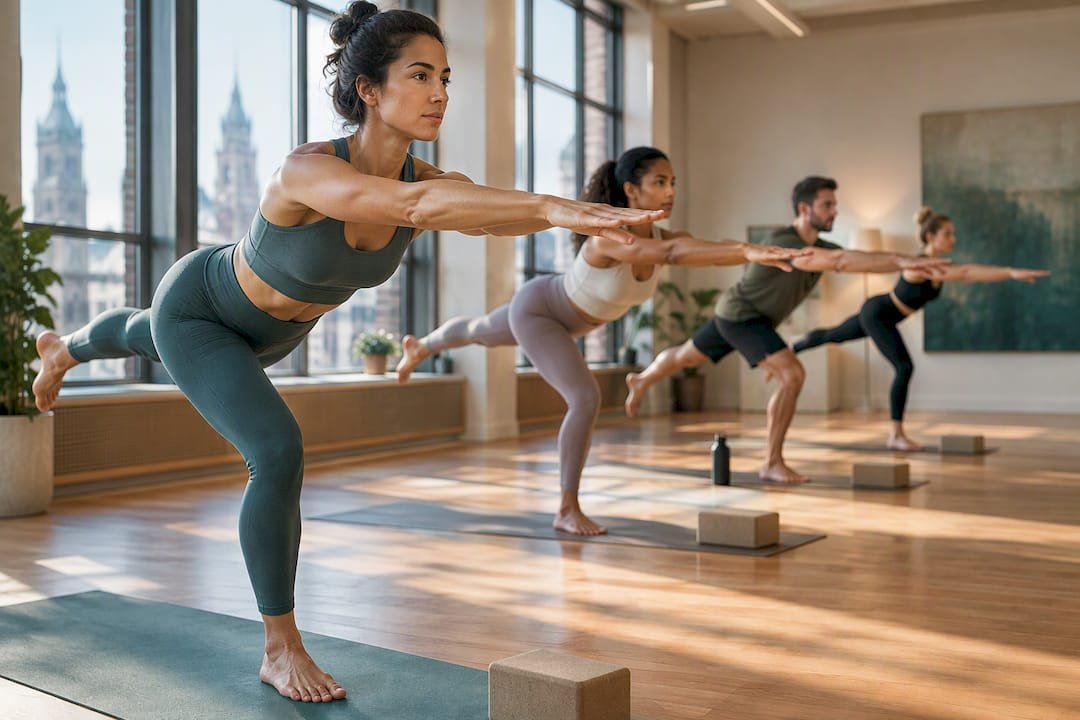
Yoga‑Pilates fusion builds core stability and flexibility. Barre‑yoga flow sculpts muscle while opening tight hips and shoulders. Pilates with breathwork calms the nervous system while it trains deep abdominal control. Tai chi paired with mindfulness sharpens balance and lowers stress hormones. Yoga‑barre strength classes add muscular endurance to a flexibility base. Each hybrid format targets a different mix of goals, and picking the right one comes down to matching your priorities to the blend.
TL;DR:
Yoga‑Pilates fusion is suitable for beginners and seniors and mainly targets core stability, spinal health, and stress reduction in a single session.
Barre‑yoga flow is low-impact, building long muscles and easing recovery, ideal for those returning to exercise after a break.
Tai chi paired with mindfulness improves balance and coordination, especially benefiting older adults or those recovering from lower‑body injuries.
Consistent participation of two to three classes weekly supports flexibility and strength goals, while one to two tai chi sessions help maintain stress relief and balance.
Modifications using props or equipment are common, but individuals with recent injuries or balance issues should consult a healthcare professional before attending.
Amritayogawellness
Explore Hybrid Wellness Practices
Amrita Yoga & Wellness brings yoga, Pilates, barre, tai chi, and other accessible practices together in a Philadelphia community studio.
Explore Amrita Yoga & Wellness
Table of Contents
Hybrid Fitness Class Examples You'll Find at a Studio
Studios have leaned hard into blended formats over the past few years, and the numbers back up why: participation in yoga, Pilates, and mobility-focused classes climbed roughly 27% between 2022 and 2024, with balance, flow, and core strength landing at #5 on ACSM's 2026 fitness trends list. People want more than one outcome from a single hour, and hybrid formats deliver that.
Here are six examples you'll actually encounter on a studio schedule, along with what to expect from each.
Yoga‑Pilates fusion. This is the most widely taught hybrid format, and for good reason: it targets core stability, spinal health, flexibility, and stress reduction in one sequence, which is why it's considered appropriate for beginners and even seniors. Expect sun salutations blended with Pilates hundred‑style core sets, mat work, and controlled breathing. You'll need just a mat and maybe a small ball or resistance band.
Barre‑yoga flow. Ballet‑inspired isometric holds at the barre get paired with yoga stretches and balance poses. The structure typically runs warm‑up, then barre work, then floor work, then a cool‑down. It's low‑impact and builds long, lean muscle without heavy joint strain, making it a good fit for people easing back into exercise after time off.
Pilates with breathwork. Traditional Pilates core sequencing gets slowed down and layered with diaphragmatic breathing drills. The outcome is a stronger core and a noticeably calmer nervous system by the end of class. This one suits anyone managing anxiety or recovering from a stressful stretch, though people with uncontrolled high blood pressure should check with a doctor before deep breath‑holds.
Tai chi and mindfulness. Slow, weight‑shifting tai chi forms combine with guided meditation or body‑scan practices. Neuromotor training like this, done in 20 to 30 minute blocks a few times a week, measurably improves balance and coordination, which makes it a strong pick for older adults or anyone recovering from a lower‑body injury.
Yoga‑barre strength. This leans heavier on muscular endurance than the barre‑yoga flow format, stacking barre sets with longer yoga holds like warrior poses. It suits people who already have some fitness base and want more sculpting alongside flexibility work.
Gentle mobility and core. A slower‑paced blend of joint mobility drills, light Pilates core work, and restorative stretching. It's the easiest entry point for total beginners or anyone returning from injury, and it usually needs nothing but a mat and a block.
Room and equipment needs stay simple across all six. Most just require a mat, and a barre‑based class needs, unsurprisingly, a barre. A few incorporate light props like resistance bands, small balls, or blocks, but none demand the heavier equipment you'd find in a dedicated reformer Pilates studio.
How to Choose the Right Hybrid Class for Your Goals
Start with your actual goal, not the class name. If flexibility and stress relief top your list, lean toward yoga‑Pilates fusion or tai chi and mindfulness. If you want more muscle definition alongside mobility, barre‑yoga or yoga‑barre strength fits better.
Then check these before you book:
Does the class description name a level (beginner, all levels, intermediate)? Vague descriptions often mean vague pacing.
Does it mention modifications or props available in the room?
Is the instructor certified in more than one of the disciplines being blended, not just one with the other borrowed loosely?
Does the studio state a clear intention for the class, rather than just listing styles mashed together? Well‑designed fusion programs spell this out precisely so you know what you're walking into.
Red flags worth pausing on: an instructor who can't answer what a "modified" version of a pose looks like, a class labeled "all levels" that runs at one unbroken pace, or a studio that can't tell you roughly how much floor time versus standing time the class includes.
Pro Tip: Call or message the studio before your first visit and ask which discipline gets more emphasis that day. Fusion classes often shift their ratio week to week, and knowing the lean helps you show up with the right expectations.
What a Typical 60-Minute Hybrid Class Looks Like
Most hybrid formats follow a similar arc, even when the disciplines being blended differ.
Warm‑up (0 to 10 minutes). Gentle joint circles, cat‑cow stretches, and light tai chi weight shifts to raise body temperature without spiking heart rate.
Main blended work (10 to 35 minutes). This is where the fusion happens: barre pulses at the wall followed by yoga standing poses, or Pilates mat sequences threaded between sun salutations. Expect the instructor to cue transitions clearly so you're never guessing which discipline you're in.
Floor and core work (35 to 50 minutes). Pilates‑style abdominal sets, bridges, and controlled leg lifts, often finished with a longer yoga hold like pigeon pose or a seated twist.
Cool‑down and mindfulness (50 to 60 minutes). Slow stretching, breathwork, and sometimes a short guided meditation to close things out.
A 45 minute version usually trims the main blended block, while a 75 minute class stretches the floor work and adds a longer meditation close. Either way, the sequencing logic stays the same.
Staying Safe: Modifications and What to Watch For
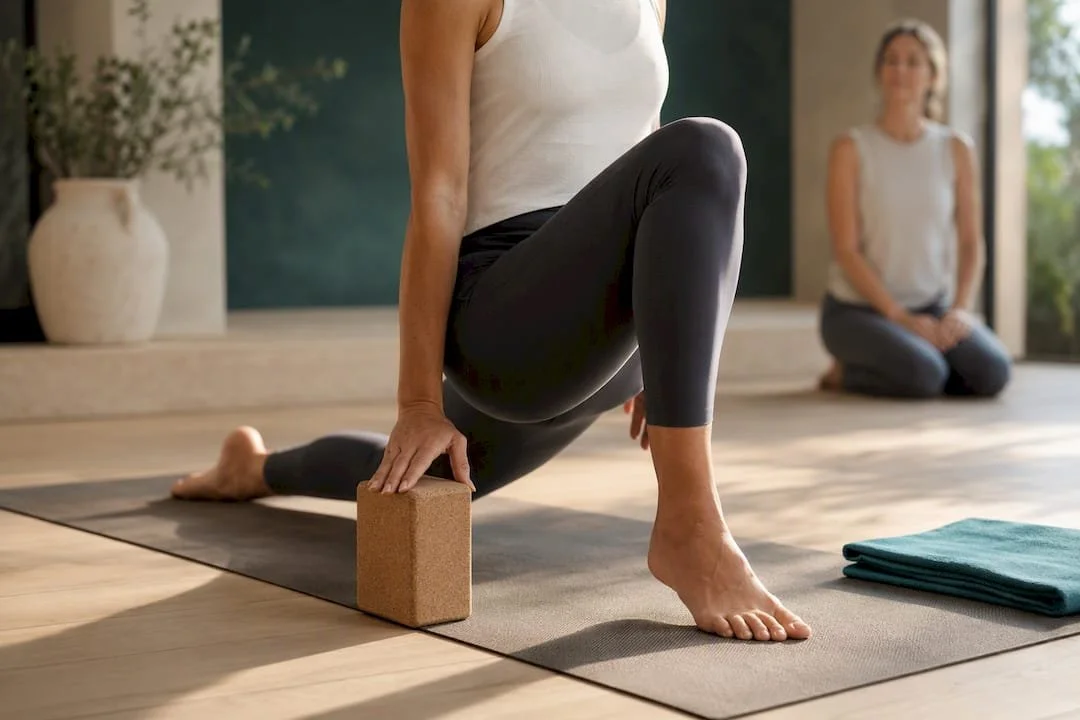
Hybrid classes mix movement systems, which means instructor cueing matters more than usual. A well‑run class names the discipline before each transition ("we're moving into a Pilates set now") instead of just flowing silently, so you never lose track of what your body should be doing.
Common modifications to look for:
Blocks under the hands for anyone with tight hamstrings during forward folds.
A chair or wall for balance work if tai chi weight shifts feel unsteady.
Knee pads or a folded mat for extended kneeling in barre or floor Pilates segments.
Reduced range of motion cues for anyone with recent joint surgery or flare‑ups.
Pro Tip: If you have a herniated disc, recent surgery, or a balance disorder, talk to your doctor or physical therapist before attending a hybrid class, and mention it to the instructor beforehand so they can offer targeted modifications from the start.
How Often to Attend Based on Your Goal
Match your weekly attendance to what you're actually chasing:
Flexibility focus: two to three yoga‑Pilates or gentle mobility classes weekly, which lines up with Cleveland Clinic's general guidance on frequency for flexibility gains.
Strength and core focus: two barre‑yoga or yoga‑barre strength classes weekly, paired with one or two separate resistance sessions since full health guidelines call for combining flexibility, resistance, and aerobic work across the week.
Stress relief and maintenance: one to two tai chi and mindfulness or Pilates‑breathwork classes weekly, layered around whatever cardio you're already doing.
Give yourself at least one full rest or light‑movement day between higher‑intensity barre sessions, and increase intensity gradually as your balance and core control improve.
Why We Build Classes This Way
Blended formats work because they respect how people actually move through a week: some days call for strength, some for stretch, some for quiet. Amrita Yoga & Wellness builds its schedule around that reality, running everything from gentle mobility sessions to barre and tai chi so beginners and advanced students can progress at their own pace inside the same community. If you're new to fusion classes, a livestream drop-in is a low‑pressure way to test the waters before stepping into the room.
— Juiced
Try a Hybrid Class at Amrita Yoga & Wellness
Reading about blended classes only gets you so far. Some studios offer these formats regularly, and a first visit can cost less than a single private session elsewhere in the wellness world.
If you're new to hybrid formats, start with a beginner‑friendly session through Nurtured Beginnings at $35 for the pass, which eases you into blended sequencing without assuming prior Pilates or yoga experience. From there, a single Group Class Drop In runs $28 if you want to sample a specific fusion format before committing further. Want to test the waters from home first? The Livestream Class Drop In at $19 lets you try a session on your own schedule. Browse full class descriptions to match a listed session to the examples above, then book your first week and see which blend fits your body best.
Sources
Yoga vs. Pilates: Which Is Right for You? — Cleveland Clinic
Successful Yoga‑Pilates Fusion - IDEA Health & Fitness Association
FAQ
What Is a Hybrid Fitness Class?
A hybrid fitness class blends two or more studio disciplines, most often yoga, Pilates, barre, or tai chi, into a single session. The goal is to combine benefits like flexibility, core strength, and stress relief that a single-discipline class might not cover as fully.
Which Hybrid Class Is Best for Beginners?
Yoga‑Pilates fusion is generally the most accessible starting point since it is designed to suit a wide range of experience levels, including seniors and total beginners. Gentle mobility and core classes work well too if you're easing back into movement after a break.
How Many Times a Week Should I Take a Hybrid Class?
Most people benefit from two to three sessions a week, matched to a specific goal like flexibility, core strength, or stress relief. Balance‑focused formats like tai chi work well at one to two sessions weekly alongside other activity.
Are Hybrid Classes Safe for People With Injuries?
Most hybrid formats offer modifications using props like blocks, chairs, or knee pads, but anyone with a recent surgery, herniated disc, or balance disorder should check with a doctor first. A good instructor will adjust cueing once you flag a limitation before class starts.
Recommended

36.7% Rise in Use: Evidence Based Complementary Health for Adults
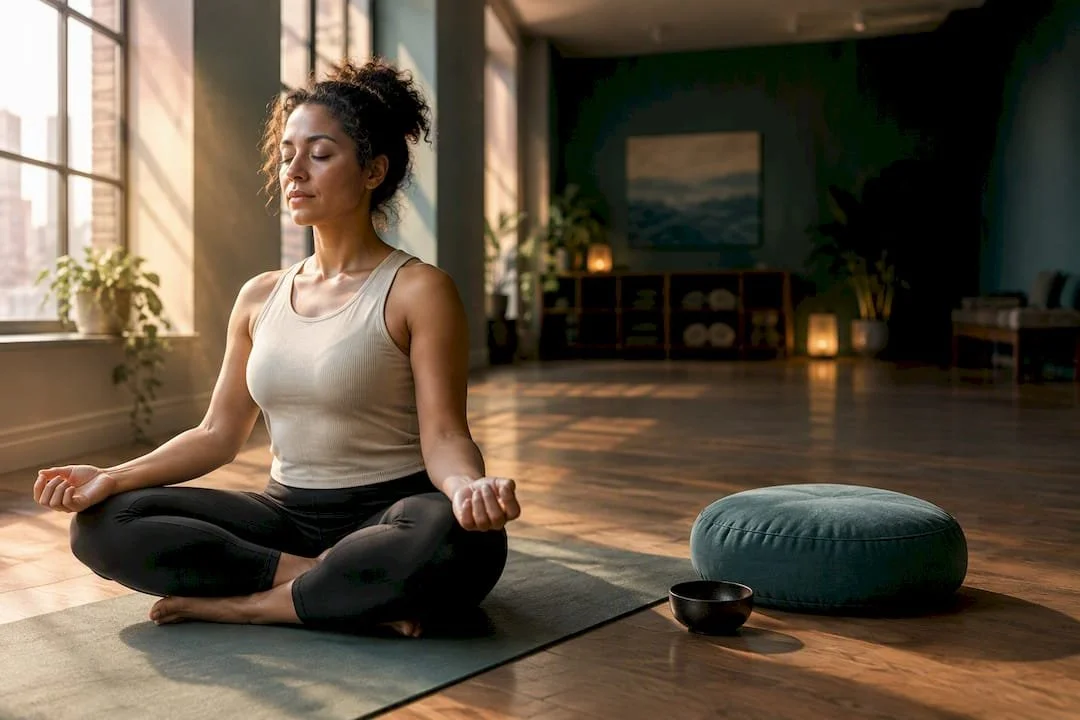
Complementary health practices are non-mainstream approaches, like acupuncture, yoga, and mindfulness meditation, used alongside conventional medical care rather than instead of it. Some have solid evidence for specific problems such as chronic pain and anxiety; many others lack conclusive proof. The safest path is choosing evidence-backed options, verifying practitioner credentials, and telling your clinician what you're trying, which the sections below walk through step by step.
TL;DR:
Evidence supports using practices like yoga and acupuncture specifically for chronic pain and certain mental health issues, but many other approaches lack strong proof.
Practitioner credentials and licensing vary by region, so verify training and ask for certification before starting any complementary therapy.
Combining conventional medicine with evidence-backed practices improves safety and effectiveness, but using non-mainstream methods as substitutes can delay necessary treatment.
Herbal supplements can interact dangerously with medications, and unsafe practices or unqualified providers increase injury and health risks.
Starting with a clear health goal, verifying the evidence, and booking trained instructors in a controlled setting helps ensure safe, beneficial use of complementary approaches.
Amritayogawellness
Explore Complementary Wellness Practices
Amrita Yoga & Wellness offers yoga, Pilates, barre, tai chi, massage therapy, workshops, and retreats in Philadelphia.
Table of Contents
What Is the Difference Between Complementary, Alternative, and Integrative Health?
An Editorial Take on Trying Complementary Practices Responsibly
Ready to Try a Complementary Practice? Here's Where to Start
What Is the Difference Between Complementary, Alternative, and Integrative Health?
The terms get mixed up constantly, and the confusion isn't accidental. Providers, insurers, and researchers use these words differently, which means the same yoga class might get labeled "complementary" in one clinic and "integrative" in another.
Here's the distinction that actually matters, per the National Center for Complementary and Integrative Health (NCCIH):
Complementary means using a non-mainstream approach together with conventional medicine. Someone doing acupuncture alongside physical therapy for a bad knee is practicing complementary health.
Alternative means using a non-mainstream approach in place of conventional medicine. This is rarer than people assume, and it's also the version most likely to cause harm when it delays effective treatment.
Integrative health coordinates conventional and complementary approaches in a planned way, usually through a clinician who manages both sides of the plan.
Whole-person health looks beyond a single symptom or diagnosis to sleep, stress, diet, movement, and relationships as connected factors in health.
Traditional medicine, in global health terms, refers to long-standing indigenous or culturally rooted systems (Ayurveda, traditional Chinese medicine). The World Health Organization now uses the umbrella term TCIM (traditional, complementary, and integrative medicine) to cover all of it under one policy framework.
Terminology also shifts by country. A practice regulated as a licensed medical profession in Germany might be sold as an unregulated wellness service in the United States. That gap explains a lot of the confusion people run into when they compare advice from different sources.
What Are the Main Types of Complementary Health Approaches?
Complementary practices generally fall into a handful of categories, and knowing which bucket a practice sits in tells you a lot about how it's studied, delivered, and regulated.
Mind-body practices include meditation, mindfulness, and guided imagery. These range from free apps to structured clinical programs like Mindfulness-Based Stress Reduction (MBSR), which runs as an eight-week course with a trained instructor.
Movement-based practices blend physical exercise with mental focus. Yoga, tai chi, and qigong fall here, typically taught in group classes but increasingly available through livestream or on-demand formats.
Manipulative and body-based practices are practitioner-administered. Massage therapy, chiropractic adjustment, and osteopathic manipulation all involve hands-on work and require in-person delivery.
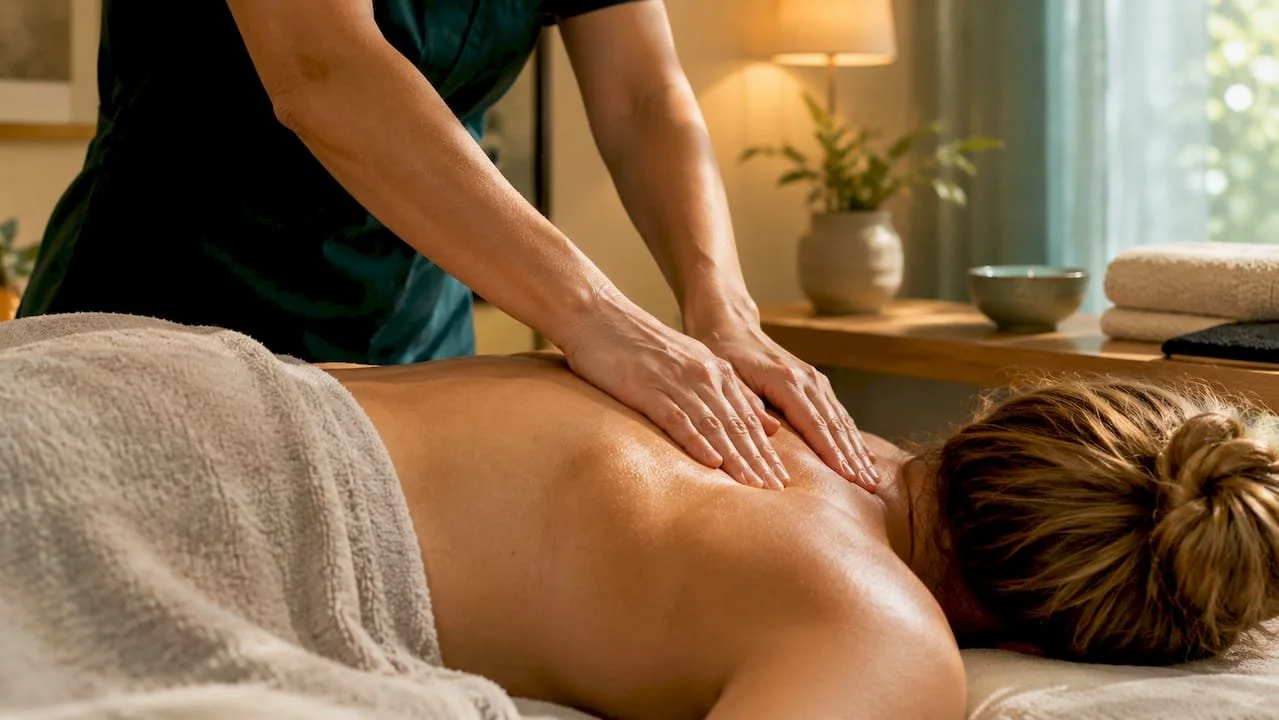
Nutritional and natural products cover herbs, dietary supplements, and probiotics. These are sold over the counter with far less regulatory oversight than prescription drugs, a gap worth remembering before you assume a supplement label tells the whole story.
Energy therapies and whole medical systems include acupuncture, Reiki, Ayurveda, traditional Chinese medicine, and homeopathy. Evidence quality varies enormously across this group, from acupuncture's relatively solid pain research to homeopathy's weak clinical support.
Usage of these approaches has climbed sharply. NHIS data tracked by NCCIH show combined use of selected complementary approaches rose from 19.2% in 2002 to 36.7% in 2022, with yoga jumping from 5% to 15.8% of adults and meditation from 7.5% to 17.3% over the same period.
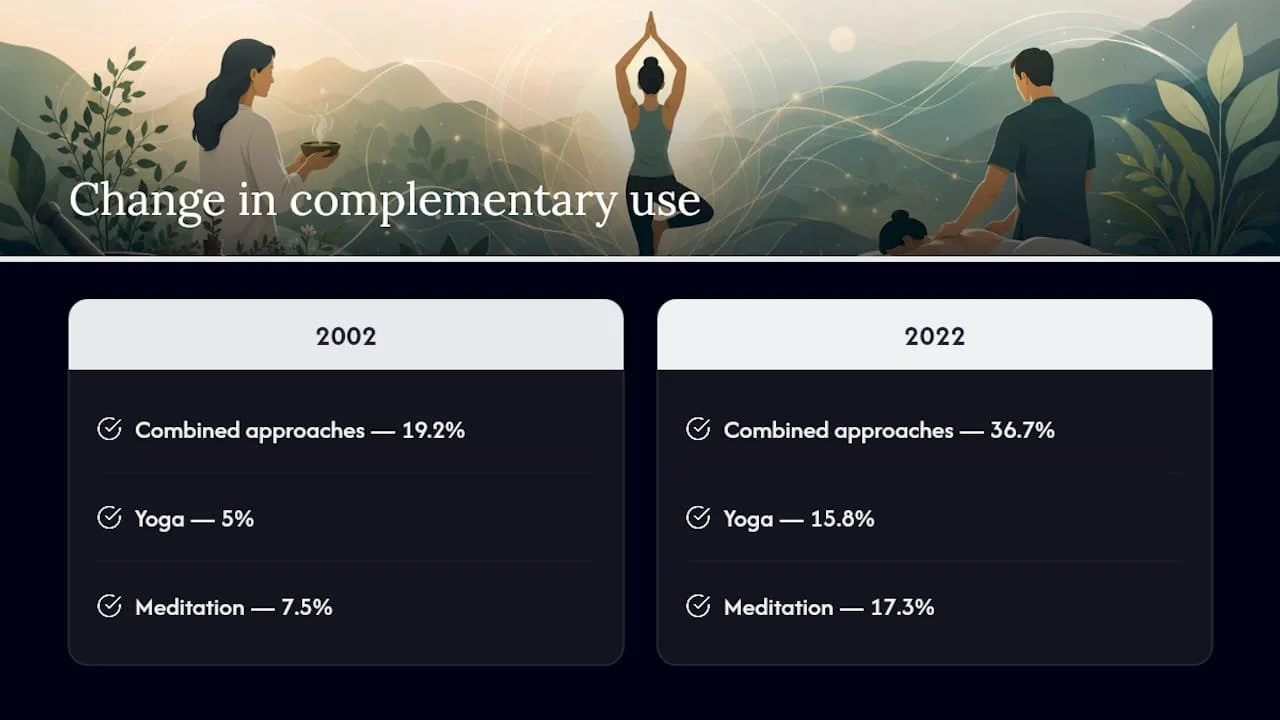
Delivery format matters more than people think. A supplement bought online carries different risks than a yoga class with a live instructor who can spot a bad shoulder position, and a self-guided meditation app serves a different purpose than a clinical MBSR program run by a trained facilitator.
Does the Research Actually Support These Practices?
Short answer: for some conditions, yes, and reasonably well. For others, the evidence is thin or mixed.
Acupuncture, yoga, tai chi, massage, and relaxation techniques show measurable benefit for specific pain conditions and certain mental health outcomes in systematic reviews summarized by NCCIH, though the strength of that evidence varies by condition and by which outcome you're measuring. Clinical guidance has moved in this direction too. Nonpharmacologic options, including several complementary approaches, are increasingly recommended as first-line treatment for chronic low-back pain rather than jumping straight to medication.
Here's roughly how the evidence sorts by condition:
Strong-to-moderate support: chronic low-back pain (yoga, acupuncture), knee osteoarthritis (tai chi), mild-to-moderate anxiety and depression symptoms (mindfulness meditation).
Moderate support: balance and fall prevention in older adults (tai chi), tension headache frequency (massage, relaxation techniques).
Weak or inconsistent support: many herbal supplements for chronic disease prevention, homeopathy for most conditions studied.
The prevalence numbers back up why this matters to so many people. A population-weighted analysis of NHIS data found meditation was used by roughly 18.3% of U.S.
That said, the research has real limits. Trials on complementary approaches tend to be smaller than pharmaceutical trials, interventions vary widely between studies (one "yoga" trial might use a gentle restorative style, another a vigorous vinyasa flow), follow-up periods are often short, and publication bias likely inflates some positive findings. None of that erases the genuine signal in the data. It does mean you should treat "acupuncture helps with chronic pain" as a real but bounded claim, not a universal guarantee.
Are Complementary Health Practices Safe?
"Natural" is not the same as "harmless," and this is where people get into trouble. Herbal supplements can interact with prescription medications, sometimes seriously. St. John's Wort reduces the effectiveness of certain antidepressants and birth control. Some herbs thin the blood in ways that compound with anticoagulants like warfarin, raising bleeding risk during surgery or dental work.
Practice-specific cautions matter too:
Pregnancy often requires modified yoga poses and avoidance of certain essential oils and herbal supplements.
Immunocompromised patients should ask about hygiene practices for anything involving needles or skin contact, including acupuncture.
Anticoagulant users should disclose any herbal supplement use before starting a new one, since interactions aren't always listed on the label.
Unsupervised yoga practice carries a real injury risk. Research on yoga-related musculoskeletal injury points to poor form and lack of modification as the main culprits, not the practice itself.
Safety reporting across clinical trials of complementary approaches remains limited overall, so absence of reported harm isn't the same as proof of safety.
Practitioner credentials vary by state and by discipline. Massage therapists and acupuncturists are licensed in most states, but "wellness coach" or "energy healer" often carries no licensing requirement at all. Ask directly about training, certification body, and years in practice before booking.
Pro Tip: Bring your full supplement list to your next doctor's appointment, even the ones you consider "just vitamins." Interaction risk is one of the most overlooked safety gaps in complementary care.
How Do You Choose a Complementary Practice Safely?
Start with a clear goal rather than a vague sense that you should "try something holistic." Chronic back pain, sleep trouble, and general stress each point toward different practices with different evidence bases.
Identify your goal (pain, stress, sleep, mobility).
Check the evidence for that specific use, not just the practice in general.
Verify practitioner credentials and licensing status in your state.
Disclose medications and conditions before your first session.
Start low and track results using simple metrics: pain scale, sleep hours, or anxiety frequency over two to four weeks.
Ask a practitioner about their training, contraindications for your specific health situation, expected timeline for results, and what stopping the practice looks like if something feels wrong. The National Cancer Institute's guidance on complementary and alternative medicine offers a useful model for these questions, especially for patients managing a serious diagnosis alongside complementary care.
Watch for red flags: anyone promising to cure a serious disease, pressure to abandon conventional treatment, or vague, unlisted ingredients in a product. On coverage, check your insurance plan's CPT codes for acupuncture and massage therapy before assuming it's out of pocket. Many plans now cover a limited number of visits.
An Editorial Take on Trying Complementary Practices Responsibly
Most guides on this topic split into two camps: breathless promotion or blanket skepticism. Neither serves the reader well. The honest position is that evidence quality is uneven across this entire field, and treating "complementary medicine" as one monolithic thing, either all valid or all pseudoscience, misses what the research actually shows condition by condition.
A studio environment can model this well when it takes safety seriously. A local studio offers a range of yoga styles, including restorative and hot yoga, alongside tai chi and massage therapy, with instructors trained to modify poses for joint issues, pregnancy, or limited mobility rather than pushing a one-size-fits-all class. That kind of screening and accommodation is exactly what turns a low-risk practice into an even lower-risk one. If you have a health condition or take medication that might interact with a new practice, tell your clinician before you start and mention it when booking a class or session so instructors can adjust accordingly.
— Juiced
Ready to Try a Complementary Practice? Here's Where to Start
Reading about evidence and safety only gets you so far. At some point, trying a class with people trained to teach it safely is the better next step than guessing your way through a YouTube video alone.
A Philadelphia-area wellness studio provides adults a way to try these evidence-supported approaches with instructors present to check form and offer modifications, something a solo app session can't do. You can start with a Group Class Drop In at $28 per session, or book a One to One Session from $85 per hour if you'd rather work through an injury or condition with individual attention. For whole-person approaches rooted in traditional systems, the studio's Ayurvedic therapies include Abhyanga at $120 per session and Shirodhara at $90 per session. When you book, mention any health conditions, medications, or specific goals so staff can point you toward the right class or session. Check current class times and book a spot through the class schedule.
Where to Learn More
For deeper reading beyond this overview: NCCIH covers terminology and evidence summaries; NCI addresses CAM in cancer care; the WHO TCIM strategy covers global policy; and NHIS trend data tracks two decades of usage patterns.
This article is general information, not a substitute for advice from a qualified doctor. Consult a qualified healthcare professional about your own circumstances before acting on anything here.
Sources
FAQ
What Are the 5 Major Types of Complementary Medicine?
The widely used categories are mind-body practices (meditation, mindfulness), movement-based practices (yoga, tai chi, qigong), manipulative and body-based practices (massage, chiropractic), nutritional and natural products (herbs, supplements), and energy therapies or whole medical systems (acupuncture, Ayurveda, traditional Chinese medicine). Evidence quality differs significantly across these categories, from solid pain research on acupuncture to weaker support for some energy therapies.
Is Complementary and Alternative Medicine (CAM) Covered by Insurance?
Coverage varies widely by plan and by practice. Acupuncture and massage therapy are increasingly covered for specific conditions like chronic pain, so check your plan's CPT codes before assuming a service isn't covered. Supplements and most energy therapies are rarely reimbursed.
Do Complementary Therapies Actually Work?
Some do, for specific uses. Yoga, acupuncture, tai chi, and mindfulness meditation have documented benefits for certain pain conditions and mental health symptoms, while many herbal supplements and some energy therapies lack strong clinical support. The honest answer depends entirely on which practice and which condition you're asking about.
Can You List Common Complementary Therapies?
Common examples include yoga, tai chi, qigong, meditation, mindfulness, acupuncture, massage therapy, chiropractic care, dietary supplements, and Ayurveda. Studios like Amritayogawellness offer several of these directly, including yoga, tai chi, and massage therapy, alongside Ayurvedic-style sessions such as Abhyanga and Shirodhara.
Recommended

WHO Guided Pilates for Spinal Alignment in Philadelphia
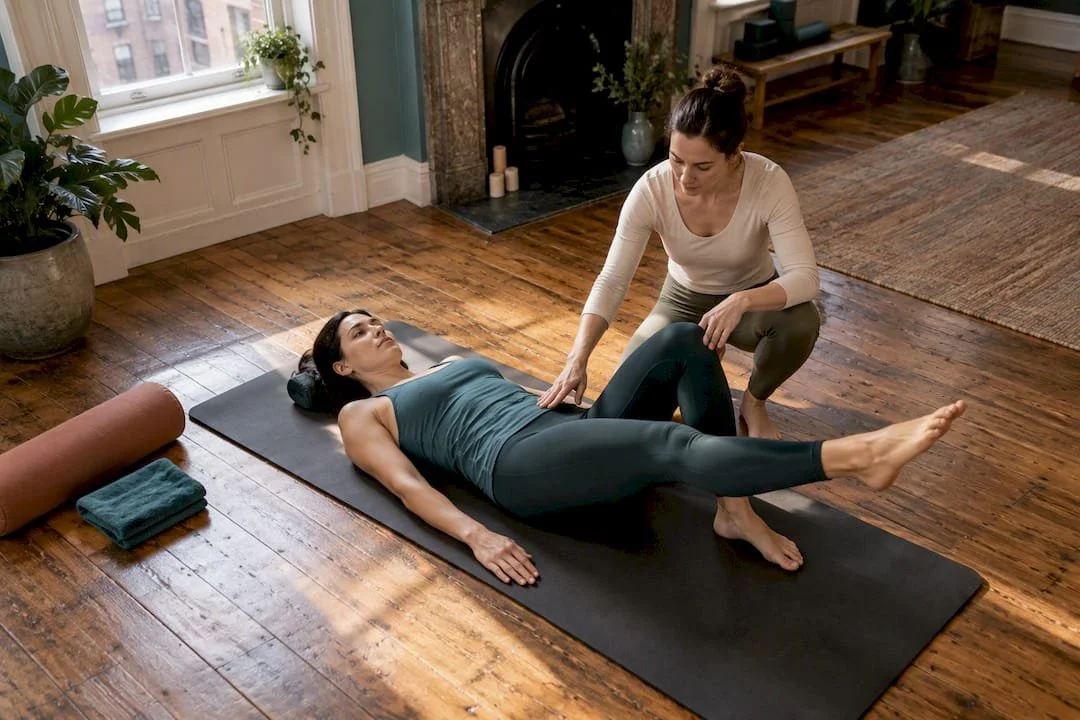
Pilates does improve spinal alignment for most adults, especially those with chronic low back pain or postural deviations from prolonged sitting. A 2022 network meta-analysis ranked it among the top exercise interventions for pain and disability, and the World Health Organization now includes structured exercise programs like it in chronic low back pain guidance. The catch: benefits build over weeks of consistent, well-taught practice, not a single class.
TL;DR:
Most studies showing Pilates benefits involve programs of one to two sessions per week lasting several weeks, with measurable improvements in posture, pain, and mobility.
Pilates scores highly in pain and disability reduction, especially in chronic low back pain, but results rely on consistent practice over at least six weeks.
Supervised instruction and equipment like reformers improve efficacy, especially for structural or asymmetrical conditions, and proper assessment before starting enhances safety.
Key muscle groups such as the transverse abdominis and multifidus are fundamental to true spinal support, with Pilates emphasizing their activation for postural correction.
Long-term progress depends on regular, well-guided sessions, and quick results are unlikely without sustained effort and professional feedback.
Amritayogawellness
Build Stronger, Better Supported Movement
Amrita Yoga & Wellness offers Pilates classes in Philadelphia for adults seeking core strength, flexibility, posture, and mobility support.
Table of Contents
Pilates Spinal Alignment Benefits You Can Actually Measure
The phrase "spinal alignment" sounds abstract until you break it into things you can feel and test. Pilates targets four specific, measurable areas: posture, pain, mobility, and daily function.
Posture markers improve, and researchers can show it. A systematic review covering nine studies and 643 participants found Pilates improved Cobb angle, trunk rotation angle, and range of motion, three of the standard metrics clinicians use to score spinal curvature and postural deviation. Study quality varied across the pooled research, so treat these as encouraging signals rather than settled fact for every case, but the direction is consistent.
Pain and function scores drop in ways that matter clinically. Trials using the Roland Morris Disability Questionnaire and the Oswestry Disability Index, two validated tools for tracking back pain's effect on daily life, show meaningful improvement after Pilates programs. That is different from saying "it feels better." It means people report doing more with less limitation.
Mobility gains show up fast because Pilates trains controlled range of motion, not just static stretching. You are not holding a position and hoping for the best. You are moving your spine actively, in segments, under load, which trains both flexibility and control at the same time.
Function transfers to real tasks. Improved motor control and core support show up in standing tolerance, lifting mechanics, and the ability to hold a position through a workday. This is where Pilates spinal flexibility benefits and strength benefits intersect: a flexible spine that lacks control does not help you carry groceries. A flexible one that also has coordinated support does.
There is a psychological layer too, and it is underrated. A study on office workers doing reformer Pilates found improvements in postural alignment alongside gains in body appreciation and reduced social appearance anxiety. Feeling more confident standing up straight is not a side effect. It is part of why people stick with the practice long enough to see structural change.
Here is a quick summary of what the research links to Pilates practice:
Improved Cobb angle and trunk rotation measures in postural and mild deformity cases
Reduced disability scores on RMDQ and ODI in chronic low back pain populations
Increased spinal range of motion and reduced stiffness
Better standing tolerance and lifting mechanics through improved core support
Higher body appreciation and lower social appearance anxiety in workplace studies
Pro Tip: Ask your instructor to track one simple functional marker, like how long you can stand with neutral posture before fatigue sets in. It is a better progress signal than how a pose looks in a mirror.
What the Systematic Reviews and WHO Guidance Actually Say
The strongest data point comes from a 2022 network meta-analysis comparing Pilates, strength training, core-based work, and mind-body exercise for chronic low back pain. Using a ranking method called SUCRA, which estimates the probability that a treatment is the best option among those compared, Pilates scored 93% for pain reduction and 98% for disability reduction. That places it at or near the top of every exercise category studied, not just above doing nothing.
The trials behind that ranking were not marathon programs. Most used one to two sessions a week, kept individual sessions under 60 minutes, and ran programs lasting several weeks. That is a realistic bar for someone weighing whether to add Pilates to a routine already crowded with work and family obligations.
The second major evidence pillar is the systematic review of spine deformities and posture referenced above. Beyond Cobb angle and rotation improvements, it noted gains on the SRS-22r, a validated quality-of-life scale used in scoliosis research. Some of the individual studies included in that review used small samples and inconsistent methods, which is why the authors themselves flagged variable study quality rather than declaring a uniform effect.
Then there is the guideline-level endorsement. The WHO's 2023 clinical guidance on chronic low back pain recommends structured exercise programs, Pilates included, as a non-surgical first-line approach. The underlying systematic review informing that guideline rated the evidence as moderate certainty that exercise reduces pain and functional limitation compared to no intervention at all. Moderate certainty is not the same as proof beyond doubt, but it is a meaningfully higher bar than the low-quality evidence base many alternative therapies rest on.
A more recent 2026 meta-analysis comparing multiple exercise types for lower back pain again placed Pilates among the top performers for pain relief and functional improvement, while explicitly calling out small trial sizes and a lack of dose-response research. In plain terms: researchers know Pilates works reasonably well, but they still cannot tell you the exact minimum dose that guarantees results for a specific person.
What does the limitation pattern mean for you as a reader?
Most supporting trials are small and short, often 3 to 9 weeks, which limits confidence in long-term outcomes
Heterogeneity across studies (different populations, instructors, and Pilates styles) makes exact effect sizes hard to pin down
Evidence is strongest for chronic low back pain and general postural deviation, weaker for structural conditions like severe scoliosis
No major review claims Pilates replaces medical treatment for diagnosed spinal disease
How Pilates Changes Your Spine From the Inside Out
Alignment change is not magic. It comes from retraining specific muscles and movement habits that most people lose through years of sitting, one-sided activity, or simply not knowing what a neutral spine feels like.
Deep core activation comes first. Pilates emphasizes the transverse abdominis, multifidus, and pelvic floor, a trio of muscles that function like an internal support belt around the lumbar spine. Surface-level ab exercises often skip these entirely. Pilates does not, and that is the core mechanical reason it shows up so consistently in low back pain research.

Neutral spine training restores balanced curves. Many adults live with either flattened lumbar curves from constant flexion (think hunched desk posture) or exaggerated ones from weak deep stabilizers. Pilates drills the position where your spine's natural curves are supported rather than collapsed or overextended, and then asks you to hold that position while moving your arms and legs. That combination is what builds lasting postural control instead of a pose you can only hold in a mirror.
Proprioception improves, which changes habits outside the studio. Proprioception is your body's internal sense of where it is in space. Pilates sharpens it through slow, controlled movement with constant feedback, so you start noticing slouching or uneven weight-bearing during ordinary moments, not just during exercise.
Controlled mobility work increases range of motion without sacrificing stability. Unlike passive stretching, Pilates moves the spine through flexion, extension, and rotation while the deep core stays engaged, which is why gains in mobility tend to come without the trade-off of new instability.
Breathing is not incidental. It is a stabilizing mechanism. Pilates breathing coordinates with movement to manage intra-abdominal pressure, essentially using controlled breath to create internal support during load-bearing positions. This breath-pressure coordination is one of the more overlooked alignment techniques in Pilates, and it is a big part of why the practice feels different from generic core workouts.
Transverse abdominis, multifidus, and pelvic floor activation for lumbar support
Neutral spine training to correct flattened or exaggerated curves
Sharper proprioception that changes posture habits outside class
Controlled range-of-motion work that builds mobility and stability together
Breath-pressure coordination for spinal stabilization under load
Research on mechanisms notes that Pilates relies on closed-chain core stabilization and breath-pelvic coordination, which gives it an edge for people whose back pain stems from instability rather than pure weakness or tightness.
Building a Pilates Program That Actually Shifts Your Posture
You do not need daily sessions to see change, and more is not automatically better. Here is a practical starting structure based on what the clinical trials actually tested.
Start at one to two sessions per week. This matches the frequency used in the trials behind the strongest SUCRA rankings for pain and disability reduction, with sessions typically under an hour.
Commit to a full block before judging results. Trial programs ran anywhere from 3 to 12 weeks; give yourself at least six weeks of consistent practice before deciding whether it is working.
Choose mat classes for accessibility and reformer classes for guided resistance. Reformer work, done with a spring-loaded machine that adds resistance and feedback, tends to produce faster postural gains in supervised settings, partly because the equipment corrects form in real time.
Book a private or small-group session first if you have a specific spinal concern. One-on-one instruction allows an instructor to assess your alignment and modify moves before you join a group class, which matters more for asymmetries than for general fitness goals.
Track progress with something objective, not just how you feel. Posture photos taken from the same angle, a simple standing-tolerance test, or a validated scale like the RMDQ give you a real before-and-after instead of a vague impression.
For structured movement ideas to build into that schedule, a rundown of essential Pilates exercises covers moves at multiple levels, and a guide to different kinds of Pilates breaks down how mat, reformer, and specialty formats differ in practice.
When to Get Cleared Before You Roll Out a Mat
Pilates is generally safe, but "generally" is doing real work in that sentence. A handful of situations call for a conversation with a doctor or physical therapist before you sign up for a class.
Recent spinal surgery, an unstable fracture, or any acute injury needs clinical clearance first, not a wellness class.
Progressive neurological symptoms, numbness, tingling, or worsening weakness in an arm or leg, is a red flag that needs medical evaluation, not modification.
Osteoporosis changes which spinal flexion and rotation moves are appropriate; a qualified instructor should adjust exercises to avoid excessive forward bending.
Spondylolisthesis and severe scoliosis both require individualized modification rather than a standard class sequence.
If a movement sharply increases pain rather than causing normal muscle fatigue, stop and tell your instructor immediately rather than pushing through.
Supervised, well-dosed practice produces better outcomes than guessing on your own. Reviews informing the WHO guideline specifically note that individualized, supervised programs outperform unsupervised ones, and that poor dosing can increase transient soreness without adding benefit.
What to Ask Before You Book a Pilates Class for Back Health
Various studios offer mat Pilates, group reformer classes, private reformer and mat sessions, and hot Pilates formats, providing a range of entry points depending on how much individual feedback you need. Before booking, it helps to ask a few direct questions.
Does the instructor do a brief postural or movement assessment before your first class?
What is typical class size, and does that allow for individual correction?
What certifications or specialized training does the instructor hold for back-focused or corrective work?
How does the instructor modify moves for conditions like scoliosis, osteoporosis, or recent injury?
A collection of Pilates-focused posts and beginner guidance can help you walk in informed rather than guessing at what to expect on day one.
Realistic Expectations: Who Benefits and How Fast
Adults with chronic low back pain, desk-driven postural collapse, or general core weakness tend to see the clearest gains, usually within six to twelve weeks of consistent practice. Structural conditions like severe scoliosis respond more slowly and often need Pilates alongside other care, not instead of it. Consistency and supervision matter more than intensity, and any new or worsening symptom deserves a call to your clinician, not a shrug.
— Juiced
Ready to Put This Into Practice in Philadelphia
Reading about deep core activation and neutral spine mechanics only gets you so far. What actually changes your posture is consistent, well-supervised practice, and that is the specific gap Amrita Yoga & Wellness fills for Philadelphia adults who want guided correction rather than a YouTube video and a guess.
If you are dealing with chronic tightness, uneven posture, or recovering strength after time off from exercise, a group reformer or mat class gives you structured, instructor-led sessions built around the same principles covered above: neutral spine, deep core engagement, and controlled mobility. If your situation involves a specific asymmetry, prior injury, or a condition like scoliosis that needs individual attention, a private one-on-one session starting at $85 per hour lets an instructor assess your alignment before building a plan around it. Either way, the next step is simple: pick a format, check the current class schedule, and book your first session this week.
This article is general information, not a substitute for advice from a qualified doctor. Consult a qualified healthcare professional about your own circumstances before acting on anything here.
FAQ
Can Pilates Realign Your Spine?
Pilates can improve measurable posture markers like Cobb angle and trunk rotation, according to a systematic review of nine studies. It is not a cure for structural spinal disease, but for postural deviation and functional misalignment tied to muscle imbalance, it produces real, trackable change over weeks of consistent practice.
What Is the Most Common Injury Risk in Pilates?
Most Pilates injuries are mild, overuse strains from poor form or overly aggressive progression rather than serious trauma. The risk drops significantly with supervised, individualized instruction, which is why reviews informing the WHO guideline emphasize proper dosing and instructor guidance over solo practice.
What Is the 80/20 Rule in Pilates?
Definitions vary by instructor, so treat it as a guiding principle rather than a fixed clinical standard.
What Are the Benefits of Spinal Alignment?
Good spinal alignment reduces strain on discs, joints, and surrounding muscles, which lowers the risk of chronic pain and improves everyday function like standing, lifting, and walking. Research tied to Pilates specifically links alignment improvement to reduced disability scores and better standing tolerance in chronic low back pain trials.
How Much Does a Pilates Class Cost?
A single group class drop-in runs $28, while private one-to-one sessions start from $85 per hour for more individualized alignment work. Full membership and pricing details, including monthly options, are listed on the group class booking page.