Pick the Right Pilates Specialization for New Instructors: Hours & Pay
Mat, reformer, comprehensive apparatus, clinical rehab, prenatal and postnatal, active aging, athletic performance, chair and Cadillac work, barre hybrids, and group versus private teaching cover the main paths a new Pilates instructor should weigh. Each one carries its own training hours, prerequisites, and pay pattern, so the right choice depends on how much time, money, and client base you have before you even enroll.
TL;DR:
Most instructors start with mat certification, which requires fewer hours and offers faster, cost-effective entry.
Apparatus training, especially in reformer, Cadillac, and clinical areas, demands more hours and often higher fees, leading to better private rates.
Supervised teaching hours and in-person practice are crucial for meeting certification standards and building real client experience; vague or online-only programs are less reliable.
Specialties like rehab, prenatal, and athletic performance typically increase earning potential and require targeted knowledge of safety and client needs.
Building local practice hours through mentorship and workshops enhances skills more than certification alone, with private sessions paying significantly more.
Amritayogawellness
Explore Pilates Training in Philadelphia
Amrita Yoga & Wellness supports Pilates enthusiasts and future instructors through classes, workshops, and wellness offerings in a community setting.
Table of Contents
2. How many training hours do certification programs require?
5. How Amrita Yoga & Wellness supports your Pilates teaching growth
1. What are the main Pilates teaching specializations?
A mat instructor teaches group mat classes built on the core repertoire, and this route usually requires the lowest number of training hours, making it the most common entry point into the field. College and community programs often describe mat certificates as covering teaching principles and applied anatomy rather than full apparatus work, which keeps the barrier to entry lower than apparatus-based tracks.
A reformer instructor works on the spring-loaded apparatus that defines most boutique studio classes, and this specialty tends to support higher private rates than mat-only teaching because reformer sessions are harder to replace with a free app or a YouTube video. Comprehensive or full apparatus training adds the Cadillac, chair, and barrels to reformer work, qualifying a teacher to run an entire studio's equipment roster rather than one machine, which widens job options at full-service studios.
Clinical or rehab Pilates asks for a base certification plus added coursework in injury patterns and movement screening, and it often means working alongside physical therapists or taking medical referrals, so programs in this track look for a teacher who already holds a comprehensive credential. Prenatal and postnatal Pilates demands specific safety training around positioning, intra-abdominal pressure, and pelvic floor function, and a teacher without that extra layer of education should not be leading pregnant clients through standard repertoire.
Active aging and older adult specialization adapts exercises for balance, joint mobility, and fall prevention, a growing niche as community centers and retirement communities add movement programming. Athletic and sports performance Pilates integrates with strength and conditioning work, appealing to teachers who want to support competitive athletes or weekend runners rather than general wellness clients.
Chair, Cadillac, and barrel-focused niches sit inside comprehensive training but can become a teacher's signature offering once certified, since fewer instructors build deep comfort with those apparatus. Barre and hybrid modalities borrow Pilates principles and crossover certifications, letting a teacher run format classes without a full comprehensive credential. Group versus private teaching is less about apparatus and more about business model: group classes pay less per session but fill a schedule faster, while private sessions pay more per hour and demand stronger one-on-one coaching and client management skills.
Mat and group formats suit teachers who want quick entry and steady class fills.
Reformer, comprehensive, and clinical tracks suit teachers aiming for private clients and higher per-session rates.
Prenatal, active aging, and athletic niches suit teachers with a specific population they already understand or want to serve.
2. How many training hours do certification programs require?
The NPCP sets the hour benchmarks most American programs build toward.
The NPCP requires a substantial number of training hours to sit for the Comprehensive Exam, with mat-only certification demanding fewer hours compared to comprehensive training, which is why mat routes move faster and cost less than apparatus-based ones.
Beyond total hours, look at what fills them. Solid programs include anatomy coursework, supervised observation of working teachers, and hands-on practice teaching, and the NPCP handbook lists in-person components for repertoire and special-population work as part of meeting eligibility rules. A program that skips supervised teaching hours or pushes everything online is unlikely to satisfy those requirements.
Accreditation adds another layer of confidence. The Pilates Method Alliance runs ITTAP, a voluntary review that recognizes training programs meeting professional standards, and the PMA itself notes that no single certification is universally considered the best, which makes checking for ITTAP recognition a more useful filter than chasing a brand name.
3. How do you choose the right specialization for you?
Picking a lane starts with naming the job you actually want, not the certification that sounds most impressive.
Define your goal: group instructor, private specialist, or rehab-focused teacher, since each points to a different hour commitment.
Match your budget and timeline to the program, because comprehensive and clinical tracks cost more and take longer than mat-only paths.
Check prerequisites before enrolling, since several rehab and prenatal programs require an existing mat or comprehensive credential.
Ask each program for total hours, supervised teaching hours, which apparatus are covered, and how much is in-person versus online.
Ask how the program assesses competency, whether through written exams, practical teaching evaluations, or both.
Start mat-first if you are unsure, then add apparatus or a specialty once you know what clients you enjoy teaching.
Watch for vague hour counts, no supervised practice teaching, or missing anatomy and special-population modules. Those gaps often mean a program will not satisfy NPCP eligibility or leave you underprepared for real clients.
Pro Tip: Call a program's office and ask how many supervised teaching hours graduates log before certification: a clear, specific number is a good sign; a vague answer is not.
4. What can you expect to earn in each specialty?
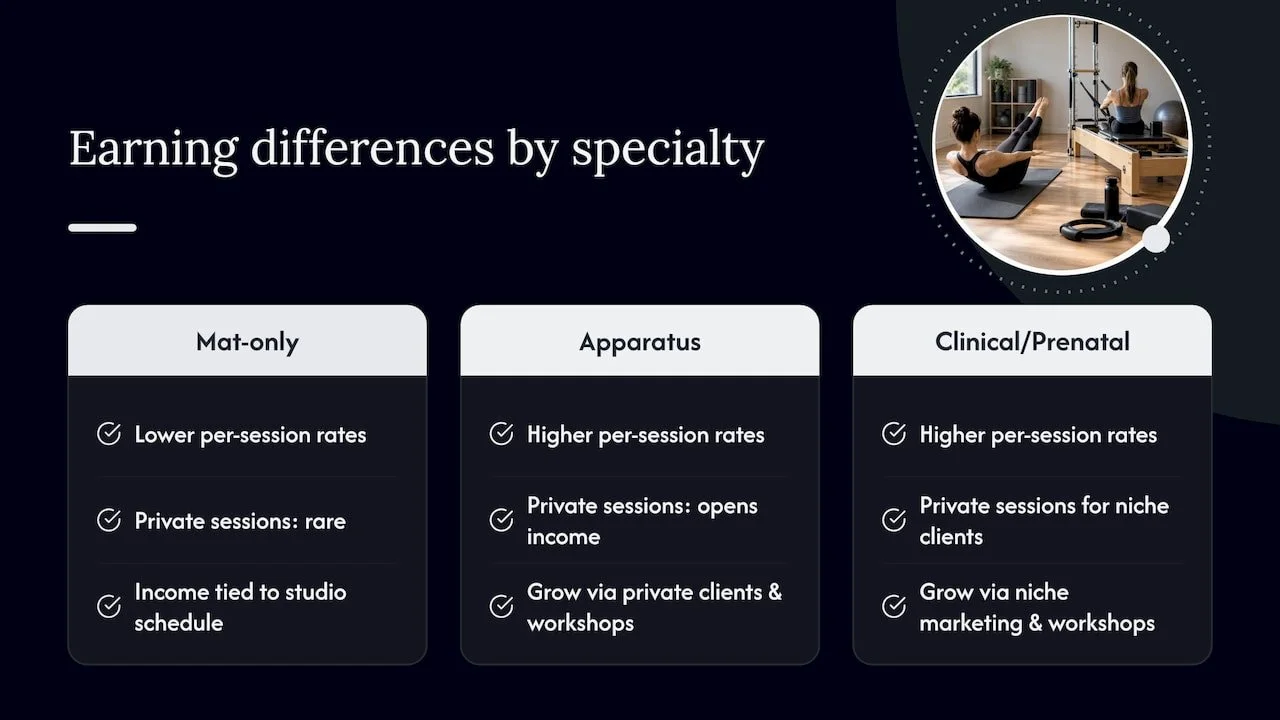
Pay moves with specialization. Specialist certifications in reformer, rehab, and prenatal work commonly increase earning potential compared with entry-level mat-only teaching, largely because private and apparatus sessions carry higher per-session rates than group mat classes.
Reformer, Cadillac, and chair work create differentiation that opens private-session income, and clinical or prenatal niches do the same by serving clients who need expertise a general mat class cannot offer. Building that income usually means growing a private client book, running specialty workshops, and marketing directly to the population you serve rather than waiting for a studio schedule to fill itself.
5. How Amrita Yoga & Wellness supports your Pilates teaching growth
Amrita Yoga & Wellness runs group mat and reformer classes, private sessions, and teacher-focused workshops in Philadelphia, giving developing instructors a place to log observation hours, practice teaching, and build the client relationships that specialization tracks require.
Sequencing your training without burning out
Most new teachers do better starting with mat, moving into supervised practice teaching, then adding a specialty once they know which clients energize them. Skipping straight to a narrow clinical or prenatal certification before building general teaching reps tends to leave gaps that supervised hours would have caught. Mentorship matters here more than the letters after your name: a teacher who watched you correct cueing in real time will catch things a workbook cannot. Pick the specialty that matches what you already notice yourself drawn to, and check whether your local market actually has demand for it before you commit the hours.
— Juiced
Where to get practice hours and mentorship locally
Building real teaching hours matters as much as the certificate itself. Amrita Yoga & Wellness offers group class drop-ins starting at $28, private sessions from $85 per hour, and teacher-focused workshops where you can observe, assist, and build the client relationships your specialization needs.
Reach out through Amrita Yoga & Wellness to book a session or ask about upcoming teacher workshops.
Where to verify certification rules and pay data
For program eligibility, check the NPCP handbook and PMA's ITTAP page. For pay context, see Gymdesk's salary research. For movement quality considerations relevant to clinical and athletic tracks, see Everton Chiropractic's guide.
Sources
FAQ
What are the different levels of Pilates instructors?
Instructors typically progress from mat-only certification into comprehensive or apparatus certification, then into specialty credentials like clinical, prenatal, or active aging work. The NPCP sets the comprehensive and mat hour minimums most American programs follow.
What is the most respected Pilates certification?
There is no single certification considered universally best. The Pilates Method Alliance notes that ITTAP accreditation of a training program is a more reliable quality signal than any one certificate name.
What is the 10/20/30 rule in Pilates?
This phrase is not a recognized industry standard covered by NPCP or PMA guidance, and definitions circulating online vary widely without a consistent source. Treat any claim about a fixed numeric rule in Pilates teaching with caution unless it comes from a named certifying body.
How much do Pilates teachers get paid per hour?
Pay varies by specialization and session type, with apparatus work, private sessions, and specialties like rehab or prenatal Pilates commonly commanding higher rates than entry-level group mat classes. Private one-on-one sessions, such as those priced from $85 per hour at studios like Amrita Yoga & Wellness, generally pay more per hour than group class formats.
Do I need a mat certification before training on apparatus?
Many comprehensive programs accept candidates without prior mat certification, but a mat-first path lets you build teaching confidence before tackling reformer, Cadillac, and chair work. Check each program's prerequisites directly, since requirements differ by school.