How to Practice Mindfulness: A Beginner's Guide
You can start a useful mindfulness practice in two minutes using one breath-based exercise. This guide gives you the scripts, timing guidance, and habit tips to make it stick.
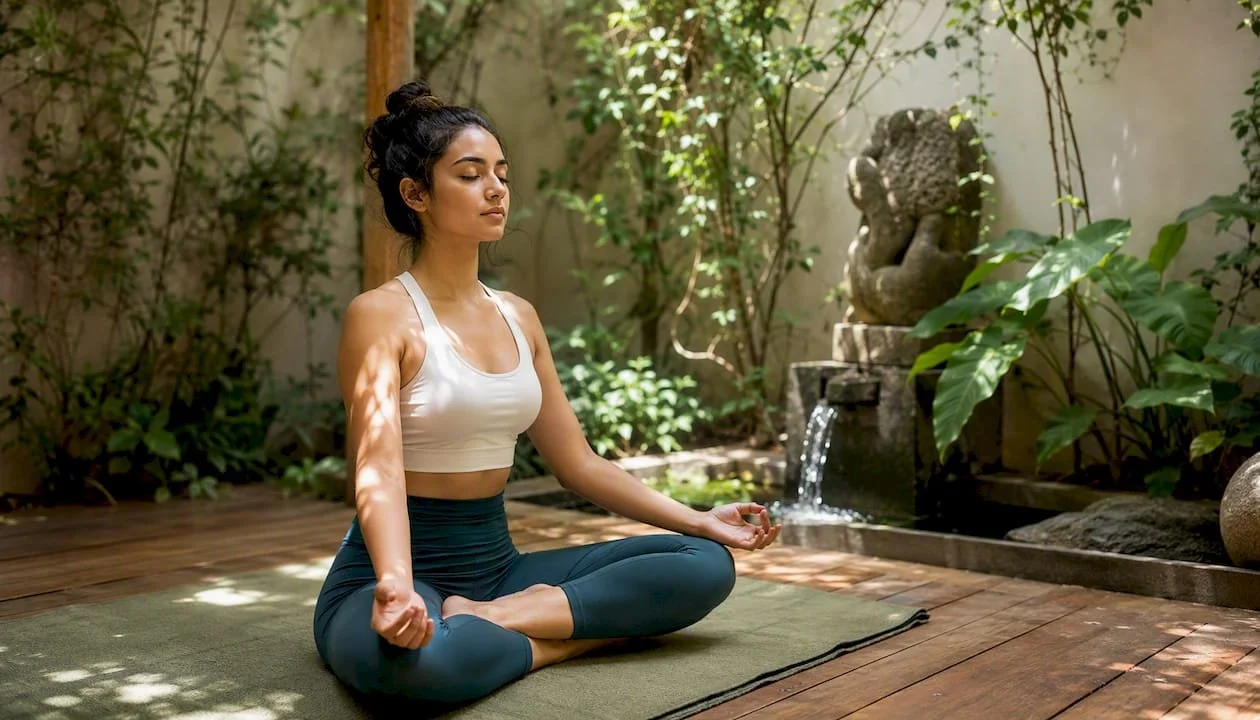
Try this right now. Sit comfortably, close your eyes, and take one slow breath in through your nose for a count of four. Hold for one count. Exhale through your mouth for a count of six. Notice where you feel the breath most clearly: your nostrils, your chest, or your belly. When a thought appears, simply note it and return to the next breath. That's one complete cycle. Do it three times.
What to expect during and after:
A slight slowing of your heart rate after the second or third breath
Thoughts appearing almost immediately (this is normal and expected)
A brief sense of mental quiet, even if it lasts only a few seconds
Mild physical relaxation in your shoulders or jaw
According to Harvard Health, even 1–3 minutes of focused breathing can reduce stress immediately. You don't need a cushion, an app, or a quiet room to begin.
Table of Contents
What mindfulness is and why it actually helps
Mindfulness is the practice of paying deliberate, non-judgmental attention to what is happening right now, in your body and mind, without trying to change it.
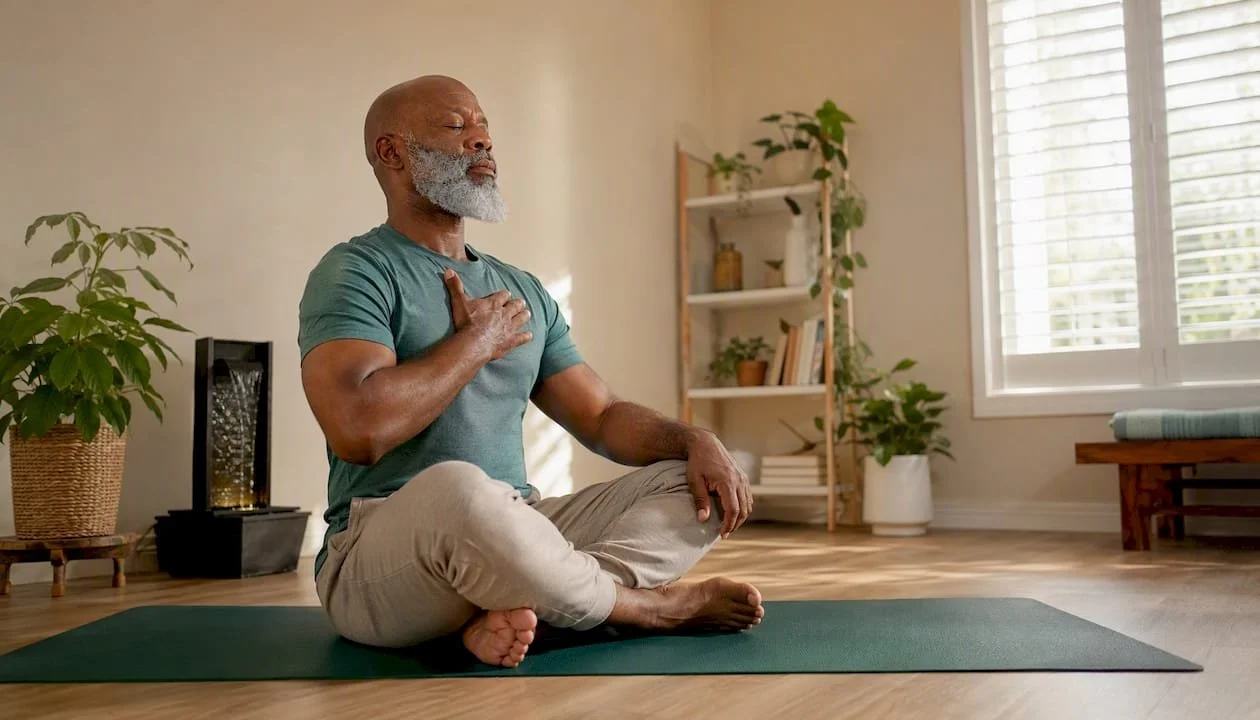
That definition sounds simple, but the effect is real. When you shift attention to present-moment sensory details, you interrupt the mental loops that replay past problems or rehearse future worries, a mechanism the NHS describes as one of mindfulness's core benefits. The practice doesn't require you to stop thinking. It just asks you to notice what you're thinking.
Research-backed benefits for beginners:
Reduced stress and anxiety, even after short sessions
Improved ability to focus and make decisions under pressure
Better sleep quality, particularly when practiced in the evening
Lower emotional reactivity, so you respond rather than react
A greater sense of calm and present-moment awareness
Reduced tendency to ruminate on past events or future worries
Mayo Clinic confirmsthat mindfulness requires no special equipment and can be done anywhere, which removes the biggest barrier most beginners face: thinking they need the right conditions to start.
How to practice mindfulness: four core exercises with step-by-step scripts
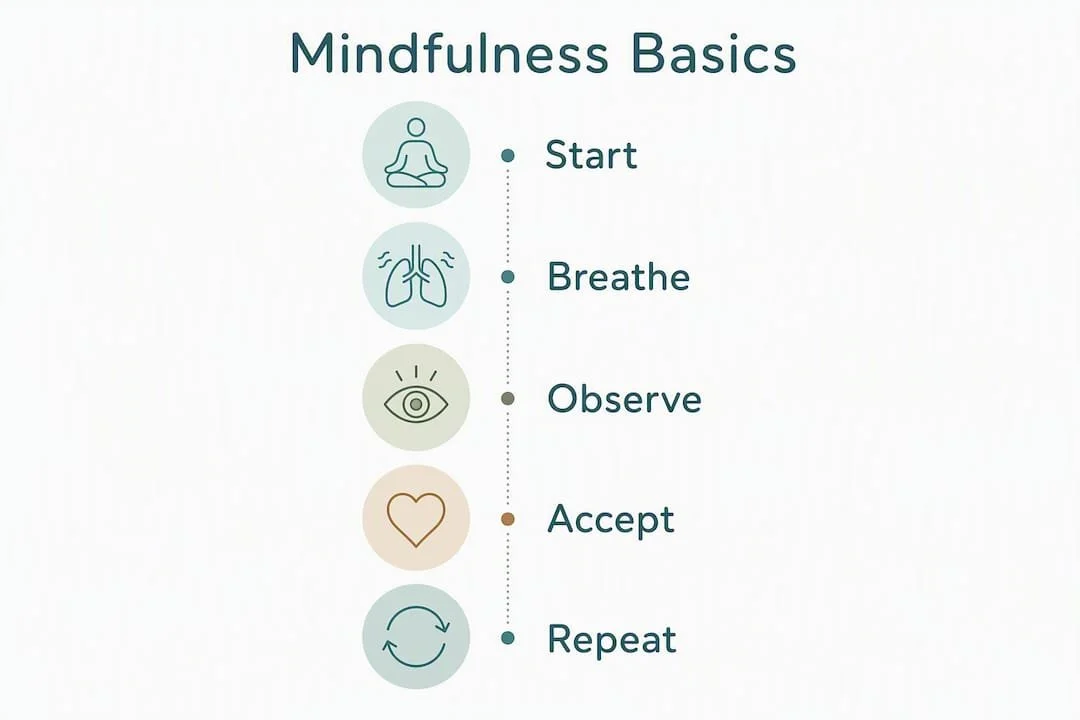
These four practices cover the full range of what most beginners need. Each one builds the same core skill: noticing where your attention is and gently returning it to your chosen anchor. Mindful.org describes this loop as the foundational skill of all mindfulness practice.
Focused breathing
Sit in a chair with your feet flat on the floor, or cross-legged on the floor.
Close your eyes or soften your gaze downward.
Breathe naturally and notice where you feel the breath most clearly: nostrils, chest, or belly.
When your mind wanders (and it will), simply notice that it has wandered.
Without judgment, return your attention to the next breath.
Repeat for your chosen duration.
Timing: 1–3 minutes to start; work toward 5–10 minutes over two to three weeks.
Body scan
Lie down or sit in a chair. Close your eyes.
Start at the top of your head and slowly move your attention downward: scalp, forehead, jaw, neck, shoulders.
At each area, notice any sensation without trying to change it: warmth, tension, tingling, or nothing at all.
If your mind drifts to a to-do list or a worry, label it mentally ("thinking") and return to the body part you left.
Continue down through your chest, arms, belly, hips, legs, and feet.
End with three slow breaths.
Timing: 5–10 minutes. A seated version works well at a desk; a lying-down version suits bedtime.
Sitting meditation
Set a timer for your chosen duration so you're not checking the clock.
Sit upright with your hands resting on your thighs.
Choose an anchor: your breath, the sounds in the room, or the physical sensation of your feet on the floor.
Hold your attention on that anchor.
When a thought arises, name it gently ("planning," "worry," "memory") and return to the anchor.
When the timer ends, open your eyes slowly and take one conscious breath before moving.
Timing: 5–15 minutes. Three to four sessions per week is a solid starting point.
Walking meditation
Find a short path, indoors or outdoors, about 10–20 steps long.
Walk at roughly half your normal pace.
Focus on the physical sensations of each step: the heel lifting, the foot swinging forward, the sole pressing the ground.
When your mind wanders to a conversation or a task, notice it, and bring your attention back to the next footfall.
At the end of the path, pause, breathe, and turn around.
Continue for your chosen duration.
Timing: 5–10 minutes. Works well outdoors on a lunch break or indoors in a hallway.
Timing and frequency at a glance

| Practice level | Session length | Frequency |
|---|---|---|
| Micro (just starting) | 1–3 minutes | Daily |
| Beginner regular | 5–10 minutes | 3–4 times per week |
| Building consistency | 10–15 minutes | Daily |
| Established practice | 15–20 minutes | Daily |
A 10-minute beginner sequence combining two techniques
Sit comfortably and set a timer for 10 minutes.
Spend the first 3 minutes on focused breathing: notice the breath, return when you wander.
Spend the next 5 minutes on a seated body scan from head to feet.
Spend the final 2 minutes back on the breath, this time noticing any shift in how your body feels.
Open your eyes and sit quietly for 30 seconds before standing.
Micro-practices you can use anywhere in under five minutes
Short on time doesn't mean short on benefit. These micro-practices are designed for real life: a commute, a bathroom break, a moment between meetings. Body scans, mindful eating, and mindful movement are all accessible alternatives to formal sitting meditation.
Six micro-practices with when to use them:
Single breath reset (30 seconds). One slow inhale, one slow exhale, full attention on the sensation. Use it before a difficult conversation or right after getting a stressful email.
3-count box breathing (2 minutes). Inhale for 3 counts, hold for 3, exhale for 3, hold for 3. Repeat four times. Use it on a commute or before a meeting starts.
Mindful hand wash (1 minute). Feel the temperature of the water, the texture of the soap, the sound of the faucet. When your mind drifts to what's next, return to the sensation. Use it as a built-in reset throughout the workday.
Mindful sip (1 minute). Hold your coffee or tea with both hands. Notice the warmth, the smell, the first taste. Take three sips with full attention before going on autopilot. Use it every morning to anchor the start of your day.
Mindful listening (1–2 minutes). Close your eyes and simply listen to whatever sounds are present: traffic, birds, an HVAC hum. Don't label them as good or bad; just notice them. Use it during a lunch break or after an argument to reset your nervous system.
Mindful 30-second stretch. Stand up, stretch your arms overhead, and feel every sensation in your shoulders, spine, and hands as you move. Breathe slowly. Use it between tasks when you've been sitting for more than an hour.
The NHS notes that shifting attention to present-moment sensory details is the mechanism that breaks worry loops, which is exactly what each of these micro-practices does in a compressed form.
Pro Tip: Pick just one micro-practice and commit to it for one week before adding another. Trying to use all six at once almost guarantees you'll use none of them.
How to build a daily mindfulness habit that actually sticks
Consistency matters more than duration. Brief daily practice beats a longer session once a week, and Harvard Health confirms that if daily practice feels unrealistic, aiming for several sessions per week is a strong and sufficient target.
Habit-building checklist:
Choose one existing daily routine as your anchor (brushing teeth, making coffee, sitting down at your desk).
Set a tiny time goal: two minutes, not twenty. You can always go longer, but two minutes is easy to keep.
Pair the practice with that anchor every single day for four weeks.
Track one simple metric: did you do it today? A paper calendar with an X works as well as any app.
After four weeks, extend by two minutes if you want more.
Pro Tip: Tying a 1–3 minute breathing practice to teeth brushing, morning or night, is one of the most reliable habit-stacking approaches because the cue is already automatic. Do it for four weeks and the association forms on its own.
What to realistically expect over time:
After 1 week: You'll notice the practice feels slightly less awkward. You may catch yourself taking a conscious breath during a stressful moment without being prompted.
After 3–4 weeks: Small but measurable shifts in how quickly you recover from stress. You'll start noticing your thoughts more often before reacting to them.
After 8 weeks: Research on mindfulness-based stress reduction programs, including work from the UMass Center for Mindfulness, points to meaningful reductions in stress and anxiety at the eight-week mark. Trait-level changes, the kind that show up in how you handle difficulty on a bad day, tend to emerge here.
For more mindfulness tips on building a consistent routine, the Amritayogawellness blog has practical, studio-tested suggestions.
What the research says about timelines and what to expect
Brief, regular practice produces measurable benefits. You don't need a clinical program or a meditation retreat to see results.
Harvard Health recommends 10–15 minutes daily as a sufficient starting point, while noting that even 1–3 minutes of focused breathing can reduce stress in the moment. For most beginners, that's the most useful piece of information in all the research: start small, and the benefits are still real.
Realistic outcomes by timeline:
Short-term (days to 2 weeks): Improved sense of calm after sessions, slightly better ability to notice stress as it builds, small improvements in sleep onset for some people.
Medium-term (4–6 weeks): Reduced emotional reactivity, better focus during work tasks, a growing ability to pause before responding in difficult situations.
Longer-term (8+ weeks): Lasting reductions in anxiety and stress, improved attention span, and the kind of trait-level changes that show up in daily behavior rather than just during practice.
| Timeline | What beginners typically notice |
|---|---|
| Short-term | Calmer feeling after sessions; thoughts still very active |
| Weeks 2–4 | Slightly faster stress recovery; catching thoughts earlier |
| Weeks 4–6 | Reduced reactivity; better focus; more consistent sleep |
| Weeks 8+ | Trait-level changes; stress response shifts in daily life |
A Harvard Gazette study on mindfulness meditation found that participants reported less stress and clearer thinking after a mindfulness program, reinforcing that the benefits are real and not just anecdotal. The key variable across all the research is not the length of each session but whether you show up regularly.
Common beginner mistakes and how to fix them
A wandering mind is not a sign that you're doing it wrong. It's the practice. Mindful.org puts it plainly: the moment you notice your mind has wandered and return to your anchor is the actual skill-building event. Every return is a mental rep, not a failure.
Common pitfalls and what to do instead:
Thinking the goal is a blank mind. The goal is noticing. When you catch a thought, you've succeeded. Return to the breath without commentary.
Judging yourself for wandering. Mind.org recommends meeting wandering thoughts with friendly curiosity rather than frustration. The phrase "be curious, not critical" is worth keeping in mind.
Naming thoughts to create distance. When a thought feels sticky, label it: "thinking," "worry," "planning." This creates psychological distance and reduces its pull without requiring you to push it away.
Quitting because sessions feel too long. Shorten the session. Two minutes of genuine attention beats ten minutes of fighting yourself. Build up gradually.
Practicing only when you feel like it. Motivation follows action, not the other way around. Set the anchor and show up even on flat days.
Practicing in a distracting environment and giving up. Move the practice outdoors, use low-volume ambient sound, or switch to a walking meditation when a quiet room isn't available.
Pro Tip: If you keep falling asleep during body scans, try the practice seated rather than lying down, and keep your eyes slightly open with a soft downward gaze. Sleep is a sign your nervous system needed rest, not that you failed.
Pro Tip: If you feel like "nothing is happening," use a concrete sensory anchor instead of a vague intention to "be present." Notice the exact temperature of the air at your nostrils, or the precise pressure of your feet on the floor. Objective sensory details reduce judgment and sharpen focus immediately.
For specific mindfulness for stress strategies, including classroom-tested exercises, the Amritayogawellness blog covers techniques that address the most common frustrations beginners bring to the studio.
Where to find good guided resources as a beginner
Use guided resources if you want structure. The best ones give you a voice to follow, a script to internalize, and a consistent format that removes the decision fatigue of figuring out what to do next.
Harvard Health points to UCLA MARC (Mindful Awareness Research Center) as a reputable starting point for free guided audio meditations. Their library includes body scans, breathing practices, and sitting meditations at various lengths, all available without a subscription.
Vetted resource categories and what each is best for:
UCLA MARC (free audio library). Best for: structured guided sessions ranging from 3 to 19 minutes, taught by trained instructors. No account required.
Mindful.org (articles and guided scripts). Best for: written scripts you can read before practicing, plus evidence-based articles on specific techniques.
Mayo Clinic mindfulness page. Best for: a clinical, no-frills overview of exercises with clear language for people who want medical credibility behind their practice.
NHS mindfulness resources. Best for: UK-based clinical guidance, though the exercises themselves are universally applicable and well-written for beginners.
Mindfulness apps (Insight Timer, for example). Best for: daily reminders, a timer with ambient sound, and a large library of free guided sessions. When evaluating any app, look for teachers with named credentials, a free tier, and a clear privacy policy before sharing personal data.
In-person classes and workshops. Best for: real-time feedback, community accountability, and the kind of subtle posture and breathing corrections that audio alone can't provide.
When evaluating a teacher or program, look for transparent credentials (training background, affiliated institution), a clear description of what the practice involves, and a free introductory option. The UMass Center for Mindfulness is one of the most credible institutional programs in the United States and a useful benchmark for what a well-structured mindfulness curriculum looks like.
For readers ready to move beyond solo practice, exploring different meditation types can help you find the style that fits your temperament and schedule.
Key Takeaways
Consistent short practice, starting at just 1–3 minutes daily, is the most reliable path to real mindfulness benefits for beginners.
| Point | Details |
|---|---|
| Start with 1–3 minutes | Even brief focused breathing reduces stress immediately; no equipment or experience needed. |
| Wandering mind is the practice | Each time you notice distraction and return to your anchor, you build the core skill. |
| Consistency beats duration | Practicing 3–4 times per week produces more progress than occasional long sessions. |
| Habit-stack to make it automatic | Tie your practice to an existing routine, like brushing teeth, for at least four weeks. |
| Amritayogawellness supports beginners | The studio offers beginner classes, workshops, and guided sessions in Philadelphia to support your practice. |
A teacher's note on starting out
Every beginner I've worked with arrives with the same worry: "I can't stop thinking." That's not a problem to solve. It's the starting point. The practice isn't about achieving silence; it's about noticing the noise and choosing where to place your attention anyway.
The most useful shift I've seen in new students is moving from "I'm doing this wrong" to "I noticed I wandered, and I came back." That second framing is accurate. The first one is just a story the mind tells to avoid sitting still.
Start with two minutes. Do it after you brush your teeth tonight. If you miss a day, start again the next morning without making it mean anything. The practice doesn't require a streak. It requires showing up more often than not.
Guided practice at Amrita Yoga & Wellness in Philadelphia
Reading about mindfulness is a solid start. Practicing it with an experienced teacher in a room full of people who are also figuring it out is a different experience entirely.
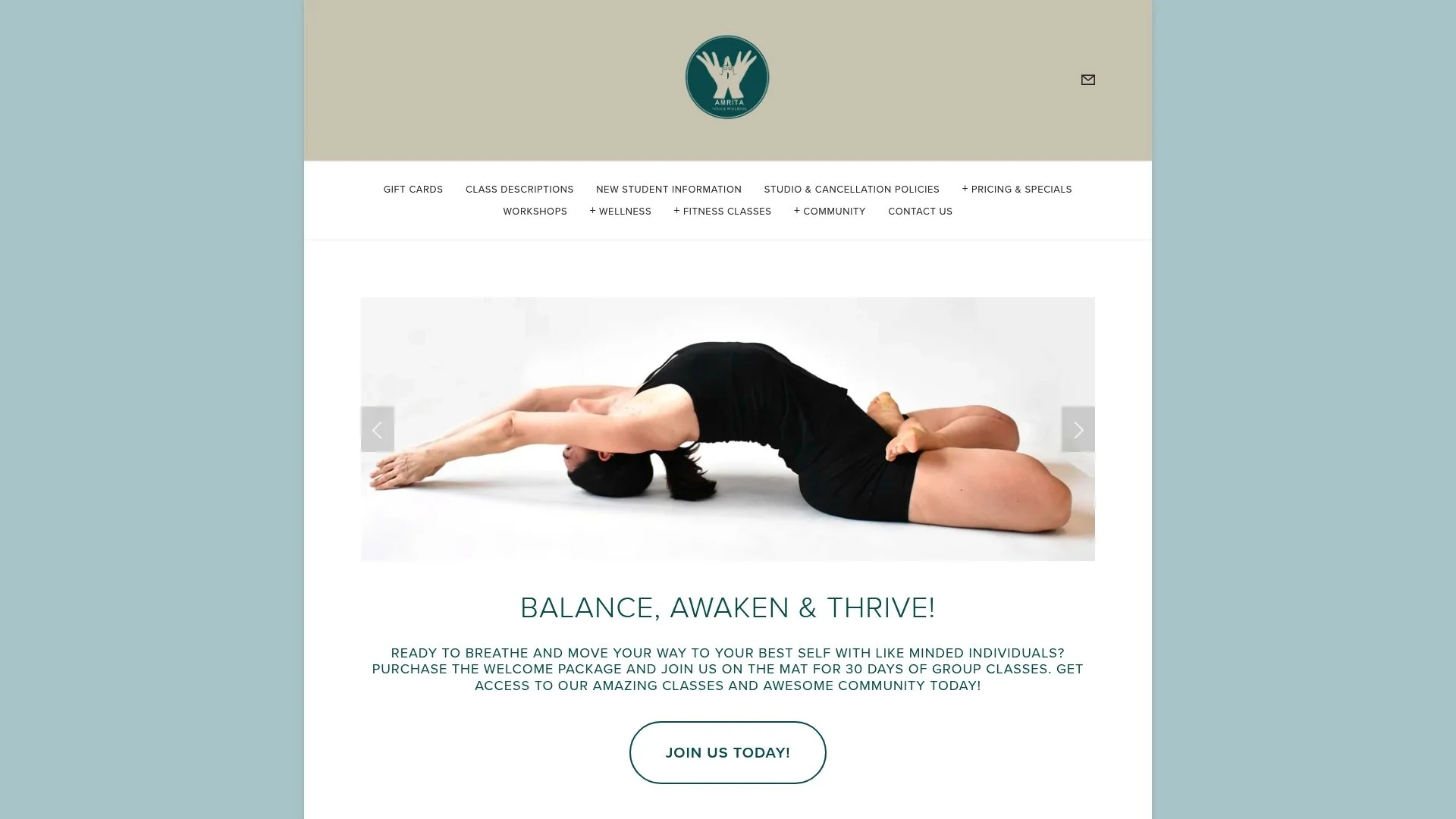
Amrita Yoga & Wellness in Philadelphia offers beginner-friendly classes, mindfulness workshops, and wellness sessions designed for people who are new to practice and want real guidance rather than a generic app. The studio's approach covers breath-based practices, mindful movement, and body-awareness techniques across formats that fit different schedules and comfort levels.
If you're ready to move from solo practice to something more structured, here's how to take the next step:
Drop into a beginner class. No prior experience needed. Show up, follow along, and ask questions after.
Try a workshop. Focused sessions on specific techniques give you more depth than a single class.
Explore the full range of offerings. From yoga and pilates to tai chi and massage therapy, the studio supports the kind of whole-body wellness that makes mindfulness practice easier to sustain.
Book your first sessionat Amrita Yoga & Wellness and bring what you've practiced here into a supported, in-person setting.
Useful sources
You can practice mindfulness in as little as 15 minutes a day — Harvard Health. Covers timing recommendations, habit-stacking advice, and beginner-friendly entry points including UCLA MARC.
Mindfulness exercises — Mayo Clinic. Clear clinical overview of core exercises (breathing, body scan, mindful movement) with no-equipment framing.
Mindfulness — NHS. Explains how mindfulness interrupts worry loops and provides accessible scripts for everyday practice.
How to Practice Mindfulness — Mindful.org. Detailed scripting guidance and the "notice and return" framing that normalizes mind-wandering for beginners.
Getting Started with Mindfulness — Mindful.org. Step-by-step beginner sequence and the four-step foundational loop used throughout this guide.
Mindfulness exercises and tips — Mind. Covers thought-labeling, body scan variations, and the "be curious, not critical" approach to self-judgment.
Less stress, clearer thoughts with mindfulness meditation — Harvard Gazette. Research-based evidence that mindfulness programs reduce stress and improve mental clarity.
Mindfulness-Based Programs — UMass Center for Mindfulness. The institutional home of Mindfulness-Based Stress Reduction (MBSR); a benchmark for evidence-based program structure and eight-week outcomes.
Mindful Eating — Harvard T.H. Chan School of Public Health. Covers mindful eating as an everyday mindfulness practice with practical guidance.