15 Pilates Examples From Beginner Moves to Advanced Work
The best starting set is a 15-move, core-focused Pilates routine that blends breathing work, spinal mobility, and full-body strength, and works whether you're brand new to a mat or years into reformer classes. Joseph Pilates built this system around what he called the "powerhouse," the deep core and back muscles that stabilize everything else you do, and modern systematic reviews indexed at NCBI back up what he saw in practice: real gains in core strength, balance, and function.
If you only have ten minutes, start with these six: the Hundred, Shoulder Bridge, Single-Leg Stretch, Plank, Roll Down, and Toe Taps. Each one shows up in the most-cited beginner Pilates lists for a reason: they teach breath, alignment, and core control before anything harder. At Amrita Yoga & Wellness in Philadelphia, our mat classes build from exactly this sequence before students move to group reformer work.
Key Takeaways
Fifteen core-focused Pilates moves, practiced with exhale-driven breath and pelvic neutral alignment, build strength and flexibility for beginners through advanced practitioners.
| Point | Details |
|---|---|
| Start with six moves | The Hundred, Shoulder Bridge, Single-Leg Stretch, Plank, Roll Down, and Toe Taps cover the basics fastest. |
| Breath drives the exercise | Exhale fully during the hardest phase of each move to activate deep core muscles. |
| Match reps to level | Beginners use 6 to 8 reps or 30-second holds; advanced practitioners push to 12 to 15 reps or 60-second holds. |
| Progress over four to six weeks | Move from Breathing and the Hundred toward Teaser and the Side Kick Series in stages. |
| Get hands-on correction | Amrita Yoga & Wellness offers mat, reformer, and private Pilates sessions in Philadelphia to fix form early. |
Table of Contents
Pilates Examples: A Quick 15-Move Reference
Here's the full set, ordered easiest to hardest, so you can scan it and decide where to start.
Breathing (lateral rib breath) — teaches the exhale that drives every other move.
The Hundred — breath and core endurance, the classic warm-up.
Shoulder Bridge — glutes, hamstrings, and lower-back activation.
Toe Taps — gentle core control for total beginners.
Single-Leg Stretch — deep abdominal work with hip flexor coordination.
Roll Down — spinal articulation and hamstring flexibility.
Plank — full-body isometric strength.
Leg Lifts (side-lying) — hip and outer thigh strength.
Crisscross — obliques and rotational core control.
Swimming — posterior chain endurance and coordination.
Spine Stretch Forward — flexibility through the back and hamstrings.
Saw — rotation plus a deeper hamstring stretch.
Double-Leg Stretch — advanced core and limb coordination.
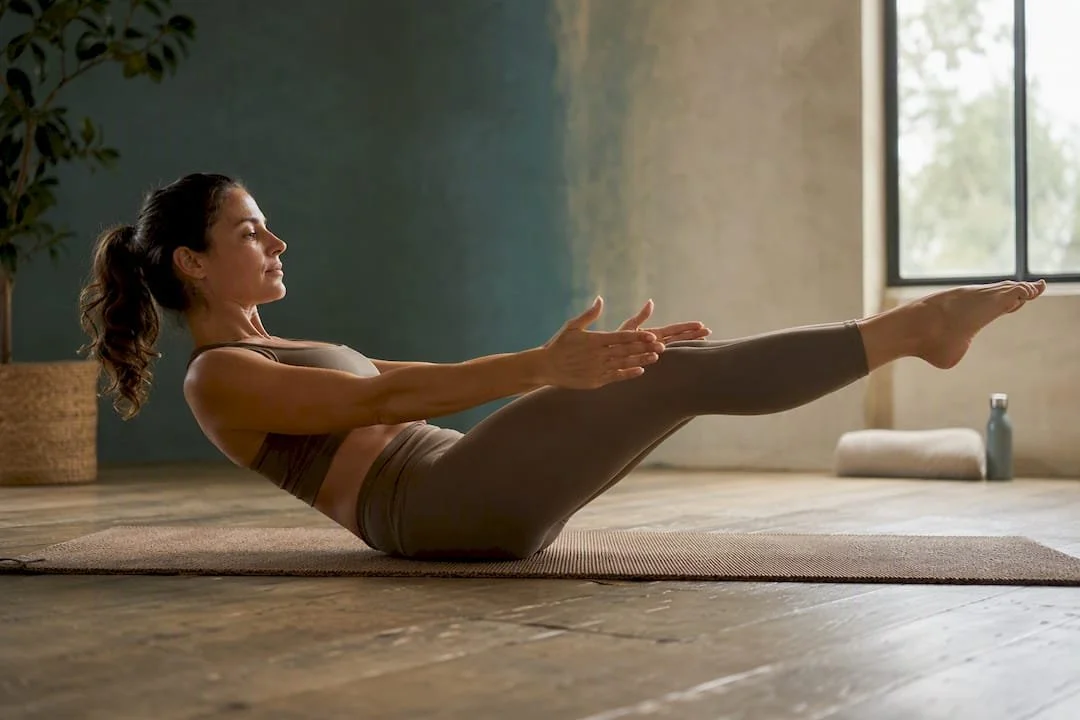
Teaser — advanced full-body balance and abdominal strength.
Side Kick Series — hip stability, often progressed on a reformer or with a magic circle.
A magic circle or light resistance band shows up most often in the Leg Lifts, Side Kick Series, and Double-Leg Stretch, once you're ready to add resistance instead of just body weight.
Core Pilates Fundamentals Before You Start
Every one of these exercises depends on two things: breath and pelvic position. Get those wrong and you're just doing crunches with better branding.
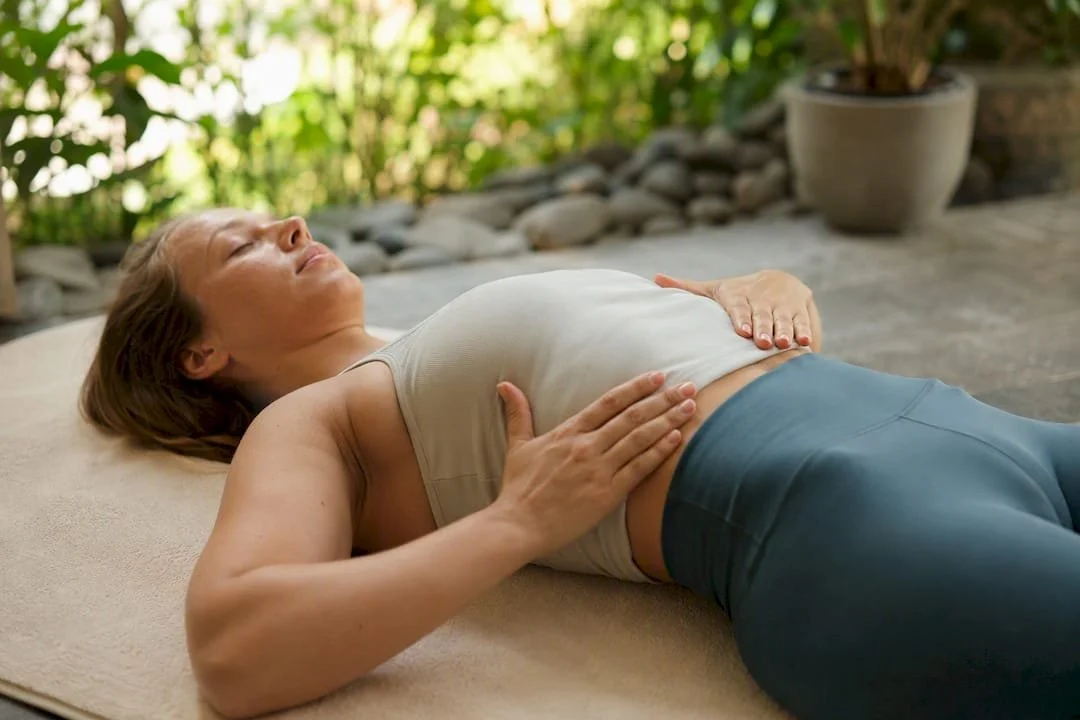
Breath comes first. Pilates uses lateral rib breathing: inhale to expand the ribs sideways, then exhale fully while drawing the navel toward the spine. That exhale is what actually switches on your deep core, according to instructor-taught cueing methods used across most mat programs. Most beginners breathe backward at first, holding the belly stiff on the inhale instead of the exhale. Fix that before you worry about reps.
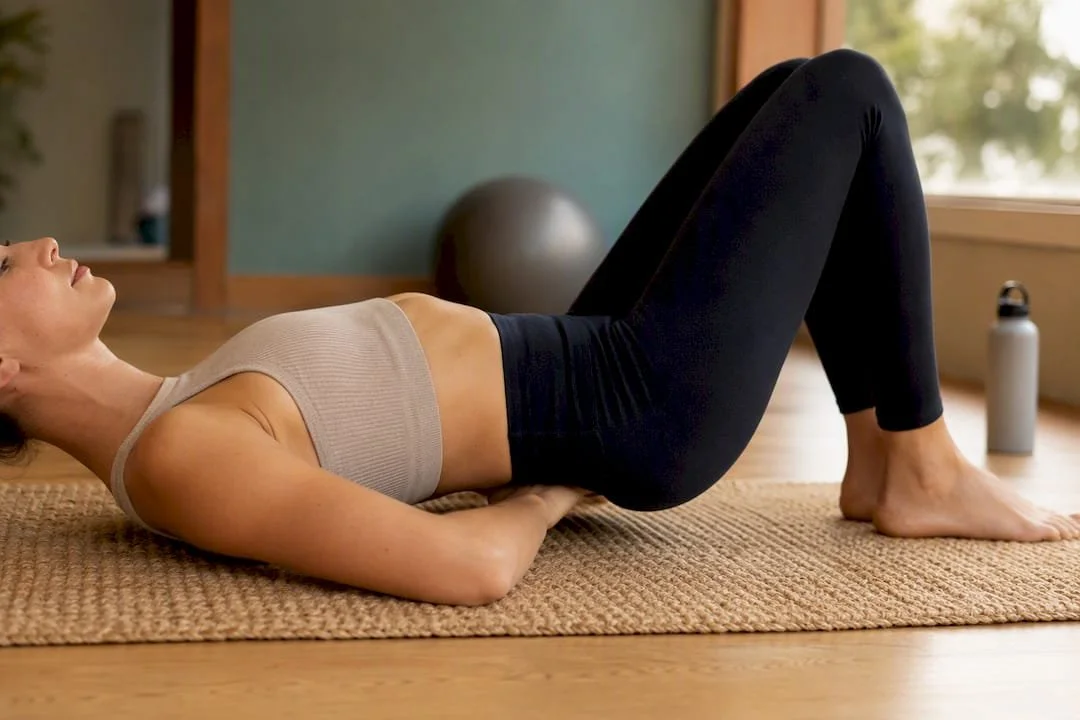
Pelvic neutral means your lower back keeps its natural, slight curve, not flattened into the mat and not arched off it. Check it by placing a hand under your low back before you start; you should feel a small gap, not a flat plank of spine.
Pro Tip: Lock your exhale to the hardest part of any move. On the Hundred, exhale as your arms pump; on the Plank, exhale as you hold. The breath IS the exercise, not a soundtrack to it.
Session structure scales with experience:
| Level | Reps/Hold Time | Session Length |
|---|---|---|
| Beginner | 6–8 reps or 30-second holds | 15–20 minutes, 3×/week |
| Intermediate | 10–12 reps or 45-second holds | 30 minutes, 3–4×/week |
| Advanced | 12–15 reps or 60-second holds | 45 minutes, 4–5×/week |
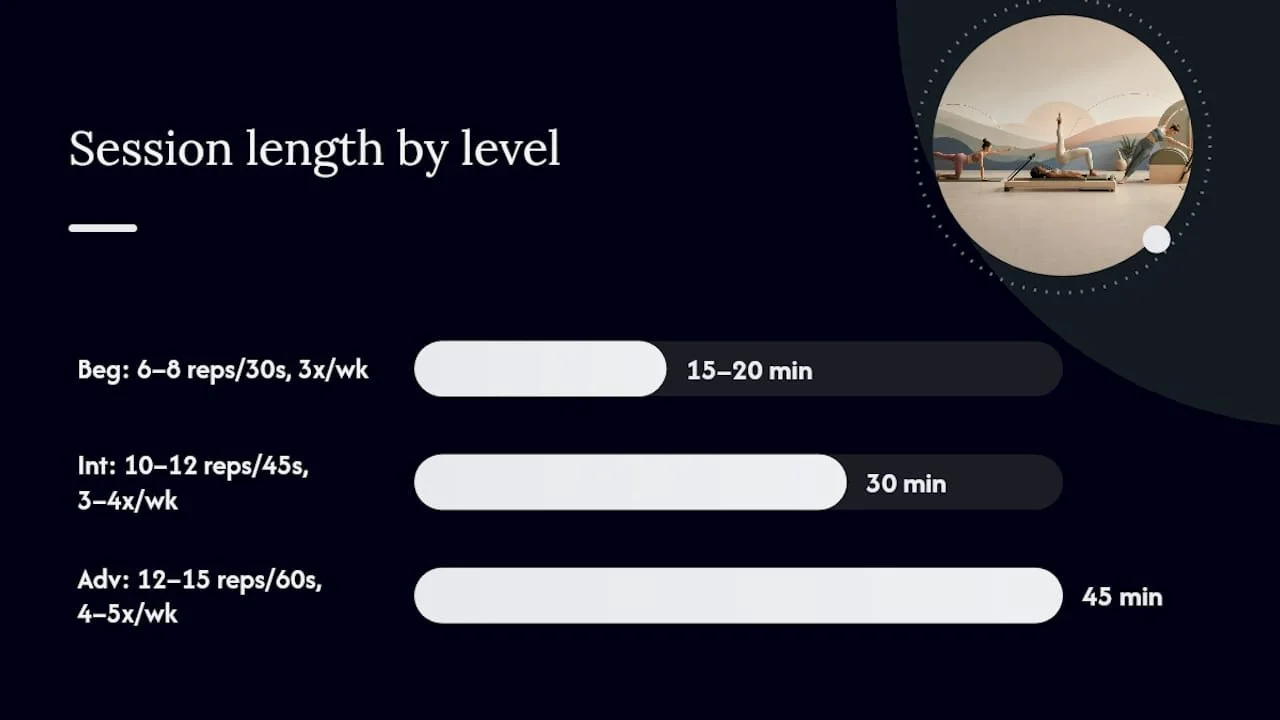
Mat work builds the control; a reformer adds adjustable resistance and spring-loaded support once your form is solid. Warm up with two minutes of the Breathing drill plus gentle Roll Downs, and cool down with the Spine Stretch Forward and a static hamstring stretch.
Step-by-Step Pilates Exercise Examples
1. Lateral Rib Breathing
Lie on your back, knees bent, hands on your ribcage. Inhale through the nose, feeling your ribs expand sideways into your hands. Exhale through the mouth, drawing ribs down and navel toward the spine. Repeat for 8 to 10 breaths.
Beginner: Do this seated in a chair if lying down feels awkward.
Advanced: Add the breath pattern to a standing squat hold.
Common mistake: Breathing into the belly instead of the ribs. Cue: "Ribs like an umbrella opening and closing."
2. The Hundred
Lie on your back, legs in tabletop or extended to 45 degrees, head and shoulders lifted, arms pumping six inches up and down. Inhale for five pumps, exhale for five, repeat for 100 total pumps (10 full breath cycles).
Beginner: Keep your head down and knees bent at 90 degrees.
Advanced: Extend legs fully toward the ceiling or lower toward the mat.
Common mistake: Straining the neck. Cue: "Lift from the chest, not the chin."
3. Shoulder Bridge
Lie on your back, knees bent, feet flat and hip-width apart. Press through your heels, lift your hips into a straight line from knees to shoulders, hold for 20 to 30 seconds, then lower one vertebra at a time.
Beginner: Hold for 10 seconds and rest between reps.
Advanced: March one knee toward your chest while holding the bridge.
Common mistake: Overarching the lower back. Cue: "Squeeze the glutes before you lift."
4. Toe Taps
Lie on your back with knees bent in tabletop position, shins parallel to the ceiling. Lower one foot to tap the mat, exhale to return to tabletop, alternate sides for 10 to 12 reps per side.
Beginner: Keep the movement small and controlled.
Advanced: Lower both feet at once without letting the low back lift.
Common mistake: Letting the ribs pop up. Cue: "Zip the ribs down as the foot lowers."
5. Single-Leg Stretch
From the Hundred setup, hug one knee to your chest while the opposite leg extends at a 45-degree angle. Switch legs with an exhale on each switch, for 10 reps per side, per SELF's beginner core sequence.
Beginner: Keep the extended leg higher, closer to 60 degrees.
Advanced: Lower the extended leg closer to the mat.
Common mistake: Losing the head lift. Cue: "Nose to knee, not chin to chest."
6. Roll Down
Stand tall, then exhale as you round forward one vertebra at a time, reaching toward the floor. Inhale at the bottom, then roll back up to standing, stacking the spine.
Beginner: Bend the knees generously and use it purely as a warm-up.
Advanced: Keep the legs straight and pause halfway for control.
Common mistake: Rushing the roll. Cue: "Peel the spine off the wall like tape."
7. Plank
From hands or forearms, extend the legs behind you, body in one straight line from head to heels, core braced, glutes engaged. Hold 20 to 60 seconds depending on level.
Beginner: Drop to knees, keeping hips in line with shoulders.
Advanced: Add a shoulder tap or a slow leg lift.
Common mistake: Sagging hips. Cue: "Pull your belly button toward your spine."
8. Side-Lying Leg Lifts
Lie on your side, legs stacked and slightly forward of your hips, head resting on your arm. Lift the top leg to hip height and lower with control, 10 to 12 reps per side.
Beginner: Bend the bottom knee for stability.
Advanced: Add a resistance band around the ankles or a magic circle between the legs.
Common mistake: Swinging the leg using momentum. Cue: "Lift like you're pouring water off your heel, slow and even."
9. Crisscross
From the Hundred position, twist your upper body to bring one elbow toward the opposite knee while the other leg extends. Alternate sides for 10 reps per side.
Beginner: Keep the extended leg higher and the twist smaller.
Advanced: Slow the tempo to three seconds per side for more oblique burn.
Common mistake: Pulling on the neck with the hands. Cue: "Hands are a hammock, not a crane."
10. Swimming
Lie face down, arms extended forward, legs extended back. Lift opposite arm and leg simultaneously, alternating in a swimming motion for 20 to 30 seconds.
Beginner: Lift just the arms first, then just the legs, before combining.
Advanced: Increase speed while keeping the lower back stable.
Common mistake: Hyperextending the neck. Cue: "Eyes down at the mat, not forward."
11. Spine Stretch Forward
Sit tall, legs extended slightly wider than hip-width, arms reaching forward. Exhale as you round forward over your legs, reaching toward your toes, then stack back up to sitting tall.
Beginner: Bend the knees slightly if hamstrings are tight.
Advanced: Flex the feet and reach further with straight legs.
Common mistake: Collapsing through the chest. Cue: "Round like you're curling over a beach ball."
12. Saw
Sit tall with legs wide, arms out to the sides. Rotate your torso, then reach one hand past the opposite foot, exhaling fully at the stretch, as if sawing off your little toe. Alternate sides.
Beginner: Keep knees slightly bent and the reach modest.
Advanced: Hold each rotation for three extra breaths.
Common mistake: Rotating the hips instead of the spine. Cue: "Hips stay square, ribs do the twisting."
13. Double-Leg Stretch
From tabletop with head lifted, extend both arms and both legs away from your body at once, then circle the arms back to hug the knees. Repeat for 8 to 10 reps.
Beginner: Keep legs bent at a higher angle and arms shorter.
Advanced: Extend legs closer to the mat and arms fully overhead.
Common mistake: Letting the back arch off the mat. Cue: "Press your low back into the floor before you reach."
14. Teaser
Lie flat, legs extended, arms overhead. Exhale and roll up simultaneously, lifting the torso and legs into a V shape, balancing on the sit bones, then roll back down with control.
Beginner: Practice with knees bent and feet on the floor for support.
Advanced: Hold the full V for 5 to 10 seconds before rolling down.
Common mistake: Using momentum to fling up. Cue: "Roll up like a coin stacking, not a catapult."
15. Side Kick Series
Lie on your side in a long line, head supported, top leg lifted to hip height. Swing the leg forward and back in controlled kicks, 10 reps, then switch sides.
Beginner: Keep kicks small and slow.
Advanced: Add a magic circle between the ankles for resistance, or move this drill to a reformer for added spring tension.
Common mistake: Rocking the pelvis with each kick. Cue: "Hips stacked like plates, they don't move."
Pro Tip: If you can't feel a muscle working after three attempts at a move, you're likely rushing the exhale. Slow the breath down before you add reps.
Safety, Progression, and When to Get an Instructor's Eyes on You
A sensible progression runs four to six weeks. Weeks one and two: master Breathing, the Hundred, Shoulder Bridge, and Toe Taps at beginner reps. Weeks three and four: add Single-Leg Stretch, Plank, and Crisscross, still at moderate holds. Weeks five and six: layer in Teaser, Double-Leg Stretch, and the Side Kick Series, pushing toward advanced rep ranges.
Watch for these signs that a move needs modifying or pausing entirely:
Sharp, localized joint pain (different from normal muscle fatigue).
Numbness, tingling, or shooting pain down an arm or leg.
Lower back pain that increases rather than eases as you warm up.
Dizziness or shortness of breath during breathing drills.
Clinical reviews on Pilates for pain and physical function support its use in rehab settings, but that same research consistently notes supervised instruction improves outcomes and lowers injury risk, especially for anyone managing a prior injury or a bone health condition. If you're managing osteoporosis or low bone density, some spinal flexion moves like the Roll Down or Saw may need adjusting; guidelines on safe exercise choices for that population are worth a look before you start.
Instructors at Amrita Yoga & Wellness see the same pattern in almost every new mat student: the exercises they think are "too easy" are the ones where their form quietly falls apart first. A hands-on correction in the first few classes fixes habits that would otherwise take months to notice alone.
Pro Tip: Book one private session before your first group mat class if you're recovering from any injury. A single hour of one-on-one cueing on breath and pelvic neutral saves weeks of practicing the wrong pattern.
What Instructors Wish Beginners Knew Sooner
Most new students obsess over rep count when the real skill is patience with the exhale. Consistency beats intensity here. Three imperfect 20-minute sessions a week build more real core strength than one exhausting hour that leaves your form falling apart by rep eight.
If you want that hands-on correction early, Amrita Yoga & Wellness's mat and reformer classes are built exactly for that first stretch of learning.
Practice These Moves in a Philadelphia Studio Class
Reading step-by-step cues gets you most of the way there, but Pilates rewards a trained eye watching your pelvis, ribs, and breath in real time. Amrita Yoga & Wellness runs mat Pilates classes for exactly the 15 moves above, plus group reformer sessions once you're ready to add spring resistance to moves like the Side Kick Series or Double-Leg Stretch.
Private sessions are worth the investment if you're modifying for an injury, tight hips, or a bone health concern, since a one-on-one hour lets an instructor correct your pelvic neutral and breath pattern before those habits harden. Between classes, students often round out their practice with a tarot reading or one of the studio's other wellness workshops, a nice way to slow down between physical sessions. Ready to put a face to the cues? Book a tarot reading or explore other Amrita Yoga & Wellness offerings to see the full studio schedule and reserve your spot in an upcoming class.
Further Pilates Reading and Studio Resources
Pilates for Beginners: A Complete Guide for equipment basics and starting points.
15 Pilates Exercises to Strengthen Your Core for the source list behind this routine.
Pilates Core Exercises for rep-range guidance.
NCBI reviews on Pilates and physical function for the clinical evidence base.
For studio-specific classes and reformer breakdowns, browse Amrita Yoga & Wellness's Pilates blog posts.
Frequently Asked Questions
What are some good pilates examples for absolute beginners? The Hundred, Shoulder Bridge, Toe Taps, and Roll Down are the four most commonly recommended starting moves, since they teach breath and pelvic control before adding rotation or balance demands.
How many reps should a beginner do per Pilates exercise? Most beginner routines use 6 to 8 reps or 30-second holds per move, per SELF's beginner sequencing, progressing to 10 to 12 reps as control improves.
Do I need a reformer to practice these Pilates examples? No. All 15 moves work on a mat with no equipment. A reformer adds adjustable resistance once your form is solid, but it's an addition, not a requirement.
Is Pilates safe if I have a back injury or osteoporosis? Many moves adapt well, but some spinal flexion exercises need modification. Check safe exercise guidance for bone health and consider a private session so an instructor can adjust the routine to your specific condition.
How often should I practice Pilates examples each week? Three sessions a week of 15 to 35 minutes builds noticeable core strength within four to six weeks, based on the progression pattern most mat programs follow.