Health Yoga Life: Build Strength, Calm, and Clarity
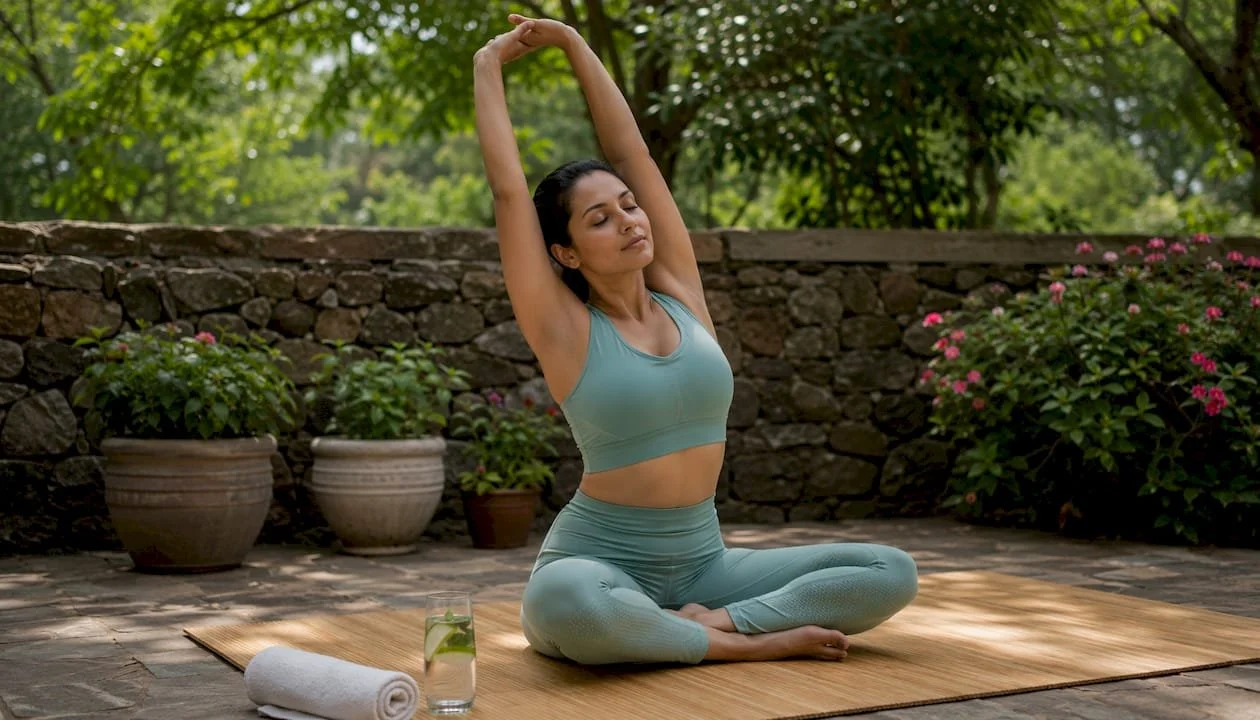
Yoga improves physical fitness, mental health, and cognitive resilience when practiced consistently. Systematic reviews and clinical trials through early 2026 show yoga-based interventions significantly reduce perceived stress, anxiety, and depressive symptoms while improving emotional wellbeing. Start with three 20–30 minute sessions per week that combine simple postures, pranayama, and five minutes of seated meditation.
Here is what a first week can look like:
Day 1: 25-minute gentle hatha session focusing on spinal mobility (Cat–Cow, Child's Pose) plus three rounds of slow diaphragmatic breathing
Day 3: 20-minute strength and balance flow (Warrior I, Warrior II, Tree Pose) followed by five minutes of seated breath awareness
Day 5: 30-minute restorative session (Legs-Up-the-Wall, Bridge, Savasana) with five minutes of body-scan meditation
Table of Contents
What does yoga actually do for your body?
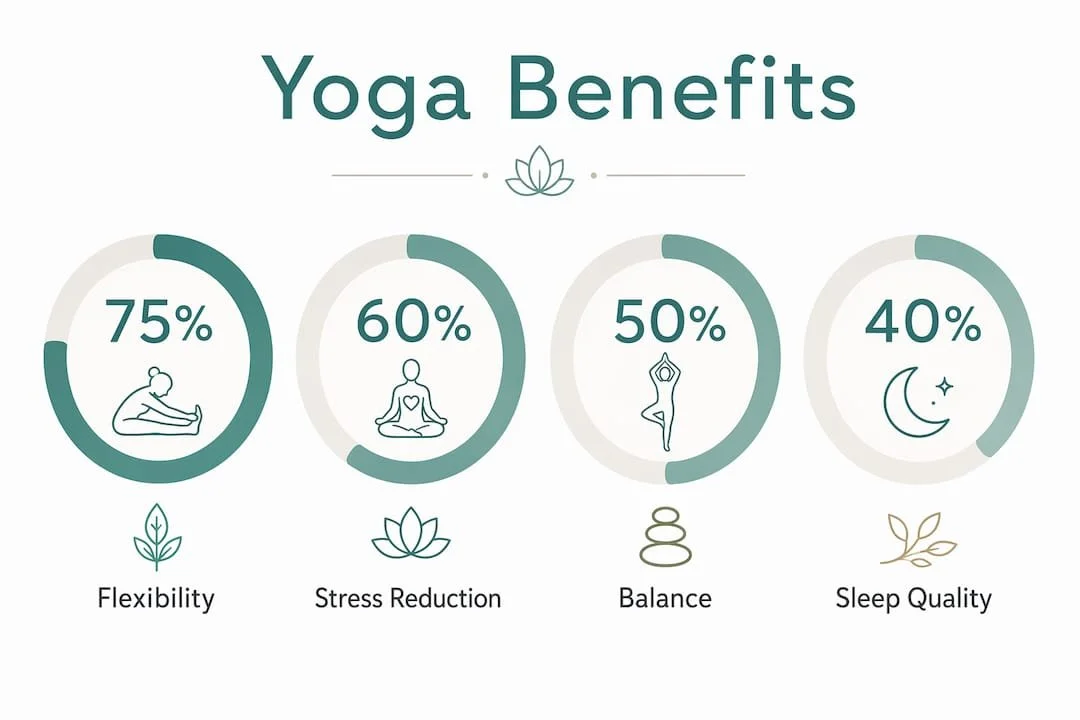
Regular yoga practice produces measurable changes across four physical domains: flexibility, muscular endurance, balance, and functional mobility. These are not incremental gains. Practitioners who train three or more times per week typically notice meaningful shifts in range of motion and postural control within six to eight weeks.
Pain management is where the evidence gets particularly compelling. Chronic low back pain is one of the most studied applications, and clinical trial data consistently shows yoga outperforming usual care for pain reduction and functional improvement.
Clinical evidence: A randomized controlled trial involving 129 university students found statistically significant improvements across stress, anxiety, and wellbeing measures after a 12-week yoga program, with effect sizes ranging from Cohen's d = 0.38 to d = 0.80.
Specific poses map directly to specific benefits:
Cat–Cow (Marjaryasana–Bitilasana): Spinal mobility and intervertebral disc health
Warrior II (Virabhadrasana II): Leg strength, hip stability, and lateral balance
Bridge Pose (Setu Bandha Sarvangasana): Glute strength and low-back support
Tree Pose (Vrksasana): Single-leg balance and proprioception
Legs-Up-the-Wall (Viparita Karani): Circulation, hip flexor release, and nervous system recovery
For progressive loading, start with a mobility-first approach in month one: slow transitions, longer holds, and breath-led movement. By month two, introduce standing sequences that challenge balance and build lower-body endurance. Month three is when you can begin adding vinyasa flows or longer holds in strength-demanding poses like Warrior III or Boat Pose.
Pro Tip: Don't chase flexibility. Chase control. A hip that moves slowly through its full range under load is far more useful than one that stretches passively on a mat.
How yoga supports mental health and sleep
Yoga reliably reduces stress, anxiety, and depression symptoms. That is not a soft claim. Frontiers in Psychology's 2026 systematic review confirms yoga-based interventions produce significant reductions in perceived stress and anxiety, and improve emotional wellbeing across diverse populations.
Key finding: In the 12-week randomized controlled trial at Frontiers in Public Health, participants in the yoga group showed a Cohen's d of 0.80 for trait anxiety reduction, a large effect by conventional standards.
The mechanism is specific. Breathwork and slow movement activate the parasympathetic nervous system, lowering cortisol and heart rate variability in ways that blunt the stress response. Pranayama, in particular, drives the most immediate shift: slow, deep breathing reduces autonomic arousal within minutes, making it a portable tool you can use anywhere. Anchoring attention to breath during asanas also reduces rumination, which is a primary driver of both anxiety and depression.
Mindful yoga as a therapeutic toolimproves self-awareness, emotional regulation, and sleep quality, particularly when movement is explicitly paired with present-moment attention rather than treated as pure exercise.
Pro Tip: During acute stress, try this three-minute sequence: four counts of Box Breathing (inhale 4, hold 4, exhale 4, hold 4), then two minutes of Alternate Nostril Breathing (Nadi Shodhana), followed by one minute of Ujjayi breath. Finish in Legs-Up-the-Wall for three minutes. You can find pranayama techniques that walk through each of these step by step.
Does yoga change how your brain works?
Yes, and the structural evidence is striking. Neuroimaging studies show that regular yoga practitioners have thicker cortex and larger hippocampal volume compared to non-practitioners. The hippocampus governs memory consolidation; the prefrontal cortex handles executive control, decision-making, and emotional regulation. Both tend to shrink with chronic stress and age. Yoga appears to slow or partially reverse that process.
Brain health signal: Harvard Health's review of neuroimaging data links consistent yoga practice to strengthened brain regions tied to memory, attention, and language processing.
The mechanism involves a feedback loop that most exercise forms don't replicate. Movement, breath regulation, and focused attention operate simultaneously during yoga, creating what researchers describe as a neurocognitive training effect. Interoception, the brain's ability to sense internal body states, improves with practice. That improvement correlates with better emotional regulation and reduced anxiety reactivity. It is not just that yoga calms you down in the moment; it appears to rewire how your nervous system responds to stress over time.
How yoga helps you age well and stay functional
Yoga preserves mobility, functional strength, and balance in ways that directly reduce fall risk, one of the most serious health threats for adults over 60. Unlike high-impact exercise, yoga places low stress on joints while still challenging the neuromuscular coordination that keeps people steady on their feet.
For older adults, a practical weekly target is 3–4 sessions, mixing balance-focused sequences with gentle strength work and longer warm-ups. Chair yoga makes the practice fully accessible for those with limited mobility or balance concerns.
Adaptive approaches that work well:
Chair yoga: All standing poses adapted to seated or supported positions; no floor work required
Longer warm-ups: 10–15 minutes of joint circles and gentle Cat–Cow before any standing sequence
Props: Blocks, straps, and bolsters reduce strain and allow full range of motion without compensation
Supervised classes: A certified instructor can spot unsafe alignment patterns that self-practice misses
Shorter sessions: Three 20-minute sessions often produce better adherence than one 60-minute class for older beginners
The group yoga for wellness model also matters here. Social connection during class improves adherence and adds a layer of accountability that solo practice rarely sustains.
How to start and make yoga part of your life
The simplest effective routine for month one is three sessions per week, each 20–30 minutes, built around mobility and breath. Add strength-focused sequences in month two. By month three, you can experiment with different styles and longer sessions.
Sample four-week plan
Week 1: Three sessions of 20 minutes each. Focus: spinal mobility (Cat–Cow, Child's Pose, seated twists) plus five minutes of diaphragmatic breathing.
Week 2: Three sessions of 25 minutes. Add standing balance poses (Tree, Warrior I). Keep five minutes of breath work at the close.
Week 3: Three sessions of 25–30 minutes. Introduce a short vinyasa link between poses. Add Bridge and Legs-Up-the-Wall for recovery.
Week 4: Three sessions of 30 minutes. Try one class in a different style (restorative or gentle hatha). Assess what feels sustainable.
Style quick reference
| Style | Best for | Session feel |
|---|---|---|
| Hatha | Beginners, learning alignment | Slow, pose-by-pose |
| Vinyasa | Building strength and cardio | Flowing, breath-linked |
| Restorative | Stress relief, recovery, sleep | Passive, prop-supported |
| Chair/Therapeutic | Limited mobility, injury recovery | Seated or standing with support |
| Yin | Deep tissue flexibility, joint health | Long holds, floor-based |
Beginner checklist
Non-slip mat (at least 4mm thick for joint cushioning)
Two yoga blocks and a strap
Comfortable, stretchy clothing that doesn't restrict hip flexion
Five-minute warm-up of joint circles before any standing sequence
Water nearby; avoid heavy meals within 90 minutes of practice
Tell your instructor about any injuries or pain before class starts
Pro Tip: Attach your yoga session to an existing habit. If you already make coffee every morning, roll out your mat while the coffee brews. Tiny habit stacking beats willpower every time. Track your sessions with a simple paper calendar, not an app. Crossing off a box is surprisingly motivating.
Consistency beats intensity. Short, regular practice tends to produce better long-term results than occasional long sessions, and three or more sessions per week is the threshold where most studies observe sustained benefits.
Safety, contraindications, and when to modify
Yoga is generally safe for most adults, but certain conditions require modifications or clinical clearance before starting. The risk is not the practice itself; it is practicing without awareness of your body's current limits.
Conditions that warrant medical advice or therapist-guided practice before beginning:
Recent surgery (especially spinal, abdominal, or joint replacement)
Uncontrolled hypertension or cardiac conditions
Acute disc herniation or nerve compression with radiating pain
Pregnancy complications (placenta previa, preeclampsia, high-risk status)
Severe osteoporosis (forward folds and inversions carry fracture risk)
Active inflammatory arthritis flare
When to stop immediately: New severe pain (especially sharp or radiating), dizziness, chest pain or tightness, sudden shortness of breath, or numbness in the hands or feet. These are signals to stop the session and consult a clinician before returning to practice.
Modification examples that make practice accessible without sacrificing benefit:
Replace floor poses with chair alternatives for anyone with knee or hip pain
Use blocks under hands in forward folds to reduce hamstring strain
Skip inversions entirely during menstruation or with uncontrolled blood pressure
Prioritize breath-first pacing: if you cannot breathe slowly and steadily in a pose, back off the depth
BJPsych Advancesrecommends yoga as a complementary, non-pharmacological option for some psychiatric conditions, while noting the need for standardized clinical modules and appropriate supervision. That framing matters: yoga works best as a complement to, not a replacement for, medical or psychiatric care.
This article is general information, not medical advice. Confirm current recommendations with your physician or a qualified health professional for your specific situation.
What does the science actually say?
The evidence base for yoga is substantial but uneven. Mental-health benefits, particularly stress and anxiety reduction, have the strongest and most consistent support across systematic reviews and randomized controlled trials. Physical function and pain management show moderate, positive evidence. Cognitive and neurological benefits are promising but based on smaller neuroimaging studies.
High-value studies worth knowing:
Frontiers in Psychology (2026): Systematic review confirming significant reductions in perceived stress, anxiety, and depressive symptoms across yoga-based interventions.
Frontiers in Public Health (2024): Randomized controlled trial in 129 university students; 12-week hatha yoga program produced large effect sizes for trait anxiety (Cohen's d = 0.80) and meaningful improvements in perceived stress and emotional wellbeing.
Harvard Health neuroimaging review: Links regular practice to thicker cortex and larger hippocampal volume in practitioners versus non-practitioners.
BJPsych Advances (Cambridge): Psychiatric review recommending yoga as a complementary option for mental health conditions, with a call for standardized clinical protocols.
Evidence note: Clinical trials involving healthcare workers also report measurable short-term improvements in quality-of-life metrics when yoga and mindfulness practices are combined.
The main limitation across the literature is heterogeneity. Different studies use different yoga styles, session lengths, frequencies, and outcome measures, which makes direct effect-size comparisons difficult. What the data consistently points to, regardless of style or duration, is a benefit direction: yoga moves the needle on stress, mood, and function. The magnitude varies; the direction does not.
How Amrita Yoga & Wellness makes yoga accessible
Amrita Yoga & Wellness, based in Philadelphia, offers a concrete example of how a studio can structure yoga for real accessibility. Their class menu spans multiple styles and ability levels, including gentle hatha, restorative sessions, chair yoga, hot yoga, pilates, barre, tai chi, and massage therapy. That range matters because no single style fits every body or schedule.
Accessible class types worth trying as a beginner or returning practitioner:
Chair yoga: Full practice without floor work; ideal for limited mobility or post-injury recovery
Gentle hatha: Slow, alignment-focused sessions that build body awareness before strength
Restorative yoga: Prop-supported passive holds that activate the parasympathetic nervous system
Breathwork sessions: Standalone pranayama classes for stress relief and sleep preparation
Short online classes: 20–30 minute virtual options that fit into a lunch break or morning routine
Amritayogawellness also offers workshops and community events that extend the practice beyond the mat, including sessions that pair wellness tools with self-care rituals.
Pro Tip: Match your first class to your current capacity, not your aspirations. If you are tired, stressed, or returning from injury, a 30-minute restorative or breathwork session will do more for you than a 60-minute vinyasa flow. Check the breathwork benefits archive to understand what each technique targets before you walk in.
A single drop-in class or a short virtual trial is the lowest-risk way to test whether a studio's style and pace fit your life. You do not need a membership to start.
Key Takeaways
A consistent yoga practice of three or more sessions per week produces measurable improvements in flexibility, stress resilience, sleep quality, and cognitive function, with the strongest evidence pointing to mental-health benefits across all age groups.
| Point | Details |
|---|---|
| Start small, stay consistent | Three 20–30 minute sessions per week outperforms occasional long sessions for long-term benefit. |
| Mental-health gains are well-supported | Systematic reviews and a 2024 RCT (Cohen's d = 0.80 for trait anxiety) confirm significant stress and anxiety reduction. |
| Breathwork drives fast results | Pranayama activates the parasympathetic nervous system within minutes and works as a portable stress tool. |
| Yoga supports healthy aging | Chair yoga, props, and balance-focused sequences reduce fall risk and preserve functional mobility for older adults. |
| Amritayogawellness offers a starting point | Amrita Yoga & Wellness in Philadelphia provides in-studio and virtual classes across styles and ability levels, including chair yoga and restorative options. |
The part most people get wrong about starting yoga
Most people approach yoga the way they approach a gym program: push harder, go longer, measure progress by how far they can stretch. That framing almost guarantees frustration, because yoga's most significant gains are not visible in the mirror.
The practitioners who stick with it long-term tend to share one habit: they treat breath as the primary metric. Not how deep the forward fold is, not how long the hold lasts. If the breath is slow and steady, the pose is working. If it is strained or held, the pose is too much. That single reframe changes everything about how you practice, and it is the insight that separates a sustainable practice from a six-week experiment.
Beginners often struggle most with the meditative component, not because they lack focus, but because physical discomfort pulls attention away from breath. The fix is not to push through the discomfort. It is to observe it. Notice where tension lives in the body, breathe toward it, and back off slightly. That is mindfulness in yoga, not a philosophical concept but a practical instruction. Jon Kabat-Zinn built the entire Mindfulness-Based Stress Reduction program around this principle, using mindful hatha yoga as one of its three core formal practices.
Small, consistent sessions also beat sporadic intensity by a wide margin. A 20-minute morning practice five days a week will outperform a 90-minute Saturday class in almost every measurable outcome. The mindfulness practices that compound fastest are the ones you actually do every day, not the ones that feel most ambitious on paper.
Guided support makes the difference faster
Amrita Yoga & Wellness offers something a YouTube video cannot: a certified instructor who sees your alignment, adjusts your pace, and connects you to a community of practitioners at the same stage you are. That combination, real-time feedback plus social accountability, is what turns a two-week experiment into a lasting practice.
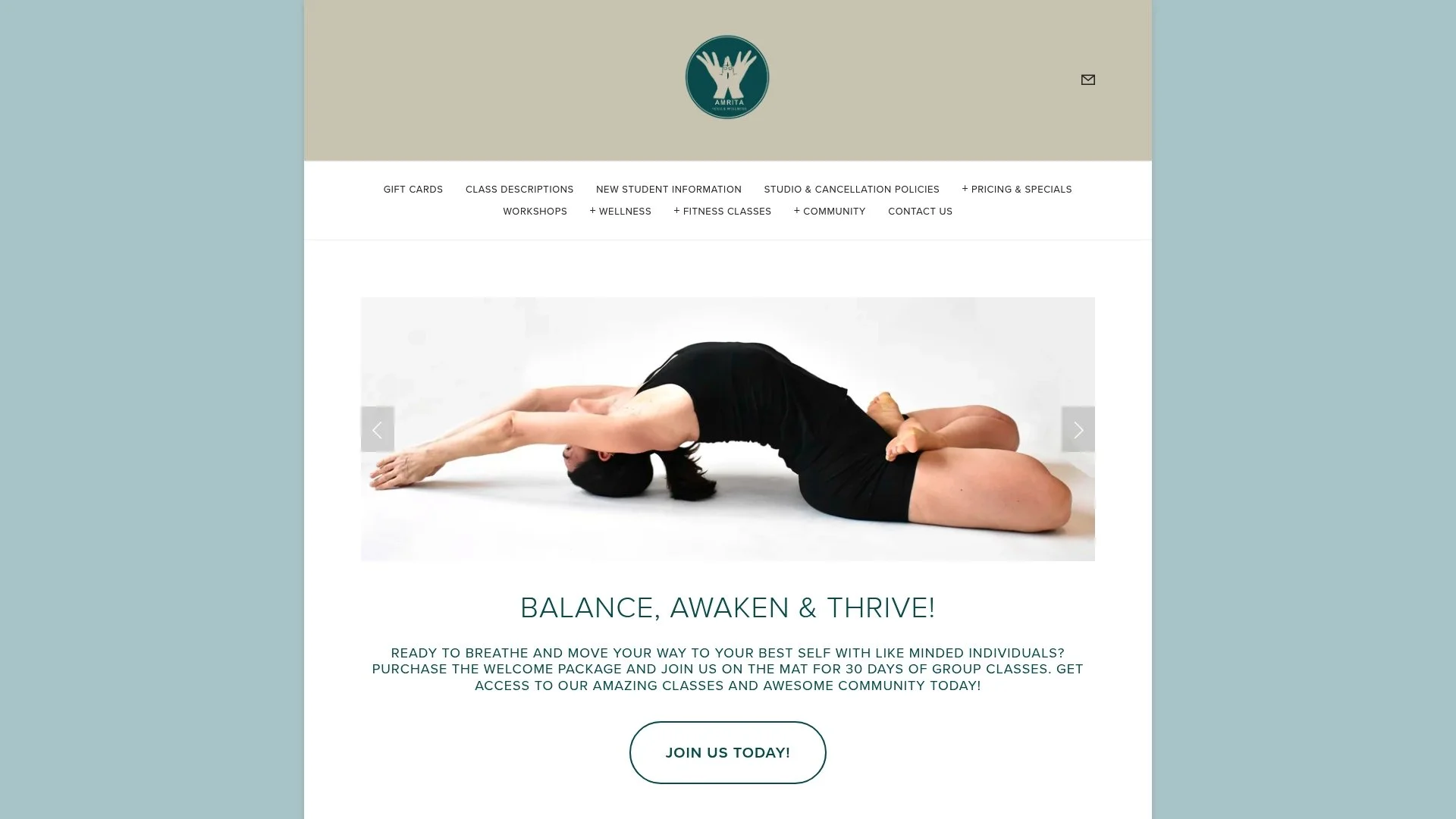
The studio's class menu covers every entry point: gentle hatha and chair yoga for beginners, restorative sessions for stress and recovery, and more dynamic options as your practice grows. Virtual classes mean you can start from your living room before committing to in-person sessions. Amritayogawellness also hosts workshops and wellness events, including tarot readings and other self-care offerings, that make the studio a full wellness community rather than just a class schedule. Visit Amrita Yoga & Wellness to browse the current schedule and book your first class or drop-in session.
Where to read the primary studies next
If you want to go deeper into the research behind these claims, these five sources are the most useful starting points:
Frontiers in Psychology (2026) systematic review: The most current comprehensive review of yoga's mental-health effects; covers stress, anxiety, and depression outcomes across multiple populations.
Frontiers in Public Health (2024) RCT: The 129-student randomized controlled trial; read this for the effect-size data and the detailed 12-week protocol.
Harvard Health neuroimaging overview: Accessible summary of brain-structure findings for non-specialists; good entry point for the cognitive benefits section.
BJPsych Advances, Cambridge Core: Psychiatric perspective on yoga as a complementary intervention; useful for understanding clinical applications and limitations.
PMC clinical trials summary: Covers yoga and mindfulness outcomes in healthcare workers; relevant for understanding real-world implementation.
When reading any study, check four things: sample size (larger is more reliable), whether there was a control group, how long the intervention ran, and what outcome measures were used. A study with 30 participants and no control group tells you far less than a 12-week randomized trial with validated scales. Most of the studies linked above meet a reasonable evidence bar, which is why they are worth your time.