Combining Movement Modalities: What 81 Studies Mean for Your Week
Combining movement modalities reliably improves cardiorespiratory fitness, mobility, injury resilience, and mind-body well-being when you sequence the right stimulus and leave room for recovery. That claim isn't a guess: meta-analyses, clinical reviews, and public health guidelines back it up. Below, we walk through the evidence and the practical steps that turn it into a weekly routine.
TL;DR:
A time efficient session can pair compound lifts with a 10 to 15 minute interval or circuit finisher, then end with mobility work.
When strength gains are the priority, lift before sustained cardio or separate sessions by more than two hours to reduce interference.
Older adults should include balance, strength, and flexibility work at least three days each week to help maintain function and lower fall risk.
People recovering from injury or illness should coordinate exercise choices with a clinician, especially when combining endurance and resistance training.
Beginners should start with low volume and focus on consistency before increasing intensity; meditative movement can support mood and early adherence.
Amritayogawellness
Explore Movement That Fits Your Week
Amrita Yoga & Wellness offers yoga, Pilates, barre, tai chi, and other practices for people exploring varied approaches to movement.
Table of Contents
Core Benefits Explained: Fitness, Mobility, Injury Resilience, and Mind-Body Gains
What the Research Says: Headline Studies and Practical Takeaways
How to Combine Modalities: Sequencing, Frequency, and Sample Templates
Who Benefits Most and How to Adapt: Older Adults, Rehab, and Beginners
Adaptations in Neuroplasticity and Cognitive Function From Multimodal Movement
Psychological and Motivational Benefits of Varied Movement Practices
Community and Social Engagement Impact When Combining Modalities
Nutritional Considerations Complementing Multimodal Movement Practice
Practical Next Steps: Classes and Services at Amrita to Combine Movement Modalities
Core Benefits Explained: Fitness, Mobility, Injury Resilience, and Mind-Body Gains
Each movement modality contributes a distinct physiological signal, and stacking the right ones produces gains no single practice delivers alone. Aerobic exercise paired with resistance training improves cardiorespiratory fitness, body composition, and metabolic markers like blood glucose and lipid profiles more broadly than either one in isolation. Resistance training on its own still carries unique weight: it builds strength and conditions tendons and connective tissue to tolerate load, which matters directly for injury resilience.
Yoga and dedicated mobility work extend joint range of motion and sharpen movement quality, the kind of control that keeps a squat or a stride mechanically sound under fatigue. Balance-focused practices such as tai chi and dance train proprioception, the body's sense of position in space, which translates into fewer falls and better coordination as people age. Meditative movement adds a different kind of return entirely: measurable reductions in stress, anxiety, and depressive symptoms, along with better sleep quality.
Put together, a well-chosen mix covers ground that no single modality reaches:
Cardiometabolic health: aerobic plus resistance work improves heart health, body composition, and blood sugar regulation.
Strength and tissue resilience: progressive resistance training conditions muscle, tendon, and connective tissue against overuse injury.
Flexibility and movement quality: yoga and mobility drills extend range of motion and improve how a joint moves under load.
Balance and coordination: tai chi and dance-based practices sharpen proprioception and reduce fall risk.
Mental health and sleep: meditative movement lowers stress and anxiety symptoms and supports more consistent sleep.
The overlap matters as much as the individual effects. A person doing only cardio misses the tendon-loading benefits of resistance work; someone doing only yoga misses the cardiometabolic stimulus that aerobic training provides. Combining modalities closes those gaps.
What the Research Says: Headline Studies and Practical Takeaways
The case for combining modalities isn't anecdotal. A Harvard Health summary of hybrid training reviewing 81 studies found that hybrid programs mixing aerobic and resistance work in the same session improved cardiometabolic markers while also saving time: participants in hybrid formats averaged less weekly training time than they did when aerobic and resistance sessions were done separately.
That's a meaningful time savings for anyone trying to fit exercise around a full schedule, without giving up the combined cardiometabolic benefit.
On the mental health side, a network meta-analysis of meditative movement interventions found that practices like tai chi, qigong, and yoga produced substantial reductions in anxiety and depressive symptoms compared with non-exercise controls. The effect sizes were large enough to place meditative movement among the more reliable non-pharmacological options for mood support.
Public health guidance backs the multicomponent approach too. The WHO guidelines on physical activity and sedentary behaviour recommend that older adults in particular combine aerobic, muscle-strengthening, and balance activities to protect function and prevent falls.
A few key points stand out:
Hybrid same-session training can match separate-session results in less total time.
Meditative movement shows some of the strongest evidence for anxiety and depression symptom relief among movement-based interventions.
Multicomponent weekly activity is the standard public health recommendation, not an optional add-on.
One caveat worth naming: a documented interference effect exists where heavy endurance work close to a strength session can blunt maximal strength gains in already-trained lifters. It's context-dependent and manageable with smart sequencing, which we cover next.
How to Combine Modalities: Sequencing, Frequency, and Sample Templates
Good programming starts with a decision: what's the primary adaptation this session is for? Strength, cardiovascular conditioning, and mobility all compete for recovery resources, so naming the priority before you train keeps the session coherent instead of diluted.
Pick one primary objective per session. Strength, cardio, or mobility, not all three at full intensity in one sitting.
Sequence by priority. When strength is the goal, lift before any sustained cardio; fatigue from a long run or ride beforehand will compromise lifting mechanics.
Separate sessions when maximizing strength matters most. A gap of more than two hours between endurance and resistance work reduces the interference effect noted in concurrent-training research.
Track effort, not just output. Rating of perceived exertion (RPE) gives a simple, subjective check on whether you're building fatigue faster than you're recovering from it.
Schedule at least one low-intensity day weekly. Gentle yoga, walking, or restorative stretching gives connective tissue and the nervous system a chance to catch up.
Three templates cover most people's needs:
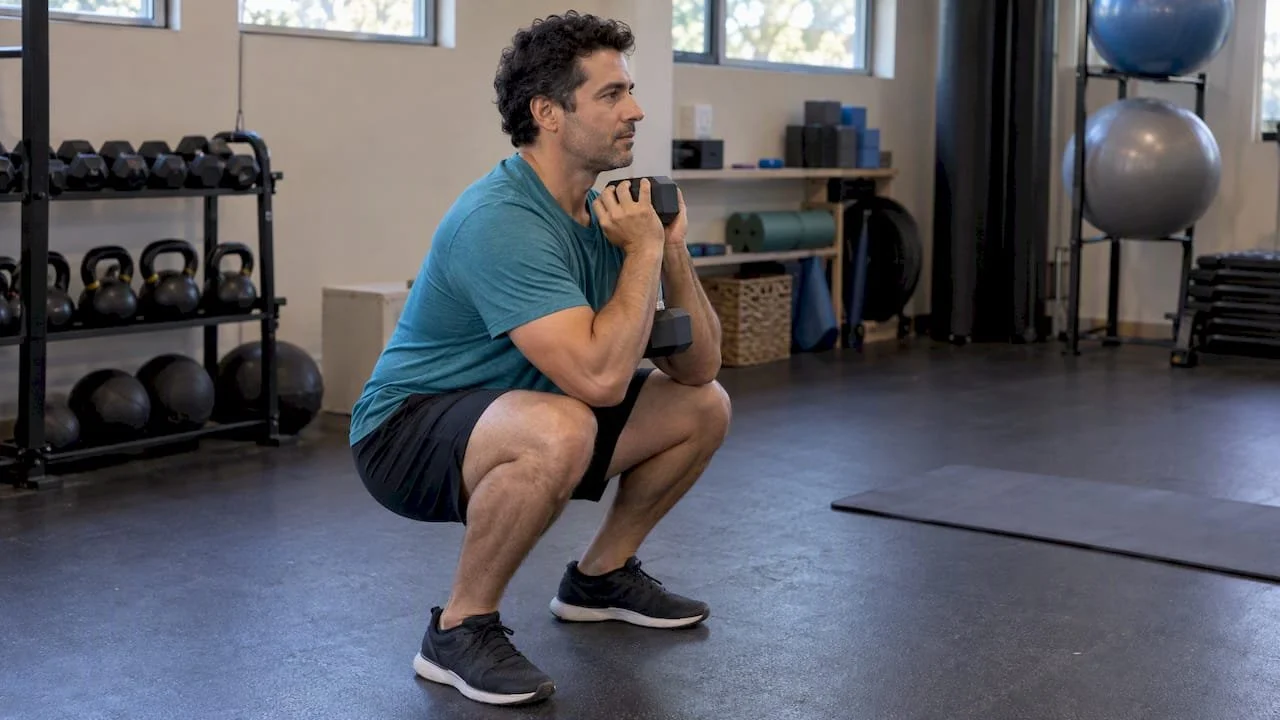
Template A, time-efficient hybrid (one session): warm-up, compound strength movements (squats, rows, presses), a 10 to 15 minute metabolic finisher (intervals or circuit work), then a mobility cool-down. This mirrors the hybrid format in the Harvard summary above and fits well into a single hour.
Template B, three-day multicomponent week: day one pairs strength with mobility work, day two pairs cardio with balance drills, day three is restorative yoga. This spreads the stimulus so no single day is overloaded.
Template C, class-friendly plan: a yoga class paired with a short run or a pilates session, plus one light strength routine during the week. This works well for people building a routine around scheduled classes rather than solo training blocks.
Pro Tip: When you're short on time, choose a hybrid session that trains two capacities at once, like resistance circuits performed with minimal rest to add an aerobic density component.
Our blog on yoga and pilates for fitness and mind walks through how those two practices complement strength-focused training if you want a deeper look at Template C in action.
Who Benefits Most and How to Adapt: Older Adults, Rehab, and Beginners
Different groups need different emphasis, though the multicomponent principle holds across all of them.
Older adults benefit most from sessions that combine balance, strength, and flexibility work at least three days a week, matching the WHO's multicomponent recommendation for maintaining function and preventing falls. Our chair yoga routine for seniors is a practical entry point for building that habit gently.
Rehab and clinical populations often see faster functional gains from multimodal programs: a systematic review on post-stroke rehabilitation found that combining resistance and endurance training improved knee-extensor strength more than single-mode approaches. Anyone recovering from injury or illness should coordinate modality choices with a clinician first.
Beginners do best starting with low volume and high consistency rather than intensity. Meditative movement in particular tends to improve adherence and mood early on, which matters more than raw training load in the first few months.
For readers managing bone health specifically, osteoporosis exercise guidelines offer useful detail on safe loading choices that pair well with balance-focused classes.
Adaptations in Neuroplasticity and Cognitive Function From Multimodal Movement
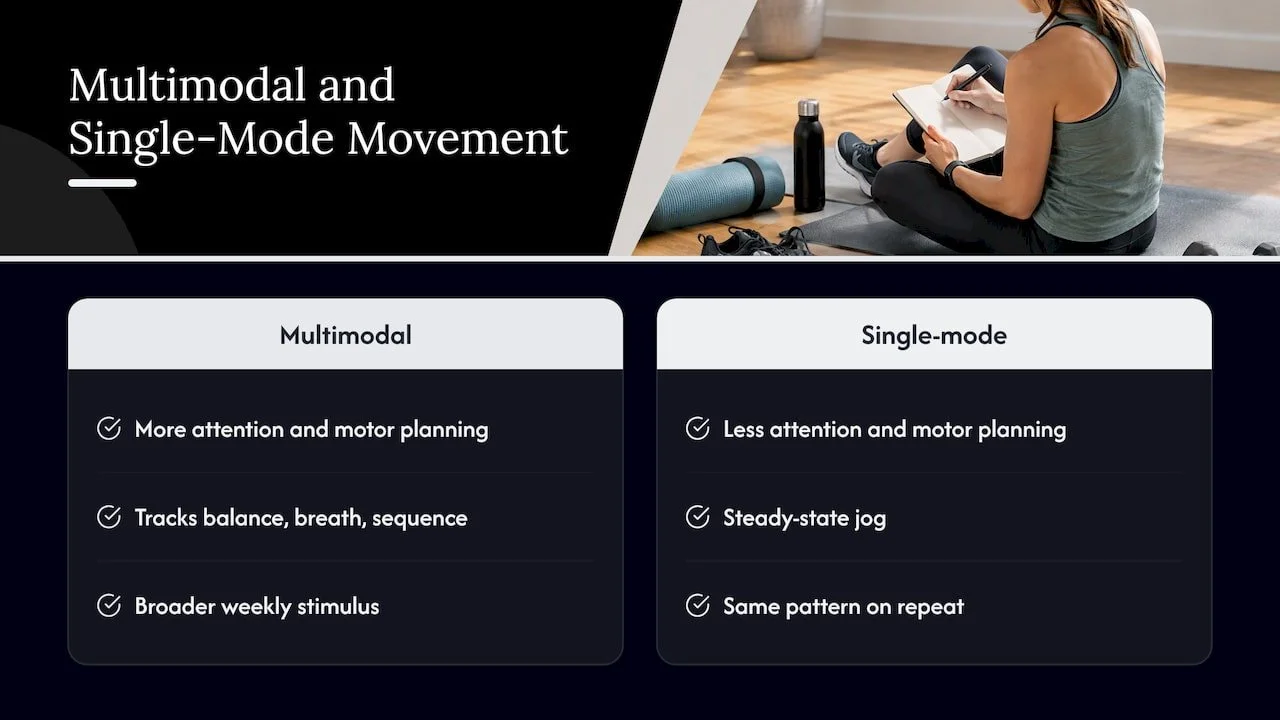
Movement that combines physical coordination with attentional demands appears to engage the brain differently than repetitive single-mode exercise. Practices that require tracking balance, breath, and sequence at the same time, like tai chi or a flowing yoga sequence, ask more of attention and motor planning than a steady-state jog.
Research on movement-integrated learning suggests that pairing physical movement with cognitive or attentional tasks can support better retention and engagement, a principle drawn from embodied cognition research on how movement and thinking interact. The same logic shows up in school-based findings: a study on movement integration in early childhood education found that programs blending movement into the school day increased physical activity and supported cognitive engagement without cutting into instructional time.
For adults, the practical version is simpler: varying the movement challenge, balance one day, coordination-heavy flow another, steady cardio on a third, gives the brain a broader range of stimulus than doing the same workout on repeat. It's not about any single "brain exercise," but about not letting one movement pattern become the only input your nervous system receives all week.
Role of Breathwork Integration Across Modalities
Breath control shows up differently across movement practices, but it's rarely optional once you look closely. In yoga, breath pacing (pranayama techniques) is built into the practice itself, syncing inhalation and exhalation with movement transitions. In tai chi and qigong, slow, deliberate breathing anchors the pace of the whole sequence. Even in resistance training, bracing the breath during a heavy lift is a basic safety technique, not a yoga-specific skill.
Adding deliberate breathwork to higher-intensity modalities gives you a built-in regulation tool: slowing the breath during a cool-down after intervals, for instance, helps shift the nervous system out of a sympathetic, fight-or-flight state faster than simply stopping and waiting. That's part of why meditative movement practices, which blend movement and breath by design, show up so strongly in anxiety and depression research.
Our mindfulness activities for stress relief cover several breath-based techniques that translate well into a strength or cardio warm-up, not just a yoga mat. The point isn't to turn every workout into a meditation session. It's to treat breath as a tool available in any modality, used deliberately rather than left on autopilot.
Psychological and Motivational Benefits of Varied Movement Practices
Doing the same workout week after week is efficient on paper and demotivating in practice. Variety solves a problem that pure physiology doesn't fully explain: people stick with routines they find engaging, and a mix of modalities gives more chances to find that engagement than a single repeated format.
There's also a confidence-building effect to trying different movement types. Someone who feels intimidated by heavy lifting might find early wins in a mobility or balance-focused class, build body awareness there, and carry that confidence into strength work later. The reverse happens too: a strength-focused exerciser who tries yoga for the first time often discovers tightness or imbalances they didn't know they had, which reframes mobility work as useful rather than optional.
Novelty itself has a motivational pull. Learning a new movement pattern, a tai chi form, a pilates sequence, a new strength lift, taps into a sense of progress that's separate from measurable fitness gains. That sense of progress is often what keeps someone training consistently long enough for the physiological benefits to compound.
Community and Social Engagement Impact When Combining Modalities
Group settings change how movement practice feels, and that shift matters more than it might seem on paper. Training alongside other people, whether in a yoga class, a pilates group session, or a tai chi circle, adds a social accountability layer that solo training doesn't offer. Showing up because a class is scheduled, and because familiar faces will be there, often sustains a habit longer than willpower alone.
Combining modalities tends to widen that social circle rather than narrow it. Someone who only ever takes spin classes meets a different group of people than someone who also shows up to a slow-flow yoga session or a barre class. Each modality tends to attract its own community, and moving between them exposes you to more of it.
Our piece on group yoga for wellness and community goes deeper into why shared practice spaces support adherence in ways that a solo home workout routine generally doesn't replicate.
Nutritional Considerations Complementing Multimodal Movement Practice
Varying your training load across the week changes what your body needs to recover well, and a flat, one-size approach to eating rarely matches that variation. A heavy resistance day calls for adequate protein to support muscle repair, while a longer cardio or cardio-heavy hybrid session increases the need for carbohydrate to replenish glycogen stores.
Hydration needs shift too, especially around hot yoga or any higher-sweat session, where fluid and electrolyte replacement matters more than on a restorative or balance-focused day. On lighter mobility or meditative movement days, the nutritional demand is lower, and the bigger priority is often just eating enough overall to support the heavier training days elsewhere in the week.
None of this requires a rigid tracking system for most people. Paying attention to how a session felt, how recovered you feel the next day, and adjusting portions and timing accordingly tends to cover the basics well enough for recreational exercisers combining several modalities.
Studio/author Perspective: How Amrita Applies These Ideas
We build our class mix around a variety of formats including strength-based formats, mobility-focused yoga, and restorative practice on the same weekly schedule. We see students get the best results when they treat that variety as a system rather than a menu, pairing a sweat-focused class with a slower one in the same week. If that approach is new to you, a single combined week in-studio is a low-pressure way to feel the difference.
— Juiced
Practical Next Steps: Classes and Services at Amrita to Combine Movement Modalities
We offer the full range the templates above call for under one roof. Our group class drop-ins cover yoga, pilates, and barre starting at $11 for a Community Class and $28 for a standard Group Class, matching Template B's multicomponent week without requiring you to piece it together across different studios.
For a program built around your specific goals, our One to One Session, from $85 per hour, lets us sequence strength, mobility, and breathwork exactly the way Template A or C calls for. Check our class schedule to find the combination that fits your week.
FAQ
What are the benefits of moving your body?
Regular movement improves cardiorespiratory fitness, strength, flexibility, and balance, while also supporting mental health through stress and anxiety reduction. Combining different movement types, rather than repeating one format, tends to cover more of these benefits at once, as reflected in the cardiometabolic gains reported with hybrid training.
What are the 7 compound exercises?
Compound exercises work multiple muscle groups and joints in a single movement; common examples include the squat, deadlift, bench press, overhead press, pull-up, row, and lunge. These movements form a practical foundation for the strength portion of a combined-modality routine like the templates described above.
What not to do immediately after exercise?
Avoid skipping your cool-down, especially after higher-intensity or hybrid sessions, since an abrupt stop skips the gradual shift out of an elevated heart rate and stress response. It's also best to avoid immediately jumping into another high-intensity session without at least a few hours of separation when strength gains are a priority.
What do movement therapists do?
Movement therapists assess how a person moves and design programs, often combining strength, mobility, and sometimes breath-based techniques, to address pain, injury recovery, or functional limitations. In clinical settings, multimodal approaches combining resistance and endurance work have shown stronger results for functional recovery than single-mode approaches in populations such as stroke rehabilitation patients.
Sources
Network meta-analysis of meditative movement interventions (PMC6111244)
Multimodal treatment for lower limb function after stroke (PMC10815740)
WHO guidelines on physical activity and sedentary behaviour (2020)