WHO Guided Pilates for Spinal Alignment in Philadelphia
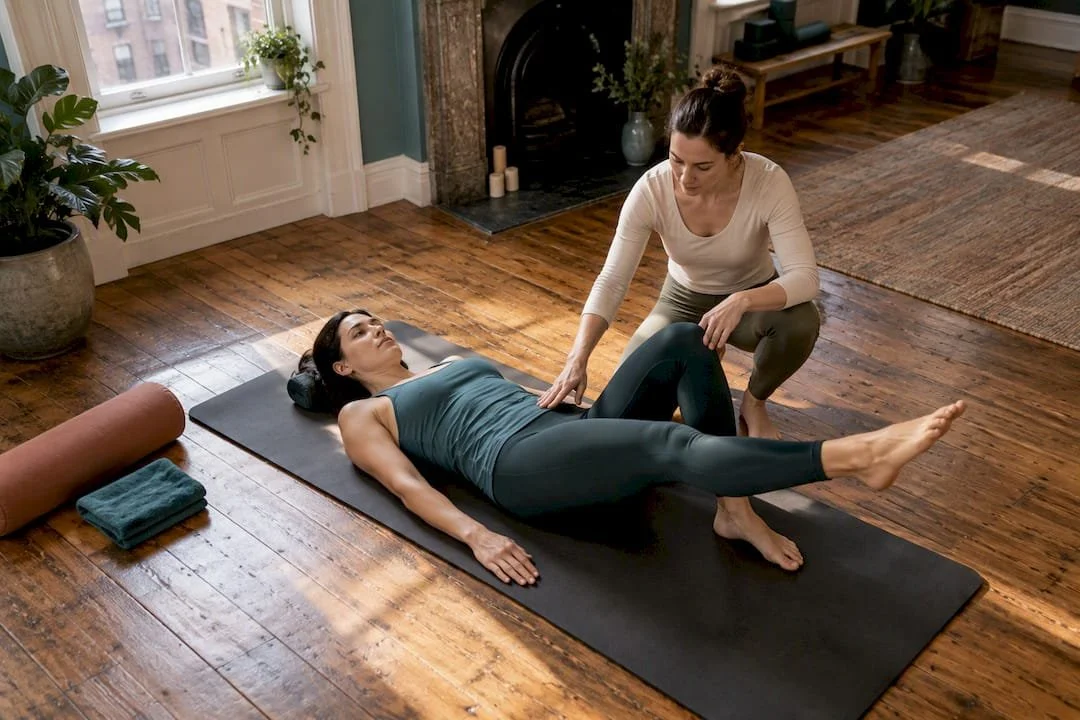
Pilates does improve spinal alignment for most adults, especially those with chronic low back pain or postural deviations from prolonged sitting. A 2022 network meta-analysis ranked it among the top exercise interventions for pain and disability, and the World Health Organization now includes structured exercise programs like it in chronic low back pain guidance. The catch: benefits build over weeks of consistent, well-taught practice, not a single class.
TL;DR:
Most studies showing Pilates benefits involve programs of one to two sessions per week lasting several weeks, with measurable improvements in posture, pain, and mobility.
Pilates scores highly in pain and disability reduction, especially in chronic low back pain, but results rely on consistent practice over at least six weeks.
Supervised instruction and equipment like reformers improve efficacy, especially for structural or asymmetrical conditions, and proper assessment before starting enhances safety.
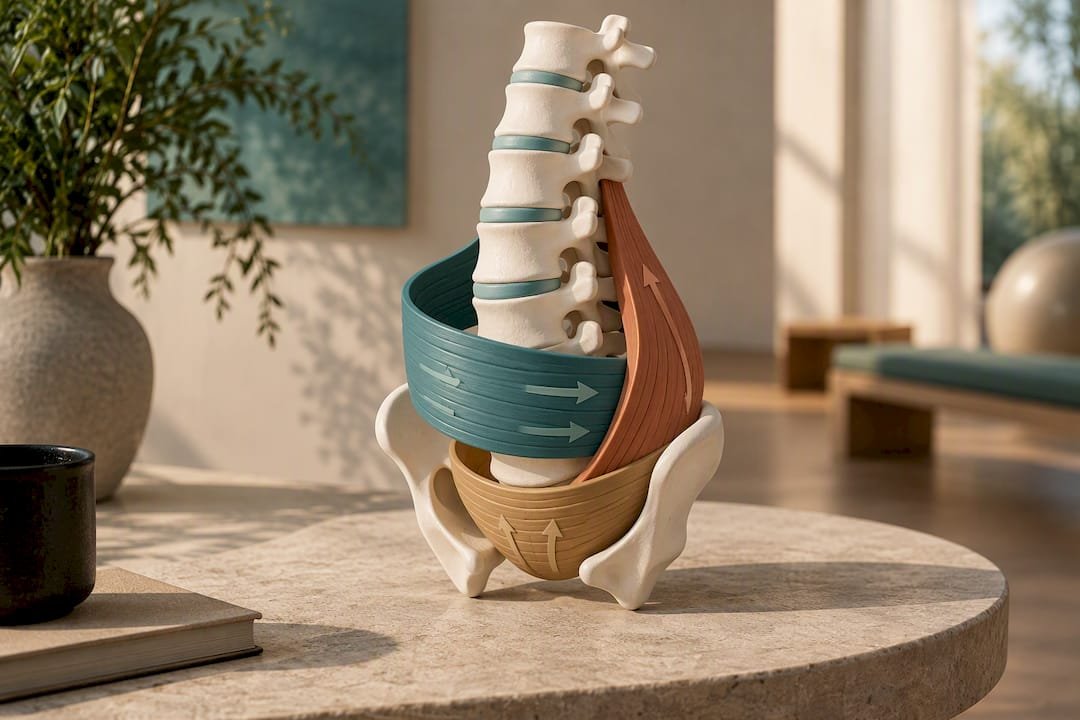
Key muscle groups such as the transverse abdominis and multifidus are fundamental to true spinal support, with Pilates emphasizing their activation for postural correction.
Long-term progress depends on regular, well-guided sessions, and quick results are unlikely without sustained effort and professional feedback.
Amritayogawellness
Build Stronger, Better Supported Movement
Amrita Yoga & Wellness offers Pilates classes in Philadelphia for adults seeking core strength, flexibility, posture, and mobility support.
Table of Contents
Pilates Spinal Alignment Benefits You Can Actually Measure
The phrase "spinal alignment" sounds abstract until you break it into things you can feel and test. Pilates targets four specific, measurable areas: posture, pain, mobility, and daily function.
Posture markers improve, and researchers can show it. A systematic review covering nine studies and 643 participants found Pilates improved Cobb angle, trunk rotation angle, and range of motion, three of the standard metrics clinicians use to score spinal curvature and postural deviation. Study quality varied across the pooled research, so treat these as encouraging signals rather than settled fact for every case, but the direction is consistent.
Pain and function scores drop in ways that matter clinically. Trials using the Roland Morris Disability Questionnaire and the Oswestry Disability Index, two validated tools for tracking back pain's effect on daily life, show meaningful improvement after Pilates programs. That is different from saying "it feels better." It means people report doing more with less limitation.
Mobility gains show up fast because Pilates trains controlled range of motion, not just static stretching. You are not holding a position and hoping for the best. You are moving your spine actively, in segments, under load, which trains both flexibility and control at the same time.
Function transfers to real tasks. Improved motor control and core support show up in standing tolerance, lifting mechanics, and the ability to hold a position through a workday. This is where Pilates spinal flexibility benefits and strength benefits intersect: a flexible spine that lacks control does not help you carry groceries. A flexible one that also has coordinated support does.
There is a psychological layer too, and it is underrated. A study on office workers doing reformer Pilates found improvements in postural alignment alongside gains in body appreciation and reduced social appearance anxiety. Feeling more confident standing up straight is not a side effect. It is part of why people stick with the practice long enough to see structural change.
Here is a quick summary of what the research links to Pilates practice:
Improved Cobb angle and trunk rotation measures in postural and mild deformity cases
Reduced disability scores on RMDQ and ODI in chronic low back pain populations
Increased spinal range of motion and reduced stiffness
Better standing tolerance and lifting mechanics through improved core support
Higher body appreciation and lower social appearance anxiety in workplace studies
Pro Tip: Ask your instructor to track one simple functional marker, like how long you can stand with neutral posture before fatigue sets in. It is a better progress signal than how a pose looks in a mirror.
What the Systematic Reviews and WHO Guidance Actually Say
The strongest data point comes from a 2022 network meta-analysis comparing Pilates, strength training, core-based work, and mind-body exercise for chronic low back pain. Using a ranking method called SUCRA, which estimates the probability that a treatment is the best option among those compared, Pilates scored 93% for pain reduction and 98% for disability reduction. That places it at or near the top of every exercise category studied, not just above doing nothing.
The trials behind that ranking were not marathon programs. Most used one to two sessions a week, kept individual sessions under 60 minutes, and ran programs lasting several weeks. That is a realistic bar for someone weighing whether to add Pilates to a routine already crowded with work and family obligations.
The second major evidence pillar is the systematic review of spine deformities and posture referenced above. Beyond Cobb angle and rotation improvements, it noted gains on the SRS-22r, a validated quality-of-life scale used in scoliosis research. Some of the individual studies included in that review used small samples and inconsistent methods, which is why the authors themselves flagged variable study quality rather than declaring a uniform effect.
Then there is the guideline-level endorsement. The WHO's 2023 clinical guidance on chronic low back pain recommends structured exercise programs, Pilates included, as a non-surgical first-line approach. The underlying systematic review informing that guideline rated the evidence as moderate certainty that exercise reduces pain and functional limitation compared to no intervention at all. Moderate certainty is not the same as proof beyond doubt, but it is a meaningfully higher bar than the low-quality evidence base many alternative therapies rest on.
A more recent 2026 meta-analysis comparing multiple exercise types for lower back pain again placed Pilates among the top performers for pain relief and functional improvement, while explicitly calling out small trial sizes and a lack of dose-response research. In plain terms: researchers know Pilates works reasonably well, but they still cannot tell you the exact minimum dose that guarantees results for a specific person.
What does the limitation pattern mean for you as a reader?
Most supporting trials are small and short, often 3 to 9 weeks, which limits confidence in long-term outcomes
Heterogeneity across studies (different populations, instructors, and Pilates styles) makes exact effect sizes hard to pin down
Evidence is strongest for chronic low back pain and general postural deviation, weaker for structural conditions like severe scoliosis
No major review claims Pilates replaces medical treatment for diagnosed spinal disease
How Pilates Changes Your Spine From the Inside Out
Alignment change is not magic. It comes from retraining specific muscles and movement habits that most people lose through years of sitting, one-sided activity, or simply not knowing what a neutral spine feels like.
Deep core activation comes first. Pilates emphasizes the transverse abdominis, multifidus, and pelvic floor, a trio of muscles that function like an internal support belt around the lumbar spine. Surface-level ab exercises often skip these entirely. Pilates does not, and that is the core mechanical reason it shows up so consistently in low back pain research.
Neutral spine training restores balanced curves. Many adults live with either flattened lumbar curves from constant flexion (think hunched desk posture) or exaggerated ones from weak deep stabilizers. Pilates drills the position where your spine's natural curves are supported rather than collapsed or overextended, and then asks you to hold that position while moving your arms and legs. That combination is what builds lasting postural control instead of a pose you can only hold in a mirror.
Proprioception improves, which changes habits outside the studio. Proprioception is your body's internal sense of where it is in space. Pilates sharpens it through slow, controlled movement with constant feedback, so you start noticing slouching or uneven weight-bearing during ordinary moments, not just during exercise.
Controlled mobility work increases range of motion without sacrificing stability. Unlike passive stretching, Pilates moves the spine through flexion, extension, and rotation while the deep core stays engaged, which is why gains in mobility tend to come without the trade-off of new instability.
Breathing is not incidental. It is a stabilizing mechanism. Pilates breathing coordinates with movement to manage intra-abdominal pressure, essentially using controlled breath to create internal support during load-bearing positions. This breath-pressure coordination is one of the more overlooked alignment techniques in Pilates, and it is a big part of why the practice feels different from generic core workouts.
Transverse abdominis, multifidus, and pelvic floor activation for lumbar support
Neutral spine training to correct flattened or exaggerated curves
Sharper proprioception that changes posture habits outside class
Controlled range-of-motion work that builds mobility and stability together
Breath-pressure coordination for spinal stabilization under load
Research on mechanisms notes that Pilates relies on closed-chain core stabilization and breath-pelvic coordination, which gives it an edge for people whose back pain stems from instability rather than pure weakness or tightness.
Building a Pilates Program That Actually Shifts Your Posture
You do not need daily sessions to see change, and more is not automatically better. Here is a practical starting structure based on what the clinical trials actually tested.
Start at one to two sessions per week. This matches the frequency used in the trials behind the strongest SUCRA rankings for pain and disability reduction, with sessions typically under an hour.
Commit to a full block before judging results. Trial programs ran anywhere from 3 to 12 weeks; give yourself at least six weeks of consistent practice before deciding whether it is working.
Choose mat classes for accessibility and reformer classes for guided resistance. Reformer work, done with a spring-loaded machine that adds resistance and feedback, tends to produce faster postural gains in supervised settings, partly because the equipment corrects form in real time.
Book a private or small-group session first if you have a specific spinal concern. One-on-one instruction allows an instructor to assess your alignment and modify moves before you join a group class, which matters more for asymmetries than for general fitness goals.
Track progress with something objective, not just how you feel. Posture photos taken from the same angle, a simple standing-tolerance test, or a validated scale like the RMDQ give you a real before-and-after instead of a vague impression.
For structured movement ideas to build into that schedule, a rundown of essential Pilates exercises covers moves at multiple levels, and a guide to different kinds of Pilates breaks down how mat, reformer, and specialty formats differ in practice.
When to Get Cleared Before You Roll Out a Mat
Pilates is generally safe, but "generally" is doing real work in that sentence. A handful of situations call for a conversation with a doctor or physical therapist before you sign up for a class.
Recent spinal surgery, an unstable fracture, or any acute injury needs clinical clearance first, not a wellness class.
Progressive neurological symptoms, numbness, tingling, or worsening weakness in an arm or leg, is a red flag that needs medical evaluation, not modification.
Osteoporosis changes which spinal flexion and rotation moves are appropriate; a qualified instructor should adjust exercises to avoid excessive forward bending.
Spondylolisthesis and severe scoliosis both require individualized modification rather than a standard class sequence.
If a movement sharply increases pain rather than causing normal muscle fatigue, stop and tell your instructor immediately rather than pushing through.
Supervised, well-dosed practice produces better outcomes than guessing on your own. Reviews informing the WHO guideline specifically note that individualized, supervised programs outperform unsupervised ones, and that poor dosing can increase transient soreness without adding benefit.
What to Ask Before You Book a Pilates Class for Back Health
Various studios offer mat Pilates, group reformer classes, private reformer and mat sessions, and hot Pilates formats, providing a range of entry points depending on how much individual feedback you need. Before booking, it helps to ask a few direct questions.
Does the instructor do a brief postural or movement assessment before your first class?
What is typical class size, and does that allow for individual correction?
What certifications or specialized training does the instructor hold for back-focused or corrective work?
How does the instructor modify moves for conditions like scoliosis, osteoporosis, or recent injury?
A collection of Pilates-focused posts and beginner guidance can help you walk in informed rather than guessing at what to expect on day one.
Realistic Expectations: Who Benefits and How Fast
Adults with chronic low back pain, desk-driven postural collapse, or general core weakness tend to see the clearest gains, usually within six to twelve weeks of consistent practice. Structural conditions like severe scoliosis respond more slowly and often need Pilates alongside other care, not instead of it. Consistency and supervision matter more than intensity, and any new or worsening symptom deserves a call to your clinician, not a shrug.
— Juiced
Ready to Put This Into Practice in Philadelphia
Reading about deep core activation and neutral spine mechanics only gets you so far. What actually changes your posture is consistent, well-supervised practice, and that is the specific gap Amrita Yoga & Wellness fills for Philadelphia adults who want guided correction rather than a YouTube video and a guess.
If you are dealing with chronic tightness, uneven posture, or recovering strength after time off from exercise, a group reformer or mat class gives you structured, instructor-led sessions built around the same principles covered above: neutral spine, deep core engagement, and controlled mobility. If your situation involves a specific asymmetry, prior injury, or a condition like scoliosis that needs individual attention, a private one-on-one session starting at $85 per hour lets an instructor assess your alignment before building a plan around it. Either way, the next step is simple: pick a format, check the current class schedule, and book your first session this week.
This article is general information, not a substitute for advice from a qualified doctor. Consult a qualified healthcare professional about your own circumstances before acting on anything here.
FAQ
Can Pilates Realign Your Spine?
Pilates can improve measurable posture markers like Cobb angle and trunk rotation, according to a systematic review of nine studies. It is not a cure for structural spinal disease, but for postural deviation and functional misalignment tied to muscle imbalance, it produces real, trackable change over weeks of consistent practice.
What Is the Most Common Injury Risk in Pilates?
Most Pilates injuries are mild, overuse strains from poor form or overly aggressive progression rather than serious trauma. The risk drops significantly with supervised, individualized instruction, which is why reviews informing the WHO guideline emphasize proper dosing and instructor guidance over solo practice.
What Is the 80/20 Rule in Pilates?
Definitions vary by instructor, so treat it as a guiding principle rather than a fixed clinical standard.
What Are the Benefits of Spinal Alignment?
Good spinal alignment reduces strain on discs, joints, and surrounding muscles, which lowers the risk of chronic pain and improves everyday function like standing, lifting, and walking. Research tied to Pilates specifically links alignment improvement to reduced disability scores and better standing tolerance in chronic low back pain trials.
How Much Does a Pilates Class Cost?
A single group class drop-in runs $28, while private one-to-one sessions start from $85 per hour for more individualized alignment work. Full membership and pricing details, including monthly options, are listed on the group class booking page.