Master 7 Intermediate Yoga Transitions With Teacher Tested Drills
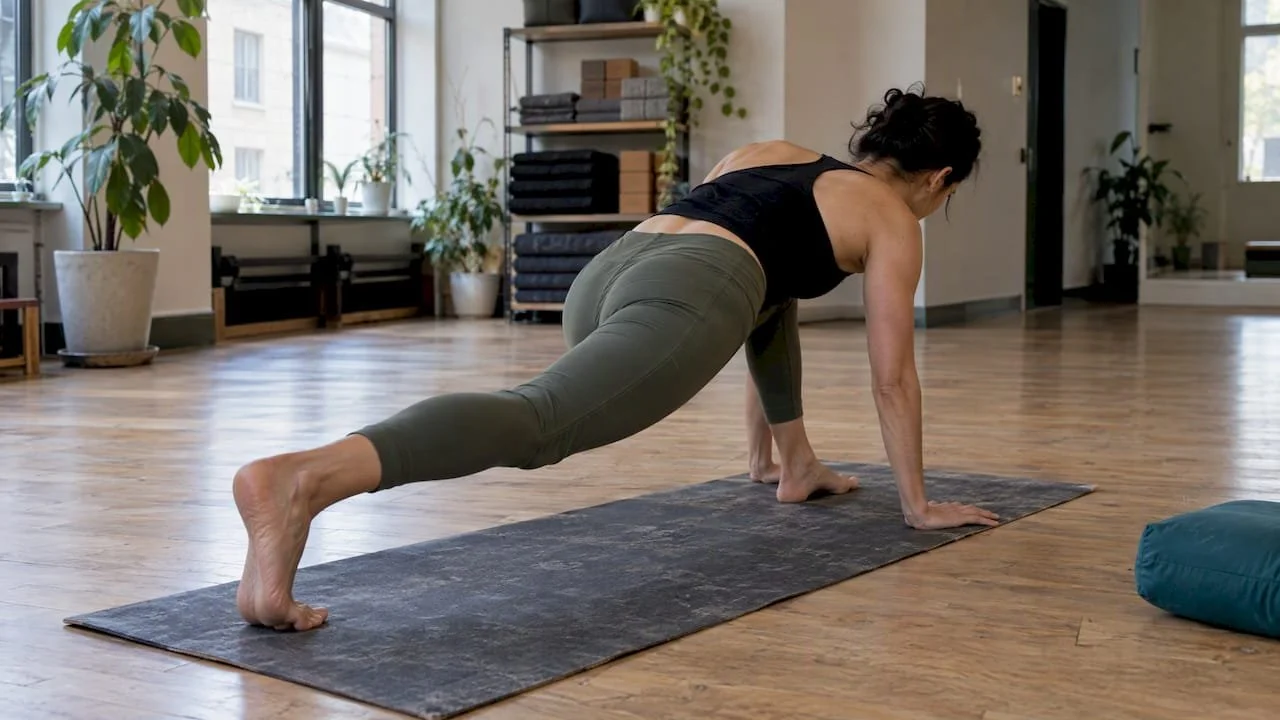
Intermediate yoga transitions are the breath-linked movements that carry you from one posture into the next, and the skill lives in the movement itself, not just the poses on either side. A few you can use today: Chair into High Lunge, Triangle into Half Moon, Downward Dog into Warrior I, and Plank into Side Plank. Each one rewards slow, breath-mapped attention over speed.
TL;DR:
Properly practicing breath-linked transitions enhances alignment and stability, requiring slow, mindful movements rather than rushing through to poses.
Repeating each transition five times with focus on form helps build muscle memory and confidence before integrating into full sequences.
Using props like blocks or walls can lower injury risk and improve stability during complex transitions, especially for beginners or those regressing.
Different sequencing patterns—one-and-done, ladder flow, and step-by-step—serve distinct goals, from precision to skill building and preparation for advanced poses.
Isolating mobility and strength drills, such as thoracic rotations and core activation, accelerates progress in transitions more effectively than only practicing full movements.
Amritayogawellness
Refine Your Yoga Transitions
Explore yoga classes, workshops, and wellness practices at an inclusive Philadelphia studio supporting mindful movement and personal growth.
Table of Contents
Examples of intermediate transitions and how to move through them
Once you can hold intermediate postures, the next skill is connecting them without losing alignment. Here are transitions worth practicing on repeat, each with a breath cue and a way to adjust the difficulty.
Chair to High Lunge: inhale to rise through Chair, exhale to step one foot back into a lunge, keeping the front knee tracking over the ankle rather than drifting inward.
Triangle to Half Moon: inhale as you shift weight into the standing leg and lift the back leg into Half Moon; a block under the bottom hand shortens the lever and steadies the hips.
Downward Dog to Warrior I: draw the knee forward using core engagement, then inhale to rise into the lunge and stack the torso upright; stepping the foot halfway forward first makes this more approachable.
Plank to Side Plank: shift weight onto one hand, inhale to stack the hips and open the chest, exhale to lengthen through the top fingertips; dropping the bottom knee removes much of the load.
Low Lunge to Extended Side Angle: inhale to open the chest and rotate, exhale to anchor the back heel and extend the top arm overhead.
Twisted Chair to Twisted High Lunge: combine rotation with a lift of the back heel, moving the spine and hips together rather than twisting from the shoulders alone.
Low Lunge step-through to Half Moon with an arm-balance lead-in: floating the back leg through to a bent-knee hover builds the hip flexion and shoulder stability needed before attempting poses like Eka Hasta Bhujasana.
Each of these treats the movement between postures as its own event rather than a gap to rush through, which matches how intelligent sequencing builds from simple actions toward more complex ones.
Pro Tip: Practice each transition five times slowly before adding it to a full flow; speed should come last, not first.
How sequencing patterns organize your transition practice
Three sequencing patterns show up again and again in intermediate classes, and each serves a different goal.
One-and-done: you move through a sequence once with full attention to alignment, useful when the goal is precision rather than repetition.
Ladder flow: you repeat a short sequence while adding one new transition each round, which builds skill gradually without overwhelming the nervous system.
Step-by-step: you break a complex transition into its component parts, practice each part on its own, then link them together once each piece feels stable.
Choosing between them depends on what you want from the practice: ladder flow suits skill-building days, one-and-done fits a cardio-focused flow, and step-by-step works best when preparing for something genuinely new like an arm-balance entry. Across all three, teachers often repeat 'landmark actions' such as pressing through the outer heel or drawing the ribs in, so the same cue transfers to unfamiliar transitions without extra instruction.
Drills that build the physical pieces of a transition
Transitions draw on specific mobility and strength qualities, and isolating them speeds up progress more than repeating the full movement over and over.
Hip mobility: a Lizard-to-Malasana flow opens the hips and hamstrings needed for leg-over-arm actions in arm balances.
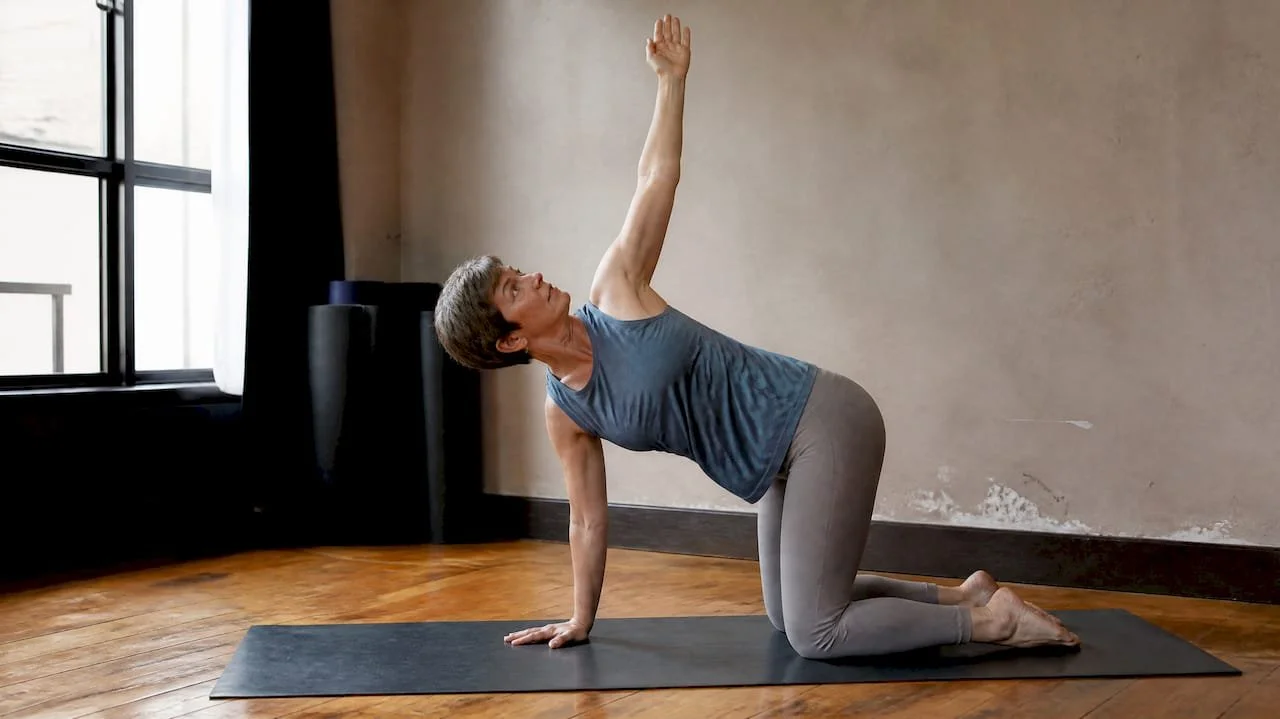
Thoracic rotation: pairing a quad stretch with Thread-the-Needle or a seated twist frees the upper spine for deeper rotations in poses like Revolved Side Angle.
Core and bandha activation: hollow-body pulses, supported jump-through holds, and standing one-leg balances train the stability that transitions depend on.
Arm strength: progress from Tripod hold toward Crow prep, then add Chaturanga negatives and Plank shoulder taps to build pressing strength gradually.
Props matter here: a block under the hand, a strap around the feet, or a wall behind the hips lets you train the same pattern with less load. Aim for 5 to 8 slow repetitions per drill rather than rushing to full expression.
Pro Tip: Treat drills as their own practice, not a warm-up to skip through: five focused minutes on thoracic rotation can unlock a twist you have been forcing for months.
Staying safe and knowing when to regress a transition
Transitions carry more injury risk than static holds because attention tends to jump ahead to the next pose instead of staying in the movement itself. Treating the transition itself as a pose, with steady breath and a fixed gaze, lowers that risk considerably.
Shorten the lever (bend the working knee) when a straight-leg transition feels unstable.
Drop the back knee to the floor in lunges and side planks when the core cannot yet control the full pose.
Place a block under the hand in standing poses to reduce the reach and stabilize the hips.
Move slowly between floor and standing postures, since fast changes can trigger lightheadedness as blood pressure adjusts.
ACE's regression guidance frames these choices as smarter technique, not a lesser version of the pose. A well-fitted mat also matters here: better grip and traction reduce slip risk during dynamic entries like Side Plank or Half Moon.
A sample intermediate flow with breath counts
This sequence runs about 12 postures and works well as a stand-alone practice or as the center of a longer class.
Chair, 5 breaths, inhale to rise.
Chair to High Lunge, exhale to step back, 5 breaths.
High Lunge to Half Moon, inhale to lift, 3 breaths each side (regression: keep fingertips on a block).
Half Moon to Warrior II, exhale to lower, 3 breaths.
Warrior II to Extended Side Angle, inhale to extend, 5 breaths.
Extended Side Angle to Triangle, exhale to straighten the front leg, 5 breaths.
Triangle to Twisted Chair, inhale to rise and rotate, 3 breaths.
Downward Dog, 5 breaths.
Downward Dog to Plank, inhale to shift forward, 3 breaths.
Plank to Side Plank, exhale to open, 3 breaths each side (regression: bottom knee down).
Child's Pose, 5 breaths.
Seated twist to close, 5 breaths each side.
Once this flow feels steady, progress it by adding the Low Lunge step-through to Half Moon described earlier, or by shortening breath counts to build more cardio demand. For readers building toward a faster-paced class, our guide on hot vinyasa preparation covers how to adjust pacing for heat and intensity.
What years of teaching transitions have taught us
Students rarely fail a transition because they lack strength. They fail it because they rush the breath to match the shape they picture in their head rather than the one their body is actually in. Our studio teaches across styles from gentle to hot vinyasa, and the drills and sequencing patterns above come directly from how we build classes for practitioners at this stage.
— Juiced
Practice these transitions with guided feedback
Reading about a transition only gets you so far: a teacher watching your knee track or your hip height catches details you cannot feel on your own. Our Group Class Drop In gives you that live feedback inside a full sequence, while a One to One Session lets you isolate a single transition, like Half Moon or an arm-balance entry, and work it until it feels steady.
Book a drop-in class to practice transitions inside a guided flow.
Schedule a private session for focused coaching on one specific transition.
Review our class descriptions to find the format that matches your current level.
Ready to put these transitions into practice? Check our class schedule and find a time that works for you.
FAQ
What are some examples of intermediate yoga sequences?
An intermediate sequence typically moves through standing postures connected by breath-linked transitions, such as Chair into High Lunge into Half Moon, followed by a Plank to Side Plank series. The sample 12-pose flow above shows how these pieces link together with specific breath counts.
What are some interesting yoga transitions?
Transitions that combine rotation with balance tend to stand out, such as Twisted Chair moving into Twisted High Lunge, or a Low Lunge step-through that floats into Half Moon as a lead-in to arm-balance work. These ask for coordinated breath, core engagement, and hip mobility rather than one isolated skill.
What are 10 intermediate yoga poses?
Common intermediate postures include Half Moon, Warrior I, Warrior II, Extended Side Angle, Triangle, Side Plank, Revolved Side Angle, Twisted Chair, High Lunge, and Crow prep. Each one appears in the transitions and sample sequence described earlier in this guide.
What are considered intermediate yoga poses?
A pose generally counts as intermediate when it asks for balance, rotation, or sustained core engagement beyond what beginner postures require, such as Half Moon or Side Plank. Intelligent sequencing guidance recommends building the mobility and strength for these poses before adding them to a flow.