Avoid Injury: 10 Common Yoga Mistakes Beginners and Intermediates Make
Most yoga injuries trace back to four habits: holding the breath, pushing into a pose instead of easing into it, ignoring alignment or skipping props, and rushing past warm-up and rest. The fix is one simple rule: breathe steadily, stop at sharp pain, and modify before you force a shape. At Amrita Yoga & Wellness, that rule shapes how every class is taught, from beginner mat work to advanced flow.
TL;DR:
Spend five minutes warming up, use blocks or straps to preserve alignment, and finish with at least three to five minutes of stillness.
Increase new intensity or hold times only after about two weeks, and build inversions or deep backbends through supported versions first.
People with glaucoma should get medical advice before inversions, while those with low bone density should avoid forceful backbends and deep spinal flexion.
A light snack with carbohydrates and protein 60 to 90 minutes before class can help, while steady hydration matters most for hot or vigorous sessions.
A 10 to 20 minute practice four or five times weekly supports steadier progress than a 90 minute class every few weeks.
Amritayogawellness
Build a Safer Yoga Practice
Explore yoga classes at Amrita Yoga & Wellness, with options for beginners through advanced practitioners in Philadelphia.
Table of Contents
3. How to pick a class, teacher, and props that keep you safe
5. How Amrita Yoga & Wellness builds safety into every class
6. Why hydration and nutrition timing matters more than you think
1. Spot and fix the mistakes that cause most setbacks
These are the errors we see trip up beginners and intermediate practitioners most often, along with the fixes for each.
Holding your breath during hard poses signals tension and cuts off the steady exhale that helps muscles release. Fix: inhale to lengthen, exhale to settle deeper, and never hold air during a stretch.
Chasing the final shape of a pose instead of building toward it gradually strains tissue that is not ready. Fix: work the preparatory version first and let depth come over weeks, not minutes.
Skipping warm-up sends cold muscles straight into deep stretches or backbends. Fix: spend the first five minutes on joint circles and gentle sun salutations before anything intense.
Ignoring alignment cues, like knees collapsing inward in lunges or rounding the lower back in forward folds, loads joints unevenly. Fix: check knee-over-ankle tracking and keep a slight bend in the knees during forward folds.
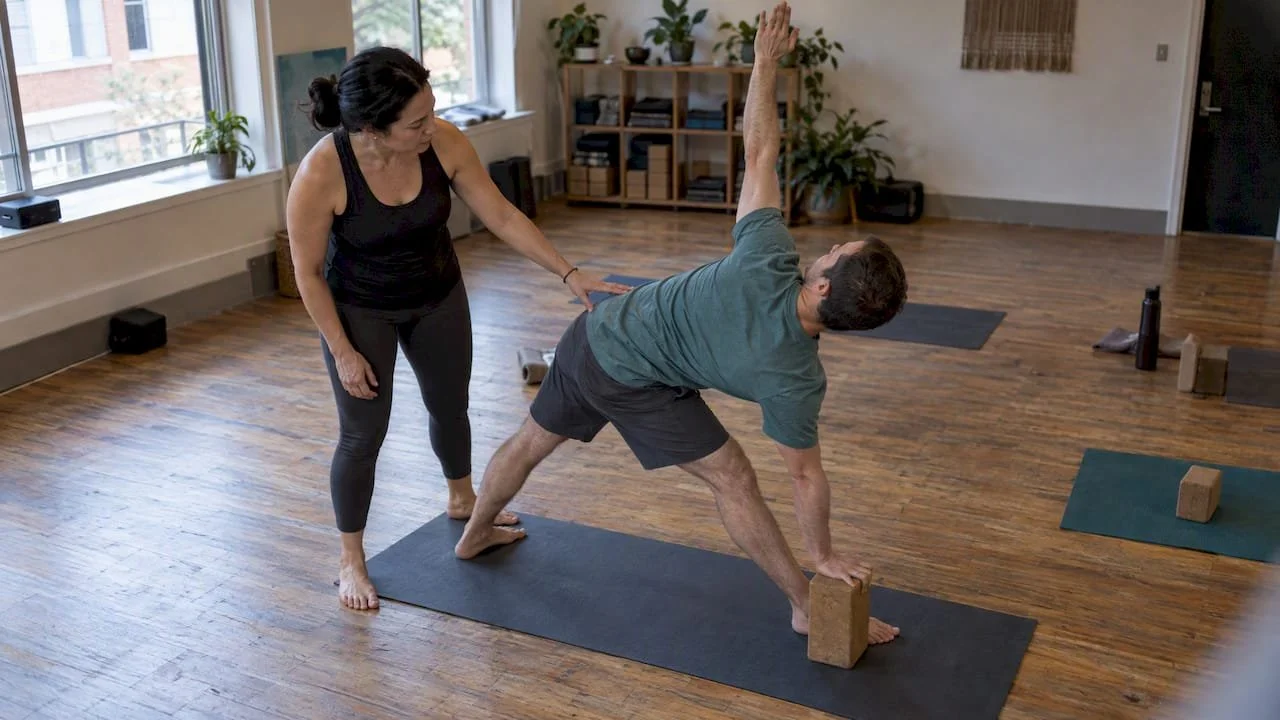
Refusing props because they feel like a beginner's crutch leaves many poses out of reach safely. Fix: a block under the hand in triangle pose or a strap around the foot in seated stretches changes nothing about the pose's benefit, only its accessibility.
Rushing your own progression, adding inversions or deep backbends before building core and shoulder strength, is a common path to strain. Fix: master supported variations for several weeks before attempting the full expression.
Clenching the jaw, shoulders, or hands during effort wastes energy and masks poor form. Fix: scan your body every few breaths and consciously soften anything that is not doing the work.
Comparing your shape to the person on the next mat pushes people into ranges of motion their joints are not ready for. Fix: measure progress against your own range from last month, not against someone else's flexibility.
Locking the knees or elbows in standing or plank poses stresses the joint instead of the muscle. Fix: keep a micro-bend in any weight-bearing joint.
Skipping shavasana at the end of class cuts the nervous system's transition back to a resting state. Fix: give yourself at least three to five minutes lying still, even on a short practice day.
Pro Tip: If your lower back aches in forward folds, bend your knees more than feels necessary. A softer spine beats a straight-legged stretch that pulls from the wrong place.
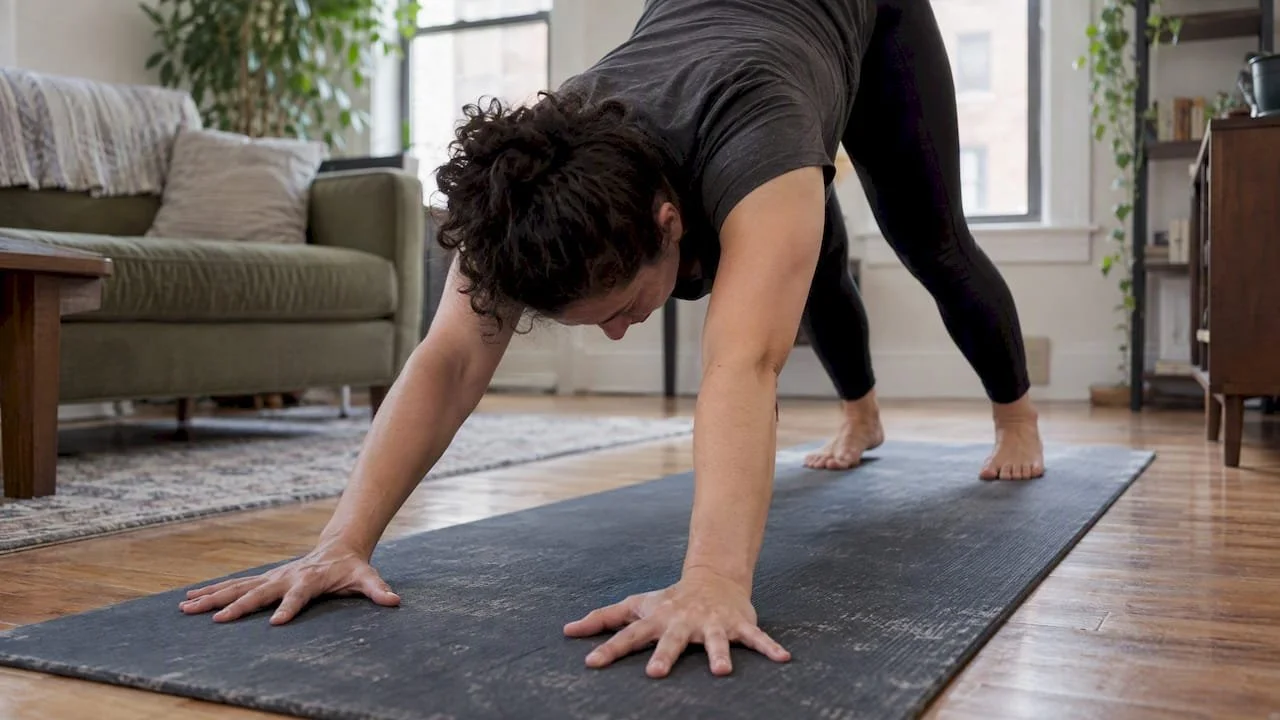
Pro Tip: Wrist pain in plank or downward dog often means the weight is sitting in the heel of the hand. Spread your fingers wide and press through the knuckles instead.
2. What the research says about yoga injuries and red flags
A systematic review of epidemiological studies found that most adverse events during yoga practice are mild and transient, typically sprains and strains rather than serious harm. A PLOS One review of case reports and case series examined 76 cases and found that advanced postures like headstand, shoulder stand, and lotus, along with forceful breathing techniques, were disproportionately linked to adverse events affecting the eyes, nervous system, or joints.
Productive discomfort feels like effort or a stretching sensation that eases as you breathe into it.
Sharp, shooting, or persistent pain is a signal to back off immediately and modify the pose.
Numbness, tingling, or dizziness during or after practice warrants a conversation with a clinician.
People with glaucoma should talk with a physician before practicing inversions, since head-down poses can raise intraocular pressure. Those with low bone density face similar caution around forceful backbends, where osteoporosis exercise guidelines recommend gentler, controlled movement over deep spinal flexion.
Most adverse events are mild, but a Cochrane review on yoga for chronic low-back pain found low-certainty evidence that yoga can slightly increase the risk of adverse events, mainly back pain, compared with no exercise at all.
3. How to pick a class, teacher, and props that keep you safe
A good beginner class offers modifications without singling anyone out, gives clear verbal cues about alignment, and uses hands-on or verbal corrections consistently rather than only demonstrating once and moving on.
Before booking, ask:
Does the teacher offer modifications for common limitations like tight hamstrings or wrist pain?
Are props like blocks, straps, and blankets available and actively encouraged?
How does the teacher handle injuries or physical limitations mentioned before class?
Props solve specific problems. A block under the hips in seated poses eases tight hamstrings, a strap looped around the foot extends your reach without rounding the spine, and a folded blanket under the knees protects joints during kneeling poses. Our chair yoga poses for beginners guide covers gentler adaptations for anyone working with limited mobility.
4. Build a practice routine that prevents overuse
A short, repeatable structure beats a long, inconsistent one. Try this order:
Warm up for five minutes with joint circles and easy flows to raise body temperature.
Link breath to movement through sun salutations or gentle standing poses.
Spend the bulk of class on focused strength or flexibility work, choosing one or two target areas rather than everything at once.
Cool down and finish in shavasana for three to five minutes minimum.
For progression, give any new intensity or longer hold time about two weeks before increasing it again. Jumping straight from a beginner backbend to a full wheel pose in one session is how strain happens. Between challenging transitions, use three breaths to reset: one inhale to find length, one exhale to anchor your base, one more inhale to adjust alignment before moving on. Our 10 to 20 minute beginner routines lay out this kind of pacing in full.
Pro Tip: When a transition feels rushed, pause and take one extra breath before moving. Speed is almost never the goal in a beginner or intermediate practice.
5. How Amrita Yoga & Wellness builds safety into every class
As a Philadelphia-based studio, Amrita Yoga & Wellness offers yoga, pilates, barre, tai chi, and massage therapy under one roof, with class structures built around accessibility and community rather than performance. Classes, workshops, and retreats are designed so beginners and advanced practitioners alike can find their level without guesswork. Our beginner's guide to learning yoga poses breaks down foundational postures step by step, supporting the kind of gradual, well-cued progression this article recommends.
6. Why hydration and nutrition timing matters more than you think
Practicing on an empty stomach or after a heavy meal both cause problems, just different ones. Too little fuel before a class, especially a longer or hot yoga session, can lead to lightheadedness or shaky balance during standing poses. A large meal right before practice does the opposite, pulling blood toward digestion and away from the muscles doing the work, which makes twists and forward folds uncomfortable.
A light snack with some carbohydrate and a little protein, eaten 60 to 90 minutes before class, tends to work better than practicing fully fasted or fully stuffed. Hydration matters just as much, particularly for hot yoga or vigorous flow classes where sweat loss is higher. Drinking water steadily through the day works better than chugging a large amount right before class, which can leave you feeling sloshy during inversions or twists.
After practice, rehydrating and eating something within an hour or two supports recovery, especially after a sweatier or more intense session. Skipping this step is a common beginner mistake that shows up as fatigue or a headache later in the day rather than during class itself. None of this needs to be complicated: water, a reasonable snack beforehand, and a real meal afterward cover most of what a regular practice requires.
7. Why consistency beats intensity for real progress
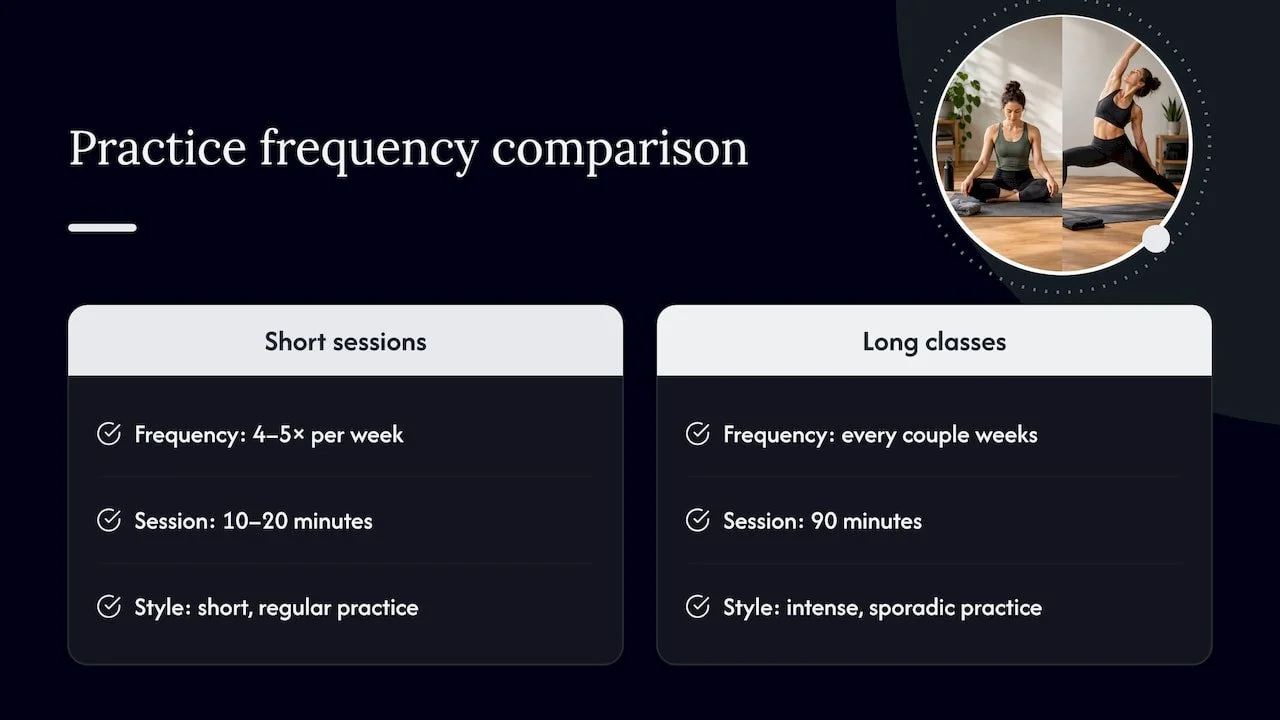
Many beginners treat yoga like a sport they need to master quickly, practicing hard for a week and then stopping for a month. Flexibility, strength, and breath control all build through repetition over time, not through one intense session. A short, 10 to 20 minute practice done four or five times a week moves you forward faster than one 90-minute class every couple of weeks.
Inconsistency also raises injury risk. Tissues adapt to regular, moderate loading, so a body that has not practiced in three weeks is more vulnerable to strain when it suddenly attempts a full class at the same intensity as before. Treating practice like brushing your teeth, something small and automatic, removes the all-or-nothing thinking that causes people to quit.
Setting a realistic schedule matters more than setting an ambitious one. Three short sessions a week that you actually complete build more capability than an ideal five-day plan you abandon after two weeks. Our routines for beginners are built around this kind of manageable repetition rather than marathon sessions.
8. Why staying present changes how your body responds
Running through poses on autopilot, thinking about work or scrolling through a mental to-do list, means missing the cues your body sends about tension, fatigue, or early pain. Mindfulness in yoga is not a separate spiritual add-on. It is the attention that lets you notice a twinge in your knee before it becomes an injury.
Presence also affects breath, and breath affects how a pose feels. A distracted mind tends to hold the breath without noticing, which tightens muscles and makes effortful poses feel harder than they need to. Bringing attention back to the breath, even briefly between poses, resets that pattern.
A simple way to build this habit is to pick one anchor, the sensation of feet on the mat, the sound of your breath, or the weight of your hands in a pose, and return to it whenever your mind wanders. This does not require a separate meditation practice. It just means treating the hour on the mat as a chance to actually notice what is happening in your body instead of performing poses from memory.
9. Why flexibility without strength sets you up for injury
A common misconception is that yoga is purely a flexibility practice, so progress means deeper stretches and little else. Many injuries actually come from being flexible without the muscular control to support that range of motion. A hip that can fold deeply into a split but lacks the strength to stabilize that position under load is more likely to get hurt than a less flexible hip with solid muscular support.
Poses like plank, warrior sequences, and chair pose build the strength that protects joints during deeper stretches elsewhere in a practice. A PLOS One review notes that advanced poses carry more risk partly because they ask joints to move through large ranges without always building the supporting strength first.
Balancing a practice means including strength-focused poses, not just the stretches that feel immediately satisfying. Holding a plank for a few extra breaths or working through a slow, controlled chair pose does as much for injury prevention as any amount of stretching. Our 10 basic poses every beginner should learn includes several that combine both qualities at once.
10. The one cue that fixes several mistakes at once
Instructors often notice the same pattern: students hold their breath right as a pose gets hard, which tightens everything from the jaw to the hips. One fix handles several problems at once. Before your next challenging pose, try a three-breath reset: inhale to find length, exhale to settle your base, inhale again to adjust alignment. Test it in your next class or home session and notice what loosens.
— Juiced
Where to get hands-on correction and guided practice
Reading about alignment only goes so far. A teacher watching your form in real time catches the small habits, like a dropped shoulder or a locked knee, that are hard to feel on your own. Amrita Yoga & Wellness offers both supervised group classes and private sessions for readers who want that kind of direct feedback.
Drop into a group or livestream class to practice alongside an instructor who can adjust your form as you go.
Book a private or small-group session for focused, one-on-one correction on the poses giving you trouble.
Browse our class descriptions to find the style and level that fits where you are right now.
This article is general information, not a substitute for advice from a qualified doctor. Consult a qualified healthcare professional about your own circumstances before acting on anything here.
FAQ
What should you avoid doing right after yoga?
Avoid jumping straight into a cold shower, a heavy meal, or intense activity right after class. Give your body a few minutes in shavasana first, then rehydrate and eat something within an hour or two to support recovery.
Who should avoid certain yoga poses or practices?
People with glaucoma should consult a physician before practicing inversions, since head-down poses can raise eye pressure. Those with low bone density should modify forceful backbends, and pregnant practitioners should avoid prone positions and prolonged time on the back, especially after the first trimester.
What do chiropractors generally think about yoga?
Views vary, but many clinicians support yoga as a complement to other care for back pain when practiced with attention to form. A Cochrane review found small improvements in function and pain for people with chronic low-back pain, alongside a low-certainty increased risk of minor adverse events compared with no exercise.
What are common injuries linked to yoga practice?
Most reported injuries are mild sprains and strains, often in the wrist, shoulder, lower back, knee, or hamstring. A PLOS One review of case reports and case series examined cases and found that advanced postures like headstand, shoulder stand, and lotus, along with forceful breathing techniques, were disproportionately linked to adverse events affecting the eyes, nervous system, or joints.
How do I know the difference between discomfort and an injury?
Productive discomfort feels like effort that eases as you breathe and settle into a pose. Sharp, shooting, or lingering pain, or any numbness and tingling, is a sign to stop and modify, and persistent symptoms deserve a conversation with a clinician.
Sources
Adverse Events Associated with Yoga: A Systematic Review of Published Case Reports and Case Series
Yoga for chronic non-specific low-back pain - Cochrane Review
Head-down yoga poses increase eye pressure in glaucoma patients — American Optometric Association