Start Pilates Safely: 45–60 Minute Workouts and Studio Modifications
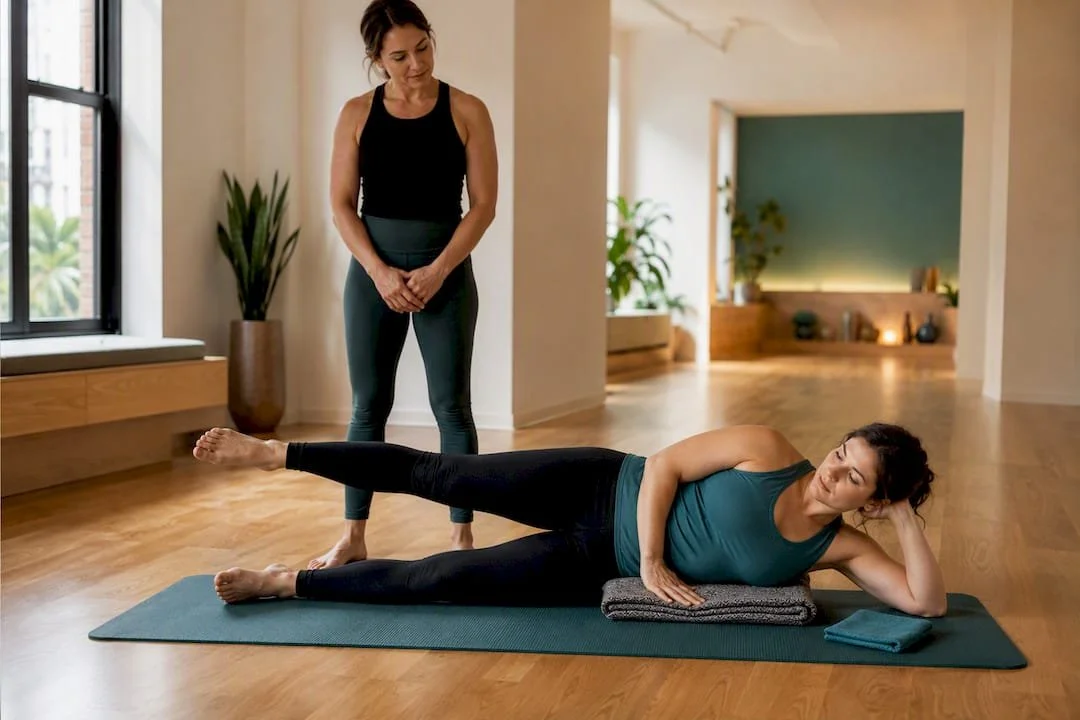
Pilates is a controlled, low-impact exercise system built around core stability, precise movement, and coordinated breathing, typically performed on a mat or a spring-loaded machine called a reformer. A typical session runs between forty-five and sixty minutes, and instructors generally recommend practicing Pilates multiple times per week. Expect muscle fatigue and better posture, not a breathless cardio burn.
TL;DR:
Pilates mainly improves core stability, posture, and flexibility, but strong evidence for back pain relief and long-term benefits is still emerging.
Proper form, instructor corrections, and gradual progression are essential for effectiveness and injury prevention, especially for those with health issues.
Beginners should start with mat classes or private sessions, particularly if managing injuries or health conditions, and ideally practice two to three times weekly for sustained results.
The method is adaptable for seniors, pregnant individuals, and rehab patients, with modifications focusing on safety and specific body needs.
Pilates is a muscular, low-impact workout that emphasizes control and precision, not cardio or muscle bulk, making it suitable for many different fitness levels.
Amritayogawellness
Find Your Pilates Practice
Explore Pilates options at Amrita Yoga & Wellness, with classes suited to beginners, active adults, and those seeking low-impact movement.
Table of Contents
What Are Pilates Exercises? Mat, Reformer, and Other Formats
Benefits of Pilates Classes: What the Research Actually Shows
Where Pilates Came From: Joseph Pilates and the Method's Rehab Roots
What Is Pilates Training, Really? The Core Principles
Joseph Pilates built his method around six principles, and they show up in every class whether you know their names or not: breath, centering, control, precision, flow, and alignment. Skip these and you're just doing calisthenics with better branding.
Breath: Instructors cue inhale and exhale patterns tied to specific movements, usually breathing out during the most exertive part of an exercise. This isn't decoration. Coordinated breath helps recruit the deep abdominal muscles and keeps you from holding tension in your shoulders.
Centering: Nearly every exercise initiates from the "powerhouse," the region spanning your abdominals, lower back, hips, and glutes. Movement radiates outward from there rather than starting at the limbs.
Control: Nothing in Pilates is thrown or rushed. Each rep is a deliberate, muscle-driven action, which is part of why a Pilates class feels harder than it looks.
Precision: Exact alignment matters more than range of motion. A smaller, correctly executed movement beats a bigger sloppy one.
Flow: Exercises link together smoothly, building stamina without resorting to fast, ballistic reps.
Alignment: Your spine, pelvis, and shoulder blades stay in specific positions throughout, protecting joints and keeping the load on the right muscles.
Because the emphasis sits on quality over quantity, most exercises run just 3 to 5 repetitions per set. That's a sharp contrast to strength training's higher-volume approach, and it's exactly why proper form gets so much attention in a beginner class. Complete Pilates breathing techniques go deeper into how the breath pattern connects to core engagement if you want to study the mechanics before your first class.
What Are Pilates Exercises? Mat, Reformer, and Other Formats
Pilates exercises fall into recognizable categories, and knowing them helps you follow along in your first class instead of guessing what's coming next.
Breathing and stability moves. The Hundred is the classic opener: you pump your arms while holding a curled position, timing the movement to breath counts. It wakes up the core before anything else happens.
Spinal articulation exercises. Roll-Ups and Rolling Like a Ball move your spine one vertebra at a time, building flexibility and control through the back rather than just stretching it.
Hip and leg work. Leg Circles and Single-Leg Stretch challenge you to keep your pelvis still while your legs move, which is harder than it sounds and directly trains hip stability.
Scapular and shoulder control. Swan and Swimming exercises strengthen the upper back and teach your shoulder blades to move correctly instead of hiking toward your ears.
Beyond the mat, the Reformer changes the entire experience. It's a sliding carriage attached to springs and pulleys, and according to Les Mills, that spring-based resistance lets you adjust load, add support for injuries, or increase challenge without ever touching a barbell. The result feels closer to guided resistance training than a floor workout.
Other apparatus you'll encounter as you go further: the Cadillac (a raised frame with bars, straps, and springs for assisted stretching and rehab work), the Wunda Chair (a compact box used for single-leg strength and balance drills), and small-group reformer classes that combine machine work with instructor coaching. Clinical or rehab-focused Pilates sessions use these same tools at a slower pace under closer supervision. If you can't make it into a studio, online mat classes cover most of the fundamental moves, though they can't replicate hands-on correction. Our beginner Pilates guide breaks down what to expect from each format in more detail.
Benefits of Pilates Classes: What the Research Actually Shows
Pilates delivers real, measurable benefits, but the research supporting them is more cautious than most marketing copy suggests. Here's the honest version.
Core strength. Nearly every exercise trains the deep stabilizing muscles of the trunk, not just the visible six-pack muscles.
Posture. Repeated alignment cues carry over into how you stand and sit outside class.
Flexibility. Spinal articulation and controlled stretching build range of motion gradually.
Balance. Single-limb and unstable-position exercises challenge coordination in ways many workouts skip.
Lower back pain. Some evidence points to improvement, though this is the benefit with the weakest support so far.
A PMC review found cautious support for Pilates improving flexibility and lumbo-pelvic stability, but the authors were clear that stronger, better-designed studies are still needed before drawing firm conclusions. A separate clinical review echoes that call, pointing to inconsistent study quality across the existing research. That doesn't mean Pilates doesn't work. It means the evidence is real but not yet as robust as, say, research on walking for cardiovascular health.
Session length runs 45 to 60 minutes, with 2 to 3 sessions per week recommended for building strength, mobility, and body awareness, according to Better Health Channel Victoria. The practical implication: Pilates rewards consistency far more than intensity. Two moderate sessions a week for a few months will do more for your posture than one brutal session followed by two weeks off.
How to Start Pilates Without Overthinking It
Picking your first class comes down to three questions: what's your goal, what's your budget, and do you have any injuries an instructor needs to know about.
Mat classes cost less and need almost no equipment, making them the natural starting point if you're just curious. Reformer classes cost more per session but offer adjustable resistance and more support for people easing back into movement after an injury. If you have a history of disc issues, joint replacements, or chronic pain, start with a private or small-group setting where an instructor can watch your form closely, rather than a crowded mat class where corrections are harder to give.
Before your first class:
Wear fitted, stretchy clothing. Loose shirts flip upside-down during inversions and get in the way.
Skip shoes. Most mat and reformer classes are done barefoot or in grip socks.
Tell your instructor about any back, neck, shoulder, or hip issues before class starts, not after an exercise hurts.
Expect modifications. A good instructor will adjust range of motion or swap an exercise entirely rather than force you through pain.
Pro Tip: Book a private session before your first group class if you have any injury history. One-on-one time lets an instructor build your personal modification list, so you walk into a group class already knowing which versions of each exercise are yours.
Plan on two to three sessions weekly for the first couple of months. Progression in Pilates usually means moving from assisted or modified versions of an exercise to the full version, then eventually adding resistance or reducing points of support, not lifting heavier external weight.
Who Pilates Is For (and What People Get Wrong About It)
Pilates suits a wider range of people than its studio-class image suggests. Beginners benefit from the slow pace and clear cues. Older adults get a low-impact way to maintain balance and core strength, which Harvard Health points to as one of the format's real advantages since it's adaptable across mat, reformer, and chair variations. Rehab patients with medical clearance often use it to rebuild control after injury. Athletes lean on it to fix the stability gaps that heavier lifting doesn't address.
A few misconceptions are worth clearing up directly:
"It's cardio." It isn't, primarily. Heart rate stays moderate for most classes; the challenge is muscular, not aerobic.
"It builds bulky muscle." Pilates tends to build long, functional muscle tone rather than size, according to Boston University, which makes it a useful complement to, not a replacement for, strength training.
"It's not adaptable." A skilled instructor can almost always modify an exercise to hit the same muscles without strain, according to WebMD.
If you have a specific spinal condition, recent surgery, or a diagnosed disc issue, check with a healthcare provider before starting, and mention it to your instructor regardless of clearance status.
Where Pilates Came From: Joseph Pilates and the Method's Rehab Roots
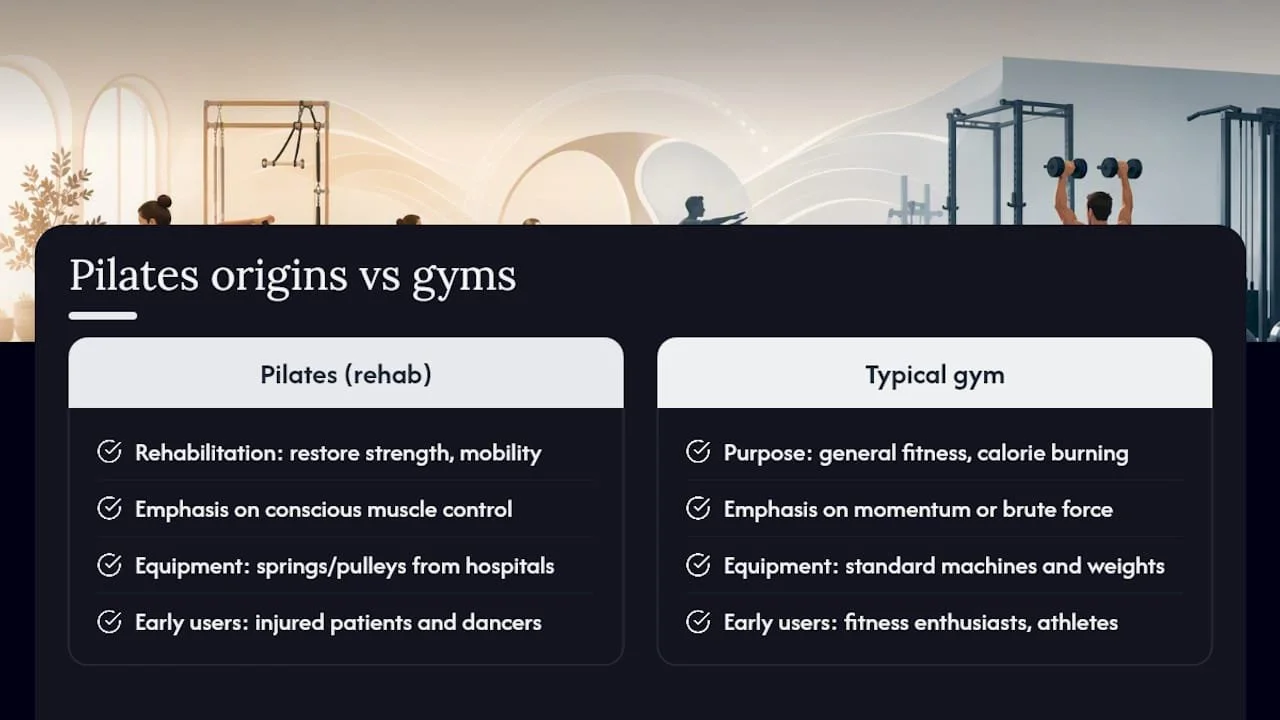
Joseph Pilates developed the method in the early 20th century, originally as a rehabilitation system rather than a fitness trend. According to Britannica, he built it while working with injured patients and dancers, designing movements meant to restore strength and mobility without straining damaged joints. That rehab origin explains a lot about why the method still feels different from typical gym workouts: it was never built around burning calories fast. It was built around rebuilding bodies carefully.
Pilates called his approach "Contrology," emphasizing conscious control over every muscle involved in a movement rather than momentum or brute force. He designed much of the original equipment, including early versions of the reformer, using springs and pulleys salvaged from hospital beds and gym gear during his time interned in England during World War I. The dancers who trained with him later brought the method into performing arts studios, where it picked up its reputation for building long, lean muscle tone and better body awareness.
That history matters for a practical reason: it's why physical therapists and rehab clinics still use Pilates-based exercises today. The method was designed from the start to meet people wherever their bodies were, whether that meant an injured soldier or a professional dancer recovering from strain. A century later, that same adaptability is what makes it work equally well for a first-time exerciser and a marathon runner cross-training between races.
Who Should Be Cautious or Avoid Certain Pilates Exercises
Pilates is generally safe for most adults, but a handful of situations call for real caution rather than just a modified rep.
People with osteoporosis need to avoid deep spinal flexion exercises, since rounding forward under load can increase fracture risk in fragile vertebrae. Anyone with a recent hernia, uncontrolled high blood pressure, or a recent abdominal surgery should get medical clearance before doing exercises that heavily pressurize the core. Severe disc herniations and unstable joint conditions also warrant a conversation with a doctor or physical therapist first, since certain flexion and rotation movements can aggravate those issues.
Pregnant individuals should avoid exercises done flat on the back past the first trimester, along with any deep twisting or intense abdominal work, and should look specifically for prenatal-modified classes rather than a standard session. People recovering from a recent joint replacement need instructor guidance on which ranges of motion are still off-limits during healing.
None of this makes Pilates inherently risky. It makes it a method where the modifications matter as much as the exercises themselves, which is exactly why an attentive instructor is worth more than a workout video when you're managing a health condition. If you're unsure whether a condition falls into a caution category, ask before booking, and mention it again during the first few minutes of class.
How Pilates Adapts for Seniors, Pregnancy, and Rehab
The same six principles that guide a standard mat class flex easily to fit very different bodies, which is a big part of why Pilates shows up in physical therapy clinics as often as fitness studios.
For seniors, classes typically shift toward chair-supported or reformer-assisted variations that reduce the balance demands of floor-based mat work while still training core strength and stability, an approach Harvard Health highlights as one of the format's advantages for older adults. For pregnant clients, instructors modify or eliminate supine positions after the first trimester, replace deep twists with gentler rotational work, and emphasize pelvic floor and breath coordination instead of intense abdominal loading. Rehab settings use Pilates differently again, often with a physical therapist directing slow, single-joint focused movements on the Cadillac or reformer to rebuild strength around a specific injury site, such as a shoulder recovering from surgery or a lower back healing from a disc issue.
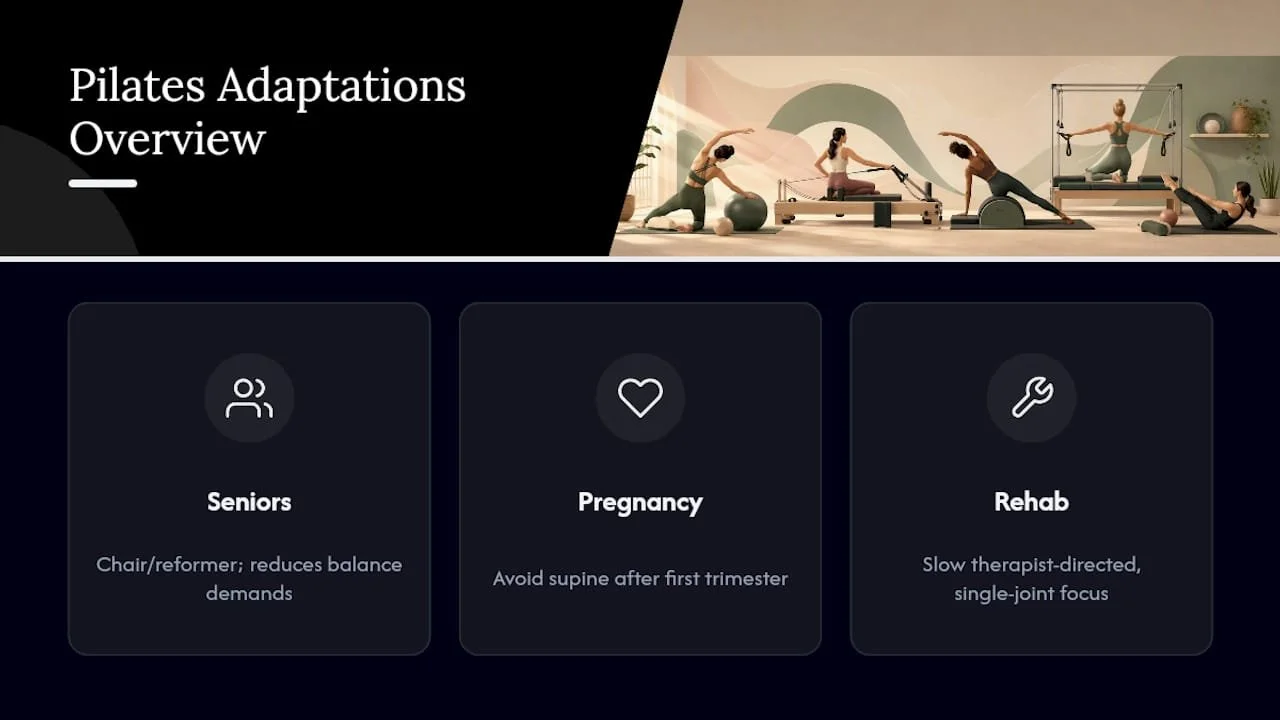
What stays constant across all three is the instructor's role. A senior in a chair-based class, a pregnant client modifying her second-trimester routine, and a rehab patient working through a shoulder injury are all doing the same underlying method, just adjusted for what their body can safely handle that day. That flexibility is the entire point of a system Joseph Pilates originally designed for injured patients in the first place.
Amrita's Take: What We Prioritize When Teaching Pilates
We think the biggest gap in how people understand Pilates isn't about the exercises. It's about how much the instructor matters. Two people can do the exact same reformer sequence and get completely different results depending on whether someone is actually watching their alignment or just calling out reps from across the room.
At Amrita Yoga & Wellness, that's the priority: hands-on correction over choreography. A modification isn't a downgrade from the "real" exercise. It's often the version that actually works for your body that day. We'd rather slow a class down to fix one person's hip alignment than keep everyone moving at the same pace toward the same mistake.
— Juiced
Try a Pilates Class at Amrita Yoga & Wellness
There are many ways to start Pilates classes, rather than following a one-size-fits-all first-class approach. That matters because the right entry point depends on your body, not a generic beginner script.
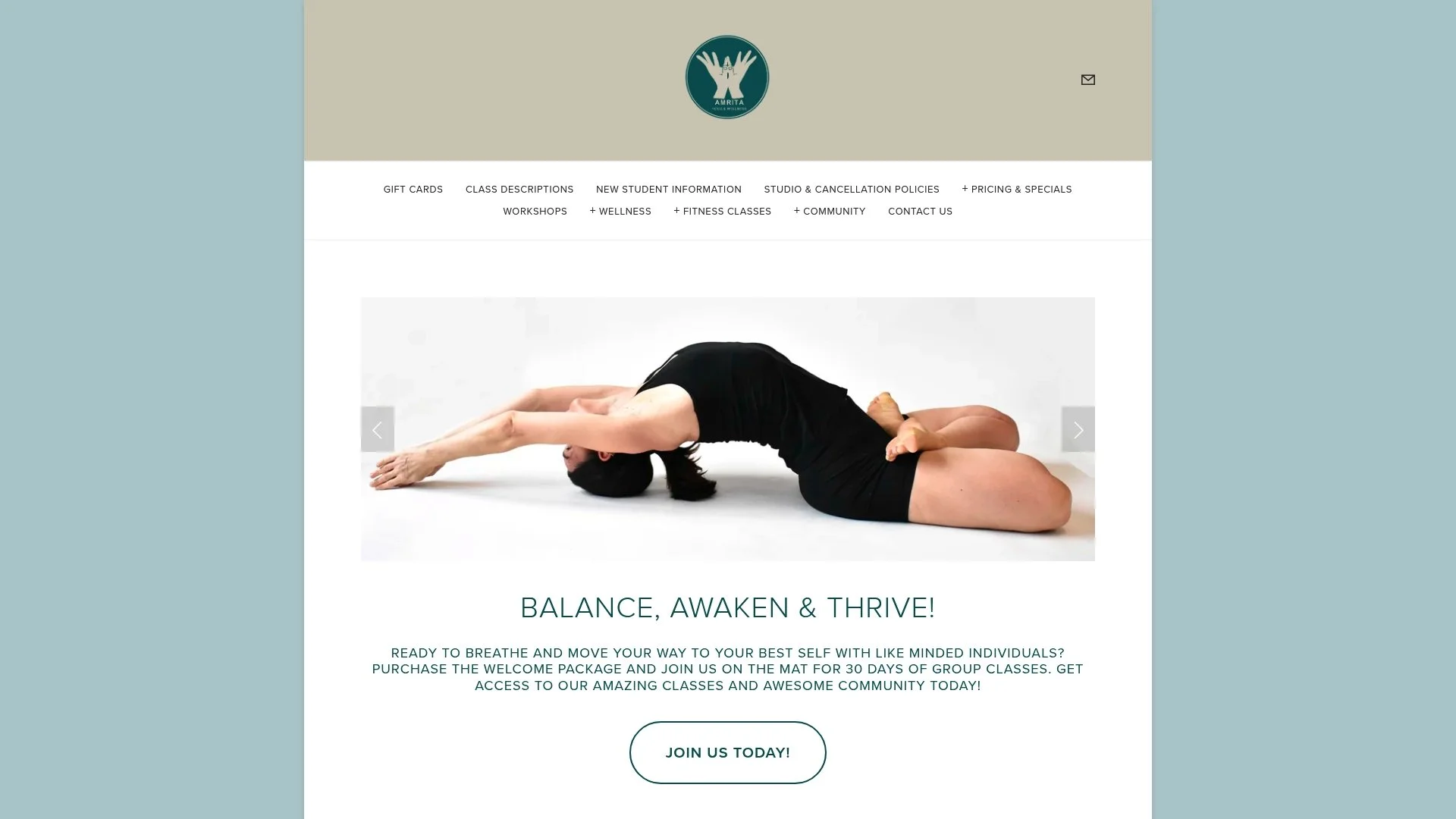
If you want to test the waters without commitment, a Community Class Drop In runs $11 per session, or step up to a full Group Class Drop In at $28. Curious about reformer work specifically? The Nurtured Beginnings pass, priced at $35, is built for exactly that first-timer transition. And if you're managing an injury or just want an instructor's full attention while you learn the fundamentals, a One to One Session starts from $85 per hour and lets you set the pace entirely around your own body. Pick whichever entry point matches where you're starting from, and book your first session directly on our site.
Sources
Pilates: a good workout option even as we get older — Harvard Health
Pilates: Overview, Pros and Cons, Benefits, and More — WebMD
FAQ
How Often Should You Do Pilates as a Beginner?
Two to three sessions per week is the commonly recommended frequency for building strength, mobility, and body awareness as a beginner. Spacing sessions across the week gives your muscles recovery time while keeping the habit consistent.
Is Pilates Good for Lower Back Pain?
Some research shows cautious support for Pilates improving lumbo-pelvic stability and reducing back discomfort, though the existing studies call for stronger evidence. If you have a diagnosed back condition, get clearance from a healthcare provider and tell your instructor before class.
What's the Difference Between Pilates and Yoga?
Pilates centers on core strength and controlled, repetition-based movement, while yoga blends held poses, breathwork, and often a meditative or spiritual component. Both improve flexibility and body awareness, but Pilates leans more toward muscular conditioning and yoga leans more toward flexibility and mind-body connection.
Can You Do Pilates at Home?
Yes, mat-based Pilates translates reasonably well to home practice since it needs little to no equipment. Reformer work requires the machine itself, so at-home practice generally sticks to mat exercises unless you have access to equipment.
How Long Until You See Results From Pilates?
Most people notice improved posture and core awareness within a few weeks of practicing two to three times weekly, with visible strength and flexibility changes building over a couple of months. Consistency matters more than intensity, since Pilates relies on frequent, controlled practice rather than occasional hard sessions.