Find Your Breathwork Style: 6 Purpose Groups for Beginners
Breathwork is the deliberate use of breathing patterns to influence your nervous system, mood, and physical state. The main families you will encounter are slow-paced and diaphragmatic techniques, yogic pranayama, clinical breathing retraining, and expressive or fast-paced methods. Slow-paced approaches have the strongest, most consistent evidence for easing stress and anxiety, which makes them the natural starting point for most people.
TL;DR:
Slow-paced diaphragmatic breathing is the most supported method for easing stress and anxiety with minimal risk, especially for beginners.
Multi-session, guided breathwork programs lasting at least five minutes show higher effectiveness than single, self-directed sessions.
Techniques like diaphragmatic breathing, box breathing, and 4-7-8 breathing are simple, low-risk options suitable for most people.
Fast-paced or intense methods such as holotropic or Wim Hof require supervision due to risks of dizziness, hyperventilation, or physiological distress.
People with respiratory or cardiovascular conditions should consult a healthcare professional before practicing more vigorous or breath-holding techniques.
Amritayogawellness
Explore Guided Breathwork Practice
Amrita Yoga & Wellness offers breathwork workshops alongside yoga, Pilates, barre, tai chi, and massage therapy in Philadelphia.
Table of Contents
What breathwork actually means
Breathing on purpose, rather than letting it run on autopilot, shows up across nearly every wellness tradition. Yogic pranayama has roots going back thousands of years in South Asia, Qigong uses breath to move energy through the body in Chinese practice, and shamanic traditions in various cultures use fast or circular breathing to shift consciousness. Contemporary therapeutic breathwork borrows from all of these while adding a clinical layer aimed at measurable outcomes.
Most people come to breathwork for one of four reasons: to calm a racing mind, to sharpen focus before a demanding task, to build better emotional regulation over time, or to manage a respiratory condition like asthma. The right technique depends heavily on which of those goals you are chasing, which is why a single "best" breathwork method does not really exist.
Terminology gets muddled fast, so it helps to separate three terms. "Breathwork" is the broad umbrella covering any intentional breathing practice. "Pranayama" refers specifically to the yogic system of breath control, with named techniques and traditional sequencing. "Breathing retraining" is the clinical term used by physiotherapists and respiratory specialists for structured programs that correct dysfunctional breathing patterns, often tied to asthma or chronic hyperventilation. You will see all three words used loosely in studios and online content, but knowing the distinction helps you find the right resource.
What the research actually supports
A meta-analysis of randomized controlled trials found that breathwork produces small-to-moderate reductions in self-reported stress, anxiety, and depressive symptoms, with effect sizes of g = −0.35 for stress, g = −0.32 for anxiety, and g = −0.40 for depressive symptoms.
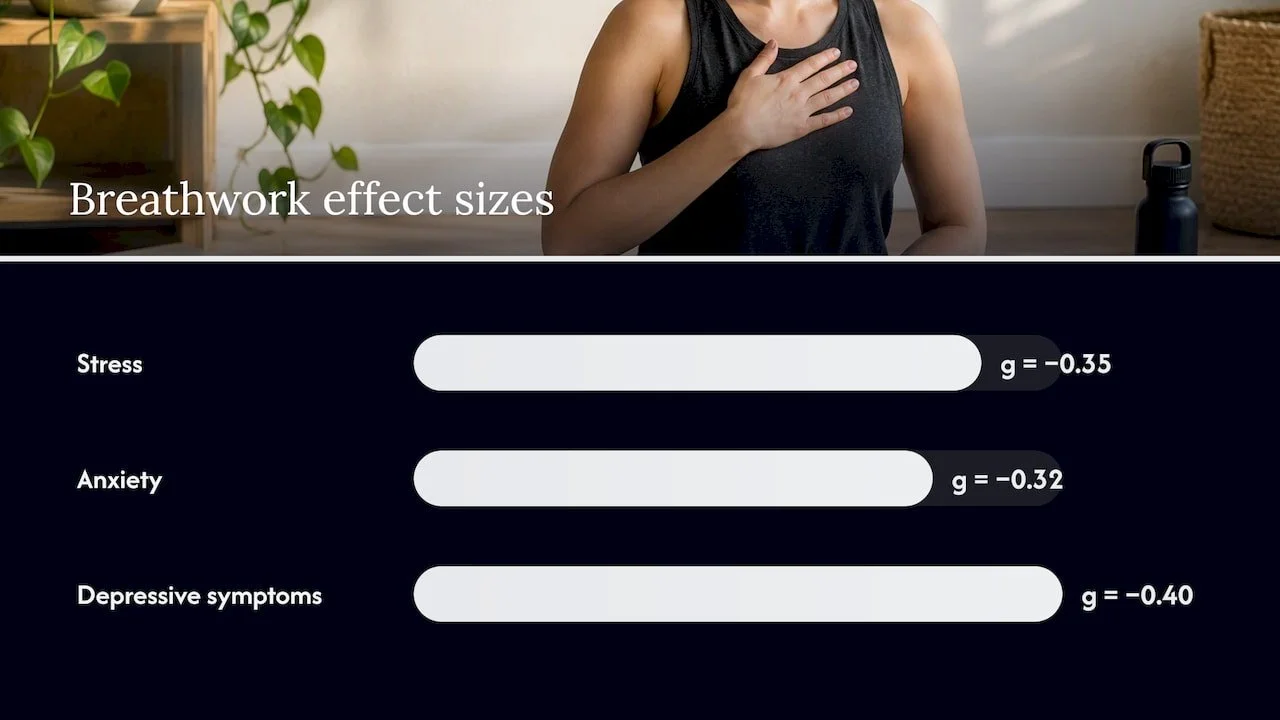
Small-to-moderate effect sizes (g = −0.32 to −0.40) for anxiety and depressive symptoms mean breathwork helps, but it is not a dramatic fix on its own. Researchers behind that review also flagged a gap between the hype around branded breathwork modalities and what the data actually shows: the rhythmic act of breathing slowly may explain much of the benefit rather than any particular trademarked method.
A separate systematic review looked at what made breathing interventions actually work. It found that programs using multi-session, human-guided training, with sessions lasting at least roughly five minutes, were more consistently effective than single, self-directed sessions. Out of 72 interventions reviewed, 54 were identified as effective, and slow, diaphragmatic breathing showed up as the most common ingredient among the successful ones.
There is a real caveat worth sitting with. Trials in this space are heterogeneous, meaning they measure different outcomes with different populations and different session lengths, and some benefit likely comes from the attention and structure of a guided program rather than the breathing technique alone. That does not erase the findings, but it does mean claims of a single miracle method deserve skepticism.
The practical takeaway: if you are new to this, start with slow-paced or diaphragmatic breathing. It has the broadest support, the lowest risk, and it sets a foundation before you try anything more intense.
Types of breathwork and how to practice each one
Breathwork techniques generally sort into six purpose-driven groups. Pick based on your goal first, your comfort level second.
Foundational slow-paced breathing builds the base for almost everything else.
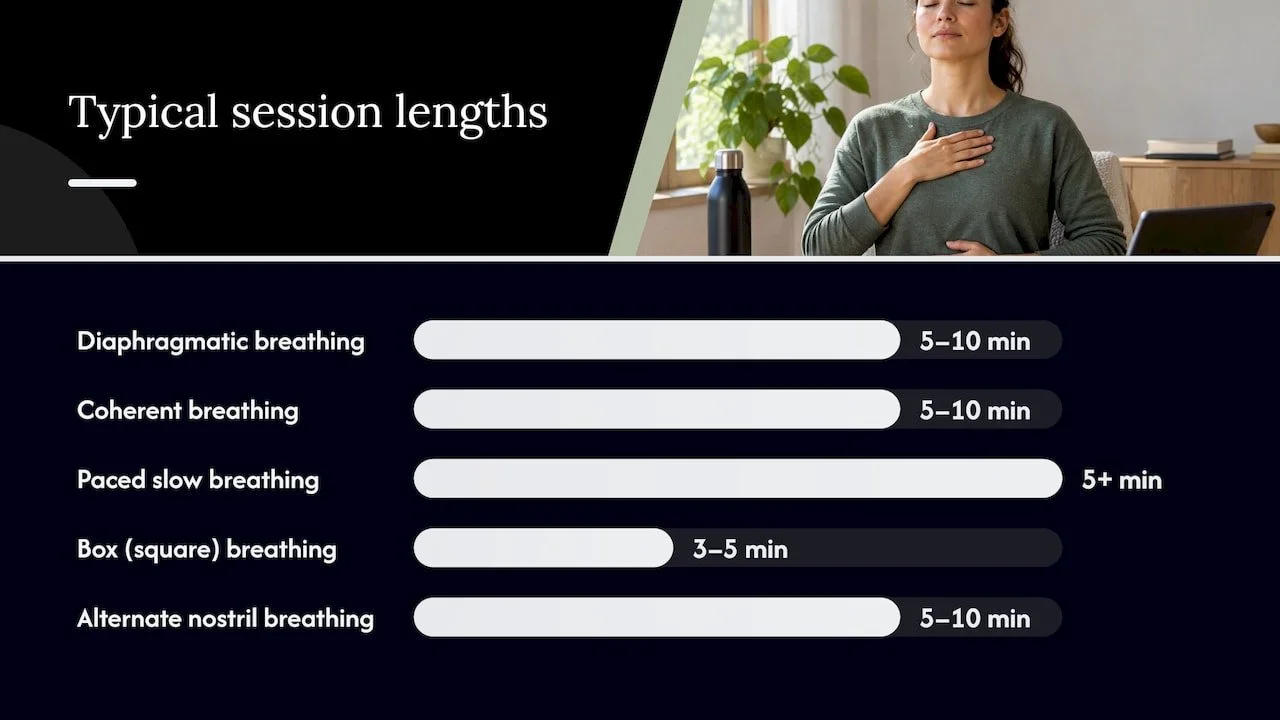
Diaphragmatic breathing is belly breathing that engages the diaphragm instead of the chest, best for anyone new to breathwork or dealing with everyday stress; inhale through the nose and let your belly expand, exhale slowly, practiced for 5 to 10 minutes lying down to start, with no major safety concerns for most people.
Coherent breathing paces inhales and exhales to around five to six breaths per minute, fitting people who want a measurable calming effect tied to heart rate variability; inhale for about five seconds and exhale for about five seconds, typically for 5 to 10 minutes seated, and it carries little risk beyond mild lightheadedness if you push the pace too hard at first.
Paced slow breathing is a looser version of coherent breathing without strict timing, suited to beginners who find counting distracting; simply slow your breath rate below your resting pace and keep it smooth, for 5 minutes or more, with the same low risk profile.
Paced and patterned calming techniques add structure for people who like a clear count to follow.
Box breathing, also called square breathing, inhales, holds, exhales, and holds again for equal counts, often four seconds each. It works well for people who want a mental anchor during acute stress, such as before a presentation, and sessions of 3 to 5 minutes are typical. The breath holds can trigger lightheadedness in beginners, so starting with shorter counts is wise.
4-7-8 breathing inhales for four counts, holds for seven, and exhales for eight, making it a favorite for winding down before sleep. It suits people dealing with racing thoughts at bedtime, and most people do four to eight cycles per session. The extended hold and exhale can feel uncomfortable at first, so easing into the counts over several sessions helps.
Pursed-lip breathing has you inhale through the nose and exhale slowly through pursed lips, a technique borrowed directly from respiratory medicine for people managing breathlessness. It fits anyone with chronic obstructive pulmonary disease or exercise-induced breathlessness particularly well, and it can be used in short bursts whenever shortness of breath strikes, with essentially no downside when done gently.
Yogic pranayama carries traditional names and specific physical techniques, and our pranayama resources go deeper into how these integrate with a full practice.
Alternate nostril breathing, or Nadi Shodhana, closes one nostril at a time while breathing through the other, suited to people seeking balance and mental clarity before meditation; practiced for 5 to 10 minutes, it is gentle for most practitioners.
Ujjayi breath creates a soft ocean-like sound by slightly constricting the throat on each breath, commonly paired with movement in a vinyls yoga class; it is used throughout a practice session rather than as a standalone exercise, and it is low risk for nearly everyone.
Kapalabhati, or skull-shining breath, uses forceful, rapid exhales with passive inhales, appealing to practitioners wanting an energizing jolt; it is typically done in rounds of 20 to 30 breaths. It is not recommended during pregnancy or for anyone with high blood pressure, glaucoma, or a hernia, and first attempts go better under direct instruction.
Clinical and retraining techniques are built around measurable respiratory outcomes rather than a meditative feel.
The Buteyko method teaches reduced-volume nasal breathing to address chronic over-breathing, aimed specifically at people with asthma or hyperventilation patterns. Programs run over weeks with short daily practice sessions. Breathing retraining for asthma more broadly has been shown to improve symptoms and reduce reliever medication use over 6 to 12 months, with trials reporting reductions of roughly 1.5 to 2.5 puffs per day when programs include sufficient patient contact. These approaches genuinely benefit from a qualified respiratory physiotherapist rather than a self-taught attempt, since short one-off sessions rarely produce lasting change for a clinical population.
Intense and expressive methods sit at the far end of the intensity spectrum and carry the most caveats.
The Wim Hof Method combines cycles of forceful breathing with breath retention and cold exposure, drawing people who want an intense physiological reset or an energy boost. Sessions often run 10 to 20 minutes across several rounds. Because it involves voluntary hyperventilation, it can cause dizziness, tingling, or fainting, and it should never be practiced in water or while driving. Holotropic and transformational breathwork use sustained rapid breathing, often with music, to access altered states or process emotion, appealing to people exploring deeper personal or therapeutic work. Sessions typically last 60 to 120 minutes and are guided in groups or one-on-one. The systematic review of breathing interventions found that this style of prolonged forced hyperventilation carries real potential to provoke anxiety or physiological distress, so a supervised setting matters here more than almost anywhere else in breathwork.
Quick energizers and calmers round out the list as short, accessible tools.
Lion's breath combines a wide-mouth exhale with a stuck-out tongue and an audible roar, useful for releasing tension or facial stress in a single round or two. Humming bee breath, or Bhramari, closes the eyes and ears while humming on the exhale, creating a vibration that many people find calming within just a few rounds. Neither carries meaningful risk for most healthy adults.
How to start a breathwork practice safely
A sustainable practice beats an intense one you abandon after a week. Here is a simple way to begin.
Week one: Practice diaphragmatic breathing for 5 minutes daily, lying down, right after waking or before bed.
Week two: Extend to 10 minutes and move to a seated position once lying down feels automatic.
Week three: Introduce one paced technique, such as box breathing or coherent breathing, for 5 minutes alongside your diaphragmatic practice.
Week four: Try a guided class or workshop session to see how a teacher's cues change the experience before adding any higher-intensity method.
Sessions of at least five minutes, repeated across multiple sessions, consistently outperform single, one-off attempts in research on breathing interventions. Consistency does more work than intensity, especially in the first month.
When choosing guided instruction, whether a class, workshop, or private session, look for a few things: a teacher who can explain the physiological reasoning behind a technique, clear verbal cues you can follow with your eyes closed, the ability to modify a practice for a health condition you disclose, and a calm, unhurried pace that never pressures you into breath holds you are not ready for.
Pro Tip: Pair your breathwork minutes with something you already do daily, like brewing coffee or brushing your teeth, so the habit attaches to an existing cue instead of relying on willpower alone.
Safety signs and when to stop
Mild lightheadedness, tingling in the fingers, or a brief wave of emotion can happen during breathwork, especially with faster techniques. If that happens, pause, sit or lie down, breathe gently through your nose, and stop the session if symptoms do not settle within a minute or two.
Persistent breathlessness, dizziness, chest tightness, or a racing heart outside of practice can signal a breathing pattern disorder, where chronic over-breathing or chest-dominant breathing has become habitual. These patterns typically respond to physiotherapist-led retraining rather than a general wellness class, and a referral is worth pursuing if symptoms linger.
Specific caution applies to people with asthma, cardiovascular disease, epilepsy, psychosis, or those who are pregnant. Fast or breath-holding techniques in particular can interact poorly with these conditions, so checking with a physician or a qualified practitioner before trying anything beyond slow diaphragmatic breathing is a reasonable baseline for safety.
How our studio supports safe breathwork learning
We built our class and workshop formats around the same principle the research points to: guided, repeated practice beats a single unsupervised attempt. We offer pranayama-focused sessions and breathwork workshops that provide direct instruction and the chance to ask questions in real time, rather than guessing from a video. We also cover how breath integrates into yoga and into Pilates on our blog, which is useful if you want to see how breathwork fits into a broader movement practice rather than standing alone. Our breathwork benefit posts walk through what different techniques tend to offer so you can match a class to your goal before you book.
Finding the breathwork style that actually fits you
The biggest mistake we see is people jumping straight to the most intense technique they heard about, usually something fast and dramatic, without building any foundation first. Start slow. Notice how your body responds to a gentle five-minute session before adding breath holds or rapid cycles. The calmest, least glamorous techniques are the ones with the sturdiest evidence behind them, and trying a few different styles over a month or two will tell you more about what fits than reading about them ever will.
— Juiced
Try guided breathwork at our studio
Reading about breathwork only gets you so far. The techniques with the strongest track record, slow and diaphragmatic breathing especially, work best when a teacher can watch your pace and adjust cues in real time, and that is exactly what our in-studio sessions are built for.
A few ways to start: guided group classes, personalized one-to-one sessions, or combined breathwork and restorative therapies are available.
None of this replaces medical care for a diagnosed respiratory or cardiovascular condition, but it does give you a structured, supervised way to build the habit. Browse our class schedule and find a session that matches where you are starting from.
FAQ
What are the 14 breathing styles?
There is no single, universally agreed list of specific breathing styles. Breathwork is better understood as a handful of purpose-based families, slow-paced, pranayama, clinical retraining, and expressive or intense techniques, within which dozens of named variations exist depending on the tradition or teacher.
What is 4-7-8 4-7-8 breathing?
4-7-8 breathing is a paced technique where you inhale for four counts, hold for seven, and exhale for eight, usually repeated for four to eight cycles. It is commonly used to wind down before sleep or to interrupt a stress response, and most people find the extended exhale produces a quick calming effect.
What are the most popular breathwork techniques?
Diaphragmatic breathing, box breathing, 4-7-8 breathing, and alternate nostril breathing are among the most widely practiced techniques because they are simple to learn and low risk. The Wim Hof Method and holotropic breathwork have also grown in popularity, though they call for more caution and ideally supervised instruction.
How many breathwork types are there?
The exact count varies by source since techniques are often renamed or combined across traditions, so there is no fixed number. It is more useful to think in terms of five or six purpose-driven groups covering calming, energizing, clinical retraining, and expressive practices, each containing several named techniques.
Do I need a teacher to start breathwork?
You can start slow diaphragmatic breathing safely on your own, but research on breathing interventions found that guided, multi-session programs produce more consistent results than single self-directed attempts. Guidance becomes especially important once you move toward faster or breath-holding techniques, where a qualified instructor can adjust pacing for your comfort and health history.