Which Type of Pilates Should You Actually Try?
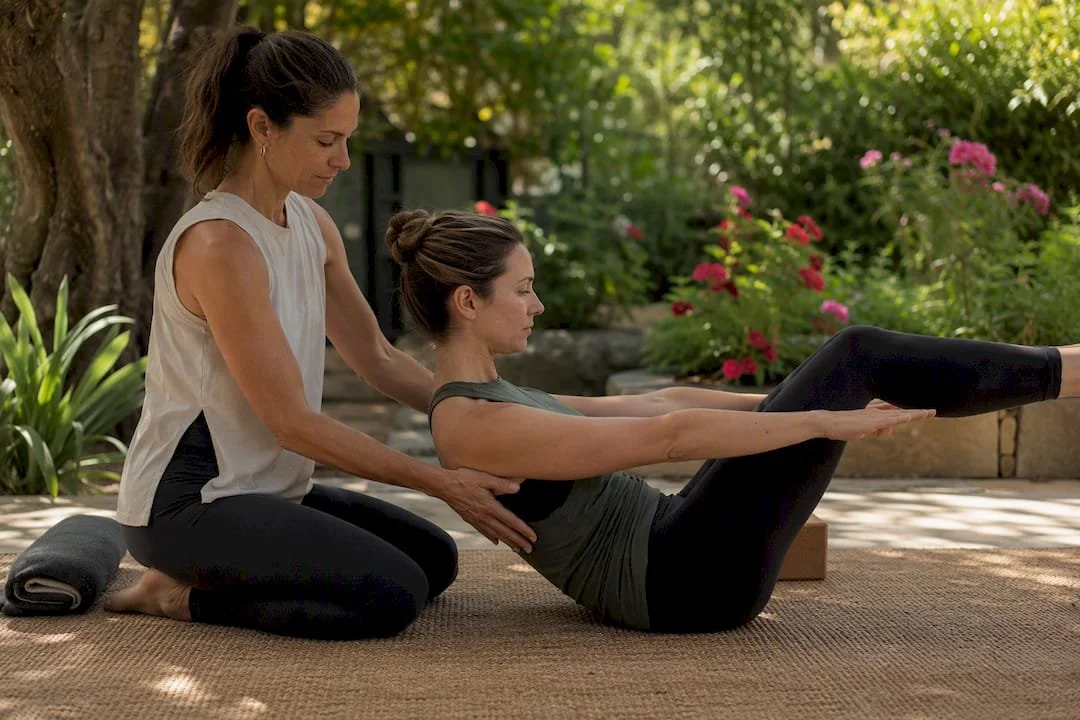
If you're trying to pick between the different types of Pilates, here's the short version: Mat Pilates is best for accessibility and building core strength on a budget. Reformer Pilates is best for progressive resistance training and full-body toning. Classical Pilates is best for purists who want Joseph Pilates' original sequences taught in order. Contemporary Pilates is best for anyone who needs modifications for an existing injury or body quirk. Clinical Pilates is best for structured rehab under professional supervision.
Joseph Pilates developed his method in the 1920s as a rehabilitation system for injured dancers and soldiers, and nearly every style practiced today branches from that root. Beyond the five core categories, you'll also run into named variants like Stott, Winsor, and various HIIT hybrids, and the instructor teaching any of them usually matters more than the label on the studio schedule. Amrita Yoga & Wellness in Philadelphia runs Mat, group Reformer, and clinically informed sessions side by side, which is a useful real-world reference point as you read through the breakdowns below.
Mat Pilates: low cost, minimal gear, best for beginners building core control
Reformer Pilates: spring resistance, best for strength progression and toning
Classical Pilates: original sequences, best for traditionalists and disciplined learners
Contemporary Pilates: biomechanics-informed, best for modifications and mixed-ability classes
Clinical Pilates: physio-led, best for injury recovery and chronic pain management
TL;DR:
Reformer Pilates is more suitable for those seeking progressive strength training due to its adjustable resistance, unlike Mat Pilates, which is slower but cost-effective.
Classical Pilates follows Joseph Pilates' original sequence strictly, making it ideal for disciplined learners, while contemporary styles incorporate modern biomechanics and modifications for injury management.
Clinical Pilates offers personalized, slow-paced rehab programs led by physiotherapists, making it the safest choice for injury recovery and chronic pain.
Instructor expertise and screening for injuries are more important than the class label or style, so ask about credentials and modification policies before booking.
Intensity levels vary widely, with Winsor and HIIT styles being most demanding; clinical and mat Pilates tend to be slower and more controlled, suited for different fitness and health needs.
Table of Contents
What Is Mat Pilates and Who Should Start There?
Mat Pilates is Pilates in its simplest form: a floor, your body weight, and sometimes a magic circle, resistance band, or small ball to add feedback. Classes run through exercises like the Hundred, the Roll-Up, and Leg Circles, all built to fire the deep core muscles that support your spine.
It's the cheapest entry point into any Pilates practice. No machine rental, no equipment purchase, and plenty of it can be practiced at home once you know the sequence.
Builds core strength and spinal mobility without equipment costs
Works well for home practice between studio sessions
Rewards patience. It's slower to show visible results than reformer work
If you're brand new, watch how the instructor cues alignment. Someone who only counts reps and never mentions your pelvis or spine position isn't teaching Pilates the way Joseph Pilates intended it.
Pro Tip: In your first mat class, ask the instructor to check your neutral spine position before you start the Hundred. Getting that baseline right changes how every other exercise feels.
What Makes Reformer Pilates Different From Mat Work?
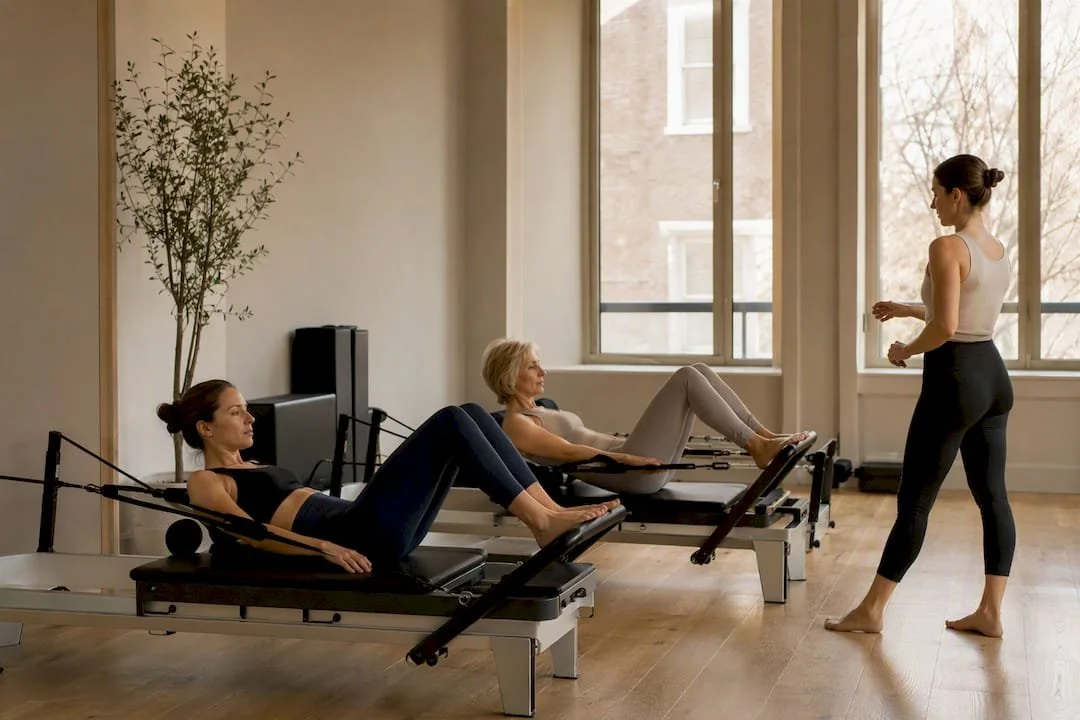
The reformer is a sliding carriage attached to a set of springs, with straps for your hands and feet and a bar you push against. Adjusting spring tension changes resistance instantly, so the same exercise can feel gentle one day and brutal the next.
That adjustability is the whole point. A reformer class scales from rehab-level gentle to genuinely demanding strength work inside a single session, which is why it appeals to people who've plateaued on the mat.
Full-body resistance training with instant load adjustments
Sharper feedback on alignment than most mat exercises allow
Available as private sessions, small-group classes, or larger studio formats
Group reformer Pilates classes are the most common entry point, and most studios will run beginners through a slower orientation session before dropping them into a regular class.
Pro Tip: Ask whether your first reformer class is a dedicated beginner session. The machine has a learning curve, and a mixed-level class moves too fast to teach you the straps and footwork properly.
Is Classical Pilates the Same as the Original Method?
Classical Pilates sticks closely to Joseph Pilates' original order of exercises, taught on his original apparatus designs with minimal deviation. Instructors trained in this lineage treat the sequence itself as sacred. You don't skip around based on what feels good that day.
This suits people who like structure and repetition, and who want to trace their training back to a documented source rather than a studio's in-house blend. It tends to appeal less to people managing an injury, since the sequence doesn't bend easily around individual limitations.
Follows a fixed sequence rather than an improvised or goal-based class plan
Best for disciplined learners who want traceable technique lineage
Progression is expected to follow the traditional order, not personal preference
Check who trained the instructor and where. Classical lineage claims vary a lot between studios, and a legitimate classical teacher can usually name their training background without hesitation.
How Does Contemporary Pilates Adapt the Classical Method?
Contemporary Pilates takes Joseph Pilates' original framework and rebuilds it around modern biomechanics and anatomy research, and studios use it to tailor exercises to the person in front of them rather than a fixed script. A physiotherapist quoted by Stylist frames contemporary and clinical approaches as the ones worth prioritizing when injury history or unusual biomechanics are part of the picture.
This is the style you'll find in most modern studios, often blended with props, cross-training elements, or faster-paced formats.
Modifications are built into the class rather than treated as an afterthought
Suits mixed-ability groups better than rigid sequence-based formats
Frequently shows up in fusion classes that borrow from strength training or cardio
If your body doesn't fit neatly into a textbook sequence, whether from a old injury, tight hips, or a hypermobile spine, contemporary is usually the more forgiving choice.
Who Benefits Most From Clinical Pilates?
Clinical Pilates is the medically oriented end of the spectrum. Classes are typically led by a physiotherapist, or by an instructor with specific rehab training, and they start with an actual assessment rather than a generic warmup.
The instructor or physio assesses your injury, posture, or movement limitation
A program gets built around measurable rehab goals, not a standard class template
Progress gets tracked and adjusted over multiple sessions, often in coordination with your physical therapist or doctor
Clinical Pilates commonly uses this assessment-first model, and it's the format most consistently recommended for injury recovery, post-surgical conditioning, and chronic pain management. Clinical Pilates sessions are generally slower-paced than reformer or mat classes. The goal here is precision, not calorie burn.
Pro Tip: Bring your physical therapy notes or surgeon's clearance to your first clinical session. A good instructor will actually read them before building your program.
What Are Stott, Winsor, and Other Named Pilates Styles?
Once you get past the five core categories, you'll run into branded systems and hybrid formats. Stott Pilates emphasizes spinal alignment and rehabilitation principles, closer in spirit to clinical work. Winsor Pilates leans toward toning and cardio, and it runs at a noticeably higher intensity. HIIT and Pop Pilates formats push the pace further still, blending Pilates movements with interval training for calorie burn over precision.
Stott Pilates: alignment-focused, close to a clinical or contemporary approach
Winsor Pilates: toning and cardio-forward, higher intensity than classical formats
HIIT/Pop Pilates: interval-based, built for calorie burn and variety over rehab
Barre-Pilates hybrids: isometric holds borrowed from ballet conditioning, mixed with core work
Marie Claire's breakdown of named systems is useful context here: these brands describe a marketing focus more than a wholly separate discipline. A "Winsor-style" class at one studio might look completely different from another. Read the actual class description, not just the label, before assuming it will meet a rehab or strength goal the format wasn't built for.
How Do You Choose the Right Pilates Class for You?
Start with your goal, not the style name. Someone recovering from a disc injury and someone training for a half marathon should not end up in the same class just because both are labeled "Pilates."
Name your goal first. Rehab, general strength, flexibility, or just wanting to move more consistently each week.
Match the goal to a cluster. Rehab points to Clinical; strength and progression point to Reformer; tradition and structure point to Classical; adaptability points to Contemporary; budget and convenience point to Mat.
Check the instructor's credentials. Ask directly where they trained and whether they hold a rehab-specific certification if you have an injury.
Ask about class ratio and screening. A studio that never asks about injuries before your first session is skipping a step that matters.
Before booking, ask these questions: Does the instructor screen for injuries before class starts? What happens if an exercise hurts, is there a modification ready, or do you just sit it out? How many people are in a typical class, and how much individual attention can you realistically expect?
Watch for red flags. A studio promising dramatic results in a set number of sessions, with no mention of individual assessment or modification, is selling a marketing pitch, not a program. As The Pilates Circuit points out, the instructor and how well the program adapts to you usually matter more than the style label itself.
Pro Tip: Most studios offer a discounted or free intro class. Use it to test the instructor's attention to detail, not just whether you liked the workout.
What Do Breath, Control, and Precision Mean in Practice?
Every legitimate Pilates style, regardless of equipment or intensity, is built on a small set of shared principles. Breath ties movement to exhale and inhale patterns, which stabilizes your core automatically. Centering means initiating movement from your deep abdominal muscles, not your limbs. Control and precision mean quality over reps, five clean repetitions beat fifteen sloppy ones.
Breath: coordinated inhale/exhale that stabilizes the spine during movement
Centering: initiating from the core rather than the arms or legs
Control and precision: fewer, cleaner reps rather than rushed volume
Flow: smooth transitions between exercises rather than stop-start movement
Most practitioners notice improved posture and core awareness within a handful of consistent sessions, though visible physical change typically takes longer and depends heavily on frequency.
What Should You Look for in a Studio's Class Offerings?
The clearest way to judge whether a studio actually delivers on a given style is to read how they describe their own classes. Amrita Yoga & Wellness lists Mat, group Reformer, and clinically informed formats separately rather than bundling everything under one generic "Pilates" heading, which tells you the difference between formats is treated as real, not cosmetic.
Confirm the instructor's certification body and any physical therapy background
Ask whether they collaborate with outside physical therapists or doctors for clinical clients
Watch your first session for individualized cueing, not just a group count
Notice whether modifications get offered before you ask, or only after you struggle
A studio that separates its Mat, Reformer, and clinically informed offerings by name, rather than folding them into one undifferentiated "Pilates class," is signaling that it actually understands the differences between them.
If a studio can't clearly explain what makes their clinical or reformer sessions different from their mat classes, that's worth noting before you book a package.
Where Did the Different Types of Pilates Come From?
Joseph Pilates built the original system in the 1920s while working with injured dancers and, earlier, with soldiers recovering during his internment in England during World War I. He called it "Contrology," and it centered on his own custom apparatus, precursors to today's reformer, Cadillac, and Wunda Chair, built using bed springs and mechanical parts he had on hand.
After Pilates moved his studio to New York, a small group of students trained directly under him. Those students, sometimes called the "Pilates Elders," went on to teach the method largely unchanged for decades. That unbroken line is the direct ancestor of what's now marketed as Classical Pilates.
The method fractured after Pilates' death in 1967, when his trademark on the name "Pilates" was successfully challenged in court, opening the term up for anyone to use commercially. That legal shift is a big part of why so many named variants exist today. Some instructors kept the classical sequence intact. Others, trained in physical therapy or sports science, began adjusting exercises based on modern anatomy research, which is the branch that became Contemporary Pilates. Clinical Pilates grew out of physiotherapy clinics adopting the equipment and exercises specifically for rehab work. Commercial brands like Stott and Winsor emerged later still, each built around a specific marketing angle rather than a documented lineage back to Joseph Pilates himself.
What Equipment Is Used Beyond the Reformer?
The reformer gets most of the attention, but Joseph Pilates designed several other machines that show up regularly in classical and clinical studios. The Cadillac, sometimes called the Trapeze Table, is a raised table frame with bars, straps, and springs suspended overhead. It allows for both assisted stretching and resisted strength work, and it's commonly used in rehab settings because a therapist can support a limb through a full range of motion.
The Wunda Chair is a compact box with a spring-loaded pedal, originally designed small enough to fit in an apartment. It's deceptively difficult. Balance and control matter more than raw strength, which makes it a favorite for testing stability in later-stage rehab or advanced classical training.
Smaller props round out most contemporary and mat-based classes:
Magic circle: a flexible ring used for resistance during arm, leg, and inner-thigh work
Resistance bands: added to mat sequences for extra load without a full machine
Small stability balls: used for core activation drills and balance challenges
Foam rollers: used for myofascial release and balance-focused exercises
Larger studios sometimes also stock the Spine Corrector, a curved barrel-shaped prop for supporting extension exercises, and the Ladder Barrel, which combines a padded arch with a small attached ladder for stretching and core work. None of these show up in every studio. Availability depends heavily on whether the space specializes in classical training, clinical rehab, or a general contemporary mix.
Are There Contraindications for Different Pilates Styles?
Every style shares core benefits: improved core strength, better posture, and increased body awareness. Where they diverge is in who should approach them cautiously.
Mat Pilates carries the fewest restrictions since it's low-impact and self-paced, though certain floor exercises that involve spinal flexion, like the Roll-Up, aren't ideal for people with osteoporosis or acute disc injuries without modification. Reformer Pilates' resistance can aggravate an unhealed injury if the springs are set too aggressively too soon, which is why a proper intake matters before your first session. Classical Pilates' fixed sequence is the least flexible option for anyone managing a current injury, since the format isn't built to skip or heavily modify exercises. Contemporary Pilates is generally the safest choice for people navigating an injury history, precisely because modification is built into how the class is taught rather than treated as an exception.
Clinical Pilates carries the most built-in safety net, given the physiotherapy oversight, but it also comes with the clearest caveat: anyone recovering from surgery or managing a chronic condition should get clearance from their surgeon or doctor before starting, regardless of how gentle the class looks on paper. That same caution applies to Reformer or HIIT-style Pilates for anyone with cardiovascular concerns. The intensity can spike faster than it appears from the sidelines. If you're pregnant, recovering from a recent surgery, or managing a diagnosed spinal condition, clinical or contemporary formats with an instructor trained to screen for those conditions are the more sensible starting point than jumping into a general mat or reformer class.
Which Pilates Style Is the Most Intense?
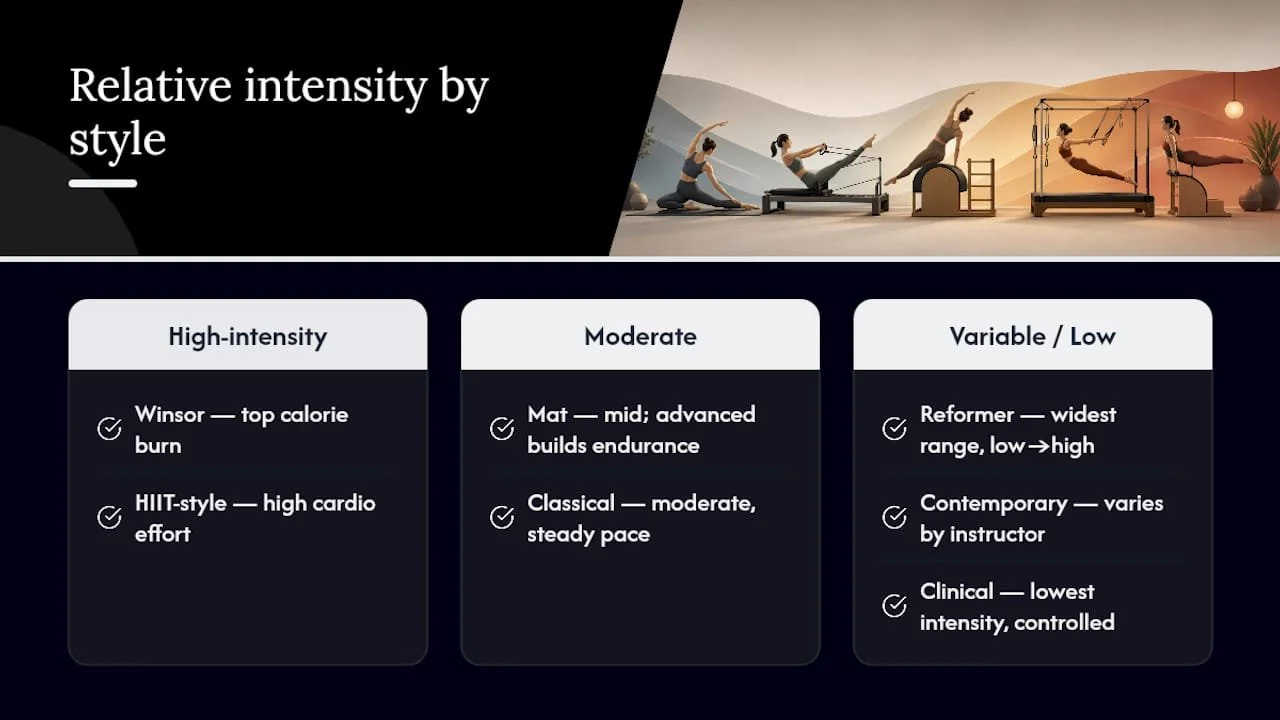
Intensity varies more between named variants than between the five core categories themselves. Business Insider's firsthand comparison of seven Pilates styles ranked Winsor and HIIT-style formats as the most demanding for calorie burn and cardiovascular effort, while Clinical Pilates ran distinctly slower and more controlled by design, not by limitation.
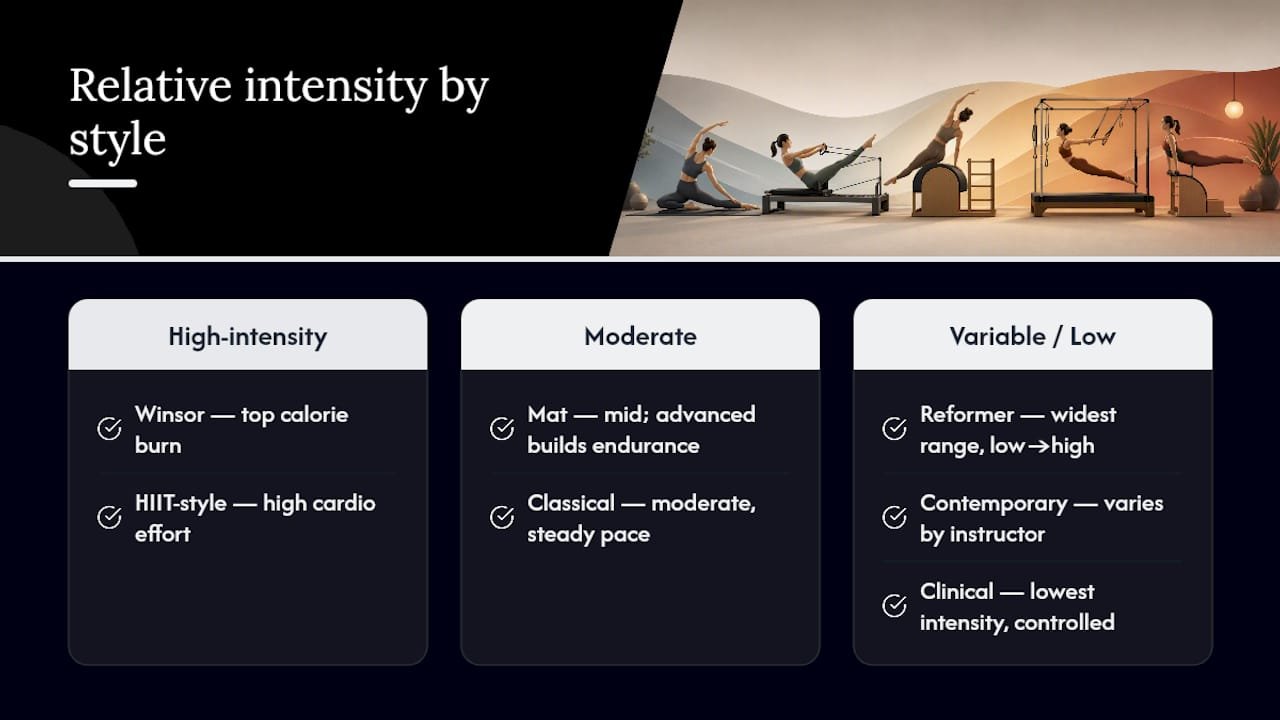
Mat Pilates sits in the middle. A beginner mat class can feel gentle, but an advanced mat sequence with continuous flow between exercises builds serious muscular endurance. Reformer Pilates has the widest intensity range of any format, since spring tension and pace are adjustable within a single session. A beginner reformer class run at low resistance can feel similar to mat work, while an advanced small-group class pushing heavy springs at speed rivals a strength training session.
Classical Pilates tends to run at a moderate, steady pace regardless of your fitness level, since the sequence itself doesn't change to match your conditioning. Contemporary Pilates varies by studio and instructor, since the entire point of the format is adjusting difficulty to the person in the room. Clinical Pilates is intentionally the least intense of the group. Speed and load take a back seat to controlled, precise movement, and that's a feature of the format, not a shortcoming.
If you're choosing based on how hard you want to work, ask about pace and format before assuming the style name tells you everything.
How Long Does a Typical Pilates Class Run?
Most Pilates formats land in a fairly narrow window, but what happens inside that window differs a lot by style. Mat classes typically run 45 to 60 minutes, often structured around a warmup, a flowing sequence of core and mobility exercises, and a cooldown stretch. Group Reformer sessions usually run similarly, 45 to 55 minutes, though the setup and adjustment time at the start eats into the actual working time more than a mat class does.
Classical Pilates sessions can run slightly longer, sometimes up to 60 or 90 minutes for advanced practitioners, since the full traditional sequence covers mat work, reformer work, and additional apparatus in one session. Contemporary studio classes generally mirror standard mat or reformer timing, 45 to 60 minutes, with the specific structure depending heavily on the instructor's programming that day.
Clinical Pilates sessions tend to run shorter for one-on-one work, often 30 to 45 minutes, since the format prioritizes focused, assessed movement over volume. A clinical session usually opens with a brief check-in about pain or progress since the last visit, moves into a small number of targeted exercises, and closes with a review of what to work on before the next appointment. That structure looks nothing like a group mat class, and that's intentional. The goal is measurable progress on a specific issue, not general conditioning.
Where Is Each Pilates Style Most Widely Available?
Mat Pilates is by far the most globally available format, since it requires no machines and can be taught almost anywhere, from community centers to home workout videos. It's the entry point for most people encountering the different types of Pilates classes for the first time.
Reformer Pilates has expanded dramatically in urban fitness markets over the past decade, with dedicated reformer-only studios now common in most major cities. Availability drops off in smaller towns and rural areas, where the machine cost makes it harder for independent studios to offer.
Classical Pilates is the hardest style to find in its strict, traditionally taught form. It survives mostly through studios with a direct instructor lineage back to one of Joseph Pilates' original students, which limits it to a smaller number of specialized locations rather than general fitness chains.
Contemporary Pilates has effectively become the default at most general fitness studios and gyms worldwide, since it's flexible enough to fit almost any class format or clientele. Clinical Pilates availability tracks closely with access to physiotherapy services, so it's most common in areas with established rehab and sports medicine infrastructure, and less common as a standalone offering in general fitness markets. Named variants like Stott and Winsor show up unevenly. Some regions have dedicated studios built around one brand, while others use the names loosely inside a broader class schedule.
Key Takeaways
The right Pilates style depends on matching your specific goal, rehab, strength, tradition, or adaptability, to the format built for that goal, not on picking whichever class is most popular.
| Point | Details |
|---|---|
| Match style to goal | Choose Mat for accessibility, Reformer for strength progression, Clinical for rehab, Classical for tradition. |
| Instructor matters more than label | A credentialed, attentive instructor beats a trendy class name every time. |
| Ask before booking | Confirm screening practices, modification policies, and class size before your first session. |
| Intensity varies widely | Winsor and HIIT formats run hardest; Clinical Pilates is deliberately the slowest and most controlled. |
| Amrita Yoga & Wellness offers a range | The Philadelphia studio runs Mat, group Reformer, and clinically informed classes as distinct formats. |
What Actually Matters When Picking a Pilates Style
Most guides to Pilates styles treat the topic like a taxonomy problem, sort every variant into a neat box and call it done. That's backwards. The style label tells you almost nothing about whether a specific class will actually help you. Two "Contemporary Pilates" classes at two different studios can look completely unalike depending on who's teaching them.
The conventional advice to "just pick reformer, it's trendy" ignores that reformer's biggest advantage, adjustable resistance, is wasted on an instructor who doesn't actually adjust anything for you. Meanwhile Clinical Pilates gets dismissed as boring or slow by people comparing it to a HIIT class, when slow and controlled is the entire point for anyone managing an actual injury.
If you take one thing from this guide, prioritize the instructor's screening process over the style name on the schedule. A studio that asks about your injuries and adapts on the spot will serve you better than a perfectly labeled "Classical" class taught by someone checking a clock. Start with a goal, ask direct questions before booking, and treat the first class as a test of the teacher, not just the workout.
— Juiced
Ready to Try It in Person?
Reading about the different types of Pilates only gets you so far. The real test is how a class feels once you're on the mat or strapped into the reformer, and that's where Amritayogawellness fits in. As a Philadelphia studio offering Mat, group Reformer, and clinically informed sessions side by side, alongside yoga, barre, and massage therapy, you get to compare formats in one place instead of guessing from a website description.
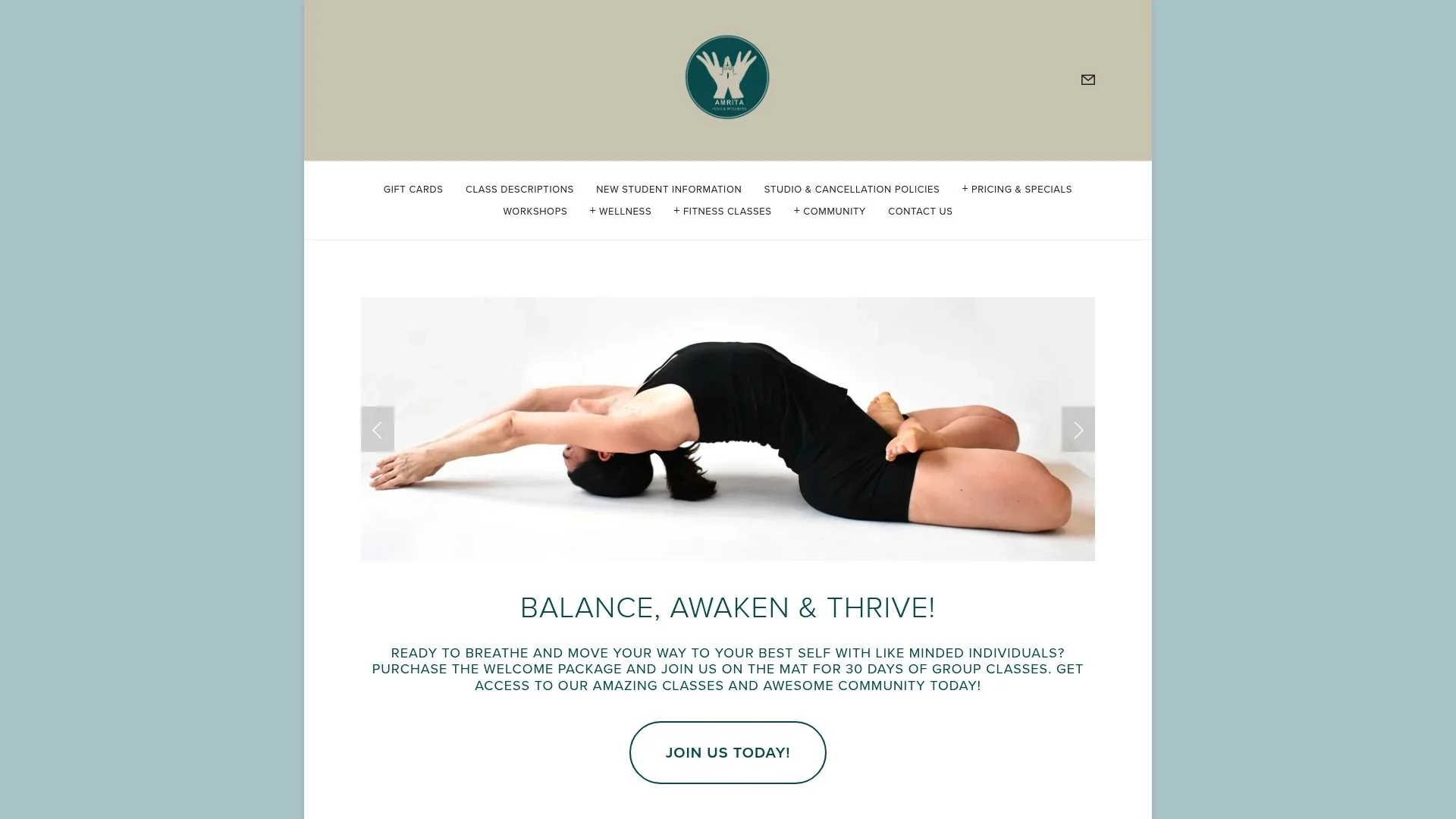
If you're managing tight hips or post-workout soreness, pairing Pilates with massage therapy speeds up recovery between sessions, and Amritayogawellness offers that alongside its movement classes. Beyond the studio floor, workshops like the tarot readings round out a wellness visit for anyone treating the trip as a full reset, not just a workout. Check the current class schedule and book your first Mat or Reformer session directly through the studio's site to see which format actually fits your body.
Sources
All the different types of pilates and what they're good for — Stylist
Types Of Pilates: A Definitive List, Plus Which Is Best | Marie Claire UK
I Tried 7 Different Types of Pilates; Here Are My Favorite — Business Insider
The 7 Different Types Of Pilates Explained — The Pilates Circuit