4 Pilates Cue Types With Copyable Scripts and Timing for Instructors
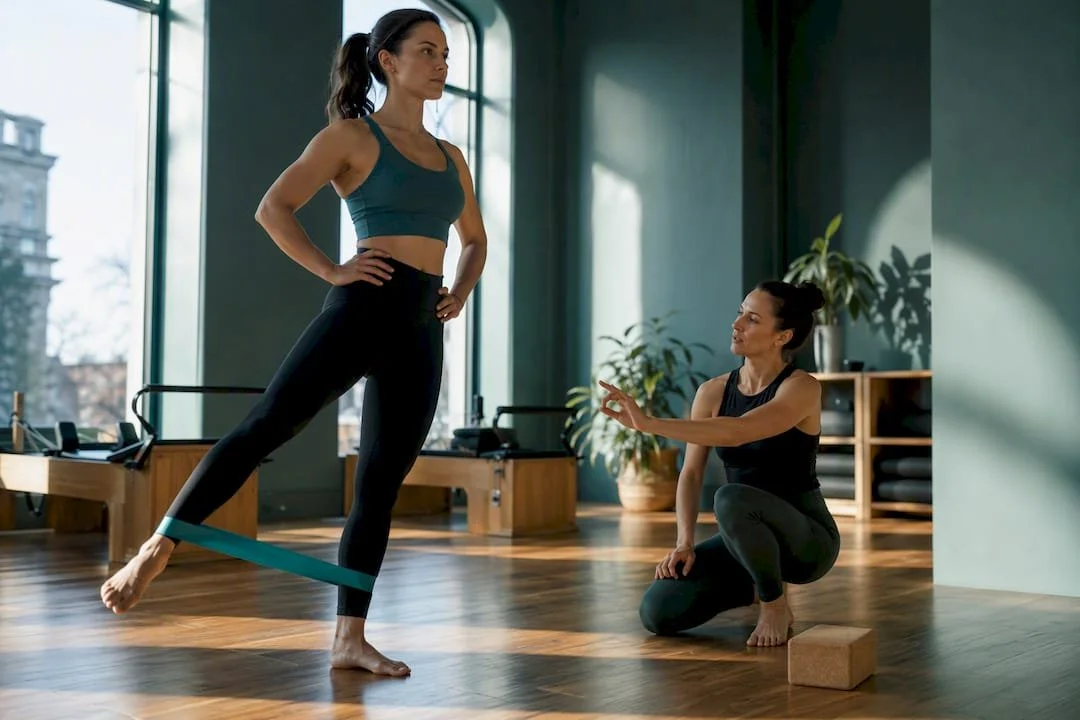
The most effective Pilates cueing techniques fall into four categories: visual, auditory, experiential, and tactile. The single rule that ties them together is this: favor external focus language that points attention to an outcome outside the body, and match your cue type to how each student learns. This list gives you scripts, timing guidance, and the research behind why it works.
TL;DR:
External focus cues are most effective when pointing attention to outcomes outside the body, and matching cue types to students’ learning preferences accelerates progress.
Different cueing styles—visual, auditory, experiential, and tactile—should be used strategically throughout class, with visual for complex exercises, auditory for pacing, experiential for awareness, and tactile for correction.
Layer cues according to a four-step framework: set up the position visually and verbally, activate deep stabilizers with experience or touch, correct minimally during movement, and streamline cues during flow.
External focus instructions consistently outperform internal cues across motor learning research, improving both immediate performance and long-term skill retention.
Always seek consent before tactile cues, keep contact brief and purposeful, and have fallback scripts ready when a cue fails to produce the desired movement change.
Table of Contents
1. Four cueing categories and when to use each
Visual cues show rather than tell, auditory cues use words or imagery, experiential cues connect movement to a felt sensation, and tactile cues use touch to guide position or muscle activation. Each works best in a different moment of class, and knowing which to reach for saves you from repeating a cue that already failed to land.
Visual: Demonstrate the movement or draw a shape in the air. Best for complex exercises and beginners who need to see the pattern before attempting it. Example: "Watch how my spine curls like a C before you try it."
Auditory: Speak a direct instruction or use imagery tied to sound or rhythm. Best for experienced students who respond to verbal pacing. Example: "Exhale for five counts as you roll up."
Experiential: Ask the student to notice a sensation or imagine an object moving through space. Best for building body awareness in intermediate students. Example: "Imagine a string pulling the crown of your head toward the ceiling."
Tactile: Use a light touch to guide alignment or activation, always with consent first. Best for students who plateau on verbal cues alone. Example: A hand at the low back signals "lengthen away from here."
According to IDEA Health & Fitness Association, most students have a dominant learning preference among these four styles, and matching your cue to that preference speeds progress and improves satisfaction. A quick way to find it: ask, test one cue type, and watch which one produces a cleaner rep.
2. Cue scripts for common Pilates objectives
These scripts cover the five goals instructors cue most often: breath, core control, alignment, balance, and mobility. Use the external focus version whenever a student overthinks the internal mechanics.
Breath: "Exhale as you press your ribs down and back into the mat" (auditory, external). For a slower class, try the experiential version: "Feel your breath fill the space behind your kidneys." Time this cue on the exhale, right before the effort phase of the movement.
Core control: Instead of "engage your core," say "draw your belly button toward your spine like you're zipping up tight jeans" (auditory with external image). A tactile alternative: two fingers pressing gently below the navel as a reminder to hollow, only after asking permission.
Alignment: "Stack your shoulders directly over your wrists" works better than "don't sag." Pair it with a visual demo showing the straight line from ear to hip to ankle before the student attempts a plank.
Balance: "Root your standing foot into the floor like it's growing into the ground" gives an external target instead of "don't wobble." Demo first for anyone new to single-leg work, then cue verbally once they're moving.
Mobility: "Reach your fingertips toward the far wall" extends range more effectively than "stretch your side body." Use this during flow, when students no longer need a full demo.
Demo before you talk when the exercise is unfamiliar or has more than two moving parts. Once students know the shape, shift to verbal and tactile cues so class keeps moving.
Pro Tip: Keep each cue to one idea. A student can absorb "exhale and reach" but loses the thread at "exhale, reach, and keep your pelvis level."
3. A four-step framework for layering cues in class
A reliable sequence for delivering cues, adapted from IDEA's mat work teaching framework, moves through four stages: lay the foundation, find the center, hold still and move, then flow. Each stage calls for a different cue density.
Lay the foundation: Set up the position with visual and auditory cues together, since students need both to see and hear the target shape.
Find the center: Add one experiential or tactile cue to activate the deep stabilizers, such as "feel your low back stay heavy on the mat."
Hold still and move: Cue one correction per repetition, not a running commentary, so students can process and adjust.
Flow: Drop to single-word or short-phrase cues ("reach," "exhale," "lengthen") since students should now know the pattern.
The decision rule is simple: if a cue doesn't produce a visible change within one or two reps, switch modality rather than repeating the same words louder.
4. Why external focus cues improve motor learning
The case for external focus phrasing isn't a teaching trend, it's a consistent finding across decades of motor learning research. A large-scale meta-analysis reviewing dozens of studies found that external focus instructions outperform internal focus instructions for motor performance, retention, and transfer, across different ages, health statuses, and skill levels. A separate set of experimental studies found the same pattern on balance and simulator tasks: external focus produced better learning outcomes than internal focus.
Converting a cue is often just a phrase swap:
"Squeeze your glutes" becomes "press the mat behind you."
"Engage your abs" becomes "draw your navel toward your spine like closing a zipper."
"Tuck your pelvis" becomes "lengthen your tailbone toward your heels."
The research consistently favors external focus cues over internal ones for both immediate performance and longer-term skill retention, according to the meta-analytic review, which means the words you choose in class aren't just style, they measurably affect how well a movement pattern sticks.
5. Tactile cuing: consent, safety, and hands-on technique
Touch is one of the most effective cueing tools available, but only when it's used with clear consent. Ask before every session, not just once: "Is it okay if I use touch to help guide your alignment today?" A student can say yes for one exercise and no for another.
Pelvis: A light hand at the sacrum cues neutral spine during bridging or footwork.
Ribs: Fingertips at the lower ribs help a student feel expansion and control during breath work.
Scapula: A gentle cue at the shoulder blade guides depression during arm work.
Hamstrings: A brief tap signals engagement during leg circles or bridge variations.
Touch requires professional judgment and, in some U.S. states, specific licensing for hands-on techniques, so confirm your local requirements and always keep contact brief, purposeful, and within clear professional boundaries.
6. Quick fixes when a cue doesn't land
When a cue fails, don't repeat it louder. Run through three fallback scripts in order: visual first, then external verbal, then tactile if the student has consented.
Visual fallback: Demonstrate the exact movement again, slower than before.
External fallback: Swap the verbal cue for an outcome-focused version, such as "push the floor away" instead of "engage your legs."
Tactile fallback: Add a brief touch cue at the target muscle, with permission.
Timing matters as much as wording. Cue the effort phase on the exhale, give one correction per repetition, and check setup before assuming the cue itself is the problem.
Pro Tip: If a student still misses the cue after three attempts, the fix is usually fewer words, not more of them.
How Amrita Yoga & Wellness applies these cueing techniques
Instructors can shift between visual, auditory, experiential, and tactile cues depending on class level and how each student responds in real time. Effective teacher training programs emphasize practiced observation and always asking consent before hands-on correction, reflecting these standards.
— Juiced
Practice these techniques in class with us
Reading a list of cues is one thing, applying them under a teacher's eye is another. Our group Pilates and livestream classes give practitioners a place to feel these cues in action, while a private session offers direct, one-on-one feedback on how you're responding to different cue types.
Book a group class to practice recognizing and responding to visual, auditory, experiential, and tactile cues in real time.
Schedule a private or small-group session for individualized cueing feedback and hands-on correction.
Ask about our teacher development track if you're building your own cueing repertoire for future classes.
Start with a one-to-one session to see which cue types work best for your body.
Sources
Instructions for motor learning: differential effects of internal versus external focus of attention
FAQ
What are some good cues for Pilates?
Good cues connect an exercise to an external outcome, such as "press the mat behind you" instead of "squeeze your glutes." The most effective options combine a visual demo with one clear verbal cue, adjusted to what each student responds to.
What are examples of cueing techniques?
Cueing techniques fall into four types: visual (demonstration), auditory (verbal instruction or imagery), experiential (felt sensation), and tactile (touch), as outlined by IDEA Health & Fitness Association. Instructors typically layer these, starting with visual and auditory, then adding tactile or experiential cues as needed.
What is the 80/20 rule in Pilates?
There is no standardized rule documented in Pilates pedagogy sources, so instructors should be cautious about treating any such rule as an established principle. If you've heard a specific ratio locally, it likely refers to a specific studio's teaching philosophy rather than a universal Pilates standard.
What are the 34 moves of Pilates?
Definitions of the classic Pilates mat repertoire vary by teacher training lineage, and no single authoritative source in this article confirms a fixed total count of moves. Instructors are better served focusing on cueing quality for the exercises in their own repertoire rather than a specific total count.