The Amrita Journal
Explore thoughtful stories, practical wellness guidance and inspiring ideas to support your movement, mindfulness and everyday wellbeing at Amrita.
What Is a Pilates Reformer Class? Core Strength Explained
TL;DR:
Pilates reformer classes are accessible and beneficial for people of all fitness levels, not just dancers or athletes. They focus on core strength, flexibility, and balance through adjustable resistance and controlled movements, making them suitable for beginners and those with physical limitations. Consistent practice builds mind-body awareness and sustainable improvements, emphasizing long-term wellness over quick results.
Pilates reformer classes have a reputation problem. Many people assume they're reserved for dancers, athletes, or people who already have six-pack abs and serious flexibility. That image couldn't be further from the truth. A beginner reformer class guide will tell you the same thing we tell every first-timer who walks through our doors in Philadelphia: this method was built to meet your body where it is today. Whether you're dealing with tight hips, a history of back pain, or you've never set foot in a fitness studio before, reformer Pilates has something real to offer.
Table of Contents
Key Takeaways
| Point | Details |
|---|---|
| Beginner friendly | Pilates reformer classes can be modified for all levels, including newcomers. |
| Core and flexibility | Consistent practice improves core strength, flexibility, and balance. |
| Customizable workouts | Spring settings and instructor guidance make reformer Pilates adaptable for any body. |
| Mat vs. reformer | Reformer Pilates provides more support and options than mat Pilates, especially for beginners. |
| Mindset matters | Long-term benefits come from regular practice and a holistic approach, not just physical exercise. |
What happens in a Pilates reformer class?
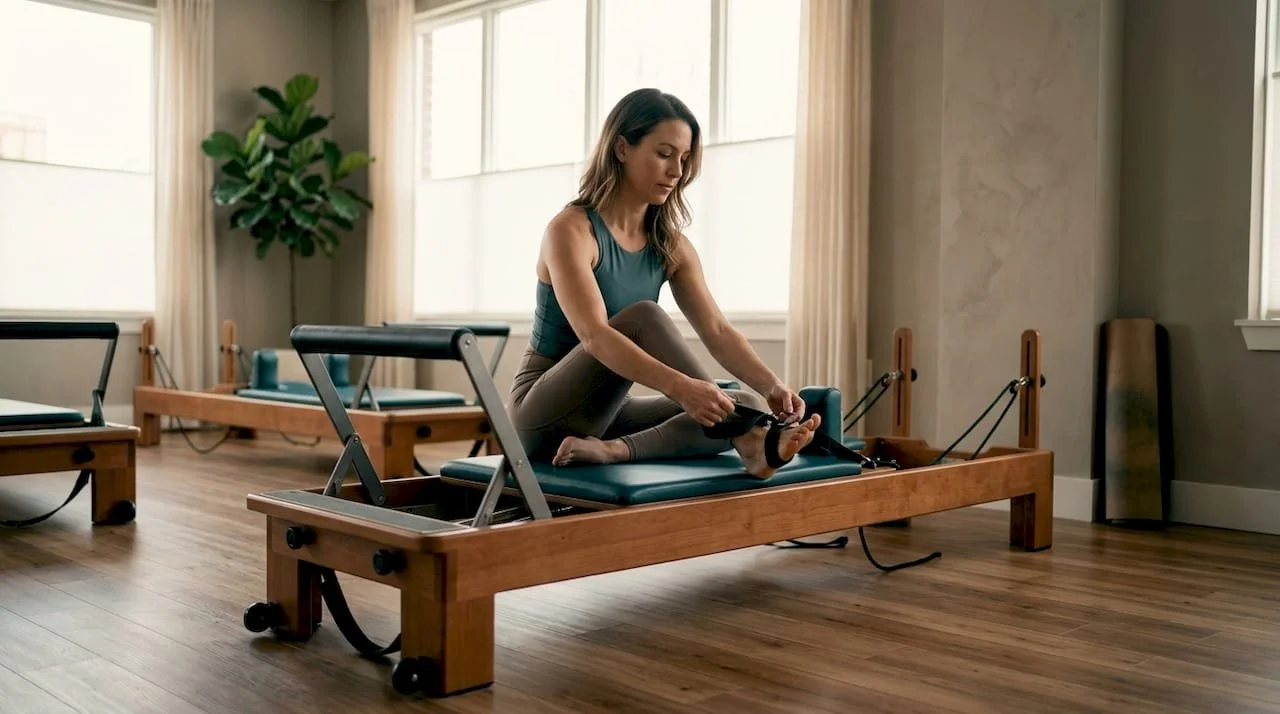
The first time you see a reformer machine up close, it might look a little intimidating. It resembles a bed frame with a sliding platform, a set of cables, and a bar at one end. But once a certified instructor walks you through it, the design starts to make perfect sense.
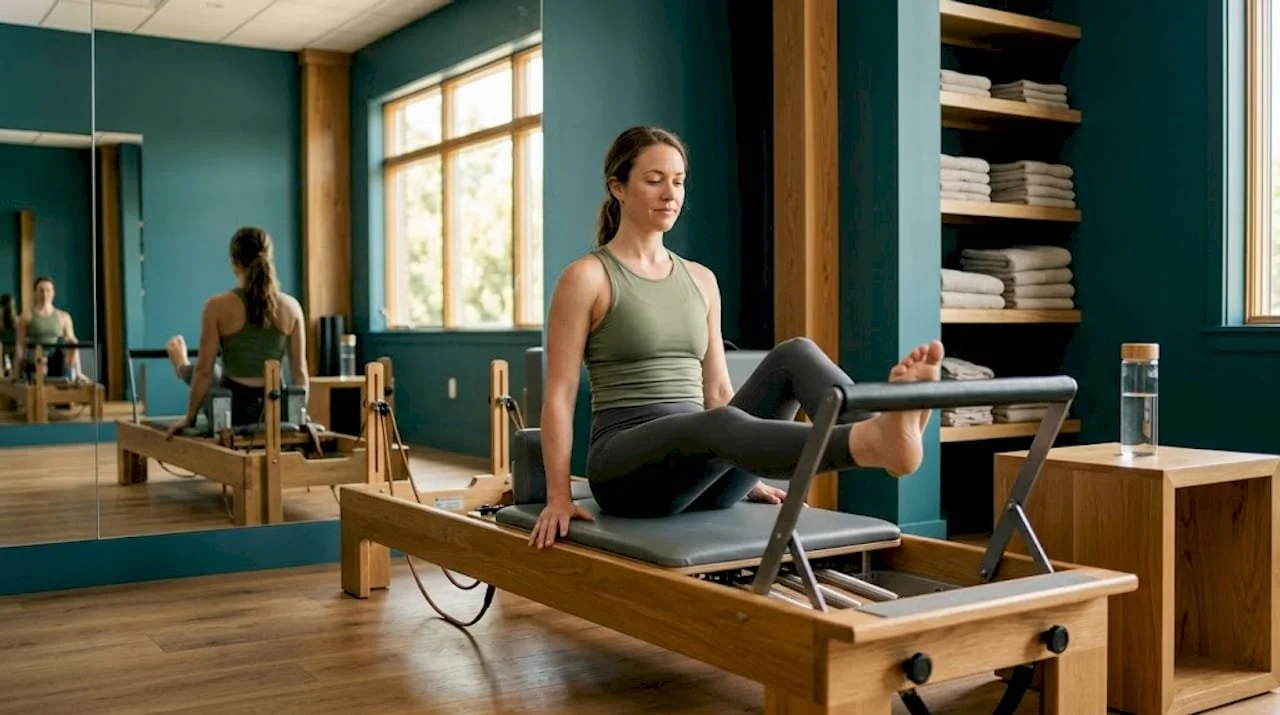
A Pilates reformer class is an instructor-led workout performed on a specialized reformer machine with adjustable springs and a sliding carriage. The carriage is the platform you lie, sit, or stand on. Springs connect the carriage to the frame and provide resistance, which you can increase or decrease depending on your strength level and the exercise. Straps and handles at one end allow you to work your arms and legs with precision, while a footbar anchors your movement on the opposite end.
Here's what the main parts of a reformer do:
Sliding carriage: Moves back and forth along rails to create smooth, controlled resistance
Adjustable springs: Add or remove resistance; lighter springs actually make some moves harder by requiring more stabilization
Footbar: Provides a fixed point for footwork, leg presses, and standing exercises
Straps and handles: Enable upper body and lower body pulls with consistent resistance
Rails: Guide the carriage for smooth linear motion
A typical class follows a clear sequence. You start with a warm-up, usually gentle footwork while lying on the carriage. Then you move into core-focused exercises like the "hundred," which activates your deep abdominal muscles. From there, the class progresses through full-body movements targeting the hips, back, arms, and legs before wrapping up with a cool-down stretch sequence.
One of the smartest features of the reformer is what spring adjustments allow instructors to do. Adding springs creates more support and stability, which is ideal for beginners learning form. Removing springs introduces instability, which challenges advanced students. This flexibility is exactly why the reformer is so beginner-friendly, even if it doesn't look that way at first glance.
| Class Phase | Duration | Focus |
|---|---|---|
| Warm-up | 5–10 min | Footwork, spinal mobility |
| Core work | 15–20 min | Deep abdominals, stabilizers |
| Full-body movements | 15–20 min | Hips, back, arms, legs |
| Cool-down | 5–10 min | Flexibility, breath |
Key benefits: Core strength, flexibility, balance, and more
Once you understand what a reformer class looks like from the inside, it's easy to see why so many people stick with it long-term. The results are real, and the research backs them up.
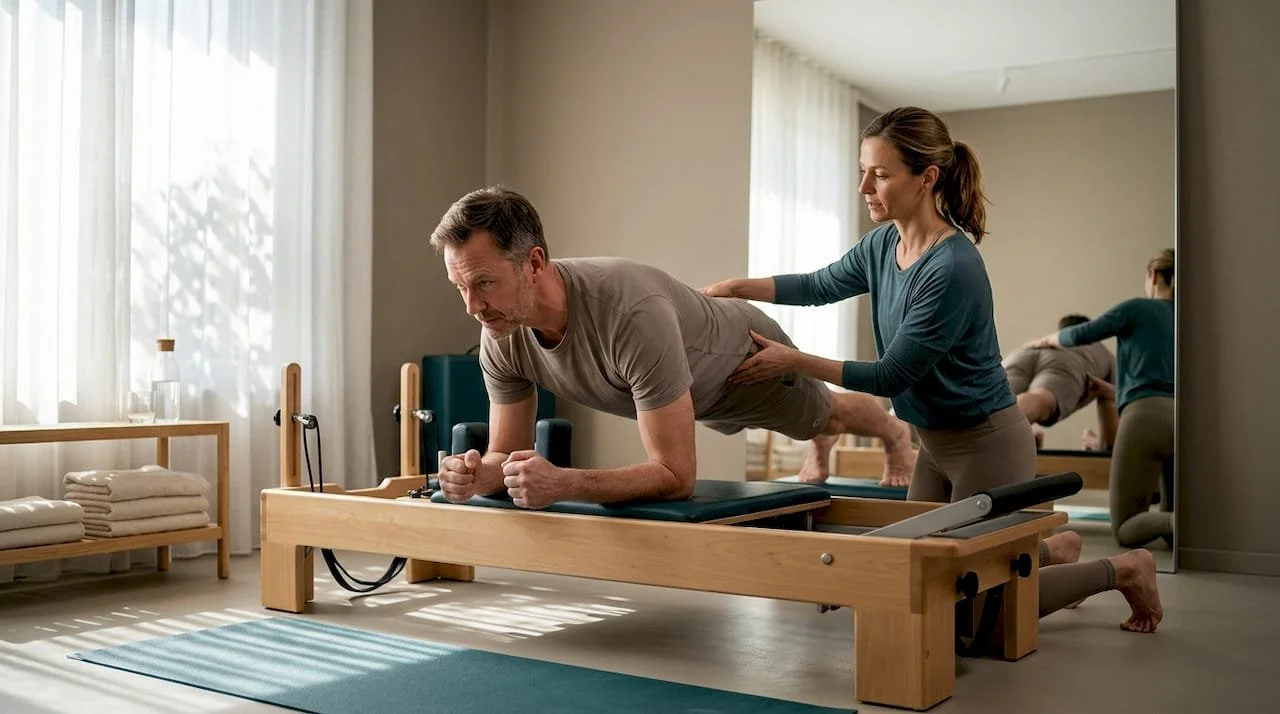
An 8-week study found significant improvements in balance, flexibility, and core muscle endurance after reformer Pilates in healthy adult women. Participants attended supervised sessions twice a week, and the measured improvements across all three areas were statistically meaningful. That's not a small win. Those three qualities, balance, flexibility, and core endurance, are foundational to almost every physical activity and daily movement pattern you perform.
Specific benefits backed by evidence include:
Core endurance: The reformer trains the deep stabilizing muscles of the spine, including the transversus abdominis and multifidus, which are the muscles most closely linked to lower back health
Flexibility: Controlled, full-range movements on the reformer improve tissue length and joint mobility over time
Balance and coordination: Constantly stabilizing a moving carriage trains proprioception, your body's awareness of where it is in space
Posture: Reformer exercises reinforce neutral spinal alignment, which translates directly to how you sit, stand, and move throughout the day
Overall well-being: Many participants in Pilates studies also report improved mood, reduced stress, and greater body confidence
Explore more detail on reformer Pilates benefits to see how these gains build over time.
"The reformer doesn't just build strength. It builds the kind of intelligent movement your body uses every day."
Pro Tip: Aim to attend at least two sessions per week for the first eight weeks. This matches the frequency used in the most consistent research, and it gives your neuromuscular system enough repetition to truly encode the movement patterns.
The 2026 reformer beginner guide offers a helpful breakdown of how to structure your first months of practice for maximum benefit.
Reformer vs. mat Pilates: What's the difference and which is best for you?
After covering the benefits, a fair question comes up: how does the reformer compare to classic mat Pilates? The answer matters because your starting point should match your goals, your body, and your access to equipment.
Reformer Pilates is more adaptabledue to spring resistance and posture modifications, while mat Pilates relies entirely on body weight. That's the core technical difference, and it shapes everything else about how each format feels and what it can do for you.
| Feature | Reformer Pilates | Mat Pilates |
|---|---|---|
| Equipment | Specialized reformer machine | Exercise mat only |
| Resistance | Adjustable spring system | Body weight only |
| Posture support | High, springs and carriage assist | Low, relies on self-correction |
| Adaptability for beginners | High, springs reduce or increase challenge | Moderate, relies on modification cues |
| Accessibility | Studio-based, higher cost | Anywhere, low cost |
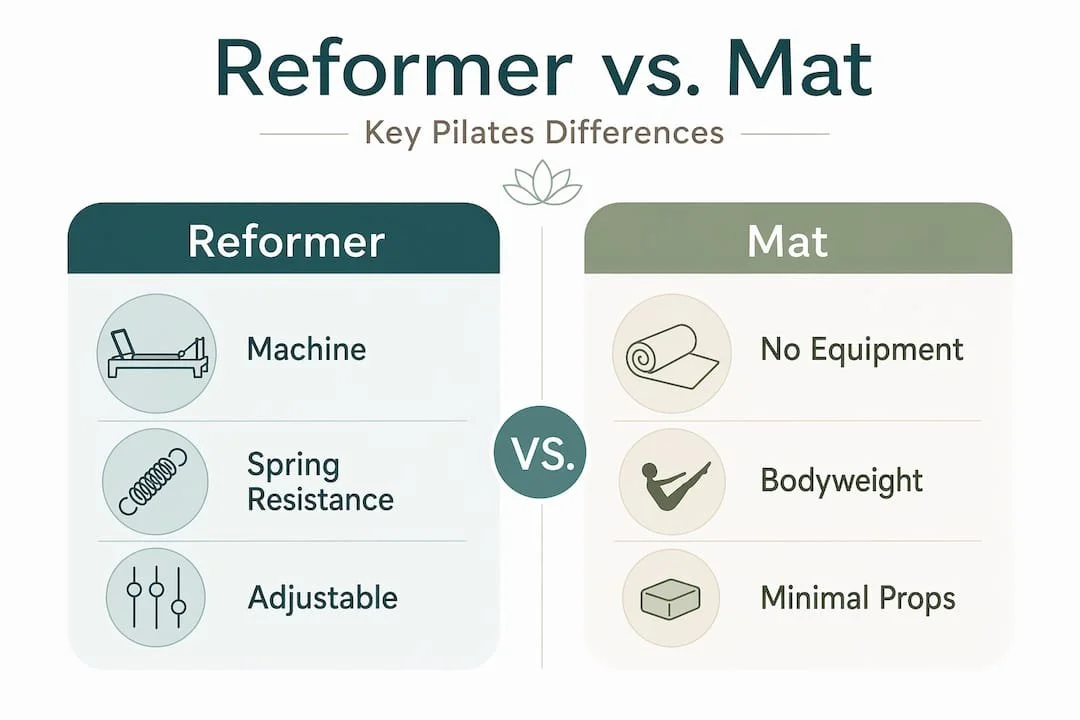
Understanding how reformer Pilates works at a mechanical level helps clarify why it's often the better starting point for adults dealing with any physical limitations.
How to choose which format to start with:
Assess your current fitness base. If you have little to no core strength or have movement restrictions, the reformer's built-in support makes it the safer and more effective entry point.
Consider your goals. If posture correction and joint mobility are priorities, the reformer gives instructors more tools to work with. If budget and convenience matter most, mat classes are accessible and still effective.
Think about supervision. First-timers benefit enormously from in-person reformer instruction. The spring system needs a trained eye to set up safely for your body.
Try both if possible. Many people who start on the reformer find that mat Pilates becomes more accessible and effective after a few months of building body awareness on the machine.
Consult your instructor. A good teacher can assess your movement patterns in a single session and recommend the best starting point for your specific body.
Looking for a beginner Pilates guide that breaks down the choice in more depth? We've got resources to help you decide with confidence.
Is reformer Pilates adaptable for all bodies?
This is the question that stops most beginners before they even sign up. The honest answer is yes, with very few exceptions. The reformer's design is inherently adjustable, which is what makes it so widely applicable.
Spring resistance and setup allow modifying posture and difficulty, making it adaptable for physical limitations. That's not marketing language. It's how the machine was engineered. Joseph Pilates originally developed his method to rehabilitate injured and bedridden people. Adaptability has always been part of the DNA.
Who benefits from reformer Pilates adaptations:
Complete beginners who need extra support and slower movement progressions
Older adults working on functional strength, fall prevention, and joint mobility
Post-injury clients (with medical clearance) rebuilding strength around vulnerable areas
Prenatal and postnatal clients who need specific modifications for safe core engagement
People with chronic pain or hypermobility who need controlled, supported movement
Athletes using Pilates as a cross-training tool to address muscle imbalances
Instructors adapt sessions by adjusting spring tension, changing the starting position of the carriage, offering alternative movements that avoid certain joint angles, and providing hands-on cues for alignment. No two bodies move the same way, and a well-trained instructor knows how to meet yours where it is.
For a deeper look at equipment variations, check out the types of Pilates reformer guide, which explains how different machine styles serve different needs.
Pro Tip: Before your first class, tell your instructor about any injuries, surgeries, or movement restrictions. Even a brief conversation before class starts allows them to modify exercises in real time and keep your session safe and productive.
If your needs are more clinical, including post-surgical recovery or management of a specific condition, ask about clinical reformer options designed specifically for therapeutic contexts.
What results should you expect—and what are the limits?
Setting realistic expectations before you start is one of the most important things you can do for your long-term success with reformer Pilates. The method delivers meaningful results, but it's worth knowing exactly what's well-supported and where the science is more nuanced.
What you can realistically expect:
Stronger, more stable core: This is the most consistent and well-documented outcome across Pilates research
Improved mobility and flexibility: Joints move through fuller ranges with less effort over time
Better balance and coordination: Especially valuable for adults over 40 who want to stay active and prevent falls
Enhanced posture: The way you carry yourself in daily life genuinely shifts after consistent practice
Reduced lower back discomfort: Many clients report meaningful relief, particularly with regular, supervised sessions
Mental clarity and body confidence: These softer outcomes are frequently reported and genuinely meaningful
"Progress in reformer Pilates often shows up in how you feel before it shows up in how you look."
Where the limits are:
Evidence for robust skeletal muscle hypertrophyis inconsistent in Pilates research, even as functional strength clearly improves. In plain terms: reformer Pilates will make you functionally stronger and more resilient, but if building large visible muscles is your primary goal, traditional resistance training is a better primary tool. The reformer excels at quality of movement, endurance, and integrated strength, not bulk.
Find community stories and practical reformer Pilates tips from people navigating exactly these questions.
A thoughtful take: Why lasting reformer results come from mindset, not just movement
Here's what most reformer Pilates guides won't say out loud: the biggest obstacle for most people isn't the spring resistance or learning the footbar sequence. It's the expectation that results should arrive quickly and look a certain way.
We see this pattern constantly at our studio. Someone takes their first few classes, feels genuinely better in their body, then gets discouraged because they don't see dramatic visual changes in the mirror by week four. They compare their experience to highlight reels on social media and wonder if they're doing something wrong. They're not.
The most consistent reformer practitioners we know are the ones who showed up not to transform their appearance but to feel better, move better, and build a relationship with their own body. And almost without exception, those people end up with the best physical results too. That's not a paradox. It's how sustainable fitness actually works.
The reformer is genuinely good at creating body awareness, that quiet internal sense of how your muscles are working, where you're gripping, where you're compensating. That kind of awareness doesn't just make you better at Pilates. It makes you better at everything physical, from picking up groceries to hiking a trail to simply standing at your desk without your back aching.
Mindfulness isn't a bonus feature of reformer Pilates. It's the mechanism. The slow, controlled movements force you to pay attention in a way that explosive training simply doesn't. And that attention, practiced twice a week over months, builds a kind of physical confidence that no before-and-after photo can fully capture.
Commit to the process rather than the outcome. Let the results surprise you.
Ready to experience Pilates reformer for yourself?
If this guide has answered your questions and made reformer Pilates feel genuinely accessible, the next step is simple: get on the machine.
At Amrita Yoga & Wellness in Philadelphia, we offer beginner-friendly reformer classes led by certified instructors who understand that every body is different. Whether you're brand new to movement-based wellness or returning after a break, our team will meet you where you are. Curious about the mind-body connection beyond the physical? Our Tarot readings sessions are a popular complement to reformer practice, supporting the mental clarity and self-awareness that makes your physical work land more deeply. Browse our class schedule, connect with an instructor, and take that first step toward stronger, more mindful movement.
Frequently asked questions
Do I need experience to join a Pilates reformer class?
No prior experience is necessary. Spring resistance and posture modifications make reformer Pilates adaptable for all levels, and instructors guide beginners through every movement from the very first session.
How often should I attend reformer Pilates for results?
Attending twice per week yields the most measurable gains. An 8-week study using twice weekly supervised sessions showed significant improvements in core endurance, balance, and flexibility.
Is reformer Pilates safe for injury recovery or older adults?
Yes, with instructor guidance. The setup allows modifying posture and difficulty for different movement levels, making it appropriate for older adults and those recovering from injury when supervised properly.
Will I build large muscles with reformer Pilates?
Strength and endurance improve clearly, but evidence for robust muscle hypertrophy is inconsistent in the research. Reformer Pilates builds functional, integrated strength rather than the kind of muscle mass associated with traditional weightlifting.
Recommended
Pilates reformer machine: benefits, uses, and how it works
TL;DR:
A Pilates reformer is a versatile resistance machine that enhances core strength, flexibility, and movement quality through adjustable spring resistance. It provides supported, low-impact full-body workouts capable of aiding injury recovery and improving posture, with each session emphasizing slow, controlled movements. Consistent practice focuses on proper form and progressive challenge, making reformer Pilates effective for long-term wellness and functional improvements.
Most people picture group fitness classes, yoga mats rolled out on hardwood floors, or rows of cardio machines when they think about low-impact exercise. The Pilates reformer rarely makes that mental shortlist, yet it consistently outperforms those alternatives for people who want to build real core strength, improve flexibility, and move with less pain. A Pilates reformer is a resistance exercise machine built around a sliding carriage, adjustable springs, and a footbar, giving you far more variability than any mat session can match. This guide breaks down exactly what the machine is, how it works, and what consistent practice can do for your body and your overall wellness.
Table of Contents
Key Takeaways
| Point | Details |
|---|---|
| Versatile support | Pilates reformers offer adjustable resistance that fits many fitness levels and goals. |
| Core and flexibility gains | Evidence shows reformer Pilates can improve core strength, balance, and flexibility. |
| Technique matters | Proper form, spring selection, and controlled movements are crucial for results. |
| Beginner-friendly | The reformer is accessible even to those new to Pilates, thanks to its adaptable setup. |
What is a Pilates reformer machine?
Joseph Pilates invented the reformer in the early twentieth century, originally designing it to rehabilitate bedridden patients during World War I by attaching springs to hospital beds. That simple idea, controlled resistance plus guided movement, grew into one of the most versatile pieces of exercise equipment available today.
The machine's design centers on a few key components that work together to create a full-body training environment. Understanding each part helps you appreciate why the reformer feels so different from lifting weights or doing push-ups on a mat.
Main components of a Pilates reformer:
Carriage: The padded sliding platform you lie, sit, or stand on. It glides along rails in response to your movements.
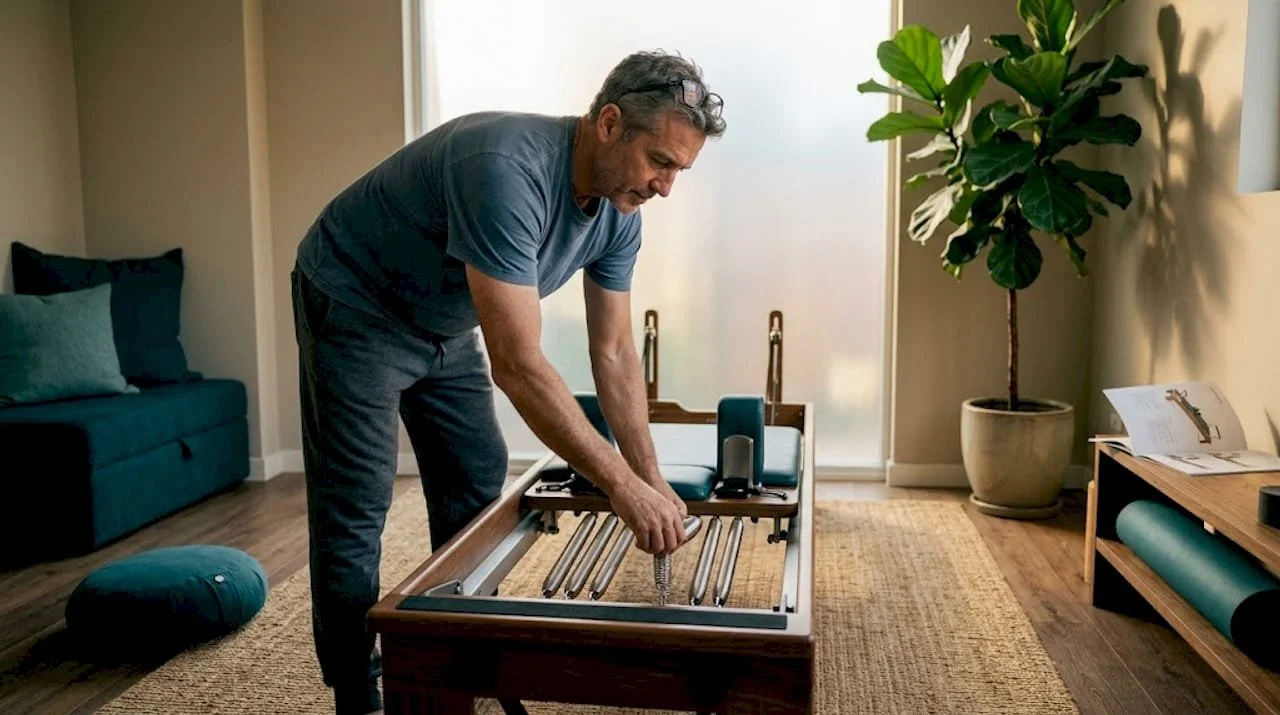
Springs: Typically four to five color-coded coil springs that connect the carriage to the frame. Adding or removing springs changes the resistance level for every exercise.
Footbar: An adjustable bar at one end of the machine. You push against it with your feet or hands depending on the exercise.
Shoulder blocks: Padded stops at the top of the carriage that keep your shoulders from sliding off when you push.
Straps and pulleys: Loops attached to a pulley system at the top of the frame. You thread your feet or hands through them for pulling movements.
Headrest: A small padded rest that adjusts to support neutral spine alignment.
That adjustable spring-based resistance can be increased or decreased for different exercises and difficulty levels, which is what separates the reformer from bodyweight-only methods. You can make an exercise easier by removing a spring, or harder by adding one, without changing the movement pattern itself.
| Component | Function | Adjustable? |
|---|---|---|
| Carriage | Slides along rails to create movement | No (fixed rails) |
| Springs | Provide resistance or assistance | Yes (add or remove) |
| Footbar | Push or press surface for feet or hands | Yes (height settings) |
| Shoulder blocks | Prevent sliding; stabilize upper body | Yes (position) |
| Straps/pulleys | Allow pulling and extension exercises | Yes (strap length) |
| Headrest | Supports neck and spine | Yes (angle) |
For a deeper look at reformer Pilates basics, including how studios structure beginner sessions, that resource walks through what a first class actually looks like.
How does a Pilates reformer machine work?
Understanding the machine's structure helps, but how does a reformer turn that into effective exercise? Let's break down how it works in practice.
Reformer Pilatesuses the machine to provide smooth, adjustable resistance while supporting alignment and enabling a wide range of positions. Every exercise on the reformer involves moving the carriage against the tension of the springs, which means your muscles are working both during the push phase and the return phase. That two-direction demand is called eccentric loading, and it's part of why reformer sessions feel thorough without feeling brutal.
A typical reformer movement, step by step:
Set up your spring load. You or your instructor choose how many springs are attached. Light spring loads reduce resistance and are often used for arm or flexibility work. Heavier loads build strength in larger muscle groups.
Position your body. You might lie on your back with feet on the footbar, sit upright holding the straps, or stand on the carriage facing the footbar. Each position targets different muscle chains.
Initiate from your core. Before the carriage moves, you engage your deep abdominal muscles and stabilize your pelvis. This is non-negotiable for reformer work.
Push or pull with control. The carriage slides smoothly. The movement should be slow and deliberate, not jerky or rushed.
Control the return. Bringing the carriage back to the starting position is equally important. The springs pull it back, and resisting that pull is where a lot of the strengthening happens.
Breathe with the movement. Instructors cue specific breathing patterns to coordinate breath with muscle activation, especially for core exercises.
Body positioning is one of the reformer's real advantages. Lying down removes the compressive load of gravity on your spine, making certain exercises far more accessible to people with back issues. Sitting and standing variations add balance challenges. Each shift in position changes the demand completely, which is why a single reformer session can feel like a full-body workout without ever feeling repetitive.
Pro Tip: If you're brand new to the reformer, start with two medium springs on most exercises. That spring load provides enough feedback to feel the resistance without overwhelming stabilizer muscles that haven't been trained yet.
Because form and alignment cues matter so much, checking out our beginner Pilates guide before your first session can make an enormous difference in how quickly you progress.
Pilates reformer vs. mat: What's the real difference?
To see where the reformer fits in, let's compare it directly to classic mat work, which many people know from group classes or videos.
Mat Pilates is genuinely effective, especially for learning foundational movement principles and developing baseline core awareness. But reformer Pilates is generally more adjustable because the spring resistance and equipment allow modifications that mat work simply cannot replicate, including easier or harder setups and far more exercise options.
| Category | Reformer Pilates | Mat Pilates |
|---|---|---|
| Equipment needed | Reformer machine | Mat only |
| Resistance type | Adjustable spring resistance | Bodyweight and gravity |
| Accessibility for beginners | High (springs can assist movement) | Moderate (relies on existing strength) |
| Support for injuries | Higher (lying down reduces load) | Lower (more demanding positions) |
| Exercise variety | Very high (hundreds of variations) | Moderate |
| Cost | Higher (studio or machine purchase) | Low to free |
| Depth of strength work | Greater with progressive resistance | Limited by bodyweight |
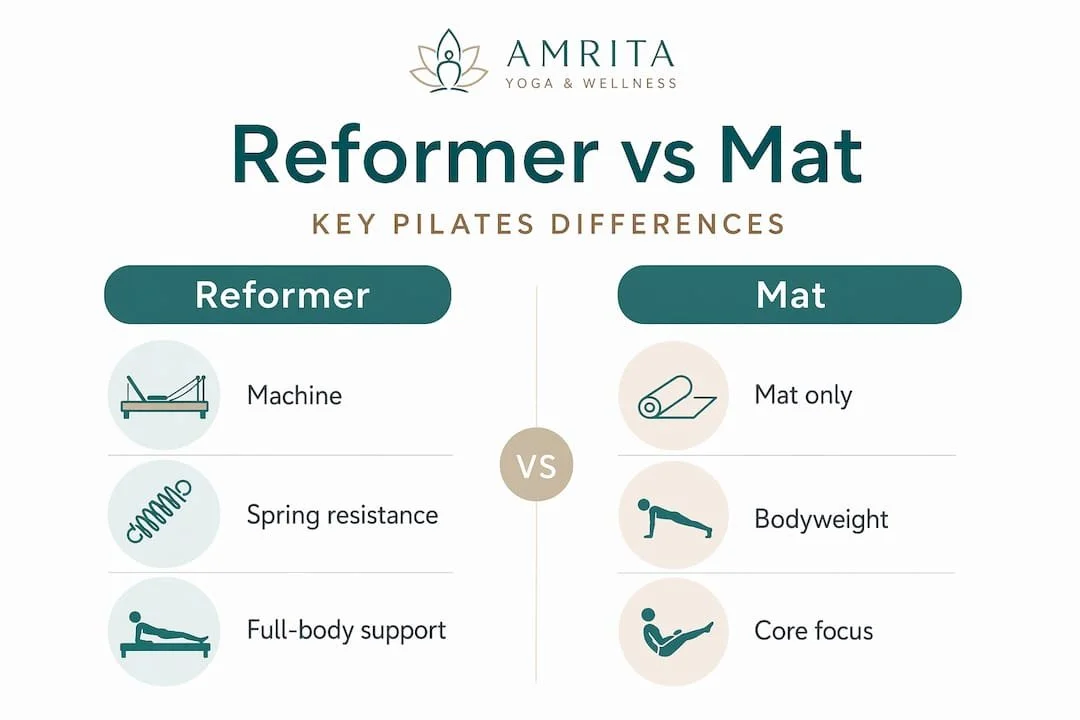
The most important distinction for most people is support. On the mat, you're working against your full bodyweight in every exercise. On the reformer, springs can actually assist your movement when set lightly, which means someone recovering from injury or a complete beginner can execute movements with correct form long before their muscles would be strong enough to do those same movements on a mat.
When to choose reformer:
You want progressive resistance without weights
You're recovering from injury and need supported movement
You're looking for variety and challenge within one machine
Core stability and posture correction are priorities
When mat works well:
You want to practice at home without equipment
You're establishing body awareness before adding machine work
Budget or space is a constraint
For more detail on why reformer Pilates works so effectively for strength and alignment, as well as a breakdown of the different reformer types you'll encounter in studios, those resources go deep on the specifics.
Key benefits and results of Pilates reformer workouts
Given what makes the reformer unique, what real-world improvements can you expect if you add it to your routine?
Research shows that reformer Pilates can improve core stability, balance, flexibility, and body-composition measures in some populations over supervised multi-week programs, though results vary and muscle-mass hypertrophy effects are not consistent across studies. In plain language, you will very likely get stronger through your core, move better, and feel more flexible. You may not bulk up, which for most people who seek reformer training is exactly the point.
"The most consistent benefits of reformer Pilates reported across research are improvements in core muscle activation, postural alignment, and functional flexibility, especially in populations dealing with chronic low back pain or age-related movement decline."
Benefits you can realistically expect:
Core stability: The reformer demands constant deep core engagement. Your transverse abdominis (the deep wrapping muscle underneath the six-pack) activates on every movement, often more effectively than in mat work.
Improved posture: Shoulder and hip alignment cues throughout every session retrain habitual movement patterns over time.
Flexibility gains: The long, controlled range of motion in exercises like footwork and long spine stretch progressively lengthens tight muscle groups.
Balance and coordination: Exercises performed standing or on one leg on a moving carriage challenge your proprioception (your body's sense of its own position) in ways flat-ground exercise cannot.
Low-impact load: Joints experience far less stress than in running, jumping, or heavy lifting, making reformer Pilates particularly valuable for older adults or anyone managing joint conditions.
Mind-body connection: The deliberate focus required for each movement builds a level of body awareness that carries over into everyday posture and movement habits.
The core benefits page covers many of these outcomes in more depth, including practical timelines for when to expect noticeable changes.
Expert tips: Getting the most from your Pilates reformer
Knowing what the research says about results, the final step is using the reformer smartly. Here's what experts say makes all the difference.
The single biggest obstacle for new reformer practitioners is the temptation to speed through exercises. Moving too fast or using the wrong spring load can limit results or create unnecessary tension in the neck, shoulders, and lower back. The springs do part of the work for you, so rushing through reps just means you're letting the machine do the job your muscles should be doing.
Checklist for a safe, effective reformer session:
Confirm your spring setup before you start. Ask your instructor which load is appropriate for each exercise rather than guessing.
Check your alignment before any movement begins. Shoulders away from ears, neutral spine, ribcage not flaring.
Engage your core before pushing or pulling. That deep contraction should happen before the carriage moves, not as an afterthought.
Move at a pace where you feel the resistance the whole time. If you can't feel the springs working, you're going too fast.
Breathe consistently. Holding your breath increases tension and reduces control. Match exhale to exertion.
Rest when needed. Fatigue leads to compensation. It's better to pause and reset than to grind through with poor form.
Common beginner mistakes to avoid:
Selecting too many springs early on, thinking more resistance equals better results
Gripping the straps or footbar tightly instead of maintaining relaxed hands and engaged arms
Lifting the head and straining the neck during footwork instead of using the headrest
Skipping the neutral spine setup cue at the start of each exercise
Pro Tip: Before your very first session, mention any injury history to your instructor, specifically areas like the lower back, knees, or shoulders. Most reformer exercises have immediate modifications, and a qualified instructor will adapt the session to where your body actually is today rather than where you wish it were.
Our beginner Pilates guide covers the foundational concepts behind these tips in more detail, so you can walk into your first session with real confidence.
What most guides miss about Pilates reformer practice
Most articles about the reformer read like machine manuals. They list the components, name the benefits, maybe show a few exercises. What they skip is the most honest and important truth about this tool: the machine is not doing the work. You are.
Adjustable resistance is the reformer's greatest strength and, for many people, its biggest source of confusion. Because you can dial the springs to make every exercise feel manageable, it's easy to stay comfortable. Comfort feels like progress. It isn't. True progress on the reformer requires regular, intentional increases in challenge, whether that means adding a spring, changing body position, or slowing the movement down until your stabilizer muscles are shaking. Most beginners over-focus on the machine's features and under-focus on the quality of each rep.
Here's something seasoned instructors and clinical reformer practitioners will tell you plainly: thirty slow, aligned, deeply engaged reps will always outperform one hundred quick, sloppy ones. The reformer is a feedback tool as much as a resistance machine. If the carriage is jerking, wobbling, or drifting to one side, that tells you something about your muscle balance that no amount of mirror-watching will reveal.
The practical advice is straightforward. Seek out an instructor who watches your movement rather than just counting reps. Prioritize form feedback over workout duration in the first several months. Treat your reformer Pilates basics education as ongoing, not something you complete after a few classes.
The reformer rewards patience and precision in ways that most fitness tools simply do not. That's what makes it genuinely useful for long-term wellness, not just a trendy workout.
Ready to try Pilates reformer? Your next step
If reading this has confirmed what you've been thinking, that the reformer might be the right next step for your body and your wellness practice, the best move is working with experienced instructors who can personalize the experience from day one.
At Amrita Yoga & Wellness, we offer Pilates reformer classes designed for every level, from your very first session to advanced progressions. Our Philadelphia studio combines reformer instruction with a full range of holistic wellness services, including yoga, barre, massage therapy, and even Tarot readings for those who want to support their wellness journey on every level. Whether you're building a stronger core, recovering from an injury, or simply looking for a movement practice that respects your body, we're here to help you get there with guidance that actually fits your goals.
Frequently asked questions
Is a Pilates reformer machine suitable for beginners?
Yes, the adjustable resistance and guided support make a reformer accessible for most beginners. The spring modifications allow instructors to set difficulty low enough that anyone can execute proper form right from the start.
Can reformer Pilates help with weight loss or toning?
Reformer Pilates can improve body composition and core stability, though significant weight loss depends on overall lifestyle factors including diet and activity volume. Most practitioners notice improved muscle tone and posture before changes in body weight.
Do I need to be flexible or fit to start with a Pilates reformer?
No. The reformer's adjustability means people at most fitness levels can participate safely, with springs set to assist rather than resist movement when needed. The spring resistance modifications specifically exist to bridge the gap between where you are and where you want to be.
How is spring resistance adjusted on a Pilates reformer?
You change the reformer's resistance by physically attaching or detaching springs from the carriage to the frame. That spring-based resistance can be increased or decreased between exercises, making it easy to scale intensity within a single session.
Recommended
Find your balance: yoga, Pilates, and mindfulness in Philadelphia
TL;DR:
Holistic wellness centers in Philadelphia integrate yoga, Pilates, and mindfulness to support both physical and mental health. These centers emphasize personalized attention, small group classes, certified instructors, and a supportive community to foster lasting well-being. Their comprehensive approach addresses stress, posture, and emotional resilience more effectively than traditional single-modality studios.
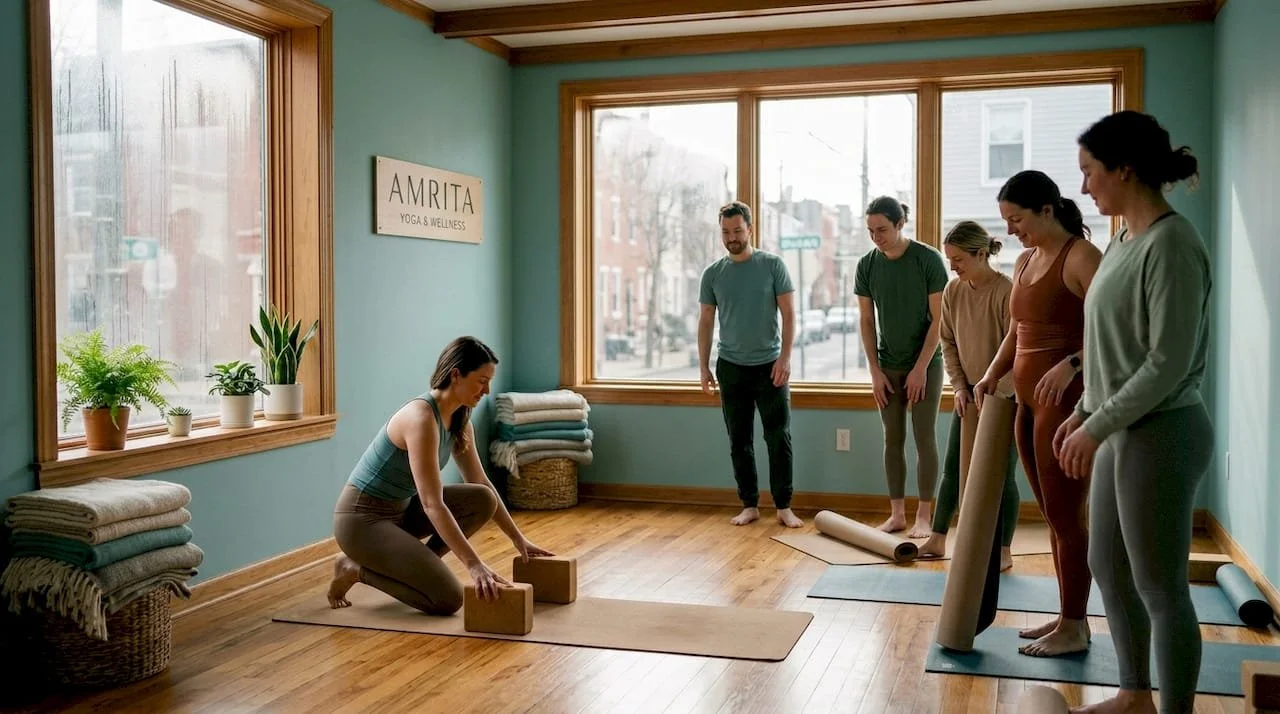
Most people assume a yoga studio is simply a room full of mats and stretching routines. That assumption misses something significant. In Philadelphia, a growing number of centers are redefining what a wellness studio can do, weaving together yoga, Pilates, and mindfulness into a single, intentional experience designed to build genuine physical and mental balance. This guide walks you through what separates these holistic centers from standard studios, how the practices complement each other, how to choose the right fit for your lifestyle, and exactly what your first steps should look like. If you're ready to move beyond the occasional class and toward lasting well-being, this is your starting point.
Table of Contents
Key Takeaways
| Point | Details |
|---|---|
| Holistic approach | Yoga balance centers integrate yoga, Pilates, and mindfulness for physical and mental wellness. |
| How to evaluate | Evaluate studios based on instructor credentials, community feel, class size, and integrated programs. |
| Benefits beyond fitness | Consistent attendance can improve posture, reduce pain, and lower stress long-term. |
| Easy to start | Begin with trial classes and supportive environments designed for all experience levels. |
What is a yoga balance center?
Most traditional yoga studios do one thing well: teach yoga. That's not a criticism. But a yoga balance center takes a much broader view of what it means to feel well in your body and mind. Rather than offering a single modality, a true balance center brings together multiple integrated practices, including yoga, Pilates, and mindfulness techniques, to address the full picture of adult well-being.
The difference shows up in the details. Class sizes tend to be smaller, which allows instructors to give personalized adjustments and real feedback. The environment is designed to feel supportive rather than competitive. And the programming reflects a philosophy that physical strength and mental clarity are not separate goals but two parts of the same practice.
Here are the core features that define a genuine yoga balance center:
Integrated modalities: Yoga, Pilates, and mindfulness are offered together, not as isolated add-ons
Certified instructors: Teachers hold credentials in their specific disciplines, not just general fitness certifications
Small group settings: Class sizes are intentionally limited to preserve safety and individual attention
Whole-person focus: Programming addresses stress, mental clarity, and emotional health alongside physical fitness
Community culture: Regular practitioners are known by name, and instructors track your progress over time
"Balance Studios in Philadelphia offers Ashtanga Yoga alongside martial arts, focusing on physical and mental well-being in a supportive environment."
This kind of intentional design matters deeply for adults who want real-life results. Stress, posture problems, and mental fatigue don't respond to physical exercise alone. They require a holistic approach where the nervous system gets as much attention as the muscles. Understanding the Pilates basics of core engagement, for example, connects directly to how your body manages tension during a stressful workday. That connection is what balance centers are built to create.
How yoga, Pilates, and mindfulness work together
Now that you know what a yoga balance center offers, let's explore how its main practices combine for whole-body results. Each discipline brings something distinct to the table, and the real value emerges when you practice all three with consistency.
Yoga builds flexibility, body awareness, and breath control. Over time, a consistent yoga practice improves your range of motion, reduces joint stiffness, and trains you to notice tension patterns in your own body before they become pain. Pilates targets the deep stabilizing muscles of the core, improving posture and spinal alignment in ways that carry over into every other physical activity. Mindfulness addresses the mental layer, reducing stress hormones, sharpening focus, and helping you stay present in your body during practice and in daily life.
| Practice | Primary benefit | Secondary benefit | Combined benefit |
|---|---|---|---|
| Yoga | Flexibility and balance | Breath awareness | Better body-mind connection |
| Pilates | Core strength and posture | Spinal stability | Reduced back pain and injury risk |
| Mindfulness | Stress reduction | Mental focus | Sustained motivation and consistency |
| All three combined | Whole-body balance | Emotional resilience | Lasting lifestyle change |
For adults in Philadelphia juggling work, family, and city living, the combined effect of these three practices is genuinely different from what any one practice achieves alone. Pilates mindfulness exercises train your ability to stay mentally present while your body works hard, which is a skill that transfers directly into managing high-pressure situations off the mat. Mindfulness for yoga deepens the physical practice by helping you connect breath to movement rather than just going through the motions.
Studies and practitioner experience alike support the idea that integrated practice benchmarks include consistent improvement in posture, pain reduction, and mental clarity when yoga, Pilates, and mindfulness are practiced together with individualized attention in small group settings.
Pro Tip: Adding even one dedicated mindfulness session per week alongside your yoga or Pilates classes can significantly improve how quickly you notice physical results. Mindfulness reduces the stress-related tension that often counteracts the physical benefits of exercise, which means your body can actually absorb and adapt to the work you're putting in. You can explore examples of mindfulness techniques specifically designed for yoga and Pilates practitioners to get started.
How to choose the best yoga balance center in Philadelphia
Understanding the combined power of yoga, Pilates, and mindfulness leads naturally to what matters in choosing a studio designed for balance. Not every studio that mentions "wellness" actually delivers integration. Here's how to evaluate your options clearly.
| Evaluation factor | What to look for | Red flag |
|---|---|---|
| Class offerings | Yoga, Pilates, and mindfulness in the same program | Only one discipline available |
| Instructor credentials | Certifications in each specific modality | Generalist fitness background only |
| Class size | Under 15 students per session | Crowded, impersonal group classes |
| Community focus | Instructors know practitioners by name | High turnover, transactional feel |
| Studio homepage | Detailed descriptions of philosophy and programming | Sparse listings without context |
When exploring studios, prioritize those with detailed homepages over directory listings. A studio's own website reveals far more about its culture, teaching philosophy, and programming depth than a third-party listing can. Look for studios that clearly explain how each modality is taught, who the instructors are, and what a new student's experience will look like from day one.
According to established holistic studio benchmarks, adults seeking genuine balance should prioritize studios that offer individualized attention, small group safety, and integrated yoga, Pilates, and mindfulness programming rather than settling for one-size-fits-all fitness classes.
Here's a checklist to use when contacting studios directly:
Does the studio offer classes in at least two of the three core modalities (yoga, Pilates, mindfulness)?
Are class sizes capped, and if so, at what number?
Do instructors hold certifications specific to the modalities they teach?
Is there an introductory program or trial period for new students?
Does the studio communicate a clear philosophy about mental and physical well-being?
For those focused on managing stress through movement, check out resources on fitness for stress relief to better understand what kinds of programming actually address the nervous system rather than just burning calories. And if you're building your overall approach to practice, the Fitness and Yoga Tips archive is a strong place to build your knowledge before committing to a studio.
Red flags worth watching for include studios that push advanced classes on beginners, lack certified instructors, or treat mindfulness as an afterthought rather than a foundational element of the programming. If a studio can't clearly explain how its practices work together, that's a sign the integration is surface-level rather than genuine.
Getting started: Practical steps and what to expect
Armed with selection criteria, you're ready for practical action. Here's what starting your wellness journey really looks like, step by step.
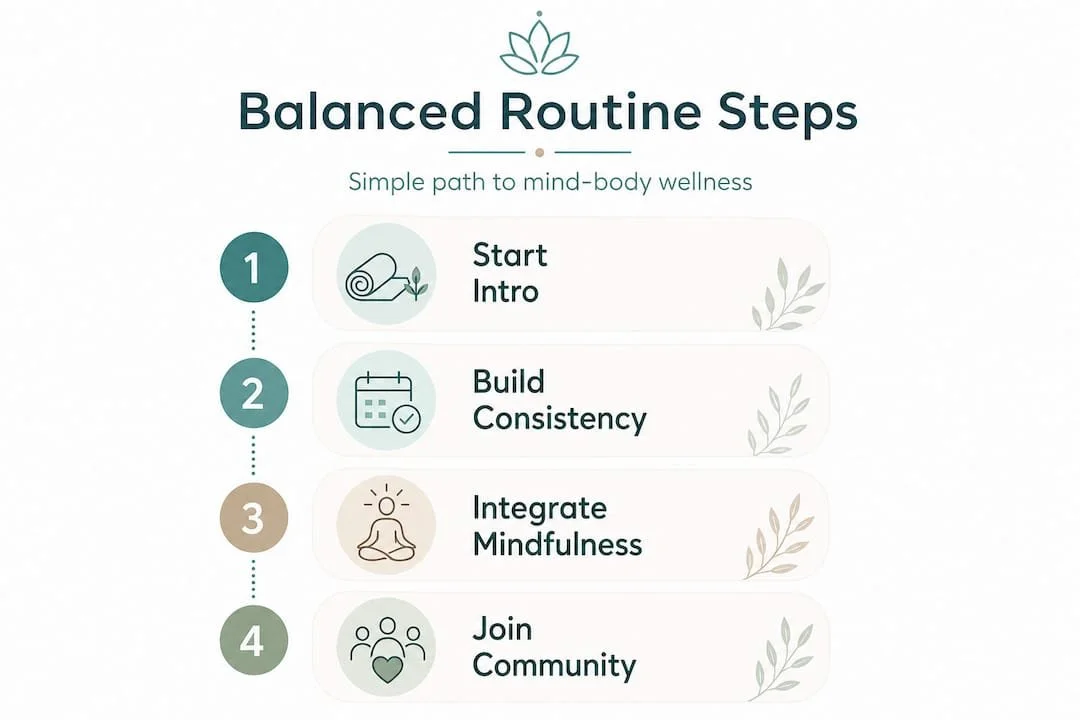
Research local studios online and read their full websites, not just their social media profiles. Look for detailed class descriptions, instructor bios, and a stated philosophy about holistic wellness.
Visit in person before committing. Walk through the space, notice whether it feels welcoming, and pay attention to how staff interact with current students.
Sample a class through an introductory offer or drop-in session. Most quality studios offer these specifically for new students.
Talk directly to instructors after class. Ask about their certifications, how they approach beginners, and how the studio structures its integrated programming.
Reflect on fit after your first two or three visits. Does the environment feel supportive? Are instructors attentive? Do you leave feeling better than when you arrived?
Pro Tip: Always start with an introductory package or designated beginner series rather than jumping into a mixed-level class. This gives you time to learn proper alignment, ask questions without pressure, and build confidence before practicing alongside more experienced students. The difference in your long-term consistency will be significant.
Your first month will likely include a safety orientation, an introduction to studio culture, and a gradual ramp-up in challenge. Expect to feel some muscle awareness (not pain) as your body adapts. Most students notice improved posture within three to four weeks, reduced stress responses by week six, and sharper mental focus by the end of the first month of consistent practice.
For deeper guidance on essential mind-body wellness tips, resources are available to help you prepare for what a balanced practice program actually involves. If you're curious about specialty formats that challenge your body in new ways, understanding aerial yoga safety explained can help you make informed decisions as your practice grows.
Building consistency is where most adults stumble. The solution isn't willpower. It's structure. Scheduling your classes as fixed appointments, choosing a studio that feels like a community, and tracking small milestones like less back pain or sleeping better keeps motivation grounded in real experience rather than abstract goals. Balance Studios in Philadelphia is one example of a center that creates this structured, supportive environment alongside diverse physical programming.
Why most adults struggle with balance—and how holistic studios change everything
After outlining steps for getting started, it's worth reflecting on why this whole-person approach actually works in ways that most wellness advice overlooks.
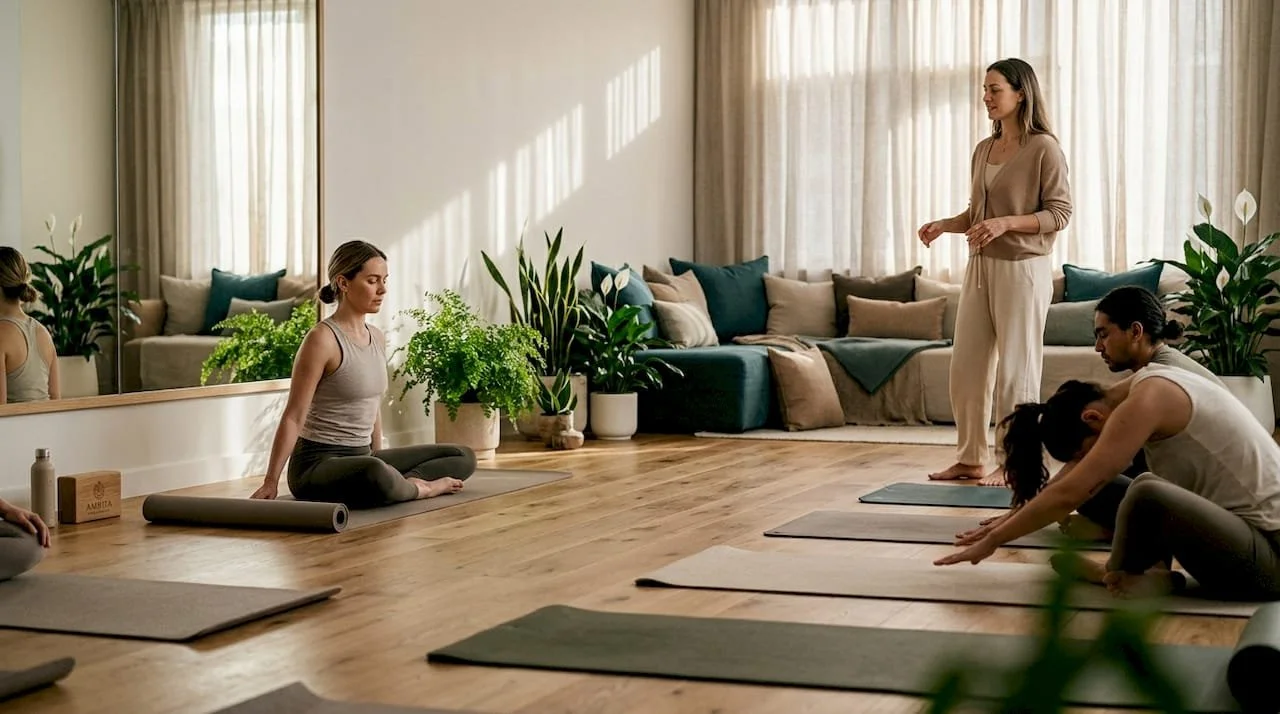
Conventional wisdom tells adults to exercise more. Go to the gym, run a few miles, take a weekly yoga class. The problem is that this advice treats the body like a machine and ignores everything else. Stress isn't just mental. It lives in your shoulders, your jaw, your breathing pattern. An isolated fitness routine can temporarily burn off tension, but it rarely addresses the nervous system patterns that create that tension in the first place.
Urban adults in Philadelphia face a specific combination of stressors: long commutes, dense living, demanding careers, and very little unstructured time. These conditions create a chronic low-level activation state in the body that sporadic yoga classes simply can't undo. What they need is a sustained practice environment where the nervous system is consistently given permission to regulate.
This is exactly where holistic studios change the equation. Mindfulness for Pilates teaches practitioners to bring conscious attention to core engagement, which directly calms the sympathetic nervous system while strengthening the body. Yoga builds flexibility not just in muscles but in how you respond to discomfort. When practiced together in a supportive community setting, these disciplines reinforce each other in a way that solo workouts never can.
What surprises most adults who make the shift to a genuine balance center is how much the community element matters. When your instructor knows your name, when fellow students recognize your progress, and when you feel accountable to showing up, the practice becomes self-sustaining. That social layer turns good intentions into durable habits, and durable habits are the only thing that actually transforms how you feel in your body and your life.
The uncomfortable truth is that most adults aren't struggling with balance because they lack discipline. They're struggling because they've been trying to solve a whole-person problem with a single-discipline answer. Holistic centers exist to close that gap.
Explore holistic balance with specialists in Philadelphia
Having explored the why and how behind balanced living, the next step is to experience these benefits firsthand with a reputable Philadelphia center.
Amrita Yoga & Wellnessoffers an integrated approach to physical and mental well-being through yoga, Pilates, mindfulness, and a range of specialty sessions designed to support every level of practitioner. Whether you're brand new to movement-based wellness or looking to deepen an existing practice, the studio's programs are structured to meet you where you are.
From beginner yoga series to specialized workshops including Tarot readings and holistic wellness sessions, the studio's offerings reflect a genuine commitment to whole-person care. Explore the full class schedule, connect with certified instructors, and find the entry point that fits your life. The community is welcoming, the programming is intentional, and the results speak for themselves.
Frequently asked questions
What's the difference between a yoga balance center and a regular yoga studio?
A yoga balance center blends yoga, Pilates, and mindfulness to support both physical and mental health, while a regular studio typically focuses on yoga alone. Centers like Balance Studios in Philadelphia illustrate this by pairing yoga with other disciplines to serve the whole person.
How do I know if a studio is right for my needs?
Look for small group sizes, certified instructors, and integrated programming, then visit their homepage and ask about trial classes. Holistic studio benchmarks emphasize individualized attention and consistent outcomes like posture improvement and pain reduction as key indicators of quality.
What are the main benefits of integrating yoga, Pilates, and mindfulness?
Integrated practice boosts posture, reduces pain, lowers stress, and supports emotional well-being beyond what physical exercise alone can achieve. Combined practice research consistently highlights posture improvement and pain reduction as early and measurable benefits.
Is a yoga balance center suitable for beginners?
Yes. Most studios offer introductory programs, emphasize safety, and help beginners gradually build consistency and confidence. Balance Studios in Philadelphia is one example of a center that creates a supportive environment for students at every experience level.
Recommended
Explore Club Pilates Class Types for Strength and Flexibility
TL;DR:
Pilates offers diverse formats like mat, reformer, tower, and chair to suit various goals and levels.Choosing the right class depends on your fitness goals, experience, injuries, and preferred intensity.Instructor quality, class environment, and your post-class feelings are crucial factors for long-term success.
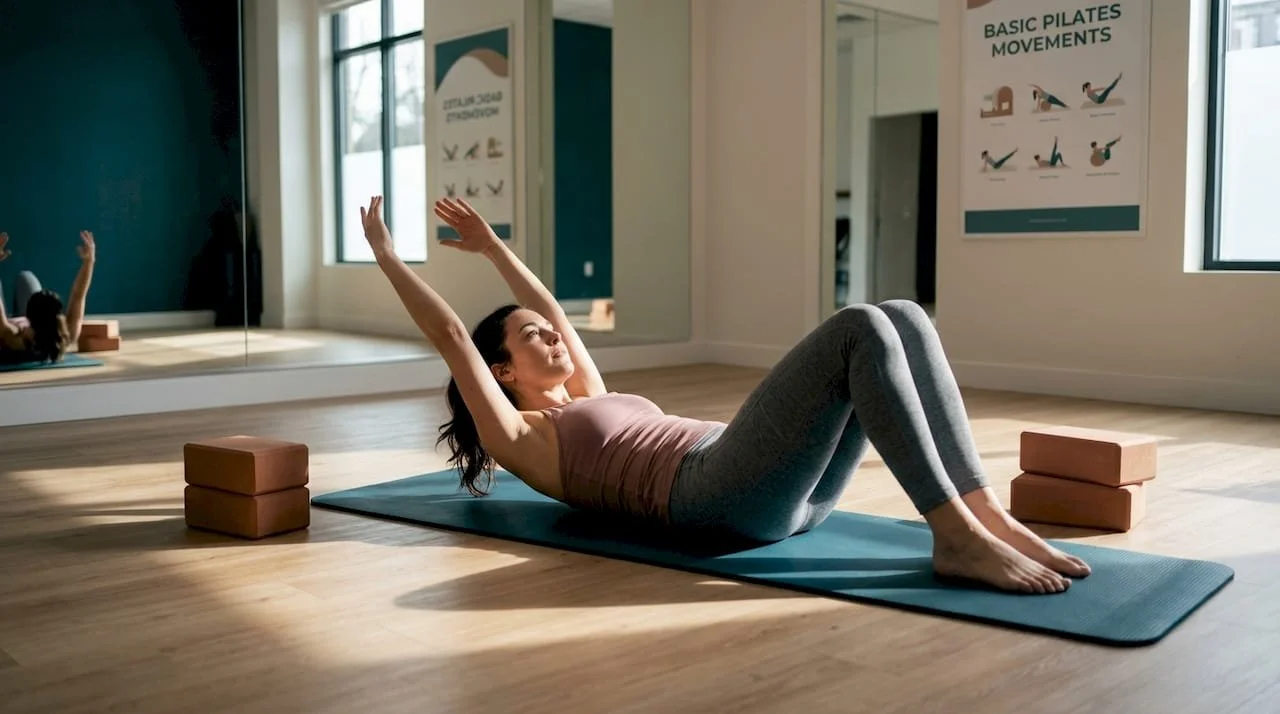
Choosing the right Pilates class feels straightforward until you're staring at a schedule packed with terms like "reformer flow," "mat foundations," "tower strength," and "fusion cardio." The variety is genuinely exciting, but it can also stop you from booking your first session. The good news: once you understand what each format offers and how it maps to your actual goals, the decision becomes much simpler. This guide breaks down every major Club Pilates class type, compares them honestly, and helps you figure out which one fits where you are right now.
Table of Contents
Key Takeaways
| Point | Details |
|---|---|
| Class type matters | Different Pilates formats target unique needs, so choosing the right type maximizes results. |
| Difficulty varies | Mat classes can be as challenging as reformer sessions, depending on class structure. |
| Equipment influences outcome | Reformer Pilates allows for adjustable resistance, supporting rehab and advanced strength. |
| Try multiple formats | Experimenting with various class types helps you find the best fit for your personal goals. |
How to choose the right Club Pilates class
Now that you recognize the range of class options, let's pinpoint how to narrow your choices to what fits best for you. Before diving into specific formats, it pays to think through a few personal criteria. Jumping straight to "reformer because everyone says so" often leads to frustration, especially if your body or goals need something different.
The four main types of Pilates equipment you'll encounter are:
Mat: A padded floor surface, sometimes with small props like resistance bands, circles, or balls.
Reformer: A sliding carriage on a frame, driven by an adjustable spring system that adds or reduces resistance.
Tower: A vertical frame with wall-mounted springs, straps, and bars attached to a mat or reformer base.
Chair: A compact box-like apparatus with a spring-loaded pedal that challenges balance and core stability in a very focused way.
Before booking, ask yourself five questions:
What's my main fitness goal? Core strength, flexibility, injury rehab, weight management, or athletic cross-training?
What's my experience level? Brand new to Pilates, returning after a break, or already consistent?
Do I have any injuries or movement restrictions? Some formats are more forgiving than others.
How intense do I want the class to feel? Sweaty and challenging, or controlled and methodical?
Do I prefer small group attention or a larger class energy?
Here's something many people don't realize: difficulty varies by instructor, not just equipment. A tough mat class with a skilled instructor can leave you more sore than a beginner reformer session. Keep that in mind as you read through the formats below.
Pro Tip: Try at least two or three different class types before settling on a regular format. Your preferences after class, not just during, are the most reliable guide.
Mat Pilates classes: Foundation and intensity
With your criteria in mind, let's start with the classic mat Pilates class and why it remains a favorite after more than a century of practice. Mat Pilates is the original format Joseph Pilates developed, and it requires no large equipment whatsoever. You work entirely with your bodyweight, floor space, and occasionally small props like foam rollers, magic circles, or light resistance bands.
The benefits are real and well-established. Mat work builds foundational core strength by forcing your muscles to stabilize without external support. It improves flexibility, body awareness, and breathing patterns. Because there's no machine involved, you can practice the same movements at home once you learn them, which makes it genuinely portable.
Mat Pilates is especially good for:
True beginners who want to learn Pilates principles before adding equipment complexity
People on a budget, since mat classes tend to be less expensive
Anyone wanting a home-friendly practice they can maintain between studio visits
Those working on postural awareness and foundational alignment
"Mat classes can sometimes feel more challenging than reformer, depending on instructor cues and props. Without the reformer's spring assistance, your muscles have to work without mechanical support, which can be humbling even for experienced movers."
The honest pros and cons of mat Pilates:
Pros:
Highly accessible, no equipment required
Teaches body awareness from the ground up
Often available at a lower price point
Great entry point for a beginner Pilates guide
Cons:
Less resistance customization than equipment-based classes
Challenge depends heavily on instructor skill
Harder to modify for certain injuries without props
Reformer Pilates: Versatile, scalable strength
After understanding the mat class foundation, explore how equipment like the reformer builds upon and expands Pilates possibilities. The reformer is arguably the most versatile piece of Pilates equipment ever designed. Its sliding carriage moves along a track, controlled by a spring system that lets you increase or decrease resistance with a simple adjustment. That single feature changes everything.
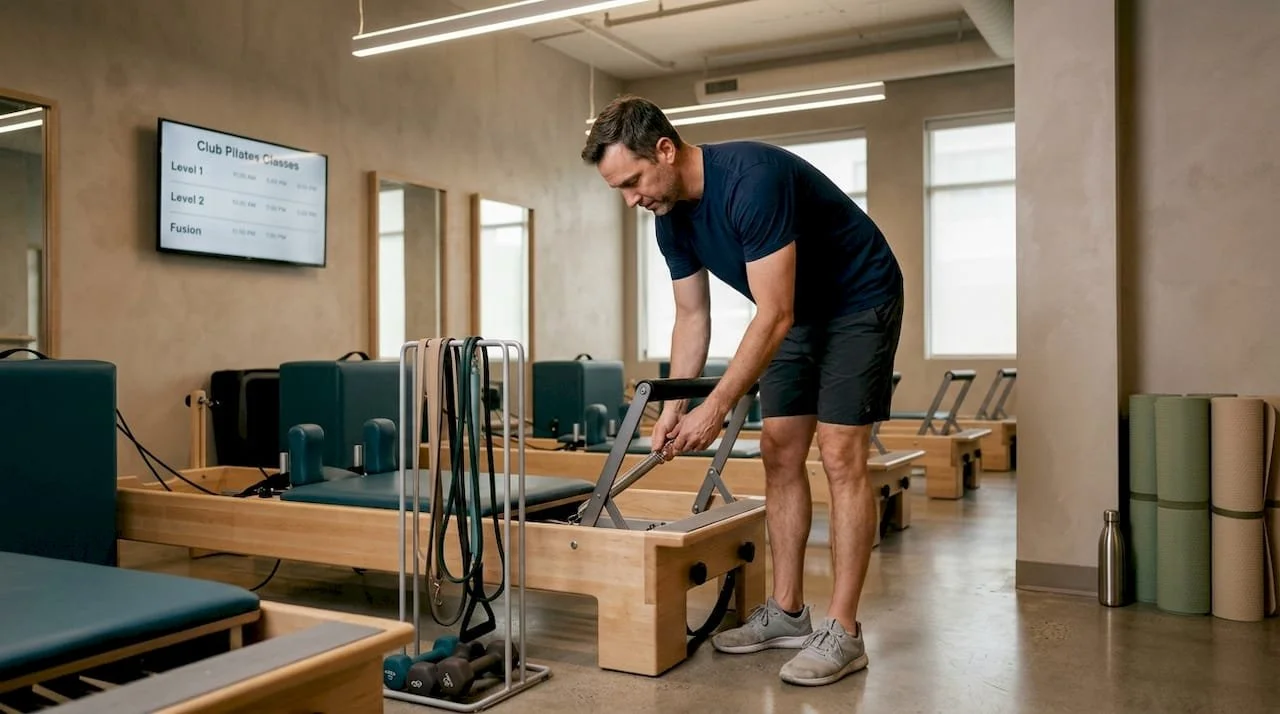
Because resistance is adjustable, reformer Pilates supports everyone from someone recovering from knee surgery to a competitive swimmer building functional strength. The machine guides your movement through a fuller range of motion than most floor exercises allow, which means your muscles work through positions they rarely access in daily life or traditional gym training.
Signature benefits of reformer classes include:
Deeper range of motion through spring-assisted and spring-resisted movement
Scalable resistance for both gentle rehab and serious strength building
Low-impact loading that protects joints while still challenging muscles meaningfully
Full-body integration where arms, legs, and core work together in nearly every exercise
Feedback from the machine that teaches alignment and muscle activation patterns quickly
Understanding the different Pilates Reformer types can also help you understand what to expect when you walk into a studio, since not all reformers feel the same to use.
Reformer classes work best for:
People with specific fitness goals like glute strength, shoulder stability, or spinal mobility
Anyone recovering from an injury who needs supervised, low-impact progression
Intermediate and advanced practitioners who want structured progression
Athletes looking for cross-training that builds stabilizer muscles
Pro Tip: Always start with a "Level 1" or "Intro to Reformer" session before jumping into intermediate classes. The spring tension and footbar adjustments feel intuitive after a few sessions, but they're genuinely confusing on day one.
The reformer Pilates core benefits also extend beyond the studio: the movement patterns you train carry over into better posture, reduced lower back tension, and more efficient movement in sports and everyday activities.
Beyond the basics: Tower, chair, and fusion classes
Once you're familiar with mat and reformer options, consider how specialty classes add variety and target specific skills. These formats aren't just for advanced practitioners. They offer genuinely different experiences that can address specific weaknesses or simply keep your practice from going stale.
Tower Pilates uses a vertical frame mounted to a wall or attached to a reformer, with springs, straps, push-through bars, and roll-down bars. The setup creates resistance from above and below, which creates a training stimulus you can't replicate with mat or reformer alone.
Benefits and considerations of tower classes:
Pros: Excellent for spinal mobility, shoulder flexibility, and balance; spring-loaded resistance challenges the body from new angles; often feels like a deeply therapeutic session
Cons: Equipment is less common than standard reformers; can feel confusing without a proper introduction; requires good body awareness to use safely
Chair Pilates uses a small box-like apparatus with a spring-loaded pedal. It sounds simple. It's not. The chair demands exceptional core stability and coordination because the base of support is small and the lever arms are long. Exercises like the footwork series on the chair will challenge your balance in ways that mat and reformer simply don't.
Benefits and considerations of chair classes:
Pros: Highly effective for core stability and functional leg strength; great for addressing asymmetries between left and right sides; compact equipment means many studios include it as part of circuit-style classes
Cons: High skill demand; not ideal for complete beginners without guidance; can feel frustrating before you develop the proprioception (your body's position sense) it requires
Fusion classes blend elements from reformer, chair, tower, and mat into a single session. These formats are creative, often fast-paced, and require a foundation in at least one Pilates apparatus before they feel manageable. The main advantage is variety: your body doesn't adapt as quickly when the stimulus keeps changing.
Benefits and considerations of fusion formats:
Pros: Prevents training plateaus; keeps class energy high; works more muscle groups in a single session
Cons: Can feel overwhelming without baseline experience; harder to focus on specific weaknesses; quality depends heavily on instructor sequencing skill
Mat vs. reformer: Which Club Pilates class suits your goals?
To help you decide, here's a clear comparison and guidance for picking what fits your needs. It's worth remembering that perceived intensity depends heavily on individual class delivery and instructor style, not just which piece of equipment you're using.
| Feature | Mat Pilates | Reformer Pilates |
|---|---|---|
| Equipment needed | None (small props optional) | Reformer machine |
| Difficulty range | Beginner to advanced | Beginner to advanced |
| Resistance customization | Low (bodyweight only) | High (adjustable springs) |
| Rehab suitability | Moderate | High |
| Home practice friendly | Yes | No |
| Cost per class | Lower | Moderate to higher |
| Best for | Foundations, flexibility, beginners | Strength, rehab, progressive goals |
Based on your goals, here's a quick recommendation guide:
Beginners: Start with mat Pilates to learn the vocabulary of movement, then transition to a reformer Pilates beginner guide once you feel comfortable.
Athletes: Reformer classes, especially intermediate or advanced levels, for targeted stabilizer work.
People with injuries: Reformer, particularly if the studio offers clinical reformer options with instructors trained in rehabilitation.
Flexibility focus: Tower and mat classes tend to emphasize long, lengthening movements.
Strength focus: Reformer and chair classes deliver more resistance-based challenge.
Both mat and reformer Pilates are excellent. Neither is universally "better." The format that gets you consistent, is the format that works.
What most miss when choosing a Club Pilates class
Here's a perspective that doesn't come up often enough: most people spend too much time obsessing over equipment and not nearly enough attention on the instructor and the class community. That's a real mistake.
We've seen it play out repeatedly. Someone tries reformer Pilates with an instructor who gives mechanical cues focused on position only, feels nothing, decides reformer "isn't for them," and walks away. Then they take a mat class with an instructor who cues from sensation and breath, and suddenly they're hooked. Same person. Different instructor. Completely different result.
The perceived difficulty is based on more than equipment: it varies by instructor, studio context, and even class energy. A great instructor makes a basic exercise feel profound. A disengaged one makes an advanced machine feel pointless.
Practically speaking, here's what we'd tell anyone starting their Pilates search:
Pay attention to how you feel an hour after class, not just during. If you feel accomplished, clear-headed, and like your body moved well, that's a green flag for that format and instructor. If you feel confused, embarrassed, or disconnected, that's information too, and it may have nothing to do with the equipment.
Notice the class culture. Is it competitive or encouraging? Do people help each other? Does the instructor remember your name? Small things like this determine whether you'll actually keep showing up, and consistency is the only thing that drives real results in Pilates.
Exploring deeper Pilates reformer types can also shift your perspective from "which machine" to "which experience," which is ultimately the more useful question. Your Pilates journey is long. The best class type is the one you genuinely look forward to attending.
Ready to discover your ideal Pilates class?
You've done the research. Now it's time to feel it in your body.
At Amrita Yoga & Wellness in Philadelphia, we believe the right class isn't just about equipment or intensity levels. It's about finding a space where you feel supported, challenged, and genuinely seen. Whether you're drawn to mat work, curious about the reformer, or ready to explore specialty formats, our studio offers class options designed to meet you exactly where you are. Joining the Karma Yoga Club is a great way to access a curated variety of classes at a value that makes consistent practice sustainable. Come find your format, and let the practice do the rest.
Frequently asked questions
Which Pilates class type is best for beginners?
Beginners often start with mat Pilates or introductory reformer classes to learn foundational techniques in a supportive setting. Mat classes focus on fundamentals that transfer naturally to equipment-based formats later.
Can Pilates reformer classes help with injury recovery?
Reformer Pilates is widely used for rehabilitation because its adjustable resistance supports gentle, guided movement. Studios offering clinical reformer options often work with instructors trained specifically in restorative applications.
Is mat Pilates less challenging than reformer Pilates?
Not always. Some people find mat classes more intense because difficulty depends on instructor style and props rather than the equipment itself.
What's unique about tower or chair Pilates classes?
Tower and chair classes add unique resistance and balance challenges that reformer and mat work simply can't replicate, making them ideal for practitioners who want targeted, specialized training stimulus.
How do I know which Pilates class is right for me?
Consider your fitness goals, experience level, and comfort with equipment, then try two or three formats before committing. How you feel in the hour after class is your most reliable guide.
Recommended
How Pilates Supports Wellness: A Guide for Philly Adults
TL;DR:
Pilates improves flexibility, core strength, balance, and posture, benefiting daily movement.It reduces stress, anxiety, and pain by emphasizing controlled movement and mindful breath.Suitable for diverse populations, Pilates supports health goals beyond aesthetics through consistent practice.
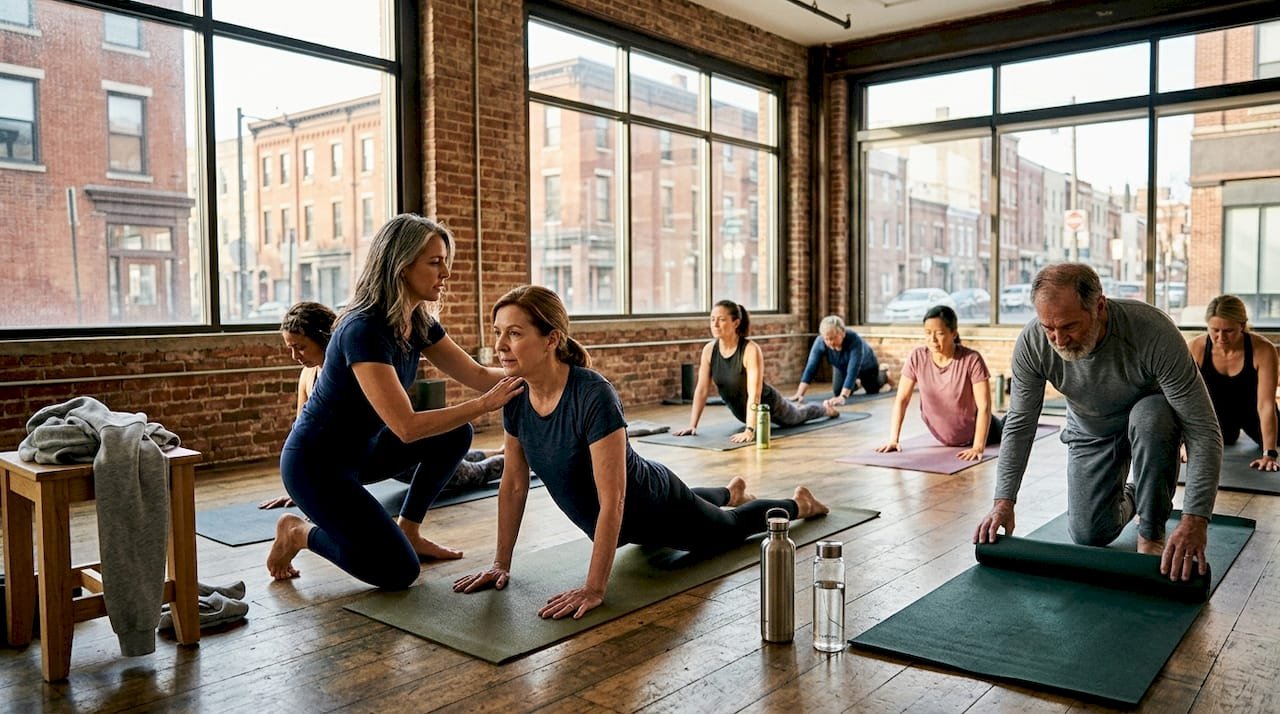
Pilates gets dismissed as gentle stretching or a boutique fitness trend reserved for dancers and athletes. That reputation undersells it completely. Recent science shows Pilates delivers measurable improvements in pain reduction, mental health, and functional fitness that go far beyond flexibility. For adults in Philadelphia juggling demanding schedules, desk jobs, and urban stress, those outcomes matter. This guide breaks down what Pilates actually does for your body and mind, who it works best for, and how to fit it into a realistic wellness routine without overhauling your entire life.
Table of Contents
Key Takeaways
| Point | Details |
|---|---|
| Holistic wellness boost | Pilates offers proven benefits for physical and mental health, including flexibility, pain reduction, and stress relief. |
| Accessible for all adults | Pilates can be safely practiced by a wide range of adults, including those with chronic conditions or beginners. |
| Best in balanced routine | Integrating Pilates with other wellness practices produces optimal results, rather than relying on it alone for muscle or weight changes. |
| Myths versus reality | Common misconceptions about Pilates are clarified—it’s not a major weight-loss method but a holistic wellness enhancer. |
Pilates as a foundation for physical health
Pilates is built on controlled, intentional movement. Every exercise asks your muscles to work together rather than in isolation, which is why it feels deceptively challenging even without heavy weights. That full-body demand is also why the benefits stack up quickly across multiple dimensions of physical health.
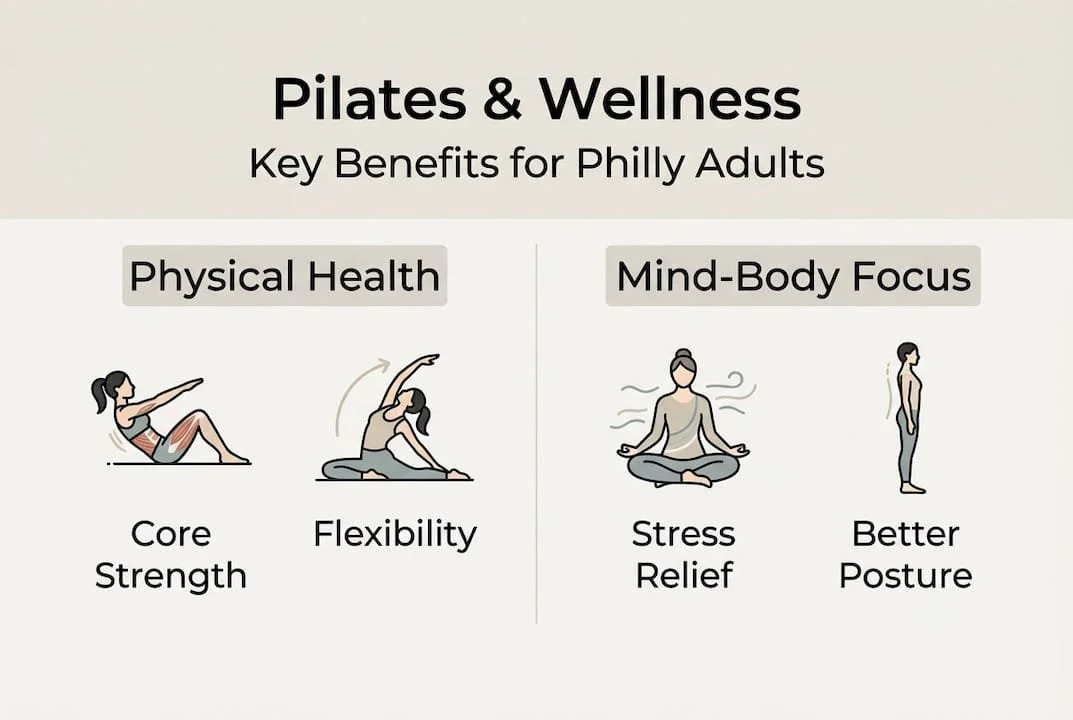
Flexibility, core strength, balance, and postureall improve with regular Pilates practice, according to National Geographic's science coverage. That combination is not just about feeling limber. Better posture reduces neck and shoulder tension. Stronger core muscles protect your lower back. Improvedpelvic alignment and balancelower your fall risk as you age, which becomes increasingly relevant past 40.
For anyone in Philadelphia who spends hours at a desk or commuting, these physical changes translate directly into daily life. You move more easily, sit more comfortably, and recover faster from physical strain.
Here is what consistent Pilates practice supports for adults:
Reduced lower back pain through targeted core engagement
Improved posture from spinal mobility and alignment work
Greater joint flexibility without the high-impact stress of running or jumping
Better balance and coordination especially important for adults over 50
Faster recovery from injuries due to emphasis on controlled, low-impact movement
Stronger deep stabilizer muscles that protect knees, hips, and the spine
If you are new to the practice, start with guided resources on building strength and flexibility to understand the foundational movements before jumping into intermediate classes. Working on building core strength with proper form from the start prevents bad habits that could limit your progress later.
Mental health: The mind-body connection in Pilates
With physical health benefits established, let's turn to Pilates' crucial role in mental wellness.
Most people who start Pilates for physical reasons end up staying for the mental clarity it provides. That is not a coincidence. Pilates demands full attention. You cannot scroll your phone while coordinating breath with precise movement, which forces your nervous system to downshift in a way passive rest often does not.
"Pilates reduces anxiety, depression, stress, pain, and disability while improving quality of life," according to peer-reviewed research published in a clinical review covering multiple controlled trials.
For Philadelphians navigating city stress, that is significant. The mind-body integration evidence points to Pilates as a meaningful complement to therapy, medication, or other mental health tools, not a replacement, but a genuine contributor.
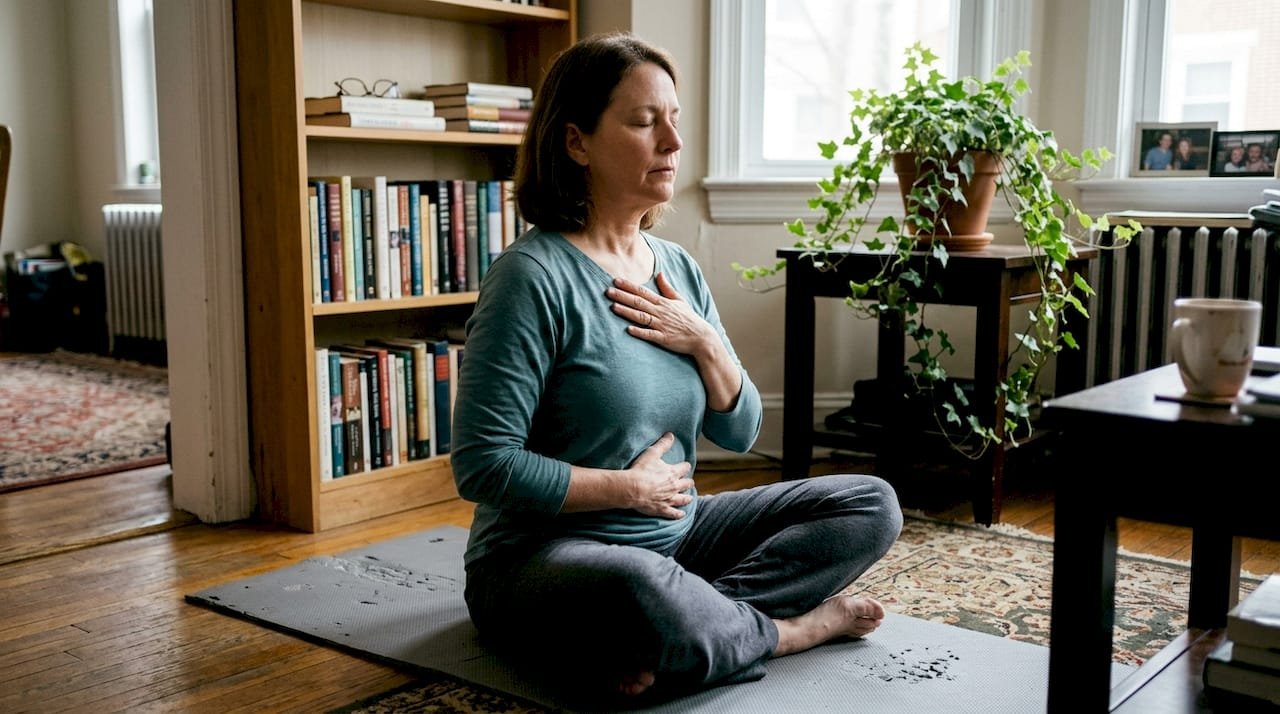
The mechanism behind these mental benefits is grounded in breathwork. Pilates uses lateral thoracic breathing, which means you expand the ribcage sideways rather than lifting the chest. This activates the parasympathetic nervous system and lowers cortisol, the body's primary stress hormone. Learning proper pilates breathing techniques early in your practice accelerates both the physical and mental payoff.
Here are practical steps to deepen the mind-body connection in your Pilates sessions:
Arrive five minutes early to sit quietly and set a single intention for your session
Sync breath with movement from the first exercise rather than treating breathing as an afterthought
Notice physical sensations without judging them, building the self-awareness that defines mindful movement
End each session with two minutes of stillness to let the nervous system register what just happened
Use breath cues as anchors whenever your focus drifts during complex sequences
The depth of breathwork in Pilates separates it from many other fitness formats. When practiced consistently, that breath awareness carries into daily life, helping you respond to stressors more calmly.
Inclusivity and adaptability: Pilates for every adult
Building on mind-body integration, let's see who can benefit from Pilates and how it adapts to individual needs.
One of the strongest arguments for Pilates is how broadly it applies. This is not a practice designed exclusively for young, flexible, or already-fit people. Pilates is adaptable for diverse populations, including middle-aged women, individuals with obesity, and those managing chronic conditions, which makes it one of the most genuinely inclusive fitness options available.
How to practice Pilates at home: step-by-step guide
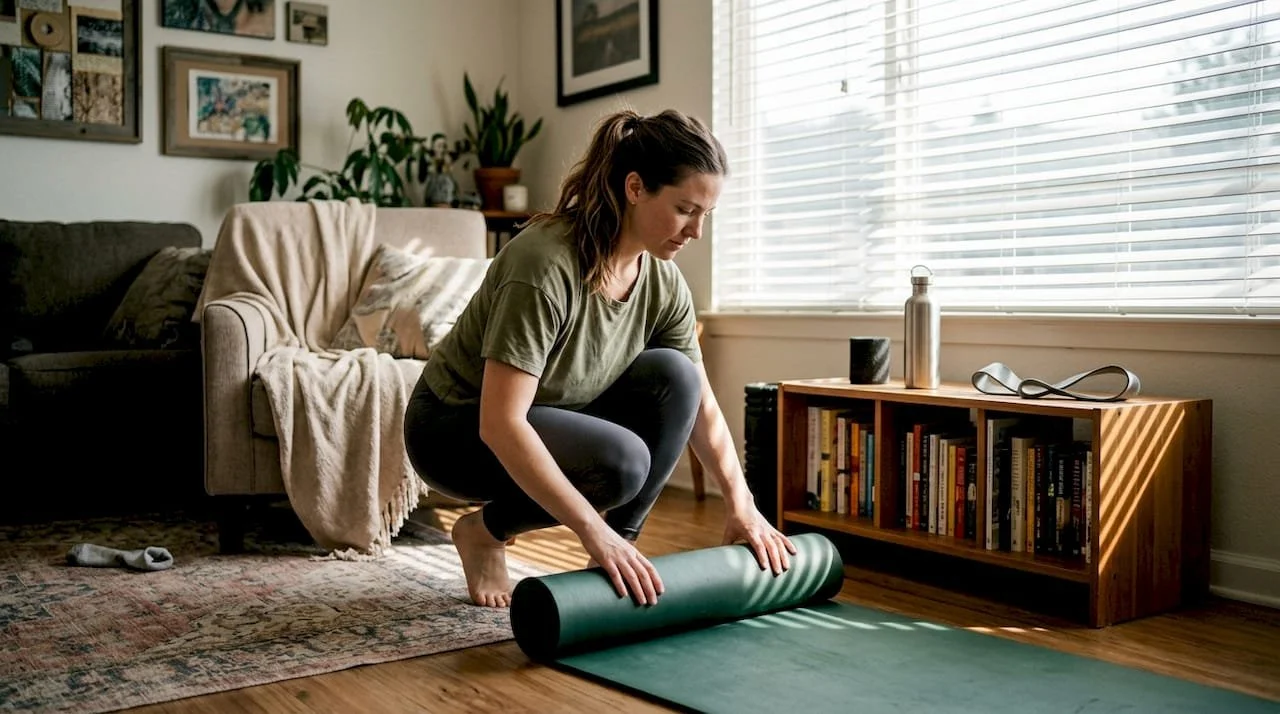
TL;DR:
Pilates is a low-impact, accessible exercise that improves spinal mobility at home.Consistent practice, even for short sessions, leads to meaningful mobility and pain reduction.Focusing on proper setup, form, and tracking progress enhances effectiveness and long-term results.
Finding time for fitness when you're juggling work, family, and everything Philadelphia life throws at you is genuinely hard. Pilates changes that equation. It's low-impact, requires almost no equipment, and improves spinal mobility and quality of life even when practiced entirely at home. Whether you've never rolled out a mat or you're returning after a long break, this guide walks you through setup, foundational moves, common pitfalls, and how to actually measure your progress so you can feel confident the effort is paying off.
Table of Contents
Key Takeaways
| Point | Details |
|---|---|
| Minimal setup needed | You only need a mat, comfortable clothes, and a small space to start Pilates at home. |
| Short sessions work | 15–45 minute Pilates routines deliver real benefits for mobility and pain relief. |
| Avoid common mistakes | Proper form and consistent practice prevent injury and maximize results. |
| Track your progress | Measuring mobility, pain, and strength helps you see improvements and stay motivated. |
| Adapt for busy schedules | Quick desk moves or micro-sessions make Pilates achievable for even the busiest adults. |
Get ready: Home Pilates essentials and setup
The good news is you don't need a reformer machine or a room full of mirrors to get started. Pilates is one of the most accessible workouts you can build at home, and the barrier to entry is refreshingly low.
Your non-negotiable starting point is a quality mat. Look for one that's at least 3/8 inch thick to protect your spine and hips during floor work. Beyond that, comfortable, form-fitting clothing helps you and any instructor video see your alignment clearly. Optional props, like a small resistance band, a yoga block, or a firm pillow, can support modifications as you build strength.
Choosing the right space matters more than most beginners expect. You need enough room to lie down fully in every direction, roughly a 6 by 6 foot square. A living room corner, a cleared bedroom, or even a back porch works. The key is removing trip hazards and ensuring the floor isn't slippery under your mat.
Short sessions of 15 to 45 minutesfit busy schedules and beginners perfectly, which means you don't need to carve out a full hour to see results. Pair that with a fewbeginner Pilates tipsand you're ready to build a sustainable habit.
| Essential | What to look for | Notes |
|---|---|---|
| Mat | 3/8" or thicker, non-slip | Non-negotiable for floor work |
| Clothing | Form-fitting, breathable | Allows you to check alignment |
| Props | Resistance band, block, firm pillow | Optional but helpful for beginners |
| Space | 6 x 6 feet minimum | Clear of clutter and furniture |
| Session length | 15 to 45 minutes | Scale up gradually |
Common setup mistakes to avoid:
Practicing on carpet without a mat (limits range of motion and stability)
Wearing loose, baggy clothing (makes it hard to spot form errors)
Setting up in a high-traffic area with distractions
Skipping a warm-up because the session feels short
Using a mat that's too thin and causing hip or spine discomfort
Understanding the Pilates health benefits before you begin also helps you stay motivated once the novelty wears off.
Pro Tip: Start in a quiet, clutter-free spot even if it means rearranging furniture temporarily. Your focus directly affects the quality of every rep.
Follow the basics: Key Pilates moves and step-by-step routine
Once your space is set up, the right moves make Pilates both effective and accessible. The goal here isn't to memorize a dozen exercises on day one. It's to move intentionally, breathe consistently, and build a foundation you can add to over time.
Here is a simple beginner session you can follow immediately:
Warm-up (5 minutes): Start lying on your back with knees bent. Do 10 slow pelvic tilts, gently pressing your lower back into the mat and releasing. Follow with 5 knee-to-chest pulls per side to release the hips.
The Hundred (core activation, 5 minutes): Lift legs to tabletop position, raise your head and shoulders, and pulse your arms up and down while breathing in for 5 counts and out for 5 counts. Complete 10 full breath cycles.
Single leg stretch (5 minutes): From a similar position, pull one knee to your chest while extending the other leg. Alternate sides for 10 reps each, keeping your lower back pressed down.
Spine stretch forward (5 minutes): Sit tall with legs extended. Inhale to grow tall, exhale to reach forward over your legs without collapsing. Repeat 6 times.
End stretch and cool-down (5 minutes): Child's pose for 60 seconds, then a gentle supine twist holding each side for 30 seconds.
Check out sample Pilates exercises to expand your routine as you grow stronger. You can also explore mat Pilates routines for structured progressions.
| Feature | Pilates routine | Generic home exercises |
|---|---|---|
| Focus | Precision, breath, core control | Repetition, volume |
| Low back pain relief | Pilates superior per RCT | Moderate, inconsistent |
| Time required | 15 to 45 minutes | 30 to 60 minutes |
| Equipment | Mat only | Often weights or machines |
| Beginner-friendly | High | Varies widely |
Maintaining form is more important than completing every rep. If your neck strains during the Hundred, place one hand behind your head. If your lower back lifts off the mat, lower your legs higher toward the ceiling.
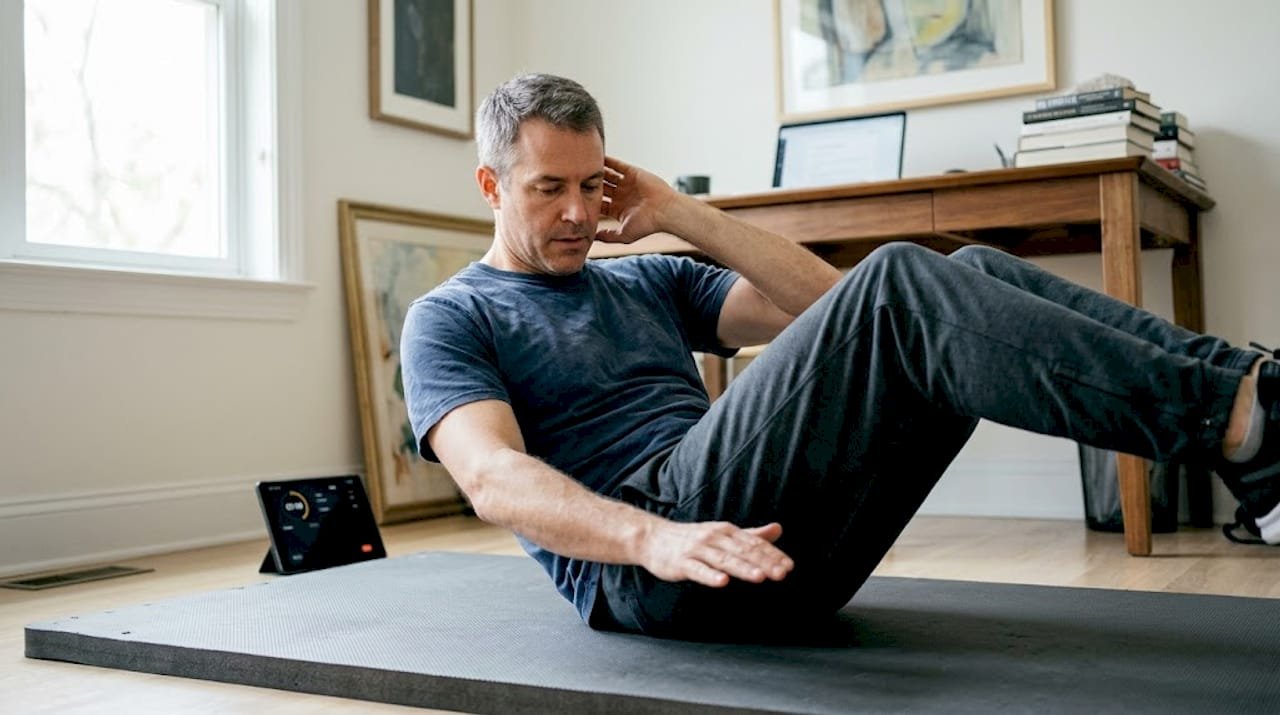
Pro Tip: Use a timer to keep sessions under 45 minutes. Shorter, focused sessions build more consistency than longer ones you dread starting.
Troubleshooting: Common mistakes and practical solutions
Now, let's ensure your Pilates routine produces solid results by avoiding common pitfalls. Even motivated beginners fall into predictable traps, and catching them early saves a lot of frustration.
Top mistakes to watch for:
Holding your breath during difficult moves instead of maintaining a steady inhale and exhale rhythm
Skipping the warm-up when time feels short, which increases your injury risk significantly
Rushing through reps to get more done instead of moving slowly with control
Ignoring discomfort signals and pushing through sharp pain, especially in the lower back
Comparing your flexibility to online instructors who have trained for years
Safety note for low back pain: If you experience sharp or shooting pain during any movement, stop immediately and consult a healthcare provider before continuing. Modify exercises by keeping legs higher, reducing range of motion, or staying in constructive rest position (knees bent, feet flat) until you've built sufficient core strength.
Consistent practice matters more than perfect form on day one. Research confirms that Pilates improves spinal motion and reduces disability when practiced regularly, even at home with basic modifications. Progress is quiet but real.
If you're unsure which style fits your needs, reviewing the types of Pilates classes can help you choose the right approach. For focused core work, building core strength through targeted progressions is a smart next step.
Pro Tip: Record yourself doing one exercise per week using your phone. Watching the playback helps you spot alignment issues that are nearly impossible to notice in the moment.
Tracking success: How to measure your progress and results
With troubleshooting addressed, understanding progress will keep your practice motivated and effective. One of the most common reasons people quit a home fitness routine is that they can't see or feel the results quickly enough. Pilates works gradually, so tracking the right metrics changes everything.
Key metrics to monitor at home:
Spinal mobility: Can you reach further in the spine stretch forward than you could two weeks ago?
Pain levels: Rate your low back discomfort from 1 to 10 before and after each session
Energy: Note whether your afternoon energy improves on days you practice
Consistency: Track how many sessions you complete per week versus your goal
Ease of daily movement: Are tasks like bending, lifting, or sitting for long periods getting easier?
Research shows that Pilates improves quality of life and mobility among a wide range of adults, including improvements in nutritional status and overall wellbeing. That kind of broad benefit is rare in a single workout method. You can also track how it supports Pilates for weight loss goals over time alongside mobility gains.
| Metric | How to measure | Check-in frequency |
|---|---|---|
| Spinal reach | Distance from fingertips to floor | Every 2 weeks |
| Pain score | 1 to 10 self-rating before/after | Every session |
| Session consistency | Sessions completed vs. goal | Weekly |
| Energy levels | Morning and afternoon self-rating | Daily |
| Ease of movement | Journal note on daily tasks | Weekly |
Set a realistic 6-week milestone. Most beginners notice meaningful mobility changes within that window when they practice 2 to 3 times per week. Celebrate small wins like being able to hold a position longer or feel less stiffness when you wake up. Those moments are Pilates benefits showing up in real life, and they matter.
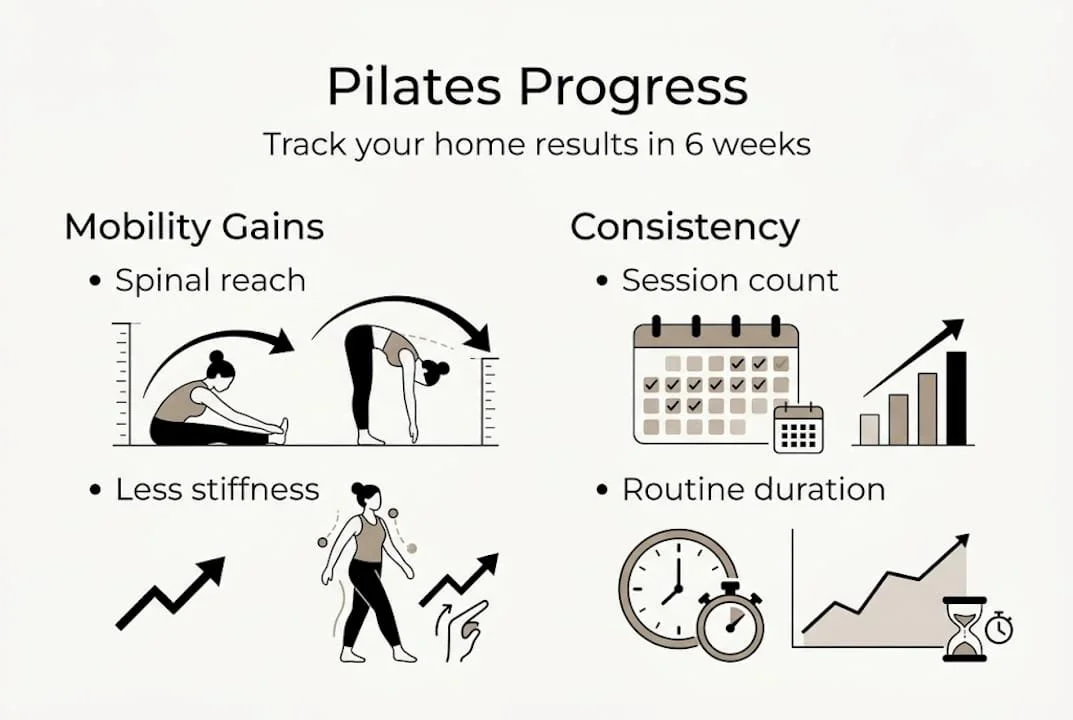
What most Pilates guides miss: Realistic home strategies for busy adults
Here's something most Pilates content won't tell you: expecting a tidy 40-minute session five days a week is the fastest way to quit. Real life in Philadelphia doesn't run on a wellness blogger's schedule. And yet, that's the standard most guides set.
The truth is that 10 minutes of intentional Pilates beats zero minutes of perfect Pilates every time. Micro-sessions, even a few pelvic tilts and a spine stretch during your lunch break, genuinely add up. Desk modifications like seated twists make Pilates accessible for professionals without ever unrolling a mat.
The other thing most guides miss is the mental side of a home practice. Without a class, an instructor, or other students around you, motivation has to come from within. Pairing your Pilates routine with an existing habit, like right after your morning coffee or before dinner, dramatically improves follow-through. Habit stacking is a simple but powerful tool.
Focus on building Pilates core strength incrementally rather than chasing flexibility milestones. Incremental progress sustained over months produces more lasting change than intense bursts followed by burnout.
Pro Tip: Commit to two scheduled sessions and one "whenever I have 10 minutes" session per week. That structure keeps your practice alive even in hectic weeks.
Ready to take your Pilates practice further?
Building a home Pilates routine is a powerful first step, and you don't have to take the next steps alone. At Amrita Yoga & Wellness, we offer a full spectrum of wellness experiences designed to complement the foundation you're building at home.
From Pilates and barre to hot yoga, tai chi, and massage therapy, our Philadelphia studio welcomes practitioners at every level. If you're looking to expand your self-care beyond movement, our Tarot readings offer a thoughtful, grounding experience that pairs beautifully with a mindful fitness practice. Explore our class schedule and community offerings, and find the next layer of your wellness journey waiting for you.
Frequently asked questions
Can I practice Pilates safely at home as a complete beginner?
Yes, Pilates is specifically designed for safe, low-impact movement, making it ideal for beginners and those with joint sensitivities. Sessions as short as 15 minutes are effective and appropriate for new practitioners.
What are the signs my Pilates routine is improving my mobility?
You'll notice easier everyday movements, reduced morning stiffness, and greater spinal flexibility within a few weeks of consistent practice. Research shows Pilates improves spinal ROM and quality of life in measurable ways.
How often should I practice Pilates at home for noticeable results?
Aim for 2 to 3 sessions per week for steady progress. Low-impact routines in the 15 to 45 minute range are effective for both building strength and maintaining what you've gained.
Is Pilates better than regular home workouts for back pain?
Studies show Pilates is superior to generic home exercises for managing low back pain and improving spinal mobility, making it the smarter choice for back pain relief.
Recommended
Why Attend Pilates Workshops: Boost Strength & Flexibility
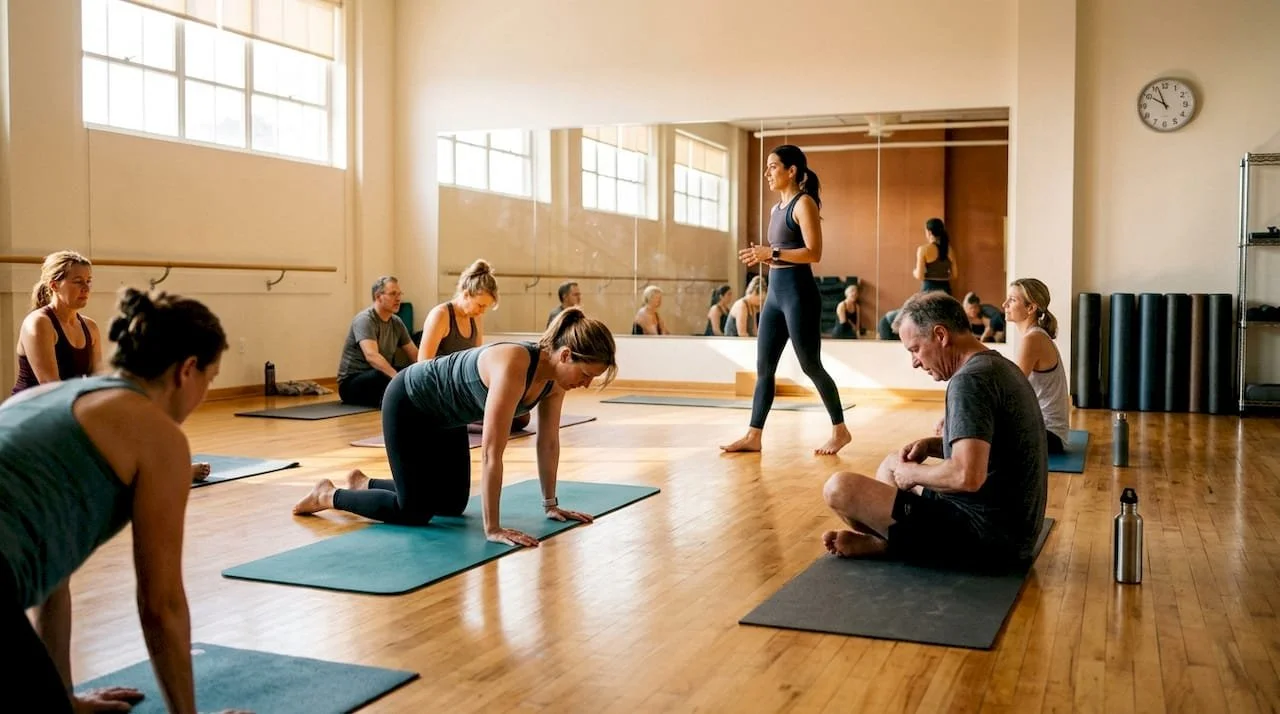
TL;DR:
Pilates workshops offer personalized guidance, deepening understanding and accelerating results for all fitness levels.They improve core strength, flexibility, pain reduction, and support injury recovery through evidence-based practices.Attending consistently and choosing certified instructors enhances safety, effectiveness, and long-term benefits.
Pilates has a reputation problem. Many people assume workshops are reserved for the already-fit, the hyper-flexible, or the injury-free. That assumption keeps a lot of people in Philadelphia from experiencing something genuinely useful. The truth is that Pilates workshops accelerate rehabilitation, reduce pain, and improve quality of life for a wide range of people, including absolute beginners and those recovering from injuries. Whether you want to build core strength, move without discomfort, or simply feel better in your body, a Pilates workshop offers a focused, evidence-backed path to get there.
Table of Contents
Key Takeaways
| Point | Details |
|---|---|
| Personalized instruction | Pilates workshops offer focused, individualized feedback for all levels. |
| Evidence-based results | Research shows consistent Pilates practice improves flexibility, strength, and reduces chronic pain. |
| Rehabilitation support | Workshops provide safe, effective movement strategies for injury recovery and ongoing pain management. |
| Community and motivation | Workshops foster a supportive environment, helping you stay motivated and accountable. |
What makes Pilates workshops unique?
To understand why attending specific workshops matters, it's helpful to see how they differ from standard group Pilates classes. The short answer: workshops go deeper, and that depth changes everything.
In a typical group class, an instructor guides 15 to 20 people through a sequence. There's value in that, but the format limits how much personalized feedback you can receive. Workshops flip that equation. They run in small groups or semi-private settings, often with just 4 to 8 participants, which means your instructor can actually watch how you move, cue you specifically, and catch habits that could lead to strain over time.
The focus shifts from simply completing a workout to truly understanding the movement. Workshops zero in on the foundational Pilates principles: breath, control, centering, precision, and flow. Workshops allow nuanced exploration of these principles in ways that a packed group class simply cannot support.
| Feature | Pilates workshop | Group class |
|---|---|---|
| Group size | 4 to 8 participants | 10 to 25 participants |
| Instructor attention | High, individualized | Limited, general |
| Technique depth | In-depth, corrective | Overview level |
| Suitable for beginners | Yes, especially | Varies |
| Suitable for rehab | Yes, ideal | Sometimes |
Workshops also tend to work well across a range of goals. Someone recovering from a back injury and someone training for their first 5K can both attend a Pilates workshop and walk away with something meaningful. The examples of Pilates exercises you practice in a workshop are carefully selected and adapted to the needs of the group.
Philadelphia's fitness scene has seen a noticeable surge in Pilates interest, with Pilates workshop trends pointing toward more specialized, smaller-format sessions that offer real results rather than just a good sweat.
"The best Pilates experiences are the ones where you leave knowing your body just a little bit better than when you walked in."
That kind of self-awareness is what workshops are designed to build.
Evidence-based benefits for fitness and flexibility
Having identified how workshops offer unique structure, let's explore the tangible benefits you can achieve, based on science.
The research on Pilates is clear and growing. Mat Pilates builds core strength, improves flexibility, and reduces chronic pain in areas like the low back and knees. These aren't minor improvements. People who practice consistently report meaningful changes in how they move and how they feel day to day.
Here are the key benefits backed by research:
Improved core strength from stabilization exercises that target deep abdominal and spinal muscles
Greater flexibility in the hips, hamstrings, and thoracic spine
Reduced chronic pain, particularly in the low back and knees
Better balance and coordination, which matters especially for adults over 40
Improved sleep quality, which shows up even in short intervention studies
The data supports a specific practice window. Measurable flexibility and fitness gains appear after 4 to 8 weeks of consistent practice, 2 to 3 times per week. That's a realistic commitment most Philadelphians can make.
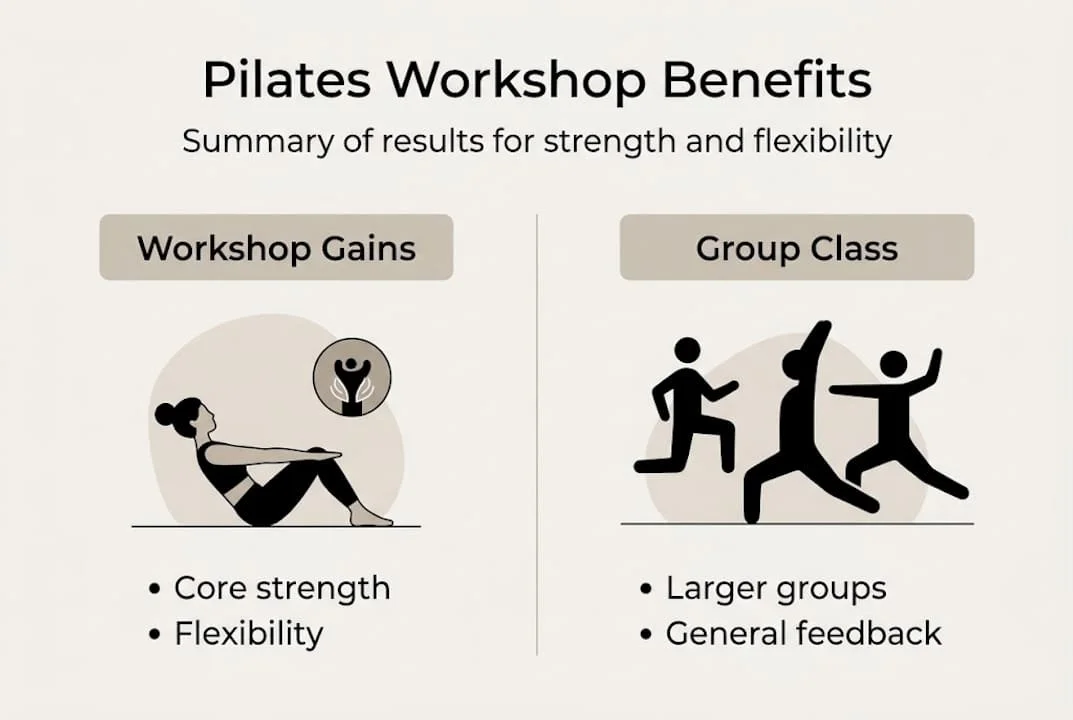
| Outcome | Evidence strength | Time to notice |
|---|---|---|
| Core strength | Strong | 4 to 6 weeks |
| Flexibility | Strong | 4 to 8 weeks |
| Chronic low back pain | Strong | 4 weeks |
| Knee pain relief | Moderate to strong | 6 to 8 weeks |
| Sleep quality | Moderate | 4 weeks |
Pilates reduces pain in knee osteoarthritis and improves function in chronic low back pain, according to recent clinical evidence. These findings apply directly to the kind of movement work done in focused workshops.
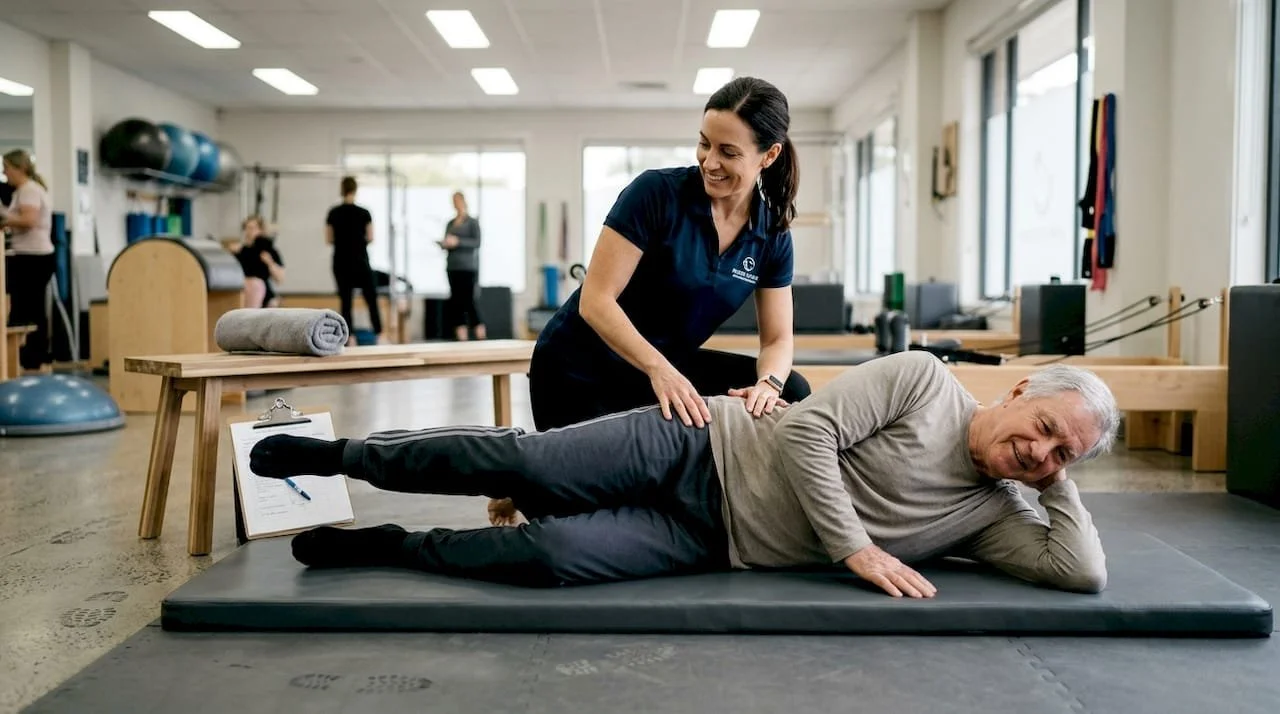
You can explore more through Pilates research articles and review a broader list of benefits of Pilates from practitioners who work with all fitness levels.
Pro Tip: Before your first workshop, do a simple self-assessment. Note your flexibility in a forward fold or rate your pain on a 1 to 10 scale. Revisit that benchmark after 4 weeks of consistent workshops. The progress you'll see is a powerful motivator.
Pilates for rehabilitation and injury recovery
While fitness and flexibility are crucial, many workshop attendees are also seeking support for injury or chronic pain. This is where Pilates workshops show some of their most impressive results.
Timing matters. Pilates is not meant to be your first intervention after an acute injury. Once the initial inflammation and swelling subside, usually within a few days to a couple of weeks depending on the injury, a structured Pilates program can become a powerful tool. Pilates accelerates rehabilitation post-injury with a structured program introduced after the acute phase, supporting better mobility and less pain.
Who benefits most from rehab-focused workshops?
People with chronic low back pain lasting longer than 12 weeks
Adults recovering from knee or hip procedures
Those managing osteoarthritis or similar joint conditions
Anyone dealing with postural pain from desk work or repetitive movement
People in pre- or post-surgical recovery looking for safe, supervised movement
"4 weeks of Pilates improved pain, sleep quality, quality of life, and disability scores in people with chronic low back pain."
That's a meaningful result in a short timeframe. And it's not just about pain numbers on a chart. People describe moving through their day with less fear, less guarding, and more confidence in their own body.
For those focused on Pilates for wellness after a difficult health period, workshops offer a supportive, structured re-entry into movement. You can also browse sample Pilates workouts to get a sense of what supervised movement looks like in practice.
Pro Tip: When choosing a workshop for rehabilitation purposes, ask specifically whether the instructor holds a certification from a recognized body like BASI Pilates or Polestar Pilates. Certified instructors understand contraindications and know how to modify safely.
Getting started: What to expect in your first Pilates workshop
Knowing the benefits and recovery potential, here's what you need to know to start your Pilates workshop journey.
Choosing the right workshop starts with a few key criteria. Look for small class sizes (ideally under 10), certified instructors, and a stated focus that matches your goals, whether that's flexibility, core conditioning, or recovery. Don't be afraid to call ahead and ask questions. A good studio will welcome them.
What to bring and wear is simple. Wear fitted, comfortable clothing that allows movement without riding up. Socks with grip are helpful on a mat. Bring water, and if the studio doesn't provide mats, bring your own. Most beginner workshops are mat-based, so no special equipment is required.
A typical workshop session flows like this: a brief check-in where the instructor learns about any injuries or limitations, a guided breathwork and warm-up sequence, focused technique work with hands-on corrections, and a cooldown or reflection period.
Here are 5 steps to a successful first workshop:
Register in advance so the instructor can prepare modifications if needed
Prepare your body by avoiding heavy meals 90 minutes before and staying hydrated
Arrive 10 minutes early to settle in, introduce yourself, and mention any injuries
Participate fully, including asking questions when something doesn't feel right
Reflect afterward by jotting down what felt challenging or surprising
For lasting results, attend 2 to 3 times per week. Empirical benchmarks show that this frequency over 4 to 8 weeks yields measurable improvements in flexibility and fitness.
Common beginner mistakes to avoid:
Holding your breath during difficult movements
Pushing through pain instead of modifying
Skipping the first few "basics" workshops because they seem too easy
Comparing your range of motion to others in the room
If you're just getting started, check out advice for Pilates beginners and explore a Pilates styles overview to find which format fits your goals best.
Our take: The real reason Pilates workshops are worth your time
Here's something that often gets lost in the conversation about Pilates: the format matters as much as the method. You can follow along with a video online or show up to a packed studio class, and you'll get some benefit. But workshops operate on a different level entirely.
In Philadelphia's growing Pilates community, we see it consistently. People who attend focused workshops progress faster, stick with the practice longer, and report greater satisfaction with their results. That's not a coincidence. Workshops provide deeper education compared to diluted group classes, and combining both formats achieves the best outcomes.
What most people miss is the community piece. Workshops create a shared experience. You're learning alongside others at a similar stage, which builds accountability and makes the process feel less isolating, especially if you're coming back from injury or starting something new.
The combination of science, hands-on supervision, and real personal attention is what moves people further, faster. If core strength from Pilates workshops is your goal, this format gets you there with far less guesswork.
Ready to experience the difference a Pilates workshop can make?
If you've been thinking about trying Pilates or leveling up your current practice, the next step is simpler than you think. Amrita Yoga & Wellness offers Pilates workshops designed for all levels, from curious beginners to those navigating injury recovery.
At classes at Amrita Yoga & Wellness, you'll find a welcoming Philadelphia studio community with certified instructors who meet you exactly where you are. Browse current schedules, read about program options, and find beginner-friendly entry points that fit your life. Your first workshop could be the most useful hour you invest in your body this year.
Frequently asked questions
What is the difference between a Pilates workshop and a regular class?
Pilates workshops are usually smaller, with more focused instruction on technique and individualized feedback compared to general group classes. Workshops emphasize depth and core principles far more than standard group formats allow.
How soon will I see results from attending Pilates workshops?
You may notice improvements in flexibility and pain relief within 4 to 8 weeks of attending 2 to 3 times per week. 4 weeks of Pilates improved pain and quality of life in people with chronic low back pain.
Are Pilates workshops safe for people recovering from injury?
Yes, when supervised by a certified instructor and started after the acute phase, workshops are especially effective for safe rehabilitation. Pilates workshops are most effective when introduced post-acute with professional guidance.
Do I need special equipment to join a Pilates workshop?
Most beginner workshops use mat Pilates and require just a mat; additional equipment is rarely needed for entry-level sessions. Mat Pilates is accessible for beginners without any specialized gear.
Recommended
How to choose the right Pilates classes in Philadelphia
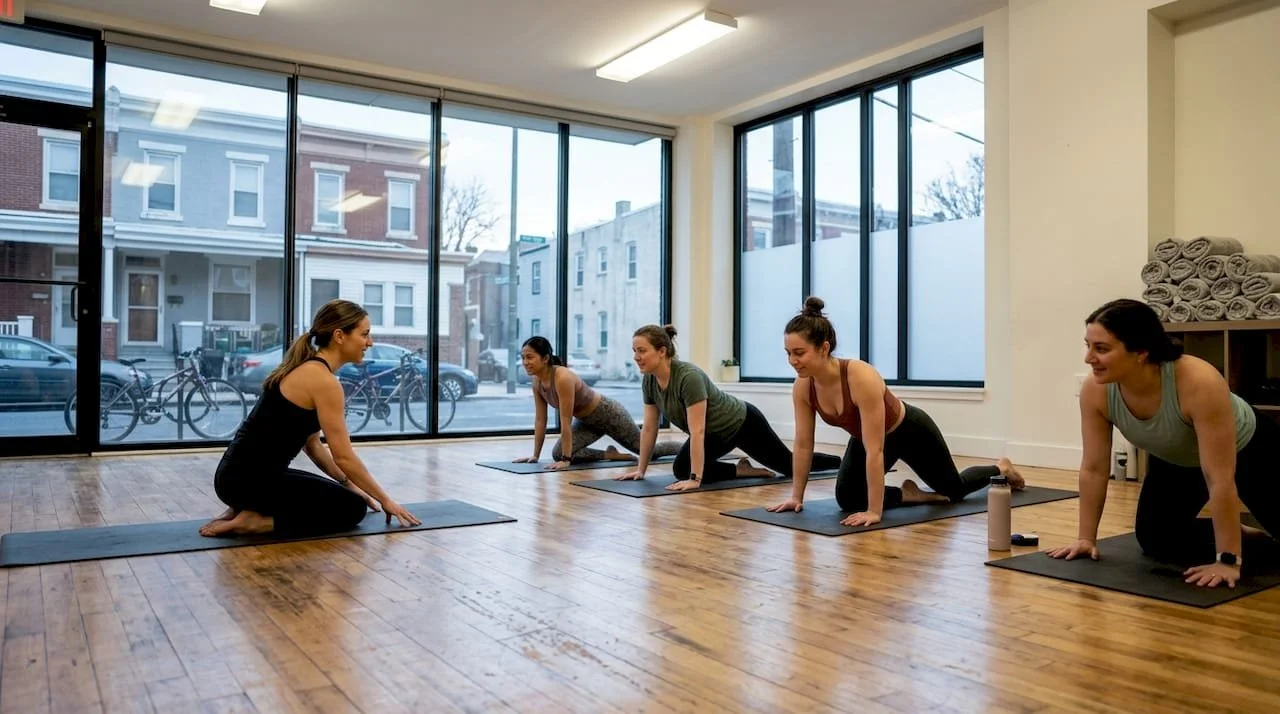
TL;DR:
Choosing the right Pilates class depends on your specific goals, fitness level, and physical readiness.Mat Pilates is affordable and suitable for beginners, while Reformer Pilates offers higher resistance and full-body training.Consistent attendance of 2-3 sessions weekly over 6-8 weeks produces significant improvements in strength and flexibility.
Too many Philadelphia fitness seekers spend weeks bouncing between studios, unsure whether they picked the right class or the right instructor. The result? Frustration, wasted money, and a nagging feeling that Pilates just isn't working. But the problem is rarely the method. It's the mismatch between what a class offers and what your body actually needs. This guide breaks down exactly how to choose a Pilates class in Philadelphia that fits your fitness level, goals, and schedule, so you stop guessing and start seeing real progress in your core strength and flexibility.
Table of Contents
Key Takeaways
| Point | Details |
|---|---|
| Define personal goals | Clarify whether you want core strength, flexibility, injury rehab or all three before choosing a Pilates class. |
| Know your options | Mat and Reformer Pilates cater to different needs, budgets, and experience levels—try both if unsure. |
| Assess studio and instructor quality | Look for certified teachers, small classes, and available modifications to ensure safety and better results. |
| Set realistic results timeline | Expect noticeable gains in core strength and flexibility after 6–8 weeks with consistent attendance. |
Clarify your fitness goals and readiness
Before you search for studios or scroll through class schedules, get clear on what you actually want from Pilates. This single step saves you more time than any other part of the process.
Pilates serves a wide range of goals, and different class formats are built for different outcomes. Here are the most common reasons people in Philadelphia start Pilates:
Core strength and stability: Building a stronger center to support daily movement and athletic performance
Flexibility and mobility: Lengthening tight muscles, especially in the hips, hamstrings, and spine
Injury recovery or rehab: Rebuilding strength after back pain, joint issues, or post-surgical recovery
Posture correction: Addressing the effects of long hours sitting at a desk or standing on your feet
Mind-body wellness: Reducing stress, improving breath awareness, and building body confidence
Once you know your primary goal, you can filter classes much more easily. Someone recovering from a herniated disc needs a very different class than a runner looking to improve hip flexibility.
Next, assess your physical readiness honestly. If you've never done Pilates before, or if you've had any recent injuries, starting with a beginner or foundational class is the smartest move. These classes move slower, explain the basics of alignment and breath, and give instructors time to offer corrections. You can always level up. Jumping into an intermediate class unprepared, however, increases your risk of poor form and discouragement.
Pro Tip: Before committing to a membership or class pack, try an intro class to assess the instructor's cueing style, the studio's vibe, and whether modifications are offered. One class tells you more than ten reviews.
If you're brand new to the practice, a solid beginner Pilates guide can help you understand the foundational movements before you even walk into a studio. Knowing what a "neutral spine" or "imprinted pelvis" means ahead of time makes your first class far less overwhelming. For a deeper look at how to ease in safely, the Pilates for beginners resource covers exactly what to expect in your first few sessions.
Compare Pilates class types: Mat vs. Reformer
Once you've clarified your goals, the next decision is format. In Philadelphia, most studios offer two primary class types: Mat Pilates and Reformer Pilates. Each has distinct advantages depending on your goals, budget, and experience level.
| Feature | Mat Pilates | Reformer Pilates |
|---|---|---|
| Equipment needed | None (just a mat) | Spring-based reformer machine |
| Cost per class | $15–22 | $30–45 |
| Challenge level | Moderate | Moderate to high |
| Best for | Beginners, flexibility, core basics | All levels, full-body strength |
| Accessibility | High | Moderate (requires instruction) |
| Class availability | Very common | Common in specialty studios |
Mat Pilates is accessible, lower in cost, and delivers strong core and flexibility benefits, making it an excellent starting point. You use your own bodyweight as resistance, which means the focus stays on precision and control rather than load. This is great for building the foundational awareness that makes all other Pilates work more effective.
Reformer Pilatesuses a sliding carriage with adjustable springs to create variable resistance. Because the springs can be lightened or intensified, it'ssuitable for all levelsand enhances full-body strength in ways that mat work alone can't replicate. The machine also provides feedback through resistance, which helps many people find correct alignment faster.
Here's how to decide between the two:
Start with Mat if you're brand new, on a tighter budget, or focused primarily on core and flexibility fundamentals.
Choose Reformer if you want to intensify your workouts, need support for injury recovery, or are ready to challenge your full body.
Try both before committing to one format. Many Philadelphia group Pilates class options offer introductory packages that include both mat and reformer sessions.
Pro Tip: If you're curious about the machine but nervous about it, check out this reformer Pilates beginner guide before your first session. Understanding how the springs and straps work removes a lot of the intimidation factor. For a detailed breakdown of the Reformer Pilates benefits, you'll find the investment in equipment-based classes pays off quickly.
Know what to look for in a studio and instructor
With an understanding of class types, now focus on choosing the right Philadelphia studio and instructor. This is where most people skip important steps, and it's often the reason progress stalls.
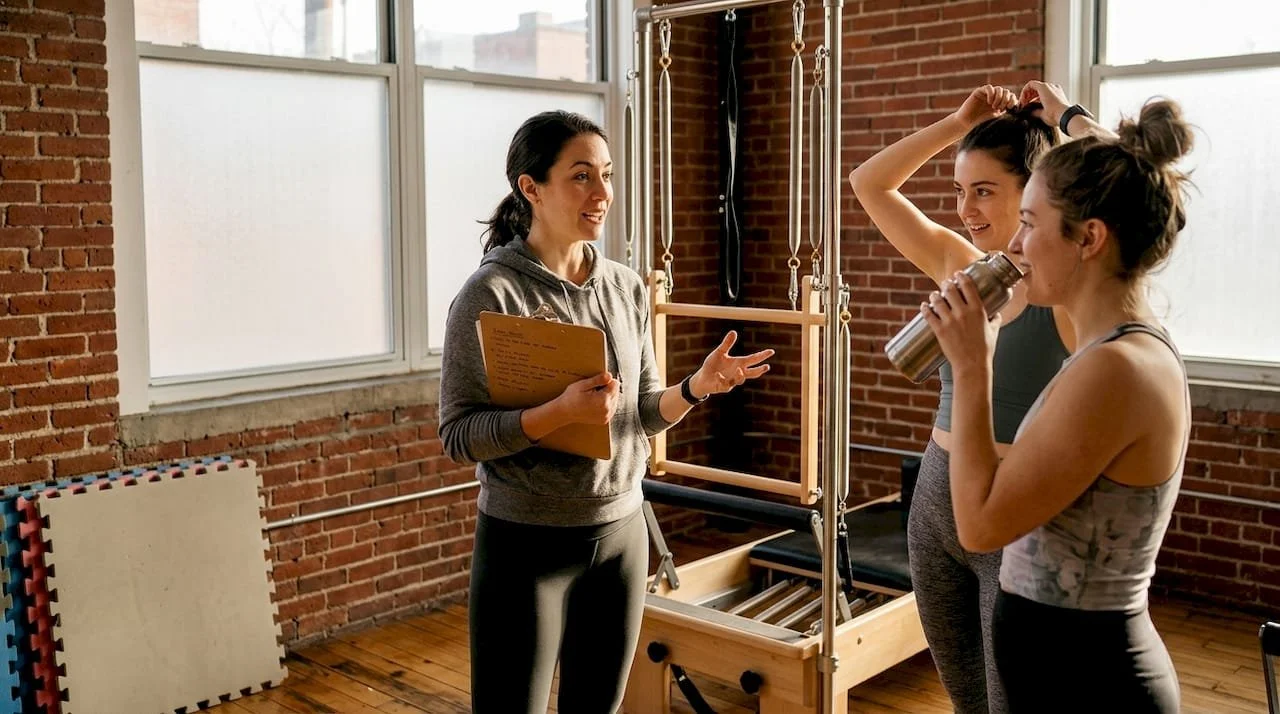
Instructor quality matters more than studio aesthetics. Look for instructors certified through reputable programs such as STOTT Pilates, BASI, Balanced Body, or Peak Pilates. These programs require 200 or more training hours and include anatomy, biomechanics, and hands-on teaching practice. The Pilates instructor certification guide from the Pilates Method Alliance outlines what rigorous training looks like, including NPCP-aligned programs that cover anatomy and biomechanics in depth.
Here's a quick checklist for evaluating any Philadelphia Pilates studio:
Instructor certification: Confirm the program name and training hours (200+ minimum)
Class size: Smaller classes of 6 to 10 participants allow for more individualized attention and corrections
Modification availability: Instructors should actively offer options for different fitness levels and injuries
Trial class policy: Reputable studios offer intro or drop-in options so you can test before committing
Recent reviews: Look for patterns in Google or Yelp reviews, specifically around instructor attentiveness and safety
"A good Pilates instructor doesn't just lead the class. They watch, adjust, and meet each student where they are."
Small class sizes are a bigger deal than most people realize. In a class of 20 or more, an instructor physically cannot watch your form closely. Poor form in Pilates doesn't just reduce results. It can cause strain, especially in the lower back and neck. Studios that cap classes at 10 or fewer participants are investing in your safety.
For those considering Pilates as part of injury recovery, look specifically for studios with experience in Pilates for rehab and fitness. Not every instructor is trained to work with chronic pain or post-surgical clients, so ask directly before booking.
Pro Tip: Call or email the studio before your first visit. Ask about class sizes, instructor certifications, and how they handle modifications. A studio that answers these questions confidently is one worth trusting.
Set expectations: Results, frequency, and tracking progress
Let's conclude the core guide by understanding how your Pilates commitment leads to visible results in Philadelphia.
One of the most common mistakes new Pilates students make is expecting dramatic results after two or three classes. Pilates rewards consistency, not intensity. Here's what the research and real-world experience actually show:
Weeks 1 to 3: You'll notice improved body awareness, better breathing patterns, and mild muscle activation in the core and hips
Weeks 4 to 6: Posture improvements become visible. Many students report less lower back tension and greater ease in daily movement
Weeks 6 to 8: Measurable gains in core strength and flexibility. This is when most people feel genuinely transformed by the practice
Key stat: 2-3 Pilates sessions per week for 6 to 8 weeks produces meaningful gains in core strength and flexibility. Attending three times per week rather than once doubles your flexibility improvements over the same period.
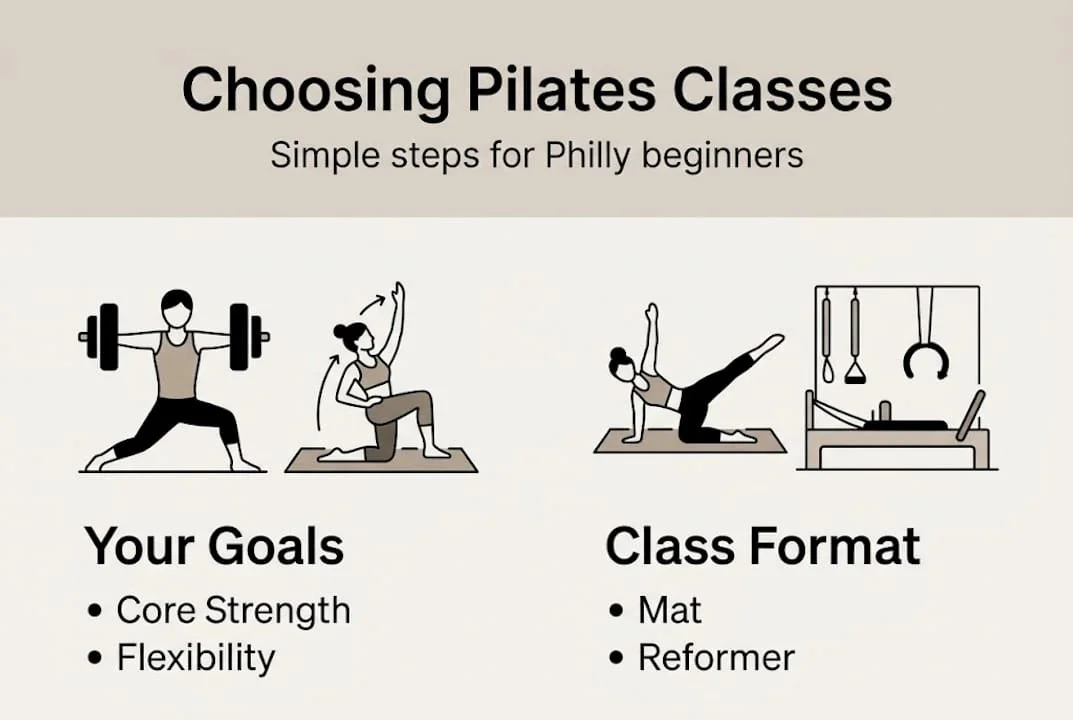
The science backs this up. An 8-week Pilates program leads to significant improvements in function among people with chronic lower back pain, making it one of the most evidence-supported low-impact options available.
Here's how to track your own progress without relying on a scale or a mirror:
Pain and discomfort: Note any reduction in lower back, hip, or neck tension week over week
Flexibility markers: Can you reach further in a forward fold? Does a seated twist feel less restricted?
Core endurance: How long can you hold a plank or a Pilates hundred without losing form?
Energy and posture: Do you sit taller at your desk? Do you feel less fatigued after long days?
For a deeper look at what to expect over time, the Pilates results in core and flexibility breakdown shows how both mat and reformer work contribute to long-term gains.
Why real results from Pilates depend on personalization, not just the class
Here's something most Pilates guides won't tell you: the class that transformed your coworker's back pain might do absolutely nothing for yours. Pilates is one of the most individualized fitness methods available, and treating it like a one-size-fits-all solution is the fastest way to plateau.
We've seen students at every level make the same mistake. They find a class they like, stick with it for months, and then wonder why progress has stalled. The answer is almost always that their needs evolved but their class didn't. What worked for you as a beginner won't challenge you at month six.
The most successful Pilates students in Philadelphia share one habit: they reassess regularly. They ask their instructor for feedback, try new class formats, and aren't afraid to switch studios if the fit stops working. Use beginner Pilates adjustment tips as a starting point, but stay curious and adaptable as your body changes.
Always take advantage of intro offers. Ask instructors directly about accommodations for your specific limitations. And revisit your goals every two months. Pilates should grow with you.
Ready to get started? Find your Pilates fit in Philadelphia
Now that you've got the insights for smart Pilates selection, here's where to take your first step. The best way to know if a studio is right for you is to show up and try it. Reading reviews helps, but nothing replaces the experience of actually moving in the space and working with the instructor.
At Amrita Yoga & Wellness, we offer a variety of Pilates classes at Amrita Yoga & Wellness led by certified instructors in North Philadelphia, welcoming students at every level from complete beginners to seasoned practitioners. Whether you're drawn to mat work for flexibility or want to explore reformer-style training, our schedule is built to meet you where you are. Check our current class offerings, instructor backgrounds, and availability before booking to make sure the timing and format align with your goals.
Frequently asked questions
How much do Pilates classes usually cost in Philadelphia?
Mat Pilates typically costs $15 to $22 per class, while Reformer classes range from $30 to $45 per session at most Philadelphia studios. Intro packages often reduce the per-class cost significantly.
What is the difference between Mat and Reformer Pilates for beginners?
Mat Pilates focuses on bodyweight exercises and core fundamentals, while Reformer Pilates uses a spring-based machine to add resistance and intensity. Both formats offer modifications that make them accessible to beginners.
How often should I attend Pilates classes to see results?
Attending 2-3 sessions per week for 6 to 8 weeks leads to noticeable gains in core strength and flexibility. Consistency over intensity is what drives lasting results.
Do Philadelphia Pilates studios offer classes for injury recovery or physical therapy?
Yes, many Philadelphia studios offer group and private Pilates classes designed for recovery and rehabilitation. Always ask about instructor experience with your specific condition and confirm that modifications for injuries are part of every class.
Recommended
Top ways to improve your Pilates routine for real results
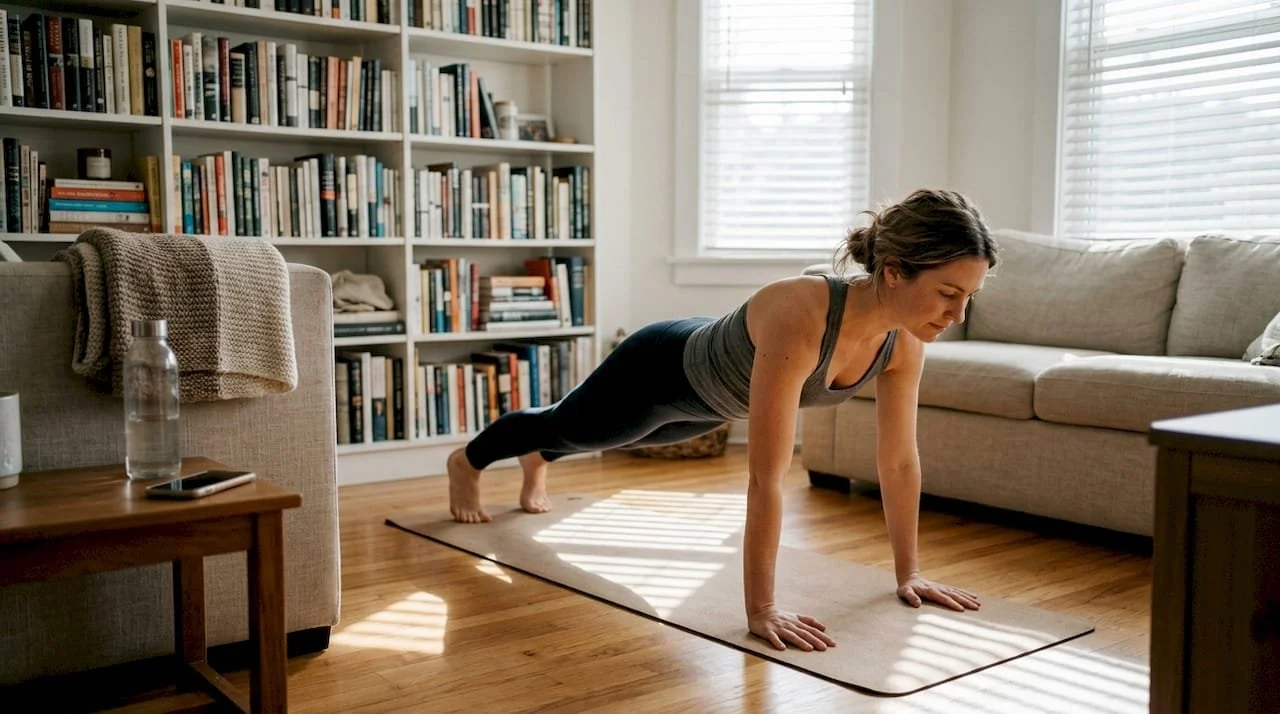
TL;DR:
Proper form, control, and breath are more effective than high repetitions in Pilates.Mastering foundational exercises is essential before progressing to more advanced movements.Focusing on breathwork and mechanics enhances core engagement and overall results.
Most people assume that doing more reps or speeding through Pilates sessions is the fastest path to results. It isn't. Proper form, control, and breath build more strength and flexibility than any high-rep routine ever will. Whether you're stepping onto the mat for the first time in Philadelphia or you've been practicing for years, the strategies in this guide will help you get measurably better results without adding more time to your schedule. This is about working smarter, not harder, and the evidence backs it up completely.
Table of Contents
Key Takeaways
| Point | Details |
|---|---|
| Form trumps speed | Focusing on proper form and control improves strength and flexibility better than rushing through reps. |
| Master the basics | Building from foundational movements in Pilates creates safer, more effective progress for all levels. |
| Breathe with intention | Integrating breath and subtle core activation is essential for maximizing every Pilates move. |
| Mix and recover | Combining Pilates with other exercise and structured rest accelerates results and prevents burnout. |
Master the basics before advancing
There's a temptation in every fitness practice to skip ahead. You see someone performing a Swan Dive or a Teaser and you want to get there fast. But in Pilates, that shortcut almost always backfires. The foundational exercises aren't just beginner content. They're the building blocks your body needs to move safely and effectively at every level.
Three exercises form the core of any solid Pilates foundation:
The Hundred: Builds breath coordination and deep abdominal endurance. It teaches your body to stabilize while moving.
Roll Up: Trains spinal articulation and lengthens the hamstrings. It's far more demanding than it looks.
Pelvic Curl: Activates the glutes, hamstrings, and lower back while teaching neutral spine awareness.
Mastering these before moving on isn't just smart. It's essential. Gradual progression through basics like the Hundred, Roll Up, and Pelvic Curl, followed by increasing range of motion and then adding resistance, is the proven path for practitioners at every level. You can also explore essential Pilates exercises to understand how these movements connect across skill levels.
Here's a simple 4-week progression framework to guide your early practice:
| Week | Focus | Example exercises |
|---|---|---|
| 1 | Basics and alignment | Hundred, Pelvic Curl, Spine Stretch |
| 2 | Core and hip stability | Roll Up, Single Leg Stretch, Bridge |
| 3 | Full-body integration | Swimming, Leg Circles, Side-Lying Series |
| 4 | Advanced introduction | Teaser prep, Swan, Rolling Like a Ball |
This table isn't a rigid prescription. It's a map. Your body will tell you when it's ready to move forward, and that signal is consistency and ease, not boredom.
Pro Tip: Skipping foundational work doesn't save time. It creates compensation patterns that limit your progress and raise your injury risk. Spend at least two to three weeks truly owning the basics before advancing.
Focus on form and control over speed
Once you have your foundation, the next upgrade isn't a harder exercise. It's better execution of the ones you already know. This is where most practitioners leave serious gains on the table.
Movement quality in Pilates produces results that quantity simply cannot match. A slow, controlled Roll Up with full spinal articulation does more for your core than twenty rushed crunches. In fact, the Roll Up is 30% more effective than crunches for abdominal strength. That's not a minor difference. That's a complete rethinking of how you approach core work.
"Prioritize proper form, control, and breath over speed or reps to build strength and flexibility effectively." — NACAMS Pilates Progression Guide
Here's a direct comparison that shows why form-focused Pilates wins:
| Exercise | Muscles targeted | Spinal involvement | Injury risk | Effectiveness |
|---|---|---|---|---|
| Roll Up | Full abdominals, hip flexors | Full articulation | Low (with control) | High |
| Standard crunch | Upper abs only | Minimal | Moderate (neck strain) | Lower |
The difference is stark. The Roll Up demands that your entire spine move sequentially, which activates far more muscle fibers and builds real functional strength.
To keep your form sharp in every session, run through this quick checklist before and during each exercise:
Alignment: Is your spine in the correct position for this movement? Neutral or imprinted as required?
Control: Are you moving with intention, or just getting through the reps?
Breath synchronization: Are you exhaling on the effort and inhaling on the release?
Understanding Pilates breathing techniques is central to this checklist. Breath isn't decoration in Pilates. It's the mechanism that drives deep core engagement and keeps your movements fluid. The Pilates breathing benefits extend beyond the mat too, improving posture and reducing tension throughout your day.
Incorporate breathwork and proper mechanics
Breath is the engine of Pilates. Not a background detail, not something to think about after you've learned the moves. The breath coordinates oxygen delivery to working muscles and activates the deep core stabilizers that make every movement safer and more effective.
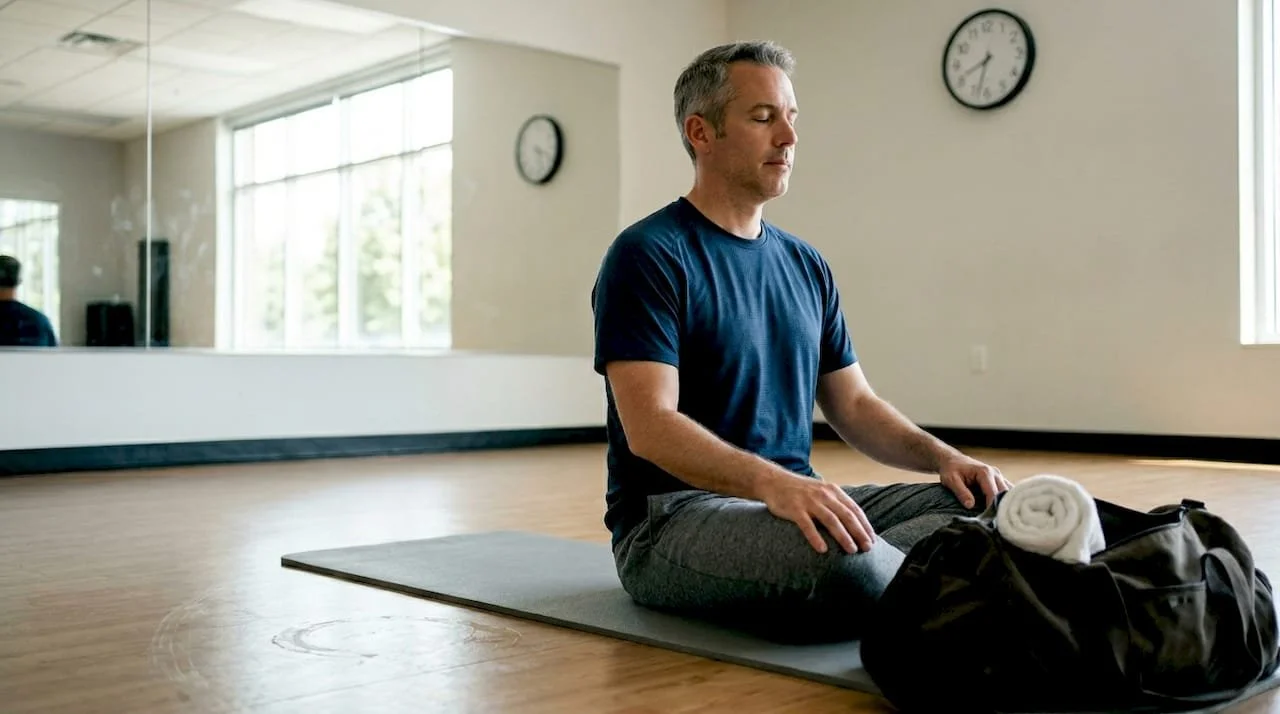
Two mechanical concepts separate good Pilates from great Pilates. The first is the two-way stretch: the idea that your body lengthens in opposite directions simultaneously during each movement. Think of reaching the crown of your head away from your tailbone during a Spine Stretch. This creates length and decompression rather than compression.
The second is understanding neutral spine versus imprinted spine. Neutral spine preserves the natural curves of your back and is used in most exercises. Imprinted spine gently presses the lower back toward the mat and is used when your legs are extended and your core needs extra support. Confusing these two positions is one of the most common form errors in Pilates.
For key mechanics like two-way stretch and subtle core engagement, the goal is never to grip or brace your abs. It's a gentle, internal lift.
Here's how to sync breath, alignment, and engagement in any exercise:
Set your position: Find neutral or imprinted spine before you begin.
Inhale to prepare: Use the breath to lengthen your spine and settle your alignment.
Exhale to engage: On the exhale, feel your deep core gently activate without gripping.
Move with the breath: Let the exhale initiate the effort phase of the movement.
Inhale to return: Use the inhale to lengthen and reset before the next rep.
For deeper core engagement, the target muscles are the transverse abdominis (TVA) and multifidus, not the superficial abs you feel during a crunch. Understanding the benefits of Pilates breathwork helps you connect with these deeper layers more effectively. Research also shows that breath-led core work can boost core strength significantly when practiced consistently.
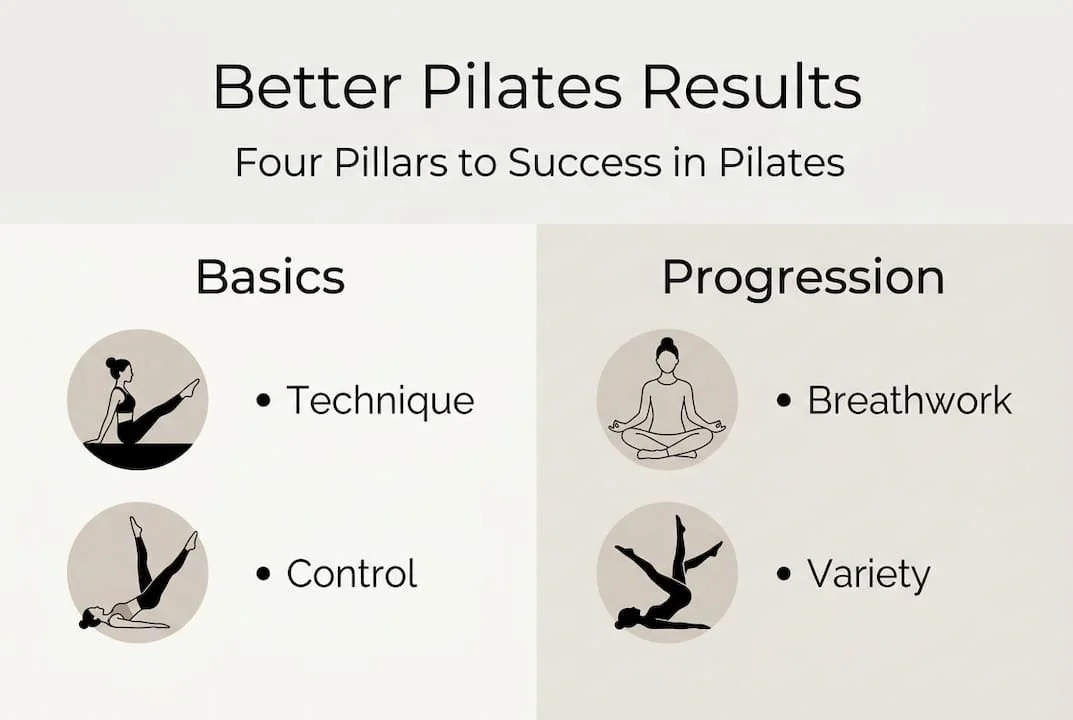
Pro Tip: Instead of thinking "pull your belly to your spine," try thinking "gently lift your pelvic floor and let your lower belly follow." This cue activates the TVA and multifidus without creating the tension that blocks fluid movement.
Combine Pilates with other exercises and recovery
Pilates is powerful. But treating it as your only form of exercise is one of the most common mistakes practitioners make. Pilates excels at building control, flexibility, and deep core strength. It doesn't fully replace the cardiovascular conditioning or heavy load-bearing stimulus that your body also needs for total fitness.
Common pitfalls to avoid:
Skipping warm-ups before class
Rushing through sessions to fit in more exercises
Doing only Pilates without any strength or cardio work
Overtraining without adequate rest days
Ignoring recovery practices like stretching or sleep
The research on Pilates outcomes is genuinely impressive. An 8-week program shows improved flexibility outcomes and spinal range of motion in gait, with large effect sizes. For people dealing with lower back pain, Pilates pain reduction research shows it outperforms basic home exercise programs. A meta-analysis found an SMD 1.41 pain reduction in lower back pain patients, which is a clinically large and meaningful effect.
A balanced weekly routine might look like this:
Monday: Pilates (60 min, form-focused)
Tuesday: Light cardio (walking, cycling) or rest
Wednesday: Resistance training (bodyweight or weights)
Thursday: Pilates (45 min, breathwork emphasis)
Friday: Active recovery (yoga, stretching)
Saturday: Cardio or group fitness class
Sunday: Full rest
Building healthy lifestyle habits around your Pilates practice, including sleep, nutrition, and stress management, amplifies everything you do on the mat. Avoiding common pitfalls like skipping warm-ups and overtraining is just as important as the work itself.
Pro Tip: Schedule your rest days with the same commitment as your workout days. Recovery is when your body actually adapts and gets stronger. Treating rest as optional is the fastest way to plateau.
Our perspective: The underrated fix that transforms your Pilates journey
Here's something we've noticed working with Philadelphia clients over the years: the people who progress fastest are almost never the ones chasing harder exercises. They're the ones who become genuinely curious about the small things. The quality of a single exhale. The subtle lift of the pelvic floor before a movement begins. The difference between gripping and engaging.
Most practitioners rush to advanced Pilates within weeks of starting, convinced that difficulty equals progress. But the greatest returns come from nuanced breath and mechanics integration, not from tougher moves. A client who can perform a basic Roll Up with perfect spinal articulation, full breath coordination, and zero tension in the neck will see more transformation than someone grinding through a Teaser with poor alignment.
Real breakthroughs come from building body awareness, not chasing complexity. Understanding breathwork for wellness is often the turning point. When you learn to feel your breath activate your deep core, the whole practice shifts. Movements become easier, more fluid, and far more effective. That's the transformation most people are looking for, and it was available to them from the very first session.
How Amrita Yoga & Wellness can support your Pilates journey
You now have a clear, evidence-backed roadmap for improving your Pilates practice. The next step is putting it into action with the right support around you.
At Amrita Yoga & Wellness in Philadelphia, our instructors work with practitioners at every level, from those just learning the Hundred to those refining advanced sequences. We offer personalized guidance on form, breath mechanics, and progressive programming so you're never guessing about your next step. Whether you're looking to deepen your practice, address a specific concern like back pain, or simply find a consistent community, our Pilates and wellness offerings are designed to meet you where you are. We also offer unique wellness experiences like Tarot readings for those interested in holistic self-exploration beyond the mat.
Frequently asked questions
How often should I practice Pilates for the best results?
Most studies show practicing Pilates 2-4 times a week yields measurable improvements in strength, flexibility, and quality of life. Flexibility and quality of life improvements typically appear within 4 to 8 weeks of consistent practice.
Is Pilates or weight training better for core strength?
Pilates is 30% more effective than crunches for abdominal strength, but combining Pilates with resistance training gives you the best total-core results overall.
Can Pilates help with chronic lower back pain?
Yes. High-quality evidence shows Pilates reduces lower back pain and disability better than basic home exercise programs, with a meta-analysis reporting an SMD of 1.41 for pain reduction.
What's the biggest mistake Pilates learners make?
Skipping foundational exercises and prioritizing speed over control are the most limiting mistakes. Mastering basics like the Hundred, Roll Up, and Pelvic Curl before advancing is the most reliable path to lasting results.
Recommended
How Pilates Accelerates Rehab: Evidence, Benefits, Steps
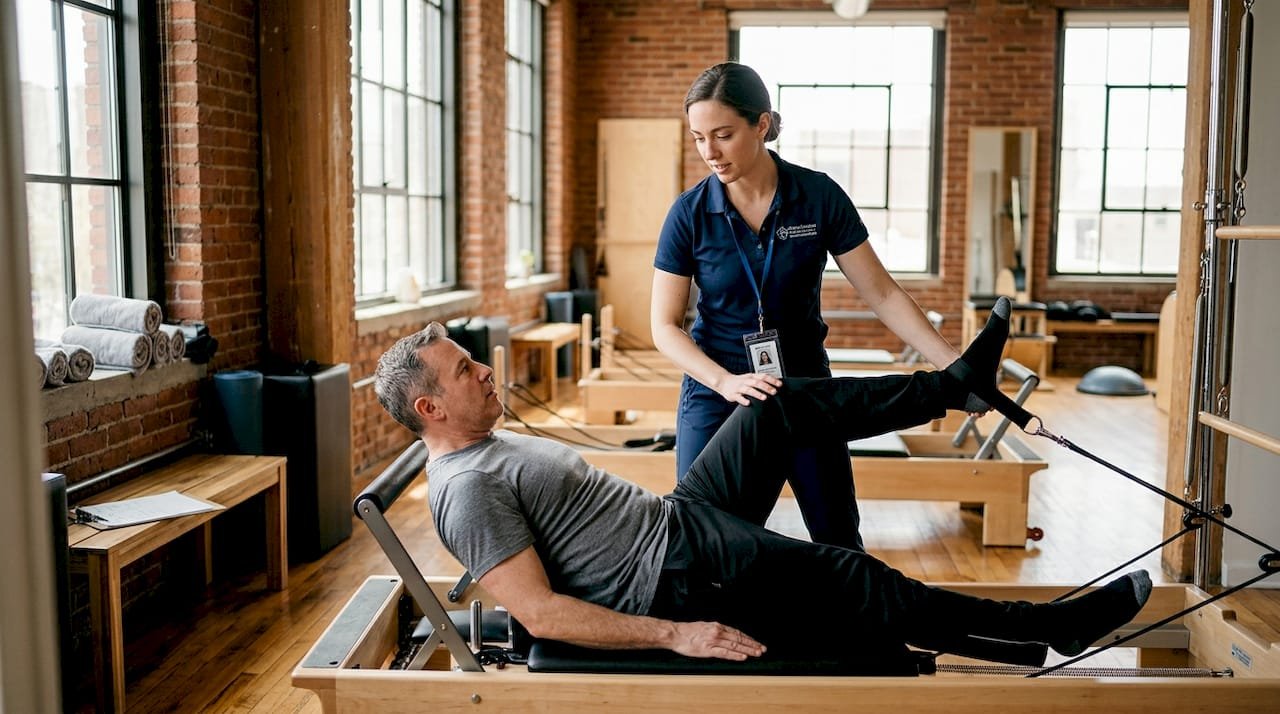
TL;DR:
Pilates effectively reduces pain, disability, and improves quality of life in musculoskeletal conditions.It is best integrated into rehab after acute injury phase under professional supervision.Evidence shows Pilates benefits low back pain, knee osteoarthritis, and post-surgical recovery.
Pilates has a reputation problem. Most people picture it as a trendy fitness class, something you do to tone your core or improve your posture. But physical therapists and rehab specialists have known for years that Pilates is far more than that. Research confirms that Pilates reduces pain and disability while improving quality of life in people with musculoskeletal conditions. If you're recovering from an injury in Philadelphia or trying to rebuild your mobility, understanding how Pilates fits into the rehab picture could genuinely change your recovery timeline.
Table of Contents
Key Takeaways
| Point | Details |
|---|---|
| Backed by science | Pilates consistently reduces pain and improves quality of life in musculoskeletal rehab settings. |
| Best post-acute phase | Start Pilates once your initial pain is controlled, working closely with your PT and Pilates instructor. |
| 4-8 week timeline | Most feel better mobility and less pain within 1-2 months with consistent, supervised practice. |
| Ideal for specific conditions | Chronic low back pain, knee osteoarthritis, and post-surgery recovery respond especially well to Pilates-based rehab. |
| Holistic recovery tool | Pilates complements traditional rehab by improving core stability, balance, and functional movement. |
What is Pilates and how does it apply to rehab?
Joseph Pilates developed his method in the early 20th century, originally using it to help injured dancers and athletes recover strength and function. His system was built around controlled, mindful movement rather than brute force or high-impact exercise. That origin story matters because it explains why Pilates translates so naturally into modern rehabilitation settings.
The foundational principles of Pilates include:
Breath control: Coordinating inhale and exhale with movement to support the spine and reduce tension
Spinal alignment: Teaching the body to find and maintain neutral posture during activity
Core stability: Building deep abdominal and back muscle strength to protect joints
Controlled movement: Prioritizing precision over speed, which reduces re-injury risk
Mind-body connection: Staying present and aware during each exercise
These principles make Pilates uniquely gentle on joints while still being effective. Unlike high-intensity workouts, Pilates is highly modifiable. An instructor can adapt almost any exercise to work around a shoulder injury, a post-surgical hip, or a sensitive lower back.
"Pilates is a valuable adjunct in rehabilitation, offering structured, low-impact movement that bridges clinical care and long-term wellness."
Physical therapists in Philadelphia increasingly use Pilates as a rehab adjunct to extend the gains made in clinical sessions. You can explore the full range of Pilates offerings or read about Pilates for total body wellness to see how the practice supports long-term health beyond the rehab phase.
What does the evidence say? Scientific support for Pilates in rehab
Understanding the principles is key, but how effective is Pilates for real rehab outcomes? Here's what the latest science shows.
A major meta-analysis found that Pilates produces meaningful improvements across three critical rehab markers. The numbers are striking:
| Outcome | Standardized Mean Difference (SMD) | Interpretation |
|---|---|---|
| Pain reduction | 1.41 | Large effect |
| Disability reduction | 0.83 | Moderate-large effect |
| Quality of life improvement | 2.10 | Very large effect |
Those are not small wins. An SMD of 1.41 for pain is considered a large clinical effect, meaning participants experienced substantial, noticeable relief. A quality of life SMD of 2.10 is exceptional by any research standard.
For people dealing with low back pain, a randomized controlled trial found that Pilates outperformed home exercises for pain, disability, and quality of life in subacute cases. This is important because home exercise programs are the typical alternative most people receive after a few PT sessions. Pilates does more.
For knee osteoarthritis, research shows that Pilates reduces pain and increases ROM compared to no intervention at all. Range of motion improvements matter enormously for anyone who wants to walk comfortably, climb stairs, or stay active in a city like Philadelphia.
It's fair to note that some studies carry moderate to high risk of bias, and certainty ratings can be low. But the consistency of positive findings across different populations and conditions is hard to ignore. You can explore evidence-backed Pilates benefits and wellness outcomes from Pilates to see how these findings translate into real practice.
When and how to add Pilates to your rehabilitation process
So, if Pilates is scientifically effective, when should you consider it during your rehab journey?
Timing matters. Jumping into Pilates during the acute phase of an injury, when inflammation is high and pain is sharp, is not the right move. The ideal window opens once your acute pain is under control and your physician or physical therapist clears you for low-impact movement.
Here's a practical sequence to follow:
Complete acute care first. Let your physical therapist address the immediate injury, reduce swelling, and restore basic movement patterns.
Get cleared for supervised exercise. Ask your PT or doctor when Pilates-style movement is appropriate for your specific injury.
Start with private or small group sessions. A one-on-one session lets an instructor assess your limitations and customize every exercise.
Progress gradually. Begin with foundational movements like pelvic tilts, breathing exercises, and gentle spinal articulation before moving to more integrated activities.
Commit to consistency. Research shows that twice-weekly sessions over 4-8 weeks produce measurable clinical benefits.
Pro Tip: Before your first Pilates session, write down your injury history, current limitations, and rehab goals. Share this with your instructor so they can design a session that complements your existing treatment plan, not work against it.
Exploring different types of Pilates can help you choose the right format, and if you're just getting started, Pilates for beginners resources can ease the transition.
Which conditions and injuries benefit most from Pilates?
You might wonder if Pilates is right for your specific condition. Here's a look at which injuries get the most from this approach.
Not every condition responds equally to Pilates, but the evidence is strong for several common rehab scenarios that Philadelphia residents frequently face.
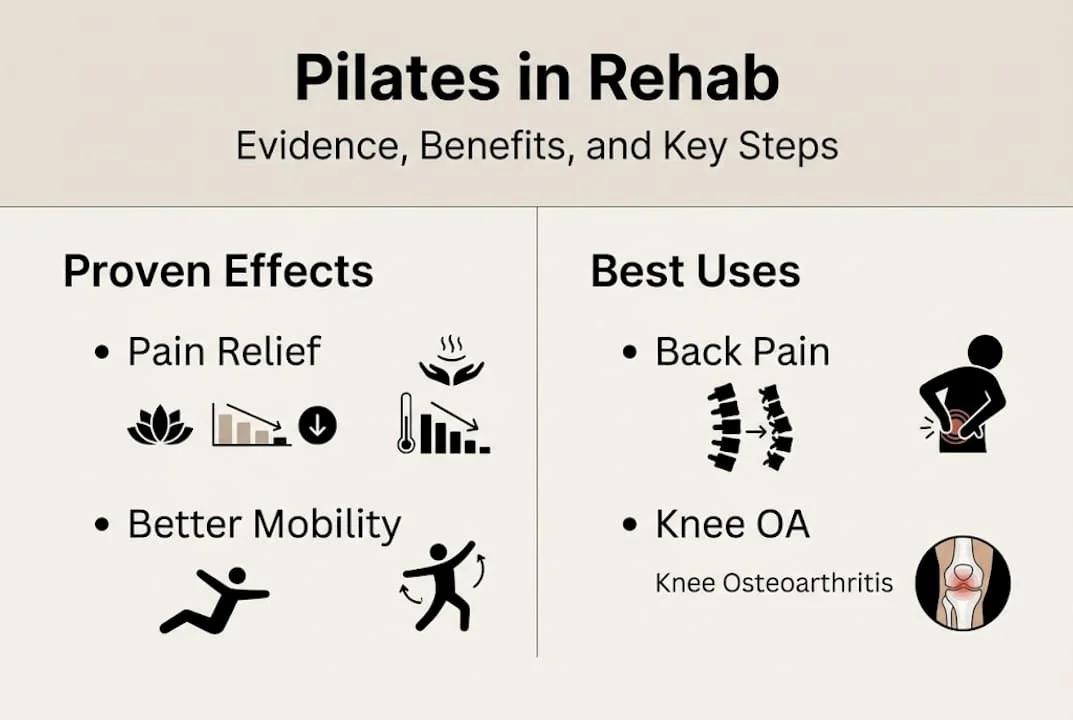
| Condition | Proven benefit | Caveats |
|---|---|---|
| Chronic low back pain | Pain reduction, improved function | Best with supervised sessions |
| Subacute low back pain | Better than home exercise for pain and QoL | Needs trained instructor |
| Knee osteoarthritis | Pain relief, increased range of motion | Less evidence for muscle mass changes |
| Post-surgical recovery | Core stability, functional movement | Timing must be cleared by surgeon |
| Hip rehabilitation | Balance, alignment, mobility | Evidence still emerging |
Research confirms that Pilates is effective post-surgery and for chronic nonspecific low back pain, though its effect on muscle tone or body composition is less clear. That distinction matters. Pilates is not a bodybuilding tool. It’s a precision movement system designed to restore function, reduce pain, and rebuild confidence in your body.
Conditions that respond particularly well include:
Chronic low back pain: The most researched area, with consistent evidence across multiple studies
Knee osteoarthritis: Especially for improving daily movement and reducing stiffness
ACL reconstruction recovery: Core and hip stability work supports knee function
Post-hip replacement: Gentle alignment and balance training aids return to activity
For a deeper look at how exercises can be adapted to your condition, browse Pilates exercise adaptations or check out essential Pilates exercises for all levels.
Practical tips for getting the most from Pilates during rehab
Beyond knowing what works, these proven strategies help you maximize your rehabilitation outcomes with Pilates.
The difference between a frustrating experience and a transformative one often comes down to how you approach the practice. Here's what actually moves the needle:
Choose a certified instructor with rehab experience. Not all Pilates instructors are trained to work with injured clients. Look for someone with additional certifications in therapeutic or clinical Pilates.
Select a studio that offers supervised small group or private sessions. Large group classes may not give you the individual attention your recovery needs.
Combine Pilates with your existing rehab program. Research confirms that customizing Pilates after initial PT yields better mobility and functional outcomes than either approach alone.
Track your progress. Keep a simple log of pain levels, mobility improvements, and any movements that feel easier week over week. This helps your instructor adjust the program.
Be patient with the timeline. Four to eight weeks of consistent practice is the benchmark for noticeable change. Rushing the process increases re-injury risk.
Pro Tip: During every session, prioritize the quality of each movement over the number of repetitions. One perfectly executed movement with full core engagement does more for your recovery than ten sloppy ones.
For targeted guidance, explore resources on Pilates core strength and browse sample Pilates workouts to see what a structured session looks like.
A fresh perspective: The overlooked power of Pilates in modern rehab
Conventional rehab thinking draws a hard line between clinical treatment and wellness. You go to PT, you get better, you graduate, and then you're on your own. Pilates challenges that model in a meaningful way.
What we see at studios like ours is that the clients who recover most fully are the ones who don't treat Pilates as a temporary phase. They treat it as a permanent part of how they move through the world. The practice becomes a language their body speaks fluently, and that fluency protects them from future injury.
The research supports this view. Pilates builds the kind of deep stabilizing strength that generic gym workouts rarely reach. It also builds body awareness, which is arguably the most undervalued asset in long-term recovery. A person who can feel when their alignment is off is far less likely to re-injure themselves than someone who simply got stronger.
In Philadelphia, where people walk everywhere, navigate uneven sidewalks, and stay active through all four seasons, that kind of awareness is not a luxury. It's a necessity. Our insights from the Pilates team reflect years of watching this transformation happen, one session at a time.
Ready to try Pilates for your recovery?
If you're considering Pilates for your recovery process, there's never been a better time to act. Amrita Yoga & Wellness in Philadelphia offers private and small group Pilates sessions designed with post-injury and mobility needs in mind. Our instructors understand the difference between a fitness goal and a rehab goal, and they build sessions accordingly.
Whether you're just finishing physical therapy or looking for a structured way to maintain the gains you've worked hard for, our studio provides the guidance and community to support your next step. Visit our Pilates rehab resources to learn more, or reach out to schedule an introductory consultation with one of our experienced instructors.
Frequently asked questions
Is Pilates safe during all stages of injury rehab?
Pilates is safest after your acute pain is managed and your PT or physician has cleared you for low-impact movement. Sessions should always be tailored to your specific injury stage and supervised by a qualified instructor.
How many sessions before I feel results from Pilates in rehab?
Most people notice meaningful improvements within 4-8 weeks at twice weekly sessions, and those effects are often sustained at follow-up assessments.
Which injuries or conditions benefit most from Pilates?
Chronic low back pain and knee osteoarthritis have the strongest research support. Studies show Pilates outperforms generic or no exercise for these conditions, and Pilates reduces knee OA pain while improving range of motion.
Can Pilates fully replace physical therapy or other rehab exercises?
No. Pilates works best as an adjunct to physical therapy, not a replacement. It should be integrated after acute PT and coordinated with your clinical care team for the safest, most effective outcome.
Recommended
Mat Pilates: Core Strength & Flexibility Benefits 2026
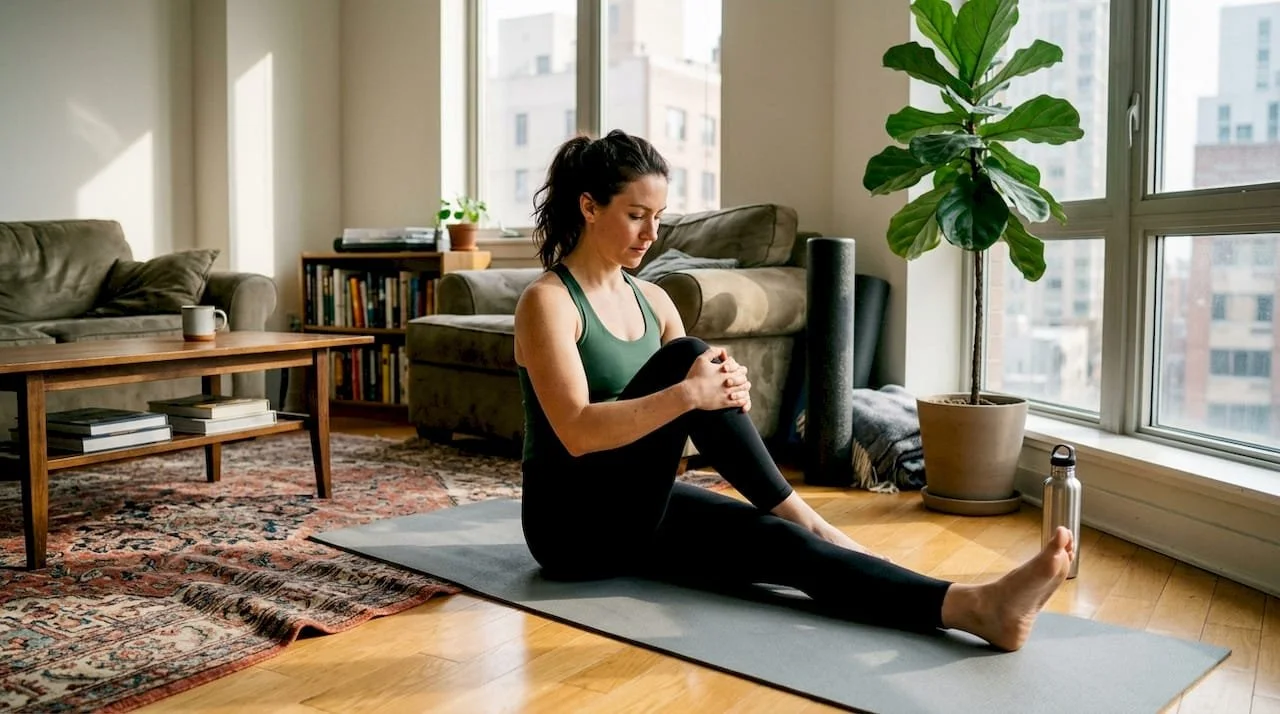
TL;DR:
Mat Pilates is a highly accessible, low-cost workout that requires only a mat and floor space.It effectively builds core strength, improves flexibility, and reduces chronic pain through controlled movements.Consistent practice offers significant benefits for posture, stability, and overall body awareness.
Many people assume Pilates means expensive reformer machines, a fancy studio membership, or a fitness background that most of us simply don't have. That assumption keeps a lot of Philadelphia adults from ever trying it. Mat Pilates flips that script entirely. All you need is a supportive mat and a small patch of floor. Research consistently shows it builds genuine core strength, improves flexibility, and even reduces chronic pain, making it one of the most accessible, low-impact workouts available to beginners and busy professionals alike. This guide breaks down exactly what mat Pilates is, what the science says, and how you can start this week.
Table of Contents
Key Takeaways
| Point | Details |
|---|---|
| Accessible for all | Mat Pilates builds core strength and flexibility without machines, making it easy for busy adults to start. |
| Backed by science | Research shows mat Pilates relieves pain, enhances movement, and supports joint health. |
| Perfect for busy lives | You can see real benefits from consistent 2-3x/week practice, fitting sessions into any schedule. |
| Empowers self-awareness | With no external equipment, mat Pilates develops deep core control and body awareness. |
What is mat Pilates and why is it unique?
Mat Pilates is a floor-based exercise system developed from Joseph Pilates' original method, sometimes called "Contrology." Every movement uses your own bodyweight as resistance. There are no springs, cables, or sliding carriages involved. A typical session runs 45 to 60 minutes and moves through a sequence of controlled exercises targeting the core, hips, back, and shoulders.
What makes it stand out among Pilates for wellness options is the sheer accessibility. You can practice at a boutique studio, in your living room, or even in a hotel room while traveling for work. For urban adults in Philadelphia juggling packed schedules, that flexibility matters enormously.
Here is what a standard mat Pilates session typically includes:
Breathing and alignment warm-up to activate deep core muscles before any movement begins
Core-focused exercises like the Hundred, Roll-Up, and Single Leg Stretch
Hip and glute work using Bridge variations and Side-Lying Leg Series
Spinal mobility sequences including Swan and Spine Stretch Forward
Cool-down stretches to lengthen muscles and release tension
Now, how does this compare to reformer Pilates? The reformer machine uses spring-based resistance to assist or challenge movement. That external support actually makes some exercises easier to perform with correct form, especially for people recovering from injury. Mat Pilates, on the other hand, offers no external support, which means your intrinsic core muscles must work harder to stabilize every single movement. That builds a deeper, more functional body awareness over time. You can explore reformer Pilates basics if you are curious about how the two approaches overlap, but for most beginners, the mat is the best starting point.
Mat Pilates suits a wide range of people: those new to structured exercise, professionals who need something they can fit into a lunch break, anyone dealing with mild joint discomfort, and even athletes looking to improve control and balance.
Pro Tip: Commit to 2 to 3 mat Pilates sessions per week for at least six weeks before judging your progress. Consistency matters far more than session length, especially in the early stages.
Core strength, flexibility, and pain relief: Science-backed benefits
Understanding what mat Pilates is sets the stage, but what do the studies really say about its impact?
The core benefits are the most well-documented. Mat Pilates targets the deep stabilizing muscles, specifically the transverse abdominis and multifidus, that most conventional gym workouts barely touch. Strengthening these muscles improves posture, reduces spinal compression, and creates the kind of stable foundation that protects your joints during everyday movement. You can explore sample Pilates exercises to see exactly which movements activate these deeper layers.
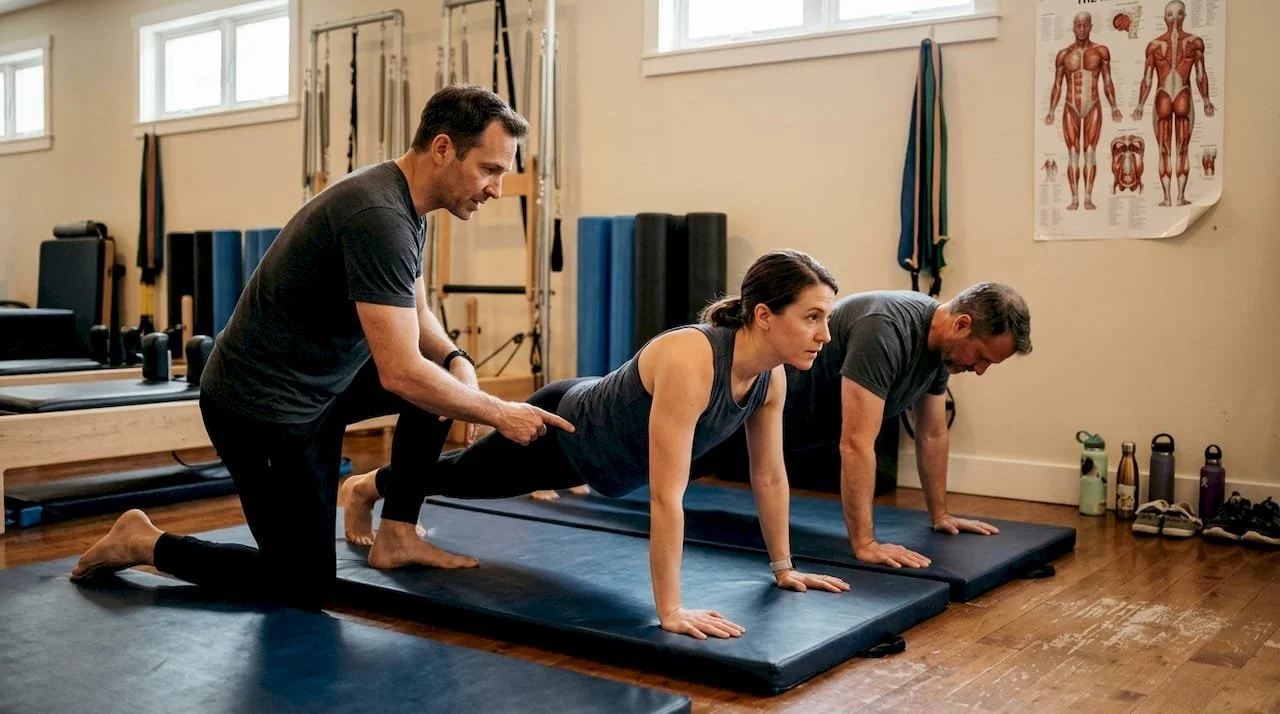
Flexibility gains are equally impressive. Unlike static stretching, where you hold a position for 30 seconds and call it done, mat Pilates improves flexibility through controlled, dynamic movements that enhance range of motion in the hamstrings, shoulders, and spine simultaneously. This dynamic approach trains your nervous system to accept greater range under load, which translates to real-world mobility improvements.
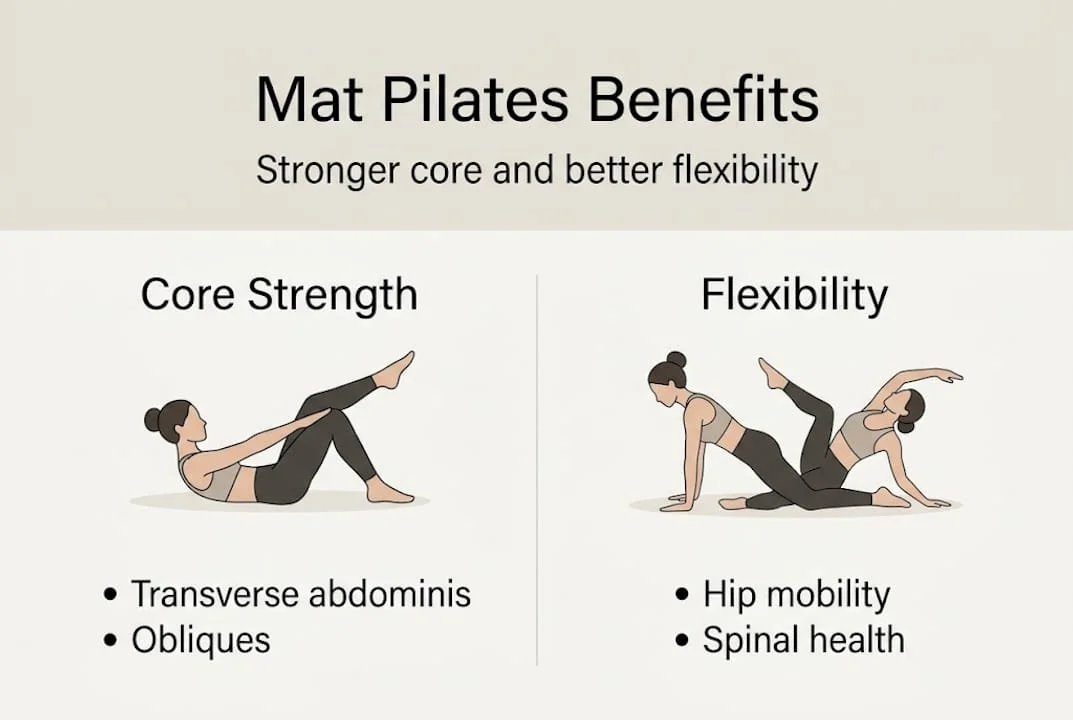
The pain relief evidence is particularly compelling for anyone dealing with chronic discomfort. Research published in a randomized controlled trial found that mat Pilates reduced pain and improved physical function in middle-aged women with chronic low back pain. A separate meta-analysis found that Pilates reduced knee pain in people with osteoarthritis compared to no intervention, with a standardized mean difference of 1.09.
Here is a quick summary of the top science-backed reasons busy adults stick with mat Pilates:
Core activation goes deeper than crunches or planks, targeting stabilizers that protect the spine
Dynamic flexibility improves range of motion without the boredom of static stretching routines
Pain reduction in the lower back and knees is supported by multiple peer-reviewed studies
Improved posture from consistent practice reduces neck and shoulder tension common in desk workers
Low injury risk makes it sustainable for people who have had to stop other workouts due to soreness or strain
"The beauty of mat Pilates is that it meets you where you are. Whether you are managing pain or training for performance, the same principles of control, breath, and precision apply."
Check out Pilates workout routines to see how these principles translate into structured weekly programs.
Mat Pilates vs. reformer: Comparing versatility and outcomes
To make your best choice, let's compare mat Pilates to the ever-popular reformer approach.
| Factor | Mat Pilates | Reformer Pilates |
|---|---|---|
| Equipment needed | Mat only | Reformer machine |
| Average cost per class | Lower | Higher |
| Space required | Minimal | Dedicated studio space |
| Core engagement | Deep intrinsic muscles | Assisted by springs |
| Balance and control | High demand | Moderate demand |
| Power and agility | Moderate | Higher potential |
| Best for | Beginners, flexibility, control | Rehab, power, variety |
| Accessibility | Home or studio | Studio only |
Beyond Pilates, the studio brings together yoga, barre, massage therapy, and even mind-body wellness options that support your overall well-being. Whether you want to try a single mat Pilates class or explore a fuller wellness routine, Amrita makes it easy to start. Browse the schedule, sign up for a class, and experience firsthand why so many Philadelphia adults have made this studio their wellness home.
Frequently asked questions
Is mat Pilates effective for core strength compared to reformer Pilates?
Yes, mat Pilates requires greater intrinsic core control since there is no external support, making it equally effective for building strength and flexibility as reformer Pilates.
Can mat Pilates help with chronic back or knee pain?
Yes, a randomized controlled trial found mat Pilates reduced pain and improved function in people with chronic low back pain, and a meta-analysis confirmed Pilates reduced knee pain in osteoarthritis patients compared to no intervention.
How often should I practice mat Pilates for best results?
Most experts recommend starting 2 to 3 times per week to see sustained core strength and flexibility improvements without overtraining.
Do I need any special equipment for mat Pilates?
No, only a supportive mat is required. No machines, springs, or special tools are needed to get started or to see meaningful results.
Recommended
Top benefits of Pilates for men: strength, flexibility, wellness
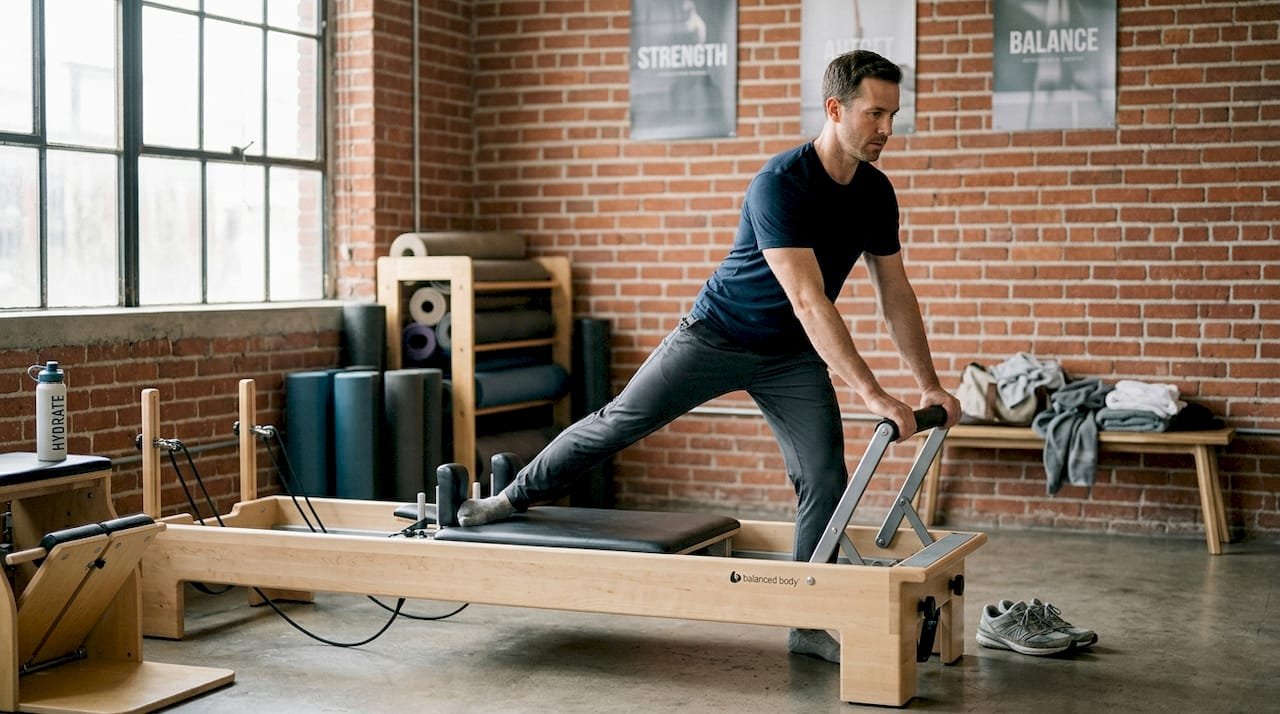
Finding a workout that actually builds strength, improves flexibility, and protects your joints is harder than it sounds. Most men in Philadelphia cycle through gym routines, running programs, or group fitness classes only to end up with nagging back pain, tight hips, or burnout. Pilates is quietly changing that story. Once dismissed as something only women did, it now has serious backing from sports scientists and elite athletes alike. This article breaks down exactly what men can expect from Pilates, with real data and practical guidance to help you decide if it belongs in your weekly routine.
Table of Contents
Core strength and functional movement: The foundational benefit
Flexibility, mobility, and joint health: Supporting men at any age
Weight control, muscle endurance, and energy: Real results for real men
Pilates versus traditional strength training: Which builds the best male body?
Who can benefit most? Situational recommendations for Philadelphia men
Key Takeaways
| Point | Details |
|---|---|
| Full-body strength | Pilates builds lean, functional strength in men and enhances stability and mobility. |
| Flexibility and joint health | Consistent Pilates training improves flexibility and supports long-term joint health. |
| Suits all ages | Men of any age or fitness level can benefit, especially those with joint pain or desk jobs. |
| Supports weight loss | Pilates can contribute to sustainable weight management and muscle endurance for men. |
| Mental wellness boost | Along with physical gains, Pilates helps reduce stress and provides greater mental clarity. |
Why Pilates? Criteria for men seeking the right workout
Before committing to any new fitness practice, it helps to know what you actually need. Most men in Philadelphia are looking for a workout that checks several boxes at once.
Here is what typically matters most:
Low-impact movement that does not grind down your knees or hips
Real strength and flexibility gains, not just the appearance of fitness
Injury prevention, especially for the lower back and shoulders
Functionality, meaning it carries over into sports, work, and daily life
Longevity, so you can stay active well into your 50s, 60s, and beyond
Stress relief, because a workout that only taxes your body is only doing half the job
Pilates fits every one of these criteria. It is ideal for building strength, flexibility, and well-being, particularly for men who spend long hours at a desk. Whether you are exploring popular Pilates styles for the first time or returning after an injury, the method adapts to where you are right now.
"Pilates is one of the few modalities that simultaneously addresses strength, mobility, and mental focus, making it a complete system rather than a supplement." — Physical therapist and movement specialist
That combination is rare. Most workouts force you to choose between building muscle and protecting your joints. Pilates refuses that trade-off.
Core strength and functional movement: The foundational benefit
Core strength is not about having a six-pack. It is about having a stable, powerful center that supports everything else you do, from lifting groceries to throwing a baseball to sitting through a three-hour meeting without your back seizing up.
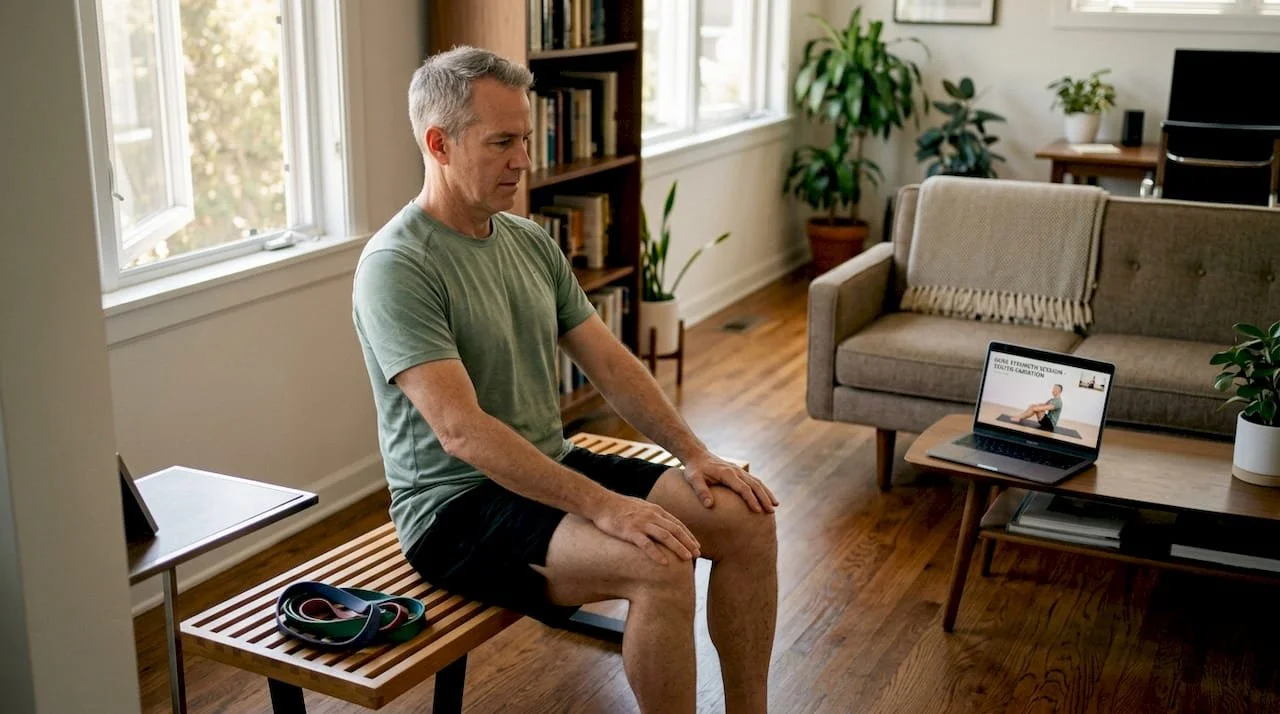
Pilates targets the deep stabilizing muscles that most gym exercises miss entirely. These are the muscles that wrap around your spine and pelvis, and when they are strong, everything else works better. Research shows that Pilates increased upper limb strength by 17.28% and improved leg dynamic strength in men, which is a meaningful gain for a low-impact practice.
Functional movement benefits men see from consistent Pilates practice include:
Better posture during both exercise and desk work
Reduced lower back pain from stronger spinal support muscles
Improved athletic performance in running, cycling, and team sports
Faster recovery between training sessions
Greater body awareness, which reduces the risk of injury during other workouts
Pro Tip: Focus on your breath during every Pilates movement. Exhaling on the effort activates your deep core muscles more effectively than just going through the motions. This single habit separates beginners from people who actually get results.
If you are searching for gyms with Pilates classes in Philadelphia, look for instructors who emphasize form over speed. You can also read more about Pilates gyms for core strength to find the right fit for your goals.
"The core is the powerhouse of the body. Every movement originates there, and Pilates trains that origin point with precision." — Joseph Pilates
Flexibility, mobility, and joint health: Supporting men at any age
Most men do not stretch enough. It is not a character flaw. It is just that traditional gym culture rarely rewards flexibility work the way it rewards adding weight to the bar. The result is tight hamstrings, stiff hips, and shoulders that click every time you reach overhead.
Pilates changes that equation. Eight weeks of Pilates training led to significant improvements in flexibility in older men, which means the benefits are not just for young athletes. They extend across age groups.
Mobility gains men report from regular Pilates sessions:
Easier hip rotation during running and cycling
Reduced morning stiffness in the lower back
Greater shoulder range of motion for overhead pressing
Less tension in the neck and upper traps after desk work
Improved balance and coordination during sports
For men dealing with joint pain, this matters even more. Pilates is particularly suitable for men with joint pain because it strengthens the muscles around vulnerable joints without loading them with heavy impact. Pilates reformer classes are especially effective here, since the reformer machine allows you to control resistance and range of motion precisely.
Weight control, muscle endurance, and energy: Real results for real men
Pilates is not a cardio class. But that does not mean it leaves your metabolism untouched. The sustained muscle engagement required in Pilates builds endurance and burns more calories than most men expect.
Here are evidence-backed results men have reported after adding Pilates to their routines:
Weight loss without diet changes. One powerlifter lost 5 lbs in 30 days of Pilates with no changes to his diet or cardio program.
Reduced warm-up time. Improved mobility means joints and muscles are ready to work faster, cutting pre-workout prep significantly.
Less back strain during heavy lifts. Stronger stabilizers protect the spine when you return to the barbell.
Higher energy levels throughout the day. Better posture and reduced muscle tension translate directly into less fatigue.
Faster recovery. Active recovery through Pilates reduces soreness between intense training days.
Pro Tip: Add two Pilates sessions per week alongside your existing training rather than replacing it. Most men see the biggest energy and endurance gains within the first four to six weeks using this approach. You can explore Pilates for weight loss strategies or start with mat Pilates routines that require no equipment at all.
Mental clarity, stress, and overall well-being
Philadelphia men are busy. Between work, family, and trying to stay in shape, mental fatigue is as real as physical fatigue. Pilates addresses both at the same time.
The focused, breath-driven nature of Pilates forces you to be present. You cannot zone out the way you might on a treadmill. That mental engagement is actually the point. The same powerlifter who lost weight also reported better mental clarity and less strain after incorporating Pilates into his routine.
Mental and emotional benefits men experience from Pilates:
Reduced stress and anxiety from controlled breathing and focused movement
Improved sleep quality linked to lower cortisol levels after sessions
Greater motivation to maintain other healthy habits
Sharper focus during work and decision-making
A stronger sense of body confidence that carries into everyday life
For men who feel like their mental game is slipping, Pilates for wellness offers a structured way to reset both physically and mentally without adding more stress to your schedule.
"The mind, when housed within a healthful body, possesses a glorious sense of power." — Joseph Pilates
Pilates versus traditional strength training: Which builds the best male body?
This is the question most men ask before they ever step into a Pilates class. The honest answer is that they build different things, and the smartest approach uses both.
| Category | Pilates | Traditional strength training |
|---|---|---|
| Muscle type built | Lean, functional, stabilizing | Bulk, hypertrophy-focused |
| Injury risk | Very low | Moderate to high |
| Mobility improvement | High | Low to moderate |
| Joint stress | Minimal | Can be significant |
| Best for longevity | Excellent | Moderate |
| Core development | Deep stabilizers | Surface muscles |
| Flexibility gains | Significant | Minimal |
Pilates builds functional and lean strength, not bulk like weights, and it is better suited for longevity and mobility. That does not make it inferior. It makes it different and complementary.
Scenarios where Pilates is the clear winner:
You want to stay active and pain-free past age 50
You are recovering from a sports injury
Your flexibility is limiting your athletic performance
You sit at a desk for eight or more hours a day
You want to improve your lifts without adding more heavy training days
Explore your Pilates workout options to find the format that fits your current training load.
Who can benefit most? Situational recommendations for Philadelphia men
Not every man comes to Pilates for the same reason. Here is a practical breakdown of who gets the most out of it.
| Male profile | Primary Pilates benefit |
|---|---|
| Office worker with back pain | Spinal support, posture correction |
| Runner or cyclist | Hip mobility, reduced injury risk |
| Weightlifter | Core stability, joint protection |
| New dad with limited time | Full-body conditioning in short sessions |
| Man over 50 | Flexibility, balance, joint health |
| Athlete in recovery | Low-impact strength maintenance |
Signs you should try Pilates now:
You have chronic lower back pain that does not respond to stretching alone
You want a low-impact option that still delivers real fitness results
You are focused on staying active and functional for the long term
Your stress levels are affecting your sleep and energy
You want to complement your current training without adding joint stress
For men dealing with chronic back pain specifically, research from a randomized controlled trial shows that Pilates reduces pain and disability more effectively than home exercises. That is a significant finding for the many Philadelphia men who have tried everything else. Find Pilates classes near you to get started with professional guidance.
Ready to try Pilates? Next steps for men in Philadelphia
If the evidence in this article resonates with you, the next step is finding a studio that actually understands what men need from Pilates. Not every class is built the same, and having the right environment makes a real difference in how quickly you progress.
At Amrita Yoga & Wellness, we welcome men at every fitness level, from complete beginners to competitive athletes looking to sharpen their edge. Our Pilates classes are designed to build real strength and mobility in a supportive, non-intimidating setting. Beyond Pilates, we also offer acupuncture services for pain management and recovery, as well as wellness readings for men who want to address stress and mental clarity from a holistic angle. Come see what a complete approach to men's wellness looks like in Philadelphia.
Frequently asked questions
Is Pilates effective for men who already lift weights?
Yes, Pilates complements weight training by improving core stability, mobility, and reducing back strain. One powerlifter saw improved performance and less back strain after adding Pilates to his lifting routine.
How quickly can men see results from Pilates?
Most men notice meaningful improvements in flexibility, strength, and posture within eight weeks of consistent practice. Eight weeks of Pilates training produced measurable gains in flexibility and posture in older men.
Is Pilates safe for men with back pain or joint issues?
Yes. Pilates is low-impact and research shows it reduces pain and disability more effectively than home exercises for men with chronic back pain. Its low-impact nature also makes it suitable for men managing joint issues.
Does Pilates help with weight loss for men?
It can. One man lost 5 lbs in 30 days of Pilates without changing his diet or adding cardio, suggesting that the muscle engagement and metabolic demand of Pilates contributes to real weight management results.
Recommended
7 Different Kinds of Pilates for Core Strength and Wellness
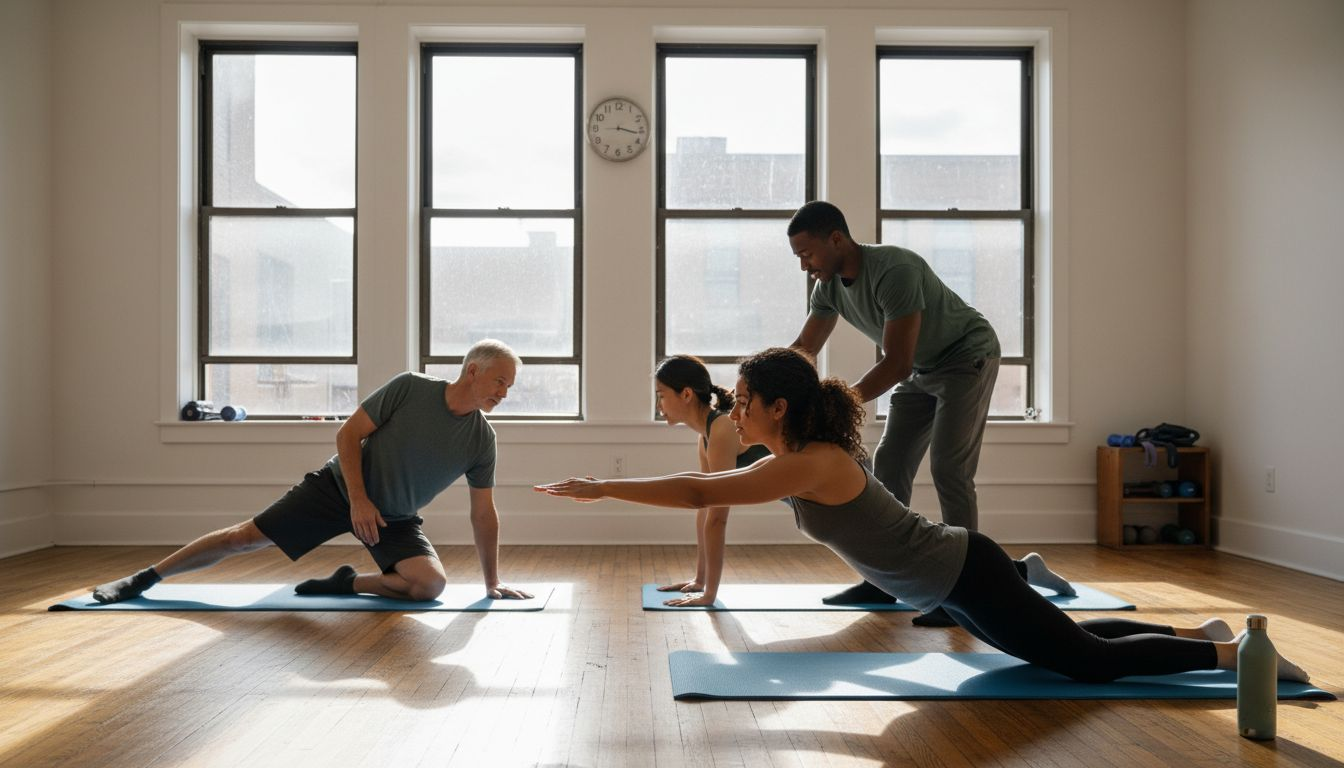
Choosing the right Pilates style can feel overwhelming when you want specific results but are faced with so many options. Whether your goal is building core strength, improving balance, or recovering from injury, finding a method that truly meets your needs is challenging. Each approach offers unique benefits, and understanding these differences makes all the difference in shaping your fitness journey.
The good news is that experts have identified proven Pilates methods that help with core muscle strength, body composition, flexibility, and even rehabilitation. This list breaks down the most effective styles and techniques, backed by research, so you can select the best practice for your goals. Get ready to discover practical insights that will help you make an informed choice and achieve lasting results.
Table of Contents
Quick Summary
| Takeaway | Explanation |
|---|---|
| 1. Mat Pilates strengthens the core effectively. | Focused movements enhance core stability and improve posture, suitable for all fitness levels. |
| 2. Reformer Pilates customizes full-body workouts. | Adjustable resistance enables diverse exercise variations, targeting every muscle group safely. |
| 3. Classical Pilates emphasizes precision and control. | Rooted in original techniques, it promotes balanced movement and injury prevention. |
| 4. Contemporary Pilates adapts to individual needs. | Incorporates modern insights to provide personalized exercise strategies for optimal results. |
| 5. Small group Pilates fosters community engagement. | Collaborative classes build connections among participants, enhancing motivation and accountability. |
1. Mat Pilates for Core Building
Mat Pilates is a foundational practice that transforms your core strength using nothing more than a simple exercise mat and your body weight. By focusing on controlled movements and precise muscle engagement, mat Pilates provides an accessible yet powerful approach to building a strong, stable core.
Unlike equipment-based Pilates methods, mat Pilates allows practitioners to concentrate on fundamental movements that target deep abdominal muscles, spinal alignment, and overall body control. Research demonstrates significant improvements in core muscle strength, posture, and stability through consistent matwork exercises.
The practice involves a series of bodyweight exercises performed on the floor, emphasizing precise muscle activation and mindful breathing. These movements engage multiple muscle groups simultaneously, creating a comprehensive workout that strengthens the core from multiple angles. By targeting muscles around the spine, pelvis, and abdomen, mat Pilates helps improve balance, reduce back pain, and enhance overall functional stability.
Particularly beneficial for individuals seeking low-impact exercise, mat Pilates can be adapted for various fitness levels. Beginners can start with basic movements like the hundred, roll ups, and leg lifts, while advanced practitioners can incorporate more challenging sequences that demand greater core control and strength.
Pro Tip: Start each mat Pilates session by focusing on your breath and establishing a strong mind body connection before moving into more complex movements.
2. Reformer Pilates for Full-Body Conditioning
Reformer Pilates represents a dynamic and transformative approach to full-body fitness that goes far beyond traditional exercise methods. By utilizing a specialized sliding platform with adjustable spring resistance, this practice offers a comprehensive workout that challenges and transforms your entire physique.
Research demonstrates significant improvementsin body composition, muscle strength, and overall physical conditioning. The Reformer machine allows for hundreds of exercise variations that target every major muscle group while providing both support and resistance.
Unlike traditional weight training, Reformer Pilates creates a unique environment where resistance can be applied from multiple angles. This approach helps develop lean muscle mass, improve flexibility, and enhance overall biomechanical efficiency. By challenging your body through controlled movements, you engage stabilizing muscles that are often overlooked in standard workout routines.
Practitioners can customize their workout intensity by adjusting the machine's spring tension, making Reformer Pilates suitable for everyone from rehabilitation patients to professional athletes. The equipment's design allows for low impact movements that protect joints while still providing an incredibly effective full body conditioning experience.
Pro Tip: Start with a trained instructor who can help you understand proper form and machine adjustments to maximize your Reformer Pilates experience and prevent potential injuries.
3. Classical Pilates for Balanced Movement
Classical Pilates represents the purest form of the Pilates method, directly rooted in Joseph Pilates' original vision of holistic body conditioning. This approach goes beyond simple exercise by creating a comprehensive system designed to restore balanced movement and optimal physical functioning.
Systematic research demonstrates significant improvementsin posture, core strength, and overall body alignment. Classical Pilates emphasizes precision, control, and intentional movement patterns that challenge both body and mind through carefully choreographed sequences.
Unlike modern fitness trends, Classical Pilates maintains a strict commitment to the original repertoire developed by Joseph Pilates. The practice focuses on six key principles flow, concentration, control, precision, breathing, and centering which work together to create a deeply transformative physical experience. Each movement is performed with meticulous attention to proper form, ensuring that practitioners develop muscle balance and functional strength.
The method integrates full body movements that simultaneously strengthen and stretch muscle groups, promoting long lean muscle development and improved joint mobility. By targeting deep stabilizing muscles, Classical Pilates helps correct postural imbalances and reduces the risk of injury through mindful, controlled exercise.
Pro Tip: Begin your Classical Pilates journey by working with a certified instructor who understands the original method and can guide you through proper technique and progression.
4. Contemporary Pilates for Modern Techniques
Contemporary Pilates represents a dynamic evolution of the traditional Pilates method, blending classic principles with cutting edge scientific understanding and individualized approaches. This modern interpretation adapts the original practice to meet the diverse needs of todays fitness enthusiasts and wellness seekers.
Research highlights the method's innovative approachby integrating functional movement patterns and the latest anatomical research. Unlike classical Pilates, this approach allows for greater flexibility in technique, equipment use, and personal modification.
The contemporary method recognizes that every body is unique, focusing on personalized movement strategies that address individual biomechanical patterns and fitness goals. Practitioners can expect a more fluid approach that incorporates insights from physical therapy, sports science, and holistic wellness practices.
Key differences include expanded equipment options, more varied exercise modifications, and a deeper understanding of how movement impacts overall body health. Contemporary Pilates practitioners benefit from a more scientific and adaptive approach that considers individual body mechanics, injury history, and specific fitness objectives.
Pro Tip: Seek out instructors with comprehensive training in both traditional and contemporary Pilates techniques to experience a truly personalized and scientifically informed approach to movement.
5. Clinical Pilates for Rehabilitation Support
Clinical Pilates represents a specialized approach to movement therapy designed specifically for rehabilitation and injury recovery. This targeted method transforms traditional Pilates principles into a precise therapeutic intervention that addresses individual physical challenges and recovery needs.
Systematic research confirms its effectivenessin managing chronic conditions, particularly chronic low back pain. Unlike standard exercise programs, Clinical Pilates is meticulously tailored to each patients unique physical requirements, focusing on targeted muscle engagement and controlled movement patterns.
The practice involves a comprehensive assessment by trained physiotherapists or specialized Pilates instructors who develop personalized exercise protocols. These protocols aim to restore muscle balance, improve flexibility, reduce pain, and enhance overall functional movement. By addressing specific musculoskeletal weaknesses, Clinical Pilates helps patients recover from injuries more effectively and prevent future physical complications.
Key benefits include improved core stability, enhanced body awareness, pain reduction, and gradual strength building. Patients with conditions such as chronic back pain, sports injuries, postural imbalances, and neurological disorders can particularly benefit from this targeted approach to rehabilitation.
Pro Tip: Always consult a certified clinical Pilates professional who can conduct a thorough initial assessment and design a rehabilitation program specific to your individual physical needs and recovery goals.
6. Pilates Barre for Flexibility and Tone
Pilates Barre blends the precision of Pilates with classical ballet techniques, creating a unique workout that transforms body composition and muscular performance. This dynamic practice combines ballet barre work, Pilates principles, and strength training to deliver a comprehensive fitness experience.
Research confirms significant improvementsin muscle control, posture, and overall body flexibility. By integrating small controlled movements with isometric holds, Pilates Barre challenges muscles in ways traditional exercise cannot, promoting lean muscle development and enhanced joint mobility.
The method utilizes a ballet barre for support while performing low impact, high intensity movements that target multiple muscle groups simultaneously. Participants experience a full body workout that emphasizes core engagement, muscle elongation, and precise movement patterns. This approach helps develop long, strong muscles without creating bulk, making it ideal for individuals seeking refined muscular definition.
Unlike traditional strength training, Pilates Barre focuses on muscle endurance, balance, and functional movement. The practice incorporates elements of dance, Pilates, and strength conditioning to create a holistic approach to fitness that improves both physical performance and body awareness.
Pro Tip: Wear form fitting clothing and grippy socks to maximize your range of motion and maintain stability during Pilates Barre exercises.
7. Small Group Pilates for Community Connection
Small group Pilates represents more than just a fitness class its a powerful platform for building meaningful connections and shared wellness experiences. This collaborative approach transforms traditional exercise into a supportive community driven journey of personal growth and mutual encouragement.
Research confirms significant community benefitsthrough collective fitness experiences. Small group settings create an environment where participants motivate each other, share challenges, and celebrate individual and collective progress, making fitness feel less like a solitary task and more like a shared adventure.
Unlike individual training, small group Pilates offers a unique blend of personalized instruction and collective energy. Participants receive targeted guidance from instructors while simultaneously experiencing the motivation that comes from working alongside peers with similar fitness goals. This approach helps individuals stay consistent, accountable, and inspired throughout their wellness journey.
The social dynamics of small group Pilates extend beyond physical exercise. Participants develop friendships, support networks, and a sense of belonging that transcends traditional workout experiences. By creating a collaborative and inclusive environment, these classes help combat isolation and promote holistic well being.
Pro Tip: Choose a small group Pilates class with a welcoming atmosphere and an instructor who emphasizes community and individual growth.
Below is a comprehensive table summarizing the various Pilates methods and their unique characteristics and benefits as detailed in the article.
| Pilates Method | Key Features | Best For |
|---|---|---|
| Mat Pilates | Involves bodyweight exercises on a mat, focusing on core strength, spinal alignment, and muscle control. | Beginners seeking low-impact workouts targeting core stability and strength. |
| Reformer Pilates | Utilizes a machine with adjustable spring resistance for exercises targeting overall muscle coordination and strength. | Individuals aiming for full-body conditioning and muscle toning. |
| Classical Pilates | Adheres to the original repertoire by Joseph Pilates, focusing on principles such as control, precision, and balance. | Enthusiasts looking to practice Pilates in its traditional and structured form. |
| Contemporary Pilates | Integrates modern anatomical knowledge and diverse modifications into traditional Pilates practice. | People looking for a flexible, scientifically informed approach to fitness. |
| Clinical Pilates | Tailored for rehabilitation and injury recovery, guided by trained professionals to address individual physical challenges. | Patients requiring therapeutic exercises for recovery and pain management. |
| Pilates Barre | Combines ballet techniques with Pilates principles, emphasizing muscle endurance and elongation. | Individuals interested in improving flexibility, posture, and achieving lean muscle definition. |
| Small Group Pilates | Focuses on community engagement, blending group dynamics with personalized instruction to foster connection and accountability. | Those seeking social motivation and shared wellness experiences. |
Discover Your Path to Core Strength and Wellness with Amrita Yoga & Wellness
Building a resilient core and achieving balanced movement is essential for both physical and mental well-being. Whether you are drawn to Mat Pilates, Reformer Pilates, Clinical Pilates, or the innovative practice of Contemporary Pilates, overcoming challenges like limited mobility, chronic pain, or lack of motivation requires guidance and a supportive community. At Amrita Yoga & Wellness, we understand these goals and pain points. Our diverse offerings are designed to help you develop core strength, enhance flexibility, and restore harmony in your body through mindful, expert instruction.
Ready to transform your wellness journey with personalized Pilates sessions and holistic practices? Visit Amrita Yoga & Wellness to explore a variety of classes, workshops, and retreat options tailored for beginners to advanced practitioners. Embrace a stronger core, improved posture, and vibrant health today by signing up for a class or reaching out for individualized support. Experience how the right Pilates style and a welcoming community can make all the difference.
Frequently Asked Questions
What is the main benefit of Mat Pilates for core strength?
Mat Pilates primarily focuses on improving core strength using bodyweight exercises on a mat. To experience these benefits, commit to practicing consistently and focus on engaging your deep abdominal muscles for noticeable improvements in posture and stability within a few weeks.
How does Reformer Pilates differ from traditional Pilates methods?
Reformer Pilates utilizes a specialized machine to provide adjustable resistance, allowing for a varied full-body workout. To fully understand this approach, consider taking an introductory class that covers different exercises and proper machine setup.
Can Classical Pilates help improve my posture?
Yes, Classical Pilates is designed to enhance posture by promoting balanced muscle development and proper body alignment. To see improvements, practice regularly and pay attention to precise movement patterns, which can lead to better posture over time.
What makes Contemporary Pilates a good choice for beginners?
Contemporary Pilates offers a modern approach that adapts traditional techniques with a focus on individual needs and functional movements. To get started, find a qualified instructor who can tailor a session to your fitness level and help you grasp the basics effectively.
How can Clinical Pilates assist in my rehabilitation process?
Clinical Pilates is specifically designed for rehabilitation and targets individual needs for effective recovery. To leverage this method, consult with a certified clinical Pilates instructor who can assess your condition and create a personalized program that addresses specific concerns.
What should I expect from a Small Group Pilates class?
In a Small Group Pilates class, you can expect personalized instruction alongside a supportive community atmosphere. To benefit fully, engage with your peers, set personal goals, and participate actively, which can greatly enhance your motivation and progress.
Recommended
Discover What Gyms Offer Pilates for Core Strength
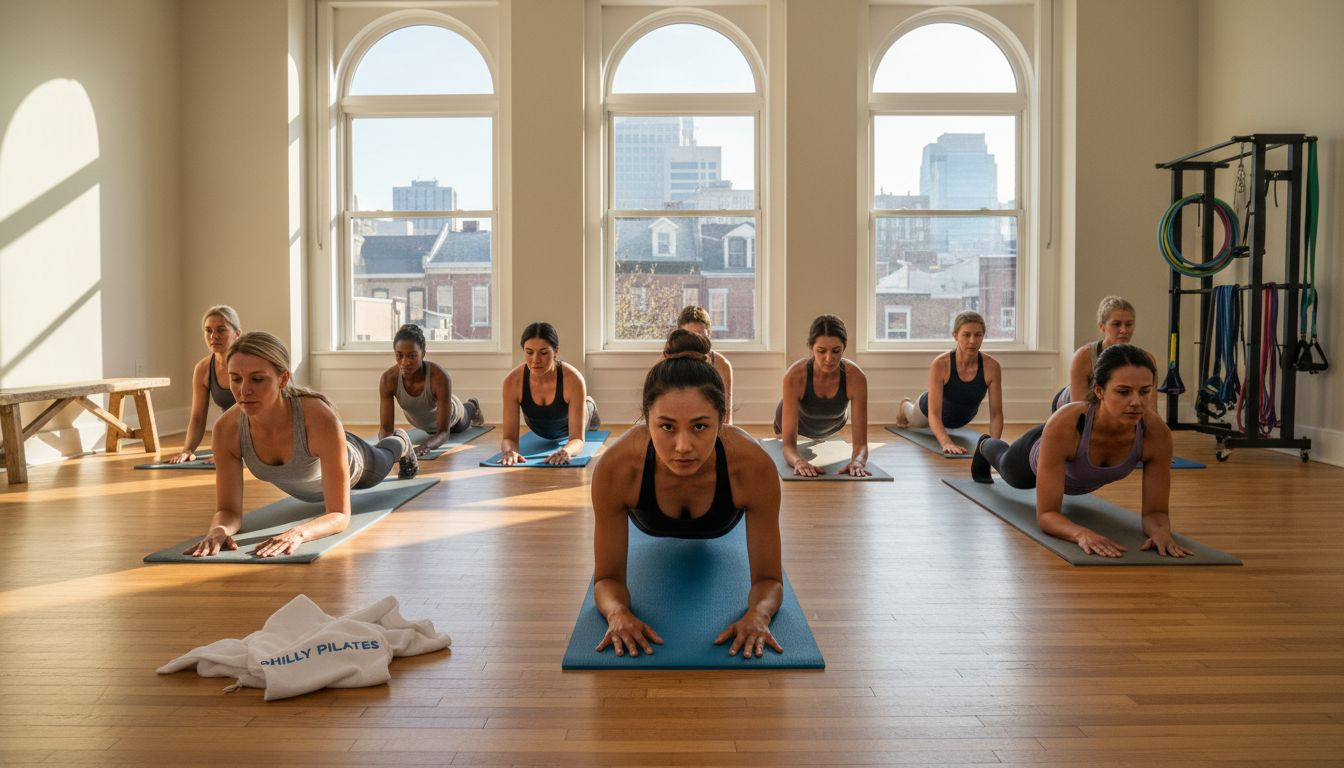
Choosing a Pilates studio in Philadelphia can feel overwhelming with so many boutique gyms spread across the city. Whether you crave intense reformer sessions or the precise challenge of mat Pilates, finding a studio that truly fits your schedule and goals is key to building lasting improvements in core strength and flexibility. By focusing on expert-led classes, personalized attention, and dedicated facilities, you can discover your ideal spot for real progress in your wellness journey. Boutique studios offer specialized options for every fitness level.
Table of Contents
Quick Summary
| Key Point | Explanation |
|---|---|
| 1. Utilize Fitness Platforms | Check ClassPass or other platforms for a curated list of pilates studios tailored to your preferences and schedule. |
| 2. Verify Instructor Credentials | Confirm that instructors have completed recognized certification programs to ensure quality and safety in your pilates practice. |
| 3. Analyze Membership Options | Compare different pricing structures and membership plans to find one that fits your budget and attendance habits best. |
| 4. Visit Studios Physically | Assess cleanliness, equipment quality, and the studio atmosphere in person to determine if it suits your personal training style. |
| 5. Attend Trial Classes | Participate in trial sessions to gauge your comfort level, teaching quality, and how well the workouts meet your fitness goals. |