How Pilates Accelerates Rehab: Evidence, Benefits, Steps
TL;DR:
Pilates effectively reduces pain, disability, and improves quality of life in musculoskeletal conditions.It is best integrated into rehab after acute injury phase under professional supervision.Evidence shows Pilates benefits low back pain, knee osteoarthritis, and post-surgical recovery.
Pilates has a reputation problem. Most people picture it as a trendy fitness class, something you do to tone your core or improve your posture. But physical therapists and rehab specialists have known for years that Pilates is far more than that. Research confirms that Pilates reduces pain and disability while improving quality of life in people with musculoskeletal conditions. If you're recovering from an injury in Philadelphia or trying to rebuild your mobility, understanding how Pilates fits into the rehab picture could genuinely change your recovery timeline.
Table of Contents
Key Takeaways
| Point | Details |
|---|---|
| Backed by science | Pilates consistently reduces pain and improves quality of life in musculoskeletal rehab settings. |
| Best post-acute phase | Start Pilates once your initial pain is controlled, working closely with your PT and Pilates instructor. |
| 4-8 week timeline | Most feel better mobility and less pain within 1-2 months with consistent, supervised practice. |
| Ideal for specific conditions | Chronic low back pain, knee osteoarthritis, and post-surgery recovery respond especially well to Pilates-based rehab. |
| Holistic recovery tool | Pilates complements traditional rehab by improving core stability, balance, and functional movement. |
What is Pilates and how does it apply to rehab?
Joseph Pilates developed his method in the early 20th century, originally using it to help injured dancers and athletes recover strength and function. His system was built around controlled, mindful movement rather than brute force or high-impact exercise. That origin story matters because it explains why Pilates translates so naturally into modern rehabilitation settings.
The foundational principles of Pilates include:
Breath control: Coordinating inhale and exhale with movement to support the spine and reduce tension
Spinal alignment: Teaching the body to find and maintain neutral posture during activity
Core stability: Building deep abdominal and back muscle strength to protect joints
Controlled movement: Prioritizing precision over speed, which reduces re-injury risk
Mind-body connection: Staying present and aware during each exercise
These principles make Pilates uniquely gentle on joints while still being effective. Unlike high-intensity workouts, Pilates is highly modifiable. An instructor can adapt almost any exercise to work around a shoulder injury, a post-surgical hip, or a sensitive lower back.
"Pilates is a valuable adjunct in rehabilitation, offering structured, low-impact movement that bridges clinical care and long-term wellness."
Physical therapists in Philadelphia increasingly use Pilates as a rehab adjunct to extend the gains made in clinical sessions. You can explore the full range of Pilates offerings or read about Pilates for total body wellness to see how the practice supports long-term health beyond the rehab phase.
What does the evidence say? Scientific support for Pilates in rehab
Understanding the principles is key, but how effective is Pilates for real rehab outcomes? Here's what the latest science shows.
A major meta-analysis found that Pilates produces meaningful improvements across three critical rehab markers. The numbers are striking:
| Outcome | Standardized Mean Difference (SMD) | Interpretation |
|---|---|---|
| Pain reduction | 1.41 | Large effect |
| Disability reduction | 0.83 | Moderate-large effect |
| Quality of life improvement | 2.10 | Very large effect |
Those are not small wins. An SMD of 1.41 for pain is considered a large clinical effect, meaning participants experienced substantial, noticeable relief. A quality of life SMD of 2.10 is exceptional by any research standard.
For people dealing with low back pain, a randomized controlled trial found that Pilates outperformed home exercises for pain, disability, and quality of life in subacute cases. This is important because home exercise programs are the typical alternative most people receive after a few PT sessions. Pilates does more.
For knee osteoarthritis, research shows that Pilates reduces pain and increases ROM compared to no intervention at all. Range of motion improvements matter enormously for anyone who wants to walk comfortably, climb stairs, or stay active in a city like Philadelphia.
It's fair to note that some studies carry moderate to high risk of bias, and certainty ratings can be low. But the consistency of positive findings across different populations and conditions is hard to ignore. You can explore evidence-backed Pilates benefits and wellness outcomes from Pilates to see how these findings translate into real practice.
When and how to add Pilates to your rehabilitation process
So, if Pilates is scientifically effective, when should you consider it during your rehab journey?
Timing matters. Jumping into Pilates during the acute phase of an injury, when inflammation is high and pain is sharp, is not the right move. The ideal window opens once your acute pain is under control and your physician or physical therapist clears you for low-impact movement.
Here's a practical sequence to follow:
Complete acute care first. Let your physical therapist address the immediate injury, reduce swelling, and restore basic movement patterns.
Get cleared for supervised exercise. Ask your PT or doctor when Pilates-style movement is appropriate for your specific injury.
Start with private or small group sessions. A one-on-one session lets an instructor assess your limitations and customize every exercise.
Progress gradually. Begin with foundational movements like pelvic tilts, breathing exercises, and gentle spinal articulation before moving to more integrated activities.
Commit to consistency. Research shows that twice-weekly sessions over 4-8 weeks produce measurable clinical benefits.
Pro Tip: Before your first Pilates session, write down your injury history, current limitations, and rehab goals. Share this with your instructor so they can design a session that complements your existing treatment plan, not work against it.
Exploring different types of Pilates can help you choose the right format, and if you're just getting started, Pilates for beginners resources can ease the transition.
Which conditions and injuries benefit most from Pilates?
You might wonder if Pilates is right for your specific condition. Here's a look at which injuries get the most from this approach.
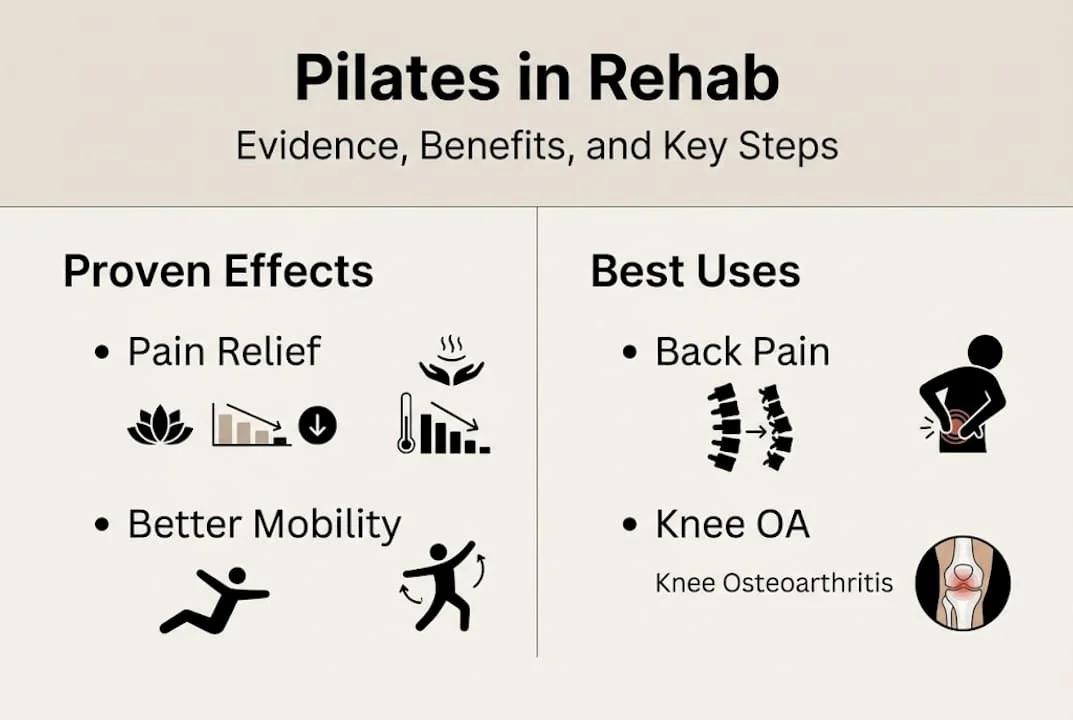
Not every condition responds equally to Pilates, but the evidence is strong for several common rehab scenarios that Philadelphia residents frequently face.
| Condition | Proven benefit | Caveats |
|---|---|---|
| Chronic low back pain | Pain reduction, improved function | Best with supervised sessions |
| Subacute low back pain | Better than home exercise for pain and QoL | Needs trained instructor |
| Knee osteoarthritis | Pain relief, increased range of motion | Less evidence for muscle mass changes |
| Post-surgical recovery | Core stability, functional movement | Timing must be cleared by surgeon |
| Hip rehabilitation | Balance, alignment, mobility | Evidence still emerging |
Research confirms that Pilates is effective post-surgery and for chronic nonspecific low back pain, though its effect on muscle tone or body composition is less clear. That distinction matters. Pilates is not a bodybuilding tool. It’s a precision movement system designed to restore function, reduce pain, and rebuild confidence in your body.
Conditions that respond particularly well include:
Chronic low back pain: The most researched area, with consistent evidence across multiple studies
Knee osteoarthritis: Especially for improving daily movement and reducing stiffness
ACL reconstruction recovery: Core and hip stability work supports knee function
Post-hip replacement: Gentle alignment and balance training aids return to activity
For a deeper look at how exercises can be adapted to your condition, browse Pilates exercise adaptations or check out essential Pilates exercises for all levels.
Practical tips for getting the most from Pilates during rehab
Beyond knowing what works, these proven strategies help you maximize your rehabilitation outcomes with Pilates.
The difference between a frustrating experience and a transformative one often comes down to how you approach the practice. Here's what actually moves the needle:
Choose a certified instructor with rehab experience. Not all Pilates instructors are trained to work with injured clients. Look for someone with additional certifications in therapeutic or clinical Pilates.
Select a studio that offers supervised small group or private sessions. Large group classes may not give you the individual attention your recovery needs.
Combine Pilates with your existing rehab program. Research confirms that customizing Pilates after initial PT yields better mobility and functional outcomes than either approach alone.
Track your progress. Keep a simple log of pain levels, mobility improvements, and any movements that feel easier week over week. This helps your instructor adjust the program.
Be patient with the timeline. Four to eight weeks of consistent practice is the benchmark for noticeable change. Rushing the process increases re-injury risk.
Pro Tip: During every session, prioritize the quality of each movement over the number of repetitions. One perfectly executed movement with full core engagement does more for your recovery than ten sloppy ones.
For targeted guidance, explore resources on Pilates core strength and browse sample Pilates workouts to see what a structured session looks like.
A fresh perspective: The overlooked power of Pilates in modern rehab
Conventional rehab thinking draws a hard line between clinical treatment and wellness. You go to PT, you get better, you graduate, and then you're on your own. Pilates challenges that model in a meaningful way.
What we see at studios like ours is that the clients who recover most fully are the ones who don't treat Pilates as a temporary phase. They treat it as a permanent part of how they move through the world. The practice becomes a language their body speaks fluently, and that fluency protects them from future injury.
The research supports this view. Pilates builds the kind of deep stabilizing strength that generic gym workouts rarely reach. It also builds body awareness, which is arguably the most undervalued asset in long-term recovery. A person who can feel when their alignment is off is far less likely to re-injure themselves than someone who simply got stronger.
In Philadelphia, where people walk everywhere, navigate uneven sidewalks, and stay active through all four seasons, that kind of awareness is not a luxury. It's a necessity. Our insights from the Pilates team reflect years of watching this transformation happen, one session at a time.
Ready to try Pilates for your recovery?
If you're considering Pilates for your recovery process, there's never been a better time to act. Amrita Yoga & Wellness in Philadelphia offers private and small group Pilates sessions designed with post-injury and mobility needs in mind. Our instructors understand the difference between a fitness goal and a rehab goal, and they build sessions accordingly.
Whether you're just finishing physical therapy or looking for a structured way to maintain the gains you've worked hard for, our studio provides the guidance and community to support your next step. Visit our Pilates rehab resources to learn more, or reach out to schedule an introductory consultation with one of our experienced instructors.
Frequently asked questions
Is Pilates safe during all stages of injury rehab?
Pilates is safest after your acute pain is managed and your PT or physician has cleared you for low-impact movement. Sessions should always be tailored to your specific injury stage and supervised by a qualified instructor.
How many sessions before I feel results from Pilates in rehab?
Most people notice meaningful improvements within 4-8 weeks at twice weekly sessions, and those effects are often sustained at follow-up assessments.
Which injuries or conditions benefit most from Pilates?
Chronic low back pain and knee osteoarthritis have the strongest research support. Studies show Pilates outperforms generic or no exercise for these conditions, and Pilates reduces knee OA pain while improving range of motion.
Can Pilates fully replace physical therapy or other rehab exercises?
No. Pilates works best as an adjunct to physical therapy, not a replacement. It should be integrated after acute PT and coordinated with your clinical care team for the safest, most effective outcome.