What Is a Pilates Reformer Class? Core Strength Explained
TL;DR:
Pilates reformer classes are accessible and beneficial for people of all fitness levels, not just dancers or athletes. They focus on core strength, flexibility, and balance through adjustable resistance and controlled movements, making them suitable for beginners and those with physical limitations. Consistent practice builds mind-body awareness and sustainable improvements, emphasizing long-term wellness over quick results.
Pilates reformer classes have a reputation problem. Many people assume they're reserved for dancers, athletes, or people who already have six-pack abs and serious flexibility. That image couldn't be further from the truth. A beginner reformer class guide will tell you the same thing we tell every first-timer who walks through our doors in Philadelphia: this method was built to meet your body where it is today. Whether you're dealing with tight hips, a history of back pain, or you've never set foot in a fitness studio before, reformer Pilates has something real to offer.
Table of Contents
Key Takeaways
| Point | Details |
|---|---|
| Beginner friendly | Pilates reformer classes can be modified for all levels, including newcomers. |
| Core and flexibility | Consistent practice improves core strength, flexibility, and balance. |
| Customizable workouts | Spring settings and instructor guidance make reformer Pilates adaptable for any body. |
| Mat vs. reformer | Reformer Pilates provides more support and options than mat Pilates, especially for beginners. |
| Mindset matters | Long-term benefits come from regular practice and a holistic approach, not just physical exercise. |
What happens in a Pilates reformer class?
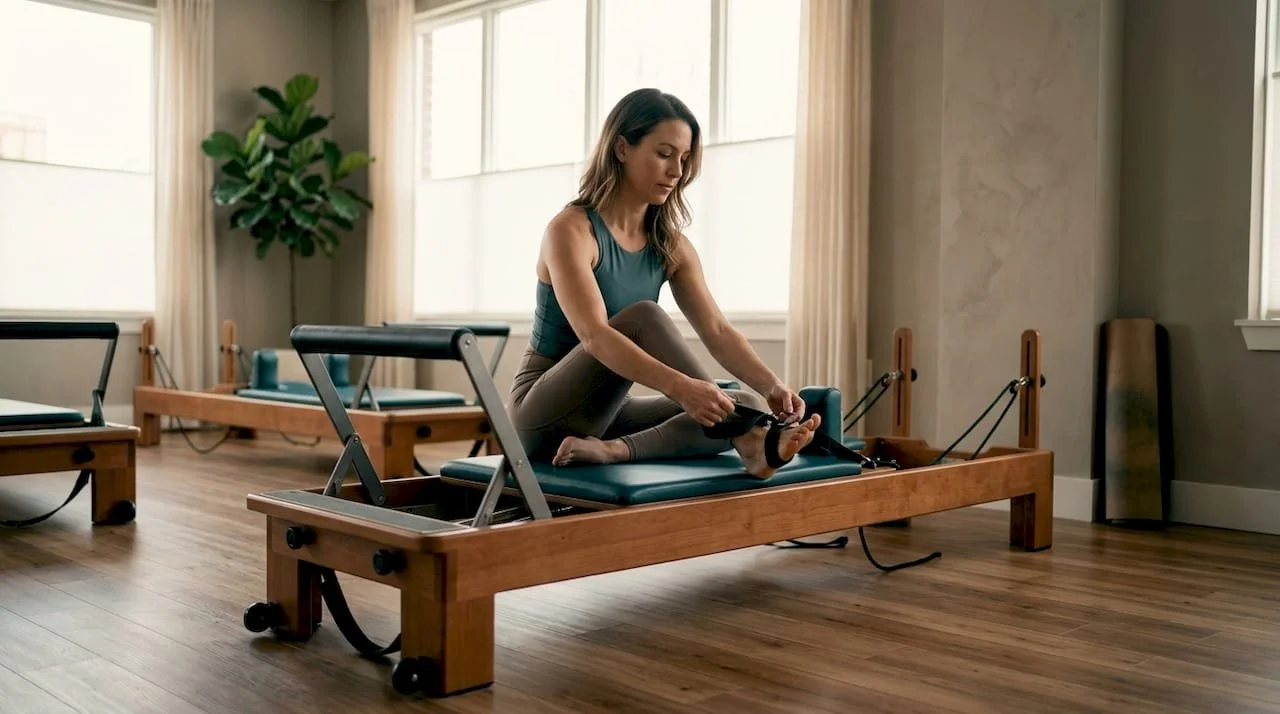
The first time you see a reformer machine up close, it might look a little intimidating. It resembles a bed frame with a sliding platform, a set of cables, and a bar at one end. But once a certified instructor walks you through it, the design starts to make perfect sense.
A Pilates reformer class is an instructor-led workout performed on a specialized reformer machine with adjustable springs and a sliding carriage. The carriage is the platform you lie, sit, or stand on. Springs connect the carriage to the frame and provide resistance, which you can increase or decrease depending on your strength level and the exercise. Straps and handles at one end allow you to work your arms and legs with precision, while a footbar anchors your movement on the opposite end.
Here's what the main parts of a reformer do:
Sliding carriage: Moves back and forth along rails to create smooth, controlled resistance
Adjustable springs: Add or remove resistance; lighter springs actually make some moves harder by requiring more stabilization
Footbar: Provides a fixed point for footwork, leg presses, and standing exercises
Straps and handles: Enable upper body and lower body pulls with consistent resistance
Rails: Guide the carriage for smooth linear motion
A typical class follows a clear sequence. You start with a warm-up, usually gentle footwork while lying on the carriage. Then you move into core-focused exercises like the "hundred," which activates your deep abdominal muscles. From there, the class progresses through full-body movements targeting the hips, back, arms, and legs before wrapping up with a cool-down stretch sequence.
One of the smartest features of the reformer is what spring adjustments allow instructors to do. Adding springs creates more support and stability, which is ideal for beginners learning form. Removing springs introduces instability, which challenges advanced students. This flexibility is exactly why the reformer is so beginner-friendly, even if it doesn't look that way at first glance.
| Class Phase | Duration | Focus |
|---|---|---|
| Warm-up | 5–10 min | Footwork, spinal mobility |
| Core work | 15–20 min | Deep abdominals, stabilizers |
| Full-body movements | 15–20 min | Hips, back, arms, legs |
| Cool-down | 5–10 min | Flexibility, breath |
Key benefits: Core strength, flexibility, balance, and more
Once you understand what a reformer class looks like from the inside, it's easy to see why so many people stick with it long-term. The results are real, and the research backs them up.
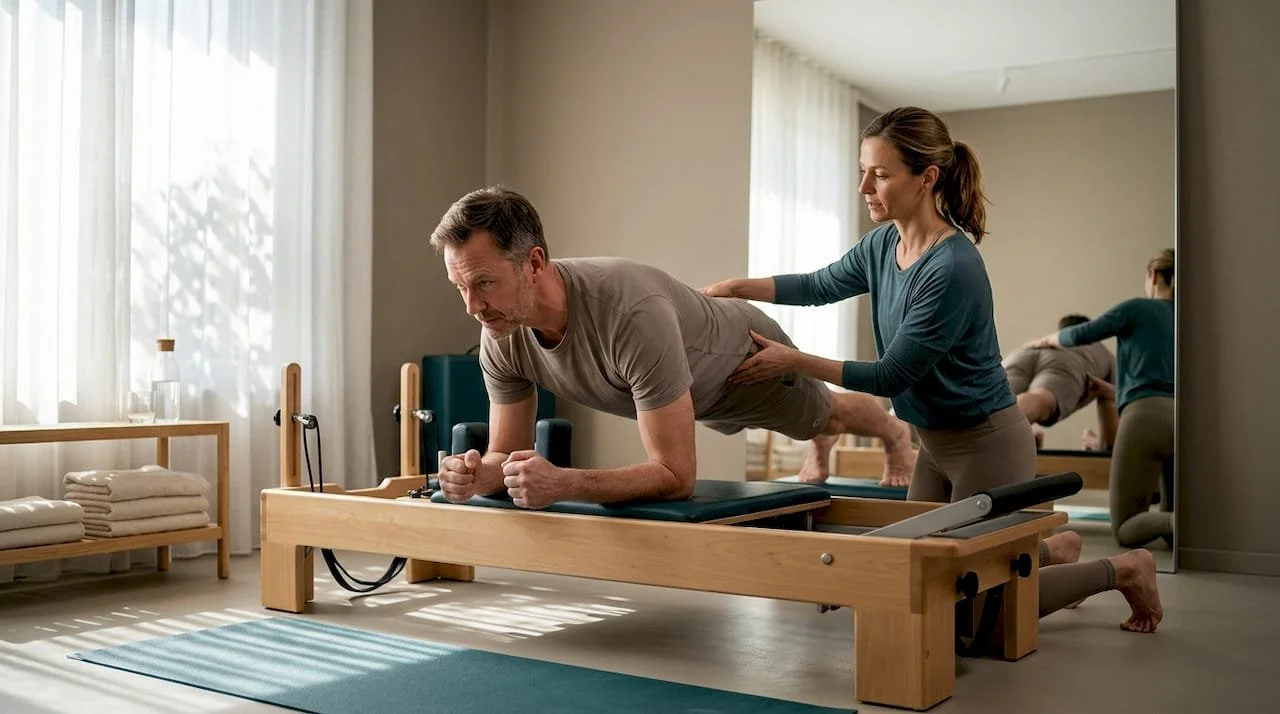
An 8-week study found significant improvements in balance, flexibility, and core muscle endurance after reformer Pilates in healthy adult women. Participants attended supervised sessions twice a week, and the measured improvements across all three areas were statistically meaningful. That's not a small win. Those three qualities, balance, flexibility, and core endurance, are foundational to almost every physical activity and daily movement pattern you perform.
Specific benefits backed by evidence include:
Core endurance: The reformer trains the deep stabilizing muscles of the spine, including the transversus abdominis and multifidus, which are the muscles most closely linked to lower back health
Flexibility: Controlled, full-range movements on the reformer improve tissue length and joint mobility over time
Balance and coordination: Constantly stabilizing a moving carriage trains proprioception, your body's awareness of where it is in space
Posture: Reformer exercises reinforce neutral spinal alignment, which translates directly to how you sit, stand, and move throughout the day
Overall well-being: Many participants in Pilates studies also report improved mood, reduced stress, and greater body confidence
Explore more detail on reformer Pilates benefits to see how these gains build over time.
"The reformer doesn't just build strength. It builds the kind of intelligent movement your body uses every day."
Pro Tip: Aim to attend at least two sessions per week for the first eight weeks. This matches the frequency used in the most consistent research, and it gives your neuromuscular system enough repetition to truly encode the movement patterns.
The 2026 reformer beginner guide offers a helpful breakdown of how to structure your first months of practice for maximum benefit.
Reformer vs. mat Pilates: What's the difference and which is best for you?
After covering the benefits, a fair question comes up: how does the reformer compare to classic mat Pilates? The answer matters because your starting point should match your goals, your body, and your access to equipment.
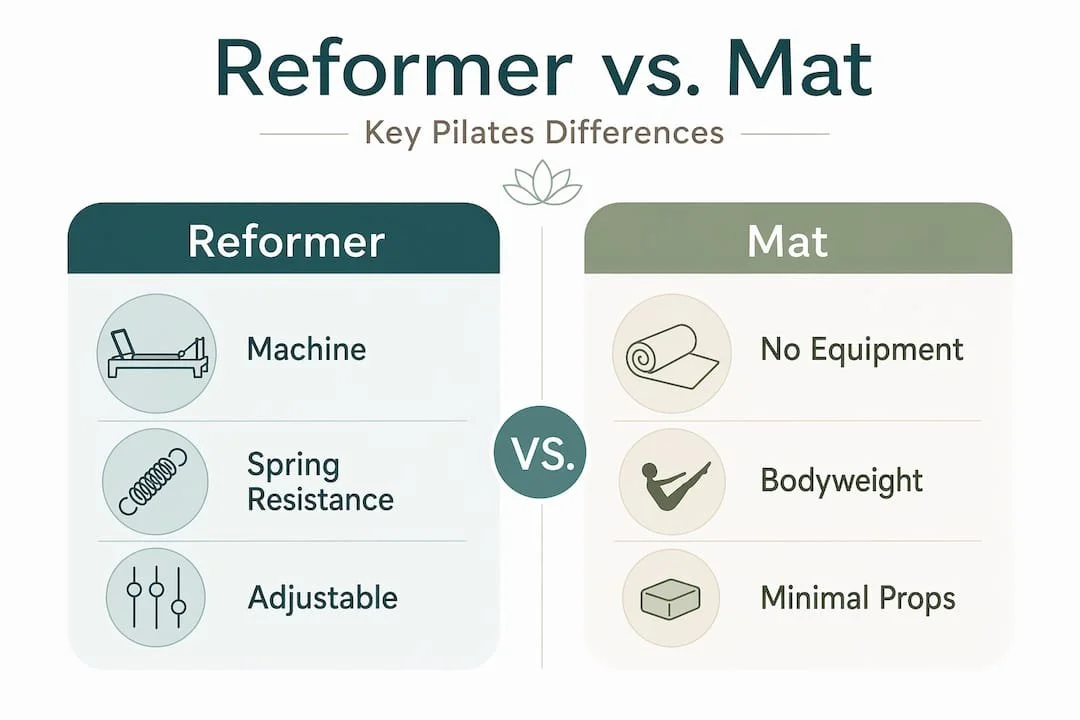
Reformer Pilates is more adaptabledue to spring resistance and posture modifications, while mat Pilates relies entirely on body weight. That's the core technical difference, and it shapes everything else about how each format feels and what it can do for you.
| Feature | Reformer Pilates | Mat Pilates |
|---|---|---|
| Equipment | Specialized reformer machine | Exercise mat only |
| Resistance | Adjustable spring system | Body weight only |
| Posture support | High, springs and carriage assist | Low, relies on self-correction |
| Adaptability for beginners | High, springs reduce or increase challenge | Moderate, relies on modification cues |
| Accessibility | Studio-based, higher cost | Anywhere, low cost |
Understanding how reformer Pilates works at a mechanical level helps clarify why it's often the better starting point for adults dealing with any physical limitations.
How to choose which format to start with:
Assess your current fitness base. If you have little to no core strength or have movement restrictions, the reformer's built-in support makes it the safer and more effective entry point.
Consider your goals. If posture correction and joint mobility are priorities, the reformer gives instructors more tools to work with. If budget and convenience matter most, mat classes are accessible and still effective.
Think about supervision. First-timers benefit enormously from in-person reformer instruction. The spring system needs a trained eye to set up safely for your body.
Try both if possible. Many people who start on the reformer find that mat Pilates becomes more accessible and effective after a few months of building body awareness on the machine.
Consult your instructor. A good teacher can assess your movement patterns in a single session and recommend the best starting point for your specific body.
Looking for a beginner Pilates guide that breaks down the choice in more depth? We've got resources to help you decide with confidence.
Is reformer Pilates adaptable for all bodies?
This is the question that stops most beginners before they even sign up. The honest answer is yes, with very few exceptions. The reformer's design is inherently adjustable, which is what makes it so widely applicable.
Spring resistance and setup allow modifying posture and difficulty, making it adaptable for physical limitations. That's not marketing language. It's how the machine was engineered. Joseph Pilates originally developed his method to rehabilitate injured and bedridden people. Adaptability has always been part of the DNA.
Who benefits from reformer Pilates adaptations:
Complete beginners who need extra support and slower movement progressions
Older adults working on functional strength, fall prevention, and joint mobility
Post-injury clients (with medical clearance) rebuilding strength around vulnerable areas
Prenatal and postnatal clients who need specific modifications for safe core engagement
People with chronic pain or hypermobility who need controlled, supported movement
Athletes using Pilates as a cross-training tool to address muscle imbalances
Instructors adapt sessions by adjusting spring tension, changing the starting position of the carriage, offering alternative movements that avoid certain joint angles, and providing hands-on cues for alignment. No two bodies move the same way, and a well-trained instructor knows how to meet yours where it is.
For a deeper look at equipment variations, check out the types of Pilates reformer guide, which explains how different machine styles serve different needs.
Pro Tip: Before your first class, tell your instructor about any injuries, surgeries, or movement restrictions. Even a brief conversation before class starts allows them to modify exercises in real time and keep your session safe and productive.
If your needs are more clinical, including post-surgical recovery or management of a specific condition, ask about clinical reformer options designed specifically for therapeutic contexts.
What results should you expect—and what are the limits?
Setting realistic expectations before you start is one of the most important things you can do for your long-term success with reformer Pilates. The method delivers meaningful results, but it's worth knowing exactly what's well-supported and where the science is more nuanced.
What you can realistically expect:
Stronger, more stable core: This is the most consistent and well-documented outcome across Pilates research
Improved mobility and flexibility: Joints move through fuller ranges with less effort over time
Better balance and coordination: Especially valuable for adults over 40 who want to stay active and prevent falls
Enhanced posture: The way you carry yourself in daily life genuinely shifts after consistent practice
Reduced lower back discomfort: Many clients report meaningful relief, particularly with regular, supervised sessions
Mental clarity and body confidence: These softer outcomes are frequently reported and genuinely meaningful
"Progress in reformer Pilates often shows up in how you feel before it shows up in how you look."
Where the limits are:
Evidence for robust skeletal muscle hypertrophyis inconsistent in Pilates research, even as functional strength clearly improves. In plain terms: reformer Pilates will make you functionally stronger and more resilient, but if building large visible muscles is your primary goal, traditional resistance training is a better primary tool. The reformer excels at quality of movement, endurance, and integrated strength, not bulk.
Find community stories and practical reformer Pilates tips from people navigating exactly these questions.
A thoughtful take: Why lasting reformer results come from mindset, not just movement
Here's what most reformer Pilates guides won't say out loud: the biggest obstacle for most people isn't the spring resistance or learning the footbar sequence. It's the expectation that results should arrive quickly and look a certain way.
We see this pattern constantly at our studio. Someone takes their first few classes, feels genuinely better in their body, then gets discouraged because they don't see dramatic visual changes in the mirror by week four. They compare their experience to highlight reels on social media and wonder if they're doing something wrong. They're not.
The most consistent reformer practitioners we know are the ones who showed up not to transform their appearance but to feel better, move better, and build a relationship with their own body. And almost without exception, those people end up with the best physical results too. That's not a paradox. It's how sustainable fitness actually works.
The reformer is genuinely good at creating body awareness, that quiet internal sense of how your muscles are working, where you're gripping, where you're compensating. That kind of awareness doesn't just make you better at Pilates. It makes you better at everything physical, from picking up groceries to hiking a trail to simply standing at your desk without your back aching.
Mindfulness isn't a bonus feature of reformer Pilates. It's the mechanism. The slow, controlled movements force you to pay attention in a way that explosive training simply doesn't. And that attention, practiced twice a week over months, builds a kind of physical confidence that no before-and-after photo can fully capture.
Commit to the process rather than the outcome. Let the results surprise you.
Ready to experience Pilates reformer for yourself?
If this guide has answered your questions and made reformer Pilates feel genuinely accessible, the next step is simple: get on the machine.
At Amrita Yoga & Wellness in Philadelphia, we offer beginner-friendly reformer classes led by certified instructors who understand that every body is different. Whether you're brand new to movement-based wellness or returning after a break, our team will meet you where you are. Curious about the mind-body connection beyond the physical? Our Tarot readings sessions are a popular complement to reformer practice, supporting the mental clarity and self-awareness that makes your physical work land more deeply. Browse our class schedule, connect with an instructor, and take that first step toward stronger, more mindful movement.
Frequently asked questions
Do I need experience to join a Pilates reformer class?
No prior experience is necessary. Spring resistance and posture modifications make reformer Pilates adaptable for all levels, and instructors guide beginners through every movement from the very first session.
How often should I attend reformer Pilates for results?
Attending twice per week yields the most measurable gains. An 8-week study using twice weekly supervised sessions showed significant improvements in core endurance, balance, and flexibility.
Is reformer Pilates safe for injury recovery or older adults?
Yes, with instructor guidance. The setup allows modifying posture and difficulty for different movement levels, making it appropriate for older adults and those recovering from injury when supervised properly.
Will I build large muscles with reformer Pilates?
Strength and endurance improve clearly, but evidence for robust muscle hypertrophy is inconsistent in the research. Reformer Pilates builds functional, integrated strength rather than the kind of muscle mass associated with traditional weightlifting.