The Amrita Journal
Explore thoughtful stories, practical wellness guidance and inspiring ideas to support your movement, mindfulness and everyday wellbeing at Amrita.
What to Wear for Reformer Pilates: Studio Outfit Guide
TL;DR:
Fitted, hardware-free clothing and grip socks are essential for safe and effective reformer Pilates classes. Wearing appropriate tops and bottoms allows instructors to see alignment and prevents damage to equipment, while grip socks ensure traction and hygiene. Loose clothing and metal hardware undermine safety, visibility, and equipment longevity.
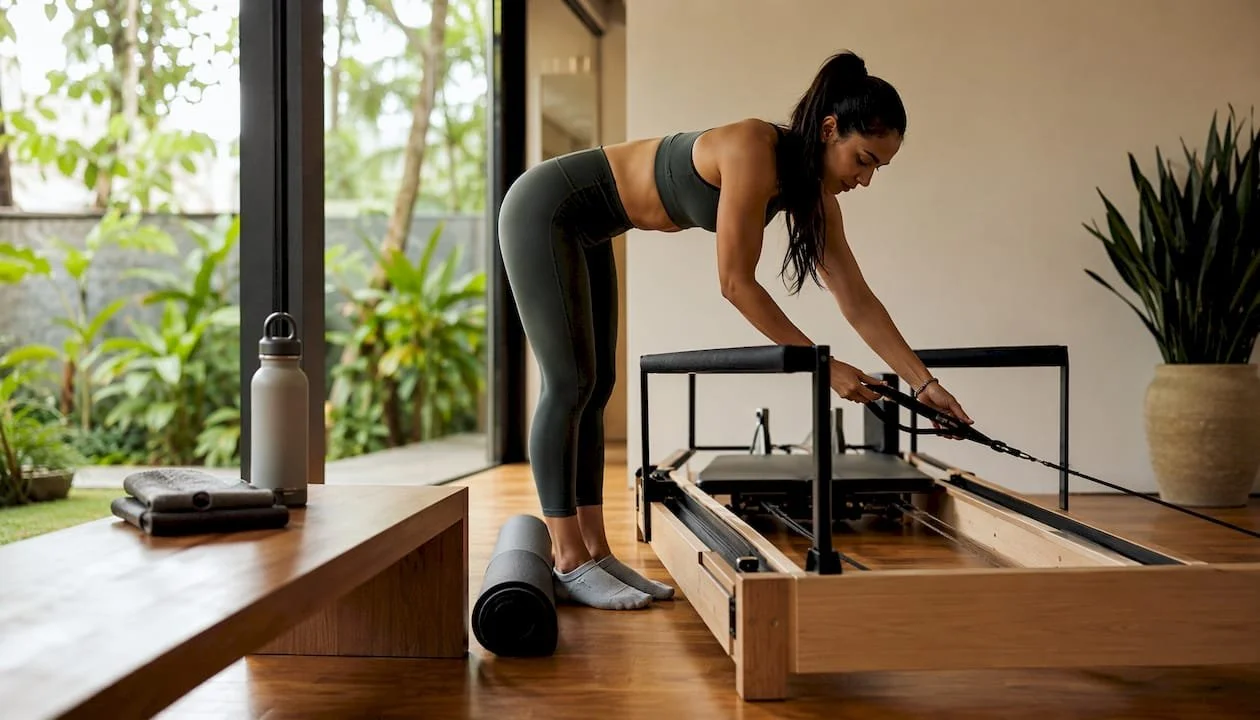
For reformer Pilates, wear fitted, smooth clothing and grip socks. That's the whole answer. Everything else is detail.
Your 10-second checklist:
Fitted tank, longline sports bra, or snug tee
High-waisted leggings or compressive bike shorts
Grip socks (required at most studios)
Hair tied low (bun, braid, or low ponytail)
Jewelry off, especially rings and bracelets
Light zip layer for warm-up, optional
Loose clothing catches on springs and hides your alignment from your instructor. Studio grip-sock policies exist for hygiene and traction, not upselling. At Amrita Yoga & Wellness, instructors rely on visual cues to correct your spine and pelvis in real time, so what you wear directly affects how much you get out of class.
Table of Contents
What should you wear on top for reformer Pilates?
Fitted is non-negotiable. When you're doing roll-ups, planks, or overhead reaches, a loose top shifts, bunches, and rides over your face. Your instructor loses sight of your ribcage and shoulder placement, which are two of the most important alignment cues in Pilates.
Best top choices:
Fitted tank tops (most popular, great airflow)
Longline sports bras or racerback crop tops
Snug long-sleeve athletic tops for cooler studios
Medium-support sports bra as a base layer
Skip underwire entirely. Prone and supine positions make underwire dig in fast, and clasps create pressure points against the carriage. A medium-support longline bra or seamless crop top handles the movement without any hardware problem.
Pro Tip: A longline sports bra worn alone counts as your top in most studios. It keeps your torso visible, stays put during inversions, and eliminates the layering issue entirely.
What bottoms work best for reformer Pilates?
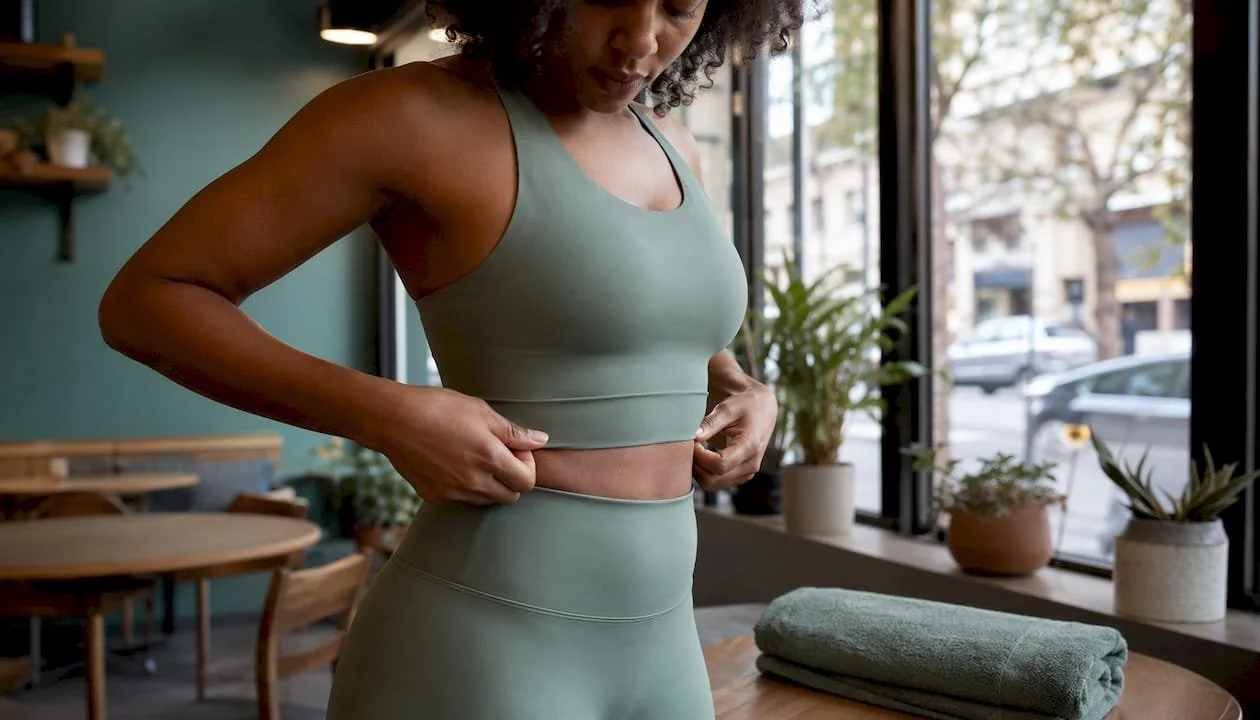
High-waist leggings are the default for good reason. High-waisted leggings with a smooth, wide waistband and flat seams prevent rolling and slipping during supine footwork, and they give your instructor a clear view of your hip and knee tracking.
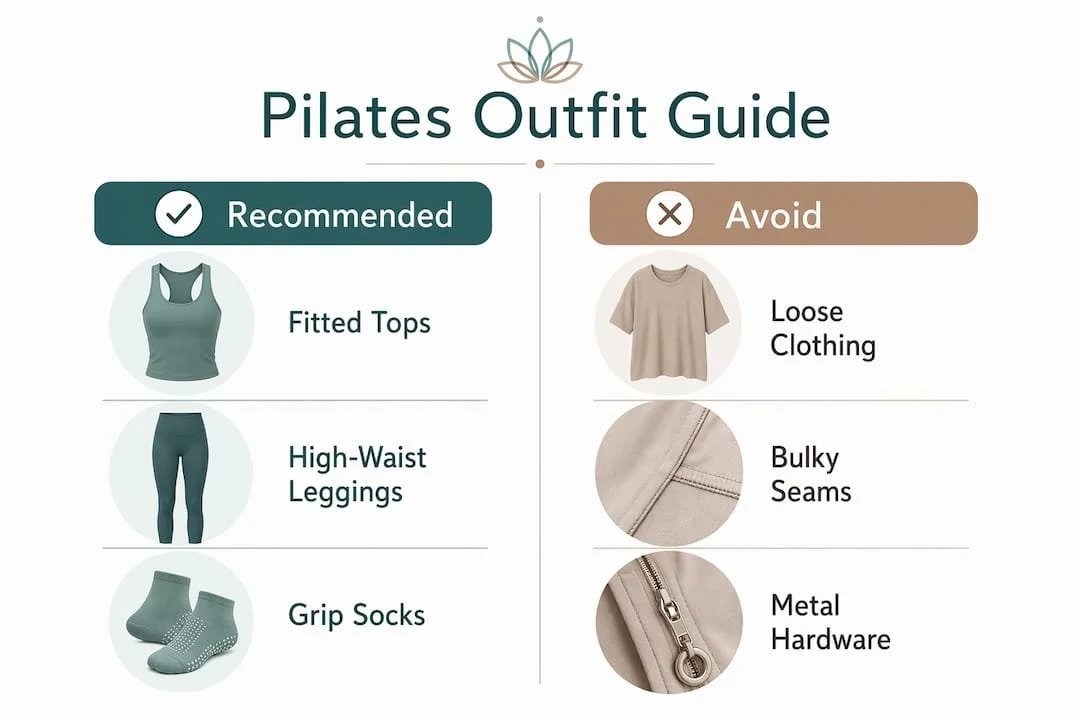
Bike shorts work well in heated classes or if you run warm, but length matters. Choose shorts with enough length to avoid riding up. Shorter styles ride up during leg circles and long stretch, and the carriage surface can chafe bare skin during strap work.
What to look for in bottoms:
Four-way stretch fabric (nylon-spandex blends, typically 75/25 or 80/20)
Waistband at least 3 inches wide, no fold-over styles
Flat-locked or seamless construction at the inner thigh
7/8 or full length for reformer (ankle bunching is a minor annoyance; bare skin on straps is not)
What to avoid:
| Avoid | Why |
|---|---|
| Flared or wide-leg pants | Can snag springs or footbar |
| Cargo pockets or belt loops | Metal hardware scratches carriage vinyl |
| Fold-over yoga waistbands | Roll down during core work by the third exercise |
| Baggy sweatpants | Hide leg alignment; unsafe near springs |
| Jeans or denim | Zero stretch, metal rivets damage equipment |
Pro Tip: Beginners benefit from solid colors or mid-tones over busy prints. Instructors can spot spinal curves and hip alignment faster on a plain surface, which means more useful corrections for you.
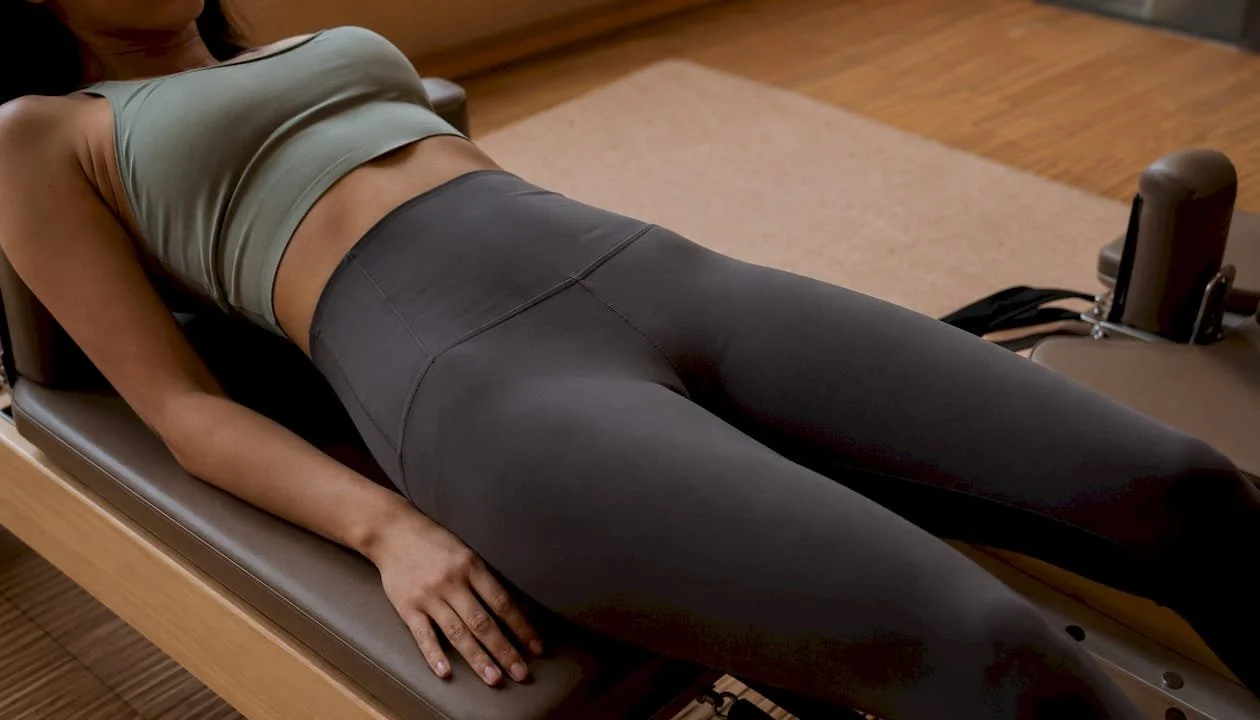
Do you need grip socks for reformer Pilates?
Yes, at most U.S. studios. Grip socks are almost universally required in U.S. reformer studios for hygiene and safety. Regular socks are genuinely dangerous on a sliding carriage and footbar. One barefoot moment on a moving reformer explains the policy better than any studio sign.
What to look for in grip socks:
Silicone or rubber treads (full-sole patterns offer more traction than scattered dots)
Snug fit that doesn't twist during footwork
Breathable fabric (cotton-blend or moisture-wicking)
Low-profile toe seam to avoid pressure points on the footbar
Toe-separator styles (like ToeSox) are optional but improve proprioceptive feedback
On rentals vs. buying your own: Studios often sell or rent grip socks at the front desk, but rental pairs wear out and rarely fit well. A basic pair costs a modest amount and lasts through regular use. Buy before your first class.
Barefoot is acceptable at some studios, particularly smaller or private ones. Athletic shoes are never worn on the reformer. They limit foot flexibility and block the sensory feedback that reformer footwork is specifically designed to build.
Pro Tip: Pack your grip socks in the outer pocket of your bag so you never walk in without them. Forgetting on day one is the most common beginner mistake.
Which fabrics and seams hold up best on the reformer?
Moisture-wicking synthetics outperform cotton for reformer work. Moisture-wicking performance materials regulate temperature and draw sweat away when you're lying on equipment for extended periods. A soaked cotton base layer gets heavy and cold during the stretch sequence.
Fabric priorities:
Nylon-spandex blends (four-way stretch, quick-dry)
Seamless or flat-locked construction at contact points
Smooth outer surface (no textured panels against the carriage)
Seam construction matters more than most people expect. Bulky inner-thigh seams press against the carriage during footwork and become genuinely uncomfortable after 20 minutes. Flat-locked or seamless panels solve this entirely.
The hardware rule is absolute. Studios prohibit clothing with hard external hardware because metal zippers, buckles, and decorative rings scratch carriage vinyl and snag on springs. Some studios charge for equipment damage. Pullover tops and elastic-waist bottoms only.
| Fabric | Verdict |
|---|---|
| Nylon-spandex blend | Best all-around: stretch, moisture management, durability |
| Polyester-spandex | Good moisture-wicking, slightly less soft |
| Cotton | Avoid as a base layer; absorbs sweat, gets heavy |
| Bamboo blends | Comfortable but slower to dry |
Pro Tip: Bring a light zip-up or cropped sweatshirt for the warm-up and cooldown. Studios start cool, heat up mid-class, and drop again during the final stretch. Tying a hoodie around your waist doesn't work on a reformer carriage.
Quick do's and don'ts before you walk in
Do:
Wear fitted base layers from top to bottom
Bring grip socks (or check studio rental policy in advance)
Tie hair low before you arrive
Remove rings, bracelets, and dangling earrings
Pack a light removable layer and a water bottle
Check studio policies on socks, nails, and jewelry
Don't:
Wear baggy tops or wide-leg pants near the equipment
Wear anything with zippers, buttons, or metal hardware
Use regular socks or athletic shoes on the machine
Wear heavy perfume (studios are small, enclosed spaces)
Leave long nails untrimmed (they can tear carriage upholstery)
Pro Tip: Check your specific studio's class policies before your first session. Sock requirements, jewelry rules, and nail-length guidelines vary by location.
How should you handle hair, jewelry, and accessories?
Hair is a practical issue, not a style one. High buns and topknots sit exactly where your head rests on the carriage headrest. After five minutes of supine work, that pressure point becomes distracting. Low buns, low ponytails, and braids stay comfortable through the whole class.
Hair options that work:
Low bun or low ponytail (most common)
Single or double braids (secure, no movement)
Headband for flyaways or shorter hair
Non-slip hair ties over regular elastics
Removing rings, bracelets, and dangling earrings prevents pinches, skin abrasions, and catching on straps. Small stud earrings are generally fine, but the safest move is to leave jewelry at home entirely. Metal hair clips are worth skipping too since they can scratch the headrest upholstery.
Pro Tip: Pack a spare hair tie in your grip-sock pocket. Elastics break at the worst moments, and mid-class adjustments interrupt your flow and your instructor's.
What should you pack in your bag?
Keep it simple. The goal is to arrive ready, not to overpack.
Essentials:
Grip socks (your own pair)
Water bottle
Small towel (some studios request one for carriage wipe-down)
Hair ties
Light zip layer or cropped sweatshirt
Optional but useful:
Unscented deodorant
A thin mat or personal towel if your studio requests it
A fresh top for after class if you're heading somewhere else
Arrive 5–10 minutes early on your first visit. Check the front desk for sock rentals if you forgot yours, confirm any studio-specific rules, and get settled on your reformer before class starts. Rushing onto the machine cold is how small injuries happen.
Why fit, fabric, and studio rules actually matter
The attire rules at reformer studios aren't about aesthetics. They exist because instructors need to see spine curves, shoulder placement, and pelvic alignment to give safe corrections. Loose clothing blocks that feedback loop entirely. In a group class, an instructor scanning six reformers has seconds to spot a misaligned pelvis. Fitted clothing makes that possible; baggy clothing makes it a guess.
Equipment protection is the second reason. Carriage vinyl is expensive to replace. Metal hardware scratches it on contact, and bulky seams can catch on springs under load. Some studios include damage fees in their liability waivers.
Grip socks reduce slipping on the carriage and footbar while also limiting shared-surface contamination on studio equipment. Most U.S. reformer studios state sock requirements explicitly for both safety and hygiene reasons.
What instructors actually watch for in your first class:
Neutral spine vs. flat back during footwork
Shoulder blade position during arm work
Pelvic tilt during the hundred and roll-ups
Knee tracking over the second toe during leg press
Fit, not brand, is what instructors prioritize. Clothing that stays put and allows visual assessment reduces mid-class adjustments and improves how much you learn. For more on why precise alignment matters in reformer Pilates, the functional stakes go well beyond what you wear.
Key Takeaways
Fitted, hardware-free clothing and grip socks are the complete reformer Pilates dress code: everything else is a preference, not a rule.
| Point | Details |
|---|---|
| Fitted base layers | Tops and bottoms must stay close to the body to avoid catching on springs and to let instructors see alignment. |
| High-waist leggings | A wide, smooth waistband and flat-locked seams prevent rolling and pressure points during supine work. |
| Grip socks required | Most U.S. studios require grip socks for traction and hygiene; buy your own pair for $8–$15 before class. |
| No hardware rule | Metal zippers, buckles, and jewelry scratch carriage vinyl and can trigger equipment damage fees. |
| Amritayogawellness | Amrita Yoga & Wellness offers beginner reformer classes and studio guidance for first-time practitioners in Philadelphia. |
What instructors actually want you to know
The clothing conversation comes up in almost every beginner's first session, and it's worth saying plainly: nobody is judging your outfit. Instructors ask about fit because they're watching your spine, not your style.
The most common beginner mistake isn't wearing the wrong brand. It's showing up in a loose tee and fold-over yoga pants, then spending half the class pulling fabric out of the way. That's frustrating for you and makes it harder for your instructor to help. One fitted outfit solves it.
You don't need expensive or branded apparel. A basic pair of compressive leggings and a snug tank from any athletic brand works perfectly. The only thing most beginners genuinely need to buy before class is grip socks. Everything else is probably already in your drawer.
Studios welcome questions. If you're unsure about the sock policy, the temperature, or whether your outfit is appropriate, ask at the front desk before class. That's a much better use of two minutes than adjusting your waistband through the entire footwork series.
Ready to try your first reformer class?
Amrita Yoga & Wellness in Philadelphia offers beginner-friendly reformer classes where fit and function matter more than gear. Whether you're stepping onto a reformer for the first time or returning after a break, the studio's approach keeps things practical: show up in fitted clothing, bring your grip socks, and the rest takes care of itself.
Browse reformer class resources on the Amritayogawellness site, or book a beginner session directly at amritayogawellness.com to get started. Drop-in and trial options are available for new practitioners.
Useful sources and further reading
Policies vary by studio, so always confirm sock requirements and jewelry rules before your first class.
What to Wear to Reformer Pilates — Vitalis Studios: General attire guidance and studio expectations
Pilates Grippy Socks Guide — DeadSoxy: Grip-sock features, fit, and traction explained
Reformer Pilates Client Safety & Studio Guidelines — Elizabeth Nadine: Equipment protection and jewelry/hardware rules
What to Wear to Pilates — Inner Soul: Fabric selection and fit-over-brand guidance
What to Wear to Pilates — Rank and Style: Waistband and seam construction details
Pilates resistance ring fitness benefits: How correct clothing and accessories support movement quality
Amrita Yoga & Wellness — Reformer Pilates resources: Studio-level guidance and class information
Recommended
What Is Reformer Pilates Good For: Real Benefits
TL;DR:
Reformer Pilates is a resistance exercise system that enhances core strength, flexibility, and posture through controlled movements on a sliding carriage. It produces reliable physical improvements, supporting injury recovery and mental health by targeting stabilizer muscles and reducing anxiety. Beginners should focus on mastering equipment mechanics and commit to consistent sessions to experience its full benefits.
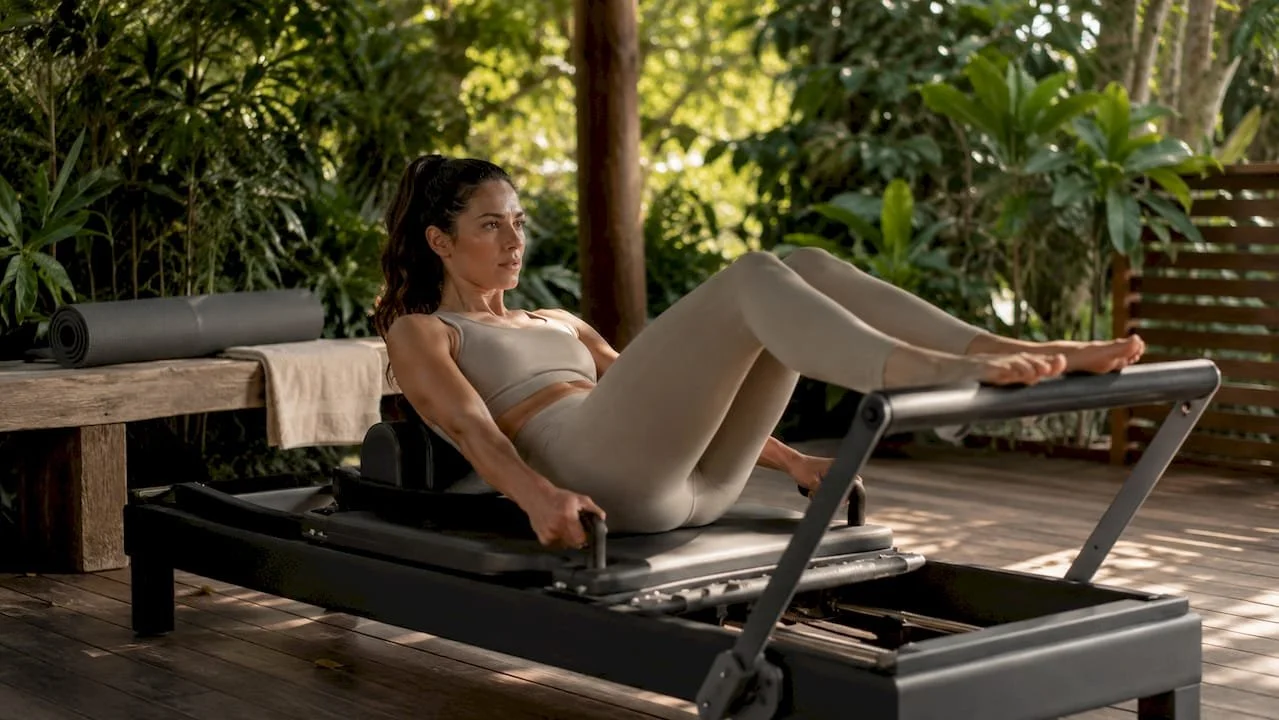
Reformer Pilates is a spring-loaded resistance exercise system, developed from Joseph Pilates' original method, that builds core strength, improves flexibility, and corrects posture through controlled movement on a sliding carriage. The apparatus uses adjustable springs, a footbar, and straps to create resistance in both the pushing and pulling phases of each exercise. This makes it distinctly different from mat Pilates or conventional gym training. Whether you are recovering from an injury, managing chronic pain, or simply looking for a low-impact workout that delivers real results, reformer Pilates addresses all of those goals within a single practice.
What is reformer Pilates good for physically?
Reformer Pilates produces measurable physical improvements across strength, posture, and body composition. A consistent 8-week protocol of two to three sessions per week shows statistically significant gains in muscular strength, endurance, BMI reduction, and fat mass loss, with results reaching p < 0.001. That level of statistical confidence means the improvements are not random. They are reliable and repeatable.
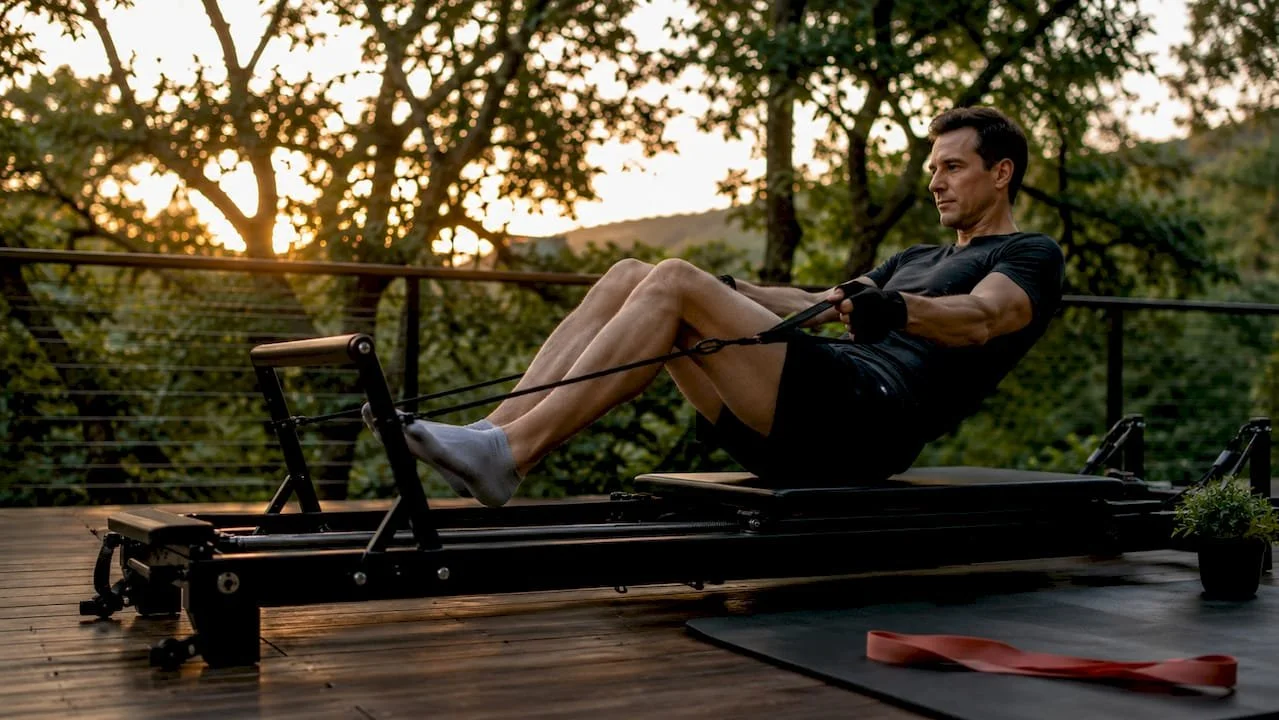
The mechanism behind these results is dual-phase muscle engagement. Reformer Pilates challenges muscles eccentrically and concentrically during every controlled resistance movement. Eccentric loading, the lengthening phase, is where most gym-based training falls short. The reformer forces your muscles to work hard in both directions, which builds functional strength and corrects imbalances that standard weight training misses entirely.
Core activation is another standout benefit. The sliding carriage creates an unstable surface that demands constant engagement from deep stabilizer muscles, including the transverse abdominis and multifidus. These are the muscles that protect your spine and support your posture. Traditional exercises like squats or bench press rarely target them directly.
Key physical benefits include:
Muscular strength and endurance across major and stabilizer muscle groups
Postural alignment with large effect sizes documented in recent research
Body composition improvements including fat mass reduction and BMI changes
Spinal stability through deep core muscle activation
Functional movement patterns that transfer to daily activities
Pro Tip: Start with lighter spring resistance and focus on form before adding load. The reformer rewards precision over power, especially in the first few weeks.
How does reformer Pilates support injury recovery?
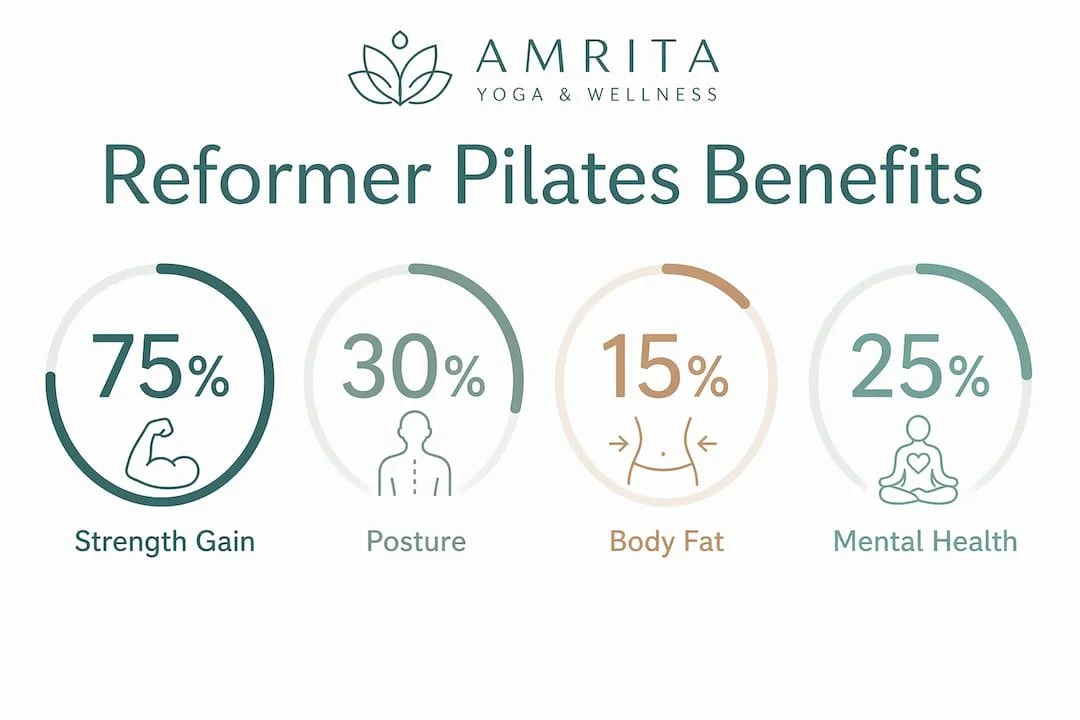
Reformer Pilates is one of the most adaptable rehabilitation tools available for low-impact exercise. The spring resistance system allows a practitioner to reduce load significantly, making it safe for people with joint pain, post-surgical recovery needs, or chronic conditions. Research validates its benefits for older adults at risk of falls, fibromyalgia patients, and people managing chronic pain, across studies spanning 2018 to 2025.
Fall risk reduction is a particularly well-documented outcome. Reformer Pilates improves balance and lower body strength simultaneously, two factors that directly reduce fall incidents in older adults. The controlled, slow movements also retrain neuromuscular coordination, which declines with age and inactivity.
One underappreciated rehabilitation benefit is imbalance detection. Reformer Pilates exposes hidden mobility gaps and muscle weaknesses that conventional training overlooks. Even trained athletes report difficulty controlling the reformer's movements at first. That difficulty is diagnostic. It tells you exactly where your body compensates and where it needs work.
Rehabilitation-specific advantages include:
Graded progression by adjusting spring tension as strength returns
Joint-friendly loading that avoids the compressive forces of free weights
Balance and proprioception training built into every exercise
Chronic pain management for conditions like fibromyalgia and lower back pain
Imbalance correction that prevents re-injury after returning to sport
Pro Tip: Always inform your instructor about any injuries or medical conditions before your first session. A qualified teacher will modify exercises to match your current capacity and keep you safe.
What psychological benefits does reformer Pilates offer?
Reformer Pilates produces measurable mental health improvements alongside its physical effects. A 2025 study on office workers found significant reductions in anxiety, depression, and social appearance anxiety after an 8-week reformer Pilates program. Quality of life scores and body appreciation also improved with moderate to large effect sizes. These are not anecdotal outcomes. They are statistically supported findings.
The mind-body connection built through reformer Pilates is central to these results. Each session requires focused breathing coordinated with precise movement. That level of attention pulls your mind away from external stressors and into the present moment. Over time, this practice builds body awareness that extends beyond the studio.
Sedentary workers benefit especially. Office-based adults who spend most of their day seated accumulate postural stress, muscle tension, and psychological fatigue. Reformer Pilates addresses all three simultaneously. The physical release of tight hip flexors and rounded shoulders has a direct effect on mood and energy levels.
"Reformer Pilates improves psychological wellbeing by reducing anxiety, depression, and social appearance anxiety, and enhancing quality of life and body appreciation among sedentary and older adults." — BMC Sports Science, Medicine and Rehabilitation, 2025
Consistency amplifies these psychological gains. Practitioners who attend two to three sessions per week report faster improvements in mood and body image than those who practice sporadically. The learning curve itself, mastering new movements and building control, contributes to a sense of accomplishment that supports mental resilience.
What should beginners expect from reformer Pilates?
Reformer Pilates for beginners starts with an orientation phase focused entirely on machine mechanics. New users need to master the carriage, spring settings, footbar positions, and strap adjustments before performing full exercises. This is not a weakness. It is a necessary foundation that protects you and makes every subsequent session more effective.
Coordination challenges are normal and temporary. Most beginners resolve them within 3–5 sessions as their neuromuscular system adapts to the machine's demands. The first session often feels more mentally taxing than physically exhausting, because you are learning movement patterns, not just exercising.
Expect delayed onset muscle soreness after your first few sessions. Deep core and stabilizer muscles that rarely get targeted in conventional workouts will feel the work. This soreness decreases quickly as your body adapts.
Here is a practical starting sequence for new practitioners:
Book a beginner or fundamentals class. These sessions teach machine setup and basic movement vocabulary at a safe pace.
Arrive early. Give yourself time to meet the instructor and ask about spring resistance before class starts.
Communicate your health history. Mention any injuries, surgeries, or chronic conditions so the instructor can modify exercises.
Focus on breath and control. Speed and load come later. Precision is the goal in early sessions.
Attend consistently. Two sessions per week for the first month builds the neuromuscular foundation faster than sporadic attendance.
Reformer Pilates vs. mat Pilates: key differences
| Feature | Reformer Pilates | Mat Pilates |
|---|---|---|
| Resistance | Adjustable spring resistance | Bodyweight only |
| Muscle engagement | Eccentric and concentric phases | Primarily concentric |
| Injury adaptability | High, springs reduce joint load | Moderate |
| Equipment required | Reformer machine | Mat only |
| Learning curve | Steeper, machine orientation needed | Gentler for beginners |
| Core activation depth | Deep stabilizers targeted | Surface muscles emphasized |
Pro Tip: If you have done mat Pilates before, do not assume the reformer will feel familiar. The spring resistance changes the movement dynamics completely. Approach it as a new skill.
How does reformer Pilates compare to other exercise types?
Reformer Pilates occupies a unique position in the fitness spectrum. It serves as a comprehensive wellness tool for foundational strength and imbalance correction, but it is not a direct replacement for high-volume sport-specific training. A marathon runner still needs long runs. A powerlifter still needs heavy compound lifts. Reformer Pilates fills the gaps those modalities leave behind.
The dual-phase muscle engagement that defines reformer Pilates is its clearest differentiator. Traditional weight training loads muscles primarily in the concentric phase. Aerobic exercise builds cardiovascular capacity but does little for stabilizer strength. Reformer Pilates targets both the push and pull of every movement, which builds the kind of balanced strength that supports all other physical activities.
| Exercise type | Impact level | Stabilizer engagement | Injury risk | Mental health effect |
|---|---|---|---|---|
| Reformer Pilates | Low | High | Low | Strong positive |
| Mat Pilates | Low | Moderate | Low | Moderate positive |
| Weight training | Low to high | Low to moderate | Moderate | Moderate positive |
| Aerobic exercise | Moderate to high | Low | Moderate to high | Strong positive |
The table above shows why reformer Pilates is particularly well-suited for people returning from injury, managing chronic conditions, or building a fitness base. Its low impact and high stabilizer engagement combination is rare among mainstream exercise options.
Key Takeaways
Reformer Pilates delivers evidence-backed improvements in core strength, posture, body composition, and mental health through low-impact spring resistance training that targets deep stabilizer muscles conventional exercise misses.
| Point | Details |
|---|---|
| Physical strength gains | An 8-week protocol at 2–3 sessions per week produces significant strength, endurance, and posture improvements. |
| Rehabilitation adaptability | Adjustable spring resistance makes it safe and effective for injury recovery, chronic pain, and fall prevention. |
| Mental health benefits | Research shows reduced anxiety, depression, and social appearance anxiety after consistent reformer Pilates practice. |
| Beginner learning curve | Coordination challenges typically resolve within 3–5 sessions once machine mechanics are understood. |
| Not a standalone solution | Reformer Pilates builds foundational fitness best when integrated with other activities suited to your specific goals. |
Why reformer Pilates surprised me
I expected reformer Pilates to feel like a gentler version of gym training. It does not. The first time I worked through a basic footwork sequence on the carriage, my inner thighs and deep abdominals were working harder than they had in months of conventional strength sessions. That is the thing about this practice: the resistance is subtle, but the demand on stabilizer muscles is not.
What I find most compelling is the diagnostic quality of the reformer. The machine does not let you cheat. If one hip is tighter than the other, the carriage will show you. If your core disengages mid-movement, you lose control of the slide. This honest feedback loop accelerates progress in a way that free weights simply cannot replicate.
The mental health angle is also real, not just a wellness marketing claim. The focused breathing and deliberate movement patterns create a meditative quality that reduces mental noise. Practitioners who come in stressed often leave noticeably calmer. That outcome is consistent enough to be considered a feature of the practice, not a side effect.
My advice for anyone considering reformer Pilates: commit to at least six sessions before forming an opinion. The first two are orientation. The next two are adaptation. Sessions five and six are where you start to feel what the practice actually does. Pair it with your existing fitness routine rather than replacing it, and you will notice improvements in how your body moves across everything else you do.
— Juiced
Reformer Pilates classes at Amrita Yoga & Wellness
Amritayogawellness offers reformer Pilates classes designed for practitioners at every level, from complete beginners learning machine fundamentals to experienced movers building on an established practice. The studio's Philadelphia location provides a structured, instructor-led environment where you get personalized attention on spring settings, footbar alignment, and movement technique.
Beginner sessions at Amrita Yoga & Wellness focus on the orientation phase that research identifies as critical for safe, effective progress. Instructors guide you through machine mechanics before any exercise load is added. If you are managing an injury or chronic condition, the team can adapt exercises to your current capacity. Browse the full reformer Pilates class schedule or explore the studio's broader wellness offerings to find the right combination of practices for your goals.
FAQ
What does reformer Pilates do for your body?
Reformer Pilates builds muscular strength, improves posture, reduces body fat, and activates deep stabilizer muscles through spring-loaded resistance. Research shows significant improvements in all these areas after just 8 weeks of consistent practice.
Is reformer Pilates good for beginners with no experience?
Yes. Beginner and fundamentals classes teach machine mechanics and movement basics at a safe pace. Most new practitioners resolve coordination challenges within 3–5 sessions.
Can reformer Pilates help with injury recovery?
Reformer Pilates is validated as a low-impact rehabilitation method for older adults, fibromyalgia patients, and people with chronic pain. Adjustable spring resistance allows graded loading that protects joints while rebuilding strength.
How often should you do reformer Pilates to see results?
Two to three sessions per week for 8 weeks produces statistically significant improvements in strength, endurance, posture, and psychological wellbeing, based on current research findings.
Is reformer Pilates better than mat Pilates?
Reformer Pilates offers greater resistance variety, deeper stabilizer muscle engagement, and higher injury adaptability than mat Pilates. Mat Pilates requires no equipment and has a gentler learning curve, making it a solid complement rather than a direct competitor.
Recommended
Reformer Pilates: What It Is and Why It Works in 2026
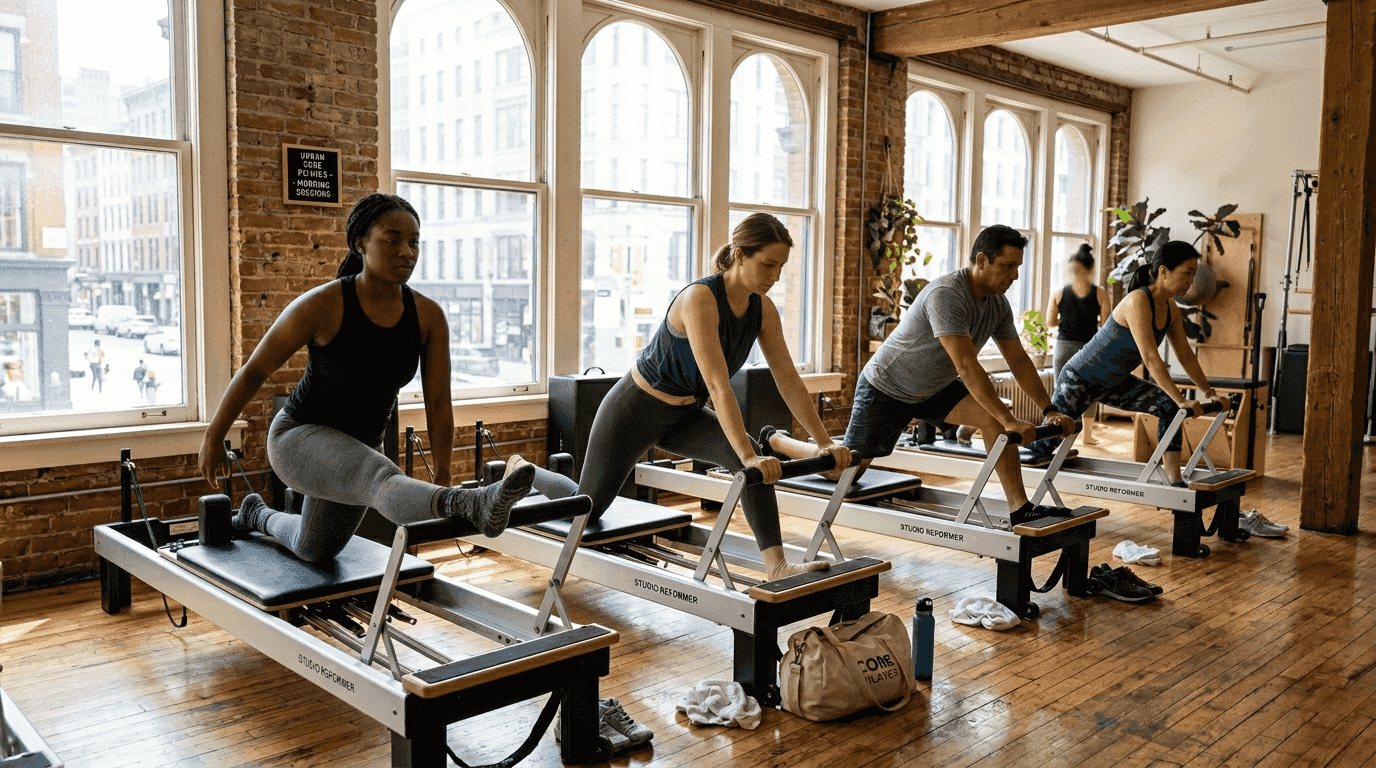
When you hear Pilates, you probably picture mat exercises with minimal equipment. That's only half the story. Reformer Pilates uses a specialized machine with springs, pulleys, and a sliding carriage to deliver controlled resistance training that builds core strength and flexibility far beyond traditional mat work. For adults in Philadelphia seeking low-impact workouts that deliver measurable results, Reformer Pilates offers an accessible, adaptable approach to fitness. This guide explains how the machine works, what benefits you can expect, who should try it, and how to get started in your local community.
Table of Contents
Key takeaways
| Point | Details |
|---|---|
| Machine mechanics | Springs, pulleys, and sliding carriage create variable resistance for controlled strength building |
| Health benefits | Studies show 20-30% core strength gains and 15-25% flexibility improvements after 12 weeks |
| Accessibility | Low-impact design suits beginners, people with joint concerns, and fitness level transitions |
| Safety priority | Professional instruction ensures proper form and prevents injuries during practice |
| Mental wellness | Regular practice reduces anxiety and depression while improving body appreciation |
Understanding the reformer machine: springs, pulleys, and carriage
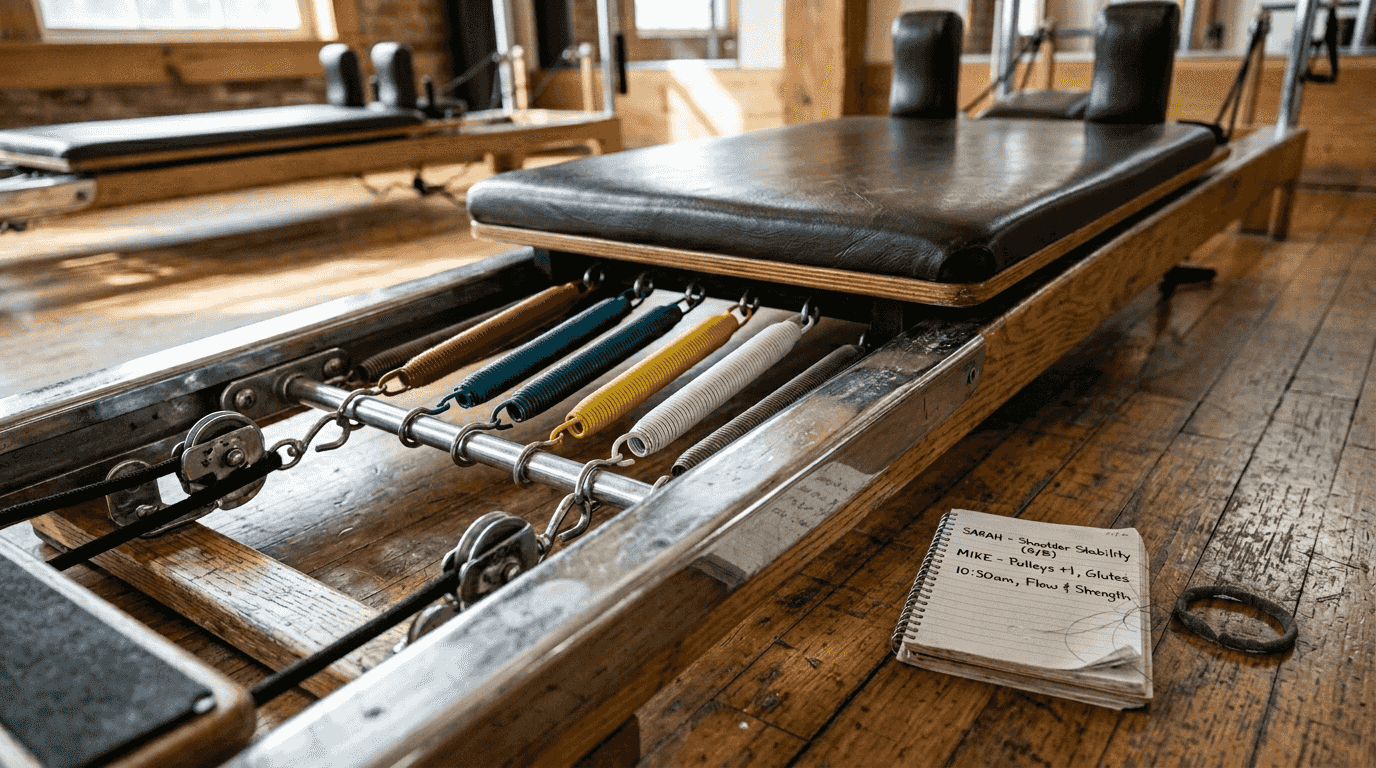
The Pilates Reformer looks intimidating at first glance, but understanding its components makes everything clear. The machine uses adjustable springs for resistance, pulleys to guide movement direction, and a sliding carriage that moves along rails. These elements work together to create a unique training environment where you control intensity through spring selection and body positioning.
Spring resistance increases as you stretch them, changing how your muscles activate throughout each movement. This variable resistance develops strength and control simultaneously, unlike fixed weights that maintain constant load. You might start an exercise with light tension that builds as you extend, forcing your muscles to adapt continuously. The pulleys attach to ropes and straps, allowing you to pull, push, or stabilize from multiple angles while the carriage glides smoothly beneath you.
Key machine components include:
Four to five color-coded springs offering different resistance levels
Adjustable footbar for varied starting positions
Shoulder blocks preventing unwanted sliding
Headrest and padded carriage for comfort
Rope and pulley system for upper body exercises
Pro Tip: Before your first session, ask your instructor to explain spring color coding and resistance levels so you understand how adjustments affect difficulty.
The beauty of this design lies in its adaptability. Instructors can modify nearly every exercise by changing spring tension, footbar height, or your body position on the carriage. This makes Reformer Pilates suitable for rehabilitation work, athletic conditioning, and everything between. A certified instructor becomes essential because improper spring selection or form can reduce effectiveness or cause strain. The machine supports your movements but demands precision, which is why Reformer Pilates classes emphasize technique over speed or repetition count.
Core strength, flexibility, and health benefits of reformer Pilates
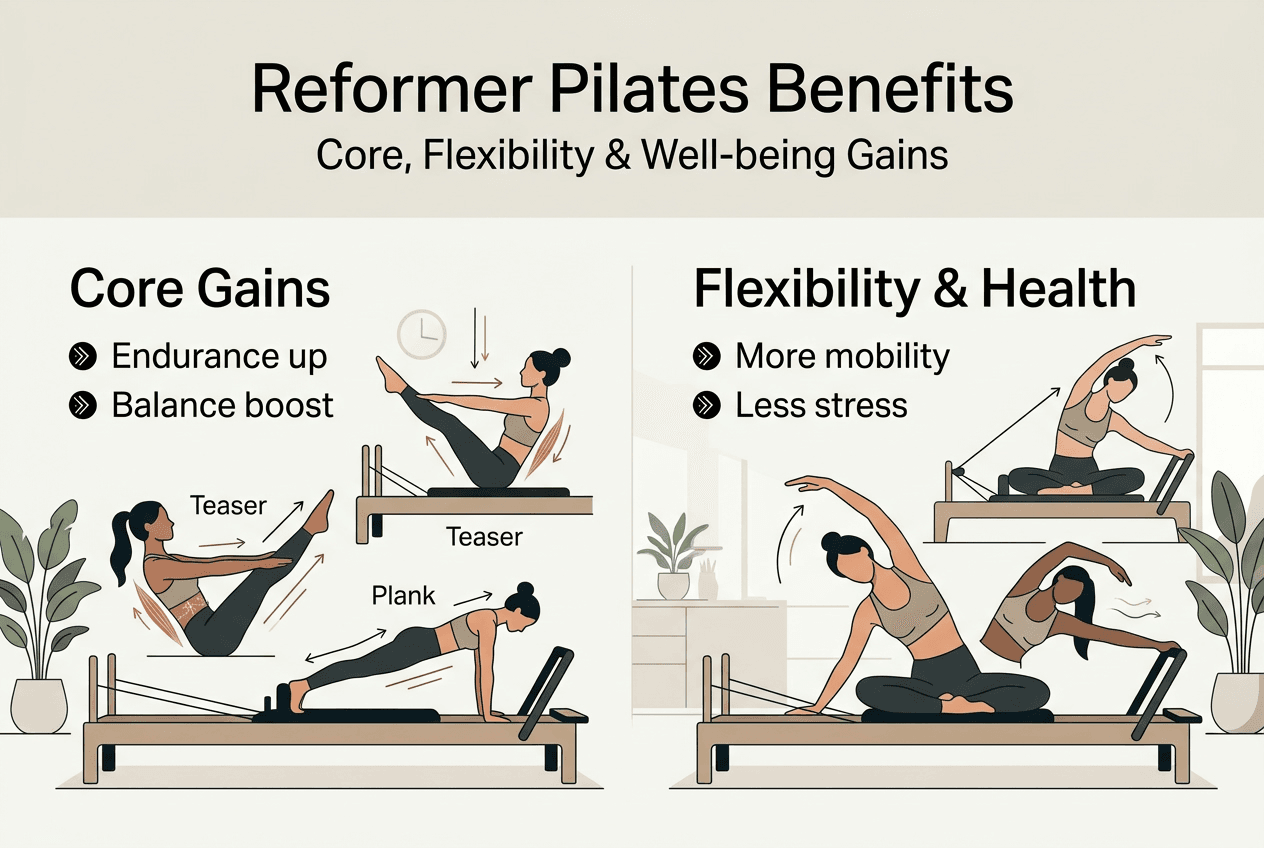
The research backing Reformer Pilates is compelling. Studies document 20-30% increases in core endurance and 15-25% improvements in flexibility after consistent 12-week programs. These aren't marginal gains. They represent functional improvements you'll notice in daily activities, from lifting groceries to maintaining posture during long work hours. The controlled resistance training strengthens deep stabilizing muscles that other workouts often miss.
Beyond core and flexibility, Reformer Pilates delivers broader health benefits. Research shows the practice improves body composition and muscle strength while reducing depression and anxiety in participants. The mind-body connection inherent in Pilates creates a meditative quality that calms your nervous system even as you challenge your muscles. You focus intensely on breath, alignment, and controlled movement, which naturally reduces stress and mental clutter.
| Benefit Category | Improvement Range | Timeline |
|---|---|---|
| Core endurance | 20-30% increase | 12 weeks |
| Flexibility | 15-25% improvement | 12 weeks |
| Muscle strength | Significant gains | 8-12 weeks |
| Depression/anxiety | Measurable reduction | 8+ weeks |
| Body composition | Improved lean mass | 12+ weeks |
The low-impact nature makes these benefits accessible without joint stress. Unlike running or high-intensity interval training, Reformer Pilates builds strength through controlled eccentric and concentric movements that protect your joints while challenging your muscles. You work against spring resistance rather than gravity alone, which allows precise load management. This proves especially valuable for people recovering from injuries or managing chronic conditions.
Additional benefits include:
Enhanced postural alignment and body awareness
Improved balance and coordination
Reduced lower back pain through core stabilization
Better breathing patterns and lung capacity
Increased muscle endurance without bulk
Pro Tip: Consistency matters more than intensity when starting out. Aim for two to three sessions weekly for at least 12 weeks to experience the documented strength and flexibility gains.
The mental health improvements deserve special attention. The focused, deliberate nature of Reformer Pilates creates a moving meditation that quiets racing thoughts. You can't multitask on the Reformer. This forced presence builds mindfulness skills that extend beyond your workout. Many practitioners report better sleep, reduced anxiety, and improved mood regulation after establishing a regular practice. Explore more about these core strength and flexibility benefits and dive deeper into Reformer Pilates advantages for comprehensive wellness.
Who can do reformer Pilates? Accessibility, safety, and beginners' tips
Reformer Pilates welcomes nearly everyone, but smart precautions ensure safe, effective practice. The adjustable resistance makes it suitable for beginners and people transitioning from other fitness routines. You can start with minimal spring tension and progress gradually as strength develops. The low-impact movements protect joints while building muscle, making this an ideal choice for people who find running or weightlifting too harsh on their bodies.
The machine's support system allows modifications that accommodate various physical limitations. Someone with knee concerns might perform exercises lying down rather than standing. A person recovering from shoulder injury can work lower body extensively while allowing upper body healing. This adaptability makes Reformer Pilates valuable for rehabilitation and general fitness alike.
Safety considerations include:
Consulting healthcare providers if you have severe back pain, osteoporosis, or recent surgeries
Avoiding practice during acute injury phases
Disclosing pregnancy, as modifications become necessary
Reporting dizziness or unusual pain immediately to instructors
Proper form remains crucial, especially for beginners who lack body awareness around spinal alignment and core engagement. Working with certified instructors prevents compensation patterns that reduce effectiveness or cause strain. They'll watch for common mistakes like gripping with shoulders instead of engaging core, holding breath during exertion, or rushing through movements without control.
Beginner steps for successful practice:
Schedule an introductory session to learn machine basics and safety protocols
Focus on mastering five to seven foundational exercises before advancing
Practice two to three times weekly, allowing rest days for muscle recovery
Ask questions about spring selection, body positioning, and breathing patterns
Track how exercises feel rather than how many repetitions you complete
Gradually increase resistance only after perfecting form at lighter tensions
Certain medical conditions require clearance before starting. People with severe osteoporosis risk fractures from spinal flexion exercises. Those with herniated discs need modifications to avoid aggravating nerve compression. Pregnancy requires specialized prenatal instruction that accounts for relaxin hormone effects on joints and ligament laxity. These aren't absolute contraindications, but they demand professional guidance and possible medical approval.
Quality always trumps quantity in Reformer Pilates. Ten perfectly executed repetitions with full core engagement and breath control deliver more benefit than thirty sloppy ones. Instructors should emphasize this from your first session. You'll feel muscles working in ways traditional exercises don't reach because the springs create constant tension that demands continuous stabilization. Check out this beginner Pilates guide for additional foundational tips.
Reformer Pilates in Philadelphia: getting started and what to expect
Philadelphia offers numerous studios with Reformer Pilates programs suited to various schedules and budgets. Most studios provide introductory packages that let you try several classes before committing to memberships. Expect small group classes with four to eight participants or private sessions for personalized attention. Group classes typically run 50 to 60 minutes and follow a structured format that works the entire body through progressive exercises.
Your first class will likely cover machine orientation, basic spring settings, and fundamental movement patterns. Instructors demonstrate each exercise, then watch closely as you attempt it, offering corrections and encouragement. Don't worry about keeping pace with experienced students. Everyone progresses differently, and good instructors modify exercises to match your current ability. The focus stays on your form and engagement, not comparison with others.
What to bring and wear:
Form-fitting clothing that allows instructors to see your alignment
Grip socks with rubber soles for traction on the carriage
Water bottle for hydration between exercises
Hair tie if you have long hair
Open mind and patience with the learning curve
| Class Format | Pros | Cons |
|---|---|---|
| Group classes | Lower cost, community motivation, regular schedule | Less individual attention, fixed pace, potential wait for equipment |
| Private sessions | Personalized programming, flexible timing, detailed corrections | Higher expense, requires self-motivation, limited social interaction |
| Semi-private (2-3 people) | Moderate cost, some personalization, accountability partner | Scheduling coordination, slightly less attention than private |
Realistic timelines matter for managing expectations. You'll likely feel muscles you didn't know existed after your first session. This normal soreness typically subsides within 48 hours as your body adapts. Visible strength improvements emerge around week four to six with consistent practice. The mental health and postural benefits often appear sooner, with many people reporting better body awareness and reduced anxiety after just eight sessions.
Maintaining motivation requires strategy. Set specific, measurable goals like holding plank position 30 seconds longer or completing footwork series without spring adjustments. Track these milestones in a journal or app. Many studios offer progress assessments where instructors document your improvements, which provides tangible evidence of growth. Connecting with other students creates accountability and makes classes more enjoyable. Some people find morning sessions boost energy for the entire day, while others prefer evening classes for stress relief after work.
Philadelphia's wellness community embraces Reformer Pilates as part of holistic health approaches. You'll find studios integrating it with yoga, barre, and massage therapy for comprehensive body care. This alignment with broader wellness philosophies makes it easier to build sustainable fitness habits. For a thorough introduction to starting your practice, review this complete 2026 beginner guide covering everything from first class expectations to long-term progression strategies.
Explore Reformer Pilates classes at Amrita Yoga & Wellness
Ready to experience these benefits yourself? Amrita Yoga & Wellness in Philadelphia offers beginner-friendly Reformer Pilates classes led by certified instructors who prioritize proper form and individual progression. Our welcoming community supports people at every fitness level, whether you're completely new to Pilates or transitioning from other workout routines.
We understand starting something new feels intimidating. That's why we offer new student specials designed to help you explore Reformer Pilates without major financial commitment. Our flexible studio and cancellation policies accommodate busy schedules while encouraging consistent practice. Visit our website to browse class schedules, meet our instructors, and book your first session. Join a community that values holistic wellness, personal growth, and supportive guidance as you build strength and flexibility through Reformer Pilates.
Frequently asked questions
What equipment does Reformer Pilates use?
Reformer Pilates uses a specialized machine with a sliding carriage, adjustable springs for variable resistance, pulleys with ropes or straps, a footbar, and shoulder blocks. The springs create tension that increases as you stretch them, providing unique resistance that builds strength and control simultaneously. Most studios have multiple reformers allowing small group instruction.
Is Reformer Pilates suitable for beginners and people with joint pain?
Yes, the adjustable resistance and low-impact nature make Reformer Pilates excellent for beginners and people with joint concerns. You can start with minimal spring tension and progress gradually as strength develops. The controlled movements protect joints while building muscle, though people with severe conditions should consult healthcare providers first. Certified instructors modify exercises to accommodate individual limitations safely.
How often should I practice Reformer Pilates for noticeable benefits?
Practice two to three times weekly for at least 12 weeks to experience the documented 20-30% core strength gains and 15-25% flexibility improvements. Consistency matters more than intensity when starting. Many people notice better posture and body awareness within four to six weeks, while mental health benefits like reduced anxiety often appear after eight sessions. Allow rest days between sessions for proper muscle recovery.
Can Reformer Pilates help with chronic pain and mental well-being?
Research shows Reformer Pilates reduces depression and anxiety while improving body appreciation and postural alignment. The practice strengthens deep core muscles that support spinal stability, which often alleviates chronic lower back pain. The mind-body focus creates a meditative quality that calms your nervous system and reduces stress. People with specific chronic conditions should work with instructors experienced in therapeutic applications and obtain medical clearance when appropriate.
What should I wear or bring to my first Reformer Pilates session?
Wear form-fitting clothing that allows instructors to see your body alignment, such as leggings and a fitted top. Bring grip socks with rubber soles for traction on the carriage, a water bottle for hydration, and a hair tie if needed. Avoid loose clothing that might catch on springs or pulleys. Most studios provide all necessary equipment, so you don't need to bring mats or props. Arrive a few minutes early to complete any paperwork and orient yourself to the studio space.
Recommended
Reformer Pilates: Core Strength and Flexibility Benefits
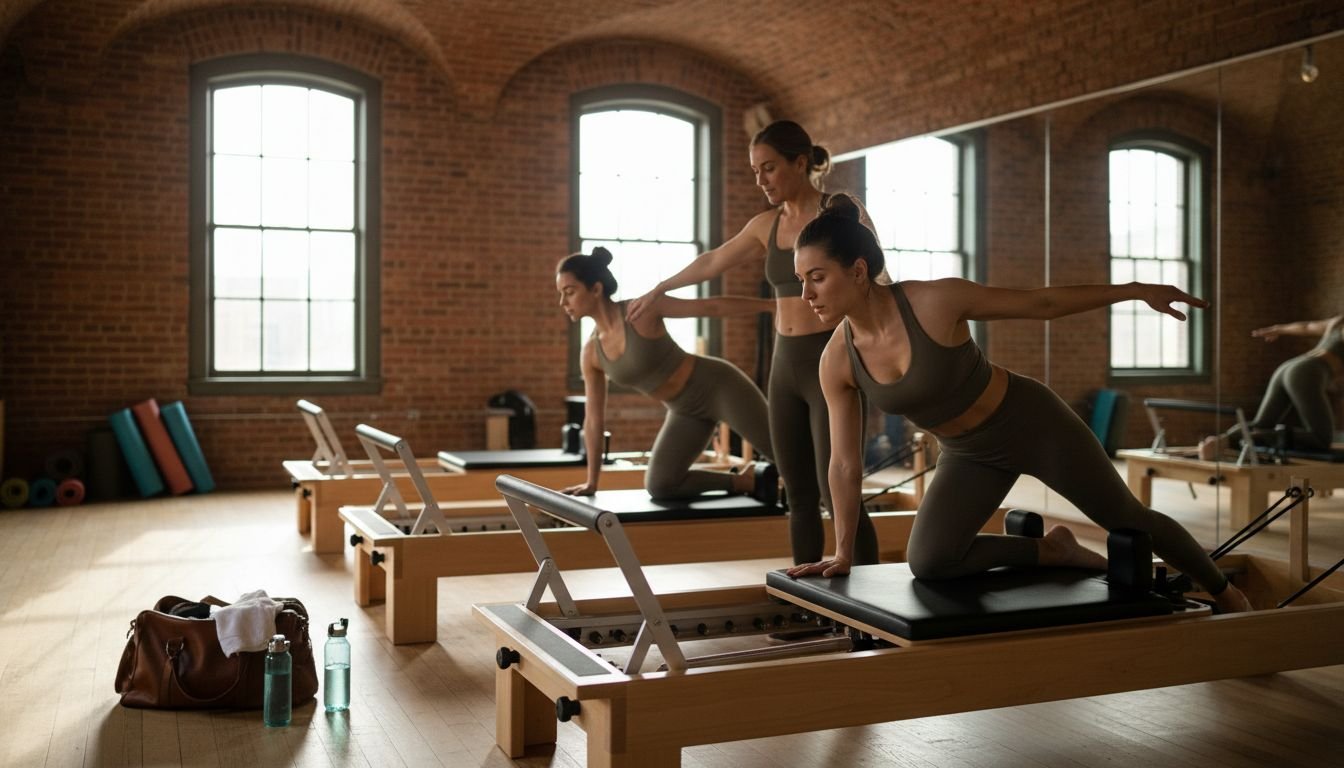
Over half of American adults now look for ways to improve flexibility and core strength, yet many myths still surround Reformer Pilates. This unique workout offers far more than standard fitness routines, blending resistance-based movements with precision control for real results. By clarifying what Reformer Pilates truly involves and debunking outdated ideas, this guide reveals how anyone can experience greater strength, improved posture, and better overall body health.
Table of Contents
Key Takeaways
| Point | Details |
|---|---|
| Reformer Pilates Enhances Workouts | Utilizes a specialized apparatus for dynamic resistance training, improving core strength and flexibility. |
| Comprehensive Training for All | Suitable for all genders and fitness levels, it promotes controlled muscle engagement and full range workouts. |
| Variety of Equipment Available | Offers different reformer models and accessories, enhancing functionality and exercise diversity. |
| Mindful Practice and Safety | Focus on body alignment and communication with instructors ensures safe participation, especially for those with health concerns. |
What Reformer Pilates Involves and Debunks
Reformer Pilates transforms traditional mat workouts through a specialized apparatus that adds resistance and precision to every movement. Unlike standard exercise routines, this method utilizes a sliding platform with adjustable spring tensions, enabling practitioners to perform exercises with enhanced control and targeted muscle engagement. Pilates reformer techniques challenge your body through dynamic resistance training that builds core strength while improving overall flexibility.
The machine itself consists of a movable carriage connected to springs and pulleys, which creates variable resistance levels suitable for all fitness abilities. These springs allow participants to modify difficulty by adjusting tension, making Reformer Pilates accessible for beginners and advanced athletes alike. Core mechanics involve maintaining body alignment while managing the carriage’s movement, which simultaneously strengthens stabilizing muscles and promotes muscular balance.
Contrary to popular misconceptions, Reformer Pilates is not exclusively for women or limited to gentle movements. Research demonstrates this practice offers comprehensive strength training suitable for all genders and fitness levels. The method challenges practitioners through precise, controlled movements that engage multiple muscle groups simultaneously. Key principles include:
Concentration on proper form and technique
Controlled breathing patterns
Precise muscle engagement
Full range of motion exercises
Low-impact muscle conditioning
By debunking myths and showcasing its versatility, Reformer Pilates emerges as a powerful full-body workout strategy that goes beyond traditional exercise paradigms. Whether you seek rehabilitation, athletic performance enhancement, or holistic fitness improvement, this method provides a scientifically designed approach to physical conditioning.
Types of Pilates Reformers and Accessories
Pilates reformer equipment represents a sophisticated fitness system designed to enhance strength, flexibility, and overall body conditioning. At its core, the reformer machine is a versatile apparatus featuring a sliding carriage, adjustable springs, and multiple attachment points that transform traditional exercise approaches. The standard reformer includes key components like a padded platform, adjustable tension springs, a movable carriage, foot bar, and integrated straps that enable a wide range of resistance-based movements.
The primary variations of Pilates reformers include studio-grade professional models, compact home versions, and specialized therapeutic designs. Professional models typically offer more robust construction, multiple spring tensions, and advanced adjustability for comprehensive training. Home reformers prioritize space efficiency and portability, often featuring foldable designs and lighter materials. Therapeutic reformers focus on rehabilitation, with gentler resistance and additional support mechanisms for individuals recovering from injuries or managing physical limitations.
Accessories play a crucial role in expanding reformer functionality and workout diversity. Essential complementary items include:
Non-slip grip socks for stability
Padded straps for comfortable hand and foot positioning
Cushioned mats for floor-based exercises
Resistance bands for additional tension variations
Foam rollers for muscle recovery and mobility work
Understanding the nuanced differences between reformer types and selecting appropriate accessories can significantly enhance your Pilates practice. Whether you are a fitness enthusiast, rehabilitation patient, or professional athlete, the right equipment can transform your workout experience and help you achieve targeted strength and flexibility goals.
How a Typical Reformer Pilates Session Works
Pilates reformer classes begin with a comprehensive warm-up designed to prepare the body for targeted movements and resistance training. Guided instruction forms the core of the session, where practitioners learn to synchronize breath with precise, controlled motions across the reformer’s sliding carriage. The instructor typically starts by helping participants adjust spring tensions, positioning, and alignment to match individual fitness levels and specific wellness goals.
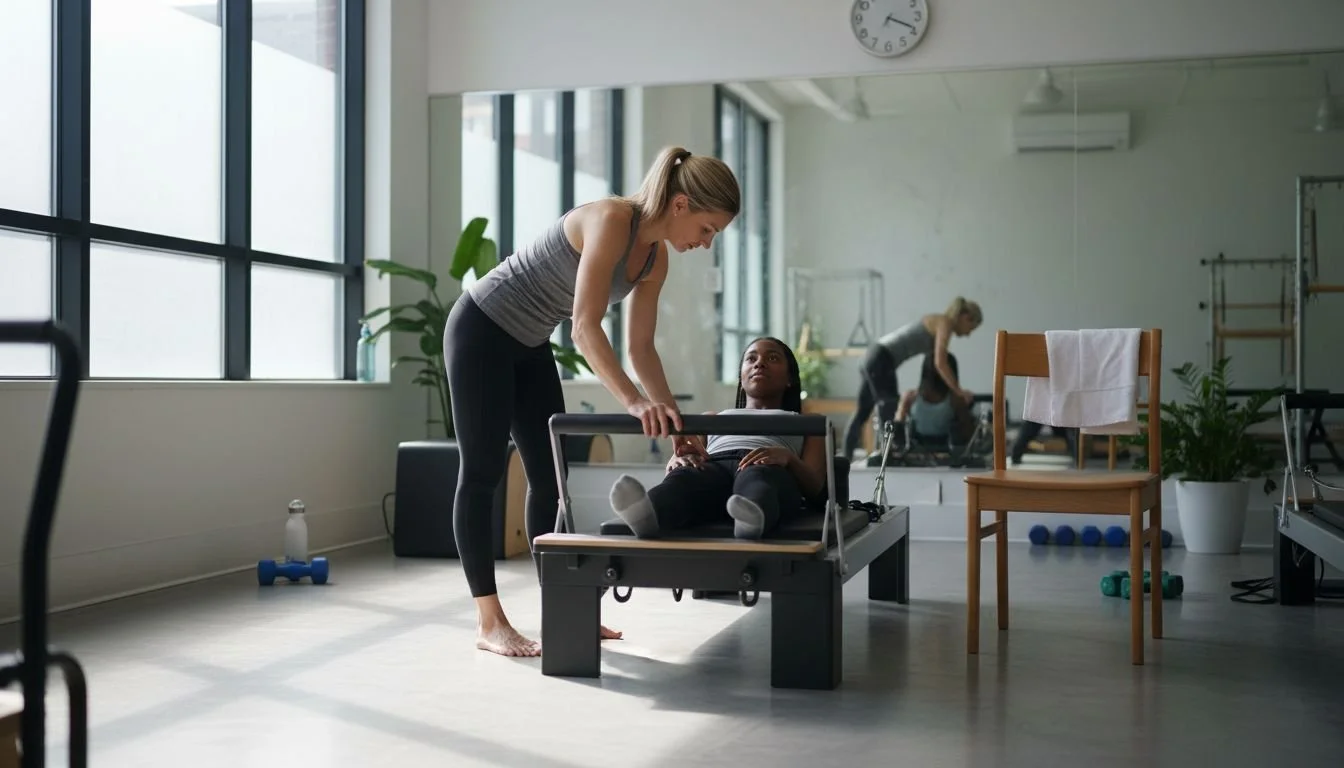
The session progresses through a structured sequence of exercises that challenge different muscle groups and movement patterns. Participants might experience a combination of supine, seated, and standing movements that leverage the reformer’s unique resistance mechanisms. Reformer Pilates workouts emphasize smooth, intentional transitions between exercises, focusing on maintaining core engagement and proper body mechanics throughout each movement.
Typical session components include:
Initial body alignment and tension setup
Dynamic full-body strengthening exercises
Targeted core engagement sequences
Balance and coordination challenges
Flexibility and mobility work
Cool-down and muscle recovery stretches
Instructors carefully modify exercises to accommodate varying fitness levels, ensuring that both beginners and advanced practitioners can benefit from the workout. The session concludes with a mindful cool-down that promotes muscle recovery, improves flexibility, and reinforces the mind-body connection fundamental to Pilates practice. Each workout represents a holistic approach to physical conditioning, combining strength, precision, and intentional movement to transform body mechanics and overall wellness.
Benefits for Flexibility, Core, and Posture
Reformer Pilates workouts fundamentally transform body mechanics by targeting core strength, flexibility, and postural alignment through strategic resistance training. Core engagement becomes the foundational principle of this practice, where practitioners learn to activate deep stabilizing muscles while performing precise, controlled movements on the reformer machine. The unique design of the equipment allows for targeted muscle recruitment that traditional strength training often overlooks, creating a comprehensive approach to physical conditioning.
The resistance mechanisms of the reformer create an environment where muscles are challenged through eccentric and concentric movements, promoting enhanced muscle elasticity and joint mobility. This approach differs significantly from standard weight training by emphasizing controlled, fluid motions that simultaneously stretch and strengthen muscle groups. Practitioners experience improved spinal alignment, reduced muscular imbalances, and increased overall body awareness through consistent practice.
Key benefits of Reformer Pilates include:
Enhanced core muscle strength and stability
Improved postural alignment
Increased full-body flexibility
Reduced risk of injury through balanced muscle development
Better movement efficiency and body mechanics
Enhanced mind-body connection
The holistic nature of Reformer Pilates extends beyond physical conditioning, offering practitioners a transformative approach to understanding body movement. By integrating precise techniques that challenge muscular endurance, balance, and control, individuals can develop a more integrated and responsive physical system that supports overall wellness and functional fitness.
Potential Risks and When to Avoid It
Reformer Pilates safety guidelines emphasize the importance of understanding individual health limitations before engaging in this dynamic workout. Medical clearance becomes crucial for practitioners with pre-existing conditions, as the resistance-based training can place significant demands on the body’s musculoskeletal and cardiovascular systems. While generally considered a low-impact exercise, certain health scenarios require careful evaluation and potential modification or avoidance of Reformer Pilates practices.
Individuals should exercise caution and potentially avoid Reformer Pilates if experiencing:
Recent surgical procedures
Uncontrolled hypertension
Acute joint injuries
Severe spinal conditions
Pregnancy without professional guidance
Chronic pain syndromes
Acute inflammatory conditions
Balance or vestibular disorders
Professional guidance is paramount when navigating potential risks. Certified Pilates instructors can provide personalized assessments, helping practitioners understand their individual limitations and develop safe, adaptive strategies. Modifications exist for most health conditions, allowing individuals to participate in modified routines that minimize strain while promoting overall wellness. Communication with healthcare providers and qualified Pilates professionals ensures a safe, effective approach to integrating this comprehensive training method into one’s fitness routine.
Reformer Pilates Versus Mat Pilates
Pilates practices demonstrate significant variation between reformer and mat methodologies, each offering unique advantages for practitioners. Equipment dynamics fundamentally distinguish these approaches, with reformer Pilates utilizing a specialized spring-loaded machine that provides adjustable resistance, while mat Pilates relies exclusively on body weight and gravitational forces. This key difference dramatically impacts the intensity, accessibility, and muscle engagement of each workout style.
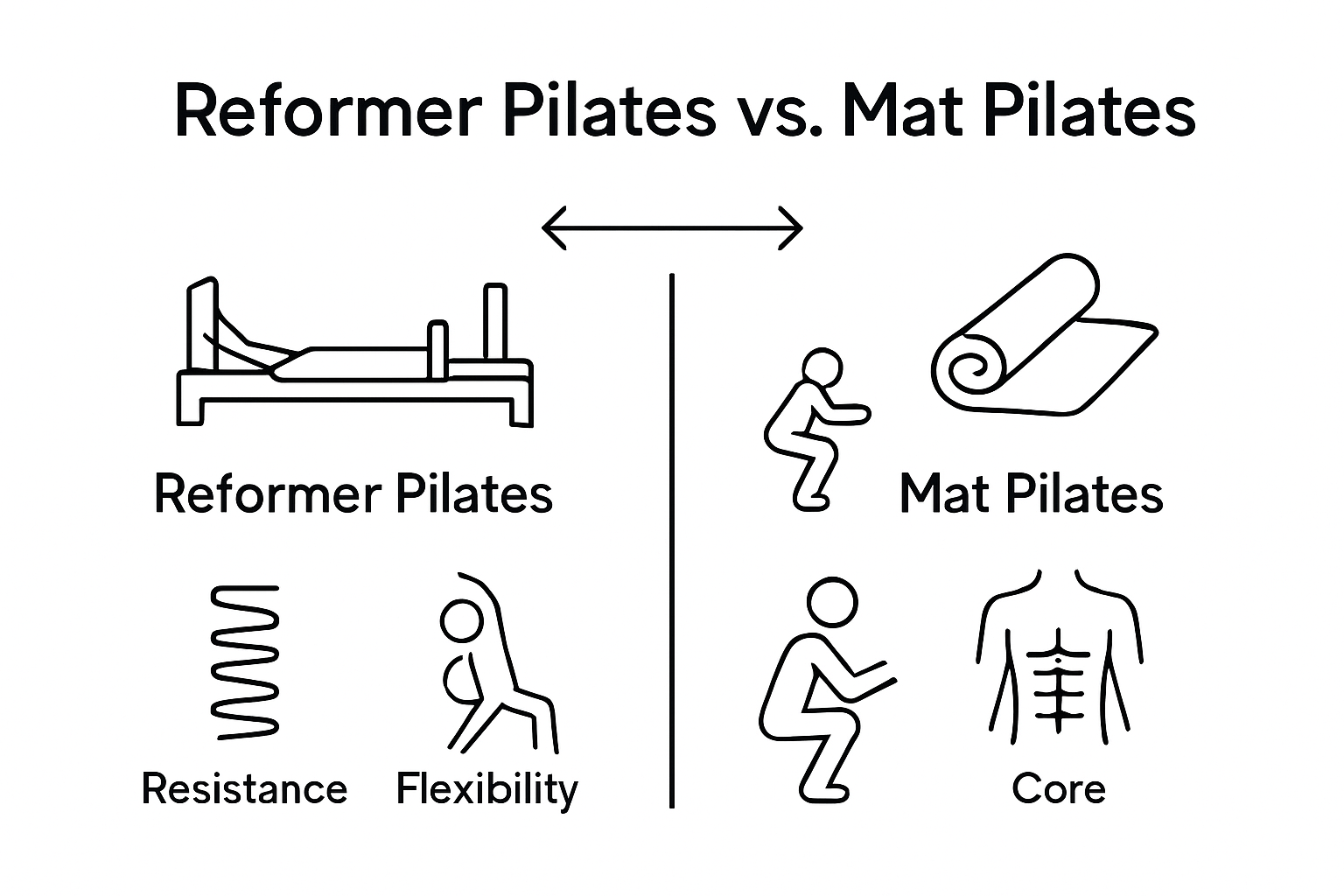
Reformer Pilates introduces external resistance through sophisticated spring mechanisms, allowing for more nuanced muscle recruitment and movement complexity. Mat Pilates, conversely, demands greater inherent core strength and stability since practitioners must generate all resistance internally. The reformer provides support and modification options that make certain challenging movements more approachable, particularly for beginners or individuals with limited mobility.
Key comparative aspects include:
Resistance mechanism
Reformer: Adjustable spring tension
Mat: Body weight and gravity
Accessibility
Reformer: More beginner-friendly modifications
Mat: Requires higher baseline strength
Muscle engagement
Reformer: Targeted, supported muscle activation
Mat: Comprehensive core and stabilization work
Equipment requirements
Reformer: Specialized machine needed
Mat: Minimal equipment necessary
Ultimately, both Pilates approaches offer comprehensive fitness benefits, with the choice depending on individual fitness goals, physical limitations, and personal preferences. Practitioners can effectively complement their fitness journey by incorporating elements from both reformer and mat Pilates, creating a holistic approach to strength, flexibility, and body awareness.
Unlock Your Full Potential with Reformer Pilates at Amrita Yoga & Wellness
If you are ready to enhance your core strength, improve flexibility, and achieve better posture through targeted resistance training then exploring Reformer Pilates classes is a powerful next step. This method addresses common challenges like muscular imbalances and limited mobility by focusing on precise muscle engagement and controlled movement designs specifically for lasting body transformation. Experience how the careful alignment and resistance of the reformer machine can build a stronger, more balanced you.
Join our welcoming community in Philadelphia at Amrita Yoga & Wellness where expert instructors tailor Reformer Pilates sessions to all fitness levels. Whether you are new or looking to deepen your practice, our class schedules and workshops provide flexible options to meet your wellness goals. Begin your journey today to reduce injury risk, enhance body awareness, and revitalize your physical and mental wellbeing. Visit our site now for details about our Reformer Pilates and other holistic practices designed to empower your health.
Frequently Asked Questions
What is Reformer Pilates?
Reformer Pilates is a specialized workout that uses a sliding apparatus to add resistance and precision to traditional Pilates movements, enhancing core strength and flexibility.
What are the core benefits of Reformer Pilates?
Reformer Pilates enhances core strength, improves postural alignment, increases flexibility, and reduces the risk of injury through balanced muscle development.
How does Reformer Pilates differ from Mat Pilates?
Reformer Pilates utilizes a machine with adjustable spring tension to provide external resistance, while Mat Pilates relies solely on body weight and gravity, requiring more inherent core stability.
Is Reformer Pilates suitable for beginners?
Yes, Reformer Pilates is accessible for beginners, as the specialized equipment allows for modifications to suit various fitness levels and helps maintain proper body mechanics.