The Amrita Journal
Explore thoughtful stories, practical wellness guidance and inspiring ideas to support your movement, mindfulness and everyday wellbeing at Amrita.
Pilates Certification Programs Philadelphia: Best In-Person Options
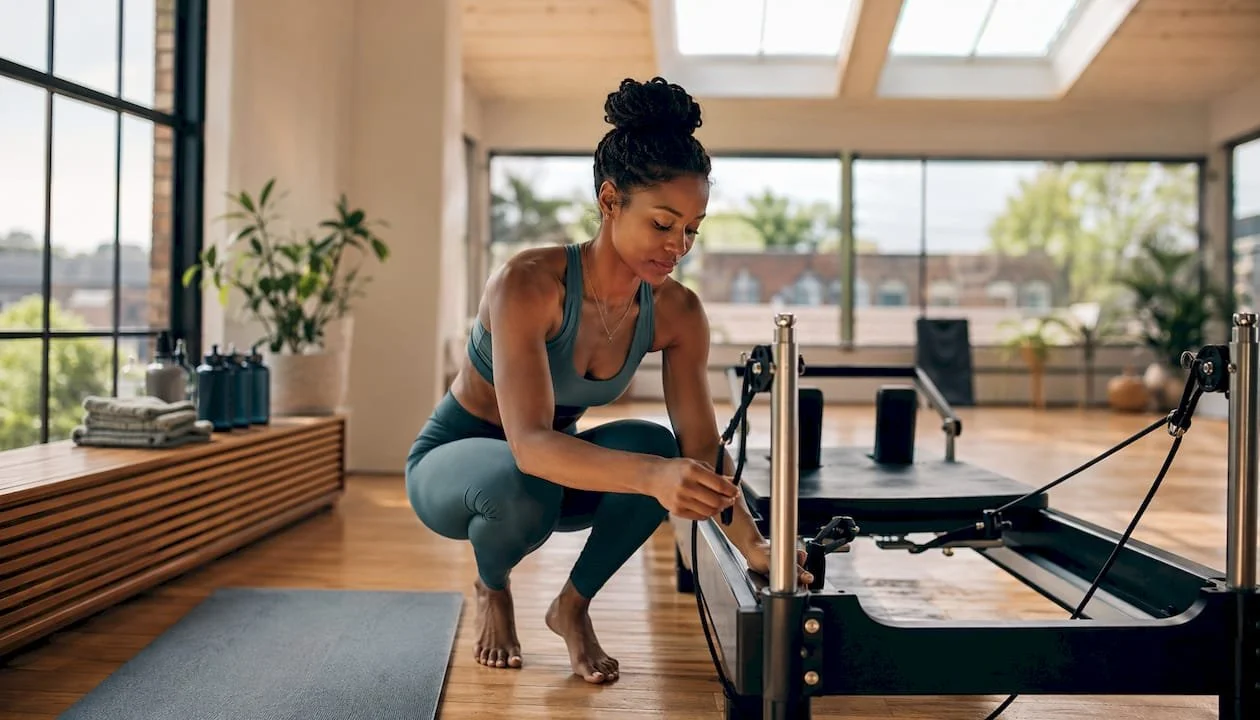
If you want in-person, NCPT-qualifying Pilates certification in Philadelphia, three programs are worth contacting first: the Drexel Pilates Training Program, SOLMAR x Polestar, and Thrive Pilates Yoga teacher training.
Here's the short version of why each one belongs on your list:
Drexel Pilates Training Program — A 450-hour comprehensive curriculum divided into three progressive modules (mat, mixed equipment, reformer) over a full academic year. University-backed, cohort-based, and explicitly structured to prepare students for the NCPT exam. The cohort runs from September through June.
SOLMAR x Polestar — A studio-hosted Polestar pathway that emphasizes movement science and rehab-informed teaching. Strong fit if you want brand recognition with Polestar and a contemporary, clinically grounded methodology.
Thrive Pilates Yoga teacher training — A local studio-run program focused on practical studio readiness and boutique-studio hiring relationships in Philadelphia.
Your immediate next step: email each program's admissions contact and ask three things — current cohort start dates, total program hours, and whether the curriculum explicitly prepares students to sit for the NPCP NCPT exam.
Pro Tip: Ask every program for a sample weekly schedule before you apply. A program that can't show you one hasn't thought carefully about your time.
Table of Contents
Which Philadelphia Pilates certification program fits your goals?
How do you pick the right program for where you want to teach?
How do you build real teaching experience in Philadelphia after you certify?
Amrita Yoga & Wellness: a local resource for practice hours and mentorship
Which Philadelphia Pilates certification program fits your goals?
| Program | Total Hours / Scope | Certification / Accreditation | Format & Schedule | Prerequisites | Duration | Cost / Tuition | Location / Contact |
|---|---|---|---|---|---|---|---|
| Drexel Pilates Training Program | 450 hours; comprehensive curriculum (Mat, Reformer, Trapeze Table (Cadillac), Chair, Ladder Barrel, and Spine Corrector) | NCPT prep (NPCP-qualifying comprehensive curriculum) | In-person cohort; three modules (fall/winter/spring) | ~30 hours prior practice recommended | ~9 months (Sept–June) | Contact admissions | Drexel Westphal College, Philadelphia |
| SOLMAR x Polestar | Not publicly listed | Polestar brand certification; NCPT eligibility — confirm with admissions | In-person; studio-hosted modules | Contact SOLMAR for current requirements | Contact admissions | Contact admissions | SOLMAR studio, Philadelphia area |
| Thrive Pilates Yoga | Not publicly listed | Studio certificate; NCPT eligibility — confirm with admissions | In-person; studio-based | Contact Thrive for current requirements | Contact admissions | Contact admissions | Thrive studio, Philadelphia |
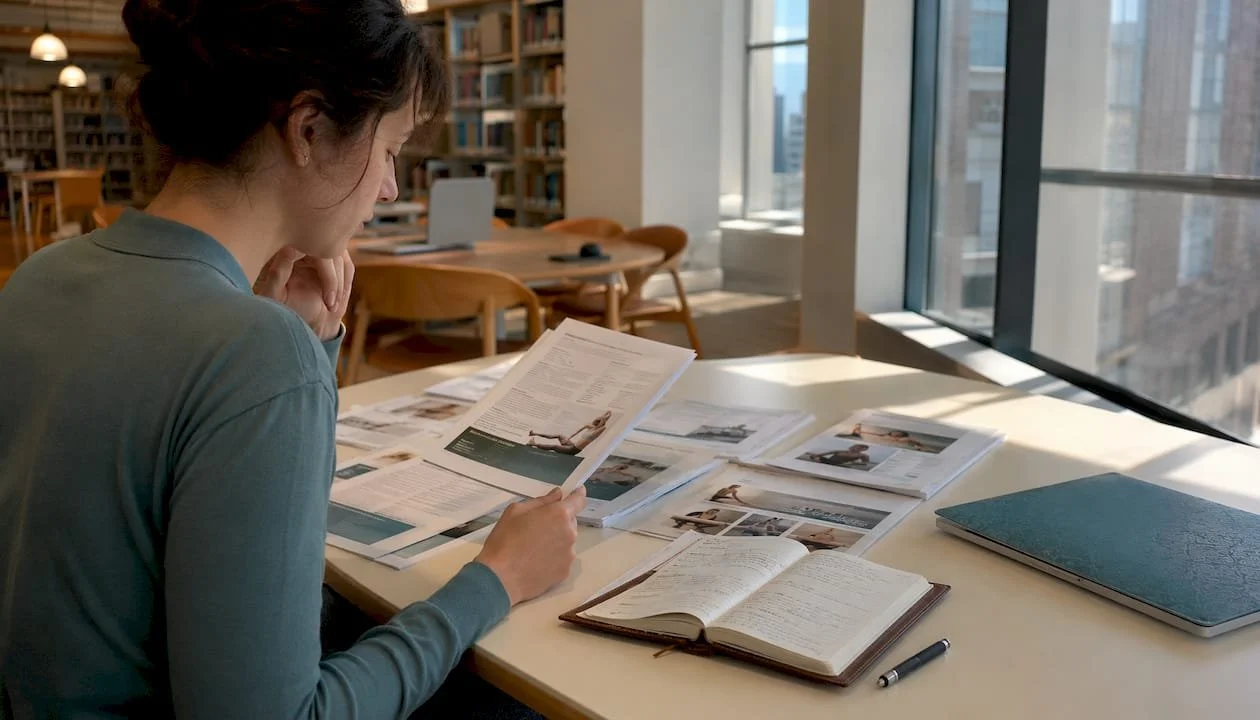
A few notes: Drexel's hours and cohort structure are publicly documented. For SOLMAR x Polestar and Thrive, tuition and cohort dates require a direct inquiry — both programs update these seasonally.
The single most important question to ask every program: "Does your curriculum explicitly prepare students to sit for the NPCP NCPT exam, and does it cover the full comprehensive repertoire?"
Confirm the program covers all six equipment categories: Mat, Reformer, Trapeze Table (Cadillac), Chair, Ladder Barrel, and Spine Corrector.
Ask how supervised teaching hours are documented and signed off for your NCPT application.
Request instructor credentials upfront — master instructors, physical therapists, or NPCP-affiliated mentors signal a serious program.
Detailed profiles: what each program actually offers
Drexel Pilates Training Program
Drexel's program is the most structurally transparent option on this list. It runs as a cohort-based, one-year curriculum with three sequential modules: mat work in the fall, mixed equipment in the winter, and reformer in the spring. Total hours reach 450, which meets the NPCP's minimum for comprehensive NCPT eligibility.
Curriculum modules covered:
Mat (foundational and advanced repertoire)
Reformer
Cadillac / Trapeze Table
Chair
Ladder Barrel and Spine Corrector
The program includes formal apprenticeship phases (Apprentice 1 and Apprentice 2), where students accumulate supervised teaching hours under faculty oversight. That structure matters: the NPCP requires documented supervised hours as part of your NCPT application, and Drexel's sign-off process is built into the cohort model. The recommended minimum prior practice is approximately 30 hours before admission. Tuition is not publicly listed; contact Drexel Westphal's admissions office directly.
Pro Tip: The Drexel cohort fills on a set academic calendar. If you miss the September start, you wait a full year. Reach out in spring to confirm your spot.
SOLMAR x Polestar
SOLMAR hosts a Polestar Pilates pathway, one of the established brand certification routes recognized across the U.S. and internationally. Polestar's methodology is built around movement science and clinical application, making it a natural fit for instructors who want to work alongside physical therapists or in rehab-adjacent settings.
Curriculum modules and total hours are not publicly listed for the SOLMAR-hosted version; contact the studio directly to confirm scope. The key question to ask: does the Polestar pathway offered here cover the full comprehensive repertoire, or only mat and reformer? That distinction determines NCPT eligibility.
Local studio support at SOLMAR is a genuine advantage. You're training in the environment where you may eventually teach, which accelerates the transition from student to working instructor.
Thrive Pilates Yoga teacher training
Thrive runs a studio-level teacher training with a practical, hire-ready focus. The program's strength is its local studio relationships — graduates enter a network of boutique Philadelphia studios that already know the Thrive training standard.
Total hours and curriculum scope are not publicly listed. Before applying, ask Thrive directly whether the program covers the full six-category comprehensive repertoire and whether it prepares students for the NCPT. If your goal is immediate local employment in a boutique studio rather than a clinical or academic setting, Thrive's pipeline is worth the inquiry.
Cost for both SOLMAR x Polestar and Thrive: contact admissions. Neither program publishes current tuition publicly.
How do you pick the right program for where you want to teach?
The answer-first version: match your career goal to the program's primary strength before you compare anything else.
NCPT credential + academic structure → Drexel. The 450-hour cohort is the clearest path to NCPT eligibility in Philadelphia.
Rehab-informed methodology + Polestar brand recognition → SOLMAR x Polestar. Useful if you plan to work in clinical fitness or alongside PTs.
Boutique studio hiring pipeline → Thrive. Best if you want to teach locally within months of finishing, not years.
There is no single "best" Pilates certification — the right choice depends entirely on where you intend to teach and what your clients will need from you.
Questions to ask every program before you commit:
Does this program explicitly prepare students to sit for the NPCP NCPT exam?
What is the total hour count, and how are supervised teaching hours documented?
Who are the lead instructors, and what are their credentials (master instructor, PT, NPCP-affiliated)?
What does the apprenticeship or mentorship structure look like week to week?
Do graduates receive job placement support or studio referrals?
What continuing education options exist after certification?
Red flags to watch for:
Vague total hours ("over 200 hours" with no breakdown)
No mention of supervised teaching or apprenticeship
Instructor credentials not listed publicly
No clear curriculum scope (can't confirm all six equipment categories)
No answer when you ask about NCPT eligibility
Once you've received replies, schedule a shadow day or info session at the top one or two programs. Sitting in on a class tells you more about teaching culture than any brochure.
Does your program actually prepare you for the NCPT exam?
The NCPT (Nationally Certified Pilates Teacher) is the primary recognized credential in the U.S. It's administered by the NPCP (National Pilates Certification Program) and is NCCA-accredited, which puts it in the same credentialing tier as other nationally recognized fitness certifications.
Key NCPT application basics from the 2026 NPCP handbook:
A minimum duration for the comprehensive curriculum pathway
Exam consisting of multiple-choice items with a time limit
A defined passing score is required
There is an application fee covering initial certification period
The full comprehensive repertoire should include Mat, Reformer, Trapeze Table (Cadillac), Chair, Ladder Barrel, and Spine Corrector.
A program that covers only mat and reformer does not qualify you to sit for the comprehensive NCPT exam. Confirm the full six-category scope before enrolling.
Brand certifications from Polestar, Balanced Body, STOTT, BASI, and Peak each carry their own employer recognition and methodology. Some studios specifically hire for a brand credential. Many instructors pursue both a brand pathway and the NCPT, since the two serve different purposes: brand certs signal methodology fluency, while the NCPT signals independent professional validation. Online and hybrid options exist, but hands-on supervised hours remain required for NCPT-qualifying comprehensive training.
Pro Tip: Start a dedicated log of every supervised teaching hour from day one of your program. Programs document hours differently, and a clean personal record prevents delays when you file your NCPT application.
How do you build real teaching experience in Philadelphia after you certify?
Philadelphia studios hire based on observed teaching hours, private-session readiness, and clear client programming skills. A certificate alone rarely gets you booked. What actually moves the needle:
Apprenticeship hours during training — the most direct signal to local studios that you've taught real clients under supervision
Mock private sessions — practice designing and delivering a 30–45 minute session for a specific client profile before you graduate
Client intake competency — studios want instructors who can read an intake form and build a session around what a client needs versus what they want; programming that balances both is what keeps clients returning
Community classes — teaching free or low-cost community sessions builds reps fast and generates early testimonials
Clinical partnerships — if you trained with a rehab focus (Polestar pathway), reach out to PT clinics about co-teaching or referral arrangements
To request a shadow day at a Philadelphia studio, send a short email with your certification status, your availability, and one or two sentences on your teaching focus. Keep it under 150 words. Attach a brief bio and, if you have one, a link to a demo video or a reference from your training program.
For building synchronized class delivery and atmosphere, focus on consistent cueing rhythm and clear transitions between exercises — these are the first things a studio owner notices during a shadow observation.
Pro Tip: Collect a short written testimonial from every practice client during training. Three genuine testimonials from real people carry more weight in a studio inquiry than a polished resume.
Key Takeaways
Philadelphia has three credible in-person Pilates instructor training pathways, and the right one depends on your career goal, not on which program has the most name recognition.
| Point | Details |
|---|---|
| Confirm NCPT eligibility first | Ask every program whether it covers all six equipment categories and meets the 450-hour NPCP minimum, as specified in the NPCP handbook. |
| Match program to career goal | Drexel suits NCPT-track students; SOLMAR x Polestar fits rehab-informed paths; Thrive targets boutique studio placement. |
| Supervised hours are non-negotiable | Document every supervised teaching hour from day one; the NCPT application requires a verified log. |
| Brand certs and NCPT serve different purposes | A Polestar or Balanced Body cert signals methodology; the NCPT signals independent professional validation. |
| Amrita Yoga Wellness supports local practice | Amrita Yoga & Wellness in Philadelphia offers reformer classes and community sessions where aspiring instructors can log practice hours while training. |
What training in Philadelphia actually prepares you for
The part no program brochure tells you: the first year after certification is mostly about reps, not credentials. Teaching three privates back to back requires a different kind of agility than passing a written exam. You need to move fluidly between a client's intake goals and what their body actually shows you in the first ten minutes.
What matters most in that early period is the quality of your supervised hours during training, not the total count. A program that puts you in front of real clients with a mentor watching and correcting you is worth more than one that logs hours through observation alone. The cohort model at Drexel, for instance, builds that accountability into the structure. Polestar's clinical framing does something similar for rehab-track instructors.
A typical early-career week in Philadelphia might look like: two to three paid privates, one community class, and two hours of continuing education or practice. That rhythm builds fast if you graduate with a studio relationship already in place. It stalls if you're starting cold.
Prioritize programs with real mentorship and clear supervised-hour documentation. That combination de-risks the transition from student to working instructor more than any single credential.
Amrita Yoga & Wellness: a local resource for practice hours and mentorship
If you're working toward certification and need consistent reformer practice time or a local studio environment to build your hours, Amrita Yoga & Wellness in Philadelphia is a practical next stop. The studio offers Pilates classes, reformer sessions, and a welcoming community for practitioners at every level — exactly the kind of environment where a trainee can log practice hours, observe experienced instructors, and get comfortable in a real studio setting before they're running sessions solo.
Aspiring instructors can use Amrita's class schedule to supplement their program training, build client-facing confidence, and connect with the local wellness community. To explore current class offerings or ask about shadowing opportunities, visit Amrita Yoga & Wellness and reach out directly through the site's contact page.
Useful sources to read next
NPCP 2026 NCPT Handbook — Primary source for exam eligibility, the 450-hour minimum, exam format, passing score, and application fee. Read this before you apply to any program.
Drexel Westphal Pilates Training Program — Full cohort structure, module breakdown, apprenticeship phases, and admissions guidance. Start here if Drexel is on your shortlist.
Fitnesstrainer: 9 Best Pilates Certifications — Useful overview of brand certification pathways (STOTT, BASI, Polestar, Balanced Body) with duration and recognition context.
Erica Bell Pilates: Programming Private Sessions — Practical guidance on building client-centered private session plans; directly relevant to early-career teaching.
Open Exam Prep: NPCP NCPT — Exam prep context and instructor skill emphasis; useful once you're in a program and preparing for the NCPT.
SOLMAR x Polestar and Thrive Pilates Yoga — Contact each studio directly for current cohort dates, tuition, and curriculum scope. Neither program publishes full details publicly; a direct inquiry is the only way to get accurate, current information.
Recommended
Pilates Class Formats in Philadelphia: 2026 Guide
TL;DR:
Philadelphia offers a variety of Pilates classes, including mat, reformer, and specialty formats for different goals. Beginners should choose smaller classes with experienced instructors or private sessions for better guidance. Amritayogawellness provides diverse Pilates options along with other wellness services in a community-focused environment.
What Pilates class formats are available in Philadelphia?
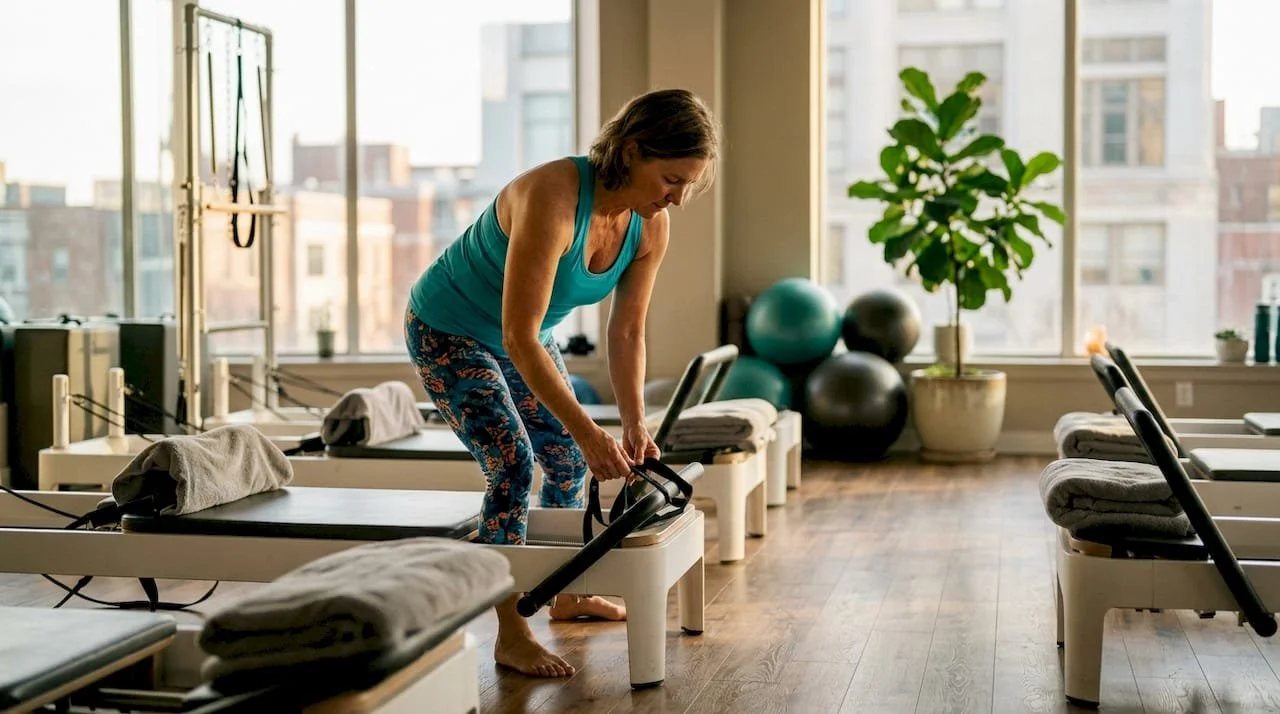
Philadelphia offers a solid range of Pilates formats, from floor-based mat work to equipment-driven reformer sessions and specialty classes built around specific goals. Here's a quick breakdown of what you'll find locally:
Mat Pilates: Bodyweight exercises on a mat, typically in group fitness classes of 8–20+ participants. Affordable, widely available, and great for building foundational core strength.
Reformer Pilates: Uses a spring-resistance machine for controlled, full-body work. Group reformer classes run 6–12 participants, offering more individual attention than large mat sessions.
Springboard Pilates: A wall-mounted apparatus with springs and bars. Targets the full body with a focus on alignment and controlled resistance, often used in smaller class settings.
Chair/Tower fusion classes: Combines the Pilates chair and tower apparatus for targeted work on stability, balance, and functional strength.
Cardio-focused Reformer classes: Incorporate a jumpboard attachment for low-impact plyometrics. These add dynamic intensity while keeping stress off the joints.
Prenatal and postnatal Pilates: Specialty formats led by instructors with additional training in prenatal movement and safety modifications.
Rehabilitation-focused Pilates: Often called clinical or therapeutic Pilates, these classes require instructors with relevant healthcare training and are suited to post-injury recovery.
Athletic performance Pilates: Designed for athletes seeking cross-training benefits, focusing on power, mobility, and sport-specific movement patterns.
Amrita Yoga & Wellnessin Philadelphia offers diverse formats across these categories, making it a practical starting point for anyone exploring local options.
Pro Tip: If a class label sounds unfamiliar, ask the studio directly: what equipment is used, who the class is designed for, and what progression looks like. Nusu's 2025 guidance makes this the single most useful step for anyone new to Pilates.
How to choose the right Pilates class in Philadelphia
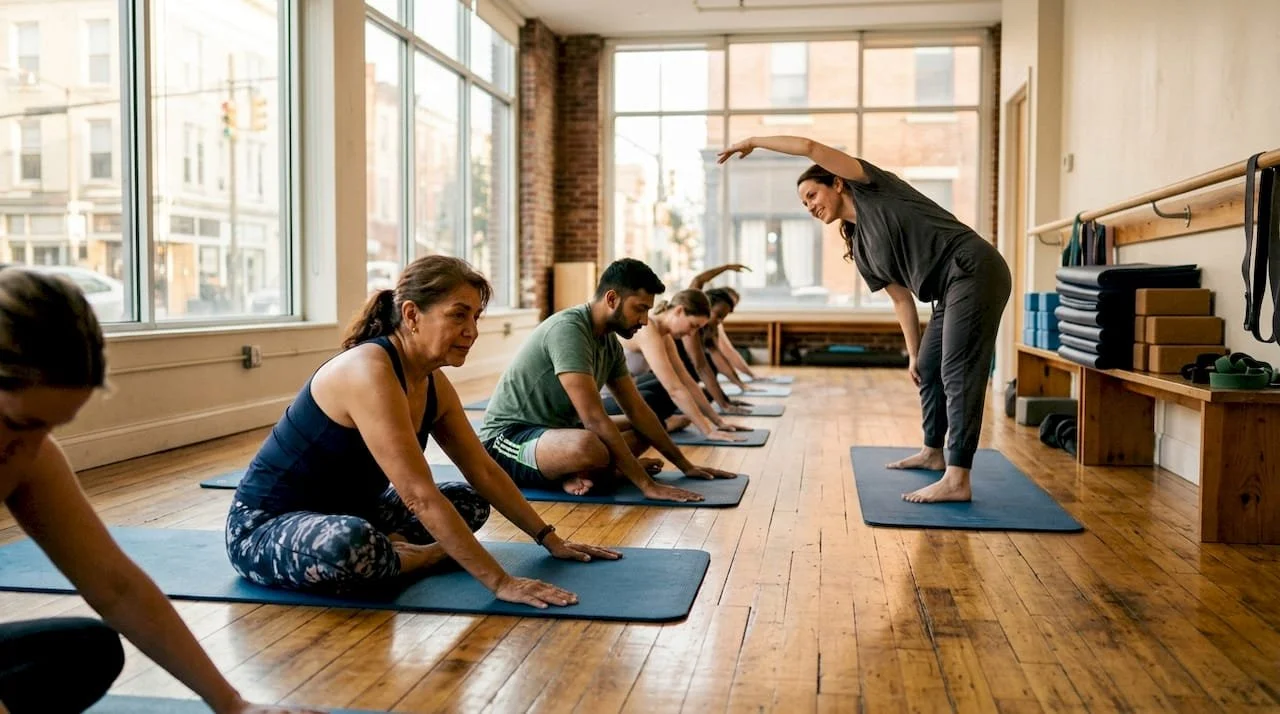
Start with your goal, not the class name. Nusu's 2025 guidance recommends asking studios about format, target audience, expectations, and coaching structure before committing, especially if you're new to Pilates.
A few practical considerations:
Experience level: Beginners benefit from a beginner Pilates guide and smaller class sizes where instructors can correct form. A group mat class of 20 people isn't the best place to learn the basics.
Group vs. private: Private and semi-private sessions offer tailored instruction adapted to your goals and any physical limitations, with direct feedback that group classes can't always provide. They cost more, but the personalization is real.
Class duration: Standard sessions run 50–60 minutes, which includes warm-up, main exercises, and enough time for proper instruction.
Accessibility: Most studios offer modifications for different fitness levels and physical limitations. Ask upfront whether the format accommodates your specific needs.
Specialty classes: Prenatal, rehab, and athletic formats require instructors with additional relevant training. Verify credentials before signing up.
Pricing and scheduling: Look for studios offering flexible membership options or drop-in rates that fit your routine without locking you into a rigid commitment.
Amritayogawellness brings Pilates and wellness together in Philadelphia
Pilates is one piece of a larger wellness picture, and Amritayogawellness builds that picture in one place. The studio offers Pilates alongside yoga, barre, tai chi, and massage therapy, so you're not piecing together a routine from multiple locations.
Whether you're starting with mat work or ready to try reformer classes, Amritayogawellness provides class options for beginners through advanced practitioners, with a community-focused environment that makes showing up easier. The studio also offers workshops and wellness services, including tarot readings, for those interested in a broader approach to self-care. Visit amritayogawellness.com to browse the current class schedule and book your first session.
Key Takeaways
Philadelphia's Pilates class formats range from accessible mat sessions to specialty equipment-based classes, and matching the format to your goal is what determines results.
| Point | Details |
|---|---|
| Format variety | Philadelphia offers mat, reformer, springboard, chair/tower, cardio reformer, and specialty classes. |
| Group class size | Mat classes run 8–20+ participants; reformer classes are capped at 6–12 for more attention. |
| Private sessions | One-on-one and semi-private formats offer personalized programming and direct feedback. |
| Class duration | Standard Pilates sessions run 50–60 minutes, including warm-up and main exercises. |
| Amritayogawellness | Offers diverse Pilates formats in Philadelphia alongside yoga, barre, and wellness services. |
What Does a Pilates Reformer Do for Your Body?
TL;DR:
A Pilates reformer is a spring-resistance machine that enhances core strength, posture, and mobility through controlled movement. It activates deep stabilizers, corrects muscle imbalances, and trains functional mobility, making it effective for injury recovery and long-term conditioning. Most noticeable results include improved posture, stronger stabilizer muscles, and better movement habits over weeks of consistent practice.
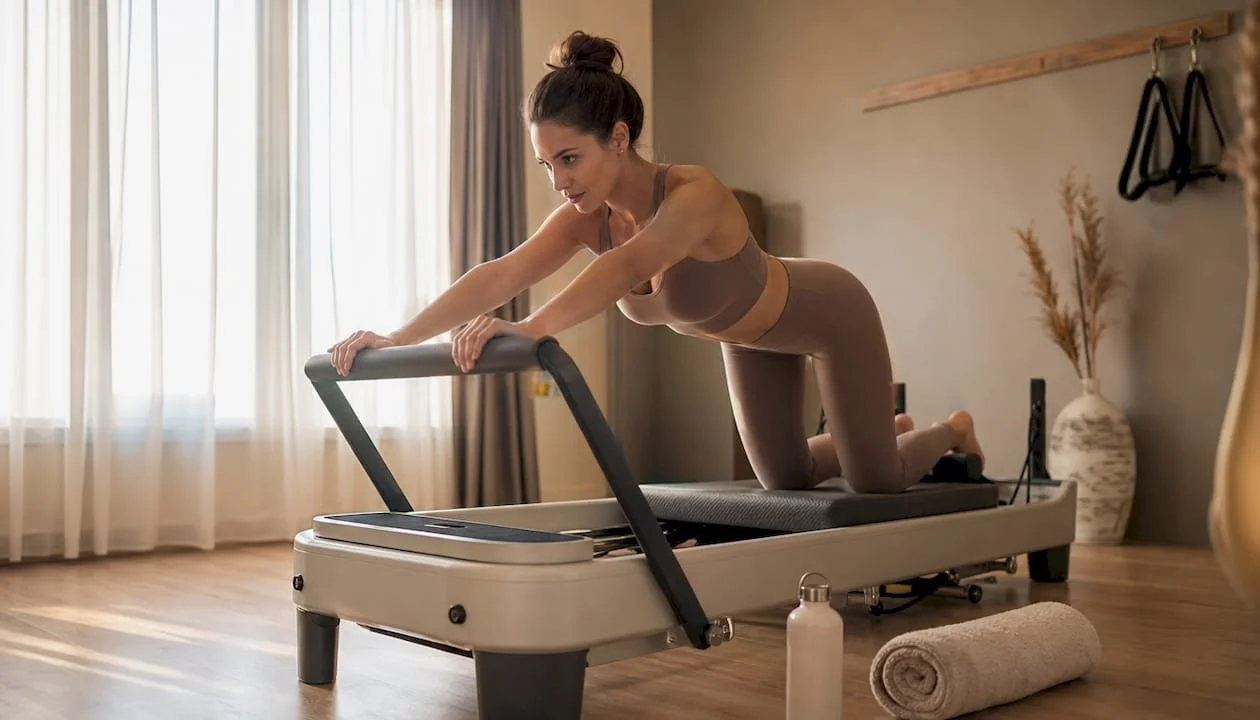
A Pilates reformer is a spring-resistance exercise machine that builds core strength, corrects posture, increases functional mobility, and conditions your entire body through controlled, low-impact movement. Understanding what does pilates reformer do for your body goes far beyond the common assumption that it is just a stretching tool. The reformer uses a sliding carriage, adjustable springs, and a pulley system to create resistance that challenges your muscles through full ranges of motion. Clinical research confirms measurable improvements in strength, posture, and pain reduction, making it one of the most versatile training tools available for beginners and experienced practitioners alike.
How does the Pilates reformer improve core strength and muscle balance?
The reformer targets deep core stabilizers that most traditional gym exercises miss entirely. Specifically, it activates the transversus abdominis and lumbar multifidus, the two muscles most responsible for spinal stability and injury prevention. A 2015 study confirmed that deep core activation improved significantly after just 8 weeks of consistent reformer use. That result matters because these muscles are chronically underactive in people who sit for long periods or rely on surface-level abdominal exercises like crunches.
Traditional strength training tends to reinforce dominant muscle groups, which creates imbalances over time. The reformer corrects this by requiring stabilization against a moving carriage, which forces your weaker, underused muscles to engage. Your hips, legs, and posterior chain all work together rather than in isolation. This whole-body recruitment pattern is what makes reformer Pilates benefits so distinct from standard resistance training.
The spring system also increases resistance dynamically as the springs stretch. That means your muscles work through the full arc of motion rather than only at peak contraction. The result is more complete muscle development and better neuromuscular coordination over time.
Deep core muscles (transversus abdominis, lumbar multifidus) are activated more effectively than in traditional training
The moving carriage demands stabilization, correcting overuse of dominant muscles
Hips, legs, and the posterior chain are engaged simultaneously, not in isolation
Dynamic spring resistance trains muscles through their full range of motion
Pro Tip: Focus on slow, controlled movement rather than speed during your first sessions. Precision activates the deep stabilizers. Speed lets your surface muscles take over and defeats the purpose.
What does the Pilates reformer do for posture and spinal alignment?
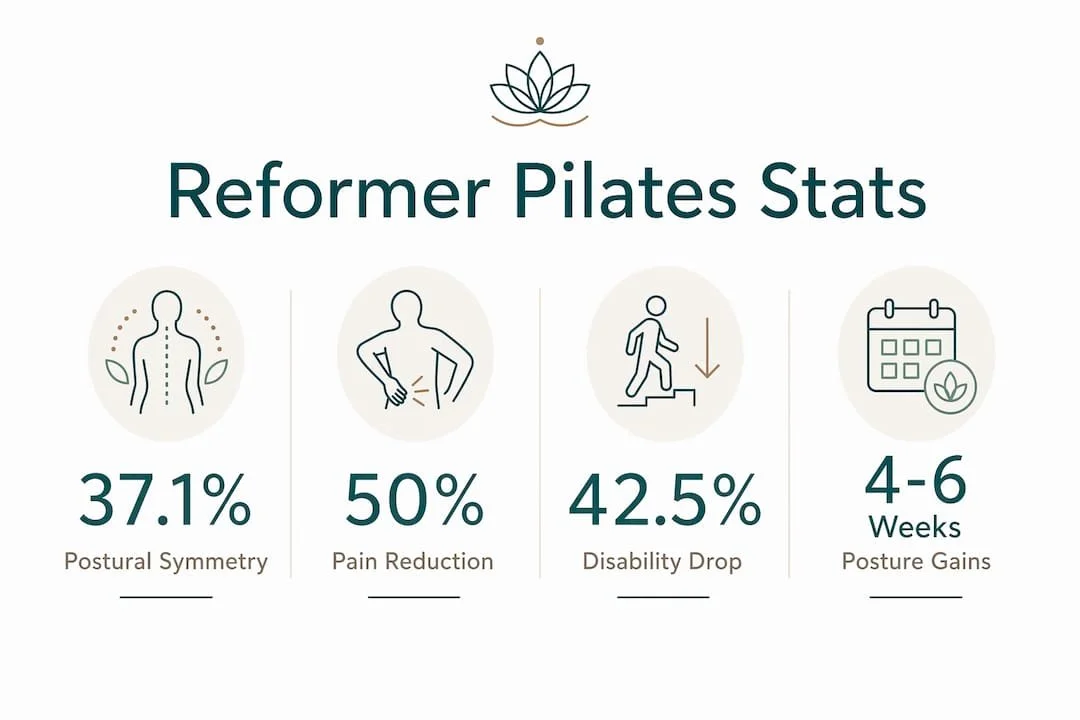
The reformer produces measurable postural improvements that few other exercise methods can match. A 12-week reformer Pilates program increased postural symmetry by 37.1%, reduced pain by 50%, and lowered disability scores by 42.5% in a study of 30 adults aged 18–45. Those numbers reflect real structural change, not just subjective comfort.
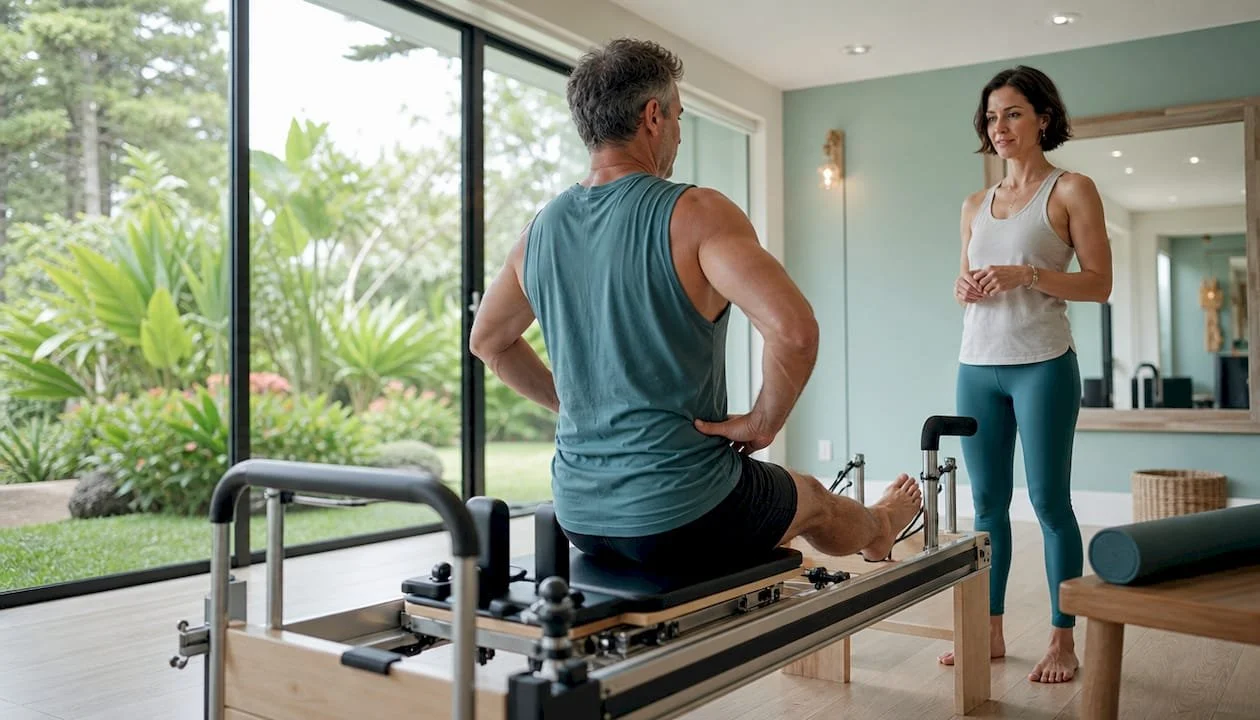
The mechanism behind this is straightforward. Spring resistance creates constant feedback during movement. Your body learns to self-correct alignment because any deviation from neutral spine immediately changes how the springs feel. That sensory loop retrains postural awareness faster than most static exercises.
Most practitioners notice posture improvements within 4–6 weeks of consistent practice. The muscles weakened by sedentary habits, particularly the deep spinal extensors and hip stabilizers, begin to reactivate and hold the body more efficiently upright.
| Benefit | What the research shows |
|---|---|
| Postural symmetry | 37.1% improvement after 12 weeks |
| Pain reduction | 50% decrease in reported pain scores |
| Disability index | 42.5% reduction in functional limitations |
| Onset of visible change | Posture improvements typically within 4–6 weeks |
Pro Tip: Ask your instructor to film a side-view video of your posture on week one. Repeat at week six. The visual difference is often more motivating than any number on a scale.
In what ways does the reformer enhance flexibility and functional mobility?
Functional mobility and passive flexibility are not the same thing. Passive flexibility means your muscles can lengthen when relaxed. Functional mobility means you can control movement through a full range of motion while under load. The reformer trains the second, which is far more useful in daily life and athletic performance.
The moving carriage and spring resistance create what researchers describe as controlled ranges of motion under load. Your muscles lengthen and contract simultaneously, which builds strength at end ranges where most people are weakest. This is especially valuable for people with stiffness from desk work, past injuries, or age-related mobility restrictions.
The reformer is also one of the few training tools that makes mobility work accessible to people who cannot yet perform bodyweight movements comfortably. Springs can assist you through a range of motion rather than just resist it. That means someone recovering from a hip replacement and a competitive athlete can both use the same machine productively.
Functional mobility trains strength through full ranges of motion, not just passive lengthening
Spring assistance allows people with restrictions to safely access greater movement ranges
Muscles lengthen under load, building strength at end ranges where injuries most often occur
Tension relief and muscle lengthening happen simultaneously, not sequentially
People with stiffness, prior injuries, or limited mobility benefit without high joint stress
How does the reformer support injury recovery and long-term conditioning?
The reformer's adjustable spring system is its most clinically significant feature. Springs can be set to assist movement, making exercises easier, or to resist movement, making them harder. This dual function means the same machine works for someone in early rehabilitation and someone training at an advanced level. Scalable spring resistance accommodates injury recovery and high-level conditioning without requiring different equipment.
For people with chronic low back pain, the evidence is particularly strong. A 12-week reformer course produced lasting pain and function improvements that held at a 6-month follow-up. That durability suggests the reformer does not just mask symptoms. It retrains the movement patterns that caused the problem in the first place.
The low-impact nature of reformer training also protects joints. Unlike running or heavy lifting, the carriage absorbs much of the compressive force that would otherwise travel through knees, hips, and the spine. This makes it a practical long-term fitness option for people across all ages and fitness levels.
Set springs for assistance first. Beginners and those in rehab should use lighter spring loads to build movement patterns before adding challenge.
Progress gradually. Increase spring resistance only when you can complete each movement with full control and no compensations.
Prioritize consistency over intensity. Practicing 2–3 times per week over several months produces functional strength gains that occasional hard sessions cannot replicate.
Use the reformer alongside physical therapy. For clinical populations, the clinical reformer approach integrates reformer work with targeted rehab protocols for faster recovery.
Track your range of motion, not just your weight. Functional improvements show up in how you move before they show up on a scale.
What are common misconceptions about reformer Pilates?
The most persistent myth is that reformer Pilates is easy. It is not. It is controlled, low-impact strength training that demands precision and deep muscular engagement. The effort is less visible than lifting heavy weights, but the internal demand on stabilizing muscles is significant. Many people leave their first session surprised by how much they feel the next day.
A second misconception is that the reformer is only for flexibility. Flexibility is a byproduct, not the goal. The primary adaptation is neuromuscular control, which means your brain and muscles learn to coordinate more efficiently. That coordination improvement is what drives the posture, strength, and mobility gains that practitioners report.
Beginners also tend to underestimate the learning curve. The reformer requires you to manage your body position, breathing, and spring resistance simultaneously. That coordination takes time to develop.
Reformer Pilates is strength training, not stretching. Expect muscle fatigue, not just a relaxed stretch.
Precision matters more than range. A small movement done correctly outperforms a large movement done sloppily.
Results require consistency. Attending once a week produces awareness. Attending 2–3 times per week produces physical change.
Springs that feel easy are not always set correctly. Ask your instructor to assess your spring load before assuming the workout is too simple.
Pro Tip: If your first few sessions feel manageable, that is normal. The reformer's learning curve means your nervous system is adapting before your muscles are fully challenged. Stick with it past week three before drawing conclusions.
Key takeaways
The Pilates reformer builds functional strength, corrects posture, and supports injury recovery through adjustable spring resistance that targets deep stabilizing muscles traditional training consistently misses.
| Point | Details |
|---|---|
| Core muscle activation | The reformer targets transversus abdominis and lumbar multifidus more effectively than standard gym exercises. |
| Posture improvement | A 12-week program produced a 37.1% increase in postural symmetry and a 50% reduction in pain. |
| Functional mobility | Spring resistance trains strength through full ranges of motion, not just passive flexibility. |
| Injury recovery | Adjustable springs make the reformer effective for both early rehabilitation and advanced conditioning. |
| Consistency requirement | Practicing 2–3 times per week over several months is necessary for lasting functional strength gains. |
People come to reformer Pilates expecting flexibility. What they get is something harder to name but more useful: control. After working with practitioners at various levels, the pattern I notice most is not dramatic weight loss or visible muscle gain in the first weeks. It is the moment someone realizes they are standing differently. Their shoulders are back without effort. Their lower back is not aching after a long day. That shift happens quietly, usually around week four or five, and it tends to stick.
What surprises people most is how demanding precision actually is. Slowing down a movement and holding it at the end range with spring resistance is genuinely hard work. The reformer does not let you cheat the way a barbell or a machine does. The carriage will slide if your stabilizers are not engaged. That honest feedback is what makes the tool so effective and so humbling for people who consider themselves already fit.
The deeper benefit I have observed is the retraining of movement habits. People stop hiking one hip when they walk. They stop collapsing through the shoulder when they reach overhead. Those corrections carry into everything they do outside the studio. That is the kind of conditioning that holds up over years, not just weeks. If you are curious about how reformer Pilates works at a deeper level, the research behind it is worth reading.
— Juiced
Reformer Pilates at Amrita Yoga & Wellness in Philadelphia
Amritayogawellness offers reformer Pilates classes designed for both first-time practitioners and those with an established practice. The studio's approach integrates physical conditioning with broader wellness principles, so your training connects to how you feel and move in everyday life, not just during class.
Classes are structured to accommodate different fitness levels, with instructors who adjust spring resistance and movement progressions to match where you are right now. Whether you are managing a past injury, building strength from scratch, or looking to deepen an existing practice, the sessions are built around your body's actual needs. Amritayogawellness also offers complementary wellness services, including tarot readings, for those who want to support their physical practice with intentional self-reflection. Visit amritayogawellness.com to view the current class schedule and reserve your spot.
FAQ
What muscles does the Pilates reformer work?
The reformer primarily targets deep core stabilizers including the transversus abdominis and lumbar multifidus, along with the hips, legs, and posterior chain. It engages multiple muscle groups simultaneously rather than isolating single muscles.
How quickly will I see results from reformer Pilates?
Most practitioners notice posture improvements within 4–6 weeks of consistent practice. Meaningful functional strength gains require 2–3 sessions per week sustained over several months.
Is the Pilates reformer good for back pain?
A 12-week reformer Pilates program produced a 50% reduction in pain and a 42.5% drop in disability scores in clinical populations. Benefits were maintained at a 6-month follow-up, suggesting lasting improvement rather than temporary relief.
Can beginners use the Pilates reformer safely?
Beginners benefit directly from the adjustable spring system, which can assist movement rather than resist it. This makes the reformer accessible and low-risk for people new to exercise or returning from injury.
Is reformer Pilates the same as mat Pilates?
Reformer Pilates uses spring resistance and a moving carriage to create dynamic load through full ranges of motion. Mat Pilates relies on bodyweight only, which limits the depth of core activation and the range of exercises available.
Recommended
How to practice Pilates at home: step-by-step guide
TL;DR:
Pilates is a low-impact, accessible exercise that improves spinal mobility at home.Consistent practice, even for short sessions, leads to meaningful mobility and pain reduction.Focusing on proper setup, form, and tracking progress enhances effectiveness and long-term results.
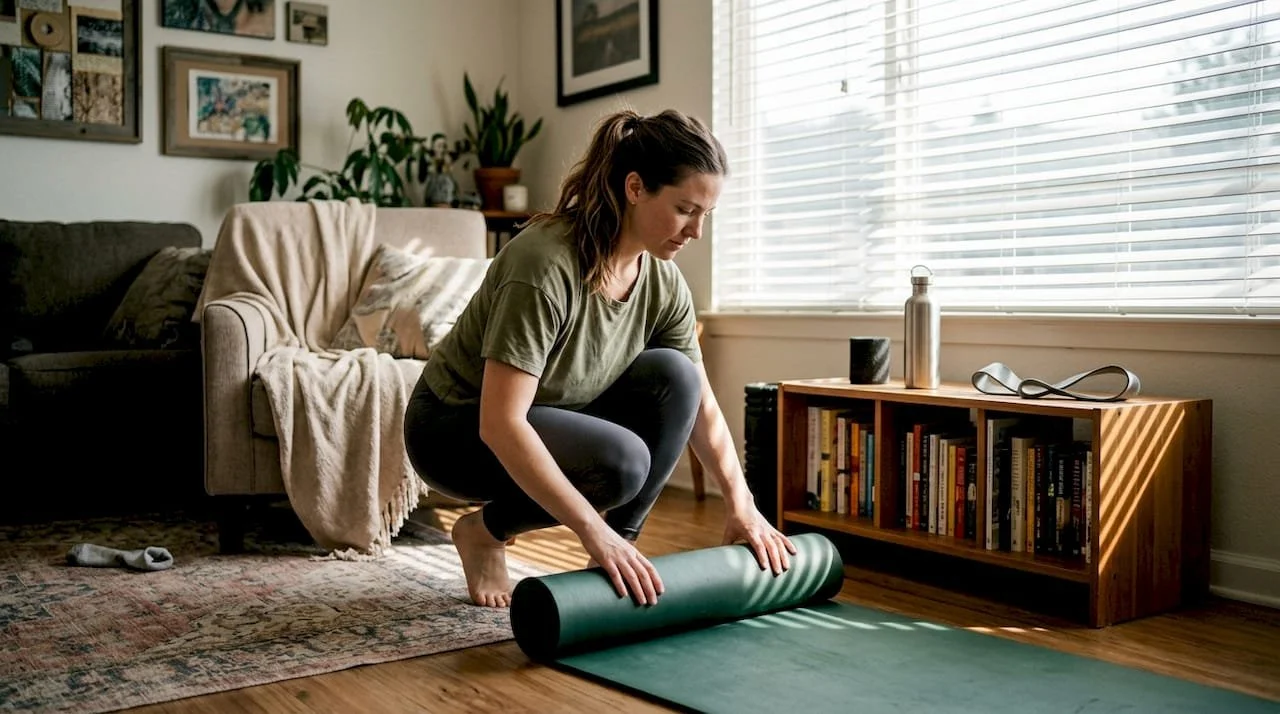
Finding time for fitness when you're juggling work, family, and everything Philadelphia life throws at you is genuinely hard. Pilates changes that equation. It's low-impact, requires almost no equipment, and improves spinal mobility and quality of life even when practiced entirely at home. Whether you've never rolled out a mat or you're returning after a long break, this guide walks you through setup, foundational moves, common pitfalls, and how to actually measure your progress so you can feel confident the effort is paying off.
Table of Contents
Key Takeaways
| Point | Details |
|---|---|
| Minimal setup needed | You only need a mat, comfortable clothes, and a small space to start Pilates at home. |
| Short sessions work | 15–45 minute Pilates routines deliver real benefits for mobility and pain relief. |
| Avoid common mistakes | Proper form and consistent practice prevent injury and maximize results. |
| Track your progress | Measuring mobility, pain, and strength helps you see improvements and stay motivated. |
| Adapt for busy schedules | Quick desk moves or micro-sessions make Pilates achievable for even the busiest adults. |
Get ready: Home Pilates essentials and setup
The good news is you don't need a reformer machine or a room full of mirrors to get started. Pilates is one of the most accessible workouts you can build at home, and the barrier to entry is refreshingly low.
Your non-negotiable starting point is a quality mat. Look for one that's at least 3/8 inch thick to protect your spine and hips during floor work. Beyond that, comfortable, form-fitting clothing helps you and any instructor video see your alignment clearly. Optional props, like a small resistance band, a yoga block, or a firm pillow, can support modifications as you build strength.
Choosing the right space matters more than most beginners expect. You need enough room to lie down fully in every direction, roughly a 6 by 6 foot square. A living room corner, a cleared bedroom, or even a back porch works. The key is removing trip hazards and ensuring the floor isn't slippery under your mat.
Short sessions of 15 to 45 minutesfit busy schedules and beginners perfectly, which means you don't need to carve out a full hour to see results. Pair that with a fewbeginner Pilates tipsand you're ready to build a sustainable habit.
| Essential | What to look for | Notes |
|---|---|---|
| Mat | 3/8" or thicker, non-slip | Non-negotiable for floor work |
| Clothing | Form-fitting, breathable | Allows you to check alignment |
| Props | Resistance band, block, firm pillow | Optional but helpful for beginners |
| Space | 6 x 6 feet minimum | Clear of clutter and furniture |
| Session length | 15 to 45 minutes | Scale up gradually |
Common setup mistakes to avoid:
Practicing on carpet without a mat (limits range of motion and stability)
Wearing loose, baggy clothing (makes it hard to spot form errors)
Setting up in a high-traffic area with distractions
Skipping a warm-up because the session feels short
Using a mat that's too thin and causing hip or spine discomfort
Understanding the Pilates health benefits before you begin also helps you stay motivated once the novelty wears off.
Pro Tip: Start in a quiet, clutter-free spot even if it means rearranging furniture temporarily. Your focus directly affects the quality of every rep.
Follow the basics: Key Pilates moves and step-by-step routine
Once your space is set up, the right moves make Pilates both effective and accessible. The goal here isn't to memorize a dozen exercises on day one. It's to move intentionally, breathe consistently, and build a foundation you can add to over time.
Here is a simple beginner session you can follow immediately:
Warm-up (5 minutes): Start lying on your back with knees bent. Do 10 slow pelvic tilts, gently pressing your lower back into the mat and releasing. Follow with 5 knee-to-chest pulls per side to release the hips.
The Hundred (core activation, 5 minutes): Lift legs to tabletop position, raise your head and shoulders, and pulse your arms up and down while breathing in for 5 counts and out for 5 counts. Complete 10 full breath cycles.
Single leg stretch (5 minutes): From a similar position, pull one knee to your chest while extending the other leg. Alternate sides for 10 reps each, keeping your lower back pressed down.
Spine stretch forward (5 minutes): Sit tall with legs extended. Inhale to grow tall, exhale to reach forward over your legs without collapsing. Repeat 6 times.
End stretch and cool-down (5 minutes): Child's pose for 60 seconds, then a gentle supine twist holding each side for 30 seconds.
Check out sample Pilates exercises to expand your routine as you grow stronger. You can also explore mat Pilates routines for structured progressions.
| Feature | Pilates routine | Generic home exercises |
|---|---|---|
| Focus | Precision, breath, core control | Repetition, volume |
| Low back pain relief | Pilates superior per RCT | Moderate, inconsistent |
| Time required | 15 to 45 minutes | 30 to 60 minutes |
| Equipment | Mat only | Often weights or machines |
| Beginner-friendly | High | Varies widely |
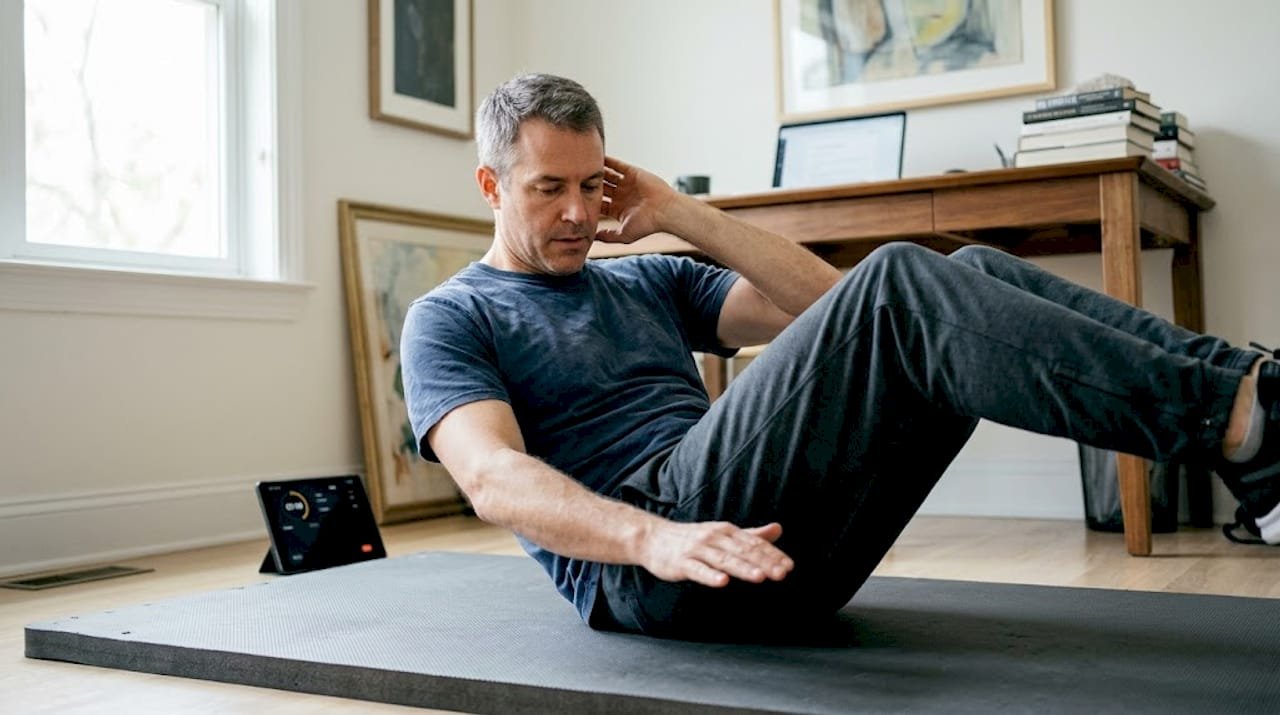
Maintaining form is more important than completing every rep. If your neck strains during the Hundred, place one hand behind your head. If your lower back lifts off the mat, lower your legs higher toward the ceiling.
Pro Tip: Use a timer to keep sessions under 45 minutes. Shorter, focused sessions build more consistency than longer ones you dread starting.
Troubleshooting: Common mistakes and practical solutions
Now, let's ensure your Pilates routine produces solid results by avoiding common pitfalls. Even motivated beginners fall into predictable traps, and catching them early saves a lot of frustration.
Top mistakes to watch for:
Holding your breath during difficult moves instead of maintaining a steady inhale and exhale rhythm
Skipping the warm-up when time feels short, which increases your injury risk significantly
Rushing through reps to get more done instead of moving slowly with control
Ignoring discomfort signals and pushing through sharp pain, especially in the lower back
Comparing your flexibility to online instructors who have trained for years
Safety note for low back pain: If you experience sharp or shooting pain during any movement, stop immediately and consult a healthcare provider before continuing. Modify exercises by keeping legs higher, reducing range of motion, or staying in constructive rest position (knees bent, feet flat) until you've built sufficient core strength.
Consistent practice matters more than perfect form on day one. Research confirms that Pilates improves spinal motion and reduces disability when practiced regularly, even at home with basic modifications. Progress is quiet but real.
If you're unsure which style fits your needs, reviewing the types of Pilates classes can help you choose the right approach. For focused core work, building core strength through targeted progressions is a smart next step.
Pro Tip: Record yourself doing one exercise per week using your phone. Watching the playback helps you spot alignment issues that are nearly impossible to notice in the moment.
Tracking success: How to measure your progress and results
With troubleshooting addressed, understanding progress will keep your practice motivated and effective. One of the most common reasons people quit a home fitness routine is that they can't see or feel the results quickly enough. Pilates works gradually, so tracking the right metrics changes everything.
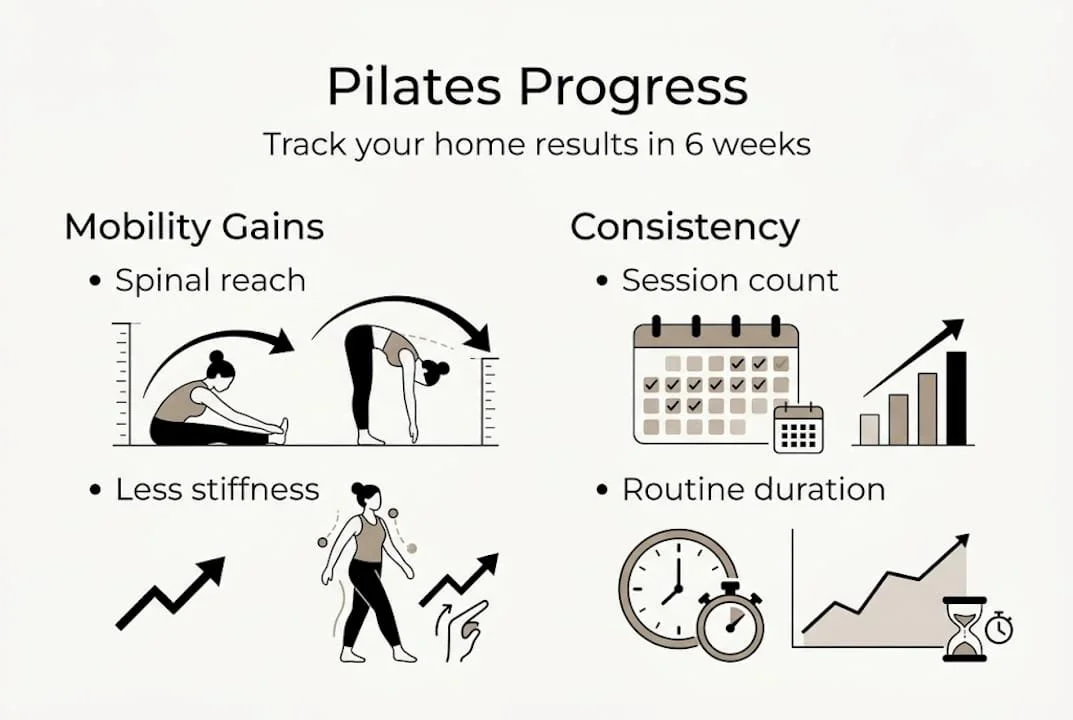
Key metrics to monitor at home:
Spinal mobility: Can you reach further in the spine stretch forward than you could two weeks ago?
Pain levels: Rate your low back discomfort from 1 to 10 before and after each session
Energy: Note whether your afternoon energy improves on days you practice
Consistency: Track how many sessions you complete per week versus your goal
Ease of daily movement: Are tasks like bending, lifting, or sitting for long periods getting easier?
Research shows that Pilates improves quality of life and mobility among a wide range of adults, including improvements in nutritional status and overall wellbeing. That kind of broad benefit is rare in a single workout method. You can also track how it supports Pilates for weight loss goals over time alongside mobility gains.
| Metric | How to measure | Check-in frequency |
|---|---|---|
| Spinal reach | Distance from fingertips to floor | Every 2 weeks |
| Pain score | 1 to 10 self-rating before/after | Every session |
| Session consistency | Sessions completed vs. goal | Weekly |
| Energy levels | Morning and afternoon self-rating | Daily |
| Ease of movement | Journal note on daily tasks | Weekly |
Set a realistic 6-week milestone. Most beginners notice meaningful mobility changes within that window when they practice 2 to 3 times per week. Celebrate small wins like being able to hold a position longer or feel less stiffness when you wake up. Those moments are Pilates benefits showing up in real life, and they matter.
What most Pilates guides miss: Realistic home strategies for busy adults
Here's something most Pilates content won't tell you: expecting a tidy 40-minute session five days a week is the fastest way to quit. Real life in Philadelphia doesn't run on a wellness blogger's schedule. And yet, that's the standard most guides set.
The truth is that 10 minutes of intentional Pilates beats zero minutes of perfect Pilates every time. Micro-sessions, even a few pelvic tilts and a spine stretch during your lunch break, genuinely add up. Desk modifications like seated twists make Pilates accessible for professionals without ever unrolling a mat.
The other thing most guides miss is the mental side of a home practice. Without a class, an instructor, or other students around you, motivation has to come from within. Pairing your Pilates routine with an existing habit, like right after your morning coffee or before dinner, dramatically improves follow-through. Habit stacking is a simple but powerful tool.
Focus on building Pilates core strength incrementally rather than chasing flexibility milestones. Incremental progress sustained over months produces more lasting change than intense bursts followed by burnout.
Pro Tip: Commit to two scheduled sessions and one "whenever I have 10 minutes" session per week. That structure keeps your practice alive even in hectic weeks.
Ready to take your Pilates practice further?
Building a home Pilates routine is a powerful first step, and you don't have to take the next steps alone. At Amrita Yoga & Wellness, we offer a full spectrum of wellness experiences designed to complement the foundation you're building at home.
From Pilates and barre to hot yoga, tai chi, and massage therapy, our Philadelphia studio welcomes practitioners at every level. If you're looking to expand your self-care beyond movement, our Tarot readings offer a thoughtful, grounding experience that pairs beautifully with a mindful fitness practice. Explore our class schedule and community offerings, and find the next layer of your wellness journey waiting for you.
Frequently asked questions
Can I practice Pilates safely at home as a complete beginner?
Yes, Pilates is specifically designed for safe, low-impact movement, making it ideal for beginners and those with joint sensitivities. Sessions as short as 15 minutes are effective and appropriate for new practitioners.
What are the signs my Pilates routine is improving my mobility?
You'll notice easier everyday movements, reduced morning stiffness, and greater spinal flexibility within a few weeks of consistent practice. Research shows Pilates improves spinal ROM and quality of life in measurable ways.
How often should I practice Pilates at home for noticeable results?
Aim for 2 to 3 sessions per week for steady progress. Low-impact routines in the 15 to 45 minute range are effective for both building strength and maintaining what you've gained.
Is Pilates better than regular home workouts for back pain?
Studies show Pilates is superior to generic home exercises for managing low back pain and improving spinal mobility, making it the smarter choice for back pain relief.
Recommended
Why Attend Pilates Workshops: Boost Strength & Flexibility
TL;DR:
Pilates workshops offer personalized guidance, deepening understanding and accelerating results for all fitness levels.They improve core strength, flexibility, pain reduction, and support injury recovery through evidence-based practices.Attending consistently and choosing certified instructors enhances safety, effectiveness, and long-term benefits.
Pilates has a reputation problem. Many people assume workshops are reserved for the already-fit, the hyper-flexible, or the injury-free. That assumption keeps a lot of people in Philadelphia from experiencing something genuinely useful. The truth is that Pilates workshops accelerate rehabilitation, reduce pain, and improve quality of life for a wide range of people, including absolute beginners and those recovering from injuries. Whether you want to build core strength, move without discomfort, or simply feel better in your body, a Pilates workshop offers a focused, evidence-backed path to get there.
Table of Contents
Key Takeaways
| Point | Details |
|---|---|
| Personalized instruction | Pilates workshops offer focused, individualized feedback for all levels. |
| Evidence-based results | Research shows consistent Pilates practice improves flexibility, strength, and reduces chronic pain. |
| Rehabilitation support | Workshops provide safe, effective movement strategies for injury recovery and ongoing pain management. |
| Community and motivation | Workshops foster a supportive environment, helping you stay motivated and accountable. |
What makes Pilates workshops unique?
To understand why attending specific workshops matters, it's helpful to see how they differ from standard group Pilates classes. The short answer: workshops go deeper, and that depth changes everything.
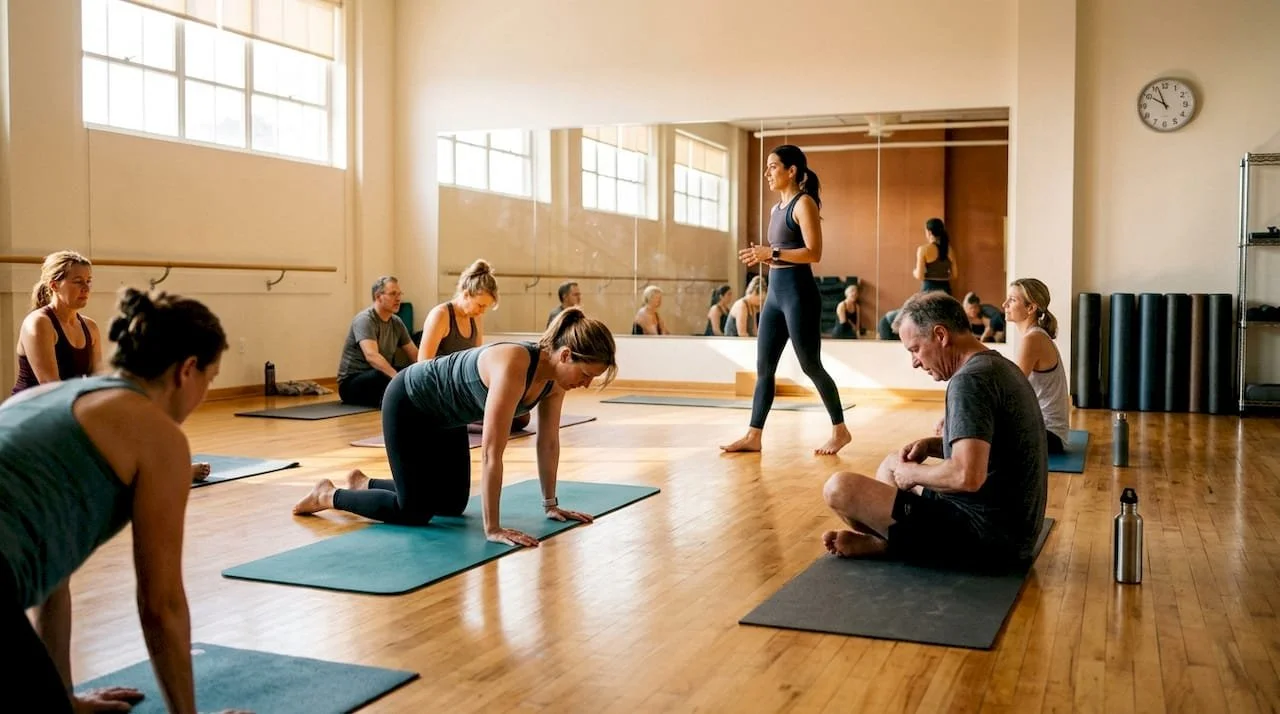
In a typical group class, an instructor guides 15 to 20 people through a sequence. There's value in that, but the format limits how much personalized feedback you can receive. Workshops flip that equation. They run in small groups or semi-private settings, often with just 4 to 8 participants, which means your instructor can actually watch how you move, cue you specifically, and catch habits that could lead to strain over time.
The focus shifts from simply completing a workout to truly understanding the movement. Workshops zero in on the foundational Pilates principles: breath, control, centering, precision, and flow. Workshops allow nuanced exploration of these principles in ways that a packed group class simply cannot support.
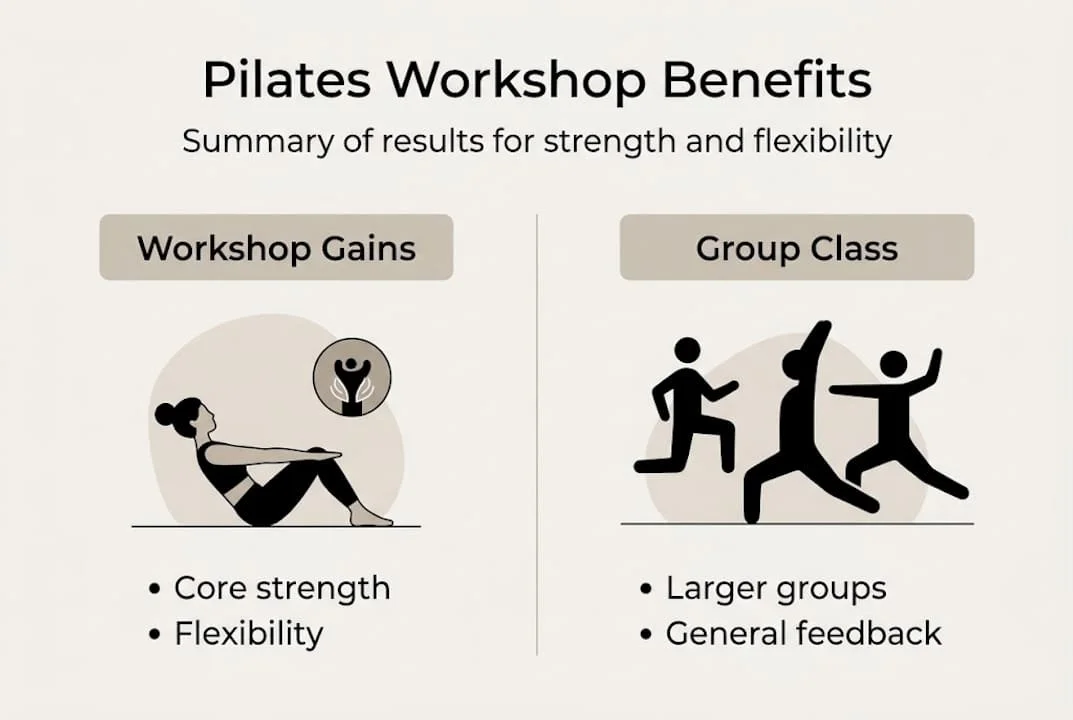
| Feature | Pilates workshop | Group class |
|---|---|---|
| Group size | 4 to 8 participants | 10 to 25 participants |
| Instructor attention | High, individualized | Limited, general |
| Technique depth | In-depth, corrective | Overview level |
| Suitable for beginners | Yes, especially | Varies |
| Suitable for rehab | Yes, ideal | Sometimes |
Workshops also tend to work well across a range of goals. Someone recovering from a back injury and someone training for their first 5K can both attend a Pilates workshop and walk away with something meaningful. The examples of Pilates exercises you practice in a workshop are carefully selected and adapted to the needs of the group.
Philadelphia's fitness scene has seen a noticeable surge in Pilates interest, with Pilates workshop trends pointing toward more specialized, smaller-format sessions that offer real results rather than just a good sweat.
"The best Pilates experiences are the ones where you leave knowing your body just a little bit better than when you walked in."
That kind of self-awareness is what workshops are designed to build.
Evidence-based benefits for fitness and flexibility
Having identified how workshops offer unique structure, let's explore the tangible benefits you can achieve, based on science.
The research on Pilates is clear and growing. Mat Pilates builds core strength, improves flexibility, and reduces chronic pain in areas like the low back and knees. These aren't minor improvements. People who practice consistently report meaningful changes in how they move and how they feel day to day.
Here are the key benefits backed by research:
Improved core strength from stabilization exercises that target deep abdominal and spinal muscles
Greater flexibility in the hips, hamstrings, and thoracic spine
Reduced chronic pain, particularly in the low back and knees
Better balance and coordination, which matters especially for adults over 40
Improved sleep quality, which shows up even in short intervention studies
The data supports a specific practice window. Measurable flexibility and fitness gains appear after 4 to 8 weeks of consistent practice, 2 to 3 times per week. That's a realistic commitment most Philadelphians can make.
| Outcome | Evidence strength | Time to notice |
|---|---|---|
| Core strength | Strong | 4 to 6 weeks |
| Flexibility | Strong | 4 to 8 weeks |
| Chronic low back pain | Strong | 4 weeks |
| Knee pain relief | Moderate to strong | 6 to 8 weeks |
| Sleep quality | Moderate | 4 weeks |
Pilates reduces pain in knee osteoarthritis and improves function in chronic low back pain, according to recent clinical evidence. These findings apply directly to the kind of movement work done in focused workshops.
You can explore more through Pilates research articles and review a broader list of benefits of Pilates from practitioners who work with all fitness levels.
Pro Tip: Before your first workshop, do a simple self-assessment. Note your flexibility in a forward fold or rate your pain on a 1 to 10 scale. Revisit that benchmark after 4 weeks of consistent workshops. The progress you'll see is a powerful motivator.
Pilates for rehabilitation and injury recovery
While fitness and flexibility are crucial, many workshop attendees are also seeking support for injury or chronic pain. This is where Pilates workshops show some of their most impressive results.
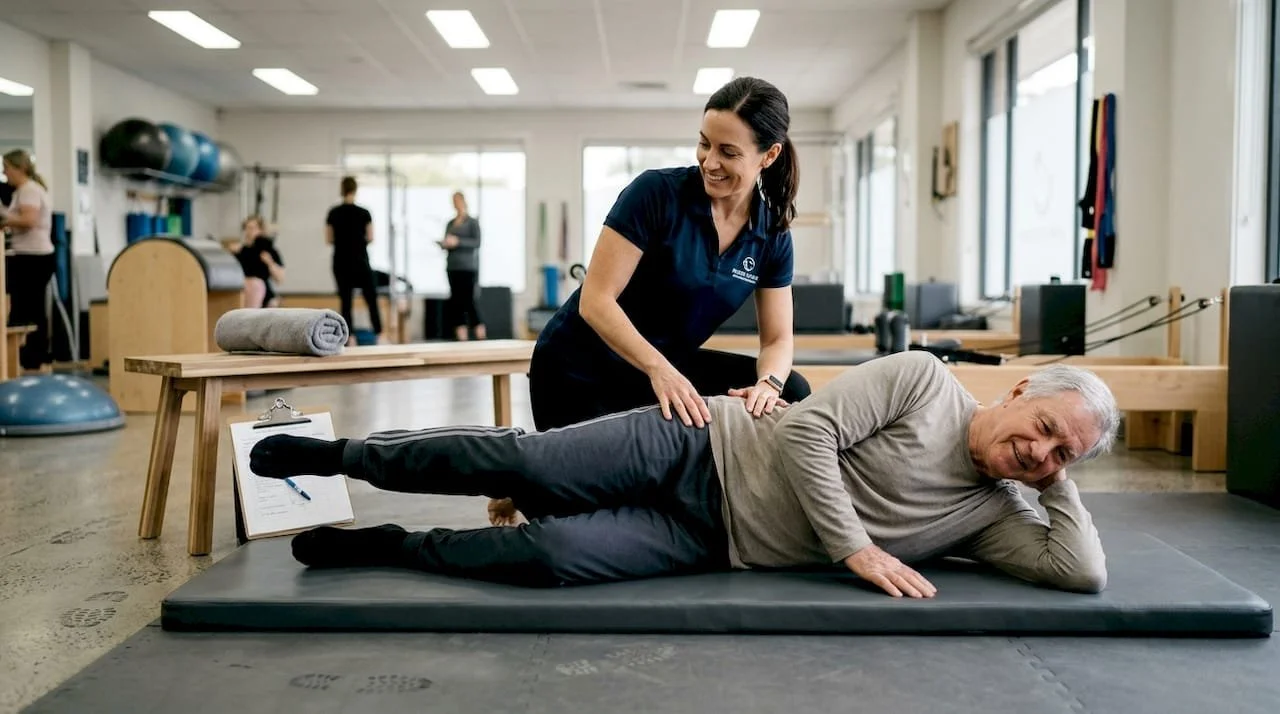
Timing matters. Pilates is not meant to be your first intervention after an acute injury. Once the initial inflammation and swelling subside, usually within a few days to a couple of weeks depending on the injury, a structured Pilates program can become a powerful tool. Pilates accelerates rehabilitation post-injury with a structured program introduced after the acute phase, supporting better mobility and less pain.
Who benefits most from rehab-focused workshops?
People with chronic low back pain lasting longer than 12 weeks
Adults recovering from knee or hip procedures
Those managing osteoarthritis or similar joint conditions
Anyone dealing with postural pain from desk work or repetitive movement
People in pre- or post-surgical recovery looking for safe, supervised movement
"4 weeks of Pilates improved pain, sleep quality, quality of life, and disability scores in people with chronic low back pain."
That's a meaningful result in a short timeframe. And it's not just about pain numbers on a chart. People describe moving through their day with less fear, less guarding, and more confidence in their own body.
For those focused on Pilates for wellness after a difficult health period, workshops offer a supportive, structured re-entry into movement. You can also browse sample Pilates workouts to get a sense of what supervised movement looks like in practice.
Pro Tip: When choosing a workshop for rehabilitation purposes, ask specifically whether the instructor holds a certification from a recognized body like BASI Pilates or Polestar Pilates. Certified instructors understand contraindications and know how to modify safely.
Getting started: What to expect in your first Pilates workshop
Knowing the benefits and recovery potential, here's what you need to know to start your Pilates workshop journey.
Choosing the right workshop starts with a few key criteria. Look for small class sizes (ideally under 10), certified instructors, and a stated focus that matches your goals, whether that's flexibility, core conditioning, or recovery. Don't be afraid to call ahead and ask questions. A good studio will welcome them.
What to bring and wear is simple. Wear fitted, comfortable clothing that allows movement without riding up. Socks with grip are helpful on a mat. Bring water, and if the studio doesn't provide mats, bring your own. Most beginner workshops are mat-based, so no special equipment is required.
A typical workshop session flows like this: a brief check-in where the instructor learns about any injuries or limitations, a guided breathwork and warm-up sequence, focused technique work with hands-on corrections, and a cooldown or reflection period.
Here are 5 steps to a successful first workshop:
Register in advance so the instructor can prepare modifications if needed
Prepare your body by avoiding heavy meals 90 minutes before and staying hydrated
Arrive 10 minutes early to settle in, introduce yourself, and mention any injuries
Participate fully, including asking questions when something doesn't feel right
Reflect afterward by jotting down what felt challenging or surprising
For lasting results, attend 2 to 3 times per week. Empirical benchmarks show that this frequency over 4 to 8 weeks yields measurable improvements in flexibility and fitness.
Common beginner mistakes to avoid:
Holding your breath during difficult movements
Pushing through pain instead of modifying
Skipping the first few "basics" workshops because they seem too easy
Comparing your range of motion to others in the room
If you're just getting started, check out advice for Pilates beginners and explore a Pilates styles overview to find which format fits your goals best.
Our take: The real reason Pilates workshops are worth your time
Here's something that often gets lost in the conversation about Pilates: the format matters as much as the method. You can follow along with a video online or show up to a packed studio class, and you'll get some benefit. But workshops operate on a different level entirely.
In Philadelphia's growing Pilates community, we see it consistently. People who attend focused workshops progress faster, stick with the practice longer, and report greater satisfaction with their results. That's not a coincidence. Workshops provide deeper education compared to diluted group classes, and combining both formats achieves the best outcomes.
What most people miss is the community piece. Workshops create a shared experience. You're learning alongside others at a similar stage, which builds accountability and makes the process feel less isolating, especially if you're coming back from injury or starting something new.
The combination of science, hands-on supervision, and real personal attention is what moves people further, faster. If core strength from Pilates workshops is your goal, this format gets you there with far less guesswork.
Ready to experience the difference a Pilates workshop can make?
If you've been thinking about trying Pilates or leveling up your current practice, the next step is simpler than you think. Amrita Yoga & Wellness offers Pilates workshops designed for all levels, from curious beginners to those navigating injury recovery.
At classes at Amrita Yoga & Wellness, you'll find a welcoming Philadelphia studio community with certified instructors who meet you exactly where you are. Browse current schedules, read about program options, and find beginner-friendly entry points that fit your life. Your first workshop could be the most useful hour you invest in your body this year.
Frequently asked questions
What is the difference between a Pilates workshop and a regular class?
Pilates workshops are usually smaller, with more focused instruction on technique and individualized feedback compared to general group classes. Workshops emphasize depth and core principles far more than standard group formats allow.
How soon will I see results from attending Pilates workshops?
You may notice improvements in flexibility and pain relief within 4 to 8 weeks of attending 2 to 3 times per week. 4 weeks of Pilates improved pain and quality of life in people with chronic low back pain.
Are Pilates workshops safe for people recovering from injury?
Yes, when supervised by a certified instructor and started after the acute phase, workshops are especially effective for safe rehabilitation. Pilates workshops are most effective when introduced post-acute with professional guidance.
Do I need special equipment to join a Pilates workshop?
Most beginner workshops use mat Pilates and require just a mat; additional equipment is rarely needed for entry-level sessions. Mat Pilates is accessible for beginners without any specialized gear.
Recommended
Top ways to improve your Pilates routine for real results
TL;DR:
Proper form, control, and breath are more effective than high repetitions in Pilates.Mastering foundational exercises is essential before progressing to more advanced movements.Focusing on breathwork and mechanics enhances core engagement and overall results.
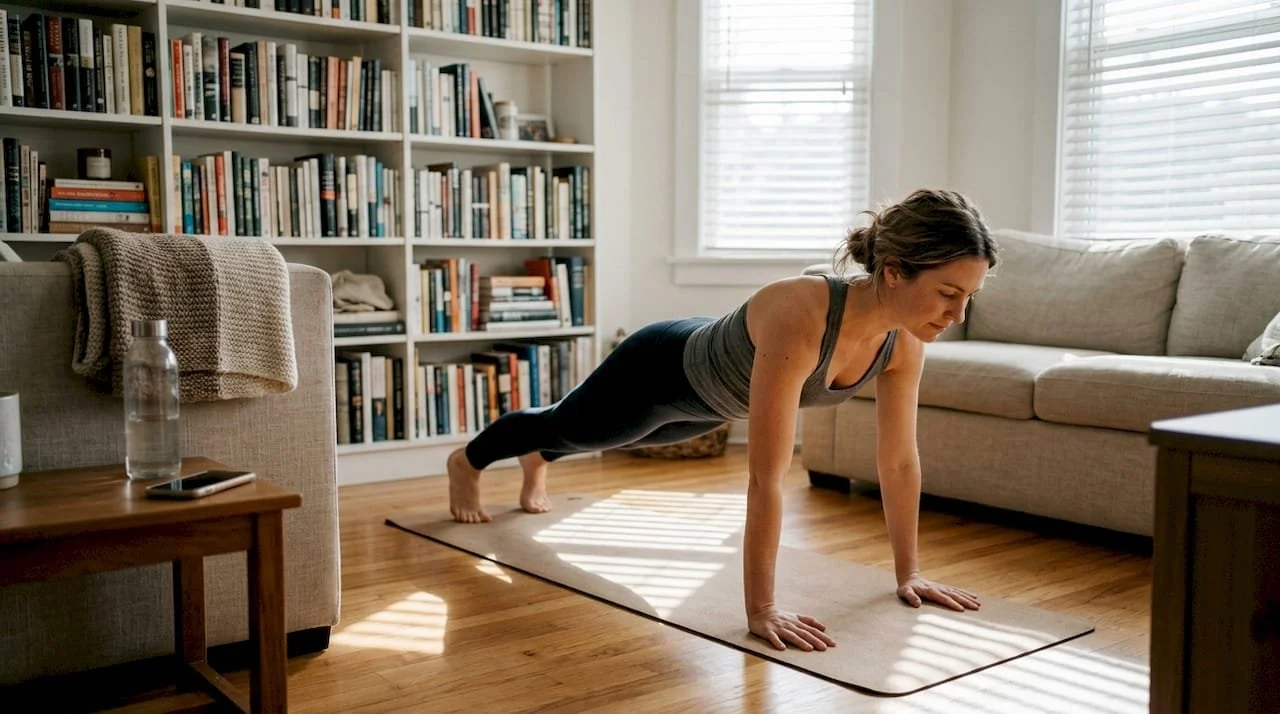
Most people assume that doing more reps or speeding through Pilates sessions is the fastest path to results. It isn't. Proper form, control, and breath build more strength and flexibility than any high-rep routine ever will. Whether you're stepping onto the mat for the first time in Philadelphia or you've been practicing for years, the strategies in this guide will help you get measurably better results without adding more time to your schedule. This is about working smarter, not harder, and the evidence backs it up completely.
Table of Contents
Key Takeaways
| Point | Details |
|---|---|
| Form trumps speed | Focusing on proper form and control improves strength and flexibility better than rushing through reps. |
| Master the basics | Building from foundational movements in Pilates creates safer, more effective progress for all levels. |
| Breathe with intention | Integrating breath and subtle core activation is essential for maximizing every Pilates move. |
| Mix and recover | Combining Pilates with other exercise and structured rest accelerates results and prevents burnout. |
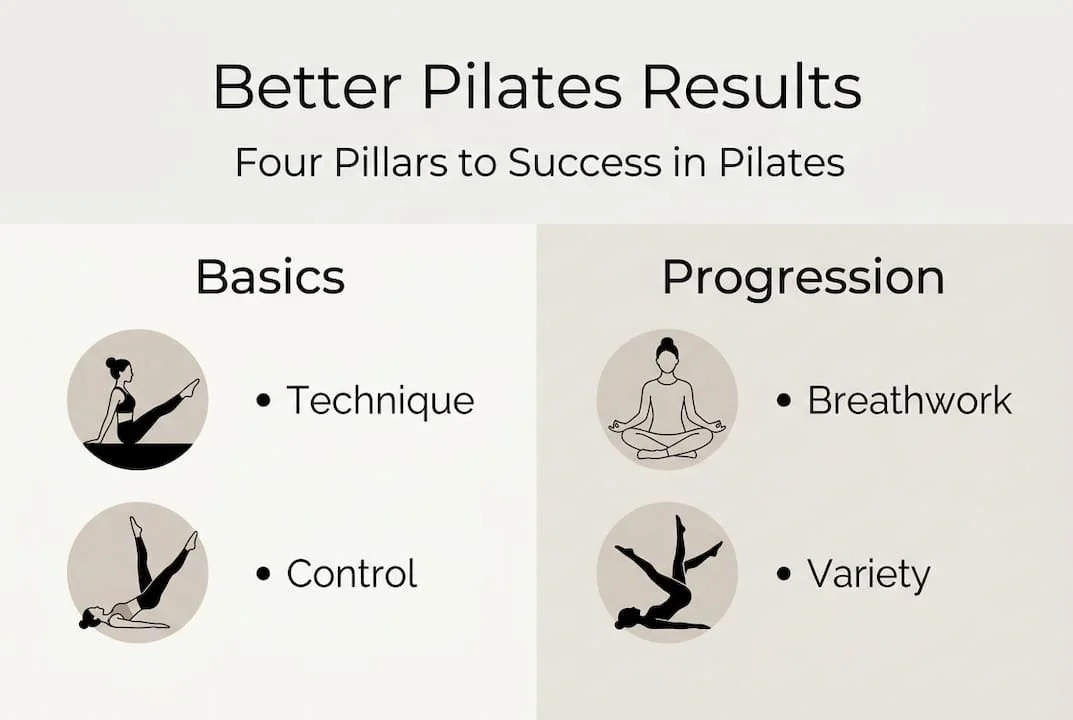
Master the basics before advancing
There's a temptation in every fitness practice to skip ahead. You see someone performing a Swan Dive or a Teaser and you want to get there fast. But in Pilates, that shortcut almost always backfires. The foundational exercises aren't just beginner content. They're the building blocks your body needs to move safely and effectively at every level.
Three exercises form the core of any solid Pilates foundation:
The Hundred: Builds breath coordination and deep abdominal endurance. It teaches your body to stabilize while moving.
Roll Up: Trains spinal articulation and lengthens the hamstrings. It's far more demanding than it looks.
Pelvic Curl: Activates the glutes, hamstrings, and lower back while teaching neutral spine awareness.
Mastering these before moving on isn't just smart. It's essential. Gradual progression through basics like the Hundred, Roll Up, and Pelvic Curl, followed by increasing range of motion and then adding resistance, is the proven path for practitioners at every level. You can also explore essential Pilates exercises to understand how these movements connect across skill levels.
Here's a simple 4-week progression framework to guide your early practice:
| Week | Focus | Example exercises |
|---|---|---|
| 1 | Basics and alignment | Hundred, Pelvic Curl, Spine Stretch |
| 2 | Core and hip stability | Roll Up, Single Leg Stretch, Bridge |
| 3 | Full-body integration | Swimming, Leg Circles, Side-Lying Series |
| 4 | Advanced introduction | Teaser prep, Swan, Rolling Like a Ball |
This table isn't a rigid prescription. It's a map. Your body will tell you when it's ready to move forward, and that signal is consistency and ease, not boredom.
Pro Tip: Skipping foundational work doesn't save time. It creates compensation patterns that limit your progress and raise your injury risk. Spend at least two to three weeks truly owning the basics before advancing.
Focus on form and control over speed
Once you have your foundation, the next upgrade isn't a harder exercise. It's better execution of the ones you already know. This is where most practitioners leave serious gains on the table.
Movement quality in Pilates produces results that quantity simply cannot match. A slow, controlled Roll Up with full spinal articulation does more for your core than twenty rushed crunches. In fact, the Roll Up is 30% more effective than crunches for abdominal strength. That's not a minor difference. That's a complete rethinking of how you approach core work.
"Prioritize proper form, control, and breath over speed or reps to build strength and flexibility effectively." — NACAMS Pilates Progression Guide
Here's a direct comparison that shows why form-focused Pilates wins:
| Exercise | Muscles targeted | Spinal involvement | Injury risk | Effectiveness |
|---|---|---|---|---|
| Roll Up | Full abdominals, hip flexors | Full articulation | Low (with control) | High |
| Standard crunch | Upper abs only | Minimal | Moderate (neck strain) | Lower |
The difference is stark. The Roll Up demands that your entire spine move sequentially, which activates far more muscle fibers and builds real functional strength.
To keep your form sharp in every session, run through this quick checklist before and during each exercise:
Alignment: Is your spine in the correct position for this movement? Neutral or imprinted as required?
Control: Are you moving with intention, or just getting through the reps?
Breath synchronization: Are you exhaling on the effort and inhaling on the release?
Understanding Pilates breathing techniques is central to this checklist. Breath isn't decoration in Pilates. It's the mechanism that drives deep core engagement and keeps your movements fluid. The Pilates breathing benefits extend beyond the mat too, improving posture and reducing tension throughout your day.
Incorporate breathwork and proper mechanics
Breath is the engine of Pilates. Not a background detail, not something to think about after you've learned the moves. The breath coordinates oxygen delivery to working muscles and activates the deep core stabilizers that make every movement safer and more effective.
Two mechanical concepts separate good Pilates from great Pilates. The first is the two-way stretch: the idea that your body lengthens in opposite directions simultaneously during each movement. Think of reaching the crown of your head away from your tailbone during a Spine Stretch. This creates length and decompression rather than compression.
The second is understanding neutral spine versus imprinted spine. Neutral spine preserves the natural curves of your back and is used in most exercises. Imprinted spine gently presses the lower back toward the mat and is used when your legs are extended and your core needs extra support. Confusing these two positions is one of the most common form errors in Pilates.
For key mechanics like two-way stretch and subtle core engagement, the goal is never to grip or brace your abs. It's a gentle, internal lift.
Here's how to sync breath, alignment, and engagement in any exercise:
Set your position: Find neutral or imprinted spine before you begin.
Inhale to prepare: Use the breath to lengthen your spine and settle your alignment.
Exhale to engage: On the exhale, feel your deep core gently activate without gripping.
Move with the breath: Let the exhale initiate the effort phase of the movement.
Inhale to return: Use the inhale to lengthen and reset before the next rep.
For deeper core engagement, the target muscles are the transverse abdominis (TVA) and multifidus, not the superficial abs you feel during a crunch. Understanding the benefits of Pilates breathwork helps you connect with these deeper layers more effectively. Research also shows that breath-led core work can boost core strength significantly when practiced consistently.
Pro Tip: Instead of thinking "pull your belly to your spine," try thinking "gently lift your pelvic floor and let your lower belly follow." This cue activates the TVA and multifidus without creating the tension that blocks fluid movement.
Combine Pilates with other exercises and recovery
Pilates is powerful. But treating it as your only form of exercise is one of the most common mistakes practitioners make. Pilates excels at building control, flexibility, and deep core strength. It doesn't fully replace the cardiovascular conditioning or heavy load-bearing stimulus that your body also needs for total fitness.
Common pitfalls to avoid:
Skipping warm-ups before class
Rushing through sessions to fit in more exercises
Doing only Pilates without any strength or cardio work
Overtraining without adequate rest days
Ignoring recovery practices like stretching or sleep
The research on Pilates outcomes is genuinely impressive. An 8-week program shows improved flexibility outcomes and spinal range of motion in gait, with large effect sizes. For people dealing with lower back pain, Pilates pain reduction research shows it outperforms basic home exercise programs. A meta-analysis found an SMD 1.41 pain reduction in lower back pain patients, which is a clinically large and meaningful effect.
A balanced weekly routine might look like this:
Monday: Pilates (60 min, form-focused)
Tuesday: Light cardio (walking, cycling) or rest
Wednesday: Resistance training (bodyweight or weights)
Thursday: Pilates (45 min, breathwork emphasis)
Friday: Active recovery (yoga, stretching)
Saturday: Cardio or group fitness class
Sunday: Full rest
Building healthy lifestyle habits around your Pilates practice, including sleep, nutrition, and stress management, amplifies everything you do on the mat. Avoiding common pitfalls like skipping warm-ups and overtraining is just as important as the work itself.
Pro Tip: Schedule your rest days with the same commitment as your workout days. Recovery is when your body actually adapts and gets stronger. Treating rest as optional is the fastest way to plateau.
Our perspective: The underrated fix that transforms your Pilates journey
Here's something we've noticed working with Philadelphia clients over the years: the people who progress fastest are almost never the ones chasing harder exercises. They're the ones who become genuinely curious about the small things. The quality of a single exhale. The subtle lift of the pelvic floor before a movement begins. The difference between gripping and engaging.
Most practitioners rush to advanced Pilates within weeks of starting, convinced that difficulty equals progress. But the greatest returns come from nuanced breath and mechanics integration, not from tougher moves. A client who can perform a basic Roll Up with perfect spinal articulation, full breath coordination, and zero tension in the neck will see more transformation than someone grinding through a Teaser with poor alignment.
Real breakthroughs come from building body awareness, not chasing complexity. Understanding breathwork for wellness is often the turning point. When you learn to feel your breath activate your deep core, the whole practice shifts. Movements become easier, more fluid, and far more effective. That's the transformation most people are looking for, and it was available to them from the very first session.
How Amrita Yoga & Wellness can support your Pilates journey
You now have a clear, evidence-backed roadmap for improving your Pilates practice. The next step is putting it into action with the right support around you.
At Amrita Yoga & Wellness in Philadelphia, our instructors work with practitioners at every level, from those just learning the Hundred to those refining advanced sequences. We offer personalized guidance on form, breath mechanics, and progressive programming so you're never guessing about your next step. Whether you're looking to deepen your practice, address a specific concern like back pain, or simply find a consistent community, our Pilates and wellness offerings are designed to meet you where you are. We also offer unique wellness experiences like Tarot readings for those interested in holistic self-exploration beyond the mat.
Frequently asked questions
How often should I practice Pilates for the best results?
Most studies show practicing Pilates 2-4 times a week yields measurable improvements in strength, flexibility, and quality of life. Flexibility and quality of life improvements typically appear within 4 to 8 weeks of consistent practice.
Is Pilates or weight training better for core strength?
Pilates is 30% more effective than crunches for abdominal strength, but combining Pilates with resistance training gives you the best total-core results overall.
Can Pilates help with chronic lower back pain?
Yes. High-quality evidence shows Pilates reduces lower back pain and disability better than basic home exercise programs, with a meta-analysis reporting an SMD of 1.41 for pain reduction.
What's the biggest mistake Pilates learners make?
Skipping foundational exercises and prioritizing speed over control are the most limiting mistakes. Mastering basics like the Hundred, Roll Up, and Pelvic Curl before advancing is the most reliable path to lasting results.
Recommended
How Pilates Accelerates Rehab: Evidence, Benefits, Steps
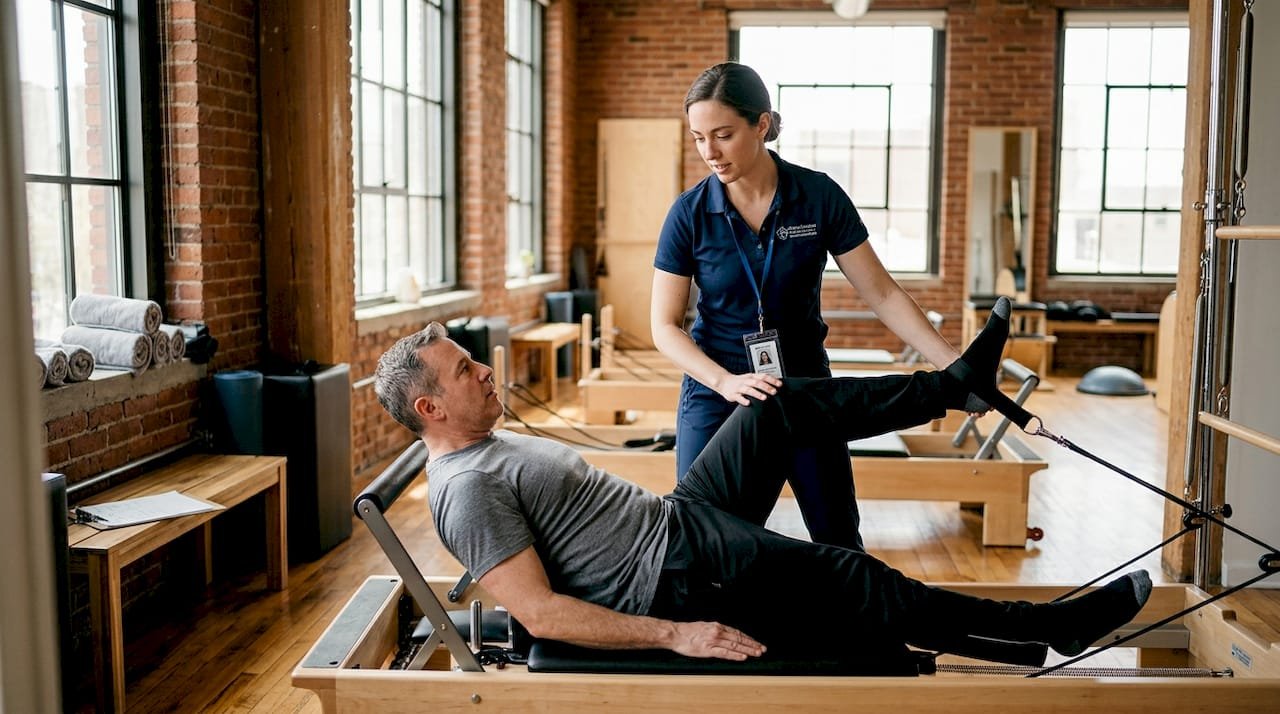
TL;DR:
Pilates effectively reduces pain, disability, and improves quality of life in musculoskeletal conditions.It is best integrated into rehab after acute injury phase under professional supervision.Evidence shows Pilates benefits low back pain, knee osteoarthritis, and post-surgical recovery.
Pilates has a reputation problem. Most people picture it as a trendy fitness class, something you do to tone your core or improve your posture. But physical therapists and rehab specialists have known for years that Pilates is far more than that. Research confirms that Pilates reduces pain and disability while improving quality of life in people with musculoskeletal conditions. If you're recovering from an injury in Philadelphia or trying to rebuild your mobility, understanding how Pilates fits into the rehab picture could genuinely change your recovery timeline.
Table of Contents
Key Takeaways
| Point | Details |
|---|---|
| Backed by science | Pilates consistently reduces pain and improves quality of life in musculoskeletal rehab settings. |
| Best post-acute phase | Start Pilates once your initial pain is controlled, working closely with your PT and Pilates instructor. |
| 4-8 week timeline | Most feel better mobility and less pain within 1-2 months with consistent, supervised practice. |
| Ideal for specific conditions | Chronic low back pain, knee osteoarthritis, and post-surgery recovery respond especially well to Pilates-based rehab. |
| Holistic recovery tool | Pilates complements traditional rehab by improving core stability, balance, and functional movement. |
What is Pilates and how does it apply to rehab?
Joseph Pilates developed his method in the early 20th century, originally using it to help injured dancers and athletes recover strength and function. His system was built around controlled, mindful movement rather than brute force or high-impact exercise. That origin story matters because it explains why Pilates translates so naturally into modern rehabilitation settings.
The foundational principles of Pilates include:
Breath control: Coordinating inhale and exhale with movement to support the spine and reduce tension
Spinal alignment: Teaching the body to find and maintain neutral posture during activity
Core stability: Building deep abdominal and back muscle strength to protect joints
Controlled movement: Prioritizing precision over speed, which reduces re-injury risk
Mind-body connection: Staying present and aware during each exercise
These principles make Pilates uniquely gentle on joints while still being effective. Unlike high-intensity workouts, Pilates is highly modifiable. An instructor can adapt almost any exercise to work around a shoulder injury, a post-surgical hip, or a sensitive lower back.
"Pilates is a valuable adjunct in rehabilitation, offering structured, low-impact movement that bridges clinical care and long-term wellness."
Physical therapists in Philadelphia increasingly use Pilates as a rehab adjunct to extend the gains made in clinical sessions. You can explore the full range of Pilates offerings or read about Pilates for total body wellness to see how the practice supports long-term health beyond the rehab phase.
What does the evidence say? Scientific support for Pilates in rehab
Understanding the principles is key, but how effective is Pilates for real rehab outcomes? Here's what the latest science shows.
A major meta-analysis found that Pilates produces meaningful improvements across three critical rehab markers. The numbers are striking:
| Outcome | Standardized Mean Difference (SMD) | Interpretation |
|---|---|---|
| Pain reduction | 1.41 | Large effect |
| Disability reduction | 0.83 | Moderate-large effect |
| Quality of life improvement | 2.10 | Very large effect |
Those are not small wins. An SMD of 1.41 for pain is considered a large clinical effect, meaning participants experienced substantial, noticeable relief. A quality of life SMD of 2.10 is exceptional by any research standard.
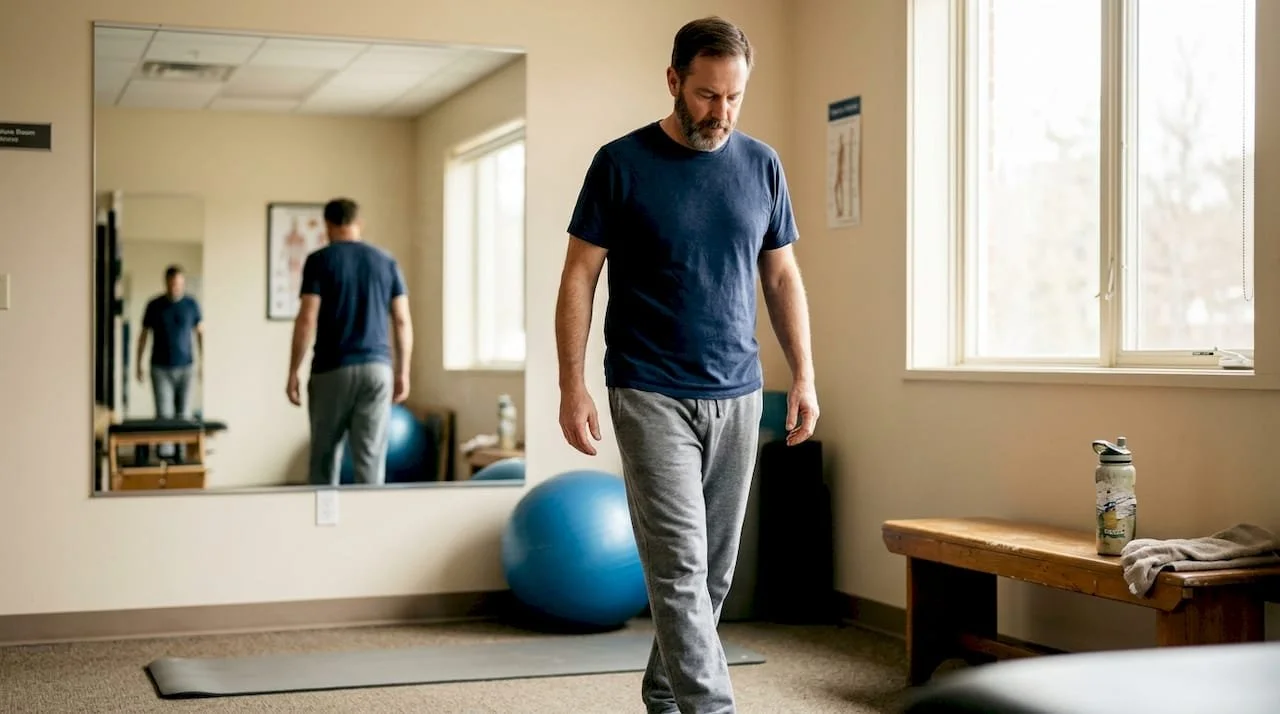
For people dealing with low back pain, a randomized controlled trial found that Pilates outperformed home exercises for pain, disability, and quality of life in subacute cases. This is important because home exercise programs are the typical alternative most people receive after a few PT sessions. Pilates does more.
For knee osteoarthritis, research shows that Pilates reduces pain and increases ROM compared to no intervention at all. Range of motion improvements matter enormously for anyone who wants to walk comfortably, climb stairs, or stay active in a city like Philadelphia.
It's fair to note that some studies carry moderate to high risk of bias, and certainty ratings can be low. But the consistency of positive findings across different populations and conditions is hard to ignore. You can explore evidence-backed Pilates benefits and wellness outcomes from Pilates to see how these findings translate into real practice.
When and how to add Pilates to your rehabilitation process
So, if Pilates is scientifically effective, when should you consider it during your rehab journey?
Timing matters. Jumping into Pilates during the acute phase of an injury, when inflammation is high and pain is sharp, is not the right move. The ideal window opens once your acute pain is under control and your physician or physical therapist clears you for low-impact movement.
Here's a practical sequence to follow:
Complete acute care first. Let your physical therapist address the immediate injury, reduce swelling, and restore basic movement patterns.
Get cleared for supervised exercise. Ask your PT or doctor when Pilates-style movement is appropriate for your specific injury.
Start with private or small group sessions. A one-on-one session lets an instructor assess your limitations and customize every exercise.
Progress gradually. Begin with foundational movements like pelvic tilts, breathing exercises, and gentle spinal articulation before moving to more integrated activities.
Commit to consistency. Research shows that twice-weekly sessions over 4-8 weeks produce measurable clinical benefits.
Pro Tip: Before your first Pilates session, write down your injury history, current limitations, and rehab goals. Share this with your instructor so they can design a session that complements your existing treatment plan, not work against it.
Exploring different types of Pilates can help you choose the right format, and if you're just getting started, Pilates for beginners resources can ease the transition.
Which conditions and injuries benefit most from Pilates?
You might wonder if Pilates is right for your specific condition. Here's a look at which injuries get the most from this approach.
Not every condition responds equally to Pilates, but the evidence is strong for several common rehab scenarios that Philadelphia residents frequently face.
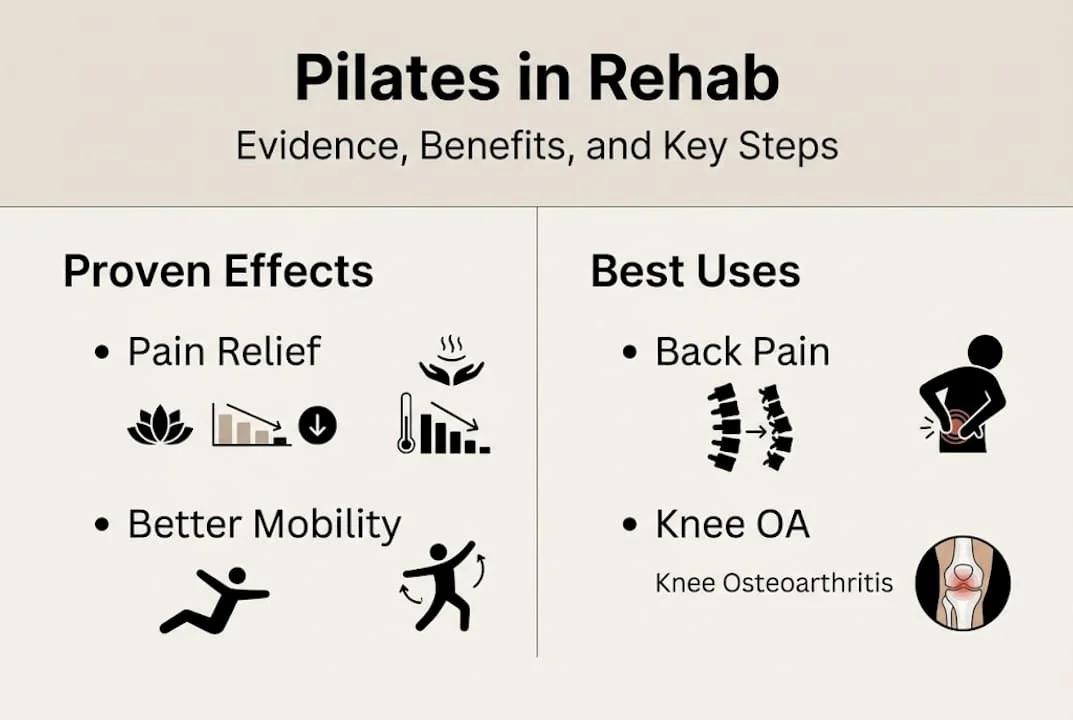
| Condition | Proven benefit | Caveats |
|---|---|---|
| Chronic low back pain | Pain reduction, improved function | Best with supervised sessions |
| Subacute low back pain | Better than home exercise for pain and QoL | Needs trained instructor |
| Knee osteoarthritis | Pain relief, increased range of motion | Less evidence for muscle mass changes |
| Post-surgical recovery | Core stability, functional movement | Timing must be cleared by surgeon |
| Hip rehabilitation | Balance, alignment, mobility | Evidence still emerging |
Research confirms that Pilates is effective post-surgery and for chronic nonspecific low back pain, though its effect on muscle tone or body composition is less clear. That distinction matters. Pilates is not a bodybuilding tool. It’s a precision movement system designed to restore function, reduce pain, and rebuild confidence in your body.
Conditions that respond particularly well include:
Chronic low back pain: The most researched area, with consistent evidence across multiple studies
Knee osteoarthritis: Especially for improving daily movement and reducing stiffness
ACL reconstruction recovery: Core and hip stability work supports knee function
Post-hip replacement: Gentle alignment and balance training aids return to activity
For a deeper look at how exercises can be adapted to your condition, browse Pilates exercise adaptations or check out essential Pilates exercises for all levels.
Practical tips for getting the most from Pilates during rehab
Beyond knowing what works, these proven strategies help you maximize your rehabilitation outcomes with Pilates.
The difference between a frustrating experience and a transformative one often comes down to how you approach the practice. Here's what actually moves the needle:
Choose a certified instructor with rehab experience. Not all Pilates instructors are trained to work with injured clients. Look for someone with additional certifications in therapeutic or clinical Pilates.
Select a studio that offers supervised small group or private sessions. Large group classes may not give you the individual attention your recovery needs.
Combine Pilates with your existing rehab program. Research confirms that customizing Pilates after initial PT yields better mobility and functional outcomes than either approach alone.
Track your progress. Keep a simple log of pain levels, mobility improvements, and any movements that feel easier week over week. This helps your instructor adjust the program.
Be patient with the timeline. Four to eight weeks of consistent practice is the benchmark for noticeable change. Rushing the process increases re-injury risk.
Pro Tip: During every session, prioritize the quality of each movement over the number of repetitions. One perfectly executed movement with full core engagement does more for your recovery than ten sloppy ones.
For targeted guidance, explore resources on Pilates core strength and browse sample Pilates workouts to see what a structured session looks like.
A fresh perspective: The overlooked power of Pilates in modern rehab
Conventional rehab thinking draws a hard line between clinical treatment and wellness. You go to PT, you get better, you graduate, and then you're on your own. Pilates challenges that model in a meaningful way.
What we see at studios like ours is that the clients who recover most fully are the ones who don't treat Pilates as a temporary phase. They treat it as a permanent part of how they move through the world. The practice becomes a language their body speaks fluently, and that fluency protects them from future injury.
The research supports this view. Pilates builds the kind of deep stabilizing strength that generic gym workouts rarely reach. It also builds body awareness, which is arguably the most undervalued asset in long-term recovery. A person who can feel when their alignment is off is far less likely to re-injure themselves than someone who simply got stronger.
In Philadelphia, where people walk everywhere, navigate uneven sidewalks, and stay active through all four seasons, that kind of awareness is not a luxury. It's a necessity. Our insights from the Pilates team reflect years of watching this transformation happen, one session at a time.
Ready to try Pilates for your recovery?
If you're considering Pilates for your recovery process, there's never been a better time to act. Amrita Yoga & Wellness in Philadelphia offers private and small group Pilates sessions designed with post-injury and mobility needs in mind. Our instructors understand the difference between a fitness goal and a rehab goal, and they build sessions accordingly.
Whether you're just finishing physical therapy or looking for a structured way to maintain the gains you've worked hard for, our studio provides the guidance and community to support your next step. Visit our Pilates rehab resources to learn more, or reach out to schedule an introductory consultation with one of our experienced instructors.
Frequently asked questions
Is Pilates safe during all stages of injury rehab?
Pilates is safest after your acute pain is managed and your PT or physician has cleared you for low-impact movement. Sessions should always be tailored to your specific injury stage and supervised by a qualified instructor.
How many sessions before I feel results from Pilates in rehab?
Most people notice meaningful improvements within 4-8 weeks at twice weekly sessions, and those effects are often sustained at follow-up assessments.
Which injuries or conditions benefit most from Pilates?
Chronic low back pain and knee osteoarthritis have the strongest research support. Studies show Pilates outperforms generic or no exercise for these conditions, and Pilates reduces knee OA pain while improving range of motion.
Can Pilates fully replace physical therapy or other rehab exercises?
No. Pilates works best as an adjunct to physical therapy, not a replacement. It should be integrated after acute PT and coordinated with your clinical care team for the safest, most effective outcome.
Recommended
Pilates for beginners: build core strength in 2026
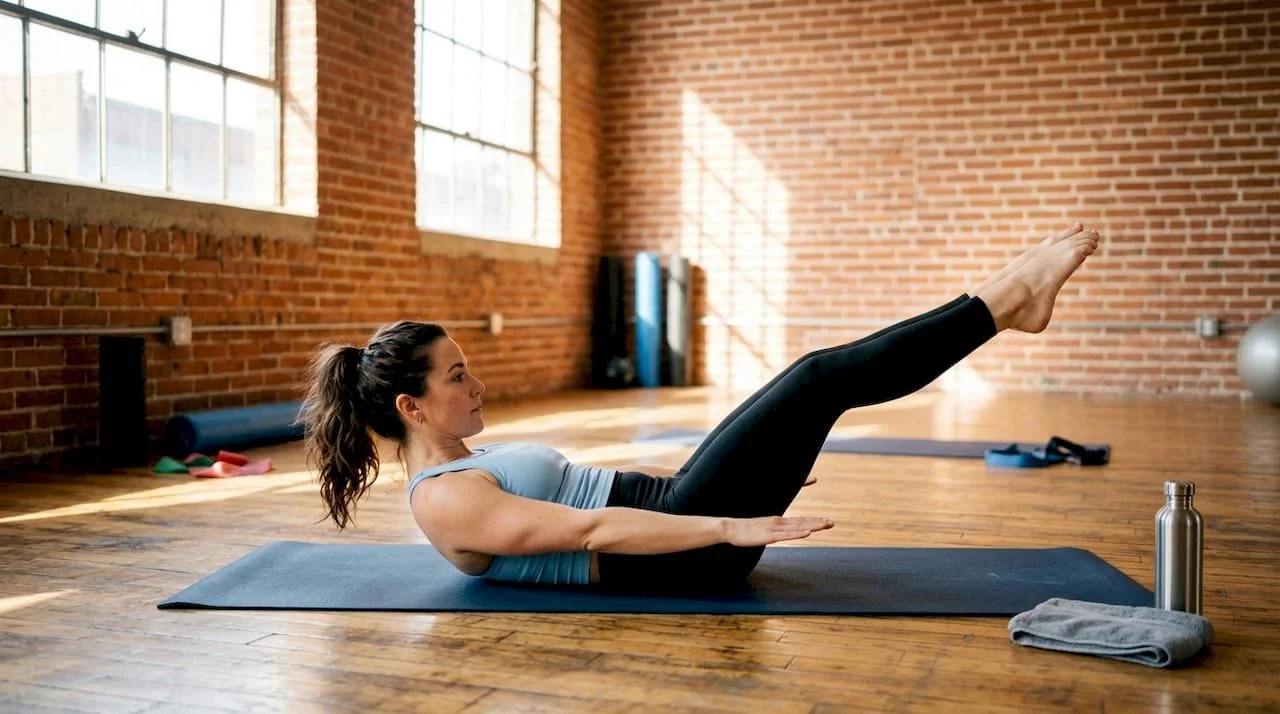
Many people assume Pilates is only for experienced fitness enthusiasts or dancers with perfect form. This misconception keeps countless adults from discovering one of the most effective low-impact workouts for building core strength and improving flexibility. Whether you're looking to reduce back pain, enhance posture, or find an alternative to high-intensity gym routines, Pilates offers a structured, accessible approach that works for all fitness levels. This guide breaks down what Pilates really is, explains the science behind its benefits, and shows you exactly how to start your practice safely and effectively in Philadelphia.
Table of Contents
Key takeaways
| Point | Details |
|---|---|
| Low-impact effectiveness | Pilates builds core strength and flexibility through controlled movements without joint stress. |
| Proven pain relief | An 8-week program reduced disability and pain scores significantly in adults with chronic back issues. |
| Structured approach | Pilates emphasizes precision, breathing, and posture with a physical rehabilitation foundation. |
| Beginner friendly | Matwork exercises require minimal equipment and can be practiced safely at home or in studios. |
| Complementary practice | Combining Pilates with yoga enhances both physical strength and mindfulness for holistic wellness. |
What is Pilates? Understanding the basics and benefits
Pilates originated as a structured physical rehabilitation method focused on core and posture precision. Joseph Pilates developed this system in the early 20th century to help injured soldiers recover strength and mobility. Unlike random exercise routines, Pilates follows specific principles that make it particularly effective for beginners seeking sustainable fitness improvements.
The core principles include controlled movement, intentional breathing, precision in form, and constant attention to posture. Each exercise targets deep stabilizing muscles rather than superficial ones you might build at a traditional gym. This focus creates functional strength that translates directly into daily activities like lifting groceries, sitting at a desk, or playing with children.
For adults new to fitness or returning after injury, Pilates offers several distinct advantages:
Builds core strength without high-impact stress on joints
Improves flexibility through full range of motion exercises
Corrects postural imbalances from desk work or repetitive activities
Reduces chronic back pain through targeted muscle engagement
Enhances body awareness and movement control
Matwork represents the most accessible entry point for beginners. These exercises use your body weight and gravity for resistance, requiring only a mat and comfortable space. You can explore various Pilates blog posts to see how different practitioners approach matwork fundamentals.
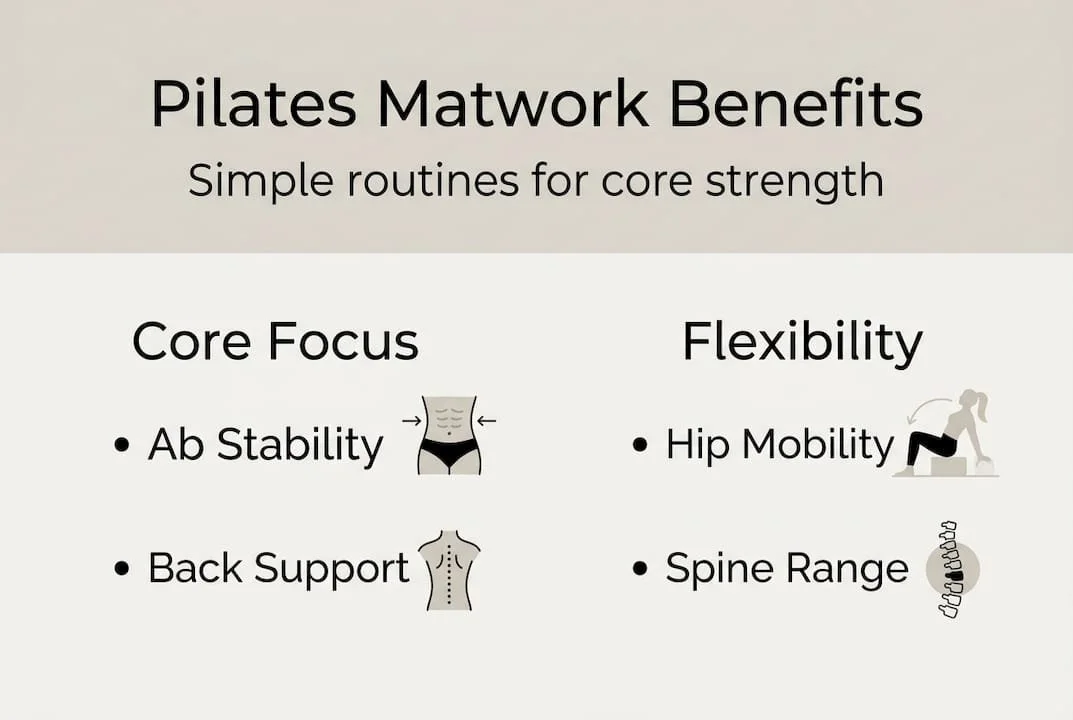
Pro Tip: Start with just 15 minutes of basic exercises three times weekly, focusing entirely on proper form rather than repetitions or speed. Building correct movement patterns early prevents injury and accelerates your progress.
The breathing technique in Pilates differs from everyday breathing. You inhale through your nose to prepare, then exhale completely through your mouth during the challenging part of each movement. This pattern oxygenates muscles, stabilizes your core, and creates rhythm that makes exercises flow naturally. Many beginners find this breathing pattern challenging at first, but it becomes intuitive within a few sessions.
How Pilates improves core strength and flexibility: scientific evidence
Research provides compelling evidence for Pilates effectiveness, particularly for adults dealing with back pain and mobility limitations. An 8-week Pilates matwork program significantly improved disability and pain scores in middle-aged women with chronic back pain. The study measured outcomes using validated scales that track real-world functional improvements.
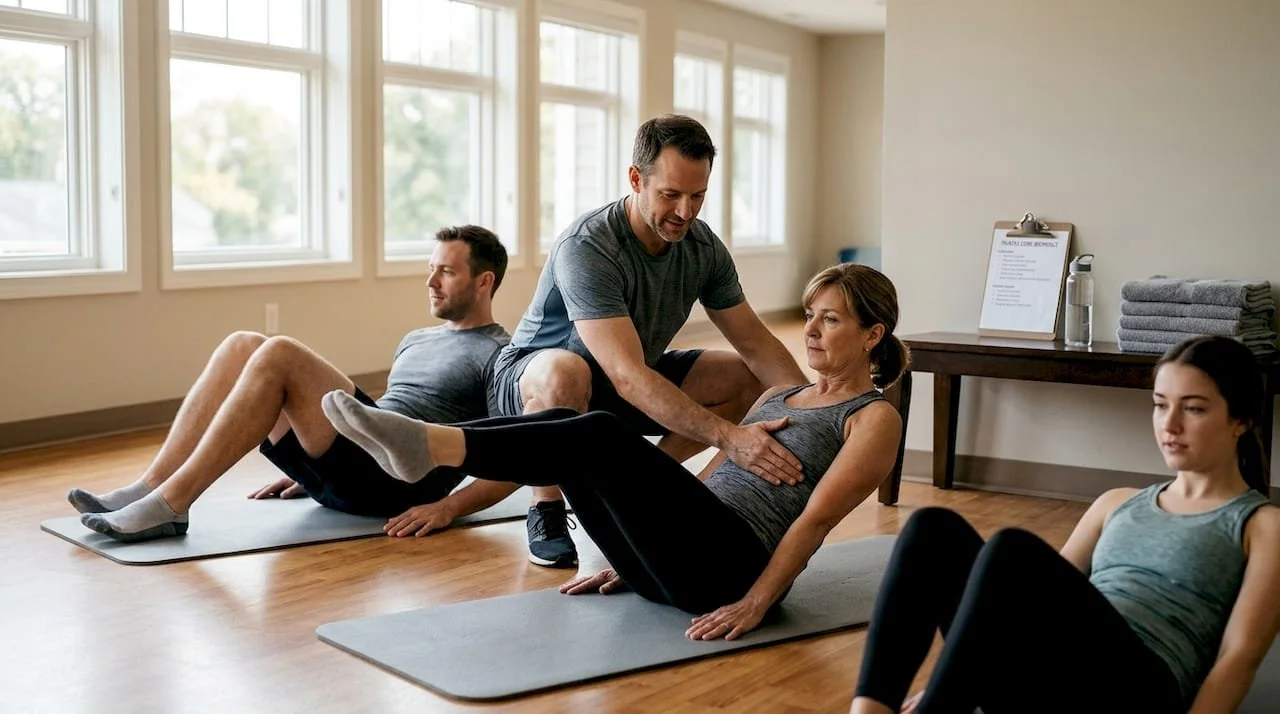
Participants showed measurable changes across multiple metrics. The Oswestry Disability Index, which assesses how back pain affects daily activities, improved substantially. The Quebec Back Pain Disability Scale showed similar positive trends. Pain intensity, measured on a numeric rating scale, decreased significantly after consistent practice.
One particularly interesting finding involved the flexion relaxation ratio. This measurement indicates how well your back muscles turn on and off during movement. Poor ratios suggest muscles stay tense when they should relax, contributing to pain and dysfunction. Pilates training improved this ratio, showing better neuromuscular control.
These improvements stem from how Pilates engages deep core muscles. Your transverse abdominis, multifidus, and pelvic floor muscles act like a natural corset supporting your spine. Traditional exercises often miss these stabilizers, focusing instead on superficial muscles like rectus abdominis. Pilates specifically targets the deep layer, creating genuine core strength rather than just visible abs.
The benefits of Pilates and yoga extend beyond pain relief to comprehensive wellness improvements:
Reduced chronic pain intensity and frequency
Improved posture and spinal alignment
Better balance and coordination
Increased joint flexibility and range of motion
Enhanced muscle endurance without bulk
After eight weeks of consistent Pilates matwork, participants experienced statistically significant reductions in disability scores and pain ratings, with improvements in muscle function patterns that support long-term back health.
The controlled, precise movements in Pilates also improve proprioception, your body's awareness of where it exists in space. Better proprioception means fewer falls, more graceful movement, and reduced injury risk during other activities. This benefit proves especially valuable as we age or recover from injuries that disrupt normal movement patterns.
Pilates vs yoga: choosing the right practice for your goals
Understanding the distinctions between Pilates and yoga helps you choose the practice that best matches your current needs and goals. Pilates focuses more on core strength and posture precision while yoga excels at flexibility, balance, and mindfulness. Both offer tremendous benefits, but their approaches differ significantly.
| Aspect | Pilates | Yoga |
|---|---|---|
| Primary focus | Core strength, posture, controlled movement | Flexibility, balance, mindfulness, spiritual connection |
| Origin | Physical rehabilitation in early 1900s | Ancient spiritual practice from India |
| Structure | Highly structured with specific exercise sequences | Varied styles from gentle to intense |
| Breathing | Lateral thoracic breathing during movement | Multiple techniques including ujjayi and alternate nostril |
| Equipment | Mat, reformer, resistance tools optional | Primarily mat with occasional props |
| Pace | Controlled, precise, moderate tempo | Ranges from slow meditative to dynamic flow |
Pilates developed from a rehabilitation foundation, which explains its emphasis on precise alignment and controlled movement. Each exercise has a specific purpose and correct execution method. This structure benefits beginners who appreciate clear guidelines and measurable progress.
Yoga encompasses diverse styles serving different purposes. Hatha yoga moves slowly with long holds, perfect for building flexibility. Vinyasa flows dynamically between poses, offering cardiovascular benefits. Restorative yoga uses props for deep relaxation. This variety means you can find a yoga style matching almost any goal or energy level.
Who benefits most from each practice?
Choose Pilates if you want targeted core strengthening, injury rehabilitation, or postural correction
Choose yoga if you seek stress relief, spiritual exploration, or comprehensive flexibility
Choose both if you want complete mind-body wellness with strength and mindfulness
Pro Tip: Start with Pilates to build foundational core strength and body awareness, then add yoga sessions for enhanced flexibility and stress management. This combination creates balanced fitness addressing physical and mental wellness.
Many practitioners find that combining yoga and Pilates provides synergistic benefits. Pilates strengthens stabilizing muscles that improve yoga poses, while yoga stretches muscles that might tighten from Pilates work. The mindfulness cultivated in yoga enhances the mind-body connection Pilates requires.
You can also explore the difference between Pilates and yoga in greater depth to understand how these practices complement rather than compete with each other. Neither is objectively better; they simply serve different primary purposes while sharing some overlapping benefits.
Getting started with Pilates: practical tips and beginner-friendly exercises
Starting your Pilates practice requires minimal equipment and can happen in your living room or a studio setting. Here's a simple beginner routine focusing on fundamental movements that build core strength safely:
Pelvic tilt: Lie on your back with knees bent and feet flat. Inhale to prepare, then exhale while pressing your lower back into the mat by engaging your deep abdominals. Hold for three breaths, then release. Repeat eight times.
Hundred preparation: From the same position, lift your head and shoulders slightly off the mat while reaching arms long by your sides. Pump arms up and down in small movements, breathing in for five counts and out for five counts. Start with 30 pumps and build to 100.
Single leg stretch: Bring one knee toward your chest while extending the other leg at a 45-degree angle. Switch legs in a controlled rhythm, keeping your core engaged and lower back pressed down. Complete ten repetitions per side.
Spine stretch forward: Sit tall with legs extended and feet flexed. Reach arms forward at shoulder height. Exhale while rounding your spine forward, reaching toward your toes. Inhale to return to sitting tall. Repeat six times.
Leg circles: Lie on your back with one leg extended toward the ceiling. Draw small circles with your foot, keeping hips stable and core engaged. Complete five circles each direction, then switch legs.
Essential equipment for home practice includes:
Quality exercise mat with adequate cushioning
Comfortable fitted clothing that allows movement visibility
Small pillow for head support if needed
Resistance band for added challenge as you progress
Mirror or phone camera to check alignment
Schedule practice sessions two to three times weekly for optimal results. Pilates matwork exercises have proven benefits and are ideal for safe beginner routines when performed consistently. Spacing sessions allows muscle recovery while maintaining momentum.
Pro Tip: Record yourself performing exercises or practice in front of a mirror initially to ensure proper form. Watching instructor videos before your session helps you understand correct positioning and common mistakes to avoid.
Common beginner mistakes include:
Holding breath instead of coordinating breathing with movement
Rushing through repetitions rather than moving with control
Arching lower back instead of maintaining neutral spine
Using momentum instead of muscle engagement
Gripping neck and shoulders instead of relaxing upper body
If you have chronic back pain, herniated discs, or other medical conditions, consult your healthcare provider before starting any new exercise program. Most conditions benefit from Pilates, but modifications may be necessary for safety.
Warmup and cooldown stretches enhance flexibility and prevent injury:
Cat-cow stretches to mobilize spine
Gentle torso twists to release tension
Hip circles to loosen lower body
Shoulder rolls to relax upper body
Child's pose to stretch back and hips
As you build confidence, explore Pilates fusion routines that combine traditional exercises with complementary movements. These variations keep practice interesting while challenging your body in new ways.
Explore Pilates classes and wellness at Amrita Yoga & Wellness
Ready to experience Pilates with expert guidance in a supportive community environment? Amrita Yoga & Wellness offers beginner-friendly Pilates classes designed specifically for Philadelphia adults seeking accessible, low-impact fitness solutions. Our instructors understand the unique challenges beginners face and provide personalized attention to ensure proper form and safe progression.
New students can take advantage of special introductory offers that make trying Pilates affordable and risk-free. These packages let you sample different class styles and instructors to find the perfect fit for your schedule and preferences. Our welcoming studio atmosphere helps nervous beginners feel comfortable from their very first session.
Beyond Pilates, we offer complementary wellness services including acupuncture that supports your holistic health journey. Many students find combining movement practices with traditional healing modalities accelerates their progress and enhances overall wellbeing. Review our studio policies to understand class registration, cancellation procedures, and community guidelines before your first visit.
Frequently asked questions about Pilates for beginners
Is Pilates safe for people with chronic back pain?
Yes, research shows Pilates significantly reduces back pain and improves function when practiced correctly. The controlled, low-impact movements strengthen supporting muscles without stressing injured areas. Always consult your healthcare provider before starting and inform instructors about your condition so they can suggest appropriate modifications.
How often should beginners practice Pilates for best results?
Beginners see optimal results with two to three sessions weekly, allowing rest days between practices for muscle recovery. Consistency matters more than frequency, so maintain a regular schedule rather than sporadic intensive sessions. Most people notice improvements in core strength and flexibility within four to six weeks of consistent practice.
Do I need special equipment to start Pilates?
No, you can begin with matwork exercises requiring only a quality exercise mat and comfortable clothing. As you advance, resistance bands, small balls, and foam rollers add variety and challenge. Studio equipment like reformers offers additional benefits but isn't necessary for building foundational strength and learning proper technique.
Can Pilates help improve posture and reduce pain?
Absolutely. Pilates specifically targets deep stabilizing muscles that support proper spinal alignment and posture. Strengthening these muscles reduces strain on joints and ligaments that cause pain. Many practitioners notice reduced neck, shoulder, and back discomfort as their core strength and postural awareness improve through regular practice.
Is Pilates suitable for all fitness levels and ages?
Yes, Pilates adapts easily to different abilities, ages, and fitness backgrounds. Exercises can be modified to make them easier or more challenging based on individual needs. Older adults, people recovering from injuries, and complete fitness beginners all benefit from Pilates when starting with appropriate progressions and proper instruction.
How does Pilates compare to traditional gym workouts?
Pilates emphasizes quality of movement over quantity, focusing on controlled precision rather than heavy weights or high repetitions. It builds functional strength through full range of motion exercises that improve daily activities. Traditional gym workouts often isolate muscle groups, while Pilates integrates multiple muscle systems in each exercise for comprehensive conditioning.
Explore more insights and tips on our Pilates blog to deepen your understanding and discover new ways to enhance your practice as you progress beyond the beginner stage.
Recommended
7 Different Kinds of Pilates for Core Strength and Wellness
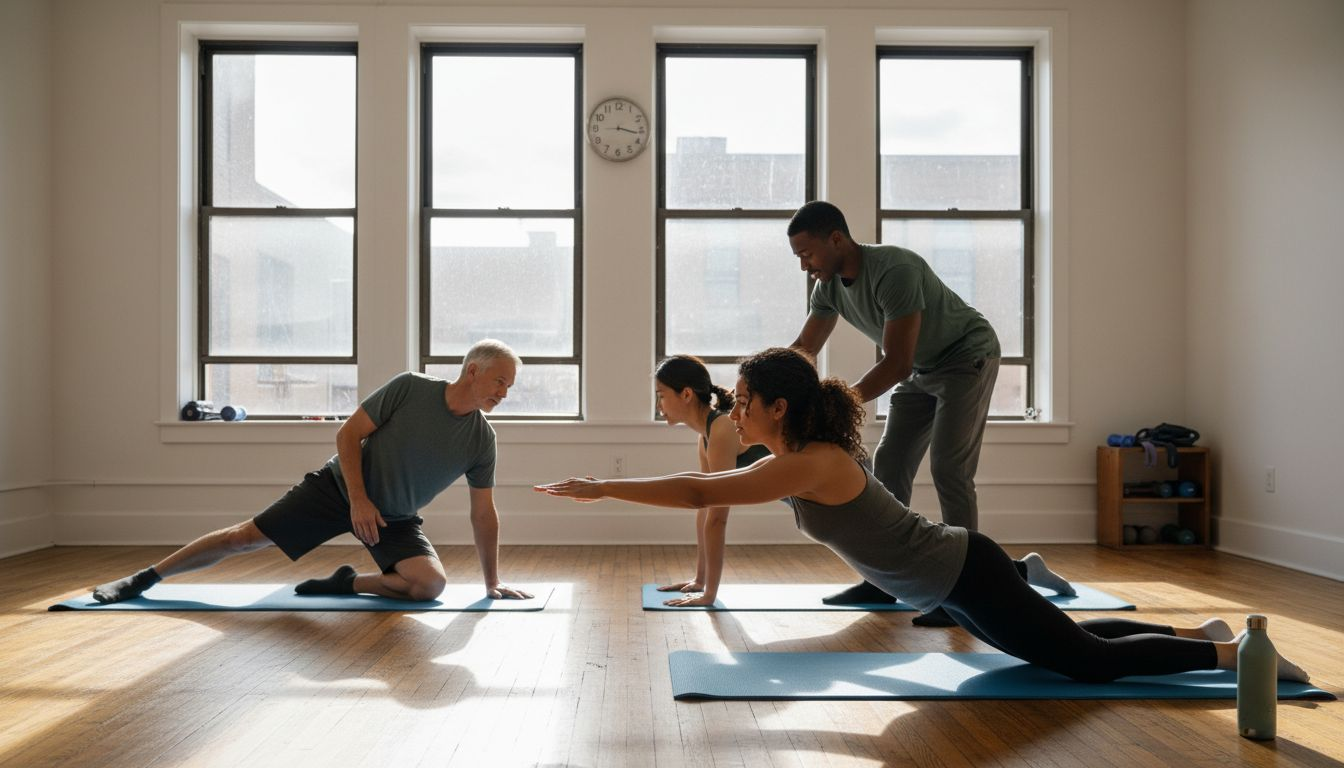
Choosing the right Pilates style can feel overwhelming when you want specific results but are faced with so many options. Whether your goal is building core strength, improving balance, or recovering from injury, finding a method that truly meets your needs is challenging. Each approach offers unique benefits, and understanding these differences makes all the difference in shaping your fitness journey.
The good news is that experts have identified proven Pilates methods that help with core muscle strength, body composition, flexibility, and even rehabilitation. This list breaks down the most effective styles and techniques, backed by research, so you can select the best practice for your goals. Get ready to discover practical insights that will help you make an informed choice and achieve lasting results.
Table of Contents
Quick Summary
| Takeaway | Explanation |
|---|---|
| 1. Mat Pilates strengthens the core effectively. | Focused movements enhance core stability and improve posture, suitable for all fitness levels. |
| 2. Reformer Pilates customizes full-body workouts. | Adjustable resistance enables diverse exercise variations, targeting every muscle group safely. |
| 3. Classical Pilates emphasizes precision and control. | Rooted in original techniques, it promotes balanced movement and injury prevention. |
| 4. Contemporary Pilates adapts to individual needs. | Incorporates modern insights to provide personalized exercise strategies for optimal results. |
| 5. Small group Pilates fosters community engagement. | Collaborative classes build connections among participants, enhancing motivation and accountability. |
1. Mat Pilates for Core Building
Mat Pilates is a foundational practice that transforms your core strength using nothing more than a simple exercise mat and your body weight. By focusing on controlled movements and precise muscle engagement, mat Pilates provides an accessible yet powerful approach to building a strong, stable core.
Unlike equipment-based Pilates methods, mat Pilates allows practitioners to concentrate on fundamental movements that target deep abdominal muscles, spinal alignment, and overall body control. Research demonstrates significant improvements in core muscle strength, posture, and stability through consistent matwork exercises.
The practice involves a series of bodyweight exercises performed on the floor, emphasizing precise muscle activation and mindful breathing. These movements engage multiple muscle groups simultaneously, creating a comprehensive workout that strengthens the core from multiple angles. By targeting muscles around the spine, pelvis, and abdomen, mat Pilates helps improve balance, reduce back pain, and enhance overall functional stability.
Particularly beneficial for individuals seeking low-impact exercise, mat Pilates can be adapted for various fitness levels. Beginners can start with basic movements like the hundred, roll ups, and leg lifts, while advanced practitioners can incorporate more challenging sequences that demand greater core control and strength.
Pro Tip: Start each mat Pilates session by focusing on your breath and establishing a strong mind body connection before moving into more complex movements.
2. Reformer Pilates for Full-Body Conditioning
Reformer Pilates represents a dynamic and transformative approach to full-body fitness that goes far beyond traditional exercise methods. By utilizing a specialized sliding platform with adjustable spring resistance, this practice offers a comprehensive workout that challenges and transforms your entire physique.
Research demonstrates significant improvementsin body composition, muscle strength, and overall physical conditioning. The Reformer machine allows for hundreds of exercise variations that target every major muscle group while providing both support and resistance.
Unlike traditional weight training, Reformer Pilates creates a unique environment where resistance can be applied from multiple angles. This approach helps develop lean muscle mass, improve flexibility, and enhance overall biomechanical efficiency. By challenging your body through controlled movements, you engage stabilizing muscles that are often overlooked in standard workout routines.
Practitioners can customize their workout intensity by adjusting the machine's spring tension, making Reformer Pilates suitable for everyone from rehabilitation patients to professional athletes. The equipment's design allows for low impact movements that protect joints while still providing an incredibly effective full body conditioning experience.
Pro Tip: Start with a trained instructor who can help you understand proper form and machine adjustments to maximize your Reformer Pilates experience and prevent potential injuries.
3. Classical Pilates for Balanced Movement
Classical Pilates represents the purest form of the Pilates method, directly rooted in Joseph Pilates' original vision of holistic body conditioning. This approach goes beyond simple exercise by creating a comprehensive system designed to restore balanced movement and optimal physical functioning.
Systematic research demonstrates significant improvementsin posture, core strength, and overall body alignment. Classical Pilates emphasizes precision, control, and intentional movement patterns that challenge both body and mind through carefully choreographed sequences.
Unlike modern fitness trends, Classical Pilates maintains a strict commitment to the original repertoire developed by Joseph Pilates. The practice focuses on six key principles flow, concentration, control, precision, breathing, and centering which work together to create a deeply transformative physical experience. Each movement is performed with meticulous attention to proper form, ensuring that practitioners develop muscle balance and functional strength.
The method integrates full body movements that simultaneously strengthen and stretch muscle groups, promoting long lean muscle development and improved joint mobility. By targeting deep stabilizing muscles, Classical Pilates helps correct postural imbalances and reduces the risk of injury through mindful, controlled exercise.
Pro Tip: Begin your Classical Pilates journey by working with a certified instructor who understands the original method and can guide you through proper technique and progression.
4. Contemporary Pilates for Modern Techniques
Contemporary Pilates represents a dynamic evolution of the traditional Pilates method, blending classic principles with cutting edge scientific understanding and individualized approaches. This modern interpretation adapts the original practice to meet the diverse needs of todays fitness enthusiasts and wellness seekers.
Research highlights the method's innovative approachby integrating functional movement patterns and the latest anatomical research. Unlike classical Pilates, this approach allows for greater flexibility in technique, equipment use, and personal modification.
The contemporary method recognizes that every body is unique, focusing on personalized movement strategies that address individual biomechanical patterns and fitness goals. Practitioners can expect a more fluid approach that incorporates insights from physical therapy, sports science, and holistic wellness practices.
Key differences include expanded equipment options, more varied exercise modifications, and a deeper understanding of how movement impacts overall body health. Contemporary Pilates practitioners benefit from a more scientific and adaptive approach that considers individual body mechanics, injury history, and specific fitness objectives.
Pro Tip: Seek out instructors with comprehensive training in both traditional and contemporary Pilates techniques to experience a truly personalized and scientifically informed approach to movement.
5. Clinical Pilates for Rehabilitation Support
Clinical Pilates represents a specialized approach to movement therapy designed specifically for rehabilitation and injury recovery. This targeted method transforms traditional Pilates principles into a precise therapeutic intervention that addresses individual physical challenges and recovery needs.
Systematic research confirms its effectivenessin managing chronic conditions, particularly chronic low back pain. Unlike standard exercise programs, Clinical Pilates is meticulously tailored to each patients unique physical requirements, focusing on targeted muscle engagement and controlled movement patterns.
The practice involves a comprehensive assessment by trained physiotherapists or specialized Pilates instructors who develop personalized exercise protocols. These protocols aim to restore muscle balance, improve flexibility, reduce pain, and enhance overall functional movement. By addressing specific musculoskeletal weaknesses, Clinical Pilates helps patients recover from injuries more effectively and prevent future physical complications.
Key benefits include improved core stability, enhanced body awareness, pain reduction, and gradual strength building. Patients with conditions such as chronic back pain, sports injuries, postural imbalances, and neurological disorders can particularly benefit from this targeted approach to rehabilitation.
Pro Tip: Always consult a certified clinical Pilates professional who can conduct a thorough initial assessment and design a rehabilitation program specific to your individual physical needs and recovery goals.
6. Pilates Barre for Flexibility and Tone
Pilates Barre blends the precision of Pilates with classical ballet techniques, creating a unique workout that transforms body composition and muscular performance. This dynamic practice combines ballet barre work, Pilates principles, and strength training to deliver a comprehensive fitness experience.
Research confirms significant improvementsin muscle control, posture, and overall body flexibility. By integrating small controlled movements with isometric holds, Pilates Barre challenges muscles in ways traditional exercise cannot, promoting lean muscle development and enhanced joint mobility.
The method utilizes a ballet barre for support while performing low impact, high intensity movements that target multiple muscle groups simultaneously. Participants experience a full body workout that emphasizes core engagement, muscle elongation, and precise movement patterns. This approach helps develop long, strong muscles without creating bulk, making it ideal for individuals seeking refined muscular definition.
Unlike traditional strength training, Pilates Barre focuses on muscle endurance, balance, and functional movement. The practice incorporates elements of dance, Pilates, and strength conditioning to create a holistic approach to fitness that improves both physical performance and body awareness.
Pro Tip: Wear form fitting clothing and grippy socks to maximize your range of motion and maintain stability during Pilates Barre exercises.
7. Small Group Pilates for Community Connection
Small group Pilates represents more than just a fitness class its a powerful platform for building meaningful connections and shared wellness experiences. This collaborative approach transforms traditional exercise into a supportive community driven journey of personal growth and mutual encouragement.
Research confirms significant community benefitsthrough collective fitness experiences. Small group settings create an environment where participants motivate each other, share challenges, and celebrate individual and collective progress, making fitness feel less like a solitary task and more like a shared adventure.
Unlike individual training, small group Pilates offers a unique blend of personalized instruction and collective energy. Participants receive targeted guidance from instructors while simultaneously experiencing the motivation that comes from working alongside peers with similar fitness goals. This approach helps individuals stay consistent, accountable, and inspired throughout their wellness journey.
The social dynamics of small group Pilates extend beyond physical exercise. Participants develop friendships, support networks, and a sense of belonging that transcends traditional workout experiences. By creating a collaborative and inclusive environment, these classes help combat isolation and promote holistic well being.
Pro Tip: Choose a small group Pilates class with a welcoming atmosphere and an instructor who emphasizes community and individual growth.
Below is a comprehensive table summarizing the various Pilates methods and their unique characteristics and benefits as detailed in the article.
| Pilates Method | Key Features | Best For |
|---|---|---|
| Mat Pilates | Involves bodyweight exercises on a mat, focusing on core strength, spinal alignment, and muscle control. | Beginners seeking low-impact workouts targeting core stability and strength. |
| Reformer Pilates | Utilizes a machine with adjustable spring resistance for exercises targeting overall muscle coordination and strength. | Individuals aiming for full-body conditioning and muscle toning. |
| Classical Pilates | Adheres to the original repertoire by Joseph Pilates, focusing on principles such as control, precision, and balance. | Enthusiasts looking to practice Pilates in its traditional and structured form. |
| Contemporary Pilates | Integrates modern anatomical knowledge and diverse modifications into traditional Pilates practice. | People looking for a flexible, scientifically informed approach to fitness. |
| Clinical Pilates | Tailored for rehabilitation and injury recovery, guided by trained professionals to address individual physical challenges. | Patients requiring therapeutic exercises for recovery and pain management. |
| Pilates Barre | Combines ballet techniques with Pilates principles, emphasizing muscle endurance and elongation. | Individuals interested in improving flexibility, posture, and achieving lean muscle definition. |
| Small Group Pilates | Focuses on community engagement, blending group dynamics with personalized instruction to foster connection and accountability. | Those seeking social motivation and shared wellness experiences. |
Discover Your Path to Core Strength and Wellness with Amrita Yoga & Wellness
Building a resilient core and achieving balanced movement is essential for both physical and mental well-being. Whether you are drawn to Mat Pilates, Reformer Pilates, Clinical Pilates, or the innovative practice of Contemporary Pilates, overcoming challenges like limited mobility, chronic pain, or lack of motivation requires guidance and a supportive community. At Amrita Yoga & Wellness, we understand these goals and pain points. Our diverse offerings are designed to help you develop core strength, enhance flexibility, and restore harmony in your body through mindful, expert instruction.
Ready to transform your wellness journey with personalized Pilates sessions and holistic practices? Visit Amrita Yoga & Wellness to explore a variety of classes, workshops, and retreat options tailored for beginners to advanced practitioners. Embrace a stronger core, improved posture, and vibrant health today by signing up for a class or reaching out for individualized support. Experience how the right Pilates style and a welcoming community can make all the difference.
Frequently Asked Questions
What is the main benefit of Mat Pilates for core strength?
Mat Pilates primarily focuses on improving core strength using bodyweight exercises on a mat. To experience these benefits, commit to practicing consistently and focus on engaging your deep abdominal muscles for noticeable improvements in posture and stability within a few weeks.
How does Reformer Pilates differ from traditional Pilates methods?
Reformer Pilates utilizes a specialized machine to provide adjustable resistance, allowing for a varied full-body workout. To fully understand this approach, consider taking an introductory class that covers different exercises and proper machine setup.
Can Classical Pilates help improve my posture?
Yes, Classical Pilates is designed to enhance posture by promoting balanced muscle development and proper body alignment. To see improvements, practice regularly and pay attention to precise movement patterns, which can lead to better posture over time.
What makes Contemporary Pilates a good choice for beginners?
Contemporary Pilates offers a modern approach that adapts traditional techniques with a focus on individual needs and functional movements. To get started, find a qualified instructor who can tailor a session to your fitness level and help you grasp the basics effectively.
How can Clinical Pilates assist in my rehabilitation process?
Clinical Pilates is specifically designed for rehabilitation and targets individual needs for effective recovery. To leverage this method, consult with a certified clinical Pilates instructor who can assess your condition and create a personalized program that addresses specific concerns.
What should I expect from a Small Group Pilates class?
In a Small Group Pilates class, you can expect personalized instruction alongside a supportive community atmosphere. To benefit fully, engage with your peers, set personal goals, and participate actively, which can greatly enhance your motivation and progress.