Barre vs Pilates Explained: Choosing Your Best Fit
Most American professionals know their packed schedules can make fitness feel like a luxury, not a routine. For those in Philadelphia juggling meetings and commutes, finding a workout that builds strength without harsh impact is key. Barre and Pilates are two popular choices reshaping how busy adults target core strength and flexibility. Learn how each option supports your goals and why more American adults are choosing low-impact routines that fit a demanding lifestyle.
Table of Contents
Key Takeaways
| Point | Details |
|---|---|
| Barre and Pilates Offer Unique Benefits | Both practices focus on low-impact fitness but cater to different goals, with barre emphasizing dynamic movements and Pilates focusing on controlled, precise movements. |
| Class Atmospheres Vary Significantly | Barre classes are energetic and social, while Pilates classes promote a calm and introspective environment. |
| Consider Personal Goals When Choosing | Assess your fitness objectives to determine whether barre or Pilates aligns better with your individual needs. |
| Combining Both Disciplines Can Be Beneficial | Integrating elements of both barre and Pilates can create a well-rounded fitness routine that enhances strength and flexibility. |
Barre and Pilates Defined for Beginners
For busy professionals seeking low-impact fitness options, barre and Pilates represent two transformative workout approaches that blend strength training, flexibility, and mindful movement. While they might seem similar at first glance, each discipline offers unique characteristics designed to enhance body awareness and physical conditioning.
Barre workouts draw inspiration from ballet techniques, combining elements of dance, Pilates, and strength training into a dynamic fitness experience. These ballet-inspired movements typically involve small, precise muscle movements performed at a ballet barre, targeting core strength, posture, and muscle endurance. Participants use their body weight, light hand weights, and ballet bar support to create lean, sculpted muscles through high-repetition, low-impact exercises.
Pilates, in contrast, focuses more comprehensively on core strength, spinal alignment, and controlled breathing. Developed by Joseph Pilates in the early 20th century, this practice emphasizes precision, proper form, and mind body connection. Whether performed on a mat or specialized equipment like the reformer, Pilates challenges practitioners to engage deep stabilizing muscles while maintaining fluid, intentional movements.
Pro Tip: If you are new to either practice, start with a beginner class and communicate any physical limitations to your instructor to ensure a safe, personalized workout experience.
Fundamental Differences in Movement Styles
While barre and Pilates share a foundation of mindful movement, they diverge significantly in their approach to physical conditioning. The nuanced differences in movement styles reveal unique strategies for building strength, flexibility, and body awareness that cater to different fitness preferences and goals.
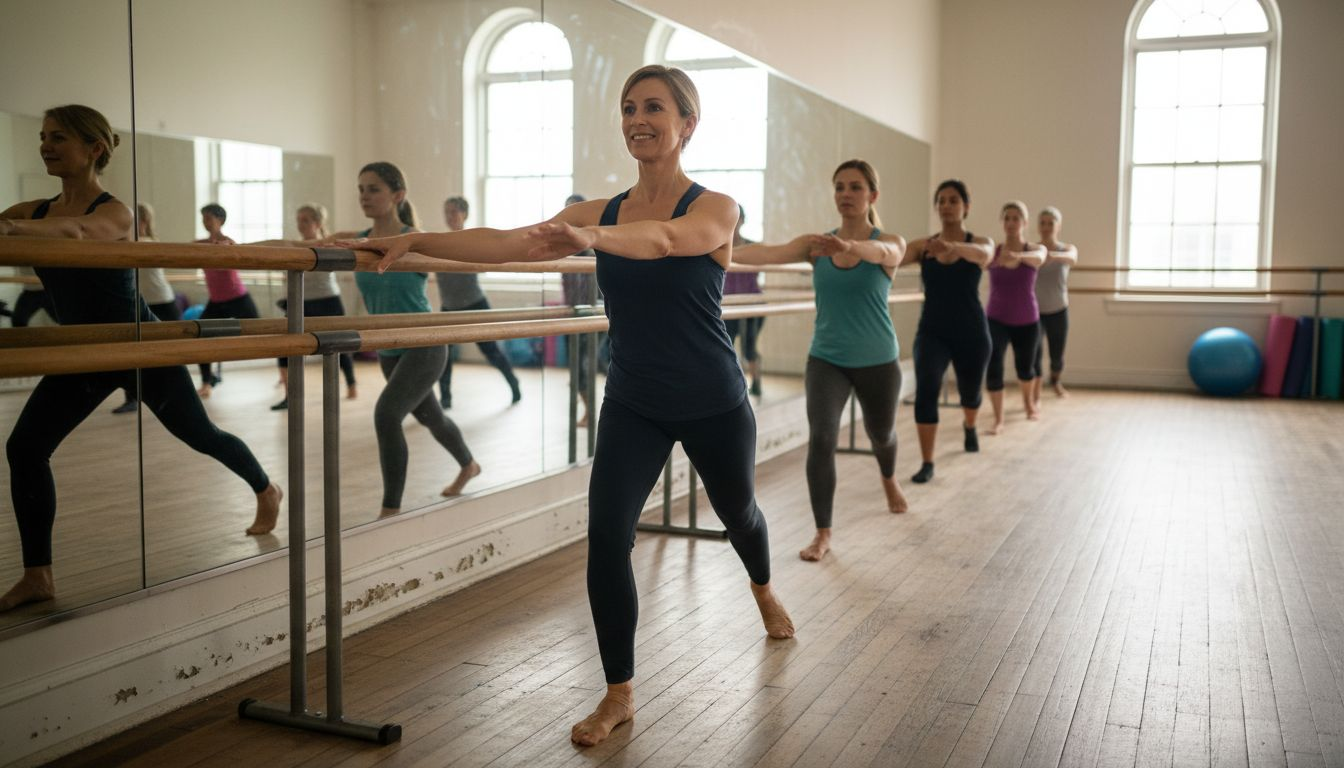
Barre workouts are characterized by rapid, high-repetition movements that blend ballet techniques with strength training. Participants engage in small, precise isometric holds and pulsing motions, typically using a ballet bar for support. These movements create muscular endurance through constant tension, targeting smaller muscle groups with light weights and bodyweight exercises. The rhythm is dynamic and energetic, mimicking a dance-inspired fitness class that keeps participants moving continuously.
Pilates, by contrast, emphasizes slow, deliberate movements with an intense focus on core engagement and proper alignment. Each movement in Pilates is performed with meticulous attention to breath, precision, and quality of motion rather than speed or repetition count. Practitioners might use specialized equipment like reformers or simply work on a mat, but the core principle remains consistent: controlled, intentional movements that build deep muscle strength and improve overall body mechanics.
A key distinction emerges in the fundamental philosophy of movement. Barre tends to be more performance-oriented, creating a high-energy workout that feels like a dance class, while Pilates approaches fitness as a meditative, technically precise practice of body awareness and muscular control.
Here's a side-by-side overview of key distinctions between barre and Pilates:
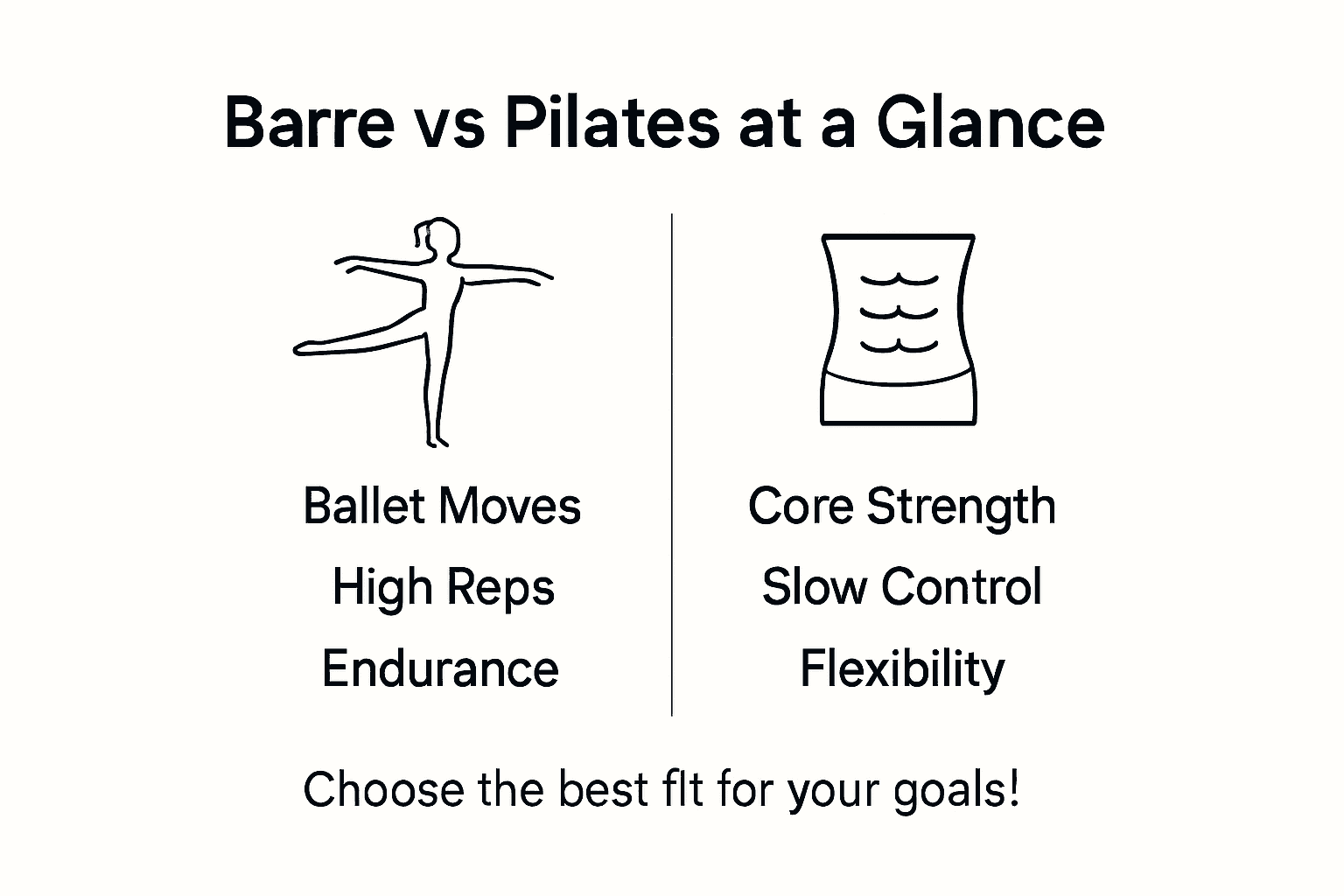
| Aspect | Barre | Pilates |
|---|---|---|
| Movement Style | High-repetition, ballet-inspired | Slow, controlled, precise |
| Energy Level | Energetic, dynamic | Calm, meditative |
| Focus Area | Sculpting and endurance | Deep core strength |
| Equipment | Ballet bar, light weights | Mat, reformer, accessories |
| Main Benefits | Enhances tone and posture | Improves alignment and flexibility |
| Class Atmosphere | Social, upbeat, musical | Quiet, focused, introspective |
Pro Tip: When choosing between barre and Pilates, observe a class beforehand to understand which movement style resonates more with your personal fitness rhythm and goals.
Primary Benefits for Core Strength and Flexibility
Both barre and Pilates offer remarkable advantages for developing core strength, flexibility, and overall body conditioning, making them exceptional choices for professionals seeking targeted, low-impact fitness solutions. The transformative core benefits of these practices extend far beyond traditional strength training, providing nuanced approaches to muscular development and body awareness.
Barre workouts excel at building muscular endurance through precise, high-repetition movements that target core muscles from multiple angles. By incorporating isometric holds and small, dynamic motions, barre creates constant muscle tension that develops long, lean muscle groups while simultaneously improving posture and stability. The focus on lower body and core muscle groups means participants can expect enhanced muscle tone, increased flexibility, and improved overall body alignment.
Pilates takes a more meditative approach to core strengthening, emphasizing controlled movements that engage deep stabilizing muscles. Practitioners develop comprehensive core strength through intentional, slow movements that require exceptional body awareness and precise muscle engagement. Unlike traditional strength training, Pilates builds strength through quality of movement rather than quantity, promoting balanced muscle development, improved spinal alignment, and enhanced overall functional fitness.
While both practices offer significant core benefits, they differ in their methodological approach. Barre provides a more dynamic, dance-inspired workout with rapid muscle engagement, whereas Pilates offers a methodical, breath-centered practice that prioritizes muscle quality and mindful movement.
Pro Tip: Combine elements from both barre and Pilates to create a well-rounded core strengthening routine that addresses multiple aspects of physical fitness.
What to Expect in Barre vs Pilates Classes
The class experience in barre and Pilates offers distinctly different atmospheres and approaches to fitness, catering to professionals seeking varied workout styles. Both typically last between 30 to 45 minutes, but the energy, structure, and focus differ significantly, providing unique pathways to physical conditioning.
Barre classes create a high-energy, dance-inspired environment that combines elements of ballet, strength training, and cardio. Muscle engagement happens continuously through small, precise movements performed at a ballet bar, with participants using light weights, resistance bands, and bodyweight exercises. The pace is rhythmic and dynamic, often accompanied by upbeat music that keeps participants motivated and moving. Expect rapid, repetitive motions that target specific muscle groups, creating an intense workout that feels more like a choreographed dance performance than traditional strength training.
Pilates classes, in contrast, offer a more meditative and controlled workout experience. The class focuses intensely on core activation and precise movement, emphasizing breath coordination and mindful muscle engagement. Practitioners might work on a mat or use specialized equipment like reformers, with each movement performed slowly and intentionally. The atmosphere is calm and focused, encouraging participants to connect deeply with their body's alignment, breathing patterns, and subtle muscle movements. Unlike barre's high-energy approach, Pilates prioritizes quality of movement over quantity, creating a more introspective fitness experience.
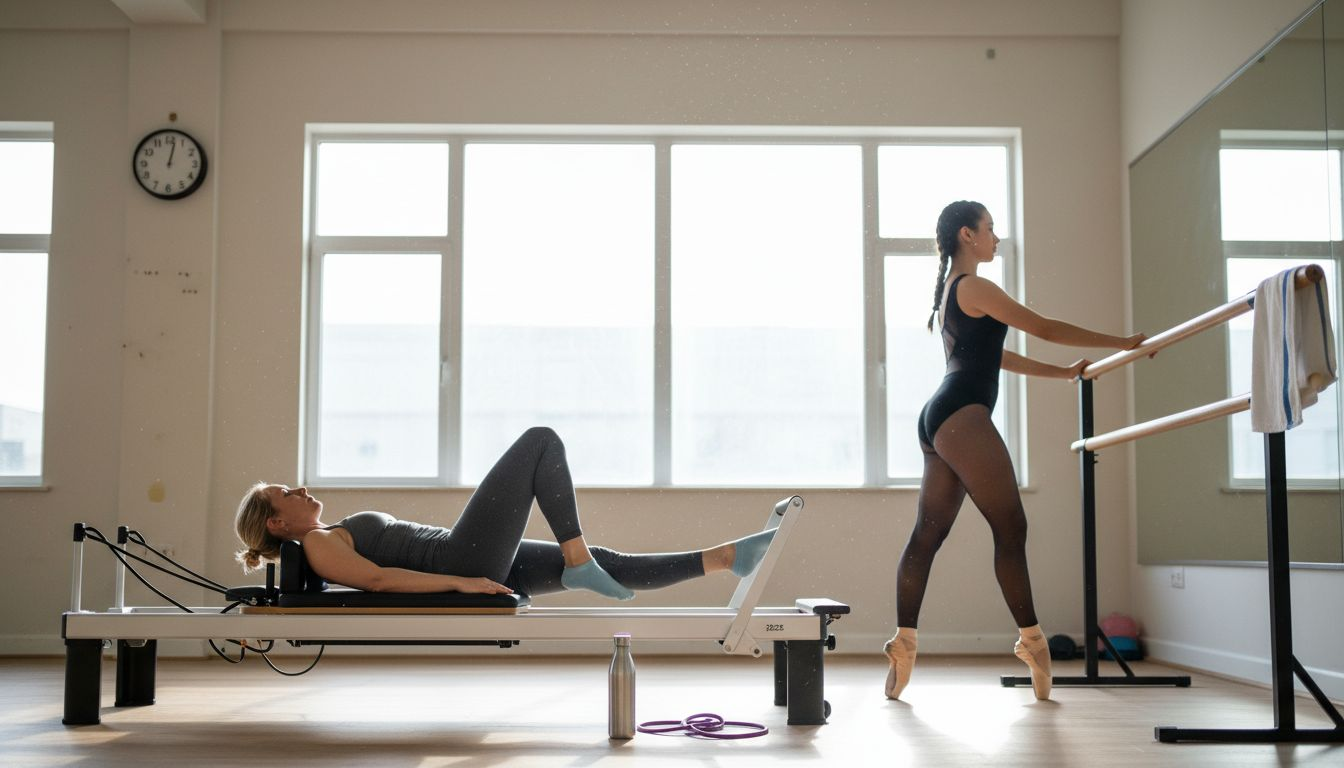
The equipment and setup also differ dramatically between these practices. Barre classes typically use a ballet bar, small weights, and sometimes resistance bands, while Pilates might incorporate complex equipment like reformers, stability balls, and specialized machines that provide varying levels of resistance and support.
Pro Tip: Arrive 10-15 minutes early to your first class to familiarize yourself with the equipment and inform the instructor about any physical limitations or concerns.
Choosing the Best Option for Your Lifestyle
Selecting the right fitness practice requires a nuanced understanding of your personal health goals, physical condition, and lifestyle preferences. Each discipline offers unique benefits that can align differently with individual fitness objectives, making the choice more about personal resonance than universal superiority.
Barre is an excellent choice for professionals seeking a high-energy, full-body workout that combines strength training with cardiovascular elements. Workout intensity in barre classes makes it ideal for those wanting to improve muscle tone, enhance posture, and enjoy a more social, dynamic exercise environment. The rhythmic, dance-inspired movements provide an engaging workout that feels less like traditional exercise and more like an energetic performance. Individuals who thrive on quick-paced, motivating group settings and want to target specific muscle groups like arms, legs, and glutes will find barre particularly appealing.
Pilates, conversely, serves those prioritizing mindful movement, core strength, and holistic body awareness. The practice offers a more introspective fitness experience that appeals to professionals dealing with chronic pain, recovering from injuries, or seeking deep muscular engagement. Its slower, more deliberate approach emphasizes breath coordination, precise movements, and comprehensive body alignment. Pilates is particularly beneficial for individuals wanting to improve flexibility, rehabilitation potential, and overall body control without high-impact stress.
Ultimately, the decision between barre and Pilates depends on your specific fitness goals, physical limitations, and personal preferences. Some practitioners even combine both disciplines to create a well-rounded fitness routine that addresses multiple aspects of physical conditioning.
Selecting the best fit often depends on personal goals—here's a practical comparison to help guide your decision:
| Goal or Preference | Best Choice | Reason |
|---|---|---|
| Boosting energy and motivation | Barre | Upbeat group classes with music |
| Building deep core stability | Pilates | Emphasis on precise, slow movement |
| Social, group atmosphere | Barre | Team energy and dynamic setting |
| Mind-body awareness | Pilates | Controlled motions and breathwork |
| Rehabilitating injuries | Pilates | Low-impact, supportive environment |
| Improving muscle tone quickly | Barre | Fast-paced, repetitive training |
Pro Tip: Consider trying a single introductory class in both disciplines to personally experience their unique approaches and determine which resonates more with your fitness style and goals.
Discover Your Perfect Fitness Match at Amrita Yoga & Wellness
Choosing between barre and Pilates can feel overwhelming when each promises unique benefits like enhanced core strength, improved flexibility, and mindful movement. If you are seeking a low-impact workout that fits your busy lifestyle and aligns with your personal wellness goals, understanding these subtle differences is the first step. Whether you resonate more with barre's energetic, dance-inspired approach or Pilates' calm, precise focus on body alignment, finding the right fit can transform your fitness journey.
Explore a variety of classes tailored to help you build strength, flexibility, and body awareness at Amrita Yoga & Wellness. Our studio in Philadelphia offers expert-led barre and Pilates classes designed to accommodate all levels including beginners. Visit our detailed class descriptions and schedule your introductory session today to experience the benefits firsthand. Take control of your wellbeing and join a supportive community dedicated to holistic growth. Start your path to a stronger core and balanced body now by signing up for classes at Amrita Yoga & Wellness.
Frequently Asked Questions
What are the main differences between barre and Pilates?
Barre focuses on high-repetition, dance-inspired movements that enhance muscle tone and endurance, while Pilates emphasizes slow, controlled movements that build deep core strength and improve body alignment.
Which workout is better for building core strength, barre or Pilates?
Pilates is generally better for building deep core strength, as it emphasizes precise movements and breath coordination, engaging stabilizing muscles. Barre also strengthens the core but with a focus on muscular endurance through dynamic, high-rep movements.
Can I perform barre and Pilates workouts if I have physical limitations or injuries?
Yes, both barre and Pilates can be adapted for individuals with physical limitations or injuries. It's essential to communicate your limitations to the instructor, who can provide modifications to ensure a safe and effective workout.
How long do barre and Pilates classes typically last?
Both barre and Pilates classes typically last between 30 to 45 minutes, although class duration may vary depending on the specific studio or program.