Low-Impact Strength Exercises: 14 Examples to Start With
Low-impact strength exercises build muscle without jumping, pounding or sudden joint stress. At least one foot stays on the floor, or your body is supported by a chair, wall, mat or band. Good examples are glute bridges, chair squats, wall push-ups, band rows, step-ups, bird-dogs and wall sits. This guide gives you 14 of them, how to do each one, how to combine them into a full-body week, and what to do when a movement hurts.
Amritayogawellness
Build Strength With Mindful Movement
Explore yoga, Pilates, and other wellness offerings at Amrita Yoga & Wellness, a Philadelphia studio with options for different experience levels.
TL;DR
Low-impact does not mean easy. You can make bodyweight and band work hard by slowing down, pausing and lengthening the set.
Adults need 2 days a week of muscle-strengthening activity that works all the major muscle groups. Every exercise below counts.
A simple full-body week: two 25-minute sessions built from one push, one pull, one squat or hinge, and one core move.
Mild soreness that fades within a day or so is normal. Sharp pain, swelling, or pain lasting more than 48 hours means you should modify the move or see a clinician.
Table of Contents
What counts as low impact (and what it is not)
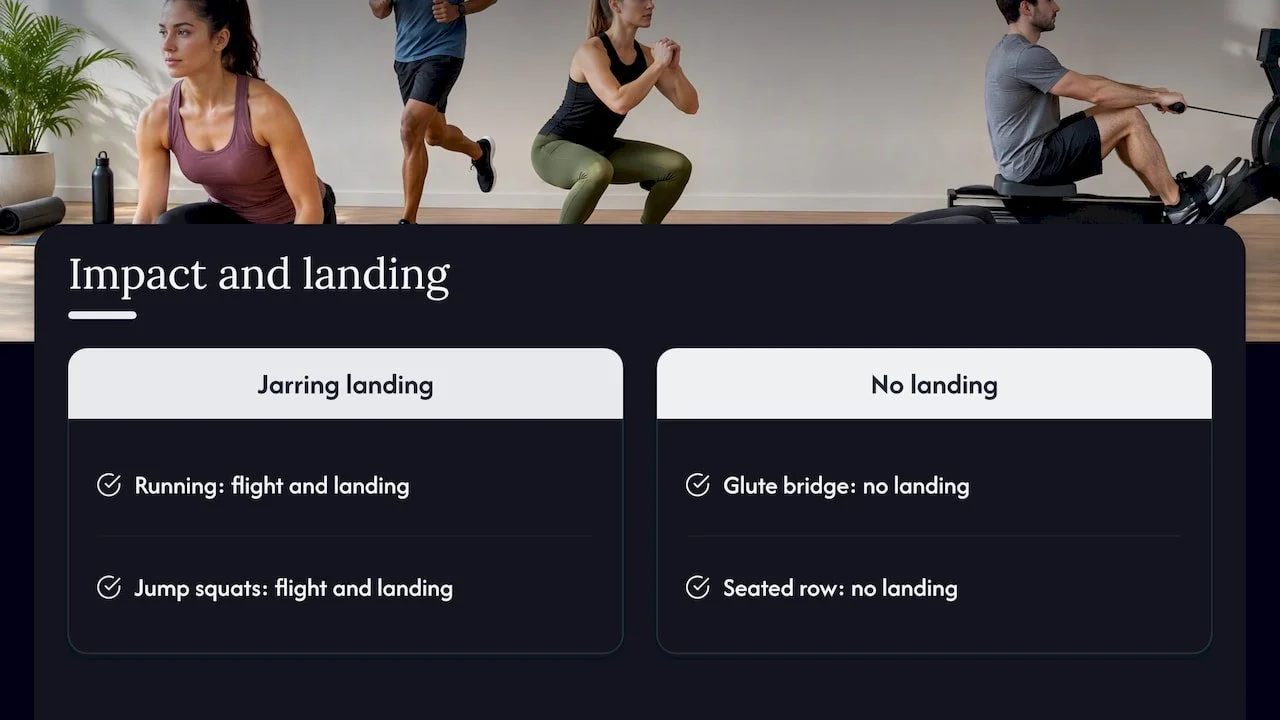
Impact describes the force that travels through your joints when your feet land. Running and jump squats have a flight phase, so the landing is jarring. A glute bridge or a seated row has none.
Impact is not the same as intensity. Kaiser Permanente's Gallardo stresses that low-impact is not low-intensity: rowing, cycling and resistance training build strength and cardiovascular fitness without the jolt of running or jumping. If you finish a set of wall sits with shaking thighs, that was low impact and it was still hard work.
The CDC's guidance on strength work is practical: the effort should reach the point where another repetition is hard to do without help. It suggests 8 to 12 repetitions per set, and 1 to 3 sets.
14 low-impact strength exercises, grouped by what they train
Start with bodyweight. Add a band or dumbbells once the movement feels smooth. Move slowly, breathe out on the effort, and stop a set when your form starts to slip.
Lower body
1. Chair squat (sit-to-stand). Stand in front of a sturdy chair, feet hip-width apart. Push your hips back, lower until you lightly touch the seat, then press through your heels to stand. The NHS lists sit-to-stands among its home strength moves. Make it easier with a higher seat, or harder by pausing a second at the bottom.
2. Glute bridge. Lie on your back, knees bent, feet flat. Press through your heels and lift your hips until your body forms a line from shoulders to knees. Lower slowly. If you want more, hold a pause at the top, or try one leg at a time.
3. Wall sit. Lean your back against a wall and slide down until your knees are bent to a comfortable angle. Hold 20 to 45 seconds. This is an isometric exercise, so your muscles work hard and your joints do not move. Keep your knees stacked over your ankles.
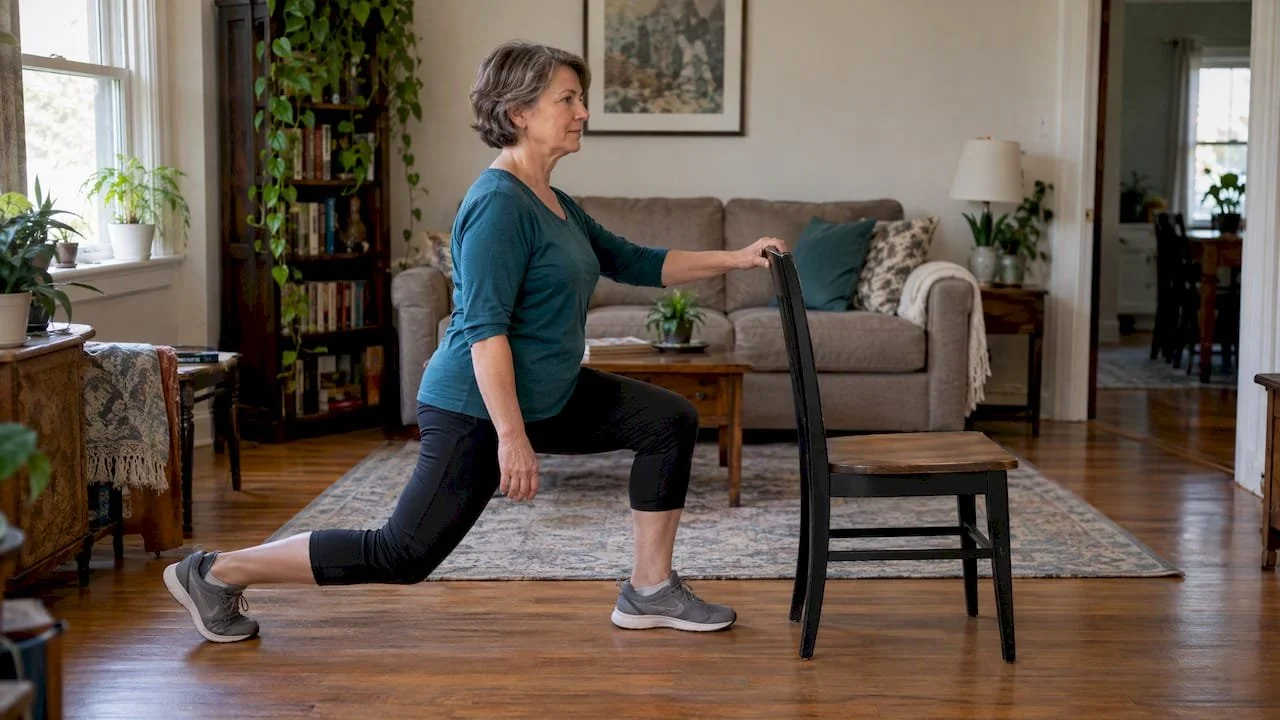
4. Reverse lunge. Step one foot back, lower your back knee toward the floor, then push through your front heel to return. Stepping back usually feels kinder on the front knee than stepping forward. Hold a counter or chair for balance at first.
5. Step-up. Use a low step or the bottom stair. Place one foot fully on it, press up, tap the other foot, and lower with control. Raise the step height gradually.
Upper body
6. Wall push-up. Stand an arm's length from a wall, hands at chest height. Bend your elbows to bring your chest toward the wall, then press back. Move your feet farther from the wall to make it harder. The next stages are an incline push-up on a counter or bench, then a floor push-up from the knees.
7. Resistance band row. Loop a band around a post at chest height, or sit with it around your feet. Pull your elbows back and squeeze your shoulder blades gently together. Pausing for one second at the end makes it far harder than it looks.
8. Band chest press. Anchor a band behind you, or wrap it across your upper back, and press your hands forward. It trains the same muscles as a bench press with much less setup.
9. Biceps curl. Use a band under your foot, a dumbbell, or a filled water bottle. The NHS notes that household items like water bottles can add resistance when you progress. Keep your elbows by your sides.
10. Seated overhead press. Sit tall in a chair with light dumbbells at shoulder height and press up. Sitting keeps your lower back steady, which is useful if standing presses bother it.
Core and balance
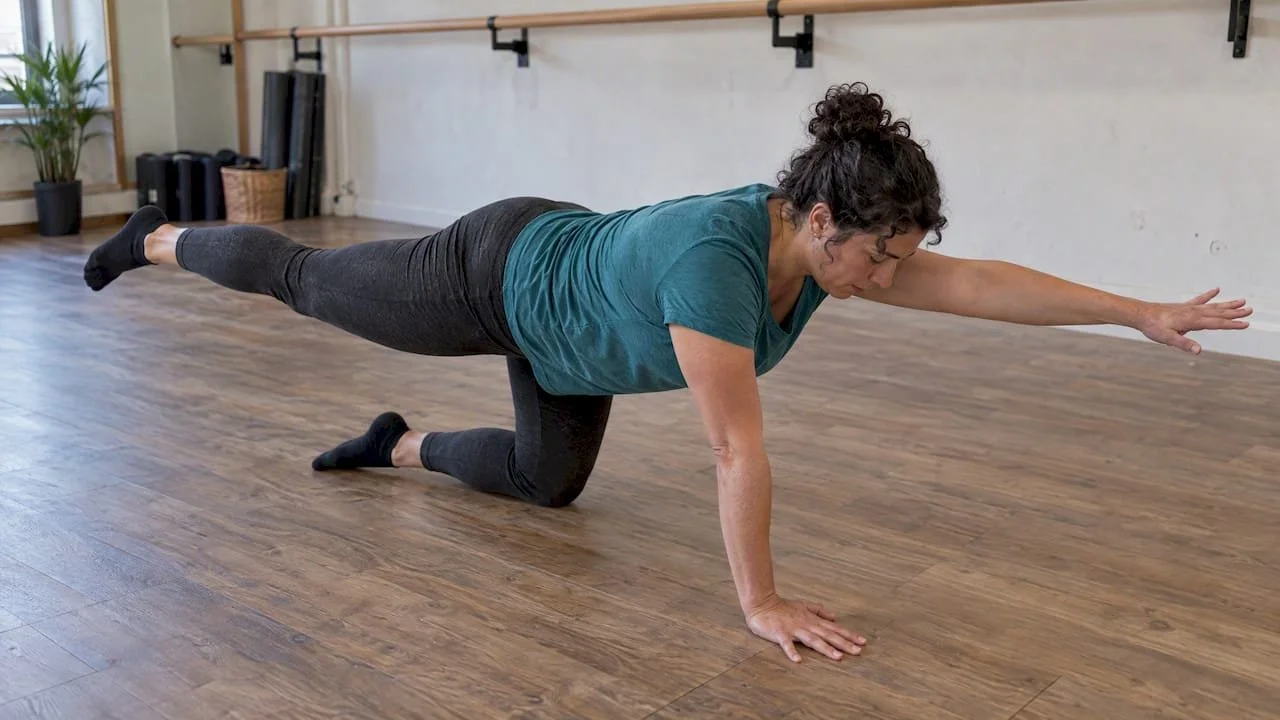
11. Bird-dog. On hands and knees, extend the opposite arm and leg, keep your hips level, and return. Do not rush: it is about control, not height. It works your back, glutes and deep core together.
12. Dead bug. Lie on your back with knees over hips and arms toward the ceiling. Lower one arm and the opposite leg, keeping your lower back gently against the floor. Switch sides.
13. Forearm plank on the knees. Rest on your forearms and knees with a straight line from shoulders to knees. Hold 15 to 30 seconds. Move to full plank when you can hold the knee version for a minute without your hips sagging.
14. Crab walk or side-lying leg lift. For hip strength, lie on your side and raise the top leg slowly, or take small steps sideways with a band above your knees. Both target the outer hips, which help steady your knees and pelvis when you walk.
A full-body low-impact workout you can do twice a week
Here is a template that covers every major muscle group using the moves above. Total time: about 25 minutes.
| Order | Movement pattern | Pick one | Sets x reps |
|---|---|---|---|
| 1 | Squat | Chair squat or step-up | 2 x 8 to 12 |
| 2 | Hinge | Glute bridge | 2 x 10 to 12 |
| 3 | Push | Wall push-up or band chest press | 2 x 8 to 12 |
| 4 | Pull | Band row | 2 x 10 to 12 |
| 5 | Core | Bird-dog or dead bug | 2 x 6 per side |
| 6 | Hold | Wall sit | 2 x 20 to 40 seconds |
Rest 45 to 60 seconds between sets. Do the session on two non-consecutive days. When 12 reps feel easy, change one variable at a time: add a pause, slow the lowering phase to three seconds, use a thicker band, or add a set. Slowing down and shortening your range of motion are two ways to scale bodyweight work, according to CDC guidance, without reaching for heavier weights.
Low-impact alternatives to a gym routine
You do not need a membership to meet the recommendation. Several formats count as strength work if you reach the point where more repetitions feel hard:
Bodyweight and band circuits at home. Cheapest, and everything in the list above works in a living room.
Yoga and tai chi. The CDC calls these multicomponent activities because they combine strength, balance and aerobic elements, and it notes they help reduce fall risk in older adults.
Pilates. Mat and reformer work uses controlled resistance through the whole body. Our guides on Pilates exercises for all levels and wall Pilates show what a session looks like.
Barre. Small, controlled pulses and holds fatigue the legs, glutes and core. We explain why in our piece on barre as a low-impact workout.
Cycling, swimming and rowing. Excellent for the heart and lungs, and the NHS leaflet on joint pain lists cycling and swimming as low-stress options. Pair them with the strength moves above.
Chair-based work. If standing is difficult, try our chair yoga routine.
Our perspective: strength is a skill, and so is patience
Most people who walk into a studio for the first time are not afraid of effort. They are afraid of looking lost, or of getting hurt on day one. That is why we build our classes around clear instructions, options for every level and a room where nobody is keeping score.
What we see again and again is that the people who get stronger are the ones who can keep showing up. A moderate session twice a week for six months beats a punishing month followed by a sore knee and a long break. Low-impact formats such as mat Pilates, barre, tai chi and yoga make that consistency easier, because you can do them the day after a busy week without dreading recovery.
We also think form matters more than load. A slow bridge with your glutes truly working teaches more than a rushed set of twenty. A teacher watching your alignment can fix in a minute what takes weeks to notice alone. If you have a past injury, we recommend pairing group classes with a private session so the work can be shaped around you. Our piece on how Pilates supports rehab goes deeper on this.
— Juiced
When it hurts: soreness, pain and who to ask
Some muscle soreness after a new routine is normal. The NHS joint-pain leaflet describes acceptable soreness as settling within about 24 hours, and treats sharp pain, localized swelling or pain lasting beyond 48 hours as a signal to adjust. Kaiser Permanente gives the same 48-hour marker: if pain worsens as you move or persists, modify or swap the activity.
Practical adjustments:
Reduce range of motion (a shallower squat, a higher step).
Switch from standing to supported (wall push-up instead of floor, chair squat instead of lunge).
Cut the number of sets in half for a week.
If you have knee or hip pain that does not settle, see a physical therapist or your primary care clinician before progressing. If you are recovering from heart surgery or a cardiac event, do not start on your own. The American Heart Association describes cardiac rehabilitation as a medically supervised program, and says exercise after such events should follow an individualized prescription. Ask your cardiologist for clearance first, and never resume high-intensity exercise without it, as the AHA notes.
Bring it into a Philadelphia studio
Home work is a fine start. But if you would like feedback on your form, a schedule that holds you to it and some company, our Philadelphia studio offers in-person yoga, mat Pilates, group reformer, barre and tai chi, plus private sessions.
A Community Class drop-in is 11 $, and a Group Class drop-in is 28 $ per session.
Nurtured Beginnings is 35 $ per pass, and is a good place to start if everything feels new.
If you train regularly, 1 Month Unlimited Group Classes is 169 $ per month, and the Earth Monthly Membership is 119 $ per month.
A One to One Session starts from 85 $ per hour, useful if you are working around an injury or want your form checked. You can read about each style on our class descriptions page.
If you want to practice between visits, start with our step-by-step guide to Pilates at home or the mind-body connection exercises.
Making it stick: a four-week ramp
Week 1: Two sessions, one set of each move in the table. Focus only on form.
Week 2: Add a second set. Add a 10-minute walk on a third day.
Week 3: Slow the lowering phase to three seconds, or add a one-second pause at the hardest point.
Week 4: Swap one move for a harder variation (incline push-up for wall push-up, reverse lunge for chair squat), and keep the rest the same.
Pair the strength days with aerobic activity. The CDC recommends 150 minutes a week of moderate aerobic activity in addition to the two strength days, and the 150 minutes can be broken into smaller pieces. Brisk walking, cycling or water aerobics all count.
FAQ
Can low-impact exercise really build strength?
Yes. Muscles respond to effort, not to impact. If your last repetitions are hard to complete with good form, the set is doing its job. Slower tempo, pauses, bands and added load make bodyweight moves harder over time.
How often should I do low-impact strength training?
The CDC advises muscle-strengthening activity on at least 2 days a week, covering the legs, hips, back, chest, abdomen, shoulders and arms. Two full-body sessions of 20 to 30 minutes is a sound beginner plan. Leave a day between sessions if you are sore.
What can I do instead of the gym?
Bodyweight and band circuits at home, yoga, tai chi, Pilates, barre, cycling and swimming are all good options. Multicomponent activities such as yoga and tai chi also train balance, which a standard machine routine often skips. Choose the one you will actually show up for.
Is it okay to exercise when I am sore?
Usually, yes, if the soreness is mild and fades within a day or so. Do lighter, gentler work such as walking or a bridge series. If you have sharp pain, swelling, or pain that lasts past 48 hours, stop that movement and speak with a clinician.
Sources
American Heart Association: Core components of cardiac rehabilitation programs, 2024 update
American Heart Association: Many people miss out on the benefits of cardiac rehab