Wall Pilates Benefits: Core, Posture, and Balance at Home
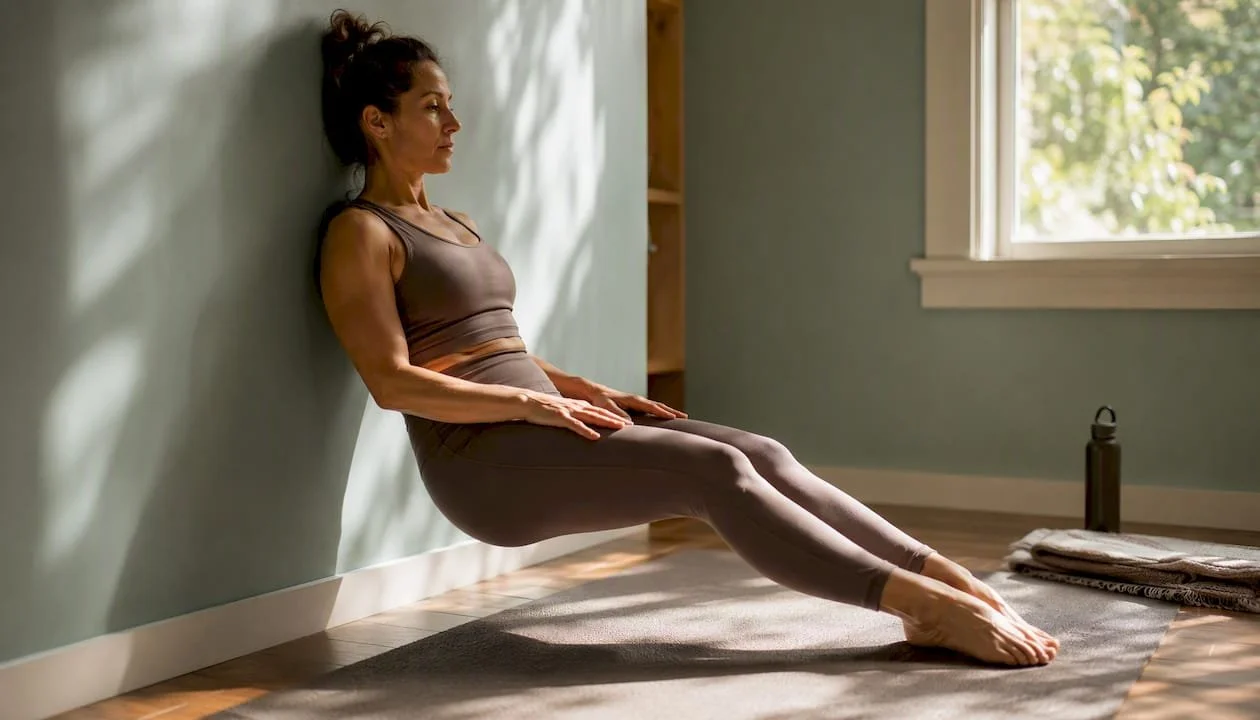
Wall Pilates builds core strength, improves posture, sharpens balance, and increases flexibility without loading your joints. It's one of the most accessible forms of Pilates you can do, and it works whether you're a complete beginner, recovering from an injury, or just tired of exercises that aggravate your knees and lower back. Small studies aggregated by researchers suggest Pilates-based protocols can reduce chronic back pain and improve postural alignment measurably, and at Amritayogawellness, instructors see those shifts show up in students who practice consistently. If you sit at a desk all day, are returning to movement after a break, or simply want a no-equipment routine you can do in your living room, wall Pilates is worth your time.
Key Takeaways
Wall Pilates is one of the most effective low-impact tools for building core strength, improving posture, and reducing joint stress, with measurable results typically appearing within 2–6 weeks of consistent practice.
| Point | Details |
|---|---|
| Core and posture gains | Small studies suggest 27% higher oblique activation and measurable posture improvement with wall-supported protocols. |
| Who benefits most | Beginners, desk workers, older adults, and people in rehab get the clearest early gains from wall Pilates. |
| Practice frequency | Start at 2–3 sessions per week; progress to 3–4 for more consistent change, per trainer guidance. |
| Safety first | Stop if you feel sharp pain, numbness, or tingling, and get medical clearance before starting post-surgery. |
| How to begin | The 7-exercise beginner routine in this guide takes 10–15 minutes and requires only a wall and a mat. |
Table of Contents
Who gets the most from wall Pilates, and who should be careful?
How often should you practice, and when will you notice results?
How does wall Pilates compare with mat and reformer Pilates?
Instructor tips and common misconceptions about wall Pilates
What are the main wall Pilates benefits?
The wall does something a mat can't: it gives your body an honest reference point. When your spine drifts out of neutral or your hips tip forward, the wall tells you immediately through pressure and contact. That tactile feedback is the core mechanism behind most of the benefits below.
Core strength and deep muscle activation
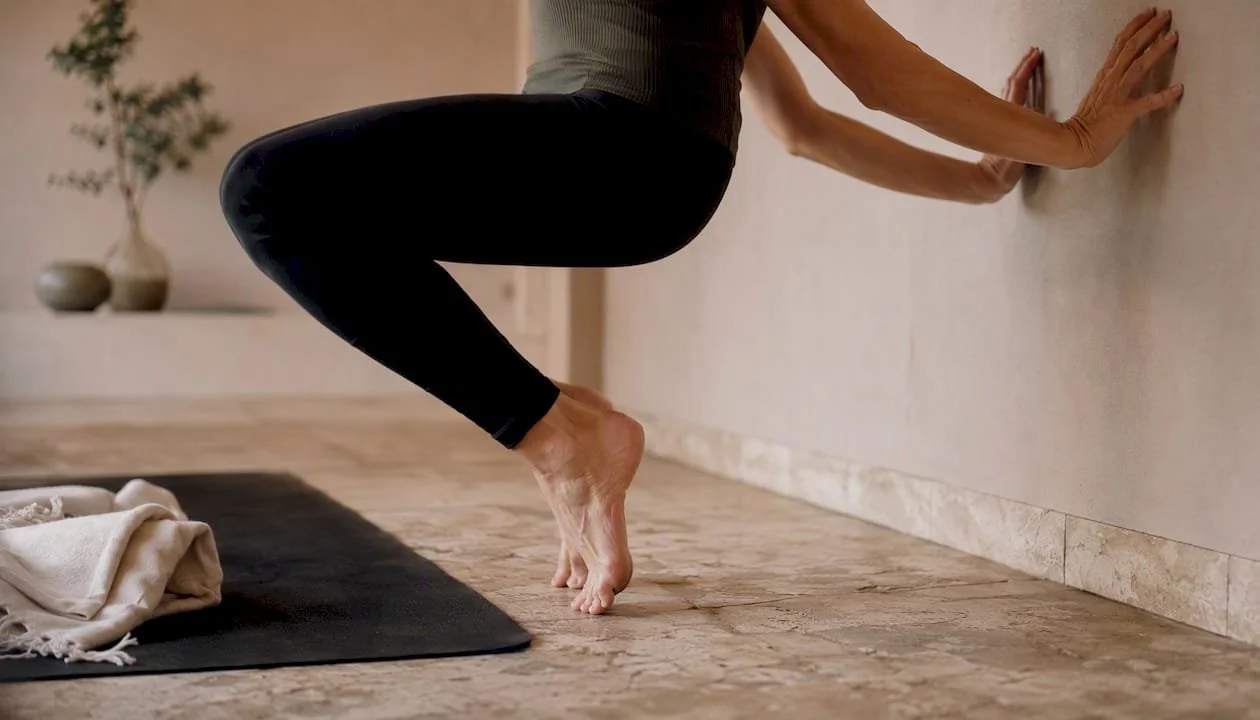
Pressing your feet or hands into the wall during moves like a wall bridge or wall plank creates isometric resistance. Your core has to work against that force to keep your spine stable, which recruits the transversus abdominis and obliques more directly than many open-chain mat exercises. One lab comparison cited in research summaries found oblique EMG activation roughly 27% higher in wall-supported Pilates protocols compared with standard mat work, though study sizes were small and results should be read with that caveat in mind.
Posture and spinal alignment
The wall acts as a real-time alignment coach. When you stand with your back against it for a roll-down or a standing leg slide, you feel exactly where your lumbar spine is lifting away or where your shoulders are rounding. Wall Pilates supports posture and flexibility in ways that transfer to how you carry yourself off the mat, and one cited study reported a measurable posture improvement in participants following a wall-supported Pilates protocol.
Balance and fall-risk reduction
Removing the balance variable during foundational moves lets your deep stabilizers fire without the nervous system splitting its attention. Once those muscles are trained, balance improves. Research aggregated from multiple reviews suggests Pilates-related protocols may reduce fall risk in older adults by around 22% in some meta-analyses, though the wall-specific evidence base is still developing.
Flexibility and spinal decompression
Legs-up-the-wall is the clearest example: gravity gently lengthens the hamstrings and decompresses the lumbar spine simultaneously, with zero active effort required. Supine hamstring slides against the wall let you control range of motion precisely, which is safer than forcing a stretch on a mat.
Low-impact, joint-friendly conditioning
The wall redistributes load. In a wall squat, the surface absorbs some of the shear force that would otherwise travel through the knee joint. That makes wall Pilates genuinely suitable for people with knee osteoarthritis, hip replacements (with clearance), or general joint sensitivity. Wall Pilates is a low-barrier, low-cost option that requires no equipment beyond a clear wall and a mat.
Who gets the most from wall Pilates, and who should be careful?
Wall Pilates suits a wide range of people, but it isn't the right starting point for everyone.
Ideal candidates:
Beginners who want to learn Pilates fundamentals with built-in alignment support before moving to mat or reformer work
Desk workers with tight hip flexors, rounded shoulders, and chronic low-grade back tension
Older adults who want to improve balance and reduce fall risk through low-impact conditioning
People in rehab (with clinician clearance) recovering from lower back issues, mild knee problems, or post-surgical deconditioning
Postpartum individuals looking for gentle core reconnection, particularly in the early return-to-exercise phase
Use caution or get clearance first if you have:
Recent spinal surgery or an unstable spine diagnosis
Acute joint inflammation or a flare of arthritis
Uncontrolled hypertension (inverted positions like legs-up-the-wall can affect blood pressure)
Active sciatica with radiating leg symptoms
If you're pregnant, consult your OB or midwife before starting. Many wall Pilates moves are safe in the second trimester with modifications, but supine positions and strong abdominal compression should be avoided without professional guidance.
How does the wall actually change Pilates mechanics?
The wall isn't just a prop for balance. It changes the physics of each exercise in ways that make certain muscles work harder, not easier.
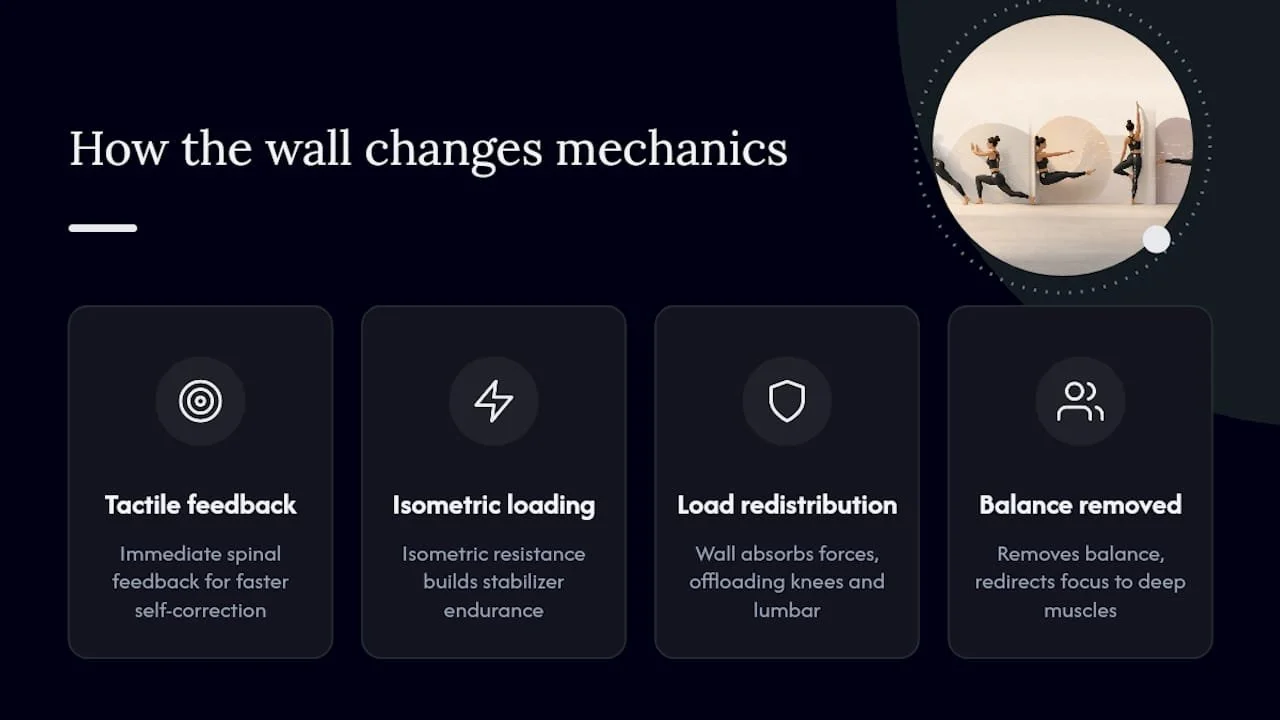
Tactile feedback and proprioception. Your skin and joints are constantly sending position signals to your brain. When your back contacts the wall, those signals become much louder and more specific. Tactile feedback accelerates postural learning because spinal deviations become obvious immediately, letting beginners self-correct faster than they would on a mat alone.
Isometric loading. Pressing your feet into the wall during a bridge, or your palms during a wall plank, creates resistance without movement. Isometric contractions are highly effective for building endurance in stabilizer muscles, which is exactly what core conditioning targets.
Load redistribution. The wall absorbs a portion of the compressive and shear forces that would otherwise travel through your joints. For someone with knee sensitivity, this means they can perform a squat pattern safely. For someone with lower back pain, it means they can access hip hinge mechanics without the lumbar spine taking the full load.
Removing the balance variable. When you don't have to fight gravity to stay upright, your nervous system can redirect attention to deep muscle activation. That's why the wall improves form and reduces injury risk for beginners, and why even experienced practitioners use it to isolate specific muscle groups. See how wall Pilates fits within the broader spectrum of popular Pilates styles if you want to understand where it sits relative to other formats.
Key wall Pilates exercises and how to do them
These six moves cover the full body and form the foundation of most beginner wall Pilates routines. For each one, the goal is control over speed.
Wall bridge (foot press): Lie on your back with feet flat on the wall, knees bent at roughly 90 degrees. Press both feet evenly into the wall and lift your hips until your body forms a straight line from knees to shoulders. Hold 2–3 seconds, lower slowly. Progression: single-leg bridge. Modification: reduce the height of the lift if your lower back arches.
Wall sit/squat: Stand with your back flat against the wall, feet hip-width apart and about 18 inches from the base. Slide down until your thighs are parallel to the floor (or as far as comfortable). Hold 20–40 seconds. Progression: add a heel raise at the top. Modification: stop at a shallower angle if your knees ache.
Wall plank/press: Face the wall, place palms flat at shoulder height, and walk your feet back until your body is at a diagonal. Engage your core and hold, or add a slow push-up. Progression: lower your hands to hip height for more load. Modification: keep hands at chest height for less demand on the shoulders.
Standing leg slides: Stand sideways to the wall with one hand lightly touching it for balance. Slide one leg forward and back in a controlled arc, keeping your pelvis level. Progression: add a small hip circle. Modification: reduce the range of motion if your hip flexors pull.
Legs-up-the-wall (supine): Lie on your back and extend both legs up the wall, hips as close to the base as comfortable. Breathe slowly for 1–3 minutes. This decompresses the lumbar spine and stretches the hamstrings passively.
Standing roll-down: Stand with your back against the wall, feet a few inches from the base. Tuck your chin and peel your spine away from the wall one vertebra at a time, reaching toward the floor. Roll back up the same way. Progression: add a single-leg variation at the bottom. Modification: bend your knees generously if your hamstrings are tight.
Pro Tip: During the wall bridge, press your feet into the wall as if you're trying to push it away from you. That cue fires the glutes and hamstrings far more effectively than just lifting your hips.
A 10–15 minute beginner wall Pilates routine to try
You need a clear wall, a yoga mat or folded blanket for your back, and about 12 square feet of floor space. No other equipment required.
Setup: Place your mat perpendicular to the wall so your feet can reach it easily when lying down.
Move through the sequence at a pace where you can breathe steadily throughout. If 30-second holds feel too long in week one, start at 15 seconds and add 5 seconds each session. For more Pilates exercises that complement this routine, the Amritayogawellness blog has additional movement guides.
How often should you practice, and when will you notice results?
Start with 2–3 sessions per week. That frequency gives your muscles enough stimulus to adapt while leaving recovery time, which matters especially if your core is deconditioned. Trainers recommend around three sessions per week for noticeable change, with sessions running 10–20 minutes for beginners.
Most people notice something within 2–4 weeks: a little more awareness of their posture at the desk, less lower back fatigue by the end of the day, or slightly easier balance on one leg. Flexibility changes tend to show up in the 4–6 week range. Meaningful core strength gains usually take 6–12 weeks of consistent practice.
Progression markers to watch for:
You can hold a wall sit for 45–60 seconds without your form breaking down. Move to a single-leg variation.
The standing roll-down feels smooth and segmental rather than stiff and blocky. Add a single-leg balance at the bottom.
Wall bridges feel easy at 10 reps. Increase to 15 reps or shift to single-leg bridges.
Once you're practicing 3–4 times per week and the basic moves feel controlled, consider adding a Pilates workout class to your week for coached progression.
Safety tips, common mistakes, and modifications
Most wall Pilates injuries come from one of three things: forcing range of motion, holding your breath, or letting the lower back arch when the core fatigues.
Common mistakes to avoid:
Letting your lower back peel away from the wall during leg slides or bridges. If it does, reduce the range of motion.
Locking your knees during a wall sit. Keep a micro-bend to protect the joint.
Rushing through roll-downs. Each vertebra should peel off the wall individually, not in a single hinge.
Holding your breath during isometric holds. Exhale on the effort, inhale on the release.
Modifications by limitation:
Knee pain: Keep wall sits above 90 degrees (shallower angle). Avoid deep wall squats entirely until cleared.
Wrist pain: For wall planks, make fists instead of flat palms to reduce wrist extension.
Shoulder mobility limits: Keep hands at chest height or higher on the wall during planks and presses.
Low back sensitivity: Place a folded blanket under your sacrum during supine work and avoid full spinal flexion in roll-downs until your core is stronger.
Stop and consult a professional if you experience:
Sharp or shooting pain during any movement
Numbness or tingling in your arms or legs
Dizziness during inverted positions like legs-up-the-wall
Pain that persists more than 24 hours after a session
This article is general information, not medical advice. If you have a diagnosed condition or are post-surgery, confirm these exercises are appropriate with your physician or physical therapist before starting.
How does wall Pilates compare with mat and reformer Pilates?
Each format has a distinct role, and the best results usually come from combining them rather than treating them as competing options.
| Format | Strengths | Limits |
|---|---|---|
| Wall Pilates | Alignment feedback, zero cost, joint-friendly, beginner-accessible | Limited resistance range; fewer exercise variations than reformer |
| Mat Pilates | Full movement range, no equipment, portable | Less alignment feedback; balance demand can frustrate beginners |
| Reformer Pilates | High resistance variety, spring-loaded feedback, wide exercise library | Requires equipment and studio access; higher cost |
Wall Pilates excels at alignment, control, and low-impact conditioning. Where it falls short is maximum strength development and body-composition change at scale. Experts recommend combining wall Pilates with mat, reformer, or resistance training when the goal shifts toward heavier strength or significant muscle gain. For a deeper look at how these formats relate, the Amritayogawellness guide to 7 different kinds of Pilates breaks down each style's purpose and ideal use case. For readers focused on mat Pilates specifically, that format pairs naturally with wall work as a progression.
Instructor tips and common misconceptions about wall Pilates
The most persistent misconception is that wall Pilates is too easy to be worth doing. Instructors push back on this directly.
The support the wall provides lets you access deeper muscles precisely because your nervous system isn't busy managing instability. That's a feature, not a shortcut.
Two cues instructors use most:
"Press the wall away from you." This cue works for bridges, planks, and leg slides. It activates the posterior chain and core simultaneously rather than letting the movement become passive.
"Find one point of contact and keep it." During standing moves, maintaining consistent contact with the wall at the sacrum or upper back teaches the body where neutral spine actually lives.
Pro Tip: If a wall Pilates move feels effortless, you're probably not pressing into the wall with enough intention.
A note from the Amritayogawellness studio
At Amritayogawellness in Philadelphia, we work with students across a wide range of starting points, and wall Pilates comes up often as the entry point that finally makes Pilates click. The wall removes the guesswork about alignment, which means students spend less time confused and more time actually feeling the work. If you're curious about where to start, the 10–15 minute routine in this guide is a reasonable first session. When you're ready for more structure, a teacher can help you identify which progressions make sense for your body and your goals.
Sources
This article is general information, not a substitute for advice from a qualified doctor. Consult a qualified healthcare professional about your own circumstances before acting on anything here.