Mindfulness at work has the strongest evidence for lowering stress and burnout and improving well-being, resilience and job satisfaction. The evidence for productivity is more modest. A large 2023 review of workplace programs found meaningful gains across mental health, stress and resilience, and it also found that results vary with program quality and workplace support. Below, we walk through each benefit, what the numbers actually say, and how to build a practice that fits a real workday.
Amritayogawellness
Make Mindfulness Part of Your Day
Explore yoga and wellness offerings in Philadelphia that can support a mindful practice beyond your workday.
TL;DR
Across 91 studies, workplace mindfulness programs improved stress, well-being, mental health and resilience, with stress and resilience showing the largest effects.
Burnout is where longer programs stand out: courses of at least 16 hours showed the highest rate of improvement in a 2024 review.
Productivity gains are real but smaller and less certain than the wellness gains, so treat focus as a bonus, not a promise.
Benefits are bigger when the workplace supports the practice. Short, repeated practices beat one-off seminars.
You can start with two to five minutes a day: single-tasking, a breathing pause before meetings, and a mindful walk.
Table of Contents
What "mindfulness at work" actually means
Mindfulness is paying attention to what is happening right now, in your body, your thoughts and the task in front of you, without rushing to judge it. At work, that rarely looks like sitting on a cushion. It looks like noticing that your shoulders are up around your ears during a tense email, taking one slow breath before replying, or finishing a report without checking your phone every few minutes.
Researchers study two broad kinds of programs. Mindfulness-based programs are structured courses, often eight weeks, with guided meditation and home practice. Mindfulness-informed programs borrow elements such as short breathing exercises, body awareness and acceptance, and deliver them in lighter formats. The reviews below include both, which is useful, because most people will start with the lighter kind.
The benefits, ranked by strength of evidence
Lower stress
Stress reduction is the most consistent finding. The 2023 systematic review and meta-regression by Michaelsen and colleagues pooled 91 studies with nearly 5,000 participants in intervention groups. It found a stress effect of SMD = 0.72, a moderate-to-large result by research standards.
A separate 2020 meta-analysis of randomized controlled trials by Vonderlin and colleagues agrees. Its perceived stress effect was g = −0.66, and the benefits held at follow-up assessments up to 12 weeks later. The negative sign simply means stress went down.
What this means for you: if your main reason for trying mindfulness is that work feels like too much, you are asking the question the research answers best.
Less burnout, especially emotional exhaustion
A 2024 systematic review by Shoker and colleagues looked at 49 randomized trials on burnout. In 67% of the studies, mindfulness training had a significant beneficial effect on at least one burnout indicator, and emotional exhaustion was the component most affected. Programs lasting at least 16 hours showed an 86% rate of significant improvement.
The authors suggest the mechanism is emotional flexibility: by building attention and awareness, people notice their emotional state, limits and resources earlier and regulate stress before it compounds. That fits what most practitioners report. You do not get fewer difficult meetings, but you catch the tightening sooner.
Better emotional regulation
A small 2015 study of 41 call center employees in Canada tested a brief audio-delivered mindfulness intervention. Participants reported lower distress, stress and burnout, and they were better able to hold back impulsive or reactive behavior when negative emotions arose. Emotional awareness itself did not change significantly, which is a useful detail: the gain came from what people did with the feeling, not from feeling more.
That pause between a trigger and a response is the everyday value of mindfulness at work. It is the difference between a sharp reply to a colleague and a clear one.
Stronger well-being, mental health and resilience
The Michaelsen review reported improvements in well-being (SMD = 0.63), mental health (0.67) and resilience (1.06), the largest effect among the outcomes it measured. Vonderlin's team found the strongest effects for well-being and life satisfaction (g = 0.68), alongside reductions in mental distress and somatic complaints.
Resilience here means recovering from setbacks and handling pressure more skillfully. It does not mean feeling nothing. A 2021 realist review of 75 studies found that these programs help participants deal more skillfully with stressful events and improve well-being.
Higher job satisfaction and engagement
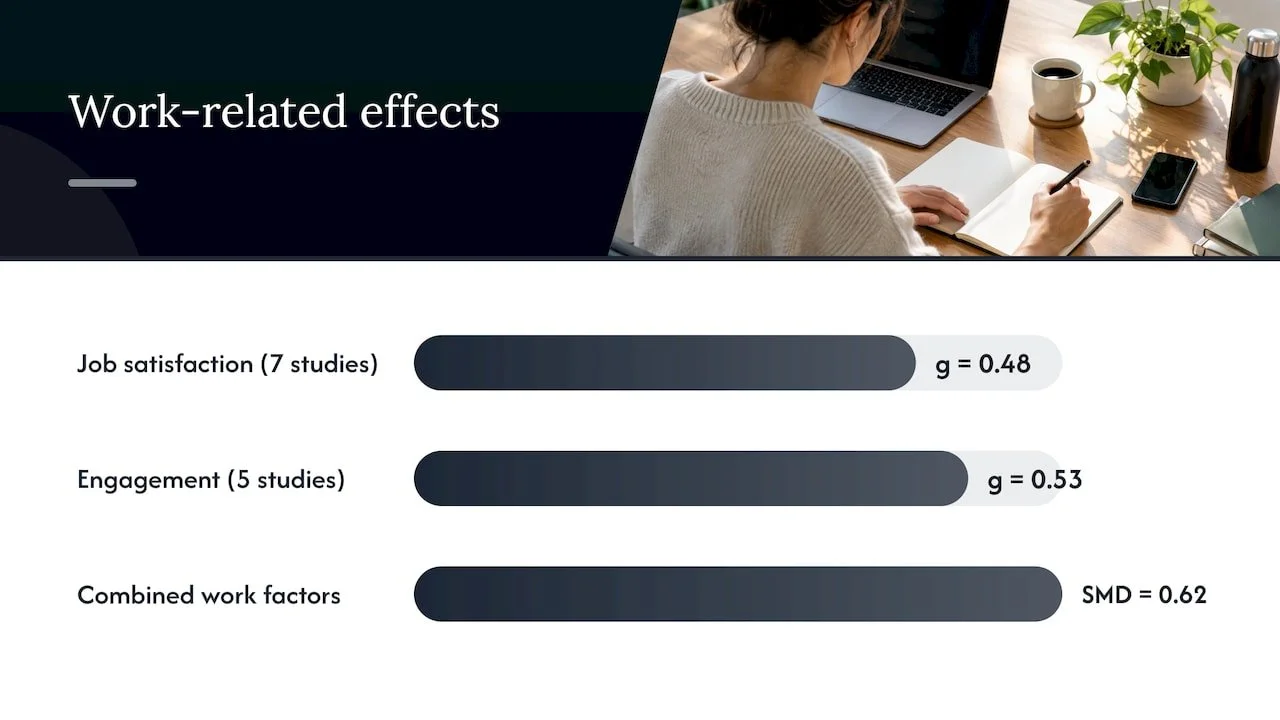
Vonderlin's analysis found significant effects on job satisfaction (g = 0.48) and work engagement (g = 0.53). These came from smaller groups of studies (seven and five respectively), so the figures are encouraging rather than definitive. The Michaelsen review also reported a combined improvement in work-related factors (SMD = 0.62).
A 2026 literature review by Singh and Duggal adds that mindfulness is linked with better performance, relationships and well-being at work, while noting that research on what makes mindfulness take hold in the first place is still thin.
Better sleep and physical health
Work stress follows people home. The Michaelsen review found a significant improvement in physical health (SMD = 0.45). A 2025 meta-analysis of four trials covering 195 stressed working adults found that mindfulness improved global sleep quality and sleep duration and reduced sleep medication use. The sample is small, so read it as a promising signal.
A randomized trial of 239 employee volunteers found that therapeutic yoga and mindfulness-based programs improved perceived stress and sleep quality compared with a control group, and online and in-person delivery worked equally well. That finding matters for people with irregular schedules, since a livestream class can do the same job as a studio one.
Sharper focus, with a caveat on productivity
A 2018 randomized trial at an Ohio digital marketing firm compared six weeks of mindfulness training with a half-day seminar. The six-week group showed greater improvement in attentional focus and less work-life conflict, while both groups improved similarly on perceived productivity. Repetition seems to beat a single event.
On hard productivity claims, the evidence is more cautious. A 2025 meta-analysis of 99 studies found that mindfulness programs improved task performance compared with passive control groups (g = 0.25) but not compared with active control groups, and the authors rated confidence in the results as very low. Vonderlin's productivity effect (g = 0.35) also leaned heavily on one study.
The practical reading: mindfulness is a reliable way to feel steadier and more present, and a plausible way to focus better. Do not expect it to double your output.
Summary of the evidence
| Benefit | Strongest finding | Confidence |
|---|---|---|
| Stress | SMD = 0.72 (2023 review, 91 studies) | High consistency across reviews |
| Resilience | SMD = 1.06 (2023 review) | Good, with varied study quality |
| Burnout | 67% of 49 trials improved at least one indicator | Good, stronger in longer programs |
| Well-being and mental health | SMD = 0.63 and 0.67 | Good |
| Job satisfaction | g = 0.48 (2020 meta-analysis) | Moderate, few studies |
| Sleep | Better global sleep quality in 4 trials | Early, small sample |
| Productivity | g = 0.25 versus passive controls | Low |
When mindfulness at work does not deliver
The research is clear that the setting matters. The 2021 realist review concluded that simply offering a program is not enough: a supportive environment has to exist, and worries about looking unproductive or exposed in front of colleagues can lead people to drop out. Michaelsen's team also points out that study heterogeneity and risk of bias mean firmer conclusions need higher-quality trials.
Translated into advice:
Practice should not be an extra chore. If it feels like one more task, shrink it until it fits inside something you already do.
Managers set the tone. Practice that leaders join, and that is optional, tends to stick. Mindful describes company programs where executives sit alongside everyone else, which signals that looking after yourself at work is acceptable.
Mindfulness is a skill, not a fix for a broken workload. It helps you meet pressure more skillfully. It works best alongside reasonable staffing and boundaries.
If you are dealing with depression, anxiety or trauma, talk with a licensed mental health professional or your doctor. Mindfulness can sit beside care, and a clinician can tell you how to fit it in.
How to practice mindfulness at work
The most useful workplace practices are short, specific and tied to a trigger. These are drawn from common guidance, including the Mindful best-practice roundup, which lists brief breaks, mindful transitions, single-tasking, and mindful meetings and email.
One-breath start. Before you open email, take three slow breaths and feel your feet on the floor. Thirty seconds.
Single-task in blocks. Pick one task, close other tabs, and work for 25 minutes. When your mind wanders, notice it and return. The return is the practice.
Meeting pause. Before a meeting begins, notice how you feel and set one intention, such as listening fully for the first five minutes.
Transition ritual. Between tasks, stand, stretch your shoulders and look out a window for a minute. This keeps stress from carrying over.
Mindful listening. In a conversation, let the other person finish before you form your reply. Notice the urge to interrupt without acting on it.
End-of-day scan. Spend two minutes noticing your body, then name one thing that went well.
Two to five minutes a day, done consistently for several weeks, is a realistic start. The 2018 trial suggests that weeks of repetition outperform a single burst, so frequency matters more than length. For more ideas, see our guides to mindfulness tips, tips for mindfulness practice that reduce stress and building a mindfulness workflow. If you want the wider picture beyond work, our piece on the benefits of mindfulness with a practice for each goes deeper.
A sample day for a desk worker
Here is how a 9-to-5 might hold five minutes of practice without anyone noticing:
8:55 a.m.: three breaths before opening your inbox.
11:00 a.m.: a one-minute stretch and window gaze after your first deep-focus block.
12:30 p.m.: the first five bites of lunch without a screen.
3:00 p.m.: a short walk, noticing your steps and the air.
5:30 p.m.: a two-minute body scan before you leave, to mark the end of the workday.
Adding up to roughly ten minutes across the day, this routine asks for almost no time and gives you regular reset points.
Why a guided class can make it stick
The studies that show the largest burnout effects used structured programs of 16 hours or more, with a teacher, a group and home practice. That is hard to replicate alone from a blog post. A regular class gives you the same ingredients: a set time, a guide and a room of people doing the same thing. Movement-based practices such as yoga count too, as the 239-employee trial of therapeutic yoga and mindfulness showed.
We teach in Philadelphia and offer several ways in. Our class schedule shows what is running now, and if you sit most of the day, our chair yoga sequence is a gentle place to begin. If you want to bring a practice to your team, take a look at our corporate wellness programs.
Our perspective
We teach mindfulness through movement, breath and stillness, and we meet a lot of people who have been told to "just relax" at work. That advice does not work. What does work, in our experience, is a practice that is specific, repeatable and shared.
That is why we build classes for every level, from first-timers to long-time practitioners. Our beginner-friendly formats, including Nurtured Beginnings, are designed so that nobody feels exposed or behind. The research on drop-out says that feeling out of place is the quiet reason people quit, and we design the room to prevent it.
We also think community matters as much as technique. A familiar teacher, a regular time and people you recognize turn a good intention into a habit. Our memberships are designed to make it easy to come often, and a livestream option means a busy week does not break the chain.
Mindfulness at work starts with five calm minutes. Over a few months it can grow into a practice that supports how you move, sleep and respond when things get hard.
Juiced
Start practicing with us in Philadelphia
If you want guidance rather than going it alone, our group classes are the simplest place to begin. A Group Class Drop In is $28 per session, a Livestream Class Drop In is $19, and a Community Class Drop In is $11. If you are new, Nurtured Beginnings is $35 per pass. For regular practice, monthly memberships run from $119 (Earth) to $149 (Air), and a Livestream Class Membership is $49 per month. Prices are as published on our site, so check the page for current details.
Prefer one-on-one attention? A private session starts at $85 per hour, and for deep rest after a demanding stretch, our Ayurvedic therapies include Shirodhara at $90 per session.
FAQ
Can mindfulness be professionally beneficial?
Yes. Reviews of randomized trials link workplace mindfulness programs with lower stress and burnout and with better well-being, resilience and job satisfaction. Evidence for productivity gains is weaker, so the clearest professional benefit is staying steadier under pressure.
How long does it take to see benefits at work?
Many programs in the research run for around eight weeks, and the burnout review found the best results in programs of 16 hours or more. You can feel calmer after a single short practice, but lasting changes in stress and focus usually build over several weeks of regular practice.
Can I practice mindfulness at my desk without anyone noticing?
Yes. Slow breathing, feeling your feet on the floor, single-tasking and mindful listening in meetings all look like ordinary work. A two-minute pause between tasks is enough to count as practice.
Do I need to meditate to be mindful at work?
No. Seated meditation is one route, but movement-based practices such as yoga, and informal habits such as mindful transitions, also build attention and awareness. A trial of 239 employees found that therapeutic yoga and mindfulness-based programs both improved stress and sleep.
Is mindfulness a substitute for fixing a stressful workload?
No. Research shows programs work best when the workplace supports them. Mindfulness helps you respond to pressure more skillfully, and it is most effective alongside sensible workload and boundaries.
Sources
Vonderlin et al. (2020), mindfulness-based programs in the workplace: meta-analysis
Shoker et al. (2024), standardized mindfulness programs and burnout
Grégoire, Lachance and Taylor (2015), mindfulness, mental health and emotion regulation
Vainre et al. (2025), mindfulness-based programmes for work performance
Slutsky et al. (2018), mindfulness training and employee well-being
Singh and Duggal (2026), antecedents and outcomes of mindfulness at work
Wolever et al. (2012), mind-body stress reduction in the workplace
Mindfulness and sleep quality in working adults (2025), meta-analysis
Micklitz, Wong and Howick (2021), realist review of workplace mindfulness programmes