
Mindfulness can help students pay attention, handle stress and manage strong emotions, and in some studies it also supports kindness toward classmates and even grades. The effects are usually modest rather than dramatic, and they grow with regular, age-appropriate practice. Below we walk through each benefit, what the studies actually measured, how it differs by age, and how a student can begin today in five minutes.
Amritayogawellness
Make Space for Mindful Practice
Explore Amrita Yoga & Wellness’s Philadelphia classes and workshops, with yoga and other practices for physical, mental, and spiritual well-being.
TL;DR
Mindfulness means paying attention to the present moment, on purpose and without judgment. Students practice it through breathing, body awareness, sounds and short emotional check-ins.
The strongest school evidence points to gains in attention, executive function, resilience and prosocial behavior, and to fewer attention problems.
Stress and emotion-regulation benefits show up in many studies but tend to be small, so consistency matters more than intensity.
Practice should fit the student's age: younger children need shorter, more playful exercises, and older students can sustain longer sits.
Five to twenty minutes a day is a realistic dose, and a live class can make the habit easier to keep.
Table of Contents
What mindfulness means for a student
For a student, mindfulness is the habit of noticing what is happening right now (thoughts, feelings, body sensations, sounds in the room) with curiosity instead of criticism. UC Berkeley's Greater Good in Education program describes it as a mix of focused attention on an anchor, such as the breath or a sound, and open awareness of experiences as they arise and pass.
It is not about emptying your mind or feeling calm on command. A student who notices "I am panicking about this exam" and takes one slow breath before reacting is practicing mindfulness. The same Berkeley resource lists school-friendly exercises:
conscious breathing
noticing body sensations
focusing on a sound or object
open awareness of thoughts and feelings
brief emotional check-ins
Each takes a few minutes and needs no equipment, which is why schools and universities adopt them so readily.
How strong is the evidence?
It helps to know how much weight each claim can carry before looking at the benefits one by one.
A 2022 systematic review of mindfulness-based school interventions covered 77 studies and 12,358 students across five continents. Where the evidence was graded highest quality, it indicated gains in prosocial behavior, resilience, executive function, attention and mindfulness itself. Well-being findings were mixed, and there was no effect on depression symptoms. The authors called for more rigorous trials with active control groups and follow-up.
A 2025 meta-analysis found small significant effects on self-reported mindfulness (SMD 0.39), emotion regulation (SMD −0.20) and perceived stress (SMD −0.20). After statistical correction for multiple comparisons, only self-reported mindfulness stayed significant, and the authors noted that relatively few high-quality studies and a lot of variation between programs limit how far the results can be pushed.
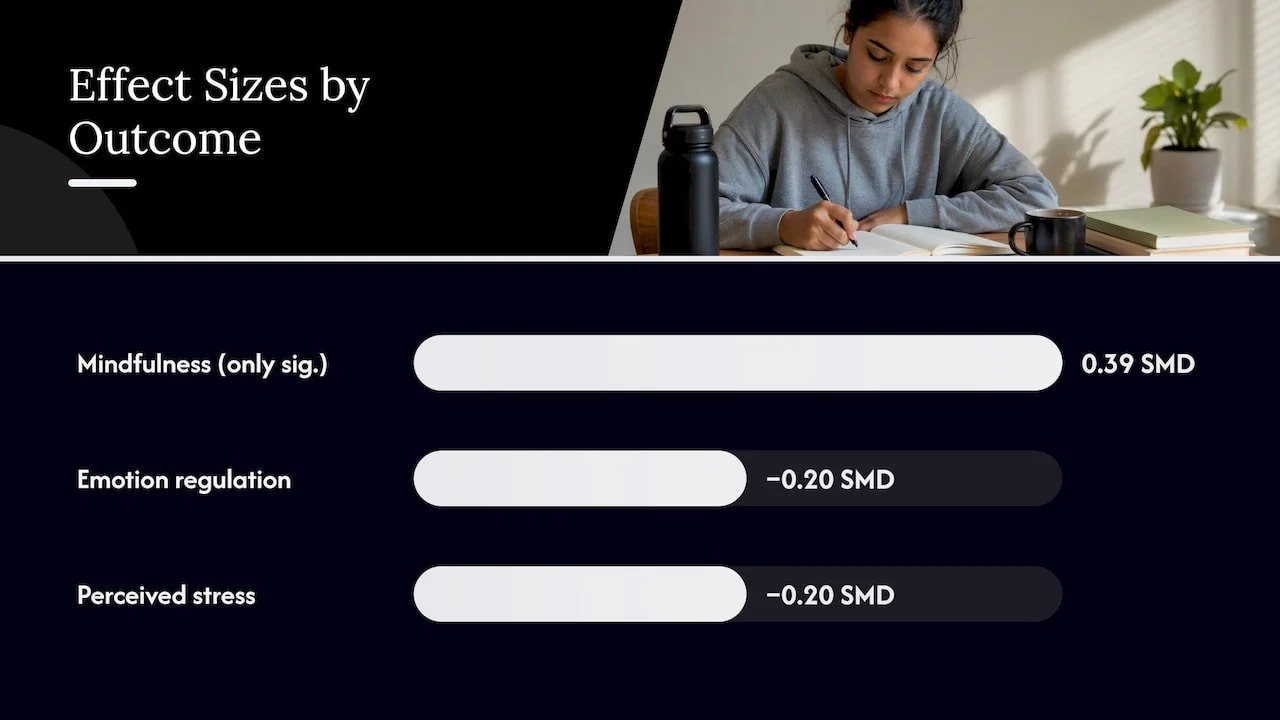
The practical reading: mindfulness reliably builds the skill of mindfulness, and the wider benefits are real but small on average, and larger for students who practice steadily. That is exactly how most skills work.
Benefit 1: Better attention and focus
Attention is the benefit students notice first, and it is one of the best supported. In the 2022 review above, the highest-graded school evidence indicated possible gains in attention and executive function, along with fewer attention problems and ADHD-type behaviors.
A 2021 study in China of 216 junior-school students found that students with higher trait mindfulness performed better on attention and working-memory tasks. This held with no stress, a single stressor and multiple stressors. Attention partly explained the link between mindfulness and working memory, which makes intuitive sense: if you can keep your attention where you put it, you can hold more in mind while solving a problem.
For a student, that translates to everyday moments: staying with a reading passage when your phone buzzes, catching yourself drifting in a lecture and returning, or holding a multi-step math problem in your head.
Benefit 2: Lower stress and calmer emotions
Students themselves describe this benefit clearly. A qualitative review of seven school-based studies found four recurring themes in what students reported: using attention to regulate emotions and thoughts, reduced stress, better coping and social skills, and a sense of calm. Students said mindful attention let them observe a feeling and respond rather than react.
The broader numbers fit that picture. A 2024 Psychiatric Services review of school interventions published from 2008 to 2022 identified 24 interventions across 41 studies. It reported improvements in executive functioning, resilience, emotion regulation and emotional awareness, alongside reductions in attention problems, stress, depressive symptoms, avoidance and rumination.
The effects on stress are small on average, as the 2025 meta-analysis shows. That is a reason to treat mindfulness as a daily habit, like brushing your teeth, rather than an emergency fix the night before finals. A short pause before an exam, or a minute of slow breathing between classes, adds up over a semester.
If you want to understand how present-moment awareness differs from grounding techniques, this explainer on grounding versus mindfulness shows when each one fits a hard moment. For a deeper look at calming practices, our own guide to mindfulness tips that reduce stress gives you routines to try.
Benefit 3: Grades and learning
Can a few minutes of practice show up on a report card? One randomized study suggests it can. In Beijing, students aged 13 to 18 did six weeks of integrative body-mind training, 20 minutes a day on weekdays, about 10 hours in total. Compared with relaxation training, they improved more in attention, mood, perceived stress and final grades in literacy, mathematics and a second language.
The authors were careful: they did not establish that better attention or self-regulation caused the grade gains. So the honest takeaway is encouraging but measured. Mindfulness trains the skills that learning depends on (focus, working memory, steadiness under pressure), and in this trial the grades moved in the same direction.
Benefit 4: Kinder relationships and a stronger sense of self
Mindfulness is not only an individual tool. In the 2022 review, the highest-quality evidence linked school mindfulness programs to more prosocial behavior and resilience. Evidence on self-compassion was not top-grade, but moderate-grade evidence showed a higher school self-concept.
Two elementary-school trials add detail:
In a randomized study of 99 fourth and fifth graders, the MindUP program improved cognitive control and stress physiology compared with another program. Children reported more empathy, perspective-taking, emotional control, optimism and school self-concept. The trial also reported lower depressive symptoms and peer-rated aggression, with greater peer-rated prosociality and acceptance.
A 2025 feasibility study of SEE Learning in the United States included 685 fourth and fifth graders in 33 classrooms. Compared with wait-list classrooms, students improved in self-compassion, perspective-taking, empathic concern, intrinsic prosocial motivation and academic goal setting.
These are younger children, but the idea carries up: a student who can pause and notice a feeling is more likely to listen well, to see a friend's point of view and to recover from a mistake without spiraling.
Does it work the same at every age?
No, and that is useful to know when choosing a practice. A 2022 review by Porter and colleagues covered experimental school studies with youth aged 3 to 18. Effects differed across developmental periods, and the authors concluded that programs should be adapted to developmental abilities, including the type of exercise, dose, frequency and what outcomes to expect.
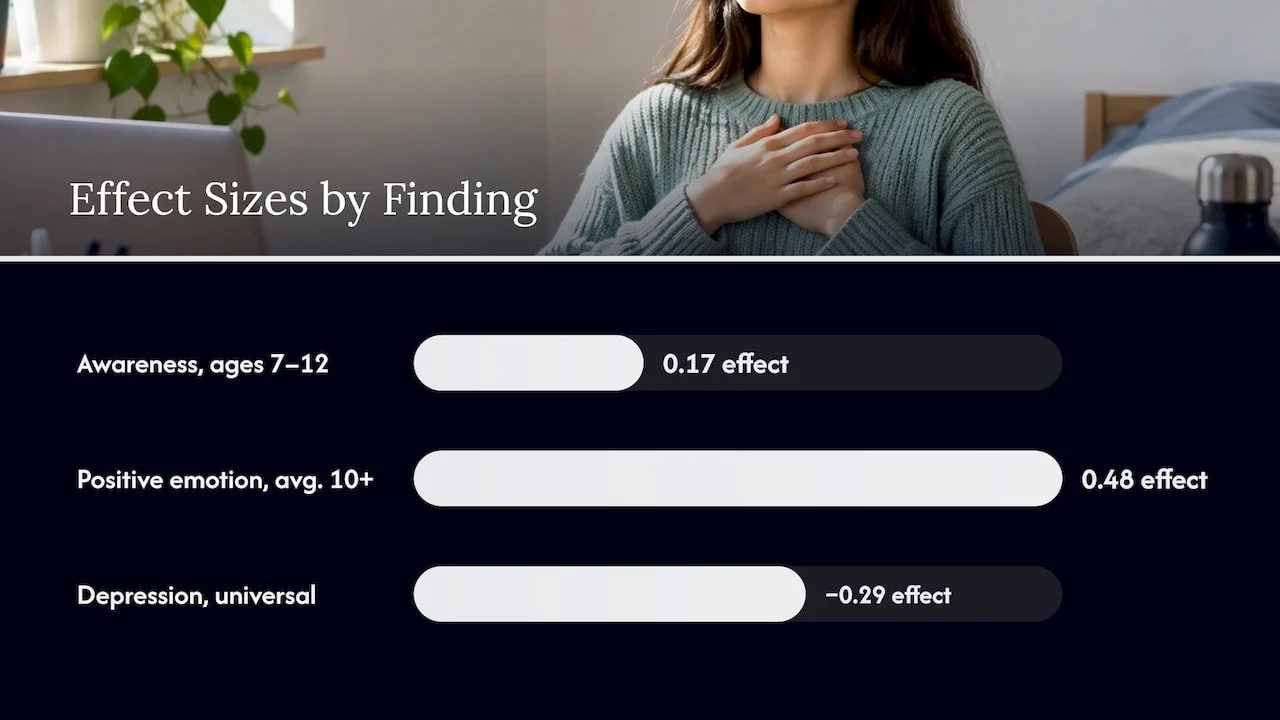
A 2023 meta-analysis of school programs adds some numbers:
| Finding | Group | Effect size |
|---|---|---|
| Emotional awareness increased (programs of 12 weeks or less) | Ages 7 to 12 | 0.17 (small) |
| Positive emotion modulation improved | Average age 10 or older | 0.48 (moderate) |
| Depression reduced (universal programs) | School students | -0.29 (small) |
What this means in practice:
Younger children (about 5 to 10): very short, sensory exercises, such as listening to a bell until the sound disappears or feeling their feet on the floor. Playful formats work well, and creative tasks can hold attention. These five-minute mindfulness art exercises show how a hands-on activity can anchor attention.
Middle and high school (about 11 to 18): five to twenty minutes, with breath, body scan and emotional check-ins. Link practice to real pressures like tests, social media and sports.
College students and adults: longer sits, movement-based practice such as yoga, and routines built around a schedule.
Which programs have the best track record?
The American Psychiatric Association's summary of the 2024 review notes that Learning to BREATHE, the Mindfulness in Schools Project and mindfulness-based stress reduction were the three interventions with high-level evidence among those identified. If your school is choosing a curriculum, those are good names to ask about. Researchers also point out that methods and instruction vary widely, which is why a trained, consistent teacher matters.
How a student can start in five minutes
You do not need a cushion or a quiet room. Try this sequence for a week:
Pick an anchor. The breath at the nostrils or belly, or the feeling of your feet on the ground.
Set a timer for five minutes. Sit upright, eyes closed or soft on a spot on the floor.
Follow five breaths. Count them if it helps. When your mind wanders, which it will, notice it and return without scolding yourself.
Do a check-in. Silently name what you feel: "nervous," "tired," "fine." Naming is a form of noticing.
Attach it to something you already do. Before homework, after brushing your teeth, or on the bus.
Then build from there. Our beginner's guide to practicing mindfulness walks through the basics in more depth, and how to practice mindfulness for mental clarity is a good next step when focus is the goal. For more ideas, see 10 benefits of mindfulness with a practice for each.
Easy moments to practice during a school day
Before a test: three slow breaths with your feet flat on the floor.
Between classes: walk to the next room noticing each step.
During studying: work in 25-minute blocks and take a one-minute breathing pause between them.
Before bed: a short body scan, from toes to head, instead of scrolling.
After a disagreement: name the feeling before you answer.
For parents and teachers
Practice alongside the student if you can. Keep sessions short, invite rather than require, and avoid using mindfulness as a punishment or a way to quiet a child. The goal is to give students a skill they choose to use, not a rule they follow. Consistent routines, such as a two-minute check-in at the start of class, matter more than occasional long sessions.
Our perspective
At Amrita Yoga & Wellness in Philadelphia, we see mindfulness as a practice you live in your body, not just a concept you read about. Students often tell us the hardest part is not understanding the idea but finding a way to keep doing it. That is where movement, breath and community help.
The research agrees with what we see: the benefits build with steady practice, and they work best when the method fits the person. A teenager facing finals and a graduate student juggling work need different things. Our classes are designed to welcome beginners and to guide every level with clear cues, so nobody has to figure out alone what to do with their breath or their wandering mind.
We offer yoga in several styles, pilates, barre, tai chi and breathwork workshops, plus a livestream and on-demand option for the weeks when you cannot get to the studio. Our approach is built around inclusivity, safety and connection, because feeling at ease in the room is the first step toward feeling at ease in your own head.
Juiced
Try it in a class
If you are a student or a parent in Philadelphia and want guided practice, our in-studio classes are a friendly place to begin. You can drop in to a group class for $28, join a community class for $11, or try a livestream class for $19 from home. If you want to practice every week, our On Demand Membership is $25 per month and the Livestream Class Membership is $49 per month. See all options and book on our class and membership page.
Not sure which class fits your schedule? Check the class schedule, or learn how it all works in our mindfulness activities for adults.
FAQ
How long should a student practice mindfulness each day?
Five minutes is enough to start. In the Beijing study, students practiced 20 minutes on weekdays for six weeks. Choose a length you can repeat daily, since regularity matters more than duration.
Can mindfulness help with exam anxiety?
It can help with stress and emotion regulation, though effects in studies are small on average and the 2025 meta-analysis did not find a significant anxiety improvement. Slow breathing and naming your feelings before a test are simple tools. If anxiety is intense or constant, talk with a school counselor or a licensed mental health professional.
At what age can children start mindfulness?
Studies include children as young as 3, and reviews show effects vary by developmental stage. Younger children do best with very short, sensory, playful exercises. Older students can handle longer breath and body-awareness practices.
Is mindfulness the same as meditation?
Meditation is one way to practice mindfulness, usually seated and focused on an anchor like the breath. Mindfulness is the broader quality of present-moment attention, which you can also bring to walking, eating, yoga or listening to a friend.
Does mindfulness improve grades?
One randomized Beijing study found better final grades after six weeks of training compared with relaxation, but the authors could not confirm that improved attention caused the gain. It is best seen as a way to build focus and steadiness that support learning.
Sources
Mindfulness for Students, Greater Good in Education (UC Berkeley)
Mindfulness-based school interventions: a systematic review (2022)
The Array of Outcomes Associated with Mindfulness (2025 meta-analysis)
Trait mindfulness, attention and working memory in junior-school students (2021)
School-based mindfulness interventions, qualitative review (2019)
Mindfulness-Based Interventions in Schools, Psychiatric Services (2024)
Short-term meditation intervention and academic performance (2014)
Systematic review of mindfulness-based interventions in youth aged 3 to 18 (2022)
School-based mindfulness and cognitive interventions for ages 7 to 12 (2023)
Supporting Student Mental Well-Being with Mindfulness Programs, Psychiatry.org