Build a mindfulness workflow for daily clarity in 2026
TL;DR:
A daily mindfulness workflow builds mental clarity through small, repeated practices linked to routines.Tools like timers, journals, and local Philadelphia resources help establish and sustain the practice.Consistency, community, and simplicity are key to long-term benefits and overcoming common challenges.
Philadelphia moves fast. Between the commute, the inbox, and the noise of city life, mental clarity can feel like something that only happens on vacation. But a structured mindfulness workflow, meaning a repeatable sequence of small, intentional practices woven into your day, makes calm and focus accessible every single morning, not just when you finally get a break. Micro-practices like mindful breathing and body scans are the building blocks of this kind of workflow. This guide walks you through every stage: what a workflow is, how to set one up, and where to find Philadelphia-specific support along the way.
Table of Contents
Key Takeaways
PointDetailsSmall steps matterStarting with just 5–10 minutes a day can significantly reduce stress and improve focus.Stack habitsPairing mindfulness with existing routines increases your chance for lasting success.Community supportPhiladelphia offers many local resources—joining a group boosts motivation and well-being.Personalize the workflowAdapt your practices and timing to fit your personality and daily schedule for best results.
Understanding the mindfulness workflow
Mindfulness is simply the practice of paying attention to the present moment without judging what you find there. That sounds easy, but in practice it means noticing your thoughts, feelings, and physical sensations as they happen, rather than getting swept away by them. A mindfulness workflow takes that principle and turns it into a daily structure, so the practice becomes a habit rather than a good intention.
Workflows work because they rely on repetition and triggers. When you attach a mindfulness practice to something you already do, like brewing your morning coffee or sitting down at your desk, the habit stacks onto an existing routine. Habit stacking into routines like this maximizes long-term adherence far better than willpower alone. You can explore mindfulness practice basics to understand how these principles apply across different styles.
The science behind this is solid. Mindfulness-based interventions reduce perceived stress by a standardized mean difference of 0.53 in non-clinical adults, which is a meaningful, real-world shift. Beyond stress, consistent practice improves mood, sharpens emotional regulation, and builds resilience over time.
Even five to ten minutes of daily mindfulness practice produces measurable improvements in focus and emotional balance. You do not need an hour on a cushion to feel a difference.
Here is a quick look at the core elements that make up a solid daily workflow:
| Workflow element | Purpose | Recommended duration |
|---|---|---|
| Morning intention | Sets mental direction for the day | 1 to 2 minutes |
| Breath focus | Anchors attention, reduces reactivity | 3 to 5 minutes |
| Body scan | Releases physical tension | 5 to 10 minutes |
| Mindful transition | Resets focus between tasks | 1 minute |
| Evening reflection | Consolidates learning, promotes rest | 3 to 5 minutes |
You can also draw inspiration from mindfulness activities to keep the workflow fresh and personally relevant.
What you need: Preparation and tools
Good news: the barrier to entry is low. You do not need a dedicated meditation room or expensive gear. What you do need is intention, a few simple tools, and the right mindset.
Essential tools to get started:
A timer (your phone works perfectly)
A small notebook or journal for brief reflections
A quiet corner, a set of headphones, or both
A meditation app if you prefer guided sessions (Insight Timer and Calm are popular free options)
A consistent trigger moment in your existing schedule
The mindset prerequisites matter just as much as the tools:
Openness: Be willing to sit with discomfort without immediately fixing it
Patience: Progress is gradual and not always linear
Non-judgment: Treat wandering thoughts as normal, not as failure
Flexibility: Adapt the workflow to your life, not the other way around
Here is how personal tools compare to local class-based support:
| Option | Best for | Key benefit | Limitation |
|---|---|---|---|
| App or journal | Solo, flexible schedules | Low cost, always available | Easy to skip without accountability |
| In-person class | Community learners | Guided instruction, social support | Fixed schedule, travel required |
| Local workshop | Beginners or deepeners | Structured curriculum, expert access | One-time or short-term |
| Therapy-integrated | Anxiety or trauma history | Clinical support alongside practice | Requires referral or cost |
Philadelphia has genuinely strong local options. Barnes Foundation art-mindfulness workshops, Chenrezig Tibetan Buddhist Center weekly meditations, Penn Memory Center classes, be mindphl at the YMCA, and MPower Wellness therapy are all accessible resources for adults at different stages. Check out practical mindfulness tips and reduce stress resources for more guidance on pairing tools with technique.

Pro Tip: Your daily commute is prime mindfulness real estate. Instead of scrolling, try one minute of slow nasal breathing before you get off the train or bus. Stacking this onto a routine you already have makes it far easier to sustain.
Step-by-step guide: Building your daily mindfulness workflow
Now that you have your tools and a supportive environment, it is time to build the actual workflow. Think of this as designing a personal system, not copying someone else's routine.
Steps to design and launch your workflow:
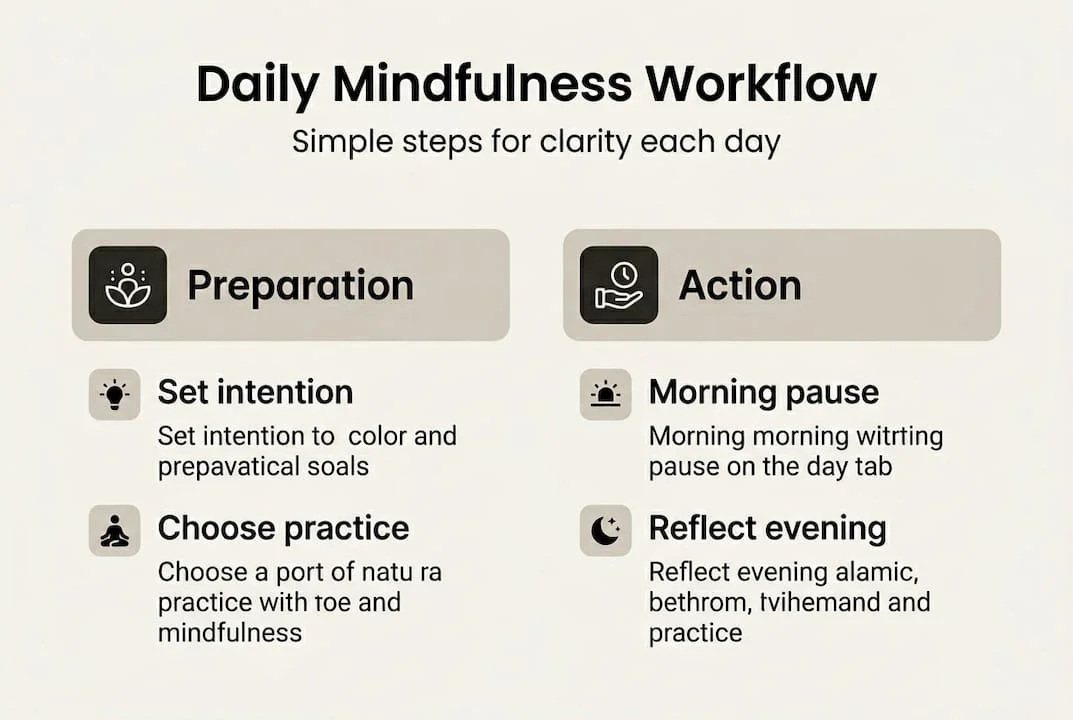
Set a clear intention. Decide what you want from the practice. Better focus? Less reactivity? Improved sleep? A specific intention keeps you motivated when novelty wears off.
Choose one anchor practice. Pick a single technique to start, such as a five-minute breath focus. Mindful breathing, body scans, and single-tasking are all strong starting points for busy adults.
Identify your trigger moments. Attach your practice to an existing habit: after brushing your teeth, before your first meeting, or during your lunch break. Triggers remove the need for daily decision-making.
Schedule it. Put it in your calendar like any other appointment. Even a two-minute block counts.
Track your experience briefly. After each session, write one sentence about how you felt. This builds self-awareness and shows you patterns over time. Use mindfulness workflow tips to refine your approach as you go.
Review weekly. Every Sunday, spend two minutes asking: What worked? What felt forced? Adjust accordingly.
Popular practices for busy Philadelphians (all under five minutes):
Box breathing: inhale four counts, hold four, exhale four, hold four
Progressive body scan: mentally check in from head to toe
Mindful eating: one meal per day without screens
Mindful walking: notice three physical sensations on your next walk
As little as 5 to 10 minutes dailyproduces measurable benefits in short-term studies, with the eight-week MBSR (Mindfulness-Based Stress Reduction) program serving as the gold standard for deeper transformation. You can explorestructured meditation techniquesandmindfulness exercise ideasto expand your toolkit over time.
Pro Tip: Start with just one practice for two full weeks before adding another. Layering too quickly leads to overwhelm and dropout. Simplicity is a feature, not a flaw.
Common challenges and troubleshooting
Starting a mindfulness workflow is the easy part. Sticking with it when life gets loud is where most people struggle. Knowing the common obstacles ahead of time gives you a real advantage.
Common workflow obstacles:
Motivation loss: The novelty fades after week two. This is normal. Return to your original intention.
Time pressure: A two-minute practice still counts. Do not let perfect be the enemy of present.
Boredom: Rotate practices or try a new format like a guided session or a local class.
Emotional discomfort: Sometimes sitting quietly surfaces difficult feelings. This is not a sign to stop, but it is a sign to go slowly.
Perfectionism: Missing a day does not erase your progress. Self-kindness is part of the practice.
Mindfulness is not universally safe or appropriate for every person in every situation. Some individuals, particularly those with unprocessed trauma or severe anxiety, may need additional support before or during practice.
Shorter practices work betterfor individuals with low agreeableness, and potential adverse effects like increased anxiety can occur when mindfulness is practiced without complementary skills. Pairing it with self-compassion training or Internal Family Systems (IFS) therapy significantly improves outcomes for those who find solo practice difficult.
Mindfulness is also necessary but not a stand-alone solution for overall well-being. Its efficacy depends on the quality of the meditation and the surrounding psychoeducation. If you feel stuck or distressed after several weeks, consider working with a therapist who integrates mindfulness rather than pushing through alone. Find local stress reduction with mindfulness resources to support your journey.
When you do miss days, treat it as data, not failure. Ask what made it hard and adjust the trigger or the duration. Consistency over months matters far more than perfection over a single week.
A fresh perspective on mindfulness workflows
Most guides tell you that more practice equals more benefit. We think that framing quietly sets people up to quit. The real power of a mindfulness workflow is not in its length or complexity. It is in its reliability. A two-minute breath practice you actually do every day beats a forty-minute session you do twice a month.
Here is what we have seen working with Philadelphia practitioners: the people who sustain long-term mindfulness gains are almost never the ones who meditate the longest. They are the ones who practice in community. Group settings create gentle accountability, shared language, and a sense of belonging that solo apps simply cannot replicate. Philadelphia's local resources are genuinely underused by most adults who could benefit from them.
The other thing worth saying plainly: clarity and emotional well-being do not come from adding more to your day. They come from doing less, more intentionally. A workflow built on three small, consistent practices will outperform a packed routine that collapses under pressure. Simplicity is not a beginner's compromise. It is the advanced move.
Take your next step: Support for your mindfulness journey
Building a workflow on your own is a powerful start. But sometimes the right environment or guide accelerates everything. At Amrita Yoga & Wellness in Philadelphia, we offer services designed to complement and deepen your daily practice in ways that solo routines often cannot.
If you are looking for reflective support, tarot sessions for reflection offer a structured way to explore your inner landscape. For physical relaxation that supports mental clarity, acupuncture for relaxation pairs beautifully with breathwork and body scan practices. Browse all of our wellness options to find what fits your current stage. Your workflow does not have to be a solo project.
Frequently asked questions
How quickly can I see results from a mindfulness practice workflow?
Most adults experience reduced stress and better focus within one to two weeks of consistent daily practice. Short-term studies show benefits with as little as five to ten minutes per day.
What if I can't meditate every day—does my workflow still work?
Yes, even irregular practice provides real benefits. Focus on gentle consistency and lean on micro-practices like mindful breathing and single-tasking when a full session is not possible.
Are there risks to starting mindfulness if I have anxiety or trauma?
Some individuals may notice increased anxiety without complementary skills, so pairing mindfulness with self-compassion practices or professional support is strongly recommended if you have a trauma or anxiety history.
Which local resources in Philadelphia support mindfulness beginners?
The Barnes Foundation workshops, Chenrezig Tibetan Buddhist Center, Penn Memory Center, be mindphl at the YMCA, and MPower Wellness all offer accessible entry points for adults new to mindfulness.