You need a yoga reset when your practice stops giving back what it used to: you dread the mat, you feel more run down after class than before, soreness lingers for days, or you go through the motions while thinking about your inbox. A reset does not mean quitting. It means changing the dose, the style, the pace or the setting so yoga supports your life again.
Below are the signs to watch for, how to tell ordinary soreness from a warning, and a gentle two-week plan to start over. We teach in Philadelphia, so we also share what a reset can look like in a real studio week.
Amritayogawellness
Find a gentler way back to yoga
Explore yoga classes at Amrita Yoga & Wellness in Philadelphia, with options for beginners and experienced practitioners.
TL;DR
Common signs: practice feels like a chore, you feel tired but wired, soreness lingers, you plateau, or the same ache keeps returning.
A reset is active rest and a change of approach, not failure. Lower the intensity, swap the style, or add restorative and breath work.
Soreness lasting beyond 48 hours, falling performance or feeling run down are reasons to swap a hard session for gentle movement.
Pain, numbness, tingling or weakness during or after practice deserves a professional's review, not pushing through.
Our beginner-friendly, community and private options make a restart easy, starting at $11 for a community class.
Table of Contents
What a yoga reset actually is
Signs your practice needs a reset
Normal soreness or a warning sign?
How to reset your practice: a two-week plan
A sample week after your reset
Resetting with different kinds of practitioners in mind
Our perspective on resets
Ready to restart? Here is how we can help
When to see a professional
FAQ
Sources
What a yoga reset actually is
A reset is a deliberate change in how you practice. Yoga teacher and wellness leader Latham Thomas, speaking to Yoga Journal, describes a practice built on listening, ease and active rest, where yoga is not about pushing to the edge but about reorienting your approach. That framing is useful. The right intensity on a given week is the one your body and nervous system can use, not the one on a chart.
A reset can be small (swap two vinyasa classes for a slow flow and a restorative class) or larger (take a full week off, then come back with a different style and teacher). Either way, the aim is the same: make the practice sustainable and enjoyable again.
Signs your practice needs a reset
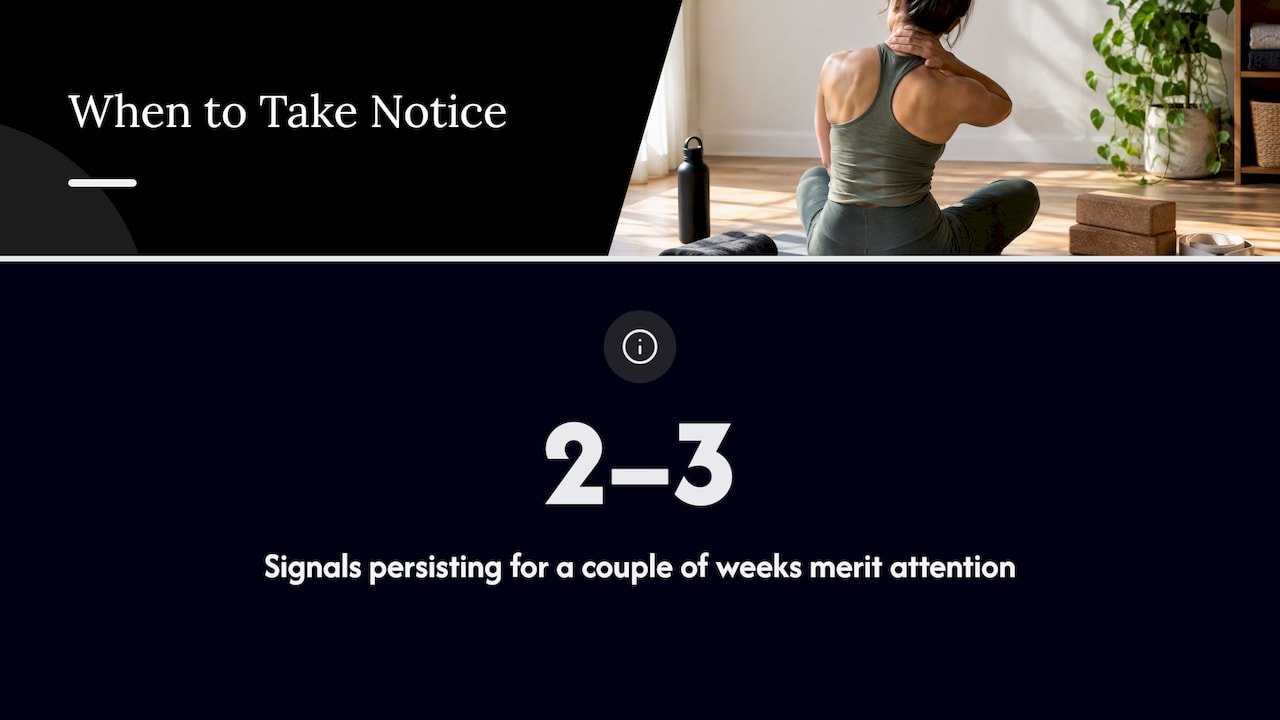
You do not need all of these. Two or three that persist for a couple of weeks are enough to take seriously.
1. Yoga feels like a chore
You used to look forward to class. Now you bargain with yourself to go, check the clock, or feel relief when you cancel. A little resistance is normal on a hard day. Weeks of dread is information. It often means the style, the schedule or the pressure you put on yourself no longer fits.
2. Your mind leaves the room
You plan your grocery list in warrior two and wake up in savasana wondering what happened. Wandering attention is normal for everyone. But if class never lands you in your body anymore, your practice may have become autopilot. Changing the sequence, the teacher or the room often brings attention back.
3. You feel tired but wired
You are exhausted by afternoon yet cannot switch off at bedtime. Fast, heated, high-effort classes can feel great when you are rested, but when life stress is already high, they may add to the load. NASM, the National Academy of Sports Medicine, notes that training load should match your recovery capacity, including sleep, nutrition and life stress. If your recovery is low, your practice should flex down.
4. Soreness lingers or performance drops
Some muscle soreness after a new or tougher class is expected. The University of California, Berkeley's student wellbeing team advises that soreness lasting more than 48 hours, declining performance, or feeling tired or run down are reasons to replace a hard workout with active recovery. Applied to yoga, that can mean gentle movement, easy stretching, or a rest day instead of another intense session.
5. You have plateaued
You have taken the same class at the same level for a year and your poses, breath and energy feel unchanged. Plateaus are not a sign you are doing it wrong. They are a signal to vary the input: a new style, a longer hold, a different teacher, or a private session aimed at one specific goal.
6. The same ache keeps coming back
A tight wrist, a cranky lower back or an irritated knee that returns every few classes is your body asking for a change in alignment, load or props. A recurring ache is a reason to slow down and get individual feedback. Our post on common yoga mistakes beginners and intermediates make covers the habits that most often lead to it.
7. Your mood dips around practice
If you feel irritable, flat or anxious before class, or you judge yourself harshly afterward, the practice has turned into another task to perform. Yoga is meant to be a place to unload, not a scoreboard.
8. You only ever do one kind of yoga
If every class you take is the same intensity, whether always hot and strong or always slow, your body gets the same message every time. Variety is not a luxury. It is how a practice stays balanced.
9. Life changed and your practice did not
A new baby, a new job, a recent illness, an injury, a move: your practice from two years ago may not fit your life now. A reset is often just an honest update.
Normal soreness or a warning sign?
Most people who practice yoga do so without trouble. A systematic review of adverse events found that yoga-associated adverse events are uncommon, with musculoskeletal ones the most frequent, and that headstands and forceful pranayama were the practices most often implicated. The same review points out that events can be significant for people with underlying risk factors and recommends instruction tailored to the individual.
Here is a practical way to sort what you feel.
| What you notice | Usually means | What to do |
|---|---|---|
| Dull, widespread muscle tenderness that fades within a day or two | Ordinary soreness from a new or harder class | Move gently, hydrate, sleep, resume as it eases |
| Soreness beyond 48 hours, or feeling run down | Your load may be outpacing your recovery | Swap in restorative or gentle classes, take a rest day |
| A sharp or pinching pain in a joint during a pose | Alignment or range problem | Come out of the pose, use props, ask your teacher for a modification |
| Pain, numbness, tingling or weakness that persists or is triggered by practice | Something that should not be ignored | Stop that movement and see a doctor or physical therapist |
| Chest pain, serious trouble breathing, fainting or sudden neurological changes | Possible emergency | Stop, call 911 or your local emergency number |
The row about numbness and tingling reflects guidance from Acibadem Health Point, which says persistent symptoms or ones triggered by yoga deserve professional review, and that people with relevant medical conditions, recent surgery or pregnancy may need individualized advice.
If you are pregnant and stretching brings a pulling feeling low in the belly or hip crease, these stretches for round ligament pain are a gentle place to start, and your prenatal care provider should hear about any pain that worries you.
Some practices carry their own precautions. If you do heated or suspended classes, read our guides on hot yoga safety and aerial yoga contraindications before you return after a break.
How to reset your practice: a two-week plan
This plan suits most healthy adults. If you have an injury, a medical condition, recent surgery or are pregnant, check with your clinician first and tell your teacher before class.
Days 1 to 3: stop and listen
Take a true day off, then keep the next two days light. Walk, stretch easily, and sleep more than usual. Notice when you feel the urge to practice and what kind of movement you actually want. Write down one sentence each night: what did my body ask for today?
Days 4 to 7: soften the edges
Choose two gentle sessions. A restorative class, a slow flow or a short home sequence with long, easy exhales works well. Active recovery can include restorative yoga, slow walks and breathwork. Skip arm balances, inversions and forceful breathing for now. If a pose is not sitting well, use a block or bolster rather than forcing depth.
Days 8 to 10: change one variable
Pick one thing to change, not five. Options:
Style: if you always take hot vinyasa, try mat Pilates or a slow, alignment-focused class. If you always do gentle classes, add one stronger session.
Teacher: a new voice often changes how familiar poses feel.
Time of day: a morning practice may suit you better than a late, rushed evening one.
Focus: spend a week on one area, such as hips or shoulders, or on one familiar pose, noticing details you usually skip.
These are the same kinds of changes Yoga Basics suggests when practice feels stale: a different style or teacher, props used differently, or a new focus.
Days 11 to 14: rebuild with variety
Return to three or four sessions, but vary them. NASM describes periodization, which means varying intensity and volume rather than raising them in a straight line, as a way to prevent overtraining and allow more effective adaptation. In plain terms: follow a hard week with an easier one, and place a strong class next to a gentle one, not three strong ones in a row.
A sample week after your reset
| Day | Practice | Why |
|---|---|---|
| Monday | Mat Pilates or steady flow | Build core and posture |
| Tuesday | Walk or rest | Recovery |
| Wednesday | Restorative or breath-focused class | Calm the nervous system |
| Thursday | Your favorite strong class | Enjoy the effort without stacking it |
| Friday | Rest | Recovery |
| Saturday | Community or exploratory class | Try something new |
| Sunday | Gentle stretch or walk | Reset for the week |
Adjust freely. The point is the pattern: effort, ease, effort, rest.
Resetting with different kinds of practitioners in mind
If you are a beginner who stalled. Many people quit in the first few months because classes felt too fast or intimidating. A beginner-focused setting and clear guidance fix more than willpower does.
If you are a long-time practitioner who burned out. Strip back to basics for a month. Fewer poses, slower, with more attention. Many experienced practitioners find that simple poses feel brand new when they pay attention again.
If you are coming back from an injury or a break. Start with private instruction or a gentle group class and increase gradually. Tell the teacher what happened before class begins.
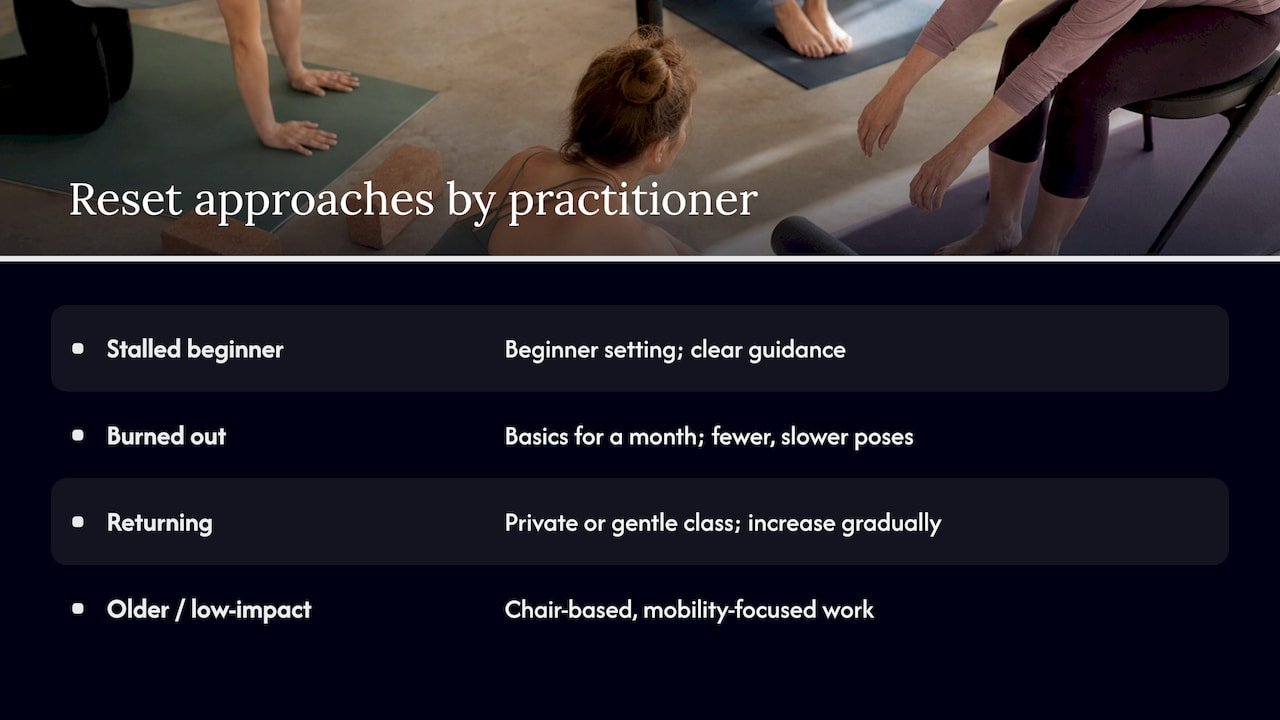
If you are older or want a lower-impact option. Chair-based and mobility-focused work is an excellent way to keep going. See our simple yoga poses for seniors and our chair yoga sequence with Heather.
Our perspective on resets
We see the same pattern in our Philadelphia studio every season: people do not leave yoga because they stopped caring. They leave because the practice they had stopped fitting their week. Too intense, too rushed, too lonely, or too far from what they needed that day.
That is why we offer a wide range of experiences under one roof: yoga in several styles including hot yoga and aerial yoga, mat Pilates, group reformer Pilates, barre, tai chi, massage therapy and workshops like breathwork. Our approach is built around inclusivity, beginner approachability and community, with class structures and detailed guidance designed for safety, personal growth and connection at every level.
A reset is not a step backward. It is a smart way to keep a practice for years. Try a different class, bring a friend to a community session, or book a private session so that someone watches your alignment and builds a plan around your goals. We would rather you practice in a way that feels good and lasts than push through for a month and disappear.
Juiced
Ready to restart? Here is how we can help
If your reset includes trying something new, we make it low-pressure. A community class is $11 per session, a group class drop-in is $28, and our Nurtured Beginnings pass is $35 for people who want a gentle on-ramp. If you would like someone to watch your form and tailor a plan, a one-to-one session starts from $85 per hour on our private yoga and mat Pilates page.
When you are ready to return more regularly, our monthly options include the Earth membership at $119 per month, and a livestream membership at $49 per month if some weeks you would rather practice from home. Browse every drop-in and membership on our class passes and memberships page, check the class schedule for current times, and read our class descriptions to find the level and style that suit you right now.
When to see a professional
A reset handles stale, stressed or tired. It does not replace medical care. Talk to a doctor or physical therapist if:
pain, numbness, tingling or weakness appears during practice or does not go away,
an injury keeps returning or is not healing,
you are pregnant, recovering from surgery or managing a medical condition and are unsure which poses suit you,
you feel persistently low, anxious or unable to sleep, which a mental health professional or your primary care doctor can address.
For chest pain, severe trouble breathing, fainting or sudden changes in strength, speech or vision, stop immediately and call 911.
FAQ
How do I know if I need a break from yoga or just a different class?
If you still want to move but dread your usual class, change the style, teacher or intensity first. If you feel run down, sore for more than two days or unable to recover, take a few days of rest or gentle movement. If symptoms persist after rest, check in with a healthcare professional.
Is it normal to feel sore after yoga?
Mild soreness after a new or more intense class is common and usually fades within a day or two. Berkeley's guidance treats soreness lasting beyond 48 hours as a cue to swap a hard session for active recovery. Sharp pain, numbness or tingling is different and should be checked by a professional.
Can yoga be done wrong?
Any physical practice can be done in a way that strains the body, and musculoskeletal complaints are the most common problem reported in the research on yoga. The review of adverse events points to headstands and forceful breathing practices as the ones most often involved. Clear instruction, props and modifications help, which is why we encourage beginners to start with guided classes or a private session.
How long should a yoga reset last?
Two weeks is a good starting frame: a few days of real rest, a week of gentle practice, then a gradual return with more variety. If you are recovering from burnout or an injury, take longer and ease back in with professional guidance.
Sources
Latham Thomas' advice for reinvigorating your practice, Yoga Journal
Workout reboot: use active rest to revamp your routine, UC Berkeley Student Wellbeing
Overtraining: how trainers spot it, prevent it and program around it, NASM
Is your yoga practice getting stale? 4 ways to change it, Yoga Basics