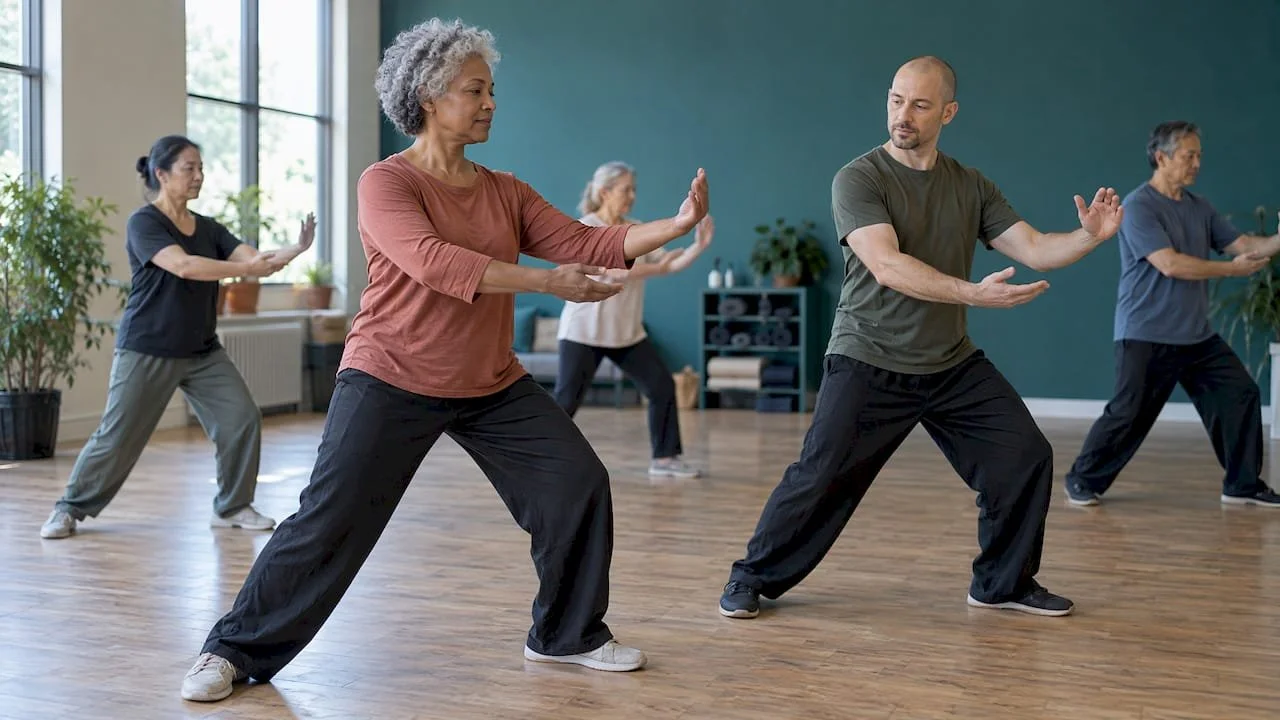
Tai chi is a slow, flowing practice that can improve balance, leg strength, flexibility and sleep, and may ease stress, anxiety and pain. You can try it in Philadelphia for free in a public park, or join a studio class with an instructor who adjusts movements to your body. This guide covers what the research shows, how much practice makes sense, who should check with a doctor first, and where to begin in the city.
Amritayogawellness
Explore Tai Chi in Philadelphia
Amrita Yoga & Wellness offers tai chi alongside yoga, Pilates, barre, and other wellness practices at its Philadelphia studio.
TL;DR
Strongest evidence: better balance and fewer falls, plus relief for osteoarthritis symptoms and Parkinson-related balance problems.
Likely extras: lower perceived stress, better sleep and well-being. Research on anxiety and depression is promising but still being refined.
Start with 10 to 15 minutes at home, or one class a week. Build up slowly and stop short of forcing any movement.
Philadelphia has free outdoor groups, such as the Franklin Square club, and paid studio classes with more personal coaching.
If you have joint, spine or heart problems, are pregnant, or take medicine that causes dizziness, talk with your doctor first.
Table of Contents
What tai chi actually is
The benefits, and how strong the evidence is
How often and how long to practice
Is tai chi right for you?
Finding tai chi in Philadelphia
Perspective
Make tai chi part of a routine at our studio
Your first month: a simple plan
FAQ
Sources
What tai chi actually is
Tai chi began as a Chinese martial art. Today most people practice it as moving meditation: you shift your weight from leg to leg, turn through the torso, and move the arms in connected, unhurried sequences while breathing steadily. There are no jumps, no equipment and no need to be flexible on day one.
That low-impact quality is why it suits such a wide range of adults, from desk workers who are stiff and stressed to people returning to movement after a long break. The Mayo Clinic describes most forms as gentle and suitable regardless of age or physical ability.
The benefits, and how strong the evidence is
Not every claimed benefit is equally well supported. Here is how it breaks down.
Balance and fall prevention
This is where the evidence is most solid. The National Center for Complementary and Integrative Health (NCCIH) reports that tai chi may improve balance and help prevent falls in older adults and in people with Parkinson's disease. Its cited analyses found 20% fewer people falling, with high certainty, compared with control groups not expected to reduce falls.
A meta-analysis of 22 studies in older adults found significant gains on several balance and function tests, including the Berg Balance Scale, standing on one leg with eyes closed, and the Timed Up-and-Go test. A few measures did not change significantly, so results vary by what you measure.
You do not need to be a senior to care about this. Better balance means steadier walking on uneven Philadelphia sidewalks, safer stairs in a rowhouse, and fewer tweaks when you return to running or cycling.
Joints, strength and chronic conditions
A peer-reviewed evidence review by Huston and McFarlane looked at more than 500 trials and 120 systematic reviews published over 45 years. It rated the evidence excellent for fall prevention, osteoarthritis, Parkinson disease, COPD rehabilitation and cognitive capacity in older adults. It rated evidence good for lower-limb strength, depression, and cardiac and stroke rehabilitation.
The same review found fair evidence for sleep, well-being, fibromyalgia, hypertension and osteoporosis. It also reported no direct benefit for diabetes, rheumatoid arthritis or chronic heart failure in the evidence it reviewed. That review is from 2015, so newer trials have added to it.
The Mayo Clinic adds that tai chi is complementary. It is not a substitute for conventional medical care.
Stress, anxiety and mood
A 2024 systematic review and meta-analysis of 11 trials and 1,323 participants found that tai chi significantly reduced perceived stress. The effect was small to moderate (standardized mean difference −0.41) and it remained at follow-up. The authors cautioned that unblinded studies and varied programs limit certainty, and that mental quality of life and biological stress markers did not change significantly.
For mood, a 2025 network meta-analysis of 82 randomized trials with 4,501 adults ranked tai chi highly for anxiety and depression outcomes. Its authors noted differences between studies and called for more work on the best dose and long-term effects.
Anxiety research is a field where the strength of trial evidence deserves a careful read. If you want to see how another widely discussed approach holds up in trials, these microdosing and anxiety trial findings show why study design matters. For tai chi, the practical takeaway is simple: many people find the slow breathing and focus calming, and the research supports a modest, real effect on stress.
Flexibility and everyday mobility
Tai chi moves joints through gentle, controlled ranges, which helps hips, ankles and spine stay mobile. If flexibility is your main goal, our guide to physical flexibility benefits for adults pairs well with a tai chi habit.
How often and how long to practice
You do not need long sessions to begin. Harvard Health advises beginners to start with 10 or 15 minutes and build gradually, and says even five minutes most days beats none. Longer sessions of 30 to 60 minutes suit people with more intensive goals.
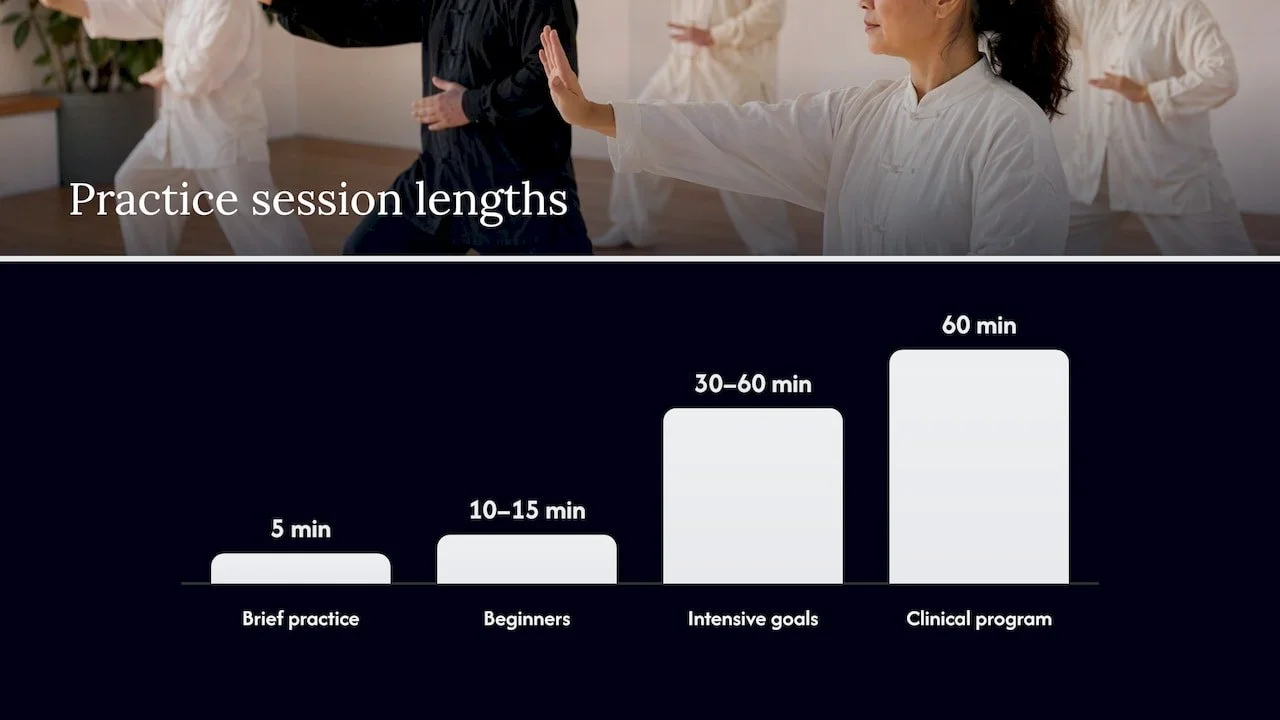
Clinical programs look different. A systematic review of tai chi prescriptions found the most common program was 60 minutes, two to three times a week, for 12 or 24 weeks. Yang style was used in 66.2% of those prescriptions, and the simplified 24-form sequence in 30.9%. The review also stresses progressing gradually, and says avoiding injury matters more than maximizing volume.
A realistic pattern for most adults:
| Goal | Starting point | Build toward |
|---|---|---|
| Try it out | One class a week | Two classes a week |
| Stress and sleep | 10 to 15 minutes at home, most days | 20 to 30 minutes daily |
| Balance and mobility | One 60-minute class plus short home practice | Two to three 60-minute sessions weekly |
This table is a practical way to apply the figures above, not a medical prescription. If you are wondering whether a short daily routine "counts," the answer from Harvard's guidance is yes: consistency matters more than length at the start.
Is tai chi right for you?
Most beginners are fine, including people who feel stiff or unsteady. A good instructor can adapt positions for injuries, chronic conditions, or balance and coordination problems.
Some situations call for a conversation with your doctor first. The Mayo Clinic lists joint, spine or heart problems, pregnancy, fractures and severe osteoporosis. Harvard Health adds limiting musculoskeletal problems, other medical conditions, and medicines that cause dizziness or light-headedness. NCCIH also advises not using tai chi to postpone evaluation of a medical problem.
Safe habits for any beginner:
Move at about 70% of your maximum effort or range of motion, as Harvard suggests, and never force a position.
If you feel pain or resistance, back off.
Enjoy the movements without worrying about perfection.
Choose an instructor with real training who is happy to explain modifications. NCCIH recommends asking about an instructor's training and experience.
If you also want gentle seated or supported movement, see our chair yoga for beginners guide, or our simple yoga poses for seniors for mobility work.
Finding tai chi in Philadelphia
The city offers three broad routes. Each suits a different kind of beginner.
Free outdoor and community groups
The Franklin Square Tai Chi group is a well-known free option. Historic Philadelphia lists it as meeting at 200 N 6th Street on Tuesdays, Thursdays and Saturdays, 7:30 to 8:30 am, with sessions moved to the pavilion in cold or wet weather. Groups like this are welcoming and cost nothing, though they are usually led at a set pace for everyone, so you get less individual correction.
Public libraries have also hosted free seasonal tai chi and qigong series. In 2025, Andorra Library ran a weekly morning series through the warmer months. These programs come and go, so confirm the current schedule with the library or park before you go.
Studio classes
A studio setting works well if you want a consistent time, a clean indoor space year-round, and an instructor who can see your form and adjust it. It is also a good fit when you are managing a tight shoulder, a sore knee or nerves about being a beginner.
Virtual and on-demand
If your schedule is unpredictable, livestream and on-demand options let you practice the 10 to 15 minute habit Harvard recommends from your living room.
Perspective
At Amrita Yoga & Wellness, we see tai chi as one piece of a broader movement and wellness practice, not an isolated trend. The people who walk into our studio are rarely looking for a performance. They want to feel steadier, calmer and more at home in their bodies.
That is why we put so much weight on approachability. Our classes are designed with clear guidance so beginners can learn safely, and experienced students can keep deepening their practice. We offer tai chi alongside yoga, pilates, barre and massage therapy because we believe slow, mindful movement, strength work and recovery support one another.
Our advice is to treat consistency as the goal. Come to class, practice a few minutes at home, and let the benefits build. Being part of a community that shows up with you makes that habit far easier to keep.
Juiced
Make tai chi part of a routine at our studio
We are a Philadelphia studio that teaches tai chi alongside yoga styles, pilates, barre and massage therapy, with a welcoming approach for first-timers. Check the class and monthly experience schedule to see what is on the calendar right now.
Prices are published on our in-studio class and membership page. A group class drop-in is $28 per session, a community class drop-in is $11, and a livestream class drop-in is $19. If you would like a more personal start, a one-to-one session begins at $85 per hour, as listed on our private sessions page. For regular practice, monthly options include unlimited group classes at $169 per month and a livestream membership at $49 per month. Class types vary by schedule, so check the calendar for current tai chi times.
Once your body is moving more freely, a massage or Ayurvedic session can support recovery, and our Ayurvedic therapies page lists the options.
Your first month: a simple plan
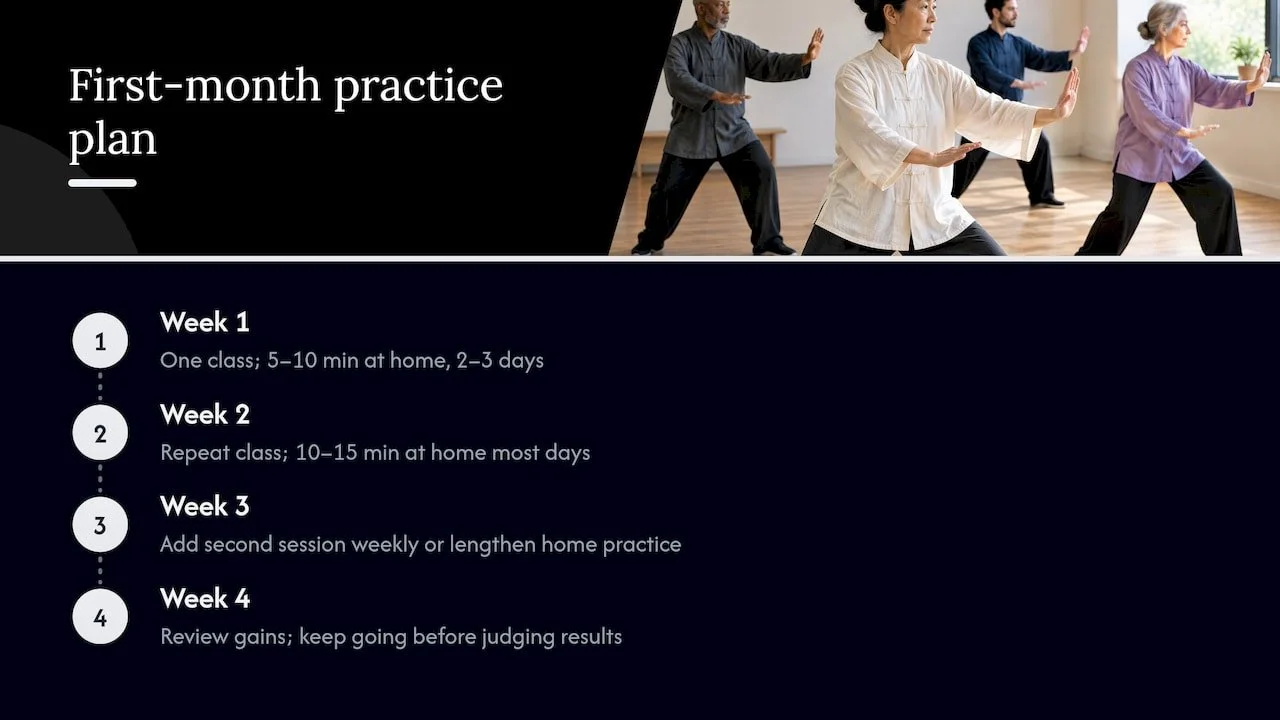
Week 1. Attend one class or a free park session. Focus on standing comfortably, breathing slowly and shifting weight without wobbling. Do five to ten minutes at home on two or three days.
Week 2. Repeat the class. Raise home practice to 10 or 15 minutes on most days. Notice how your legs feel; mild fatigue is normal, sharp pain is not.
Week 3. Add a second weekly session if it fits your schedule, or lengthen home practice. Tell your instructor about any tight or sore areas so they can offer modifications.
Week 4. Review. Are you sleeping a bit better, feeling steadier on stairs, or less keyed up after work? The research suggests such gains build over weeks, and clinical programs often run 12 weeks or more, so keep going before judging results.
Avoid common beginner errors: rushing through movements, locking knees, or pushing deep ranges. Our article on common yoga mistakes that cause injury covers habits that carry over to any mind-body practice.
FAQ
Is tai chi really beneficial?
Yes, for several outcomes. Evidence is strongest for balance, fall prevention and osteoarthritis symptoms, and it also points to lower perceived stress. Some findings come with limits, so think of tai chi as a helpful complement to medical care, not a replacement.
Is 20 minutes of tai chi enough?
For most beginners, yes. Harvard Health suggests starting with 10 or 15 minutes and building gradually, and says even five minutes most days is better than nothing. Clinical programs often use 60-minute sessions two to three times a week.
How many times a week should you do tai chi?
Two to three sessions a week is the most common pattern in clinical programs, with short daily home practice added if you like. If you are new, begin with one class weekly and increase slowly, letting comfort and injury avoidance guide you.
Can I find free tai chi classes in Philadelphia?
Yes. The Franklin Square group meets outdoors three mornings a week at no cost, and libraries have run free seasonal series. Schedules change, so confirm times with the host before you go.
Sources
Tai Chi: Discover the Many Possible Health Benefits, Mayo Clinic
Effectiveness of tai chi on balance, falls and function (meta-analysis)
Stress reduction through taiji: a systematic review and meta-analysis
Traditional Chinese exercises and anxiety and depression: network meta-analysis