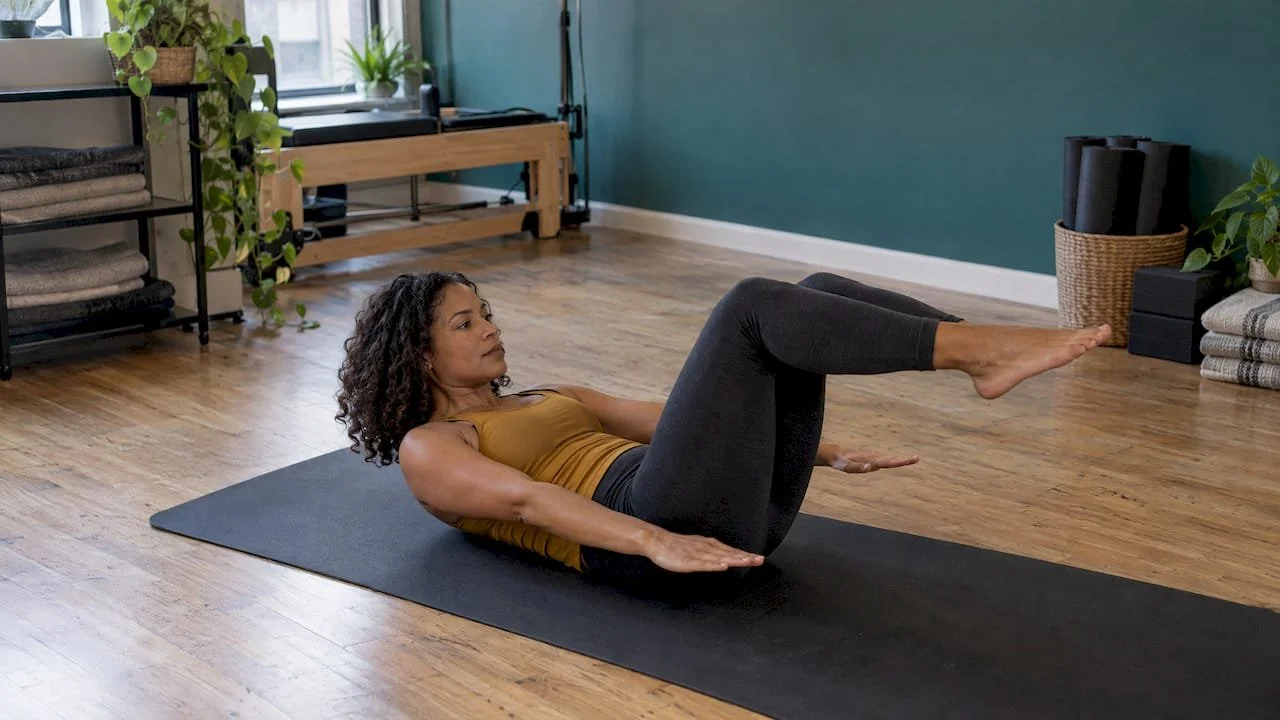
Pilates can reduce back pain for many people, especially chronic low back pain, and the gains show up most clearly over the first few weeks to months of regular practice. It works through slow, controlled movement that trains the deep muscles around your spine, along with breathing and posture habits that carry into daily life. It is not a cure, and it is not right for every kind of back pain, so this guide covers what the research says, which movements are commonly used, how often to practice, and which symptoms mean you should see a doctor before you start.
Amritayogawellness
Explore Pilates in Philadelphia
Amrita Yoga & Wellness offers mat and reformer Pilates classes, with options for beginners and experienced practitioners.
TL;DR
Studies suggest Pilates can lower pain and improve function in chronic low back pain, with the clearest benefit in the short term (roughly 4 to 15 weeks).
Expert consensus points to about twice a week for 3 to 6 months, in sessions of around 50 to 60 minutes.
Start with simple movements such as pelvic tilts, bird dogs and bridges, at a comfortable range, with an instructor who can modify them.
Get checked first if your pain follows an injury, spreads down a leg, comes with numbness or weakness, or does not improve after a week of home care.
In Philadelphia, you can begin with a drop-in mat or reformer class or a private session at our studio.
Table of Contents
- What the research says about Pilates and back pain
- Why Pilates suits a sore back
- Movements commonly used to support the back
- How often and how long to practice
- Mat or reformer for back pain?
- Practicing safely with back pain
- Pilates and chronic pain beyond the back
- Our perspective
- Start Pilates at Amrita Yoga & Wellness in Philadelphia
- FAQ
- Sources
What the research says about Pilates and back pain
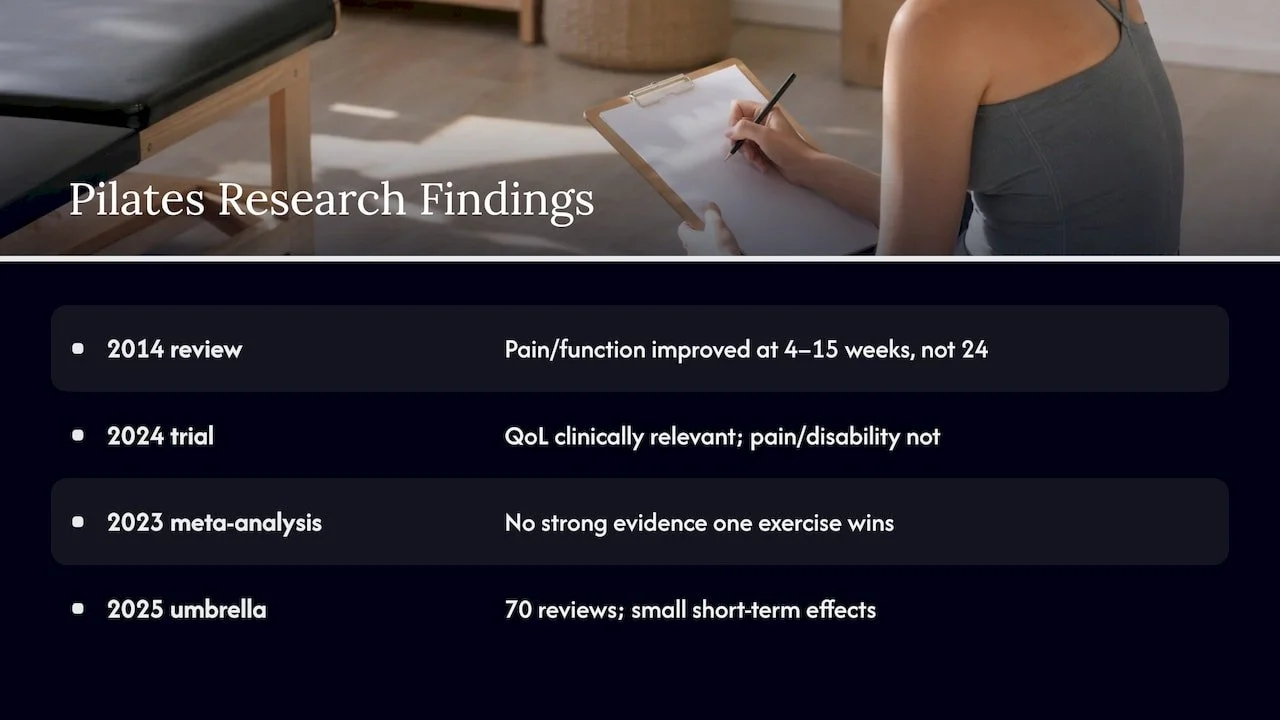
The honest summary: Pilates helps, but it is one good option among several, not a magic one. A review of Pilates training for chronic low back pain concluded that it may be an effective strategy for improving pain and disability. An earlier systematic review from 2014 found statistically significant improvements in pain and function compared with usual care and general physical activity in the short term, between 4 and 15 weeks, but not at 24 weeks.
That gap matters. It suggests the benefit depends on keeping the practice going, the same way strength does.
A 2024 randomized trial from Brazil compared Pilates with home-based exercise. Pilates came out ahead on pain and disability, though the differences were not considered clinically relevant. It did produce clinically relevant improvements in health-related quality of life. In plain terms: you may feel better in your whole life, not only in your back.
Other work is more cautious about picking a winner. A 2023 meta-analysis found no strong evidence that one type of exercise beats another for chronic non-specific low back pain, and suggested choosing based on the person's goals. A 2025 umbrella review of 70 systematic reviews reported small beneficial effects of exercise therapies such as Pilates on pain and disability, particularly in the short term, with low to moderate certainty.
What does that mean for you? The best exercise for your back is often the one you will actually do, enjoy and keep doing. If you like guided, mindful, low-impact movement, Pilates is a strong candidate.
Why Pilates suits a sore back
Pilates is built around a handful of principles: centering, control, precision, breathing and posture. The Cochrane review of Pilates for low back pain describes it as mainly isometric contractions of core muscles that stabilize the body. It also notes that exercises can be done on a mat or with apparatus, and that they are adapted to the person's condition, with difficulty raised gradually.
Three things explain why this fits back pain.
It trains the deep stabilizers. Pilates is described as reactivating weakened core muscles, including the transversus abdominis, internal oblique and multifidus, which supports lumbar stability and spinal mobility. During dynamic Pilates work, the multifidus, transversus abdominis, pelvic floor and diaphragm contract together, which is the team that steadies your lower back.
It teaches awareness. Many people with persistent back pain move in guarded, stiff ways without noticing. Cueing on ribcage, shoulder blades and head position helps you feel when you are bracing or slumping.
It addresses the fear of movement. In a 2025 trial of Reformer Pilates in women with chronic musculoskeletal pain, a 6-week program of 45-minute sessions twice a week brought clinically significant improvements in pain intensity and fatigue. The authors describe Pilates as combining physical conditioning with mental discipline, which may help reduce fear of movement, fatigue and stress.
Movements commonly used to support the back
These are the basics you will meet in most beginner mat classes. According to Healthline's overview of Pilates for chronic back pain, commonly used movements include the following.
| Movement | What it targets | What to focus on |
|---|---|---|
| Pelvic tilt | Pelvic positioning, neutral-spine awareness, gentle lumbar mobility | Small, slow rocking of the pelvis; no forcing |
| Bird dog | Multifidus and transversus abdominis strength, spinal control | Keep hips level; reach only as far as you can stay steady |
| Glute bridge | Glute and hip-extension strength, less lower-back compensation | Press through the heels; lift without arching |
| Modified side plank | Obliques and quadratus lumborum endurance against side-bending | Knees down is a perfectly good version |
| Spine stretch forward | Back-body flexibility and spinal mobility with abdominal control | Sit tall first, then round gently |
A word on technique. The NHS physiotherapy guidance to Pilates asks patients to keep five elements in every exercise: breathing, centering, ribcage placement, shoulder blade placement, and head and neck placement. Another NHS leaflet advises exhaling on the part of the movement that takes the most effort.
Breath is where many beginners get stuck, and where a good teacher helps most. If you want to go deeper, our guides to Pilates breathing techniques and breathwork in Pilates practice walk through it step by step.
A simple 15-minute starter routine
Use this only if you have no red-flag symptoms (see below) and your clinician has not told you otherwise.
Breathing in a relaxed position (2 minutes): lie on your back with knees bent, feet on the floor. Breathe into the sides of your ribcage.
Pelvic tilts (8 to 10 slow reps): rock the pelvis gently, staying in a pain-free range.
Glute bridges (8 reps): lift, pause, lower one vertebra at a time if comfortable.
Bird dog (6 per side): start with just the arm or just the leg if balance is shaky.
Modified side plank (2 holds per side, 10 to 20 seconds): knees bent, forearm down.
Spine stretch forward (5 reps): sit on a folded blanket if your hamstrings are tight.
Stop any move that sharpens your pain or sends symptoms into a leg. A little muscle effort is expected. A sharp or radiating feeling is a signal to back off.
How often and how long to practice
There is no single dose proven for everyone, but research gives a useful range. A review of Pilates dosage in rehabilitation found the most common program length was 8 weeks, with 2 to 3 sessions a week of 50 to 60 minutes. In a Delphi consensus, physiotherapists recommended Pilates for chronic low back pain twice a week for 3 to 6 months.
A realistic plan looks like this:
Weeks 1 to 2: two supervised sessions a week, gentle range, lots of breath and cueing.
Weeks 3 to 8: two or three sessions a week. Add load or complexity only when the previous level feels easy.
Months 3 to 6: keep two sessions a week and consider adding short home practice on off days.
Expert guidance cited in the 2014 review suggests programs for chronic low back pain should be individualized and supervised in the first 2 weeks, and can then move to group sessions of up to 4 clients per therapist. That is a useful benchmark when you choose a studio: smaller groups and a teacher who knows your history make a difference. Our post on measurable changes in eight weeks of Reformer Pilates sets out what a first two months can look like.
Mat or reformer for back pain?
Both work. Mat Pilates needs no equipment and teaches you to control your own body weight. The reformer uses springs that can assist or resist a movement, which many people find helpful when a pose feels too hard or too loaded on the floor. Because the Cochrane review confirms that Pilates can be done on the mat or with apparatus, the choice comes down to comfort, access and what keeps you coming back.
A practical way to choose:
Mat first if you want low cost and something you can repeat at home.
Reformer first if floor work is uncomfortable, if you like feedback from springs, or if you want a more guided, progressive setup.
A mix if you are fit enough to try both. Many people use the reformer for strength and mat work for daily habits.
Practicing safely with back pain
The overall safety picture is reassuring. A 2021 systematic review concluded that Pilates is safe and effective for adults over 50 with musculoskeletal conditions, with no significant adverse effects reported. In the 2025 umbrella review, minor events such as post-exercise soreness or temporary pain increases appeared in fewer than 31% of reviews, mostly in yoga studies, and no serious adverse events were identified.
To keep it that way:
Work at a comfortable level. NHS guidance tells patients to modify exercises to suit their needs and to ask a physiotherapist if they are struggling.
Tell your teacher everything. Name your pain, where it sits, and any diagnosis before class starts, so they can offer options.
Expect gradual progress. Difficulty should go up as your ability does, not on a calendar.
Ask about training. One review noted a lack of relevant certifications for physical therapists and a need for specialized professionals in rehabilitation. Ask any studio about their teachers' training and experience with back pain.
If you have low bone density, you need a more careful approach to spinal flexion and loading. A daily posture plan for osteoporosis covers how to put safety first, and your doctor should guide what is right for you.
We also offer a seated option for anyone who finds the floor difficult: our chair yoga sequence with Heather is a gentle way to build spinal movement and breath awareness. For a longer look at class structure, see our guide to starting Pilates safely with studio modifications.
When to see a doctor before you exercise
According to the Mayo Clinic, seek emergency care if back pain follows a trauma, causes new problems controlling your bowels or bladder, or comes with a fever.
Book a doctor's visit before starting if your pain:
has not improved after a week of home treatment
is constant or intense, especially at night or when lying down
spreads down one or both legs, especially below the knee
causes leg weakness, numbness or tingling
comes with unintended weight loss, swelling in your back, or skin color changes
Anyone with a recent fracture, a diagnosed disc problem or surgery should get clearance from their own clinician and share it with their instructor.
Pilates and chronic pain beyond the back
Long-lasting pain is not only a muscle problem. Fear of movement, poor sleep, fatigue and stress all feed it. The Turkish trial mentioned above suggests Pilates may help here through better posture, core control and breath-centered movement, which build an internal capacity for managing your own condition.
A 2023 systematic review prepared to inform a World Health Organization guideline found pain reduction and improved function associated with Pilates versus no intervention, while rating the evidence for individual exercise types as mostly very low certainty. Read that as encouragement with realism: movement helps, the details of which movement are still being worked out, and your own preference and consistency count for a lot.
Our perspective
We teach many people who come to us because their back hurts, and the pattern is familiar. They have been told to "strengthen the core" but nobody showed them how to find it, or they avoid movement because they are afraid of making things worse.
That is where a small, guided class changes things. Our approach is built around inclusivity, beginner approachability and community, so you can walk in without having done Pilates before and still be taught clear, safe options. We offer both mat Pilates and group reformer classes, which lets us match the equipment to what your body is telling you on a given day.
We think the biggest advantage of a studio is not the exercises, which you can find anywhere. It is the eyes on you: someone who notices that your ribcage flares when you reach, or that your hips shift in a bridge, and offers a modification before it becomes a pain flare. Add breathing that is taught rather than assumed, and a room of people who show up for each other, and consistency gets much easier.
If your back is sensitive, start with a private session, tell us your history, and let us build a plan you can then carry into group classes.
Juiced
Start Pilates at Amrita Yoga & Wellness in Philadelphia
If you are ready to try it, we make the first steps easy to take at our Philadelphia studio. You can book a group class drop-in for $28 per session, or a $11 community class drop-in if you want a lower-cost way to test the room. A one to one session starts from $85 per hour, and is a good choice if you want your back history and goals taken seriously from the first minute.
If you plan to practice twice a week, as the research above suggests, a membership may suit you better than drop-ins. Our 1 Month Unlimited Group Classes pass is $169 per month, and monthly memberships run from $119 (Earth) to $149 (Air). Check the class and monthly experience schedule for current times and our new student specials for introductory offers.
FAQ
Is Pilates good for lower back pain?
For many people with chronic low back pain, yes. Reviews report improvements in pain and function, particularly over the short term of about 4 to 15 weeks. The effect is generally small to moderate, and results are strongest when you keep up regular practice with good instruction.
How long does it take for Pilates to help back pain?
Some people notice easier movement within a few weeks, but studies commonly run 8 weeks or more. Physiotherapists in a consensus study recommended twice-weekly Pilates for 3 to 6 months for chronic low back pain. Give it at least two months of consistent sessions before judging it.
Can Pilates make back pain worse?
Mild post-exercise soreness or a temporary rise in pain can happen, but reviews have found no serious adverse events. Keep movements within a comfortable range, tell your teacher about your pain, and stop anything that causes sharp pain or symptoms down a leg. Pain that is new, severe or spreading deserves a doctor's visit.
Is reformer or mat Pilates better for back pain?
Research has not shown that one is clearly better. Mat work builds control with your own body weight, while the reformer's springs can support or challenge movements. Pick the one that feels comfortable and that you will attend regularly, or try both with a qualified instructor.
Should I see a doctor before starting?
Yes, if your pain followed an injury, has lasted more than a week despite home care, wakes you at night, spreads below the knee, or comes with weakness, numbness, fever or bladder or bowel changes. If you have none of these, you can usually begin gently with a qualified teacher.
Sources
Effect of Pilates training on pain and disability in chronic low back pain
The Effectiveness of Pilates Exercise in People with Chronic Low Back Pain
The effects of Pilates exercise in comparison to other exercises
Benefits and harms of exercise therapy and physical therapies: umbrella review
Systematic review to inform a World Health Organization guideline
Effects of Reformer Pilates on pain, psychological factors and fatigue
Pilates for Chronic Back Pain: 5 Exercises to Try (Healthline)
A systematic review of the effectiveness of Pilates on musculoskeletal conditions in adults over 50