See Measurable Changes in Eight Weeks: Reformer Pilates for Adults
Reformer Pilates strengthens your core, corrects postural habits, increases flexibility, and takes measurable inches off BMI and body fat in as little as eight weeks. It also reduces chronic low back and neck pain, and it tends to lift mood and body image along the way. Most of these changes show up in research programs running two to three sessions a week for six to eight weeks, not overnight.
TL;DR:
Reformer Pilates can lead to measurable body composition changes, like BMI and body fat reduction, after about six to eight weeks of consistent practice.
The core muscles activated through reformer exercises are deep stabilizers that improve spinal load control without building visible bulk.
Postural improvements are significant within two months, especially for sedentary individuals who learn to maintain proper spinal alignment during daily activities.
Regular reformer sessions boost muscular endurance and strength in arms, shoulders, and legs, especially with three sessions weekly.
People with chronic low back or neck pain often experience pain reduction and better movement control, but should seek medical clearance if they have recent or severe spinal conditions.
Amritayogawellness
Build Strength With Reformer Pilates
Amrita Yoga & Wellness offers Pilates classes in Philadelphia for adults seeking core strength, flexibility, posture, and full-body conditioning.
Table of Contents
What Does Reformer Pilates Do to Your Body's Core Muscles?
The reformer's spring resistance forces constant recruitment of the deep stabilizers most exercisers never consciously engage: the transversus abdominis, multifidus, pelvic floor, and diaphragm. These muscles do not build visible bulk. They act as your body's internal bracing system, controlling how your spine handles load during everything from lifting groceries to sitting through a nine-hour workday.
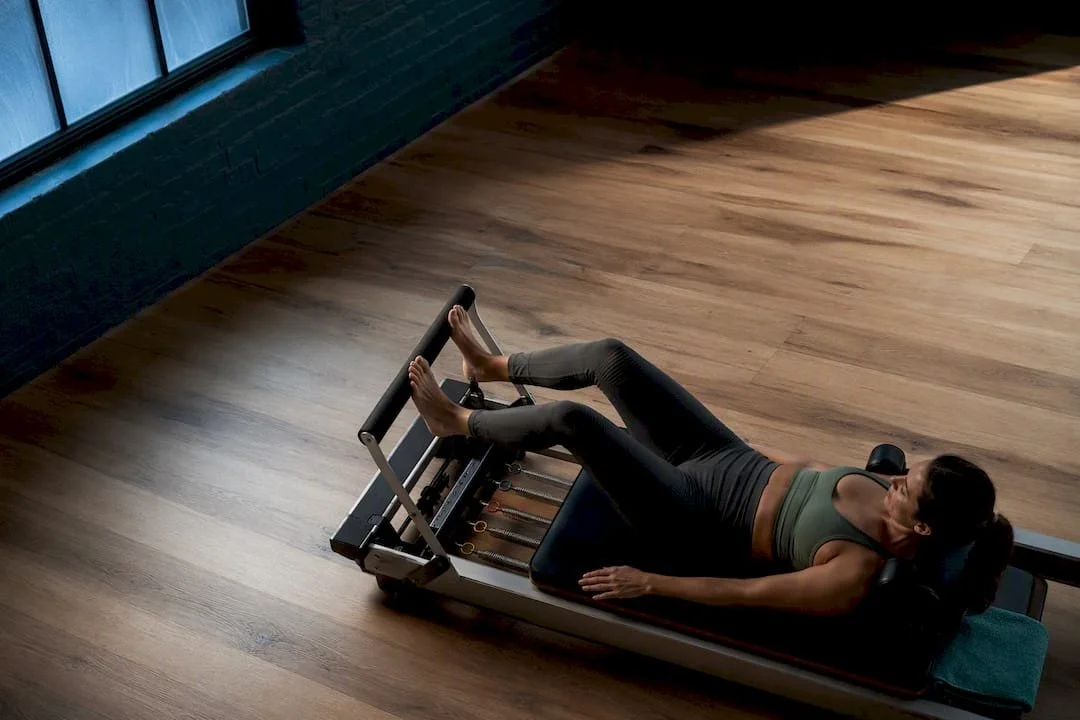
The carriage is the mechanism that makes this different from crunches on a mat. Every time it slides, your body has to resist unwanted movement while still producing the intended one, which is a form of training researchers call anti-movement stability. That is a big part of why supervised reformer programs show consistent gains in trunk flexor strength and endurance over just a few weeks.
Three movement patterns show up constantly in reformer programming:
Footwork on the carriage. Legs press the carriage out against spring tension, building lower-body strength while the core stabilizes the spine against the sliding platform.
The hundred. A pulsing arm and breath sequence performed with the torso curled forward, which hammers the rectus abdominis and deep stabilizers simultaneously.
Short-box sequences. Seated on the box with the strap around the feet, you flex, extend, and rotate the trunk against resistance, which is one of the more direct tests of trunk endurance used in clinical protocols.
Pro Tip: Focus on keeping your ribs from flaring during footwork. If your lower back arches off the carriage, the spring tension is doing the work your core should be doing.
Can Reformer Pilates Improve Posture and Spinal Alignment?
Yes, and the improvement can be dramatic. Years of sitting hunched over a laptop tend to produce a predictable pattern: rounded shoulders, a forward head, and an anteriorly tilted pelvis that flattens the natural curve of the lower back. Reformer work directly counters this because nearly every exercise demands a neutral spine before you're allowed to move, retraining the body to find that position by feel rather than by conscious correction.
A study of sedentary office workers who did an eight-week reformer Pilates program, twice weekly for 60 minutes, found large improvements in postural alignment scores, along with a meaningful jump in body appreciation and a drop in social appearance anxiety. That is a striking result for a desk-bound population, and it lines up with how Pilates principles like centering and precision work as much on the nervous system as on the muscles.
Two ways to track your own progress:
Photograph your side profile against a wall every two weeks. A shrinking gap between your ear, shoulder, and hip landmarks is a real signal of change.
Notice whether you catch yourself slumping less during the workday. That behavioral shift usually precedes visible postural change.
Body Composition, Strength, and Endurance: Realistic Expectations
A 2025 randomized controlled trial tracked overweight and obese women through an eight-week reformer program, supervised sessions three times a week, and found significant drops in BMI and body fat percentage alongside gains in upper-extremity strength, with large effect sizes on both fronts. That is a meaningful result for a low-impact modality often dismissed as "just stretching."
The mechanism is straightforward: springs provide progressive resistance you can dial up as your body adapts, and three sessions a week gives the neuromuscular system enough repeated stimulus to change. If you're not in an obese cohort, expect the same direction of change, strength up, waist down, just don't assume identical magnitude. Individual results depend heavily on starting fitness, diet, and consistency.
What to actually expect over two months:
Noticeable strength gains in arms, shoulders, and legs by weeks three to four.
Modest body composition shifts by week six to eight, more visible in people carrying more excess fat to start.
Muscular endurance, the ability to hold a plank or repeat footwork sets without fatigue, tends to improve before raw strength does.
What the Evidence Shows on Pain Relief and Rehab
Clinical trials on chronic low back and neck pain report meaningful reductions in pain intensity after structured reformer programs, along with improvements in functional interference items like general activity, mood, and sleep quality. Fear of movement and fatigue scores also improved in these trials, which matters because chronic pain often gets worse not from tissue damage but from avoidance behavior that weakens the body further.
The likely mechanisms are proprioceptive: better body awareness, smoother neuromuscular control, and a breathing pattern that shifts the nervous system toward a calmer state during exercise rather than a stressed one.
If you have a diagnosed spinal condition, get medical clearance before starting.
If pain spikes during any exercise rather than easing over sessions, stop and modify with an instructor.
Pro Tip: Chronic pain that improves with movement and worsens with rest is a different pattern than pain triggered by specific movements. Tell your instructor which one you're experiencing before your first session.
Flexibility, Balance, and Mobility Gains From Reformer Work
The carriage's instability is a built-in balance challenge you don't get on a stationary mat. Every rep asks your body to control a moving surface, which trains the small stabilizing muscles around ankles, knees, and hips that matter most for fall prevention as people age.
Assisted stretching is the other half of the equation. Straps and springs let you move into a deeper range than you could unsupported, then add gentle eccentric control on the way back, which builds flexibility without the ballistic risk of forcing a stretch cold. Leg-spring series, lying on your back with feet in straps, work exactly this way, taking the hip through a full range while the core stays anchored.
Reformer practice is consistently linked to improved flexibility and functional balance markers, benefits that show real value as strength alone can't prevent a fall, but better balance and joint control can.
What to Expect: Session Structure and a Realistic Timeline
A typical beginner reformer class opens with breathing and pelvic positioning, moves into footwork and leg work, adds arm and core sequences, and finishes with stretching. Progression happens through spring tension, added repetitions, and more complex movement patterns, usually introduced gradually as your control improves.
Most of the research programs behind these results run six to eight weeks, two to three sessions per week, 50 to 60 minutes each. A six to eight week starter plan looks roughly like this:
Weeks 1 to 2: Learn breathing and neutral spine, light spring tension, focus on form.
Weeks 3 to 4: Postural and alignment changes typically become noticeable here.
Weeks 5 to 6: Strength and muscular endurance gains accelerate.
Weeks 7 to 8: Body composition and pain-related improvements, if applicable, tend to show up last.
Safety, Modifications, and Choosing an Instructor
Reformer Pilates suits most fitness levels, but a few conditions call for caution: recent spinal or joint surgery, an unstable cervical spine, an acute disc herniation, or uncontrolled cardiovascular or blood pressure conditions. If any of these apply to you, get medical clearance and tell your instructor before class.
When picking a studio, look for small class sizes, instructors with rehabilitation or clinical training, and explicit modification cues offered during class rather than after you ask.
Confirm the instructor can name at least two modifications for any exercise on request.
Ask whether the studio offers a private introductory session for first-timers with pain history.
Pro Tip: If you have any chronic pain condition, book a private session before joining a group class. One-on-one time lets an instructor correct your form before habits set in.
How Does Reformer Pilates Affect Your Heart and Breathing?
Reformer Pilates is not primarily a cardio workout, but it is not purely strength training either. Sessions keep your heart rate in a moderate zone through continuous movement between exercises with minimal rest, which produces a mild aerobic training effect over time, especially in faster-paced or flow-style formats.
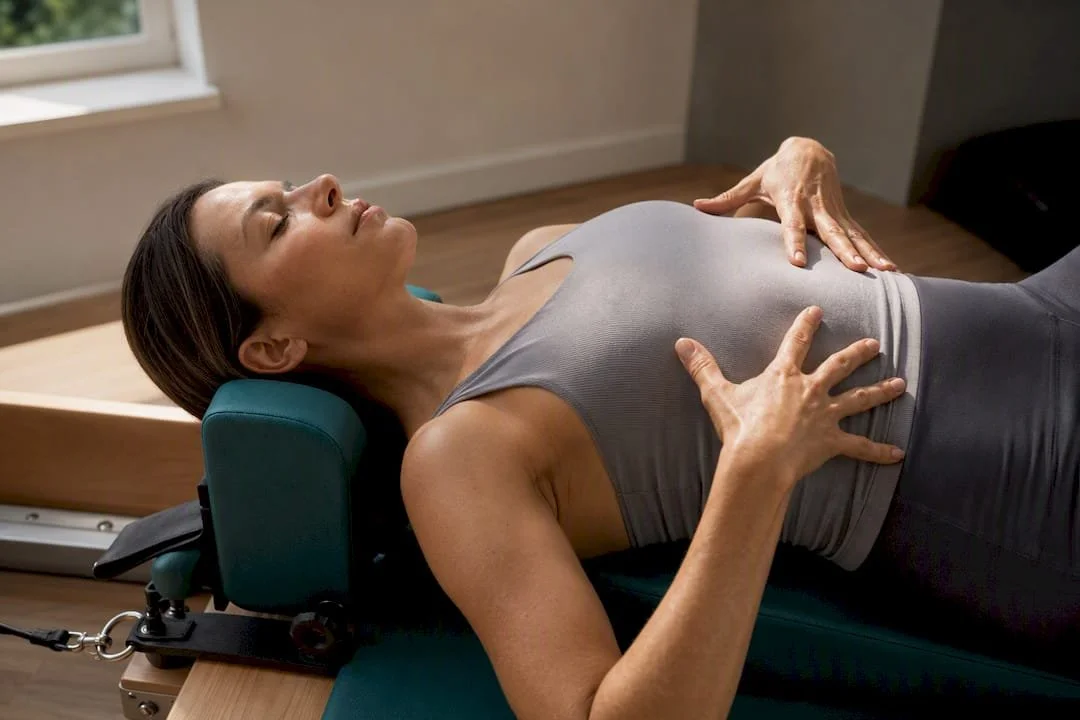
The bigger respiratory story is breath control. Pilates method built around Pilates principles trains lateral rib breathing, expanding the rib cage sideways while keeping the core engaged, rather than shallow chest breathing common under stress. This pattern activates the diaphragm more fully and tends to shift the nervous system toward a calmer, parasympathetic state during exercise.
That calming effect is part of why reformer sessions leave many people feeling clearheaded rather than wiped out, unlike high-intensity interval training that spikes heart rate into an anaerobic zone. If your goal is cardiovascular endurance for running or cycling, reformer Pilates works better as a complement than a replacement. If your goal is a workout that builds strength while lowering stress hormones, the breathing component alone makes it worth the time.
People with hypertension or other cardiovascular conditions should still get clearance from a doctor before starting, since spring resistance and certain positions, particularly inverted or Trendelenburg-style exercises, can affect blood pressure and should be modified accordingly.
Does Reformer Pilates Improve Athletic Performance?
Athletes across running, cycling, tennis, and golf increasingly add reformer sessions to their weekly training because it closes a gap that heavy lifting and sport-specific drills leave open: core stability under rotational and multi-directional load. A golfer's swing and a tennis serve both depend on the trunk transferring force from the legs to the arms without leaking energy at the spine, which is precisely what footwork and short-box sequences train.
Functional movement, the ability to squat, hinge, rotate, and reach with good control, tends to improve because reformer exercises rarely isolate a single joint. Most patterns require the hips, spine, and shoulders to coordinate at once, closer to how the body moves in sport and daily life than a seated leg extension machine.
Runners often notice reduced hip and pelvic instability, a common source of knee and lower back pain over long mileage. The adjustable spring resistance also makes it possible to work through a controlled range of motion at low impact, useful during a return from injury when full-intensity training would be premature.
It won't replace heavy strength training for building maximal power, but as a supplement two or three times a week, reformer Pilates fills a genuine gap in most athletic training plans.
Reformer Pilates vs. Mat Pilates and Other Workouts
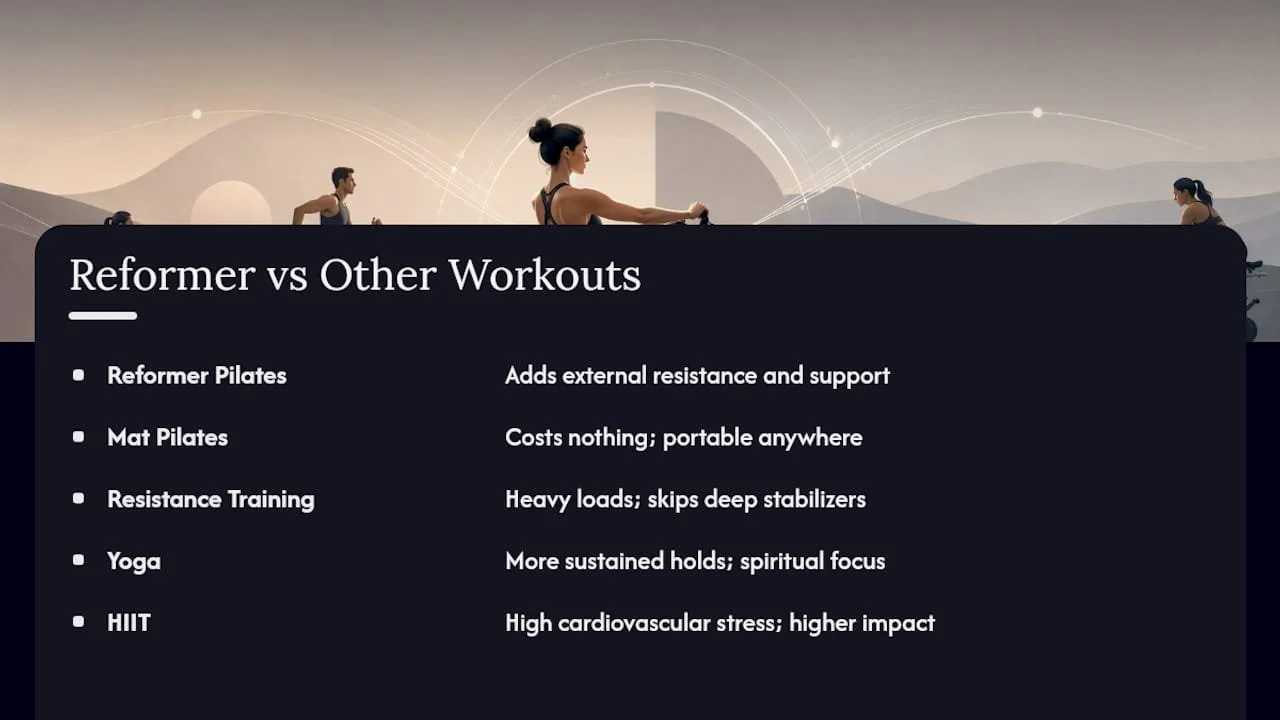
Mat Pilates and reformer Pilates share the same underlying principles, breath, control, precision, but the reformer changes the experience in two concrete ways: it adds external resistance through springs, and it adds support through the carriage and straps. That combination lets beginners access exercises that would be too advanced on a mat, while also letting advanced practitioners load movements harder than bodyweight alone allows.
Compared with resistance training in a traditional gym, reformer Pilates trains the same muscles through smaller, more controlled ranges and puts far more emphasis on the deep stabilizers that heavy compound lifts tend to skip. Compared with yoga, the reformer is more focused on strength and precise movement, and less on sustained holds or spiritual practice, though both share breath awareness as a core tool.
Compared with high-intensity interval formats, reformer sessions are lower impact on joints and better suited to rehabilitation, but they produce less cardiovascular stress. None of these formats are strictly superior. Mat Pilates costs nothing and travels anywhere; the reformer adds resistance and support a mat can't. For adults managing pain, recovering from injury, or wanting measurable strength changes without joint stress, the reformer tends to close the gap between low-impact and effective faster than mat work alone.
Amrita Yoga & Wellness: A Studio-Level Perspective
Amritayogawellness offers reformer group classes and private sessions for readers who want supervised practice rather than guesswork. First-timers or anyone managing pain should start with a private intro before joining a group. The studio's reformer Pilates blog has beginner resources worth reading before your first session.
— Juiced
Try a Reformer Class or Private Session
Amritayogawellness gives you a structured path into reformer Pilates without the trial-and-error of piecing together a routine from videos or a gym floor you're not sure how to use. A Group Class Drop In at $28 per session lets you test the format with instructor guidance before committing to anything, and if you're managing pain, recovering from an injury, or simply want your form corrected one-on-one, a private session starting at $85 per hour gets you individualized attention from the first move.
Group classes suit people comfortable following cues alongside others and building consistency through a regular schedule. Private sessions suit anyone starting with a pain history, postural concern, or simply wanting faster progress through personalized correction. If you want structured guidance on general fitness programming outside the studio, resources like JustFit Pakistan cover broader training approaches worth knowing about.
Book your first class or private session through Amritayogawellness's in-studio group class page and see which format fits your body's starting point.
Sources
FAQ
How Fast Will I See Changes From Reformer Pilates?
Postural and core control improvements often show up within three to four weeks of consistent practice, while strength, endurance, and body composition changes tend to follow by week six to eight. Most clinical programs behind these results ran two to three sessions weekly for eight weeks.
Can Reformer Pilates Help With Weight Loss?
Reformer Pilates supports weight loss indirectly through muscle building and improved body composition rather than heavy calorie burn alone. An eight-week randomized trial in overweight and obese women found significant reductions in BMI and body fat percentage alongside strength gains.
Is Reformer Pilates Safe for Back Pain?
For many people with chronic low back pain, reformer Pilates is safe and can meaningfully reduce pain intensity and improve function, according to clinical trial results. Anyone with an acute injury, recent surgery, or unstable spinal condition should get medical clearance first and consider starting with a private session rather than a group class.
Is Reformer Pilates Better Than Mat Pilates?
Neither is strictly better. The reformer adds spring resistance and carriage support that make certain exercises more accessible and more progressively challenging, while mat Pilates requires no equipment and builds the same foundational control. Many practitioners use both, mat work between reformer sessions to reinforce the same core principles.