Pilates helps runners in four main ways. It builds the deep core and hip muscles that hold your form together late in a run. It trains breathing and body awareness. It exposes small left-right imbalances that repetitive mileage can magnify. It gives tired legs a low-impact day that still counts as training. The best-known trial of runners found faster 5K times after 12 weeks of Pilates. The evidence on injury prevention is still developing. Here is what each benefit means in practice and how to fit Pilates around your running week.
Amritayogawellness
Build Strength Beyond the Run
Amrita Yoga & Wellness offers Pilates classes in Philadelphia, supporting runners who want to add controlled movement to their training.
TL;DR
Pilates trains the whole core, including the lower back, glutes and inner thighs, which are the muscles that keep your pelvis and spine steady stride after stride.
In a 2018 trial, runners who completed 12 weeks of Pilates improved their 5K time, VO2max and running economy.
Breath control and body awareness from Pilates carry straight into hard efforts, when form usually fades.
Two to three short sessions a week is the range experts suggest. Keep them gentle on heavy mileage days.
Mat and reformer classes both work. Choose the one you will attend consistently.
Table of Contents
Why Pilates suits running
Running is repetitive. You move forward in a single plane, thousands of times per outing, and the body rewards what it does often. The muscles that drive you forward get strong. The ones that stabilize, rotate and control tend to get less attention.
Runner's World's UK edition explains that because running is repetitive, small muscle or gait imbalances can be magnified into injury, and that Pilates helps identify and strengthen those weaknesses. The same outlet's 2025 piece describes Pilates as fruitful cross-training for runners because it bolsters the core and improves flexibility, posture, balance and body awareness.
Pilates fits because it is slow, precise and controlled. You are not trying to get your heart rate up. You are teaching muscles to fire in the right order, and that is the part a long run cannot teach you.
A core that works for the whole run
Most runners hear "core" and think crunches. Running asks for something different: a trunk that stays stable while your legs swing, your arms counter-rotate and your pelvis absorbs impact.
Runner's World notes that Pilates is particularly good at focusing on the "whole" core, including the lower back, where runners often concentrate only on the abdominals. Its US coverage adds that Pilates works the deep core muscles along with often-neglected glutes and inner thighs, building control that can improve posture and running form.
Why does the deep core matter? The same article reports that Ohio State University researchers found in 2018 that weak deep core muscles led to compensations that could raise the risk of lower back pain over time. When the deep stabilizers are not doing their job, bigger muscles pick up the slack and tire.
In practice you may notice:
Less sagging through the hips and lower back in the last miles.
A steadier pelvis, so your stride looks less like it is wobbling side to side.
Better posture on hills, when many runners fold forward from the waist.
These are the things Pilates exercises are designed to train: pelvic control, rib-to-hip connection and single-leg stability. If you are brand new to the method, our Pilates for beginners guide walks through the fundamentals. Our mat Pilates overview covers core strength and flexibility in more detail.
What the research shows on speed and efficiency
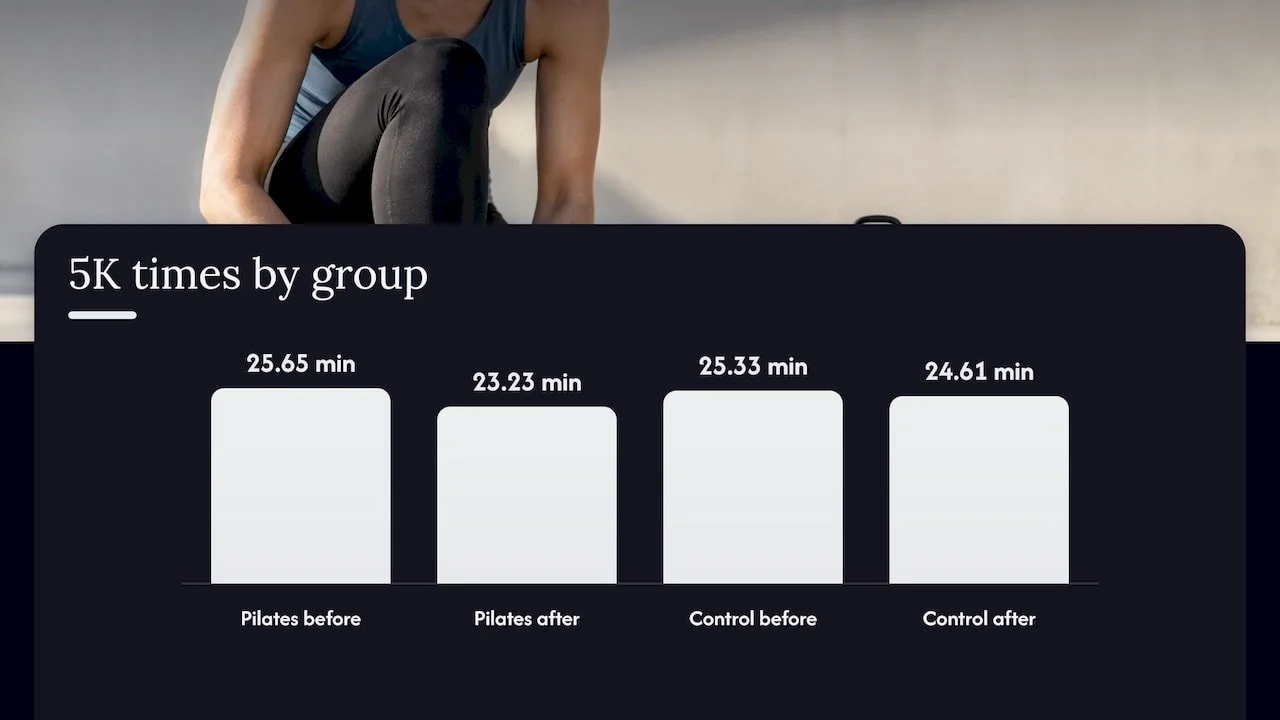
The most cited study for this keyword is a Brazilian trial published in PLOS One. Researchers had trained distance runners add Pilates for 12 weeks. The 13 runners in the Pilates group who completed the program improved their 5K time from 25.65 to 23.23 minutes, while the control group moved from 25.33 to 24.61 minutes.
The same paper reports more than a faster clock:
| Measure | Before | After 12 weeks of Pilates |
|---|---|---|
| 5K time (Pilates group) | 25.65 min | 23.23 min |
| VO2max | 51.8 mL/kg/min | 58.53 mL/kg/min |
| Metabolic cost at 12 km/h | 5.0 J/kg/m | 4.33 J/kg/m |
The full text on PubMed Central also reports lower activation of postural muscles at submaximal running speeds. In plain terms, the runners spent less energy holding themselves upright at an easy pace. The authors concluded that the results support strength training aimed at specific postural and locomotor muscles in trained distance runners.
A sample of 13 is small, so treat the numbers as an encouraging signal rather than a promise. Still, the direction fits what runners and coaches report: better control means less wasted motion.
Marie Claire UK's 2026 feature makes a complementary point. Pilates trains controlled, low-impact movement that running cannot, and doing both lets you get cardio from mileage and strength and mobility from Pilates, which can support running economy.
Movement quality, injury risk and recovery
This is the benefit runners ask about most, and it deserves a careful answer.
A 2017 University of Bath study found that six weeks of Clinical Pilates improved functional movement scores in 40 recreational runners, from 13.4 to 17.0. Better movement patterns are one of the things coaches look at when judging injury risk.
A 2022 study of 34 novice runners looked at knee mechanics during a 12-week mat Pilates program. The Pilates group showed a 5.1 cm reduction in dynamic knee valgus, the inward collapse of the knee that is often linked to knee pain. The authors suggest that core-focused programs like Pilates may help knee running mechanics and reduce injury risk, and they call for larger and longer studies to confirm it.
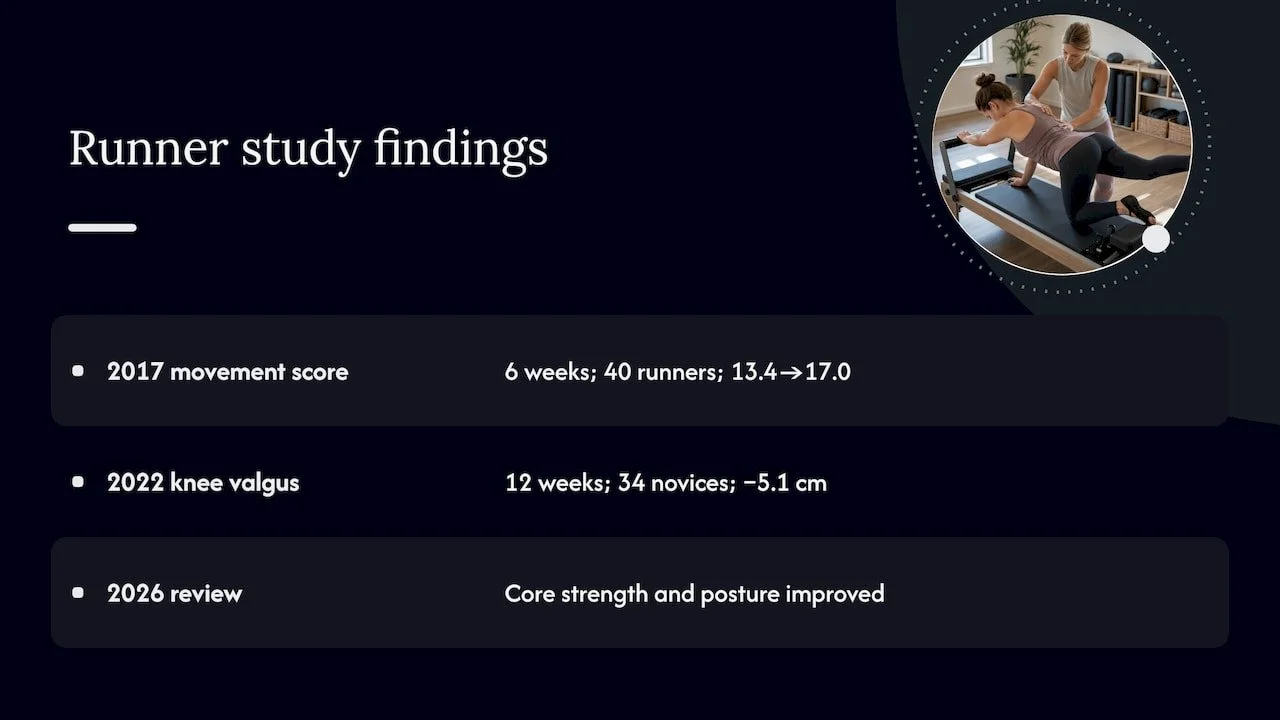
A 2026 systematic review of literature from 2014 to 2024 found that Pilates is effective at strengthening core musculature and correcting postural imbalances, both considered important for injury prevention in athletes.
The honest summary: the movement-quality benefits are well supported, and injury-prevention research specific to runners is still growing. What we can say is that building strength, control and symmetry is a sound way to look after your body between runs. If you have pain that lingers, changes your stride or wakes you at night, see a physician or a physical therapist. A podiatric sports medicine practice can assess foot and ankle problems that Pilates alone is not meant to diagnose.
Recovery days
Pilates also gives you something useful to do on days when your legs do not want to run. British GQ quotes instructor Deery saying gentle mat work the day after a long run can help flush the legs and release tight hip flexors and hamstrings, and can mobilize a stiff lower back without adding more load. Slower classes with breathwork help calm the nervous system, which the same source describes as where real recovery happens.
Breathing and body awareness
Runners lose form when they tire. Shoulders creep up, the ribcage stiffens, breathing turns shallow. Pilates puts breathing at the center of every exercise, so it is practice for exactly that moment.
Deery describes Pilates as teaching lateral, 360-degree breathing that expands the ribcage sideways and backwards, recruits the diaphragm and keeps the deep core engaged, things runners tend to lose when tired. Marie Claire UK reports that connecting to breath is a key tenet of both Pilates and running, and that practicing it on the mat improves your ability to do it during miles and races.
The usual technique is simple. Merrithew describes a cycle of inhaling through the nose and exhaling audibly through pursed lips, used to build mind-body awareness and muscular control.
Try this the next time you are in a class: on each exhale, feel your lower ribs draw in and down, then keep that sense of connection as you lift a leg. On your next tempo run, check in with the same cue every mile.
How often, and when to fit Pilates around running
You do not need to overhaul your training. Three experts in British GQ advise two to three Pilates sessions a week, noting that even 15 minutes a day may be enough, with softer intensity on mileage days.
One practical way to build the week, adapted from the guidance above:
| Day | Running | Pilates |
|---|---|---|
| Monday | Easy run | Optional short mat session after the run |
| Tuesday | Intervals or hills | None, or gentle stretching only |
| Wednesday | Rest or easy | Full 45 to 60 minute class |
| Thursday | Tempo run | None |
| Friday | Rest | Short mat or recovery session |
| Saturday | Long run | None |
| Sunday | Easy or rest | Gentle mat work to loosen up |
A few rules of thumb:
Pair Pilates with easy days. One published plan suggests adding one or two Pilates sessions on easy-run or rest days, or straight after an easy run, and avoiding a long abdominal session right before a hard run or race.
Keep your strength work. The same plan keeps two weekly strength sessions with weights and uses Pilates alongside them.
Taper gently. Runner's World quotes O'Leary advising that in a two to three week marathon taper, you stay with gentle cross-training for the first two weeks, then in the final week do only the gentlest stretching and avoid chasing strength gains with weights.
Mat or reformer: which fits a runner?
Both work. British GQ's experts say that mat fundamentals build strength and control when done properly, while reformer exercises in standing and single-leg positions are functionally relevant for runners.
Here is how we would think about the choice:
Mat Pilates is the easiest place to start. It needs no equipment, it teaches the breathing and pelvic control everything else builds on, and it is a good fit for recovery days.
Reformer Pilates adds spring resistance and adjustable support. It suits single-leg work and lets you load the glutes and hips in ways body weight alone may not. Read our guides to what a reformer does for your body and reformer benefits for core strength and flexibility.
Athletes in general may also like our overview of the benefits of Pilates for athletes.
If you are new, start with a beginner-friendly mat class and add reformer once the basics feel natural. Our guide to starting Pilates safely explains typical class lengths and modifications. Tell your instructor about any current injury before class so they can adjust the exercises.
Our perspective
Runners often come to us with strong lungs and legs and very little idea what their hips and trunk are doing. That is not a flaw. It is what happens when most of your training is one repetitive movement.
At Amrita, we teach Pilates as skill practice. We ask you to slow down, breathe with each movement and notice which side is working harder. Those small discoveries are what tend to carry over to the road: a calmer breath at mile eight, a steadier pelvis on a hill, a lower back that feels less cranky afterward.
Our approach is built around inclusivity and beginner approachability. Our classes are designed with clear guidance and modifications so you can build strength safely at your own level. Many runners find the community side valuable too. It is easier to stay consistent when you have a class on your calendar and people expecting you.
Our advice: start with mat classes, pair them with your easy days and let the practice build quietly alongside your mileage.
Juiced
Try Pilates at Amrita in Philadelphia
If you run in Philadelphia and want a class to anchor your cross-training, we offer mat Pilates and group reformer classes, plus yoga, barre and tai chi, in the studio. Prices are published on our class and membership page.
A Community Class drop-in is $11, a Group Class drop-in is $28, and Nurtured Beginnings is $35 per pass. If you want to attend two or three times a week, our Earth Monthly Membership is $119 per month, and 1 Month Unlimited Group Classes is $169. For a plan built around your training, a One to One Session starts from $85 per hour on our private yoga and mat Pilates page. See the class schedule for current times, and check our new student specials if you are joining us for the first time.
FAQ
Is Pilates good for runners?
Yes. Pilates builds the deep core, glutes and hip stabilizers that support running form, and it trains breathing and body awareness. In a 2018 trial, runners who completed 12 weeks of Pilates improved their 5K time and running economy. It works best as a complement to your runs, not a replacement.
Should I do Pilates before or after a run?
After an easy run, or on a separate easy or rest day, is the most common advice. Avoid a long, demanding abdominal session just before a hard run or race. Gentle mat work the day after a long run is a good way to loosen the hips and back.
How many times a week should runners do Pilates?
Experts quoted by British GQ suggest two to three sessions a week, and even 15 minutes a day can help. On heavy mileage days, keep the intensity light. Start with one or two classes and add more as your body adapts.
Is mat or reformer Pilates better for running?
Neither is strictly better. Mat classes teach the fundamentals of breathing and core control, while reformer classes add resistance and single-leg work that is relevant to running. Pick the one you will attend regularly, and consider combining both over time.
Sources
PubMed Central: Pilates training improves 5-km run performance
University of Bath: Clinical Pilates and functional movement in recreational runners
PubMed Central: Pilates mat-based exercises and knee kinematics
Interdisciplinary Journal of Human Kinetics: Comparative efficacy of yoga and Pilates