Benefits of Pilates for Athletes: Performance Guide
TL;DR:
Pilates enhances athletes' core stability, flexibility, and balance, leading to better performance and injury prevention. It targets deep stabilizing muscles, improves movement efficiency, and promotes recovery when integrated properly into training routines. Consistent practice during the off-season effectively resets imbalances and builds foundational strength.
Pilates is a systematic training method that builds the core stability, flexibility, and dynamic balance athletes need for peak performance and long-term injury prevention. The benefits of Pilates for athletes go well beyond basic stretching. Research on college basketball players shows a 6-week Pilates program produced significant gains in flexibility, balance, muscular strength, and core stability compared to a control group. Pilates targets the deep stabilizing muscles that explosive sports training typically ignores, making it one of the most effective cross-training tools available for athletes at every level.
1. Benefits of Pilates for athletes: core strength and power transfer
Core strength is the foundation of every athletic movement, from a sprinter's drive phase to a basketball player's jump shot. Most athletes train the superficial muscles like the rectus abdominis while neglecting the deep core: the transversus abdominis, multifidus, pelvic floor, and diaphragm. Pilates targets all four directly.
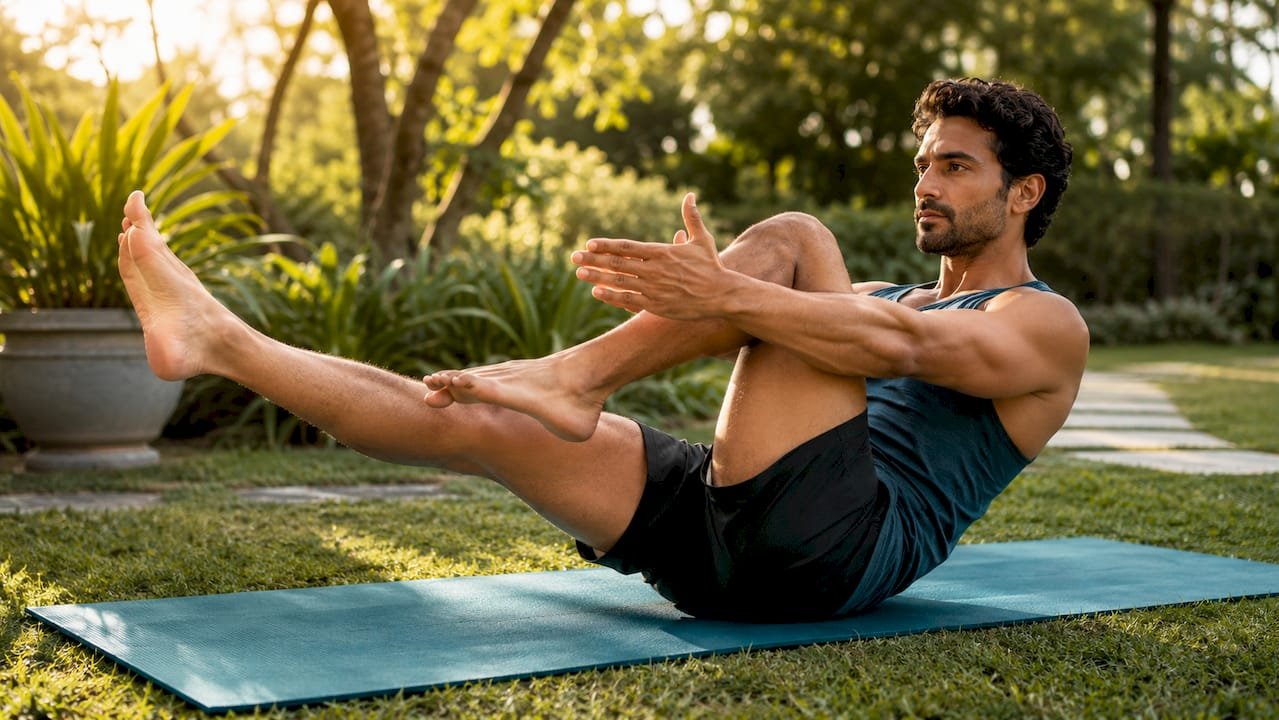
Pilates solves the "energy leak" problem by strengthening these deep muscles and improving force transfer during explosive movements. When your deep core fires correctly, power generated in your legs travels efficiently through your trunk to your arms or the ground. Without that transfer, energy bleeds out at the midsection and performance drops.
An 8-week mat Pilates program significantly improved isometric back and leg strength in male youth soccer players aged 11–13. That result matters because it shows strength gains appear even in young, developing athletes who already train regularly.
Key deep core muscles Pilates develops:
Transversus abdominis: the body's internal weight belt, stabilizing the spine before limb movement
Multifidus: small spinal muscles critical for vertebral stability and posture under load
Pelvic floor: the base of the core cylinder, essential for intra-abdominal pressure control
Diaphragm: the top of the core cylinder, coordinating breathing with spinal stability
Pro Tip: Prioritize Pilates exercises like the Hundred, Dead Bug, and Single Leg Stretch early in your routine. These load the deep core without fatiguing the prime movers you need for sport-specific training later.
2. Flexibility and joint mobility gains for better movement
Dynamic flexibility is the ability to move a joint through its full range under load and at speed. Static stretching builds range of motion at rest. Pilates builds the kind of flexibility athletes actually use during competition.
Pilates lengthens muscles while simultaneously demanding control through that range. A footballer gaining hip flexor length through Pilates does not just stretch the tissue. He trains the nervous system to use that length at full stride. That combination directly improves movement efficiency and reduces the stiffness that slows athletes down in the second half of a game.
The 6-week basketball study recorded significant flexibility improvements across the intervention group. Flexibility gains in athletes translate to faster stride mechanics, deeper squat patterns, and reduced compensatory movement that leads to overuse injuries.
Sports that benefit most from Pilates-driven flexibility gains:
Runners: hip flexor and hamstring length reduces stride restriction and IT band stress
Golfers: thoracic rotation mobility directly increases club head speed
Football players: hip and groin flexibility reduces adductor strain risk during cutting movements
Swimmers: shoulder mobility and thoracic extension improve stroke efficiency and reduce rotator cuff load
Pro Tip: Pair your Pilates session with sport-specific dynamic warm-up drills on the same day. The nervous system is primed after Pilates work, making it the ideal time to reinforce sport-relevant movement patterns.
3. Dynamic balance and neuromuscular control
Dynamic balance is the ability to maintain body position while moving, absorbing force, or changing direction. It is not a talent. It is a trainable skill, and Pilates trains it directly.
A 12-week Pilates intervention significantly improved dynamic balance and lower limb strength in elite fencers, with a strong correlation between quadriceps strength and balance scores. Elite athletes already train hard. The fact that Pilates produced measurable balance gains on top of their existing training shows how much foundational stability typical sports programs leave on the table.
Pilates builds proprioception, the body's ability to sense its own position in space, by demanding precise movement on unstable surfaces and through unfamiliar planes of motion. Better proprioception means faster automatic corrections when you land awkwardly, change direction, or absorb contact. That speed of correction is what separates athletes who stay healthy from those who get hurt.
Balance and strength gains: what the research shows
| Metric | Pre-Pilates | Post-Pilates (12 weeks) |
|---|---|---|
| Dynamic balance score | Baseline | Significantly improved (p<.05) |
| Lower limb strength | Baseline | Significantly improved |
| Quadriceps-balance correlation | Measured | Strong positive correlation |
| Study population | Elite fencers | Elite fencers |
Pro Tip: Add single-leg Pilates exercises like the Standing Leg Press or Side-Lying Leg Series to your routine. These directly challenge the hip stabilizers and ankle proprioceptors most relevant to cutting and landing mechanics.
4. Injury prevention through muscular balance
Most sports injuries do not come from a single catastrophic event. They come from accumulated stress on tissues that are overworked because other muscles are not doing their job. Pilates corrects that imbalance at the source.
Pilates improves gluteal muscle strength and neuromuscular coordination, directly reducing injury risk at the knee, hip, and lower back. Weak glutes force the hamstrings, IT band, and lumbar spine to compensate. That compensation pattern is behind a large share of running injuries, ACL tears, and chronic low back pain in athletes.
Pilates also trains tendons and ligaments through controlled, progressive loading rather than the ballistic stress of sport. That controlled loading builds tissue resilience without the joint overload that heavy lifting or plyometrics can cause. For athletes managing sports injury recovery, Pilates provides a way to maintain conditioning while protecting vulnerable structures.
How Pilates reduces injury risk in athletes:
Corrects muscle imbalances by targeting underactive stabilizers that sport-specific training skips
Trains movement control through full range of motion, reducing the risk of joint stress at end range
Builds tendon resilience through slow, loaded movements that stimulate collagen remodeling
Improves landing mechanics by strengthening the hip and knee stabilizers that absorb ground reaction force
Reduces compensatory patterns that develop when dominant muscles take over for weaker ones
5. Faster recovery and off-season conditioning
Recovery is not passive. Athletes who use their off-season to correct movement faults and rebuild foundational strength return to preseason training ahead of those who simply rest. Pilates is the most effective tool for that work.
Pilates is most effective in the off-season because it addresses movement compensations without adding joint overload. During the competitive season, athletes accumulate asymmetries from repetitive sport-specific patterns. A pitcher's shoulder, a soccer player's dominant kicking hip, a tennis player's dominant forearm all create imbalances that compound over time. Pilates resets those patterns.
Qualitative improvements in movement efficiency and injury resilience typically appear within 8–12 weeks of consistent Pilates practice. That timeline fits neatly into a standard off-season block, making it a practical addition to any periodized training plan.
For athletes recovering from ankle or lower limb injuries, Pilates provides controlled loading that supports ankle sprain rehabilitation while rebuilding the hip and core stability that protects the joint from reinjury.
6. Mental discipline and movement precision
Pilates requires deliberate, precise movements that challenge athletes in ways their regular training does not. NFL players who have added Pilates to their programs describe it as mentally demanding in a completely different way from lifting or conditioning work. That demand is the point.
Pilates emphasizes slow, controlled movement with high concentration on stabilizing muscles. This differs sharply from the explosive, high-load training that dominates most athletic programs. The mental discipline of holding precise positions under fatigue transfers directly to sport. Athletes who can maintain form when tired make fewer technical errors and sustain fewer injuries in the late stages of competition.
The concentration Pilates demands also builds body awareness. Athletes who know exactly where their spine, hips, and shoulders are during movement make faster technical corrections. That awareness is a skill, and Pilates is one of the few training methods that develops it systematically. You can explore Pilates breathing techniques as a starting point for building that internal focus.
7. How to build a Pilates routine for athletes
A Pilates routine for athletes works best when it is treated as a complement to sport-specific training, not a replacement for it. Pilates corrects imbalances and prevents injury. It does not replace heavy lifting or conditioning work.
Practical guidelines for integrating Pilates into athletic training:
Frequency: 2 sessions per week is the minimum effective dose for measurable gains. The basketball and fencer studies used 3 sessions per week over 6–12 weeks.
Duration: 45–60 minutes per session is sufficient. Longer sessions do not produce proportionally better results.
Timing: Schedule Pilates on lower-intensity training days or after technical skill work, not before heavy strength sessions.
Instructor selection: Athletes need instructors experienced with sport-specific biomechanics. A general Pilates class will not address the joint loading patterns specific to your sport.
Progression: Start with mat-based fundamentals like the Pilates exercises for all levels before moving to reformer or equipment-based work.
Periodization: Use higher Pilates volume in the off-season for correction and rebuilding. Reduce to maintenance frequency during the competitive season.
General Pilates classes may not address sport-specific demands. Athletes should seek programs tailored to the biomechanical requirements of their sport to get the most from the method.
Key takeaways
Pilates builds the core stability, dynamic balance, and muscular coordination that athletes need to perform better and stay healthy longer.
| Point | Details |
|---|---|
| Core strength drives performance | Pilates targets deep stabilizers that improve force transfer in every explosive movement. |
| Flexibility gains are functional | Pilates builds dynamic range of motion athletes use at speed, not just at rest. |
| Balance and proprioception improve measurably | A 12-week program produced significant balance gains in elite fencers already in peak training. |
| Injury prevention is the clearest ROI | Correcting gluteal weakness and movement compensations reduces the most common sports injury patterns. |
| Off-season timing maximizes results | Eight to twelve weeks of consistent Pilates resets imbalances and rebuilds foundational stability before preseason. |
What I've learned watching athletes train with Pilates
Athletes walk into their first Pilates session expecting it to be easy. They walk out humbled. That gap between expectation and reality is the most important thing Pilates teaches.
The mental shift is real. Athletes who train with maximum effort in every session learn to push through discomfort. Pilates teaches something different: precision under fatigue, control at the edge of your range, and patience with slow progress. Those qualities show up in competition in ways that are hard to measure but impossible to miss.
What I find most underrated is how Pilates exposes the weak links that athletes have learned to work around. A tight hip flexor, a lazy glute, a spine that locks up instead of rotating. Sport-specific training masks these problems because dominant muscles compensate. Pilates removes the compensation and forces you to address the actual issue.
The athletes who get the most from Pilates are the ones who treat it seriously from the start. Two sessions a week, a qualified instructor who understands your sport, and a willingness to slow down and feel what your body is actually doing. That investment pays off in fewer injuries, better movement quality, and a longer career.
— Juiced
Pilates classes for athletes at Amrita Yoga & Wellness
Athletes in Philadelphia looking to add Pilates to their training have a direct option at Amrita Yoga & Wellness. The studio offers Pilates classes designed to build the core strength, flexibility, and balance that support athletic performance and recovery.
Amritayogawellness provides a range of wellness programs and classes that fit different training schedules and experience levels, from beginners working on foundational stability to experienced athletes refining movement quality. The studio's approach to Pilates fits naturally into a periodized training plan, whether you are in the off-season rebuilding phase or maintaining conditioning during competition. Check the schedule and find a session that works around your sport.
FAQ
What are the main benefits of Pilates for athletes?
Pilates improves core strength, dynamic balance, flexibility, and neuromuscular coordination. Research shows measurable gains in all four areas within 6–12 weeks of consistent practice.
How often should athletes do Pilates?
Two to three sessions per week produces significant results, based on the basketball and fencer studies that used that frequency over 6–12 weeks.
Does Pilates replace strength training for athletes?
Pilates complements strength training but does not replace it. Its primary value is correcting imbalances, preventing injury, and improving core-integrated movement alongside regular sport-specific work.
When is the best time for athletes to add Pilates?
The off-season is the most effective time to start Pilates, as it allows athletes to address movement compensations and rebuild foundational stability without the joint overload of in-season training.
Can Pilates help with sports injury recovery?
Pilates supports recovery by rebuilding hip and core stability through controlled loading that protects vulnerable joints. It is particularly useful for athletes recovering from lower limb injuries and overuse conditions.