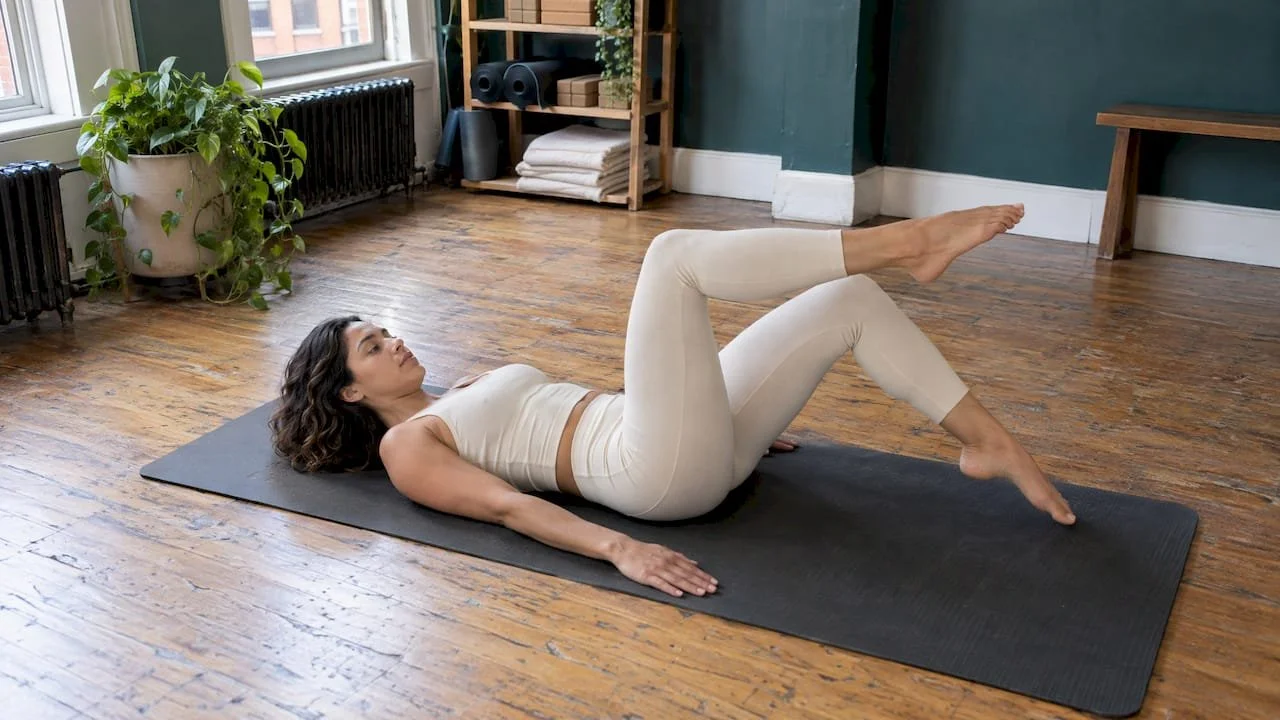
Pilates exercises are slow, controlled movements that build core strength, mobility and balance. You do them on a mat or on spring-based equipment such as the reformer, and you pair each move with deliberate breathing. A session is about precision, not exhaustion. Typical moves include the hundred, the pelvic curl, the single leg stretch, the roll up and the spine twist.
Below you will find what makes an exercise "Pilates," a set of examples with cues, what a class feels like, who benefits, and how to begin in Philadelphia or at home.
Amritayogawellness
Explore Pilates in Philadelphia
Amrita Yoga & Wellness offers Pilates alongside yoga and other wellness practices for beginners and experienced practitioners in Philadelphia.
TL;DR
Pilates is a low-impact, mind-body method built on core control, breathing and precise form, using a mat or equipment like the reformer.
Classic examples: the hundred, pelvic curl, chest lift, single leg stretch, roll up, spine twist, swan and bird dog.
Sessions usually run 45 to 90 minutes, with low repetitions (often five to ten) and quality over speed.
Research links Pilates with better flexibility, balance and muscular endurance, and with less pain for some people with chronic low back pain.
Beginners can start with mat work two or three times a week, then add the reformer when the basics feel familiar.
Table of Contents
What makes an exercise "Pilates"
Joseph Pilates developed the method in the early 20th century. The Australian government's Natural Therapies Review describes it as a body conditioning system for both body and mind, founded on stabilizing the core muscles (abdominal, gluteal and paraspinal) while moving through a controlled range of motion.
What separates a Pilates exercise from a regular crunch or squat is how it is done. Instructors often teach six principles: centering, breathing, concentration, precision, control and flow. Shape notes that teachers do not always agree on the exact number or order, so you may hear slightly different lists from studio to studio.
An academic overview by a physical therapist in PMC adds that every exercise flows from five essentials: breathing, cervical alignment, rib and scapular stabilization, pelvic mobility and use of the transversus abdominis. In plain words: you set your ribs, shoulders, pelvis and deep abdominals first, then you move.
That is why a Pilates move can look small and still feel demanding. The same review notes the emphasis falls on efficient muscle recruitment and quality of performance rather than maximal effort.
Mat exercises and apparatus exercises
The Natural Therapies Review says contemporary Pilates includes more than 500 exercises, split into two broad groups: mat work and apparatus work. Large apparatus includes the reformer, the trapeze table (Cadillac), the Wunda chair and barrels.
Mat Pilates uses your body weight and gravity. In a mat class you typically sit, or lie face up or face down, and use gravity to help stabilize the core, as described in the PMC overview. Small props such as resistance bands, foam rollers or a small ball are common. WebMD lists these among typical Pilates equipment.
Reformer Pilates uses a sliding carriage connected to a frame by springs, with straps and a footbar. You push and pull the carriage, and the springs add resistance or support depending on the setting. If you are curious about the variations, our guide to types of Pilates reformer walks through them.
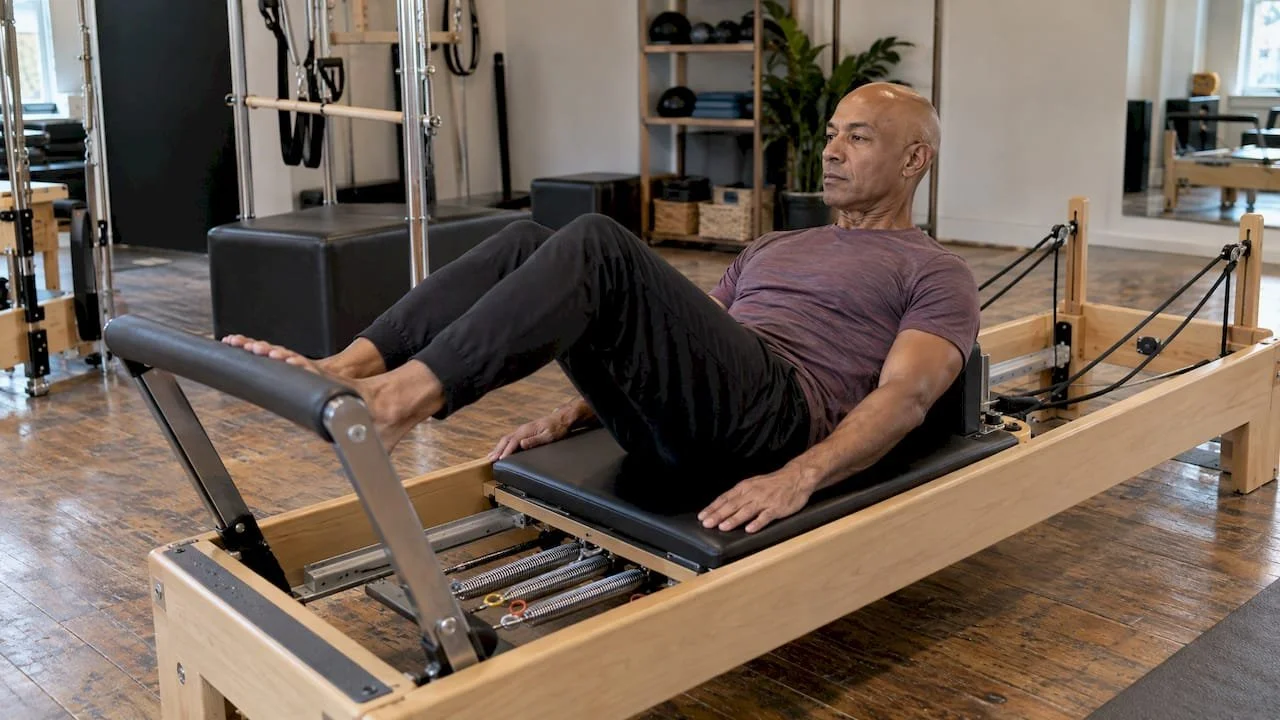
Neither is better in every case. Mat work teaches you to control your own body weight and costs nothing to practice at home. The reformer gives feedback and adjustable load, which many people find helpful for form.
Examples of Pilates exercises, with cues
These are widely taught mat exercises. Move slowly, breathe steadily, and stop if anything pinches or hurts.
1. Breathing (ribcage breathing)
Lie on your back with knees bent. Place your hands on the sides of your lower ribs. Inhale through the nose and feel the ribs widen. Exhale through the mouth and feel them close as your deep abdominals draw in. Nearly every other exercise builds on this. Our guide to breathwork in Pilates goes deeper.
2. Pelvic curl (shoulder bridge preparation)
Lie on your back, feet hip-width apart. Exhale and roll your tailbone up, then your spine, one vertebra at a time, until you form a diagonal line from shoulders to knees. Inhale at the top. Exhale and roll down slowly. It works the glutes, hamstrings and spinal mobility.
3. Chest lift
From the same position, hands behind your head, exhale as you nod the chin slightly and curl the head, neck and shoulder blades off the mat. Lower with control. It is a gentler first step toward the roll up.
4. Toe taps
Lie on your back with legs in tabletop (knees over hips, shins parallel to the floor). Lower one foot to tap the floor and return, keeping your lower back steady. Alternate sides. This trains the abdominals to hold the pelvis still while the legs move.
5. Single leg stretch
Curl your head and shoulders up. Hug one knee in while the other leg extends at about a 45 degree angle, then switch. Keep your torso still. It works the abdominals and hip flexors.
6. The hundred
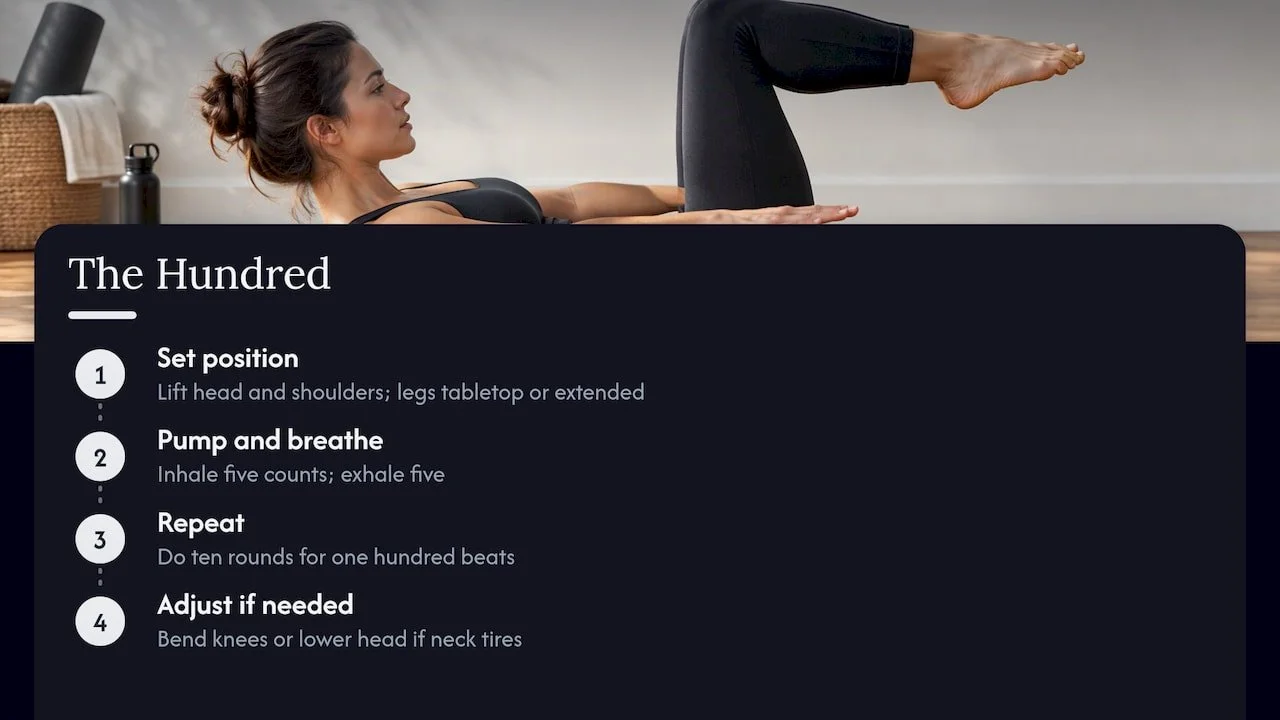
With head and shoulders lifted and legs in tabletop or extended, pump your arms in small, quick beats while inhaling for five counts and exhaling for five. Repeat ten times for a hundred beats. It is the classic warm-up that links breathing to abdominal control. Bend your knees or keep your head down if your neck tires.
7. Single leg circle
Lying on your back with one leg extended to the ceiling, draw small circles with that leg while the pelvis stays still. It builds hip mobility and trunk stability together.
8. Roll up
Lie flat, arms overhead. Exhale as you float the arms up and peel the spine off the mat, reaching toward your toes. Inhale at the top, then roll down slowly. Bend your knees or hold the backs of your thighs for support if needed.
9. Spine twist
Sit tall with legs extended and arms out to the sides. Rotate your ribcage from the waist, pulse twice, return to center, and switch. It teaches rotation from the trunk, not the shoulders.
10. Bird dog
On hands and knees, reach one arm forward and the opposite leg back, hold your pelvis level, then return. A common Pilates-style core move, it appears in Women's Health's core routines alongside side planks and glute bridges with arm reaches.
11. Plank and side plank
Hold a straight line from head to heels on forearms or hands, ribs drawn in and glutes lightly engaged. For the side plank, stack your feet or stagger them, and lift the hips. Healthline places planks and swan dives toward the intermediate end of its list.
12. Swan prep
Lie face down, hands under shoulders. Lengthen through the crown of the head and lift the chest slightly, using the back muscles instead of pushing hard with the arms. It balances all the front-body work above.
What each type of move trains
| Exercise | Main focus | Beginner-friendly option |
|---|---|---|
| Ribcage breathing | Breath control, deep abdominals | Do it as is |
| Pelvic curl | Glutes, hamstrings, spinal mobility | Smaller range of motion |
| Toe taps | Core stability, pelvic control | Keep feet closer to the mat |
| Single leg stretch | Abdominals, coordination | Head down, hands on shin |
| The hundred | Breath, abdominal endurance | Bent knees, head down |
| Roll up | Spinal flexion, abdominal control | Bent knees, hands behind thighs |
| Spine twist | Rotation, posture | Sit on a folded blanket |
| Bird dog | Back and hip stability | Lift the arm only |
| Side plank | Obliques, shoulders, hips | Bottom knee down |
What a Pilates workout and class feel like
The Natural Therapies Review describes a Pilates workout as low-impact and focused on core strength, balance, coordination and flexibility. It notes that muscles are rarely worked to exhaustion, so there may be little sweating, just intense concentration. Exercises are done in low repetitions, usually five to ten, across a session that can last 45 to 90 minutes.
A beginner reformer class often follows a pattern like this, according to the same review:
Minutes 0 to 5: orientation to the machine, springs and carriage.
Minutes 5 to 25: footwork and lower body.
Minutes 25 to 40: core, upper body and straps.
Minutes 40 to 50: cool-down and stretching.
Wear stretchy, comfortable clothing that stays put when you lie upside down or reach. Grip socks are required at most studios for hygiene and safety, and a water bottle is all else you need. If you want to compare formats before you book, our Pilates class formats guide for Philadelphia lays out the options, and what group Pilates is like covers the social side.
What Pilates does for your body
Research on Pilates is encouraging, though the quality of studies varies and results depend on the group studied.
Flexibility, balance and endurance. A systematic review of 16 studies found strong evidence that Pilates improves flexibility and dynamic balance in healthy people, and moderate evidence for muscular endurance.
Older adults. A meta-analysis of nine randomized trials found mat Pilates improved dynamic balance, lower limb strength, hip and lower back flexibility and cardiovascular endurance in elderly participants. The authors call for higher-quality studies on other measures.
Pain and quality of life. A 2023 systematic review in women reports that Pilates may improve quality of life while lowering pain and disability.
Chronic low back pain. A narrative review of 26 studies found Pilates, among other postural methods, reduced pain and disability.
Strength and stability. Cleveland Clinic explains that Pilates is strength training that emphasizes tone over bulk, building stability and endurance, and can lay a foundation for other muscle-building activities.
On timing, Australia's Better Health Channel says postural improvements may show after 10 to 20 sessions, so give it a few weeks of regular practice before judging it.
Pilates exercises for rehab and core stability
Many people come to Pilates after an injury or because of a stiff back. Exercises such as the pelvic curl, bird dog, toe taps and side-lying leg work are often used to retrain deep trunk muscles in gentle ranges. If you are recovering from an injury, had surgery, are pregnant or live with a diagnosed back condition, check with your physician or physical therapist before starting, and tell your instructor so they can adapt each move.
For a clinical view of how stabilizing exercises are structured, this page on therapeutic core stability exercises shows how rehabilitation professionals approach the same muscles that Pilates targets. For fitness and rehab class styles, see our overview of types of Pilates classes.
A simple beginner Pilates workout
This 20-minute mat sequence uses the exercises above. Do it two or three times a week.
Ribcage breathing: 5 slow breaths.
Pelvic curl: 6 to 8 reps.
Chest lift: 8 reps.
Toe taps: 8 per side.
Single leg stretch: 6 to 8 per side, head down if needed.
Spine twist: 5 per side.
Bird dog: 5 per side.
Swan prep: 4 reps, then rest in child's pose.
Beginner checklist
Start with ribcage breathing every time.
Choose the smaller version of any move that strains your neck or lower back.
Aim for slow reps with steady exhales, not speed.
Stop if you feel sharp pain, tingling or dizziness.
Practice two to three times a week for several weeks before adding reformer classes or longer sessions.
Keep a note of which moves feel easier after two weeks.
A mat routine at home is a good start. A teacher, though, can see your alignment and offer modifications you cannot feel yourself. Our post on mat Pilates core strength and flexibility goes deeper on progressing.
Our perspective
We teach Pilates as a practice anyone can enter, not a test of how much you can already do. The best first class is one where you learn to breathe into your ribs, find your deep abdominals and leave feeling taller, not wrecked.
At Amrita Yoga & Wellness, our class structures and detailed guidance are designed for safety, personal growth and connection across all experience levels. That is why we offer mat Pilates and group reformer classes alongside yoga, barre and tai chi: many people do best when they can mix strength, mobility and calm in the same week.
If you are new, start with a community or group class and ask questions. If you want attention on a specific goal, such as posture, mobility or building confidence after time away, a private session lets the instructor shape every exercise around you.
Juiced
Try Pilates with us in Philadelphia
We offer in-person mat Pilates and group reformer classes for beginners through advanced students, plus yoga, barre and tai chi in the same studio. A single group class drop in is $28, and the community class drop in is $11. If you want a routine, the Earth monthly membership is $119 per month and one month of unlimited group classes is $169.
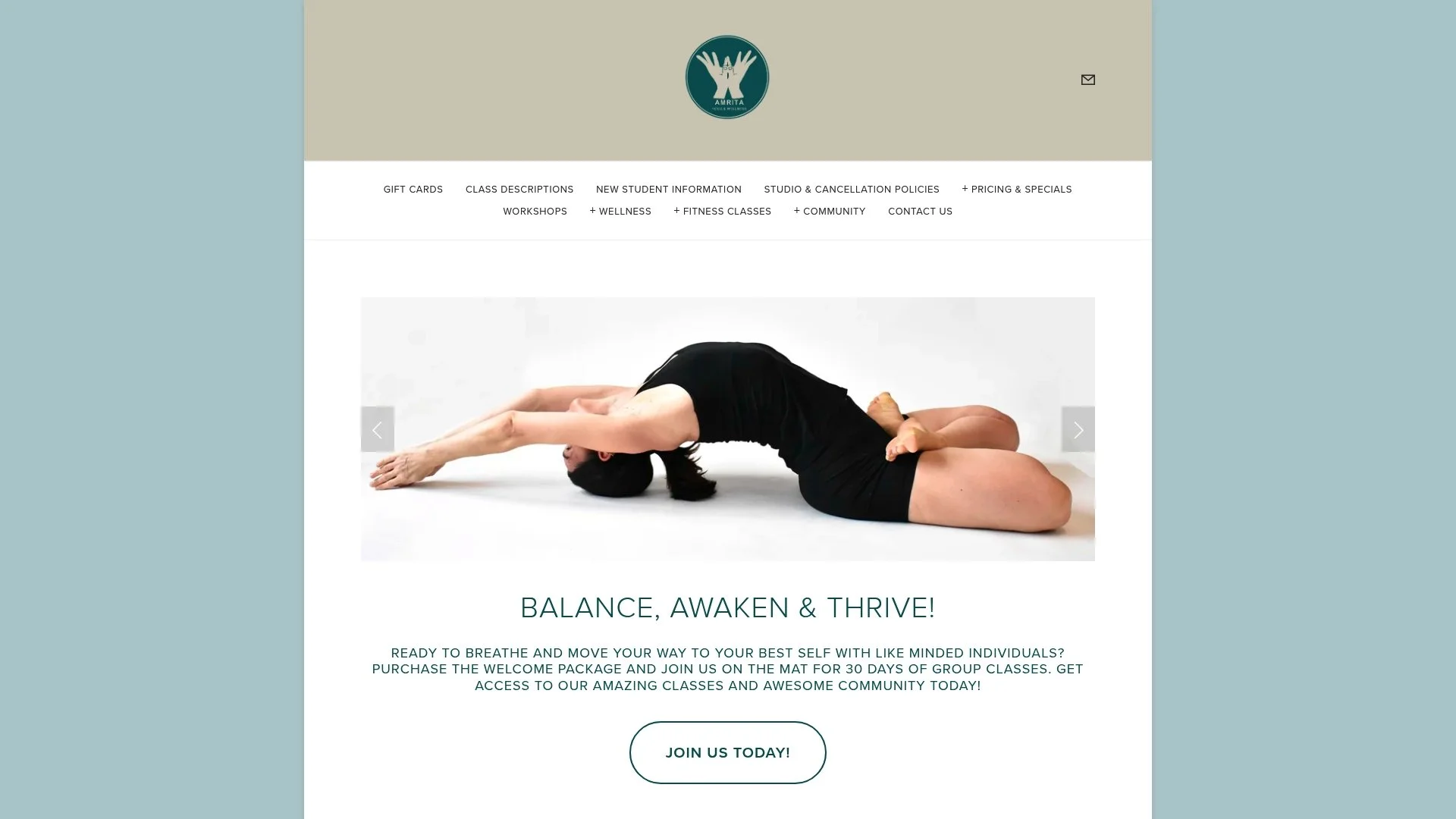
Prefer one-on-one attention? Private mat Pilates and yoga sessions start from $85 per hour. See the class schedule for current times.
FAQ
Is Pilates good for beginners?
Yes. The NHS describes Pilates as suitable for people of all ages and fitness levels, and every exercise has a gentler version. Start with mat basics, learn the breathing, and move at your own pace. A teacher can adjust moves for your body.
How often should I do Pilates?
Two to three sessions a week is a common starting point for beginners. Better Health Channel says postural improvements may appear after 10 to 20 sessions, so consistency matters more than length. Add sessions gradually as your body adapts.
What is the difference between Pilates and yoga?
Both are mind-body practices that value breath and control. Pilates centers on core stability and precise, repeated movements, often with equipment. Yoga includes held poses, flexibility, and meditative elements. Many people practice both, and we teach both.
Do I need equipment for Pilates?
Not for mat work: a mat and comfortable clothes are enough. For reformer classes, the studio supplies the machine, and you bring grip socks and water. Bands, rollers and small balls are optional extras.
Sources
Pilates: Overview, Pros and Cons, Benefits, and More (WebMD)
10 Pilates Exercises To Build A Strong Core (Women's Health)
A Systematic Review of the Effects of Pilates Method of Exercise in Healthy People
Effects of Mat Pilates on Physical Functional Performance of Older Adults (PubMed)
Effects of Pilates on health and well-being of women (Springer)
Chronic low back pain and postural rehabilitation exercise (Dove Press)