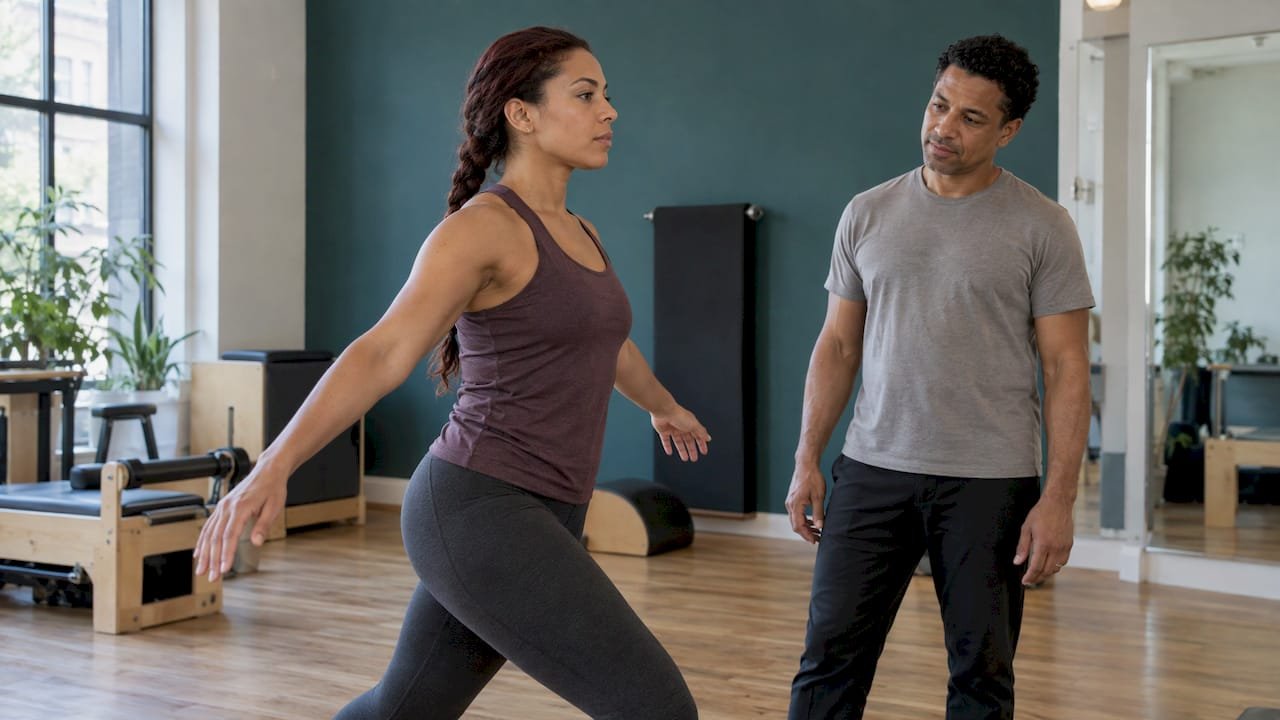
A Pilates movement assessment is a short, structured look at how you stand, balance and move, so your instructor can pick exercises that fit your body. The core toolkit is simple: a plumb line or posture grid for standing alignment, a few observed movements such as the overhead squat and single-leg balance, and, where an instructor is trained in it, a standardized screen such as the Functional Movement Screen. This guide explains each tool, what it can and cannot tell you, and how to use the results.
Amritayogawellness
Find Pilates Classes That Fit
Explore Amrita Yoga & Wellness in Philadelphia, with Pilates classes and other movement practices for a range of experience levels.
TL;DR
Start with static posture (front and side views against a plumb line), then watch dynamic movement: squat, single-leg balance, walking.
Standardized screens, such as the Functional Movement Screen (FMS), score seven basic movements and take about 15 minutes.
Findings should change what you do: which exercises, which modifications, what you retest.
Record numbers and notes so you can compare in a few weeks, with consent for any photos or video.
A Pilates assessment is not a diagnosis. Pain, numbness or tingling belongs with a physician or physical therapist.
Table of Contents
What a Pilates movement assessment actually does
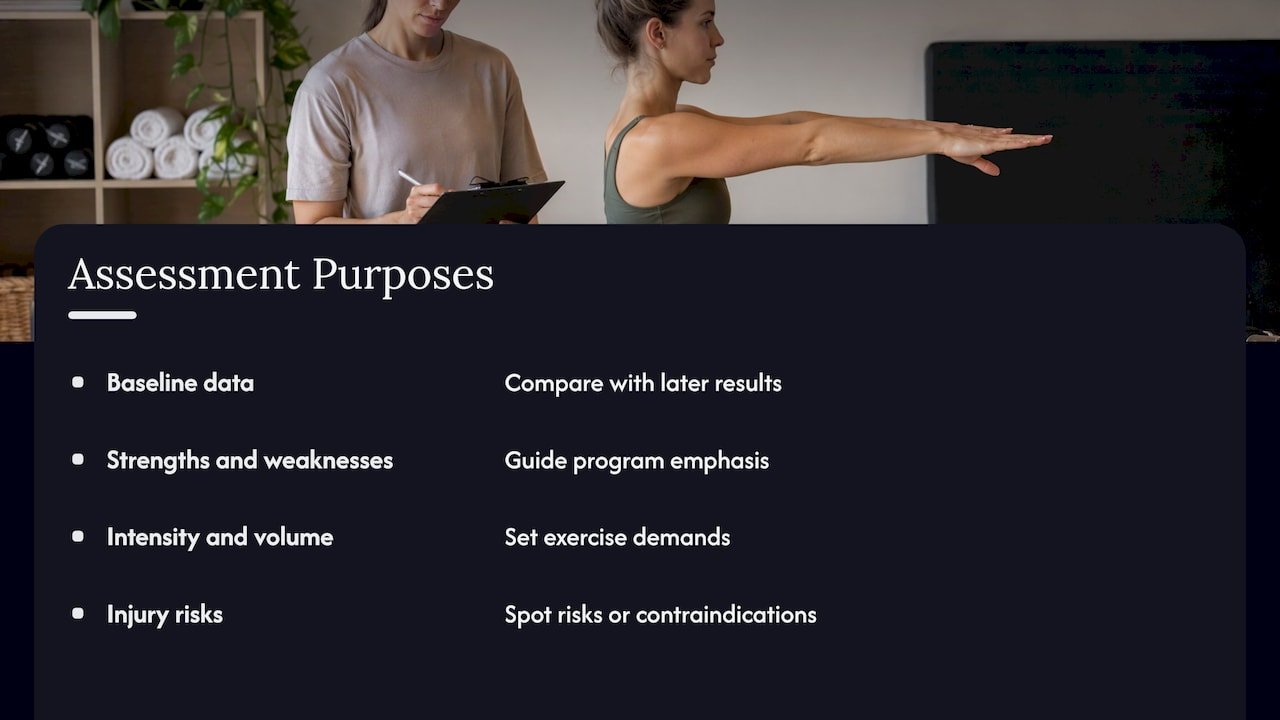
The aim is practical: find where movement is limited, unstable or uncontrolled, and let that shape the program. The National Strength and Conditioning Association lists the purposes of assessment as gathering baseline data for later comparison, identifying strengths and weaknesses that affect program emphasis, helping set exercise intensity and volume, and spotting potential injury risks or contraindications before a program begins.
In Pilates this usually means a conversation first (health history, goals, past injuries) and observation second. The Pilates Association Australia expects practitioners to evaluate static and dynamic posture and movement function for each client. For sessions that are therapeutic in nature, it asks for a recorded full functional movement assessment covering posture, strength, balance, range of motion, functional performance skills and breathing patterns. That is an Australian standard, but it is a useful model for what a thorough assessment covers anywhere.
The tools below are not rivals. Most good assessments combine two or three of them: one for standing alignment, one or two for movement quality, and one for tracking.
Movement assessment tools at a glance
| Tool | What it looks at | What it tells you | Equipment |
|---|---|---|---|
| Plumb line | Static alignment, front and side | How the ear, shoulder, hip, knee and ankle stack | String with a weight, or a posture grid |
| Posture grid or photo | Static alignment, asymmetry | Visible left/right differences and deviations | Grid wall, camera |
| Overhead squat | Whole-body movement pattern | Foot, knee, trunk and arm compensations | Open floor, barefoot |
| Single-leg balance | Weight transfer and control | Hip and pelvic control on one leg | Open floor, timer |
| Gait observation | Walking pattern | Asymmetries and inefficiencies while moving | Space to walk, optional video |
| Functional Movement Screen | Seven fundamental movements | Scored pattern quality, with pain flagged | Trained assessor, FMS kit |
| Pain and effort scales | Client-reported measures | Pain level and session effort | Paper or app |
Static posture: the plumb line and what to look for
The plumb line is the oldest tool here and still the most useful starting point. You (or your instructor) hang a weighted string and compare your body to a vertical reference. In the American College of Sports Medicine's introductory guide, fitness professionals view the client from the front and from the side, with the front line aligned to the pubis and the side line just in front of the outer ankle bone. The aim is to spot three common patterns: pes planus (pronation) distortion, lower crossed and upper crossed syndrome.
The same guide gives good setup advice you can copy:
Wear shorts or yoga pants and a T-shirt or tank top, so joints are visible.
Take shoes and socks off.
Stand naturally, as if waiting for an elevator. Shaking out or a few mini squats helps you settle into your real posture rather than a posed one.
How reliable is the plumb line? A narrative review of posture measurement tools reported good intra-rater reliability, with an average ICC of 0.80 in standing. That means the same observer tends to get consistent readings. It does not make the line a diagnostic device: it shows a pattern, not a cause.
A simple postural checklist
Use this as a note sheet. Mark each item left, right or both, and add a date.
Side view
Ear over shoulder, or head forward of the line?
Shoulder over hip, or rounded forward?
Ribcage stacked over pelvis, or flared?
Lower back: flat, neutral or strongly arched?
Pelvis: tipped forward, back or neutral?
Knees: locked back, soft or bent?
Weight over the arch, or pushed into the toes or heels?
Front view
Head tilted or turned to one side?
One shoulder higher than the other?
Space between arm and waist equal on both sides?
Hips level?
Knees pointing straight ahead, or turning in or out?
Feet: arches collapsed, toes turned out?
Back view
Shoulder blades symmetrical and flat, or one sitting out?
Spine straight, or leaning to one side?
Heels even, ankles straight?
Posture also changes with life stage. During pregnancy, for example, the center of gravity shifts, and a standard static checklist is only the beginning of the conversation. If you are pregnant and dealing with pain on the sides of the lower belly, stretches for round ligament pain are worth reading alongside advice from your own clinician before you start a new movement program.
One caution on interpretation: a "deviation" from the line is not automatically a problem. Plenty of people move well and feel well with a posture that differs from the textbook. Treat the checklist as a map of where to look next, not a list of faults.
Dynamic assessment: watching movement, not just standing
Static posture is a photograph. Dynamic tests are the film. The Journal of Bodywork and Movement Therapies has reviewed movement screens for Pilates, circus and dance, and describes the Janda approach, where movement testing follows a postural analysis and looks at static posture as well as single-limb balance and gait.
Overhead squat
The overhead squat is the workhorse of movement observation. The client squats about five times, barefoot, arms raised overhead, while the assessor watches from the front and the side. The usual checkpoints are:
Feet turning out
Knees collapsing inward
Excessive forward lean
Lower back arching or rounding
Arms drifting forward
The National Academy of Sports Medicine describes this setup in its movement assessment guide. For a Pilates client, each flag points toward something to work on: knees caving might call for hip and foot control work, arms falling forward might call for thoracic mobility and shoulder organization.
Single-leg balance
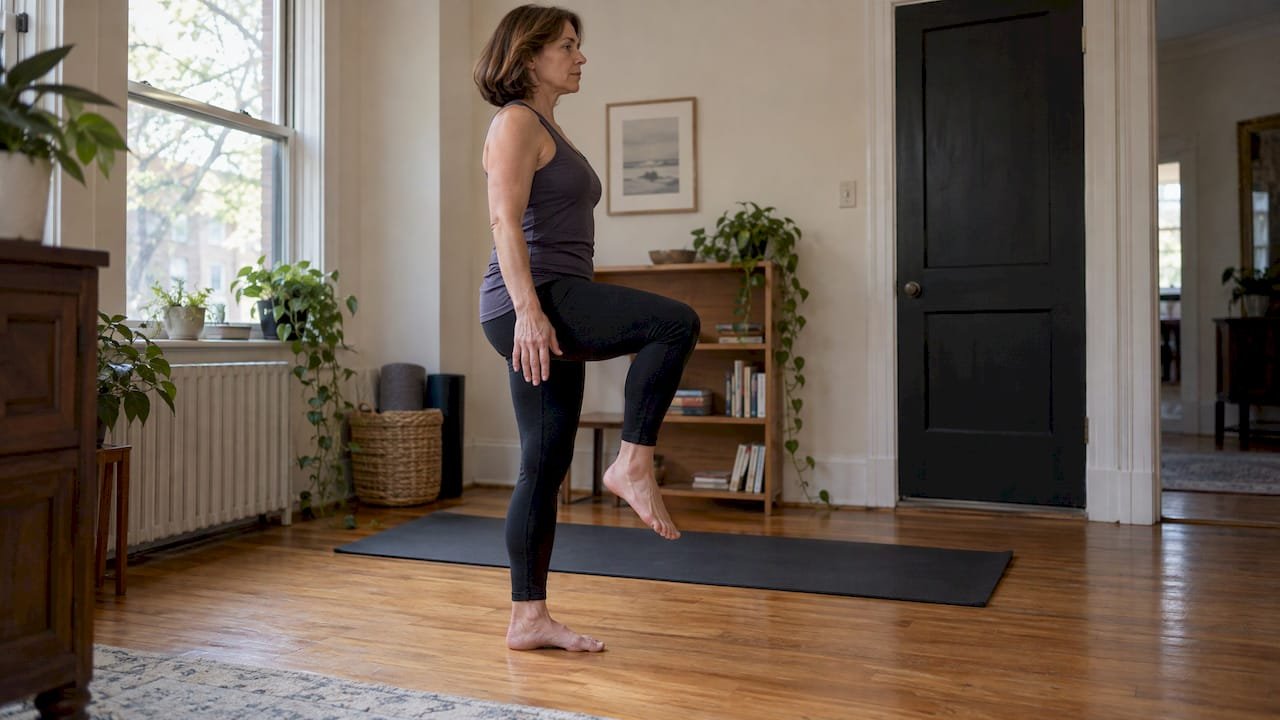
Stand on one leg, then the other, for a set time. The assessor is looking at how you transfer weight. In the Janda approach described in the same journal review, shifting your weight excessively onto the stance leg, or the thigh rotating inward, suggests a failure of control in the gluteal region. Time each side. A big difference between left and right is useful information in itself.
Gait
Walking is the movement you do most. Watching a client walk toward, away from and across the room, or filming it with permission, can show asymmetries that a standing check cannot. Look at arm swing, pelvic movement, foot strike and whether one side looks quieter or heavier.
The Functional Movement Screen
The FMS is a standardized screen. According to Cleveland Clinic, it is a seven-part assessment that looks at how you perform fundamental motions, giving a snapshot of balance, coordination, flexibility and stability. The full series takes about 15 minutes, and the screen itself does not diagnose a cause. It points to possible reasons.
Scoring uses a four-point scale, as summarized in the Journal of Bodywork and Movement Therapies review:
3: the movement is done without compensation
2: done with some compensation
1: unable to complete the movement
0: the movement causes pain, which automatically lowers the score
That last point matters. A pain response during any test is a stop sign, not something to push through. It is also a reason to talk to a physician or physical therapist.
The same review also describes the Performance Matrix, which describes uncontrolled movement by its location, direction (flexion, rotation, translation) and the threshold at which control fails. You do not need to use it, but the idea is helpful: when you note a problem, write down where it happens, which way, and how far into the movement.
Turning findings into exercise choices
An assessment that does not change the session is just paperwork. A few ways findings translate into programming:
Mobility first, then stability, then pattern: FMS corrective work follows a path from basic mobility to basic stability to retraining the full movement pattern, according to the system's Level 1 manual. It is a handy order of operations for any Pilates program.
Inhibit, activate, integrate: the corrective exercise continuum described in the NASM guide mentioned above releases overactive muscles, activates underactive ones, then blends the corrected pattern into full movements, often within the warm-up.
Match issue to principle: poor trunk control calls for core control work, limited spinal motion for spinal articulation, poor balance for alignment and weight bearing, and shallow rib expansion for breathing work.
Modify as you go: the Pilates Association Australia expects practitioners to keep evaluating movement and technique and to offer regressions, progressions and modifications, and to keep notes on progress and program updates.
There is some research support for linking Pilates and movement screening. A 2022 systematic review in the International Journal of Sports Physical Therapy found that a six-week Clinical Pilates program raised total FMS scores by an average of 3.5 points in recreational runners. That is a result about runners and one screen, so treat it as encouraging, not as a promise for every body.
If you want to see how Pilates carries over to sport, our piece on the benefits of Pilates for athletes goes deeper. For spinal alignment work in particular, see our guided Pilates for spinal alignment article.
Tracking change over time
The first assessment is a baseline. Its value shows up when you repeat it. A simple tracking routine:
Choose five or six repeatable tests. For example: overhead squat, single-leg balance (timed, each side), active shoulder flexion, thoracic rotation, a hip hinge, and a timed core hold.
Record both kinds of data. Write qualitative notes ("left knee drifts in at the bottom") and numbers (seconds held, degrees of rotation).
Add client-reported measures. A 0 to 10 pain rating before and after sessions, and a rating of perceived effort, give context numbers cannot.
Photograph or film only with consent. Same clothing, same distance, same background, so comparisons are fair.
Retest on a schedule. Every several weeks is a common rhythm, adjusted for how often the client trains, their goals and any injury recovery.
Update the plan. Retire what is now easy, progress what is improving, and revisit what has not changed.
Keep the test conditions identical: same time of day if possible, same footwear status, same warm-up. Otherwise you are measuring the day, not the person.
What assessments cannot do
A Pilates assessment describes movement. It does not diagnose. The Pilates Association Australia's pre-exercise screening template says instructors should not carry out physical testing, examination or diagnosis beyond their scope, and that the template does not replace advice from a qualified medical practitioner.
Its scope-of-practice documents add that practitioners should collaborate with medical or allied health professionals and refer where appropriate, and that group instructors work with healthy and lower-risk participants, so a person whose condition falls outside that range needs a different route.
In plain terms, see a physician or physical therapist before or alongside Pilates if you have:
Pain, numbness or tingling that travels down an arm or leg
Pain that wakes you at night
Dizziness, or unexplained weakness or fatigue
A known spinal condition or a recent injury or surgery
Pain during any of the screening movements above
Also keep the evidence in perspective. The Australian Government's Natural Therapies Review found that the evidence base for Pilates rests on a relatively small number of studies, many with treatment periods of 12 weeks or less. Good assessment and sensible, individualized progression are how you make the most of the practice while the research continues to grow.
Our perspective
We think the best assessment is the one that ends with you moving better in the next session, not the one with the most equipment.
At Amrita Yoga & Wellness, we see Pilates as one part of a wider practice that includes yoga, barre and tai chi, and we welcome beginners through advanced students. Because of that, we care less about a perfect score on any single test and more about whether you feel safe, supported and able to grow.
That is why we encourage a private session as a first step for many people. One to one, there is time to talk about your goals and history, to watch how you move, and to adjust the work to you before you join a group. Our teachers' guidance is designed for safety and connection across all experience levels, and we would rather you ask a question mid-class than quietly work around something that does not feel right.
Treat any checklist, ours or anyone else's, as a starting point for a conversation with a teacher you trust.
Juiced
Start with a private session in Philadelphia
If you are in Philadelphia and want individual attention on how you move, our One to One private sessions start from $85 per hour, with a two-to-three person option on the same page. When you are ready for classes, a group drop-in is $28 per session, and you can see every pass and membership on our in-studio group class page.
New to Pilates? Our guide to different kinds of Pilates can help you choose where to begin, and our class schedule shows what is on the calendar now.
FAQ
How long does a Pilates movement assessment take?
A standardized screen like the FMS takes about 15 minutes for the full series, according to Cleveland Clinic. A fuller Pilates assessment, with a health history, goals conversation, posture check and movement tests, usually fills most of a session. Allow extra time if you want baseline photos or video.
Can I assess my own posture at home?
You can do a basic check: stand barefoot in fitted clothes beside a door frame or a hanging string, and have a friend photograph you from the front and side. Use the checklist above to note what you see. Self-checks are limited, since it is hard to see yourself objectively, so share the results with a qualified teacher rather than acting on them alone.
What is the difference between a posture assessment and a movement assessment?
A posture assessment looks at how you stand still, usually against a plumb line or grid. A movement assessment looks at how you move: squatting, balancing, walking or reaching. Most Pilates professionals use both, because standing alignment and movement quality do not always match.
How often should movement be reassessed?
There is no single rule. Many instructors retest every several weeks, and sooner after an injury or a big change in training. Keep the tests, clothing and conditions the same each time so that changes reflect you, not the setup.
When should I see a doctor instead of a Pilates teacher?
See a physician or physical therapist if you have pain, numbness or tingling that radiates down a limb, dizziness, unexplained weakness, or pain during a movement test. Pilates professionals are expected to stay within their scope and refer clients when a condition falls outside it.
Sources
Pilates Association Australia, Scope of Practice for Pilates Practitioners (December 2023)
Pilates Association Australia, Scope of Practice for Pilates Practitioners (2026)
Pilates Association Australia, Pre-Exercise Physical Screening and Assessment
ACSM, A Fitness Professional's Introductory Guide to Assessing Static Posture
Posture and Back Shape Measurement Tools: A Narrative Review
Cleveland Clinic, Why Functional Movement Screens Are Important
Natural Therapies Review 2024, Pilates evidence evaluation, Australian Government
Pregnancy Tracker: Clinician Vetted Stretches for Round Ligament Pain