Pranayama is the breath practice of the yoga tradition. Modern breathwork is a broader, newer family of techniques that borrows from pranayama and from therapy and personal-growth methods. The real divide is less "ancient versus modern" than slow, calming breathing versus fast, high-ventilation breathing. That divide decides what the practice feels like, what the evidence supports and what precautions apply.
Amritayogawellness
Explore Breathwork in Philadelphia
Amrita Yoga & Wellness offers yoga classes and breathwork workshops for Philadelphia practitioners exploring mindful breathing.
TL;DR
Pranayama is a yogic discipline of breath regulation, traditionally tied to steadying the mind and preparing for meditation. Modern breathwork is an umbrella term for many methods, from gentle slow breathing to intense accelerated sessions.
Both deliberately change how you breathe, and modern breathwork learned from pranayama while remaining a distinct tradition.
Slow, deep breathing is the better studied and generally relaxing end of the spectrum. Fast, high-ventilation breathwork has less research behind it and needs more care.
Fast pranayama such as kapalabhati is not automatically risk-free either. Match the practice to your health, and ask a doctor first if you have a heart, lung or panic condition or are pregnant.
If you are new, start with slow breathing in a guided class, not an intense solo session.
Table of Contents
What the two terms actually mean
Origins: a 3,000-year tradition and a 1970s revival
Technique and session structure
Goals: what people are really after
What the research says
Safety: where the two really diverge
Our perspective
How to choose between them
Practice breath with us in Philadelphia
FAQ
Sources
What the two terms actually mean
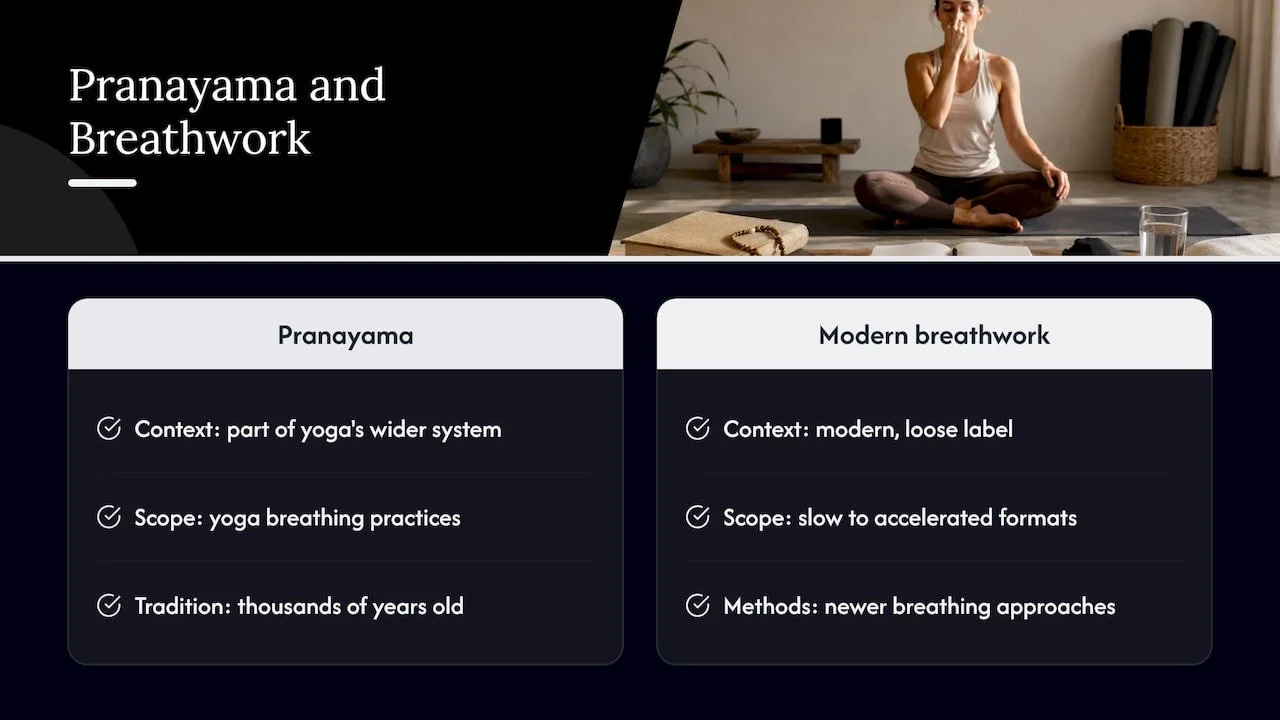
Pranayama is a Sanskrit term for the breathing practices of yoga. It sits inside a larger system: postures, ethics, concentration and meditation. The breath exercises are not meant to be a standalone workout. They are one limb of a path, and classical teaching treats them as a way of working with prana, usually translated as life force or vital energy.
Breathwork is a modern, loose label. It covers anything from five minutes of slow nasal breathing before bed to a long group session with accelerated breathing and music. There is no single governing body, curriculum or definition. A teacher who says "breathwork" might mean something very calm or something very intense, so the word alone tells you little.
Researchers who work in this field draw the line in a different place than most blog posts do. According to a MIND Foundation interview with breathwork researchers, pranayama is a breathing-modification tradition thousands of years old, while contemporary breathwork uses newer methods that deliberately alter normal breathing to improve well-being. Both manipulate the breath on purpose. What matters in practice is whether the method is slow and relaxing or fast and high-ventilation, and modern breathwork includes both.
Origins: a 3,000-year tradition and a 1970s revival
Yoga is often described as a 3,000-year-old tradition, with pranayama as part of its toolkit from early on. Contemporary breathwork, in the same academic account, developed from blending ancient breathing techniques with modern growth and therapeutic practices since the 1970s. Both have applications in physical health, psychotherapy and spiritual growth, which is one reason people confuse them.
The best-known modern style is Holotropic Breathwork. Stanislav and Christina Grof developed it in the late 1970s after restrictions on psychedelic research, using accelerated breathing, evocative music and facilitation to bring on non-ordinary states of consciousness. That origin story shows how different the intention is. Pranayama aims at steadiness. Holotropic work aims at an altered, exploratory state.
Not all modern breathwork follows that model. Many current classes are closer to a slow-breathing practice with a check-in and a short integration period, which is much nearer to pranayama in feel.
Technique and session structure
The table below compares typical patterns. Individual teachers vary, so treat it as a map and not a rulebook.
| Pranayama | Modern slow breathwork | Modern high-ventilation breathwork | |
|---|---|---|---|
| Typical pace | Slow and measured, with some fast techniques (kapalabhati, bhastrika) | Slow, mostly nasal | Sustained fast, deep breathing |
| Structure | Technique taught inside a yoga class or a dedicated lesson, often with counted ratios and retentions | Check-in, short breathing block, integration | Long guided session with music and facilitator support |
| Typical aim | Steady the mind, prepare for meditation | Calm the nervous system, manage stress | Reach altered states, emotional release |
| Lineage | Yoga tradition | Mixed: yoga, clinical and wellness sources | Holotropic and related methods |
A simple modern session map can include a check-in, five to fifteen minutes of slow, mostly nasal breathing, then a few minutes of integration. Holotropic-style sessions are substantially different: reported formats use sustained accelerated breathing for roughly one to three hours, with evocative music, facilitator support, bodywork and post-session integration.
Even "traditional" pranayama is not one fixed thing
If you expect pranayama to be a single standardized method, the literature will surprise you. A 2022 comparison of practice guidelines looked at yoga breathing as described in traditional texts against 73 PubMed-indexed studies. For bhastrika, bhramari and kapalabhati, the texts and the research differed in breathing depth, relative breath-phase duration and breath frequency, respectively. In plain terms, the version a research team tested is not always the version a classical text describes, and your teacher's version may differ from both.
This matters when you read a headline claiming that "pranayama" reduces stress. The claim attaches to a specific protocol, not to the whole tradition.
Goals: what people are really after
Traditional pranayama is described as a method for stabilizing the mind and supporting concentration and meditation. Some accounts describe the ultimate aim as the suspension of breathing, a very advanced idea that has little to do with a beginner's first class. If steadier focus is your goal, you may also find natural ways to improve concentration a useful companion to a regular breath practice.
Modern breathwork goals are more varied:
Stress and nervous system regulation: usually slow breathing, often a few minutes a day.
Emotional processing or self-exploration: more often the long, accelerated formats.
Athletic or focus preparation: short, structured protocols.
Support for movement practices: breathing taught inside Pilates or yoga, where breath sets the rhythm of the exercise. If that is your interest, our guides to breathwork in Pilates practice and the role of breathwork in yoga practice go deeper.
Our guide on finding your breathwork style by purpose can help you sort these goals into practical choices.
What the research says
The honest summary is that the evidence is promising but early, and it depends on which technique you mean.
Pranayama. A 2025 systematic review and meta-analysis pooled seven publications covering six randomized trials and 517 patients. Pranayama reduced post-intervention symptom severity for mental disorders compared with passive controls (standardized mean difference −0.27, 95% CI −0.52 to −0.03). The studies had substantial risk-of-bias concerns, the secondary analyses showed no significant effect on depression, and the authors concluded pranayama should not replace standard therapy. Read that as a modest, short-term signal, best treated as a complement to care.
Modern breathwork. A 2025 review of breathwork for chronic stress and mental health found the evidence fragmented, with varied techniques, small samples, inconsistent methods and non-standardized protocols. That makes direct comparisons between techniques hard. The same review makes a point worth remembering: claims should be matched to the exact protocol. Evidence for slow breathing does not automatically support high-ventilation breathwork, and a study of a combined Wim Hof program cannot separate the breathing from the cold exposure or meditation.
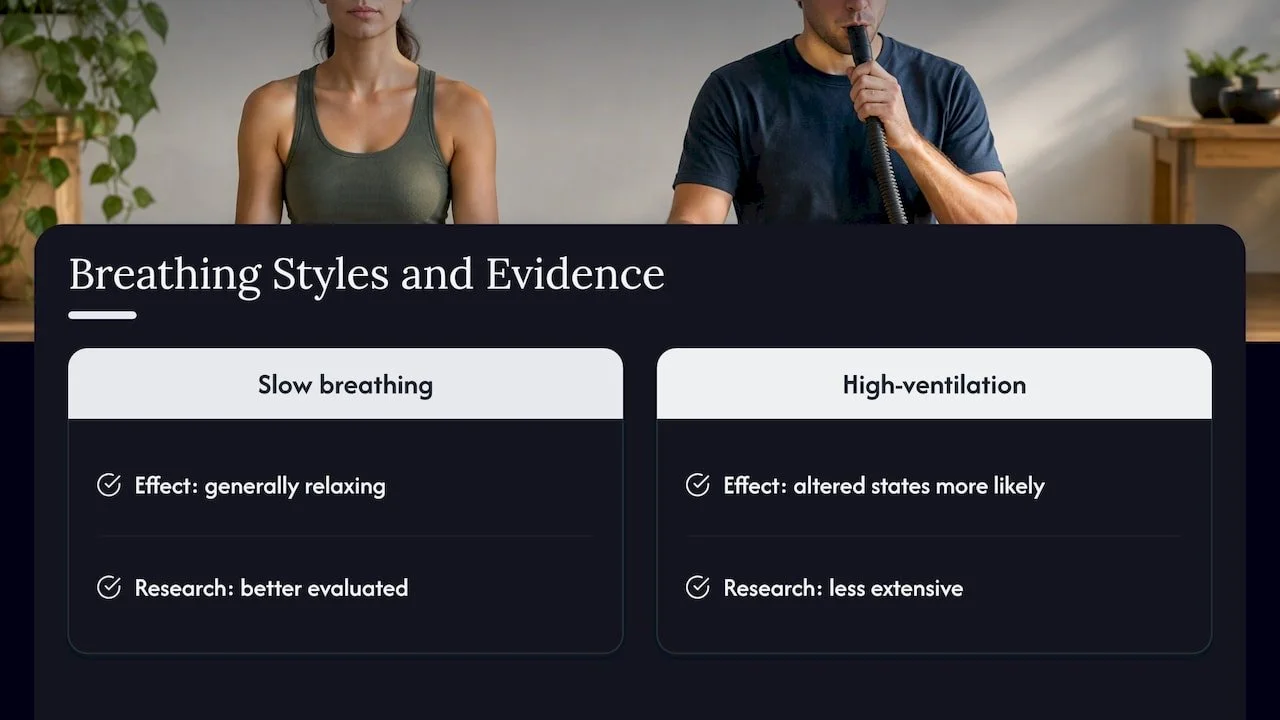
The MIND Foundation experts add that research reviews often wrongly pool slow and accelerated breathing, and that separating them is essential because their physiological and experiential effects differ. Slow, deep abdominal or coherent breathing is the better evaluated and generally relaxing one. Fast circular or high-ventilation breathwork is more likely to produce altered states and has less research.
Across practices, a 2023 overview of high-ventilation breathwork supports a cautious conclusion: breathing interventions may offer short-term adjunctive benefits for stress-related and some mental-health outcomes, while long-term effects, comparative superiority and safety in high-risk groups remain insufficiently established.
Safety: where the two really diverge
Slow breathing at roughly 4 to 6 breaths per minute is the gentle end of the range. A 2026 review says healthy adults do not need supervision for it, while people with panic symptoms, significant cardiopulmonary disease or pregnancy may need tailoring and close monitoring. If any of those apply to you, talk to your doctor before you start and tell your teacher.
High-ventilation breathwork needs more care. The 2023 overview lists reported acute effects including light-headedness, visual changes, tingling, palpitations, shakiness, anxiety, sweating, fatigue, cramping and altered perception. It advises caution or medical screening for cardiovascular, cerebrovascular and respiratory disease, severe hypertension, arrhythmias, heart failure, ischemic disease, aneurysms, COPD, epilepsy, panic disorder, psychotic disorders and pregnancy. Its advice for anyone practicing alone is to choose a safe environment away from water, hard surfaces and anywhere fainting could cause serious injury.
Fast pranayama deserves the same respect. The 2025 pranayama meta-analysis reported adverse events more often with fast than slow techniques, including anxiety, breathlessness, dizziness, headache, cough and constriction, and flashbacks in one study, particularly involving kapalabhati. Being ancient does not make a technique gentle. In practice:
Begin with slow, comfortable breathing and keep the exhale easy.
Stop if you feel dizzy, tingly or anxious, and return to normal breathing.
Add fast techniques only with a qualified teacher who knows your health history.
Never practice fast breathing in water, while driving or standing on a hard floor.
Our perspective
At Amrita, we see people arrive with the same question: do I need the "real" pranayama or the newer breathwork? We think it is the wrong either-or. The useful question is what you want your breath to do today, and how much guidance you want while you learn.
In our classes, breath is taught as part of movement. A yoga flow, a mat Pilates sequence and a barre class all use breathing to set rhythm, steady attention and help you move with control. That is where most beginners learn that the breath responds to attention. Our approach is built around beginner approachability, clear instruction and community, so you are never left guessing whether you are doing it right.
We also offer breathwork workshops for those who want to focus on the breath itself. Starting with slow, guided breathing in a room with a teacher is, in our view, the kindest way in. You can go deeper later, whether that means traditional yogic practices or other methods, once you know how your body responds.
Juiced
How to choose between them
Use these questions rather than the label on the flyer.
Do you want calm and focus? Look for slow breathing, whether it is called pranayama or breathwork. Ask the teacher about pace and session length. Five to fifteen minutes of steady nasal breathing is a reasonable place to begin, and our five-minute breathwork habit checklist shows how to build it.
Do you want a spiritual or philosophical frame? Pranayama inside a yoga class gives you that context, with breath linked to posture, meditation and the wider tradition. Our posts tagged pranayama yoga cover the basics.
Do you want an intense, exploratory experience? That points to high-ventilation formats. Check the facilitator's training, the screening process and the support offered afterward, and talk to your doctor first if any condition above applies.
Do you want better breathing for exercise? Learn breath coordination inside Pilates or yoga. Our overview of Pilates breathing techniques is a good starting point.
A few signs that a class is well run: the teacher asks about health conditions before you begin, explains the pace in plain words, lets you stop at any time, and makes no sweeping promises about healing. Claims that a single technique cures anxiety, depression or illness go beyond what the research supports.
Practice breath with us in Philadelphia
If you would like to learn breathing in a supportive room, our studio offers yoga, mat Pilates, group reformer, barre and tai chi, plus wellness workshops including breathwork. Single visits are simple: a community class drop-in is $11, a group class drop-in is $28, and Nurtured Beginnings is $35 per pass. If you want a regular rhythm, monthly memberships run from $119 to $149, and unlimited group classes are $169 per month.
Prefer one-to-one guidance on your breath and movement? Private sessions start from $85 per hour. You can also check the current class schedule before you book.
FAQ
Is breathwork the same as pranayama?
No. Pranayama is the breath practice of the yoga tradition, while breathwork is a modern umbrella term for many methods, some of which borrow from pranayama. Both deliberately alter breathing, but breathwork also includes fast, high-ventilation protocols that sit outside classical yoga.
Which is better for stress, pranayama or modern breathwork?
There is no proven winner. Slow breathing, found in both, is the better studied approach and generally relaxing. Reviews in 2025 describe the evidence as small, short-term and uneven, so treat either as a complement to, not a replacement for, professional care.
Is fast breathwork safe for beginners?
It needs caution. Reviews report effects such as light-headedness, tingling, palpitations and anxiety, and advise medical screening for several conditions, including heart disease, epilepsy and pregnancy. Beginners are better off starting with slow, guided breathing and building up with a qualified teacher.
Do I need to know yoga to try pranayama?
No. Simple slow breathing needs no yoga background, though learning it inside a beginner-friendly class helps you pick up the pacing and cues. Tell the teacher about any health conditions first.
Sources
In the beginning was the breath? Breathwork in practice and science (MIND Foundation)
Breathwork for Nervous System Regulation: Simple Session Map
Effectiveness of pranayama for mental disorders (Frontiers in Psychiatry, 2025)
Neurophysiological mechanisms of slow breathing (Frontiers in Psychiatry, 2026)