
Holistic Morning Routine Examples: 5 Real Schedules to Borrow
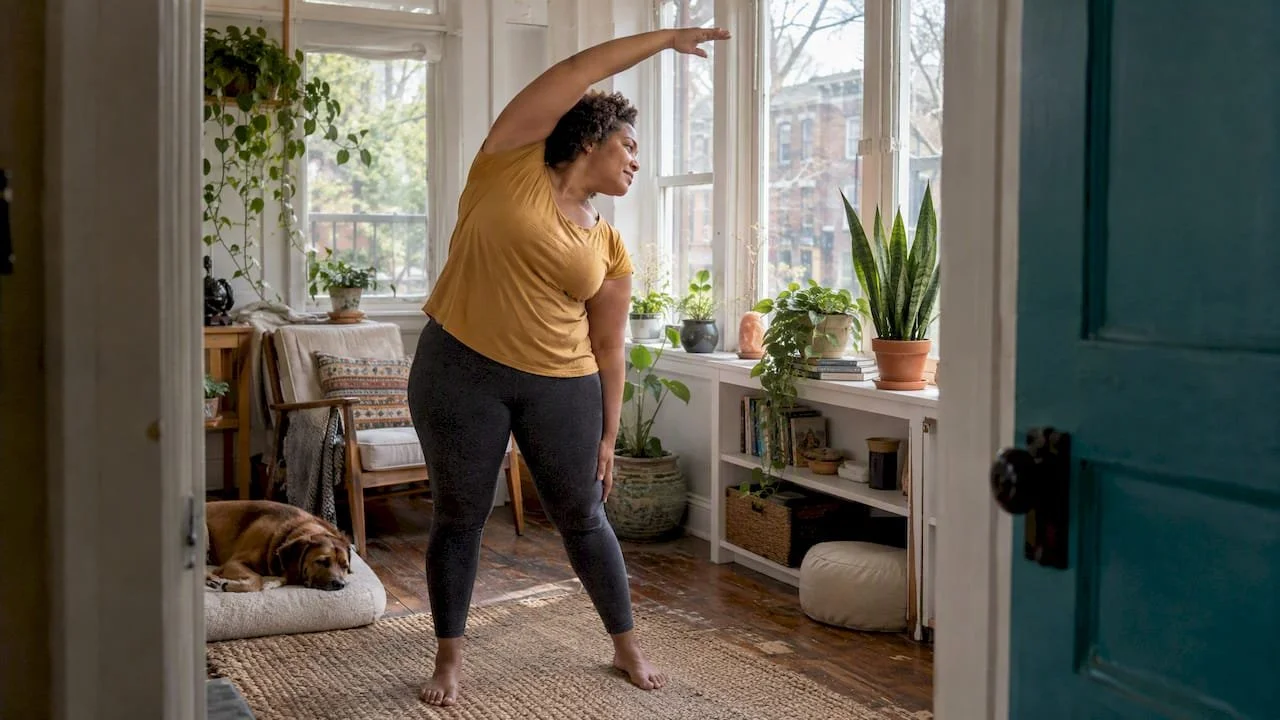
A holistic morning routine is a short, repeatable sequence that looks after your body, mind and mood before the day takes over. The best examples share the same bones: light, water, breath, movement and a moment of intention. They differ only in how much time you have. Below are five complete schedules (5, 10, 15, 30 and 60 minutes), the evidence behind each ingredient, and a way to choose between them.
Amritayogawellness
Bring Morning Movement to the Mat
Explore yoga classes at Amrita Yoga & Wellness, with practices for beginners through advanced practitioners in Philadelphia.
TL;DR
Build on four anchors: daylight, water, breath and gentle movement. Add journaling or stillness if you have time.
Consistency beats intensity. A 5-minute routine you do daily is worth more than a 60-minute one you do twice.
Morning is a good slot for activating practices such as sun salutations and energizing breathwork. Save slow, calming work for the evening.
Start with the 5- or 15-minute example below, run it for two weeks, then add one element at a time.
If you want guidance on the mat, a beginner-friendly class can teach you the movement and breath pieces safely.
Table of Contents
What makes a morning routine "holistic"
Most morning routine lists are productivity lists in disguise: wake at 5 a.m., cram in six habits, optimize. A holistic routine has a different goal. It treats sleep, light, food, movement, breath and mindset as one system, and asks what you need to start the day steady rather than what you can squeeze in.
That shift matters for how you build it. Experts quoted in NBC News' account of a month on the Miracle Morning describe a routine as making space, not reaching a final state of productivity, and for beginners the key is regularity: showing up at the same time each day.
A useful test: if your routine feels like a task list you can fail, it is too rigid. Think of it as a small toolkit (breathing, a stretch, a page of journaling) that you adjust to your energy that day.
The evidence-based foundation: sleep and light
Before any ritual, the morning starts the night before. The American Heart Association's guide to a good wake-up routine begins with the math: adults need seven to nine hours of sleep. Pick the wake time you need, then count back seven to nine hours to find your bedtime.
Two habits do most of the work after that:
Get daylight early. MIT's sleep guidance suggests opening shades, stepping outside and walking, even on overcast days. A 2025 study in the journal SLEEP examined morning sunlight alongside time-restricted eating, Zone 2 training and breathwork as circadian-alignment behaviors tied to more consistent sleep.
Keep your wake time steady. Wide swings between weekday and weekend wake times can leave you feeling jet-lagged. Keeping your weekend wake time within about an hour of your weekday time is a sensible target, and the same SLEEP paper supports consistency as a core principle.
If you press snooze often, move the alarm across the room and put your water next to it. Drinking a glass is a small win that gets you upright.
Example 1: The 5-minute reset
For chaotic mornings, small children, early shifts. The idea is to do almost nothing, but do it every day.
Minute 1: Drink a full glass of water.
Minute 2: Open the blinds or step onto the porch or stoop. Look at the sky.
Minutes 3 and 4: Breathe in for a count of four and out for a count of four, seated on the edge of the bed.
Minute 5: Stretch your arms overhead, fold forward, roll up slowly.
This lines up with a broader point from the yoga research: even 5 minutes of intentional breathing or gentle movement is a legitimate practice, not a lesser one. If you want more ideas at this scale, our 3, 5 and 10 minute yoga routine variants lay out several options.
Example 2: The 10-minute mind-and-body start
For people who can wake 10 minutes earlier and want a bit of both movement and calm.
Water, then two minutes of daylight (window or outside).
Three minutes of cat-cow, gentle twists and a standing forward fold.
Three minutes of seated breathing or a simple mantra.
Two minutes writing one sentence: what matters most today?
The single written sentence borrows from the S.A.V.E.R.S. framework (Silence, Affirmations, Visualization, Exercise, Reading, Scribing) in Hal Elrod's Miracle Morning. When time is short, the program offers a 6-minute version with one minute for each habit. You do not have to adopt the whole system. Borrowing the idea that each habit can be tiny is the useful part.
Example 3: The 15-minute yoga and breath routine
This is the sweet spot for most beginners: long enough to feel something, short enough to survive a busy week.
| Minutes | Practice | Purpose |
|---|---|---|
| 0 to 2 | Water, daylight, a few deep breaths | Wake the system gently |
| 2 to 5 | Joint circles, cat-cow, child's pose | Warm the spine and hips |
| 5 to 10 | Three to five slow sun salutations | Build heat and alertness |
| 10 to 13 | Standing balance, a gentle lunge, a hamstring stretch | Mobility and focus |
| 13 to 15 | Seated even-ratio breathing | Settle the nervous system |
Why this works: in an 8-week study of 90 adults, people practicing Pilates and yoga reported higher engagement in health-promoting behaviors and better subjective health than control groups. It is a small study, so treat it as encouraging rather than definitive.
Morning timing also fits the style. A narrative review of yoga timing concluded that morning vigorous exercise or yoga is better than evening vigorous practice for mood and for sleep quality that night, while evening yoga should be gentler. Harvard Health also publishes a simple 15-minute morning yoga routine if you want a second set of poses to rotate in.
New to the mat? Our guides to starting a yoga practice at home in 10 to 15 minutes and practicing yoga safely in 10 to 20 minutes walk through the poses and common mistakes.

Example 4: The 30-minute whole-person routine
For people with a calmer start to the day, or who work from home.
0 to 5 minutes: Hygiene, water, daylight. Some people add tongue scraping and a quick skin refresh here, which is common in Ayurvedic-style routines.
5 to 15 minutes: Yoga flow or a short mat Pilates sequence focused on core and posture.
15 to 20 minutes: Breathwork. Keep it gentle if you are new to it, and stop if you feel dizzy.
20 to 25 minutes: Silent sitting or a guided meditation.
25 to 30 minutes: Journaling, then a protein-rich breakfast.
The journaling step deserves its place. Writing helps many people separate real priorities from background worry, and there is a good overview of why journaling supports mental health if you want the evidence. Keep it light: three lines on how you feel, one on what you intend.
For the meditation block, our seven mindfulness practices for everyday wellness give you options so you are not staring at a blank mind.
Example 5: The 60-minute weekend ritual
Not a daily plan. Use it once or twice a week, when you can slow down.
A walk outside in morning light (20 minutes). This doubles as your daylight dose.
A longer yoga or Pilates session (25 minutes), or a studio class.
Ten minutes of meditation or mantra work.
Five minutes of journaling, planning the week ahead.
Keep your weekend wake time close to your weekday time. Sleeping in two hours then trying to be serene is a recipe for a groggy Sunday and a harder Monday.
How to choose and build yours
Pick based on your honest minimum, not your best day.
Fewer than 10 free minutes: Example 1, every day.
10 to 20 minutes, new to movement: Example 3.
Stiff back, desk job: Make the movement block posture-focused: cat-cow, thoracic twists, hip openers, a few minutes of core work.
Anxious or foggy mornings: Lean on breath, daylight and journaling more than movement.
Evening person: Do not force a 5 a.m. start. Shift your wake time by small steps and anchor it with light.
Then apply three rules:
Stack, don't overhaul. Attach the routine to something you already do, like making coffee.
Add one thing every two weeks. Water and light first, then movement, then breath, then reflection.
Define a minimum version. On bad days, do the 1-minute version: water, daylight, three breaths. Streaks survive that way.
Skip the idea that there is one ideal. The yoga-timing review notes that there is no universally best time for physical activity; individual outcomes vary. Your best routine is the one your body tolerates and your calendar permits.
Common mistakes
Starting with ten new habits. Choose two or three.
Scrolling first. Checking your phone in bed pulls you into other people's priorities before you have had your own. Charge it across the room.
Treating it as a performance. The routine is support, not a test.
Pushing through pain. Gentle movement should never hurt. If you are recovering from an injury, are pregnant or have a medical condition, check with your doctor or physical therapist before starting new exercise or breathwork.
Ignoring the evening. Your morning is built the night before: screens down, a steady bedtime, a glass of water by the bed.
Our perspective: why the mat helps
We teach people at every level, and the pattern we see is consistent: the routines that last are the ones that feel kind. People who arrive saying they have failed at morning routines before usually tried to do too much, too early, alone.
Our view is that a home routine and a studio practice feed each other. At home you build the daily habit in minutes. In class, a teacher can refine your alignment and breathing, adjust the pace to your body, and give you a community to show up for. That is why we offer beginner-friendly classes across yoga, mat Pilates, barre and tai chi, along with workshops such as breathwork. You can then take what you learn into a 10-minute morning sequence that is truly yours.
If you want to borrow one idea from us: make the first movement of the day something you look forward to, not something you owe yourself.
— Juiced
Take your routine into the studio
If you live in or near Philadelphia and want guidance on the movement and breath pieces above, we would love to see you. Our class and monthly experience schedule shows what is on this week. Prices on our group class page include a Community Class drop-in at $11, a Group Class drop-in at $28, and the Nurtured Beginnings pass at $35. If you plan to practice often, the Earth monthly membership is $119 per month and 1 Month Unlimited Group Classes is $169 per month. Prefer one-on-one attention? Private yoga and mat Pilates sessions start from $85 per hour.
FAQ
What is the 5 5 5 30 morning routine?
It is a popular social media format, not a researched protocol, and versions vary, so check the source of whichever one you follow. The common idea is to split your first block of the morning into short timed segments of movement, reflection and planning. You can build the same structure from the examples above.
What is the 6-minute Miracle Morning?
It is a condensed version of Hal Elrod's S.A.V.E.R.S. routine: one minute each of silence, affirmations, visualization, exercise, reading and scribing, as described by the Miracle Morning team. It is built for days when you feel you lack time to do things properly.
What is the scientifically best morning routine?
No single routine has been proven best. The best-supported elements are enough sleep, a steady wake time, and morning daylight, as covered by the American Heart Association and the SLEEP study. Movement and breathwork then fit around those foundations.
Is it better to do yoga in the morning or at night?
There is no universal answer. The timing review links morning vigorous practice to better mood and suggests evening yoga should be gentler. Choose the time you will keep.
Sources
Four core circadian behaviors that improve cardiorespiratory fitness through consistent sleep, SLEEP
How to Establish a Wake-Up Routine, American Heart Association
You can do yoga: A simple 15-minute morning routine, Harvard Health
The Impacts of Pilates and Yoga on Health-Promoting Behaviors, PMC