The best yoga class in Morristown is the one that matches your goal, your experience and your body on the day you walk in. Style names alone will not tell you that. This guide shows how to read a class description, what a first class involves, how to stay safe in the heat, and how to keep a steady practice going when your schedule does not line up with a studio's. We are Amrita Yoga & Wellness, a Philadelphia studio, and our livestream and on-demand options let you practice with us from home in New Jersey, with in-studio classes there when you are in the city.
Amritayogawellness
Find a Yoga Practice That Fits
Explore Amrita Yoga & Wellness classes and practice options, with livestream and on-demand choices for students joining from Morristown.
TL;DR
Pick the style by your goal first: slow and supported for recovery and stress, flowing for movement and stamina, heated for a sweaty, intense session.
Class names are unreliable. Hatha and vinyasa can be gentle at one studio and demanding at another, so ask about pace and difficulty before you book.
Tell the teacher you are new, and mention any injury, pregnancy or limitation before class starts.
For hot yoga, hydrate before, during and after, wear light fabrics and know the early signs of heat sickness.
Our livestream drop-in is $19 per class, and monthly memberships start at $25 for on-demand classes.
Table of Contents
Start With Your Goal, Not the Style Name
What the Main Styles Actually Involve
Why Class Labels Mislead You
Your First Class: What to Expect
What to Bring, Wear and Check
Hot Yoga: Precautions for a Safe Start
Prenatal and Postnatal Yoga
When the Schedule Does Not Fit: Practicing With Us From Morristown
Build a Routine That Lasts
Practice With Us
Our Perspective
FAQ
Sources
Start With Your Goal, Not the Style Name
Most people searching for yoga in Morristown scroll a list of studios and compare schedules. A better first step takes two minutes: decide what you want from the hour. Your answer narrows the options faster than any studio ranking.
Here is a practical way to match goals to formats.
| Your main goal | Format to look for | What it feels like |
|---|---|---|
| Unwind after a long workday | Restorative or gentle yoga | Slow, supported poses, often with props, held for a long time |
| Learn the basics without pressure | Beginner or all-levels slow flow | Simple shapes, time to adjust, lots of cueing |
| Build strength and stamina | Vinyasa or flow | Poses linked by breath, steady movement |
| Sweat and work hard | Hot yoga | A heated room, deep stretching, high intensity |
| Improve core strength and posture | Mat Pilates, often paired with yoga | Controlled, low-impact movement |
| Quiet the mind | Breathwork, restorative or yin | Stillness, long holds, attention on the breath |
If you are torn between two rows, pick the gentler one for your first month. You can always add intensity. Starting too hard is the more common reason people stop going.
What the Main Styles Actually Involve
Gentle and restorative
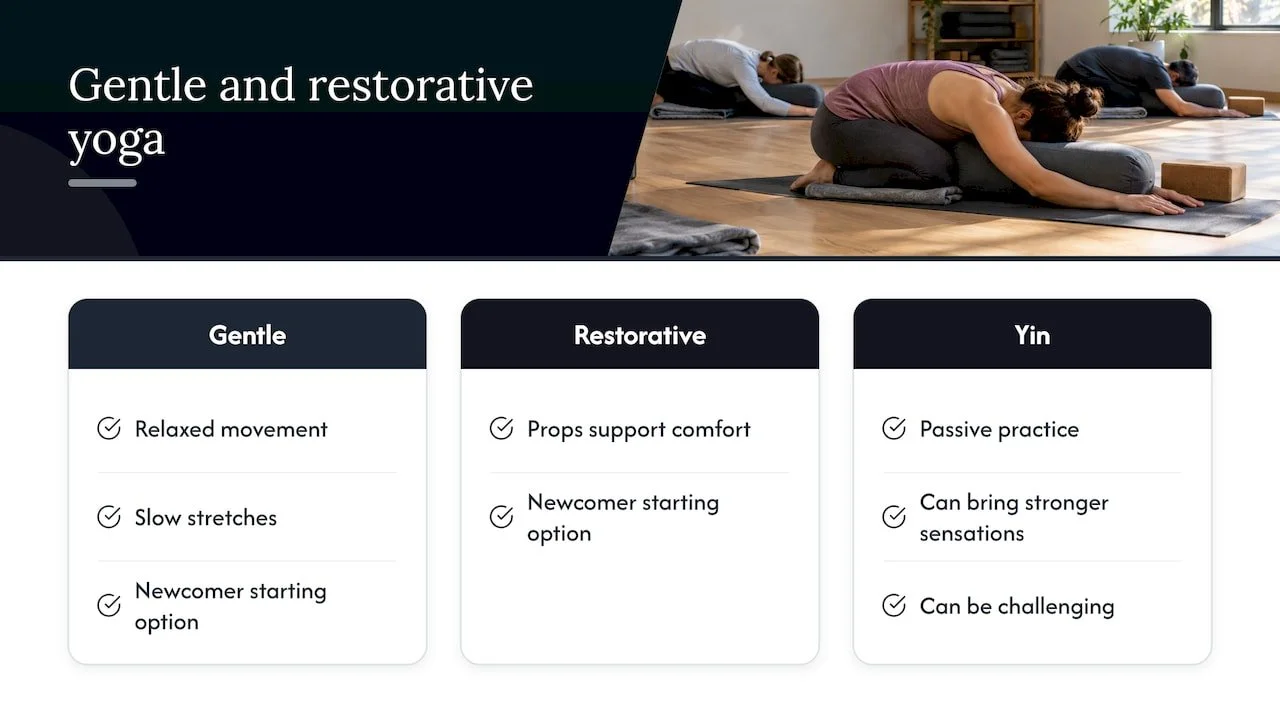
UCLA Health's beginner guide to yoga names gentle or restorative classes, along with slow flow, as good places for newcomers to start. Gentle classes suit people who want relaxed movement and slow stretches. Restorative classes go further: a physician's guide to recommending yoga published in 2018 describes restorative yoga as using props to support comfort.
Yin sits nearby but is not the same. The same guide notes that yin can bring stronger physical sensations and can be challenging even though it is passive. If you want to know what a long hold feels like before you try it, our post on restorative yin yoga and how to practice it walks through it.
Flow and vinyasa
Flow classes link poses with breath so you keep moving. The pace varies a lot. The physician's guide says vinyasa styles differ substantially from studio to studio and can range from beginner-friendly to advanced. That is why the word "vinyasa" on a schedule tells you very little. Look for the level label, the length of the class and a sentence about pace.
Hot yoga
Hot yoga is practiced in a heated room, and the heat changes how the body responds. We cover it in detail below because it is the style where preparation matters most.
Pilates, barre and tai chi
Many people who come to yoga for flexibility add Pilates for core strength and posture, or barre and tai chi for variety. These are low-impact, which suits beginners, busy professionals and active adults who want better mobility. A weekly mix of one strength-focused class and one slower class is a common, balanced pattern.
Why Class Labels Mislead You
A class called Hatha may be gentle at one studio and demanding at another. UCLA Health says Hatha classes may be beginner or advanced, depending on who teaches them. Reading about choosing a class that fits is useful, but the surest method is simple: send a message to the studio before booking.
Three questions get you a straight answer:
How fast does the class move, and how long do we hold poses?
Is the class open to complete beginners, or does the teacher assume some experience?
Is the room heated, and if so, by how much?
UCLA Health's advice is the same: ask about pace and difficulty, tell the teacher you are new, and mention injuries or limitations. The physician's guide adds that you should practice at your own ability level and seek medical advice if you are unsure whether a style suits you. If you have a health condition, see your doctor before starting.
Your First Class: What to Expect
A first yoga class usually follows a predictable arc. Knowing it removes most of the nerves.
Arrival. Get there 10 to 15 minutes early. Check in, find a spot and set up your mat.
Introduction. Tell the teacher it is your first class and share anything relevant: a sore knee, a recent surgery, a pregnancy.
Warm-up. Gentle movement, breath awareness and simple stretches.
Main sequence. Standing, seated and floor poses. In a beginner class the teacher demonstrates and offers modifications.
Cool-down and rest. Most classes end lying on your back for several minutes. Do not skip it.
You are allowed to rest in child's pose whenever you need to. No one is grading you. Pushing into a stretch because the person beside you can go deeper is the quickest route to a strain. Our post on 10 common yoga mistakes beginners and intermediates make lists the habits worth correcting early.
What to Bring, Wear and Check
A short checklist covers nearly every class.
A mat. Many studios rent or lend one, so ask. If you buy one, a non-slip surface matters more than thickness.
Comfortable clothing. Choose something stretchy that stays in place when you bend. For heated classes, pick light fabrics, as UF Health recommends.
Water. Bring a bottle, and a towel if the class is heated.
Food timing. A heavy meal right before class makes twists and forward folds uncomfortable. A light snack an hour or two earlier works for most people.
Questions to settle before you book: the cancellation policy, the arrival cutoff and whether the first class has an introductory price.
For your body, a few minutes of easy movement before you arrive helps you settle in. A short guide on warming up before exercise explains why preparing muscles and joints reduces strain, and the principle applies to a brisk yoga session too.
Hot Yoga: Precautions for a Safe Start
Hot yoga is popular in New Jersey and Pennsylvania alike, and it can be a rewarding practice. It also asks more of your body than a room-temperature class, so go in prepared.
UF Health notes in a 2017 podcast that muscle injuries are more common in hot yoga than in other yoga practices, because heat lets people overstretch. Their guidance is practical:
Wear exercise clothes made of light fabric.
Drink water before, during and after class.
Learn the early signs of heat sickness: nausea, dizziness, muscle cramps and extreme thirst.
If you are new, try a "light" hot class in a cooler room to ease in.
When you feel any of those early signs, leave the heat, sit or lie down and drink water. Do not push through. Stretch to a point of mild tension, never sharp pain, because warm muscles can feel looser than they are.
We have written several guides on this. Hot yoga safety tips: stay safe and energized covers the basics, essential hot yoga safety tips for injury-free practice goes deeper on avoiding strains, and smart hydration tips for hot yoga explains how to drink well around a session. If you want the full sequence of a session, hot yoga step by step takes you through it.
If you have a heart condition, low blood pressure, are pregnant, or take medication that affects hydration or heat tolerance, talk to your doctor before taking a heated class.
Prenatal and Postnatal Yoga
Yoga during pregnancy is usually practiced in a class designed for it, with modified poses and no deep twists or lying flat on the belly. Before joining any class, get clearance from your OB-GYN or midwife, and tell the teacher how far along you are. Avoid heated rooms unless your clinician says otherwise.
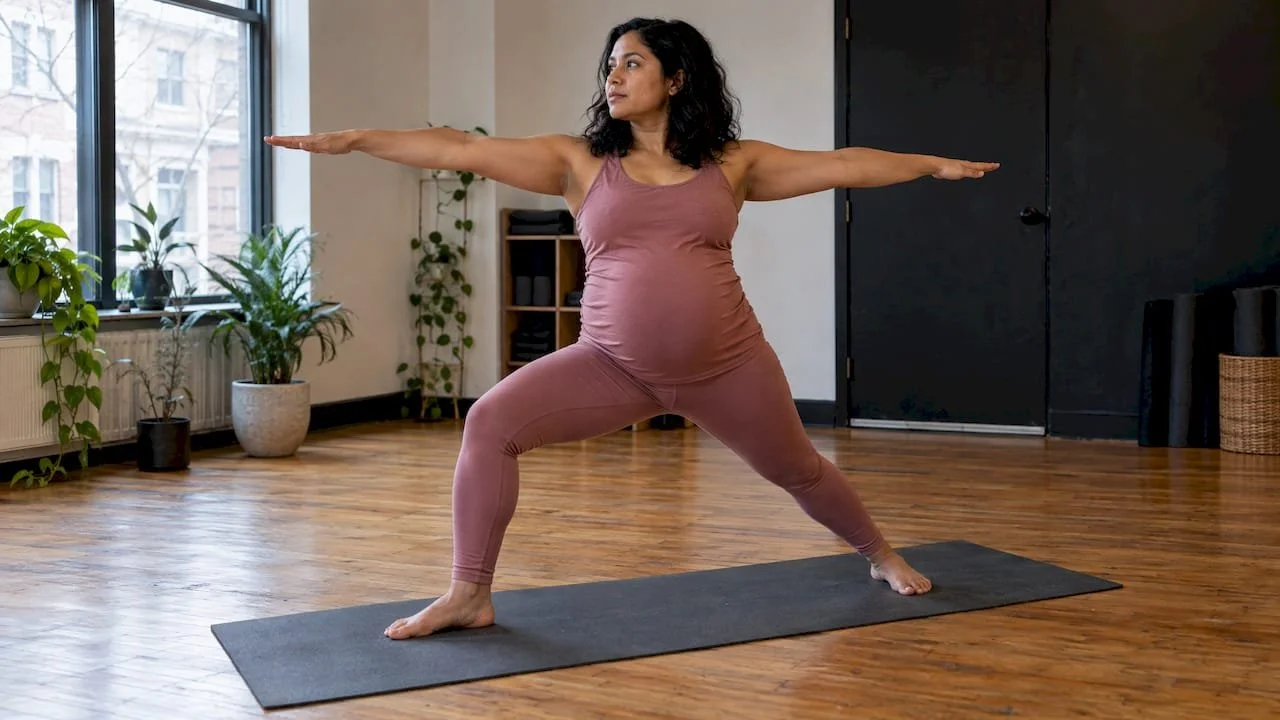
Gentle stretching can also help with common discomforts. A pregnancy resource on stretches for round ligament pain shows examples, which you can bring up with your clinician. After birth, wait for your provider's go-ahead before returning to class, and start with gentle sessions.
When the Schedule Does Not Fit: Practicing With Us From Morristown
Life in northern New Jersey is busy. Commutes, kids and work make a fixed class time hard to keep, and a missed class is the usual start of a lapsed habit. That is the reason we built flexible ways to practice with us.
Our studio is in Philadelphia, so in-person classes are for the times you are in the city. For everything else, these options come from our class and membership page:
| Option | Price |
|---|---|
| Livestream class drop-in | $19 per session |
| Livestream class membership | $49 per month |
| On-demand membership | $25 per month |
| Community class drop-in | $11 per session |
| Group class drop-in (in studio) | $28 per session |
| One month of unlimited group classes | $169 per month |
A livestream lets you join a live class from your living room, and the on-demand library fits a lunch break or a late evening. Both suit a beginner who would rather learn the shapes at home before walking into a studio. When you are ready to progress, our class descriptions explain each style and level, and the class schedule shows what is on and when.
If you want one-to-one attention, for an injury, a specific goal or a teacher-led plan, we offer private yoga and mat Pilates sessions, from $85 per hour.
Practicing at home takes a little setup, especially for heated sessions. Our guide to hot yoga at home with a safe setup and quick routine covers it.
Build a Routine That Lasts
The style you choose matters less than whether you keep showing up. A routine that survives a busy month looks like this:
Two sessions per week. One at a slower pace, one with more movement.
A fixed slot. Same days and times, so it stops being a decision.
A fallback. A short on-demand class on days you cannot get out.
A review at four weeks. Ask what felt good, what felt like too much, and adjust the style or intensity.
People who want to go deeper often add Pilates, breathwork or a workshop, and some move on to teacher training. Starting with a simple, consistent base makes each of those steps easier.
Practice With Us
If you want a yoga practice that fits around a Morristown schedule, start with a livestream drop-in at $19, or choose the $25 on-demand membership if you prefer to practice on your own time. When you are in Philadelphia, drop into a group class from $28, or choose the unlimited month at $169 if you plan to come often. See all class options and pricing.
Gift cards are also available if you want to give someone a first class: see our gift cards page.
Our Perspective
We teach adults at every level, from people who have never rolled out a mat to long-time practitioners, and we design our classes around one idea: safety and personal growth go together. Clear guidance, room to modify and a welcoming community let people go further than pressure ever does.
That is why we offer such a range: yoga in several styles including hot and aerial, mat and group reformer Pilates, barre, tai chi, breathwork and massage. People's needs change from season to season, and one studio should be able to meet them.
It is also why our memberships are flexible. Livestream and on-demand access means a busy week does not break your habit, and an unlimited in-studio month supports those who want to go deeper. Whatever your starting point, we want your practice to feel like yours.
Juiced
FAQ
What type of yoga is best for a complete beginner?
UCLA Health points to gentle or restorative classes and slow flow as good starting points. Look for a class labeled beginner or all levels, and tell the teacher it is your first time. Ask about pace before you book, since class names vary by studio.
Is hot yoga safe for beginners?
Many beginners enjoy it with preparation. Hydrate before, during and after class, wear light fabrics and know the early signs of heat sickness: nausea, dizziness, cramps and extreme thirst. UF Health suggests easing in with a light class in a cooler room. Check with your doctor first if you have a health condition or are pregnant.
How often should I practice yoga?
Two sessions a week is a realistic starting point for most adults and builds a steady habit. Add a third, shorter session at home when it feels comfortable. Consistency over weeks matters more than the length of any single class.
Can I practice with Amrita if I live in New Jersey?
Yes. Our studio is in Philadelphia, and we offer livestream classes at $19 per drop-in or $49 per month, plus an on-demand membership at $25 per month. You can join from home and visit the studio when you are in the city.
What should I tell the teacher before my first class?
Share that you are new, plus any injuries, surgeries, pregnancy or health conditions. A good teacher will offer modifications and keep an eye on you throughout the class.