Restorative Yin Yoga: What It Is and How to Practice It
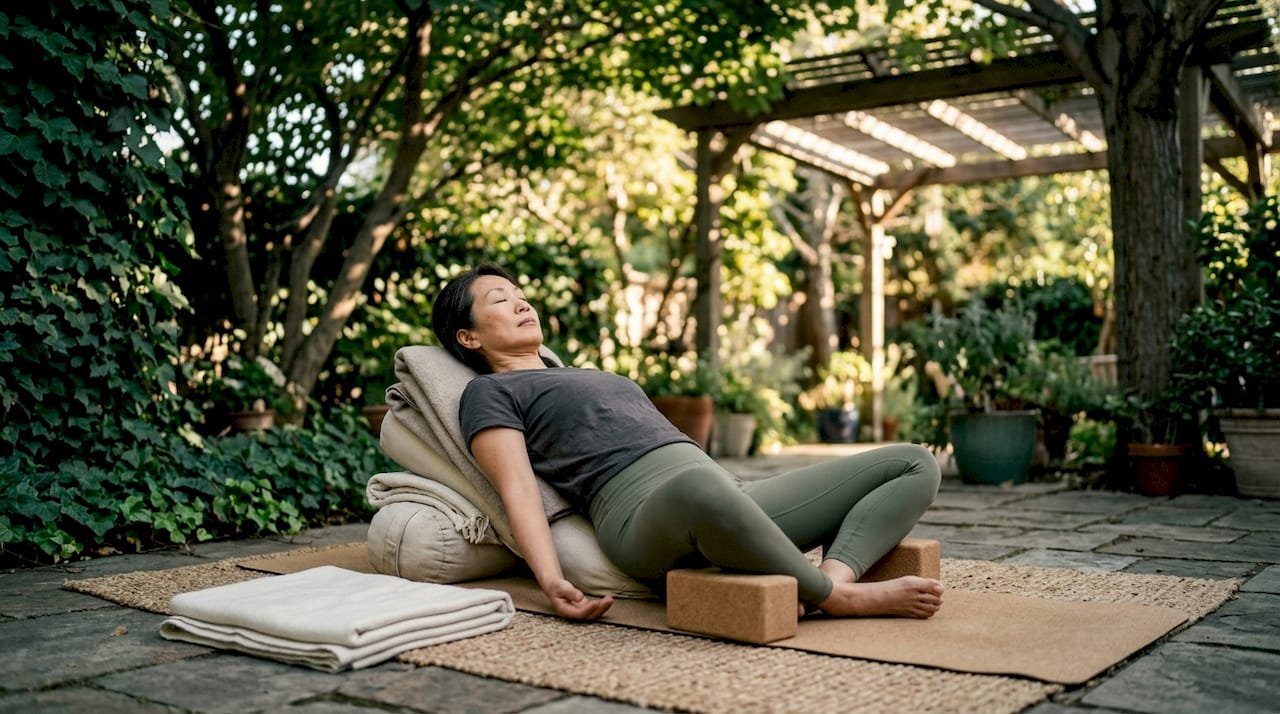
Restorative yin yoga is a hybrid practice that combines the long-held connective tissue work of yin yoga with the full prop-supported relaxation of restorative yoga. You hold floor-based poses for several minutes, fully supported by bolsters, blocks, blankets, and eye pillows, so your muscles can disengage completely while your connective tissues receive a gentle, sustained release. The result is something neither practice delivers alone: deep tissue work happening simultaneously with a profound nervous system reset.
What makes this hybrid distinct is the intention behind the props. In traditional yin yoga, props assist your position but you still feel a working edge of sensation. In restorative yoga, props eliminate all sensation entirely. Restorative yin yoga lands between those two poles, using props generously enough to remove muscular effort while still allowing mild connective tissue engagement to occur passively over time.
This practice suits anyone chasing flexibility, stress relief, or a nervous system reset, particularly people who find pure restorative yoga too passive but find traditional yin too demanding.
At a glance, restorative yin yoga:
Holds poses for 3–10 minutes in fully supported positions
Uses bolsters, blocks, blankets, and eye pillows to eliminate muscular effort
Targets deep connective tissues (fascia, ligaments, joint capsules) passively
Activates the parasympathetic nervous system for deep rest
Blends yin's tissue focus with restorative yoga's surrender and comfort
Suits flexibility goals, stress recovery, and emotional processing
What is yin yoga and why does it matter?
Yin yoga is a slow, floor-based practice that targets the body's deep connective tissues rather than its muscles. Where most movement practices work the muscular layer, yin goes deeper, reaching fascia, ligaments, and joint capsules through long, still holds. The practice was popularized in the West by Paul Grilley and Sarah Powers, drawing on both Taoist principles and anatomical understanding of how connective tissue responds to sustained, gentle load.
The defining concept in yin is the "working edge." You move into a pose until you feel a mild to moderate sensation, then stop there and stay. Not pain, not numbness, just a noticeable pull that you breathe through for several minutes. That sustained, low-level stress is what prompts connective tissue to adapt and lengthen over time, which is why yin yoga benefits include improved joint mobility and tissue health that other styles rarely touch.
Props appear in yin, but their role is positioning rather than comfort. A block under your hip might help you reach the floor, but you're still feeling the stretch. The mental side of yin is real too: staying with sensation for several minutes builds a kind of quiet resilience, training your nervous system to tolerate discomfort without reacting.
Core characteristics of yin yoga:
Poses held several minutes at a mild working edge of sensation
Targets fascia, ligaments, and joint capsules rather than muscles
Props used for alignment assistance, not to remove sensation
Builds flexibility, joint health, and connective tissue adaptation
Cultivates mental stillness and breath awareness under mild stress
Best suited for active practitioners wanting tissue-focused recovery
What restorative yoga actually does for your body
Restorative yoga operates on a completely different premise. The goal is not adaptation through stress but recovery through the complete absence of it. Every prop, every blanket fold, every bolster angle exists to remove physical load from the body until muscles have nothing left to do but let go.
Pose durations run longer here because the nervous system needs time to shift from sympathetic (fight-or-flight) to parasympathetic (rest-and-digest) mode. A well-set-up restorative pose feels like being held rather than stretched. Restorative yoga sessions use props like two blankets, two blocks, a bolster, and often an eye pillow to create that nest of support, and even a 10-minute session can produce measurable emotional relief.
The mental approach is surrender rather than endurance. You're not staying with anything uncomfortable. You're practicing the skill of letting go, which turns out to be harder than it sounds for most people. Restorative yoga is particularly effective during burnout, illness recovery, or any period when the body's reserves are genuinely depleted.
Core characteristics of restorative yoga:
Poses held 5–20 minutes with full prop support and zero sensation
Props fill every gap so muscles disengage completely
Activates the parasympathetic nervous system for deep recovery
Benefits include stress relief, improved sleep, emotional balance, and injury recovery
No stretch sensation should be present; props are adjusted until comfort is total
Suited for burnout, stress recovery, and nervous system restoration
How yin yoga and restorative yoga actually differ
The clearest way to separate these two practices is by asking one question: are you supposed to feel something? In yin yoga, yes. In restorative yoga, no. That single distinction drives every other difference between them.
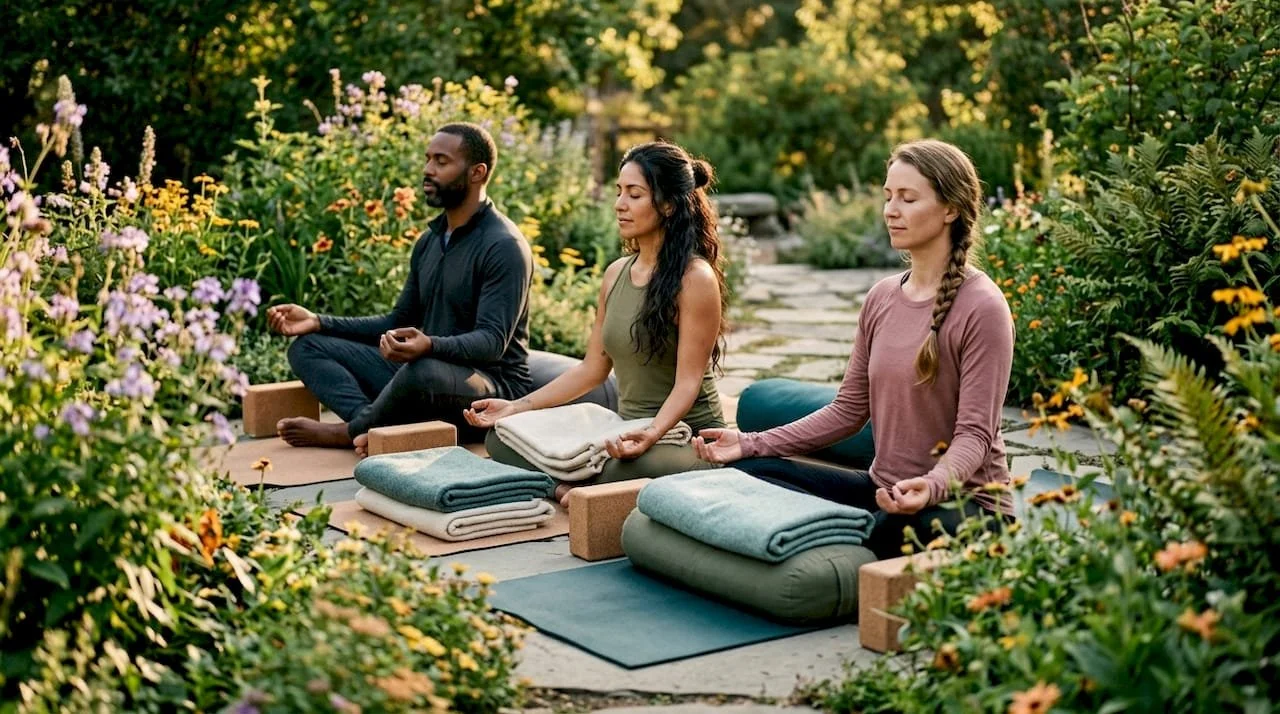
Yin yoga introduces mild sustained stress to connective tissues to stimulate adaptation, while restorative yoga uses extensive props to remove all physical load for total relaxation. The prop use reflects this: yin uses props moderately to help you reach a position, while restorative yoga's prop approach fills every negative space in the body until muscles disengage completely. A restorative setup can involve sandbags, multiple bolsters, and carefully folded blankets under every limb.
Philosophically, yin builds resilience through controlled sensation. Restorative rehearses rest by removing all challenge. Both activate the parasympathetic nervous system, but through opposite mechanisms: yin applies gentle stress for tissue adaptation, while restorative removes stress entirely for deep recovery. They're complementary, not interchangeable, and confusing them leads to either under-supporting a restorative pose or over-supporting a yin one.
| Dimension | Yin yoga | Restorative yoga |
|---|---|---|
| Philosophy | Resilience through sustained sensation | Surrender and deep rest |
| Stress vs. rest | Mild connective tissue stress for adaptation | Complete removal of physical stress |
| Alignment | Functional; props assist positioning | Comfort-first; props fill all gaps |
| Time per pose | 3–5 minutes | 5–20 minutes |
| Use of props | Moderate; sensation remains | Extensive; sensation eliminated |
| Intended benefits | Flexibility, joint health, mental resilience | Stress relief, recovery, nervous system reset |
Common misconceptions worth clearing up:
- Yin yoga is not the same as restorative yoga, even though both are slow and floor-based.
- Restorative yoga is not a beginner version of yin; it serves a different physiological purpose.
- Using more props does not make a yin pose restorative; the intention and sensation level define the practice.
- Both practices can and do activate the parasympathetic nervous system, just through different pathways.
Benefits of restorative yin yoga and how to start safely
The hybrid practice earns its place precisely because it delivers what neither parent practice does alone. Yin restorative yoga offers deep tissue work alongside complete relaxation and nervous system calming, with poses typically held up to 10 minutes in full prop support. You get the connective tissue release of yin without the mental demand of staying with sharp sensation, because the props reduce that sensation to something mild and manageable.
Mentally and emotionally, this practice creates space that active yoga rarely offers. Long, supported holds give the nervous system time to process stress rather than just suppress it. Many practitioners find that emotions surface during extended floor poses, which is a sign the body is releasing stored tension rather than a reason to stop. Breath awareness is the primary tool for navigating that experience: slow, deliberate exhales signal safety to the nervous system and deepen the relaxation response.
For beginners, the biggest obstacle is usually mental rather than physical. Stillness feels unproductive at first, especially for people accustomed to movement-based exercise. Breath focus is the primary technique instructors teach overcoming restlessness and settle into the hold. Start with shorter holds of 3–5 minutes and build gradually. Pair restorative yin yoga with more active practices on alternating days for a balanced approach to both flexibility and recovery. Exploring a holistic wellness routine that includes movement variety can make the stillness of restorative yin feel more natural over time.
Practical tips and precautions for beginners:
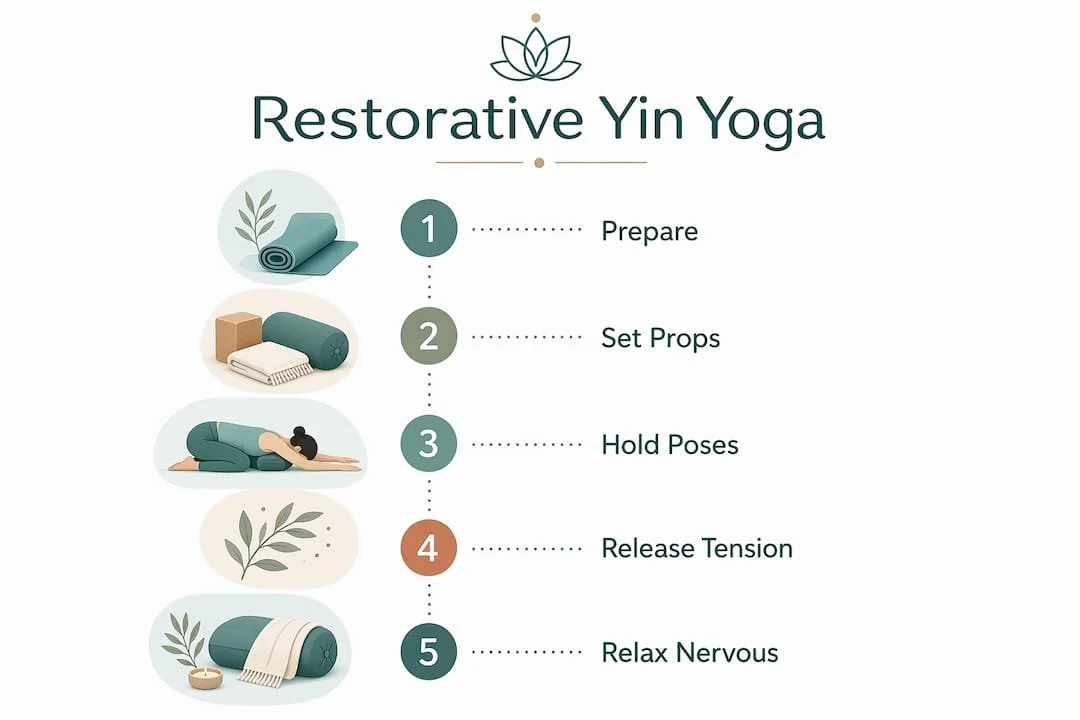
Start with classic poses: Supported Child's Pose, Reclined Butterfly, Legs Up the Wall, Supported Fish, and Melting Heart
Use a bolster under the spine, blocks under the knees, and blankets under the head to build full support
Aim for mild tissue sensation at most; if you feel sharp or joint pain, add props or exit the pose
Avoid restorative yin yoga during acute injury, late-stage pregnancy, or severe osteoporosis without medical guidance
Keep the room warm and dim; cold muscles and bright light work against the parasympathetic shift
Allow 5–10 minutes of stillness after your final pose before returning to activity
Pro Tip: Before settling into any pose, spend 60–90 seconds adjusting your props until you feel no muscular effort at all. Most beginners under-prop and then wonder why they can't relax. The setup is the practice.
Key Takeaways
Restorative yin yoga is the most accessible entry point for practitioners who want connective tissue release and nervous system recovery in a single session, without the mental demand of traditional yin or the complete passivity of pure restorative yoga.
| Point | Details |
|---|---|
| Hybrid practice definition | Restorative yin yoga blends yin's connective tissue focus with restorative yoga's full prop support and relaxation. |
| Pose duration | Poses are held 3–10 minutes, fully supported, to release tension without muscular effort. |
| Key distinction from yin | Yin requires a working edge of sensation; restorative yin minimizes that sensation through generous prop use. |
| Key distinction from restorative | Restorative yoga removes all sensation; restorative yin allows mild passive tissue engagement to occur. |
| Beginner priority | Adjust props until muscular effort disappears, and use breath awareness to navigate mental restlessness during holds. |
Amritayogawellness offers classes, workshops, and community events in Philadelphia designed to support exactly this kind of layered wellness practice. Whether you're drawn to the deep tissue work of yin, the nervous system reset of restorative yoga, or the restorative yoga techniques that bridge both, the studio's offerings meet you where you are. You can also explore Amritayogawellness's wellness workshops for community-centered ways to deepen your self-care practice beyond the mat.