How to use yoga for fitness: steps, styles, and results
TL;DR:
Yoga for fitness requires intentional style selection, focusing on higher intensity practices like Vinyasa.Consistent practice of 2-3 sessions weekly for 45-60 minutes yields measurable strength and mobility gains.Proper setup, progression, and tracking are essential to maximize results and avoid plateauing.
Plenty of fitness-minded Philadelphians hit a wall. The gym routine gets stale, generic yoga classes feel more like naptime than training, and the scale on meaningful metrics like strength or flexibility barely moves. Here's the thing: yoga absolutely can deliver real physical fitness results, but only when you approach it with the same intentionality you'd bring to any serious training plan. This guide breaks down the right styles to choose, how to structure sessions for maximum impact, what to measure, and how to avoid the most common pitfalls that keep people from seeing the results they came for.
Table of Contents
Key Takeaways
| Point | Details |
|---|---|
| Choose dynamic styles | Yoga forms like Vinyasa offer more fitness gains compared to gentle or restorative classes. |
| Consistency earns results | Practicing 2–3 sessions per week for 45–60 minutes leads to measurable fitness improvements. |
| Track both form and feeling | Measure your progress by using both physical benchmarks and how you feel after each session. |
| Adapt for joint safety | Always listen to your body, modify poses for joint pain, and seek instruction if unsure. |
What is yoga for fitness and why does it work?
Most people think of yoga as stretching or stress relief. That's not wrong, but it's incomplete. Yoga for fitness means deliberately selecting postures, sequences, and breathing patterns that produce measurable improvements in strength, mobility, cardiovascular endurance, and metabolic health. The distinction matters because not all yoga classes are created equal, and choosing the wrong style for your goals is the single biggest reason people plateau.
Research backs this up. Cardiometabolic benefits are real, particularly modest reductions in blood pressure for adults with overweight or obesity who practice consistently. The key word is "consistently," and the key variable is intensity. A candlelit Yin class two nights a week will feel wonderful but won't build quad strength or elevate your heart rate enough to drive cardiovascular adaptation.
Here's a quick comparison so you can self-select your starting point:
| Style | Intensity | Primary fitness benefit |
|---|---|---|
| Vinyasa / Power Yoga | High | Cardiovascular fitness, strength, mobility |
| Hatha (active) | Moderate | Flexibility, functional strength, balance |
| Hot Yoga | Moderate to High | Endurance, detox, flexibility |
| Yin / Restorative | Low | Deep tissue flexibility, stress recovery |
| Barre / Pilates Fusion | Moderate to High | Core strength, muscle tone, posture |
To get fitness returns, prioritize styles in the upper half of that table. Explore our yoga styles overview if you want to dig deeper into each category before committing.
Key benefits of a fitness-oriented yoga practice include:
Improved muscular endurance from sustained isometric holds
Greater joint mobility that carries over into running, cycling, or lifting
Better posture and spinal alignment, reducing chronic back and neck tension
Cardiovascular conditioning in flowing, higher-paced sequences
Reduced inflammation markers with regular consistent practice
Essential tools and practice setups for success
Once you understand the benefits, it's time to ensure you have the right setup to maximize them. You don't need expensive gear, but a few fundamentals make an enormous difference in how effective and sustainable your practice becomes.
At minimum, you need:
A non-slip yoga mat (at least 4mm thick for joint cushioning)
Two yoga blocks for modifying poses and deepening stretches
A strap for hamstring and shoulder mobility work
Comfortable, breathable clothing that moves with you
Water and a small towel, especially for vigorous or hot classes
Setting up at home versus attending a studio involves real trade-offs. A home practice is convenient and private, which removes friction for busy schedules. However, a studio gives you real-time corrections from instructors, community motivation, and structured programming that makes progressive challenge much easier to follow. For most fitness-focused adults, a hybrid approach works best: attend studio classes two or three times per week and supplement with shorter home sessions on the days in between.

Evidence from recent reviews suggests that 2 to 3 yoga sessions per week, each lasting 45 to 60 minutes, is the minimum effective dose for producing measurable improvements in physical fitness and flexibility. Going below that threshold tends to yield stress reduction benefits but not significant strength or mobility gains.
| Practice frequency | Session length | Expected outcome |
|---|---|---|
| 1x per week | 60 min | Stress relief, mild flexibility |
| 2x per week | 45–60 min | Noticeable flexibility gains, light strength |
| 3x per week | 45–60 min | Measurable strength, mobility, cardiovascular gains |
| Daily micro-sessions | 15–20 min | Skill maintenance, adherence, mobility upkeep |
If you're just getting started, the styles for beginners guide is a practical resource for choosing your entry point without overwhelming yourself.
Pro Tip: Schedule your yoga sessions the same way you'd schedule a meeting. Pick a consistent time of day when your energy levels are predictable, whether that's early morning before the city wakes up or after work as a transition ritual. Consistency of timing dramatically improves long-term adherence.
Step-by-step: Structuring a fitness-focused yoga session
Now that you know how often and what you need, let's break down exactly what to do during each session. The structure below applies whether you're practicing at home or taking a class. Understanding the template helps you assess whether a given class is actually serving your fitness goals.
A complete fitness yoga session looks like this:
Joint mobilization warm-up (5 minutes): Begin with slow neck rolls, shoulder circles, hip circles, and ankle rotations. This primes the joints and signals the nervous system to prepare for movement.
Sun salutations (10 minutes): Perform 4 to 6 rounds of Sun Salutation A or B. This builds internal heat, connects breath to movement, and begins loading major muscle groups through their full range of motion. Explore Hatha yoga sequences for foundational variations.
Standing strength series (15 minutes): Move through Warrior I, Warrior II, Warrior III, Chair Pose, and Crescent Lunge. Hold each pose 5 to 8 breath cycles. These standing poses load the glutes, quads, hamstrings, and core simultaneously.
Plank and core block (10 minutes): Integrate plank holds, side planks, boat pose, and low-cobra-to-plank transitions. This is where muscular endurance gets built. Adding Vinyasa yoga flow transitions between these positions elevates intensity significantly.
Balance and coordination (5 minutes): Tree pose, Eagle pose, or Warrior III single-leg holds. Balance work recruits smaller stabilizer muscles often skipped in traditional gym training.
Cool-down stretching (5 to 8 minutes): Focus on hip flexors, hamstrings, thoracic spine, and shoulders. This is where flexibility gains are consolidated.
Breathwork or Savasana (5 minutes): Non-negotiable. This is when the nervous system shifts from effort to recovery, locking in the adaptation you just created.
Pro Tip: Alternate between dynamic flowing sequences and static hold blocks within the same session. The combination builds muscle tone through time-under-tension while the flowing sections maintain cardiovascular stimulus. It's a more efficient use of 45 to 60 minutes than doing one or the other exclusively.
Movement quality first. The moment a pose creates sharp, shooting, or joint-level pain, come out of it. Yoga rewards patience. Pushing through real pain doesn't speed up progress; it sets it back. Stay hydrated throughout vigorous sessions, especially in a heated studio environment.
Research confirms that yoga styles vary significantly in training intensity and physiological load, which means choosing a vigorous class style matters more than simply showing up for any yoga class. A slow restorative session and a hard Vinyasa flow are physiologically very different experiences.
Safety and adaptations: Common pain points and progressions
As you incorporate yoga for fitness, it's vital to understand how to adapt for your body's needs and stay safe. This is especially relevant for anyone dealing with knee discomfort, hip tightness, or limited shoulder mobility, all common among active adults in their 30s, 40s, and beyond.
Yoga can and should be modified. Props are not a sign of weakness; they're tools that allow you to access the actual benefit of a pose without compensating through joints or connective tissue. A yoga block under your hand in Triangle Pose, for example, lets your spine rotate properly instead of collapsing to one side.
For joint-related concerns, yoga for mobility tips provides practical entry points. Research shows that yoga can be a viable complement to strengthening exercises for some joint-pain outcomes, though it may not outperform dedicated strength training for knee osteoarthritis pain in the short term. That said, the mood, functional movement, and quality-of-life benefits remain valuable. For older adults or those with specific mobility limitations, simple mobility poses offer a gentler starting point.
Stop your practice and consult a professional if you experience:
Sharp, stabbing, or electrical pain in any joint
Pain that persists for more than 24 hours after a session
Numbness or tingling in the hands, feet, or face during practice
Significant dizziness or nausea during breathing exercises
Swelling in a joint following practice
Competent instruction changes everything. One well-timed cue from an experienced teacher can correct a misalignment you've been carrying for years. Build your foundation gradually and resist the urge to jump straight into advanced inversions or deep backbends before your body is ready.
Safe progression means increasing challenge by extending hold times before adding more advanced pose variations. Add one new challenging element per session, not five. That measured buildup is what prevents injury and actually speeds up overall progress.
How to track your fitness results with yoga
To keep motivated, you'll want to check that your practice is working. Tracking progress with yoga requires a mix of objective and subjective measures, and the combination gives a much fuller picture than any single metric.
Simple self-tests you can perform at home:
Seated forward fold: Sit with legs extended and reach toward your feet. Measure how far your fingertips reach relative to your heels. Retest every four weeks.
Plank hold: Time how long you can hold a solid forearm plank. This is a reliable core and shoulder endurance benchmark.
Single-leg balance: Stand on one foot with eyes open. Time yourself. Retest monthly to track stability improvements.
Resting heart rate: Track it weekly first thing in the morning. Consistent yoga practice tends to lower resting heart rate over time as cardiovascular efficiency improves.
| Measure type | Examples | When to track |
|---|---|---|
| Objective | Blood pressure, plank time, forward fold reach, resting HR | Monthly |
| Subjective | Mood, energy, sleep quality, perceived effort | Weekly |
| Performance | Session duration, poses held, flow completion | Per session |
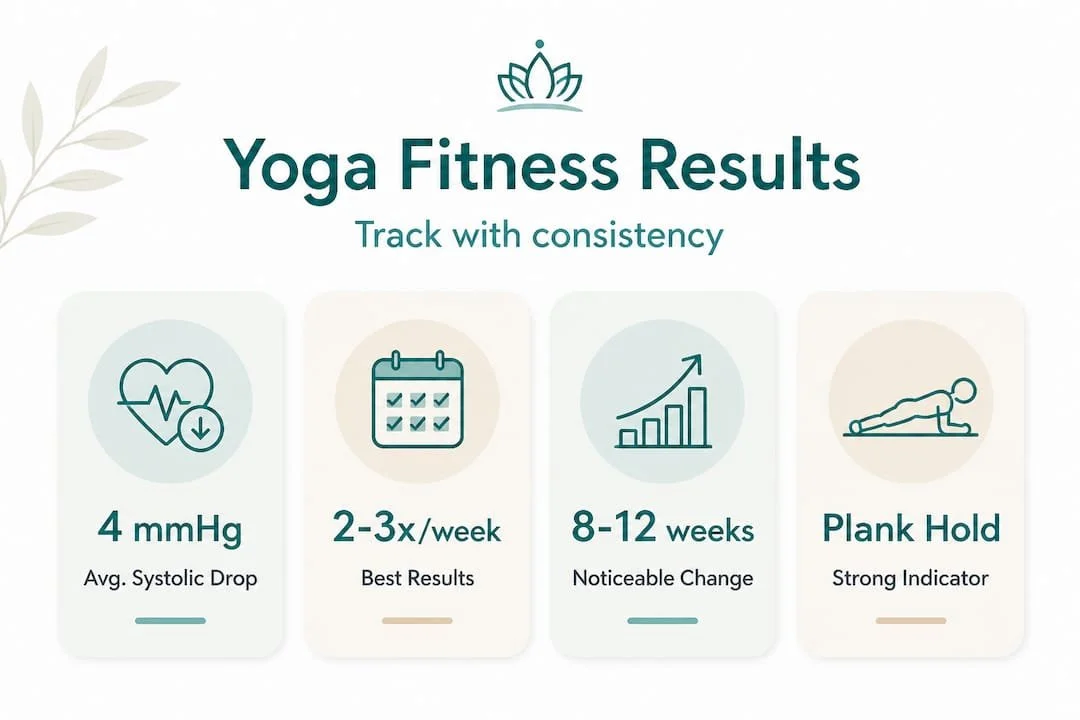
Managing expectations matters. Best results come from consistent, moderate practice, and the effect sizes tend to be meaningful but not dramatic. Most adults practicing 2 to 3 times per week will notice real flexibility improvements within 6 to 8 weeks and broader fitness gains within 8 to 12 weeks.
Blood pressure reductions average around 4 mmHg systolic in fitness-focused adult populations. That's small on paper but clinically significant when maintained consistently over months. Track your progress through poses and keep a simple practice log. You'll be surprised how motivating the data becomes.
Why most people miss out on yoga's full fitness benefits
Now that you know how results are made, let's address why so many don't experience them. The honest answer is that most people treat yoga as a recovery activity rather than a training modality, and that mindset is the core of the problem.
A typical drop-in class at most studios leans heavily into relaxation, gentle sequencing, and low to moderate effort. That has genuine value, but it doesn't create the stimulus needed for strength adaptation or meaningful cardiovascular development. If you walk out of every class barely sweating and feeling like you could have gone longer, the class probably isn't challenging enough for your fitness goals.
Real progress in yoga, just like in strength training or running, requires progressive challenge. That means systematically increasing hold times, selecting harder pose variations, or shortening rest between flow sequences. Most casual practitioners never do this. They attend the same class at the same effort level for months and wonder why their body hasn't changed.
The second biggest reason people plateau is that they don't measure anything. Without a baseline and periodic retests, you lose the feedback that tells you whether the approach is working. When you can see that your plank hold went from 30 seconds to 75 seconds over two months, or that your forward fold improved by four inches, you have concrete proof that the practice is working. That proof sustains motivation through the inevitable rough weeks.
Finally, many fitness seekers stick exclusively to gentle or beginner classes long after they're ready for more. If you've been practicing for six months, try a dynamic vinyasa class and assess honestly whether the intensity matches your fitness ambitions. The gap between what most people are doing and what they could be doing is where the results live.
Explore next-level yoga and wellness options
If you're ready to go further or want expert feedback, the next logical step is working with instructors who can assess your movement, correct your alignment, and progressively challenge you in the right direction.
At Amrita Yoga & Wellness in Philadelphia, you'll find a full range of fitness-focused yoga styles, including Vinyasa, hot yoga, Pilates, Barre, and Tai Chi, all taught by experienced instructors who know how to help active adults make measurable progress. Group classes provide the community and accountability that keep consistent practice alive. Beyond physical fitness classes, the studio also offers integrative wellness options including workshops and even tarot readings and wellness sessions for those interested in the full mind-body-spirit experience. Whether you're building a structured training plan or just ready to step up from solo home practice, the studio gives you the tools and community to take your results to the next level.
Frequently asked questions
Is yoga enough for building strength and fitness?
Yoga builds functional strength and improves mobility but is best combined with other training for maximal muscle gain. Research shows yoga can complement strengthening exercises for certain outcomes but may not outperform dedicated strength training alone.
How soon can I expect fitness results from yoga?
Most people notice improved flexibility and moderate fitness gains within 8 to 12 weeks with consistent practice. Evidence supports that 2 to 3 sessions per week at 45 to 60 minutes each is enough to produce measurable benefits.
What styles of yoga are best for fitness?
Dynamic and flowing styles such as Vinyasa or Power Yoga deliver greater fitness benefits than gentle or restorative classes. Yoga styles vary significantly in physiological load, so choosing a vigorous style is essential for fitness-specific goals.
Is yoga safe for people with joint pain?
Yoga can be safely adapted for joint pain with the right modifications and prop support. Work with an experienced instructor and modify or skip poses that create discomfort, and know that yoga can be a viable complement to traditional treatment for many joint-related conditions.