How Mindfulness Deepens Aerial Yoga for Philadelphia Wellness
TL;DR:
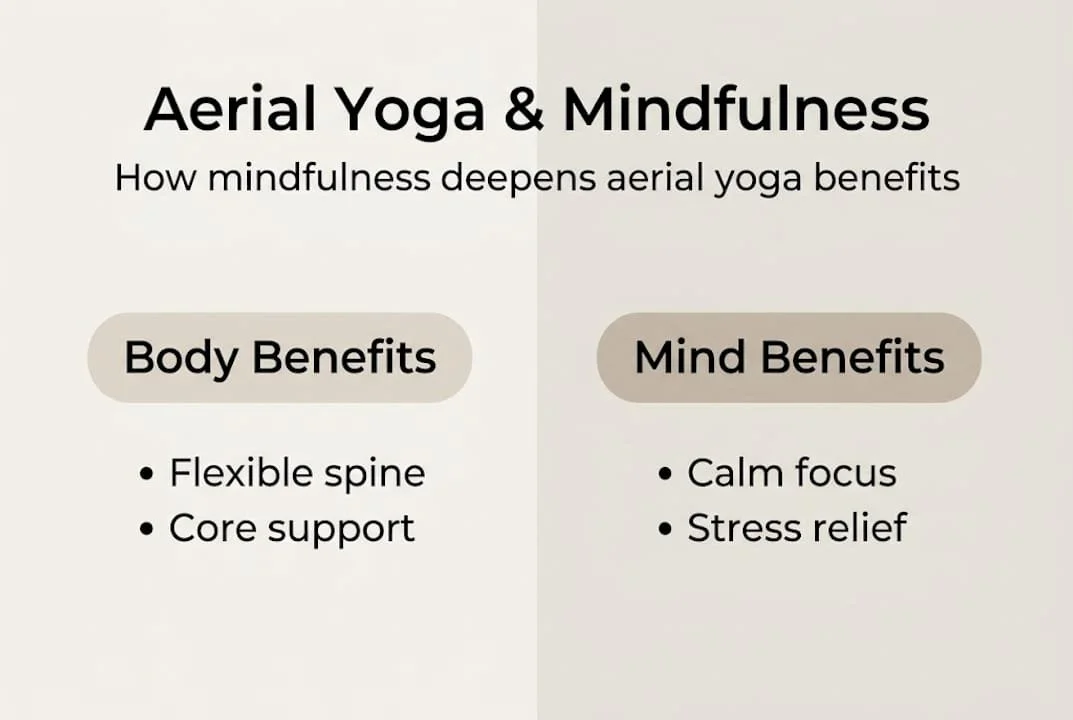
Aerial yoga uniquely interrupts nervous system patterns, promoting emotional and mental renewal through mindfulness.Mindfulness enhances physical benefits and emotional healing by focusing awareness during suspension and movement.Philadelphia studios integrate mindfulness into aerial yoga, offering holistic practices for stress relief and self-awareness.
Aerial yoga is not just about floating above the ground or pulling off a gravity-defying pose. What most people miss is that suspension actively interrupts your nervous system's default patterns, creating a rare window for emotional and mental renewal that traditional mat yoga rarely opens. That window only stays open when you bring mindfulness into it. For Philadelphia adults exploring holistic wellness, the combination of hammock-based movement and conscious awareness is proving to be one of the most effective and underrated paths to both physical health and mental clarity.
Table of Contents
Key Takeaways
| Point | Details |
|---|---|
| Mindfulness and movement | By combining breath and suspended poses, aerial yoga makes mindful engagement with the body easier and deeper. |
| Emotional healing | Aerial yoga with mindfulness breaks mental patterns and supports stress relief and emotional regulation. |
| Practical applications | Simple mindfulness cues like breath focus and body scans can be integrated into every aerial yoga session. |
| Local studio advantage | Philadelphia offers unique studios specializing in mindful aerial yoga for mental and physical wellness. |
What is aerial yoga and why mindfulness matters
Aerial yoga uses a soft, hammock-like silk suspended from the ceiling to support and extend the body through yoga poses, stretches, and inversions. Unlike traditional yoga, where gravity pushes you into the floor, the hammock redistributes weight across your body, allowing you to reach positions that would otherwise strain your joints. That redistribution is what makes the practice so physically unique. But here is what most people overlook: the hammock also changes how your brain processes body movement.
Mindfulness in this context is not a meditation buzzword. It is the active, deliberate awareness of your breath, sensation, and position in space while you move. When you bring that awareness into aerial yoga, something interesting happens. Your body stops reacting automatically and starts responding consciously. That shift from reaction to response is where the real wellness gains begin.
The hammock provides support for deeper stretches, spinal decompression, and proprioception enhancement, integrating mindfulness with breath-movement synchronization. Proprioception, your body's ability to sense its own position, sharpens when you are suspended and forced to stabilize. Adding mindful breathing in aerial yoga amplifies this effect, giving your nervous system a richer map of where you are and what you are doing.
Core benefits of the aerial yoga and mindfulness combination:
Spinal decompression through supported inversions
Sharpened proprioceptive awareness during suspension
Deeper stretches with less joint compression
Slowed stress response through breath-synced movement
Improved body-image awareness via intentional sensation focus
| Aspect | Traditional yoga | Aerial yoga with mindfulness |
|---|---|---|
| Spinal support | Gravity-dependent | Hammock-assisted decompression |
| Proprioception | Moderate challenge | Heightened during suspension |
| Breathwork role | Optional emphasis | Structurally integrated |
| Mental engagement | Variable | Consistently demanded |
For anyone in Philadelphia curious about taking this further, aerial yoga classes at local studios offer beginner-friendly environments that teach you how to pair breath with each movement from your very first session. Aerial yoga is not just a workout. With mindfulness woven in, it becomes a complete wellness practice.
How mindfulness transforms aerial yoga: Mental and physical benefits
Once you understand what aerial yoga is, the real question becomes: what does mindfulness actually change about the experience? The answer is more than most people expect.

Mindfulness amplifies something called interoceptive awareness, which is your ability to notice and interpret signals from inside your body. Things like hunger, tension, emotional discomfort, or calm. An OT-led aerial yoga program showed improved interoceptive awareness and emotional regulation in youth participants, suggesting these benefits could extend to adults who practice with consistent mindfulness focus.
Suspension does something that a mat cannot. It physically removes familiar ground-level cues, which means your brain cannot rely on its usual movement shortcuts. That interruption is valuable. Mindfulness via suspension breaks mental patterns and enhances emotional healing more dynamically than traditional yoga alone. For those dealing with anxiety, burnout, or stress, that pattern interruption is not just useful. It is transformative.
"When you are suspended in a hammock and focusing on your breath, you are not just stretching your body. You are rewriting how your nervous system responds to discomfort."
Here is how mindfulness elevates specific outcomes in aerial yoga:
Stress reduction: Breath-focused awareness lowers cortisol response during and after class
Emotional regulation: Holding awareness of sensation during poses builds tolerance for discomfort
Flexibility gains: Mindful relaxation during stretches allows deeper, safer range of motion
Joint health: Conscious weight distribution through the hammock reduces compression injury risk
Sleep quality: Post-session parasympathetic activation is stronger when mindfulness is active throughout
For more on how stress relief with aerial yoga works in practice, the research and community experience align: it is not the poses themselves but the awareness you bring to them that drives the deepest results. You can also explore aerial yoga stress relief tips and the science behind benefits of aerial yoga for stress to build your practice with more intention.
Pro Tip: During any aerial pose, soften your jaw and consciously breathe into your lower belly. This one cue activates your parasympathetic nervous system faster than any single stretch can.
Mindfulness practices in aerial yoga: Techniques and studio highlights
Knowing mindfulness matters is different from knowing how to do it inside a hammock. These practical techniques make the integration real.
Before the session: Arrive two to three minutes early and sit quietly with your hands on your thighs. Take three slow, intentional breaths. This is not just a ritual. It signals to your nervous system that this time is different from the chaos of your day.
During poses: Use anchor-point awareness. Every time you shift position in the hammock, consciously notice where the silk touches your skin. That sensation becomes your mindfulness anchor, similar to how meditators use the feeling of breath at the nostrils.
Body scan in suspension: In supported inversions, mentally scan from the crown of your head down to your feet. Notice warmth, tension, or ease without judgment. This activates interoception and helps the body release held tension more effectively than passive stretching alone.
Observing mental patterns: Aerial yoga often surfaces quiet fears, whether about falling, losing control, or not being good enough. These are not problems. They are data. Mindfulness teaches you to watch those thoughts without feeding them.
After class: Lie in savasana with one hand on your heart and one on your belly. Notice how your emotional baseline has shifted. This two-minute reset anchors the session's benefits into long-term memory.
Philadelphia studios like Amrita Yoga & Wellness and Relax and Hang Aerial offer aerial yoga classes emphasizing mindfulness and stress reduction for adults. These are not generic fitness classes. They are guided mind-body experiences built for people who want more than a workout.
For those drawn to the healing dimensions of this practice, exploring healing with aerial yoga, emotional healing practices, and aerial yoga therapy approaches can open up an entirely different relationship with movement and self-awareness.
Pro Tip: Begin every session with three grounding breaths before touching the hammock. It sounds small, but this habit trains your nervous system to enter a receptive state before physical movement begins.
Getting started: Steps for integrating mindfulness into aerial yoga
Ready to build this practice intentionally? Here is a step-by-step approach that works whether you are brand new or already attending aerial yoga sessions regularly.
Set a mindful intention before class: This does not need to be spiritual. It can be as simple as, "Today I will notice how my body feels in each pose." Intention primes attention, and attention drives change.
Focus on breath in every pose: Match your inhale to expansion, your exhale to release. When you enter or exit a pose, let your breath lead. The body follows.
Pause for a body scan mid-session: Find a comfortable supported position and spend 60 to 90 seconds scanning for tension, warmth, or resistance. Do not try to change anything. Just notice.
Reflect after class: Spend three to five minutes sitting quietly after your session. Ask yourself: what felt different? What emotions came up? What did your body release?
Track your experience over time: Patterns only become visible across multiple sessions. Keeping a short journal, even two or three sentences per class, creates a record you can actually learn from.
Research context matters here. While youth-focused research suggests strong interoceptive and emotional benefits, the broader yoga literature consistently supports stress reduction and mood improvements in adult practitioners. The steps above are grounded in both the emerging aerial yoga research and decades of mindfulness-based wellness work.
For those who have experienced trauma or are using yoga as part of recovery, connecting with trauma recovery yoga strategies can add an important layer of support and context to this process.
Pro Tip: Keep a mindfulness journal and write in it immediately after class while the physical sensations are still fresh. This captures data your thinking mind will otherwise reframe or forget.
Why most people overlook mindfulness in aerial yoga—and why it matters
Here is something we have noticed: most people walk into aerial yoga for one of two reasons. They want a fun workout, or they saw it on social media and got curious. Both are valid entry points. But very few people walk in thinking about mindfulness, and that is exactly why they often plateau.
The physical benefits of aerial yoga are real, but they have a ceiling when practiced without awareness. You can get stronger and more flexible. That is great. But if you leave each session without noticing how your nervous system has shifted, you are leaving the best part behind.
Suspension creates a genuinely novel situation for your brain. Mindfulness via suspension breaks mental patterns and enhances emotional healing more dynamically than floor-based practice. Philadelphia's wellness community is in a strong position to lead this integration, because studios here are already building mindfulness into their aerial programs. The question is whether students show up willing to use it.
Exploring healing with aerial yoga is not about adding something extra to your practice. It is about waking up to what was already there.
Explore mindful aerial yoga and wellness in Philadelphia
If this article has shifted the way you think about aerial yoga, that is a sign you are ready to take the next step in your practice.
At Amrita Yoga & Wellness, we offer aerial yoga sessions designed to weave mindfulness into every movement, not as an add-on, but as the foundation. Whether you are new to aerial yoga or looking to deepen what you already do, our Philadelphia studio offers small-group classes, workshops, and community events that meet you exactly where you are. We also offer tarot readings and other wellness experiences for those exploring the fuller picture of holistic self-care. Come practice with us and feel the difference that intention makes.
Frequently asked questions
How does mindfulness enhance the physical benefits of aerial yoga?
Mindfulness synchronizes breath and movement, allowing deeper stretches and improved spinal health during aerial yoga. When your attention follows your breath, your muscles release more completely, which means each pose works harder with less effort.
Is mindfulness in aerial yoga beneficial for stress relief and emotional healing?
Research and studio practice both confirm that mindfulness-integrated aerial yoga improves interoceptive awareness and emotional regulation in participants. The suspended environment accelerates this process by removing familiar ground-level mental defaults.
What are simple mindfulness practices for aerial yoga beginners?
Beginners can start with three intentional breaths before class, a brief body scan during suspension, and two to three sentences of post-class journaling to build awareness over time.
Are there Philadelphia studios that specialize in mindful aerial yoga?
Studios like Amrita Yoga & Wellness provide aerial yoga classes in Philadelphia that emphasize mindfulness and stress reduction for adult practitioners. These classes are structured to support both beginners and those with existing yoga experience.