What Are Pilates Reformer Classes? a Beginner's Guide
TL;DR:
Reformer Pilates uses spring resistance to engage muscles more deeply than mat exercises, making it effective for most fitness levels. Classes follow a structured routine of warm-up, main exercises, and cool-down, emphasizing control, alignment, and breath, with modifications for individual needs. This low-impact training improves strength, balance, posture, and fall risk reduction, regardless of age or starting fitness level.
If you've walked past a Pilates studio and spotted those sleek, sliding machines and wondered what are Pilates reformer classes, you're not alone. Many fitness-curious adults assume reformer Pilates is reserved for dancers, gymnasts, or people who can already bend themselves into impossible shapes. That assumption is wrong, and it keeps a lot of people from one of the most effective low-impact strength training methods available. This guide breaks down exactly what a Pilates reformer class is, how it works, what to expect when you walk in, and why it might be the smartest addition to your wellness routine.
Table of Contents
Key takeaways
| Point | Details |
|---|---|
| Reformer uses spring resistance | The machine challenges muscles in both directions, creating deeper engagement than mat work alone. |
| Safe for most fitness levels | With proper instruction and spring adjustment, beginners can train effectively and without injury. |
| Benefits go beyond flexibility | Research shows measurable gains in strength, balance, posture, and even fall risk reduction. |
| Form beats speed every time | New practitioners get better results focusing on breath and alignment than rushing through repetitions. |
| Classes are structured and guided | Instructors set pace, correct form, and modify exercises so every student progresses at the right rate. |
What Pilates reformer classes actually are
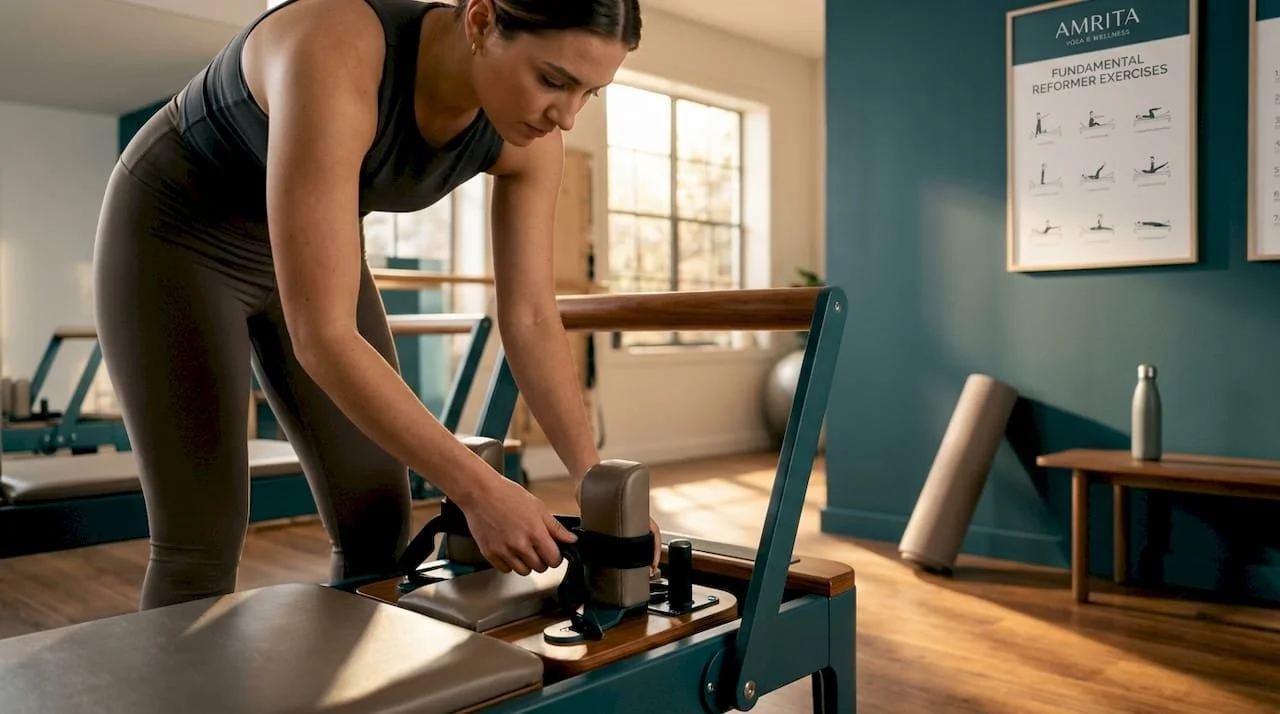
The reformer is a bed-like frame fitted with a sliding carriage, adjustable springs, a footbar, and straps attached to pulleys. You move the carriage by pushing or pulling against spring tension while lying, sitting, kneeling, or standing on it. That last part surprises most beginners: reformer Pilates is not just lying down doing gentle stretches.
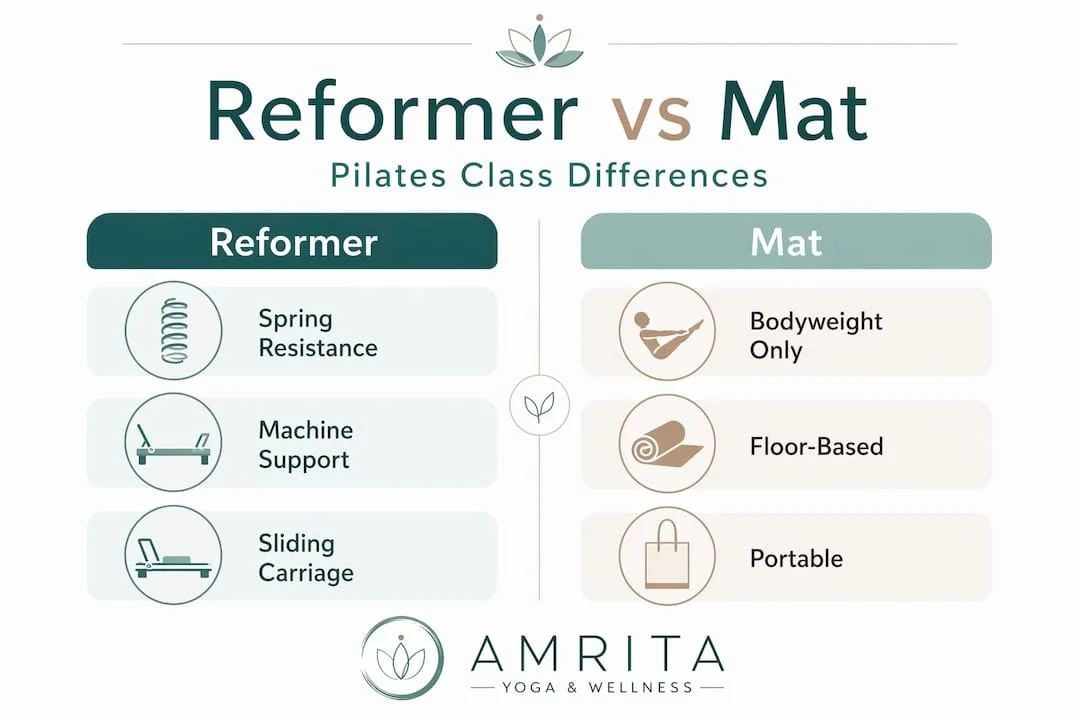
What sets reformer Pilates apart from mat Pilates is the resistance mechanism. Spring resistance works in both directions, meaning your muscles engage on both the push and the pull. Mat Pilates relies primarily on bodyweight, which is valuable but limited in how much it can load the stabilizer muscles. The reformer creates a deeper stability challenge because your core and supporting muscles must control the carriage throughout the full range of motion.
Joseph Pilates originally developed reformer-based exercises for rehabilitation, working with injured dancers and soldiers. That rehabilitation foundation is still visible in modern classes: precision, control, and breath are prioritized over volume and speed.
Here's a quick comparison to clarify the differences:
| Feature | Mat Pilates | Reformer Pilates |
|---|---|---|
| Equipment | Exercise mat | Reformer machine with springs and carriage |
| Resistance type | Bodyweight only | Adjustable spring tension, both directions |
| Body positions | Primarily floor-based | Lying, seated, kneeling, standing |
| Beginner accessibility | Very accessible | Accessible with proper guidance |
| Muscle depth targeted | Surface and core | Deep stabilizers and surface muscles |
Core principles of reformer Pilates:
- Concentration: Full mental attention on each movement
- Control: No momentum; every inch of motion is deliberate
- Centering: All movement originates from the core
- Precision: Quality of movement over quantity of repetitions
- Breath: Coordinated with movement to amplify engagement
The real benefits of reformer Pilates
This is where reform Pilates earns its reputation. People often come in for the flexibility gains and stay because of the strength results. Reformer Pilates engages deep stabilizer muscles that conventional gym training routinely skips, including the muscles along the spine, hip rotators, and inner thighs. These are the muscles that keep you upright, protect your joints, and support every movement you make outside the studio.
The benefits extend well beyond what most beginners expect:
Core strength: Every reformer exercise recruits the core, not as an afterthought but as the foundation.
Posture improvement: Consistent practice retrains the body to hold proper alignment naturally.
Flexibility: Moving through controlled ranges of motion builds functional flexibility, not just passive stretch.
Balance and coordination: The unstable carriage surface demands constant neuromuscular feedback.
Mental focus: Coordinating breath with precise movement builds a mindfulness practice alongside the physical one.
The clinical research on these outcomes is worth knowing. A 10-week reformer program significantly improved functional mobility, balance, and fall risk reduction in adults over 65. That's not a small result. Falls are a leading cause of injury in older adults, and a twice-weekly Pilates reformer practice produced measurable change in just ten weeks.
Pro Tip: If you feel muscle fatigue or mild soreness after your first few reformer classes, that's a sign the deep stabilizers are activating. Most beginners feel this in the inner thighs, glutes, and lower abdominals, not the back or neck. If you feel it in your neck, check your form with your instructor.
For anyone integrating breathwork into their practice, Pilates breathing and core strength have a direct and documented relationship. Controlled lateral breathing keeps the core engaged while allowing the ribcage to expand, which is a skill that takes a few classes to develop but pays off throughout your training.
What to expect in reformer classes
Knowing the structure of a class removes most of the anxiety beginners feel walking in. A standard reformer Pilates class runs 50 to 55 minutes and follows a clear rhythm.
Warm-up (5 to 10 minutes): Light spring-loaded movements to activate the core and establish breath rhythm. Common openers include footwork on the footbar with the carriage moving against resistance.
Main sequence (35 to 40 minutes): A series of exercises targeting legs, core, upper body, and full-body integration. You change positions frequently, moving from supine to seated to standing. Instructors cue transitions and adjust spring settings between exercises.
Cool down (5 to 10 minutes): Stretching using the straps and footbar, often accompanied by gentle spinal decompression exercises.
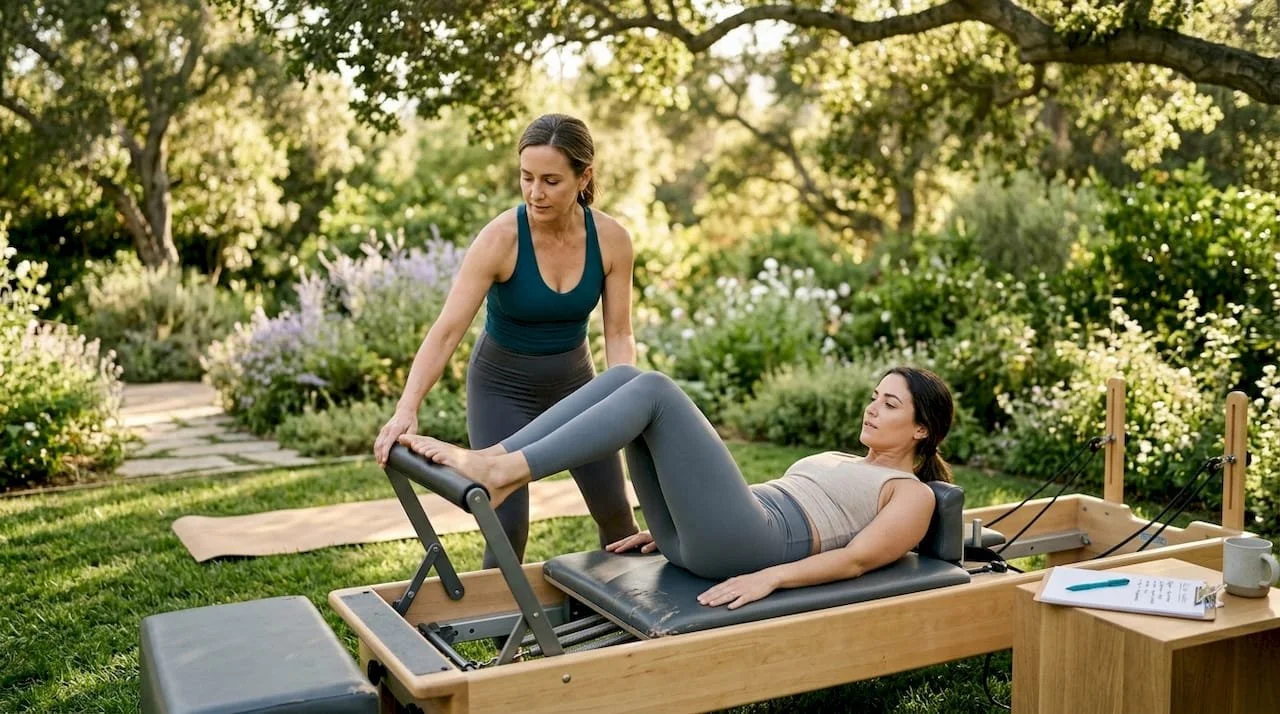
Spring resistance is the most technical aspect for beginners. Adjustable spring resistance is calibrated individually, and a good instructor adjusts it based on your fitness level and the specific exercise. Here's the counterintuitive part: more springs often mean more support, not more difficulty. If the carriage feels wobbly and impossible to control, adding more spring resistance actually stabilizes the carriage and helps you engage correctly.
Pro Tip: Before your first class, tell your instructor you're new. They will set your springs, explain transitions, and watch your alignment throughout. Most reformer injuries happen because beginners try to follow experienced practitioners without establishing their own baseline first.
Getting on and off the carriage is also part of the skill set. Rushing transitions on and off the reformer carriage is a common cause of minor accidents. Take it slow, plant your feet firmly, and always confirm your stability before shifting weight.
Safety, myths, and how to get the most out of it
The biggest misconception about reformer Pilates is that the machine makes the practice inherently safe. It does not. Safety in reformer Pilates depends on instruction quality, spring configuration, and the practitioner's body awareness. A machine with the wrong spring setting and no guidance is not safer than a mat.
Common mistakes that beginners make:
Gripping the straps too tightly: Proper force in reformer work travels through correct body lines, not through a white-knuckle grip. Over-gripping creates tension in the neck, shoulders, and wrists that interferes with engagement and causes strain.
Progressing too fast: The reformer looks simple until you're on it. Most seasoned instructors recommend spending at least four to six sessions on foundational exercises before advancing to standing or jumping work.
Skipping breath cues: Breath is not decoration. Beginners who prioritize breath and alignment over speed build stronger foundations and see faster progress in later stages.
Comparing progress to others in class: Reformer Pilates is highly individual. Someone next to you using lighter springs may be working twice as hard if they're managing a recent injury or learning a new movement pattern.
"Reformer Pilates is not 'Pilates lite.' It offers rigorous training that demands focus and control, making it beneficial even for experienced exercisers." Source: Reformer Pilates for Beginners
For wrist and shoulder alignment specifically, kinetic chain positioning during strap use is critical. Wrists should stay neutral, elbows slightly soft, and shoulders drawn away from the ears. This is something an experienced instructor will cue repeatedly in early sessions. See the full breakdown of breathwork mechanics in our guide to breathwork in Pilates to understand how breath and alignment work together.
Pro Tip: If you feel any sharp pain, stop immediately. Reformer Pilates creates muscle fatigue and sometimes mild discomfort as new muscle patterns activate. Sharp or joint pain is different and always warrants a pause and a word with your instructor.
My take on who this is really for
I've worked alongside people exploring reformer Pilates for the first time, and the pattern I see most often is this: they walk in convinced they're too out of shape, too inflexible, or too old to do it well. Within three sessions, they can't imagine going back to their previous routine.
What makes reformer Pilates different is that the machine meets you where you are. The spring system provides support when you need it and challenge when you're ready. I've seen people recovering from hip replacements rebuild functional strength alongside marathon runners correcting years of muscle imbalances. The same machine, the same class structure, completely different spring settings and modifications.
The intimidation factor is real, but it's a perception problem, not a fitness problem. The reformer looks complicated because it is mechanical. But within one class, the logic of the machine becomes clear, and the focus shifts from "how do I operate this" to "what is my body doing." That shift is where the real work begins. It's a form of strength training that asks you to be present, and that combination of physical and mental engagement is rare in fitness.
If you're curious about reformer Pilates, the best thing you can do is take one beginner class and commit to getting through three. The first one is orientation. The second is where you start to feel it. The third is when you understand why people do this for life.
— Amritayogawellness
Start your reformer Pilates practice at Amrita Yoga & Wellness
At Amrita Yoga & Wellness in Philadelphia, reformer Pilates classes are designed with beginners in mind, not as an afterthought but as a central priority. Every session includes instructor guidance on spring settings, movement cues for proper alignment, and modifications that meet each student where they are physically.
Whether you're managing a previous injury, building strength after a long break from exercise, or exploring low-impact training for the first time, Amrita's reformer Pilates classes offer a structured, supportive environment to learn the fundamentals and progress safely. The studio also supports your practice beyond the machine, with resources on technique, community events, and an online hub through Amrita Yoga & Wellness where you can book classes, explore schedules, and connect with the broader wellness community. This is one of those practices that rewards consistency. Starting in a space that takes your safety and progression seriously makes all the difference.
FAQ
What is a Pilates reformer class?
A Pilates reformer class is a structured group or individual session using the reformer machine, a sliding carriage with spring resistance, straps, and a footbar. Classes guide participants through exercises in multiple positions to build strength, flexibility, and core control.
Can anyone do Pilates reformer classes?
Yes. Reformer Pilates is adaptable for most fitness levels, ages, and physical conditions. Spring resistance can be adjusted to provide support or challenge, and experienced instructors modify exercises for beginners, older adults, and those managing injuries.
How do reformer classes work compared to mat Pilates?
Reformer classes use spring tension that challenges muscles in both directions, creating more resistance than bodyweight-only mat Pilates. This produces greater engagement of deep stabilizer muscles and allows more varied body positions, from lying flat to standing.
How many classes before you see results?
Most beginners notice improved body awareness and mild muscle fatigue within two to three sessions. Visible strength and postural changes typically emerge after four to six consistent weeks of weekly practice.
Is reformer Pilates safe for beginners?
Reformer Pilates is safe for beginners when taught by a qualified instructor who sets appropriate spring resistance and corrects form. The machine is not inherently safe on its own; proper instruction and controlled transitions are what make the practice safe and effective.