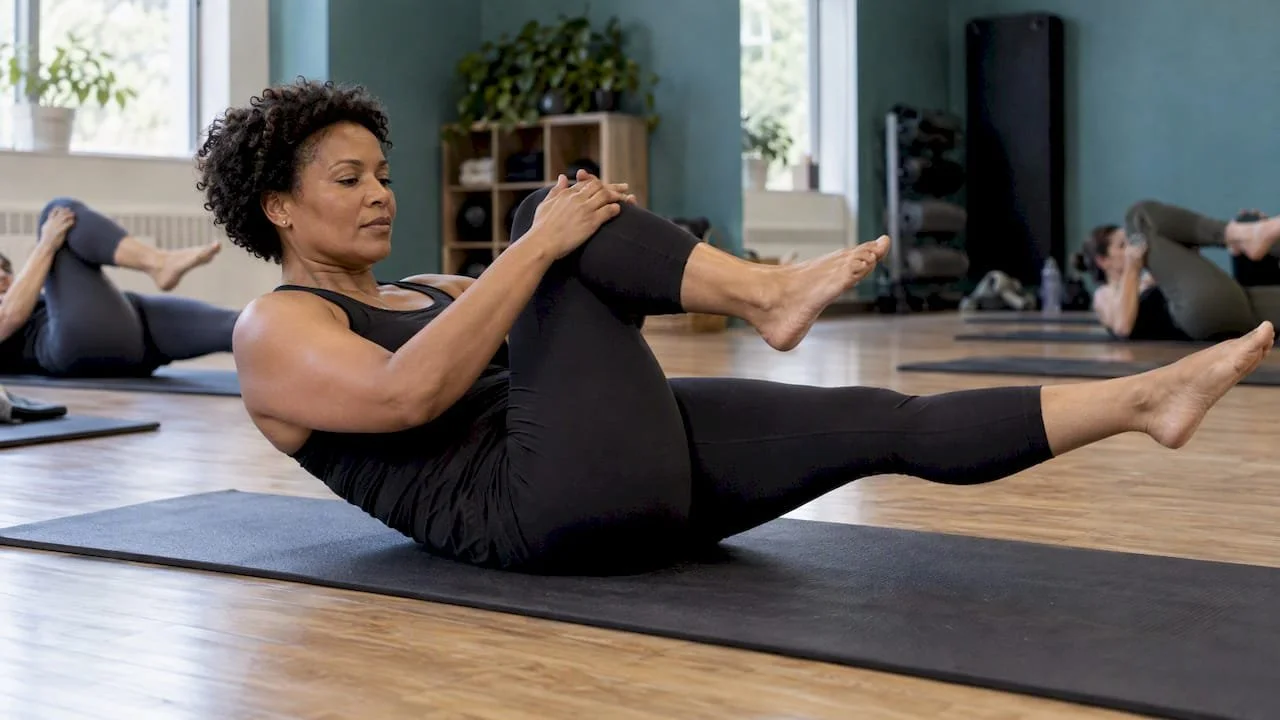
Pilates is good for building core strength, improving posture, increasing flexibility and balance, and becoming more aware of how your body moves. Research also links it to less lower back discomfort and better well-being, though the evidence is more modest for some of those outcomes than the marketing suggests. This guide separates what Pilates reliably does from what is still uncertain, so you can decide whether it belongs in your week.
Amritayogawellness
Build strength through mindful movement
Explore Pilates alongside yoga, barre and other wellness practices at Amrita Yoga & Wellness in Philadelphia.
TL;DR
Pilates uses precise, controlled movement and breathing, on a mat or on equipment such as a reformer, to build strength, tone, flexibility, balance and body awareness.
Its best-supported benefits are physical: strength, balance and flexibility, especially in older adults. Evidence for back pain and mental health is promising but often rated low certainty.
Even one session a week may be enough to start noticing changes in body awareness and mood, according to a 2026 review.
It is adaptable for beginners, but talk with a healthcare provider first if you are injured or recovering from surgery.
Table of Contents
What Pilates actually is
Pilates is an exercise method developed by Joseph Pilates in the early 20th century. It relies on precise, flowing movements and controlled breathing, and you can do it on a mat or on specialized apparatus such as a reformer. The Cleveland Clinic notes that it focuses more on muscle tone than on building bulk.
Researchers often classify it as a mind-body intervention. That label matters. A Pilates class is not a set of repetitions to get through. You are asked to pay attention to alignment, breath and the order in which muscles switch on. That attention is a large part of why people feel different after a few weeks, and it is also why a slow, small movement can feel harder than a fast, big one.
If you are comparing it with yoga, the two overlap in breath and body awareness, and many people do both. Yoga draws on a broader tradition that includes flexibility, stillness and meditation. Pilates is more focused on trunk control and precise movement patterns. Neither replaces the other, and they complement each other well.
Core strength and muscle tone
The most common answer to "what is Pilates good for" is the core, and it holds up. According to the Cleveland Clinic, Pilates can improve core strength and muscle tone as well as posture, flexibility, balance and coordination.
In practice, "core" means more than the abdominal muscles you see in the mirror. It includes the deep muscles around your spine and pelvis, your hips and your upper back. Pilates exercises ask those muscles to stabilize your trunk while your arms and legs move. That is why a simple leg slide can leave you shaking: the limbs are moving, but the work is in keeping the middle still.
A few things to expect:
Tone, not bulk. Pilates tends to produce leaner, more defined muscle rather than large muscle growth. If your goal is maximum size or strength, you will likely want to pair it with heavier resistance training.
Endurance over peak effort. Many movements are held or repeated slowly, so the muscles that keep you upright get more time under load.
Transfer to daily life. Carrying groceries, sitting at a desk and climbing stairs all depend on trunk stability.
Posture, flexibility and balance
Posture is one of the benefits people notice first, partly because you spend a class thinking about where your ribs, pelvis and shoulders are. An Australian government evidence review describes Pilates as believed to improve posture, muscle control, proprioception and body awareness, and to help people return to functional activities. Proprioception is your sense of where your body is in space, and it is what keeps you steady when you step off a curb.
For flexibility and balance, the stronger evidence comes from older adults. A 2021 meta-analytical review found that Pilates produced small to large effects on physiological measures, including muscle strength, balance and flexibility.
A practical way to think about it: Pilates trains strength through a range of motion. You are not stretching passively and you are not lifting heavy. You are controlling a joint through its full movement, which builds usable flexibility, the kind you can actually control, rather than flexibility you have to be pushed into.
Back discomfort and injury recovery
This is where people most often ask for a guarantee, and where honesty matters. The Cleveland Clinic says Pilates may help people recover from injuries or manage chronic musculoskeletal issues, especially lower back pain. The word "may" is doing real work there.
The Australian review is more cautious: for the populations and outcomes it assessed, it described the evidence as generally low certainty and said more studies are needed to confirm the findings. That does not mean Pilates does not work. It means the studies so far are small, varied or limited in quality, so nobody can promise you a specific result.
What this means if your back bothers you:
See a clinician first if the pain is new, severe, spreading into a leg, or follows an injury. The Cleveland Clinic recommends talking with a healthcare provider before starting a new routine, especially if you are injured or recovering from surgery.
Tell your instructor about any diagnosis, surgery or recurring pain before class so they can offer modifications.
Consider a private session at the start. One-to-one attention lets an instructor adapt every exercise to you, which is hard to do in a full group class.
Go slowly. The aim is controlled movement without sharp pain, not pushing through it.
Stress, mood and sleep
Because Pilates asks you to coordinate breath and movement, many people find a class works like a reset. The research is encouraging but needs careful reading.
In older adults, the 2021 review found that Pilates improved physiological and psychological measures, including quality of life, sleep quality and pain, compared with inactive controls. Compared with active controls, such as people doing another form of exercise, the effects on psychological measures were not significant. In plain terms: Pilates helps compared with doing nothing, but it may not beat other exercise you enjoy for mood.
A 2026 review of Pilates and mental health adds that meta-analyses describe it as a versatile tool for both clinical and healthy populations. It also flags significant differences in how studies were run, which makes it hard to name one standard protocol. So the honest summary is that Pilates is a reasonable, low-risk way to support well-being, not a treatment for anxiety or depression. If you are struggling with either, a mental health professional is the right first call, and Pilates can sit alongside that care.
Pilates for older adults
Older adults are the group with the most research behind them. The 2021 meta-analysis concluded that Pilates is a safe, adaptable and promising exercise approach for older adults. Gains in strength, balance and flexibility are directly relevant to staying independent and steady on your feet.
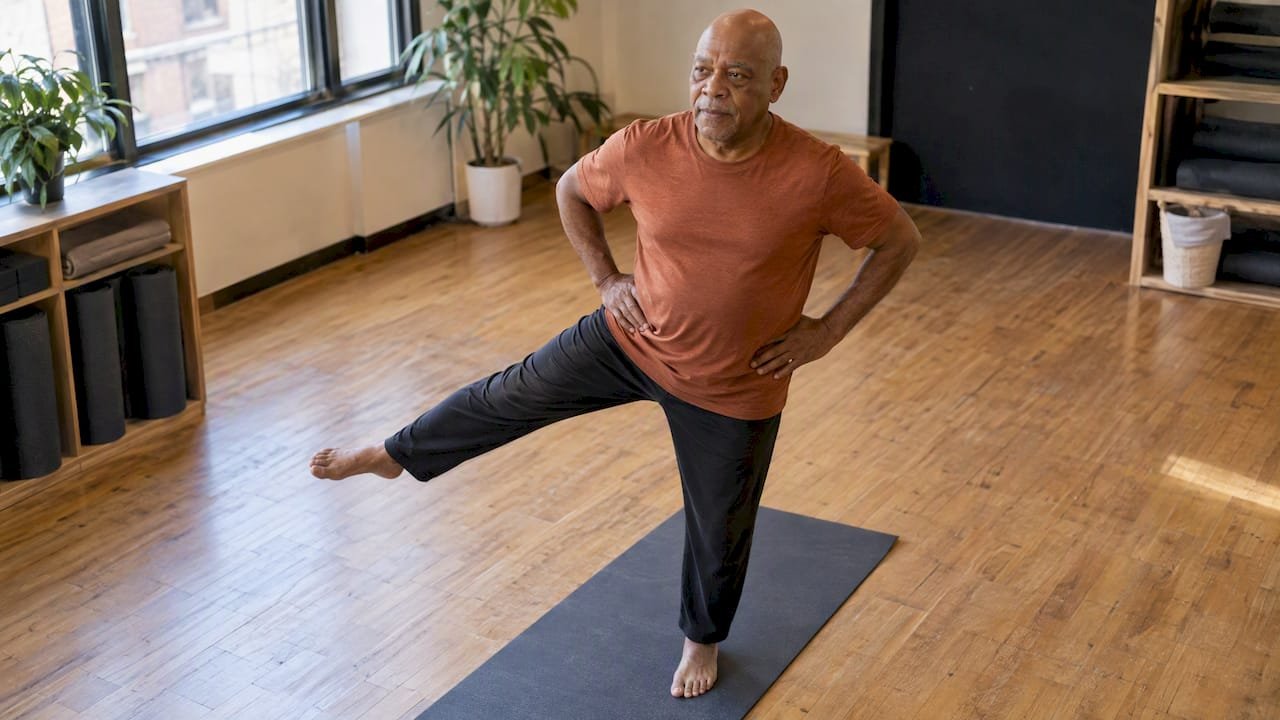
If falls are your main concern, Pilates fits well into a broader plan. You can read more about balance training for seniors and combine it with the controlled, strength-focused work of a Pilates class. If you have osteoporosis, osteopenia, a joint replacement or another condition, ask your doctor which movements to avoid before you begin, and tell your instructor too.
How often you need to practice
There is no magic number. The 2026 mental health review describes once-weekly sessions as associated with improvements in body awareness and affective states, and says optimal frequency and duration remain unclear. Some research suggests that even low-frequency sessions, such as once a week, may be enough to start psychosocial and physical awareness improvements.
Here is a reasonable way to approach it, based on how people typically build a habit rather than on a proven prescription:
Once a week is a sensible starting point and easy to keep up around work and family.
Two sessions a week gives you more chances to practice the movement patterns and recover between classes.
Mix it in. Pilates pairs well with walking, strength training, yoga or barre, so you do not need to make it your only workout.
Consistency matters more than intensity. A class you attend every week beats an ambitious schedule you drop after a month.
Mat, reformer or barre: which fits you
Pilates comes in a few forms, and the benefits overlap.
Mat Pilates needs little more than a mat and your own body weight. It is a strong way to learn the fundamentals of core control and alignment. Our guide to mat Pilates for core strength and flexibility goes deeper.
Reformer Pilates uses a sliding carriage and springs to add resistance or support. Many people like it because the springs can make an exercise easier to learn or harder to master. If you want detail, see what a Pilates reformer does for your body and what reformer Pilates is good for.
Barre and Pilates combinations borrow small, pulsing, posture-focused movements from ballet-inspired training and pair them with Pilates-style core work. People who like both often find the mix keeps them engaged, and it builds endurance in the legs, hips and trunk.
| Format | Best for | What you need |
|---|---|---|
| Mat Pilates | Learning core control, building a home practice | A mat |
| Group reformer | Added resistance, variety, guided progression | A studio with equipment |
| Private session | Injury history, specific goals, nervous beginners | An instructor's full attention |
| Barre-style classes | Muscular endurance, a fast-paced feel | A studio class |
Our perspective at Amrita Yoga & Wellness
We teach yoga, mat Pilates, group reformer, barre and tai chi under one roof in Philadelphia, so we see how people move between these practices. Our view is that Pilates is most useful when it is treated as a skill rather than a workout to survive. People who come to class curious about how their body works tend to stay longer than people who come only for a sweat.
We also think the best studio for a beginner is one that makes the first class feel safe. That means clear cueing, options for every exercise and no pressure to keep up with the person on the next mat. It is why we offer lower-cost community classes and a beginner pass alongside regular group classes, and why we encourage private sessions for anyone with an injury history.
And we want you to be realistic. Pilates will not fix everything, and the research says so. What it can do is give you a steady, low-impact routine that improves how you move, and that is often what makes the rest of life feel easier.
— Juiced
Starting Pilates as a beginner
Pilates suits beginners because you can scale nearly every exercise up or down. Here is how to start well.
Check with your provider if needed. If you are injured, pregnant, or recovering from surgery, get medical guidance first. The Cleveland Clinic advises talking with a healthcare provider before beginning a new workout.
Start with mat or a beginner class. Learning breath and trunk control on a mat makes reformer work easier to follow.
Tell the instructor it is your first time. They can offer modifications and watch your form.
Wear fitted, comfortable clothing so the instructor can see your alignment. Grip socks are common in studios.
Go for control, not range. Small, accurate movements beat big, sloppy ones.
Give it a few weeks. The first classes often feel awkward. Body awareness builds with repetition.
What you may feel afterward is mild muscle fatigue in the abdominals, hips and upper back. Sharp or lingering pain is a signal to stop and speak with your instructor or a clinician.
Try Pilates with us in Philadelphia
If you would like to try it, our group class drop-in is $28 per session, community class drop-ins are $11, and the Nurtured Beginnings pass is $35. If you plan to come regularly, the Earth Monthly Membership is $119 per month. You can browse the class schedule and read the class descriptions to find a level that suits you.
For injuries, specific goals or a gentler start, a one-to-one session starts at $85 per hour, and we can adapt mat Pilates to what your body needs.
FAQ
What is Pilates good for most?
Pilates is best known for building core strength, improving posture and increasing flexibility, balance and coordination. It also encourages you to notice your body and breathing. Older adults show the clearest gains in strength and balance in the research.
Is Pilates good for back pain?
It may help people manage chronic musculoskeletal problems, especially lower back pain, according to the Cleveland Clinic. However, the Australian review rated the evidence as generally low certainty. See a healthcare provider before you start if the pain is new, severe or follows an injury.
Is Pilates good for beginners?
Yes, because exercises can be modified in difficulty and pace. Start with a beginner or mat class, tell your instructor about any injuries, and focus on control rather than range. A private session can help if you are nervous or have a medical history.
How often should I do Pilates?
The research does not give a single answer. A 2026 review links once-weekly sessions with improved body awareness and mood, but says the best frequency is unclear. Many people start with one or two classes a week and build from there.
Is Pilates better than yoga?
Neither is better; they do different things. Pilates concentrates on trunk control and precise movement, while yoga offers a broader mix of flexibility, stillness and breath practice. Many people do both, and that is a common combination at our studio.
Sources
Natural Therapies Review 2024: Pilates evidence evaluation, Australian Department of Health
Balance Training for Seniors: Safe Exercises to Prevent Falls