Benefits of Breathwork Sessions: What the Research Shows
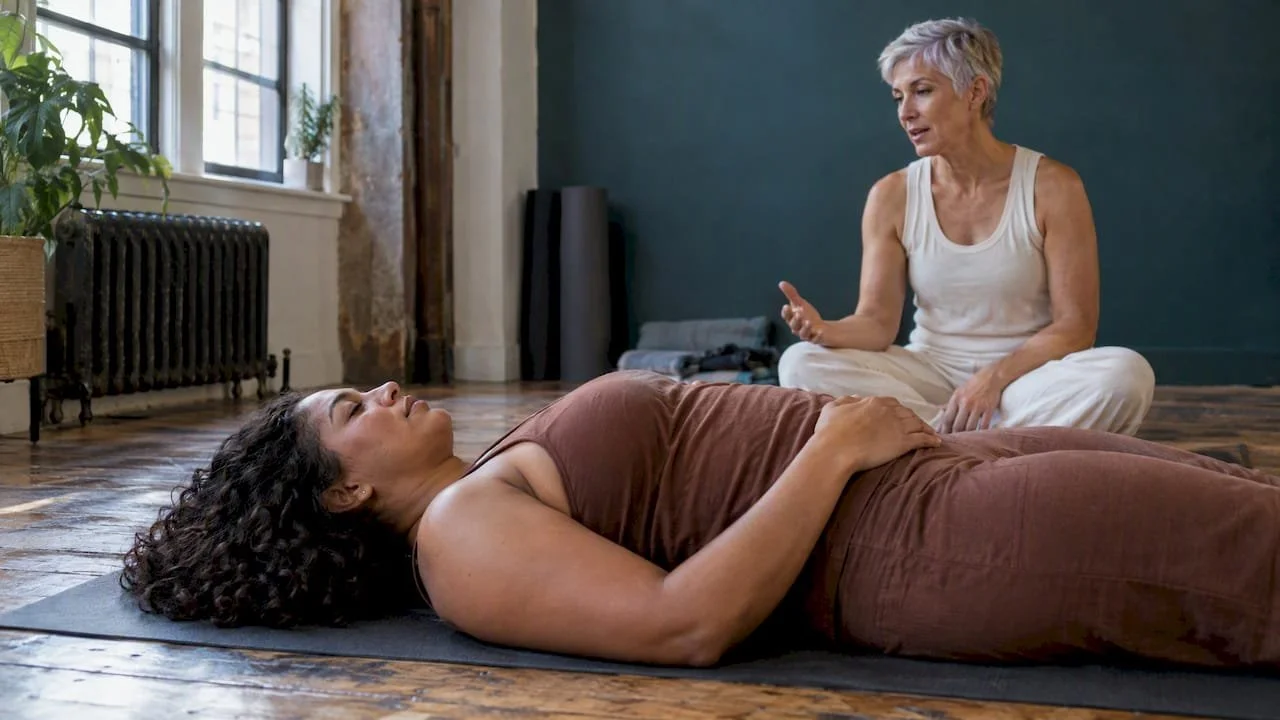
Breathwork sessions can lower stress and anxiety, ease low mood, nudge blood pressure and heart rate down, and leave you calmer and more focused afterward. The evidence is real but modest, and it is strongest for slow, guided practice done for at least a few minutes at a time. Below we separate what studies support from what is still hype, explain what a group session adds, and flag who should check with a clinician first.
Amritayogawellness
Explore Guided Breathwork in Philadelphia
Amrita Yoga & Wellness offers workshops and wellness practices for people exploring breathwork and holistic well-being in Philadelphia.
TL;DR
Meta-analyses link breathwork to lower self-reported stress, anxiety and depressive symptoms, though study quality varies and researchers urge caution.
Breathing exercises lowered blood pressure and heart rate on average in a 2023 meta-analysis of 15 randomized trials.
Group and solo practice both improved well-being in one Harvard-hosted study, and people stuck with the group format more reliably.
Slow, guided practice of 5 minutes or more has the best support. Fast breathing is a specialized tool, and some people should skip it.
"Rewiring the brain" is a stretch: imaging studies show changes in activity, but what they mean is still being worked out.
Table of Contents
What a breathwork session actually is
Breathwork is the umbrella term for deliberately changing how you breathe: slower, deeper, rhythmic, through one nostril, with long exhales, or in faster patterns. A session usually means a facilitator guides you through one or more of these for 20 to 60 minutes, often lying down, often with a short check-in before and after.
The techniques differ a lot. Box breathing and 4-7-8 breathing are slow and structured. Pranayama, the yogic tradition, includes alternate nostril breathing and humming breath. Faster, cyclic patterns are used in some group sessions for energy and emotional release. If you are unsure where to begin, our guide to finding your breathwork style sorts the options by purpose.
How breathing changes your body
Most of us spend long stretches in a keyed-up, fight-or-flight state. According to the Cleveland Clinic, breathwork gives you a way to consciously shift toward the parasympathetic nervous system, the side that supports rest and digestion. The same page links the practice to better focus, energy and quality of life.
There is a plausible mechanism underneath. Researchers describe a breathing central pattern generator in the brainstem, including the preBötzinger complex, that ties breathing rhythm to emotion and cognition. When you change the rhythm, you send a different signal into those circuits. That is why a long, slow exhale can feel like it "turns something down."
If you want a wider toolkit for the same goal, a guide to mental relaxation strategies covers other ways to bring stress down alongside breathing.
Mental health benefits: stress, anxiety, mood and sleep
This is where the evidence is deepest.
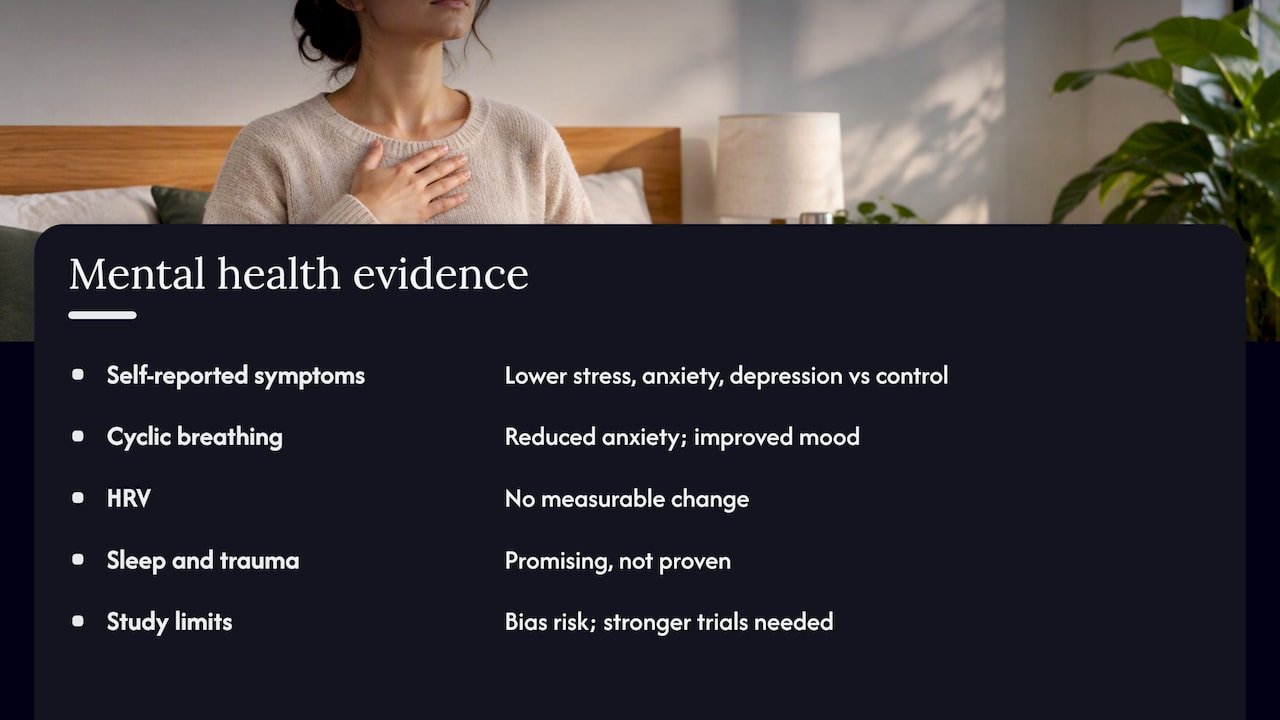
Stress, anxiety and depressive symptoms. A meta-analysis in Scientific Reports found breathwork associated with lower self-reported stress, anxiety and depressive symptoms than control conditions. The full text on PubMed Central shows the stress analysis covered 785 adults. The authors are careful, though: many studies carry a risk of bias, and more rigorous trials are needed before anyone claims a firm effect against active placebos.
Mood. A 2026 paper in Frontiers in Psychiatry on the neurophysiology of breathing practices reports that cyclic breathing reduced anxiety and improved mood. Interestingly, heart rate variability did not change measurably. So the popular explanation that everything runs through HRV is not the whole story, and the benefit may come from other pathways.
Sleep and trauma. Consumer health pages often list deeper sleep and reduced trauma symptoms among breathwork's benefits. We would treat these as promising rather than proven. If you live with PTSD, sleep disorders or panic attacks, breathwork can be a supplement to care from a licensed mental health professional, not a replacement for it.
Not all breathing is the same
A systematic review of breathing practices for stress and anxiety found that the effective protocols tended to avoid fast-only breathing paces, lasted 5 minutes or longer, and included human-guided training. The same review notes that breathing practices are universally accessible, scalable and cost-free. That is a good argument for learning from an instructor first, then practicing on your own.
Physical benefits: blood pressure, heart rate and lungs
The most concrete numbers come from cardiovascular research. A 2023 systematic review and meta-analysis of 15 randomized clinical trials found that breathing exercises reduced systolic blood pressure by a mean of 7.06 mm Hg and diastolic by 3.43 mm Hg. Heart rate dropped by an average of 2.41 beats per minute.
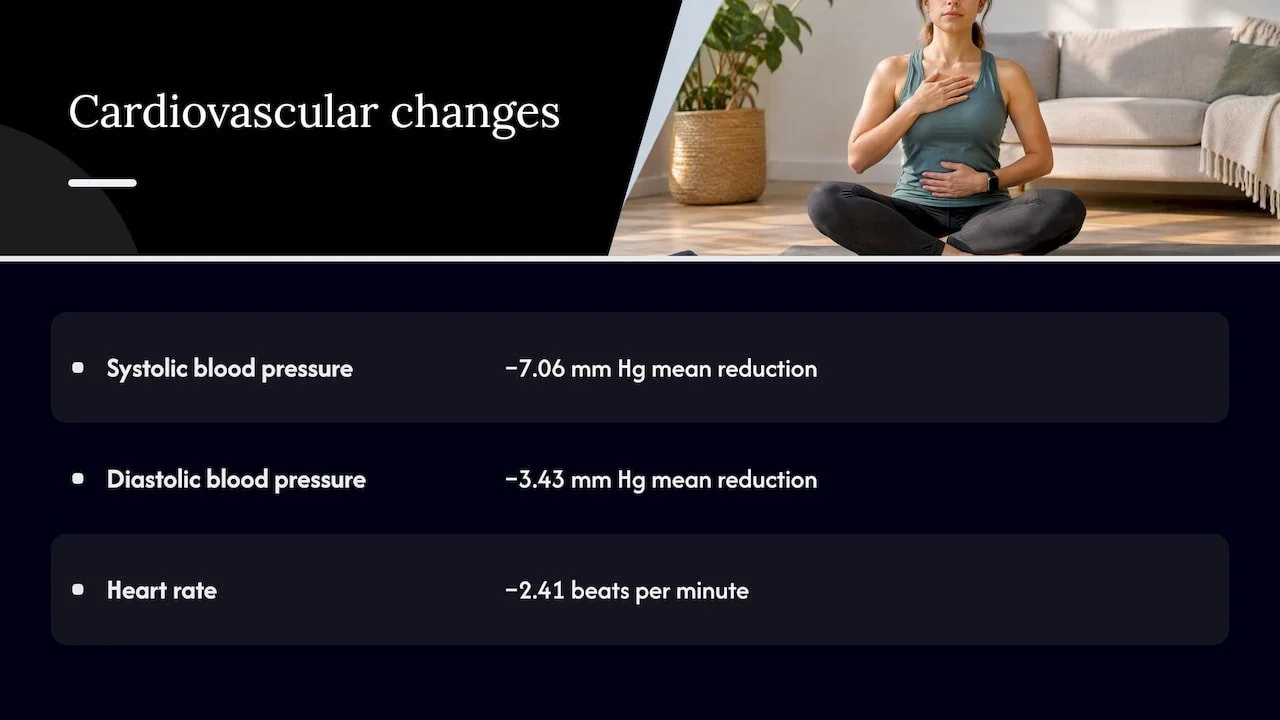
Those are averages across different programs, so your result will vary. They are also not a substitute for blood pressure medication. If you manage hypertension, tell your doctor before you change your routine and keep taking what you are prescribed.
On respiratory function, research into pranayama has looked at markers such as forced vital capacity and heart rate variability in clinical settings. A 2024 review in The Yogic Journal describes this work. It shows researchers are measuring the effects, but it should not be read as a promise of bigger lungs.
Does breathwork rewire your brain?
Probably not in the dramatic sense the phrase suggests. What can be said is narrower. Neuroimaging studies associate breathing with activity in the insula, the anterior cingulate cortex and the brainstem, and the 2026 Frontiers review says the functional significance still needs investigation. Some imaging work suggests that slow, controlled breathing can raise cerebral oxygen levels and stabilize activity patterns, which may support emotional regulation and cognitive performance.
That is a useful finding, and it is not proof of lasting structural change. A fair summary: breathing changes how your brain and body are working in the moment, and regular practice may make calm easier to reach. Anyone promising that a few sessions will permanently rewire you is getting ahead of the data.
What a group session adds
Can you get the same benefit at home? Mostly yes, and that is good news. A Harvard-hosted comparison of group and individual practice found both settings significantly increased well-being, with no meaningful difference in outcomes between them. Group compliance was higher, though. People showed up and kept going.
That matches what we see in a studio. A group gives you:
A guide who corrects pace and posture. The review above found human-guided training in effective protocols.
A reason to show up. A time on the calendar beats a good intention.
Permission to slow down. Lying on a mat among other people who are doing the same is a lot easier than doing it alone on the couch.
A safer place to try new patterns. An instructor can tell you when to ease off.
Who should be careful
Slow, gentle breathing such as box breathing or a long exhale is low risk for most adults. Fast, forceful patterns that cause overbreathing are different. Clinical guidance for neurophysiology labs treats hyperventilation as a specialized tool that needs clear safety protocols and informed consent because it can trigger seizures. In a national audit of more than 3,000 patients hyperventilating during EEG, adverse events, mainly seizures, occurred in fewer than 3% of cases.
That setting is not a yoga studio, but the lesson carries over:
If you have epilepsy or a history of seizures, ask your neurologist before any fast or breath-holding practice.
If you have heart disease, uncontrolled high blood pressure, or lung conditions such as asthma, ask your cardiologist or pulmonologist first.
If you are pregnant, check with your OB-GYN or midwife before breath retention or intense patterns.
If you have PTSD, panic disorder or a history of dissociation, talk to your therapist before a deep emotional-release session, and tell the facilitator beforehand.
In any session, you can stop. Dizziness, tingling, chest pain or distress are signals to return to normal breathing and sit up. A good facilitator tells you this at the start.
How to get the most from a session
The research gives us a few practical rules.
Stay slow to start. Pick a pace you can hold without strain.
Give it at least 5 minutes. Shorter bursts are still pleasant, but the supported protocols ran at least that long.
Learn it with a person. Guided training shows up in the effective studies.
Repeat it. Benefits are measured over weeks of practice, not a single class. Our five-minute daily breathwork checklist is a simple way to build the habit.
Pair it with movement or stillness you enjoy. Breath work fits naturally into yoga and Pilates practice.
For a wider view of calming habits, our seven mindfulness activities for stress relief pair well with a breathing routine.
Our perspective
We teach in Philadelphia, and most people who come to us for breath work are not chasing a peak experience. They are tired, wired, or both. They want to feel their shoulders drop on a Tuesday evening and sleep better that night.
So we keep it simple. We believe breathwork belongs in the same category as good yoga: a skill you learn with guidance, practice in small doses, and adjust to your body. We would rather you leave a session a little calmer and curious than overwhelmed. We tell beginners to go slow, to treat any strong sensation as information, and to skip anything that feels wrong. We are also wary of claims that breathwork heals everything. The research is encouraging, and honest researchers say so with caveats. We try to do the same.
What we can promise is the setting: an inclusive room, a beginner-friendly pace, and a community that makes it easier to come back next week.
— Juiced
Try a session with us
If you would like to learn breathing techniques in person, Amrita Yoga & Wellness in Philadelphia offers wellness workshops, including breathwork, alongside yoga, Pilates, barre and tai chi. Our class descriptions explain each style, so you can see what suits your level.
Not sure where to start? A Community Class drop-in is $11, a Group Class drop-in is $28, and a Livestream Class drop-in is $19. If you plan to come regularly, monthly memberships start at $119 for Earth, with a $25 On Demand membership for practicing at home. You can see every option on our class and membership page. Prefer one-on-one attention? Private sessions start at $85 per hour.
FAQ
What are the main benefits of breathwork sessions?
The best-supported benefits are lower stress and anxiety, fewer depressive symptoms, and modest drops in blood pressure and heart rate. Many people also report better focus and energy. The research carries caveats about study quality, so treat breathwork as a helpful habit rather than a cure.
Is group breathwork better than practicing alone?
Not necessarily for the results. One study found group and individual practice improved well-being about equally. The group advantage was compliance: people kept up the practice more consistently, and a facilitator can guide pace and technique.
What are the mental health benefits of breathwork?
Meta-analyses link breathwork with lower self-reported stress, anxiety and depressive symptoms compared with controls. Cyclic breathing has also been associated with better mood. It can support therapy, but it does not replace treatment for a diagnosed condition.
Does breathwork rewire your brain?
It changes brain and body activity while you do it, and imaging studies show shifts in regions linked to emotion and interoception. Researchers say the long-term significance still needs study, so "rewiring" overstates what is known.
Is breathwork safe for everyone?
Gentle, slow breathing is low risk for most adults. Fast overbreathing can provoke seizures or other problems, so people with epilepsy, heart or lung conditions, or who are pregnant should talk to their doctor first. Stop and breathe normally if you feel dizzy or unwell.
Sources
Breathing Rhythm and Pattern and Their Influence on Emotion, PubMed Central
Effect of breathwork on stress and mental health, Scientific Reports
Effect of breathwork on stress and mental health, PubMed Central
Neurophysiological mechanisms of breathing practices, Frontiers in Psychiatry
Breathing Practices for Stress and Anxiety Reduction, PubMed Central
Effect of breathing exercises on blood pressure and heart rate, PubMed Central
Physiological effects of pranayama on clinical practice, The Yogic Journal