The wellness practices with the best support for lifting mood are ordinary ones: regular movement, a few minutes of slow breathing, enough sleep, time with other people, time outside, and a way to put feelings into words. None of them needs special equipment, and none works overnight. Together, done in small doses, they build what the National Institutes of Health calls emotional wellness: the ability to handle life's stresses and adapt to change. This guide walks through eight practices, how to fit them into a real week, and the signs that mean self-care is not enough on its own.
Amritayogawellness
Find a Wellness Practice That Fits
Explore yoga, Pilates, tai chi, and other wellness offerings at Amrita Yoga & Wellness in Philadelphia.
TL;DR
Movement is the most reliable lever. Adults are advised to aim for 150 minutes of moderate activity a week, and even a brisk 10-minute walk helps.
Slow breathing and mindfulness take two to five minutes and work anywhere, which makes them the easiest habit to start.
Sleep (7 or more hours for adults), time with people you trust and time outdoors quietly hold up everything else.
Pick practices you enjoy and start small. You are more likely to keep doing them.
Severe or distressing symptoms lasting two weeks or more are a reason to talk to a doctor or mental health professional, not to try harder at self-care.
What "mood boosting" realistically means
A wellness practice will not make every day feel good. What it can do is raise your baseline and shorten the dip after a bad day. The National Institute of Mental Health describes small acts of self-care, including regular exercise, healthy eating and prioritizing sleep, as ways to manage stress and increase energy. The same page suggests starting with small amounts of exercise, scheduling regular times for activities you enjoy, and noticing which kinds of self-care work for you.
That last part matters. Self-care is personal. A practice that settles one person can bore or irritate another, so treat the list below as a menu to test, not a program to complete.
Eight practices, ranked by how easily they fit into a day
| Practice | Minimum useful dose | Best for |
|---|---|---|
| Brisk walk | 10 minutes | Clearing the mind, low barrier |
| Yoga or Pilates | One class a week | Movement plus breath and focus |
| Slow breathing | 2 to 5 minutes | Feeling anxious or wound up |
| Mindfulness | 5 minutes | Racing thoughts |
| Sleep routine | Consistent bed and wake times | Irritability, low energy |
| Time with people | One real conversation | Isolation, low mood |
| Time outside | 10 to 20 minutes | Restlessness, screen fatigue |
| Gratitude or journaling | 3 lines a day | Rumination, negativity |
1. Move your body, in whatever way you will repeat
Exercise has the strongest evidence of the group. The NHS says exercise can lift mood, that any type that suits you counts, and that adults should aim for 150 minutes of moderate activity a week. It adds that a brisk 10-minute walk can clear your mind and help you relax.
The Mayo Clinic explains that regular exercise may ease depression and anxiety by releasing feel-good endorphins and taking your mind off worries and negative thoughts. A second Mayo Clinic page describes how activity refocuses the mind on body movements, which can improve mood and help the day's irritations fade.
Which type? A 2024 systematic review in PMC found that walking, jogging, yoga and strength training were among the most effective modalities for reducing depression. The NHS gives the practical tiebreaker: choose something you enjoy, because you are more likely to keep doing it.
A realistic first week looks like this:
Two 10-minute walks, ideally at the same time each day.
One class that is new to you, such as a gentle yoga or mat Pilates session.
One stretch or mobility break at your desk or in your living room.
2. Add breath to the movement: yoga and Pilates
Yoga and Pilates are movement with an attention anchor built in. You follow the breath, track where your body is in space, and have little room left to replay the morning's email. That is the same mechanism Mayo describes, only more structured, and a teacher handles the sequencing so you do not have to plan anything.
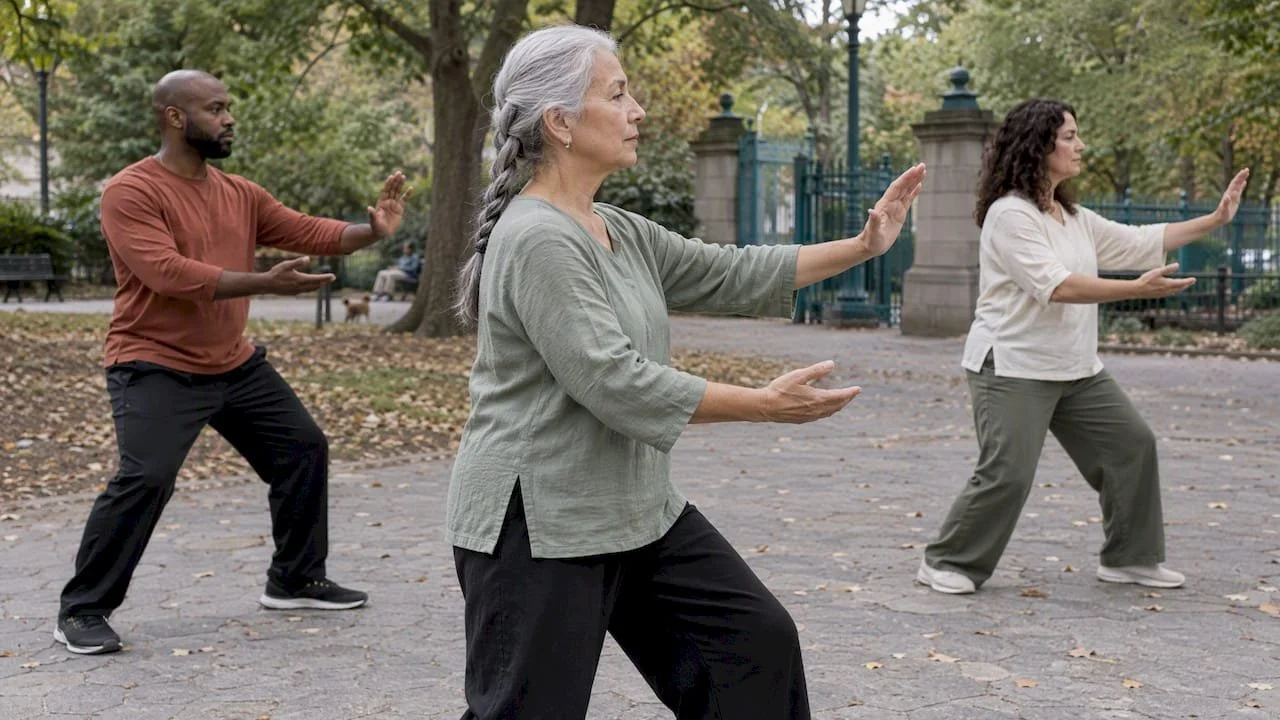
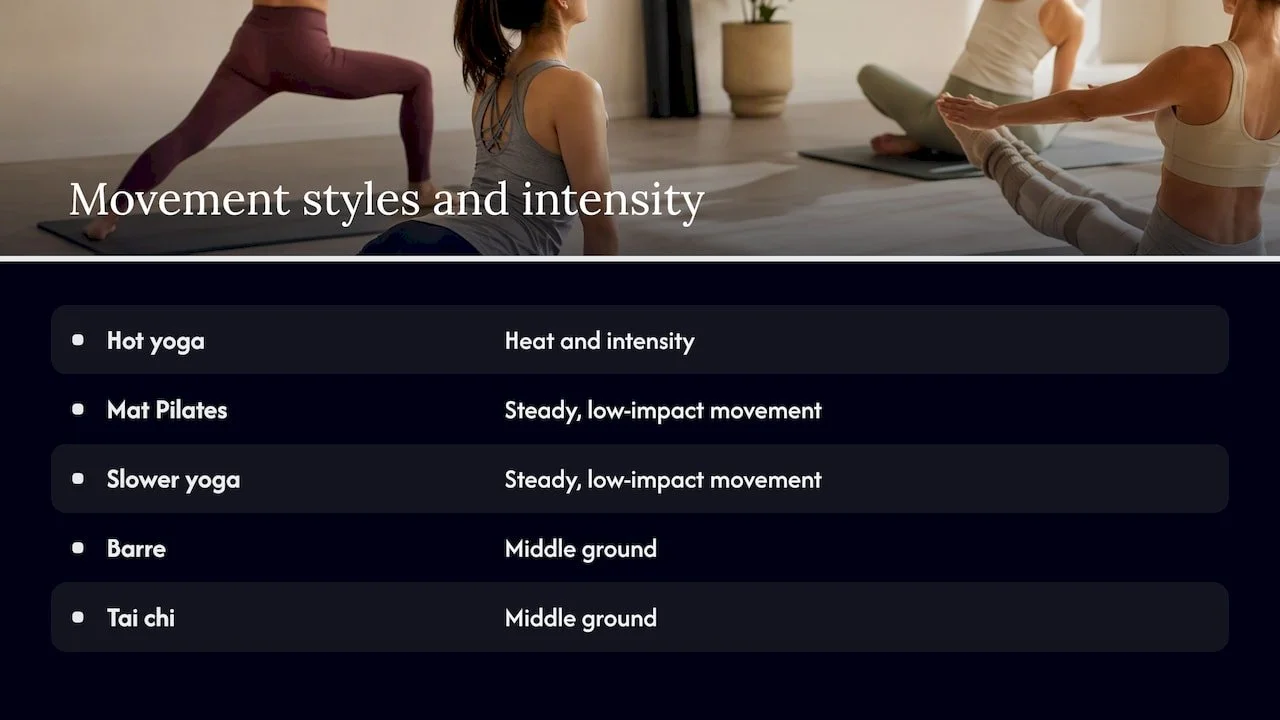
For beginners, the style matters less than the room. Look for a class labeled for beginners or all levels, where the teacher offers options rather than assuming experience. Hot yoga suits people who like heat and intensity. Mat Pilates and slower yoga suit people who want something steady and low-impact. Barre and tai chi sit in between. If you have an injury, a heart condition or are pregnant, tell the teacher before class and check with your doctor first.
3. Breathe slowly on purpose
The CDC lists relaxation techniques such as deep breathing, yoga and meditation among the ways to improve emotional well-being. Breathing is the lowest-effort entry point because you can do it at a red light, before a meeting or in bed.
A simple version:
Sit or stand comfortably and let your shoulders drop.
Breathe in through your nose for about four counts.
Breathe out slowly through your nose or pursed lips for about six counts.
Repeat for two to five minutes, letting your attention rest on the feeling of the breath.
If counting makes you tense, drop the counts and just make the exhale longer than the inhale. If breathing exercises make you dizzy or more anxious, stop and return to normal breathing.
4. Practice mindfulness in small pieces
The CDC describes mindfulness as being present, focusing on the breath, and observing your thoughts and feelings without judgment. You do not need to sit for 30 minutes. Try attaching it to something you already do: the first minute of your coffee, a walk without headphones, or the minute before you open your laptop.
We have written several practical guides on this, including mindfulness activities for stress relief, tips for a mindfulness practice that reduce stress, and a rundown of the benefits of mindfulness with a practice for each.
The CDC also notes that naming a hard emotion is the first step to managing it, which lets you reach for healthier coping tools instead of harmful ones. A quiet minute that ends with "I feel anxious" or "I feel flat" is already doing real work.
5. Protect your sleep
The American Psychiatric Association calls sleep a basic human need and critical to physical and mental health. Poor sleep can cause fatigue, irritability and problems with decision-making and mood. The CDC says adults need 7 or more hours a night and that consistent schedules help.
Two habits give the best return:
Keep the same wake time, including weekends, as far as life allows.
Dim screens before bed. NIMH suggests reducing blue light from phones and computers before bed to make falling asleep easier.
If you want to experiment with a wind-down routine, there is a guide to dim red light for sleep that covers session length and supervision. Whatever you try, the foundation is the same: a regular schedule, a dark and cool room, and a pause between the last bright screen and bed.
6. Spend time with people
The CDC says healthy relationships offer a sense of belonging and support, which helps emotional well-being and coping. The APA page goes further, quoting the 2023 Surgeon General advisory: loneliness and isolation raise mental health risks, and lacking connection raises the risk of premature death by an amount comparable to smoking daily.
That does not mean you need a big social life. It means one good conversation a week counts. Text a friend and ask for a walk. Eat with a coworker. Take a class where the same faces show up each week; after a few visits, a nod at the door becomes a real connection. This is one reason many people find group classes easier to keep up than a solo workout.
7. Get outside
The CDC lists getting outside as a self-care option, and it pairs well with movement and sleep. Morning daylight on a short walk does double duty. Even ten minutes in a park, on a stoop or by a river counts. In Philadelphia, that can be as simple as a loop of a neighborhood square or a stretch of the Schuylkill River Trail.
8. Write it down: gratitude and journaling
NIMH suggests that keeping a gratitude practice, such as writing down things you are grateful for, can help you focus on the positive. The CDC adds that journaling can help you process feelings and that replacing negative thoughts with more positive ones can support coping.
Keep it small. Three lines before bed is enough: one thing that went fine, one person you appreciated, one thing you want to do tomorrow. If positive statements feel fake, start with accurate ones, such as "This is hard, and I am still showing up."
For more small-habit ideas, this overview of self-care practices for mental health is a good companion.
Building a routine that survives a busy week
Most people fail at wellness routines by starting too big. Use this approach instead.
Pick two practices. One for the body (a walk or a class) and one for the mind (breathing or journaling).
Attach them to something fixed. After brushing your teeth. Before your first meeting. On the commute home.
Schedule the enjoyable one. NIMH recommends scheduling regular times for activities you enjoy. A class you have booked is harder to skip than a workout you meant to do.
Track mood loosely. A 1 to 5 rating in your notes app is enough. After three or four weeks, look back and see what lines up with better days.
Swap, do not quit. If one practice stops working, replace it with another from the list.
| Day | Practice |
|---|---|
| Monday | 10-minute walk at lunch, three-line gratitude note |
| Tuesday | Evening yoga or Pilates class |
| Wednesday | Five minutes of slow breathing before work, early bedtime |
| Thursday | Walk with a friend or coworker |
| Friday | Mindful minute with coffee, screens off an hour before bed |
| Saturday | Longer outdoor walk or a weekend class |
| Sunday | Plan the week, set the same wake time for Monday |
Our perspective: why we teach it as a community practice
We see the same pattern at the studio again and again. People rarely arrive because they read that exercise helps mood. They arrive because they are tired, stressed or disconnected, and a friend said to try a class. The ones who stay are rarely the ones who were most flexible or fit. They are the ones who felt welcome on the first day.
That is why we build around beginner approachability and community. Our class styles run from yoga (including hot and aerial) to mat Pilates, group reformer, barre and tai chi, so there is a way in for different bodies and temperaments. Our teachers give options and detailed guidance so a first-timer is safe and a long-time practitioner is still challenged. The movement, the breath and the people in the room each carry part of the benefit, and a class puts all three in one hour.
We also think wellness should not feel like another demanding project. Start with the version of the practice that is almost too easy, and let it grow.
— Juiced
Try it with us in Philadelphia
If you want a guided way to start, our class schedule and class descriptions show what each style feels like and which ones suit beginners. New to the studio? Look at our new student specials first.
Prices as published on our booking page:
| Option | Price |
|---|---|
| Community Class Drop In | $11 per session |
| Group Class Drop In | $28 per session |
| Livestream Class Drop In | $19 per session |
| Nurtured Beginnings pass | $35 per pass |
| Livestream Class Membership | $49 per month |
| On Demand Membership | $25 per month |
| Earth Monthly Membership | $119 per month |
| 1 Month Unlimited Group Classes | $169 per month |
Prefer one-on-one attention? Private yoga and mat Pilates sessions start at $85 per hour. For deep rest, our Ayurvedic therapies include Shirodhara at $90 per session and Abhyanga at $120 per session.
When self-care is not enough
Wellness practices support mental health. They do not replace treatment. NIMH says to seek professional help if you have severe or distressing symptoms that have lasted two weeks or more, such as:
Difficulty sleeping
Changes in appetite or unplanned weight changes
Difficulty getting out of bed because of your mood
Difficulty concentrating
Loss of interest in things you usually enjoy
Inability to complete usual tasks and activities
Irritability, frustration or restlessness
The starting point NIMH suggests is a primary care provider, who can refer you to a psychologist, psychiatrist or clinical social worker. If you are in crisis or thinking about suicide, call or text 988, which offers 24/7 support in the United States.
A good rule: if you are using every practice on this list and still feel worse, that is information, not failure. Tell your doctor what you have tried.
FAQ
How long does it take for wellness practices to improve mood?
A walk or a few minutes of slow breathing can leave you feeling calmer the same day. Lasting changes in baseline mood take longer and depend on doing the practices regularly, so give a new routine several weeks before judging it. If your mood is not improving, or is getting worse, talk to a healthcare provider.
Is yoga or Pilates better for mood?
There is no proven winner. The PMC review named yoga among the most effective exercise types for depression, and the NHS says any activity you enjoy is useful. Choose the one you will return to, and try a class of each if you are unsure.
How much exercise do I need to feel a difference?
The NHS advises adults to aim for 150 minutes of moderate activity a week, and says a brisk 10-minute walk can clear the mind. NIMH suggests starting with small amounts. Begin with what feels easy, then build.
Can a beginner join a yoga class if they feel anxious or low?
Yes. Choose a beginner or all-levels class, arrive a few minutes early and tell the teacher about any injuries or concerns. Our studio is built around beginner approachability, and a Community Class Drop In costs $11. If your low mood has lasted two weeks or more and is affecting daily life, see a doctor as well.
Sources
Caring for Your Mental Health, National Institute of Mental Health
Depression and anxiety: Exercise eases symptoms, Mayo Clinic
Lifestyle to Support Mental Health, American Psychiatric Association