Pilates Exercises for Better Posture: A Practical Routine
Pilates can improve posture, and the research supports it. The catch is that it works through steady, well-executed practice, not through a single magic move. The exercises below strengthen the muscles that hold your spine, ribs and shoulders in place. They also teach you to feel where your body is in space. Do them with good form two or three times a week and you have a realistic plan.
Amritayogawellness
Build Better Posture Through Pilates
Explore Amritayogawellness’s Pilates and yoga offerings in Philadelphia to find a practice that supports strength, mobility and body awareness.
TL;DR
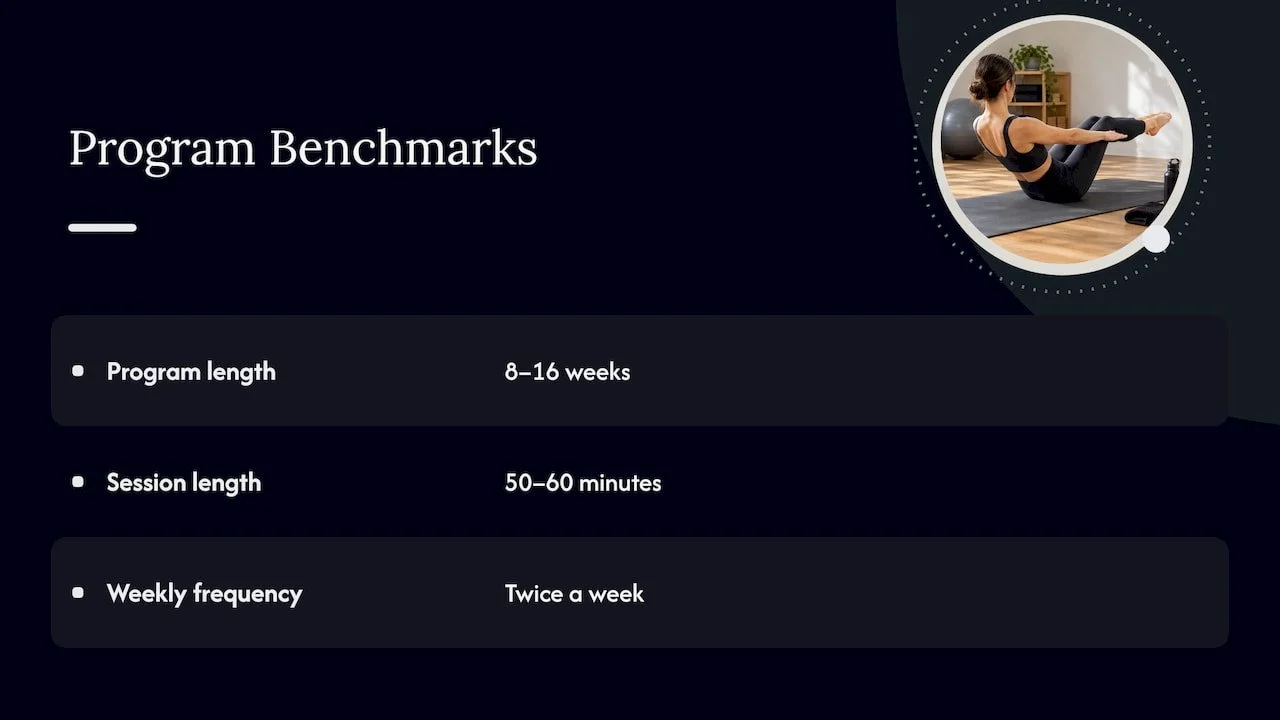
A 2024 systematic review found that Pilates improves postural alignment in adults. Programs typically ran 8 to 16 weeks, with 50 to 60 minute sessions twice a week.
The most useful moves for posture are the pelvic tilt, shoulder bridge, chest opener, swan, swimming, thread the needle and the seated side stretch.
Quality beats quantity. Breathing, rib control and shoulder-blade position matter more than how many reps you do.
Pain, injury, pregnancy or visible asymmetry such as a curved spine call for a professional's input first. A private session is a sensible start.
Table of Contents
What Pilates does for posture
Posture is not a position you hold by force. It is the result of muscles that support the spine, a rib cage that stacks over the pelvis, and shoulder blades that sit comfortably on the back. Long hours at a desk or phone tend to tighten the chest and hip flexors and leave the upper back and deep abdominals underused.
Pilates addresses this from several angles at once:
Deep core strength. Most exercises load the muscles around the trunk and pelvis, which support the spine.
Back-body strength. Extension work such as the swan and swimming builds the muscles along the spine and between the shoulder blades.
Mobility. Rotation and side-bending exercises restore movement to a stiff upper back.
Body awareness. Slow, controlled movement teaches you to notice slumping before it becomes a habit.
The 2024 review linked above reports that Pilates reduced forward head posture, increased thoracic curve (rounded upper back) and anterior pelvic tilt in adults compared with inactive controls. That is the best evidence we have, and it is encouraging. It is still a review of programs lasting weeks, so treat it as a guide to pace and patience, not a promise of a particular result.
One honest caveat from clinical guidance: physiotherapy-based Pilates guidance from an NHS trust notes there is no strong evidence that Pilates beats other exercise for reducing pain, and that you should choose something you enjoy. For posture, the best exercise is the one you will keep doing.
The principles that make the exercises work
The same guidance stresses that Pilates depends on the quality of muscle activation, not just on copying shapes. These cues apply to every exercise below.
Keep the ribs soft
Don't poke your ribs forward to look "tall." That rigid, military stance creates tension instead of support. Picture a spring between your ribs and hips under gentle, constant tension, so the rib cage stays stacked over the pelvis.
Lower the shoulder blades
If your shoulders creep toward your ears, the neck is compensating for weak core support. Glide the shoulder blades down and slightly in, and keep the collarbones broad.
Breathe into the sides and back of the ribs
Breath sets the rhythm of Pilates and keeps the ribs mobile. If you want to go deeper, our guides on Pilates breathing techniques and the benefits of Pilates breathing explain how to coordinate inhale and exhale with each movement.
Neutral spine, not a flat back
Readers often ask whether to press the lower back flat or keep a neutral spine. For most posture work, aim for neutral: the natural, gentle curves of your spine, with the pelvis neither tucked nor arched. Pelvic tilts, below, are how you learn to find that position and then move out of it and back with control.
Best Pilates exercises for posture
Each move below targets a specific part of the posture chain. Start with the first three if you are new.
1. Pelvic tilts
Targets: lower back awareness, deep abdominals.
Lie on your back with knees bent and feet flat, hip-width apart. Exhale and gently roll the pelvis so the lower back melts toward the floor. Inhale and return to neutral. Do 8 slow repetitions. Your goal is to feel the pelvis move independently of the legs and ribs.
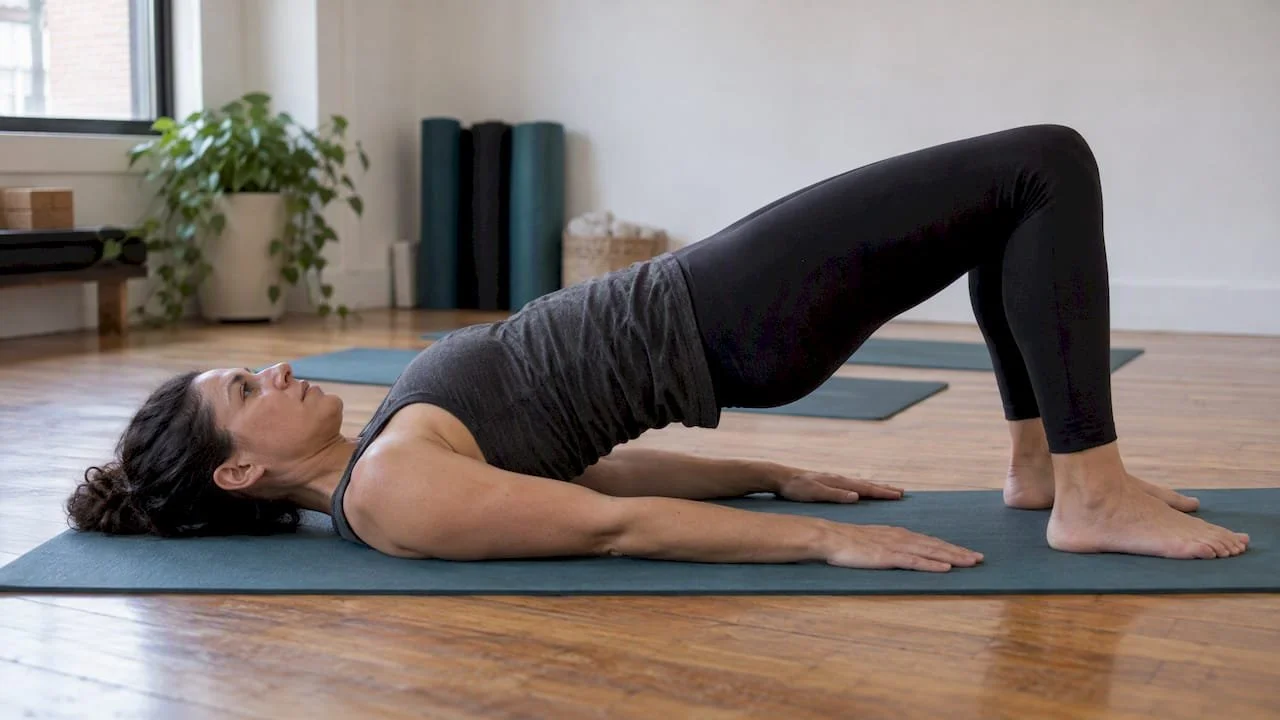
2. Shoulder bridge
Targets: glutes, hamstrings, back of the body.
From the same position, press into your feet and peel your spine off the mat one vertebra at a time until your body forms a diagonal line from shoulders to knees. Hold for a breath, then roll down slowly. Keep the ribs soft and avoid arching. Do 5 to 8 repetitions. Strong glutes help the pelvis stay level when you stand and sit.
3. Chest opener
Targets: chest, front of the shoulders, upper back.
Lying on your back or sitting tall, open your arms wide with palms facing up. Think of the collarbones spreading while the shoulder blades slide down. Hold for about a minute with natural breathing. This counters the forward-rounded shoulders that come with typing and scrolling.
4. Swan (back extension)
Targets: muscles along the spine, upper back.
Lie on your stomach with hands under your shoulders. Draw the navel gently up, and lift the chest a few inches, keeping the neck long and the gaze down. Lower with control. Start with 3 to 5 repetitions. Small and controlled beats high and strained.
5. Swimming (or opposite arm and leg reach)
Targets: back extensors, glutes, shoulder stabilizers.
On your stomach, lift opposite arm and leg a little, then switch in a steady rhythm. If swimming is uncomfortable for your lower back, reach one arm and the opposite leg along the floor on all fours instead. Both versions teach the trunk to stay steady while the limbs move.
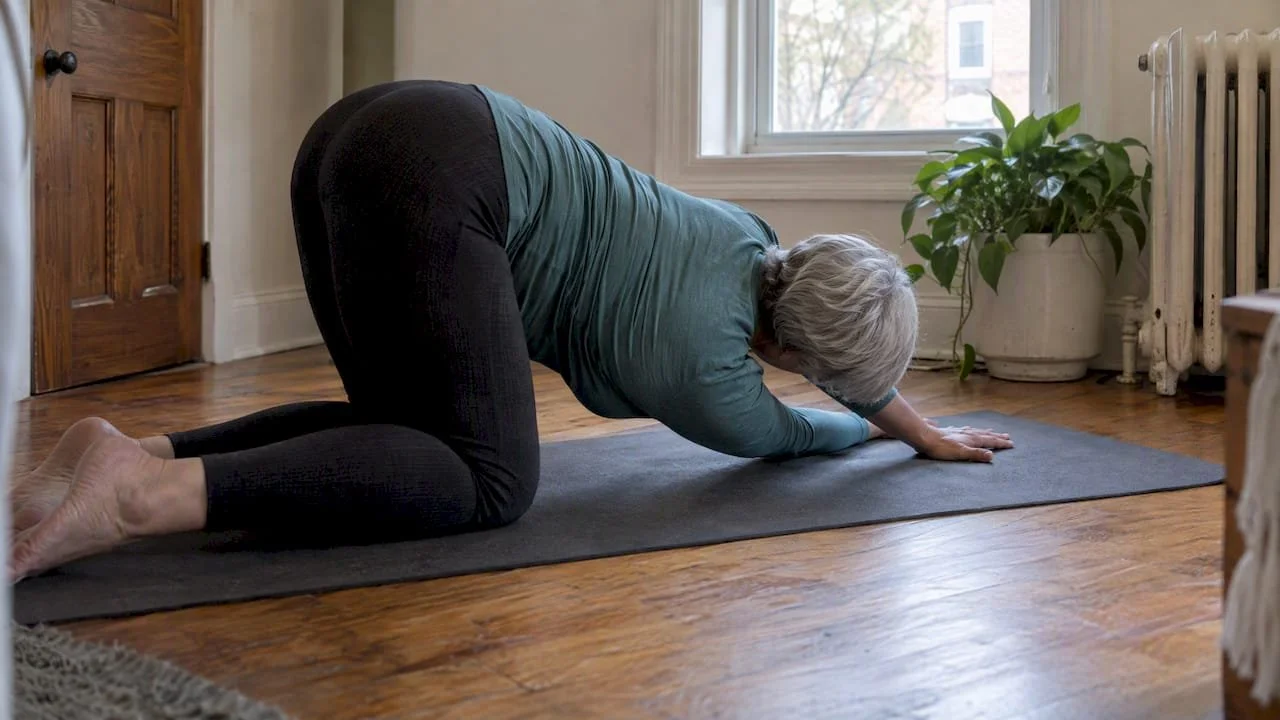
6. Thread the needle
Targets: thoracic rotation, shoulders.
On hands and knees, slide one arm under the other, turning the chest toward the floor, then open the same arm toward the ceiling. Do 5 each side. Many people with desk-bound upper backs find this the most noticeable release. A similar open-the-book rotation is among three Pilates-inspired desk-worker moves that a Pilates trainer recommends for restoring thoracic rotation and opening the chest.
7. Seated side stretch
Targets: the sides of the trunk, rib mobility.
Sit tall, inhale to lengthen, then exhale and bend sideways over one hip, keeping both sitting bones grounded. Return on the inhale. Do 5 each side. It is easy to do at a desk, which is why we suggest it as a break between meetings.
8. Forearm plank
Targets: the whole trunk, shoulder blades.
Hold a plank on your forearms or with knees down for 20 to 30 seconds, keeping the shoulder blades wide and the ribs drawn in. If the shoulders hunch toward the ears or the lower back sags, rest or make it easier. Quality over time.
A 15-minute Pilates routine for posture
Use this three times a week, or a shorter version on busy days.
| Order | Exercise | Dose |
|---|---|---|
| 1 | Pelvic tilts | 8 slow reps |
| 2 | Shoulder bridge | 6 reps |
| 3 | Chest opener | 1 minute |
| 4 | Thread the needle | 5 per side |
| 5 | Swan | 4 reps |
| 6 | Swimming or opposite arm and leg reach | 20 to 30 seconds, twice |
| 7 | Forearm plank (knees down if needed) | 20 seconds, twice |
| 8 | Seated side stretch | 5 per side |
Move slowly, breathe through every rep, and stop short of fatigue that changes your form. Two short sessions a week plus a few seated breaks in the workday will do more than one heroic session on Sunday.
Sitting itself matters too. WHO advice on staying active suggests short 3 to 5 minute movement breaks every 20 to 30 minutes to reduce long periods of sitting. Pair your routine with that habit.
How often and how long until you notice a change
The studies in the 2024 review generally used programs of 8 to 16 weeks, with sessions of 50 to 60 minutes twice a week. That is a good benchmark: expect to commit a couple of months before judging results. Early signs are usually subtle. You may catch yourself sitting taller without effort, or find your neck less tired at the end of the day.
Pilates also fits into general health guidance. For adults, WHO recommends 150 to 300 minutes of moderate aerobic activity a week plus muscle-strengthening on at least 2 days. Pilates counts as muscle-strengthening, so it can cover that second half. Walking, cycling or swimming can supply the aerobic part.
Mat or reformer for posture?
Both work. Mat Pilates uses your body weight and is easy to practice at home. The reformer adds spring resistance and support, which can make it easier to feel the right muscles working and to adjust the load as you progress. Some people find the springs help them learn shoulder-blade control more quickly. Others prefer the simplicity of the mat. Choose the one you will attend consistently, which echoes the clinical guidance above.
Safety: when to adjust, and when to see a professional
Pilates is highly modifiable, and the difference between progress and injury often lies in the range of motion you choose. If a move hurts, shrink it. Do not push into a classic position because the instructor or a video does it.
Specific situations call for a professional's input before you start:
Pain that persists or spreads. If symptoms worsen or travel into your arms or legs, stop and see your doctor or a physical therapist. Guidance from the Dudley Group NHS Foundation Trust on acute low back pain says the same.
Injury, existing conditions or pregnancy. The NHS Pilates guidance advises checking with a healthcare professional first. If you are postpartum and think you have abdominal separation, NHS physiotherapy advice says to avoid movements that make the abdomen dome or bulge until you are assessed.
Osteoporosis or low bone density. Forward-flexing moves and loaded twists can be inappropriate. A daily 5 to 10 minute posture plan built around osteoporosis safety is a useful reference, and your physician should confirm what suits you.
Visible asymmetry or suspected scoliosis. A one-size-fits-all class may not be enough here. Seek one-to-one clinical or specialized instruction.
Pilates is not a treatment for a specific disease. It supports good movement habits. Think of it as a complement to medical care, not a substitute.
Our perspective: posture is a skill you practice
At Amrita Yoga & Wellness we see posture as something you learn, not something you are handed. Most people who come to us for "better posture" already know they slouch. What they lack is a felt sense of the alternative, and a low-pressure place to practice it.
That is why we focus on beginner approachability and on detailed guidance in class. We would rather you do a smaller version of a move with the right muscles working than a bigger version with your neck doing the job. Our studio offers mat Pilates, group reformer classes and private sessions alongside yoga, barre and tai chi, so you can combine strength work with mobility and breath. Our own writing on starting Pilates safely and on improving your Pilates routine covers modifications and habits in more detail.
Our honest advice: pick a rhythm you can sustain, twice a week for a couple of months, and let community and routine carry you on the days motivation dips.
— Juiced
Practice with us in Philadelphia
If you would like an instructor to watch your form, our studio is in Philadelphia. Our group class page lists the options:
Community Class Drop In: $11 per session
Group Class Drop In: $28 per session
Nurtured Beginnings pass: $35 per pass
1 Month Unlimited Group Clases: $169 per month
If you have a specific concern, such as one shoulder sitting higher or a stiff upper back, a private session lets an instructor tailor the exercises to you. One to One Sessions start from $85 per hour. You can also read about each style on our class descriptions page.
Frequently asked questions
Can you fix posture with Pilates?
Pilates can substantially improve posture for many adults. The systematic review cited above found improvements in forward head posture and related measures. Results depend on your specific pattern and how consistently you practice. Structural conditions need a medical evaluation.
What exercise is best for correcting posture?
There is no single best exercise. The shoulder bridge, chest opener, swan and thread the needle together cover the glutes, back, chest and upper-back rotation. Clinical guidance notes that the best choice is the one you enjoy and will repeat.
Is it better to do Pilates with a flat back or a neutral spine?
For posture, aim for neutral. Use pelvic tilts to learn the difference between a tucked, flat position and a gentle natural curve. Then keep the ribs soft and the spine supported. Some exercises call for a deliberate tuck, and a good instructor will tell you when.
How long does it take for Pilates to improve posture?
Studies typically used 8 to 16 weeks of training, with sessions twice a week. You may feel taller or less tense sooner. Lasting change comes from repetition, so judge progress over months, not days.
Should I see a professional first?
Yes if you have pain, a recent injury, are pregnant or postpartum, or have a condition such as osteoporosis or scoliosis. Ask your doctor or physical therapist what is safe, then look for an instructor who can modify the work for you.
Sources
Effects of Pilates on Body Posture: A Systematic Review (PMC)
Diastasis Recti following Pregnancy (Bedfordshire Hospitals NHS Trust)